www.ijemst.com
Response to Intervention and Math
Instruction
Vanessa Hinton, Margaret M. Flores, Margaret Shippen
Auburn University
To cite this article:
Hinton, V., Flores M.M., & Shippen, M. (2013). Response to intervention and math
instruction.
International Journal of Education in Mathematics, Science and Technology,
1
(3), 190-201.
This article may be used for research, teaching, and private study purposes.
Any substantial or systematic reproduction, redistribution, reselling, loan, sub-licensing,
systematic supply, or distribution in any form to anyone is expressly forbidden.
Authors alone are responsible for the contents of their articles. The journal owns the
copyright of the articles.
Volume 1, Number 3, July 2013, 190-201
ISSN: 2147-611X
Response to Intervention and Math Instruction
Vanessa Hinton*, Margaret M Flores, Margaret Shippen
Auburn University
Abstract
Response to intervention (RTI) is a framework in which interventions are implemented mostly in general education classes to resolve academic difficulties and help to mitigate contextual variables (i.e., lack of instruction, socio economic status, cultural differences, etc.) as an explanation for academic failure. The implementation of evidence-based interventions is very important to the RTI framework. There is limited research regarding RTI and evidence-based interventions in mathematics and young students. For math interventions to be successful in an RTI framework, comprehensive math interventions have to incorporate computation fluency, problem solving, and the use of visual representational simultaneously. Moreover, early instruction in math skills sets the foundation for developing higher order math skills. Therefore, this manuscript reviews the literature regarding math interventions that would apply to early childhood students and are conducive to the RTI model.
Key words: Mathematics, Response to intervention, Number sense
RTI and Mathematics Instruction
One major methodological and practical aspect regarding RTI is the use of research or evidence-based interventions to meet students’ educational needs (Kratochwill, Volpiansky, Clements, & Ball, 2007). Research-based instruction is a cornerstone of effective intervention for students who are at-risk (Denton, Vaughn, & Fletcher, 2003). It includes instructional practices for which original data have been collected to determine their effectiveness, and scientifically-based, rigorous research designs have been utilized to evaluate the practices (State Education Research Center, n.d.). For math intervention to be successful in an RTI framework, comprehensive supplemental math interventions have to incorporate computation fluency, problem solving, and the use of visual representational all together (Fuchs et al., 2005; Fuchs, Fuchs, & Hollenbeck, 2007; Gersten et al, 2009).
Gersten et al (2009) made eight recommendations for math interventions in an RTI model that were as follows: (a) provide screening to all students to identify those at risk for potential mathematics difficulties and provide interventions for those at-risk, (b) instructional materials for students receiving interventions should focus intensely on in depth treatment of whole numbers in kindergarten through Grade 5 and on rational numbers in Grades 4 through 8 (c) intervention should be explicit and systematic, (d) interventions should include instruction on solving word problems that is based on common underlying structures, (e) intervention materials should include opportunities for students to work with visual representations of mathematical ideas and teachers should be proficient in the use of visual representations, (f) interventions at all grade levels should devote about ten minutes in each session to building fluent retrieval of basic arithmetic facts, (g) progress of students receiving supplemental instruction should be monitored, and (h) interventions should include motivational strategies. All recommendations had strong or moderate evidence to support the practice except three (interventions focusing on intensive in depth treatment of whole numbers, progress monitoring, and motivational strategies).
The recommendation of interventions that provide intensive instruction of whole numbers is important for many reasons. It does not take long to realize that along with increased competency in basic addition or subtraction facts, children develop or fail to develop number sense (Gersten & Chard, 1999). Number sense is a developing construct that refers to children’s fluidity and flexibility with numbers, the sense of what numbers mean, and the
*
Corresponding Author:
ability to perform mental mathematics and look at the world and make comparisons (Berch, 1998). Number sense leads to the automatic use of math information and is the key ingredient to solve basic arithmetic computations (Gersten & Chard, 1999). Griffin, Case, and Siegler (1994) suggest number sense is a necessary ingredient for learning formal arithmetic in the early elementary grades. Therefore, the National Council of Teachers of Mathematics (NCTM) Curriculum Focal Points (2006) suggested heavy emphasis on instruction in whole numbers for young elementary students. This position was strengthened by the 2008 report of the National Mathematics Advisory Panel (NMAP), which provided detailed benchmarks and again emphasized in-depth coverage of key topics involving whole numbers as crucial for all students. Milgram and Wu (2005) suggest an intervention curriculum for at-risk students should not be oversimplified and that in-depth coverage of key concepts involving whole numbers is critical for success in mathematics.
Method
This manuscript examines (a) research-based math interventions that would apply to young students (grades pre-kindergarten to second grade), (b) interventions that are conducive to the RTI model and (c) investigates interventions that focus on problem solving, computation, and number sense recommended by Gersten et al., NCTM, and NMAP. A computer search of ERIC and PsycINFO was used to locate studies published between 1990 and 2010. The timeframe was selected because studies in the 1990s greatly influenced policy related to RTI (Wanzek & Vaughn, 2007). Key descriptors or root word descriptors (response to intervention, number sense, at-risk, mathematical difficulties, special education, learning disability, inclusion) were used in combination with key mathematic descriptors or root forms of descriptors (mathematic interventions, mathematic instruction, supplemental instruction, number sense instruction) to identify possible articles. The initial electronic search yielded 6394 articles. The criteria for selecting studies were as follows: (a) the research is applicable to national benchmarks in early math curricula, Kindergarten to Grade 2 , (b) the research had to examine an intervention for early childhood students at risk or students with disabilities, (c) the research had to be conducted on or after 1990, (d) the research had to focus on student performance outcomes as a dependent variable, and (e) the research had to be published in a peer reviewed journal and written in English. Three major areas were gleaned from the literature search: problem solving, computation, and number sense. Each is presented and discussed below.
Mathematic Interventions for Problem Solving
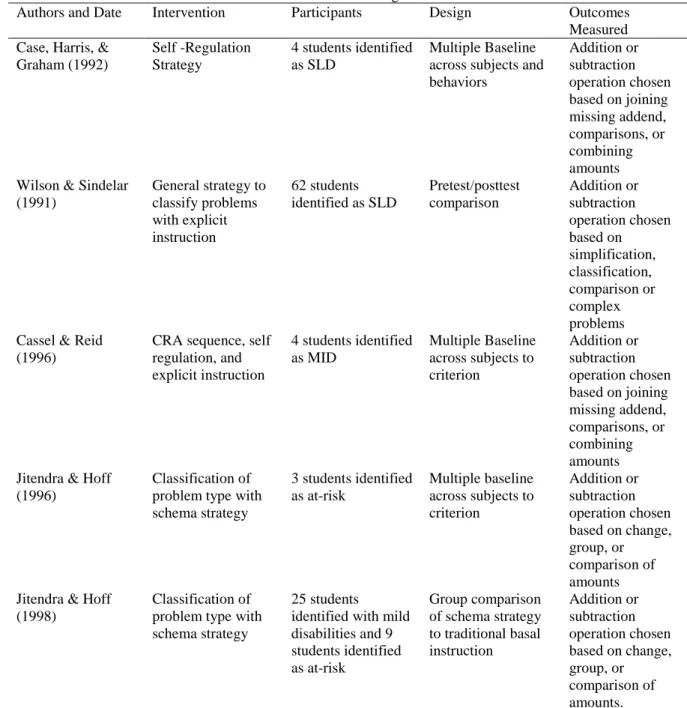
Problem solving involves ignoring extraneous information, organizing a strategy to solve the problem, completing steps required to solve the problem, representing the word problem using number equations, and computing basic facts (Jitendra et al., 1998). Research suggests direct instruction, self-regulated strategies coupled with explicit instruction, and schema training that involved direct instruction improved students’ word problem skills (Case, Harris, & Graham, 1992; Cassel & Reid, 1996; Jitendra & Hoff, 1996).
Case, Harris, and Graham (1992) investigated problem solving instruction by focusing on word problem errors due to students choosing the wrong operation. The researchers examined effects of a self-regulated strategy intervention on the problem solving performance of fifth and sixth graders with specific learning disability (SLD). The students learned the following strategy: (a) read the problem aloud, (b) look for important words, (c) draw pictures to tell what is happening, (d) write the math sentence, and (e) write down the answer. Instruction in this strategy consisted of the following components: (a) conferencing where performance and instructional goal was discussed, (b) discussion of the strategy using charts, (c) modeling of the strategy and self instruction, (d) mastery of the strategy steps, (e) collaborative practice, (f) independent performance, and (g) generalization and maintenance. Instruction was provided on an individual basis in the students’ school. In addition to the strategy, Case et al. explicitly taught mathematics vocabulary, in which instructors demonstrated words using manipulatives and instruction continued until the students identified the words with 100% accuracy. Overall, Case and colleagues (1992) reported successive increases in problem solving behaviors across students after instruction, thus demonstrating a functional relation.
Sixty-two students were provided instruction in groups of three to five which took place in classrooms, office space, the media center, and school cafeteria. Each lesson was 30 minutes and intervention lasted approximately one month. The design of the study was a pretest and posttest design that compared three intervention groups: strategy only, sequence only, and strategy and sequence. Students in the strategy plus- sequence group scored significantly higher on both tests than did students in the sequence- only group. Students in the strategy-only group also scored significantly higher on both the posttest and the follow-up test than did students in the sequence-only group. On the posttest, the difference between the strategy plus- sequence and strategy-only groups was not significant; yet on the follow-up test, the strategy plus-sequence group scored significantly higher.
Cassel and Reid (1996) incorporated the self-regulated strategy, concrete representational abstract strategies, and explicit instruction for word problem solving. Students were taught the “FAST DRAW” mnemonic method to solve problems. The steps of FAST DRAW were as follows: (a) read the problem out loud; (b) find, highlight the question, then write the label; (c) ask what are the parts of the problem then circle the numbers needed; (d) set up the problem by writing and labeling the numbers; (e) re-read the problem and decide if addition or subtraction is required, (f) discover the sign by rechecking the operation; (g) read the number problem; (h) answer the problem and; (i) write the answer and make sure the answer makes sense. The FAST DRAW technique was coupled with self-speech in which students generate statements to help solve the problem and recorded them on a strategy check off sheet. Participants were two elementary students with mild intellectual disabilities who learned to solve and explain the problem solving process using the FAST DRAW mnemonic and manipulative objects. The students learned to solve change/equalize and combine/compare problems. Following completion of instruction, mean levels of correct equations and answers increased for all students. Students’ maintenance levels for correct equations and answers were stable and remained at levels consistent with treatment phases. The students’ use of strategy steps either increased or remained steady in the first post-instructional phase.
Jitendra and Hoff (1996) extended the research on strategy based instruction by teaching elementary students by combining instruction in problem type with a schema approach, classifying different types of word problems with graphic representations. The essential elements of the intervention were categorized as problem schemata, action schemata and strategy knowledge. Three steps led to the solution of the word problem. First, the student defines the problem which involves processing schemata. The problem is defined by characteristics, features and facts and one has to recognize and represent the situation described in the problem. The second step, action schemata, requires the student to select the action procedure (e.g., counting, adding, subtracting) in which one uses information present in the problem to select the appropriate action procedures. Therefore, the arithmetic operation is selected based on which part of the problem situation is unknown and which of the critical elements in the problem structure represents the total. Third, strategic knowledge comprises a set of procedures, rules, or algorithms that can be used to reach the solution (Marshall, 1990, 1993). Written responses were judged as correct or incorrect based on correct operation only because the study was limited to word problem solving rather than computational ability. Increases in student performance were replicated across three students and each maintained increases in performance following instruction.
Jitendra et al., (1998) replicated the previous study but compared schema training to traditional word problem solving and used a group design instead of a single subject design. There were 58 elementary students were included in the study, four students who were typically achieving served as a control group and twenty-four students with high incidence disabilities received schema instruction. Both groups showed an increase in scores from pretest to posttest and maintained their use of problem-solving skills. Both groups made gains, but the schema group made more gains from pretest to generalization than the traditional group.
Table 1. Problem solving studies
Authors and Date Intervention Participants Design Outcomes
Measured Case, Harris, &
Graham (1992)
Self -Regulation Strategy
4 students identified as SLD
Multiple Baseline across subjects and behaviors
Addition or subtraction operation chosen based on joining missing addend, comparisons, or combining amounts Wilson & Sindelar
(1991)
General strategy to classify problems with explicit instruction
62 students identified as SLD
Pretest/posttest comparison Addition or subtraction operation chosen based on simplification, classification, comparison or complex problems Cassel & Reid
(1996)
CRA sequence, self regulation, and explicit instruction
4 students identified as MID
Multiple Baseline across subjects to criterion
Addition or subtraction operation chosen based on joining missing addend, comparisons, or combining amounts Jitendra & Hoff
(1996)
Classification of problem type with schema strategy
3 students identified as at-risk
Multiple baseline across subjects to criterion
Addition or subtraction operation chosen based on change, group, or comparison of amounts Jitendra & Hoff
(1998)
Classification of problem type with schema strategy
25 students
identified with mild disabilities and 9 students identified as at-risk
Group comparison of schema strategy to traditional basal instruction
Addition or subtraction operation chosen based on change, group, or comparison of amounts.
Mathematical Interventions for Computation
other in terms of complexity. Second, although most students acquire the respective computation skill (e.g., addition facts) when they reach the posttest, they need additional practice to maintain their knowledge and skills, to increase their fluency, and to ensure further development of their problem-solving skills.
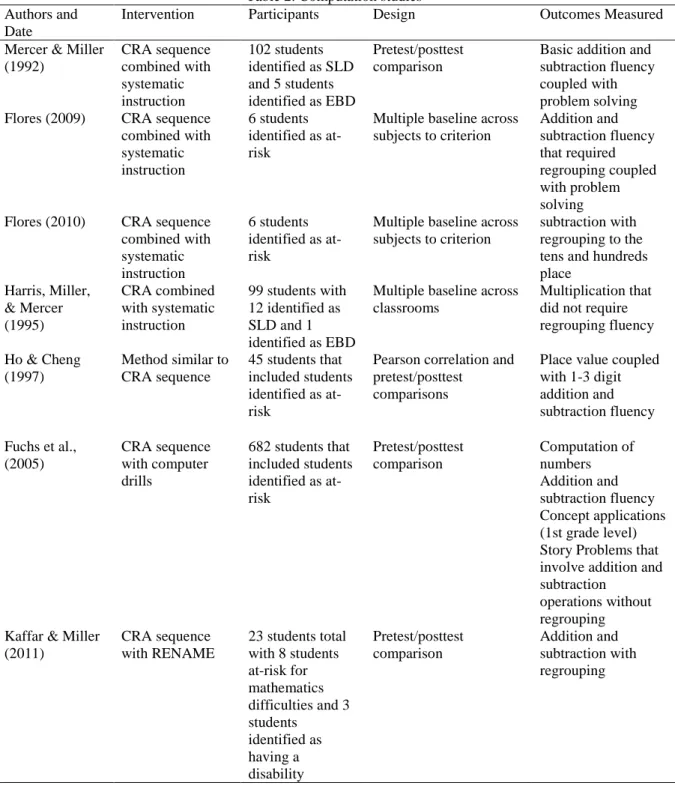
Mercer and Miller (1992) field tested SMS with 109 elementary students of whom 102 had a specific learning disability (SLD), five students had an emotional behavior disorder, and two were at risk. Miller and Mercer concluded that overall, the field test data indicated that students with learning problems were able to (a) acquire computational skills across facts, (b) solve word problems with and without extraneous information, (c) create word problems involving facts, (d) apply a mnemonic strategy to difficult problems, (e) increase rate of computation, and (f) generalize math skills across examiners, settings, and tasks.
Flores (2009) expanded on Miller and Mercer’s research and investigated the use of visual representation to teach students how to subtract with regrouping. Flores demonstrated that the use of the concrete- representational- abstract (CRA) sequence is effective for teaching mathematics involving regrouping to students who struggle with learning mathematics. Participants were six third-grade students who learned to solve problems involving subtraction with regrouping problems using manipulative objects, pictorial representations, finally, using numbers only. All 5 students met the criterion of writing 20 digits on three consecutive 2 minute curriculum-based measures. Of the students, four of five maintained their performance 4 weeks after the end of instruction. Flores (2010) extended previous research utilizing CRA (Flores, 2009) to include subtraction with regrouping to the tens and hundreds place. Similar to the previous study, participants solved problems using manipulative objects, picture representations and numbers only. Each participant showed an upward path in progress, indicating steady improvement and reached criteria for regrouping in the tens and hundreds place.
Kaffar and Miller (2011) investigated the effects of CRA instruction similar to Flores (2009) but used a different mnemonic titled “RENAME”. Participants who received the CRA instruction for subtraction with regrouping consisted of eight students with math difficulties and three students with disabilities. Twelve students were in the control group and received the basal program for instruction on subtraction with regrouping. Both groups made gains in subtraction with regrouping, yet the gains made by the students who received instruction with the CRA sequence were greater.
Harris, Miller, and Mercer (1995) evaluated the effectiveness of teaching multiplication skills to elementary students with disabilities in general education classrooms. Ninety-nine second grade students participated in the study. Comparison of median rate scores during baseline and the final phase of instruction show that the average amount of change was an increase of 8 correct digits and a decrease of 21 incorrect digits per minute. Ho and Cheng (1997) investigated instruction similar to the CRA strategy for place-value concepts for arithmetic in Hong Kong. Place-value intervention employed counting skills, and activities of grouping, regrouping, and trading straws. Session 1 focused on reviewing and consolidating the children’s oral and object counting skills through simple counting exercises. In Session 2, the children were presented with some straws as counting objects. They were asked to count and tie ten straws into a bundle, and to put ten bundles of straws into a glass. When counting the straws in bundles, they counted in tens, and when counting the straws in glasses, they counted in hundreds. After counting and grouping the straws, the researchers taught regrouping and trading concepts by giving more straws to the children or asking the children to give away some straws.
Ho and Cheng’s (1997) findings suggest a significant relationship between place-value understanding and arithmetic skills. The Intervention Group showed greater improvement in place-value understanding and addition after training in place-value concepts than did the two control groups.
exceeded students at risk who did not receive tutoring. However, scores on story problems were still lower than students who were not at risk.
Dev, Doyle, and Valente (2002) extended the use of visual and verbal representations to arithmetic through a multisensory method of teaching mathematics (Scott, 1993). This approach incorporates visual, kinesthetic, and tactile modalities. Number concepts are learned with the help of dots and circles on numerical symbols. Students learn basic math facts and mathematical operations. Students are gradually taught to solve mathematical problems without depending on the dots and circles. Eleven participants were taught according to the TouchMath system in the general education classroom for 25 to 55 min every day while they were in first grade. At the end of second grade the 11 participants were re-tested to determine grade level growth. Eight of the eleven participants scored above the 2nd grade level in arithmetic. One student scored below grade level in arithmetic. A summary of the studies are shown in Table 2.
Table 2. Computation studies Authors and
Date
Intervention Participants Design Outcomes Measured
Mercer & Miller (1992) CRA sequence combined with systematic instruction 102 students identified as SLD and 5 students identified as EBD
Pretest/posttest comparison
Basic addition and subtraction fluency coupled with problem solving Flores (2009) CRA sequence
combined with systematic instruction
6 students identified as at-risk
Multiple baseline across subjects to criterion
Addition and subtraction fluency that required regrouping coupled with problem solving Flores (2010) CRA sequence
combined with systematic instruction
6 students identified as at-risk
Multiple baseline across subjects to criterion
subtraction with regrouping to the tens and hundreds place Harris, Miller, & Mercer (1995) CRA combined with systematic instruction
99 students with 12 identified as SLD and 1 identified as EBD
Multiple baseline across classrooms
Multiplication that did not require regrouping fluency Ho & Cheng
(1997)
Method similar to CRA sequence
45 students that included students identified as at-risk
Pearson correlation and pretest/posttest
comparisons
Place value coupled with 1-3 digit addition and subtraction fluency Fuchs et al.,
(2005)
CRA sequence with computer drills
682 students that included students identified as at-risk Pretest/posttest comparison Computation of numbers Addition and subtraction fluency Concept applications (1st grade level) Story Problems that involve addition and subtraction
operations without regrouping Kaffar & Miller
(2011)
CRA sequence with RENAME
Research suggests instruction in place value and cognitive processes improved students with math difficulties’ computational skills. These studies are important to the RTI framework because evidence based interventions can be formed in the school to assist students with computation difficulties.
Mathematical Interventions for Number Sense
Number sense is defined as “moving from the initial development of basic counting techniques to more sophisticated understandings of the size of numbers, number relationships, patterns, operations, and place value” (National Council of Teachers of Mathematics [NCTM], 2000, p. 79). Difficulties with numeracy interfere with acquisition of math skills later in childhood (Van Luit & Schoman, 2000). Mazzocco and Thompson (2005) analyzed test items on a psychoeducational test battery and found that subsets of items involving number sense (e.g., reading numerals, magnitude judgments, mental addition of one-digit numbers) accurately predicted students who would later develop math disabilities. In addition, Clarke and Shinn (2004) found aspects of number sense, such as magnitude comparisons and quantity discrimination, correlate with math achievement. Researchers are not sure of the best approach to teach number sense (Gersten, & Chard, 1999). Berch (2005) explained researchers have not come to a consensus of what number sense is. Studies examine classification, seriation and conservation as broad categories of number sense. However, Jordan, Kaplan, Olah, and Locuniak (2006) identified key elements of number sense as counting, number knowledge, number transformation, estimation, and number patterns.
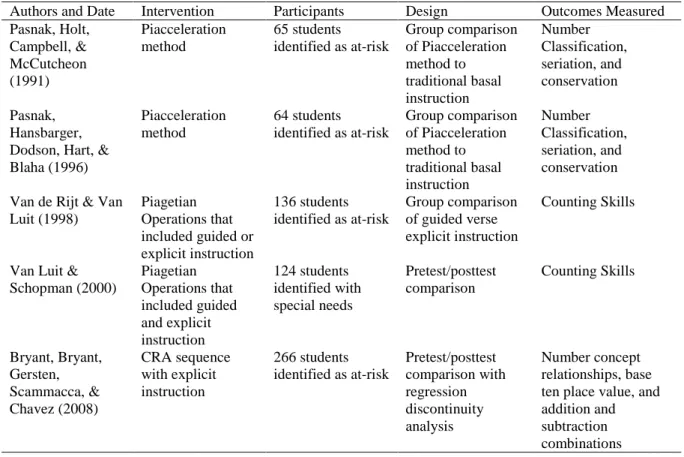
Pasnak and colleagues (1991) investigated the Piacceleration method used to teach classification, seriation and number conservation to students with disabilities. The Piacceleration method is a constructivist curriculum that uses sets of objects to teach students how to classify, put numbers in sequence and conserve numbers. Pasnak et al. (1991) compared the effects of the Piacceleration curriculum to the standard curriculum for kindergarten students who were at risk. The curriculum consisted of 160 sets of items used to teach classification, seriation, and conservation concepts. Half of the items were oddity (classification) problems in which four items were similar and one was different based on size, shape, and orientation. There were also 65 seriation problems, consisting of items that could be ordered based on a particular characteristic such as length, height, width or overall size. Intervention consisted of 40 lessons over a period of three months.
Sixty-five students participated in the study. Results were analyzed by a step-wise discriminate function analysis. The Piacceleration curriculum was significantly better for classification and ability index subsets, the Concepts part of the Mathematics scale, and the Comprehension subscale.
Pasnak, Hansbarger, Dodson, Hart, and Blaha (1996) replicated the 1991 examination of the Piacceleration curriculum with two different samples of kindergarten students, sixty-four students. A group design was used to compare effects of the Piacceleration curriculum and traditional teaching groups. Effects were found for students’ scores in the experimental group on all measures. In addition, there were no significant interactions between schools and the experimental/control condition.
Van de Rijt and Van Luit (1998) expanded on intervention that involved Piagetian operations and combined the method with guided or explicit instruction. They investigated the effectiveness of the Additional Early Mathematics (AEM) program for teaching students early mathematics using guiding or structured instruction. Guiding instruction was used in which the teacher observed and provided feedback to students as they engage in the problem solving process. Structured instruction was explicit and the teacher made suggestions and modeled solving the problem. The AEM program covers the Piagetian operations and counting skills with an emphasis on the development and knowledge of using counting skills. The program consists of 26 lessons that last 30-min, and involves the numbers 1 to 20. Lessons are divided into several themes. The themes provide the children with a familiar background in which the activities become meaningful and useful.
There were no statistical significant differences between the two experimental groups on the pretest. The early mathematical competence scores of both experimental groups on T2 differed significantly from the scores of both control groups. In addition, on T3 there was a significant difference between the scores of both experimental groups and both control groups. Results indicate a positive effect of the AEM program on the early mathematical competence scores for both experimental groups.
Van Luit and Schopman (2000) extended research on guided verses explicit instruction for number sense in which the instructor chose the approach best suited to the student. They examined early numeracy based on perceptual gestalt theory using the program Young Children with Special Education Needs Count Too (Van Luit & Schopman, 1998). The program consisted of 20 lessons with complete instructional plans and materials to assist students in learning to count. Both learning by doing and structured learning was incorporated in the program and the teacher chose which type of instruction was the best fit for the student’s needs. The student connected new information with prior knowledge by repeating, organizing, and arranging information. Realistic math problems were posed to make the math skills and problem-solving meaningful, in which the reason for using a particular strategy was explained. Initially students needed instruction in a structured way with lots of repetition. After three months, some students were able to receive instruction using the learning-by-doing principles of the math program.
Participants were 124 kindergarten students with disabilities who were between the ages of five and seven were assigned to one of two groups by matching for gender, age, and early numeracy performance. A significant difference was found between the experimental and comparison group with effect sizes of 1.44 for the experimental group and .68 for the comparison group. A significant difference was found between the two groups for comparison, but not classification, serration, or correspondence. A significant difference was found for all three of the counting skills that favored the experimental group. A significant difference was found favoring the experimental group for general understanding of number, however no significant differences were found between groups for transfer task performance.
Bryant, Bryant, Gersten, Scammacca, and Chavez (2008) expanded research on number sense by using explicit instruction and combining it with the CRA method. Bryant et al., investigated Tier I (not-at-risk students) and Tier II (at-risk students) interventions using the CRA approach. A median of 64 fifteen-minute sessions for first graders and a median of fifteen-min sessions for second graders were conducted across 18 weeks for Tier I intervention. Tier II intervention ranged from 45 to 60 minutes of instruction based on number, operation, and quantitative-reasoning skills. The CRA sequence was used to teach number concept and relationships, base ten and place value, and addition and subtraction combinations. Lesson procedures including modeling “thinking aloud,” guided practice, pacing, and error correction were used to deliver the scripted lessons. All tutoring sessions were implemented in small group settings of students within the same ability and grade level.
Participants in this study included 126 students in first grade and 140 students in second grade. Students who scored at or below the 25th percentile (total standard score of 90 or below) at the start of the school year were assigned to the treatment group. Students who scored above 90 at the start of the school year received no intervention but did take the posttest measure at the same time as the intervention students.
The design was a pretest and post test design that employed regression discontinuity (RD) analyses. For first grade pretest and posttest data were available for 100 students who did not qualify for intervention and did not receive intervention and for 26 students who qualified for and received intervention. There is little to no discontinuity between the regression line for the Tier 2 (at-risk) group and the Tier 1 (not-at-risk) group. Therefore, RD analysis revealed that no significant effect was observed among first-grade students.
Table 3. Number sense studies
Authors and Date Intervention Participants Design Outcomes Measured
Pasnak, Holt, Campbell, & McCutcheon (1991) Piacceleration method 65 students identified as at-risk
Group comparison of Piacceleration method to traditional basal instruction Number Classification, seriation, and conservation Pasnak, Hansbarger, Dodson, Hart, & Blaha (1996)
Piacceleration method
64 students identified as at-risk
Group comparison of Piacceleration method to traditional basal instruction Number Classification, seriation, and conservation Van de Rijt & Van
Luit (1998)
Piagetian Operations that included guided or explicit instruction
136 students identified as at-risk
Group comparison of guided verse explicit instruction
Counting Skills
Van Luit & Schopman (2000) Piagetian Operations that included guided and explicit instruction 124 students identified with special needs Pretest/posttest comparison Counting Skills Bryant, Bryant, Gersten, Scammacca, & Chavez (2008) CRA sequence with explicit instruction 266 students identified as at-risk
Pretest/posttest comparison with regression discontinuity analysis Number concept relationships, base ten place value, and addition and subtraction combinations
Research suggests instruction in classification, seriation, and conservation improves students with math difficulties’ numeracy skills. Instruction on these concepts involve direct and discovery oriented, and as well as guided practice and modeling techniques. These studies are important to the RTI framework because evidence based interventions can be formed in the school to assist young learners with number sense.
Discussion
Practical Recommendations and Future Research
Students’ needs are diverse; therefore, practitioners must build a repertoire of supplemental instructional knowledge to meet the needs students who are at-risk. Professional developmental should demonstrate a variety of supplemental interventions to address any difficulties students may have with problem solving, computation, or number sense. One way to ensure teachers have the knowledge base to address these needs would be through professional development that targets supplemental instruction for these areas. Professional development should include explicit instruction in self-regulated strategies, CRA, mnemonic devices, and schema training devices as ways teachers can help students in problem solving. Professional development in computation intervention could consist of ways to provide CRA instruction, instruction that uses mnemonic devices, instruction that combines computer drills, multisensory methods of implementing interventions, and explicit instruction. Professional development geared to help teachers provide supplemental interventions for number sense would include direct instruction, discovery oriented methods of instruction, and guided practice and modeling techniques.
A very important practical element of RTI is the use of evidence-based interventions to meet students’ educational needs and is the cornerstone of effective instruction for students at-risk (Denton et al, 2003; Kratochwill et al, 2007). Therefore researchers and practitioners must stay informed to ensure effective instructional practices can take place. Research has demonstrated that effective supplemental mathematics intervention for young students involve instruction of whole numbers which build computation fluency, problem solving and number sense skills. If mathematics intervention is to be successful in an RTI framework, it is critical professional development provides practitioners with a repertoire of supplemental interventions that address problem solving, computation and number sense.
Research needs to continue to examine mathematics instruction that is conducive to the RTI framework. This includes investigating new ways of providing instruction in regards to ways of teaching problem solving, computation, and number sense. Future research should also explore varying mathematics instruction in as many different contexts as possible, and with a variety of students who have diverse needs. Finally, research should follow up with practitioners regarding the social value of interventions and ways of improving mathematics instruction.
References
Berch, D.B. (Ed.). (1998, April). Mathematical cognition: From numerical thinking to mathematics education.
Conference presented by the National Institute of Child Health and Human Development, Bethesda, MD.
Berch, D. B. (2005). Making sense of number sense: Implications for children with mathematical disabilities. Journal of Learning Disabilities, 38, 333 – 339.
Bryant, D.P., Bryant, B.R., Gersten, R., Scammacca, N., & Chavez, M.M. (2008) Mathematics interventions for first-and-second-grade students with mathematics difficulties. Remedial and Special Education, 29, 20-32.
Case, L. P., Harris, K. R., & Graham, S. (1992). Improving the mathematical problem solving skills of students with learning disabilities: Self regulated strategy development. The Journal of Special Education, 26, 1-19.
Cassel, J., & Reid, R. (1996). Use of self-regulated strategy intervention to improve word problem solving skills of student with mild disabilities. Journal of Behavioral Education, 6, 153-172.
Clarke, B., & Shinn, M. (2004). A preliminary investigation into the identification and development of early mathematics curriculum-based measurement. School Psychology Review, 33, 234–248.
Denton, C., Vaughn, S., & Fletcher, J. (2003). Bringing research-based practice in reading intervention to scale.
Learning Disabilities Research and Practice,18, 201-211.
Dev, P. C, Doyle, B., A. & Valente, B. (2002). Labels needn't stick: "At-risk" first graders rescued with appropriate intervention. Journal of Education for Students Placed At Risk, 7, 327-332.
Flores, M. (2009). Teaching subtraction with regrouping to students experiencing difficulty in mathematics.
Preventing School Failure, 53, 145-152.
Fuchs, L., S. (2003). Assessing intervention responsiveness: conceptual and technical issues. Learning
Disabilities Research and Practice, 18, 172-183.
Fuchs, L. S., Compton, D. L., Fuchs, D., Paulsen, K., Bryant, J.D.,& Hamlett, C. L. (2005). The prevention, identification, and cognitive determinants of math difficulty. Journal of Educational Psychology, 97,
493–513.
Fuchs, L. S., Fuchs, D., & Hollenbeck, K. N. (2007). Extending responsiveness to intervention to mathematics to first and third grades. Learning disabilities Research & Practice, 22, 13-24.
Fuchs, L. S., Hamlett, C. L., & Powell, S. R. (2003). Fact fluency assessment. (Available from L. S. Fuchs, 328 Peabody, Vanderbilt University, Nashville, TN 37203).
Gersten, R., & Chard, D. (1999). Number sense: rethinking arithmetic instruction for students with mathematical disabilities. Journal of Special Education, 33, 18-28.
Gersten, R., Beckmann, S., Clarke, B., Marsh, L., Star, J. R., & Witzel, B. (2009). Assisting students struggling with mathematics: Response to intervention (RtI) for elementary and middle schools. U.S Department of Education.
Griffin, S. A., Case, R., & Siegler, R. S. (1994). Rightstart: Providing the central conceptual prerequisities for first formal learning of arithmetic to students at risk for school failure.In K. McGilly (Ed.), Classroom
lessons: Integrating cognitive theory and classroom practice (pp. 25-49). Cambridge, MA: MIT Press.
Harris, C. A., Miller, S. P., & Mercer, C. D. (1995). The initial multiplication skills to students with disabilities in general education classrooms. Learning Disabilities Research & Practice, 10(3), 180–195.
Harris-Murri, N., King, K., & Rostenburg, D. (2006). Reducing disproportionate minority respresentation in special education programs for students with emotional disturbances: toward a culturally responsive response to intervention model. Education and Treatment of Children, 29, 779-799.
Ho, C. S., & Cheng, F. S. (1997). Training in place-value concepts improves children’s addition skills.
Contemporary Educational Psychology, 22, 495-506.
Hoover, J., J., & Patton, J., R. (2008). The role of special educators in a multitiered instructional system.
Intervention in School & Clinic, 43, 195-203.
Janssen, F. J., G., Bokhove, J., & Kraemer, J. M. (1992). Leerlingvolgsysteem: Rekentoets medio groep 3
(Student monitoring system: Mathematics 1 for grade 3). Arnhem, The Netherlands: Cito.
Jitendra, A. K., Griffin, C. C., McGoey, K., Gardill, M.C., Bhat, P., & Riley, T. (1998). Effects of mathematical word problem solving by students at risk or with mild disabilities. Journal of Educational Research,
91, 345-355.
Jitendra, A. K., & Hoff, K. (1996). The effects of schema-based instruction on the mathematical word-problem solving performance of students with learning disabilities. Journal of Learning Disabilities, 29, 422-431.
Jordan, N. C., Hanich, L. B., & Kaplan, D. (2003). Arithmetic fact mastery in young children: A longitudinal investigation. Journal of Experimental Child Psychology, 85, 103–119.
Jordan, N. C., Kaplan, D., Oláh, L. N., & Locuniak, M. N. (2006). Number sense growth in kindergarten: A longitudinal investigation of children at risk for mathematics difficulties. Child Development, 77, 153– 175.
Jordan, N. C., Kaplan, D., Locuniak, M. N., & Ramineni, C. (2007). Predicting first-grade math achievement from developmental number sense trajectories. Learning Disabilities Research & Practice,22, 36–46. Kaffar, B. J., & Miller, S. P. (2011). Investigating the effects of the RENAME Strategy for developing
subtraction with regrouping competence among third-grade students with mathematics difficulties.
Investigations in Math Learning.
Kratochwill, T., Volpiansky, P., Clements, M., & Ball, C. (2007). Professional development in implementing and sustaining multitier prevention models: implications for response to intervention. School Psychology
Review, 36, 618-631.
Madden, R., Gardner, E.F., & Collins, C. S. (1982). Stanford early school achievement test. San Antonio, TX: Psychological Corp.
Marshall, S. P. (1990), The assessment of schema knowledge for arithmetic story problems: A cognitive science perspective. In G. Kulm (Ed.), Assessing higher order thinking in mathematics. Washington, DC: American Association for the Advancement of Science.
Marshall, S. P. (1993), Assessing schema knowledge. In N. Frederikson, R, Mislevy, & I. Bejar (Eds.), Test
theory for a new generation of tests (pp. 155-180). Hillsdale, NJ: Erlbaum.
Mazzocco, M. M., & Thomspon, R. E. (2005). Kindergarten predictors of math learning disability. Learning
Disabilities Research & Practice, 20, 142–155.
Mercer, C.D., Jordan, L., & Miller, S.P. (1996). Constructivistic math instruction for diverse learners. Learning
Disabilities Research and Practice, 11, 147-156.
Milgram, R. J., & Wu, H. S. (2005). The key topics in a successful math curriculum. Retrieved February 11, 2010, from http://math.berkeley.edu/~wu/
National Council of Teachers of Mathematics. (2000). Principles and standards for school mathematics.
Reston, VA: Author.
National Council of Teachers of Mathematics (2006). Curriculum focal points for prekindergarten through
grade 8 mathematics: A quest for coherence. Reston, VA: Author.
National Mathematics Advisory Panel. (2008). Foundations for success: The final report of the national
mathematics advisory panel. Washington, DC: U.S. Department of Education.
Otis, A. S., & Lennon, R. T. (1989). Otis-Lennon School Ability Test (6th ed., OLSAT). San Antonio, TX: Psychological Corp.
Pasnak, R., Hansbarger, A., Dodson, S. L., Hart, J. B., & Blaha, J. (1996). Differential results of instruction of the preoperational/concrete operational transition. Psychology in the Schools, 33, 70-83.
Pasnak, R., Holt, R., Campbell, J. W., & McCutcheon, L. (1991). Cognitive and achievement gains for kindergarteners instructed in Piagetian operations. Journal of Educational Research, 85, 5-13.
Pickering, S., & Gathercole, S. (2001). Working Memory Test Battery for Children. London: The Psychological Corporation.
Riley, M. S., Greeno, J.G., & Heller, J.I. (1983). Development of children's problem solving ability in arithmetic. In H. P. Ginsburg (Ed.), The development of mathematical thinking (pp. 153-196). New York: Academic Press.
Scott, K. S. (1993). Multisensory mathematics for children with mild disabilities. Exceptionality, 4, 97–111. Silbert, J., Carnine, D., & Stein, M. (1990). Direct instruction mathematics. Columbus, OH: Merrill.
Sinclair, A., Carin, A., & Tieche-Christinat, C. (1992). Constructing and understanding of place value in numerical notation. European Journal of Psychology of Education, 7, 191–207.
State Education Research Center. (n.d.). Scientific research-based intsruction and evidence based paractices. Retrieved March 19, 2009 from http://www.ctserc.org/rti/rationale/sciencebased.shtml
Van de Rijt, B.A.M., & Van Luit, J.E.H. (1994). The results of different treatments on children’s weak performances in preparatory and initial arithmetic. In J.,E.,H., Van Luit, ed., Research on
Learning and Instruction of Mathematics in Kindergarten and Primary School. Doetinchem/Rapallo:
Graviant Publishing Company.
Van de Rijt, B. A. M., & Van Luit, J. E. H. (1998). Effectiveness of the Additional Early Mathematics program for teaching children early mathematics. Instructional Science, 26, 337-358.
Van Luit, J. E. H., Van de Rijt, B. A. M., & Pennings, A. H. (1994). Utrechtse Getalbegrip Toets (Utrecht Test of Number Sense). Doetinchem, The Netherlands: Graviant.[
Van Luit, J. E. H., & Schopman, E. A. M. (2000). Improving early numeracy of young children with special education needs. Remedial and Special Education, 21, 27-40.
Van Luit, J. E. H., & Schopman, E. A. M. (1998). Als special kleuter tel je ook mee! Voobereidende
rekenactiviteiten voor kleuters met een ontwlkkelingsachterstand (Young children with special needs
count too! Early math mathematics activities for young children with special educational needs.) Doetinchem, The Netherlands: Graviant.
Vaughn, S., & Fuchs, L. (2003). Redefining learning disabilities as inadequate response to instruction. The promise and potential problems. Learning Disabilities Research and Practice, 18, 137-146.
Vaughn, S., Linan-Thompson, S., & Hickman (2003). Response to instruction as a means of identifying students with learning/reading disabilities. Exceptional Children, 69, 391-409.
Wilkinson, G. S., Stone, M. H., & Jastak, S. (1995). Wide Range Achievement Test- 3. Delaware: Wide Range. Wilson, C. L., & Sindelar, P. T. (1991). Direct instruction in math word problems: Students with learning
disabilities. Exceptional Children, 57, 512-519.