Contract teachers and student achievement in
rural China: evidence from class fixed effects
*
Wang Lei, Mengjie Li, Siqi Zhang, Yonglei Sun,
Sean Sylvia, Enyan Yang, Guangrong Ma, Linxiu Zhang,
Di Mo and Scott Rozelle
†For schooling to play an important role in the development of human capital, the system of education needs to provide quality education, which among other things requires high-quality teachers. Facing fiscal constraints and growing enrolments, school systems in developing countries often supplement their teaching staff by hiring contract teachers. However, there is limited evidence on how the effectiveness of these teachers compares to that of civil service teachers. We use a dataset from rural primary schools in western China to estimate the causal effect of contract teachers on student achievement and find that gains in student scores on standardised examinations in mathematics and Chinese are less in classes taught by contract teachers than in classes taught by civil service teachers. The results demonstrate that China’s education system needs to focus on producing high-quality teachers to improve the quality of schooling in its rural education system. The findings imply that educators in developing countries should not only seek to hire increasingly more civil service teachers in rural schools, but they should also identify ways of improving the quality of contract teachers. If efforts to improve teaching can succeed, rural students can learn more, earn higher incomes and contribute more to the productivity of the overall economy.
Key words: China, contract teachers, primary education, student achievement.
1. Introduction
Education is widely considered to be the most important form of human
capital (Schultz 1961). In low-income and middle-income countries, the
private and social rate of return – especially to primary and secondary
schooling – is generally high (Psacharopoulos 1994). Huffman (1974) shows
* We gratefully acknowledge support from the 111 Project, State Administration of Foreign Experts Affairs P.R. China, and Ministry of Education of the P.R. China. (Grant number B16031). † Wang Lei is an Associate Professor and Mengjie Li a Masters student with the InternationalBusinessSchool,ShaanxiNormalUniversity,Xi’an.SiqiZhang(Ph.Dstudent) and Yonglei Sun are with the Center for Experimental Economics in Education, Shaanxi NormalUniversity,Xi’an.SeanSylviaisanAssociateProfessorattheDepartmentofHealth PolicyandManagement,UniversityofNorthCarolinaatChapelHill,NorthCarolina.Enyan Yang(Postdoctoralcandidate),iswithPostdoctoral ScientificResearch Workstation,Postal Savings Bank of China & Center for post-doctoral studies, Renmin University of China. LinxiuZhangisaProfessor(email:[email protected]) withtheCenterforChinese Agricultural Policy, Institute of Geographic Sciences and Natural Resources Research, ChineseAcademyofSciences,Beijing.GuangrongMaisanAssociateProfessorattheRenmin UniversityofChina,Beijing.DiMoisanAssociateResearcherandScottRozelleaProfessor arewiththeRuralEducationActionProject,StanfordUniversity,California.
howtheimpactofeducationonincomealsoholdsinthecaseofagricultural
producers. High levels of education can help producers in planning,
production and management, and marketing phases of their family farms.
Therearealsoreasonstobelieveeducationaids householdsastheybeginto
diversifyinoff-farmlabourmarketsandself-employednon-farmenterprises.
Of course, to achieve high ultimate outcomes from education, schooling
needs tolead tolearning. Unfortunately, eventhough most of theprevious
literaturefocusedonquantity(sincethereisplentyofcensusandsurveydata
onyearsofschooling),thereisverylittleevidenceontheimpactofthequality
ofschooling, particularly inrural areas.
In China, the empirical literature demonstrates the importance of
education in raising the incomes of farm families. Lin (1991) finds that
education enhances the production and efficiency offarmers when they are
adoptingnew technologies,inthis case hybrid rice.Yang(1997) empirically
ties higher levels ofschooling toproducer performance. Zhangetal. (2002)
reportthehighratesofreturnforChina’sfarmfamiliesastheymoveintothe
nonfarm sectors. Interestingly, however, inthe Zhanget al. (2002) paper, a
review of the literature demonstrates that not all studies of education and
ratesofreturninrural Chinahavefoundhighreturns, suggestingthat there
maybe heterogeneity across spaceforsubpopulations.
What may cause differences in rates of return? One frequently unstated
assumptionoftheeducationandruralgrowthliteratureisthat forschooling
toplay an importantrole, the system ofeducationneeds toprovide quality
education, whichamong other thingsrequires high-quality teachers.
Unfor-tunately, across China, there are dramatic differences in the quality of
teachers and their effectiveness (Peng etal. 2006, 2014). There are also
differencesinobservedlearningoutcomesthathavebeenthoughttoexistdue
todifferencesinteaching (Wanget al. 2017).
While there may be different reasons for the heterogeneity of teaching
quality across rural China(andindeveloping countries,ingeneral),staffing
remoteschoolswith effectiveteachers can be achallenge. Qualified teachers
areoftenunwillingtoworkinremotelocations,andlocalgovernmentsoften
lackthefiscalresourcesneededtopayhigherteachersalaries(Pandey2006).
Asa result, there canbe substantial inequalityinthedistributionofteacher
quality between urban and remote rural areas (Luschei and Carnoy 2010;
Luschei 2011). Teacher quality is widely regarded as one of the most
importantinputs–ifnotthemostimportantinput–forstudentachievement
andhasevenbeenshowntohavesubstantialeffectsonoutcomeslaterinlife
(Rockoff2004;Rivkinet al.2005;Leigh2010;Chettyet al.2011).Shortages
of effective teachers in poor, rural areas may therefore have important
implicationsfor bothefficiencyand equity.
Oneofthemainapproachestoaddressteachershortagesinremoteareasis
to staff remote schools with ‘contract teachers’, also referred to as
‘para-teachers’. Contract teachers are teachers employed on fixed-term contracts
have lower levels of education and less (if any) formal pedagogical training. Contract teachers are typically paid lower salaries than civil service teachers from the formal education system (Pandey 2006).
The objective of this study was to evaluate the effects of using contract teachers to address staffing needs on student achievement. We use a primary dataset from poor regions of western China. This region provides a unique opportunity to study these policies, as both types of teachers are common. As in many other developing countries, contract teachers are thought to have played a fundamental role in expanding access to primary education in China (Sargent and Hannum 2005; Robinson and Yi 2008). In 1980, contract teachers made up half of the primary and secondary education teaching force in China (Kingdon et al.2013). While the use of contract teachers has fallen, they are still prevalent in poor and remote rural areas where fiscal and logistical constraints persist. According to data from the three western provinces of our study, contract teachers currently make up 9 per cent of the teaching force.
The impact of contract teachers on student achievement is unclear. Existing
studies in developing countries outside of China have suggested that–despite
fewer formal qualifications – contract teachers actually outperform civil
service teachers (for a review, see Kingdon et al.2013). This result has been
attributed to contract teachers facing stronger incentives than civil service teachers (Muralidharan and Sundararaman 2013). For example, while firing regular teachers may be untenable (e.g. for political reasons), schools may be able to more easily replace poorly performing contract teachers employed on fixed terms. It has also been argued that contract teachers may be more effective given reduced social distance with students (Muralidharan and Sundararaman 2013). Similar arrangements have been put forward with
regard to the medical profession by Xueet al.(2017). Convincing evidence on
the comparative effectiveness of contract teachers from existing studies, however, primarily comes from studies on less developed areas (mostly regions in India) and results are likely to be highly dependent on context
(Kingdon et al. 2013). In particular, formal qualifications may be more
important for student outcomes beyond a basic level of achievement. In contrast, in more developed educational systems, the performance of civil service teachers is expected to be greater further the employment of contract teachers may have negative systemwide effects by deprofessionalising the
teaching profession (Kumar et al.2001; Govmda and Josephine 2005).
effect approach. Because classes are fixed across subjects in Chinese primary schools (or, in other words, a student takes all of his or her subjects together with the same group of peers), we are able to control for fixed class-level characteristics (including class composition) that could bias comparisons using variation between mathematics and Chinese teachers teaching the same students. In using this approach, we follow several recent studies of teacher
characteristics in the fields of education and economics (Clotfelteret al.2007;
Goldhaberet al. 2013).
We begin by estimating the effect of contract teachers on student achievement. We present both ‘as-is’ estimates that include the effects of teacher characteristics correlated with contract status as well as estimates controlling for other teacher characteristics. We find that contract teachers have a negative effect on gains in student performance on standardised examinations in mathematics and Chinese relative to civil service teachers.
Although na€ıve comparisons of students taught by contract and civil service
teachers show only minor differences in achievement, cross-subject, class fixed effect estimates show that examination scores of students taught by contract teachers improve 0.13 standard deviations less than students taught by civil service teachers. This difference is not significantly affected when controlling for observable differences in teacher characteristics, suggesting that this negative effect is mainly driven by either unobserved characteristics or the contract itself.
Our study contributes to a growing literature on the use of contract teachers in developing countries. Although there have been a small number of experimental studies that compare contract and regular teachers directly, the
results have been mixed.1A number of studies in the developing world have
shown mixed or negative associations with the employment of contract
teachers (Vegas and De Laat 2003; Bourdonet al.2010). Other experimental
and observational studies suggest that the students of contract teachers
actually perform better than the students of regular teachers (Duflo et al.
2009; Atherton and Kingdon 2010). These differences may be attributable to differences in institutional context that affect the quality of contract teachers selected and the effort that contract teachers make once they are employed. The rest of the paper is organised as follows. The next section provides background on the employment of contract teachers in China. Section 3 describes our data (including survey design and characteristics of teachers, students and schools). Section 4 discusses the empirical approaches we use to derive the estimates of the effect of contract teachers on student performance. We present our primary results in Section 5 and Section 6 discusses policy implications and concludes.
1
2. Background: contract teachers and teacher deployment in rural China
The employment of contract teachers has a long history in China. The present
model of employing contract teachers (calleddaikein China) has its roots in
the minban system, first inaugurated in the mid-1940s as a way to expand educational opportunity in poor rural areas at a relatively low cost (Robinson
and Yi 2008). The minban system involved the creation of schools–separate
from the regular government-administered schools– that were administered
and financed by local communities and employed contract teachers. These teachers were mostly community members with above-average education but no formal professional qualifications. Although the minban system was gradually phased out, the practice of employing contract teachers persisted as
regular, government-run schools– particularly those in resource-constrained
and remote areas – struggled to recruit and retain good teachers. In 1980,
nearly half of all teachers in primary and secondary schools were contract teachers (Fyfe 2007). Over the past several decades, the employment of large numbers of contract teachers is believed to have contributed significantly to China’s impressive improvement in rural student access to education (Duthilleul 2006; Fyfe 2007).
One primary reason for the employment of contract teachers is their relatively low cost. In a survey of Gansu Province, average contract teacher salaries were found to be just one-fifth of civil service teacher salaries (Robinson and Yi 2008). Civil service teachers generally receive incomes above the rural average, as well as employee benefits and relative job security (Han 2013). Contract teachers, on the other hand, work on fixed-term contracts for lower salaries and, no benefits. In spite of their lower status and pay, most contract teachers carry work a full teaching load for many years (Robinson and Yi 2008). Hiring contract teachers can be an attractive choice for schools looking to expand offerings or bring down class sizes at minimal cost. However, as the country’s education system has developed, the practice of employing contract teachers has come into question. The majority of full-time civil service teachers in China graduated from upper secondary schools and their employment is contingent upon obtaining proper teacher qualifications and pedagogical training (Sargent and Hannum 2005; Robinson and Yi 2008). By contrast, most contract teachers have either junior high school or upper secondary education at most and very few have been exposed to any sort of formal teacher training (Sargent and Hannum 2005).
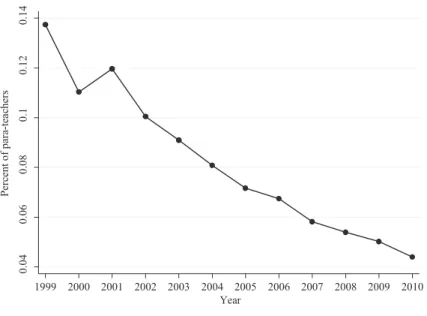
others dismissed. According to the Education Statistics Yearbook of China, the share of contract teachers in China’s rural primary schools declined from 13.7 per cent in 1999 to 4.4 per cent in 2010 (Figure 1).
Although the employment of contract teachers is declining in rural China
on average–and is very low in terms of national averages–the practice is still
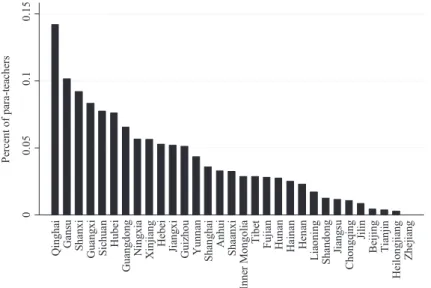
persistent in certain areas. Figure 2 presents the percentage of contract teachers in rural primary schools in each province from 1999 to 2010. The proportion of contract teachers remains high in poorer provinces concen-trated in western China. In our three sample provinces, Shaanxi, Gansu and Qinghai, the proportion of contract teachers as of 2010 is 3.2 per cent, 10.2 per cent and 14.1 per cent, respectively. Gansu and Qinghai were the two provinces with the largest proportion of contract teachers in rural primary schools in 2010.
Contract teachers in our sample are concentrated in resource constrained areas. Figure 3 plots the share of teachers that are contract teachers in each
school (on theY-axis) against a measure of theteaching capacityof the school
(on the X-axis). In this graph, the authors measure teaching capacity by
dividing the total number of students in the school by the total number of
fully funded civil service teaching positions (in Chinese, bianzhi) in each
school. According to this definition of teaching capacity, the weaker the teaching capacity, the higher the number. Given this, we believe that schools that are fiscally constrained will have lower teaching capacity (and higher values for their measures of teaching capacity). As Figure 3 demonstrates, the
0.04
0.06
0.08
0.1
0.12
0.14
P
erc
ent
of
para
-te
ac
h
ers
1999 2000 2001 2002 2003 2004 2005 2006 2007 2008 2009 2010 Year
schools with the greatest proportion of contract teachers are in counties with lower teaching capacity.
Although contract teachers are being phased out due to quality concerns, there is no empirical evidence of whether China’s contract teachers in fact perform better or worse than civil service teachers. Hence the need for this study.
3. Data
3.1 Survey design
The data used in this study come from a survey of 300 schools in three provinces of western China (Shaanxi, Gansu and Qinghai) during the 2011/2012 academic year. Schools were sampled as follows. We first obtained a list of all schools in
five prefectures (shown in Figure 4–Haidong, Longan, Dingxi, Tianshui and
Ankang) which were located in counties outside of the region’s urban district.2
In total, 26 counties were included in the sampling frame.3 Within these 26
0 0.05 0.1 0.15 Pe rce n t of pa ra-t ea che rs Q ingha i Ga n su Sh an x i Gu an g x i Si ch u an Hu b ei G u an gdong N ingxi a Xi n ji an g H ebe i Ji an gx i G uiz hou Yu n n an Sh an g h ai An h u i Sh aa n x i Inne r M o ngoli a T ibe t Fu ji an Hu n an Ha in an He n an Li ao n in g S h an do ng Ji an g su Chongqi n g Ji li n Be ij ing Ti an ji n H ei longj ia ng Zh ej ia n g
Figure 2 Proportion of contract teachers in rural primary schools by province in 2010. Source: Ministry of Education of the People’s Republic of China, 2010.\
2
Prefectures are the administrative regions below the province. Prefectures comprise several counties including one county-level ‘urban district’, the main metropolitan area. The next level below counties is that of township. School districts are generally administered at the township level and are in turn administered by county-level departments of education.
3
counties, 300 townships were selected from a list of all 512 townships.4 One school was selected from all schools in each township with at least 150 students in the school (a criterion that was chosen in order to avoid choosing (small) schools that were destined to be closed as part of the nation’s school merger program).
Within each school, we collected information on grade 4 and grade 5 students and their teachers. Within each study school, we randomly sampled 50 grade 4 and grade 5 students. When there were fewer than 50 students in the two grades, all students were included. The final sample used for analysis covers 11,698 students for whom no necessary data were missing. Given that the rate of missing data is low (only 9 per cent), we expect that results should not be affected. The main results are unaffected if we use multiple imputation to address missing observations rather than dropping them.
A survey questionnaire administered to students at the beginning of the school year (September) collected detailed information on students and their families. The surveys included questions on ethnicity, age, gender, boarding status, parental schooling, parental migrant status and household assets. A separate teacher questionnaire collected information on teachers including education, teaching experience, employment status, contract status (contract teacher versus civil service teacher), salary, a psychological scale to measure
0
0.2
0.4
0.6
Sha
reo
f
con
tract
te
ac
he
rs
amo
n
g
all
tea
ch
er
s
10 20 30 40 50 60
Teaching Capacity
Figure 3 Teacher shortage and proportion of contract teachers. Source: Authors’ survey in 300 schools.
4
motivation and time use. At the end of the school year (May), both students and teachers were surveyed a second time. This second survey collected additional information on teacher time use and teaching practices during the school year. In addition to surveys, all students were administered standardised examinations in mathematics or Chinese based on the national uniform curriculum. All students took the examinations twice, once at the beginning of the academic year and once at the end of the academic year. Within each classroom, half of the students were randomly assigned to take the mathematics examination and the rest took Chinese. The examination at the beginning of the year covered material that, according to the national curriculum, should have covered in the school by the end of the previous year and so it provides a baseline for the knowledge the students have. The examination at the end of the year covered material that should have been taught that year, according to the curriculum. Thus, a within-student comparison of scores on the two examinations provides a measure of their learning growth. To ensure coherence with the national curriculum, the tests were developed with assistance from local bureaus of education. Questions used in the mathematics examination were drawn from the question bank of the Trends in International Mathematics and Science Study, an international assessment of mathematics and science knowledge of primary and lower secondary school students. Questions used in the Chinese examination were taken from national fourth- or fifth-grade textbooks. To minimise cheating,
two versions of each examination (with re-ordered questions) were randomly assigned to students. Students were given 30 minutes to complete the examinations, which were proctored closely by enumerators. For analysis, scores for both subject tests were normalised by the distribution of scores in each grade. A full list of variables used in the analysis along with descriptions is given in Table 1.
3.2 Characteristics of contract and civil service teachers
Panel A of Table 2 contains a listing of the number of teachers (total; mathematics and Chinese language) in each of the prefectures. This table shows that, while the number of contract teachers varies by prefecture, there are still substantial numbers of them in every sample prefecture. Panel B of Table 2 shows the percentage of contract teachers among teachers in our survey. The first column shows the percentage among all teachers (including teachers who teach neither mathematics nor Chinese). Among 819 teachers total, 72 (8.8 per cent) are contract teachers (Row 6). The percentage of contract teachers among Chinese teachers (9.8 per cent) is slightly higher than among mathematics teachers (7.4 per cent), though this difference is not statistically significant
(P-value = 0.23). Rows 1–5 in the table show that there is substantial variation
across the five sample prefectures. In particular, the percentage of contract teachers is lower in Shaanxi compared with less densely populated prefectures in Gansu and Qinghai. The proportion of contract teachers in our sample is consistent with official province-level statistical data (Figure 2).
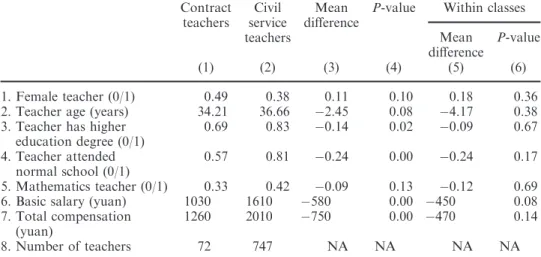
Table 3 compares the characteristics of contract teachers and civil service
teachers in the sample. Columns 1–4 compare contract and civil service
teachers in the full sample.5 Compared with civil service teachers, contract
teachers are significantly less educated. Only 69 per cent of contract teachers finished college, as compared to 83 per cent of civil service teachers. The disparity is even larger in terms of normal school (teaching college) attendance. Only 57 per cent of contract teachers attended normal school, as compared to 81 per cent of civil service teachers. Finally, contract teachers are also paid significantly lower salaries than civil service teachers. The average monthly base salary of contract teachers in our sample is 1030 yuan, as compared with 1610 yuan for civil service teachers. These disparities in education and pay are entirely in line with what is commonly known about contract teachers (Pandey 2006).
The primary analysis in this study is based on comparisons across teachers teaching the same class. Thus, the ‘effective sample’ used to estimate effects is comprised of students in classes where the characteristics of interest differ between mathematics and Chinese teachers. The final two columns (Columns 5 and 6) in Table 3 test differences between contract and civil service teachers teaching the same class. These comparisons show that the magnitudes of
5
Table 1 Variable descriptions
Variable Description
Gains in Standardized Examination Score
Normalised score on standardised examinations in mathematics and Chinese at the end of the school year minus normalised test score in the beginning of the school year. Half of students in each class took mathematics examination at the beginning and end of the school year and the other half took the Chinese examinations. Examinations were designed with assistance from local bureaus of education. For the mathematics examination, grade-appropriate question items were drawn from the Trends in International Mathematics and Science Study question bank.
Student and household characteristics
Female (0/1) Student is female
Boarding student (0/1) Student boards at school
Age (years) Student age in years
Grade Four (0/1) Student is in fourth grade
Household size Total number of individuals living in the student’s household
Mother has lower secondary degree or above (0/1)
Student’s mother has completed junior high school education or above
Father has lower secondary degree or above (0/1)
Student’s father has completed junior high school education or above
Father at home (0/1) Father currently lives at home (has not migrated for work)
Mother at home (0/1) Mother currently lives at home (has not migrated for work)
Household asset index Index of household durable assets.
Constructed using first principal component of motorbike, tractor, car, van, refrigerator, air conditioning, computer, washing machine and dummy variables for type of housing (cave dwelling, packed earth house, cement house, apartment building, other)
Teacher characteristics
Contract teacher (0/1) Teacher is employed on noncivil service teacher contract (has daike or minban status) Female teacher (0/1) Teacher is female
Teacher age (years) Teacher age in years Teacher has a higher education
degree (0/1)
Teacher has completed college or above
Teacher attended normal school (0/1)
Teacher attended normal school
Mathematics teacher (0/1) Teacher teaches mathematics. Other teachers in sample teach Chinese
Basic salary Monthly base salary in thousand yuan Total compensation Monthly total compensation in thousand yuan Teacher effort
Time spent preparing lessons per class hour (Teacher Reported)
Teacher reported hours of preparation time per hour of instruction
Days of absence last semester (Teacher Reported)
Table 1 (Continued)
Variable Description
Working hours last week (Teacher Reported)
Teacher reported number of hours worked last week
Days of absence last week (Student reported)
Days of absence last week reported by students
Number of homework assignments last week (Student reported)
Student reported number of homework assignments assigned per week
Number of homework assignments graded and returned last week (Student reported)
Student reported number of homework assignments corrected and handed back to students per week
Times asked questions in class last week (Student reported)
Student reported number of times asked question by teacher in class last week
Teacher effort index Index of teacher effort. Constructed using GLS weighting procedure described in
Anderson (2008)
Table 2 Total number of sample teachers and per cent of sample teachers that are contract teachers by prefecture
Prefecture Full sample Mathematics teachers Chinese teachers
Panel A. Total number of sample teachers
1. Ankang, Shaanxi 123 58 65
2. Dingxi, Gansu 217 83 134
3. Longnan, Gansu 208 86 122
4. Tianshui, Gansu 174 70 104
5. Haidong, Qinghai 97 44 53
6. Full sample 819 341 478
Panel B. Share of contract teachers
1. Ankang, Shaanxi 1.6% 1.7% 1.5%
2. Dingxi, Gansu 9.7% 6.0% 11.9%
3. Haidong, Gansu 6.2% 2.3% 9.4%
4. Longnan, Gansu 9.1% 7.1% 10.6%
5. Tianshui, Qinghai 13.8% 17.4% 11.4%
6. Full sample 8.8% 7.4% 9.8%
Source:Authors’survey.
differencesbetweencontractandcivilserviceteachersteachingthesameclass
remain sizeable (though only base salary remains significant given the
reduced sample).
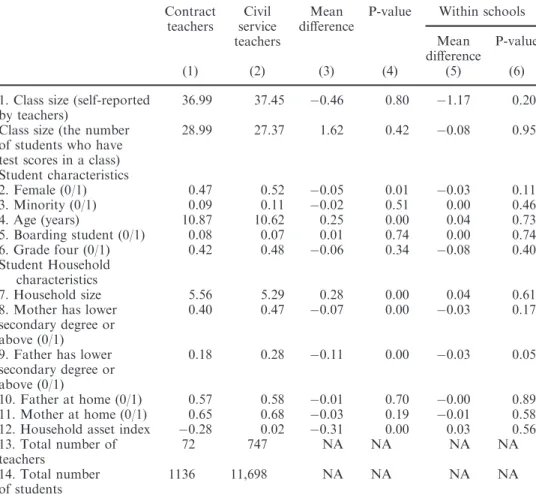
Table 4 compares the composition ofclasses taughtby contract teachers
and civilserviceteachers. Comparisonsusing thefull sample(Columns1–4)
showanumberofsignificantdifferences.Contractteachersinoursampleare
significantly more likely to teach boys, older students, students with larger
families, students with less educated parents and poorer students (Table 4,
columns 3 and 4). Of note, however, is that the size of classes taught by
contractandcivilserviceteachersissimilar.Thismightsuggestthatcontract
teachersarenotbeinghiredtoreduceclasssizes.Rather,itispossiblethat,in
fact,contractteachersarebeinghiredeitherinresponsetoshortages ofcivil
Most of these differences in class composition are reduced, however, when comparing within schools (Columns 5 and 6). This could suggest that ‘within-school sorting’ is not much of a concern in our sample; however, there may remain substantial sorting within schools on unobserved characteristics.
4. Empirical approach
The primary challenge for comparing the effectiveness of contract and civil service teachers is the possibility of unobserved heterogeneity due to selection. First, there may exist between-school sorting of contract teacher employment. For instance, contract teachers are more likely to be employed in more remote schools where shortages of civil service teachers are more significant. Second, there may be within-school sorting if contract teachers are more likely to be assigned to certain classes or subjects. To deal with this potential source of bias, our main strategy is to employ a cross-subject class fixed effects approach.
4.1 Cross-subject class fixed effects
Cross-subject class fixed effects can mitigate bias arising from between- and within-school sorting of teachers and students by comparing teachers who
teach the same class.6 Because we administered examinations in both
Table 3 Teacher characteristics by teacher contract status
Contract teachers
Civil service teachers
Mean difference
P-value Within classes
Mean difference
P-value
(1) (2) (3) (4) (5) (6)
1. Female teacher (0/1) 0.49 0.38 0.11 0.10 0.18 0.36
2. Teacher age (years) 34.21 36.66 2.45 0.08 4.17 0.38
3. Teacher has higher education degree (0/1)
0.69 0.83 0.14 0.02 0.09 0.67
4. Teacher attended normal school (0/1)
0.57 0.81 0.24 0.00 0.24 0.17
5. Mathematics teacher (0/1) 0.33 0.42 0.09 0.13 0.12 0.69
6. Basic salary (yuan) 1030 1610 580 0.00 450 0.08
7. Total compensation (yuan)
1260 2010 750 0.00 470 0.14
8. Number of teachers 72 747 NA NA NA NA
Note: Columns 1–4 presents the characteristics of contract and civil service teachers. Columns 5 and 6
present the within classes difference between contract and civil service teachers.Source: Authors’ survey.
6
mathematics and Chinese and have information on the characteristics of both mathematics and Chinese teachers, we can identify the effect of teacher characteristics (including contract status) by comparing achievement gains of thesame studentsacross teachers. Because each elementary school student in China takes all of his or her subjects together with a fixed group of peers (or, in other words, with the same class), including class fixed effects in the model allows us to control for unobservable characteristics of students (such as ability or motivation) that could be correlated with teacher contract status.
We estimate a linearised specification of the educational production function as follows:
DScoreis¼b0þb1CTisþb2Tisþb3Iisþb4Hisþcsþeis; ð1Þ
Table 4 Student and student household characteristics by teacher contract status
Contract teachers
Civil service teachers
Mean difference
P-value Within schools
Mean difference
P-value
(1) (2) (3) (4) (5) (6)
1. Class size (self-reported by teachers)
36.99 37.45 0.46 0.80 1.17 0.20
Class size (the number of students who have test scores in a class)
28.99 27.37 1.62 0.42 0.08 0.95
Student characteristics
2. Female (0/1) 0.47 0.52 0.05 0.01 0.03 0.11
3. Minority (0/1) 0.09 0.11 0.02 0.51 0.00 0.46
4. Age (years) 10.87 10.62 0.25 0.00 0.04 0.73
5. Boarding student (0/1) 0.08 0.07 0.01 0.74 0.00 0.74
6. Grade four (0/1) 0.42 0.48 0.06 0.34 0.08 0.40
Student Household characteristics
7. Household size 5.56 5.29 0.28 0.00 0.04 0.61
8. Mother has lower secondary degree or above (0/1)
0.40 0.47 0.07 0.00 0.03 0.17
9. Father has lower secondary degree or above (0/1)
0.18 0.28 0.11 0.00 0.03 0.05
10. Father at home (0/1) 0.57 0.58 0.01 0.70 0.00 0.89
11. Mother at home (0/1) 0.65 0.68 0.03 0.19 0.01 0.58
12. Household asset index 0.28 0.02 0.31 0.00 0.03 0.56
13. Total number of teachers
72 747 NA NA NA NA
14. Total number of students
1136 11,698 NA NA NA NA
Note: This table presents the characteristics of students and their household by teacher contract status.Source: Authors’ survey.
whereDScoreis isthevalue-addedtest scores ofstudenti inschools (thatis
test score in the end of the academic year); CTisis a dummy that equals one if
the teacher is a contract teacher;Tisis a vector of teacher characteristics (age,
gender, a dummy variable indicating whether teacher has a college degree, a dummy variable indicating whether teacher attended normal school and
subject taught); Iis and His are vectors of individual student (age, gender,
boarding status and minority dummy) and household variables (household size, father’s education, mother’s education, whether father lives at home or not, whether mother lives at home or not, and household assets), respectively.
cs is class fixed effect. eis is an error term. The error term is allowed to be
correlated at the school level to account for clustering effects. Because students in each elementary school class are taught all subjects together in China,
including class fixed effects (cs) in the model allows us to control for all
unobservable characteristics of the classroom/school that do not vary by
teacher–for example classroom size; the quality of the classroom facilities; the
number of other subjects that students have). The coefficient (b1) on the
contract teacher variable (CTis), then, is the effect of having a contract teacher
(e.g. differences in innate ability; gender; age – all of those things that are
potentially different between contract teachers and civil service teachers, which are NOT in the model explicitly) and NOT the effect of the other
teacher characteristics (Tis) that were explicitly included in the model (such as
the effect of differences in formal education and the effect of salary differences).
We also run a number of other models with/without teacher and student-level controls. In the regression that excludes other teacher controls (besides contract status) that estimated effect of contract teachers includes effects due to differing characteristics of contract and civil service teachers. Student-level
controls – while not strictly necessary for identification because students
remain constant across contract and civil service teachers – are included to
improve the precision of the estimates.
One of the most important regressions is as follows:
DScoreis¼b0þb01CTisþcsþeis: ð2Þ
In this case (Eqn 2), the coefficient (b01), which we can call the unadjusted
model with class fixed effects model, measures all of the differences between contract teachers and civil service teachers, including education differences and the impact of salary differences. The difference with the full model is that
the resulting coefficient (b01) contains all of the differences between contract
teachers and civil service teachers.
(mathematics). A potential threat to this assumptionis if contract teachers
somehowinfluence thescores ofstudents insubjects that theydonotteach.
We present a limited test of this assumption inTable S1. Usingonly the
sample of student scores from classes that were taught by civil service
teachers, we regress student value-added scores on the fraction of contract
teachers employed in the school (with and without controlling for other
characteristics). We find that, after controlling for county fixed effects, the
proportionofcontractteachersintheschoolisnotasignificantpredictor of
studentperformanceinsubjects taughtbycivil serviceteachers.
5. Results
5.1 Teacher contract statusandstudent achievement
The regression results using model (1) are reported in Table 5. When
controlling for just contract teacher (column 1); contract teacher and
teacher characteristics (column 2); contract teacher, teacher characteristics
and student characteristics (column 3); and contract teacher, teacher
characteristics, student characteristics and school fixed effects (column 4),
the effectof contract teacheron studentachievement suggests that contract
teachers have a modestly negative effect on student achievement gains
(between 0.05 and 0.06). The results are significant at the 10 per cent
level.
Columns5–8presenttheresultwithclassfixedeffects,alone(withnoother
controls) and with different sets of teacher and student characteristics. As
seenincolumn 8,thecoefficient is0.13and isstatisticallysignificant.This
means that holding Tis constant, thevalue addedofthe(randomly assigned
halfofthe)studentsthathadacontractteacherwas0.13standarddeviations
less than the(randomly assigned other halfof the) studentsthat had a civil
service teacher. Interestingly, the coefficients (b2) on the contract teacher
variables (CTis) are insignificant. This suggests that differences in the value
addedofthestudentsofcontractteacherswhencomparingtheirvalueadded
ofthestudentsofcivilservicestudentsarenotthoseobservablefactors(CTis)
but ratherunmeasured/unobservable differences that existbetween contract
teachersand civilservice teachers.
When controlling for all of the unobservable traits of contract and civil
service teachers, the coefficient on the contract teacher suggests that the
value-added test scores (as measured by changes oftest scores) of students
taughtbycontractteachersisless(from0.13to0.14 standarddeviations
lower) thanthose ofstudentstaughtby civilserviceteachers (columns 1–4).
Theresultsaremorestatisticallysignificant–significantlydifferentthanzero
atthe1percentlevel. However,sincethecoefficient containstheadditional
factors that were included in the full model – but had no effect – it is not
surprising that theabsolute value of theunadjusted coefficient is nearly the
Interestingly, we can also see from the class fixed effect estimates in
columns 5–8 that none of the observable teacher characteristics are significant
in determining student value added. These findings are in line with other recent research showing that observable teacher attributes have limited
impacts on student achievement (Aaronson et al. 2003; Ballou et al. 2004;
Nye et al.2004; Rockoff 2004; Hanusheket al.2005; Rivkinet al.2005).
5.2 Teacher effort
So what may account for the results? The effectiveness of contract and civil service teachers as measured by the class fixed effects models may differ for two primary (unmeasured) reasons. First, it also might be because of difference in effort between contract and civil service teachers. According to Han (2013), contract teachers have less job security and are more closely monitored, it would be expected that this unobserved characteristic would lead to higher scores of the students that are taught by contract teachers. Second, Sargent and Hannum (2005) and Pandey (2006) and our analysis (Table 3) show that contract teachers have a lower ability than civil service teachers. Lower ability contract teachers, ceteris paribus, would be expected to produce student outcomes that were lower than higher ability civil service teachers. There are many factors that would affect the ability of a teacher,
some of them are measurable – like educational level, training experiences,
etc. – and many others that do not have explicit continuous measures (e.g.
interest in teaching; commitment to teaching; understanding of the theory of teaching). In our analysis, we have included all explicit measures in the regression; however, most cannot be explicitly measured and so the difference between contract teachers and civil service teachers will be a combination of all of these factors. Since in our results in Table 5, we see that the achievement of students of contract teachers is lower than those of civil service teachers, and it appears that the ability effect (which would mean higher achievement scores for the students of civil service teachers) is stronger than the effort effect (which would mean higher achievement scores for the students of contract teachers).
It is important to note that our model assumes that ability is a broad and multifaceted concept that cannot be simply measured by a single variable.
Although teacher education – which we include in our adjusted model
(‘teacher has a higher education degree’) – is commonly associated with
ability, we assume that many other unobservable factors also account for teacher ability. Indeed, the seminal work of Angrist and Krueger (1991, 1992, 1995) showed that ability encompasses far more than simply education. Therefore, the coefficient on the contract teacher variable in our unadjusted model measures all of the differences between contract and civil service
teachers (or everything besides those already measured –like education – in
Table 6 shows estimates of the effect of teacher contract status on indicators of teacher effort. Regressions in this table use the class fixed effects specification in Equation (1), but with all variables aggregated to the teacher
level (in columns 1–4). We test effects on six different indicators: the ratio of
preparation time to class time over the past week (teacher reported–Column
1); days of absence in the last month (teacher reported – Column 2); total
hours worked in the past week (teacher reported–Column 3); time spent on
asking questions in class last week (teacher reported – column 4); times
assigned homework was corrected and returned to students (student reported
–Column 5); and how often students report being asked questions in class in
past week (student reported– Column 6).
Across these six indicators in Table 6 (columns 1–6), we find no significant
effects of contract teacher status. Although point estimates for several of the variables suggest that the effort of contract teachers is higher than that of civil service teachers, none of the estimates are significant at conventional levels. These results suggest that the reason that we find contract teachers performing worse than civil service teachers in student outcomes is purely due to lower abilities of contract teachers. In other words, the insignificant results in Table 6 mean that there are not large (statistically significant) offsetting positive effects coming about due to any greater effort of contract teachers. It also means that the coefficients in Table 5 are mostly (all) due to the inferior ability of contract teachers relative to civil service teachers.
6. Conclusion
We draw on longitudinal data from a survey of 300 schools in Shaanxi, Gansu and Qinghai provinces to estimate the effect of teacher designation as a contract teacher (a teacher employed on fixed-term contracts) versus a civil service teacher on gains in student achievement over 1 year. We find that gains in student scores on standardised examinations in mathematics and Chinese are 0.13 standard deviations less in classes taught by contract teachers than in classes taught by civil service teachers. The differences in student learning do not seem to come from different effort levels between contract teachers and civil service teachers. The difference is more likely due to the fact that contract teachers on average have lower abilities or qualifications than civil service teachers.
Fyfe 2007). Replacement of contract teachers with civil service teachers would require additional funding in areas with fewer economic resources.
While the focus of this paper has been on one of the problems of the way teachers are hired and its effect on student achievement, the reader should be reminded that there are many other initiatives that school districts might take beyond replacing contract teachers. In particular, there may be many
interventions that education systems might make on the student side–which
might be as effective (or more effective) as (than) teacher-side policy changes. In fact, in our own results, we show that a number of student and student household-related characteristics (e.g. ‘minority’, ‘age’ and ‘mother has lower secondary degree or above’) have effects on student value added. In other words, in their efforts to raise the quality of schooling, school systems need to focus on all different possible reforms and programs, including those that target better teaching as well as those that prepare students better so they are able to learn more when they are in school. In this paper, however, we focus on the teacher-side issues and leave student-side issues for future research.
The results also have lessons for all rural economies in low-income and middle-income countries. Regardless of whether a rural economy is domi-nated by agricultural producers or off-farm workers, Schultz (1961) demon-strates there are high returns for education. However, the work of Hanushek (1986) is clear that returns only accrue to education if the schooling system is producing learning, and learning is in no small part dependent on quality
teaching. The policy implication of this paper – whether it is an issue of
contract teacher versus civil service teachers or any other characteristic of
teaching–is that the education system must focus on finding a way to attract
and keep high-quality teachers. High-quality teachers can form the basis of a solid schooling system and that can lead to learning and higher levels of farm income, farm output, off-farm employment and overall economic growth.
References
Aaronson, D., Barrow, L. and Sander, W. (2003).Teachers and Student Achievement in the Chicago Public Schools (No. WP-2002-28). Federal Reserve Bank of Chicago, Chicago. Anderson, M.L. (2008). Multiple inference and gender differences in the effects of early
intervention: A reevaluation of the abecedarian, Perry Preschool, and Early Training Projects,Journal of the American Statistical Association103, 1,481–1,495.
Angrist, J. and Krueger, A. (1991). Does compulsory school attendance affect schooling and earnings?,Quarterly Journal of Economics106, 979–1,014.
Angrist, J. and Krueger, A. (1992). The effect of age at school entry on educational attainment: an application on instrumental variables with moments from two samples, Journal of the American Statistical Association87, 328–336.
Angrist, J. and Krueger, A. (1995). Split sample instrumental variables estimates for the return to schooling,Journal of Business & Economic Statistics13, 225–235.
Ballou, D., Sanders, W. and Wright, P. (2004). Controlling for student background in value-added assessment of teachers, Journal of Educational and Behavioral Statistics 29, 37–65.
Bourdon, J., Frolich, M. and Michaelowa, K. (2010). Teacher shortages, teacher contracts and€ their effect on education in Africa, Journal of the Royal Statistical Society: Series A (Statistics in Society)173, 93–116.
Chetty, R., Friedman, J.N. and Rockoff, J.E. (2011). The long-term impacts of teachers: Teacher value-added and student outcomes in adulthood. National Bureau of Economic Research. Available from URL: http://www.nber.org/papers/w17699. https://doi.org/10. 3386/w17699 [accessed 15 October 2017].
Clotfelter, C.T., Ladd, H.F. and Vigdor, J.L. (2007). Teacher Credentials and Student Achievement in High School: A Cross-Subject Analysis with Student Fixed Effects. National Bureau of Economic Research. Available from URL: http://www.nber.org/papers/w13617. https://doi.org/10.3386/w13617
Duflo, E., Dupas, P. and Kremer, M. (2009). Additional resources versus organizational changes in education: Experimental evidence from Kenya. Unpublished Manuscript. Abdul Latif Jameel Poverty Action Lab (JPAL). Massachusetts Institute of Technology, Cambridge, MA.
Duthilleul, Y. (2006).Lessons Learnt in the Use of “Contract” Teachers. IIEP, Paris. Fyfe, A. (2007). The use of contract teachers in developing countries : trends and impact (ILO
Working Paper No. 399704). International Labour Organization. Available from URL: http://ideas.repec.org/p/ilo/ilowps/399704.html [accessed 20 October 2017].
Fyfe, A. (2007).The Use of Contract Teachers in Developing Countries: Trends and Impact. ILO, Geneva. Available from URL: http://www.oit.org/wcmsp5/groups/public/—ed_d ialogue/—sector/documents/publication/wcms_160813.pdf [accessed 10 September 2017]. Goldhaber, D.D., Goldschmidt, P. and Tseng, F. (2013). Teacher value-added at the
high-school level: different models, different answers?,Educational Evaluation and Policy Analysis
35, 220–236.
Govmda, R. and Josephine, Y. (2005). Para-teachers in India: a review, Contemporary Education Dialogue2, 193–224.
Han, L. (2013). Is centralized teacher deployment more equitable? Evidence from rural China,
China Economic Review24, 65–76.
Hanushek, E. (1986). The economics of schooling: production and efficiency in public schools,
Journal of Economic Literature24, 1,141–1,177.
Hanushek, E.A., Kain, J.F., O’Brien, D.M. and Rivkin, S.G. (2005).The Market for Teacher Quality. National Bureau of Economic Research. Available from URL: http://www.nber. org/papers/w11154. https://doi.org/10.3386/w11154 [accessed 13 May 2017].
Huffman, W. (1974). Decision making: the role of education,American Journal of Agricultural Economics56, 85–97.
Kingdon, G., Aslam, M., Rawal, S. and Das, S. (2013). Are Contract Teachers and Para-Teachers a Cost-Effective Intervention to Address Teacher Shortage and Improve Learning Outcomes. University of London, Institute of Education, London, UK. Education in Pakistan’s Punjab: Outcomes and Interventions, 47. Available from URL: https://safedafed. org/~safedafe/document/learning_resources/2013/Parateachers%202013Kingdon.pdf [accessed 3 March 2017].
Kumar, K., Priyam, M. and Saxena, S. (2001). The trouble with para-teachers,Frontline18, 93–94.
Leigh, A. (2010). Estimating teacher effectiveness from two-year changes in students’ test scores,Economics of Education Review29, 480–488.
Lin, J.Y. (1991). Education and innovation adoption in agriculture: evidence from hybrid rice in China,American Journal of Agricultural Economics73, 713–723.
Luschei, T.F. and Carnoy, M. (2010). Educational production and the distribution of teachers in Uruguay,International Journal of Educational Development30, 169–181.
Ministry of Education of the People’s Republic of China. (2010). China Education Statistics Yearbook, 2010. Available from URL:http://www.yearbookchina.com/navibooklist-N2012010030-1.html [accessed on 25 February 2018].
Muralidharan, K. and Sundararaman, V. (2013).Contract Teachers: Experimental Evidence from India. National Bureau of Economic Research. Retrieved from http://www.nber. org/papers/w19440. https://doi.org/10.3386/w19440 [accessed 5 April 2017].
Nye, B., Konstantopoulos, S. and Hedges, L.V. (2004). How large are teacher effects?,
Educational Evaluation and Policy Analysis26, 237–257.
Pandey, S. (2006). Para-teacher scheme and quality education for all in India: Policy perspectives and challenges for school effectiveness,Journal of Education for Teaching32, 319–334.
Peng, W.J., Thomas, S.M., Yang, X. and Li, J. (2006). Developing school evaluation methods to improve the quality of schooling in China: a pilot ‘value added’ study, Assessment in Education: Principles, Policy & Practice13, 135–154.
Peng, W.J., McNess, E., Thomas, S., Wu, X.R., Zhang, C., Li, J.Z. and Tian, H.S. (2014). Emerging perceptions of teacher quality and teacher development in China,International Journal of Educational Development34, 77–89.
Psacharopoulos, G. (1994). Returns to investment in education: a global update, World Development22, 1325–1343.
Rivkin, S.G., Hanushek, E.A. and Kain, J.F. (2005). Teachers, schools, and academic achievement,Econometrica73, 417–458.
Robinson, B. and Yi, W. (2008). The role and status of non-governmental (“daike”) teachers in China’s rural education,International Journal of Educational Development28, 35–54. Rockoff, J.E. (2004). The impact of individual teachers on student achievement: evidence from
panel data,The American Economic Review94, 247–252.
Sargent, T. and Hannum, E. (2005). Keeping teachers happy: job satisfaction among primary school teachers in rural Northwest China,Comparative Education Review49, 173–204. Schultz, T.W. (1961). Investment in human capital,The American Economic Review51, 1–17. Vegas, E. and De Laat, J. (2003). Do Differences in Teacher Contracts Affect Student Performance? Evidence from Togo. World Bank. Retrieved from http://www-wds.worldba nk.org/servlet/WDSContentServer/IW3P/IB/2003/10/24/000160016_20031024103517/Re ndered/PDF/269550Vegas0Teacher1contracts.pdf [accessed 12 December 2016].
Wang, L., Min, W., Zhang, S., Shi, Y. and Rozelle, S. (2017). Math and Chinese language learning: Where are China’s vulnerable subpopulations? REAP Working Paper.
Xue, H., Liu, G., Shi, Y., Yi, H., Rozelle, S. and Sylvia, S. (2017). Doctor employment contracts, decentralization, and the quality of primary care: Evidence from China’s Iron Rice Bowl. REAP Working Paper.
Yang, D. (1997). Education in production: measuring labor quality and management,
American Journal of Agricultural Economics79, 764–772.
Zhang, L., Huang, J. and Rozelle, S. (2002). Employment, emerging labor markets, and the role of education in rural China,China Economic Review13, 313–328.
Supporting Information
AdditionalSupportingInformationmaybefoundintheonlineversionofthis
article:
TableS1.Fractionofcontractteachersemployedintheschoolandstudent