TECHNICAL UNIVERSITY OF CLUJ-NAPOCA
ACTA TECHNICA NAPOCENSIS
Series: Applied Mathematics, Mechanics, and Engineering Vol. 61, Issue IV, November, 2018
THE INFLUENCE OF THE ENVIRONMENTAL LEVEL ON THE
PROFESSIONAL RESULTS OF THE ROMANIAN STUDENTS
Laura Andrada BACALI, Andreea BOTOS, Ligia Maria NAN, Laura BACALI
Abstract: This paper presents the coordinates of a study targeting students in the high schools in Cluj-Napoca regarding the assessment of the study environment, its elements as a communication element, but especially as a possible influence on their professional performances. The concept of space management and ambiance will be analysed in educational spaces emphasizing on the concept of net zero energy building (nZEB). The sample of the study was randomly chosen, the methodology applied to the research shows, starting from the preliminary investigation and assumptions, the survey method, the study instrument and the results of exploratory research.
Key words: Ambiance, educational space, nZEB, Energy efficiency in buildings
1. INTRODUCTION
With the help of marketing researches, high school institutions can identify pupils' needs and requirements regarding the educational environment. In this sense, this quantitative research has been carried out, in which the attitudes, views and behaviour were identified of some Cluj-Napoca high-school students, towards the services provided in the educational space, in order to improve the learning spaces and, implicitly, their professional performances. Over time, schools, in general and educational buildings, in particular, played a very important role in the development of society as a whole. School is a catalyst, but also an integrator factor in the development of the social activities system within the community, the issue of accessibility of educational spaces, under multiple sales valences is of major importance.
The regulations from European Commission are especially in the direction towards the energy efficiency policy. The EU have set goals for every member country to reduce the energy consumption and to reduce the greenhouse gas emissions from houses, offices, shops and other buildings. Because of this, the buildings are put first in the spotlight. In this case it is the time to
develop plans to improve the buildings, starting with those were the children are, were they spend a good part of the day, the school buildings.
The educational buildings in Romania have one major problem, the lack of mechanical ventilation systems, which lead to inadequate ventilation in many classrooms. This is considered to be the main cause of students’ performance reduction [1]. Even, if there is a school renovation it will be finished without installing a controlled ventilation system.
As a fact or better said a suggestion, for achieving the 2030 targets, the biggest potential of reducing the energy consumption can be only through the building sector [2]. In Europe, the largest potential source of cost-effective energy saving and CO₂ reduction is represented by the buildings [3]. So, because of it, the attention should be on the public institutions buildings.
future potential, but also to strengthen local identity.
2. THE CONCEPT OF nZEB IN
EDUCATIONAL SPACES
nZEB represent the short version for the Nearly Zero Energy Building concept. In Romania, a nZEB is a very energy-efficient building where conventional energy needs are almost zero or very low and is mostly covered by renewable energy, including renewable energy produced on-site or nearby [4]. When this definition was reviewed and updated for the Romanian situations, it was taken in the consideration, both the results of a research in the field, as well the developments at EU and national level in the field of sustainable development policies.
A first problem appears from the not clearly detailed meaning of “on-site or nearby” from the nZEB definition. Usually, it is accepted that it refers to the considered building and corresponding land which is linked with it, in terms of property.
When looking to the main policies and measures that supports the nZEB, in Romania there is still more room for: raising the awareness and information; strengthening building regulations; energy performance certificates; education and training in this particular area; demonstration and pilot projects; financial support schemes; supervision and energy audits; research and development [2].
The nZEB concept is achieved by combining high energy efficiency and renewable energy sources. A nZEB type building has to have the energy configuration within [5]: the architectural configuration of the building in keeping with the principles of sustainable development, including a high level of energy performance of building elements leading to the least energy requirement; ensuring energy demand, especially with high efficiency urban/area districts; endowment of buildings with renewable energy sources located either on the building or on the land owned by the building with analysis at urban level project stage.
The useful surface of buildings for education in Romania is 1,125,999.85 m2 [6]. In table 1, it
is presented the estimated number of buildings that are for the educational sector [7].
Table 1: Table with the estimated number of building
institutions in education Category No. of units Schools and high schools 5982 Kindergartens 1498 Higher Education 624
In Romania, there is still a need for promoting the best practices in this area and a well-developed raising awareness campaign about the benefits of nZEB, because the concept of “nearly zero energy building” is very new for everyone, starting with the public institutions and to the large public [1].
Social impact occurs in the relationship between schools and community and can be noticed when some school functions are shared with the community, especially green spaces or sports. The nZEB projects not only achieve energy performance, but also sustainable development of the community and the environment [8].
2.1 Opportunities and threats in ZEB
The key drivers and barriers identified in the implementation process of nZEB will be presented below [9].
The main drivers that exist in the process of nZEB are:
● Detailed definition of nZEB in the legal
framework;
● Energy cost saving;
● Lower dependence on energy suppliers; ● Improved comfort, better conditions for
working, studying and living;
● Incentives and grants; ● Tax deductions;
● Low interest rates on loans;
● Best practices of innovative renovation
solutions for buildings;
● Best practices related to the renovation of
existing buildings at high-energy efficiency;
● Availability of good practices regarding the
● Demonstration projects that allow
constructors to understand the benefits of meeting the requirements of the nZEB;
● The Energy Performance Certificates
Database, which facilitates the choice of buildings for energy renovation.
Here are some barriers that appear in the implementation of nZEB:
● There is no numerical indicator for energy
demand of nZEBs;
● There are no requirements for the mandatory
proportion of energy from renewable sources;
● The requirements vary and there is a high
diversity of definition, algorithms and local requirements, because of local administration and regions;
● Lack of financial instruments for renovation
and local budgets are cut for energy efficiency projects for the public buildings;
● High initial costs of investments; ● Long payback time of investments;
● Limited technical competence in public
decision-making, which may lead to the choice of conventional, low energy efficiency measures;
● There are very few demonstration projects
for energy renovation nZEB;
● Lack of awareness of the economic benefits
achieved through the implementation of energy renovation measures;
● Uncertainties concerning the measurement,
monitoring and verification of energy savings.
2.2 Successful examples of nZEB
An example of successful and efficient nZEB school project can be found in Germany, Hauptschule Schrobenhausen. This pilot project intended to have an improvement of energy consumption compared to national requirements by at least 15% of primary energy use and the results of energy saving shows an undercut of 44%. The renovation of the building was a part of the project that gives the possibilities to reach a very good energy reduction in schools. The central ventilating system was equipped with a
heat recovery system. The renewable energy technologies were: for electricity, a roof with installed photovoltaic modules that supply part of the electricity use and for heating, the district heating system based on renewable energy with a primary energy factor of zero. The renewable energy contribution ratio is 43% of the total final energy. This project has a very good reproducibility for other schools with low cost to improve thermal comfort and air quality in classrooms. [10]
An example of the importance a school has in the society is presented next. A good example is at the Usasazo Secondary School, held in 2004 in the southern African city of Khayelitsha. Wolff Architects have taken it from the beginning to consider that this project is not one that generates a simple learning space, but a stable space within the community, which it can also enjoy it. In an area like Khayelitsha, schools are often the first public buildings and, for a long time, the only permanent, durable and expensive buildings. Thus, schools perform a critical role in the formation of qualitative urban spaces. [11] Initially, this school had to contain 37 classrooms, a meeting room, a library, a media room and an administrative area. Following the change in certain laws and the understanding of the requirements of this type of site, the architects saw a greater development opportunity for the community. Therefore, functions and spaces for entrepreneurial activities have been integrated to help society and strengthen links between it and the school. At the level of the street, developed on a single level, a series of classrooms where there are vocational courses (hairdressers, shoes repairers, car mechanics, etc.), have a street showcase where students can expose and sell products or services. Because of this, there is a strong interaction between the school and the city's inhabitants, while the community enjoys the local services offered.
3. METHODOLOGY
The study was conducted between May and June 2018.
The studied population consists of high school students from the high-schools of Cluj-Napoca, who have specific economic courses in the content of curricula. In this survey, the respondents that were considered are at a high-school in the services profile, which is centred on economic studies and have an entrepreneurial background.
The poll consisted of investigating a total of 30 school students. To investigate the high-school students in this research, the parents' agreement was requested from all the students who participated, if they would be willing to let their kids to take part in this survey.
A random sampling method based on accessibility was used to select the subjects. This paper is an exploratory research, useful for carrying out a future representative study at regional or national level on this topic.
For this study in the secondary education program, it was chosen the method of self-administration of the questionnaire, and the processing of the results was done computerized.
3.1 The assumptions of the research
The most fundamental objectives of this applied research were:
O1. Identifying the possibilities to improve the learning environment and upgrade the high-school buildings.
O2. Developing an effective way to improve the professional performances of high-school students, from the perspective of the learning environment.
O3. Designing sustainable learning spaces for students.
The speculative hypotheses that led to the research and generated the structure of the questionnaire were:
H1. "Most investigated subjects appreciate the ambiance of the high-school being enjoyable and appealing."
H2. "At the minimum one-third of the investigated subjects consider that there is an appropriate environment for the study at the high-school."
H3. "Not more than a quarter of the investigated subjects appreciate the school's concern to improve the environment and to improve the results that are at an average level."
H4. "Most investigated subjects find it efficient to use flexible, dynamic learning spaces as a way to improve their performance in terms of learning space."
H5. "At least half of the subjects consider educational spaces to be related to methods of transfer the of information to a great extent." H6. "At least a quarter of the investigated subjects agree with the statement: The high-school environment is appropriate to the working environment."
H7. "Most of the investigated subjects consider the flexibility of the educational space to be very important."
H8. "At least half of the subjects appreciate the endowment of the educational spaces being very good."
H9. "Most investigated subjects view charity as a social activity in their school."
H10. "Not more than a quarter of respondents appreciate the integration of the building in the context."
H11. "Most subjects consider that their school implements sustainable and environmentally sustainable development strategies and programs."
H12. "At least half of respondents say that the high-school institution has a strong and distinctive identity."
H13. "The building is very poorly assessed on the flexibility and dynamics of the structure of at least a quarter of the investigated subjects." H14. "At least a quarter of the investigated subjects do not know if there are spaces designed for distinct communities at the building level." H15. "Most respondents know about the link between the building and the natural environment."
H16. "At least half of respondents propose modern equipment as a way of improving educational spaces."
4. PRELIMINARY RESULTS
obtained in each question with the hypothesis underlying the question.
H1 regarding the subject’s opinion on high-school environment is confirmed. The majority (97%) of those investigated responded affirmatively and appreciated the high-school environment as being pleasant and appealing. H2 shows the view of subjects about the studying environment in the high-school. This hypothesis is invalid, because only 28% of respondents have said that there is an appropriate environment for studying, the percentage being less than one-third.
H3 on subject’s opinion on the high-school's concern to improve the environment and the learning outcomes is neglected, because only 33% of respondents have responded that they appreciate the concern of the high-school institution for improving the ambience that help improve the results of the students.
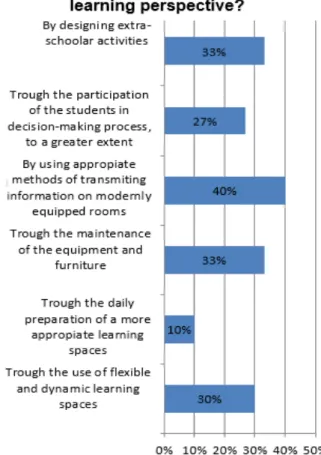
H4 shows the opinion of the subjects about the most effective way to improve school performance is invalid. As it can be seen in figure 1, the percentage is not representing the majority. Only 30% of the investigated subjects responded that they considered effective the use of flexible and dynamic learning spaces, as a way to improve their professional performance from the perspective of the learning space. H5 about the opinion of the subjects on the correlation of the educational spaces with the methods of transmission of information is confirmed, as more than half (53%) of respondents said that the spaces are highly correlated with methods of transmission of information.
H6 regarding the opinion of the subjects on the statement "The environment in the high-school is appropriate to the working environment" is confirmed, as it is shown in figure 2. More than half (63%) of respondents agreed that the working environment in their high-school have an appropriate ambience.
H7 on the opinion of the subjects about the importance of the flexibility of the educational space is invalid, because 50% of the respondents said that the space flexibility was very important.
H8 about the opinion of the subjects on the provision of educational premises is neglected,
because the percentages are less than half of the respondents. Only 19% of the respondents appreciated that the endowment of the educational spaces is very good, and it is cumulated as follows: 8% for the courses, 5% for the laboratories and 6% for the projects.
Fig 1. The chart with the most effective ways to improve the high-school students’ performances
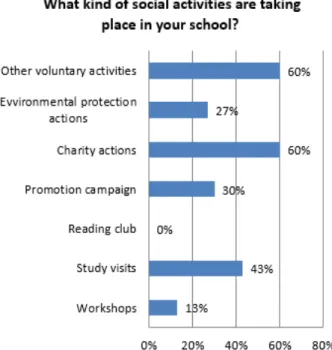
H9 about subject’s opinion on social activities in school is confirmed, as it is shown in figure 3. The majority (60%) consider charity activities as a social activity in their high-school.
Fig. 3. The chart with the social activity that exist in the respondents’ high-school
H10 regarding subject’s opinion on the context integration of a building is neglected, because only 20% of respondents have responded that they appreciate a building's integration into the context.
H11 is about subject’s opinion on the implementation of environmentally sustainable development strategies and programs is denied, as can be seen in figure 4. Most of the investigated subjects do not know anything about the existence of such strategies or programs in their high-schools.
H12 regarding the subject’s opinion on high-school identity is confirmed, as 60% of those investigated have affirmatively answered that the high-school institution has a strong and distinctive identity.
H13 is about the opinion of the subjects that appreciate the flexibility and dynamics of the structure of a building as very weak is invalid. Less than a quarter of the investigated subjects consider that they are in a building with a very weak structure.
H14 about the knowledge of designing spaces for distinct communities is confirmed, because more than half of respondents do not know if
there are spaces designed for distinct communities in their high-school buildings.
Fig. 4. The chart regarding the knowledge of implementation of sustainable strategies and environmentally friendly programs in high-schools
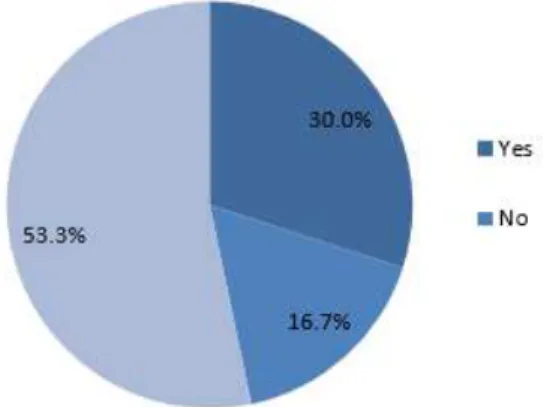
H15 regarding the awareness of a green building concept is invalid, as shown in figure 5. Because only 30% of students know that there can be a link between the building and the natural environment.
H16 is confirmed, because more than half of respondents propose modern equipment to improve educational spaces. Other proposals of the investigated subjects regarding the improvement of the educational spaces are: each classroom to have has its own room; proper fitting of the classrooms, the sports ground and school yard; increasing the number of hours specific to the learning program; setting up specialized laboratories and placing a coffee machine on the lobby.
In the table 2 there are the identification data related to the investigated sample.
Table 2: Table with the studying profile of the investigated
subjects
Profile No. of
people Technician in economic activities 17 Technician in acquisition and contracting 4
Trade 5
Accountancy 1
Economic 2
In the surveyed population there were 10 girls and 20 boys. About 70% of the subjects have a stable residence in the urban area and 30% have their domicile in rural areas.
Fig. 5. The chart regarding the awareness of a green building concept
5. CONCLUSIONS AND FOLLOWING RESEARCH DIRECTION
The analyses conducted in our study have generated some interesting results, through which the proposed research hypotheses were more or less validated. H1, H5, H6, H9, H12, H14 and H16 were validated, while the rest were rejected. Based on the obtained results, we can say that the hypothesis concerning the dependence between the need for a modern learning space of high-school students and upgrading the educational buildings is validated. An extremely significant conclusion focuses on identifying the needs and requirements of the students, which are necessary to analyse the interests and priorities, as well as identifying students’ attitudes and behaviours towards the services provided in the educational area for improving their performances in school.
Another resolute conclusion is that most of the respondents argue that the environment is pleasant and appealing; the distribution of frequencies indicates a strong concentration of the answers on the positive side of the scale, the percentage being 97% of the investigated high-school students.
A remarkable conclusion of this research is that the students have an opinion on the development of educational spaces and environment, as well as on the location.
The suggestion for the high-schools’ institutions in Cluj-Napoca is to create a more comfortable, flexible and dynamic space, as it should actively maintain students’ interest in studying and to promote more the concept of "learning by pleasure" to increase their school performance.
The main limit of the research is that the results cannot be extrapolated to the whole population surveyed; being an exploratory research, but it is useful for carrying out a future representative and descriptive research.
6. REFERENCES
1. Stet, D., Czumbil, L., Implementing
nZEB Skills in Romanian High
Education Curricula, The 7th
International Conference on Modern Power Systems, MPS, 2017, doi: 10.1109/MPS.2017.7974457.
2. Groezinger, J., Boermans, T., John, A., Seehusen, J., Wehringer, F., Scherberich, M., Overview of Member States information on NZEBs Working version of the progress report - final report, Ecofys, 2014, by order of: European Commission.
3. Gaitani, N., et al., Nearly Zero Energy Buildings (nZEB) Status Report in
Mediterranean countries, 2014,
ZEMEDS.
4. Ministry of Regional Development and Public Administration, Nearly Zero Energy Buildings (NZEB) Romania - Plan of growing the number of buildings in which the energy consumption is equal to zero - revised and updated plan, July 2014.
5. Xu, W., Zhang, S., APEC 100 Best Practice Analysis of Nearly/Net Zero Energy Building, 2017, APEC, ISBN: 978-981-11-3511-8.
7. National Action Plan for Energy Efficiency 2020.
8. Poulsen, K., Chickens across the
curriculum: an experiment in
experiential learning, Paper presented at the Annual Meeting of the American Association of Colleges for Teacher Education, San Antonio, Texas, 1992. 9. Aeleneia, L., Petran, H., et al., New
Challenge of the Public Buildings: nZEB Findings from IEE RePublic_ZEB
Project, 6th International Building Physics Conference, Energy Procedia 78, 2015 - doi: 10.1016/j.egypro.2015.11.195.
10.Erhorn, H., Erhorn-Kluttig, H., Selected examples of Nearly Zero Energy Buildings - Detailed Report, September 2014, Concerted Action Energy Performance of Buildings.
11.Wolff Architects – Projects -http://wolffarchitects.co.za
INFLUENȚA NIVELULUI MEDIULUI PRIVIND REZULTATELE PROFESIONALE ALE STUDENȚILOR DIN ROMÂNIA
Rezumat: Această lucrare prezintă coordonatele unui studiu care vizează elevii din liceele din Cluj-Napoca cu privire la evaluarea mediului de studiu, a elementelor sale ca element de comunicare, dar mai ales ca o posibilă influență asupra performanțelor lor profesionale. Conceptul de management al spațiului și al ambianței va fi analizat în spațiile educaționale, subliniind conceptul de clădire cu un consum de energie care este aproape egal cu zero (nZEB). Eșantionul studiului a fost ales aleator, metodologia aplicată cercetării arată, pornind de la investigația preliminară și ipotezele, metoda sondajului, instrumentul de studiu și rezultatele cercetării exploratorii.
Laura Andrada BACALI, Faculty of Machine Building, Technical University of Cluj-Napoca, 400641, Cluj-Napoca, Romania
Andreea BOTOS, Faculty of Machine Building, Technical University of Napoca, 400641, Cluj-Napoca, Romania
Ligia Maria NAN, Faculty of Machine Building, Technical University of Cluj-Napoca, 400641, Cluj-Napoca, Romania