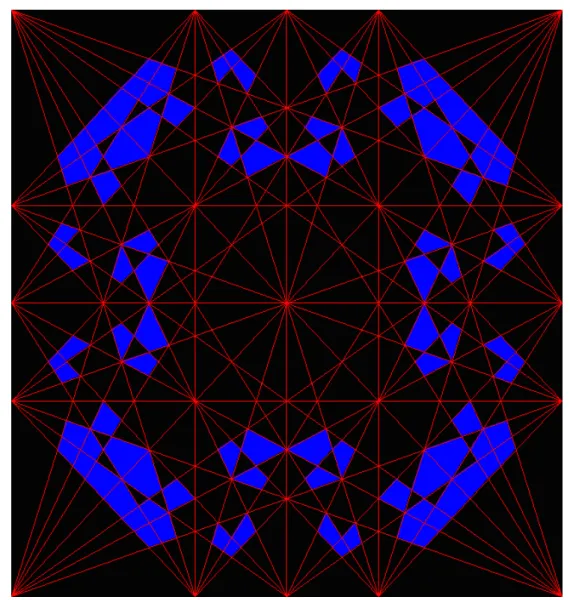
Journal of Algebra Combinatorics Discrete Structures and Applications
Erratum to “A further study for the upper bound of
the cardinality of Farey vertices and applications in
discrete geometry”
[J. Algebra Comb. Discrete Appl.
2(3) (2015) 169-190]
Erratum
Daniel Khoshnoudirad
Abstract: The equation (4) on the page 178 of the paper previously published has to be corrected. We had only handled the case of the Farey vertices for which min
2m sr0
,j n
s0r
k
∈ N∗. In fact we had
to distinguish two cases: min
2m sr0
,j n
s0r
k
∈ N∗ and min
2m sr0
,j n
s0r
k
= 0. However, we highlight the correct results of the original paper and its applications. We underline that in this work, we still brought several contributions. These contributions are: applying the fundamental formulas of Graph Theory to the Farey diagram of order(m, n), finding a good upper bound for the degree of a Farey vertex and the relations between the Farey diagrams and the linear diophantine equations.
2010 MSC:05A15, 05A16, 05A19, 05C30, 68R01, 68R05, 68R10
Keywords: Combinatorial number theory, Farey diagrams, Theoretical computer sciences, Discrete planes, Diophantine equations, Arithmetical geometry, Combinatorial geometry, Discrete geometry, Graph theory in computer sciences
1.
Introduction
In [9], one of the strategies for the enumeration of pieces of discrete planes, was to estimate the number of vertices in a Farey diagram. This work, combined with a basic property of Graph Theory, yields an upper bound. This upper bound is an homogeneous polynomial of degree 8: m3n3(m+n)2.
In [17], I found that the number of straight Farey lines is asymptotically mn(m+n)
ζ(3) whenmandn
go to infinity.
Henceforth, the strategy consisting in focusing on Farey lines to study Farey vertices combinatorics is not sufficient if we want to have a deeper understanding of the combinatorics of the(m, n)-cubes, and we can directly focus on the Farey vertices [17] with some tools of number theory.
The work which has been done for the case wheremin
2m sr0
,j n s0r
k
∈N∗, remains correct. But
the case wheremin
2m
sr0
,j n s0r
k
= 0has to be handled.
The goal of this study is to understand better how to bound|F V(m, n)| in an optimal way.
2.
Preliminaries
LetJ−m, mKdenote the set{−m, . . . ,−1,0,1, . . . , m}of consecutive integers between−mandm.
Definition 2.1. [17](Farey lines of order (m, n)) A Farey line of order (m, n) is a line whose equation is uα+vβ+w= 0 with(u, v, w)∈J−m, mK×J−n, nK×Z, and which has at least 2 intersection points with the frontier of [0,1]2. (u, v, w) are the coefficients. (α, β) are the variables. Let denote the set of Farey lines of order (m, n)by F L(m, n).
Definition 2.2. [14](Farey sequences of ordern) The Farey sequence of order nis the set
Fn= n
0o [
p q,
1≤p≤q≤n, p∧q= 1
We mention [14] as a forthcoming modern reference work on the Farey sequences. Several standard variants of the notion of Farey diagram are mentioned there.
Definition 2.3. (Farey vertex) A Farey vertex of order (m, n) is the intersection of two Farey lines in
[0,1]2. We will denote the set of Farey vertices of order (m, n), obtained as intersection points of Farey lines of order(m, n), byF V(m, n).
Definition 2.4. (Farey diagrams for the pieces of discrete planes of order(m, n)(or(m, n)-cubes)) The Farey diagram for the (m, n)-cubes of order (m, n) is the diagram defined by the passage of Farey lines in [0,1]2.
We recall thatb c denotes the integer part,d e denotes the upper integer part, andh idenotes the fractional part. If aand b are two integers, a∧b denotes the greatest common divisor of aand b, and
a∨bdenotes the least common multiple. ϕdenotes the Euler’s totient function. Card(A)or|A|denotes the cardinality of the setA.
Definition 2.5. (Farey edge) A Farey edge of order (m, n) is an edge of the Farey diagram of order
(m, n). We denote the set of Farey edges byF E(m, n).
Definition 2.6. (Farey graph) The Farey graph of order (m, n) is the graph F G(m, n) = (F V(m, n), F E(m, n)).
Definition 2.7. (Farey facet) A Farey facet of order(m, n)is a facet of the Farey graph of order (m, n). We will denote the set of Farey facets of order (m, n) byF F(m, n).
Let mand nbe two positive integers. We let Fm,n denote the set =J0, m−1K×J0, n−1K. Um,n
denotes the set of all(m, n)-cubes. Furthermore, the proposition 3 of [9] shows that the set of(m, n)-cubes of the discrete planes Pα,β,γ only depends of(α, β), and is denoted byCm,n,α,β.
Definition 2.8. [9]((m, n)-pattern) Let m and n be two positive integers. A (m, n)-pattern is a map
Figure 1. Farey lines of order(3,3)
Definition 2.9. [9]((m, n)-cube, see figure 2) The (m, n)-cube wi,j(α, β, γ) at the position (i, j) of a
discrete plane Pα,β,γ is the(m, n)-patternw defined by:
w(i0, j0) =pα,β,γ(i+i0, j+j0)−pα,β,γ(i, j) for all(i0, j0)∈ Fm,n
=bα(i+i0) +β(j+j0) +γc − bαi+βj+γc for all(i0, j0)∈ Fm,n
where pα,β,γ(i, j) =bαi+βj+γcand n
(i, j, pα,β,γ(i, j)),
(i, j)∈Z
2odefines the discrete planeP α,β,γ.
Now, we recall some results obtained in [9], and some direct consequences of this result.
Proposition 2.10. (Recall [9])
1. The(k, l)-th point of the(m, n)-cube at the position(i, j)of the discrete planePα,β,γ can be computed
by the formula :
wi,j(α, β, γ) (k, l) = (
bαk+βlc if hαi+βj+γi< Ck,lα,β
Figure 2. Example of two(4,3)-cubes (red and green)
whereCk,lα,β= 1− hαk+βli
2. The (m, n)-cube wi,j(α, β, γ) only depends on the interval [Bhα,β, Bhα,β+1[ containing hαi+βj+γi
where theBhα,β are the numberCk,lα,β ordered by ascending order.
3. For allh∈J0, mn−1K, if[Bhα,β, Bhα,β+1[is non-empty, then there existsi, jsuch thathαi+βj+γi ∈
[Bhα,β, Bhα,β+1[. Such a way, the number of (m, n)-cubes in the discrete plane Pα,β,γ is equal to
cardnCk,lα,β
(k, l)∈ Fm,n o
≤mn.
Corollary 2.11. [9]
1.
2.
∀(α, β, γ)∈[0,1]2×R,∀(i, j)∈Z2, w
i,j(α, β, γ) =w0,0(α, β, αi+βj+γ)
=w0,0(α, β,hαi+βj+γi)
3. By the proposition 2.10, the set of(m, n)-cubes of the discrete planesPα,β,γ only depends of(α, β)
and is denoted byCm,n,α,β.
Corollary 2.12. [9] Let Obe a Farey connected component, thenO is a convex polygon and ifp1, p2, p3 are distinct vertices of the polygonO, then :
• for any pointp∈ O,
Cm,n,p=Cm,n,p1∪ Cm,n,p2∪ Cm,n,p3
• for any pointp∈ O in the interior of the segment of verticesp1 andp2,
Cm,n,p=Cm,n,p1∪ Cm,n,p2
By this corollary, all the(m, n)-cubes are associated to Farey vertices. And according to the propo-sition2.10, there are at mostmn(m, n)-cubes associated to a Farey vertex, therefore
Um,n
≤mn
F V(m, n) .
3.
Fundamental properties and lemmas
Lemma 3.1. (Reminder of Graph Theory) Let us consider n straight lines. The number of vertices
constructed from these nlines is at most n(n−1)
2 .
We know by [17], that the number of Farey lines, is equivalent to a polynomial of degree 3 inmand
n, when mandngo to infinity. According to lemma3.1, these lines form a number of vertices, given at most by a polynomial of order 6 ([9]). But this method is far from giving an optimal upper bound for the cardinality of the Farey vertices. In order to obtain a new and more powerful result of combinatorics on this set of vertices, we are going to study the properties of the Farey lines passing through a Farey vertex. Our idea is to use the theorem:
Proposition 3.2. (Reminder of Graph Theory) In a simple graph G= (V, E), we have:
X
x∈V
deg(x) = 2|E|
where V is the set of vertices, andE is the set of edges, anddeg(x)is the degree of the vertexx, that is the number of edges which are adjacent to the vertexx.
Moreover, we remind the Euler’s Formula:
Theorem 3.3. (Euler’s formula for the connex planar graphs) In a connex planar multi-graph, having
V vertices,E edges, andF facets, we have:
4.
Bound for the degree of a farey vertex
4.1.
Modeling
Corollary 4.1. In F G(m, n),
|F E(m, n)| ≤ X
x∈F V(m,n)
nl(x, m, n)
where nl(x, m, n)denotes the number of Farey lines of order (m, n)passing through the vertex x.
Proof. InF G(m, n), because a Farey line generates at most2edges passing through the Farey vertex
P, we have:
deg(P)≤2×CardnFarey Lines passing throughPo (1)
So, by the handshaking proposition3.2,
2|F E(m, n)| ≤ X
x∈F V(m,n)
2nl(x, m, n)
We simplify by2, and we obtain the result.
Theorem 4.2. (Gauss theorem) If(a, b, c)∈Z3, such that a|bc, anda∧b= 1. Then,a|c.
Theorem 4.3. [2](Asymptotic development of the harmonic series) Ifx≥1, then
X
n≤x
1
n = logx+C+O(
1
x).
where C is Euler’s constant, and τ the divisor function.
We can apply this theorem and we are able to say in particular:
Corollary 4.4. There existsK >0 such that,∀n∈N\ {0,1}, we have
n X
i=1
1
i ≤Klogn.
Lemma 4.5. Let(a, b)∈N∗×N. Letx∈R.
bbxc
a
=
bx
a
Proof. There is a classical equality which already exists, wherea=b. Here, we generalize it :
bbxc
a −1<
bbxc
a
≤bx
a
We multiply by aall the members :
bbxc −a < a
bbxc
a
≤bx⇔ bbxc −a+ 1≤a
bbxc
a
So, using the definition of the integer part ofbx, we have
bx−a < a
bbxc
a
≤bx⇔ bx
a −1<
bbxc
a
≤bx
a
So, by the definition of the integer part of bx
a, we obtain the claim.
Proposition 4.6. (Upper bound for the number of Farey lines of order (m, n) passing through a Farey
vertex of order (m, n)) LetP =
p
q, p0 q0
be a Farey vertex of order(m, n). Let us define r, r0, s, s0, d and
d0 as follows:
p= (p∧p0)r, q= (q∧q0)s p0= (p∧p0)r0, q0= (q∧q0)s0 d=p∧p0, d0 =q∧q0
(2)
Let us define nlmax(P, m, n) as following:
nlmax(P, m, n) =
min
2m
sr0
,j n s0r
k
+ 1
×
2
1
d
mp q+n
p0 q0
+
2jm
sd0
k
+ min
2m
sr0
,j n s0r
k
.
• If(p, p0)∈N∗2. Then, we have
nl(P, m, n)≤nlmax(P, m, n)
• Ifp= 0 then we have
nl
0,p
0
q0
≤
1 +
n
q0
(2m+ 1).
The vertices such thatp= 0, are the vertices of the set
0,p
0
q0
with p 0
q0 ∈Fn
• Ifp0= 0, then we have
nl
p
q,0
≤
1 + 2
m
q
(n+ 1).
The vertices such thatp0 = 0are the vertices of the set
p
q,0
with p
q ∈Fm
Proof. We can always suppose that in the equation of a Farey line, (of the type: uα+vβ+w = 0, with(u, v, w)∈J−m, mK×J−n, nK×Z), we have v≥0. Because ifv <0, it is sufficient to multiply the
equation by−1. And we obtain the same line, but(−u,−v,−w)∈J−m, mK×J0, nK×Z.
First, we handle the case where p= 0or p0 = 0.
p= 0⇒p0v+q0w= 0⇒
(
v=q0k
w=−p0k ⇒0≤k≤ n
There are at most 1 +
n q0
such integers. And there are 2m+ 1integers in the interval J−m, mK. The vertices such that p= 0, are the vertices of the set
0,p
0
q0
with p
0
q0 ∈Fn
.
p0= 0⇒pu+qw= 0⇒
(
u=qk
w=−pk ⇒0≤ |k| ≤ m
q
There are at most1 + 2
m
q
such integers. The vertices such thatp0 = 0, are the vertices of the set
p q,0
with p
q ∈Fm
.
Then, it remains to handle the general case:
(p, p0)∈N∗2
So, we are looking for an optimal bound for the cardinality of (u, v, w)∈J−m, mK×J0, nK×Zsuch
that
up q +v
p0
q0 =−w⇔
upq0+vp0q qq0 =−w
(with the condition u∧v∧w= 1), that is
u(p∧p0)r(q∧q0)s0+v(p∧p0)r0(q∧q0)s
qq0 =−w.
(p∧p0)(q∧q0)urs
0+vr0s
(q∧q0)2ss0 =−w.
After simplification:
(p∧p0)urs
0+vr0s
(q∧q0)ss0 =−w.
(p∧p0)(urs0+vr0s) =−w(q∧q0)ss0
(p∧p0)urs0=−w(q∧q0)ss0−(p∧p0)vr0s
⇒s|(p∧p0)urs0
Ass∧[(p∧p0)rs0] = 1, the Gauss theorem4.2implies thats|u. So,
(
∃u0∈Zsuch thatu=su0
∃v0 ∈
Zsuch thatv=s0v0
(3)
Ifv= 0, then we have:
u=qk⇒1≤ |k| ≤jm
sd0
k
w=−pk⇒1≤ |k| ≤
1
p
mp q+n
p0 q0
So, in the case wherev= 0,
1≤ |k| ≤min
jm
sd0
k
,
1
p
mp q+n
p0 q0
.
We come back to the general equation (with v0 ≥1): In particular,
0≤ |u0| ≤jm
s
k
and1≤v0≤jn
s0
k
.
(p∧p0)su
0rs0+s0v0r0s
(q∧q0)ss0 =−w⇒(p∧p
0)u0r+v0r0
(q∧q0) =−w
(theorem of Gauss 4.2)
⇒(p∧p0)|wand(q∧q0)|u0r+v0r0.
And because of the non-redundancy hypothesis, we have:
u0∧v0|q∧q0
The diophantine equation becomes:
u0r+v0r0=−w
dd
0 (4)
When w is fixed, the consequence of the hypothesis of primality enables to solve this diophantine equation: Let us fixw,
u0= u0
− w
p∧p0(q∧q 0)
+r0k
v0 = v0
− w
p∧p0(q∧q 0)
−rkfork∈Z
(5)
where (u0, v0)is a particular solution of the diophantine equation in(x, y):
rx+r0y= 1.
In particular,
−jm
s
k
+u0
w
p∧p0
q∧q0 ≤r0k≤jm
s
k
+u0
w
p∧p0
q∧q0
−jn
s0
k
+v0
− w
p∧p0
q∧q0 ≤rk≤ −1−v0
w
p∧p0
q∧q0
(6)
The determinant of this system in
w
p∧p0, k
is:
u0q∧q0r+v0(q∧q0)r0 = (q∧q0)[u0r+v0r0] =q∧q0
Moreover, we have seen that as we have:
|w| ≤mp q+n
p0 q0,
and as p∧p0 |w, we can deduce that there existsw0 such thatw=w0(p∧p0). So,
0≤ |w0| ≤
1
p∧p0
mp q+n
p0 q0
• Ifw= 0, by the lemma4.5, the number of suitable integersk is bounded by
min2jm
sr0
k
,j n s0r
k
• w6= 0. We can always chooseu0<0andv0>0.
In these conditions, the number of suitable integersk is bounded by:
min
2m sr0
,j n s0r
k
and the number ofk,w d
is bounded by:
1 + min
2m
sr0
,j n s0r
k ×2 1 d mp q+n
p0 q0
And finally, the total number of couplesk,w d
is at most:
min
2m
sr0
,j n s0r
k + 1 × 2 1 d mp q +n
p0 q0 + 2 min jm sd0 k , 1 p mp q +n
p0 q0 + min 2m sr0
,j n s0r
k That is, min 2m sr0
,j n s0r
k + 1 × 2 1 d mp q +n
p0
q0
+
2jm
sd0 k + min 2m sr0
,j n s0r
k
So,
nl(P, m, n)≤nlmax(P, m, n)
Lemma 4.7. If we consider a Farey vertexV =
p q, p0 q0
of order(m, n), then
q∨q0≤2mn.
Proof. p q, p0 q0
∈F V(m, n)⇒
∃((u, u0),(v, v0),(w, w0))∈J−m, mK2×J−n, nK2×Z2
u0v−uv06= 0
such that: p q, p0 q0 =
|w0v−wv0|
|uv0−u0v|,
|wu0−w0u| |uv0−u0v|
So,
q∨q0| |uv0−u0v|.
In particular,
q∨q0≤2mn.
In particular,ss0d0 ≤2mn.
Proposition 4.8. Let
p
q, p0 q0
∈F V(m, n).
A(m, n, p, q, p0, q0) = min
2m
sr0
,j n s0r
k
B(m, n, p, q, p0, q0) = 2
1
d
mp q +n
p0 q0
C(m, n, p, q, p0, q0) =A(m, n, p, q, p0, q0)×B(m, n, p, q, p0, q0)
A0(m, n) = X
0≤p<q≤2mn p∧q=1
X
0≤p0<q0≤2mn
p0∧q0=1 min(b2m
sr0c,b n s0rc)∈N
∗
A(m, n, p, q, p0, q0)
B0(m, n) = X
1≤p<q≤2mn p∧q=1
X
1≤p0<q0≤2mn p0∧q0=1 min(b2m
sr0c,bsn0rc)∈N ∗
B(m, n, p, q, p0, q0)
C0(m, n) = X
1≤p<q≤2mn p∧q=1
X
1≤p0<q0≤2mn p0∧q0=1 min(b2m
sr0c,bsn0rc)∈N ∗
C(m, n, p, q, p0, q0)
D0(m, n) = X
x∈F V(m,n) min(b2m
sr0c,bsn0rc)=0
nl(x, m, n)
We have:
|F E(m, n)| ≤A0(m, n) + 2B0(m, n) +C0(m, n) +D0(m, n) (7)
+ X
p q∈Fm
nl
p q,0
+ X
p0 q0∈Fn
nl
0,p
0
q0
(8)
Proof. P(α, β)∈F V(m, n)⇒ ∃
p
q, p0 q0
such that:
α= p
q withp∧q= 1, p≤q≤2mn β = p
0
q0 withp
0∧q0 = 1, p0≤q0 ≤2mn
|F E(m, n)| ≤ X
x∈F V(m,n)
nl(x, m, n)
≤ X
x∈F V(m,n) min(b2m
sr0c,b n s0rc)∈N
∗
nl(x, m, n) + X
x∈F V(m,n) min(b2m
sr0c,b n s0rc)=0
nl(x, m, n)
+ X
p q∈Fm
nl
p
q,0
+ X
p0 q0∈Fn
nl
0,p
0
q0
To conclude, we use the result of the Proposition2.
4.2.
Case of the vertices for which
min
2
m
sr
0,
j
n
s
0r
k
∈
N
∗Proposition 4.9.
∃K >0,∀(m, n)∈(N\ {0,1})2, A0(m, n)≤Km2n2(m+n) ln2(mn).
Proof.
A0(m, n) X
0≤p<q≤2mn p∧q=1
X
0≤p0<q0≤2mn p0∧q0=1 min(b2m
sr0c,b n s0rc)∈N
∗
A(m, n, p, q, p0, q0)
≤
2mn X
d0=1
b2mn d0 c
X
s=1
b2mn d0sc
X
s0=1
d0s X
r=1
bn s0c≥r
d0s0 X
r0=1
b2m s c≥r
0 j
min(d0s r ,
d0s0 r0 )
k X d=1 min 2m sr0
,j n s0r
k
I point out that I choosed j n
s0r
k
, and after
2m sr0
, in order to obtain a symmetric upper bound. In the
following, we use the boundaries for r, r0, s, s0 given by: Let us permute the sums and let us change the variables by using, as before,
r = p
p∧p0, s=
q q∧q0
r0 = p
0
p∧p0, s 0= q0
q∧q0
d =p∧p0, d0=q∧q0
⇒
1≤s≤2mn
d0
1≤s0 ≤2mn
d0
1≤r≤d
0s
d
1≤r0≤ d
0s0
d In particular,
r≤d
0s
d r0 ≤d 0s0
d
⇒d≤
min
d0s
r , d0s0
r0
A0(m, n)≤
m+n X
d=1 2mn X
d0=1
b2mn d0 c
X
s=1
b2mn d0sc
X
s0=1 j
d0s d
k
X
r=1 j
d0s0 d
k
X
r0=1
j n
s0r
k
≤
2mn X
d0=1
b2mn d0 c
X
s=1
b2mn d0sc
X
s0=1
d0s X
r=1 d0s0 X
r0=1
j n
s0r
k
j min(d0s
r ,d 0s0 r0 )
k
X
d=1
1
Now, we have to distinguish the case whered0s= 1and the cased0s >1 in the sums in order to use the corollary4.4(and the same ford0s0).
∃K >0,∀(m, n)∈(N\ {0,1})2,
A0(m, n)≤
2mn X
d0=1
b2mn d0 c
X
s=1
b2mn d0sc
X
s0=1
d0s X
r=1 d0s>1
d0s0 X
r0=1 d0s0>1
d0 n
rr0 +Km
2n3ln2
(mn)
≤K0nln2(mn)
2mn X
d0=1
d0
b2mn d0 c
X
s=1
b2mn d0sc
X
s0=1
1 +Km2n3ln2(mn)
≤K0nln2(mn)
2mn X
d0=1
d0
b2mn d0 c
X
s=1
2mn d0s +Km
2n3ln2
(mn)
A0(m, n)≤K0nln2(mn)
2mn X
d0=1
b2mn d0 c
X
s=1
2mn s +Km
2n3ln2(mn)
≤K0nln2(mn)
2mn X
s=1
b2mn s c
X
d0=1
2mn s +Km
2n3ln2(mn)
≤K0m2n3ln2(mn)
2mn X
s=1
1
s2 +Km 2n3ln2
(mn)
≤K00m2n3ln2(mn)
∃K >0,∀(m, n)∈(N\ {0,1})2,
A0(m, n)≤ X
1≤p<q≤2mn p∧q=1
X
1≤p0<q0≤2mn p0∧q0=1
A(m, n, p, q, p0, q0)
≤
m+n X
d=1 2mn X
d0=1
b2mn d0 c
X
s=1
b2mn d0sc
X
s0=1 d0s
d
X
r=1
d0s0 d
X
r0=1
2m sr0 ≤ 2mn X
d0=1
b2mn d0 c
X
s=1
b2mn d0sc
X
s0=1
d0s X
r=1 d0s0 X
r0=1
jm
sr0
k
j min(d0s
r , d0s0
r0 ) k
X
d=1
≤
2mn X
d0=1
b2mn d0 c
X
s=1
b2mn d0sc
X
s0=1
d0s X
r=1 d0s0 X
r0=1
m sr0
d0s r
≤
2mn X
d0=1
b2mn d0 c
X
s=1
b2mn d0sc
X
s0=1
d0s
X
r=1 d0s>1
d0s0
X
r0=1 d0s0>1
d0 m rr0 +Kn
2m3ln2
(mn)
≤K0mln2(mn)
2mn X
d0=1
d0
b2mn d0 c
X
s=1
b2mn d0sc
X
s0=1
1 +Kn2m3ln2(mn)
≤K0mln2(mn)
2mn X
d0=1
b2mn d0 c
X
s=1
2mn d0s +Kn
2m3ln2
(mn)
≤K0m2nln2(mn)
2mn X
d0=1
b2mn d0 c
X
s=1
1
s+Kn
2m3ln2(mn)
≤K00n2m3ln2(mn)
Proposition 4.10.
∃K >0,∀(m, n)∈(N\ {0,1})2, B0(m, n)≤Km2n2(m+n).
Proof.
B0(m, n) = X
0≤p<q≤2mn p∧q=1
X
0≤p0<q0≤2mn p0∧q0=1 min(b2m
sr0c,b n s0rc)∈N
∗
B(m, n, p, q, p0, q0)
≤[B01(m, n) +B20(m, n)]
B10(m, n)≤m
2mn X
d0=1
b2mn d0 c
X
s=1
b2mn d0sc
X
s0=1
d0s X
r=1
bn s0c≥r
d0s0 X
r0=1
b2m s c≥r
0 j
min(d0s r ,
d0s0 r0 )
k
X
d=1
r q
B20(m, n)≤n
2mn X
d0=1
b2mn d0 c
X
s=1
b2mn d0sc
X
s0=1
d0s X
r=1
bn s0c≥r
d0s0 X
r0=1
b2m s c≥r
0 j
min(d0s r ,
d0s0 r0 )
k
X
d=1
r0 q0
B10(m, n)≤m
2mn X
d0=1
b2mn d0 c
X
s=1
b2mn d0sc
X
s0=1
d0s X
r=1
bn s0c≥r
d0s0 X
r0=1
b2m s c≥r
0 j
min(d0s r ,
d0s0 r0 )
k X d=1 r q ≤m 2mn X
d0=1
b2mn d0 c
X
s=1
b2mn d0sc
X
s0=1
d0s X
r=1
bn s0c≥r
d0s0 X
r0=1
b2m s c≥r
0
1
≤m2n
2mn X
d0=1
b2mn d0 c
X
s=1
b2mn d0sc
X
s0=1
1
ss0
≤K0m3n2
2mn X
s=1 2mn X
s0=1
1
s2s02
≤K00m2n2(m+n)
The computation is exactly the same for B20(m, n).
Proposition 4.11.
∃K >0,∀(m, n)∈(N\ {0,1})2, C0(m, n)≤Km2n2(m+n) ln(mn).
Proof.
C0(m, n) = X
0≤p<q≤2mn p∧q=1
X
0≤p0<q0≤2mn
p0∧q0=1 min(b2m
sr0c,b n s0rc)∈N
∗
C(m, n, p, q, p0, q0)
≤ X
1≤p<q≤2mn p∧q=1
X
1≤p0<q0≤2mn p0∧q0=1 min(b2m
sr0c,b n s0rc)∈N
∗
A(m, n, p, q, p0, q0)×B(m, n, p, q, p0, q0)
≤K[C10(m, n) +C
0
2(m, n)]
C10(m, n) =mn
2mn X
d0=1
b2mn d0 c
X
s=1
b2mn d0sc
X
s0=1
d0s X
r=1
bn s0c≥r
d0s0 X
r0=1
b2m s c≥r
0 j
min(d0s r ,d
0s0 r0 )
k
X
d=1
1
s0r
1
d p q
C20(m, n) =mn
2mn X
d0=1
b2mn d0 c
X
s=1
b2mn d0sc
X
s0=1
d0s X
r=1
bn s0c≥r
d0s0 X
r0=1
b2m s c≥r
0 j
min(d0s r ,d
0s0 r0 )
k X d=1 1 sr0 1 d p0 q0
∃K >0,∀(m, n)∈(N\ {0,1})2,
C10(m, n)≤mn
2mn X
d0=1
b2mn d0 c
X
s=1
b2mn d0sc
X
s0=1
d0s X
r=1
bn s0c≥r
d0s0 X
r0=1
b2m s c≥r
0 j
min(d0s r ,d
0s0 r0 )
k
X
d=1
1
ss0d0
≤mn
2mn X
d0=1
b2mn d0 c
X
s=1
b2mn d0sc
X
s0=1
d0s X
r=1
bn s0c≥r
d0s0 X
r0=1
b2m s c≥r
0
d0s0 r0
1
ss0d0
≤mn
2mn X
d0=1
b2mn d0 c
X
s=1
b2mn d0sc
X
s0=1
d0s
X
r=1
bn s0c≥r
d0s0
X
r0=1
b2m s c≥r
0
d0s0>1
1
r0s+Km
2n3ln(mn)
≤K0mn2ln(mn)
2mn X
d0=1
b2mn d0 c
X
s=1
b2mn d0sc
X
s0=1
1
ss0 +Km
2n3ln(mn)
≤K0m2n3ln(mn)
b2mn d0 c
X
s=1
b2mn d0sc
X
s0=1
1
s2s02+Km
2n3ln(mn)
≤K00m2n3ln(mn)
The computation is exactly the same for C20(m, n).
4.3.
Cases of the vertices for which
p
= 0
or
p
0= 0
Now, we treat the two simple cases wherep= 0orp0= 0 of the proposition4.6: Proposition 4.12.
∃K >0,∀(m, n)∈N∗2,
X
p0 q0∈Fn
nl
0,p
0
q0
+ X
p q∈Fm
nl
p q,0
≤Kmn(m2+n2).
Proof. • 1 + n q0
(2m+ 1)
≤2m+ 1 + 2nm+n≤5mn+ 1
X
p0 q0∈Fn
nl
0,p
0
q0
≤ X
p0 q0∈Fn
1 + n q0
(2m+ 1)
≤ X
p0 q0∈Fn
(5mn+ 1)≤(5mn+ 1)|Fn|
•
1 + 2
m
q
(n+ 1)
≤n+ 1 + 2mn+ 2m≤5mn+ 1
X
p q∈Fm
nl
p q,0
≤ X
p q∈Fm
1 + 2
m q
(n+ 1)
≤ X
p q∈Fm
We know [12] that
|Fn|= 1 + n X
k=1
ϕ(k) ∼
+∞
n2
2ζ(2)
So there exists K >0 such that
X
p0 q0∈Fn
nl
0,p
0
q0
+ X
p q∈Fm
nl
p q,0
≤Kmn(m2+n2).
4.4.
Case of the vertices for which
min
2
m
sr
0,
j
n
s
0r
k
= 0
It remains to handle the case of the vertices for which min
2m
sr0
,j n s0r
k
= 0. At this stage of
our research, we are not yet able to bound this termD0(m, n).
5.
Conclusion of this strategy
By the strategy of the Farey vertices, we obtained some interesting results:
• We applied the fundamental formulas of Graph Theory to the Farey diagram of order(m, n).
• We found a good upper bound for the degree of a Farey vertex.
• We made relations between the Farey diagrams and the linear diophantine equations by solving explicit systems of linear diophantine equations.
However, at the moment, this method does not help to improve the known upper bound for the cardinality of the Farey vertices.
We suggest two possible ways of future research for bounding this termD0(m, n).
• Either
∃K >0,∀(m, n)∈(N\ {0,1})2, D0(m, n)≤Km2n2(m+n) ln2(mn).
In that case, we could conclude that :
∃K >0,∀(m, n)∈(N\ {0,1})2,
F V(m, n)
≤Km
2n2(m+n) ln2
(mn)
• Otherwise we have to search a bound whose order is between 5 and 6. If the optimal order is 6, that would strenghten the importance of our work [17], as it would probably mean that the order of the cardinality of Farey vertices is a homogeneous polynomial of order6.
References
[1] D. M. Acketa, J. D. Žunić, On the number of linear partitions of the(m, n)−grid, Inform. Process. Lett. 38(3) (1991) 163–168.
[2] T. M. Apostol, Introduction to Analytic Number Theory, Springer-Verlag, 1976.
[3] T. Asano, N. Katoh, Variants for the Hough transform for line detection, Comput. Geom. 6(4) (1996) 231–252.
[4] C. A. Berenstein, D. Lavine, On the number of digital straight line segments, IEEE Trans. Pattern Anal. Mach. Intell. 10(6) (1988) 880–887.
[5] J. M. Chassery, D. Coeurjolly, I. Sivignon, Duality and geometry straightness, characterization and envelope, Discrete geometry for computer imagery, 1–16, Lecture Notes in Comput. Sci., 4245, Springer, Berlin, 2006.
[6] J. M. Chassery, A. Montanvert, Geometrical representation of shapes and objects for visual percep-tion, Geometrical representation of shapes and objects for visual perception. In: Geometric Reasoning for Perception and Action, vol. 708 of LNCS, pp. 163–182. Springer, Berlin, 1993.
[7] D. Coeurjolly, Algorithmique et géométrie discrete pour la caractérisation des courbes et des surfaces, Phd-Thesis, Université Lumière-Lyon II, 2002.
[8] D. Coeurjolly, I. Sivignon, F. Dupont, F. Feschet, J. -M. Chassery, On digital plane preimage struc-ture, Discrete Appl. Math. 151(1-3) (2005) 78–92.
[9] A. Daurat, M. Tajine, M. Zouaoui, About the frequencies of some patterns in digital planes applica-tion to area estimators, Comput. Graph. 33(1) (2009) 11–20.
[10] I. Debled-Rennesson, Etude et reconnaissance des droites et plans discrets, PhD thesis, Université Louis-Pasteur, 1995.
[11] E. Domenjoud, D. Jamet, D. Vergnaud, L. Vuillon, Enumeration formula for(2, n)−cubes in discrete planes, Discrete Appl. Math. 160(15) (2012) 2158–2171.
[12] G. H. Hardy, E. M. Wright, Introduction À La Théorie Des Nombres, Traduction de François Sauvageot, Springer, 2007.
[13] P. Haukkanen, J. K. Merikoski, Asymptotics of the number of threshold functions on a two-dimensional rectangular grid, Discrete Appl. Math. 161(1-2) (2013) 13–18.
[14] A. Hatcher, Topology of Numbers, Unpublished book, in preparation; see http://www.math.cornell.edu/~hatcher/TN/TNpage.html.
[15] W. Hou, C. Zhang, Parallel-beam ct reconstruction based on mojette transform and compressed sensing, Int. J. Comput. Electr. Eng. 5(1) (2013) 83–87.
[16] Y. Kenmochi, L. Buzer, A. Sugimoto, I. Shimizu, Digital planar surface segmentation using local geometric patterns, Discrete geometry for computer imagery, 322–333, Lecture Notes in Comput. Sci., 4992, Springer, Berlin, 2008.
[17] D. Khoshnoudirad, Farey lines defining Farey diagrams and application to some discrete structures, Appl. Anal. Discrete Math. 9(1) (2015) 73–84.
[18] A. O. Matveev, Relative blocking in posets, J. Comb. Optim. 13(4) (2007) 379–403.Corrigendum: arXiv:math/0411026.
[19] A. O. Matveev, A note on Boolean lattices and Farey sequences, Integers. 7(A20) (2007) 1–7.
[20] A. O. Matveev, A note on Boolean lattices and Farey sequences II, Integers. 8(A24) (2008) 1–8.
[21] A. O. Matveev, Neighboring fractions in Farey subsequences, arXiv:0801.1981, 2008.
[22] M. D. Mcllroy, A note on discrete representation of lines, AT&T Tech. J. 64(2) (1985) 481–490.
[23] E. Remy, E. Thiel, Structures dans les sphéres de chanfrein, RFIA. (2000) 483–492.
[24] E. Remy and E. Thiel, Exact medial axis with euclidean distance, Image Vision Comput. 23(2) (2005) 167–175.
[25] I. Svalbe, A. Kingston, On correcting the unevenness of angle distributions arising from integer ratios lying in restricted portions of the Farey plane, Combinatorial image analysis, 110–121, Lecture Notes in Comput. Sci., 3322, Springer, Berlin, 2005.
(1983) 381–392.
[27] G. Tenenbaum, Introduction to Analytic and Probabilistic Number Theory, Cambridge University Press, 1995.
[28] E. Thiel, Les distances de chanfrein en analyse d’images:fondements et applications,PhD thesis, Université Joseph-Fourier-Grenoble I, 1994.
[29] E. Thiel, A. Montanvert, Chamfer masks: discrete distance functions, geometrical properties and optimization, Pattern Recognition, 1992. Vol. III. Conference C: Image, Speech and Signal Analysis, Proceedings., 11th IAPR International Conference on. IEEE, 1992.
[30] R. Tomás, From Farey sequences to resonance diagrams, Phys. Rev. ST Accel. Beams. 17(1) (2014) 014001-1–014001-3.
[31] R. Tomás, Asymptotic behavior of a series of Euler’s totient functionϕ(k)times the index of1/kin a Farey sequence, arXiv:1406.6991, 2014.