ORIGINAL RESEARCH ARTICLE
Fertility after Endoscopic Surgery for Ectopic Pregnancy
Management in Point "G” Teaching Hospital, Bamako-Mali
DOI: 10.29063/ajrh2020/v24i1.12
Youssouf Traoré
1, Soumaila
Keita
2, Sékou Koumaré
2, Lamine Soumaré
2, Oumar Sacko
2,
Aboubacar Camara
2, Moussa Camara
2, Moussa Sissoko
2, A Sissoko
3, Tiounkany Théra
3,
Ahmadou Coulibaly
3, Seydou Fané
1, Amadou Bocoum
1, Adama Koita
2and Zimogo Z Sanogo
2Faculty of medicine and Odontostomatology of Bamako, USTTB1; Surgery and endoscopic department of Point ―G‖ Teaching Hospital, Bamako2; Gynecology and obstetrics department of Point ―G‖ Teaching Hospital, Bamako3
*For Correspondence: Email: [email protected]; [email protected]; Phone: (+223) 66710194
Abstract
Endoscopic surgery of ectopic pregnancy is actually the gold standard for the management of fallopian tubal diseases. A survey was conducted to evaluate fertility in patients who underwent endoscopic management for ectopic pregnancy. A retrospective study was conducted at the department of general and endoscopic surgery of the Point "G" teaching hospital, in Bamako, Mali, from January 1st 2007 to December 31, 2016. Forty-eight (48) patients who underwent endoscopic management of tubal ectopic pregnancy and who have been followed up for fertility were included in this study. Statistical tests used were X2 or Fisher test and their confident interval, p<1 % has been considered as statistically significant. The therapeutic score of Pouly was less than 4 in 25.0% (n = 12). The return to fertility was observed among 48.0% of patients (n = 23). The chance of conception was less than 80.0% after the fourth postoperative year (p=0.001). The outcome of pregnancies has been seventeen full-term pregnancies, three ectopic pregnancies and three miscarriages. The occurrence of pregnancy after endoscopic management indicated for ectopic pregnancy is possible. However, many factors can influence the future conception. (Afr J Reprod Health 2020; 24[1]: 115-120).
Keywords: Extra-uterine pregnancy, tubal abnormality, endoscopic management, Mali
Résumé
La chirurgie endoscopique de la grossesse extra-utérine est en fait l'étalon-or pour la gestion des maladies des trompes de Fallope. Une enquête a été menée pour évaluer la fécondité auprès des patientes qui ont subi une prise en charge endoscopique pour une grossesse extra-utérine. Une étude rétrospective a été menée au service de chirurgie générale et endoscopique du Centre Hospitalier Universitaire du Point "G", à Bamako, Mali, du 1er janvier 2007 au 31 décembre 2016. Quarante-huit (48) patientes ayant subi une prise en charge endoscopique des trompes de la grossesse extra-utérine et qui ont été suivies pour la fécondité ont fait partie de cette étude. Les tests statistiques utilisés étaient le test X2 ou Fisher et leur intervalle de confiance, p <1%, a été considéré comme statistiquement significatif. Le score thérapeutique de Pouly était inférieur à 4 sur 25,0% (n = 12). Le retour à la fécondité a été remarqué chez 48,0% des patients (n = 23). Le risque de conception était inférieur à 80,0% après la quatrième année postopératoire (p = 0,001). Le résultat des grossesses a été de dix-sept grossesses à terme, trois grossesses extra-utérines et trois fausses couches. La survenue d'une grossesse après une prise en charge endoscopique indiquée pour une grossesse extra-utérine est possible. Cependant, de nombreux facteurs peuvent influencer la conception future. (Afr J Reprod Health 2020; 24[1]: 115-120).
Mots-clés: Grossesse extra-utérine, anomalie tubaire, prise en charge endoscopique, Mali
Introduction
The incidence of ectopic pregnancy has been estimated to range from 2.7 to 12.9 per 1000 diagnosed conceptions, pregnancies, or live births for women in the normal reproductive rangel-4. It appears to be increasing over the last few decades
19916. In Mali, ectopic pregnancy ranks second among gynecological and obstetric emergencies after caesarean section8.
It is associated with high mortality that increased from 6% - 10% if diagnosis and management is delayed9. Early intervention carries significant better prognosis10. Furthermore, surgery can be avoided if management starts before tubal rupture and cardiovascular compromise11. Ectopic pregnancy is a serious condition that can be life-threatening during the first trimester of pregnancy and compromises subsequent fertility. Hence, it cannot be over emphasized that early diagnosis is of paramount importance9.
For two decades, the progressive increase in the frequency of extra-uterine pregnancy in developed countries has been accompanied by a revolution in its diagnosis and treatment. Ectopic pregnancy is more and more treated by conservative endoscopic and medical methods12. When laparoscopic surgery is indicated, either salpingotomy (i.e. conserving the fallopian tube and removing only the trophoblast) or salpingectomy (i.e. complete removal of the fallopian tube) can be used13. In developed countries, medical treatment and conservative laparoscopic surgery are the best methods of management of ectopic pregnancies11,14,15. Over the course of the last decade, the laparoscopic approach has emerged as the technique of choice for direct visualization of ectopic gestation, offering a convenient modality for both diagnosing the condition and managing it in a timely fashion7. In addition to acute morbidity, ectopic pregnancy may decrease future fertility16. Endoscopic management of ectopic pregnancy helps to preserve fertility, limit the risk of recurrence and therapeutic morbidity17. Theoretically, the preservation of the Fallopian tube via salpingotomy should partially increase the probability of intra uterine pregnancy (IUP)17.
Several studies have reported burden of ectopic pregnancy in gynecological admission and its prognosis12,18. However, there are few data that have assessed the fertility among women who have benefited endoscopic management for ectopic pregnancy. Although endoscopic management of ectopic pregnancy can
theoretically improve fertility, controversies exist on the data existing in the literature.
This survey aims to assess the return to fertility and to describe the factors influencing it in laparoscopic surgery for extra uterine pregnancy. The therapeutic scoring system (TSS) for ectopic pregnancy described by Pouly19 has been used to undertake the type of surgery (conservative treatment, salpingectomy or salpingectomy associated to sterilization of the contralateral salpinx).
Methods
Study setting
Our study was conducted in the endoscopic department of Point ―G‖ teaching hospital. It is an endoscopic training and care center. The management of infertile patients has been done in collaboration with the obstetrics and gynecology department of the same hospital.
Type and period of survey
It was an analytical cross-sectional retrospective study that took place from January 1st 2007 to December 31, 2016.
Inclusion criteria
Was included in this study any patient operated for tubal ectopic pregnancy by endoscopic route at the Point G teaching hospital. Each patient had to be followed up for a minimum of 7 years since leaving the hospital.
Non-inclusion criteria
Were excluded in this study any patient operated for other infertility factors and whose partners had semen abnormalities.
Sample and sampling
Clinical records of forty-eight patients have been included in the study.
Data collection and analysis
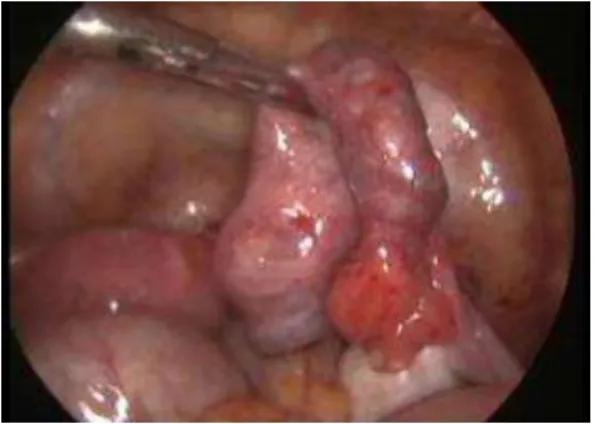
Figure1: Unruptured ectopic pregnancy
Figure2: Cross-coagulation of the fallopian tube
Figure 3: Extraction of the trophoblast after salpingotomy
prenatal care documents. Patients have been followed-up from operative date up to a minimum of 7 years. The parameters that have been studied
were age of patients, the therapeutic score for ectopic pregnancy, site of pregnancy, macroscopic aspect of the contralateral fallopian tube, therapeutic measures, conception times after surgery, outcome of the pregnancies and the factors influencing conception.
SPSS version 23.0 has been used to compute the data, then they were analyzed with Epi info 7.0 version. Pearson Chi square has been used for qualitative variables and when the number of observations was ≥ 5); Fisher‘s exact test was used when the number of observations obtained for analyze is inferior to 5 (n<5) , Odd ratio (OR) and its confidence interval at 95% (IC95%); P value < 1% has been considered
statistically significant.
Results
Frequency
During the study period, one thousand two hundred and sixty three (1263) surgical procedures have been performed, including forty eight endoscopic managements that have been indicated for ectopic tubal pregnancy (3.8%).
Characteristics of the patients and data
related to the ectopic pregnancy
The mean age of the patients was 29.6 ± 7 years (Range 16 to 41 years) with a median age of 30 years. The sites of the pregnancy were the right tube (85.4%), the fimbrial tube (56.2%) (n = 27), the ampulla (27.1%) (n = 13), the isthmus (6.3%) (n = 3). In 10.4% of the cases the site was not specified. Twenty-eight cases of hematosalpinx (58.3%n = 28), 8.4 % (n = 4) of tubo-abdominal abortion and 33.3% (n = 16) cases of intra peritoneum bleeding, were noticed. The therapeutic score of Pouly was under 4 in 25.0% (n = 12).
Fertility after endoscopic surgery
Table 1: Relation between intervention types and fecundity of patients (n = 48)
Birth n (%)
EP n (%)
Miscarriage n (%)
No pregnancy n (%)
Total n (%) P Salpingectomy 0 (0.0) 0 (0.0) 0 (0.0) 2 (4.2) 2 (4.2) - Salpingostomy 12 (25.0) 2 (4.2) 1 (2.5) 17 (35.4) 32 (66.7) 0.000 TAA 1 (2.5) 0 (0.0) 0 (0.0) 3 (6.3) 4 (8.3) 0.051 Fimbrial compression 2 (4.2) 1 (2.5) 0 (0.0) 3 (6.3) 6 (12.5) 0.035 IABA 2 (4.2) 0 (0.0) 2 (4.2) 0 (0.0) 4 (8.3) 0.007 Total 17 35.4) 3 (6.3) 3 (6.3) 25 (52.1) 48 100.0)
TAA: Tubo-abdominal abortion; IABA: Intra-abdominal blood aspiration
Table 2: Relation between contralateral tubal aspect and fecundity among patients (n=48)
Birth n (%)
EP n (%)
Miscarriage n (%)
No pregnancy n (%)
Total
n (%) P Normal aspect 10 (20.8) 1 (2.5) 3 (6.3) 2 (4.2) 2 (4.2) 0.005 Abnormal aspect 3 (6.3) 2 (4.2) 0 (0.0) 17 (35.4) 32 (66.7) 0.009 Absence of oviduct 2 (4.2) 0 (0.0) 0 (0.0) 3 (6.3) 4 (8.3) 0.002 No description 2 (4.2) 0 (0.0) 0 (0.0) 3 (6.3) 6 (12.5) - Total 17 (35.4) 3 (6.3) 3 (6.3) 25 (52.1) 48 (100.0)
The outcome of pregnancies was seventeen full-term pregnancies, three ectopic pregnancies and three miscarriages. In the Table 1 is shown the fertility rates according to the treatment performed. Table 2 describes contralateral fallopian tubal aspect and fecundity of patients who have undergone endoscopic management for ectopic pregnancy.
Discussion
Laparoscopic management of tubal ectopic pregnancy accounted for 3.8% of laparoscopic surgery activities. It is the golden standard for the management of ectopic pregnancy20. The main characteristics of patients with ectopic pregnancy found in our study are the same elsewhere21. The right tubal location accounted for 85.4%; no bilateral extra-uterine has been noted. However, all the parts of oviduct tubal were concerned by ectopic pregnancy in our survey.
The return to fertility determined by the occurrence of conception regardless of the outcome of pregnancy has been noted in less than half of the patients. This can be explained by the persistence of the causes of infertility in twenty five patients of our study and the high number of them who had Pouly‘s score more than 3. Conception was null in cases of radical treatment regardless of the tube morphological aspect. That
should be related to the severity of tubal disease. Most of the patients with term pregnancies had normal contralateral fallopian tube. The absence of fecundity has been noted when contralateral fallopian tube was seemingly normal. Thus, the macroscopic appearance of the contralateral fallopian tube did not seem to affect fertility (P> 0.05) but seemed to influence the outcome of the pregnancy as well as the nature of the laparoscopic procedure (P = 0.001). A review of the literature by Tulandi22, concerning the results of fertility after laparoscopic treatment of ectopic pregnancy, concluded that the risks of this pathology, all patients combined, seem comparable, that the treatment was conservative or radical and that the risk of recurrence remains high after salpingectomy. Fernandez23 and Dubuisson24 reported recurrence rates of 11% and 15%, respectively, after laparoscopic salpingectomy.
Many factors can affect the occurrence of pregnancy after endoscopic surgery indicated for ectopic pregnancy. They are the presence or persistence of infertility causes such as hydrosalpinx, adhesions, uterine myoma23,25, contralateral fallopian tube anatomic abnormalities, non-conservative surgery of the oviduct and age of the patients.
endoscopic management, some controversies still exist17,26-29. Actually, fertility is better after conservative surgery when contralateral tube is altered26. In other situations, the results of the treatments seem to be similar26. So, further research is needed to determine whether endoscopic surgery for ectopic pregnancy can improve fertility of patients.
Ethical Considerations
The written informed consent has been obtained before the endoscopic surgery of all the patients.
Conclusion
The laparoscopic approach is currently the golden standard for the treatment of ectopic pregnancy. Our study clearly demonstrates that occurrence of pregnancy after endoscopic management indicated for ectopic pregnancy is possible. However, many factors can influence the future conception. We suggest that a randomized study in African context be done to appreciate fertility after endoscopic treatment.
Acknowledgement
Our acknowledgement is for all the health agents who have contributed to the management of our patients and the collection of data.
Contribution of Authors
:We declare that all the authors mentioned in this manuscript have contributed in the conception, collection and analysis of the data as well as the preparation of the manuscript. So, all of them approved it.
References
1. Barnes AB, Wennberg CN and Barnes BA. Ectopic pregnancy. Incidence and review of determinant factors. Obstet Gynaecol Surv 1983; 38(6):345-56 2. Strathy JH, Coulam CB, Marchbanks P and Annegers
JF. Incidence of ectopic pregnancy in Rochester, Minnesota, 1950-1981. Obstet Gynecol 1984; 64(1) :37-43
3. Rubin GL, Peterson MB, Dorfman SF, Layde PM, Maze
JM, Ory HW and Kope W. Ectopic pregnancy in the United States. 1970 through 1978. JAMA 1983; 249 (13): 1725-9
4. Westrom L, Bengtsson LPH and Mardh PA. Incidence, trend and risks of ectopic pregnancy in a population of women. Br Med J 1981; 282, 6257:15-8 5. Francisca M and Alan T. An analysis of factors
associated with ectopic pregnancy in a human in vitro fertilization program. Fertility and sterility 1986 ; 45 (1) : 79 – 87
6. Saraiya M, Berg CJ, Shulman H, Green CA and Atrash HK. Estimates of the Annual Number of Clinically Recognized Pregnancies in the United States, 1981-1991. Am J Epidemiol 1999; 149: 1025-1029. 7. Lifeng C, Danpeng Z, Qing W and Yan Y. Fertility
outcomes after laproscopic salpingectomy or salpingotomy for tubal ectopic pregnancy: A retrospective cohort study of 95 patients. International Journal of surgery 2017; 48: 59 – 63 8. Traoré Y, Teguete I, Thera AT, Mulbah JK, Kane F,
Mounkoro N, Diarra I, Diabate FS, Traore M and Dolo A. Extra-uterine and intra-uterine pregnancy association: three cases report. Mali medical 2006; Tome XXI, 4: 34 - 8
9. Awatuf E and Seema S. A Case of Ectopic Pregnancy. An Unusual Diagnostic Challenge and Lesson Learnt. Open Journal of Obstetrics and Gynecology 2015; 5:192- 4
10. Dialani V and Levine D. Ectopic Pregnancy. A Review. Ultrasound Quarterly 2004; 20, 105-17.
11. Murray H, Baakdah H, Bardell T and Tulandi T. Diagnosis and Treatment of Ectopic Pregnancy. CMAJ 2005, 173:905-12.
12. Koumare S, Soumare L, Sissoko M, Keita S, Camara M, Sacko O, Camara A, Sima M, Traoré M, Dicko H, Bengali B, Traoré D, Togo S, Koné D, Diallo S, Sangaré M, Koïta A, Sanogo ZZ and Sangaré D. Evaluation of 15 Years Practice of Coelioscopic Treatment of Ectopic Pregnancy in the Surgery Department ―A‖ at the University Hospital Point G. Surgical Science 2018; 9:454-60.
13. Thomas D and Carla T. Surgery for ectopic pregnancy: making the right choice. The Lancet 2014; 383:1444 – 5
14. Davut G, Kadir B and Sertaç BA. Local metothrexate treatment of cesarean scar ectopic pregnancy Open Journal of Obstetrics and Gynecology 2012; 2: 329-30.
15. Fletcher H, Buchanan K and Jacob L. Conservative treatment of unruptured ectopic pregnancy in Jamaica. Open Journal of Obstetrics and Gynecology 2011; 1: 6-11
16. Hsu JY, Chen I, Gumer AR, Tergas AI, Hou JY, Burke WM, Ananth CV, Hershman DL and Wright JD. Disparities in the management of ectopic pregnancy. Am J Obstet Gynecol 2017; 207: 1 – 10 17. Cheng X, Tian X, Yan Z, Jia M, Deng J, Wang Y and
pregnancy: A systematic review and meta-analysis. Plos One 2016; 11 (3): 1–16
18. Oppong, AA, Agbemenyah HY, Afeke I, Jamfaru I,Attachie I and Orish VN. Ectopic Pregnancy in a Referral Hospital in the Volta Region of Ghana West Africa. Open Access Library Journal 2016; 3 (9) : 1-9.
19. Pouly JL, Chapron C, Manhes H, Canis M, Wattiez A and Bruhat MA. Multifactorial analysis of fertility after conservative laparoscopic treatment of ectopic pregnancy in a series of 223 patients. Fertil Steril 1991; 56: 453 – 60.
20. Lundorff P, Thornburg J, Hahlin M. Källfelt B and Lindblom B. Laparoscopic surgery in ectopic pregnancy: a randomized trial versus laparotomy. Acta Obstet Gynecol Scand 1991;70:343-8 21. Bouyer J, Coste J, Fernandez H, Pouly JL and Job-Spira
N. Sites of ectopic pregnancy: a 10 year population based study of 1 800 cases. Hum Reprod 2002; 17:3224-30.
22. Tulandi T and Yao M. Current status of surgical and non-surgical management of ectopic pregnancy. Fertil Steril 1997; 67:421-33
23. Fernandez H, Marchal L and Vincent Y. Fertility after radical surgery for tubal pregnancy. Fertil Steril 1998; 70: 680 - 6.
24. Dubuisson JB , Morice PH , Chapron C , De Gayffier A and Mouelhi T. Salpingectomy in the laparoscopic surgical choice for ectopic pregnancy. Hum Reprod 1996; 11:1199-203
25. Hayata E, Tsuchiya T, Maemura T, Katagiri Y, Hasegawa T and Morita M. Recurrent Ectopic Pregnancy in the Remnant Fallopian Tube Following Ipsilateral Partial Salpingectomy. Open
Journal of Obstetrics and Gynecology 2015; 5: 373 - 77.
26. Desroque D, Capmas P, Legendre G, Bouyer J and Fernandez H. Fertility after ectopic pregnancy. J Gyn Obstet Biol Reprod 2010; 39: 395 – 400 27. Mol F, van Mello NM, Strandell A, Strandell K,
Jurkovic D, Ross J, Barnhart KT, Yalcinkaya TM, Verhoeve HR, Graziosi GCM, Koks CAM, Klinte I, Hogström L, Janssen ICAH, Kragt H, Hoek A, Trimbos-Kemper TCM, Broekmans FJM, Willemsen WNP, Ankum WM, Mol BW, van Wely M, van der Veen F, Hajenius PJ and European Surgery in Ectopic Pregnancy (ESEP) study group. Salpingotomy versus salpingectomy in women with tubal pregnancy (ESEP study): an open-label, multicenter, randomised controlled trial. The Lancet 2014; 383: 1483 – 9
28. Talarczyk-Desole J, Wróbel M, Niepsuj-Biniaś J, Szymanowski K, Opala T, Pawelczyk L and Jędrzejczak P. Ectopic pregnancy: which treatment method least affect fertility? Eur J of Obstet Gyn and reprod biol 2016; 198: 161 – 2