Explaining L2 Writing Performance through a Chain of Predictors:
A SEM Approach
LEAH GUSTILO
De La Salle University Philippines [email protected]
CARLO MAGNO
De La Salle University Philippines
ABSTRACT
Renewed calls for identifying other variables and validating previous models that account for the complex interplay of mechanisms that are activated in the writing process have been made. In response to this call, the study investigates whether text production processes (idea generation, idea encoding, idea/text revision, and idea transcription) mediate the effect of topic knowledge, linguistic knowledge, writing approach, and writing experience on writing performance. Writer’s performance was measured by timed essays, while the psycholinguistic and linguistic variables were measured by scales and tests. Results yielded by Structural Equations Modeling indicate that topic knowledge and linguistic knowledge have direct effects on writing performance and indirect effects on writing performance through text production process. Writing approach and writing experience do not directly affect writing performance, but they indirectly affect writing performance through text production processes.
Keywords: writing proficiency; cognitive process; ESL writing; L2 writing performance
INTRODUCTION
Writing in a second language (L2) is regarded as a demanding task which makes it difficult for language learners to master (Schoonen, van Gelderen, de Glopper, et.al 2003, Tillema 2012). This difficulty is substantiated by research findings that some students’ L2 written outputs are of lower quality compared to their L1 essays in terms of language use, content and organization (Van Weijen 2009). The writers’ long-term memory juggles too many processes as writers solve the problems of generating ideas, translating those ideas into accurate phrase and sentence structures, and tailoring tone and wording to the intended audience, to name some of the cognitive processes involved in writing. Schoonen et al. (2003) claim that in the case of L2 learners, the constituent abilities that have a constant interplay while writing in L2 are less developed and less automatic, stultifying the working memory resources and causing them to produce essays with lower quality. The complex nature of L2 writing often leaves novice writers grappling, leaving them disheartened due to repeated failure. Writing research has attempted to resolve this problem by focusing on cognitive processes at work while composing (Gustilo 2010, Tillema, 2012).
For example, Lu (2010) concluded that the investigated variables in her study accounted for only 31 percent of the variance in second language writing performance, suggesting that a big percentage of the variance has to be explained by other variables. The present study aims to respond to these calls by putting together important factors identified in previous studies and examining their effects in L2 performance. Not only did the present study add more explanatory variables and measure the direct effects of the variables such as those that had already been found in previous studies, it also sought to measure both the direct and indirect effects of the variables to L2 writing performance. The reason for this is that factors affecting writing proficiency do not have a unidirectional relationship. What constitutes writing proficiency should be explained by looking closely at a sequence of predictors.
THEORETICAL FRAMEWORK
The present study is underpinned by the cognitive process framework which was popularized by Flower and Hayes (1983). Since the cognitive process model has undergone many expansions or restructuring (Becker 2006, Galbraith 2009), the present study delimited its theoretical underpinning by using the text production model developed by Chenoweth and Hayes (2001, 2003) in the selection of process level and resource level variables. Their model represents the interactions among the resource level—the knowledge and general purpose processes stored in the memory; the process level—the processes that are at work in accessing knowledge in the resource level; and the control level—the intentions of the writer that serve as bases for accessing and activating the resources and processes. Within the process level are two components: the external component (audience, the written text, materials used to draft the text) and the internal component, which has four processes: the proposer, which is responsible for generating ideas; the translator, which encodes ideas into strings of words and sentence structures; the transcriber, which translates linguistic strings into text; and the reviser, which evaluates and revises both the pre-linguistic ideas and written text (p. 15). The resources and processes in the internal component are accessed and activated according to the purposes and aims of the writer in the control level. The proposer, at the beginning of a writing episode, formulates ideas based on writer’s communicative goals, content, audience, and the like. These ideas are accessed from the memory or from external sources (texts or pictures). The translator translates the generated ideas into linguistic structures using the linguistic knowledge stored in the memory (i.e. resource level). The number and complexity of ideas that go through the process of translation depends on the translator’s ability to find linguistic forms to encode the generated ideas. The reviser evaluates the ideas for acceptability based on the writer’s goals. If the translated information meets the writer’s intentions, the transcriber writes the text in words, phrases or sentences, depending on the number of ideas encoded by the translator. The resource level variables included in the present study are linguistic knowledge, topic knowledge, writing experience, and writing approach; while the process variables are idea generation (proposer), idea encoding (translator), idea transcription (transcriber), and idea revision (reviser).
LINGUISTIC KNOWLEDGE
English essay. They claimed that students’ linguistic competence can set a limit to how students perform in English essay writing.
Sasaki and Hirose (1996) investigated the explanatory variables that influence Japanese university students’ writing in English. Their quantitative analyses revealed that of the three explanatory variables , which are L1 writing ability, meta knowledge , and L2 proficiency, L2 proficiency (measured by the structure, listening, and vocabulary components of the Comprehensive English Language Test for Learners of English) explained the largest variance (52%).
Schoonen et al. (2003) also examined three explanatory variables that influence grade 8 students’ first (Dutch) and second (English) language writing: linguistic knowledge, metacognitive knowledge, and fluency or speed of sentence building. Linguistic knowledge was measured by vocabulary, grammar and orthographic tests in Dutch and English. They found that although fluency measures correlated with both L1 and L2 writing performance, when compared to linguistic knowledge factors, fluency measures did not predict L1 or L2 performance. They claimed that L2 writing rely more on L2 linguistic knowledge.
Lu’s (2010)’s dissertation on the cognitive factors contributing to Chinese university students’ writing performance in timed essays corroborated Sasaki and Hirose’ s (1996) and Schoonen et al.’s (2003) findings that L2 linguistic knowledge, measured by receptive and controlled-production vocabulary tests and timed grammaticality judgment test, is the most important explanatory factor of L2 writing. English knowledge contribution, which explained 20.4% of the variance of L2 writing, was significantly higher compared to Genre knowledge (7.3%), and Strategy Use (2.1%). Chinese writing Score and Working memory capacity explained less than 1 % of the variance of L2 writing.
In addition, linguistic knowledge influences text production processes in writing. For example, Al-Sawalha and Chow (2012) found that vocabulary knowledge, which is a linguistic skill, affected the writing process of Jordanian university students. Students’ responses to a questionnaire revealed that their lack of vocabulary impeded their ability to execute planning, editing and revising activities during writing. Manchon and Roca (2007) also found a similar finding for their Spanish students whose level of language proficiency influenced the amount of time they devoted to planning in L1 and L2 tasks.
These studies provide evidence that linguistic knowledge does not only directly affect writing performance. Linguistic knowledge also affects text production process. Hence, it is hypothesized in the present study that linguistic knowledge does not only directly affect writing performance, but it also affects writing performance through the text production processes.
TOPIC KNOWLEDGE
Topic, content or subject knowledge is a crucial factor in writing performance. Alexander, Schallert and Hare (1991) define it as “the interaction between one’s prior knowledge and the content of a specific passage” (p. 334). All cognitively-based writing models assume the fundamental role of long-term memory in which knowledge of the subject about what one will write is retrieved. Writers who have the knowledge about the subject or topic have an edge over those who lack it (Flower & Hayes 1980).
Aside from the direct effect of topic knowledge on writing performance, knowledge of the topic influences cognitive processes. It influences how writers plan during writing (Bereiter & Scardamalia 1987) and how they evaluate and revise their texts (DeGroff 1987). These findings lend support to the hypothesis of the present study that topic knowledge directly affects writing performance and indirectly affects writing performance through text production processes.
WRITING EXPERIENCE
Researchers claim that students’ writing experience impacts writing performance as the decisions of writers while composing their texts may be influenced by their prior writing experience (Matsuda 1997). Sasaki and Hirose (1996) had already reckoned that writing experience was a possible explanatory variable in L2 writing performance. Gustilo’s (2013) pilot study confirmed Sasaki and Hirose’s (1996) claim that writing experience had a significant positive relationship with L2 writing quality. Moreover, the notion of expert writers or writers having more experience in writing explains students’ effective use of composing processes (Cumming 1989, Sasaki & Hirose 1996). The present study would like to extend this finding by adding writing experience as an explanatory variable to explain L2 performance. We hypothesized that writing experience affects writing performance directly; it also affects writing performance indirectly through text production process.
WRITING APPROACHES
Students’ writing approaches or beliefs can be another possible explanatory factor to L2 writing. Lu (2010) listed students’ beliefs about writing as one of the possible explanatory variables that need investigation. Marton, Hounsell, and Entwistle (1997) used the term “approach” to refer to the quality of students’ processing and students’ intentions in relation to the quality of processes. Lavelle (1993) operationalized the writing approach framework, integrating both writers’ strategies that writers employ and their beliefs about writing, by developing the Inventory of Processes in College Composition. Hence, the construct of writing approach is a broader framework based on the writers’ beliefs about writing and their patterns of writing, which in turn affect their writing outcomes (Lavelle & Bushrow 2007).
According to Lavelle (1997), writing approach has five factors. The first factor,
Elaborative, views writing as a deep personal investment and a tool for one’s learning, employs visualization, and thinks outside the box. The second factor, Low-Self-Efficacy
views writing as a dreadful task, causing writers who have this approach to perceive themselves as strugglers during the writing process and to focus on surface-level items. The third approach, Reflective-Revision, characterizes a deep approach to writing based on the understanding that revisions improve the text; it emphasizes synthesis of information and process awareness. The fourth approach, Spontaneous-Impulsive describes an impulsive and think-and-write approach, without much planning and focusing on surface level concerns. The last approach, Procedural, are driven by methods or concerns of what is appropriate according to the rules of writing.
TEXT PRODUCTION PROCESSES
Alongside the knowledge resources needed to be successful in writing, writers need to employ effective text production processes, which are reflected in the quality of their written outputs (Rijlaarsdam & Van den Bergh 1996, Gustilo 2010, Tillema 2012). These processes are interchangeably referred to in the literature as writing/composing processes (Humes 1983, Tillema 2012, Van Weijin 2009), (meta)cognitive processes (Gustilo 2010), writing strategies (Lu 2010), and text production processes (Chenoweth & Hayes 2001, 2003).
Van Weijin’s (2009) found that writers vary in the execution of each cognitive process between tasks, and the variations seem to be related to variations in writing quality. Tillemma (2012) used a temporal model of cognitive process in relating the composing behaviour of Dutch secondary level students to their text quality. Tillema claimed that L2 content planning relates to L2 text quality at the end of task execution. Chenoweth and Hayes (2001) claimed that the effect of language experience on writing fluency is mediated by translator and reviser: two internal processes in their model. It is hypothesized in the present study that text production processes mediate the influence of topic knowledge, linguistic knowledge, writing approach, and writing experience on writing performance.
THE PRESENT STUDY
The present study aims to investigate the relationship of three groups of variables: writer’s resources, writer’s text production processes, and writer’s performance. Furthermore, it explores the predictive power of the different factors in predicting writer’s performance. Specifically, the following questions directed our investigation:
(1) What is the relationship among the writer’s resources variables (as measured by topic knowledge, linguistic knowledge, writing approach and writing background), writer’s text production processes factors (as measured by idea generation, idea encoding, idea evaluation/revision, and idea transcription) and L2 writing performance (as measured by essay score)?
(2) Do writer’s resources indirectly predict writer’s performance through text production processes?
The present study hypothesized that writer’s resources variables such as linguistic knowledge, topic knowledge, writing experience, and writing approach do not only directly affect writing performance, but they also indirectly affect L2 writing performance through text production processes. It forwards the notion that explaining writing performance is not simply achieved by using direct predictors but can be explained using a chain of predictors which includes a mediating variable.
The selected variables in the present study correspond to the resource and process level components described by Chenoweth and Hayes (2001, 2003). Topic knowledge, linguistic knowledge, writing approach, and writing experience are variables used in accessing knowledge and general purposes that serve as a resource for the writer. The text production processes, on the other hand, represent the internal process level variables: idea generation, idea encoding, idea transcription, and idea/text revision.
METHOD
PARTICIPANTS
The participants in the present study are 323 ESL freshmen college students in a university in the National Capital Region of the Philippines. The students, whose ages ranged from 16-18 years, were composed of Filipinos and Filipino-Chinese. They had been educated in Philippine schools since their preschool years. All participants were enrolled in an English course, which is a required general education course for all college students. Their informed consent was sought before the data gathering procedure.
INSTRUMENTS
The students were asked to complete a 15-item multiple-choice Topic Knowledge/ Familiarity Test that measures their prior knowledge on the topic The implementation of the K to 12 education system in the Philippines. The items include conceptual knowledge of the K to 12, aims of the K to 12, reasons for or against the implementation of K to 12, and the like. The computed Kuder Richardson #21 to measure internal consistency of the test items is .83.
LINGUISTIC KNOWLEDGE TEST
Drawing on Schoonen et al.’s (2003) types of linguistic tests, the present study constructed
grammar, vocabulary, and spelling tests. The first part measured productive grammar skills in L2 composed of 72 items involving correct forms of nouns, pronouns, verbs, adverbs, adjectives, prepositions, articles, and sentence structures. The computed Kuder Richardosn #21 to measure internal consistency of the test items is .87.
The vocabulary test is composed of 60-item multiple choice vocabulary items taken from the reading selections for freshmen college students by Cusipag et al. (2006) and from Alan Beale’s (2003) Core Dictionary, a compilation of words from three ESL dictionaries. The computed Kuder Richardson #21 to measure internal consistency of the items is .87.
The third part of the linguistic test measured receptive spelling knowledge in L2 with 85-items in multiple-choice format. The words were taken from Alan Beale’s (2003) Core Dictionary. The respondents had to choose the correct spelling from four concurrent choices. Based on the present data, the internal consistency of the items using Kuder Richardson #21 is .88.
WRITING APPROACH SURVEY
WRITING EXPERIENCE SURVEY
Gustilo’s (2013) writing background survey was used to measure L2 writing experience. Writing experience in this present study refers to students’ discourse level writing in different genres in high school. Hence, we used only the items in Gustilo’s writing background scale that relate to students’ use of genre or discourse conventions in (school-related writing) and outside (personal writing) school. Students responded to each item using a four-point Likert scale from Strongly Agree (4) to Strongly Disagree (1). Internal consistencies using Cronbach’s alpha was .78 for school-related writing and .77 for personal-related writing. Factorial validity of these two subscales was proven using the present data in the study. Using Confirmatory Factor Analysis, both school-related and personal-related writing showed convergence (parameter estimate=.11, p<.01). The two-factor model of writing experience was supported by the data: χ2=71, df=26, RMSEA=.07, PGI=.97, GFI=.95, CFI=.92.
TEXT PRODUCTION PROCESSES SCALE
A scale with 24 items was constructed to measure text production processes. The factors used was based on Chenoweth and Hayes’ (2001 & 2003) description of the internal component of the process level of writing. The first component process is idea generation; it measures students’ strategies and sources of ideas and corresponds to Chenoweth and Hayes’ proposer
(see Appendix, items 1-10, 24). The second component is idea encoding (items 11-14); it corresponds to Chenoweth and Hayes’ translator and refers to students’ ease or difficulty in translating their ideas into English words and structures. The third component process is idea transcription (items 18-19); it corresponds to Chenoweth and Hayes’ transcriber and refers to whether or not students transcribed their ideas after they had formed them in complete sentences. The last process is idea/text revision (items 15-17, 21, 22, 23); it corresponds to Chenoweth and Hayes’ (2001, 2003) reviser. Items for this processasked as to whether or not students evaluate/revise their ideas and texts. Each item was rated using a four-point scale with the following responses: Not at All (1), Very Little (2), Somewhat (3), and To a Great Extent (4). Using the data in the present study, the generated internal consistencies of four subscales were .90, .89, .89, and .90 for idea generation, idea encoding, idea transcription, and idea/text revision respectively.
WRITING PROFICIENCY TASKS
The students wrote two persuasive essays about the implementation of the K to 12 education system in the Philippines in 45 minutes. The tasks required the students to make a stand as to whether or not Philippines is ready for the academic shift and to argue as to whether or not they are in favour of the implementation of the educational system in the Philippines. A holistic rubric with a six-point scale was used to score the essays (Gustilo 2013). The rubric has a minimum score of 1 and a maximum score of 6. To facilitate consistency in the scoring, model essays were shown to the raters. Inter-rater reliability of essay scores was
ω=.62 (p<.05) concordance for the first essay and ω=.58 (p<.05) for the second essay. Both coefficients of concordance were positive and significant, indicating consistency of the ratings. The two essay scores showed parallelism and consistency with a correlation of r=.81.
PROCEDURE
At the start of the term, the students were informed that a series of assessments will be conducted. All students gave their informed consent to participate in the study. The instruments were administered by participating teachers within the period of two weeks. The essays were administered on the first week. The topic familiarity test was administered prior to the essay writing task. A retrospective survey on the students’ text production processes was administered after the essay writing task. The writing experience scale was also administered on the first week. The linguistic knowledge tests and writing approach survey were administered on the second week of the course. Each data collection session lasted for 15-20 minutes except for the essays and the text production processes scale which were completed in 45-50 minutes.
DATA ANALYSES
The means, standard deviations, and confidence intervals were obtained for the factors of topic knowledge, linguistic knowledge, writing approach, writing experience, text production processes, and writing performance. The internal consistencies for the instruments were also computed. The Cronbach’s Alpha was used for the scales (writing approach, writing experience, text production process) and Kuder Richardon #21 for the tests with dichotomous responses or right and wrong answers (topic knowledge and linguistic knowledge). Inter-rater agreement for essay scores was tested using Kendall’s Tau coefficient of concordance (ω). Parallel form of validity was also conducted for the two essays using Person’s r coefficient. The factors of topic knowledge, linguistic knowledge, writing approach, writing experience, text production processes, and writing performance were intercorrelated as well.
production processes are idea generation, idea encoding, idea transcription, and idea/text revision. The scores of the essays served as manifest variables for writing performance.
The relative sizes of parameter estimates in the SEM analysis indicate which effect is better supported by the data. Aside from the parameter estimates, the entire model’s fit was also tested using different goodness of fit indices: Chi-square, Root Mean Square Standardized Error (RMS), Root Mean Square Error Approximation (RMSEA), Population Gamma Index (PGI), Joreskog Goodness of Fit Index (GFI), and Comparative Fit Index (CFI). Independence mode Chi-square (χ2) and df assume that the population covariances are all zero. The discrepancy function (χ2/df) supports fit if the value is 5.0 and below. The Steiger-Lind RMSEA compensate for model parsimony by dividing the estimate of the population noncentrality parameter by degrees of freedom. This ratio represents a “mean square badness-of-fit”. An estimate of below .08 assumes less error and supports fit of the model. The PGI provides useful information about the extent to which a model reproduces the information in the sample. Values above .90 indicate a good fit. The GFI is a sample based index and values of .90 and above indicate model fit. The CFI in a noncentrality fit index represents one approach to transforming the population noncentrality index F* into range 0 to 1.
RESULTS
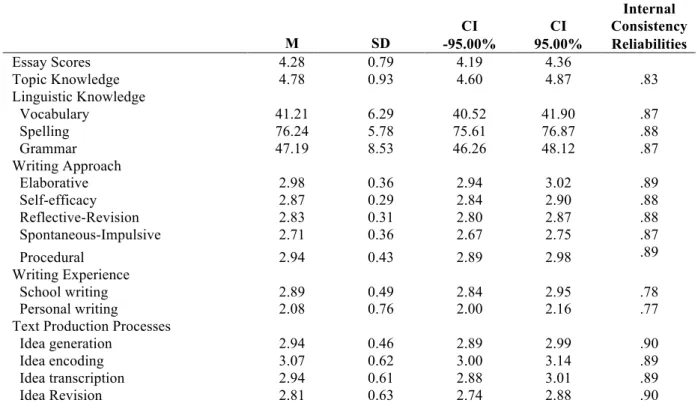
This first part of this section presents the results for the descriptive statistics: means, standard deviations, and correlations for the factors of topic knowledge, linguistic knowledge, writing approach, writing experience, text production processes, and writing performance (Table 1). The second part presents the tested model in which text production processes mediate the effects of topic knowledge, linguistic knowledge, writing approach, and writing background on students’ writing performance.
TABLE 1. Means and Standard Deviation of Topic Knowledge, Linguistic Knowledge, Writing Approach, Writing
Experience, Text Production Processes, and Writing Performance
CI CI
Internal Consistency M SD -95.00% 95.00% Reliabilities
Essay Scores 4.28 0.79 4.19 4.36
Topic Knowledge 4.78 0.93 4.60 4.87 .83
Linguistic Knowledge
Vocabulary 41.21 6.29 40.52 41.90 .87
Spelling 76.24 5.78 75.61 76.87 .88
Grammar 47.19 8.53 46.26 48.12 .87
Writing Approach
Elaborative 2.98 0.36 2.94 3.02 .89
Self-efficacy 2.87 0.29 2.84 2.90 .88
Reflective-Revision 2.83 0.31 2.80 2.87 .88
Spontaneous-Impulsive 2.71 0.36 2.67 2.75 .87
Procedural 2.94 0.43 2.89 2.98 .89
Writing Experience
School writing 2.89 0.49 2.84 2.95 .78
Personal writing 2.08 0.76 2.00 2.16 .77
Text Production Processes
Idea generation 2.94 0.46 2.89 2.99 .90
Idea encoding 3.07 0.62 3.00 3.14 .89
As shown in Table 1, a small range of confidence intervals was obtained for the means which indicate small standard errors for most of the measures. The scores on linguistic knowledge show large variations, while all other factors have small variations. Acceptable internal consistencies were obtained for all the measures (.77 to .90).
The factors of topic knowledge, linguistic knowledge, writing approach, writing experience, text production processes, and writing quality as measured by essay scores were correlated. The inter-correlations among the variables need to be established before testing further the proposed model in the present study. Correlations also established the similarity between the two essay scores used to measure writing performance. The similarity of these two essays needs to be proven by obtaining convergence in the scores. The correlation coefficient obtained for the two essays was r=.81 (p<.001). This strong and significant correlation indicates similarity in the writing performance of the students in the two essays.
The zero-order correlation conducted also showed that the two essay scores are significantly related to the topic knowledge, linguistic knowledge, some factors of writing approach (Elaborative, Reflective-revision, Procedural), and some factors of text production process (idea encoding and idea/text revision). For the text production processes, idea generation is significantly related to topic knowledge, vocabulary, spelling, Elaborative approach, Reflective-Revision approach, Self-efficacy, and school writing. Almost the same pattern can be observed for idea encoding and idea revision. Idea transcription is significantly related with vocabulary, Elaborative approach, and Reflective-Revision approach. All the factors of linguistic knowledge are inter-correlated. This holds true for all the factors of writing approach and text production processes.
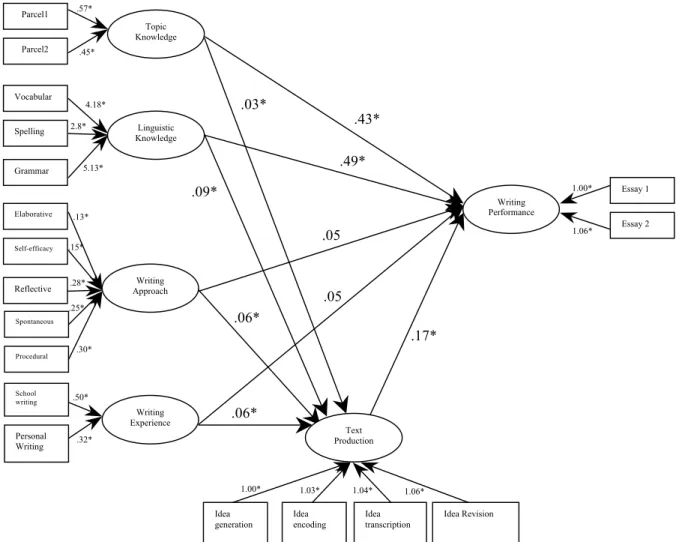
Structural Equations Modelling (SEM) was used to test the hypothesis of the study that text production processes mediate the effect of topic knowledge, linguistic knowledge, writing approach, and writing experience on students’ writing performance. These factors were used as latent variables and their specific subscales were used as the manifest variables. For topic knowledge, two parcels were created to serve as manifest variables—these two indicators showed strong internal consistency (r=.87). The two essay scores used as manifest variables for writing performance showed convergence (r=.81).
Results of the SEM show that all the manifest variables under each latent variable (text production processes, topic knowledge, linguistic knowledge, writing approach, writing experience, and writing performance) in the study are significant. Each of the manifest variables significantly account for its corresponding latent variable.
Furthermore, results of the SEM indicate that the direct effects of topic knowledge, linguistic knowledge, writing approach, and writing experience on text production are significant. Similarly, the direct effect of text production processes on writing performance was also significant. As regards the direct effects of the variables measured on writing performance, only the direct effects of topic knowledge and linguistic knowledge are significant. The results indicate that text production processes partially mediate the effect of topic knowledge and linguistic knowledge on writing performance. The other factors such as writing approach and writing experience indirectly affect writing performance. These two factors did not directly affect writing performance.
The overall mediation model in which topic knowledge and linguistic knowledge both directly and indirectly affect writer’s performance through text production processes is supported by the data. Adequate goodness of fit for the model was obtained as shown by
FIGURE 1. Text Production Processes in Writing as a Mediator for the Effect of Topic Knowledge, Linguistic Knowledge,
Writing Approach, and Writing Experience on Students’ Writing Performance
DISCUSSION
In the present study reported here, a model of explanatory variables based on previous studies was constructed and tested in terms of its direct effects on L2 performance and indirect effects on L2 writing performance through text production processes. The present study focused on the role of text production processes as a mediator in the effects of topic knowledge, linguistic knowledge, writing approach, and writing experience in explaining L2 writing performance. First, correlation analysis established the inter-correlations among the selected variables that constituted our model. The correlations between writing performance and knowledge factors such as linguistic and topic knowledge are higher compared to other factors.
Second, findings from SEM analysis confirmed our hypothesis that linguistic knowledge directly influences L2 writing performance and indirectly influences L2 writing performance through text production processes. The present study validates previous claims that students who have mastery of grammar, vocabulary, spelling, and other linguistic skills produce better essays (Schoonen et al. 2003, Lu 2010). In addition, the present study highlights the finding that text production processes mediate the effect of linguistic knowledge on writing performance. Knowledge of grammar, spelling and vocabulary play an
.57* .45* .03* .43* 4.18* 2.8* .49* 5.13*
.09* 1.00*
.13* .05 .05 .17* .06* .06* 1.06*
1.00* 1.03* 1.04* 1.06* .32* .50* .30* .25* .28* .15* Topic Knowledge Linguistic Knowledge Writing Approach Writing Experience Parcel1 Parcel2 Vocabular y Spelling Grammar Elaborative Self-efficacy Reflective Spontaneous Procedural School writing Personal Writing Text Production Idea
generation Idea encoding Idea transcription Idea Revision Writing Performance
Essay 1
Third, the SEM results confirmed our hypothesis that topic knowledge has both a direct effect on writing performance and an indirect effect on writing performance through text production processes. This result supports the findings of Tedick (1988), Lu (2010), He (2010), and He and Shi (2012) that knowledgeable writers on the topic produced written outputs of better quality. Based on the present findings, it can be claimed that topic-relevant prior knowledge stored in the resource level of the long term memory has facilitating effects on the processes that are activated during writing, which in turn, affects writing performance.
Third, writing approach significantly affects text production processes and indirectly affects writing performance. Findings from the present study support our theory that writing approach seems to have facilitating effects. Although the hypothesis of the present study on the direct effects of writing approach on writing performance was not confirmed, the results still uncovered a way on how writing approach explains writing performance. Students’ individual approaches, when effectively activated during composing, enhance the way students generate ideas, transcribe their encoded strings of ideas, and evaluate their written ideas and texts.
Fourth, writing experience significantly affects text production processes and indirectly affects writing performance. This finding implies that the quality of execution of cognitive processes while composing is influenced by one’s prior experience in writing both school-related and personal writing which one does beyond the requirements of school. There is logic in this finding since students’ experiences in writing different genres and discourse conventions enable students to develop effective strategies in composing their texts. The more they write, the more they are given an opportunity to develop different ways of generating, organizing, transcribing and revising their ideas. This is what Alamargot and Chanquoy (2001 in Becker 2006) refer to as “expertise comes with maturity and practice” (p. 35).
The finding on the indirect effect of writing approach and L2 writing experience on L2 writing performance led us to theorize that the effects of these variables on the composing processes of L1 writers may be different. It has already been established in previous findings that composing processes between L1 and L2 are different (Manchοn & Roca 2007, Van Weijin 2009, Tillema 2012). Future research could provide a deeper understanding on this issue if it investigates as to whether writing approach and writing experience have direct or indirect effects on both L1 and L2 writing. For now, the present study indicates that writing approach and writing experience need to enhance text production first before it can affect writing performance. Among L2 writers, idea generation can be both in L1 and in L2, but the generated ideas need to be translated in L2 before they go through the transcription process (Tavakoli, Ghadiri & Zabihi 2014). The cognitive constraints imposed by the incompatibility between idea encoding while composing and the target written output would require the facilitating effects of writing experience and writing approach, together with topic and linguistic knowledge, on text production processes for these two latent factors to influence writing performance.
CONCLUSION
Idea generation process formulates ideas by selecting information based on the writers’ communicative aims and awareness of genre and discourse conventions. The information is accessed either from memory or from external sources such as spoken and written text (Chenoweth and Hayes 2003). Idea generation process is facilitated by several factors. It draws on the writers’ topic knowledge, linguistic knowledge, writing experience, and writing approach.
Idea encoding process converts ideas into strings of words or phrases using the writers’ linguistic resources. The generated ideas that get encoded are largely dependent on the ability of idea encoding process to find linguistic forms with which to encode the ideas into appropriate linguistic structures (Chenoweth and Hayes 2003).
Idea revision process takes place as writers’ examine the encoded ideas for acceptability. Chenoweth and Hayes (2001) claimed that ideas (bursts in Chenoweth and Hayes’ study) that are accepted are dependent on one’s linguistic competence. The more topic knowledge a writer has, the more knowledge to be reexamined and reformulated, allowing idea revision process to evaluate text and produce quality revisions (DeGroff 1987). Idea transcription process writes the text once the information meets the writers’ intention. Idea transcription may be in small or large packages of information depending on the number of generated and encoded ideas that were accepted during the revision process (Chenoweth & Hayes 2003).
Unlike previous studies which took the relative contribution of the direct effects of explanatory variables to L2 writing performance (Sasaki & Hirose 1996, Schoonen et al. 2003, Lu 2010), the present study uncovered the direct and indirect effects of predictor variables on writing performance. The direct effects of linguistic and topic knowledge are not the only effects that are important in explaining writing performance. The indirect effects of all variables under study, especially those of writing approach and writing experience, provide a new way of explaining L2 writing. The model that has been established in the present study entails enlarging the theoretical underpinning of L2 writing proficiency and explaining it in terms of a chain of predictors.
The results of the present study have implications to writing instruction. First, because of the finding that L2 writing performance is dependent on linguistic knowledge, it should be the priority of writing teachers to create awareness among L2 learners of the role of linguistic knowledge and to provide practice that enables students to advance into higher levels of linguistic proficiency. Second, since topic knowledge directly predicts L2 writing performance, it would prove beneficial if teachers could urge their students to be abreast of the developments across disciplines. For example, making reading logs as a requirement in English courses could help students expand their general knowledge of the world. Reading selections as a pre-writing strategy would also give students a good schema when they write their essays. Third, providing more opportunities for students to write both outside and inside the classroom should be an indispensable component of writing classrooms. Fourth, educating learners of the different writing approaches that impact writing should be taught in writing classrooms. Finally, teachers should educate learners regarding the different variables that slow down or facilitate the different text production processes that mediate the effects of resource factors to L2 writing performance.
ACKNOWLEDGEMENTS
REFERENCES
Abiodun, A. & Folaranmi, A. (2007). Effects of verbal ability in second language writers’ achievement in essay writing in English Language. International Journal of African & American Studies. Vol. 6(1), 61-67. Al-Sawalha, A., & Chow, T. (2012). The effects of proficiency on the writing process of Jordanian EFL
university students. Academic Research International, 3(2), 379-388.
Alexander, P. A., Schallert, D. L. & Hare, V. C. (1991). Coming to terms: How researchers in learning and literacy talk about knowledge. Review of Educational Research. Vol. 61, 315–343.
Beale, A. (2003). English vocabulary world list. Retrieved from
http://www.manythings.org/vocabulary/lists/l/words.php?f=3esl.08.
Becker, A. (2006). A review of writing model research based on cognitive processes. In A. Horning & A. Becker (Eds.), Revision: History, theory, and practice (pp. 25-49). Parlor Press.
Bereiter, C. & Scardamalia, M. (1987). The psychology of written composition. Hillsdale, NJ: Lawrence Erlbaum.
Chenoweth, N. A. & Hayes, J. R. (2001). Fluency in writing. Generating text in L1 and L2. Written Communication. Vol. 18(1), 80-98.
Chenoweth, N.A. & Hayes, J. R. (2003).The inner voice in writing. Written Communication. Vol. 20, 99-118.
Cumming, A. (1989). Writing expertise and second-language proficiency. Language Learning. Vol. 39(1),
81-141.
Cusipag, M.N., Aglaua, C.M., Balarbar, C.V., Madrunio, M. R., Miciano, R.Z. & Mojica, L.A. (2006).Critical
thinking through reading and writing. Manila: De La Salle University Press.
DeGroff, L. J. C. (1987). The influence of prior knowledge on writing, conferencing, and revising. Elementary
School Journal. Vol. 88(2), 105-118.
Flower, L. & Hayes, J. R. (1980). The cognition of discovery: Defining a rhetorical problem. College Composition and Communication. Vol. 30, 21–31.
Flower, L. S. & Hayes, J. R. (1983).A cognitive model of the writing process in adults. ERIC Document Reproduction Service No. ED 240608.
Gustilo, L. (2010). What you think, feel, and experience shape your writing: Cognitive, affective, and contextual
processes in ESL writing. The Asia-Pacific Education Researcher. Vol. 19(2), 271-285.
Gustilo, L. (2011). Linguistic features that impact essay scores: A corpus-linguistic analysis of ESL writing in three proficiency levels.3L: Language, Literature, and Linguistics. The Southeast Asian Journal of English Language Studies. Vol. 17(1), 55-64.
Gustilo, L. (2013). An analysis of writer’s performance, resources, and idea generation process: The case of
Filipino Engineering students. Language Testing in Asia. doi:10.1186/2229-0443-3-2.
He, L. (2010). The effect of topical knowledge on L2 writing. Electronic Theses and Dissertations. Retrieved
from:http://hdl.handle.net/2429/27919
He, L., & Shi, L. (2012). Topical knowledge in ESL writing. Language Testing. Vol. 29(3), 443-464 .
Humes, A. (1983). Research on the composing process. Review of Educational Research, Vol. 53(2) 201–216.
Lavelle, E. (1997). Writing style and the narrative essay. British Journal of EducationalPsychology . Vol. 67,
475–482.
Lavelle, E., & Bushrow, K. (2007). Writing approaches of graduate students. Educational Psychology. Vol. 27(6), 807-822.
Lavelle, E., & Zuercher, N. (2001). The writing approaches of university students. Higher Education. Vol. 42,
373-385.
Lu, Y. (2010). Cognitive factors contributing to Chinese EFL learners’ L2 writing performance in timed essay
writing. Applied Linguistics and English as a Second Language Dissertations. Paper 13.
Mancion, R. & Roca de Lario, J. (2007). On the temporal nature of planning in L1 and L2 composing.
Language Learning. Vol. 57(4), 549-593.
Marton, F., Hounsell, D., & Entwistle, N. (1997). The experience of learning (2nded.). Edinburgh: Scottish Academic Press.
Rijlaarsdam, G., & Van den Berg, H. (1996). The dynamics of composing. An agenda for research into an interactive compensatory model of writing. Many questions, some answers. In C. M. Levy & S. Randsdell (Eds.). The science of writing (pp. 107-126). New York Erlbaum.
Sasaki, M. & Hirose, K. (1996). Explanatory variables for EFL students’ expository writing. Language Learning. Vol. 46(1), 137-174.
Schoonen, R., van Gelderen, A., de Glopper, K., Hulstijn, J., Simis, A., Snellings, P. & Stevenson, M. (2003). First language and second language writing: The role of linguistic knowledge, speed of processing, and
Tavakoli, M., Ghadiri, M., & Zabihi, R. (2014). Direct versus translated writing: The effect of translation on
learner’s second language writing ability. GEMA Online Journal of Language Studies, Vol. 14(2),
61-74.
Tedick, D. (1988). The effects of topic familiarity on the writing performance of non-native writers of English at the graduate level. Unpublished Dissertation. The Ohio State University.
Tillema, M. (2012). Writing in first and second language: Empirical studies on text quality and writing processes. LOT Dissertation Series 299. Ulrecht University.
Van Weijin, D. (2009). Writing processes, text quality, and task effects: Empirical studies in L1 and L2 language learning. LOT Dissertations. Ulrecht University.
Victori, M. (1995). EFL writing knowledge and strategies: An integrative study. (Doctoral dissertation)
Universitat Autònoma de Barcelona, Bellaterra, Spain.
Zhang, Y. (2006). Task representation and second language writers’ prior writing experience: A case study.
Retrieved from http://books.google.com.ph/books?id=wAGcJ9imAOEC&
APPENDIX: TEXT PRODUCTION PROCESSES SCALE
Recall the thought processes you engaged in when you were writing your essay. There are no wrong or right answers. Just think about what you really did when you were writing your essay. Answer Not at All, Very Little, Somewhat, To a Great Extent to each statement.
What thought processes did you engage in while forming/generating ideas for this essay?
1. I generated ideas based on my goal.
2. I recalled my prior knowledge regarding the structure of essays. 3. I recalled what I have read about the topic.
4. I recalled the news that I had heard about the topic. 5. I stopped to read the previous sentences I had written. 6. I created a mental picture of the ideas I wanted to write. 7. I visualized the reaction of my audience to my ideas. 8. I kept in mind the topic of my essay when retrieving ideas.
9. I got more content when I generated ideas using my first language. 10.I got more content when I generated ideas in the English language.
How did you find putting your ideas into English words and structures? 11.It was easy for me to find English words to express my ideas.
12.I did not find it difficult to recall the spelling of words. 13.I easily recalled the correct grammar rules that apply.
14.It was easy for me to arrange my ideas into my intended structure.
1. What did you do the moment you found English words to express your ideas? 15.I evaluated the information first if I wanted to include it in my text or not.
16.I checked first if I had chosen the appropriate vocabulary before I wrote it down. 17.I visualized the acceptable sentence structure before I wrote it down.
18.I started writing the words/phrases even if they were not in complete sentences. 19.I waited until I had the complete sentence in mind before I wrote down my ideas. 2. What did you do after you had written your ideas?
20.I read back what I had written to help me think of new ideas. 21.I read back what I had written to know if it was acceptable. 22.I revised the unacceptable part right away.
23.I delayed the revision and went on even though there was unacceptable information in my text.