100
Readability of Reading Texts in Alexander’s Practice and Progress: An Integrated Course for Pre Intermediate Students
M. Sayid Wijaya
Abstract: Determining the appropriate reading materials for students is not merely a matter for a teacher’s preference and viewpoint. The teacher must ensure the readability level of reading materials is on the same level as students’ since they easily attain the information depends on the readability of the text. Since there are so many books in bookstores which can be recommended by the teacher as a learning material, Alexander’s Practice and Progress is the common English book which provides a bunch of reading texts. In this case, this article reviews three readability measurements: Flesch-KincaidGrade Level, Coleman-Lieu Index, and SMOG, of reading texts provided by Alexander’s Practice and Progress. Also, to what extent of student’s level is presented based on those readability measurements.
Key words: reading texts, readability, Flesch-Kincaid Grade Level, Coleman-Lieu Index, SMOG
101
Finding out readability level of the texts helps teachers recognize whether the texts provided match students’ level or not. Every student should be given
material appropriate specifically to his own needs.Text characteristics must match reader knowledge and abilities for optimal comprehension to occur (Block et.al., 2002:27). In this case, a reading text given should be on the same level as the students’ reading competence. Recognizing the appropriateness between the
readability level of the texts and the students’ level, then, becomes very crucial.
Concerning readability measurements,Flesch (1986:145) explained readability as ease of reading plus interest. They want to make as little effort as possible while they are reading, and they also want something ‘built in’ that will automatically carry them forward like an escalator.Different from Flesch(1986), Nuttall (1982:26) points out that readability makes use of counts of word length and sentence length.Further, Dale and Chall (1949, as cited in Oakland and Lane, 2004:9) proposed the definition of readability as the total sum, including the interactions, of all those elements within a given piece of printed material that affects the success a group of readers have with it. The success is the extent to which they understand it, read it at an optimum speed, and find it interesting. In
other words, to measure readability of a text, structural and lexical elements in a text should be calculated so that the text can be in regard to be easy and interesting to read by a reader.In addition, readability is a complex construct that
involves not only the observable characteristics of a text, but also aptitude, knowledge, experience, skill, efficiency and motivation that the reader brings to the text and to the reading task, as well as to the situation for reading (Hedgcock& Ferris, 2009:89). Readability measures must account for how certain text properties, primarily the arrangement of the propositions in the text base, word frequency and sentence length, interact with the reader’s processing strategies and resources (Miller &Kintsch, 1980 as cited in Hedgcock and Ferris, 2009:339)
102
the words, and the number of words that are not considered common of frequent.Further, the result of the count is interpreted with readability index which provides the interpretation of what grade level the readability score is.
In conjunction with readability formulas, Flesch-Kincaid Grade Level (FKGL), Coleman-Liau Index (CLI), and SMOG are among readability formulas employed mostly in computing readability of the texts.FKGL measures readability of a text by analyzing the average number of syllables per word and average number of words per sentence. It is the most common readability formula used in USA. It is also available in Microsoft Word. CLI, which is the second mostly used readability formula in USA, the same as FKGL. The result of both FKGL and CLI showed the grade level used in USA. In other hands,SMOG examines 10 consecutive sentences from the beginning, middle, and end of a text. In the 30 selected sentences, all words containing three or more syllables were counted. Although it is used by first language teachers to measure readability of the texts, it is employed by foreign language teachers to measure readability of the texts for that the result of SMOG is closely accurate for foreign language learners.
METHOD
This article describes readability of reading texts in Alexander’s Practice and
Progress. The book is divided into four units, in nature, in which each unit
103
Both readability-score.com and read-able.com briefly interpret the result of readability grade level only, without showing readability score of each text. However, both online services demonstrate to what age the text is appropriate with. They also provide the computation of Flesch-Kincaid Grade Level (FKGL), Coleman-Lieu Index (CLI), and Simple Measure of Gobbledygook (SMOG).In addition, this article provides the description of readability grade level of the texts and appropriateness of students’ age level.
FINDINGS
The computation of readability grade level using readability-score.com for all texts was conducted gradually. After computing the readability of the texts using readability-score.com, all texts were computed its readability by using read-able.com. The result of online readability computation of the Alexander’s
Practice and Progresswas presented per Unit. Table 1. presented the result for Unit One:
Table1. The Result of Online Readability Grade Level Computation of Alexander’s Unit One
Unit One
Readability Grade
FKGL CLI SMOG
1 2 5.8 3.8
2 1.1 4.9 2.8
3 3.2 5.8 4.6
4 4.8 8.1 6
5 6.5 10 6.4
6 2.1 5.3 3.5
7 6.7 11.9 6.7
8 6.7 9.4 6.4
9 3.2 9.2 3.8
104
11 4.5 6 3.8
12 3.9 8.5 4.8
13 4.4 9.8 6
14 3.3 5.6 3.8
15 2.6 6.1 4.3
16 4.7 7 5
17 3.2 6.5 4.6
18 1.5 3.5 2.4
19 1.8 6.1 3.5
20 4.2 8.9 4.7
21 4.3 7.5 5
22 6 8.8 5.6
23 3.4 6.9 3.9
24 3.7 6 5.5
105
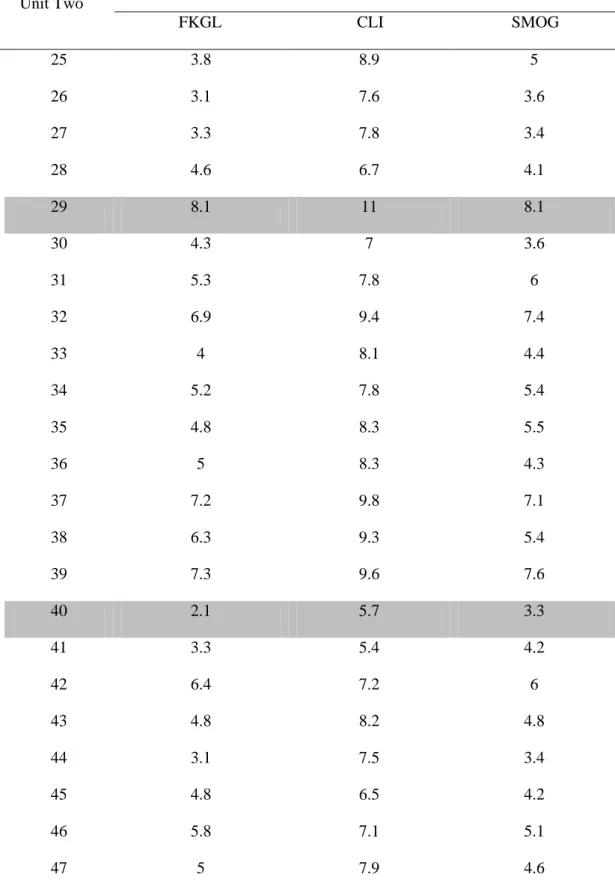
Table 2. The Result of Online Readability Grade Level Computation of Alexander’s Unit Two
Unit Two
Readability Grade
FKGL CLI SMOG
25 3.8 8.9 5
26 3.1 7.6 3.6
27 3.3 7.8 3.4
28 4.6 6.7 4.1
29 8.1 11 8.1
30 4.3 7 3.6
31 5.3 7.8 6
32 6.9 9.4 7.4
33 4 8.1 4.4
34 5.2 7.8 5.4
35 4.8 8.3 5.5
36 5 8.3 4.3
37 7.2 9.8 7.1
38 6.3 9.3 5.4
39 7.3 9.6 7.6
40 2.1 5.7 3.3
41 3.3 5.4 4.2
42 6.4 7.2 6
43 4.8 8.2 4.8
44 3.1 7.5 3.4
45 4.8 6.5 4.2
46 5.8 7.1 5.1
106
48 5.3 8.2 5
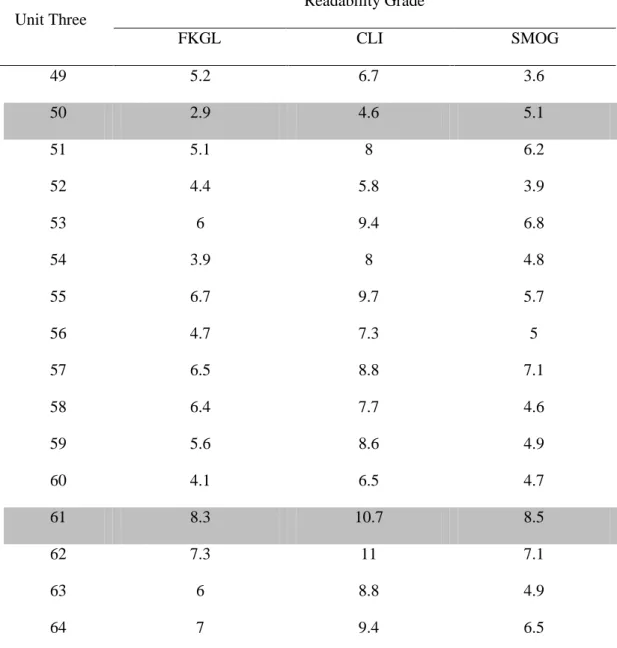
The below Table 3.showed the easiest text in Unit Three was the text number 50 in which the score of FKGL was 2.9, the score of CLI was 4.6, and the score of SMOG was 5.1. The most difficult text in Unit Three was the text number 61 in which the score of FKGL was 8.3, the score of CLI was 10.7, and the score of SMOG was 8.5
Table 3. The Result of Online Readability Grade Level Computation of Alexander’s Unit Three
Unit Three
Readability Grade
FKGL CLI SMOG
49 5.2 6.7 3.6
50 2.9 4.6 5.1
51 5.1 8 6.2
52 4.4 5.8 3.9
53 6 9.4 6.8
54 3.9 8 4.8
55 6.7 9.7 5.7
56 4.7 7.3 5
57 6.5 8.8 7.1
58 6.4 7.7 4.6
59 5.6 8.6 4.9
60 4.1 6.5 4.7
61 8.3 10.7 8.5
62 7.3 11 7.1
63 6 8.8 4.9
107 Unit Three
Readability Grade
FKGL CLI SMOG
65 7.4 8.8 6.3
66 7.4 8.6 7.2
67 7.7 9.7 7.5
68 3.4 5.7 4
69 5 8.3 6
70 6.1 9.7 7.2
71 4.4 8 6
72 6.2 8.8 5.2
Table 4.showed that the easiest text in Unit Four was the text number 87 in which the score of FKGL was 2.4, the score of CLI was 5.1, and the score of SMOG was 4. The most difficult text in Unit Four was the text number 90 in which the score of FKGL was 9, the score of CLI was 10.9, and the score of SMOG was 8.3.
Table4. The Result of Online Readability Grade Level Computation of Alexander’s Unit Four
Unit Four
Readability Grade
FKGL CLI SMOG
73 6.6 7.7 5.8
74 3.6 8.3 4.3
75 5.2 8.6 4.8
76 8.1 11.5 8.7
77 6.1 8.4 6.2
78 7.6 9.7 8.1
79 6.6 8.2 6.7
108 Unit Four
Readability Grade
FKGL CLI SMOG
81 5.5 9.1 6.2
82 7.4 9.3 6.8
83 6.6 10.7 7.5
84 5.7 9.3 5.5
85 8.4 9.8 8.3
86 6.3 9.8 6
87 2.4 5.1 4
88 5.6 9.5 6.6
89 6.2 8.4 7.5
90 9 10.9 8.3
91 7.7 9.9 5.7
92 5.5 6.8 5.4
93 10 9.7 10.4
94 7.4 10.6 6
95 3.8 8.3 5.1
96 8.7 8.4 6.3
From Table 1., Table 2., Table 3., and Table 4., it can be inferred that the easiest
text in Unit One was the text number 2, the easiest Unit Two was the text number 40, the easiest text in Unit Three was the text number 50, and the easiest text in
109
The Result of Online Readability Grade Level Based on Unit
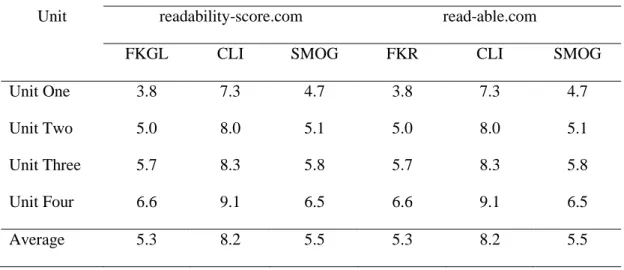
The online readability computation by readability-score.com and read-able.com resulted readability grade level. Table 5.presented the result of online readability grade level computation of Alexander’s Practice and Progress based on each
Unit. The result of the computation can be seen in below Table 5.
Table 5.The Result of Online Readability Grade Level Computation of Alexander’s Units
Unit
Readability Grade Level
readability-score.com read-able.com
FKGL CLI SMOG FKR CLI SMOG
Unit One 3.8 7.3 4.7 3.8 7.3 4.7
Unit Two 5.0 8.0 5.1 5.0 8.0 5.1
Unit Three 5.7 8.3 5.8 5.7 8.3 5.8
Unit Four 6.6 9.1 6.5 6.6 9.1 6.5
Average 5.3 8.2 5.5 5.3 8.2 5.5
Note:
FKGL = Flesch-Kincaid Grade Level
CLI = Coleman-Liau Index
SMOG = Simple Measure of Gobbledygook
110
was mostly comprehended by students in grade four to eight. In addition, the result of read-able.com was the same as the result of readability-score.com.
The result of readability-score.com computation for Unit Two grade level illustratedthat the average FKGL grade level was 5.0 which meant the unit was easily understood by the students in grade five while CLI grade level was 8.0 which meant the unit was appropriate with students in grade eight. Further, the SMOG grade level was 5.1 which meant the unit was suitable with students in grade five to six. The result of read-able.com for Unit Two was also the same as the result of readability.com.
The average readability grade level based on the readability-score.com for Unit Three resulted grade level for FKGL was 5.7 and SMOG 5.8 which meant that the Unit was best-suited for students in grade five to six while grade level for SMOG was 8.3 which meant that the Unit was appropriate with students in grade eight to nine. Further, the average readability grade level for Unit Four showed that FKGL and SMOG grade levels were 6.6 and 6.5 which meant that the Unit was suitable with students in grade six to seven while CLI grade level was 9.1 which meant that the Unit was well comprehended by students in grade nine to ten.
Table 5.presented no difference in score between the result of the computation using readability-score.com and read-able.com since both online service
employed identical formula either for FKGL, CLI, or SMOG. In this case, there was no need to recheck the result of readability-score.com and read-able.com with others online services which provide online readability calculation.
Appropriateness of the Text with Students’ Age
Concerning the computation for students’ appropriateness age, the calculation was
111
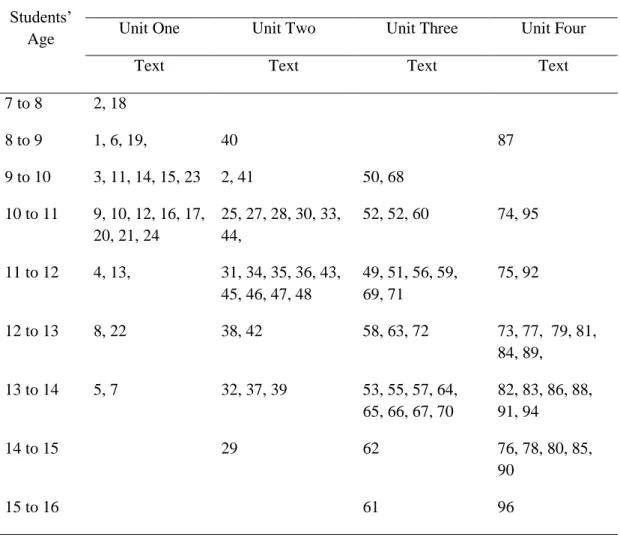
Table 6. The Result of the Appropriateness of the Text with Students’ Age
Students’ Age
The Appropriateness of the Texts
Unit One Unit Two Unit Three Unit Four
Text Text Text Text
7 to 8 2, 18
8 to 9 1, 6, 19, 40 87
9 to 10 3, 11, 14, 15, 23 2, 41 50, 68
10 to 11 9, 10, 12, 16, 17, 20, 21, 24
25, 27, 28, 30, 33, 44,
52, 52, 60 74, 95
11 to 12 4, 13, 31, 34, 35, 36, 43, 45, 46, 47, 48
49, 51, 56, 59, 69, 71
75, 92
12 to 13 8, 22 38, 42 58, 63, 72 73, 77, 79, 81, 84, 89,
13 to 14 5, 7 32, 37, 39 53, 55, 57, 64, 65, 66, 67, 70
82, 83, 86, 88, 91, 94
14 to 15 29 62 76, 78, 80, 85,
90
15 to 16 61 96
Based on the Table 6., most texts in Unit One were suitable with ten to eleven
years old students while most texts in Unit Two are appropriate with eleven to twelve years old students. Further, most texts in Unit Three were best suited for thirteen years old students while most texts in Unit Four wereeasily comprehended by twelve to thirteen years old students.
DISCUSSION
The findings reveal that each Unit consisted of the easiest text and the most difficult text. It means that level of difficulty presented in Alexander’s Practice
112
students reading comprehension on variety of text level and insists them to sharpen their reading skills.
The findings also uncover that Alexander’s Practice and Progressserves
seven-to-sixteen-year-old students variety texts with different readability grade levels. Each unit contains texts which are easily comprehended by students at that age. This is
in line with what Flesch (1986:145) described that students want to make as little effort as possible while they are reading, and they also want something ‘built in’
that will automatically carry them forward like an escalator. In this case, Alexander’s Practice and Progress has maintained the readability level for the
intermediate students as it is intended to serve. In this case, the teacher is free to choose the available materials on the students’ level and provide them with the difficult ones. Further, this will ease them in attaining the information and to promote their reading comprehension
The grade level varies from eight to sixteen. This illustrates that Alexander’s
Practice and Progress promotes students to read more difficult texts. This gives students chance to enhance their reading competence. The more difficult the texts, the more exposure students deal with. In this case, they are used to face such texts. When it comes to get information as soon as possible, they are allowed to read the text on their level, and when it comes to improve their reading competence, they are allowed to read the texts above their level.
CONCLUDING REMARK
Knowing the readability of the texts given to the students, either as primary or as supplementary materials, is beneficial for the teacher to assess students’
comprehension for that the readability level determines whether the students easily extract the information contained in the text or not. Further, providing the materials in the same level as students’ level is expected to ease them find the
information as they need. To sum up, readability of the text is not a major aspect to support students’ comprehension, but it is a considerable aspect to ease students
113 REFERENCES
Block, C.C., Gamrell, L.B., and Pressley, M. 2002. Improving Comprehension Instruction.Newark: Jossey-Bass
Caldwell, J.S. 2008.Reading Assessment (2nd Edition). New York: The Guildford Press
Flesch, R. 1949. The Art of Readable Writing. New York: Harper & Row, Publishers
Hedgcock, J.S. and Ferris, D.R. 2009.Teaching Readers of English: Students, Texts, and Contexts.New York: Routledge
Nuttal, C. 1982.Teaching Reading Skills in a Foreign Language. London: Heinemann Educational Books
Oakland, T. and Lane, H. (2004). Language, Reading, and Readability Formulas: Implications for Developing and Adapting Tests. International Journal of Testing, Vol. 4, 239-252.