ARTICLE
Background. The detrimental effects of excess personal solar ultraviolet (UV) radiation exposure include sunburn, immunosuppression and skin cancer. In South Africa, individuals with minimum natural protection from melanin, including fair-skinned individuals and African albinos, and people spending extended unprotected periods outdoors are at risk of sunburn, a risk factor for skin cancer. Sunburn becomes increasingly likely during the high solar UV radiation hours around midday, and previous studies have shown that children are exposed to potentially high, sunburn-causing solar UV radiation levels while at school.
Method. To estimate national potential child sunburn risk patterns, monitored ambient solar UV radiation levels at six sites in South Africa were converted into possible schoolchild solar UV radiation exposures by calculating the theoretical child exposure to 5% of the total daily ambient solar UV radiation as derived from personal child exposure studies.
Results. Schoolgoing children with skin types I, II and III were identified as being at greatest risk of sunburn. There were 44 and 99 days in a year when schoolchildren with skin type III (moderately sensitive) living in Durban and De Aar, respectively, would be likely to experience sunburn. Schoolchildren with skin type I (extremely sensitive) were at risk of experiencing sunburn on 166 days in De Aar, and those with skin types I and II were at risk on at least 1 day per year at all six locations.
Conclusion. Seasonal patterns show that schoolchildren with sensitive skin types may experience sunburn in spring, summer and autumn months. Differences in child sunburn risk were evident, mainly due to latitude and atmospheric aerosols. Additional factors affecting sunburn risk include schoolchildren’s use of sun protection, sun-exposed activity, and timing and duration of exposure. Understanding risk patterns and obtaining locally relevant information will assist South African skin cancer prevention and sun protection awareness
C Y Wright, PhD (Public Health), MSocSc, BSocSc (Hons)
Council for Scientific and Industrial Research, Pretoria
G Coetzee, BSc
K Ncongwane, BSc, BPhil, MPhil
South African Weather Service, Pretoria
Corresponding author: C Y Wright ([email protected])
Ambient solar UV radiation and
seasonal trends in potential sunburn
risk among schoolchildren in South Africa
campaigns.
Some sun exposure is important for vitamin D production1 and protection against certain internal cancers.2 Detrimental health effects of excess personal solar ultraviolet (UV) radiation exposure include sunburn, photo-ageing, cataracts, immunosuppression and skin cancer.2-4 Melanin in human skin affords some natural protection against the harmful effects of solar UV radiation. Individuals with minimum natural protection, including fair-skinned individuals and African albinos, are therefore at risk, as are people spending extended unprotected periods outdoors, especially when solar UV radiation levels are high.
The relationship between sun exposure, sunburn and skin cancer is complex.4 There is evidence to support a relationship between sunburn during childhood and adolescence and skin cancer in adulthood.5 Previous studies have shown that children are exposed to potentially high, sunburn-causing solar UV radiation levels during school hours.6,7 The World Health Organization (WHO) has argued that school sun protection programmes should be emphasised, because a sizeable portion of lifetime sun exposure occurs during childhood and adolescence.8 Moreover, epidemiological evidence suggests that appropriate sun protection behaviour implemented from as early as possible in life is likely to have the greatest impact.4
In South Africa, few studies have measured solar UV radiation exposure among schoolchildren.9,10 One study analysed personal sun behaviour
and solar UV radiation exposure patterns among a sample of South African schoolchildren living in Durban.10 Children received ~5% of the total daily ambient solar UV radiation, a finding consistent with similar studies among schoolchildren in New Zealand,11 Denmark12 and England,13 and activity was the most important influencing factor. Similarly, personal exposure studies among outdoor workers found that individuals engaged in road construction, horticulture, roofing and other outdoor occupations received ~20 - 26% of the total daily ambient solar UV radiation levels.14,15
In South Africa, there are two indications that we should be concerned about personal solar UV radiation exposure risk. First, melanoma and non-melanoma skin cancers account for ~30% of all histologically diagnosed cancers.16 Second, measured ambient solar UV radiation levels increased between 1979 and 2001.17,18 A more recent quantitative analysis of the South African Weather Service Global Atmospheric Watch UV-B network data showed that maximum ambient solar UV-B radiation levels between 1994 and 2009 have remained greater than 8 UVI (UV index units) (UVI = 40 × Eeff W m-2) during summer months across all monitoring
sites.19 For effective planning of skin cancer prevention and sun protection awareness programmes, we therefore need to understand the seasonal patterns in potential risk posed by solar UV radiation to schoolchildren throughout the year in South Africa.
To this end, we set out to identify sunburn risk as a proxy for
S
A
J
ea
lth
S
A
J
ou
rna
l of Child H
ea
lth
S
A
J
ou
rna
l of Child H
ea
excess solar UV radiation exposure and associated adverse human health risks. We estimated possible schoolchild solar UV radiation exposures at six geographically different sites in South Africa. By using the reported figure of 5% of the total daily ambient solar UV radiation levels,10 the monitored ambient solar UV radiation levels were converted into potential child exposures. A unique aspect of this research is merging atmospheric science outputs with public health messages for skin cancer prevention and sun protection.
Methodology
Monitored ambient solar UV radiation data
Solar radiation covers a broad wavelength range, where the shorter the wavelength the greater the radiation energy and its capability to produce chemical and biological reactions. Solar UV radiation may be divided into three bands: UV-C, UV-B and UV-A. Most UV-C is absorbed by stratospheric ozone in the atmosphere and very little reaches the Earth’s surface. UV-B and UV-A are more likely to reach the Earth’s surface and impact upon human health. Erythemal UV radiation is defined as UV-B irradiance weighted by the action spectrum for human erythema (sunburn).20
The South African Weather Service monitors ambient solar erythemal UV-B radiation (290 - 320 nm) levels at six stations in South Africa: Pretoria (25.7° S, 28.2° E), Durban (30.0° S, 31.0° E), Cape Town (33.98° S, 18.6° E), Cape Point (34.35° S, 18.48° E), De Aar (30.7° S, 24.0° E) and Port Elizabeth (33.9° S, 25.5° E). UV Biometers (model 501) comprising a Robertson-Berger pattern UV radiation detector, digital recorder and control unit are used. The erythemal UV-B spectral range closely mimics the McKinley/ Diffey Erythemal Action Spectrum.20 Logged readings are converted into hourly MED (minimal erythemal dose) values (1 MED = 210 Jm-2 or 583 Wm-2). Using this definition, hourly MED values during 2006 for each of the six stations were converted into hourly SED values, the international standard unit for expressing personal solar UV radiation exposure (defined as 1 SED = 100 Jm-2).21 Ambient solar erythemal UV-B radiation data for 2006 were applied in this study, since this annual data set is the most recent and complete set for all six geographical sites. Ambient seasonal trends were calculated and then applied to estimate potential schoolchild solar UV radiation exposure by skin type.
The amount of solar UV radiation reaching the Earth’s surface is affected by several geographical, temporal and meteorological factors
including altitude, latitude, season, aerosols, the thickness and distribution of clouds, stratospheric ozone, surface reflection and time of day,22,23 with the solar zenith angle being the dominant factor of influence followed by clouds, aerosols and stratospheric ozone.24-26 The interpretation of monitored solar UV radiation at the six stations has proved to be difficult, chiefly because of non-availability of geophysical variable data known to absorb or scatter solar UV radiation as it passes through the atmosphere. Only geometrical factors are generally known, but do not provide the basis to quantify the amount of solar radiation at a particular location. The combined effect of these parameters determines the amount and variability of solar UV radiation reaching the ground at a particular location. Because of non-availability of data on atmospheric variables, the focus of this work was on the actual solar UV radiation data recorded at the six stations.
Potential child solar UV radiation exposures
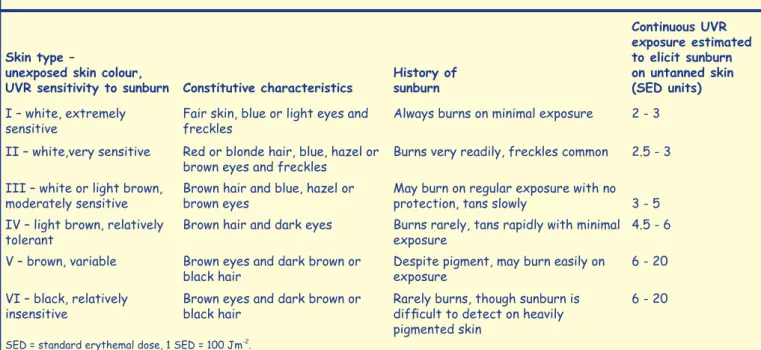
To provide an estimate of the annual variation in child solar UV radiation exposure at six sites in South Africa, the factor of 5% was applied to the daily ambient solar erythemal UV radiation as measured by the UV-B biometers for a typical year (in this case the year 2006). Children received ~5% of the total daily ambient solar UV radiation, a finding consistent with similar studies among schoolchildren in New Zealand,11 Denmark12 and England.13 Sunburn is an indication of excess sun exposure and a risk factor for skin cancer. Different skin types require varying doses of solar UV radiation to elicit a biological response. The continuous solar UV radiation doses (in SED units) estimated to elicit sunburn on untanned, unprotected skin for skin types I - VI are set out in Table I.27 By superimposing these values required to induce minimal sunburn onto the annual variation of a schoolchild’s potential total daily UV radiation exposure, the number of days during one year when a schoolchild of a particular skin type may be at risk of sunburn was estimated.
Results
Seasonal patterns of ambient total daily solar UV
radiation levels
The solar UV-B radiation levels at the six geographical areas followed a similar annual cycle, with maximum values recorded in the summer months (December, January and February) and minimum values in the winter months (June, July and August). Results for seasonal
TABLE I. FITZPATRICK SKIN PHOTOTYPE CLASSIFICATION WITH PERSONAL SOLAR UV RADIATION EX-POSURE ESTIMATES LIKELY TO CAUSE SUNBURN ON UNTANNED SKIN
Skin type –
unexposed skin colour,
UVR sensitivity to sunburn Constitutive characteristics History ofsunburn
Continuous UVR exposure estimated to elicit sunburn on untanned skin (SED units) I – white, extremely
sensitive Fair skin, blue or light eyes and freckles Always burns on minimal exposure 2 - 3 II – white,very sensitive Red or blonde hair, blue, hazel or
brown eyes and freckles Burns very readily, freckles common 2.5 - 3 III – white or light brown,
moderately sensitive Brown hair and blue, hazel or brown eyes May burn on regular exposure with no protection, tans slowly 3 - 5 IV – light brown, relatively
tolerant Brown hair and dark eyes Burns rarely, tans rapidly with minimal exposure 4.5 - 6 V – brown, variable Brown eyes and dark brown or
black hair Despite pigment, may burn easily on exposure 6 - 20
VI – black, relatively
insensitive Brown eyes and dark brown or black hair Rarely burns, though sunburn is difficult to detect on heavily pigmented skin
6 - 20
averaged solar UV-B radiation demonstrated that the highest seasonal averaged ambient solar UV-B radiation of 1.36 kJ/m2 was measured in De Aar during summer and the lowest record of 0.27 kJ/m2 was measured in Cape Point during winter. For summer, the second highest seasonal averaged solar UV-B radiation of 1.26 kJ/ m2 was measured in Durban, followed by Pretoria (0.95 kJ/m2), Port Elizabeth (0.92 kJ/m2), Cape Town (0.89 kJ/m2) and Cape Point (0.85 kJ/m2); the same sequence is true for autumn. The seasonal variation in the amount of ambient solar UV-B radiation is very small, ranging between 0.14 and 0.5 kJ/m2. In Cape Point, there was no significant variation in the amount of ambient solar UV-B radiation during summer and spring.
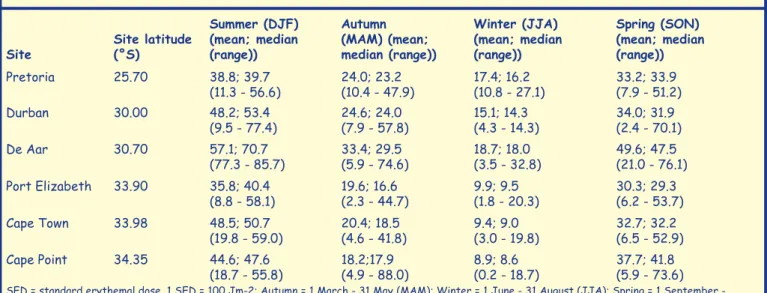
Means, medians and ranges by season for ambient total daily solar UV radiation (in SED units) for each of the six geographical sites are set out in Table II. Maximum mean ambient total daily solar UV radiation levels occurred in the summer months, followed by spring, autumn and winter. While the most northern sites of Pretoria and Durban recorded relatively high ambient total daily solar UV radiation SED values in summer, the highest values were recorded at De Aar. De Aar is an isolated monitoring site with a small resident population and minimal industrial activity causing relatively clear skies. Ranges in seasonal ambient total daily solar UV radiation SED values probably indicate changes in solar zenith angle and cloud effects; however, this requires further investigation.
Potential child total daily solar UV radiation
ex-posures
The mean (median and range in parentheses) potential schoolchild total daily solar UV radiation exposures (SED units, 1 SED = 100 Jm-2) for Pretoria, Durban, De Aar, Port Elizabeth, Cape Town and Cape Point were 1.41 (1.34; 039 - 2.83), 1.52 (1.23; 0.12 - 3.87), 2.06 (1.83; 0.17 - 4.28), 1.21 (1.01; 0.09 - 2.90), 1.38 (1.30; 0.15 - 2.95) and 1.27 (1.08; 0.01 - 2.79), respectively.
The mean potential schoolchild total daily solar UV radiation exposure for all geographical locations tended to be low, ranging from 2.06 SED units in De Aar to 1.21 SED units in Port Elizabeth. Maximum values for potential schoolchild total daily solar UV radiation exposure ranged from 2.83 SED units in Pretoria to 4.28 SED units in De Aar. These upper values are lower than expected because they assumed that all schoolchildren consistently received 5% of the total daily ambient solar UV radiation. Real-time sun exposure studies among schoolchildren have shown that activity, and
timing and duration of exposure, may lead to significantly higher total daily personal solar UV radiation exposure for certain schoolchildren compared with the rest of the group.10-12
Potential schoolchild sunburn risk by geographical
location and skin type
Fig. 1 shows potential schoolchild total daily solar UV radiation exposures by geographical location as well as potential sunburn risk by skin type. Required solar UV radiation exposures needed to elicit sunburn response in individuals with different skin types are set out in Table I. For skin types I, II, III and IV, the required solar UV radiation exposures are 2 - 3 SED units (extremely sensitive), 2.5 - 3 SED units (moderately sensitive), 3 - 5 SED units (relatively tolerant) and 4.5 - 6 SED units (variable), respectively. Schoolgoing children with skin types I and II living in all geographical locations were identified as being at risk of experiencing sunburn at least once during the year. The annual distribution in potential schoolchild total daily solar UV radiation exposures is indicative of seasonal differences, with an envelope effect illustrating higher exposures during summer and lower exposures during winter. The scatter below the envelope of potential schoolchild total daily solar UV radiation exposures is probably due to the presence of clouds, since ambient total daily solar UV radiation levels were used to calculate schoolchild exposure. There were 44 and 99 days during the year when schoolchildren with skin type III (only moderately sensitive) living in Durban and De Aar, respectively, would be likely to experience sunburn (Table III). Schoolchildren with skin types I (extremely sensitive) and II (moderately sensitive) living in all six locations were at risk of experiencing sunburn on at least one day a year, the total number of days per year ranging from 14 in Pretoria (skin type II) to 166 days in De Aar (skin type I).
Potential schoolchild sunburn risk by geographical
location, skin type and season
Seasonal differences in the number of days that schoolchildren may be at risk of experiencing sunburn based on their potential total daily solar UV radiation exposures are shown in Fig. 2 and Table III. Some schoolchildren may experience sunburn during spring, summer and autumn months depending on which geographical location they reside in and other factors, such as use of sun protection, timing and duration of exposure, and type of outdoor activity. There were no risk days for schoolchildren with skin types IV, V and VI; however, this will depend on their individual exposure patterns. The greatest number of days with potential schoolchild sunburn risk among children with skin types I and II occurred during the summer months
TABLE II. MEAN AND MEDIAN, AND RANGE IN TOTAL DAILY AMBIENT SOLAR UV RADIATION LEVELS (SED) BY SEASON AT SIX MONITORING SITES IN SOUTH AFRICA, 2006
Site Site latitude (°S)
Summer (DJF) (mean; median (range))
Autumn (MAM) (mean; median (range))
Winter (JJA) (mean; median (range))
Spring (SON) (mean; median (range))
Pretoria 25.70 38.8; 39.7
(11.3 - 56.6) 24.0; 23.2 (10.4 - 47.9) 17.4; 16.2(10.8 - 27.1) 33.2; 33.9(7.9 - 51.2)
Durban 30.00 48.2; 53.4
(9.5 - 77.4) 24.6; 24.0(7.9 - 57.8) 15.1; 14.3(4.3 - 14.3) 34.0; 31.9(2.4 - 70.1)
De Aar 30.70 57.1; 70.7
(77.3 - 85.7) 33.4; 29.5(5.9 - 74.6) 18.7; 18.0(3.5 - 32.8) 49.6; 47.5(21.0 - 76.1)
Port Elizabeth 33.90 35.8; 40.4
(8.8 - 58.1) 19.6; 16.6(2.3 - 44.7) 9.9; 9.5(1.8 - 20.3) 30.3; 29.3(6.2 - 53.7)
Cape Town 33.98 48.5; 50.7
(19.8 - 59.0) 20.4; 18.5(4.6 - 41.8) 9.4; 9.0(3.0 - 19.8) 32.7; 32.2(6.5 - 52.9)
Cape Point 34.35 44.6; 47.6
when ambient solar UV radiation levels were highest compared with all other seasons. However, schoolchildren with skin type III living in Durban and De Aar may also be at risk of experiencing sunburn during autumn and spring. Applying the calculation of 5% of the total daily ambient solar UV radiation for potential schoolchild total daily solar UV radiation exposure, there were no days during winter months when schoolchildren were at risk of experiencing sunburn. However, sunburn may still be experienced during winter months when exposures are continuous and long, and no sun protection is applied.
Since these calculations are based on a percentage estimate of schoolchild exposure in relation to total daily ambient solar UV radiation levels, it is not possible to detect diurnal patterns of schoolchild solar UV radiation exposure. To do so, real-time and time-stamped personal solar UV radiation monitoring in conjunction with personal activity record keeping would be required. However, many schools schedule lunch breaks in the 2-hour period either
side of midday. Fig. 3 shows the ambient 1-hour solar UV radiation exposure levels for the midday maximum between 12h00 and 13h00 at the six monitoring stations. Levels ranged between 2 and 12 SED units, with the highest midday ambient solar UV radiation levels recorded during the summer months and in Durban. Schoolchildren who do not use sun protection or seek shade may be at risk of sunburn; however, use of cumulative total daily personal solar UV radiation exposures excludes interpretation of hourly patterns of schoolchildren during school hours alone.
Discussion
The main purpose of the South African Weather Service solar UV-B biometer network is to create and enhance public awareness and provide real-time information about the hazard of personal exposure to biologically active solar UV-B radiation. In this study, these data have been transformed from ambient measurements primarily used as a warning tool, to potential child exposures by skin type. In the light of the WHO recommendation to focus sun awareness
Fig. 1. Potential total daily child solar UV radiation exposure at Pretoria, Durban, Cape Town, Cape Point, De Aar and Port Elizabeth (SED = standard erythemal dose; 1 SED = 100 Jm-2).
TABLE III. TOTAL NUMBER OF DAYS PER YEAR AND PER SEASON THAT SCHOOLCHILDREN OF VARYING SKIN TYPES MAY BE AT RISK OF EXPERIENCING SUNBURN FROM EXCESS SOLAR UV RADIATION
EXPOSURE DEPENDING ON ACTIVITY AND SUN PROTECTION, USING AN ESTIMATED PERSONAL EXPOSURE OF 5% OF THE TOTAL DAILY AMBIENT SOLAR UV RADIATION LEVELS
Skin type Skin type
I II III I (2 - 3 SED) II (2.5 - 3 SED) III (3 - 5 SED)
Site All year Summer Autumn Winter Spring Summer Autumn Winter Spring Summer Autumn Winter Spring
Pretoria 71 14 0 43 5 0 23 13 0 0 1 0 0 0 0
Durban 97 69 44 59 10 0 28 48 4 0 17 35 0 0 9
De Aar 166 122 99 69 32 0 53 65 14 0 43 61 7 0 31
Port
Elizabeth 76 23 0 47 3 0 26 18 0 0 5 0 0 0 0
Cape
Town 112 57 0 80 2 0 30 50 0 0 7 0 0 0 0
Cape
Fig. 2. Total number of days per season that schoolchildren of varying skin types may be at risk of experiencing sunburn from excess solar UV radiation exposure depending on activity and sun protection, using an estimated personal exposure of 5% of the total daily ambient solar UV radiation levels.
programmes on schoolchildren, it was considered important to assess potential schoolchild sunburn risk patterns in South Africa, where skin cancer statistics are relatively high, to better inform planning for sun protection awareness programmes.
Potential schoolchild sunburn risk patterns were estimated using monitored ambient solar UV radiation levels for Pretoria, Durban, Cape Town, Cape Point, De Aar and Port Elizabeth. Schoolgoing children with skin types I, II and III were identified as being at greatest risk of sunburn. There were 44 and 99 days in a year when schoolchildren with skin type III (only moderately sensitive) living in Durban and De Aar, respectively, would be likely to experience sunburn. Schoolchildren with skin types I (extremely sensitive) and II (moderately sensitive) living in all six locations were at risk of experiencing sunburn on at least one day during the year, the total number of days per year ranging from 14 in Pretoria (skin type II) to 166 in De Aar (skin type I). Seasonal patterns showed that schoolchildren may experience sunburn in spring, summer and autumn months depending on geographical location. This was because ambient solar UV radiation levels were converted into potential child solar UV radiation exposures and factors influencing ambient solar UV radiation, specifically latitude, altitude, atmospheric aerosols and solar zenith angle, were applied rather than real-time personal measurements of schoolchildren. While sunburn risk depends on schoolchildren’s skin type and the season, as well as sun protection, timing and duration of exposure, and nature of activity, these results will help inform messages aimed at schoolchildren, schoolteachers and parents/caregivers regarding skin cancer prevention and sun protection awareness campaigns.
Conflict of interest. None declared.
Author contribution. CW: conceptualised this work, was involved in data analysis and wrote the manuscript. GC: responsible for data collection, contributed to a draft manuscript and reviewed the final draft. KN: assisted with data collection and preparation, contributed to the draft manuscript and reviewed the final draft.
Acknowledgements. This study was funded by a CSIR Parliamentary Grant. The South African Weather Service is thanked for provision of ambient solar UV radiation data. M Naidoo and P Albers (CSIR) assisted with data analysis and graphic display.
References
1. Holick MF. Vitamin D: importance in the prevention of cancers, type 1 diabetes, heart disease and osteoporosis. Am J Clin Nutr 2004;79(3):362-371. 2. Norval M, Lucas RM, Cullen AP, et al. The human health effects of ozone
depletion and interactions with climate change. Photochem Photobiol Sci 2011;10(2):199-225.
3. Armstrong BK. Stratospheric ozone and health. Int J Epidemiol 1994;23(5):873-885.
4. Armstrong BK, Kricker A. The epidemiology of UV induced skin cancer. Photochem Photobiol B 2001;63:8-18.
5. Stern RS, Weinstein MC, Baker SG. Risk reduction for non-melanoma skin cancer with childhood sunscreen use. Arch Dermatol 1986;122:537-545. 6. Kimlin M, Parisi A. Usage of real-time ultraviolet radiation data to modify
the daily erythemal exposure of primary schoolchildren. Photodermatol
Photoimmunol Photomed 2001;17(3):130-135.
7. Hunter S, Wells KJ, Jacobsen PB, et al. Assessment of elementary school students’ sun protection behaviours. Pediatr Dermatol 2010;27(2):182-188. 8. World Health Organization. Sun Protection and Schools: How to Make a
Difference. Geneva: WHO, 2003.
9. Guy CY, Diab RD. A health risk assessment of ultraviolet radiation in Durban. South African Geographical Journal 2002;84(2):208-213.
10. Guy CY, Diab RD, Martincigh BM. Ultraviolet radiation exposure of children and adolescents in Durban, South Africa. Photochem Photobiol 2003;77:265-270.
11. Wright C, Reeder A, Bodeker G, Gray A, Cox B. Solar UVR exposure concurrent activities and sun-protective practices among primary schoolchildren. Photochem Photobiol 2007;83:749-758.
12. Thieden E, Philipsen PA, Heydenreich J, Wulf HC. UV radiation exposure related to age, sex, occupation, and sun behaviour based on time-stamped personal dosimeter readings. Arch Dermatol 2004;140:197-203.
13. Diffey BL, Gibson CJ, Haylock R, McKinlay AF. Outdoor ultraviolet exposure of children and adolescents. Br J Dermatol 1996;134:1030-1034.
14. Hammond V, Reeder AI, Gray A. Patterns of real-time occupational ultraviolet radiation exposure among a sample of outdoor workers in New Zealand. Public Health 2009;123:182-187.
15. Gies HP, Roy C, Toomey S, MacLennan R, Watson M. Solar UVR exposures of three groups of outdoor workers on the Sunshine Coast, Queensland. Photochem Photobiol 1995;62:1015-1021.
16. Mqoqi N, Kellet P, Sitas F, Jula M. Incidence of Histologically Diagnosed Cancer in South Africa, 1998-1999. Johannesburg: National Cancer Registry of South Africa, National Health Laboratory Service, 2004.
17. Musil CF, Bodeker GE, Scourfield MWJ, Powrie LW. Geographical and temporal trends in southern African clear-sky, solar ultraviolet-B flux: 1979-2001. South African Journal of Science 2003;99:477-483.
18. Herman J R, Bhartia P K, Ziemke J, Ahmad Z, Larko D. UV-B increases (1979 - 1992) from decreases in total ozone. Geophysical Research Letters 1991;23(16):2117-2120.
19. Ncongwane K, Coetzee G. A quantitative analysis of the SAWS GAW UV network and data since 1994. SASAS (South African Society for Atmospheric Sciences) Conference Proceedings, Gariep Dam, South Africa, 20 - 22 September 2010.
20. McKinley AF, Diffey BL. A reference action spectrum for ultraviolet induced erythema in human skin. CIE J 1987;6:17-22.
21. CIE. Erythemal reference action spectrum and standard erythema dose. CIE Standard ISO 17166:1999/CIE S007-1998 , Vienna, 1998. http://www.cie. co.at/publ/abst/s007.html (accessed 8 June 2011).
22. Diffey BL. Solar ultraviolet radiation effects on biological systems. Phys Med Biol 1991;36(3):299-328.
23. Lemus-Deschamps L, Rikus L. The operational Australian ultraviolet index forecast 1997. Meteorol Appl 1999;6:241-251.
24. McKenzie RL, Bjorns LO, Bais A, Llyasd M. Changes in biologically active ultraviolet radiation reaching the Earth’s surface. Photochem Photobiol Sci 2003;2:5-15.
25. Hicke J, Slusser J, Lantz K, Pascual FG. Trends and inter-annual variability in surface UVB radiation over 8 to 11 years observed across the United States. J Geophys Res 2008;113:D21302, doi:10.1029/2008JD009826.
26. Anton M, Serrano A, Cancillo ML, Darcia JA. An empirical model to estimate ultraviolet erythemal transmissivity. Ann Geophys 2009;27:1387-1398. 27. Fitzpatrick TB. The validity and practicality of sun-reactive skin types I through