Ndziessiet al.
Congo Family Planning Services Quality
African Journal of Reproductive Health September 2017; 21 (3):
70
ORIGINAL RESEARCH ARTICLE
User Satisfaction with Family Planning Services in Government Health
Centres in the Congo
Gilbert Ndziessi
1, 2, Gickelle Bintsene-Mpika
3and Richard Bileckot
4, 5Université Marien Ngouabi, Faculté des Sciences de la Santé (FSSA), Parcours de Santé Publique, Brazzaville, Congo1 ; Association Congolaise pour le Bien-Etre familial (ACBEF), Brazzaville, Congo2 ; Centre Hospitalier Universitaire de Brazzaville (CHUB), service de Gynéco-obstétrique, Brazzaville, Congo3; Université Marien Ngouabi, Faculté des Sciences de la Santé, Département des Doctorats, Brazzaville4; Ministère de la Santé et de la Population (MSP), Inspection Générale de la Santé (IGS), Brazzaville, Congo5
*
For Correspondence: Email: [email protected]; Phone: +242 06876 13 77Abstract
Patient satisfaction is considered an indicator of quality of care. This study aimed to assess the degree of clients‘ satisfaction with family planning (FP) services in government health centers in Congo. A cross-sectional study was conducted. A total of 635 clients nested in 27 health facilities were included in the analysis. Satisfaction was defined as "having a good perception of provider technical skills, being satisfied with the service organization and having a general positive appreciation of FP services. Statistical analyses were performed using SPSS v15. Among 635 clients, 57% perceived lack of technical competence in providers, 88% perceived good organization in FP services and 77% declared having general positive appreciation of FP services. Global level of client satisfaction was 42%. In conclusion client satisfaction with FP service was low and strengthening health workers technical competence is crucial. But, as the quality is multidimensional, other aspects especially significant funding investment and quality-assurance interventions must be taken into account. (Afr J Reprod Health 2017; 21[3]:70-75).
Keywords: family planning, services, user satisfaction, Congo
Résumé
La satisfaction des patients est considérée comme un indicateur de qualité des soins. Cette étude visait à évaluer le degré de satisfaction des clients avec les services de planification familiale (PF) dans les centres de santé gouvernementaux au Congo. Une étude transversale a été réalisée. Au total, 635 clients nichés dans 27 établissements de santé ont été inclus dans l'analyse. La satisfaction a été définie comme « avoir une bonne perception des compétences techniques du fournisseur, être satisfait de l'organisation des services et avoir une appréciation positive générale des services PF. Les analyses statistiques ont été effectuées à l'aide de SPSS v15. Parmi les 635 clients, 57% ont perçu un manque de compétence technique chez les fournisseurs, 88% ont perçu une bonne organisation dans les services de PF et 77% ont déclaré avoir une appréciation positive générale des services de PF. Le niveau global de satisfaction des clients était de 42%. En conclusion, la satisfaction de la clientèle devant le service de PF était faible et le renforcement des compétences techniques des travailleurs de la santé est crucial. Puisque la qualité est multidimensionnelle, d'autres aspects, en particulier des investissements de financement importants et des interventions d'assurance de la qualité, doivent être pris en compte. (Afr J Reprod Health 2017; 21[3]: 70-75).
Mots-clés: planification familiale, services, satisfaction des usagers, Congo
Introduction
Patient satisfaction is considered an indicator of quality of health care1–4. Measurement of patient satisfaction helps in understanding patients‘ experiences of health care, identifying problems and evaluation of health care5. Patient satisfaction has been found to correlate with therapeutic adherence, continuity of care and improvement of the health status as perceived by the patient6–8 and clinical outcomes9. Scientific evidence suggests that increased client satisfaction with family planning
Ndziessiet al.
Congo Family Planning Services Quality
African Journal of Reproductive Health September 2017; 21 (3):
71
show a connection between improving clientsatisfaction and improved FP use12–14.
Congo, as in other Sub-Saharan Africa countries, still experience high levels of fertility and low contraceptive prevalence. In spite of the expansion of family planning services during the last decade in Congo15,16, very little is known about client satisfaction with offered services. Available data about satisfaction expressed by clients show a high level of satisfaction 90%, which is inconsistent with low contraceptive prevalence and high fertility rate reported in Congo. According to the 2012 Congo Demographic Health Survey (DHS) total national fertility rate was estimated at 5.1 and contraceptive prevalence rates averaged at 22%, with just 14% of married women reporting use of a modern method of family planning16. A better understanding of client satisfaction would help policy-and decision-makers to implement programs tailored to patients needs as perceived by patients. This study therefore aimed to assess the degree of client satisfaction with family planning services in government health centers in Congo.
Methods
Study design
A cross-sectional study was carried out in government primary health centers in Congo from July 15 to 30, 2014. The country has 89 functional primary healthcare centers (called "Integrated Health Center: IHC) providing FP services, which are distributed throughout the 12 administrative departments of Congo. Distribution according to department is: 32 IHC in Brazzaville Department, 29 IHC in Pointe-Noire Department, and 28 IHC in other Departments. Stratified random sampling was performed to select 27 IHC: 10 IHC in Brazzaville, 9 IHC in Pointe-Noire, and 8 in the other departments. Systematic random sampling was performed to select 635 clients in study sites. Information on socio demographic characteristics, various aspects related to services organization, providers‘ technical competence during consultations, and global opinion on FP services were collected from clients. A structured, pretested questionnaire was designed to conducted exit interviews with client immediately after they had received FP services from IHC17. Data was collected by face-to-face interview held in a private room at the study site by community health workers trained by the research team. Interviews in
each site were usually initiated between 9.00 to 14.00 hours from Monday to Friday until the target was reached.
Ethical approval from the institutional ethics committee of Ministry of Health was obtained. All study participants provided written informed consent.
Variables used for analyses
Variables used for analyses were classified into the following four categories:
- "Socio demographic characteristics" including age (years), matrimonial status (union with children, alone with children, alone without children, union without children), and education level (not all, elementary, college, high school, university).
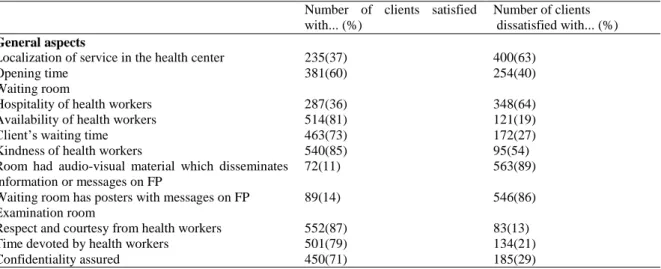
- "Services organization" including service localization in the center, the opening time, the waiting room (Comfortable, audiovisual material which disseminates information or messages about FP, posters with messages on FP) and examination room concerns (respect and courtesy from providers, time devoted by the provider, confidentiality issues). These items were assessed using a Likert scale: "Totally agree," "Mostly agree," "Disagree," "Not agree at all." If the answers to each item were "Totally agree" or "Mostly agree", client were considered as "satisfied" concerning the FP services organization. Otherwise, they were considered as "dissatisfied".
- " Providers‘ technical competence "including the presentation of the full range of contraceptive methods, contraceptive method chosen at the discretion of the client, information regarding the use of the method chosen, knowledge of the side effects of methods, how to proceed in cases of adverse reactions, complications requiring return to the FP center and appointments for follow-up visit. All these items were assessed using a Likert scale: "Totally agree," "Mostly agree," "Disagree," "Not agree at all." If the answers to each item were ""Totally agree" or "Mostly agree", clients were considered as "satisfied" concerning the FP services organization.
Otherwise, they were considered as
"Dissatisfied".
Ndziessiet al.
Congo Family Planning Services Quality
African Journal of Reproductive Health September 2017; 21 (3):
72
service to other women9? If the answers at thetwo questions were "yes", client was considered as "having global positive appreciation of FP services". Otherwise, they were considered as "having global negative appreciation of FP services".
Definition of global satisfaction
To measure global satisfaction, we constructed a composite measure including 3 variables: i) providers‘ technical competence during consultations, ii) FP service organization and iii) global appreciation of services. Finally, client who declared "having good perception of providers‘ technical competence, being satisfied with service organization and having general positive appreciation of FP services" were considered as "satisfied". Otherwise, they were considered as "Dissatisfied".
Statistical analyses
Descriptive statistics were used to describe study population characteristics. Respondents were classified into two groups according their level of satisfaction (satisfied and dissatisfied) and frequencies were provided for each group. Statistical analysis was performed using SPSS v15. (SPSS, Inc., Chicago, Illinois, USA) software.
Results
Main characteristics of family planning services
clients
A total of 635 women enrolled in this study. Mean age (standard derivation, SD) was 28 ± 7 years. Majority of respondents (65%) were in the age range of 25-45 years while the teenage group with age range 15-19 years had the lowest percentage of family planning attendance of 13%. Young group with age range 20-24 years had 22% of family planning attendance. A total of 72% respondents lived in union with children, 7% in union without children, 17% alone with children and 4% alone without children. Education level of study population were low, with 81% of women having no education at all, elementary or college education level.
Perception of FP services organization
The details for each variable assessed for service organization are provided in Table 1. For a total of
591 respondents (88%) FP services were well organized. The remaining, i.e. 12% reported lack of organization in the FP services.
Perception of providers
‘ technical competence
Details for each item of perceived technical competence of health workers are provided in Table 2. Overall 362 (57% of the study population) reported that providers lacked technical competence in FP. The remaining, i.e. 43% reported that health workers in FP services had technical competence.
General appreciation of FP services
In total, 572 (90%) surveyed clients declared that they wanted to return to FP services and 63 (10%) declared that they will not. Concerning the recommendation of FP services to other women, 508 (80%) surveyed clients responded they will recommend the service to others versus 127 (20%) who declared they will not. Overall 77% had general positive appreciation of FP services.
Global satisfaction
As shown in Figure 1, the global clients‘ satisfaction level with FP services (i.e. having a good perception of the technical competence of providers, being satisfied with the service organization and having declared being able to return to service and to recommend the service to others) was 42%. Moreover, when clients' satisfaction was measured as a binary variable (yes / no), the global satisfaction level was almost doubled with 82% (data not shown).
Discussion
Ndziessiet al.
Congo Family Planning Services Quality
African Journal of Reproductive Health September 2017; 21 (3):
73
Table 1: Clients‘ Satisfaction with Various Aspects of FP Services Organization in Government Health Centers in Congo (N=635)
Number of clients satisfied with... (%)
Number of clients dissatisfied with... (%) General aspects
Localization of service in the health center 235(37) 400(63)
Opening time 381(60) 254(40)
Waiting room
Hospitality of health workers 287(36) 348(64) Availability of health workers 514(81) 121(19) Client‘s waiting time 463(73) 172(27) Kindness of health workers 540(85) 95(54) Room had audio-visual material which disseminates
information or messages on FP
72(11) 563(89)
Waiting room has posters with messages on FP 89(14) 546(86) Examination room
Respect and courtesy from health workers 552(87) 83(13) Time devoted by health workers 501(79) 134(21) Confidentiality assured 450(71) 185(29)
Table 2: Clients‘ Satisfaction with Various Technical aspects of Providers in FP Services in Government Health Centers in
Congo(N=635)
which is consistent with lack of FP services utilization reported in Congo characterized by low contraceptive prevalence and high abortion and fertility rate16.
The study finding also highlighted that patient satisfaction was low for providers‘ technical quality however concerning FP services organization and general appreciation of FP services, patient satisfaction was high which is consistent with previous study in the field of health in African context19. Based on this evidence, improving technical competence of caregivers is crucial for maximizing quality of FP services in government health centers in Congo. But, as the quality is multidimensional, other aspects especially significant funding investment and quality-assurance interventions must be taken into account.
The study findings also show that majority of study respondents were between 25 and 45 years
of age suggesting that more women in this age range visit health centers to seek modern contraceptive methods. This is consistent with the Demographic Health Survey and Multiple Indicators in 2012 which reported that the contraceptive prevalence rate was high among women aged 25 to 45 years than among young aged from 15 to 24 years16 .
Furthermore, the study‘s findings show that level of satisfaction is influenced by measurement method used. When binary questions were used, the satisfaction must be assessed as a binary variable "Yes" or "No". Therefore, participants who answered "Yes" were considered as "satisfied" and participants who answered "No" were considered as "Dissatisfied"20,21. Regarding our study, satisfaction was measured by a Likert scale in four categories: "Totally agree", "Mostly agree," "Disagree," "Not agree at all", and we defined satisfaction as a composite measure including 3 variables (i.e.
Number of clients satisfied with... (%)
Number of clients dissatisfied with... (%)
Presentation of the range of contraceptive methods by provider
400(63) 235(37)
Got the contraceptive method of your choice 457(72) 178(18) Information provided about how to use the
contraceptive method
457(72) 178(18)
Information provided about the contraceptive method‘s potential side effects
304(48) 317(52)
Information provided on what to do if problem occurs
267(42) 368(54)
Information provided about complications requiring return to the FP services
216(34) 419(56)
Information provided on when to return for follow-up
Ndziessiet al.
Congo Family Planning Services Quality
African Journal of Reproductive Health September 2017; 21 (3):
74
Figure 1: Clients‘ Global Satisfaction with FP Services in Government Health Centers in Congo(N=635)providers‘ technical competence during consultations, FP service organization and general appreciation of services). Our results concerning level of satisfaction are consistent with health studies using Likert scale to assess patient satisfaction19. Indeed, when we tested satisfaction as binary variable, we observed that client satisfaction was high (95%) consistent with other previous studies who had assessed satisfaction as binary variable 18. These results show that studies using binary method tend to overestimate satisfaction rate compared to studies using the Likert scale. This may be due to the fact that Likert scales have the advantage of allowing a gradation of the answers than binary questions.
Despite these finding, some limitations should be acknowledged. First, satisfaction assessment were based on self-reports which are known to be affected by social desirability bias. Nevertheless, the social workers who conducted client interviews were specially trained to use nonjudgmental approaches in order to minimize such biases. Because, the study concerned a representative sample of health centers, the results may be extrapolated. However, we have not taken into account hospitals and private clinics. Therefore, the results of this study should not be applied to FP services in hospitals and private clinics. In addition, the evaluation issue of appreciation of FP services that include the question if someone ―will come back for FP service‖ is very open-ended and one could answer that in the negative for a variety of reasons not related to satisfaction (for example, they decided not to use a method after all). In this case, using this
variable for building a composite scale for global satisfaction can lead to overestimation of satisfaction rate in this study.
Conclusion
Although the composite scale for global satisfaction should be further explored in other studies, clients‘ general satisfaction was low. Patient satisfaction with FP services organization and general appreciation of FP services were high. Patient satisfaction for provider‘s technical competence was low. If government health centers wish to improve quality of FP services they should give priority to improving technical competence of care providers. But, as the quality is multidimensional, other aspects especially significant funding investment and quality-assurance interventions must be taken into account. This study will help policy- and decision-makers to determine the aspects of FP services that should prioritized to improve clients‘ satisfaction.
Acknowledgements
The authors acknowledge women who responded to the survey in health centers, health centre staff and departmental health authorities who contributed to this study.
Contribution of Authors
Conceived and designed the study: GN. Coordinated the data collection in the field: GN GBP. Analyzed the data: GN. Prepared the manuscript: NG GBP RB.
Satisfied, 267, 42%
Ndziessiet al.
Congo Family Planning Services Quality
African Journal of Reproductive Health September 2017; 21 (3):
75
All authors mentioned in this article approved thefinal version of the manuscript before submission.
References
1. Donabedian A. The quality of care: how can it be assessed?
JAMA 1988; 260, 1743–1748.
2. Cleary PD and McNeil BJ. Patient satisfaction as an indicator of quality care. Inquiry. 1988; 25–36. 3. Sitzia J and Wood N. Patient satisfaction: a review of issues
and concepts. Soc. Sci. Med. 1997; 45, 1829–1843. 4. Aldana JM, Piechulek H and Al-Sabir A. Client satisfaction
and quality of health care in rural Bangladesh. Bull. World Health Organ. 2001; 79, 512–517.
5. Westaway MS, Rheeder P, Van Zyl DG and Seager JR. Interpersonal and organizational dimensions of patient satisfaction: the moderating effects of health status. Int. J. Qual. Health Care J. Int. Soc. Qual. Health Care. 2003; 15, 337–344.
6. Gasquet I. Satisfaction des patients et performance
hospitalière: Qualité des soins. Presse Médicale. 1999; 28, 1610–1616 .
7. Golin CE, DiMatteo MR and Gelberg L. The role of patient participation in the doctor visit: implications for adherence to diabetes care. Diabetes Care. 1996; 19, 1153–1164.
8. Urden LD. Patient satisfaction measurement: current issues and implications. Prof. Case Manag. 2002; 7, 194–200. 9. Dang BN, Westbrook RA, Black WC, Rodriguez-Barradas
MC and Giordano TP. Examining the link between patient satisfaction and adherence to HIV care: a structural equation model. PloS One. 2013; 8, e54729. 10. Rosenberg MJ, Waugh MS and Burnhill MS. Compliance, counseling and satisfaction with oral contraceptives: a prospective evaluation. Fam. Plann. Perspect. 1998; 89–104.
11. Frost JJ and Darroch JE. Factors associated with
contraceptive choice and inconsistent method use, United States, 2004. Perspect. Sex. Reprod. Health
2008; 40, 94–104.
12. Gold J, Burke E, Cissé B, Mackay A, Eva G and Hayes BL. Increasing Access to Family Planning Choices Through Public-Sector Social Franchising: The Experience of Marie Stopes International in Mali. Glob. Health Sci. Pract. 2017; 5, 286–298.
13. Forrest JD and Frost JJ. The family planning attitudes and experiences of low-income women. Fam. Plann. Perspect. 1996; 28, 246–255, 277.
14. Tessema GA, Mahmood MA, Gomersall JS, Assefa Y, Zemedu TG, Kifle M and Laurence CO. Client and facility level determinants of quality of care in family planning services in Ethiopia: Multilevel modelling.
PloS One. 2017; 12, e0179167.
15. CNSEE. EDS Congo Brazzaville 2005. Available at: https://www.cnsee.org/Donnees/Enquete/PDF/Congo EDSC-1.pdf. (Accessed: 15th September 2017) 16. CNSEE. Enquête Démographique et de Santé du Congo
(EDSC-II) 2011-2012. Available at: http:// http://www.cnsee.org/pdf/EDSC2012.pdf. (Accessed: 26th August 2017)
17. Williams T, Schutt-Aine J and Cuca Y. Measuring family planning service quality through client satisfaction exit interviews. Int. Fam. Plan. Perspect. 2000; 63–71. 18. Mabiala-Babela J. Satisfaction des usagers vis-a-vis des
soins dispenses dans les centres de sante integres de Brazzaville. Ann. Sci. Santé 2016; 15.
19. Diouf MCD, Lo CMM, Faye D, Traoré R. Évaluation de la satisfaction des patients admis en service d‘odontologie à Dakar. Pratiques et Organisation des Soins. 2010; 41. 20. Alloh D, Bombo J, Kouakou J and Pillah L. Evaluation de la satisfaction des patients d‘hospitalisation de jour de rééducation à Abidjan. Médecine Afr. Noire. 2011; 58, 63–68.