VOLUME 15 ISSUE 1 (2017), Page 271 - 278
ROLES OF COMMUNITY TOWARDS URBAN FARMING ACTIVITIES
Norul Hafizah binti Yusoff1, Mohd Ramzi Mohd Hussain2, & Izawati Tukiman3
1,2,3Kulliyyah of Architecture and Environmental Design
INTERNATIONAL ISLAMIC UNIVERSITY MALAYSIA
Abstract
The aim of this paper is to review and analyse the importance of the framework for urban farming activities to be implemented within cities environment. This paper also describes the role of the community to achieve the environmental, economic and social sustainability for the enhancement of the urban environment and healthy lifestyles through community participation in food supplies, nutrition, and spaces utilization. The paper evaluates the benefits and potential of urban farming activities within limited urban spaces and how it improves the quality of life. It also reviews on how urban farming is beneficial to the society due to food shortage crisis which is inadequate for the whole population. It is necessary to apply and practice in our daily lives for the consumption of food security, human safety, and health. Therefore, the role of community is very crucial in the implementation of urban farming activities within urbanized areas as the demand for green development increases. Based on this theoretical framework, it is hoped that the paper will be a useful addition to the body of knowledge in promoting a stronger community interdependence to create the sustainable urban environment.
Keyword:
Urban farming, role of community, importance, sustainable.INTRODUCTION
Aggressive development challenges the human mind to trigger innovative ideas to create sustainable development in fast growing cities. Certainly, urban farming is widely practiced by the society in rapid urbanization areas, cities and town spaces (Bellows, Brown & Smit, 2003). Suryandari (2012) reported that urban farming activities had been introduced to reduce and overcome the environmental, economic and social problems other than to fulfil people needs and demands.
With regards to the implementation of urban farming, theory on The Garden City Movement initiated by Sir Ebenezer Howard during the year of 1898 has proved that urban farming concept is not a new idea. In retrospect, The Garden City Movement method emphasized on the combination of town and country to offer an alternative to working class in crowded and unhealthy cities (ACT Planning and Land Authority, 2003). It was intended to create cities with economically independent and countryside’s preservation. Indeed, the connection between foods and the city had already evolved since ancient times.
Although urban farming is not new worldwide, it is yet to become popular in Malaysia due to lack of awareness and participation from community (Islam & Siwar, 2012; Kaur & Hitam, 2010). Thus, the objectives of this paper are to identify the role of community in the urban farming activities towards sustainable urban environment, and to explore the benefits and potential of urban farming activities and how it improves the quality of life.
URBAN FARMING
Thoreau (2010) defines urban farming as food or livestock growth or processes that are undertaken within the urban area or around the urban centres with the purpose to generate income. Likewise, Watson (2015) also discovered that urban farming is about raising foods including plants and animals in the city ground either at allotment land or non-occupied space. In the context of Malaysia, urban farming is often recognized as “pertanian bandar” or “kebun bandar”. Izham Alias, whom the founder of Kebun Bandar: Jom Tanam Sendiri stated that urban farming is an activity that helps to encourage communities to plant crops while saving expenses on foods, which at the same time significantly related to the ecology, health, sustainability and food security (Md Sani, 2016; Mat & Abdul Majid, 2015). Urban farming activity is also beneficial to the society especially urban communities and helps to lessen the problem of food shortage and limited spaces for agriculture (Giedych, 2015; Smith, 2005).
Types of Urban Farming
balcony and rooftop of buildings, as well as on vertical walls, in various cities in different climatic environment, including high-density cities like in the United State of America, Japan, Singapore and many others (Shanshan & Ge, 2013; Hui, 2011).
There are three types of urban farming identified, which are community farming, rooftop farming and vertical farming. Each farm shares similar practices and purposes with specific characteristics due to space organizations and boundaries.
Community Farming in Japan
Rooftop Farming in Singapore
Vertical Farming in Malaysia Figure 1 Types of Urban Farming
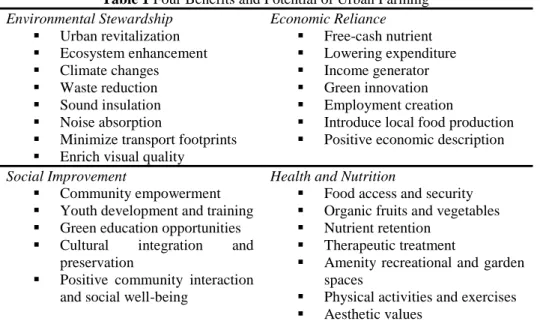
Benefits and Potential of Urban Farming
Table 1 Four Benefits and Potential of Urban Farming
Environmental Stewardship
▪ Urban revitalization
▪ Ecosystem enhancement
▪ Climate changes
▪ Waste reduction
▪ Sound insulation
▪ Noise absorption
▪ Minimize transport footprints
▪ Enrich visual quality
Economic Reliance
▪ Free-cash nutrient
▪ Lowering expenditure
▪ Income generator
▪ Green innovation
▪ Employment creation
▪ Introduce local food production
▪ Positive economic description
Social Improvement
▪ Community empowerment
▪ Youth development and training
▪ Green education opportunities
▪ Cultural integration and preservation
▪ Positive community interaction and social well-being
Health and Nutrition
▪ Food access and security
▪ Organic fruits and vegetables
▪ Nutrient retention
▪ Therapeutic treatment
▪ Amenity recreational and garden spaces
▪ Physical activities and exercises
▪ Aesthetic values
THE ROLES OF COMMUNITY IN URBAN FARMING ACTIVITIES Community perception and participation in urban farming is highly related to the level of awareness of the benefits of the activity. To be successful, it is important that community involvement is kept continuous in the implementation of urban farming.
Community Perception
Russell (2008) discovered perception as the way of people grouping particular matters into things or perspectives which derived from sensations or images. It is the way people classify things through the ability of sensory and reaction of their personal judgment. People can acknowledge something through physical senses by seeing, hearing, tasting and feeling during certain situations. They get to understand, interpret and become aware on something from their point of views and giving the opinions based on the limited knowledge a person has.
Community Participation
physical powers, efforts and influences which they had clearly understood and realize about the importance of something that may help in changing and enhancing their quality of lifestyles.
A positive correlation was found by Banning (2015), indicating that the practices of urban farming activity are linked with the commitment and the awareness of urban communities towards preserving and protecting the natural resources for future growth through establishing environmentally-friendly educational community programs held in the neighbourhood green spaces. Access to food supplies and knowledge of health among the communities will also provide positive outcomes to the number of participations of the urban community in urban farming (Trutko, 2014).
Sustainable Urban Environment
Considerable evidences support the notion that the public play important roles in in creating sustainable urban environment through the practice of urban farming. Although many researchers have mentioned about the benefits of urban farming activities in the urban context, very few studies regarding urban farming have been conducted in Malaysia (Islam & Siwar, 2012; Kaur & Hitam., 2010). This is because urban farming in Malaysia is currently lacking public support, especially in terms of public participation.
Table 2 presents the relationship between community participation with the urban farming activities towards sustainable urban environment. According to recent researches as in Table 2, urban farming activities can provide opportunities in fostering community building and support environmental education.
Table 2 Relationship between Community Participation in Urban Farming Activities and Sustainability
Sources Urban Farming
Activities Community Participation
Sustainable Urban Development
Evan, Valsecchi & Polastri (2012)
Matter of awareness about progressive detachment in the reality of food production knowledge.
Hesitation due to the different attitude and perceptions (farming is rural and traditional senses).
It is necessary to maintain a growing and living spaces in the changing environment.
Peemoeller (2011)
For future, people need to understand the relevance of food in their lives.
Engage and educate the public about healthy and sustainable food systems.
Community leadership is essential, recognize the strength of diversity.
Funders’ Network (2011)
Physical, technical, educational and programmatic support is important to urban agriculture success and longevity
Absences of community engagement and opportunities (lack of supportive public policies and community visioning).
Kaur & Hitam
(2010) -
Lack of community participation in sustainable program.
Local Agenda 21 - fewer authorities efforts “words are, action not”.
Rujiroj Anambutr (2010)
-
Community need for motivation and application experiences for better understanding and awareness to gain good results.
Policy → apply→ enforcement
- time, efforts and cooperation are needed.
Victor Rubin (2008)
-
Increase environmental justice campaign from development projects & healthier activities
Contribution of greening-need diverse methods and supports, connection for green movement.
CONCLUSION
REFERENCES
ACT Planning and Land Authority (2008). Garden City values and principles - design considerations for residential development in inner North and South Canberra. Anambutr, R. (2010). Moving toward eco-friendly city: Perspective on Thailand. In L. L.
Fook, C. Gang (Eds.), Towards a liveable and sustainable urban environment: eco-cities in East Asia, p. 107-128. Singapore: World Scientific.
Banning, J. (2011). Food (and farms) for thought: campus farming and environmental
sustainability. Retrieved October 21, 2015 from
http://blogs.worldwatch.org/nourishingtheplanet/food-and-farms-for-thought-campus-farming-and-environmental-sustainability.
Bellows, A. C., Brown, K., & Smit, J. (2003). Health Benefits of Urban Agriculture. Community Food Security Coalition, 19, 702–703.
Burns, D., Heywood, F., Taylor, M., Wilde, P., & Wilson, M. (2004). Making community participation meaningful: a handbook for development and assessment. Bristol: The Policy Press.
Cabannes, Y. (2006). Financing and investment for urban agriculture. In R. V. Veenhuizen (Ed.), Cities farming for the future, p.87-124. Silang, Philippines: International Institute of Rural Reconstruction.
Evans, S., Valsecchi, F., & Pollastri, S. (2012). Design for distributed and networked urban farming in Shanghai. Cumulus 2012. Helsinki, Finland.
Feenstra, G. W. (1997). Local food systems and sustainable communities. American Journal of Alternative Agriculture, 12(1), 28-36.
Funders’ Network (2011). Investing in healthy, sustainable places through urban agriculture (Translation paper 5).
Giedych, R. (2013). Urban agriculture: structure, functions, future challenges. Global Landscapes Forum. Warsaw, Poland.
HB Lanarc-Golder (2013). The urban farming guidebook: planning for the business of growing food in BC’s towns and cities. Vancouver.
Hui, S. C. M. (2011). Green roof urban farming for buildings in high-density urban cities.
The 2011 Hainan China World Green Roof Conference. Hainan, China.
Islam, R., & Siwar, C. (2012). The analysis of urban agriculture development in Malaysia.
Advances in Environmental Biology, 6(3), 1068–1078.
Kaur, H., & Hitam, M. (2010). Sustainable living: an overview from the Malaysian perspective. In L. L. Fook, C. Gang (Eds.), Towards a liveable and sustainable urban environment: eco-cities in East Asia, p. 159-178. Singapore: World Scientific.
Kumar, R. (2012). Five reasons why urban farming is the most important movement of
our time. Retrieved December 22, 2015 from:
http://magazine.good.is/articles/five-reasons-why-urban-farming-is-the-most-important-movement-of-our-time.
Lydecker, M., & Drechsel, P. (2010). Urban agriculture and sanitation services in Accra, Ghana: the overlooked contribution. International Journal of Agricultural Sustainability, 8(1), 94-103.
Mat, R., & Abdul Majid, A. (2015). Kepentingan pertanian bandar dan cabaran yang dihadapi oleh petani bandar di Malaysia. International Journal of Environment, Society & Space, 3(1), 44–56.
Md Sani, M. S. (2016). Bantu warga bandar bertani. HM Online. Retrieved March 16, 2016 from http://www.hmetro.com.my/node/24925?m=1
Nemore, C. (1998). Rooted in community: community gardens in New York City. City
Farmer. Retrieved November 12, 2015 from
http://www.cityfarmer.org/NYcomgardens.html.
Peemoeller, L. (2011). Sustainable food system. In S. Coyle (Ed.) Sustainable and resilient communities: A comprehensive action plan for towns, cities, and regions, p. 269-283. Hoboken, New Jersey: John Wiley & Sons.
Rubin, V. (2008). The roots of the urban greening movement. In E. Birch, S. Wachter (Eds.), Growing Greener Cities, p. 187-. Philadelphia: University of Pennsylvania Press.
Russell, B. (2008). Lecture VII: definition of perception, the analysis of mind. LLC: NuVision Publications.
Scott, E. (2012). Why gardening beats reading for stress relief. Retrieved October 17, 2015 from http://stress.about.com/od/generaltechniques/a/gardening.htm. Shanshan, D., & Ge, C. (2013). Multiple functions of urban farming. Retrieved October
17, 2015 from http://www.pcd.org.hk/en/newsletter/multiple-functions-urban-farming.
Sharp, J., Imerman, E., & Peters, G. (2002). Community Supported Agriculture (CSA): building community among farmers and non-farmers. Journal of Extension, 2002. Retrieved October 14, 2015 from http://www.joe.org/joe/2002june/a3.html. Smith, D. L. (2005). Urban and peri-urban agriculture as a public policy issue. Workshop
on Policy Prospects for Urban and Peri-Urban Agriculture in Kenya. Nairobi, Kenya.
Suryandari, R. Y. (2012). Urban farming and its impact on local communities and urban environment: A case study of West Jakarta and Tangerang, Indonesia. Malaysian Journal Society and Space, 8(3), 12–22.
Thoreau, C. (2010). Defining urban farming. Vancouver Urban Micro. Retrieved November 19, 2015 from http://cmthoreau.wordpress.com/2010/10/15/defining-urban-farming/.
Trutko, A. (2014). Perceived outcomes of a community-based urban agriculture and nutrition education program: a case study of Common Good City Farm’s Green Tomorrows program in Washington, D.C. IGARSS 2014. Quebec, Canada. Veenhuizen, R. V. (Ed.) (2006). Cities farming for the future. Silang, Philippines:
International Institute of Rural Reconstruction.
Wackernagel, M., & Rees, W. (1996). Our ecological footprint: reducing human impact on the earth. Gabriola Island, BC: New Society Publishers.
Watson, M. (2014). What is an urban farm? About Food. Retrieved November 14, 2016 from http://localfoods.about.com/od/localfoodsglossary/g/What-Is-An-Urban-Farm.htm/