Hungarian Association of Agricultural Informatics
European Federation for Information Technology in Agriculture, Food and the Environment
Journal of Agricultural Informatics. 2015 Vol. 6, No. 4 journal.magisz.org
What really matters? A qualitative analysis on the adoption of innovations in
agriculture
Erika Pignatti1, Giacomo Carli2, Maurizio Canavari3
I N F O Received: Accepted: Available on-line: Responsible Editor
Keywords: agriculture,
technological innovations, adoption,
qualitative analysis, drivers
A B S T R A C T
The agricultural industry is confronted with the need of increasing the production to feed a growing population, and contemporarily to manage the decreased availability of natural resources. This major challenge boosts agriculture sector to adopt new approaches and technical innovations; anyway, the adoption of innovations in agriculture is not immediate, due to the interaction of many drivers that impact on individuals and enterprises’ decisions. This paper aims at providing a list of drivers for the adoption of technological innovations in agriculture, on the basis of the outcomes of in-depth interviews and focus groups performed in three European countries (Italy, Greece, Turkey). With specific reference to innovations, ease of use, effectiveness, usefulness, resource savings, and compatibility were mentioned as relevant features for an innovation to be adopted. Trials, demonstrations, experience and knowledge sharing, and support from qualified third parties were included among the facilitating factors for conveying and promoting innovations. Finally, public funding, agricultural policies and market conditions were identified as factors that may tip the balance in the process of innovations’ adoption.
1. Introduction
The agricultural industry is nowadays facing some major issues: to feed a growing population; to face natural resources’ decreasing availability; to improve farmers’ working conditions; to improve products’ quality; to increase competitiveness. Advancements in technological solutions demonstrate that approaching and adopting technological innovations are mandatory steps for agricultural industry development, and a strategic choice to cope with the challenges the sector is confronted with.
Technological innovations present many potentialities that could help facing structural changes in labour conditions, food supplies, market fluctuations, and natural resources management. As an example, stricter environmental regulations could stimulate advancements in environmental friendly techniques to reduce environmental load; as well as constraints in the use of natural resources will promote the adoption and spreading of resources-saving agronomic techniques. The adoption and implementation of technological innovations at different links of the agricultural value chain, along with the access to and the management of technological information, will result in improvements to the competitiveness of the chain in general. Then, drivers that affect the decision process regarding adoption or rejection of innovations, and their influence on the steps of the adoption process must be carefully taken into consideration.
The aim of this paper is to provide a detailed set of drivers for the adoption of ICT and technological innovations in agriculture, to be tested in a consecutive quantitative survey. A qualitative exploratory approach was chosen, and in-depth interviews and focus groups discussions were performed in three
1 Erika Pignatti
Department of Agricultural Sciences, University of Bologna [email protected]
2 Giacomo Carli
Department of Management, University of Bologna [email protected]
3 Maurizio Canavari
countries (Italy, Greece, Turkey) involved in the ROBOFARM project (ICT-AGRI ERA-NET Project “Integrated robotic and software platform as support system for farm level business decisions”). This paper is organized as follows: first, a synthetic overview of the theoretical background regarding the adoption of technological innovations in agriculture is provided. In section 3, the adopted qualitative techniques are briefly described. Section 4 explains the results in details, focusing on the main topics that were extracted from the interviews and the focus groups. Final discussion is provided in Section 5.
2. Theoretical background
According to (Rogers 2003), a new technology (or innovation) is defined as “an idea, practice, or object that is perceived as new by an individual or other unit of adoption”. The process of technology adoption has been deeply analysed in literature, and two main strands of research have developed (Marra et al. 2013). The sociological perspective focused on adopters’ socio-demographic and behavioural features; later on, a stream of research emerged that highlighted the relevance of economic variables in determining the adoption of technological innovations. Anyway, as acknowledged in (Baumüller 2012), the process of technology adoption is even more complex and dynamic, and should take into account the fitting with specific physical, farming, and extrinsic features of the context the technology is placed in. Moreover, the technology itself could lead to different farmers’ approach and evaluations. The same outcomes are confirmed by (Howley, O. Donoghue, and Heanue 2012), that provided a careful and exhaustive overview on all the research streams that debated the topic of adoption of agricultural technology, and focused their study on heterogeneity in structural farm and farmer characteristics as explanatory variables for technology adoption patterns.
Agricultural industry has been subjected to the introduction of a large set of technological innovations in the last years, which can be roughly divided in information management systems and tools and equipment for in-field activities. With reference to ICT innovations and their introduction in the agricultural industry, contributions in literature (Gelb and Voet 2009; Rota et al. 2013, in Anastasios et al. 2010) identified some relevant drivers that can affect the process of ICTs adoption in farms. Age, level of education, farm size, type of production, income, along with software features, ease of use, perceived benefits, and training, were described as critical in adopting ICTs at the farm level.
3. Materials and methods
Since the objective of this study is to create a list of drivers for the adoption of ICT and technological innovations in agriculture, a preliminary literature review was conducted aiming at identifying the main constructs underlying the decision process regarding technology acceptance and adoption. Then, an exploratory analysis was performed adopting two qualitative methodological approaches: in depth
face-to-face interviews and focus groups with selected key informants. Qualitative approaches are generally employed to conduct in-depth investigations on relatively unexplored topics. They base on exploring people’s behaviour, attitudes, experiences and opinions, trying to highlight underlying or latent mechanisms and interactions between factors. Since qualitative methods are largely inductive, they are particularly suitable to approach under-studied phenomena and to develop hypotheses for further research steps (Creswell 2003), helping in providing context and foundation for quantitative analyses. Interviews and focus groups are generally conducted with pre-selected targeted participants to discern and assess the relevance of interviewees’ experience facilitating the understanding of central and fundamental features of a specific phenomenon (Harris et al. 2009).
Data collection was performed in three countries (Greece, Turkey and Italy) during summer 2013. In each country, 4 in-depth face-to-face interviews and 2 focus groups (minimum 6, maximum 10 participants each) with selected key informants were carried out, aiming at testing farmers’ and technicians’ perception of the factors related to technology acceptance and adoption.
Discussions were conducted using a semi-structured qualitative schedule, organized according to the following topics:
THEMES TOPICS AND QUESTIONS (selection)
Organizational and professional tenure
Company business, income
Company size and level of specialization Land and equipment ownership
Role and professional tenure Age and Education
Technology adoption in agriculture
What do you think about technological innovations’ adoption? What is the role of ICT tools in agricultural practices?
What is your experience and the orientation of your farm/company? Do you think that any of the factors listed in the previous cell could affect or have affected any decision about technology adoption? ICT/Technological
innovations’ adoption process
What are the phases that compose the adoption process? (Steps) What are the relevant factors (positive and negative) that affect the decision process?
Can you connect the relevant factors with the above-mentioned phases, according to their influence?
Opportunities and limitations
Technological innovations’ adoption: benefits and limitations
What do you think ICT tools and technological innovations are missing, to satisfy farmers’ needs?
The first section (Organizational and professional tenure) aimed at understanding the role that “socio-demographic” features (both of the farm and the farmer) play in affecting the technology adoption decision processes.
The third section (ICT/Technological innovations’ adoption process) aimed at identifying the stages that lead to the adoption/rejection of technological innovations, and for each stage the factors (intrinsic and extrinsic) they are influenced by.
Finally, in the fourth section (Opportunities and limitations) additional opinions and ideas about drivers to be enhanced (or factors to be adjusted) to encourage the process of technology adoption in agriculture were collected.
Participants to in-depth face-to-face interviews were preferably selected among technicians with expertise in agricultural practices, providers of technologies (e.g.: FMIS providers, equipment producers, etc.), farm co-ops and association representatives, researchers. According to the protocol, interviews aimed at collecting the qualitative material to be debated during the focus groups. Therefore, we oriented interviewees towards a brainstorming process, based on their experiences and understanding of the industry.
Participants to the focus groups were preferably recruited among medium-large size farm owners, farm co-ops representatives. This is due to the need of having a validation of the different outcomes from interviews. Participants were invited to debate on a set of options trying to identify the reasons underlying their convictions. In each focus group we observed an appreciable level of debate.
Interviews and focus groups were recorded, transcribed and analysed using a qualitative content analysis technique (Atlas.ti software). This content analysis approach allowed for screening and identifying the steps of the technology adoption process in agriculture, and the influential factors for each step.
4. Results
4.1. Interviews and focus groups: geographic area and participants
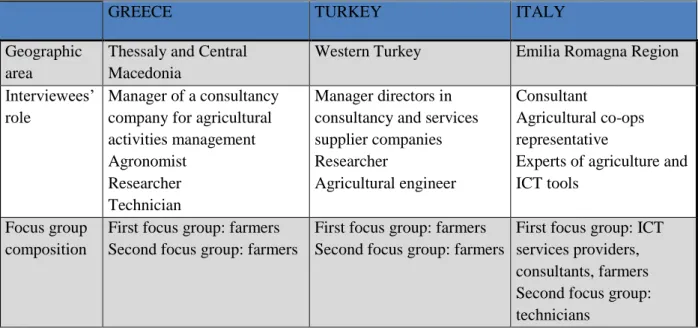
A synthetic overview on locations where interviews and focus groups took place, interviewees’ roles and focus groups’ compositions is provided in Table 1.
Table 1. In-depth interviews and focus group discussions: geographic area and roles of participants
GREECE TURKEY ITALY
Geographic area
Thessaly and Central Macedonia
Western Turkey Emilia Romagna Region
Interviewees’ role
Manager of a consultancy company for agricultural activities management Agronomist
Researcher Technician
Manager directors in consultancy and services supplier companies Researcher
Agricultural engineer
Consultant
Agricultural co-ops representative
Experts of agriculture and ICT tools
Focus group composition
First focus group: farmers Second focus group: farmers
First focus group: farmers Second focus group: farmers
First focus group: ICT services providers, consultants, farmers Second focus group: technicians
innovations in the agricultural sector is sometimes slow, due to some constraints and limitations. Results from interviews and focus groups are summarized in the following sections, according to the most relevant outcomes.
4.2. Farms’ and farmers’ features
Respondents confirmed that some socio-demographic features of farmers, such as age and educational level, affect the process of innovations’ adoption. New generation of farmers are very interested in technology and apply new technologies in their daily life and farms. Younger farmers are more innovative and seem to be more willing to approach innovations, and their higher education levels allow them to interact with new technologies more effectively. Young farmers seem to be better informed about the capabilities of advanced machineries and ICT; the use of ICT tools in their daily routine and the availability of easy to use and easy to handle devices make younger farmers more familiar with technological innovations. On the other side, older farmers and “old style” farmers seem to be more indifferent and affected by a sort of “generational” reluctance and distrust, due to consolidated habits and experiences and to the belief that experience in agricultural practices could substitute the need for innovative tools. A generally lower level of education of older farmers increase the difficulty of perceiving and understanding the actual benefits ICTs can provide. Nonetheless, the negative effects of age, distrust and reluctance could be bypassed in presence of leading/frontier farmers with a good propensity towards innovations and changes. Entrepreneurial attitude and open-mindedness were mentioned as fundamental features for farmers to approach technological innovations and invest on them, whilst low technologies’ understanding, uncertain perspectives and low propensity to invest are influential factors that limit technology adoption.
Farmers’ attitude towards innovations plays a relevant role in the agricultural industry: fear of technology, anxiety and feeling incapable in presence of complex devices or equipment could discourage farmers and increase their rejection. Background and previous experiences influence both farmers’ knowledge and perception of innovations, and determine the level of trust against new tools and equipment. Some interviewees remarked that the low level of knowledge, competence and training could fuel a certain degree of scepticism against innovations and their level of accuracy. In addition, the lack of expertise, and the difficulty in approaching new technologies when they are out of farmers’ experience could end up in unsuccessful experiences and expectations’ failure, thus fomenting scepticism and distrust. In this case, external support and successful experiences’ sharing were recognized as fundamental to mitigate such attitudes. Some participants pinpointed that openness towards innovations is commensurate with farmer’s actual needs and with the level of integration of a technology in the existing operational system.
Employees’ knowledge and skills are additional determinants for the adoption process, since technological innovations require know-how and qualified personnel. Training of employees with a permanent position would be a facilitating condition for technology adoption, but since investing in training requires time and money, it can be a barrier to the adoption of technological innovations. Belonging to cooperatives or associations could help farmers’ in reducing costs for innovations and training, since co-ops and associations could test and adopt technological innovations, share them with farmers (asking for a depreciation charge) and provide farmers with the required know-how and information. Information about new technologies and equipment are fundamental in the decision process for adoption; therefore, when a huge information gap exists between agricultural knowledge centres and rural communities, or when information are not available nor shared, technologies can hardly reach farmers at the production level.
4.3. Technological innovations’ role and features
Many interviewees declared that the actual level of integration of technological innovations in agriculture is quite low, and their complexity is sometimes too high to let innovations access farmers’ daily routine. Anyway, technological innovations’ potentialities are indisputable. In a broader perspective, technological innovations are acknowledged to be fundamental in promoting sustainability, enhancing food security and supporting rural development. Interviewees agreed that technological innovations could provide many benefits and opportunities for improvement in a sector that show some deficiencies, especially in terms of organizational and managerial aspects. Focusing on farms, technological innovations can boost efficiency and productivity, and provide a more rational overview on farm’s activities, performances and management, supporting a better and easier decision-making process. They can lead to improvements both in terms of performance (production’s optimization, reduction of costs) and working conditions and comfort (automation, digitalization); in addition, they could reduce uncertainty in production processes and optimize the management and use of inputs and resources. Moreover, in geographical areas where high quality agricultural products are produced, innovations can be particularly profitable since they could enhance yields and products’ quality, and improve farmers’ revenues. Finally, technological innovations can favour accessing new market segments and production areas, where cultivating is actually impeded by environmental constraints. To these purposes, some features are fundamental for the adoption and the spreading of innovations among end-users.
Technological innovations must be easy to use and accessible to every user, irrespective of his/her skills and age, and acquiring familiarity with a new technology should be easy and quick. Simplicity, compatibility with other systems already in place in the organizations, and flexibility are relevant features that favour the adoption of technological innovations, along with a high level of fitting and customization that could favour the achievement of goals such as resources saving and management effectiveness. New technologies should guarantee continuity in operational activities, and avoid significant changes in the organization of work tasks that could cause farmers’ rejection. Innovations must be affordable (with reference to complexity), factually useful, with distinguishable functions, and must provide a concrete simplification of procedures, along with observable and understandable outputs and concrete benefits. Moreover, they should guarantee reliability and resistance.
Small size, ease of use and manageability of new technological devices are captivating features that increase the positive attitude towards adoption. Data collection and transfer are nowadays facilitated by Wi-Fi devices and cloud based storing solutions. Nonetheless, data charging should be easy and quick, and overtake practical problems (vocal identification software are an example). Data analysis must provide easy to understand feedbacks and ready-to-use information outputs; therefore, software for farm management information systems should be designed with the aim of providing a rigorous but simplified overview on farm’s performance, reducing uncertainties and supporting farmers and technicians in their decision process. Software solutions should also be customized according to users’ features and needs. Compatibility with some commonly adopted tools (such as Windows Office package) is a prerequisite for adoption; similarly, automation in operational activities or in data management is seen as a facilitating condition for innovations’ success.
Finally, many participants remarked the fundamental role of trials, which can disclose innovations’ potential and functions, favouring the perception of the benefits they can provide. In-field demonstrations, pilot farms and farmers, along with successful experiences of technological innovations’ implementation, could fasten the process of awareness and trust raising, and seem to be the most convincing reason to adopt innovations and spread them among end-users.
4.4. Role of the external environment: agricultural industry framework, external support, knowledge and experience sharing, market and institutions
Some participants pinpointed that, despite the recent trends and developments in terms of technological advancements, agricultural industry has been scarcely inclined to innovations during years, and acknowledged as self-sufficient. In decades, innovations for agricultural industry have rather been imposed than created by the agricultural industry itself; therefore, they lacked in answering to farmers’ requests and did not fit the contexts they were placed in. Participation in creating technological innovations that satisfy farmers’ needs and fit farmers’ conditions is definitely a prerequisite for a higher likelihood of innovations’ success and acceptance. Collaborating with innovations’ designers and providers could increase farmers’ trust and confidence, and their positive attitude towards new technologies.
The “environmental” context where farms operate is relevant for adopting and spreading innovations as well. According to some participants’ opinion, innovations alone cannot access a consolidated system and survive; they need to be conveyed, promoted and defended. In well established, advanced and structured systems where associations, consortia and support units exist and cooperate, the presence of technical controls can assure innovations’ protection, support and diffusion. In contexts where the external system is less structured and supportive, innovations’ diffusion dynamics can differ, and farmers can autonomously decide to approach innovations. External third parties act as filters for innovations’ diffusion in well-established systems. Moreover, in a broader perspective, external parties can act as a catalyst for technological innovations’ adoption, since farmers and operators show a positive attitude against all technological solutions that are guaranteed and certified by trusted providers or tested and promoted by institutional subjects (governments, universities, research centres).
responses according to the data collected and to their specialized know-how and expertise. Then, consultants and experts are particularly relevant in the technology adoption process, since they can recommend innovations and provide competence and support for their implementation. Communication and qualified support is also requested from technological innovations’ providers, especially in after sales stages, and could affect the decision process as well, especially when skilled and highly qualified support is missing.
Experience sharing is an additional driver that can affect the decision process about innovations’ adoption. The factual sharing of experiences and opinions among farmers, business partners and competitors is a powerful way to overtake “narrow-mindedness” and fears, to approach innovations with a higher awareness both about needs and innovations’ benefits, and a chance for development. Sharing experiences could be a revolutionary change in agricultural industry, since it would increase farmers’ knowledge, favour risks’ reduction when choosing or investing in a new technology, and stimulate significant improvements. Despite a sort of rejection towards sharing (of ideas, knowledge, experiences, machineries) that affects agricultural industry in some countries and grounds mainly on mentality, many interviewees agreed that exchanging experiences among farmers and practitioners regarding technological innovations and successful histories of adoption would be more trusted than any promotional initiative and would fasten the access of innovations into the agricultural sector. Examples from positive previous experiences and from advanced farmers with a strong propensity towards innovation, can be particularly effective: since frontier farmers are more willing to apply technologies, they can act as forerunners and demonstrate that the result of technology application is successful, and cost losses are minimized. This can start a virtuous mechanism of emulation.
Finally, institutions and market environment play a relevant role in supporting or dissuading farmers from adopting technological innovations. Some participants agreed that market pressures could influence the adoption process when the adoption of a specific innovation becomes a mandatory requirement to stay in the market. With reference to institutions, some interviewees remarked that some policy indications and decisions could conflict with innovations’ trends, reduce innovations’ potential and slow down the adoption process, damaging farmers’ competitiveness. In financial terms, the role of public funding in facilitating the adoption of technological innovations is fundamental. Since uncertainties about the return on investments could discourage farmers, the whole agricultural system should put into effect some actions that guarantee farmers’ investments from markets’ instability and allow them to access innovations. An “underlying” protection system should be in place to protect farmers against market risks and subsidize them in case the return on investments is delayed. Many respondents remarked that funding schemes and subsidies could be an effective (and in some cases essential) tool to improve the access to and the adoption of technological innovations. Besides some infrastructural upgrades, a Wi-Fi, cloud based, open source system could be a fundamental improvement in agricultural industry, and a mean for fastening the process of technology knowledge, sharing and adoption, and reducing costs. In this context, a continental shared platform could write off the investment, and could guarantee data homogeneity among European partners. Public funding, agricultural policies and market conditions are highly significant for innovations’ spreading and adoption, since they could enforce the adoption process acting as enhancers and promoters.
4.5. Adoption process: main steps and relevant factors
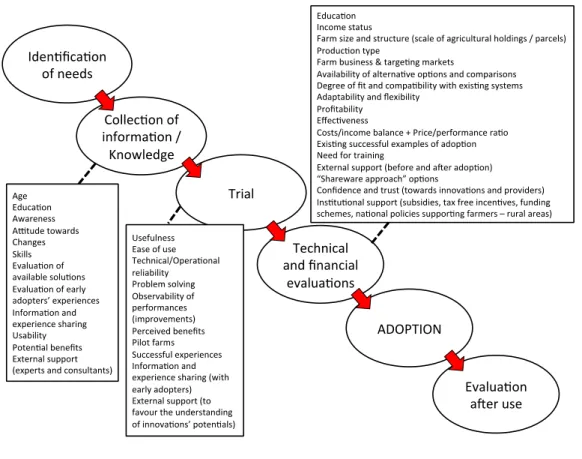
Interviewees were asked to identify the main phases that lead to the adoption (or the rejection) of technological innovations. Furthermore, participants were invited to link all the drivers that emerged from the first stage of in-depth interviews and focus groups discussions to the respective phase of the adoption process, highlighting the influence of the drivers on the adoption steps.
Figure 1. Adoption process stages and relevant factors (in-depth interviews)
5. Discussion
The outcomes of this exploratory study highlight the need for further research and analyses, to test the concrete relevance of the identified determinants on technological innovations’ adoption in agriculture. Anyway, a broad overview on the main drivers was provided, and some considerations can be drawn.
According to the outcomes of the exploratory analysis, some steps can be identified that compose the decision process of adopting technological innovations. Identification of needs and of the available solutions are the first phases. Then, trials and demonstrations must be performed, along with the analysis of scenarios. The next step encompasses technical and financial evaluations, and all the critical issues that could lead to the adoption or suggest rejection. Each phase in the process is strongly connected with a list of drivers that were acknowledged to be influential on the evaluation of technological innovations’ viability.
“Socio-demographic” features of farmers are particularly relevant in the first steps of the decision process regarding adoption. Age and educational level can affect the identification and evaluation of needs, and the consequent process of information collecting. Behavioural traits (entrepreneurial attitude, open-mindedness, attitude towards changes, propensity, fear and anxiety, etc.) are equally relevant, but they seem to become critical in the stage of technical and financial evaluations preceding the decision to adopt. Knowledge and awareness are additional farmers’ features that affect the process of approaching technological innovations in these early stages. With reference to farms, structural features such as land ownership, farm size, aggregation, economic status, farm business and targeting markets, perspectives and planning, production type and farm’s organization influence the decision process as well, especially when the final risk/benefits analysis is performed. Small parcel sizes and scattered fields limit the propensity towards adopting some kinds of innovations, since innovations cannot perform at their best in such conditions and farmers cannot invest big amounts of money in expensive technologies. Similarly, geographical location can affect the availability of innovations, their usability and consequently their adoption. Employees’ knowledge, skills and training are critical features for adoption as well, both in the early steps of the decision process and in the evaluation phase, since training asks for resources and investments. Organizational changes and resources are a significant barrier to the adoption of innovations.
Technological innovations’ features are undoubtedly relevant in all the stages of the decision process regarding adoption, including the evaluation of innovations after use. In the first steps, “functional” features of innovations are considered; then, during trials and in the analysis of scenarios and risks/benefits balance, innovations are evaluated according to a wider set of requirements. Ease of use, usability, simplicity, compatibility with existing systems, flexibility, were mentioned as fundamental functional features for innovations to be adopted. In addition, effectiveness, usefulness, observability of performances, reliability, degree of fitting, potential and perceived benefits, profitability, price/performance ratio and return on investments were mentioned as unavoidable aspects to be evaluated especially in the last stages of the decision process. Innovations must provide understandable feedbacks and ready-to-use information outputs, and should be tailored on agricultural sector’s features and needs. The trade-off between technological innovations’ usefulness and viability on one side, and farms’ size and profitability, costs, farmers’ exposure to risks and the actual added value of the innovations themselves on the other side must be carefully evaluated.
role in disseminating and promoting innovations among farmers, and in increasing farmers’ confidence through training and demonstrations.
Similarly, experience and information sharing among farmers and practitioners is particularly powerful and could be more influential than any institutional dissemination and promotional activity. Especially in the first stages, successful experiences of pilot farms and farmers, evaluations on early adopters’ results, information sharing, word of mouth are the reference system farmers can rely on. Sharing experiences could be a revolutionary change in agricultural industry, since it would increase farmers’ knowledge, favour risks’ reduction when choosing or investing in a new technology, and stimulate significant improvements.
Finally, public funding, agricultural policies and market conditions are the under-layer the decision process is placed on. They affect the decision process since its early stages, because they can impose constraints that limit or adopt measures that favour the approach to innovations. The lack of facilitating conditions provided by public administrations, the lack of an underlying system that supports and protects farmers against market’s risks and subsidize them when the return on investments is delayed, policy orientations that conflict with innovations’ trends, changes in legislation that reduce innovations’ potentials are responsible for negative evaluations during the risks/benefits analysis stage, for farmers’ reluctance and final rejection of innovations. In other cases, the existence of legal mandatory requirements or strong market orientations enforces the adoption, bypassing any decision process and voluntariness, which is an important driver at the beginning of the decision process. Nonetheless, policies, legislations and market trends can act as powerful and effective catalysts for innovations’ spreading, acting as enhancers and promoters of the adoption process.
To conclude, this paper provides a wide and exhaustive background regarding factors that can affect the adoption of technological innovations in agricultural industry. According to country-specific, site-specific and technology-site-specific features, and encompassing additional economic and extrinsic variables that could intervene in the decision process, further analyses are needed to identify the constructs that affect technology adoption, their relationships and the determinants for successful experiences.
Acknowledgements
The financial support of the European Union and of the National Funding Agency (Italian Ministry of Agriculture) within the European Union Seventh Framework Programme (FP7/2007 – 2013) for Research, Technological Development and Demonstration Activities, for the Project “Integrated robotic and software platform as support system for farm level business decisions” (ROBOFARM) is acknowledged.
References
Adrian, AM, Norwood, SH, and Mask, PL 2005 ‘Producers’ perceptions and attitudes towards precision agriculture technologies’. Computer and Electronics in Agriculture, vol. 48, pp. 256-271.
doi: 10.1016/j.compag.2005.04.004
Anastasios, M, Koutsouris, A, and Konstadinos, M 2010 ‘Information and Communication Technologies as Agricultural Extension Tools: A Survey among Farmers in West Macedonia, Greece.’ Journal of Agricultural Education and Extension, vol. 16, no. 3, pp. 249-263. doi: 10.1080/1389224x.2010.489767
Aubert, BA, Schroeder, A, and Grimaudo, J 2012 ‘IT as enabler of sustainable farming: An empirical analysis of farmers’ adoption decision of precision agriculture technology’. Decision Support System, vol. 54, pp. 510–520. doi: 10.1016/j.dss.2012.07.002
Baumüller, H 2012 ‘Facilitating agricultural technology adoption among the poor: the role of service delivery through mobile phones’. Working Paper Series 93. ZEF Working Paper Series (eds von Braun, Denich, Gerke, Hornidge and Schetter), Department of Political and Cultural Change, Center for Development Research, University of Bonn, ISSN 1864-6638
Davis, FD, 1989 ‘Perceived Usefulness, Perceived Ease of Use, and User Acceptance of Information Technology. MIS Quarterly, vol. 13, pp. 319–340. doi: 10.2307/249008
Gelb, E, and Voet, H 2009 ‘ICT Adoption Trends in Agriculture: A Summary of the EFITA ICT Adoption Questionnaires (1999-2009)
Harris, JE, Gleason, PM, Sheean, PM, Boushey, C, Beto, JA, and Bruemmer, B 2009 ‘An introduction to qualitative research for food and nutrition professionals’. Journal of the American Dietetic Association, vol. 109, 80-90. doi: 10.1016/j.jada.2008.10.018
Howley, P, O. Donoghue, C, and Heanue, K 2012 ‘Factors Affecting Farmers’ Adoption of Agricultural Innovations: A Panel Data Analysis of the Use of Artificial Insemination among Dairy Farmers in Ireland’. Journal of Agricultural Sciences, vol. 4, no. 6, pp. 171-179.
Marra, M, Pannell, DJ, and Abadi Ghadim, A 2003 ‘The economics of risk, uncertainty and learning in the adoption of new agricultural technologies: where are we on the learning curve?’. Agricultural Systems, vol. 75, no. 2-3, pp. 215-234. doi: 10.1016/s0308-521x(02)00066-5
Rogers, EM 2003 ‘Diffusion of Innovations’, 5th Edition, New York, Free Press.
Rota, C, Nasuelli, PA, Spadoni, C, Valmori, I, and Zanasi, C 2013 ‘Factors Affecting the Sustainable Use of ICTs for Agriculture at the Farm: The Case of Image Line Network Community’. EFITA-WCCA-CIGR Conference “Sustainable Agriculture through ICT Innovation”, Turin (Italy), 24-27 June 2013.