Relationship between innovation climate and innovative behavior of librarians: Case study in Organization of Libraries, Museums and Documentation Center
of Astan Quds Razavi
Zahra Jafarzadeh Kermani
Assistant professor of Library and Information Science Department, Imam Reza International
University, Mashhad, Iran Corresponding Author; Email: [email protected]
Fatemeh Solhdoost
MA Student in Library and Information Science, Imam Reza International University, Mashhad, Iran
Email: [email protected]
Abstract
This study aims to determine the relationship between innovation climate and the librarians' innovative behavior in Organization of Libraries, Museums and Documentation Center of Astan Quds Razavi, as the largest public library of Iran. The methodology for this study is based on a survey research. To this purpose, the innovative behavior questionnaire and Ekvall's (1996) innovation climate, developed by the Creative Problem Solving Group, Buffalo, USA, were used. The study population consisted of 104 librarians working in Organization of Libraries, Museums and Documentation Center of Astan Quds Razavi. The results show that there is a significant relationship between innovative behavior of librarians and innovation climate in the library (44%). That is, innovation climate and innovative behavior factors can explain 44% of variation in each other. The findings show that innovation climate exists at an average level (mean: 3.24) in Organization of Libraries, Museums and Documentation Center of Astan Quds Razavi. Among the dimensions of innovation climate, challenge (3.44) and trust (2.86) achieved the highest and the lowest mean respectively. In general, the librarians' innovative behavior was found to be at an average level (2.44).This behavior was above average at the two stages of idea discovery (2.6) and idea generation (2.54), whilst it was at the medium level at the two stages of idea support (2.321) and idea implementation (2.33). This is the first research to study the relationship between innovation climate and innovative behavior of librarians in the library organization.
Keyword: Innovation Climate, Innovative Behavior, Librarians, Organization Of Libraries, Museums And Documentation Center Of Astan Quds Razavi
Introduction and problem statement
innovation, employees are discouraged from risk-taking. In general, innovation is essential to create an effective work climate that provides a peaceful and intimate atmosphere, specifies objectives, reward creativity and innovation, supports determination and commitment of employees and prepares them for change (Qaemi, 2001, as quoted in Aqadavood, Hatami & Hakiminia, 2010). Also, as pointed by some researchers innovative behavior and innovation is promoted by the knowledge flexibility, which is an outcome of personality qualifications and workplace factors (West & Richards, 1999 quoted in Mathisen & Einarsen, 2004). Thus, the managers and employees of organizations, cognizant of the creativity and innovation climate in their organization, can take measures to promote such a climate in their organization. Such an organization is characterized by a revisiting past procedures, generation of new ideas, products and services based on the brainstorming of employees, which is one of the top priorities, and innovation as an institutional value, which is treated as the shared beliefs of the organization (Aghaei Fishani, 2011). It is under proper conditions and in a fertile environment that individuals can foster innovation at any time through integration, generation, support and finally application of their ideas (Scott & Bruce, 1994).
Innovation allows organizations, including libraries, to introduce constructive ideas vital to their existence rather than simply adopting a reactive position toward change (Evans, Layzell Ward & Rugaas, 2009). In public libraries, innovation can encourage the introduction of new organizational procedures and handling of daily affairs, optimization of the work environment, changes in external relations, reduction of administrative costs or transaction cost, etc. As a result, these changes enable the organization to provide more desirable services while the efficiency of human resources is also increased (Norouzi Chakly, 2010). Given the importance of this issue and the paucity of studies in this field, the present study aims to evaluate the innovation climate and innovative behavior of librarians working in Organization of Libraries, Museums and Documentation Center of Astan Quds Razavi, as one of the most important public libraries and information centers at the regional and national level, to determine the relationship between innovation climate and innovative behavior in the Library of Astan Quds Razavi.
Theoretical Framework Innovation Climate
innovations and new ideas may be derided by others (Fakhrian, 2002, as quoted in Mohammad Kazemi, Jafari Moghadam & Sohaili 2002).
An organizational climate supportive of innovation has several dimensions. In a study on evaluating the working environment in terms of creativity and innovation, Amabile et al (1996) identified several scales including stimulant scales (organizational encouragement, supervisory encouragement, work group supports, freedom, sufficient resources and Challenging work), obstacle scales (organizational impediment and workload pressure), and criterion scales (innovation and productivity). Also some researchers designed a questionnaire to assess the climate of workgroups for innovation in which they analyzed the factors of attitude, participatory safety, work tendency and innovation support and some evaluated the innovation climate using 6 dimensions of solidarity, autonomy, challenges, resources, openness to innovation and supervisory encouragement (Anderson and West 1996; Crespell & Hansen, 2007 quoted in Shakeri et al, 2011). Ekvall (1996) also proposes the dimensions of challenge, idea support, freedom, trust, dynamism, idea time, humor, conflicts, debates and risk taking. Further elaborating on this subject, he stated that these dimensions were environmental factors with a broader sphere of influence compared to the creativity and innovations. In this regard, it can be expected that dimensions of challenges, freedom, trust, humor and conflicts can both affect innovation and leave a positive effect on outcomes such as productivity, quality and comfort. Moreover, some other dimensions like idea support, debate and risk taking are particularly related to creativity and innovation.
Innovative behavior
Innovative behavior is defined as a process that offers new problem-solving ideas by providing a product, service or process to be used. Typically, innovative behavior is considered not as a part of employee’s job, but as a conspicuous behavioral function which involves a voluntary behavior not specified in the job description (Katz & Kahn, 1978 quoted in Dörner 2012).
Researchers have offered a variety of steps for innovative behavior. A review of literature shows three different conceptualization of this matter. Some have summarized innovative behavior in three stages of idea generation, coalition building (idea promotion) and implementation (idea realization) (Scott & Bruce, 1994; Janssen, 2000). Some consider innovative behavior as a five-stage process including idea generation, constructive analysis, support and the application of the idea (Kleysen & Street, 2001). From another perspective, innovative behavior comprises of four stages of idea exploration, idea generation, idea support and idea implementation (De Jong & Den Hartog, 2010). In this study, the four-stage model proposed by De Jong and Den Hartog (2010) has been adopted for evaluating innovative behavior, as it distinguishes between the stages of idea exploration and idea generation presented by Basadur (2004), which requires various skills, attitudes and behaviors on the side of employees. This model fails to take into account the constructive analysis stage of Kleysen and Street (2001), but as Waenink (2012) points out, these four stages reflect innovation behaviors and innovative processes.
Literature Review
non-library organizations and there is a paucity of studies on innovative behavior of librarians and the relationship between innovative climate and innovative behavior of librarians.
In a case study, Coveney (2008) examined the perception of public library employees working in Bath and North East Somerset of UK about the innovation climate in their workplace. This study sought to determine the climate-related factors that could stimulate or hamper innovation by distributing a questionnaire among 116 subjects. The results of the study showed that the workload pressure acted as a barrier to innovation and factors like workgroup support, freedom and supervisory encouragement were the motivating factors of innovation.
Isaksen & Akkermans (2011) investigated the nature of innovation climate required for creativity and innovation by distributing a questionnaire among 103 organizations active in 31 industries across 10 different countries. According to their results, organizations that had received greater leadership support for innovation scored higher in innovative climate. They were followed by organizations that had received higher levels of innovative productivity. In their study, organizational climate had a moderating effect on the relationship between leadership behavior and innovation, which played an integral role in this regard.
Shakeri et al (2011) explored the impact of organizational climate on seven scales of solidarity, autonomy, challenges, resources, and openness to innovation, encouragement, monitoring and management of innovation process. To this end, they did a survey study by distributed a questionnaire among 50 members of a Car Leasing Company associated with Iran Khodro Industrial Group in Iran. They observed that there was a causal relationship between the subscales, except for the solidarity. It was also found that scales of monitoring and supervision, challenges, resources and openness to innovation influenced innovation process with the monitoring and supervision scale having the greatest effect and openness to innovation having a negative effect on innovativeness.
Kheng, June & Mahmood (2013) investigated the relationship between innovative climate, leadership style, leader-member exchange, social capital and their innovative behavior. They used a questionnaire, which was distributed among 1520 Malaysian employees, for data collection. The results showed that innovation climate, social capital and leader-member exchange were significantly related to the innovative behavior of employees. They also found that innovation climate was a strong predictor of innovative work behavior.
Zhao (2013) studied the impact mechanism between the organizational innovation climate and the business performance. He explores the intervening variable—the innovative behavior through the buffering effect model. Findings showed the innovative behavior is a direct impact on business performance. Except the staff characteristics, organizational innovation climate is also an important influencing factor. His study reveals that organizational innovation climate impacts more on performance through the intermediation of employee innovative behavior.
innovative, when the employees perceived their tasks to require creativity and innovation. Perceived innovation climate did not moderate the relationship.
Research Objectives
- Evaluating the innovation climate in the Library of Astan Quds Razavi.
- Evaluating the innovative behavior of the librarians (in the process of idea exploration, idea generation, idea support and idea implementation) in the library of Astan Quds Razavi.
- Evaluating the relationship between innovation climate and innovative behavior of librarians working at the Library of Astan Quds Razavi.
Research Questions
1. What is the innovation climate like in the Library of Astan Quds Razavi?
2. What is the innovative behavior of librarians (in terms of idea exploration, idea generation, idea support and idea implementation) like in the library of Astan Quds Razavi.
Research hypothesis
H: There is a significant relationship between innovation climate and innovative behavior of librarians working at the Library of Astan Quds Razavi.
Type, method and population of the study
This is an applied research in term of its goals and a descriptive-analytical survey study in terms of its methodology. Also, since the study population was limited to the librarians
working at the Organization of Libraries, Museums and Documentation Center of Astan Quds Razavi, this research qualifies as a case study.
For the purpose of this study, the acquisitions department (which is responsible for the need analysis, selection, ordering, reception and dissemination of information) of Organization of Libraries, Museums and Documentation Center of Astan Quds Razavi was studied. The acquisitions department of the library comprises of 118 employees (including both librarians and administrators) who work at various library departments including library services (the section in charge of ordering and purchase of resources), Office of the Public Library (repository of printed books, the hall of researchers, open-shelf study halls for men and women, study halls and book exchange desks of young boys and girls, audio-visual materials halls, press rooms for men and women, foreign-language books hall, comprehensive electronic library, specialized libraries of Geography, History, Islamic Economics, Quranic and Hadith Science, literature and the Ahl al-Bayt Library (in Goharshad Mosque), documents and press administration (press group) and Digital Library Management, Museums and Documents Center of Astan Quds Razavi. Of the entire study population, 104 librarians filled out the questions.
Data collection tools
Ekvall’s questionnaire (1996), after revision by Creative Problem Solving Group- Buffalo, was reduced from 10 to 9 dimensions. They removed the dimension of dynamism / vitality to be integrated in other dimensions (Lauer, 1996 quoted in Dorabjee, Lumley and Cartwright, 1998).
Ekvall (1996) describes these dimensions as following:
Challenge: The emotional involvement of the members of the organization in its operations and goals
Freedom: The independence in behavior exerted by the people in the organization. Idea Support: The ways new ideas are treated.
Trust: The emotional safety in relationships.
Humor: The spontaneity and ease that is displayed.
Debate: The occurrence of encounters and clashes between view- points, ideas, and differing experiences and knowledge.
Conflicts: The presence of personal and emotional tensions (in contrast to conflict between ideas) in the organization.
Risk Taking: The tolerance of uncertainty in the organization.
The dimensions of innovation climate were measured on a 5-point Likert scale (from strongly agree to strongly disagree) with the following coding: strongly agree = 5, agree = 4, Neutral = 3, disagree = 2, strongly disagree = 1
In the following table, the scoring process of innovation climate questionnaire based on total points has been given (Moghimi & Ramezani, 2011).
Table I
Scoring process of innovation climate questionnaire based on total points Score description Based on the total scores
It indicates the lack of an innovation climate in an organization
Less than 100
It indicates the relative presence of innovation climate in an organization
Between 100 and 175
It indicates the strong innovation climate in an organization Between 175 and 250
As for the dimensions of innovation climate, if the mean value of a dimension is less than 2, 2 to 3.5 and 3.5 to 5, it will be treated as undesirable, medium and desirable respectively.
The innovative behavior of librarians was measured on a 5-point Likert scale (very high=4, high=3, moderate=2, low=1, none=0). Accordingly, the means less than 1 were assumed as undesirable and low, means between 1 and 2.5 as moderate and means between 2.5 to 4 as desirable.
Results
Q1: What is the innovation climate like at the Library of Astan Quds Razavi?
Table II
Statistical indices (mean and standard deviation) for innovation climate
No SD Mean Variable 104 23.56 158.54 innovation climate
According to Table II, the sum of scores computed for innovation climate is between 100 and 175 (i.e. 158.54). Thus, according to Table I, it can be stated that innovation climate is relatively at work at the library of Astan Quds Razavi.
The descriptive statistics of innovation climate is presented in the following table.
Table III
Statistical indices (mean and standard deviation) of innovation climate with respect to its dimensions No SD Mean dimension 104 0.57 3.44 Challenge 104 0.61 3.1 Freedom 104 0.64 2.86 Trust 104 0.68 3.12 Idea time 104 0.59 3.43 Humor 104 0.7 3.082 Conflict 104 0.65 3.37 Idea support 104 0.55 3.35 Debate 104 0.48 3.084 Risk taking
The results of Table III show that among the dimensions of innovation climate, challenge
(mean = 3.44) and trust (mean= 2.86) gained the highest and lowest scores respectively. The mean values of other dimensions are found to be at the medium level (2 to 3.5).
Q2: What is the innovative behavior of librarians (at the stages of idea exploration, idea generation, idea support and idea implementation) like at the libraries of Astan Quds Razavi?
Table IV
104 0.57
2.44 Innovative behavior
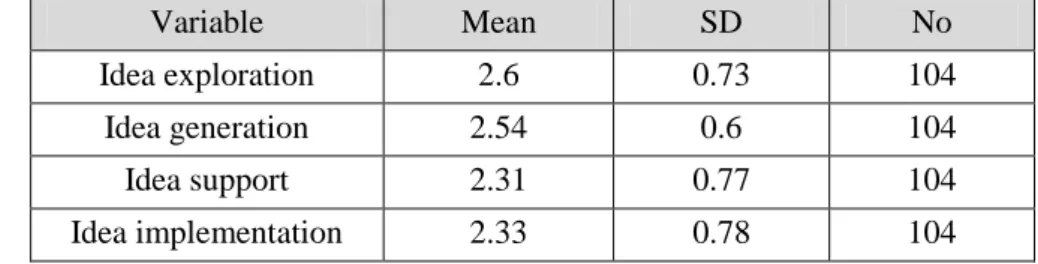
As shown in Table IV, the innovative behavior of librarians is desirable at two stages of idea discovery (2.6) and idea generation (2.54) and moderate at the two stages of idea support (2.31) and idea generation (2.33). According to the results, the innovative behavior of librarians of Astan Quds Razavi Razavi was found to be at the medium level (2.44).
In light of the above points, the research hypothesis can be tested.
H: there is a significant relationship between innovation climate and innovative behavior of librarians at the Library of Astan Quds Razavi
For this purpose, the normality of the two main variables, i.e. innovative behavior and innovation climate, were evaluated by Kolmogorov–Smirnov test.
Table V
Kolmogorov–Smirnov test to check the normality of the data distribution for variables innovative behavior and innovation climate
Kolmogorov–Smirnov test Variable
statistics df
P-value
0.102 104
0.011 Innovation climate
0.071 104
0.200 Innovative behavior
As shown in Table V, since P-value>0.01 for both variables of innovative behavior and innovation climate, it can be concluded that both variables are normally distributed.at 99% confidence level.
Accordingly, Pearson correlation can be used to examine the relationship between these two variables.
Table VI
Pearson correlation test to evaluate the significance of relationship between innovation climate and innovative behavior
Innovation climate Innovative
behavior
1 0.440
Pearson correlation Innovation
climate Sig. (2-tailed) 0.000
104 104
No
0.440 1
Pearson correlation Innovative
behavior Sig. (2-tailed) 0.000
104 104
No
Conclusion
According to the findings of the study, a total score of 158.54 was obtained for the innovation climate (Table II). This indicates the relative presence of innovation climate in these sections. The analysis of nine dimensions of innovation climate suggests that they are all at the medium level. Meanwhile, the challenge dimension gained the highest mean (3.44) as shown in Table III. In fact, challenge refers to the extent of one’s engagement in daily activities, long-term goals and organizational perspectives (Isaksen, Fritz, Lauer & Ekvall, 2001). According to Ekvall (1996) in a challenging climate, individuals have a pleasurable experience in their jobs, which makes them invest more energy and effort in their job. Accordingly, if the situation is ripe for greater participation of employees in workplace activities, their sense of responsibility will be strengthened, they will attach more value to their work and find ways to improve business processes.
The mean value of humor dimension (3.43) suggests that a relatively relaxed atmosphere lightened by humors and laughter is presents at the Library of Astan Quds Razavi
Obviously, provided that librarians enjoy their work, a more relaxed atmosphere with low tension will be created. The dimension of idea support gained a mean value of 3.73. In a supportive climate, ideas and suggestions are more likely to be noted and supported by directors and managers. People tend to listen to alternative ideas and initiatives and innovations are encouraged.
Thus, the current mechanism of idea support should be developed to allow for the ideas of employees as well. The dimension of debate gained a mean value of 3.73. One way to gain the support of coworkers for new ideas is through debates, as it allows employees to freely express and exchange their ideas with their colleagues, thereby sharing their experience and knowledge in different fields.
In this case, not only is the ground prepared for the support and implementation a plan, but the exchange of different views may lead to the discovery of news ideas. In the absence of debates, people are required to obey the dictated models blindly. Certainly, under such circumstances, the proper conditions for the generation and implementation of new ideas would be hardly achieved.
Another dimension of innovation climate is idea time for which a mean value of 3.12 was obtained. Considering that engagement in innovative activities is beyond the librarian's job, even if they manage to identify innovation opportunities and spot potential problems, in the absence of sufficient time to evaluate such problems and find possible solutions, the innovation would not be realized.
When the situation is not ripe to the generation of ideas, if the organization obliges the librarians to do things differently and offer new solutions, time constraint would probably prevent the idea generation outside the instructions and planning process.
Provided that librarians have enough freedom and autonomy, they can discuss their ideas beyond the organizational constraints and adopt a critical view of work processes. The lack of centralization and participation of librarians in decisions makings gives the impression that the dominant climate is supportive of innovation.
Another dimension of innovation climate was risk taking with a mean value of 3.084. A climate welcoming or even supportive of change is capable of controlling uncertainty. In fact, the more librarians are supported to take risks in a timely manner, the more likely they are to come up with innovations. Risk taking should be bilateral, meaning that the successful introduction of innovation is not only a variable of the readiness of the librarians to face the potential risks , but also the acceptance of changes by colleagues and management and attempts to integrate them into the usual work routine.
In this regard, the organization can benefit from periodic training classes that inform employees about the latest changes and developments in the library environments, which can enhance their flexibility in face of variations in work processes.
A mean value of 3.082 was achieved for the dimension of conflict. When conflicts and disagreements are properly managed in an organization, the tension between employees is significantly reduced. By reinforcing open communications and nurturing an atmosphere of free expression, libraries can mitigate tensions that may give rise to the spread of rumors and conspiracies against people.
As pointed by Isaksen (2007) individuals blessed with a psychological insight are capable of controlling conflicts. Thus, taking the psychological state of employees into account and organizing training courses and conferences with a view of psychological purposes can help reduce potential stresses. Also, in an environment in which employees can get what they deserve without any discrimination imposed by senior managers, there would be a remarkable decline in rumors and conflicts.
Among the dimensions of innovation climate, trust obtained the lowest score (mean: 2.86) Thus, in the absence of a trustful climate, employees would be unwilling to share their knowledge and experience with others, for the growing suspicion in such environments would make them cautious about the theft or misuse of their innovative ideas. As such, trust can be seen as the most important dimension of an innovation climate for increased trust amongst libraries working at difference departments can have a positive effect on other dimensions such as challenge, humor, idea support and risk taking. According to Clegg, Unsworth, Epitropaki and Parker (2002) trust motivates innovation in the organization and there is a significant relationship between trust and the application of new ideas in organizations that are after innovative ideas.
had a higher chance of success. In other words, after identifying opportunities, they were less successful in integrating and evaluating ideas and information to reach practical solutions.
The lack of necessary experience and uncertainty about gaining the support of others to put the ideas into action are the possible reasons that can hamper the development of ideas.
As a result, at the stage of idea support, the unwillingness of librarians to take risks of introducing new ideas and bearing the possible resistances and oppositions of management are the factors that lessen their motivation to gain support for the implementation of their idea. In this regard, librarians can win support necessary for the implementation of their ideas by gathering information and resources that reflect the merits and benefits of their idea, establishing proper relationships and maintaining the organizational objectives of influential authorities at different departments.
In this way, they will find the confidence required to explain their ideas and elaborate on benefits and concessions associated with the implementation of their idea.
That the mean score of idea implementation stage is greater than the idea support stage suggests the importance of supporting innovative people in an organization as these people are not only capable of proposing innovative ideas, but also good at putting these ideas into practice.
The results of the study show that there is a significant relationship (44%) between innovative behavior of librarians and innovation climate (Table VI). Thus, it can be concluded that innovation climate can largely explain the manner and extent of an organization to promote innovation and innovative behaviors. Conversely, the innovative behavior of librarians shows the success of Astan Quds Razavi Library in creating a fertile innovation climate.
Innovation, as one of the main factors affecting innovative behavior, has been the subject of growing attention (Scott & Bruce, 1994; Amabile et al., 1996; Dorabjee et al., 1998; Isaksen et al., 2001; De Jong, 2007; Coveney, 2008; Kheng et al., 2013 & Madrid 2013) and the extent of its impact on innovation and innovative behavior has been evaluated in many organizations.
Kheng et al. (2013) introduced the innovation climate as a significant predictor of innovative behavior. The relationship between these two variables enables an organization to improve the innovation climate and consequently innovative behavior by establishing a competitive environment. In a competitive environment, librarians feel more challenged to improve business activities and promote organizational objectives, participate actively in debates, take risks associated with work activities, dedicate more time to ways of improving work processes and focus their efforts on promoting innovation.
Overall, it seems that the moderate innovative behavior of librarians can be rooted in the lack of a full-fledged innovation climate. In fact, the moderate desirability of innovation climate has engendered a medium innovative behavior.
Recommendations
measures such as the establishment of cooperative groups, specialized social networks and so on. Establishing a reward system is another way of supporting innovative ideas. It should be noted that the rewards granted to employees to support innovative activities is not limited to financial bonuses. For example, an organization can encourage innovative employees by mentioning their name in news bulletins and appreciate their contribution to the organization. Planning tours to visit successful organizations for employees can be another strategy.
2. In light of the fact that the innovative behavior of librarians at the stage of idea exploration is greater than other stages, organizing tours for innovative employees to visit well-known libraries in other countries can prepare a fertile ground for adoption of successful model and plans. As discussed earlier, although the librarians are relatively good at the idea exploration stage, they displayed a poor performance at idea generation and idea support stages.
3. Given the moderate presence of innovation climate at the library of Astan Quds Razavi and the fact that innovation climate accounts for 44% of variations in innovative behavior, some measures should be taken to improve innovation climate. For this purpose, the view of senior management and leadership of the organization toward innovative activities should be explained for the employees, and the degree of correlation between organizational structure and innovative behaviors as well as the power and authority of employees in expression and application of innovation should be revisited.
References
Aarons, G. A., & Sommerfeld, D. H. (2012)," Leadership, innovation climate, and attitudes toward evidence-based practice during a statewide implementation", American Academy
of Child and Adolescent Psychiatry, Vol. 51 No. 4, pp. 423-431.
Amabile, T. M., Conti, R., Coon, H., Lazenby, J., & Herron, M.(1996),"Assessing the work environment for creativity", Academy of Management Journal, Vol.39 No. 5, pp. 1154– 1184.
Aqadavood, R., Hatami, M. & Hakiminian, B. (2010)," A study of the factors affecting organizational innovation among executive managers (Case study: senior managers of Telecom Company of Isfahan Province)", Journal of Social Sciences, Islamic Azad
University, Shoushter Branch, Vol. 4 No. 11, pp.127 170.
Aqaei Fishani, T. (2011), Creativity and innovation through a "systematic approach", Ketab Talaee Jame, Tehran.
Basadur, M. (2004)," Leading others to think innovatively together: Creative leadership",
Leadership Quarterly, Vol.15, pp. 103-121.
Clegg, C., Unsworth, K., Epitropaki, O., & Parker, G. (2002), "Implicating trust in the innovation process", Occupational and Organizational Psychology, Vol. 75, pp. 409-422. Coveney, B. (2008), "Assessing the organizational climate for creativity in a UK Public
Library Service: a case study", Library and Information Research, Vol. 32 No. 102, pp. 38-56.
De Jong, J. (2007), Individual innovation: The connection between leadership and employees’
innovative work behavior. Doctoral Dissertation, University of Amsterdam, available at:
De Jong, J. & Den Hartog, D. N. (2008)," Innovative work behavior: Measurement and validation", EIM Business and Policy Research, available at: http://www.entrepreneurship-sme.eu/pdf-ez/h200820.pdf (accessed 16 June 2014).
De Jong, J. & Den Hartog, D. (2010)," Measuring Innovative Work Behaviour", Creativity
and Innovation Management, Vol. 19 No. 1, pp. 23-36.
Dorabjee, S., Lumley, C. E. & Cartwright, S. (1998), "Culture, innovation and successful development of new medicines-an exploratory study of the pharmaceutical industry",
Leadership & Organization Development Journal, Vol. 19 No. 4, pp.199-210.
Dörner, N. (2012), Innovative Work Behavior: The Roles of Employee Expectations and
Effects on Job Performance. Doctoral dissertation, University of St. Gallen, available at:
http://verdi.unisg.ch/www/edis.nsf/SysLkpByIdentifier/4007/$FILE/Dis4007.pdf (accessed 16 June 2014)
Ekvall, G. (1996)," Organizational climate for creativity and innovation", European Journal
of Work and Organizational Psychology, Vol. 5 No. 1, pp. 105–123.
Evans, J.E., Layzell Ward, P. & Rugaas, B. (2009), Management principles for
information-science experts, Translated by Minou Vaezzadeh et al, Iran National Library and Archives
Organization, Tehran.
Isaksen, S. G. (2007)," The Situational Outlook Questionnaire: Assessing the context for change", Psychological Reports, Vol. 100, pp. 455-466.
Isaksen, S. G. & Akkermans, H. J. (2011), "Creative climate: A leadership lever for innovation", The Journal of Creative Behavior, Vol. 45 No. 3, pp. 161-187.
Isaksen, S. G., Lauer, K. J., Ekvall, G. & Britz, A. (2001), "Perceptions of the best and worst climates for creativity: Preliminary validation evidence for the situational outlook questionnaire", Creativity research, Vol. 13 No. 2, pp. 171-184.
Janssen, O. (2000), "Job demands, perceptions of effort-reward fairness and innovative work behavior", Journal of Occupational and Organizational Psychology, Vol. 73, pp. 287-302. Kheng, Y. K., June, S. & Mahmood, R. (2013), "The Determinants of Innovative Work Behavior in the Knowledge Intensive Business Services Sector in Malaysia", Asian Social
Science, Vol. 9 No. 15, pp. 47- 59.
Kleysen, R.F. & Street, C.T. (2001), "Toward a multi-dimensional measure of individual innovative behavior", Journal of Intellectual Capital, Vol. 2 No. 3, pp. 284-296.
Madrid, H. (2013), on innovation as an affect-driven work behaviour. Doctoral dissertation, Institute of Work Psychology, University of Sheffield, available at: http://etheses.whiterose.ac.uk/4528/1/HMadrid%20-%20ethesis.pdf (accessed 26 September 2014).
Mathisen, G. E. & Einarsen, S. (2004), "A review of instruments assessing creative and innovative environments within organizations", Creativity Research Journal, Vol. 16 No. 1, pp. 119-140.
Mohammad Kazemi, R. & Jafari Moghadam, S. & Sohaili S. (2012)," Identifying the effects of organizational climate on innovation (Case study: Melat Banking)", Entrepreneurship
Development, Vol. 2 No. 16, pp. 67, 86.
Norouzi Chakoly, A. (2010)," The role of innovation in improving the effectiveness of services in public libraries" in Alipour, R. (Ed.), Innovation in Creativity in Public Libraries: Proceedings of the Specialized Congress of the General Directorate of
Research and Public Education of Iran , National Organization of Public Libraries,
Tehran, pp. 85-108.
Pundt, A. (2015). The relationship between humorous leadership and innovative behavior.
Journal of Managerial Psychology, 30(8), 878-893.
Scott, S. G., & Bruce, R. A. (1994), "Determinants of innovative behavior: A path model of individual innovation in the workplace", Academy of management Journal, Vol. 37 No. 3, pp. 580-607.
Shakeri, F, Tahari Mehrjardi, M.H., Dehghan Dehnavi, H. & Kavand, R. (2011)," Investing the relationship between organizational climate and process innovativeness using structural equation modeling", Production and Operations Management, Vol. 2 No. 1, pp. 29- 46.
Soken, N. H. & Barnes, B. K. (2014), "What kills innovation? Your role as a leader in
supporting an innovative culture", Industrial and Commercial Training, Vol. 46 No. 1, pp. 7- 15.
Waenink, E. (2012). Creating innovative employees: the effect of competences on innovative
work behavior and the moderating role of human resource practices. Master thesis,
University of Twente, available at: http://essay.utwente.nl/61964/ 1/Final_Version _Master_Thesis_Elles_Waenink_-_August_2012.pdf (accessed 12 August 2014).
Zhao, H. (2013, January). Organizational Innovation Climate and Performance: Based on the Intermediation of Innovative Behavior. In The 19th International Conference on Industrial