VOLUME 17 ISSUE 2 (2019), Page 158 – 167
ENHANCING THE POTENTIAL OF RECYCLABLES WASTE COLLECTION THROUGH WASTE BANK PROGRAMME:
EXPERIENCE FROM HEI IN MALAYSIA
Fatma Sabariah Alias1, Latifah Abdul Manaf2, Mariani Ariffin3, & Sabrina Ho Abdullah4
1,2,3,4
Faculty of Environmental Studies UNIVERSITI PUTRA MALAYSIA
Abstract
A voluntary approach for recycling programme can be enhanced by the establishment of waste bank in institutions of higher education. Hence, a waste bank programme was implemented in a “close loop” system at the Faculty of Environmental Studies, Universiti Putra Malaysia (FPAS, UPM). This aims to promote collection of recyclable materials and raise awareness among UPM students on the importance of recycling. Throughout the five (5) phases of operation, about 500 students were registered as waste bank members with the amount of total collected recyclables reaching 14,817.46 kg. The direct measurement method was applied in the waste bank operation procedure to weigh the recyclable materials received twice a week. The most frequent type of recyclable material collected was paper, including black/white paper, newspaper, and mix paper. The waste bank programme has enhanced the potential of solid waste minimisation by shifting the amount of waste disposed at the landfill site. Moreover, it enables recyclable materials to be seen as valuable resources as monetary rewards were given to encourage recycling practices among students based on the total weight for each collection of recyclable materials. Therefore, the implementation of the waste bank programme in Higher Education Institutions (HEI) in Malaysia creates an opportunity to be a medium of a sustainable solid waste minimisation system in promoting sustainable green campuses at the university.
INTRODUCTION
The rapid rate of development in Malaysia has accelerated the daily generation and volume of solid waste. The amount of waste produced has increased from 33,000 tonnes in 2012 to 38,000 tonnes of waste in year 2015. This figure is expected to increase to 16.76 million tonnes by year 2020 with 45,900 tonnes of waste are predicted to be generated every day (Agamuthu & Dennis, 2011; SWCorp. 2012; SWCorp, 2014). Approximately 28% of the total daily waste generated originate from the commercial and institutional sectors, which contributed 9,224 million tonnes of waste generated daily (NSWMD, 2015).
At the same time, the rapid expansion of the Higher Education Institutions (HEI) sector in Malaysia has also led to the increasing of solid waste generation as the population within HEIs in Malaysia increases (Jibril, Sipan, & Lawal, 2012). Population in HEIs comprises administrative personnel, students, academic staff and non-academic staff. These groups produced waste of which only 40% of recyclable items were collected at educational institutions with an average per person of 0.33 kg/person/day. Additionally, the recycling rate for the institutional and commercial sectors is about 7.4% and almost 89% of waste were disposed of in landfill sites (NSWMD, 2015).
A recycling programme is an activity which often attracts attention in HEIs as an on-going sustainability initiative for solid waste management. HEIs are among the major contributors to the increase in solid waste generation and most of the waste generated were recyclable materials (Kehmeyer et al., 2011). HEIs in Malaysia have taken the initiative to implement recycling as a campus sustainability programme by involving the campus community, such as in Universiti Sains Malaysia (USM). However, the recycling programme failed to achieve sustainability due to the seasonal nature of the programme and the ineffective recycling system adopted (Abas & Md Nor, 2014). Meanwhile, Universiti Teknologi Malaysia (UTM) has produced the UTM Sustainable Campus Policy as a general guideline for campus sustainability including areas such as energy management. Monday is UTM Recycling Day, where the Green Office and Sustainable Arcade make an effort to provide a conducive campus environment for a sustainable learning and teaching environment in the university (Zen, Ahamad, & Omar, 2014). UPM was also the leading university in terms of sustainable campus by implementing the Environmental Management System (EMS) MS ISO 14001 through activities relating to the teaching and learning process in the campus towards sustainable development goals.
Education Institutions in Malaysia
Initially, recycling collections were dominated by the informal sector such as door-to door itinerant recycling buyers, waste collection workers separating recyclable materials and scavenging activities in landfills (Siwar, 2008). Zen and Siwar (2015) revealed that about 31% of households have a high preference towards door-to-door itinerant buyers because of monetary incentives received. Besides that, accessibility of kerbside recycling and drop-off recycling has a significant impact on solid waste reduction and can also have a positive effect on the percentage of recyclables collected. However, both methods largely dependent on household participation on voluntary basis. Nevertheless, the individuals’ recycling participation is also influenced by investment of time, space, money and effort, in addition to their knowledge and attitude towards recycling (Sidique, Joshi, & Lupi, 2010).
According to Beringer, Wright and Malone (2008), and Zen, Bandi, Zakaria and Saleh (2013), campus waste characterisation studies are relatively inexpensive and can generate administrative support and cooperation among students and academia by inspiring involvement in the sustainable campus community. This can be achieved through activities involving the aspects of teaching, learning and research as part of the education to the campus community. Thus, this paper highlights the activities of UPM through its Faculty of Environmental Studies’ initiative of implementing a waste bank programme for the campus community as part of its ongoing efforts to promote green campus.
RESEARCH BACKGROUND
Universiti Putra Malaysia (UPM) formerly known as Universiti Pertanian Malaysia is located in Serdang, Selangor next to Malaysia’s administrative capital city, Putrajaya. It is one of Malaysia’s leading research universities (RU) with a total enrolment of 24,874 students and 2,595 academic staff for the 2016 academic year. Its campus sits on an estimated 1,108.103 hectares of land, housing 16 faculties, 17 student hostels, nine (9) institutes, four (4) centres and several administrative and academic buildings respectively. The major activities on campus focused on teaching, research and extracurricular activities such as sports, recreation, associations, clubs, arts and culture.
Waste Bank Initiative
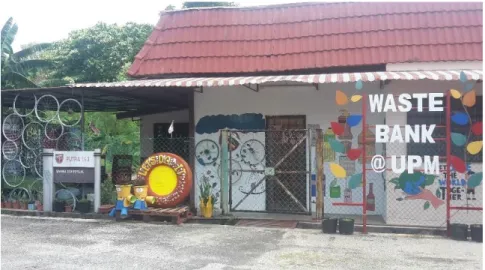
Figure 1 Waste bank at Faculty of Environmental Studies, UPM
Waste Bank Operation Procedure
Education Institutions in Malaysia
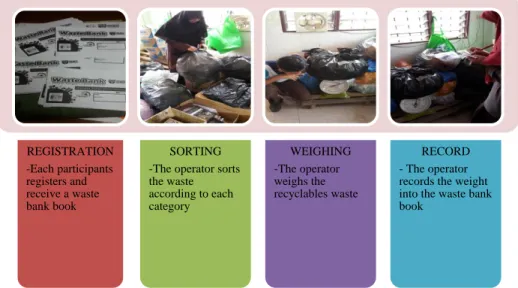
Figure 2 Waste Bank Operation Procedure
Type of Recyclable Waste
The waste bank receives five (5) main types of recyclable waste namely: i. Paper: Newspaper, Mix paper, Black/white paper;
ii. Plastic: PETE, HDPE; iii. Aluminium cans: Can drinks;
iv. Box/cardboard: All types of boxes; and v. Metal: Food cans and all types of metal.
RESULTS AND DISCUSSION
Waste bank has been operating in a five (5) phase operation where about 500 students had registered as waste bank members since October 2015 until December 2017, with the total recyclables collection reached 14,817.46 kg (Table 1). The participation in the waste bank has been on a voluntary basis among UPM students and a mandatory basis for environmental students who took the Solid Waste Management Course (EMG 3104) as part of their teaching and learning process.
Table 1 Waste bank recyclables collection
Phases Time Member
(nos.)
Recyclables collection (kg)
1 October-December 2015 53 1,663.22
2 March-June 2016 113 1,986.11
3 October-December 2016 137 3,604.74
4 March-June 2017 144 5,555.74
5 October-December 2017 53 2,007.65
TOTAL 500 14,817.46
REGISTRATION -Each participants registers and receive a waste bank book
SORTING -The operator sorts the waste according to each category
WEIGHING -The operator weighs the recyclables waste
Phase 1 was the pilot phase where 53 students who took the Solid Waste Management Course (EMG 3104) were required to be involved in collecting recyclable waste as part of their teaching and learning process in the faculty. Saphores, Ogunseitanc and Shapiro (2012) stated that there is a positive correlation between knowledge and action in environmental behaviour. Thus, the students managed to collect 1,663.22kg of recyclable materials in 14 weeks. The overwhelming results encouraged the waste bank programme to be continually operated for the next phase.
In Phase 2, waste bank operation was opened to UPM students and staff on a voluntary basis in which increasing amount of recyclables were collected. About 1,986.11kg of recyclable waste was collected showing the increased awareness towards recycling. Subsequently, to also support the university effort towards green campus, several activities and recycling programmes were organised during Phases 3 and 4. The amount of recyclables collected, again, increased due to overwhelming participation from the students in the campus. National Recycling Day, Waste Bank Open Day and Recycling Training were organised in FPAS to raise awareness on the importance of recycling. Besides that, as part of the teaching and learning process in EMG 3104, the environmental students were required to spread recycling awareness in every faculty in the UPM campus and promote the waste bank programme. The increasing participation has increased the amount of recyclables collection from 3,604.74kg to 5,555.74kg.
In addition, to encourage recycling practices among UPM students, monetary incentives were provided to each member as well as university merit as a reward for their participation. However, in phase 5, which extended from October until December 2017, the amount of recyclables collected decreased to 2,007.65kg. The reduced amount could possibly be due to other recycling collections being operated in other faculties, due to growing awareness towards the idea of a green campus for a sustainable community. Furthermore, recycling awareness has increased among campus community as UPM has conceived a Green Policy. The Green Policy also has recognised the waste bank programme as part of the green activities in the campus. The existence of waste bank as a positive asset of the university in encouraging students to participate actively in recycling practices on campus supports Dahle and Neumayer’s (2001) research where they proposed that HEIs can serve as a role model in environmental behaviour by implementing an appropriate recycling system on campus.
Education Institutions in Malaysia
paper, black paper and white paper have higher sales compared to mix paper and newspaper despite lower amount collected. The high sales show that recyclable materials have high potential in market values as well as economic benefits.
Figure 3 Total weight and total sales of recyclable waste by category
Table 2 Waste Bank Potential Revenues
Items Recyclable
Collection (kg)
Recyclables
Market Price
(RM)*
Total Sales in Waste Bank (RM)
Potential Revenues (RM)
Newspaper 1,669.50 0.24 333.90 400.68
Mix paper 3,519.85 0.18 527.98 633.57
Black/White paper
3,263.91 0.34 652.78 1109.79
Plastic 2,124.72 0.40 637.42 849.88
Aluminium 1,153.68 3.00 2307.36 3461.04
Box/Cardboard 1,977.45 0.20 296.62 395.49
Metal 1,108.35 0.30 279.85 332.51
Total 14,817.46 5,035.90 7,182.96
*Note: Market price set by from Alam Flora Sdn Bhd. (2016)
Figure 4 shows that 57% of the recyclable waste collection consisted of paper (newspaper/ mix paper and black/white paper). This represented the highest quantity of recyclable waste collected. This is due to the location of waste bank at Universiti Putra Malaysia (UPM), one of the HEIs in Malaysia which influenced the type of recyclable waste in the collection. Moreover, the campus activities of teaching and learning produce a significant amount of recyclable waste paper such as lecture notes, books, study notes, exam papers, letters, memos and research papers. Plastic waste also provided good revenue for the recycling programme as there was 14% of plastic material collected in the waste bank. The plastic waste consisted of plastic code 1 which is PETE and mineral bottles, and plastic code 2: HDPE such as shampoo, liquid soap bottles, and cosmetic containers. The collection also comprised aluminium cans including those from carbonated drinks, and metal consisting of food cans and all types of metal.
Education Institutions in Malaysia
Throughout the waste bank operation, monetary rewards and university merit were an encouragement for students to participation. These have also become a key contributing factor to the success of the waste bank operation in UPM. Basri, Zawawi, Zain, Mohamad and Kasa (2016) also mentioned that encouragement and incentive measures should be provided to students as this will motivate them to be more keen to participate in the on-campus recycling activities. Students play a vital role in the sustainable campus society as their attitudes and behaviour have been of great importance in the success of the recycling programme.
CONCLUSION
Based on the results obtained, it can be concluded that it is important to develop sustainability policies in campus which cover the issue of solid waste minimisation to support the waste bank programme. The waste bank programme reveals the potential of solid waste minimisation, as can be seen from the recyclables collection in the campus and also raised awareness towards the importance of recycling. Besides that, the waste bank programme also shows the potential value of recyclables in the market. Moreover, it could be suggested that the waste bank programme can be seen as an environmental protection in HEIs as part of the learning and teaching programme aiming towards sustainability of campuses and green universities. A waste bank programme would be a beneficial model for a sustainable solid waste minimization system for HEIs in Malaysia in order to increase awareness levels towards sustainability development goals.
ACKNOWLEDGEMENT
The authors would like to thank the volunteers and participants at Universiti Putra Malaysia (UPM) for their time and support of the waste bank programme at the Faculty of Environmental Studies.
REFERENCES
Agamuthu, P., & Dennis, V. (2011). Policy trends of extended producer responsibility (EPR) in Malaysia. Waste Management & Research Journal. Retrieved from https://www.researchgate.net/publication/51504774_Policy_trends_of_extende d_producer_responsibility_in_Malaysia.
Abas, M. A., & Md Nor, N. (2014). Participation of campus community at Universiti Sains Malaysia on the single stream recycling system. Jurnal Personalia Pelajar, 17, (83-95).
Beringer, A., Wright, T., & Malone, L. (2008). Sustainability in higher education in Atlantic Canada. International Journal of Sustainability in Higher Education, 9(1), 48-67.
Dahle, M., & Neumayer, E. (2001). Overcoming barriers to campus greening: A survey among higher educational institutions in London, UK International Journal of Sustainability in Higher Education, 2, 139-160.
Department of Standard Malaysia (2012) MS 2505:2012, Malaysian Standard. Guideline for sampling of household solid waste – Composition and Characterisation analysis. Kuala Lumpur: Author.
Jibril, J, Sipan, I., & Lawal, J. (2012). 3R’s critical success factor for integrated solid waste management in higher educational institution. International Journal of Sustainable Development, 05(10), 109-120.
Kehmeyer, M., Miller, C., Neppel, K., Ronnebaum, C., Webber, J. & Zinke, B. (2011). Waste characterization study for Kansas State University Recycling. Kansas State University, Natural Resources and Environment Sciences Capstone Course.
National Solid Waste Management Department [NSWMD], (2015). Final Lab Report, Solid Waste Management Lab 2015. Ministry of Housing and Local Government (MHLG)
Purcell, M., & Magette W. L. (2010). Attitudes and behaviour towards waste management in the Dublin, Ireland region. Waste Management, 30, 1997-2006.
Saphores, J. M., Ogunseitanc, O. A., & Shapiro, A. A. (2012). Willingness to engage in a pro-environmental behavior: An analysis of e-waste recycling based on a national survey of U.S. households. Resources, Conservation and Recycling, 60, 49-63.
SWCorp, (2012). Composition on household solid waste in Malaysia. Final report survey on solid waste composition, characteristic, and existing practice of solid waste recycling in Malaysia.
SWcorp. (2014). Pelan Strategik Swcorp 2014-2020, Melakar Dimensi Baharu Menuju
Masa Hadapan.
Sakawi. Z., (2011). Municipal solid waste management in Malaysia: Solution for sustainable waste management. Journal of Applied Sciences in Environmental Sanitation, 6(1), 29-38.
Siwar, C. (2008). Solid waste management: Recycling, green jobs and challenges in Malaysia. ILO Research Conference on Green Jobs for Asia & Pacific. April 21-23, 2019, Niigata, Japan.
Sidique, S. F., Joshi, S. V., & Lupi, F. (2010). Factors influencing the rate of recycling: An analysis of Minnesota counties. Resources, Conservation and Recycling 54, 242-249.
Zen, I. S. & Siwar, C. (2015). An analysis of household acceptance of curbside recycling scheme in Kuala Lumpur, Malaysia. Habitat International, 47, 248-255. Zen, I. S., Ahamad, R., & Omar, W. (2014). The development and measurement of
conducive campus environment for Universiti Teknologi Malaysia (UTM) of campus sustainability. Jurnal Teknologi, 68(1), 71-82