HOW BAT MODIFICATIONS CAN AFFECT THEIR RESPONSE
L. V. SMITH AND C. CRUZ Washington State University 201 Sloan, Spokane Street Pullman, WA 99164-2920 USA
E-mail: [email protected] A. NATHAN University of Illinois
1110 W Green St Urbana, IL, 61801-3080 USA
E-mail: [email protected] D. RUSSELL Kettering University
1700 W. Third Ave. Flint, MI, 48504-4898 USA E-mail: [email protected]
The majority of players that compete in organized softball or baseball leagues use performance regulated bats. Some players attempt to gain a competitive edge by modifying their bats. The motivation to modify a bat has increased in some areas due to reductions in their allowed performance. Bat tampering (or doctoring) encompasses changing the weighting of a bat, reducing a bat’s wall thickness, and artificially “breaking-in” a bat. Each of these doctoring methods alters the performance of a bat, although not to the same degree.
In this study, bats were tested before and after doctoring procedures to determine how a bat’s performance and other characteristics had changed. The tests involved modal analysis, measuring the barrel compliance, and air cannon performance testing (ASTM 2219). The average performance increase of the bat modification techniques ranged from 3% to 4% according to ASTM 2219. Bat modifications were also identifiable using modal analysis and barrel compliance. The change in these measures was often not proportional to that found using ASTM 2219, however.
1. Introduction
The competitive nature of sport inevitably drives any athlete to seek a means of gaining an advantage. In most cases these means involve optimized equipment and specialized training, and are within the rules set forth by the respective governing bodies. In some cases, however, athletes may seek advantages that are not allowed. This study will consider modifications to bats that are used in the sport of softball and baseball and their affect on performance.
2. Background
The most important factor in properly hitting a ball with a bat involves the skill, speed, timing and accuracy of the batter. It has long been believed, however, that the construction of the bat can have a large effect on its hitting performance. The regions of the bat relevant to this study are presented in Fig. 1.
2.1. Corking
Prior to the introduction of aluminum and other synthetic materials, bats were made from a solid piece of wood. The geometry and wood species used to make bats has varied over the years according to player preference. The effect of these factors is believed to be small, however, as evidenced by their lack of regulation in Major League Baseball.
A well publicized method of modifying a solid wood bat involves replacing an interior section of the barrel with another material. The process derives its name from cork, which is used to replace the heavier wood that was removed. In some cases weight is added to the bat in pursuit of materials with increased elasticity, such as “super balls.”
2.2. Weighting
Manufacturers often add weight to the shell of hollow synthetic bats. The weights are typically located in the knob or end cap according to player preference. Some believe, however, that weight adjustments can improve performance. Lighter bats may be easier to control, for instance, while heavier bats may impart more impulse to the ball.
2.3. Shaving
A salient difference between solid and hollow bats is the radial compliance of the barrel region of the bat. The portion of energy that can be stored in the bat and returned to the ball during impact increases with barrel compliance. This effect can be manipulated by reducing the barrel wall thickness.
2.4. Breaking-in
With repeated use, damage can develop in bats in the form of dents or cracks. As the barrel accumulates damage, its compliance and resulting performance can increase. Some have taken advantage of this fact, intentionally inducing damage to increase barrel compliance. The method, coined Accelerated Break-In (ABI), is particularly popular with composite bats that require sophisticated methods to identify internal cracking.
3. Testing Procedure
3.1. Bats
Three wood bats were obtained from a commercial bat producer. The solid wood bats were made from Northern White Ash, intended for use in Major League Baseball.
Twenty five bats were purchased from commercial sporting good equipment distributors. The sampling included models from four manufacturers that were certified by the Amateur Softball Association. The bats were constructed of aluminum or composite materials and included single or multi-wall designs, designated as A or C and S or M, respectively.
3.2. Doctoring
Performance limits put in place by governing associations have increased the scale of enterprising individuals who modify bats. An aim of this study was to determine the effectiveness of their work, and the availability of their services.
To this end, eleven individuals with established records of bat doctoring were selected. Bats were shipped to these bat doctors through a third party to maintain anonymity and ensure that the changes would be representative of what a typical player might achieve employing a similar process.
3.3. Assessing Bat Changes
A protocol was developed for the hollow bats to quantify the effect of bat doctoring. Upon receipt of the unaltered bats from the manufacturer, the first natural frequencies in the hoop and flexural modes were measured using modal analysis. The linear barrel stiffness of each bat was then determined using a displacement of 0.05 inches from 1.9 inch radius steel platens placed 6 inches from the distal end of the bat. Next the performance of the bat was measured in the laboratory following ASTM F2219, using the batted ball speed (BBS) method as set forth by the Amateur Softball Association (ASA). The natural frequencies and barrel stiffness were measured after the performance test to determine if it affected the bat response. Eighteen bats were sent to bat doctors; ten had their barrel wall thickness reduced, eight were given an accelerated break-in treatment. The remaining seven bats in the study stayed in house. Four of these were weighted, while the remaining three were used to study the effects of normal batting practice.
4. Results and Discussion
4.1. Measuring Bat Changes
The barrel compliance, natural frequencies, and BBS of each bat were measured before and after modification. The changes in compliance and natural frequency did not always correlate with the changes in BBS. As the latter technique is deemed most representative of game conditions, the former results are not included.
4.2. Corked Bats
The effect of corking was studied using three 34 inch pro-stock solid wood bats. Two of these were modified by drilling a 1 inch diameter hole 6 inches longitudinally into their barrel end. Performance was quantified using BBS following ASTM 2219 with Major League baseballs.
One of the drilled bats was filed with cork, while the other was filled with high elasticity elastomeric balls (super balls). The modifications caused an MOI change of between -13% and +2%. The bat-ball coefficient of restitution
(BBCOR) and BBS of the modified bats (hollow and drilled) changed by less than 1% from their unmodified state (within the repeatability of the test). A player using a corked bat will not gain an advantage due to an increase in BBS. However, a lighter bat can be easier to control and may increase the likelihood of a player making contact with a difficult pitch.
4.3. Weighted Bats
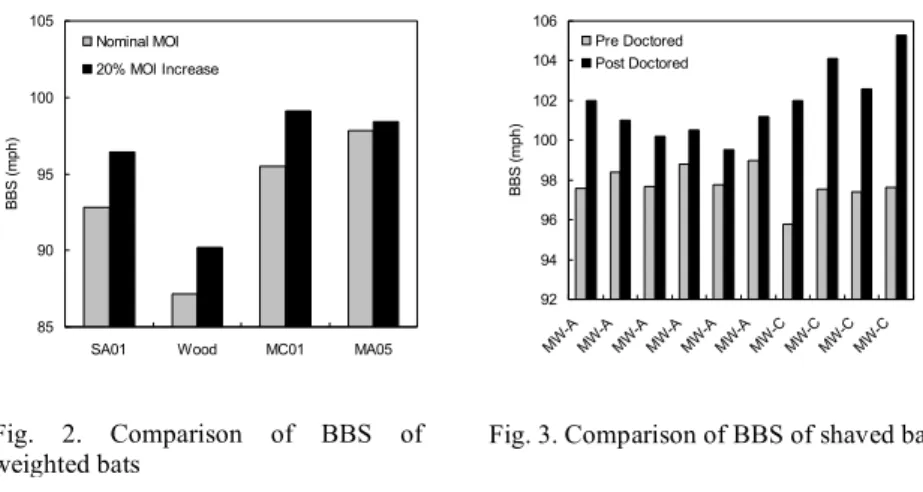
Weight was added to the end cap of four bats to increase their MOI by 20%. The BBS of each bat was measured before and after the weight was placed on the bat, as shown in Fig. 2. The average BBS increased 3%. It is unlikely that weighted bats would change by this magnitude in play, however, as the 20% MOI increase used here is more than most batters prefer. The results show, however, that an average batter can impart more impulse to the ball using a slower and heavier bat.
4.4. Shaved Bats
Ten bats had their wall thickness reduced. All bats were of a multi-wall construction and made from aluminum or composite materials. The BBS of each bat before and after modification is presented in Fig. 3. The effect of wall thickness reduction was relatively large, providing an average BBS increase of 4%. Unlike the weighted bats, this wall reduction represents current bat modification practices and the average performance increase a batter would experience in play. 85 90 95 100 105
SA01 Wood MC01 MA05
B B S ( m ph ) Nominal MOI 20% MOI Increase Fig. 2. Comparison of BBS of weighted bats 92 94 96 98 100 102 104 106 MW -A MW -A MW -A MW -A MW -A MW -A MW -C MW -C MW -C MW -C B B S ( m ph ) Pre Doctored Post Doctored
4.5. Broken-in Bats
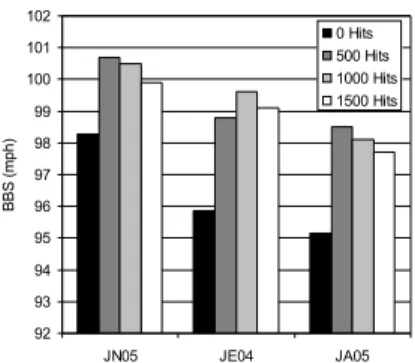
The performance of naturally broken-in bats was measured during batting practice at 500 hit intervals. The performance of the bats subjected to accelerated break-in procedures was measured before and after their modification. The change in performance of bats exposed to conventional and accelerated break-in procedures is compared in Figs. 4 and 5, respectively. The performance increase between the two methods was comparable, averaging 4 and 3 mph for the accelerated and conventional techniques, respectively.
5. Summary
This study has considered the effect that modifications to baseball and softball bats have on their hitting performance. Tests performed on solid wood bats have dispelled the common misconception that corking increases hit ball speed. The results of this work have also shown that changing a hollow bat’s MOI, its barrel wall thickness, and inducing barrel damage can have a measurable and significant effect on its hitting performance. The modifications to the hollow bats were identifiable from barrel compliance and natural frequency measurements. Taken by themselves, however, these measures to not appear adequate in quantifying the effects of the bat modifications.
92 93 94 95 96 97 98 99 100 101 102 JN05 JE04 JA05 B B S ( m ph ) 0 Hits 500 Hits 1000 Hits 1500 Hits
Fig 4. Change in performance from naturally broken-in bats.
92 94 96 98 100 102 104 106 Rolle d Rolle d BCT BCT ACT ACT Viced Viced B B S ( m ph ) Pre Doctored Post Doctored
Fig. 5 The change in performance of bats from accelerated break-in processes.