Writing While Designing: Combining ECE Senior
Design with an Existing Technical Writing Course
John Brocato
1, Joe Picone
2Abstract
– This paper describes a multiyear project that integrates a specialized writing course with a senior design course for electrical and computer engineering (ECE) students. The Shackouls Technical Communication Program (TCP) and Department of Electrical and Computer Engineering at Mississippi State University have teamed to merge focused writing instruction with applied engineering design as a means of integrating substantive communication experiences into the existing curriculum. Specifically, students enrolling in ECE’s Senior Design I are also required to enroll in an ECE-only, Senior Design-focused section of the college’s writing course during the same semester. The merger provides rigorous, TCP-guided instruction and practice in technical writing as part of the students’ capstone design process. Topics discussed in this paper include the rationale behind and objectives for this merger, an assessment of the initial ECE-only pilot section of technical writing, and plans for fully implementing this co-requisite in future semesters.Keywords: communication skills, senior design, technical communication, technical writing
INTRODUCTION
This paper describes a multiyear project to integrate a specialized writing course, required of all undergraduate engineers, with the writing component of a senior design course for electrical and computer engineering (ECE) students. Since 1999, the Shackouls Technical Communication Program (TCP) in Mississippi State University’s Bagley College of Engineering has offered an in-house technical writing course to satisfy the college’s junior-level writing requirement. This course is now required of every undergraduate engineering major. However, current with national trends[Bakos, 1; Hendricks and Pappas, 2; Newell, Ludlow, and Sternberg, 3], the Shackouls TCP also seeks to integrate more substantivewriting experiences into theengineering curriculum itself rather than relying solely on one specialized writing course toimprove students’ writing abilities. The Shackouls TCP and MSU’s ECE Department have therefore teamed to merge focused writing instruction with applied engineering design. This project was motivated in part by extensive feedback from students indicating a strong desire to couple the two writing experiences.
In this merger, students enrolling in ECE Senior Design I are also required to enroll in an ECE-only, Senior Design-focused section of the college’s writing course during the same semester. Instructors for these courses synthesize their respective content, contributing technical, engineering-related subject matter and designs on the one hand and discipline-specific writing instruction and resources on the other. Using the substantial writing experiences already offered to students in senior design, the merger provides rigorous instruction and practice in technical writing as part of the students’ capstone design process.
Topics discussed in this paper include the rationale and objectives for synthesizing the two courses; the steps undertaken in administering and assessing the initial spring 2004 pilot section of the writing course; and a discussion of future plans.
1
Bagley College of Engineering, Mississippi State University, P.O. Box 9544, Mississippi State, MS, 39762, [email protected]
2
Department of Electrical and Computer Engineering, Mississippi State University, P.O. Box 9571, Mississippi State, MS 39762, [email protected]
RATIONALE AND OBJECTIVES
The rationale for this plan involves uniting two existing, engineering-specific writing experiences that have in the past been only tangentially connected. Although the college’s technical writing course is wholly focused on engineering-based writing in both form and content, gaps still exist between the differing expectations of writing teachers and engineering professors. Such gaps are unavoidable because writing and the process of
teaching/evaluating writing are inexact sciences: there are no universally accepted right and wrong answers for how students should write an introduction or how they should organize a lab report or whether they should use passive voice to avoid first-person pronouns. In practice, therefore, the philosophies espoused in discipline-specific writing courses can easily and innocently differ from those of technical courses. One natural development of this lack of standardization is the desire to house writing/speaking instruction literally inside more specific discourse communities – individual departments within an engineering school, for example, rather than within a school or college of engineering as a whole. The result of such movements is the integration of writing and speaking experiences into a technical curriculum rather than providing such training solely through a separate, non-technical course (even if such a course is engineering-specific).
MSU’s Bagley College of Engineering began its quest for enhanced writing/speaking training via a specialized course because the requirement for such a course had long been present in the engineering curriculum. However, while this technical writing course has clearly improved both student abilities and the overall curriculum, the college has always planned to use this course more as a means of integration as described above than an end in itself. Merging this technical writing course with ECE Senior Design is, therefore, simply one more step in the college’s integrative process.
In addition to the well-established objectives of capstone design courses (experience with realistic design problems, developing teamwork skills), this plan’s primary pedagogical objective involves developing students’ technical communication skills at the same time they apply these skills in a realistic ECE setting.
THE SPRING 2004 PILOT SECTION
Administering Spring 2004
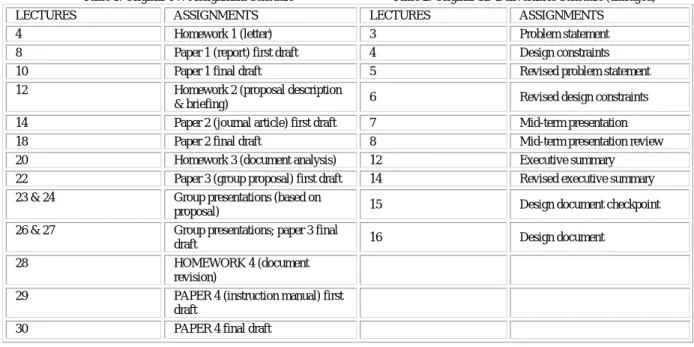
Formal execution of this plan began with restricting one of the seven spring 2004 sections of Technical Writing to ECE majors only and directing incoming senior design students to enroll in this restricted section (eight students eventually enrolled.) Next, the instructors for Senior Design and Technical Writing synthesized their course outlines and content by merging the two courses’ assignment schedules. Tables 1 and 2 below show the original technical writing assignment schedule and the original senior design “deliverables” schedule; the latter has been abridged to remove senior design work not currently relevant to the technical writing course. (NOTE: “TW” stands for “technical writing,” “SD” for “senior design.”)
Table 1. Original TW Assignment Schedule
Table 2. Original SD Deliverables Schedule (abridged)LECTURES ASSIGNMENTS LECTURES ASSIGNMENTS
4 Homework 1 (letter) 3 Problem statement
8 Paper 1 (report) first draft 4 Design constraints
10 Paper 1 final draft 5 Revised problem statement
12 Homework 2 (proposal description
& briefing) 6 Revised design constraints
14 Paper 2 (journal article) first draft 7 Mid-term presentation
18 Paper 2 final draft 8 Mid-term presentation review
20 Homework 3 (document analysis) 12 Executive summary
22 Paper 3 (group proposal) first draft 14 Revised executive summary 23 & 24 Group presentations (based on
proposal) 15 Design document checkpoint
26 & 27 Group presentations; paper 3 final
draft 16 Design document
28 HOMEWORK 4 (document
revision)
29 PAPER 4 (instruction manual) first draft
30 PAPER 4 final draft
Table 3 below shows the integrated schedule for the newly synthesized senior design-technical writing class (Senior Design assignments are in bold in the far-right column).
Table 3. Integrated SD-TW Assignment Schedule
LECTURES ASSIGNMENTS 4 Homework 1 (problem statement) 8 Paper 1 (design constraints) first draft 10 Paper 1 final draft
12 Paper 2 (journal article) first draft
14 Homework 2 (proposal description and briefings based on SD project) 16 Paper 2 final draft
17 & 18 Homework 3 (document analysis); midterm presentation
20 Paper 3 (group proposal based on SD project) first draft 24 Paper 3 final draft
26 Homework 4 (document revision)
28 Paper 4 (final SD report, 50-75%complete) first draft 30 Paper 4 final draft
Table 3 highlights one of the obvious benefits of this plan for students: the ability to couple both writing
experiences and thereby make students’ documents work for both courses (in other words, students will write fewer individual documents overall during the semester). The more important benefit, of course, is the potential for improvements in the quality of Senior Design documents along with the students’ retention of important technical writing concepts and strategies resulting from the two courses’ integration, the latter improvement resulting directly from applied, curricular writing instruction. One critical element in these improvements will be the document workshops required as part of Technical Writing. All four major writing assignments (papers) in Technical Writing include a mandatory first-draft workshop where students read, discuss, and evaluate their colleagues’ drafts (with instructor feedback supplementing student feedback). Although past Senior Design students have written their design documents through an iterative process (written in stages throughout the semester), none of these documents
have been subject to the peer and instructor scrutiny that will be provided by writing workshops under this plan. The small-group interaction of this system will constitute the most significant (and rewarding) change in the
administration of ECE Senior Design.
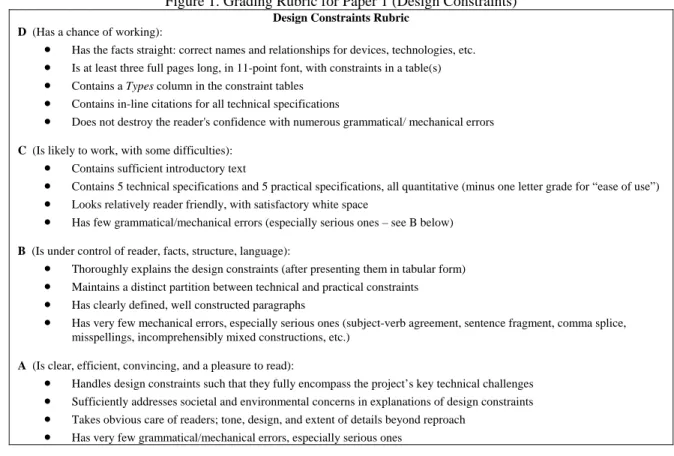
The next step involved unifying the grading process for written work. Instructors chose to use the TCP’s grading rubrics, which eschew a numbering system for errors in favor of categories defining the characteristics of A papers, the characteristics of B papers, and so forth. Criteria for these categories consist of specific details from the writing assignment in question, ranging from content-related facts like equations and data to more format-driven elements like correct incorporation of figures and overall document design. This rubric method is based on the broader concept of holistic grading recently codified by Pappas and Hendricks [4]. In this method, student documents are marked and then compared with the rubric criteria to determine the grade category into which the documents fall. These determinations depend on fulfillment of the criteria for a specific category.; for example, a document fulfilling all of the D and C criteria but only fulfilling two of the B criteria would earn a C. Figure 1 below shows a sample grading rubric similar to those used for Senior Design/Technical Writing documents.
Figure 1. Grading Rubric for Paper 1 (Design Constraints) Design Constraints Rubric
D (Has a chance of working):
• Has the facts straight: correct names and relationships for devices, technologies, etc. • Is at least three full pages long, in 11-point font, with constraints in a table(s) • Contains a Types column in the constraint tables
• Contains in-line citations for all technical specifications
• Does not destroy the reader's confidence with numerous grammatical/ mechanical errors
C (Is likely to work, with some difficulties): • Contains sufficient introductory text
• Contains 5 technical specifications and 5 practical specifications, all quantitative (minus one letter grade for “ease of use”) • Looks relatively reader friendly, with satisfactory white space
• Has few grammatical/mechanical errors (especially serious ones – see B below)
B (Is under control of reader, facts, structure, language):
• Thoroughly explains the design constraints (after presenting them in tabular form) • Maintains a distinct partition between technical and practical constraints • Has clearly defined, well constructed paragraphs
• Has very few mechanical errors, especially serious ones (subject-verb agreement, sentence fragment, comma splice, misspellings, incomprehensibly mixed constructions, etc.)
A (Is clear, efficient, convincing, and a pleasure to read):
• Handles design constraints such that they fully encompass the project’s key technical challenges • Sufficiently addresses societal and environmental concerns in explanations of design constraints • Takes obvious care of readers; tone, design, and extent of details beyond reproach
• Has very few grammatical/mechanical errors, especially serious ones
Assessing Spring 2004
Assessment of the spring 2004 pilot section included instructor discussions and collection of student feedback. The following paragraphs describe each of these stages.
Instructor impressions: The instructors for Senior Design and Technical Writing shared observations about how the semester had gone in general and what improvements they saw in student writing. Overall, the quality of student writing in Senior Design remained largely unchanged. Despite incorporating Technical Writing’s peer-review process for Senior Design documents, several students simply did not use the feedback they got in modifying (or not modifying) their drafts; in this way, students treated the two courses as separate experiences, much as they would had they been enrolled in these classes during any other semester. The instructors believe that this treatment is
largely due to the plan’s newness and that students will likely not take the courses’ pairing too “seriously” until it has been in place for several semesters.
Student feedback: in informal discussions on the last day of class, students indicated they thought the co-requisite plan was a good idea and were overall satisfied with their Senior Design/Technical Writing experience. They did express concern that the two instructors had not fully synthesized their content and grading standards; put simply, students were frustrated that Senior Design documents and Technical Writing documents sometimes earned different grades even when the documents submitted for the two courses were identical. Students also expressed concern that the two courses’ assignment schedules needed to be more closely arranged so that documents could be submitted for inspection in Technical Writing before they are due in Senior Design. Additionally, students also related that, even with coupled or otherwise related assignments, Technical Writing “takes a lot of time,” time that is especially difficult to set aside or plan for while also enrolled in an all-encompassing course like Senior Design. These same issues were later reiterated on the course evaluation, a standardized, computer-read bubble sheet using a Likert scale (“Strongly Agree” through “Strongly Disagree”) and providing spaces for written comments. Of the evaluation form’s 10 Likert-scale items, four are relevant to the Senior Design-Technical Writing project. Table 4 below provides the Senior Design students’ responses to these four items (two students were absent and did not complete an evaluation form).
Table 4. Student Responses to Relevant Course-Evaluation Likert-Scale Items
Strongly Disagree
Disagree Neither Agree Nor Disagree Agree Strongly Agree Mean Std. Dev. The instructor makes the material relevant to my course of study. 0 0 0 3 3 4.00 0.63 I have had to work hard in this course. 1 1 0 1 3 3.67 1.75 I have become more competent in this area because of this instructor. 1 1 0 3 1 3.33 1.51 Grading and evaluation procedures by the instructor seem fair and objective.
2 2 1 1 0 2.17 1.17
These results are very similar to the results typically seen in standard multi-major sections of the course. Most noteworthy are the first and fourth items. Because the writing course is engineering specific, most students indicate that the instructor makes the material relevant to them, an effect heightened here by the inclusion of material students were working on simultaneously in another course. The students’ responses on grading and evaluation procedures are also typical; in fact, the authors’ experience has been that students generally consider grading standards for written work unfair and subjective (to paraphrase the fourth item) regardless of efforts to make such standards as transparent and as objective as possible.
Also noteworthy are the written comments several students provided on their evaluation forms, the most relevant of which appear below.
• “Grading is too harsh. Some documents in SD [Senior Design] recieved [sic] a ‘B’ and even an ‘A’, but in TW [Technical Writing] recieved [sic] a ‘C’ or ‘D’. Too much emphasis on style in writing. Style
• “The linkage of SD and Tech writing is an excellent idea. [I suggest] more communication [between] departments to ensure that schedules do not conflict.”
• “Course was very helpful w/ S.D. Seems more difficult than other Tech. Writing sections (harder to get a good grade).”
• “I do not suggest this type of class format again. It did not accurately represent individual effort. The draft day helps in writing a better paper.”
• “I liked that we got to practice our oral presentation for our design.”
In preparing for the fall 2004 semester – when another Senior Design-only section of Technical Writing would be offered – the instructors relied heavily on the student feedback discussed above. In particular, the assignment schedule for Technical Writing was modified so that every Senior Design-related document was due in draft form before it was submitted in Senior Design; in fact, some were ultimately submitted in both draft stages, graded, and returned to students before they were due in Senior Design. Also, the grading standards for Technical Writing were reviewed and modified as needed (a routine end-of-semester task in other sections as well) to respond to student concerns over harshness. The main objective in modifying these standards was not to “soften” them but to ensure that they (a) weighed technical content, document structure, and language convention proportionately, and (b) converged as thoroughly as possible with the grading standards in Senior Design.
FUTURE PLANS
For fall 2004, 22 ECE students co-enrolled in Senior Design and in Technical Writing. As of this writing, the fall semester has just ended and therefore cannot yet be adequately assessed, though the instructors’ initial impressions are that these most recent design documents show noticeable improvements over those of previous semesters. The authors hope to write a follow-up paper assessing the fall 2004 semester as well as the overall impact of the co-requisite after it has been in place for two full academic years. This assessment will incorporate three main parts: (1) the activities described in the previous section; (2) feedback from the students’ faculty and industrial project advisors on the relative improvement of the design teams’ documents; and (3) an instrument (possibly a written exam) that will assess students’ abilities before taking the courses and their improvements after taking the courses. Even at this early stage, the authors remain confident that this co-requisite plan will significantly improve the communication skills of Senior Design students and better prepare them for the communicative duties they will face as working professionals.
REFERENCES
[1] Bakos, J.D., “A Departmental Policy for Developing Communication Skills of Undergraduate Engineers,”
Journal of Engineering Education, American Society for Engineering Education, Washington, D.C., November 1986, vol. 75, p. 101.
[2] Hendricks, R.W. and E. C. Pappas, “Advanced Engineering Communication: An Integrated Writing and Communication Program for Materials Engineers,” Journal of Engineering Education, American Society for Engineering Education, Washington, D.C., October 1996, vol. 85 no. 4, pp. 343-352.
[3] Newell, J.A., D. K. Ludlow, and S. P. K. Sternberg, “Progressive Development of Oral and Written Communication Skills across an Integrated Laboratory Sequence,” Chemical Engineering Education, 1997, vol. 31 (2), p. 116.
[4] Pappas, E.C. and R. W. Hendricks, “Holistic Grading in Science and Engineering,” Journal of Engineering Education, American Society for Engineering Education, Washington, D.C., October 2000, vol. 89, no. 4, pp. 403-408.
John Brocato
John Brocato serves as Coordinator and Instructor in the Shackouls Technical Communication Program in the James Worth Bagley College of Engineering at Mississippi State University. He designed and helps teach GE 3513 Technical Writing and works closely with engineering departments on enhancing the technical communication content in their curricula. He holds bachelor’s and master’s degrees in English from MSU and previously taught in the English Department at MSU. He is a member of ASEE and serves as the Campus Representative for MSU.
Joe Picone
Joe Piconeis currently a Professor in the Department of Electrical and Computer Engineering at Mississippi State University, where he also directs the Institute for Signal and Information Processing. For the past 15 years he has been promoting open source speech technology. He has previously been employed by Texas Instruments and AT&T Bell Laboratories. Dr. Picone received his Ph.D. in Electrical Engineering from Illinois Institute of Technology in 1983. He is a Senior Member of the IEEE and a registered Professional Engineer.