warwick.ac.uk/lib-publications
Original citation:
Pala, A., Gaensicke, B. T. (Boris T.), Townsley, D., Boyd, D., Cook, M. J., De Martino, D.,
Godon, P., Haislip, J. B., Henden, A. A., Hubeny, I., Ivarsen, K. M., Kafka, S., Knigge, C.,
LaCluyze, A. P., Long, K. S., Marsh, T. R., Monard, B., Moore, J. P., Myers, G., Nelson, P.,
Nogami, D., Oksanen, A., Pickard, R., Poyner, G., Reichart, D. E., Rodriguez Perez, D.,
Schreiber, M. R., Shears, J., Sion, E. M., Stubbings, R., Szkody, P. and Zorotovic, M.. (2016)
Effective temperatures of cataclysmic-variable white dwarfs as a probe of their evolution.
Monthly Notices of the Royal Astronomical Society, 466 (3). pp. 2855-2878.
Permanent WRAP URL:
http://wrap.warwick.ac.uk/86023
Copyright and reuse:
The Warwick Research Archive Portal (WRAP) makes this work by researchers of the
University of Warwick available open access under the following conditions. Copyright ©
and all moral rights to the version of the paper presented here belong to the individual
author(s) and/or other copyright owners. To the extent reasonable and practicable the
material made available in WRAP has been checked for eligibility before being made
available.
Copies of full items can be used for personal research or study, educational, or not-for profit
purposes without prior permission or charge. Provided that the authors, title and full
bibliographic details are credited, a hyperlink and/or URL is given for the original metadata
page and the content is not changed in any way.
Publisher’s statement:
This is a pre-copyedited, author-produced PDF of an article accepted for publication in
Monthly Notices of the Royal Astronomical Society following peer review. The version of
record Pala, A., Gaensicke, B. T. (Boris T.), Townsley, D., Boyd, D., Cook, M. J., De Martino, D.,
Godon, P., Haislip, J. B., Henden, A. A., Hubeny, I., Ivarsen, K. M., Kafka, S., Knigge, C.,
LaCluyze, A. P., Long, K. S., Marsh, T. R., Monard, B., Moore, J. P., Myers, G., Nelson, P.,
Nogami, D., Oksanen, A., Pickard, R., Poyner, G., Reichart, D. E., Rodriguez Perez, D.,
Schreiber, M. R., Shears, J., Sion, E. M., Stubbings, R., Szkody, P. and Zorotovic, M.. (2016)
Effective temperatures of cataclysmic-variable white dwarfs as a probe of their evolution.
Monthly Notices of the Royal Astronomical Society, 466 (3). pp. 2855-2878 is available online
at:
http://dx.doi.org/10.1093/mnras/stw3293
A note on versions:
The version presented here may differ from the published version or, version of record, if
you wish to cite this item you are advised to consult the publisher’s version. Please see the
‘permanent WRAP url’ above for details on accessing the published version and note that
access may require a subscription.
MNRAS000,1–26(2016) Preprint 1 February 2017 Compiled using MNRAS LATEX style file v3.0
Effective Temperatures of Cataclysmic Variable White
Dwarfs as a Probe of their Evolution
A. F. Pala
1?, B. T. G¨
ansicke
1, D. Townsley
2, D. Boyd
3, M. J. Cook
4,
D. De Martino
5, P. Godon
6,7, J. B. Haislip
8, A. A. Henden
4, I. Hubeny
9,
K. M. Ivarsen
8, S. Kafka
4, C. Knigge
10, A. P. LaCluyze
8, K. S. Long
11,12,
T. R. Marsh
1, B. Monard
13, J. P. Moore
8, G. Myers
4, P. Nelson
4, D. Nogami
14,
A. Oksanen
15, R. Pickard
3, G. Poyner
3, D. E. Reichart
8, D. Rodriguez Perez
4,
M. R. Schreiber
16, J. Shears
3, E. M. Sion
6, R. Stubbings
4, P. Szkody
17, M. Zorotovic
161Department of Physics, University of Warwick, Coventry, CV4 7AL, UK
2Department of Physics and Astronomy, University of Alabama, Tuscaloosa, AL 35405, USA
3British Astronomical Association, Variable Star Section, Burlington House, Piccadilly, London, W1J ODU, UK 4American Association of Variable Star Observers, Cambridge, MA 02138, USA
5INAF – Osservatorio Astronomico di Capodimonte, Napoli, I–80131, Italy
6Astrophysics & Planetary Science, Villanova University, Villanova, PA 19085, USA
7Visiting at the Johns Hopkins University, Henry A. Rowland Department of Physics and Astronomy, Baltimore, MD 21218, USA 8Skynet Robotic Telescope Network, University of North Carolina, Chapel Hill, NC 27599, USA
9Steward Observatory, The University of Arizona, Tucson, AZ 85721, USA
10School of Physics and Astronomy, University of Southampton, Southampton, SO17 1BJ, UK 11Space Telescope Science Institute, 3700 San Martin Drive, Baltimore, MD 21218, USA 12Eureka Scientific, Inc. 2452 Delmer Street, Suite 100, Oakland, CA 94602–3017, USA 13CBA Kleinkaroo, Calitzdorp, South Africa
14Department of Astronomy, Graduate School of Science, Kyoto University, Kitashirakawa–Oiwake–cho, Sakyo–ku, Kyoto, 606–8502, Japan 15Caisey Harlingten Observatory, Caracoles 166, San Pedro de Atacama, Chile
16Instituto de F´ısica y Astronom´ıa, Universidad de Valpara´ıso, 2360102 Valparaiso, Chile 17Department of Astronomy, University of Washington, Seattle, WA 98195–1580, USA
Accepted 2016 December 14. Received 2016 December 10; in original form 2016 November 12
ABSTRACT
We present HST spectroscopy for 45 cataclysmic variables (CVs), observed with HST/COS andHST/STIS. For 36 CVs, the white dwarf is recognisable through its broad Lyαabsorption profile and we measure the white dwarf effective temperatures (Teff) by fitting theHST data assuming log g= 8.35, which corresponds to the
aver-age mass for CV white dwarfs (' 0.8 M). Our results nearly double the number of
CV white dwarfs with an accurate temperature measurement.
We find that CVs above the period gap have, on average, higher temperatures (hTeffi '23 000 K) and exhibit much more scatter compared to those below the gap
(hTeffi '15 000 K). While this behaviour broadly agrees with theoretical predictions,
some discrepancies are present: (i) all our new measurements above the gap are charac-terised by lower temperatures (Teff '16 000−26 000 K) than predicted by the present
day CV population models (Teff '38 000−43 000 K); (ii) our results below the gap
are not clustered in the predicted narrow track and exhibit in particular a relatively large spread near the period minimum, which may point to some shortcomings in the CV evolutionary models.
Finally, in the standard model of CV evolution, reaching the minimum period, CVs are expected to evolve back towards longer periods with mean accretion rates
˙
M .2×10−11M
yr−1, corresponding toTeff .11 500 K. We do not unambiguously
identify any such system in our survey, suggesting that this major component of the predicted CV population still remains elusive to observations.
Key words: stars: white dwarfs – cataclysmic variables – fundamental parameters – ultraviolet.
? E-mail: [email protected]
c
1 INTRODUCTION
Cataclysmic variables (CVs) are close interacting binaries containing a white dwarf accreting from a Roche–lobe filling
low–mass companion star (Warner 1995). In the absence of
a strong magnetic field (B . 10 MG), the flow of material
lost by the secondary gives rise to an accretion disc around the white dwarf primary.
In the standard model of CV evolution, the stability of the accretion process on long time scales (of the
or-der of 109Gyr, Kolb & Stehle 1996) requires a mass ratio
q=M2/M1.5/6 (Frank et al. 2002,M1andM2denote the
white dwarf and secondary mass) and a mechanism of angu-lar momentum loss (AML) which continuously shrinks the system and keeps the secondary in touch with its Roche lobe. In the frequently referenced Interrupted Magnetic Braking Scenario, at least two different AML mechanisms drive CV
evolution (Rappaport et al. 1983,Paczynski & Sienkiewicz
1983,Spruit & Ritter 1983). For orbital periodsPorb & 3 h,
the angular momentum is predominantly removed by mag-netic braking (MB) which arises from a stellar wind asso-ciated with the magnetic activity of the secondary, with
typical mass transfer rates of M˙ ∼ 10−9−10−8Myr−1
(Spruit & Ritter 1983). ForPorb.3 h, the dominant AML
mechanism is gravitational wave radiation (GR), with
typi-cal ˙M∼5×10⁻¹¹Myr−1 (Patterson 1984).
Another fundamental ingredient for CV evolution is the internal structure of the secondary and its response to mass
loss (Knigge 2006, Knigge et al. 2011). At Porb '3 h, the
donor star has become fully convective. Magnetic braking via a stellar wind is thought to be greatly reduced and the system evolves as a detached binary through the
pe-riod range 2 h . Porb . 3 h (the period gap). Following
the diminution of MB (Rappaport et al. 1983), the system
evolves through GR only, which reduces the orbital sepa-ration bringing the secondary again into contact with its
Roche–lobe atPorb'2 h.
In the final phase of CV evolution (Porb ' 80 min),
the donor starts behaving like a degenerate object, ceas-ing to contract in response to continue mass loss, and the system evolves back towards longer periods (the so–
called ‘period bouncers’), with mean accretion rates M˙ .
2×10⁻¹¹Myr−1.
Since different period ranges are characterised by
dif-ferent mass transfer rates,Porb(one of the most easily
mea-sured system parameter in CVs) provides a first rough esti-mate of the accretion rate and the evolutionary stage of the system. A more precise measurement of the mean accretion rate can be derived from the white dwarf effective
temper-ature (Teff): its value is set by compressional heating of the
accreted material (Sion 1995), providing a constraint on the
secular mean of the mass–transfer rate hM˙i, averaged over
the thermal time–scale of the white dwarf envelope, (103 –
105 yr) and is one of the best available tests for the present
models of CV evolution (Townsley & Bildsten 2003).
While there are now over 1100 CVs with an orbital
pe-riod determination (Ritter & Kolb 2003), comparatively
lit-tle is known about their accreting white dwarfs: reliable1
1 A temperature measurement is defined reliable when the white
dwarf can be unambiguously detected either in the ultraviolet spectrum (from a broad Lyα absorption profile and, possibly,
−2.5 −2.0 −1.5 −1.0 −0.5 0.0 0.5 1.0
log
(
Porb[d])
0 20 40 60 80 100 120 140
Num
be
r of S
ys
tem
s
Figure 1.The orbital period distribution of 1144 semi–detached binaries containing a white dwarf and a Roche–lobe filling low– mass secondary (Ritter & Kolb 2003, 7th Edition, Release 7.21, March 2014). The systems visible at short orbital periods (Porb.
75 min) are the AM CVn stars and CVs hosting an evolved donor. The green band highlights the period gap (2.15 h.Porb.3.18 h, Knigge 2006), the blue box indicates the period spike (80 min. Porb.86 min,G¨ansicke et al. 2009), the red line shows the period
minimum (Pmin= 76.2 min,Knigge 2006), while the vertical lines
along the top mark the orbital periods of the objects in our survey.
Teffmeasurements are available for only 43 CV white dwarfs
(Townsley & G¨ansicke 2009), only 32 have an accurate mass
determination (Zorotovic et al. 2011) and only 11 have both.
To improve our knowledge of CV evolution, it is essential to
increase the number of objects with an accurate Teff and
mass measurement.
Since CV white dwarfs are relatively hot objects (Teff &
10 000 K) their spectral energy distribution peaks in the ul-traviolet. At these wavelengths, the contamination from the accretion flow and the secondary star is often small or negli-gible compared to their contribution at optical wavelengths, and therefore space–based ultraviolet observations are
nec-essary for a white dwarfTeff determination (Szkody et al.
2002a, G¨ansicke et al. 2006, Sion et al. 2008, and many
others). For this purpose, we carried out a large Hubble
Space Telescope(HST) program in which we obtained high–
resolution ultraviolet spectroscopy of 40 CVs with the
Cos-mic Origin Spectrograph(COS). We complemented our sam-ple with eight systems (three of which are in common with the COS sample) observed during two programs carried out
with theSpace Telescope Imaging Spectrograph (STIS).
The targets were selected to sample the entire orbital
period range of the galactic CV population (Figure1); four
objects with previousTeff measurements were included for
comparison with our results (CU Vel, DV UMa, GW Lib and SDSS J103533.02+055158). In particular, we selected two eclipsing systems (DV UMa and SDSS J103533.02+055158) to compare our spectroscopic analysis with results obtained
from modelling the eclipse light curve (e.g.Feline et al. 2004,
Littlefair et al. 2006, 2008), which is the most commonly
used method for determining white dwarfTeff from ground
based observations.
Here we present theHST observations and the results
of our spectral analysis, which almost doubles the number of
Effective Temperatures of CV white dwarfs
3
objects with reliableTeff measurements, providinghM˙iand
testing the present day CV population evolution models.
2 OBSERVATIONS
2.1 COS observations
TheCosmic Origin Spectrograph (COS) data were collected
in 122HST orbits from October 2012 to March 2014
(pro-gram ID 12870, Table1). Each CV was observed using the
Primary Science Aperture (PSA) for two to five consecutive spacecraft orbits. The data from all the orbits were summed to produce an average ultraviolet spectrum for each object. We used the G140L grating, which has a nominal
resolu-tion ofR '3000, at the central wavelength of 1105 ˚A and
the far–ultraviolet (FUV) channel, covering the wavelength
range 1105−2253 ˚A. The detector sensitivity quickly
de-creases in the red portion of the spectrum, reducing the
use-ful range to' 1150−1730 ˚A.
The COS FUV detector consists of a photon–counting micro–channel plate which converts the incoming photons into electronic pulses. An excessive photon flux could re-sult in permanent damages, and even the loss, of the de-tector. This is very important in the framework of CV ob-servations since these objects are characterised by periods of quiescence, in which the accretion onto the white dwarf is greatly reduced, interrupted by bright outbursts (ther-mal instabilities in the disc which cause a variation in the
mass transfer rate through the disc, Osaki 1974, Hameury
et al. 1998, Meyer & Meyer-Hofmeister 1984). During an
outburst, CVs typically brighten by 2–5 magnitudes,
occa-sionally up to 9 magnitudes (Warner 1995,Maza & Gonzalez
1983,Templeton 2007). This increase in luminosity occurs
rapidly, on the time–scale of about a day, first at optical
wavelengths and hours to a day later in the ultraviolet (
Has-sall et al. 1983,Schreiber et al. 2003,Schreiber et al. 2004).
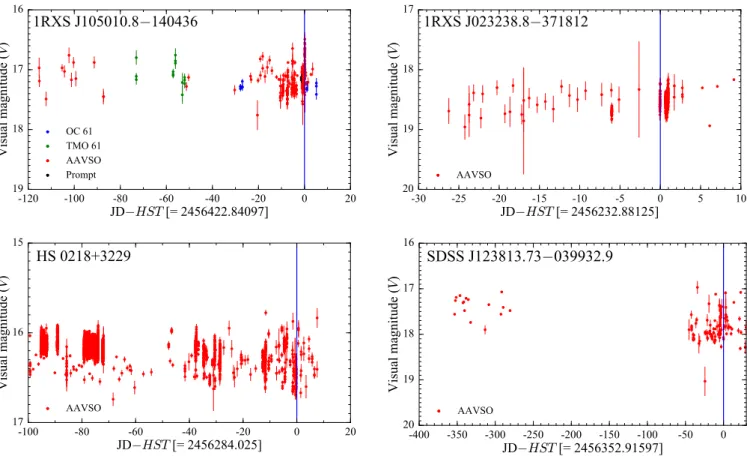
Therefore CVs can easily reach, and exceed, the COS detec-tor safety threshold. The outburst recurrence time ranges from weeks to decades and these events are unpredictable. To avoid damage to the detectors an intensive monitoring of each target was required before the observations. This monitoring program was carried out by the global amateur community and some additional small telescopes (AAVSO, Prompt and many others), and only their outstanding
sup-port has made thisHST survey possible.
Among our 41 COS targets, only
SDSS J154453.60+255348.8 could not be observed since it showed strong variations in its optical brightness in the
days before theHST observation.
After an outburst, the white dwarf does not cool imme-diately to its quiescent temperature since it has been heated by the increased infall of material. The time required to cool back to the quiescent temperature has been modelled and is
related to the outburst amplitude and duration (Sion 1995,
Townsley & Bildsten 2004, Piro et al. 2005). It has been
observed that it can vary from days or weeks up to
sev-eral years (Long et al. 1995,G¨ansicke & Beuermann 1996,
Slevinsky et al. 1999,Piro et al. 2005, seeSzkody et al. 2016
for an extreme case). Therefore the effective temperature measured in a system in which an outburst has recently oc-curred provides only an upper limit for its quiescent effective
temperature and, consequently, forhM˙i.
The right panels of Figure2show three sample COS
ul-traviolet spectra of quiescent CVs in which the white dwarf
dominates the emission, as seen from the broad Lyα
absorp-tion centred on 1216 ˚A. The shape of the Lyαline changes
withTeff, becoming more defined and narrower in the
hot-ter white dwarfs, while the continuum slope of the spectrum becomes steeper.
While the majority of the CVs in our sample have
been observed in quiescence (Figure3), obvious signatures
of the white dwarf were missing in the spectra of nine sys-tems: seven of them experienced an outburst shortly before
theHST observation while the remaining two systems are
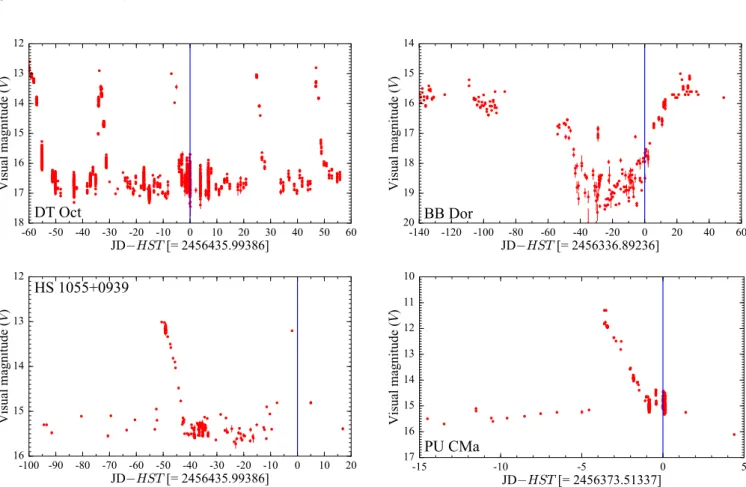
VY Scl stars (Figure4). This class of CVs is characterised
by high mean accretion rates which keep the disc usually in a stable hot state, equivalent to a dwarf nova in permanent outburst. In this high state, the disc dominates the spec-tral appearance even in the far ultraviolet. However, occa-sionally the accretion rate drops (low state) and unveils the
white dwarf (e.g.G¨ansicke et al. 1999,Knigge et al. 2000,
Hoard et al. 2004). The VY Scl stars in our sample (OR And
and BB Dor) were caught in the high state and intermedi-ate stintermedi-ate respectively, preventing a detection of the white dwarf. For the purpose of completeness, the spectra of these
nine objects are shown in Figure5, but a detailed analysis of
these systems is outside the scope of this paper and will be
presented elsewhere (e.g.Godon et al. 2016). In Section3, we
analyse the 31 systems in which the white dwarf signature
is easily recognisable from a broad Lyαabsorption profile.
2.2 STIS observations
TheSpace Telescope Imaging Spectrograph(STIS) data were collected as part of two snapshot programs (programs ID
9357 and 9724) in Cycle 11 and 12 (Table2). Snapshot
pro-grams are designed to fill short gaps in the weekly HST
observing schedule, therefore each CV was observed with exposure times of only 600 to 900 seconds, through the
52”×0.2” aperture. We used the G140L grating at the
cen-tral wavelength 1425 ˚A and the FUV–MAMA detector to
obtain spectra covering the wavelength range 1150−1700 ˚A
at a nominal resolution ofR ' 1000.
Similar to the COS–FUV detector, the MAMA detec-tor is also subject to damage by excessive illumination but, contrary to the COS program, the snapshot programs did not have a long term schedule which could allow detailed monitoring before the STIS observations. We analysed the STIS acquisition images to determine the source bright-ness immediately before the spectrum acquisition. These
images were acquired with the F28 × 50LP filter
(cen-tral wavelength of 7228.5 ˚A and full width at half–maximum
of 2721.6 ˚A). We determined the corresponding magnitude
following the method described in Araujo-Betancor et al.
(2005b). By comparison with published magnitudes and the
system brightness in the Sloan Digital Sky Survey (SDSS) and AAVSO Photometric All–Sky Survey (APASS), we ver-ified that all the targets were observed in quiescence.
These snapshot programs produced ultraviolet spectra
of 69 CVs (e.g.G¨ansicke et al. 2003,Araujo-Betancor et al.
2005a, Rodr´ıguez-Gil et al. 2004). Here we analyse the
re-maining eight objects in which the white dwarf dominates the ultraviolet emission. We show three sample STIS
spec-tra of quiescent CVs in the left panel of Figure2where the
Wavelength [Å]
0 2.0 4.0 6.0 8.0
V844 Her
Wavelength [Å]
0 2.0 4.0 6.0 8.0 10.0 12.0
Fλ
[
10
−
15 erg c
m
−
2 s
−
1Å
−
1]
CY UMa
1200 1300 1400 1500 1600 1700
Wavelength [Å]
0 0.5 1.0 1.5
2.0
DV UMa
Wavelength [Å]
0 0.2 0.4 0.6 0.8 1.0
SDSS J103533.02+055158.4
Wavelength [Å]
0 2.0 4.0 6.0 8.0
Fλ
[
10
−
15 erg c
m
−
2 s
−
1Å
−
1]
SDSS J123813.73
−033932.9
1200 1300 1400 1500 1600 1700
Wavelength [Å]
0 5.0 10.0
15.0
HS 2214+2845
Figure 2.HST/STIS spectra (left) andHST/COS spectra (right) for six objects in which the white dwarf dominates the far–ultraviolet. The geocoronal emission lines of Lyα(1216 ˚A) and Oi(1302 ˚A) are plotted in grey.
-120 -100 -80 -60 -40 -20 0 20
JD
−HST[= 2456422.84097]
16
17
18
19
Vi
sua
l m
agni
tude
(
V
)
1RXS J105010.8
−
140436
OC 61 TMO 61 AAVSO Prompt
-30 -25 -20 -15 -10 -5 0 5 10
JD
−HST[= 2456232.88125]
17
18
19
20
Vi
sua
l m
agni
tude
(
V
)
1RXS J023238.8
−
371812
AAVSO
-100 -80 -60 -40 -20 0 20
JD
−HST[= 2456284.025]
15
16
17
Vi
sua
l m
agni
tude
(
V
)
HS 0218+3229
AAVSO
-400 -350 -300 -250 -200 -150 -100 -50 0
JD
−HST[= 2456352.91597]
16
17
18
19
20
Vi
sua
l m
agni
tude
(
V
)
SDSS J123813.73
−
039932.9
AAVSO
Effective Temperatures of CV white dwarfs
5
Table 1.Log of theHST/COS observations. The systems are ordered by orbital period. TheV–band magnitudes listed here are the quiescent values reported from the literature and do not represent the brightness during the COS observations (see Figures3and4).
System Porb Type V E(B−V) Observation Number Total State
(min) (mag) (mag) date of exposure
orbits time (s)
V485 Cen 59.03 SU UMa 17.7 0.071a 2013 Mar 16 4 9907 q
GW Lib 76.78 WZ Sge 16.5 0.03b 2013 May 30 3 7417 q
SDSS J143544.02+233638.7 78.00 WZ Sge? 18.2 0.029a 2013 Mar 09 3 7123 q
OT J213806.6+261957 78.10 WZ Sge 16.1 0.063a 2013 Jul 25 2 4760 q
SDSS J013701.06–091234.8 79.71 SU UMa 18.7 0.024c 2013 Sep 13 4 10505 q
SDSS J123813.73–033932.9 80.52 WZ Sge 17.8 0.006c 2013 Mar 01 3 7183 q
PU CMa 81.63 SU UMa 16.2 0.09a 2013 Mar 22 2 4757 eq
V1108 Her 81.87 WZ Sge 17.7 0.025c 2013 Jun 06 3 7327 q
ASAS J002511+1217.2 82.00 WZ Sge 17.5 0.025c 2012 Nov 15 3 7183 q
SDSS J103533.02+055158.4 82.22 WZ Sge? 18.8 0.009c 2013 Mar 08 5 12282 q
CC Scl 84.10 DN/IP 17.0 0.013a 2013 Jun 29 2 4668 q
SDSS J075507.70+143547.6 84.76 WZ Sge? 18.2 0.028a 2012 Dec 14 3 7183 q
1RXS J105010.8–140431 88.56 WZ Sge 17.0 0.018c 2013 May 10 3 7363 q
MR UMa 91.17 SU UMa 16.7 0.02a 2013 Apr 04 2 4401 q
QZ Lib 92.36 WZ Sge 17.5 0.054c 2013 Apr 26 3 7512 q
SDSS J153817.35+512338.0 93.11 CV 18.6 0.012a 2013 May 16 2 4704 q
1RXS J023238.8–371812 95.04 WZ Sge 18.8 0.027a 2012 Nov 01 5 12556 q
SDSS J093249.57+472523.0 95.48 DN? 17.9 0.014a 2013 Jan 11 2 4326 eq
BB Ari 101.20 SU UMa 17.9 0.105a 2013 Sep 27 2 4817 q
DT Oct 104.54 SU UMa 16.5 0.145a 2013 May 20 2 4875 eq
IY UMa 106.43 SU UMa 18.4 0.012c 2013 Mar 30 2 4195 q
SDSS J100515.38+191107.9 107.60 SU UMa 18.2 0.025a 2013 Jan 31 3 7093 q
RZ Leo 110.17 WZ Sge 19.2 0.029c 2013 Apr 11 4 10505 q
CU Vel 113.04 SU UMa 17.0 <0.02d 2013 Jan 18 2 4634 q
AX For 113.04 SU UMa 18.5 0.027c 2013 Jul 11 3 7483 q
SDSS J164248.52+134751.4 113.60 DN 18.6 0.063a 2012 Oct 12 3 7240 eq
QZ Ser 119.75 SU UMa 17.9 0.038c 2013 Jun 21 4 10505 q
IR Com 125.34 DN 18.0 0.016c 2013 Feb 08 3 6866 q
SDSS J001153.08–064739.2 144.40 U Gem 17.8 0.029a 2012 Nov 09 5 12601 q
OR And 195.70 VY Scl 18.2 0.158a 2013 Jul 10 3 7361 hs
BB Dor 221.90 VY Scl 18.0 0.03a 2013 Feb 13 3 7272 is
SDSS J040714.78–064425.1 245.04 U Gem 17.8 0.08a 2013 Jan 24 2 4315 q
CW Mon 254.30 U Gem 16.8 0.044c 2012 Nov 30 2 4774 eq
V405 Peg 255.81 CV 18.2 0.064c 2012 Dec 07 3 7303 eq
HS 2214+2845 258.02 U Gem 16.8 0.078a 2013 Jun 18 2 4680 q
BD Pav 258.19 U Gem 15.4 0.0b 2013 Jun 14 3 7375 q?
SDSS J100658.41+233724.4 267.71 U Gem 18.3 0.018c 2014 Mar 20 5 12494 q
HM Leo 268.99 U Gem 17.5 0.021c 2013 Feb 22 4 9979 eq
SDSS J154453.60+255348.8 361.84 U Gem? 16.9 0.032c 2013 Apr 22 – – ?
HS 0218+3229 428.02 U Gem 15.5 0.05c 2012 Dec 22 3 7159 q
HS 1055+0939 541.88 U Gem 15.5 0.025a 2013 Apr 15 2 4688 eq
Notes.TheE(B−V) data have been retrieved from: (a) the NASA/IPAC Extragalactic Database (NED); (b) GW Lib: Bullock et al.(2011), BD Pav:Sion et al.(2008); (c) the three–dimensional map of interstellar dust reddening based on Pan–STARRS 1 and 2MASS photometry (Green et al. 2015); (d) this work. The NED data are the galactic colour excess and represent an upper limit for the actual reddening while the Pan–STARRS data are the actual reddening for the systems with a known distance. The last column reports the state of the system during theHST observations:eq, early quiescence, i.e. observed close to an outburst;q, quiescence;
hs, high state;is, intermediate state.
broad Lyαabsorption centred on 1216 ˚A reveals the white
dwarf photosphere.
Three of the eight systems observed by STIS (BD Pav, QZ Ser and V485 Cen) are in common with the COS sample and we present a detailed comparison of the two datasets in
Section4.2.2.
Adding the five additional CVs observed with STIS to the 31 from the COS survey results in our total sample of 36 CVs in which the white dwarf dominates the overall spectral emission.
3 DATA ANALYSIS
Ultraviolet spectra are particularly suitable for the study of CV white dwarfs because, at these wavelengths, the spectral energy distribution is often dominated by the white dwarf while the donor star does not contribute at all. However, some contamination from the disc, the bright spot (the re-gion where the ballistic stream from the companion inter-sects the disc) or the boundary layer (the interface between the accretion disc and the white dwarf) can dilute the emis-sion from the white dwarf photosphere. As described in
-60 -50 -40 -30 -20 -10 0 10 20 30 40 50 60
JD
−HST[= 2456435.99386]
12 13 14 15 16 17 18
Vi
sua
l m
agni
tude
(
V
)
DT Oct
-140 -120 -100 -80 -60 -40 -20 0 20 40 60
JD
−HST[= 2456336.89236]
14 15 16 17 18 19 20
Vi
sua
l m
agni
tude
(
V
)
BB Dor
-100 -90 -80 -70 -60 -50 -40 -30 -20 -10 0 10 20
JD
−HST[= 2456435.99386]
12
13
14
15
16
Vi
sua
l m
agni
tude
(
V
)
HS 1055+0939
-15 -10 -5 0 5
JD
−HST[= 2456373.51337]
10 11 12 13 14 15 16 17
Vi
sua
l m
agni
tude
(
V
)
PU CMa
Figure 4.Sample light curves for four targets in our sample which have been observed close to an outburst or in an intermediate state. The blue line represents the date of the HST observation, which has been subtracted from the Julian date on the x–axis. Note the different time range on the x–axis. The data have been retrieved from the AAVSO database.
Table 2.Log of theHST/STIS observations. The systems are ordered by orbital period. The fourth column reports the instrumental magnitudes measured from the acquisition images, which were obtained through theF28×50LP filter.
System Porb Type F28×50LP E(B−V) Observation Number Total State
(min) (mag) (mag) date of exposure
orbits time (s)
V485 Cen 59.03 SU UMa 17.9 0.071a 2004 Apr 15 1 900 q
V844 Her 78.69 SU UMa 17.4 0.013c 2003 Feb 23 1 900 q
UV Per 93.44 SU UMa 17.9 0.0b 2002 Oct 11 1 900 q
RZ Sge 98.32 SU UMa 18.0 0.302a 2003 Jun 13 1 900 q
CY UMa 100.18 SU UMa 17.3 0.012a 2002 Dec 27 1 830 q
QZ Ser 119.75 SU UMa 16.9 0.038c 2003 Oct 07 1 900 q
DV UMa 123.62 SU UMa 18.6 0.014c 2004 Feb 08 1 900 q
BD Pav 258.19 U Gem 14.6 0.0b 2003 Feb 09 1 600 q
Notes. TheE(B−V) data have been retrieved from: (a) the NASA/IPAC Extragalactic Database (NED); (b) UV Per:Szkody
(1985), BD Pav: Sion et al. (2008); (c) the three–dimensional map of interstellar dust reddening based on Pan–STARRS 1 and 2MASS photometry (Green et al. 2015). The NED data are the galactic colour excess and represent an upper limit for the actual reddening while the Pan–STARRS data are the actual reddening for the systems with a known distance. The last column reports the state of the system during theHST observations:q, quiescence.
tion2.1, the overall shape of a white dwarf ultraviolet
spec-trum is determined by its effective temperature: hotter white
dwarfs have narrow Lyα profiles and steep blue continua,
while cooler white dwarfs are characterised by broad Lyα
profiles and flat continua. Therefore the white dwarf effec-tive temperature can be accurately measured by fitting the
HST data with synthetic white dwarf atmosphere models.
In Figure6, we show the COS data of 1RXS J023238.8–
371812 as an example of a typical CV spectrum from
our sample. The broad Lyα absorption at ' 1216 ˚A, the
quasi–molecular absorption bands of H+2 at '1400 ˚A and
several sharp absorption lines (e.g. Ci 1460/1490 ˚A, Siii
1526/1533 ˚A, Ci 1657 ˚A) reveal the white dwarf
photo-sphere. The white dwarf dominates the ultraviolet
emis-sion but the non–zero flux detected in the core of the Lyα
Effective Temperatures of CV white dwarfs
7
0 0.5 1.0 1.5 2.0 2.5
BB Dor
0 1.0 2.0 3.0 4.0
5.0
CW Mon
1200 1300 1400 1500 1600 1700
0 2.0 4.0
6.0
DT Oct
1200 1300 1400 1500 1600 1700
0 0.5 1.0 1.5 2.0
2.5
HM Leo
1200 1300 1400 1500 1600 1700
0 0.5 1.0 1.5 2.0
Fλ
[
10
−
14
erg c
m
−
2
s
−
1Å
−
1
]
HS 1055+0939
1200 1300 1400 1500 1600 1700
0 0.1 0.2 0.3
0.4
OR And
1200 1300 1400 1500 1600 1700
0 4.0 8.0 12.0 16.0
18.0
PU CMa
1200 1300 1400 1500 1600 1700
0 1.0 2.0
3.0
SDSS J093249.57+472523.0
1200 1300 1400 1500 1600 1700
Wavelength [
Å]
0 4.0 8.0
12.0
V405 Peg
Figure 5.HST/COS spectra of the nine CVs dominated by emis-sion from the accretion flow, outshining the white dwarf. Strong emission lines of Ciii(1175 ˚A), Nv(1242 ˚A), Cii(1335 ˚A), Siiv
(1400 ˚A), Civ(1550 ˚A) and Heii(1640 ˚A) are clearly visible. The wavelength ranges affected by the geocoronal emission lines of Lyα(1216 ˚A) and Oi(1302 ˚A) are plotted in grey.
a hot boundary layer, or from the disc (Long et al. 1993,
Godon et al. 2004,G¨ansicke et al. 2005). In addition we
de-tect emission lines, which are broadened by the Keplerian velocity distribution of the disc. A model to fit the data has to account for these three contributions (white dwarf, second component and emission lines) detected in a CV spectrum.
We usedtlusty andsynspec(Hubeny 1988;Hubeny
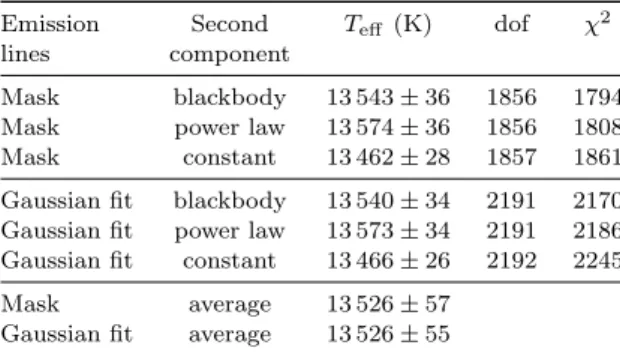
Table 3.Results for 1RXS J023238.8–371812 for the two different fitting methods for the disc emission lines, in which we either mask the emission lines (Mask) or include them as Gaussian profiles (Gaussian fit). We fixed logg= 8.35. The last two rows (average) report the mean and the standard deviations for each method.
Emission Second Teff (K) dof χ2
lines component
Mask blackbody 13 543±36 1856 1794
Mask power law 13 574±36 1856 1808
Mask constant 13 462±28 1857 1861
Gaussian fit blackbody 13 540±34 2191 2170 Gaussian fit power law 13 573±34 2191 2186 Gaussian fit constant 13 466±26 2192 2245
Mask average 13 526±57
Gaussian fit average 13 526±55
& Lanz 1995) to compute a grid of synthetic spectra of white
dwarf atmospheres, coveringTeff = 10 000−70 000 K in steps
of 100 K, and metal abundancesZ of 0.01, 0.10, 0.20, 0.50
and 1.00 times their solar values2.
Ideally, a spectral fit to the ultraviolet data would
pro-vide bothTeffand the surface gravity (logg). However these
two quantities correlate: an increase in the temperature translates into a larger fraction of ionised hydrogen and nar-rower Lyman and Balmer lines; this effect can be counter-balanced by a higher gravity which increases pressure broad-ening. It is not possible to break this degeneracy from the
sole analysis of theHST data since they only provide the
Lyαabsorption profile which, in the case of cool CV white
dwarfs, is limited to only the red wing of the line. Therefore we needed to make an assumption on the surface gravity. Most previously published work analysing CV white dwarf
ultraviolet spectra assumed logg = 8.00, corresponding to
0.6 M, the average mass of isolated white dwarfs (Koester
et al. 1979,Liebert et al. 2005,Kepler et al. 2007), unless an
independent white dwarf mass determination was available.
However,Zorotovic et al.(2011) demonstrated that the
av-erage mass of white dwarfs in CVs is actually higher than
that of isolated white dwarfs,'0.8 M(logg'8.35). Since
the canonical assumption logg = 8.00 does not reflect the
observed average mass of CV white dwarfs, we generated
our grid of models assuming logg= 8.35.
The COS ultraviolet spectra are contaminated by
geo-coronal emission of Lyαand Oi1302 ˚A, and we masked these
wavelength regions for our spectral analysis. Furthermore, we noticed the presence of an additional continuum
compo-nent in all our systems, which contributes'10−30 per cent
of the observed flux. In order to account for this, we included
in the fit a blackbody, a power law or a constant flux3 (in
2 Using a single metallicity is sufficient to account for the
pres-ence of the metal lines in the fit, which are relatively weak. Pos-sible deviations of single element abundances from the overall scaling with respect to the solar values do not affect the results of theχ2 minimisation routine. In fact, varying the abundances
of individual elements has no effect on the measuredTeff. 3 The constant is a special case of a power law and accounts for
the easiest case with no slope, as it requires only one free param-eter (a scaling factor), while power law and blackbody require two (respectively, a temperature and an exponent, plus a
H
+2C
iii
N
v
C
ii
Si
iv
C
i
C
i
C
i
Si
ii
C
iv
He
ii
Wavelength [˚
A]
F
λ[1
0
−
1
5
er
g
cm
−
2
s
−
1
˚ A
−
1
]
1200 1300 1400 1500 1600 1700
2.0
1.5
1.0
0.5
0
Figure 6.HST/COS spectrum of 1RXS J023238.8–371812. Plotted in green are the emission lines of Ciii(1175 ˚A), Nv(1242 ˚A), Cii
(1335 ˚A), Siiv(1400 ˚A), Civ(1550 ˚A) and Heii(1640 ˚A). The red band underlines the position of the H+2 quasi–molecular absorption bands. The blue band highlights the presence of a second, flat continuum component which, in this case, contributes'10 per cent of the observed flux. The geocoronal emission lines of Lyα(1216 ˚A) and Oi(1302 ˚A) are plotted in grey.
Fλ), which can reproduce different slopes in the second
com-ponent and are representative of different physical processes (thermalised emission in the case of the blackbody, optically
thin emission in the case of the power law). Using aχ2
min-imisation routine, we fitted the grid of model spectra to the
HST data and measured the effective temperatures of the
36 CV white dwarfs.
To investigate the influence of the disc emission lines on our fitting procedure, we carried out our spectral analysis using two different methods: (i) we masked all the emission
lines (Mask); (ii) we included the emission lines as Gaussian
profiles, allowing three free parameters: amplitude,
wave-length and width (Gaussian fit).
We illustrate the differences between the two
meth-ods using 1RXS J023238.8–371812. Figure7shows the COS
spectrum along with the best–fit models obtained masking the emission lines (left panels) and including the lines in the fit (right panels), for all three different second components (from top to bottom: blackbody, power law and constant). The temperatures measured with the two methods typically
only differ by' 3 K (see Table3), demonstrating that
in-cluding or masking the disc lines has no influence on the
fit result (see alsoSzkody et al. 2010). Therefore, to use as
much of the data as possible, we decided to include the lines
in the fit (Gaussian fit).
The uncertainties of the individual fits listed in Table3
are purely statistical, as derived from the fitting procedure. They are unrealistically small and do not reflect the real uncertainties, which are instead dominated by several sys-tematic effects, analysed in the following sections.
ing factor). For this reason, we included the constant flux as an additional mode for the second component.
3.1 The unknown nature of the second component
The first systematic uncertainty in our fitting procedure arises from the unknown nature of the additional emission component. The blackbody, the power law or the constant are not constrained outside the ultraviolet wavelength range, and only serve to account for different slopes in the de-tected additional continuum component. They thus repre-sent a very simplified model of the additional continuum contribution and it is likely that none of them provides a realistic physical description of this emission component.
From a statistical point of view, and owing to the lim-ited wavelength coverage of our data, we cannot discriminate among the three of them, and they all result in fits of sim-ilar quality and in very simsim-ilar temperatures for the white
dwarf (see Table 3). These differences in Teff reflect a
sys-tematic effect related to presence of this additional flux. For
this reason, we decided to adopt as finalTeff measurement
the mean of the results obtained with the three different additional components. To evaluate the magnitude of the related systematic uncertainty, we calculated both the
stan-dard deviation of the Teff values obtained with the three
different additional components and the sum in quadrature of the statistical errors of the individual fits. We assumed as final and more realistic estimate for the systematic uncer-tainty the larger of these two. Additional systematic effects are analysed in the following sections.
3.2 The unknown white dwarf mass
As pointed out above, the temperature and mass of a white
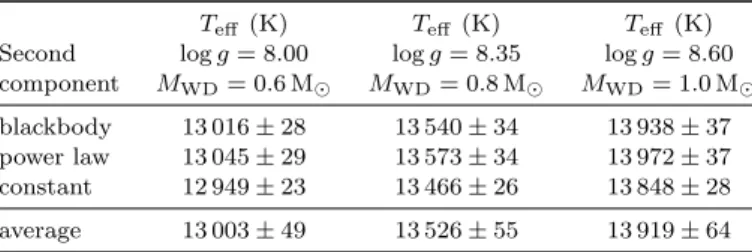
dwarf correlate. Table4reports the effective temperatures of
1RXS J023238.8–371812 allowing different logg(= different
white dwarf masses). These results show that an
assump-tion on loggtranslates into an accurate measurement of the
temperaturefor a given mass('50 K), while the systematic
1200 1300 1400 1500 1600 1700
Wavelength [
Å
]
0 0.5 1.0 1.5 2.0
F
λ[
10
−
15
erg c
m
−
2
s
−
1
Å
−
1
]
T =
13543 ± 36
K
BB
1200 1300 1400 1500 1600 1700
Wavelength [
Å
]
-20 2
Re
sidua
ls
1200 1300 1400 1500 1600 1700Wavelength [
Å
]
0 0.5 1.0 1.5
F
λ[
10
−
15
erg c
m
−
2
s
−
1
Å
−
1
]
T =
13540 ± 34
K
BB
1200 1300 1400 1500 1600 1700
Wavelength [
Å
]
-20 2
Re
sidua
ls
1200 1300 1400 1500 1600 1700
Wavelength [
Å
]
0 0.5 1.0 1.5 2.0
F
λ[
10
−
15
erg c
m
−
2
s
−
1
Å
−
1
]
T =
13574 ± 36
K
PL
1200 1300 1400 1500 1600 1700
Wavelength [
Å
]
-20 2
Re
sidua
ls
1200 1300 1400 1500 1600 1700Wavelength [
Å
]
0 0.5 1.0 1.5 2.0
F
λ[
10
−
15
erg c
m
−
2
s
−
1
Å
−
1
]
T =
13573 ± 34
K
PL
1200 1300 1400 1500 1600 1700
Wavelength [
Å
]
-20 2
Re
sidua
ls
1200 1300 1400 1500 1600 1700
Wavelength [
Å
]
0 0.5 1.0 1.5 2.0
F
λ[
10
−
15
erg c
m
−
2
s
−
1
Å
−
1
]
T =
13462 ± 28
K
const
1200 1300 1400 1500 1600 1700
Wavelength [
Å
]
-20 2
Re
sidua
ls
1200 1300 1400 1500 1600 1700Wavelength [
Å
]
0 0.5 1.0 1.5 2.0
F
λ[
10
−
15
erg c
m
−
2
s
−
1
Å
−
1
]
T =
13466 ± 26
K
const
1200 1300 1400 1500 1600 1700
Wavelength [
Å
]
-20 2
Re
sidua
ls
10000.0 20000.0 30000.0 40000.0 50000.0
log (T
8. 35[K])
−4000 −3000 −2000 −1000 0 1000 2000 3000 4000
∆
T
eff[K
]
DW UMa
Z = 0.71 Z⊙
DW UMa
Z = 0.71 Z⊙
∆
+T
eff
= T
eff(log g = 8. 60) − T
eff(log g = 8. 35)
∆
−T
eff
= T
eff(log g = 8. 00) − T
eff(log g = 8. 35)
Figure 8. Best–fit to ∆+T
eff = Teff(logg = 8.60)−Teff(logg = 8.35) and ∆−Teff =Teff(logg = 8.00)−Teff(logg = 8.35), as a
function ofTeff(logg= 8.35), for the five metallicities and the three additional continuum second components (red for blackbody, blue
for power law and gold for constant). The fit excludes the effective temperatures of (i) the eclipsing systems IY UMa, SDSS J040714.78– 064425.1 and SDSS J100658.41+233724.4 for which disc absorption along the line of sight makes the identification of the continuum flux level difficult (Section4.4); (ii) CC Scl and SDSS J164248.52+134751.4 for which a reliable effective temperature determination was not possible (Section4.2); (iii) SDSS J153817.35+512338.0 because the core of its narrow Lyαline is strongly contaminated by geocoronal airglow emission which makes the data less sensitive to a change in the model surface gravity. DW UMa was not included in the fit, but serves as independent test of the fit.
Table 4.Tefffor 1RXS J023238.8–371812 allowing different logg,
corresponding to different white dwarf masses. These results have been obtained fitting the data including the emission lines as Gaussian profiles, and using three different models for the sec-ond component.
Teff (K) Teff (K) Teff (K)
Second logg= 8.00 logg= 8.35 logg= 8.60 component MWD= 0.6 M MWD= 0.8 M MWD= 1.0 M
blackbody 13 016±28 13 540±34 13 938±37 power law 13 045±29 13 573±34 13 972±37 constant 12 949±23 13 466±26 13 848±28
average 13 003±49 13 526±55 13 919±64
is typically an order of magnitude larger ('500 K).
There-fore the dominant source of error is the (unknown) white dwarf mass and we used the following approach to evaluate
how this systematic uncertainty depends onTeff.
As shown byZorotovic et al.(2011), the average mass
of CV white dwarfs is 0.83±0.23M and we therefore
investigated the correlation between effective temperature
and logg in the mass range 0.6 M(logg = 8.00) to
1.0 M(logg = 8.60). We fitted our HST data assuming
logg = 8.00, logg = 8.35 and logg = 8.60 for each
metallicity and for each type of second component, resulting
in 15 effective temperatures (five metallicities×three
sec-ond components) for each logg, for each object. We define4
as T8.00 = Teff(logg = 8.00), T8.35 = Teff(logg = 8.35)
and T8.60 = Teff(logg = 8.60), and calculated ∆+Teff =
T8.00−T8.35, and ∆−Teff =T8.60−T8.35.
We excluded from this analysis the eclipsing
systems IY UMa, SDSS J040714.78–064425.1 and
SDSS J100658.41+233724.4 for which disc absorption
along the line of sight makes the identification of the
continuum flux level difficult (Section4.4). We also did not
include CC Scl and SDSS J164248.52+134751.4 for which a reliable effective temperature determination was not
possi-ble (Section 4.2), and SDSS J153817.35+512338.0 because
the core of its narrow Lyα line is strongly contaminated
by geocoronal airglow emission which makes the data less sensitive to a change in the model surface gravity.
The remaining objects have typicallyTeff . 21 000 K,
with the exception of HS2214+2845 (Teff ' 26 000 K).
To better constrain ∆+T
eff and ∆−Teff and to verify the
validity of this relationship at high temperatures, we in-cluded in our analysis two additional hotter objects: SS Aur
(Teff = 34 000±2 000 K for logg = 8.8, Sion et al. 2008)
and DW UMa (Teff = 50 000±1 000 K for logg= 8.00 and
Z = 0.71 Z,Araujo-Betancor et al. 2003). Both these
ob-jects have been observed with STIS, which allows the
re-4 We found that the effective temperature derived for different
Effective Temperatures of CV white dwarfs
11
moval of the contamination from geocoronal emission and therefore, differently from SDSS1538 in our sample, they can be used to constrain the relationship at high temperatures. We retrieved the STIS spectrum of SS Aur and the out–
of–eclipse STIS low–state spectrum of DW UMa (Knigge
et al. 2000) from theHST data archive. Following the same
method as for the CVs in our sample, we fitted these data
assuming logg = 8.00, logg = 8.35 and logg = 8.60. For
SS Aur we found: T8.00 = 26 269±275 K,T8.35 = 27 507±
282 K andT8.60= 28 402±270 K forZ= 0.1 Z. In the case
of DW UMa, we assumedZ = 0.71 Z, and obtainedT8.00=
49 900±844 K, in agreement with Araujo-Betancor et al.
(2003), T8.35 = 52 532±893 K and T8.60= 54 282±986 K,
respectively.
Figure 8 show the trend of ∆+Teff and ∆−Teff as a
function ofTeff(logg= 8.35). These correlations are well fit
with the following relation:
∆Teff =alog(Teffb) (1)
wherea= 1054(2) K,b= 0.0001052(7) K−1for ∆+T
eff, and
a=−1417(2) K,b= 0.0001046(5) K−1 for ∆−Teff.
We included the SS Aur temperatures in the fit of
∆+Teff and ∆−Teff to better constrain the relationship
at high temperatures. In contrast, we did not include the DW UMa temperatures and we only overplot them in
Fig-ure8to illustrate that our best–fit is in good agreement with
this independent measurement.
The two best–fit curves represent the systematic
un-certaintyσTeff due to the unknown mass of the white dwarf.
The two curves are not symmetric (since the relationship
be-tween loggand the white dwarf mass is not linear), resulting
in asymmetric error bars with ∆−Teff >∆+Teff. However,
to simplify our discussion, we adopted as final uncertainty
the larger value derived from ∆−Teff:
σTeff = 1417 log(0.0001046Teff) (2)
In summary, we found that the systematic uncertainty due to the unknown white dwarf mass lies in the range
300−1800 K. Once the masses for each system are accurately
determined, the degeneracy between Teff and logg will be
broken, reducing the uncertainties in Teff to those related
to the unknown nature of the second additional component
(see Section3.1).
3.3 Reddening
Reddening due to interstellar dust along the line of sight can introduce an additional systematic uncertainty in the effective temperature determination as it affects the overall slope of the ultraviolet spectra. However, CVs are intrinsi-cally faint and thus we are observationally biased towards nearby systems, for which extinction is usually negligible. Moreover, owing to their colour similarity with quasars, CVs are often discovered by extragalactic surveys (such as SDSS), which cover high Galactic latitudes, and are therefore not heavily affected by reddening. To verify that reddening is a minor contribution to the total error budget, for all the systems in our sample, we compiled the colour excess of
our CVs (Table1and 2) using the three–dimensional map
of interstellar dust reddening based on Pan–STARRS 1 and
0.00 0.05 0.10 0.15 0.20 0.25 0.30 0.35
E(B − V) 13800
13900 14000 14100 14200 14300 14400 14500 14600
Teff
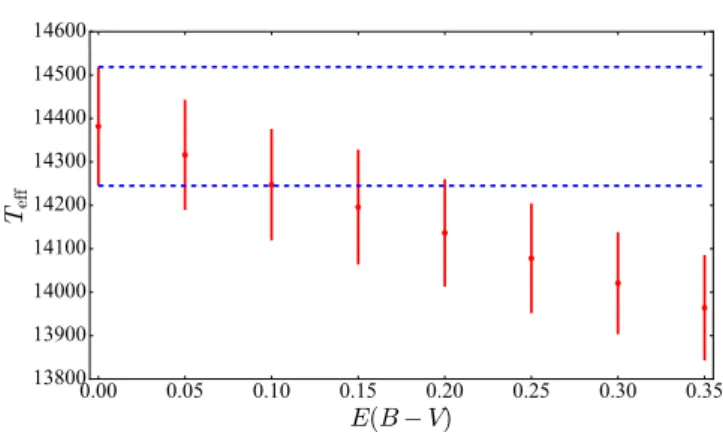
Figure 9.Best–fit effective temperatures for UV Per, obtained by reddening theHST/STIS data for increasing values ofE(B−V). The blue lines show the systematic uncertainties on the effective temperature derived from the fit to the original data (E(B−V) = 0), following the method described in Section3.1. They establish the threshold above which the effect of interstellar absorption on ourTeff is greater than the systematic uncertainties, i.e.E(B−
V)'0.1.
2MASS photometry (Green et al. 2015) wherever possible,
i.e. when the distance is known and the object is inside the field covered by this map. For the remaining objects, we re-port either the value from the literature where available or
the galacticE(B−V) from the NASA/IPAC Extragalactic
Database (NED), which only represents an upper limit for the actual reddening. Finally, for CU Vel, we determined its
colour excess below (Section4.3.1.1).
To establish how the interstellar absorption affects our analysis, we considered one of the systems with zero colour excess, UV Per, and reddened its spectrum using the
rela-tionship given byCardelli et al.(1989) for a range of values
inE(B−V). Since we previously determined the effective
temperature for this CV white dwarf,Teff[E(B−V) = 0] =
14 389±578 K, we can use this “artificially reddened” dataset
to study the variation of Teff as a function of reddening.
We fitted the reddened spectra following the prescription
from Sections3and3.1and show the derived temperatures
in Figure9. The interstellar absorption introduces a
vari-ation in Teff greater than the systematic uncertainties
de-fined in Section3.1(blue dashed lines) forE(B−V)&0.1,
which we assumed as the threshold above which the effect of the reddening cannot be neglected. Only one system in our sample has a colour excess significantly higher than this
value: RZ Sge,E(B−V) = 0.302, as returned from the NED
database. However Sagittarius lies on the Galactic plane and
thisE(B−V) represents an estimate over the entire
Galac-tic column. Given the typical distances of CVs, the actual reddening of RZ Sge is likely to be lower than that. We
as-sumed the mass–radius relationship fromVerbunt &
Rap-paport(1988) and, using the scaling factors from the fit to
the STIS data for different surface gravities (Section 3.2),
we estimated the distance to RZ Sge to lie in the range
262 pc . d . 335 pc, for 0.6 M ≤ MWD ≤ 0.8 M.
From the three–dimensional map of interstellar dust
redden-ing (Green et al. 2015) we found 0.044 . E(B−V) .0.070,
well below the threshold we established above. We therefore considered negligible the reddening for this system.
Finally, interstellar gas along the line of sight can also
contaminate the observed spectrum with additional Lyα
drogen column density and reddening fromDiplas & Savage
(1994), we determined that this contribution is always of the
order of few ˚Angstrom ('3 ˚A for E(B−V) = 0.05 up to
' 7 ˚A for E(B−V) = 0.3) and therefore much narrower
than the white dwarf Lyα absorption line. In fact, the
in-terstellar Lyα absorption is located in the spectral region
that we always masked owing to geocoronal airglow
emis-sion, which typically has a width of '18 ˚A, and therefore
we concluded that interstellar Lyαabsorption has no effect
on our results.
3.4 Other possible systematic effects
To review all the systematic uncertainties in a way as com-prehensive as possible, we need to discuss the possibility of
Lyαabsorption from the additional non–white dwarf
com-ponent and inaccuracies in the instrument calibration. Although not much is known about the physical origin of the second component, it is likely to arise from a hot op-tically thick (e.g. the bright spot) or a hot opop-tically thin medium surrounding a cooler optically thick layer (e.g. the disc or the boundary layer). It is therefore possible that the second component can contribute, to some extent, to the
observed Lyαabsorption. The Lyαprofile is, along with the
spectral slope, the main tracer of the white dwarf tempera-ture, and such a hypothetical contamination could
system-atically affect our results.Long et al.(2009) investigated an
additional Lyβ absorption in VW Hyi finding that it most
likely originates from a hot spot region whose emission can
be approximated by a stellar model with logg ' 4. The
Lyman absorption lines arising from such an environment are consequently significantly narrower than the white dwarf
Lyαabsorption itself, which is broadened by the higher
pres-sure on the white dwarf surface at logg '8.35. Thus,
al-though the model we used to describe the additional com-ponent does not account for the possibility of absorption in
the Lyαregion, such contamination (if present) would not
appreciably affect our effective temperature determination. Finally, limitations in the instrument calibration may
affect our results. Massa et al.(2014) report that the
sys-tematic uncertainties in the COS G140L flux calibration are
less than two per cent forλ <1200 ˚A and one per cent for
1200 ˚A< λ <1900 ˚A, with an increase up to six per cent at
λ= 2150 ˚A. Owing to a decrease in the detector sensitivity
in the red portion of the spectrum, we only considered the
wavelength range 1150 ˚A< λ <1730 ˚A, for which systematic
uncertainties are less than two per cent. The maximum ef-fect on our results can be evaluated by multiplying the COS spectra with a linear function with a two per cent slope. To assess also for possible dependencies with the tempera-ture of the white dwarf, we choose three systems representa-tive of cool, warm and hot white dwarfs: 1RXS J105010.8– 140431, SDSS J123813.73–033932.9 and HS 2214+2845. We fitted their spectra after applying the two per cent slope in
flux calibration and find that the resultingTeff values are in
agreement, within the uncertainties, with the one we derived from the original COS data. We therefore conclude that our analysis is not affected by the very small uncertainty in the COS instrument calibration.
Three objects in our sample have been observed both
with STIS and COS. In Section4.2.2 we compare the two
1200 1300 1400 1500 1600 1700
0 0.5 1.0 1.5 2.0 2.5
Fλ
[
10
−
15 erg c
m
−
2 s
−
1Å
−
1]
H+
2 H2
T = 11622 ± 277 K
1200 1300 1400 1500 1600 1700
Wavelength [Å] -2
-10
1 2
Re
sidua
ls
1200 1300 1400 1500 1600 1700
0 0.1 0.2 0.3 0.4 0.5 0.6 0.7 0.8
Fλ
[
10
−
14 erg c
m
−
2 s
−
1Å
−
1]
H+
2
SDSS J123813.73−033932.9
T = 18358 ± 922 K
1200 1300 1400 1500 1600 1700
Wavelength [Å] −2
−10
1 2
Re
sidua
ls
1200 1300 1400 1500 1600 1700
0 0.2 0.4 0.6 0.8 1.0 1.2 1.4
Fλ
[
10
−
14 erg c
m
−
2 s
−
1Å
−
1]
HS 2214+2845 T = 26443 ± 1436 K
1200 1300 1400 1500 1600 1700
Wavelength [Å] -2
-10
1 2
Re
sidua
ls
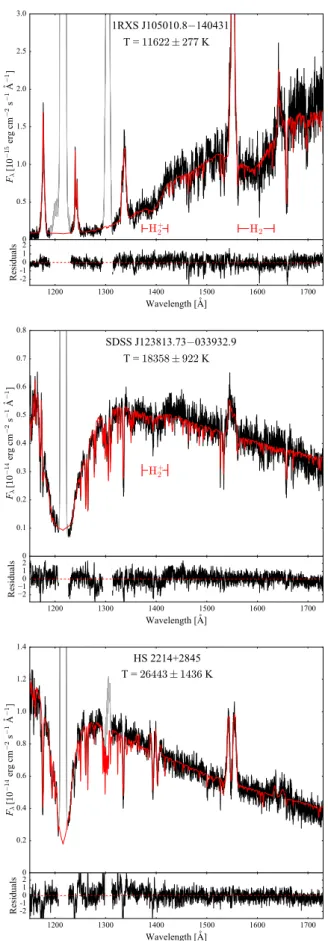
Figure 10.Ultraviolet spectra (black) of cool, warm and hot CV white dwarfs in our sample along with the best–fit model (red) assuming a blackbody second component. The quasi–molecular absorption bands of H+2 and of H2 are visible at'1400 ˚A and
'1600 ˚A forTeff . 19 000 K andTeff .13 500 K, respectively
emis-Effective Temperatures of CV white dwarfs
13
datasets and, for this comparison to be reliable, we needed to verify that the STIS and COS calibrations agree. To do
so, we retrieved from theHST archive the STIS and COS
data of the flux standard WD 0308–565. We overplot the one available STIS spectrum and the COS data acquired at different epochs, finding that the STIS spectrum matches the flux level of all the COS data. With a linear fit to the ratio between the two datasets, we determined that they
differ, on average, by'3 per cent. This comparison proves
that uncertainties in the STIS calibration are comparable to the systematic uncertainties of COS and therefore they are negligible in our analysis. Finally, we can also conclude that the differences in the STIS and COS effective temperatures
discussed in Sections 4.2.2 are not related to calibration
issues of the two instruments.
We followed the procedure outlined in the previous
Sec-tions to fit theHST data of the 36 CVs and summarize the
results in Table5. Figure10shows three examples of best–
fit models obtained with this procedure: 1RXS J105010.8– 140431 (top panel), SDSS J123813.73–033932.9 (middle panel) and HS 2214+2845 (bottom panel), which are rep-resentative of different temperature regimes (cool, interme-diate and hot, respectively). All the spectra, along with their best–fit models, are available in the online material.
4 DISCUSSION
4.1 loggcorrection of publishedTeff values
The two most commonly used techniques to measure effec-tive temperatures of CV white dwarfs are spectroscopy, that is by fitting ultraviolet or optical spectra with white dwarf atmosphere models, and photometry, i.e. from the analysis of light curves to study the white dwarf ingress and egress
in eclipsing systems. Townsley & G¨ansicke(2009, hereafter
TG09) present an analysis of CV white dwarf effective tem-peratures and selected only those systems for which a
re-liableTeff determination is available. They consider a
mea-surement unreliable when obtained from (i) spectra in which the white dwarf could not be unambiguously detected or, (ii) in the case of eclipse light curve analyses, oversimplified models or data of poor quality were used. Following these criteria, TG09 compiled 43 systems with a reliable temper-ature measurement (see their table 1).
Among the 43 measurements from TG09, 15 were ob-tained from light curve analyses (which also delivers the white dwarf mass) or have a white dwarf mass measurements independent from the spectral fit. For the remaining 28 ob-jects an independent mass determination was not available
and the white dwarf Teff was evaluated via spectroscopic
analyses, following methods similar to the one described
here, but assuming logg= 8.00. As discussed in Section3,
this assumption does not reflect the average mass in CV
white dwarfs,M '0.8 M, corresponding to logg= 8.35.
To combine our results with those of TG09, we need
there-fore to evaluate the correspondingTeff for logg= 8.35 for
those 28 objects.
The systematic correction that we need to apply is
∆Teff = Teff(logg = 8.35)−Teff(logg = 8.00), which is
the opposite of the quantity ∆−Teff we calculated in
Sec-tion3.2. Using the relationship−∆−Teff = 1417×log(Teff×
0.0001046), we corrected the Teff values for those 28
sys-tems from TG09 which did not have an independent mass measurement to the average CV white dwarf mass (i.e.
logg= 8.35), therefore enabling a consistent combinations
of these values with the 36 temperatures that we derived for the COS+STIS data.
4.2 Notes on individual objects
4.2.1 Systems observed close to an outburst
As explained in Section2, if a CV experienced an outburst
shortly before the ultraviolet observation, its spectrum could be contaminated by disc emission. Furthermore the white dwarf photosphere is heated by the increased infall of ma-terial and different subtypes of CVs have different cooling time scales on which they return to their quiescent
temper-ature (Sion 1995,Piro et al. 2005). A spectroscopic analysis
of these systems can therefore provide only an upper limit on the white dwarf effective temperature.
For each system, we inspected the light curves re-trieved from the AAVSO web site plus a total of
addi-tional ∼ 2000 images (collected with the Mount John
University Observatory OC61 Telescope, the New Mex-ico State University Observatory TMO61 telescope and the Prompt telescopes located in Chile), covering two
months before theHST/COS observations. We found that
nine systems in which the white dwarf dominates the ul-traviolet flux went into outburst within this time inter-val: AX For, BB Ari, HS 2214+2845, IY UMa, MR UMa,
QZ Ser, V485 Cen (Figure11), CC Scl (Figure12, left), and
SDSS J164248.52+134751.4 (SDSS1642, Figure 12, right).
QZ Ser and V485 Cen have STIS observations (Section4.2.2)
from which we determined the quiescent temperature while, for the remaining systems, the results that we report here
only represent an upper limit for their quiescentTeff.
For CC Scl and SDSS1642, we found that the white
dwarf contributes only'35 per cent (Figure13, top) and
'50 per cent of the total flux (Figure13, bottom),
respec-tively. Owing to this strong disc contamination, the derived effective temperatures do not fulfil the requirement of a re-liable measurement as defined in TG09, and we do not in-clude them in the following analysis. Furthermore CC Scl is an Intermediate Polar (IP) and its response to accretion and disc instabilities is more complicated than that of a non– magnetic CV. This system will be analysed in more detail by Szkody et al. (2016, in preparation).
4.2.2 Systems with COS and STIS observations
QZ Ser and V485 Cen have been observed both with COS
and STIS (Table6). Inspecting their spectra (middle and
bottom panel of Figure 14), the COS observations have a
higher flux compared to the STIS observations, which is also reflected in their effective temperatures; the STIS data
re-turn a lower value (QZ Ser:Teff = 14 481±587 K, V485 Cen:
Teff = 15 200±655 K) compared to the COS data (QZ Ser:
Teff = 15 425±676 K, V485 Cen:Teff = 16 208±746 K). This
difference is not related to difference in the calibration of the
two instruments (see Section3.4) and it is rather expected
given that the magnitudes derived from the STIS acquisi-tion images suggest that these systems were observed by
System Porb d MWD References Z Teff ± WD Instrument
(min) (pc) (M) (Z) (K) (K) contribution
V485 Cen 59.03 1 0.5 15 200 655 56% STIS
GW Lib 76.78 140+30−20 2, 3 0.2 16 995↓ 812 85% COS
SDSS J143544.02+233638.7 78.00 4 0.01 11 940 315 84% COS
OT J213806.6+261957 78.10 5 0.2 16 292 753 69% COS
V844 Her 78.69 290±30 3, 6 0.1 14 850 622 61% STIS
SDSS J013701.06–091234.8 79.71 300±80 7, 8 0.1 14 547 594 77% COS
SDSS J123813.73–033932.9 80.52 110 9 0.5 18 358 922 75% COS
PU CMa 81.63 10 COS
V1108 Her 81.87 130±30 11, 12 1.0 13 643 503 81% COS
ASAS J002511+1217.2 82.00 130±30 12, 13 0.1 12 830 416 77% COS
SDSS J103533.02+055158.4 82.22 170±12 0.835±0.009 14, 15 0.01 11 620 44* 85% COS
CC Scl 84.10 16 0.2 16 855: 801 35% COS
SDSS J075507.70+143547.6 84.76 17 0.5 15 862 716 90% COS
1RXS J105010.8–140431 88.56 100±50 18, 19 0.1 11 622 277 89% COS
MR UMa 91.17 20 0.2 15 182↓ 654 69% COS
QZ Lib 92.36 120±50 19 0.01 11 303 238 64% COS
SDSS J153817.35+512338.0 93.11 17 0.01 33 855 1785 94% COS
UV Per 93.44 21 0.2 14 389 578 75% STIS
1RXS J023238.8–371812 95.04 160 22 0.2 13 527 491 78% COS
SDSS J093249.57+472523.0 95.48 17 COS
RZ Sge 98.32 20 0.5 15 287 663 56% STIS
CY UMa 100.18 23 0.1 15 232 658 61% STIS
BB Ari 101.20 24, 25 0.2 14 948↓ 632 83% COS
DT Oct 104.54 24, 25 COS
IY UMa 106.43 190±60 0.79±0.04 26, 27 1.0 17 750↓ 1000* 77% COS
SDSS J100515.38+191107.9 107.60 17 0.2 15 944 723 74% COS
RZ Leo 110.17 340±110 28, 29 0.5 15 014 638 83% COS
CU Vel 113.04 150±50 29, 30 0.1 15 336 668 89% COS
AX For 113.04 370+20−60 25, 31 1.0 16 571↓ 777 68% COS
SDSS J164248.52+134751.4 113.60 32 1.0 17 710: 871 48% COS
QZ Ser 119.75 460+150−110 33 0.2 14 481 587 68% STIS
DV UMa 123.62 504±30 1.098±0.024 15, 34 1.0 18 874 182* 92% STIS
IR Com 125.34 300 22, 35 1.0 16 618 781 86% COS
SDSS J001153.08–064739.2 144.40 36 0.1 13 854 525 63% COS
OR And 195.70 25 COS
BB Dor 221.90 1500±500 37 COS
SDSS J040714.78–064425.1 245.04 38 1.0 20 885 1104 67% COS
CW Mon 254.30 297 25, 39 COS
V405 Peg 255.81 149+26−20 40 COS
HS 2214+2845 258.02 41 0.5 26 443↓ 1436 84% COS
BD Pav 258.19 500 42, 43 0.5 17 775 876 92% STIS
SDSS J100658.41+233724.4 267.71 676±40 0.78±0.12 44 1.0 16 000 1000* 96% COS
HM Leo 268.99 350 45 COS
HS 0218+3229 428.02 1000 46 0.2 17 990 893 70% COS
HS 1055+0939 541.88 25 COS
Notes.For each object, its orbital period, distance and white dwarf mass are compiled from the literature. The last columns report the results from this work: metallicity, effective temperatures, the systematic uncertainties arising from the unknown white dwarf mass, the percentage of the white dwarf contribution to the total flux and the instrument used. The white dwarf contribution has been calculated assuming a constant flux as second component. For the four systems highlighted with a star, a precise mass measurement is available. While the uncertainties on the effective temperature of IY UMa and SDSS1006 are dominated by the presence of the curtain of veiling gas (Section4.4), the uncertainties reported for SDSS1035 and DV UMa are those related the unknown nature of the second additional component (Section3.1). In particular, for DV UMa, we report the effective temperature obtained assuming log g = 8.78 (Section4.3.2). The values flanked by a downwards arrow represent upper limits for the temperature of the systems. The values flanked by a colon represent unreliable effective temperature and are not considered in the discussion.
References.(1)Augusteijn et al.(1996), (2)Thorstensen(2003), (3)Thorstensen et al.(2002a) (4)Szkody et al.(2007), (5)Chochol et al.(2012), (6)Oizumi et al.(2007), (7)Pretorius et al.(2004), (8)Imada et al.(2007), (9)Aviles et al.(2010), (10)Thorstensen & Fenton(2003), (11)Price et al.(2004), (12)Ishioka et al.(2007), (13)Templeton et al.(2006), (14)Littlefair et al.(2006), (15)Savoury et al.(2011) (16)Chen et al.(2001), (17)G¨ansicke et al.(2009), (18)Mennickent et al.(2001), (19)Patterson et al.(2005a), (20)
Patterson et al.(2005b), (21)Thorstensen & Taylor(1997), (22)Patterson(2011), (23)Thorstensen et al.(1996), (24)Uemura et al.
(2010), (25)Ritter & Kolb(2003), (26)Steeghs et al.(2003), (27)Patterson et al.(2000), (28)Mennickent & Tappert(2001), (29)