PaperID#30875
Diversity,
Equity,
and
Inclusion
Teaching
Practices
among
Engineering
Librarians
SarahELester,CaliforniaPolytechnicStateUniversity,SanLuisObispo
Diversity, Equity, And Inclusion Teaching Practices
Among Engineering Librarians
Abstract
With ASEE’s growing commitment to Diversity, Equity, and Inclusion [1] there is a push for educators to make a greater effort to improve outcomes for students from marginalized and legally protected social identities. With this commitment in mind this research investigates if engineering librarian members of ASEE have the knowledge, training, and support to incorporate inclusive teaching practices into their library instruction. This research examines the current climate for engineering librarians through an anonymous survey. The survey will collect data on inclusive teaching by engineering librarians. The study aims to answer whether librarians have the knowledge, training, and support from their library, college, and institution to engage with inclusive teaching practices.
Introduction and background
Substantive research has demonstrated that students from underrepresented communities
experience marginalization in STEM education. As a result, STEM fields continue to see limited increases in professionals from those communities [2]. While there are many theories to the cause, research shows a consistent pattern to this discrimination.
[T]he bias experienced by underrepresented students in STEM academic departments are a combination of historical patterns of scientific racism, academic disciplinary cultural assumptions of meritocracy, and norms and behaviors that privilege some groups and marginalize others, such as hyper-masculinity in formal and informal academic discourse, individualism, extreme hierarchy, and assumptions that a successful scientist is White or Asian/Asian-American and often male [3].
In their essay in Science, C. Puritty et al., provide this critical analysis of the state of university diversity efforts, “if we do not focus on inclusion and changing institutional culture to address the effects of prejudice, we can increase the number of diverse scientists without creating an equitable scientific community in which all scientists feel welcomed and valued [4] .”
In engineering education, considerable work is being done to address these issues, and the research supports this. My review of engineering literature found papers proposing changes to address gender bias[5][6][7], racial bias[8][9], as well as general curriculum changes in
engineering programs[10]. Despite all of this, I found it challenging to find papers documenting successful interventions based on these changes.
Colleges and universities are increasingly turning to the development of an inclusive culture by applying frameworks like Inclusive Excellence, a model of diversity and inclusion that
of Arizona Libraries, their Diversity, Social Justice and Equity Council (DSJEC) was created to align with the institution’s priorities based on an Inclusive Excellence Model [11, p. 67].
In approaching this work, I looked for a definition of inclusive teaching that captured the multi-dimensional nature of this term. The University of Michigan Center for Research on Learning and Teaching provides a definition that captures this complexity:
Inclusive teaching involves deliberately cultivating a learning environment where all students are treated equitably, have equal access to learning, and feel valued and
supported in their learning. Such teaching attends to social identities and seeks to change the ways systemic inequities shape dynamics in teaching-learning spaces, affect
individuals’ experiences of those spaces, and influence course and curriculum design [12].
Librarians often have limited access to full courses. Rather than serving as the primary instructor, they may only visit a course once to do a workshop on a particular research topic. This limited access can make it challenging to adopt inclusive practices as there is not sufficient time or resources to get to know students or identify specific needs for individuals. There are ways a librarian can contribute to a course that can indicate their support for differences. This might include sharing your pronouns with a class[13], incorporating examples with an inclusive lens when demonstrating searches, or talking about specific research needs. For example, when talking to mechanical engineering design students, I talk about how, in design, it is important to know your end users, either from a user experience perspective or from a larger social one. I share the example of how a fitness tracker, designed to track a wearers blood pressure, failed because the company who created it neglected to test it on people of color [14].
In my review of research, I found a fair amount of literature in the library profession related to structural oppression[15], critical information theory[16], cultural capital and cultural
competency[17][18], as well as articles on integrating diversity, equity and inclusion ideals into our libraries[19][20]. The profession collectively is working on examining, understanding, and implementing new approaches to address inequities. In their ASEE 2019 paper, “Academic Libraries and the Strategic Vision for Diversity in Higher Education,” Napp and Sabharwal describe the role of libraries in direct support of institutional goals for diversity and inclusion: “Academic libraries can articulate direct support through collection development, reference, and instruction” as well as “provide materials for diversity workshops offered to employees... the selection of culturally diverse material aim to shape collective understanding of diversity and inclusion [21].”
Libraries have their own substantive issues around hiring and retention of librarians from Black, Indigenous, and Communities of Color[22]. For the purposes of this paper, this topic is out of scope, however it is understood that these issues can be a contributing factor in librarians’ work with inclusive instruction and outreach.
Survey
support they indicate from their institution and library. It also gathered details about the engineering school or program at their institution. The survey was sent out via email to the ASEE Engineering Librarian’s Division member only mailing list (ELD-L) which has just over 230 subscribers. The survey was open for 2 weeks between December 22, 2019 and January 9, 2020.
A total of 29 librarians participated. Three participants did not complete all of the survey questions and one participant’s responses had to be redacted because they included personally identifiable information. All participants worked at an academic institution, the majority of which were masters and doctoral granting institutions. One participant indicated they worked at a community college.
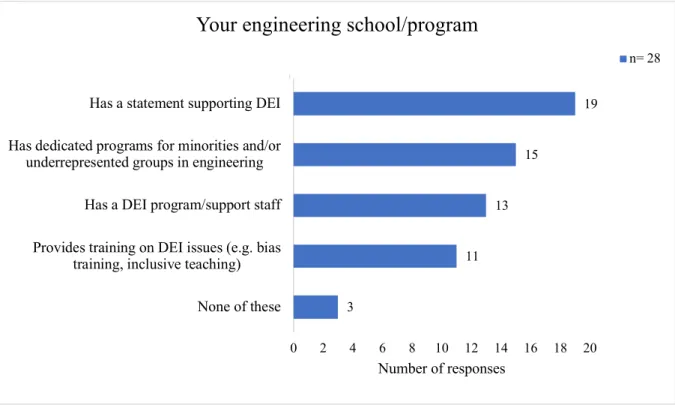
The first three questions of the survey asked participants to mark any statements in each question that applied to their institution, library, and engineering school or department. These questions sought to gauge what the diversity, equity, and inclusion (DEI) climate was at each respondent’s college. The responses showed that most of the colleges and universities provide support for DEI practices. At the library and engineering program level, this support was reported as lower. In particular, just over 10% of participants indicated that their library did not have a statement supporting DEI, had no DEI program or support staff, and did not provide training on DEI issues. This is also true of our library at Cal Poly, for example (where we currently have a DEI committee and training, but have not yet adopted a statement on DEI.) All survey participants reported that these areas were well supported at an institutional level. Nineteen of the institutions represented in the survey were identified as predominantly white institutions (PWI), none were HBCUs. (See fig. 1, 2, 3)
Your institution
n= 28
Has a statement supporting DEI 24
Provides training on DEI issues (e.g. bias
training, inclusive teaching) 24
Has a DEI program/support staff 22
Is a predominantly white institution (PWI) 19
Is a Historically Black College and University
(HBCU) 0
None of these 0
0 5 10 15 20 25 30
Fig. 1: Participants’ selections for which statements apply to the institution where they work.
Your library
n= 28
Has a DEI program/support staff 14
Provides training on DEI issues (e.g. bias 20
training, inclusive teaching)
Has a statement supporting DEI 22
0 5 10 15 20 25
Number of responses
Fig. 2: Participants’ selections for which statements apply to the library where they work.
Your engineering school/program
n= 28
Has a statement supporting DEI 19
Has dedicated programs for minorities and/or 15
underrepresented groups in engineering
Has a DEI program/support staff 13
Provides training on DEI issues (e.g. bias 11
training, inclusive teaching)
None of these 3
0 2 4 6 8 10 12 14 16 18 20 Number of responses
The next part of the survey, asked librarians about the type of DEI activities they had
participated in. Nearly all participants indicated that they had participated in one or more of the following: received training on inclusive or equitable teaching, participated in training on hidden bias, allyship, or related topics, or participated in diversity, equity, and inclusion programming. There were notably fewer participants who indicated they were a member of their library DEI committee or an institutional DEI committee. (See fig. 4).
In your role at your institution have you..
n= 26
Participated in training on hidden bias, allyship, or
related topics 23
Participated in diversity, equity, and inclusion
programming 20
Received training on inclusive or equitable teaching 15
Collaborated with faculty on inclusive or equitable
teaching 4
Been a member of a library DEI committee/working
group 3
Other (please specify) 2
Been a member of an institution DEI committee/working group 1
0 5 10 15 20 25
Number of responses
Fig. 4: Areas where participants have been engaged in DEI activities at their institution.
Participants were asked to list any specific ways in which they had participated in DEI at their institution and to comment if they had done any significant work in this area. Some of the comments gave examples like: creating LibGuides for courses that included books from underepresented groups, or that specifically addressed diversity in STEM. Attending training, mentorship and work on developing accessible materials. Participants complete comments are listed in Appendix A.
In looking at specific DEI instruction techniques, participants were asked if they had
In your workshops and instruction have you incorporated any of
the following
n= 26
Use culturally diverse and relevant examples 14
Sharing and using pronouns 6
Providing content related to DEI in subject guides or
course handouts 5
Other (please specify) 1
None of these 9
0 2 4 6 8 10 12 14 16 Number of responses
Fig. 5: Types of inclusive teaching practices incorporated into participants’ workshops or instruction.
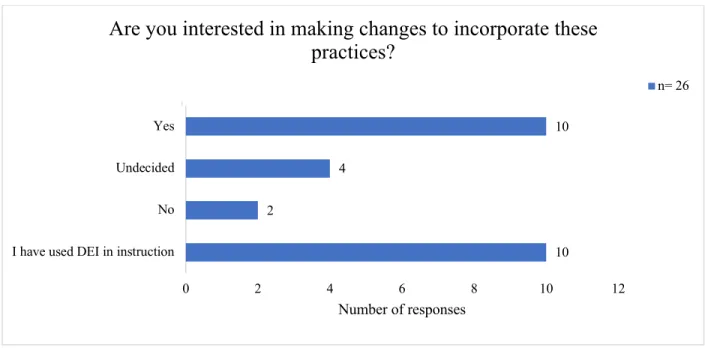
Are you interested in making changes to incorporate these
practices?
n= 26
Yes 10
Undecided 4
No 2
I have used DEI in instruction 10
0 2 4 6 8 10 12
Number of responses
Fig. 6: Participants’ interest in incorporating DEI instruction into their workshops and instruction.
When asked about specific kinds of things they were interested in learning, participants highlighted inclusive teaching as something they wanted to learn more about. Participants’ comments are listed in Appendix C.
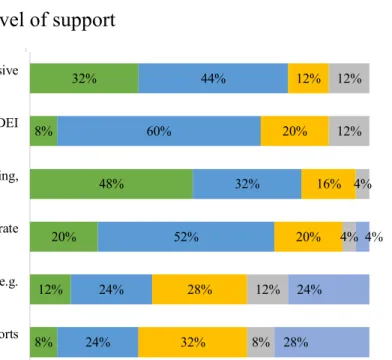
32% 44% 12% 12%
8% 60% 20% 12%
48% 32% 16% 4%
20% 52% 20% 4%
12% 24% 28% 12% 24%
8% 24% 32% 8% 28%
Level of support
Library training on DEI issues (e.g. bias training, inclusive teaching)
Library support for individual efforts to incorporate DEI into instruction
Institutional training on DEI issues (e.g. bias training, inclusive teaching)
4%
0% 10% 20% 30% 40% 50% 60% 70% 80% 90% 100% Percentage of responses (n=25)
Considerable Some Very little None N/A
Fig. 7: Level of support for training and individual efforts to incorporate DEI into instruction
Discussion of results
In general, there are some consistent patterns in participant responses. Most reported that their institution is moving forward considerably with regard to supporting DEI work; libraries are also doing this work, but not to the same degree. From some private messages sent to me directly after the survey was sent out, I know some librarians felt they didn’t have enough information to rate their institution’s engineering program. However, the goal of this survey was to understand how much was happening, in general, with some sense of where and how well librarians could seek support for this work. That some of the data is incomplete is the nature of this kind of survey. Many of the comments were helpful in illustrating areas where librarians would like more training in bringing inclusive teaching practices into information literacy instruction and provided some examples of their approach. Others spoke to a desire for more general instruction to help increase librarians level of understanding of this work.
There was one participant whose comments were notably negative, there weren’t any other commenters who expressed similar feelings. It is possible that there are others who feel similarly but who chose not to complete the survey. There are a number of possible ways to address these comments, I choose to try to maintain some perspective. Everyone is in different places with regard to their understanding of and exposure to DEI principles. There are people who will
Institutional support for individual efforts to incorporate DEI into instruction
Engineering program/school training on DEI issues (e.g. bias training, inclusive teaching)
simply never be “on board” with this work, but hopefully won’t stand in the way of it, and some people are in roles at institutions where the demands of their position may be overwhelming, those people might feel really frustrated by being asked to take on anything new. We also work to support a field with a significant history of discrimination, some may see this as indicative of that issue as well.
The lack of information on support for STEM librarians who have an interest in DEI
demonstrates the importance of this research and the need to connect with related work in our field. Most critically, fulfilling the need to articulate the types of roles librarians can have in advancing inclusive practices at their library, their college, and among their colleagues. While there are many studies demonstrating the use of DEI, there is a serious dearth of results from these studies to be found. There is no method currently available with which to measure these outcomes, and very few follow-up studies to be looked at.
Future work and conclusion
When I initiated this research, I wasn’t sure how much work was being done by engineering librarians in this area. The survey responses were encouraging both in their number, and the comments given. I intend to expand on this research using further surveys or focus groups to better understand the kinds of work already being done and interest in future DEI work. A likely approach would include forming a community of practice to share resources across our various roles and responsibilities.
This research aimed to understand current support for engineering librarians incorporating inclusive teaching practices and to collect data on their current work in this area. The survey data provided a snapshot of the kinds of programming currently in use and areas for more training and support. The participants’ comments showed an understanding of the myriad ways librarians can engage with DEI in their institution, their library, and in their interactions with students.
References
[1] “ASEE Statement on Diversity and Inclusiveness – ASEE Diversity.” https://diversity.asee.org/about/ (accessed Jun. 12, 2019).
[2] “Women, Minorities, and Persons with Disabilities in Science and Engineering: 2019 | NSF -National Science Foundation.” https://ncses.nsf.gov/pubs/nsf19304/digest/introduction (accessed Jan. 30, 2020).
[3] D. F. Carter, J. E. Razo Dueñas, and R. Mendoza, “Critical Examination of the Role of STEM in Propagating and Maintaining Race and Gender Disparities,” in Higher Education: Handbook of Theory and Research: Volume 34, M. B. Paulsen and L. W. Perna, Eds. Cham: Springer International Publishing, 2019, pp. 39–97.
[5] A. Peixoto et al., “Diversity and inclusion in engineering education: Looking through the gender question,” in 2018 IEEE Global Engineering Education Conference (EDUCON), Tenerife, Apr. 2018, pp. 2071–2075, doi: 10.1109/EDUCON.2018.8363494.
[6] L. M. Maclean, Cracking the code: how to get women and minorities into STEM disciplines and why we must. Momentum Press, 2017.
[7] M. A. Armstrong and J. Jovanovic, “The intersectional matrix: Rethinking institutional change for URM women in STEM,” Journal of Diversity in Higher Education, vol. 10, no. 3, pp. 216–231, Sep. 2017, doi: 10.1037/dhe0000021.
[8] M. M. Camacho, The borderlands of education Latinas in engineering. Sl: The Rowman & Littlefield Publishing Group, 2013.
[9] M. M. Camacho and S. M. Lord, “‘Microaggressions’ in engineering education: Climate for Asian, Latina and White women,” in 2011 Frontiers in Education Conference (FIE), Oct. 2011, pp. S3H-1-S3H-6, doi: 10.1109/FIE.2011.6142970.
[10] S. Farrell, T. Forin, K. Jahan, R. Dusseau, P. Bhavsar, and B. Sukumaran, “Developing Multiple Strategies for an Inclusive Curriculum in Civil Engineering,” in 2017 ASEE Annual Conference & Exposition Proceedings, Columbus, Ohio, Jun. 2017, doi: 10.18260/1-2--28147.
[11] J. Perry, J. Nichols, C. Neal, S. Thompson, and P. Situ, “Aligning the Library’s Strategy With the Parent Organization,” in Diversity and Inclusion in Libraries: A Call to Action and Strategies for Success, Rowman & Littlefield, 2019, pp. 65–74.
[12] “Overview of Inclusive Teaching at Michigan | CRLT.” http://crlt.umich.edu/overview-inclusive-teaching-michigan (accessed Jan. 30, 2020).
[13] “Pronouns: A Resource for Educators,” GLSEN.
https://www.glsen.org/activity/pronouns-resource-educators (accessed Mar. 12, 2020).
[14] M. Kim, “Wearables still haven’t solved the problems of skin science, but new ideas are coming,” Wareable, Nov. 18, 2017. https://www.wareable.com/health-and-wellbeing/skin-science-complex-wearables-4441 (accessed Apr. 22, 2019).
[15] A. Pashia, “Examining structural oppression as a component of information literacy: A call for librarians to support #BlackLivesMatter through our teaching,” Journal of
Information Literacy, vol. 11, no. 2, pp. 86–104, Dec. 2017.
[16] E. C. Tewell, “The Practice and Promise of Critical Information Literacy: Academic Librarians’ Involvement in Critical Library Instruction,” College & Research Libraries, vol. 79, no. 1, p. 10, Jan. 2018, doi: https://doi.org/10.5860/crl.79.1.10.
Research Libraries, vol. 80, no. 5, pp. 659–673, Jul. 2019, doi: https://doi.org/10.5860/crl.80.5.658.
[18] L. S. Mestre, “Librarians Working with Diverse Populations: What Impact Does Cultural Competency Training Have on Their Efforts?,” The Journal of Academic Librarianship, vol. 36, no. 6, pp. 479–488, Nov. 2010, doi: 10.1016/j.acalib.2010.08.003.
[19] M. Brimhall-Vargas, “Where the Rubber Meets the Road: The Role of Libraries and Librarians in Bringing Equitable Access to Marginalized Communities,” The Library Quarterly, vol. 85, no. 2, pp. 193–199, Apr. 2015, doi: 10.1086/680157.
[20] A. M. Cruz, “Intentional integration of diversity ideals in academic libraries: A literature review,” The Journal of Academic Librarianship, vol. 45, no. 3, pp. 220–227, May 2019, doi: 10.1016/j.acalib.2019.02.011.
[21] J. B. Napp and A. Sabharwal, “Academic Libraries and the Strategic Vision for Diversity in Higher Education,” presented at the 2019 ASEE Annual Conference & Exposition, Jun. 2019, Accessed: Jan. 29, 2020. [Online]. Available: https://peer.asee.org/academic-libraries-and-the-strategic-vision-for-diversity-in-higher-education.
[22] J. Alabi, “From Hostile to Inclusive: Strategies for Improving the Racial Climate of Academic Libraries,” Library Trends, vol. 67, no. 1, pp. 131–146, 2018, doi:
10.1353/lib.2018.0029.
[23] Austin, Duke W.; Atencio, Matthew; Yeung, Fanny; Stein, Julie; Mathur, Deepika; Ivester, Sukari; Woods, Dianne Rush, “Diversity and Inclusion Curriculum: Addressing Culturally Relevant Pedagogy and the Achievement Gap at a Racially Diverse University.,” Currents in Teaching & Learning, vol. 11, no. 1, pp. 112–134, Aug. 2019.
Appendix A: Participant comments on any significant DEI activities at their institution.
Survey Question #4:
In your role at your institution have you (check all that apply):
• Received training on inclusive or equitable teaching
• Participated in training on hidden bias, allyship, or related topics
• Participated in diversity, equity, and inclusion programming
• Been a member of a library DEI committee/working group
• Been a member of an institution DEI committee/working group
• Collaborated with faculty on inclusive or equitable teaching
• Other
“As a member of the library DEI committee, we are participating in a statewide cosortial[sic] diversity intern program which begins Spring '20 and is designed to hire an intern from a
traditionally under-represented group and allow them to rotate through a series of experiences in six different areas of the library. It is hoped that after this experience, this individual will pursue a career in librarianship.”
“Same as above "Other" box in #4: Built more diverse collection; Created a LibGuide for STEM biographical sources with books that included individuals from underepresented groups[sic]; Mentored students through a formal program for underepresented groups; Created multimedia (books and other materials) exhibits featuring underepresented groups in STEM fields.”
“currently working with an instructional design intern to develop accessible materials for major IL lessons, our T&L Center provides 2 part[sic] inclusive teaching practices workshops”
“I took a universal design for learning class over the summer through my university's disability office.”
“we have been forced to take the training multiple times in the last few years. it just makes everyone feel worse and like their time isn't valued.”
Appendix B: Participants’ comments on their experience using DEI instruction techniques
Survey Question 6: In your workshops and instruction have you incorporated any of the following (check all that apply)
• Sharing and using pronouns
• Providing content related to DEI in subject guides or course handouts
• Use culturally diverse and relevant examples
• None of these
Comments below are in response to the prompt, for all the areas above, please share any significant work in this area.
“Some of my colleagues have provided content related to DEI in subject guides or course handouts, but I have not yet had the opportunity, since I have not been here very long.” Nothing beyond what I checked in #6.
“Would like to use more of all of these in my future instruction.”
Appendix C: Participants’ comments on their interest in incorporating DEI into their instruction
Question 10: Are there areas or topics on DEI you'd like to learn more about?
“I indicated N/A for the last two because in the five years I've worked with the engineering college, I've not heard of any DEI programming related to training or instruction. If it exists it isn't publicized well.” [note this comment refers to Question 9]
“I would like to learn more about Inclusive teaching.”
“inclusive examples”
“It would be great to attend a workshop focused on integrating DEI into library teaching for engineering students.”
“All areas would be beneficial to learn more about.”
“Ways to use inclusive examples in engineering IL”