www.nature.com/scientificreports
Dean Flow Dynamics in Low-Aspect
Ratio Spiral Microchannels
Nivedita Nivedita
1, Phillip Ligrani
2& Ian Papautsky
3A wide range of microfluidic cell-sorting devices has emerged in recent years, based on both passive
and active methods of separation. Curvilinear channel geometries are often used in these systems
due to presence of secondary flows, which can provide high throughput and sorting efficiency. Most
of these devices are designed on the assumption of two counter rotating Dean vortices present in the curved rectangular channels and existing in the state of steady rotation and amplitude. In this work,
we investigate these secondary flows in low aspect ratio spiral rectangular microchannels and define their development with respect to the channel aspect ratio and Dean number. This work is the first to experimentally and numerically investigate Dean flows in microchannels for Re> 100, and show presence of secondary Dean vortices beyond a critical Dean number. We further demonstrate the impact of these multiple vortices on particle and cell focusing. Ultimately, this work offers new insights into secondary flow instabilities for low-aspect ratio, spiral microchannels, with improved flow models for design of more precise and efficient microfluidic devices for applications such as cell sorting and
micromixing.
Inertial microfluidics has gained considerable interest in recent years for cell analysis and sample preparation on chip1–4. Devices based on the physics of inertial microfluidics offer high throughput and efficiency, leading to reductions in cost and labor as compared with the conventional cell-sorting techniques such as fluorescence activated cell sorting (FACS)5, magnetic activated cell sorting (MACS)6, and filtration2,3. The key to this sort-ing approach is manipulation of geometry-induced hydrodynamic forces, which in turn provides continuous size-based sorting of cells in a flow-through manner1,7,8. This approach has been implemented using both straight and curved microchannels2,4,8.
Inertial focusing of particles and cells in straight microchannels has been investigated extensively in recent years. It has been demonstrated that focusing is dependent on the balance of the shear-induced lift force (aris-ing from the parabolic velocity profile) and the wall-induced lift force (aris(aris-ing from interactions with channel walls)1,7–11. Under certain conditions in rectangular microchannels, a rotation-induced lift force, imposed on the suspended particles/cells, further dominates migration and drives microparticles toward the centers of the larger walls7,11. Extensive work has been done to further investigate the fluid flow behavior and consequent particle-focusing in straight microchannels1,4,8,10–13. The interplay of inertial lift forces on particle focusing has been manipulated for a number of straight channel microfluidic devices with various cross-sectional geometries, particularly for size-based sorting of cells/particles2,4,8,10,14. For example, Mach et al.15 devised an array of 40 straight channels for continuous filtration of diluted blood from bacteria, whereas Zhou et al.16 manipulated the inertial lift forces by means of modulation of channel aspect ratio to achieve high efficiency (> 99%) and high purity (> 90%) separation of particles and rare cells spiked in blood. Furthermore, straight channels with expan-sions leading to formation of micro-vortices and manipulation of wall-induced lift forces, have been used for size-selective isolation of particles and cells17–19. The concept of inertial lift forces for particle focusing gets com-plicated even further when a curvature is added to the geometry. A curvature results in development of secondary flow which induces Dean force (FD) that can be used to further manipulate the focusing positions of suspended
cells and microparticles20–26.
A large number of cell-analysis devices is based on the concept of secondary flows in curved microchan-nels2–4,8. Majority of these devices are of spiral geometry and are designed on the assumption that the secondary flow in spiral microchannels leads to two counter-rotating vortices which are similar in amplitude and contribute to the net Dean force experienced by the suspended particles or cells20–23,26. These spiral cell-sorting devices rely
1Department of Pharmacology, University of North Carolina at Chapel Hill, Chapel Hill, North Carolina 27599,
USA. 2Department of Mechanical and Aerospace Engineering, University of Alabama at Huntsville, Huntsville,
Alabama 35899, USA. 3Department of Bioengineering, University of Illinois at Chicago, Chicago, Illinois 60607, USA.
Correspondence and requests for materials should be addressed to I.P. (email: [email protected]) received: 19 October 2016
Accepted: 01 February 2017 Published: 10 March 2017
www.nature.com/scientificreports/
on the balance of the net hydrodynamic forces (FL) and Dean force to separate cells according to their size4,8,20,22,24.
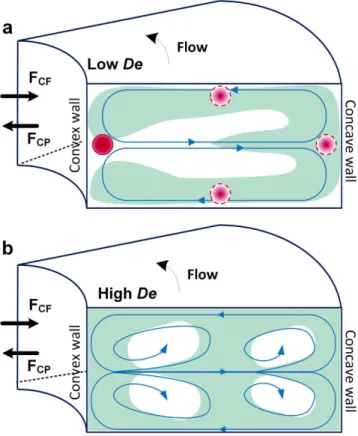
The result of this force balance is a single equilibrium position near the inner channel wall (Fig. 1a). Spiral devices based on this concept have been used by us22–25 and others21,26,27 for multitude cell sorting applications, including separation of neuroblastoma cells and C6 glioma cells22, sorting WBCs and RBCs24, separating polymorphonu-clear leukocytes and mononupolymorphonu-clear leukocytes21 and even for isolation of CTCs from blood26. In fact, Xiang et al.27 explored particle focusing dynamics in visco-elastic fluids in spiral microchannels, providing further insight into elasto-inertial focusing coupled with Dean flow.
The current physics behind Dean flow dynamics in spiral micro-channels is based on the assumption of two counter-rotating vortices, which is partially supported by various fluid mixing studies. These studies, although quite detailed, are primarily numerical in nature and are often confined to low Reynolds numbers, Re < 2028–33. For example, the study of fluid mixing in curved microchannels by Howell et al.28 and convective vortex based mixing in spiral microchannels by Sudarshan et al.34, focus on lower Re (Re< 18). However, at higher Re this assumption of two-counter rotating vortices falters since the focusing positions of cells vary from the predicted ones. In fact, we observed this variation while infusing a diluted blood sample in spiral microchannels for blood cell sorting (discussed in later sections). At higher Re (Re> 100), RBCs focused closer to the outer channel wall/ concave wall instead of focusing closer to the inner channel wall/convex wall (as predicted by the assumption) in a spiral sorting device. We attributed this behavior to the anomaly in the assumption of two counter rotating vortices and lack of physical understanding of the fluid flow dynamics in spiral microchannels at higher Re.
In this work, we provide a systematic experimental investigation of the fluid flow dynamics in low aspect ratio rectangular spiral microchannels which are widely used as highly efficient cell-sorters or micromixers. For the first time we demonstrate the presence of multiple pairs of secondary flow vortices (secondary Dean vortices) in these microchannels at high Re. We also introduce a non-dimensional parameter, critical Dean number (DeC), to
represent a threshold for the onset of these secondary Dean vortices. This work offers insight into the phenome-non of development of secondary flows in spiral microchannels and improves the understanding of the concept of particle focusing in spiral devices. Additionally, this work also paves way into understanding the reason behind the need for a certain range of Dean number for cell focusing in current sorting techniques. Furthermore, the concept presented can potentially assist in manipulation of the interaction of multiple vortices and other inherent fluid forces to achieve higher efficiency and selectivity in cell sorting.
Results
Evolution of Dean vortices.
The first conclusive research to analyze flow in curved macrochannels was done by Dean35,36 in 1927. He showed that in curved pipes (circular cross-section), the laminar Poiseuille flow is subjected to centrifugal force (F ) (Fig. 1a). This external force disturbs the parabolic profile of the laminar flow/ Figure 1. (a) Schematic illustrating two counter rotating vortices in a curved rectangular channel at low De. caused by the effect of centrifugal (FCF) and centripetal (FCP) forces on the parabolic velocity profile.www.nature.com/scientificreports/
primary flow and the maximum point of velocity distribution shifts from the center of the channel towards the concave wall of the channel. This shift causes a sharp velocity gradient to develop between the point of maximum velocity and the concave wall35–42. The sharp velocity gradient causes increase in pressure, and the local velocity near the walls is not sufficient to completely balance this pressure gradient35,37,43. This imbalance is known as Dean instability and leads to recirculation of fluid in the form of vortices directed from center of the channel towards the outer channel wall and back towards the center, in order to balance the pressure gradient (Fig. 1a).
The pressure and velocity gradient imbalance caused by Dean instability results in vortices/secondary flow defined by a non-dimensional number, called the Dean number (De)35,36. De can be defined as a control param-eter for the secondary flow which directly represents the Dean force or force due to secondary flow in curved channels35,36,39,43,44.
=
De Re D
R
2h (1)
where Re is the Reynolds number, given by UDh/ν, U is the average channel velocity, ν is kinematic viscosity, Dh
is the hydraulic diameter and R is the radius of the curvature of the convex surface of the curved channel. Hence, the strength of secondary flows is strongly dependent on the dimensions of the channel cross-section and radius of curvature. Note that some other investigations determine the Dean number based on a channel width-length scale, instead of hydraulic diameter45–47.
Spiral channel geometry offers a convenient platform to investigate the effects of De and aspect ratio (AR) on secondary flow in curved microchannels. In this work, we used three geometries of Archimedean spiral sort-ing device with three different aspect ratios (AR), g1 with AR= 0.6(250 μ m × 150 μ m), g2 with AR= 0.4 (250 μ m × 100 μ m) and g3 with AR= 0.2 (500 μ m × 100 μ m ) (Fig. 2). Here, concave and convex channel surfaces are associated with the smaller dimension of each channel cross section. Convex refers to the inner channel wall and concave refers to the outer channel wall. The onset of instability can be defined by the flow conditions at which De is sufficient to cause the formation of two counter rotating vortices (primary Dean vortices). To determine flow conditions which lead to the onset of Dean instability, we used computational analysis. We simulated the presence of primary Dean vortices and determined the evolution of multiple vortices on increase in De.
www.nature.com/scientificreports/
additional regions of pressure gradient near the concave wall. To balance this increase in the pressure gradient, there is formation of additional counter-rotating vortices which locally recirculate the fluid near the concave wall. These vortices are called secondary Dean vortices or additional secondary flow vortices as seen in the Fig. 3 panel for De= 257 and for De= 343.
The secondary flow behavior can be further described using the shift (x) of the center of the maximum velocity from the center of the channel. Figure 3b shows the plot of this shift relative to half width of the channel (w0.5).
There is a linear increase in the shift till it reaches the secondary vortex regime where the primary vortices start to expand and sharpen and ultimately bifurcate into four vortices. The center of maximum velocity shifts gradually, moving closer to the concave wall, thereby further increasing the pressure gradient and causing the formation of multiple vortices. These results are comparable with the secondary flow behavior at macro-scale where multiple Dean vortices are observed for high De. In fact, it has been reported that in macrochannels these additional vor-tices develop beyond a critical Dean number (DeC) depending on the aspect ratio of the channel35,45–49. Although
the simulations computationally confirm the presence of multiple vortices in microchannels, we observed that the shift in focusing position of RBCs occurred at much lower De ~37 than indicated by the simulations. Hence, we investigated the development of secondary flow experimentally by means of confocal imaging.
Secondary Dean vortices.
In curved macrochannels, a wide variety of methods have been used to study the fluid behavior including dye and smoke contrast and perturbation methods33,35,45,46,50. For example, Dean used perturbation methods to study the behavior of Newtonian fluids in curved pipes35 and Ligrani et al.45 and Sugiyama et al.47 used smoke contrast in macroscale curved rectangular channels to study Dean flows. These methods are incredibly challenging to perform at microscale. Hence, numerical studies along with simulation have been the most common methods of study of secondary flows in curved microchannels51,52. In this work, we used confocal imaging using streamline flow contrast provided by fluorescent dye to image the progression of flow in spiral microchannels at high Re.For spiral geometry g1 (AR= 0.6), the rate of onset of instability and formation of secondary Dean vortices was investigated. We used confocal microscopy such that the images were taken along both the outer loop, and the inner loop of the spiral microchannel (Fig. 4a). A 1/3rd confinement of fluorescein dye (1 μ M) was used to provide contrast for visualizing the streamlines. A constant Re= 200 was maintained as the data was acquired. Near the beginning of curvature, for De= 28.2 (Fig. 4b), because of the onset of the instability, the dye was locally advected by secondary flows which were directed from the convex wall towards the concave wall and pinched at the central section of the channel. Such fluid motion occurred simultaneously as fluid was locally advected from the concave wall towards the convex wall near the edges of the channel. The resulting local variations of static pressure caused recirculation of the dye from the center towards the concave wall, and then, back towards the center of the channel leading to the formation of two primary vortices (Fig. 4c,d).
www.nature.com/scientificreports/
vortices, due to molecular diffusion of the dye. Note that local Dean numbers increase as the flow advects through the spiral micro-channel, because of progressively smaller values of R, which result in stronger effects of concave curvature, and locally stronger centrifugal instabilities.
www.nature.com/scientificreports/
vortices occupied nearly the same area of approximately 15% each. Similar trends of development were observed for channels with lower aspect ratios.
For geometry g2 (AR= 0.4, 250 μ m × 100 μ m cross-section), the change of area associated with Dean vortices was comparatively lower as is indicated by the gradient of increase in the area of the vortices (Fig. 4k). Re was increased from 200 to 260 to visualize the multiple vortices in the inner loop. The flow patterns changed in the same manner as for g1, and a pair of secondary Dean vortices was observed for De> DeC. Here, the vortices were
observed to be slightly narrow when compared to the secondary Dean vortices associated with g1-geometry. As such, the area covered by the vortices and recirculation of vortices is governed by AR and De as the flow moves downstream. The data for g2 channel shows that the variation in area occupied by primary Dean vortices has a lower slope (compared to g1 data). Additionally, the size of primary vortices then plateaus for 35 < De< 36.5. For De> 36, we observed a reduction in the area covered by primary Dean vortices with simultaneous development of secondary Dean vortices. For most experimental conditions, the area covered by secondary Dean vortices was observed to be much smaller than the area associated with primary Dean vortices.
For channel geometry g3, the aspect ratio (AR= 0.2) was quite low and the movement of the dye along the channel was very slow leading to a faster molecular diffusion and lower contrast for visualization. However, pinching of the dye at the center of the channel cross-section confirmed the presence of two primary Dean vorti-ces. At De ~ 38, primary vortices were unable to persist in the same form as they advected downstream, because of local increase in static pressure near the concave wall. This resulted in secondary instability, which in turn, caused the formation of secondary Dean vortices. The secondary Dean vortices were smaller in area when compared to the previous channel geometries, providing additional verification that the strength and shape of the vortices is highly dependent upon AR (Fig. 4l). As such, development of the instabilities associated with Dean flows are also highly dependent upon AR. Additionally, in each case, we observed that beyond a critical De the two primary vortices started recirculating with additional secondary flow to form multiple vortex pairs.
Critical Dean number.
We observed that the flow in spiral microchannels transitions from primary Deanvortices to secondary Dean vortices over a certain threshold of the Dean number, which we termed the critical De (Dec). For De > Dec, the perturbation of primary Dean vortices begins, followed by the development of
sec-ondary Dean vortices. At this point, the pressure gradient between the high velocity area and the concave wall has increased to the point at which primary Dean vortices are unable to maintain the balance of pressure across the width of the channel. To balance this additional pressure near the concave wall, primary vortices split and recir-culate the fluid near the concave wall leading to formation of secondary Dean vortices. Dec denotes the condition
associated with decrease in the area covered by primary vortices, and increase in the area covered by secondary vortices. Dec was determined from the results of the experiments in flow visualization for each of the ARs of 0.2,
0.4 and 0.6.
Note that results in Fig. 5 show that different ranges of De are present for the primary and secondary insta-bilities for each of the channel geometries. For De > Dec, we observed a steady increase in the area covered by
secondary vortices until the flow stabilized. We also observed that Decis highly dependent on the AR (Fig. 5). It
was observed that higher the AR, lower is the Dec(Decα AR−0.5). This order of dependence is consistent with the
classical studies done by Sugiyama et al.47. For AR < 1, Sugiyama’s absolute values of critical De were different, and are in the range of 100–300 (in part, because of a different Dean number definition), but the DeC in his work was
also indirectly proportional to AR. He concluded that the Dec reaches a minimum value when AR nears 1, which
agrees with the results presented in this work. The presence of multiple vortices beyond Dec affects the focusing of
particles and cells in spiral microchannel as discussed in the following section.
Effects on particle focusing.
The presence of multiple vortices for De > Dec has important effects upon thewww.nature.com/scientificreports/
shifted towards the concave wall as flow rate increased to 3 mL/min. (channel cross-section = 250 μ m × 100 μ m). This observation, coupled with confirmation of the presence of secondary Dean vortices near the concave wall, suggested that the cells became entrained within secondary Dean vortices at the higher flow rate values.
To investigate dynamics of the entrapment, a solution of 10 μ m diameter fluorescent polystyrene particles was introduced into a spiral device with AR= 0.4 (g2 geometry) at low De= 17 and high De= 37. It was observed that the particles get trapped in the secondary vortices and hence focus near the concave wall (Fig. 6). This trapping of particles is evident from the fluctuation of the focused stream width. At lower De, the particles focus near the inner channel wall and the full width at half maximum (FWHM) of the intensity scan across the channel was ~21 μm. As the flow rate was increased, De increased to 37 and the particles started focusing closer to the concave wall. This focusing position was unsteady and spread over a spatial area. The focusing regime shifted between a narrow focused stream to a broad band. The FWHM of the broad band was 42 μ m indicating trapping of the particles in the secondary vortices.
www.nature.com/scientificreports/
intensity peaks at each position describe the subsequent motion of the particles which get trapped within the vor-tex being measured (Fig. 6e). The intensity peaks show that the particles get trapped in the vorvor-tex and recirculate. In fact, the distance of the position of intensity peaks from the concave wall is comparable to the one obtained from the streak velocimetry images (~150–230 μ m). From this observation, we conclude that particles get trapped in the secondary Dean vortices.
The focusing regime where particles focus near the concave wall was observed only at high flow rates (Re > 200). At this Re, Dean drag acting on particles overwhelms the inertial lift forces acting on the particles; using equations we reported in our earlier work22,25, the ratio between the Dean drag and inertial lift is estimated to be FD/FL> 15 for 10 μ m diameter particles. This overwhelming Dean force disrupts initial equilibrium near the convex wall and causes them to migrate towards the concave wall. Without secondary Dean vortices, the parti-cles would have continued to recirculate, following the streamlines of the primary vortices. Indeed, this can be observed when particles (or cells) are too small to be focused in channels. For example, as we have reported pre-viously24, when Red Blood Cells were too small to focus in our spiral microchannel before flow conditions were optimized, they continued to circulate throughout the cross-section under the influence of the Dean drag force.
In this work, however, at higher Re the overwhelming Dean drag pushes particles to follow streamlines of primary vortices towards the concave wall. Eventually particles become trapped in the secondary vortices pres-ent near the concave wall. We believe that the particles remain trapped there due to the local pressure gradipres-ent between the secondary and primary vortices. This pressure gradient develops due to the shift in the center of max-imum velocity towards the concave wall at higher flow rates, as indicated by the numerical modeling (Fig. 5a). Hence, the local variations in momentum and the pressure gradient between primary and secondary vortices allows entrapment of particles causing them to appear focused near the concave wall.
An alternate explanation of this behavior is provided by Martel et al.53 who attributed the shift of equilibrium positions towards the concave wall to interactions between increased wall-lift forces and Dean forces. This expla-nation is generally applicable when particles are located closer to the center of the channel. However, it does not fully explain shifts in particle focusing that occur in close proximity to the concave wall. The existing theory of particle focusing in spiral microchannels is based on the balance between inertial lift forces and Dean drag due to counter-rotating primary Dean vortices. This theory is based on the assumption that the fluid dynamics of the vortices do not change with increase in Re and De, except for magnitude of the forces. The presence of secondary vortices adds complexity to the cross-sectional flow that is not considered in the present theory of particle focus-ing. At higher flow rates, if the secondary vortices were absent, the Dean drag would eventually overwhelm the inertial lift forces leading to circulation of particles over the entire channel cross-section (following the stream-lines of primary vortices). Our observation of particles focusing in a band near the concave wall is not explained by the existing theory. This work attempts to explain this behavior and offers a possible explanation of this uncharacteristic particle behavior at higher flow rates. Overall, this work demonstrates the presence of multiple Dean vortices in low-aspect-ratio, rectangular spiral microchannels, which is consistent with observations at spe-cific Dean numbers in many curved macroscale channels45,47. These secondary vortices also offer justification for the entrapment of particles, and uncharacteristic focusing of particles, which are observed at higher De and Re.
Discussion
Curvilinear geometry, especially spirals, offer a complex fluidic system which has been used for numerous micro-fluidic applications. From investigations at macroscale35,37–39,45 and from numerical investigations at micros-cale28–33, presence of two counter rotating vortices at lower De has been well established. The presented work, for the first time, demonstrates the presence of multiple pairs of Dean vortices in low-aspect-ratio, rectangular spiral microchannels. The observed sequential development of secondary Dean vortices depends upon the Dean num-ber in the spiral microchannel, as well as the radius of curvature, and the aspect ratio of the channel. Additionally, this vortex development is consistent with the macroscale investigations reported by Sugiyama et al.47. In both macroscale and microscale studies, a dimensionless parameter, critical De (Dec) offers a threshold for the
forma-tion of secondary Dean vortices. These secondary Dean vortices develop to balance the addiforma-tional fluidic pressure near the concave wall of the channel. This additional pressure is generated particularly by increase in Re (increase in volumetric flow rate) as well as on increase in De. These secondary vortices also provide justification for the entrapment of particles, and uncharacteristic focusing of particles, which are observed at higher De.
Even though flow-streamline determination is challenging using cross-sectional visualization images at high Re, confocal images from this work demonstrate presence of the additional secondary Dean vortices within spiral microchannels. This development directly affects particle focusing within spiral/curved microfluidic devices. As such, the assumption of only two Dean vortex pairs is no longer valid for all experimental conditions, thereby redefining the fluidic model for spiral device design. The present study of the effects of secondary flows and Dean instabilities thus provides new flow modality for manipulation of multiple vortices and other inherent fluid forces to achieve higher efficiency in fluid mixing, particle separation, and heat transfer. This work also paves way into understanding the reason behind the need for a certain range of De for cell focusing in sorting techniques, thereby providing a working window for successful cell sorting in spiral microchannels.
Methods
www.nature.com/scientificreports/
Simulation parameters.
Numerical simulations were performed using a commercial platform, STAR CCM+ , developed by CD-Adapco. The simulation workflow involved importing the geometry (spiral loop-Fig. 3a), defining boundary surfaces, followed by generation of a polyhedral mesh including a surface mesh and prism layers (for boundaries). The base size for the mesh was set to 2.5 μ m with the surface mesh growth rate of 1.3. Physics models were selected to define the primary variables of the simulation including the governing equations. The selected models were: Time-Steady state; Material-Liquid (H2O); Segregated Flow; Laminar flow and Gradients. STAR-CCM+ uses these models to solve the continuity equation, the momentum equation and the Navier-Stokes equation simultaneously. Before running the simulation, boundary and initial conditions were defined. The initial velocity at the inlet was set in m/s and varied to change the net De in the loop. The walls were set to no-slip boundary conditions (v = 0 m/s ). The outlet was set as a pressure boundary. The number of itera-tions were set to 500–600 with residual of 10−6 as convergence criterion. For each of the models, the steps/solver iterations could be varied to satisfy the convergence criterion.Microfabrication.
Devices were fabricated in polydimethysiloxane (PDMS, Sylgard 184, Dow Corning)using the standard soft lithography process. The 100 μ m and 150 μ m high masters were fabricated in SU-8 pho-toresist (Microchem Corp.). A mixture of PDMS base and curing agent (10:1 ratio) was poured on the master; after degassing PDMS was cured for 4 h on a 60 °C hotplate. The cured PDMS devices were peeled off, and inlet/ outlet ports were punched with a 14 gauge syringe needle. PDMS was bonded to standard glass slide using a hand-held plasma surface treater (BD-20AC, Electro-Technic Products, Inc.).
Device operation and imaging.
We used 1 μ M fluorescein solution to provide contrast for visualizing the stream lines. A syringe connected to a device with 1/16″ peek tubing (Upchurch Scientific) and proper fittings (Upchurch Scientific) provided input flow using a syringe pump (Legato 180, KD scientific). The flow behav-ior was first visualized using an inverted epi-fluorescence microscope (IX71, Olympus Inc.) equipped with a 12-bit high-speed CCD camera (Retiga EXi, QImaging). To image cross-sectional flow, confocal microscopy was performed using Zeiss LSM710 LIVE Duo Confocal Microscope with the aforementioned experimental set-up. Cross-sectional images were taken at each loop of the spiral channel starting from the outer-most loop (closest to the inlets) at the interval of 60° and analyzed using ZEN lite software along with Image J.References
1. Amini, H., Lee, W. & Di Carlo, D. Inertial microfluidic physics. Lab Chip14, 2739–2761 (2014).
2. Beebe, D. J., Mensing, G. A. & Walker, G. M. Physics and applications of microfluidics in biology. Annu. Rev. Biomed. Eng.4,
261–286 (2002).
3. Bhagat, A. et al. Microfluidics for cell separation. Med. Biol. Eng. Comput.48, 999–1014 (2010).
4. Zhang, J. et al. Fundamentals and applications of inertial microfluidics: a review. Lab Chip16, 10–34 (2016).
5. Bonner, W. A., Hulett, H. R., Sweet, R. G. & Herzenberg, L. A. Fluorescence activated cell sorting. Rev. Sci. Instrum. 43, 404–409 (1972).
6. Schmitz, B. et al. Magnetic activated cell sorting (MACS) — a new immunomagnetic method for megakaryocytic cell isolation: Comparison of different separation techniques. Eur. J. Haematol. 52, 267–275 (1994).
7. Asmolov, E. S. The inertial lift on a spherical particle in a plane Poiseuille flow at large channel Reynolds number. J. Fluid Mech.381,
63–87 (1999).
8. Di Carlo, D. Inertial microfluidics. Lab Chip9, 3038–3046 (2009).
9. Bhagat, A. A. S., Kuntaegowdanahalli, S. S. & Papautsky, I. Enhanced particle filtration in straight microchannels using shear-modulated inertial migration. Phys. Fluids20, 101702 (2008).
10. Martel, J. M. & Toner, M. Inertial Focusing in Microfluidics. Annu. Rev. Biomed. Eng.16, 371–396 (2014). 11. Zhou, J. & Papautsky, I. Fundamentals of inertial focusing in microchannels. Lab on a Chip13, 1121–1132 (2013).
12. Liu, C., Xue, C., Sun, J. & Hu, G. A generalized formula for inertial lift on a sphere in microchannels. Lab Chip16, 884–892 (2016). 13. Hood, K., Kahkeshani, S., Di Carlo, D. & Roper, M. Direct measurement of particle inertial migration in rectangular microchannels.
Lab Chip16, 2840–2850 (2016).
14. Bhagat, A. A. S. & Lim, C. T. Microfluidic technologies. Recent Results in Cancer Research195, 59–67 (2012).
15. Mach, A. J. & Di Carlo, D. Continuous scalable blood filtration device using inertial microfluidics. Biotechnol. Bioeng.107, 302–311 (2010).
16. Zhou, J., Giridhar, P. V., Kasper, S. & Papautsky, I. Modulation of aspect ratio for complete separation in an inertial microfluidic channel. Lab Chip13, 1919–1929 (2013).
17. Dhar, M. et al. Label-free enumeration, collection and downstream cytological and cytogenetic analysis of circulating tumor cells.
Scientific Reports6, 35474 (2016).
18. Sollier, E. et al. Size-selective collection of circulating tumor cells using Vortex technology. Lab Chip Miniaturisation Chem. Biol. 14,
63–77 (2014).
19. Zhou, J., Kasper, S. & Papautsky, I. Enhanced size-dependent trapping of particles using microvortices. Microfluidics and Nanofluidics15, 611–623 (2013).
20. Gossett, D. R. & Carlo, D. D. Particle Focusing Mechanisms in Curving Confined Flows. Anal. Chem.81, 8459–8465 (2009). 21. Guan, G. et al. Spiral microchannel with rectangular and trapezoidal cross-sections for size based particle separation. Scientific
Reports3, 1475 (2013).
22. Kuntaegowdanahalli, S. S., Bhagat, A. A. S., Kumar, G. & Papautsky, I. Inertial microfluidics for continuous particle separation in spiral microchannels. Lab on a Chip - Miniaturisation for Chemistry and Biology9, 2973–2980 (2009).
23. Nivedita, N., Giridhar, P. V., Kasper, S. & Papautsky, I. Sorting human prostate epithelial (HPET) cells in an inertial microfluidic device
(15th International Conference on Miniaturized Systems for Chemistry and Life Sciences 2011, MicroTAS 2011 Ser. 2, 2011). 24. Nivedita, N. & Papautsky, I. Continuous separation of blood cells in spiral microfluidic devices. Biomicrofluidics7 (2013). 25. Bhagat, A. A. S., Kuntaegowdanahalli, S. S. & Papautsky, I. Continuous particle separation in spiral microchannels using dean flows
and differential migration. Lab Chip8, 1906–1914 (2008).
26. Warkiani, M. E. et al. Ultra-fast, label-free isolation of circulating tumor cells from blood using spiral microfluidics. Nat. Protocols 11, 134–148 (2016).
27. Xiang, N. et al. Fundamentals of elasto-inertial particle focusing in curved microfluidic channels. Lab Chip16, 2626–2635 (2016). 28. Howell, J., Peter B., Mott, D. R., Golden, J. P. & Ligler, F. S. Design and evaluation of a Dean vortex-based micromixer. Lab Chip4,
www.nature.com/scientificreports/
29. Ookawara, S., Street, D. & Ogawa, K. Numerical study on development of particle concentration profiles in a curved microchannel.
Chem. Eng. Sci.61, 3714–3724 (2006).
30. Fellouah, H., Castelain, C., Moctar, O. E. & Peerhossaini, H. A Numerical Study of Dean Instability in Non-Newtonian Fluids.
Journal of Fluids Engineering128, 34–41 (2005).
31. Li, P., Cogswell, J. & Faghri, M. Design and test of a passive planar labyrinth micromixer for rapid fluid mixing. Sens Actuators, B Chem174, 126–132 (2012).
32. Pathak, J. A., Ross, D. & Migler, K. B. Elastic flow instability, curved streamlines, and mixing in microfluidic flows. Phys. Fluids16,
4028–4034 (2004).
33. Scherr, T. et al. A Planar Microfluidic Mixer Based on Logarithmic Spirals. Journal of micromechanics and microengineering: structures, devices, and systems22, 055019 (2012).
34. Sudarsan, A. P. & Ugaz, V. M. Fluid mixing in planar spiral microchannels. Lab Chip6, 74–82 (2006).
35. Dean, W. R. LXXII. The stream-line motion of fluid in a curved pipe (Second paper). The London, Edinburgh, and Dublin Philosophical Magazine and Journal of Science5, 673–695 (1928).
36. Dean, W. R. XVI. Note on the motion of fluid in a curved pipe. The London, Edinburgh, and Dublin Philosophical Magazine and Journal of Science4, 208–223 (1927).
37. Barua, S. N. On secondary flow in stationary curved pipes. The Quarterly Journal of Mechanics and Applied Mathematics16, 61–77 (1963).
38. Berger, S. A., Talbot, L. & Yao, L. S. Flow in Curved Pipes. Annu. Rev. Fluid Mech.15, 461–512 (1983).
39. Bhunia, A. & Chen, C. L. Flow Characteristics in a Curved Rectangular Channel With Variable Cross-Sectional Area. Journal of Fluids Engineering131, 091102-091102–16 (2009).
40. Chandratilleke, T. T. Numerical prediction of secondary flow and convective heat transfer in externally heated curved rectangular ducts. International Journal of Thermal Sciences42, 187–198 (2003).
41. Chen, J. J., Chen, C. H. & Shie, S. R. Optimal Designs of Staggered Dean Vortex Micromixers. International Journal of Molecular Sciences12, 3500–3524 (2011).
42. Dombrowski, N., Foumeny, E. A., Ookawara, S. & Riza, A. The influence of reynolds number on the entry length and pressure drop for laminar pipe flow. The Canadian Journal of Chemical Engineering71, 472–476 (1993).
43. Cheng, K. C. & Akiyama, M. Laminar forced convection heat transfer in curved rectangular channels. Int. J. Heat Mass Transfer13,
471–490 (1970).
44. Cheng, K. C., Lin, R. & Ou, J. Fully Developed Laminar Flow in Curved Rectangular Channels. Journal of Fluids Engineering98,
41–48 (1976).
45. Ligrani, P. M., Longest, J. E., Kendall, M. R. & Fields, W. A. Splitting, merging and spanwise wavenumber selection of Dean vortex pairs. Exp. Fluids18, 41–58 (1994).
46. Ligrani, P. M. & Niver, R. D. Flow visualization of Dean vortices in a curved channel with 40 to 1 aspect ratio. Phys. Fluids31,
3605–3617 (1988).
47. Sugiyama, S., Hayashi, T. & Yamazaki, K. Flow characteristics in the curved rectangular channels (visualization of secondary flow).
Bull JSME26, 964–969 (1983).
48. Cheng, K. C., Lin, R. & Ou, J. Fully Developed Laminar Flow in Curved Rectangular Channels. Journal of Fluids Engineering98,
41–48 (1976).
49. Jarrahi, M., Castelain, C. & Peerhossaini, H. Secondary flow patterns and mixing in laminar pulsating flow through a curved pipe.
Exp. Fluids50, 1539–1558 (2011).
50. Schönfeld, F. & Hardt, S. Simulation of Helical Flows in Microchannels. AIChE J. 50, 771–778 (2004).
51. Jiang, F., Drese, K. S., Hardt, S., Küpper, M. & Schönfeld, F. Helical flows and chaotic mixing in curved micro channels. AIChE J. 50,
2297–2305 (2004).
52. Jitchote, W. & Robertson, A. M. Flow of second order fluids in curved pipes. J. Non Newtonian Fluid Mech. 90, 91–116 (2000). 53. Martel, J. M. & Toner, M. Particle Focusing in Curved Microfluidic Channels. Scientific Reports3, 3340 (2013).
Acknowledgements
This work was supported in part by funds provided by the NSF Center for Advanced Design and Manufacturing of Integrated Microfluidics (CADMIM) awards IIP-1362165 and IIP-1362048, and the Ohio Center for Microfluidic Innovation (OCMI) at the University of Cincinnati.
Author Contributions
N. Nivedita designed and performed experiments, prepared figures and wrote the main text. P. Ligrani advised on experimental design and fluid mechanics aspect of the work. I. Papautsky advised on the experimental plan and assisted in figure design. All the authors reviewed the manuscript.
Additional Information
Competing Interests: The authors declare no competing financial interests.
How to cite this article: Nivedita, N. et al. Dean Flow Dynamics in Low-Aspect Ratio Spiral Microchannels. Sci. Rep.7, 44072; doi: 10.1038/srep44072 (2017).
Publisher's note: Springer Nature remains neutral with regard to jurisdictional claims in published maps and institutional affiliations.
This work is licensed under a Creative Commons Attribution 4.0 International License. The images or other third party material in this article are included in the article’s Creative Commons license, unless indicated otherwise in the credit line; if the material is not included under the Creative Commons license, users will need to obtain permission from the license holder to reproduce the material. To view a copy of this license, visit http://creativecommons.org/licenses/by/4.0/