Effect of Exercise in a Warm Environment on Circulating Neutrophils
Erica S. Cooper
A thesis submitted to the faculty of the University of North Carolina at Chapel Hill in partial fulfillment of the requirements for the degree of Master of Arts in the Department of
Exercise and Sport Science (Exercise Physiology).
Chapel Hill 2008
Approved by: Dr. Robert McMurray, Advisor
ABSTRACT
ERICA S. COOPER: Effect of Exercise in a Warm Environment on Circulating Neutrophils (Under the direction of Robert McMurray)
The primary purpose of this investigation was to determine if exercise in the heat elicited a greater increase in the number of circulating neutrophils than exercise in a cool environment. The secondary purposes were to, 1) investigate the relationship between the change in core temperature (Tre) and the degree of neutrophilia and 2) validate a previously stated hypothesis that Tre must increase to greater than 38°C to elicit a significant rise in
neutrophilia. Cycling for 40 minutes at 65% VO2peak caused neutrophilia, which was most evident two hours post-exercise. Moreover, exposure to the heat during exercise resulted in higher core temperatures and elicited a greater neutrophilia two hours post-exercise. No relationship was observed between a Tre of 38°C and increases in the circulating neutrophil count. However, a Tre of 38°C appears to contribute to exercise-induced neutrophilia since a greater exercise-induced Tre occurred concomitantly with greater neutrophilia.
TABLE OF CONTENTS
LIST OF TABLES………..…...v
LIST OF FIGURES………..vi
Chapter I. BASIS FOR STUDY.………1
Neutrophil Function………...1
Neutrophil Response to Exercise………...2
Neutrophil Response to Heat Exposure……….2
Neutrophil Response to Exercise in the Heat………3
Purpose………...3
Research Hypotheses……….4
Definition of Terms………4
Assumptions………...5
Delimitations………..5
Limitations……….6
Significance of Study……….6
II. REVIEW OF LITERATURE………8
Neutrophil Response to Heat Exposure………...15
Neutrophil Response to Exercise Combined with Heat Exposure…………...18
III. METHODOLOGY……… ..23
Subjects………....23
Instrumentation………24
Protocol………24
Procedures………30
IV. RESULTS……….…...32
V. DISCUSSION………...…...38
Circulating Neutrophil Count in a Hot and Cold Environment………..…….38
Temperature Threshold………42
Limitations………...43
Conclusions………..44
Recommendations for Future Research………...44
APPENDICES Appendix A: Training History Form………...………47
Appendix B: Informed Consent Form………...48
Appendix C: Maximal Exercise Session Data Collection Sheet……….57
Appendix D: Experimental Trials Data Collection Sheet………60
LIST OF TABLES
Table
1. Oxygen uptake, heart rate and rating of perceived
LIST OF FIGURES
Figure
1. Exercise trial protocol diagram………...29 2. Core temperature during exercise trials………...34 3. The circulating neutrophil count response to exercise in
a warm environment………...…….34 4. Change in circulating neutrophil number during and
CHAPTER I
BASIS FOR STUDY
Neutrophil Function
Activity of the human immune system is mediated by several types of leukocytes (white blood cells), including Granulocytes, Monocytes and Lymphocytes. Of these leukocytes, Granulocytes play a large role in the body’s immediate response to invading pathogens. Neutrophils are a subpopulation of granulocytes, comprising approximately 90% of the body’s circulating granulocyte concentration and up to 70% of the circulating leukocyte concentration (Mackinnon 1999). Neutrophils destroy pathogenssuch as viruses, bacteria and fungi by processes including adherence, chemotaxis, phagocytosis, oxidative burst, degranulation and microbial killing (Smith 1997). Additionally, research has associated circulating neutrophil number with tissue damage and inflammation (Pizza et al. 1995; Fielding et al. 1993). With regards to tissue damage, research indicates that neutrophils may be responsible for the degradation of damaged and necrotic muscle tissue and cellular debris, so that new contractile elements can be laid down and the muscle repaired (Tidball 1995; Teixeira et al. 2003).
invading pathogens can also damage healthy muscle cells and connective tissues (Pizza et al. 2002; Frenette et al. 2002).
Neutrophil Response to Exercise
The neutrophil response to exercise has been summarized by Mackinnon(1999), and in general, the circulating neutrophil number increases during exercise and continues to do so throughout the first few hours of recovery. Many possible factors may be responsible for mediating the exercise-induced neutrophilia, including release from marginal pools, an increased cardiac output and an increase in the secretion of hormones, bioactive lipids and cytokines (Smith 1997). Of the aforementioned factors, many are secreted in response to stress, which is in turn, subject to mode, intensity and duration of the exercise (Kjaer 1989). Therefore, the pattern of exercise-induced neutrophilia depends on the mode, intensity and duration of activity (Mackinnon 1999).
Neutrophil Response to Heat Exposure
Neutrophil Response to Exercise in the Heat
In addition to the role of exercise and heat exposure as individual physiological stressors, research suggests that these two factors have a synergistic stress response during exercise in the heat (Severs et al. 1996). Relative to thermoneutral exercise, exercise in the heat has been shown to result in higher circulating levels of stress-mediated hormones and increased cardiac output, both of which are potential mediating factors for neutrophilia (Shephard 1998). Although research widely recognizes the augmentation of the stress response during exercise in a warm environment, limited research has been conducted concerning the effect of exercise in the heat on immune function.
The limited evidence concerning the neutrophil response to exercise in the heat is equivocal. Some research suggests that there is little or no difference in the magnitude of neutrophilia following heated exercise as compared to thermoneutral exercise (McFarlin & Mitchell 2003, Laing et al. 2005), while other literature suggests that heated exercise results in a significantly larger circulating neutrophil number relative to more thermoneutral exercise (Niess et al. 2003, Mitchell et al. 2002). Differences in the conclusions of various research studies may be the result of differences in methodology including environmental factors and mode, intensity and duration of exercise. As a result, the exact extent to which exercise in the heat can modify neutrophilia is not well understood.
Purpose
exercise-circulating neutrophils following exercise in a cool environment to the number of exercise-circulating neutrophils following exercise in a warm environment. The latter purpose was investigated by comparing Tre to the circulating neutrophil count elicited by exercise in both conditions combined.
Research Hypotheses It was hypothesized that:
1. Exercise in a warm environment would cause a rise in the circulating neutrophil count immediately and two hours post-exercise compared to resting levels.
2. Exercise in a warm environment would lead to a higher circulating neutrophil count immediately and two hours post-exercise when compared to exercise in a cool environment.
3. The change in Tre would be positively correlated with the change in the circulating neutrophil count.
4. Exercise sessions in which Tre did not exceed 38° C would not elicit a significant neutrophil response, but exercise sessions in which Tre did exceed 38° C would elicit
a significant neutrophil response.
Definition of Terms
1. Leukocyte – “Immune cells found in several lymphoid organs and tissues throughout the body and in the blood and lymph circulation”(Mackinnon 1999).
3. Neutrophil – A “phagocytic cell that kill[s] ingested microorganisms by releasing proteases and phospholipases from cytoplasmic granules and by generating toxic molecules such as oxygen radicals” (Mackinnon 1999).
4. Neutrophilia – Recruitment of neutrophils into circulation (Mackinnon 1999). Assumptions
1. Subjects were free of infection for the three weeks preceding participation in this study.
2. Subjects refrained from vigorous exercise and alcohol consumption for the 24 hours preceding each exercise session, and caffeine consumption for the 12 hours preceding each exercise session.
3. Subjects had no prior incident of heat injury.
4. Subjects were not consuming anti-inflammatory medications (i.e.-NSAIDs).
5. Subjects had no fear of water, confined spaces, or blood draws. Delimitations
1. Male subjects between the ages of 18 and 40 were be recruited.
2. Subjects were physically active, participating in at least 30 minutes of moderate physical activity at a minimum four times per week.
5. Exercise occurred at 65% of peak oxygen uptake for 40 minutes. Limitations
1. Results can be generalized only to healthy, recreationally active adult males between 18 and 40 years of age.
2. The subjects’ exercise history for the 24 hours preceding the exercise sessions was self-reported.
3. Although subjects were assumed to be free of infection during the study, and to have been so for three weeks prior to the study, some infection may have been unknown to the subjects, and could have resulted in perturbation of baseline neutrophil levels. Significance of Study
Recent research continues to provide valuable information concerning the inflammatory response to both injurious damage and non-injurious perturbations in muscle tissue. These studies offer evidence to suggest that not only do neutrophils help to mediate the healing process, but that they also propagate tissue injury.
CHAPTER II
REVIEW OF LITERATURE
Introduction and Basics of Immune Cells
This chapter will review literature concerning the influence of exercise and heat on white blood cells, or leukocytes. The introduction will provide a brief overview of the immune system’s cells, while the following section will discuss the function of neutrophils, and their role in the immune system. Subsequent sections will discuss the neutrophil response to exercise, the neutrophil response to heat exposure, and finally, the neutrophil response to exercise combined with heat exposure.
The Immune System’s role is to defend the body from invading pathogens, foreign matter, or the body’s own malfunctions, such as the growth of tumor cells (Mackinnon 1999). This system is comprised of several different types of leukocytes and messenger molecules (cytokines), the actions and interactions of which mediate the overall immune response. Three types of leukocytes will be discussed in the following paragraphs: lymphocytes, monocytes and polymorphonuclear granulocytes.
1999). Thus, the body adapts to previous antigen exposure in order to execute a swifter and more efficient immune response. Two major subpopulations of lymphocytes are “T” lymphocytes (T cells), and “B” lymphocytes (B cells). T cells are responsible for activating B cells, destroying tumor and virally infected cells, and secreting cytokines, which are further responsible for mediating the activity of other immune cells (Mackinnon 1999). B cells contain memory blueprints for antibodies that enable swifter antibody production for specific antigens. Upon T cell activation, B cells produce large quantities of antibodies for a specific antigen (Mackinnon 1999).
Monocytes, produced in the bone marrow, circulate in the blood and become macrophages when fixed within tissues. Monocytes/macrophages constitute 10-15% of leukocytes, and help to mediate the body’s innate, and therefore immediate, response to pathogens by processes including phagocytosis, destruction of infected cells, and secretion of lymphocyte-activating cytokines (Mackinnon 1999; Guyton 1979).
respond to infection, where they ingest and destroy invading pathogens by releasing free radicals, proteases and phospholipases that breakdown the pathogen. Additionally, neutrophils are the first immune cell to infiltrate damaged tissue and areas of inflammation, where it has been suggested that they help to break down necrotic tissue and cellular debris so that new contractile elements can be laid down, and the tissue repaired (Mackinnon 1999; Tidball 1995; Teixeira et al. 2003).
The purpose of the current study is to examine how the physiological stressors of heat and exercise affect the immune response. Although the overall immune response is mediated by all leukocyte subsets acting together, the current study will focus on circulating neutrophils as a means to begin understanding the overall immune response. The Role of Neutrophils
In addition to being a part of the body’s first line of immune defense against invading pathogens, neutrophils provide the first immune response to areas of inflammation and tissue damage. Despite the rapid response, the role of neutrophils at sites of inflammation and tissue damage is less clear; research suggests that neutrophils act as mediators of both tissue repair and tissue damage.
Much research offers support for the role of neutrophils as mediators of tissue damage. Significant correlations between post-exercise neutrophilia and markers of tissue damage, including serum creatine kinase, serum myoglobin, and disruptions in myofibril structure, suggest a relationship between neutrophils and tissue damage (Fielding et al. 1993; Suzuki et al. 1999).
depletion, mice exhibited a lower percentage of injured fibers, and attenuated force deficits and oxidative damage following muscle injury. Likewise, Mishra et al. (1995) found that administration of a non-steroidal anti-inflammatory drug (NSAID) following exercise-induced injury in rabbits resulted in reductions in serum creatine kinase and the number of injured fibers. Although neutrophil count was not measured directly, the presumed NSAID-induced reduction in the inflammatory response, a large part of which is comprised of neutrophils, suggests that mediators of the inflammatory response, including neutrophils, could be responsible for exacerbating post-exercise muscle injury. Ishchemia/repurfusion models also provide compelling evidence to suggest that neutrophils play a role in mediating tissue damage. Depleting the blood’s circulating neutrophil concentration prior to repurfusion in ischemic muscle tissue results in direct attenuation of muscle damage, as well as indirect attenuation of muscle damage via reductions in vascular damage (Romson et al. 1983; Korthius et al. 1988). Additionally, administration of free radical scavengers to reduce the oxidative stress caused by neutrophil-mediated free radical release resulted in less muscle damage relative to controls (Jolly et al. 1984).
myonecrosis and residual creatine kinase (CK) levels (index of muscle damage and damaged particles) did not differ from non-neutropenic mice 24 hours after infection, suggesting that neutrophils do not cause additional tissue damage. Additionally, the neutropenic mice exhibited impaired muscle fiber regeneration and CK synthesis, and prolonged presence of necrotic debris in the affected tissue, further suggesting that neutrophils mediate tissue repair. Jesse et al. (1998) suggest that the granulocytes and macrophages invading tissue following injury may have a role in activating satellite cells to begin the process of muscle repair and regeneration. This implication is based on the satellite cell expression of vascular cell adhesion molecule-1 (VCAM-1), and invading granulocytes and macrophage expression of the coreceptor specific for VCAM-1.
Neutrophil Response to Exercise
Research suggests that certain physiological stressors including exercise augment neutrophilia. It is widely recognized that neutrophils exhibit a biphasic response to exercise (Mackinnon 1999; Fairbarn et al. 1993; Nieman et al. 1995; Robson et al. 1999; Nieman et al. 1994; Gabriel et al. 1994). The number of circulating neutrophils increases throughout exercise, then displays a second marked increase which generally peaks two to three hours post-exercise. The magnitude and duration of the neutrophilia, however, is dependant on the interaction of the duration, intensity, and mode of exercise (Mackinnon 1999; Fairbarn et al. 1993).
the average intensity at the highest workload was ~76% VO2max. In eight internationally competitive rowers, a six-minute VO2max test on a rowing ergometer resulted in a ~42% increase in circulating neutrophils. Two hours post-exercise, this concentration increased to ~179% above pre-exercise levels, and remained 86% elevated over pre-exercise levels four hours post-exercise (Nielsen et al. 1996). Although exercise duration was shorter in the Nielsen et al. study relative to the Fairburn et al. study, the resulting neutrophilia was larger, likely due to the higher exercise intensity.
In longer duration exercise, 22 male marathoners, treadmill running for 2.5 hr at 75% VO2max, showed a significant elevation in circulating neutrophils over pre-exercise levels immediately post-exercise, 1.5, three and six hours post-exercise, with the number peaking three hours post-exercise. At each time point, increases approximated 186%, 243%, 260% and 175%, respectively (Nieman et al. 1995).
Nieman et al. (1994) conducted a study comparing 45 minutes of exercise at high and low-intensities. Ten well-conditioned men ran on a treadmill for 45 minutes twice: once at 50% VO2max, and once at 80% VO2max. Exercise at 80% resulted in significantly larger neutrophil counts immediately post-exercise, one and 3.5 hours post-exercise. The authors conclude that the larger physiological stress induced by higher intensity exercise results in a larger number of circulating neutrophils.
Research suggests that extremely prolonged exercise elicits the largest increases in the circulating neutrophil concentration. In nine endurance-trained runners, an ultra-marathon (100 Km) run over the course of 7.5-10 hours, resulted in a 310% increase in neutrophils within 10-33 minutes of finishing the race. Three hours after the race, neutrophils were elevated 317% (Gabriel et al. 1994).
Taken as a whole, the results of these studies suggest that the degree of exercise-induced neutrophilia is the product of the interaction of exercise intensity, duration and mode.
Neutrophil Response to Heat Exposure
Passive heat exposure also elicits an increase in the circulating neutrophil concentration. Some investigators have suggested that the degree of neutrophilia is proportional to increases in core temperature above 38°C (Severs et al. 1996; Cross et al.
1996; Downing et al. 1988). As discussed below, however, the evidence supporting this suggestion is equivocal. Differences in methodologies of heat exposure, such as heat medium (water, environmental chamber), temperature and time of exposure, make it difficult to compare results and qualify the exact neutrophil response to passive heat exposure.
Severs et al. (1996) conducted a study in which eleven male subjects sat in an environmental chamber for two three-hour sessions. Temperature during the thermoneutral trial was set at 23°C, while the heat exposure trial was 40°C, 30% RH
(relative humidity). Exposure to the above temperatures elicited only modest alterations in Tre; an average 0.3°C decrease in the thermoneutral trial, and 0.7°C increase in the heat
alterations in Tre, and concur with Kappel et al. (1991), that a threshold Tre of 38°C must be met before significant increases in granulocytes can be elicited.
Studies involving heat exposure that causes Tre to meet or exceed 38°C have
elicited significant increases in the circulating neutrophil count. Cross et al. (1996) submerged nine moderately fit men in water to the mid-chest level for two 80-minute sessions. Water temperature for the sessions was either 23°C for the thermoneutral trial
or 39°C for the heat exposure trial. Tre during passive heat exposure peaked at ~38°C.
Heat exposure granulocyte counts became significantly elevated over the thermoneutral condition after the 70th and 80th minutes of exposure. Granulocyte count did not change during the thermoneutral trial. Although neutrophils were not measured directly, it can be inferred that they rose significantly during heat exposure because they comprise ~90% of all granulocytes. These results, however, do not indicate what proportion of the increase in circulating granulocytes is attributable to an increase in neutrophils. Based on this data, the authors agreed with other investigators, in that a Tre threshold of at least 38°C must be met to induce a significant neutrophilia.
Downing et al. (1988) offer additional evidence to suggest that heat exposure elicits a significant neutrophilia. Three healthy volunteer subjects sat with approximately 70% of their bodies submerged in 40-45ºC water until Tre reached 39.5ºC. The circulating granulocyte concentration, again reflective of the circulating neutrophil concentration, increased a significant 39.5% by the time Tre reached 39.5ºC.
(sternoclavicular notch) for two hours in water, with one arm above the water. Water temperature was 34.5°C for the control trial, and 39.5°C for the heated trial. Blood
samples were drawn before immersion, two hours after finishing immersion, and at time points coinciding with Tre of 38°C, 39°C, and 39.5°C. In the heat exposure trial, neutrophils were significantly elevated over pre-exposure values when Tre was 38°C and 39.5°C, as well as two hours after finishing immersion. These significant elevations
measured 16%, 38% and 254%, respectively. At no point during the control trial were neutrophils significantly elevated over baseline values. The heat exposure neutrophil count was significantly elevated over control values at two hours post-immersion only, despite the return of Tre to baseline values in both trials at two hours post-immersion.
Kappel et al. (1998) conducted a similar follow-up study in which eight men again sat immersed in 39.5°C water for two hours, with one arm above the water.
Immediately following two hours of hot water immersion, Tre had risen to 39.6°C, and
circulating neutrophils had increased ~33%. Two hours following the cessation of immersion, circulating neutrophils had increased ~141% over baseline values, despite a fall in Tre to 37.4°C.
Neutrophil Response to Exercise Combined With Heat Exposure
Like exercise and passive heat exposure studies, a variety of methodologies to induce exercise and heat stress have been employed. The results are equivocal concerning whether exercise and heat combined elicit a larger degree of neutrophilia than exercise or heat exposure separately. Additionally, the degree of neutrophilia following exercise and heat exposure varies across studies. The following section will first discuss the studies that found no significant effect of combined exercise and heat exposure on neutrophilia, and then discuss those studies that found a significant effect.
In 13 non-heat acclimatized endurance trained males, Liang et al. (2005) found no statistically significant difference between the neutrophilia induced by two hours of cycling at 62% VO2max in a hot environment and a thermoneutral environment (control). Subjects exercised in an environmental chamber at 30.3°C, 76% RH for the hot trial, and
20.4°C, 60% RH for the control trial. After 50 minutes of exercise, Tre became
significantly higher in the hot trial and remained so for the rest of the two-hour exercise session. After two hours of exercise, Tre measured 38.7 and 38.1°C for the hot and cold trials, respectively. Despite the significant difference in Tre, neutrophil counts did not differ significantly immediately post-exercise or two hours post-exercise.
Likewise, a study conducted by McFarlin and Mitchell (2003) found no significant effect of a heated environment on exercise-induced neutrophilia. In this investigation, 10 men cycled in an environmental chamber for 60 minutes at 60% VO2peak twice, once at 38°C, 45% RH, and once at 8°C, 50% RH. Tre exceeded 38°C in both
different Tre, neutrophil counts did not differ between conditions at any point during exercise, or at 24 hours post-exercise.
Despite the results of the two aforementioned studies, research has also provided compelling evidence suggesting that exercise in the heat induces a larger degree of neutrophilia compared to thermoneutral exercise. For example, in a study by Niess et al. (2003), seven endurance-trained men completed two 60-minute treadmill runs at 90% of individual anaerobic threshold in an environmental chamber. The first trial (EX1) was performed in 18°C, 50% RH, while the second trial (EX2) was performed in 28°C, 50%
RH. At the end of exercise, Tre exceeded 38°C in both trials, but was significantly higher for EX2 at 39.8°C, than for EX1 at 38.7°C. The only time-point at which neutrophil
counts were significantly different between EX1 and EX2 was three hours after exercise when EX2 exhibited an ~15% larger circulating neutrophil count. It is difficult to quantify these results, however, because the authors fail to explain if the subjects recovered outside of the environmental chamber in the laboratory’s ambient temperature, or remained seated in the chamber, exposed to the trial’s prescribed environmental conditions, following exercise. Additionally, the authors do not present Tre data for the three hours following exercise. Nonetheless, the authors conclude that exercise in elevated ambient temperatures seems to elicit greater changes circulating neutrophils than exercise in a thermoneutral environment.
trial, and remained so throughout the duration of exercise. In the hot trial, Tre exceeded 38°C after 45 minutes and peaked at ~39°C, while Tre in the cold trial peaked at ~37.7°C.
While exercise in both environments elicited increases in the circulating neutrophil concentration over pre-exercise values immediately after, and two hours post-exercise, the count was ~37% higher in the hot trial, relative to the thermoneutral trial, at two hours post-exercise only. Again, the authors conclude that the stress imposed by exercise combined with heat exposure is additive, resulting in an additive effect on neutrophil mobilization.
In an investigation studying the effect of exercise combined with heat exposure on the circulating granulocyte count, Brenner et al. (1999) had seven moderately fit young men exercise on a cycle ergometer for 60 minutes at 55% VO2peak while immersed in water up to the shoulder. The first trial consisted of submersion in 18°C water, and the
second trial in 35°C water. While Tre was not significantly altered during exercise in
18°C water, it significantly increased 0.6°C after 30 minutes of exercise in 35°C water,
and peaked at ~38.3°C after 60 minutes of exercise. In both hot and cold trials, the
circulating granulocyte concentration increased significantly after 60 minutes of exercise. At 60 minutes, however, the circulating granulocyte concentration elicited by the hot trial was ~15% larger than that elicited by the cold trial. Although neutrophils were not measured directly, the granulocyte counts suggest that exercise in a warm environment may elicit a larger increase in circulating neutrophils than exercise in a cooler environment.
occasions; once immersed to the mid-chest in 23°C water, and once in 39°C water.
Following exercise, subjects remained sitting in the water for 40 minutes. Tre progressively increased during exercise, peaking at ~39.1°C ten minutes after the
cessation of exercise in the hot trial, and 37.6°C immediately after the cessation of exercise in the cold trial. Tre was significantly higher in the warm trial after 15 minutes of exercise, and remained so throughout the duration of exercise and the 40 minutes of exposure following exercise. This study measured granulocytes, rather than neutrophils, and found that the warm exercise trial resulted in an ~19 to 25% larger circulating granulocyte concentration between minutes 15-25 of exercise, corresponding to the onset of the significant difference in Tre between trials. Granulocyte count was again significantly larger by ~57% during minutes 20-40 of the resting exposure following exercise, despite a decrease in Tre.
Similar to Cross et al. (1996), Rhind et al. (1999) conducted a study in which 10 recreationally active males cycled for 40 minutes at 65% VO2peak while immersed in water to the mid-chest, once in 39°C water, and once in 18°C water. Exercise in the
warm water caused Tre to significantly increase from 37.2°C to 39.3°C, while exercise in the cold water caused Tre to increase only to 37.6°C. Exercise in the warm water resulted in significant increases in the circulating granulocyte concentration after 40 minutes of exercise (~34%), and two hours after exercise ceased (~65%). Although the significant increases in circulating granulocytes suggest significant increases in circulating neutrophils, the proportional increase in neutrophils is unknown, based on these results.
CHAPTER III
METHODOLOGY
The purposes of this study were to determine the effect of exercise in a warm environment on the number of circulating neutrophils, and to investigate the relationship between Tre and the degree of exercise-induced neutrophilia. The former purpose was investigated by comparing the circulating neutrophil count following exercise in a cool environment to the circulating neutrophil count following exercise in a warm environment. The latter purpose was investigated by comparing Tre to the circulating neutrophil count elicited by exercise in both conditions combined. This chapter explains the methodology for this investigation by first describing the subject pool and the instrumentation used, followed by the protocol for the experiment and procedures for data analysis. Finally, the chapter will describe the statistical data analysis.
Subjects
Instrumentation
The subject’s height was determined using a portable standiometer (Perspectives Enterprises, Portage, MI). Body mass was measured by a mechanical scale (Detecto, Webb City, MO). Oxygen consumption during all trials was measured by a Parvo Medics TrueMax 2400 Metabolic System (Parvo Medics, Salt Lake City, UT) while the subject cycled on a mechanically braked cycle ergometer (Monark, Varberg, Sweden). The cycle ergometer was immersed in a 1,790-liter submersion tank. Core body temperature (Tre) was monitored by a YSI rectal probe (YSI, Daytona, OH) connected to a thermistor thermometer (Cole-Parmer, Vernon Hill, Ill). Heart rate (HR) was monitored by a Polar telemetry system (Polar Electro Inc., Lake Success, NY). Blood pressure (BP) measurements were taken using a Diagnostix sphygmomanometer (American Diagnostic Corporation, Hauppauge, NY). Subjects reported ratings of perceived exertion (RPE) according to Borg’s original 6-20 RPE scale (Borg 1970).
Blood samples were drawn by a trained technician using 10-mL syringes (Becton, Dickinson and Company, Franklin Lakes, NJ) attached to hypodermic needles (Kendall Healthcare Products, Covidien, Mansfield, MA), and transferred to three-mL K2-EDTA Vacutainers (Becton, Dickinson and Company, Franklin Lakes, NJ) for storage prior to analysis.
Protocol
ergometer to obtain peak oxygen uptake (VO2peak). The subsequent two sessions consisted of submaximal cycling while immersed in water up to the xyphoid process. The submaximal exercise lasted 40 minutes at a workload designed to elicit an intensity of 65% VO2peak. Blood samples were drawn pre-, post- and two hours-post exercise by a trained technician using standard venipuncture techniques. The circulating numbers of neutrophils were determined from whole blood samples.
Session One. Subjects arrived to the Applied Physiology Laboratory at least four hours post-prandial. Subjects then read the informed consent form. After having the opportunity to ask questions, subjects who agreed to participate in the study signed the informed consent form. Subjects then filled out a standard Applied Physiology Laboratory medical history form, and underwent a medical screening and physical examination. Next, subjects were asked to provide their age, and their physical characteristics were measured. Height was measured using a stadiometer as subjects stood flat on their feet without shoes, back and heels flush against the stadiometer, looking straight ahead. Body mass was measured using a mechanical scale as again subjects stood flat on both feet without shoes.
level of immersion. Seat height and handle bar angle were adjusted for each subject and recorded for consistency during the subsequent exercise sessions.
Immediately after the seat and handle bars were adjusted, the graded maximal exercise test began with the subject pedaling at a rate of 40 rpm for five minutes. At the end of the first stage, the pedal rate was increased to 45 rpm and subjects rode at the new pedal rate for three minutes. Thereafter, pedal rate increased by five rpm every three minutes. Exercise intensity was monitored by continuous collection of VO2 data, while HR and RPE measurements were collected during each minute of the test to monitor subject safety. The test was terminated when the subjects reached volitional fatigue. Following cessation of the test, subjects performed an active recovery at a self-selected pace on the cycle ergometer until HRs fell below 120 beats per minute (BPM). If HRs failed to fall below 120 bpm in three to five minutes, subjects stopped cycling and continued recovery lying down on a cot until HRs fell below 120 bpm. Subjects then left the Applied Physiology Laboratory when HRs were within 20 beats of the resting rate and blood pressures were within 10 mmHg of resting value. From this trial, pedal rates eliciting 65% of the subjects’ VO2peak were computed using the Karvonen method (0.65 * (VO2peak - VO2rest) + VO2rest, where VO2rest is resting oxygen uptake).
from caffeine consumption for 12 hours prior to arrival. Subjects were instructed to eat their typical pre-workout meal for the last meal consumed prior to arrival at the Applied Physiology Laboratory. The type and quantity of food consumed was recorded by the subjects, and the same meal was ingested as the last meal prior to the next exercise session. The arrival time to the Applied Physiology Laboratory was the same for sessions two and three. The water temperature during immersed exercise was randomly assigned and counterbalanced. For each session, subjects cycled for 40 minutes at a workload eliciting an intensity of 65% VO2peak, while immersed in water up to the xyphoid process.
Subjects had their body mass measured using a mechanical scale while standing flat on their feet without shoes. Subjects changed into the same clothing worn for the graded maximal exercise test, self-inserted a rectal thermometer approximately 10 centimeters into the rectum, and strapped a heart rate monitor around their chests. Subjects then rested quietly for twenty minutes on land in an upright-seated position. Subjects were allowed to wear a shirt if they felt cold. At minute 10 of seated rest, a two-minute resting VO2 sample was collected. At minute 19 of rest, baseline HR and blood pressure measurements were taken. At the end of the rest period, a nine-mL blood sample was drawn. The blood sample was transferred from the syringe to three three-mL K2-EDTA treated Vacutainers and stored on ice for later analysis.
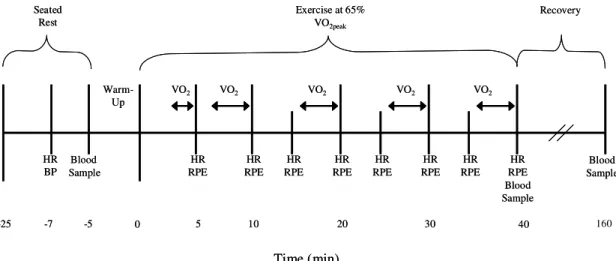
monitored for two minutes to ensure that they were working at 65% VO2peak. At this point in session two, if the subjects were not exercising at 65% VO2peak, pedal rate was adjusted to elicit an intensity of 65% VO2peak. Pedal rate was not adjusted again during session two. The magnitude and timing of any change in pedal rate was recorded to standardize the workload for session three. Thereafter, expired air was sampled for the last two minutes of each 10-minute interval (10-minutes 8-10, 18-20, 28-30, 38-40). Throughout the 40 10-minutes of exercise, the subjects’ HR and RPE were measured and recorded during the last 15 seconds of each five-minute interval in order to monitor subject safety (Figure 1).
Tre was monitored minute-by-minute and recorded at five-minute intervals in order to avoid any large unexpected increases in core body temperature. Subjects had access to drinking water at their own discretion throughout exercise. The trial was stopped if a subject’s core temperature rose above 39°C (102°F), or if otherwise deemed necessary.
Figure 1. Time course of measurements during exercise sessions two and three.
After the cool down had been completed, subjects changed into a sweat suit to keep warm and remained in the Applied Physiology Laboratory for two hours. During this time, subjects were free to engage in general movement and participate in activities requiring minimal exertion (i.e.- reading). BP measurements were taken every five minutes during the first 20 minutes after the cessation of exercise to ensure subject safety. At the end of the two-hour period, final HR, BP and core temperature measurements were taken. Immediately following vital measurements, a third nine-mL blood sample was drawn, transferred to three K2-EDTA treated Vacutainers, and placed on ice for storage and later analysis. Subjects then self-extracted the rectal thermometer and had a final body mass measurement taken, again using a mechanical scale while standing flat on their feet without shoes. Comparison of post-exercise and pre-exercise body mass measurements further allowed monitoring of subject safety, indicating if subjects were losing body mass due to water loss during the exercise sessions. Subjects then left the laboratory, providing core temperatures were below
-25
-7
Blood
Sample
REST
-25
-7 -5
Blood
Sample
REST
-25 -7 -5 0
Warm-Up
5 10 20 30 40
Time (min)
VO2 VO2 VO2 VO2 VO2
HR RPE HR RPE HR RPE HR RPE HR RPE HR RPE HR RPE Blood Sample HR RPE HR BP Blood Sample Blood Sample 160 Seated Rest
Exercise at 65% VO2peak
Recovery
-25 -7 -5 0
Warm-Up
5 10 20 30 40
Time (min)
VO2 VO2 VO2 VO2 VO2
HR RPE HR RPE HR RPE HR RPE HR RPE HR RPE HR RPE Blood Sample HR RPE HR BP Blood Sample Blood Sample 160 Seated Rest
Exercise at 65% VO2peak
required to remain in the Applied Physiology Laboratory until the measurements decreased to within the aforementioned limits of resting values.
Procedures
Hematocrit. The UNC-Chapel Hill hospital’s core laboratory determined resting, pre-exercise and two hours post-pre-exercise hematocrit (Hct) measurements using whole blood samples and the Advia 2120 Hematology system (Siemens Healthcare Diagnostics, Deerfield, IL).
Hemoglobin. The UNC-Chapel Hill hospital’s core laboratory determined resting, pre-exercise and two hours post-exercise hemoglobin (Hb) measurements using whole blood samples and the Advia 2120 Hematology system (Siemens Healthcare Diagnostics, Deerfield, IL).
Plasma Volume Shift. Plasma volume shifts were calculated using the method proposed by Dill and Costill (1974). Neutrophil counts were corrected for any shifts in plasma volume to ensure that any observed changes in neutrophilia were not due to hemoconcentration.
Neutrophil Analysis. The UNC-Chapel Hill hospital’s core laboratory performed a complete blood count with a differential using an Advia 2120 Hematology System (Siemens Healthcare Diagnostics, Deerfield, IL).
Data Analysis. Since all subjects did not complete the full duration of the warm trial, the VO2, HR, RPE and Tre data were reduced using minutes 10, 20, 30 and the subjects’ final minute, regardless of the exact minutes of exercise completed. Data analysis was performed using SPSS statistical software, version 15.0 (Chicago, Ill.). An α-level was set a priori at
For hypothesis one, analysis consisted of a one-way ANOVA to determine if the neutrophil count differed between measurements taken at rest, immediately post-exercise and two hours post-exercise during the exercise session conducted in a warm environment.
For hypothesis two, analysis consisted of a 2 X 3 (trials by time) ANOVA to determine if the change in neutrophil count from pre- to immediately post-exercise differed from pre- to two hours post-exercise both within and between the cool and warm environments. A Tukey HSD post-hoc test was used to determine between which comparisons significant differences occurred.
For hypothesis three, a Pearson-Product Moment Correlation determined if the change in Tre was positively correlated with the change in the circulating neutrophil count from pre- to post-exercise.
For hypothesis four, a 2 X 2 Chi Square Test of Independence determined if exercise sessions in which Tre exceeded 38° C elicited a significant neutrophil response, and if
CHAPTER IV
RESULTS
The primary purpose of this investigation was to determine if exercise combined with heat exposure elicited a greater increase in the number of circulating neutrophils than exercise in a more thermoneutral (cool) environment. The secondary purposes were to, 1) investigate the relationship between the change in core temperature (Tre) and the degree of neutrophilia and 2) validate a previously stated hypothesis that the Tre must increase to greater than 38°C for a significant rise in neutrophilia to occur. This chapter will first discuss
the subjects’ characteristics and general exercise responses during both trials. Thereafter, results will be presented by order of hypothesis.
Eight recreationally active males with an average age of 24.0 ± 1.7 (SD) years participated in this investigation. They were 180.4 ± 6.1 cm tall and had a body mass of 78.3 ± 6.1 kg. The average Body Mass Index (BMI) measured 24.05 ± 1.92 kg/m2. Their VO2peak was 52.8 ± 3.7 mL/kg/min, while their absolute VO2peak was 4.1 ± 0.4 L/min. Together, the VO2peak and BMI scores indicate that the subjects were of a normal body weight and in good cardiovascular condition.
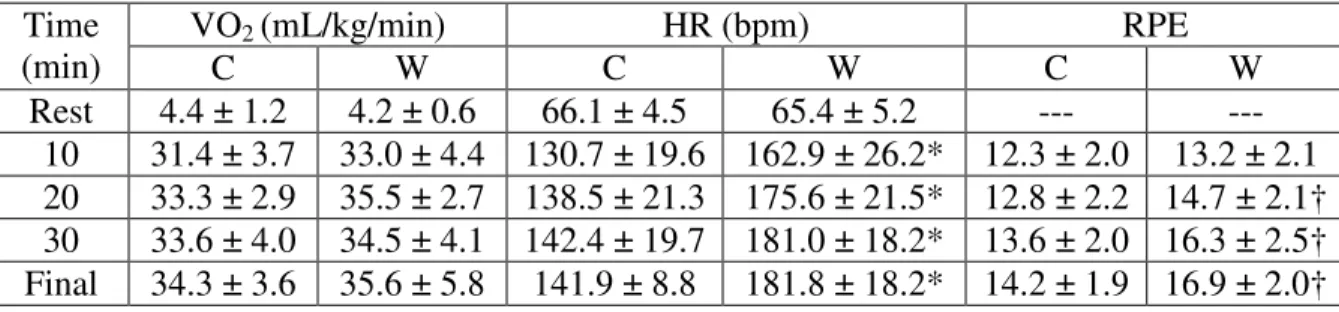
Values for VO2, HR and RPE during each trial are presented in Table 1. On average, subjects exercised at 33.2 ± 2.7 and 34.7 ± 3.2 mL/kg/min in the cool and warm trials,
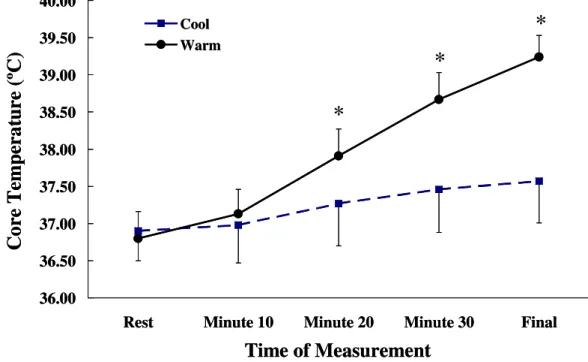
respectively. The average VO2’s did not significantly differ from each other or from the average VO2 estimated to elicit exercise at 65% of the subjects’ maximal capacity. Ventilation and the respiratory exchange ratio (RER) increased over resting values throughout exercise in both trials, but did not differ between trials during exercise. Relative to the cool trial, Tre became significantly higher than in the warm trial after 20 minutes and remained so for the duration of exercise (Figure 2).
Table 1. Means ± SD oxygen uptake (VO2), heart rate (HR) and rating of perceived exertion (RPE) responses during the cool (C) and warm (W) trials (n = 8). * p ≤ 0.02, † p ≤ 0.011; warm vs. cool trial.
Hypothesis one stated that exercise in a warm environment would cause a rise in the circulating neutrophil count immediately and two hours post-exercise, compared to resting levels. The results of a one-way, repeated measures ANOVA showed a significant effect of time on the circulating neutrophil count during exercise (Figure 3). Post-hoc analysis showed that the circulating neutrophil count was significantly elevated over resting values immediately post-exercise and at two hours post-exercise (p ≤ 0.002). At two hours post-exercise, the circulating neutrophil count was also significantly elevated over immediately
VO2 (mL/kg/min) HR (bpm) RPE
Time
(min) C W C W C W
Figure 2. Means ± SD Tre in both the cool and warm trials during rest, at minutes 10, 20, 30 and during the final minute of exercise. * p ≤ 0.003 warm vs. cool at same time.
Figure 3. Means ± SD circulating neutrophil count response to exercise in a warm
environment. Pre-exercise (pre), immediately post-exercise (post) and two hours post exercise (2 Hr Post). Values are corrected for shifts in plasma volume. * p ≤ 0.002 vs. pre-exercise; ‡ p = 0.004, vs. post-exercise.
36.00 36.50 37.00 37.50 38.00 38.50 39.00 39.50 40.00
Rest Minute 10 Minute 20 Minute 30 Final
Time of Measurement
C
o
re
T
em
p
er
a
tu
re
(
ºC
)
Cool Warm*
*
*
36.00 36.50 37.00 37.50 38.00 38.50 39.00 39.50 40.00Rest Minute 10 Minute 20 Minute 30 Final
Time of Measurement
C
o
re
T
em
p
er
a
tu
re
(
ºC
)
Cool Warm*
*
*
1.50 2.50 3.50 4.50 5.50 6.50 7.50 8.50Pre Post 2 Hr Post
Measurement Time
C
ir
cu
la
ti
n
g
N
eu
tr
o
p
h
il
C
o
u
n
t
(x
1
0
3
c
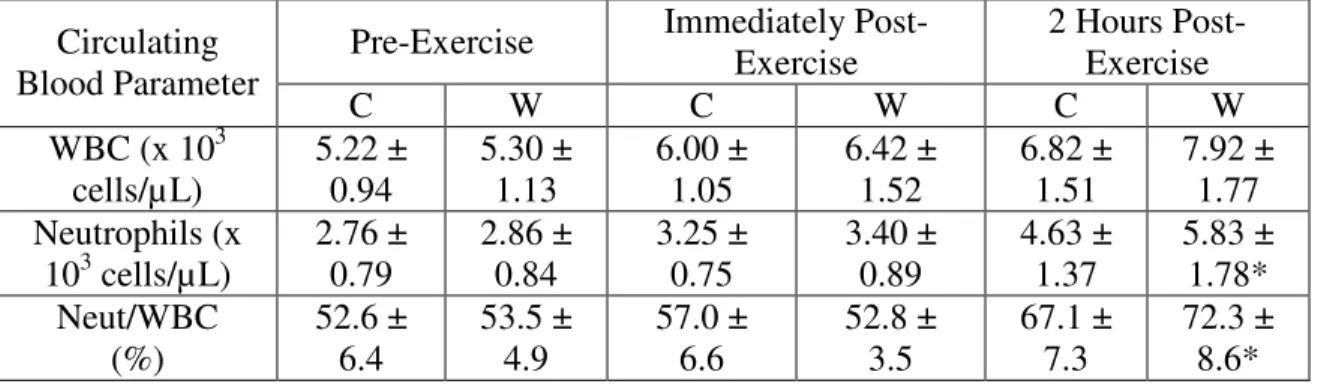
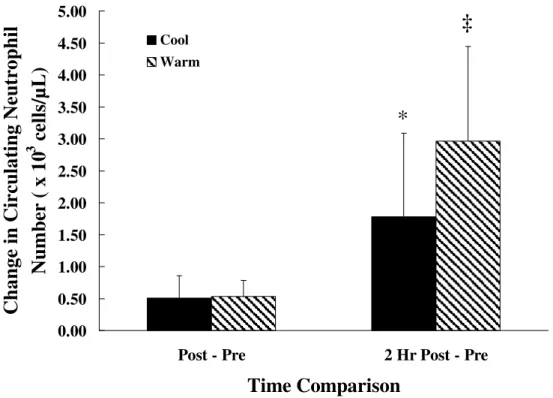
Hypothesis two stated that exercise in a warm environment would lead to a higher circulating neutrophil count immediately and two hours post-exercise when compared to exercise in a more thermoneutral environment (Figure 4 and Table 2). A two-by-two trial-by-change from rest ANOVA revealed significant main and interaction effects for environmental temperature and time during exercise. Tukey HSD post-hoc analysis showed that the change in the circulating neutrophil count from pre- to post-exercise did not differ between the two trials (p = 0.05). In a significant time-by-trial interaction effect, the neutrophil count increased two hours post-exercise in both trials, but the change in the neutrophil count from pre- to two hours post-exercise was significantly larger in the warm trial (p = 0.05). Additionally, WBC counts did not differ between trials; however, the percentage of WBC’s comprised by neutrophils was significantly greater in the warm trial at two hours post-exercise (p ≤ 0.019).
Table 2. Means ± SD circulating total white blood cell (WBC) and neutrophil counts during cool (C) and warm (W) exercise trials. Values corrected for shifts in plasma volume. * p ≤ 0.019 between trials.
Pre-Exercise Immediately Post-Exercise
2 Hours Post-Exercise Circulating
Blood Parameter
C W C W C W
WBC (x 103 cells/µ L) 5.22 ± 0.94 5.30 ± 1.13 6.00 ± 1.05 6.42 ± 1.52 6.82 ± 1.51 7.92 ± 1.77 Neutrophils (x
103 cells/µL)
2.76 ± 0.79 2.86 ± 0.84 3.25 ± 0.75 3.40 ± 0.89 4.63 ± 1.37 5.83 ± 1.78* Neut/WBC (%) 52.6 ± 6.4 53.5 ± 4.9 57.0 ± 6.6 52.8 ± 3.5 67.1 ± 7.3 72.3 ± 8.6*
Pearson-Product Moment correlation indicated that the change in Tre was not correlated with the change in the circulating neutrophil count (r = 0.052; p = 0.850).
Hypothesis four stated that exercise sessions in which Tre did not exceed 38°C would
not elicit a significant neutrophil response, but exercise sessions in which Tre did exceed 38°C would elicit a significant response. Any increase in the neutrophil count that was at
0.00 0.50 1.00 1.50 2.00 2.50 3.00 3.50 4.00 4.50 5.00
Post - Pre 2 Hr Post - Pre
Time Comparison
C
h
a
n
g
e
in
C
ir
cu
la
ti
n
g
N
eu
tr
o
p
h
il
N
u
m
b
er
(
x
1
0
3
c
el
ls
/µ
L
)
Cool Warm*
‡
Figure 4. Means ± SD change in the circulating neutrophil count from pre-exercise to post-exercise (Post - Pre) and pre-post-exercise to two hours post-post-exercise (2 Hr Post - Pre) in cool and warm environments. Values corrected for shifts in plasma volume. * p = 0.05 vs. pre-post in both conditions; ‡ p = 0.05 vs. all other comparisons.
CHAPTER V
DISCUSSION
Research suggests that neutrophils could be responsible for causing both host tissue damage and repair (Suzuki et al. 1999; Pizza et al. 2005; Jesse et al. 1998; Teixeira et al. 2003). The exact function of neutrophils may be increasingly important during situations in which the circulating neutrophil count is augmented, and therefore the likelihood of neutrophil-mediated tissue damage or repair increased. Certain physiological stressors are known to elicit increases in this circulating immune parameter; two of these stressors are exercise and passive heat exposure. The purpose of this investigation was to determine if exercise combined with heat exposure had an additive effect on augmenting the circulating neutrophil count. Subjects cycled at 65% VO2peak for 40 minutes while immersed in water up to the xyphoid process twice, once in 25°C and once in 39°C. During exercise, the monitored physiological parameters reacted as anticipated. Exercise intensity as quantified by VO2 did not differ between trials; however, significantly higher HR and RPE values were observed during the warm trial, perhaps due in part to larger thermoregulatory demands during the warm trial. Tre was also significantly higher in the warm trial due to the subjects’ inability to dissipate heat as effectively as in the cool trial.
Circulating Neutrophil Count in a Hot and Cool Environment
et al. 2003). This response is characterized by an initial increase during exercise, followed by a secondary, larger increase two hours post-exercise. The WBC counts in the present study also increased during exercise, and exhibited a further increase two hours post-exercise. The increases in the WBC count were attributable almost entirely to increases in circulating neutrophils. Exercise in the warm environment also elicited a neutrophil response post and two hours post-exercise, but the two hours post-exercise response was significantly greater in the warm environment. Similarly to the current study, Cross et al. (1996) found no difference between cool and warm conditions in the increase in circulating granulocytes from pre- to post-exercise; however, the increase in circulating granulocytes was found to be significantly higher in the warm trial at 40 minutes post-exercise. Because neutrophils comprise ~92% of total granulocytes, these results are suggestive of neutrophil responses. Mitchell et al. (2002) and Niess et al. (2003) found that the circulating neutrophil count was significantly higher in the warm trial only at two and three hours post-exercise, respectively. Furthermore, the magnitude of increase in circulating neutrophils from baseline to two hours post-exercise for both the warm and cool trials in the current study are similar to those reported by Rhind et al. (1999) who found differences of ~1.6 and ~3.0 x 10^3 granulocytic cells/µL for a cool and warm trial, respectively.
the significantly higher HR without a concomitant increase in VO2 during the warm trial indirectly suggests that cardiac output may have been higher, relative to the cool trial. As suggested by McCarthy and Dale (1988) and Niess et al. (2003), a greater cardiac output could result in greater blood flow through the lungs, therefore inducing greater shear forces throughout the pulmonary and systemic vasculature. Exacerbated shear forces could lead to increased neutrophil efflux from the lungs and endothelium into circulation. The primary effect of cardiac output on neutrophilia would be expected immediately post-exercise, because cardiac output decreases towards resting levels shortly following the cessation of exercise.
of the biphasic responses. Additionally, Rhind et al. (1999) found that cortisol levels were significantly positively associated with total circulating granulocytes (R2 = 0.136, p = 0.004), indirectly suggesting a relationship between cortisol concentrations and the circulating neutrophil count. Cross et al. (1996), using exercise of the same intensity and duration performed in similar environmental conditions to the current study, found significantly larger cortisol concentrations during and 40 minutes post-exercise during the warm trial. Exercise in the heat has also been shown to strengthen the correlation between the circulating leukocyte count and cortisol concentrations (Severs et al. 1996).
The mechanisms by which these hormones elicit increases in the circulating neutrophil count vary. Boxer et al. (1980) proposed that epinephrine’s primary mechanism of action may be related to stimulating beta-adrenergic receptors on the endothelial lining of blood vessels to release cyclic-AMP, which then may decrease the adhesion of granulocytes to the endothelium and result in granulocyte egress into circulation. Research suggests that action of norepinephrine is two-fold; first, it may increase neutrophil demargination from the spleen and lymph glands, and second, in increasing cardiac contractility, it may also increase cardiac output, and therefore demargination of neutrophils located in stores of the lungs and endothelium (Brenner et al. 1998; Shephard 2002). Nakagawa et al. (1998) suggest that cortisol elicits granulocyte egress from marginal and bone marrow stores, possibly by altering adhesion molecules on both the endothelium and granulocytes.
neutrophil demargination from the marginal stores as previously discussed (Niess et al. 2003; Shephard & Sidney 1975).
Although the exact cause of the neutrophilia during exercise in cool and warm environments cannot be determined from the present study, a large body of research offers several possible mechanisms. It may be concluded however, that 40 minutes of exercise at 65% VO2peak performed in 39°C water produces a perturbation of the immune system sufficient to cause neutrophilia post- and two hours post-exercise. Furthermore, exercise in a warm environment causes a greater perturbation in the immune system than exercise of the same duration and intensity performed in a cooler environment.
Temperature Threshold
circulating neutrophil count than exercise sessions in which Tre did not exceed 38°C. In agreement with the present findings, Mitchell et al. (2002) noted that when exercise Tre peaked at 39°C, the rise in circulating neutrophils was greater than when Tre peaked at 37.7°C. Similarly, Rhind et al. (1999) and Cross et al. (1996) found that the increase in circulating granulocytes was greater when exercise Tre surpassed 39°C, than when Tre peaked at ~37.6°C.
The results of the current investigation suggest that Tre is not the primary controller of neutrophilia during exercise; several additional mechanisms may be working together to determine the circulating neutrophil count. The present findings also show that exercise-induced neutrophilia is not based on a 38°C Tre threshold. However, Tre appears to influence the circulating neutrophil count since a greater exercise-induced Tre occurred concomitantly with greater neutrophilia.
Limitations
Conclusions
Exercise for 40 minutes at 65% VO2peak causes neutrophilia, which is most evident two hours post-exercise. Moreover, exposure to heat during the exercise results in higher core temperatures and elicits a greater neutrophilia two hours post-exercise. Based on these findings, hypothesis one was accepted and hypothesis two was partially accepted. Although no relationship was observed between a Tre of 38°C and increases in the circulating neutrophil count, Tre appears to contribute to exercise-induced neutrophilia since a greater exercise-induced Tre occurred concomitantly with greater neutrophilia. Considering these results, hypotheses three and four were rejected.
Recommendations for Future Research
Although these results suggest that exercise in a warm environment may elicit greater immune system perturbations than exercise in a cooler environment, no conclusions may be made concerning the effect of exercise in any temperatures other than 25°C or 39°C, or during exercise of any other intensity or duration. To further elucidate the combined environmental and exercise effects on the circulating neutrophil count, future studies should employ various environmental conditions during exercise of the same duration and intensity, or the same environmental condition during exercise of various durations and intensities. In the same manner, the current results can be generalized only to men between the ages of 18 and 40 years. Additional research is needed to discover if this combination of exercise and environmental condition elicits the same neutrophil responses in pediatric, geriatric or female populations.
likely able to complete the protocol. Although heat acclimatization prior to participation could lead to altered physiological and neutrophil responses during testing, it could help subjects avoid premature cessation of exercise and eliminate any confounding variable that may be the result of different levels of heat acclimatization across the subject pool.
Measuring neutrophil responses elicited by resting exposure to several environmental temperatures in the same subjects could help to distinguish between the temperature and exercise effects and further examine the mechanisms contributing to the neutrophilia. Measuring stress-mediated hormones, such as epinephrine, norephinephrine and cortisol, would also provide data to examine relationships between the potential modifiers of exercise-induced neutrophilia and the circulating neutrophil count. Finally, an additional practice session prior to participation in the exercise trials may help to eliminate any additional stress the subjects experience during the first trial due to unfamiliarity with the feeling of cycling in water. In attenuating a stress that could potentially influence stress-mediated hormones, the possibility of an order effect is reduced.
APPENDIX A:
Training History Form
Training History Form
Are you currently involved in a regular exercise program? ___yes___no Do you regularly walk or run one or more miles continuously? ___yes___no How often per week? _________
Do you participate in other forms of regular aerobic exercise? ___yes___no If yes, average number of miles covered per workout or day: ___miles___ Do you regularly lift weights? ___yes___no ____# times/wk
Do you consider yourself: (please circle)
sedentary lightly active moderately active highly active How long (years) have you been consistently training?
Overall, how many days are you active each week?
Besides those listed, are there any other types of activities that you participate in on a regular basis? How much time do you spend each week in these activities?
Please describe your average typical weekly workout schedule over the last six months (i.e. types of workouts/amount per day)
When was the last time you had an injury that stopped you from exercising for more than three days, and what was the injury?
APPENDIX B:
Informed Consent Form
University of North Carolina-Chapel Hill Consent to Participate in a Research Study Adult Subjects age 18-40
Biomedical Form
________________________________________________________________________
IRB Study # 07-1827
Consent Form Version Date: 12.5.2007
Title of Study: The Effect of Exercise in a Warm Environment on Tumor Necrosis Factor-α
Concentration and Circulating Neutrophil Count
Principal Investigator: Mark Berry and Erica Cooper
UNC-Chapel Hill Department: Exercise and Sport Science
UNC-Chapel Hill Phone number: (919)609-8915, (757) 642-3670
Email Address: [email protected], [email protected] Co-Investigators:
Faculty Advisor: Robert G. McMurray, Ph.D.
Funding Source: University of North Carolina-Chapel Hill Exercise and Sport Science Department
Study Contact telephone number: (919)-609-8915, (757) 642-3670
Study Contact email: [email protected], [email protected] _________________________________________________________________
What are some general things you should know about research studies?
You are being asked to take part in a research study. To join the study is voluntary.
You may refuse to join, or you may withdraw your consent to be in the study, for any reason. Research studies are designed to obtain new knowledge that may help other people in the future. You may not receive any direct benefit from being in the research study. There also may be risks to being in research studies.
Deciding not to be in the study or leaving the study before it is done will not affect your relationship with the researcher, your health care provider, or the University of North Carolina-Chapel Hill. If you are a patient with an illness, you do not have to be in the research study in order to receive health care.
You will be given a copy of this consent form. You should ask the researchers named above, or staff members who may assist them, any questions you have about this study at any time.
What is the purpose of this study?
Background: Stress, either physical or mental, has been shown to alter immune function. Two individual stressors that are known to alter immune function include exercise and heat exposure. While many studies have examined the effects of heat and exercise individually on immune function, little research has been devoted to exploring the combined effect of exercise and heat on immune function. Any disruption of immune function due to exercise in the heat may be of particular importance to coaches, athletes, physicians, and individuals whose professions require activity in warm environments (firefighters, military personnel). The current study will focus on the effect of exercise in the heat on two markers of immune function: Tumor Necrosis Factor-α (TNF-α) and Neutrophils.
The purpose of this research study is two fold; 1) to determine how exercise in the heat effects the TNF-α concentration in the blood and 2) to determine how exercise in the heat
effects the number of circulating neutrophils in the blood.
You are being asked to be in the study because you are a recreationally active male between the ages of 18 and 40 who does not have a history of heart disease, a history of infection within the past three weeks, an injury hindering your ability to exercise, claustrophobic tendencies, or a fear of blood draws or water.
Are there any reasons you should not be in this study?
You should not be in this study if you are female, have a history of heat related problems, heart disease, diabetes or diseases affecting your lungs (such as asthma), are not between the ages of 18-40, have an orthopedic injury that would hinder your ability to exercise, are not comfortable with water, have claustrophobic tendencies, if you are currently on anti-inflammatory medications, or if you are not comfortable with blood draws. Also, you should not be in this study if you have had an infection within the past three weeks.
How many people will take part in this study?
If you decide to be in this study, you will be one of approximately eight people in this research study.
How long will your part in this study last?