IMPACTS OF A LARGE STORM DISTURBANCE ON MICROBIAL COMMUNITY COMPOSITION IN THE TAR RIVER OF NORTH CAROLINA
John Paul P. Balmonte
A thesis submitted to the faculty of the University of North Carolina at Chapel Hill in partial fulfillment of the requirements for the degree of Master of Science in the Department of
Marine Sciences
Chapel Hill 2014
ii © 2014
iii ABSTRACT
John Paul P. Balmonte: Impacts of a large storm disturbance on microbial community composition in the Tar River of North Carolina
(Under the direction of Andreas Teske and Carol Arnosti)
Microbial community response to environmental disturbances is a crucial topic to investigate as changes in community composition can have widespread consequences on an ecosystem. Microbes are generally sensitive to disturbances, but can exhibit resilience, capable of returning to pre-disturbance composition or achieving an alternative stable state. Here, I investigate microbial community composition in the Tar River of North Carolina from November 2010 to November 2011, capturing the landfall of Hurricane Irene on August 27, 2011. Using 16S ribosomal RNA sequence analyses, I investigated the response of riverine microbial communities to Hurricane Irene and found a likely hurricane-induced change or “signature”. A finer analysis on two major groups, Betaproteobacteria and Verrucomicrobia, demonstrate the ecophysiological flexibility of their members, persisting and, in some
iv
To Hallie, my beautiful pup, who is the embodiment of these words: committed, loving, patient, and high-energy…
v
ACKNOWLEDGEMENTS (Pasasalamat)
Ma at Pa, salamat sa lahat—kung hindi dahil sa inyo at sa inyong pag-gabay, hindi ako siguro makakadating sa kinaroroonan ko ngayon. Napakalaki ang utang na loob ko sa inyo para sa lahat ng nagawa niyo para sa akin. Salamat sa suporta at sa palaging
pagpapaalala na ang pag-aaral ay isa sa pinaka-importanteng bagay na kailangan kong asikasuhin sa aking buhay. Salamat na marami sa inyo. Kasama na rin kayo dito mga Kuya. Maraming salamat din sa inyong pagsusuporta at pagtanggap sa akin. Hindi masaya ang buhay kung wala kayo.
To my advisors, Andreas and Carol: I am indebted to both of you for your unwavering support, brilliant guidance and trust in me as a graduate student, educator, and scientist. I am truly fortunate for the opportunity to learn from both of you—thank you!
To the Teske and Arnosti labs: For helping me get started in the labs, for your willingness to answer questions, and for those late nights in Venable, I thank you all!
To my friends: The pressures of graduate school and life would have been almost unbearable without your comfort, laughter, and support. Thanks, all!
vi
TABLE OF CONTENTS
LIST OF FIGURES ... viii
LIST OF TABLES ... ix
LIST OF ABBREVATIONS ...x
1. INTRODUCTION ...1
1.1 The rise of cultivation-independent technique ...1
1.2 Aquatic microbial communities ...2
1.3 Ecosystem disturbance ...4
1.4 Response of microbial communities to disturbance ...6
1.5 Project overview ...8
2. METHOD ...10
2.1 Sampling sites and dates ...10
2.2 Sample collection and filtration ...10
2.3 DNA extraction ...11
2.4 PCR amplification, cloning and sequencing of 16S rRNA genes ...11
2.5 Sequence and phylogenetic analyses ...12
2.6 Creation of phylogenetic trees ...12
2.7 OTU analyses using MOTHUR ...13
3. RESULTS AND DISCUSSION ...15
vii
3.2 Environmental conditions ...15
3.3 Bacterial community composition upstream and downstream ...16
3.4 Families of the Betaproteobacteria ...17
3.5 Whole-community changes following Hurricane Irene ...18
3.6 Changes within the Betaproteobacteria...19
3.7 Changes within Verrucomicrobia ...23
4. CONCLUSION ...26
FIGURES ...28
viii
LIST OF FIGURES
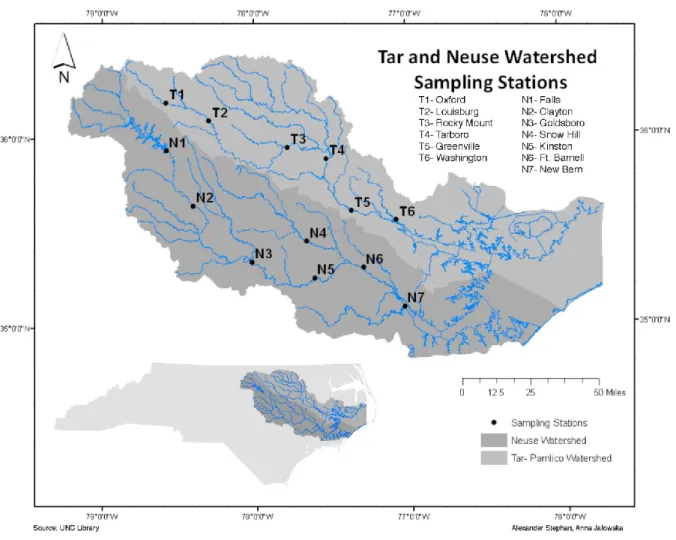
1: Tar and Neuse Watershed ...28
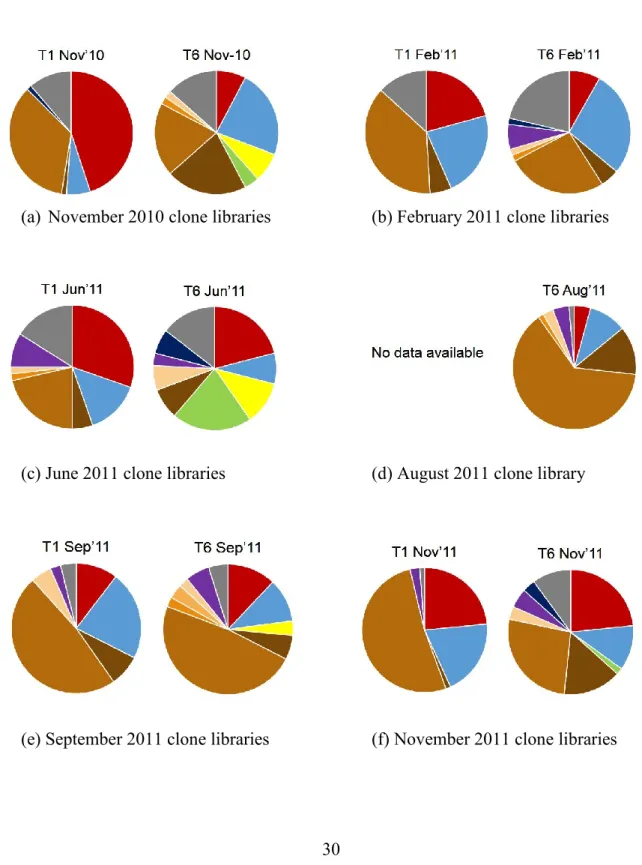
2: Clone libraries analyzed from November 20120 to November 2011 ...30
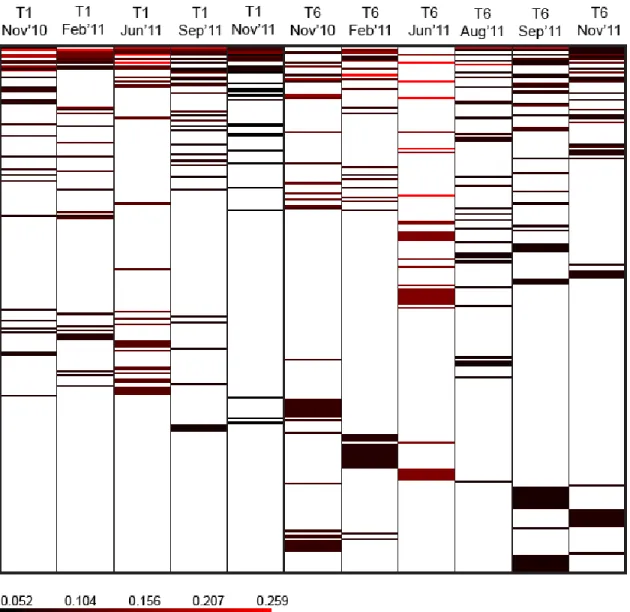
3: Heatmap of all OTUs found in the Tar River clone libraries ...31
4: Comparison of OTUs found in T1 (upstream) and T6 (downstream) ...32
5: Phylogenetic tree of the class Betaproteobacteria ...33
6: Heatmap of betaproteobacterial clones by abundance ...35
7: Phylogenetic tree of the phylum Verrucomicrobia...36
ix
LIST OF TABLES
x
LIST OF ABBREVIATIONS
DNA Deoxyribonucleic Acid RNA Ribonucleic Acid
1
1. INTRODUCTION
Microbial communities regulate global biogeochemical cycles, influence ecosystem health through elemental transformations, form the basis of aquatic and marine food webs, and represent a significant fraction of life’s genetic diversity (Pomeroy, 1974; Azam et al., 1983; Whitman et al., 1998; Cotner and Biddanda, 2002; Rappe and Giovannoni, 2003). Global prokaryotic abundance, encompassing bacteria and archaea, is estimated to be 9.2-31.7 x 1029 cells (Kallmeyer et al., 2012) Although the vast majority of microbes are
uncultivated, a more comprehensive understanding of their diversity and ecosystem functions are emerging through the use of cultivation-independent methods (Woese, 1987; Pace, 1997; Rappe and Giovannoni, 2003)
1.1 The rise of cultivation-independent techniques
2
domains exist in a molecular chronometer, the greater is the likelihood that the calculated evolutionary distance is a measure of randomly accumulating changes that occur
independently of each other (Woese, 1987). The ability to amplify 16S rRNA genes
(Weisburg et al., 1991) from mixed environmental communities and to sequence it directly as a PCR product or after cloning into bacterial vector plasmids meant that the phylogeny of unculturable bacteria can be inferred. Thereafter, a multitude of techniques based on 16S rRNA were developed for efficient and convenient identification of microbes, including denaturing gel gradient electrophoresis (DGGE) and terminal restriction fragment length polymorphism (T-RFLP) (Muyzer et al., 1993; Liu et al., 1997). These techniques, while relatively simple and cost-efficient, do not provide the fine phylogenetic resolution that full-length 16S rRNA gene sequencing offers. Nevertheless, the full spectrum of cultivation-independent methods has been widely utilized in investigations of microbial community composition.
1.2 Aquatic microbial communities
Aquatic microbial communities, in particular, have been extensively studied due to the ease of sampling in freshwater ecosystems, such as lakes (Glockner et al., 2000;
Lindstrom, 2000, 2001; Van der Gucht et al., 2001; Zwart et al., 2002; Yannarell et al., 2003; Newton et al., 2006; Eiler et al., 2012) and rivers (Crump and Hobbie, 2005; Crump et al., 2009; Liu et al., 2012). From these numerous investigations, we have grasped the appreciable diversity of freshwater microbes, which, prior to the use of cultivation-independent
techniques, were once thought to be indistinct from microbial groups found in soils
3
These groups include the alpha-, beta-, gamma-, delta, and epsilon- classes of
Proteobacteria, the phyla Bacteroidetes, Actinobacteria, Cyanobacteria, Verrucomicrobia, Planctomycetes, Holophaga, Chloroflexi and candidate division OP10; the most common freshwater bacteria belong to Actinobacteria, Betaproteobacteria, Bacteroidetes, and Alphaproteobacteria (Zwart et al., 2002). Additionally, distinct phylotypes within these broader taxonomic levels are cosmopolitan, including the hgcI cluster of Actinobacteria (Glockner et al., 2000) as well as the genus Limnohabitans of Betaproteobacteria (Hahn et al., 2010; Kasalicky et al., 2010)
Multiple intrinsic and extrinsic factors have been found to shape freshwater microbial communities, such as water pH, alkalinity, and nutrient concentration (Methe and Zehr, 1999; Crump et al., 2003), phytoplankton community composition (Newton et al., 2006) and temperature (Yannarell and Triplett, 2004). The temporal patterns of these factors help explain the documented seasonality of freshwater microbial communities, which show distinct and, to some extent, predictable microbial groups associated with seasonal climate (Yannarell et al., 2003; Crump and Hobbie, 2005; Crump et al., 2009). Additionally, the spatial gradients of these measured parameters help maintain spatial heterogeneity in
microbial communities within the same ecosystem (Crump et al., 2004; Ibekwe et al., 2012; Liu et al., 2012)
4
materials can either remain entrained in the water column or can settle and be deposited onto the river bed (Droppo, 2001). During the transport process, microbes utilize and remineralize nutrients and organic matter, influencing the biogeochemistry of the river. Specific microbes attach to organic matter aggregates for effective hydrolysis and remineralization of complex organic components (Droppo, 2001; Battin et al., 2008), a process that is also widely
recognized in marine ecosystems (Smith et al., 1992; Ziervogel and Arnosti, 2008); this ecophysiological specialization results in distinct particle-attached and free-living bacterial communities (Delong et al., 1993; Crump et al., 1999). The composition and activity of riverine microbial communities are therefore highly dependent on the availability and quality of autochthonous (originating from within) as well as the allochthonous (originating from a different region) organic matter (Crump et al., 2003; Battin et al., 2008).
The observed seasonality of microbes in aquatic and marine ecosystems related to temporal shifts in intrinsic and extrinsic factors suggests that microbial communities would be sensitive to sudden or gradual changes in conditions due to disturbances. In the following section, I will provide an overview of disturbances and the relevant studies on microbial communities.
1.3 Ecosystem disturbance
A disturbance is traditionally defined as an uncommon or irregular event that can abruptly result in changes in natural community composition, deviating from the static or near-equilibrium conditions (Sousa, 1984). Two factors, however, confound this traditional definition of disturbance. First, natural populations are rarely found in static or
5
negligible to extreme; hence, it is difficult to ascertain the threshold of what constitutes a disturbance (Sousa, 1984). For these reasons, a more accurate definition of disturbance is a “discrete, punctuated killing, displacement, or damaging of one or more individuals (or colonies)” that directly or indirectly gives way to the establishment and/or proliferation of other individuals or colonies (Sousa, 1984). This definition, however, is more descriptive of a pulse disturbance; prolonged perturbations, which can arise steeply or gradually, are termed press disturbances (Bender et al., 1984; Lake, 2000).
The various types of disturbances have the capacity to perturb an ecosystem in different ways. For example, fires can affect terrestrial ecosystems by burning down trees, but these events may have little to no impact in aquatic ecosystems. On the other hand, disturbances such as hurricanes or tropical cyclones can cause severe flooding the affectboth of these ecosystems, although the response of natural communities to the disturbance may be markedly different. Other types of disturbances to be considered are ice storms, droughts, large waves, high winds, landslides and desiccation, all of which can impact various
ecosystems in distinct ways. Some disturbances are intertwined and can act in concert, as is the case with large storms and high winds (Sousa, 1984).
6
or coral reefs, have been extensively studied within the context of disturbances (Connell, 1978); microbes, however, have previously received much less attention because of only recently-recognized substantial contributions to ecosystem processes. Recent papers highlight our limited understanding of microbial community responses to disturbance (Allison and Martiny, 2008; Shade et al., 2012). Hence, the role of microbes in the
environment has been taken into consideration only in contemporary individual ecosystem or global process models (Le Quere et al., 2005). Cultivation-independent methods, as
previously described, have advanced our knowledge on the role of microbes in ecosystem, and how they respond to different types of disturbances.
1.4 Response of microbial communities to disturbance
Microbial community disturbance has been largely studied in terrestrial ecosystems and suggest that microbes are in fact very sensitive to disturbances (Allison and Martiny, 2008; Shade et al., 2012); the caveat to remember is that studies in which disturbances do not cause an altered microbial community structure may be more difficult to publish. Shade et al. (2012) analyzed a total of 310 experimental and 68 observational investigations to assess sensitivity of microbial community composition and function; the difference between the two is that experimental investigations are designed and manipulated, while observational
7
disturbance while afterwards reverting back to their original state (Pimm, 1984; Allison and Martiny, 2008).
To assess stability, one must consider a community’s resistance to compositional changes or its resilience, the rate by which sensitive communities return to pre-disturbance state or to an alternative stable state (Allison and Martiny, 2008). The stability of a
community can be assessed either through its composition or function; either a resistant or resilient community is considered to be rather stable. Also, while the community composition and function may be linked, they may also appear disconnected; this is wholly dependent on the function of interest. For example, if a function of interest can be performed by many different taxa (functional redundancy), a shift in community composition may not necessarily induce a change in functionality; the opposite is true for functions carried out by a few
specific taxa (Schimel, 1995; Allison and Martiny, 2008). This topic is discussed in greater depth in a comprehensive review on microbial community resistance and resilience by Shade et al. (2012).
8
Hurricanes Katrina and Rita on the microbial landscape of Lake Pontchartrain and the waterways in New Orleans (Sinigalliano et al., 2007; Amaral-Zettler et al., 2008).
Sinigalliano et al. (2007) focused on changes in abundances of fecal indicator bacteria, while Amaral-Zettler et al. (2008) performed a community-wide analysis using DNA sequencing techniques and found a distinct and highly diverse microbial community in the floodwaters following the two hurricanes. Although these studies provide insight into community response to a disturbance, more investigations are necessary for us to fully assess the
response of microbial communities in the face of large storm events, particularly for riverine ecosystems. Research on the effects of disturbance on community composition is especially important as it has been suggested that shifts in microbial communities may have extensive consequences on ecosystem health (Mao-Jones et al., 2010).
1.5 Project overview
This thesis is a subset of a larger project called “Black water, white water, blue water: Understanding the fate of organic matter within North Carolina rivers and its consequences for water quality in coastal North Carolina” that examines the sedimentological,
9
system in the United States (Paerl et al., 2002). Two sampling stations, upstream near the head of the Tar River and downstream where the water feeds into the estuary, were chosen for this project, allowing us to also study geographic succession of Tar River microbial assemblages. In the subsequent sections, I will examine not only identified bacterial taxa and their spatiotemporal patterns but also their ecological niches in an attempt to explain their presence in time and space. Information on ecological niche are taken from studies on close cultured relatives of identified bacterial taxa. I will also use hydrological data to help explain spatiotemporal patterns of microbial species/groups. By utilizing full-length 16S rRNA gene sequence analyses we hoped to explore the diversity and fine-scale phylogenetic
10
2. METHODS AND MATERIALS 2.1 Sampling sites and dates
The Tar River, which runs for 180 river miles, begins in Triple Springs, NC (36.42°N, 78.80°W) and ends in Washington, NC (35.55°N, 77.08°W), where the water drains into the Pamlico Sound (USGS.gov). Two sites within the Tar River, located upstream (station T1; Oxford, NC, 36.19°N, 78.58°W) and downstream (station T6; Washington, NC, 35.56°N, 77.09°W) were chosen due to close proximity to USGS survey sites where gage height and discharge measurements are available, and to assess the response of microbial communities to distinct riverine flow regimes, sediment load and organic carbon input in the upper Piedmont and in the coastal plain (Figure 1). Water samples were collected from both sites during five sampling events (November 2010, February 2011, June 2011, September 2011, and November 2011) to examine the seasonal dynamics of microbial communities. An additional sample was collected at T6 on August 29, 2011, three days after Hurricane Irene hit the eastern region of North Carolina.
2.2 Sample collection and filtration
At each sampling event, pre-rinsed cubitainers were used to collect approximately 5 L of surface water, of which 500 mL was filtered within 24 hours of collection using a vacuum pump through two 45 mm diameter 0.2 µm pore size Nucleopore filters (Track-Etch
11 2.3 DNA extraction
Total nucleic acids were extracted based on the cetyltrimethylammonium (CTAB) protocol developed by Dempster et al. (1999) and with the following modifications. Sample filters were placed in 2 mL centrifuge tubes (one filter per tube) containing 1 mL of CTAB and frozen overnight at -20°C. Frozen tube samples were thawed at room temperature, and 8 µL of 0.4% (vol/vol) 2-mercaptoethanol was added per tube. The tubes were incubated at 65°C for 15 min with occasional tube inversion. Once cooled to room temperature, an equal volume of 24:1 chloroform:isoamyl alcohol was added to each tube. Using a rotating platform, the tubes were shaken for 20 min at room temperature. To separate the aqueous layer from the solution, the tubes were centrifuged at 12,500 rpm at 4°C. The aqueous layer was transferred to a new 2 mL centrifuge tube, and was subjected to one more extraction using an equal volume of chloroform:isoamyl alcohol. After another centrifugation step at 12,500 rpm and 4°C, the aqueous layer was split and placed in two new 1.5 mL centrifuge tubes, to which a half volume of 5M NaCl and an equal volume (to aqueous layer) of
isopropanol were added. After inversion, the tubes containing the treated aqueous layer were incubated at -80°C for 1-2 hours. To precipitate the DNA out of the solution, the tubes were centrifuged at 12,500 rpm for 45 min at 4°C. The resulting pellet was washed using 500 µL 70% ethanol, centrifuged for 5 min at 12,500 rpm, air-dried, then resuspended until full dissolution in 50 µL RNAse-free water. The DNA solution was stored in -80°C until further use.
2.4 PCR amplification, cloning and sequencing of 16S rRNA genes
12
Fast Buffer 1 (TaKaRa, Clontech Laboratories, Inc., Mountain View, CA, USA), 2.0 µL deoxynucleotide triphosphate (dNTP) mix containing 2.5 mM of dNTP (TaKaRa), 2.0 µL each for bacterial primers 8f and 1492r (Teske et al., 2002), 1.0 µL bovine serum albumin (10 mg ml-1), 0.25 µL SpeedSTAR Taq polymerase (TaKaRa), 1.0 µL DNA template, and 14.25 µL RNA-free water. The PCR conditions used are as follows: initial denaturation round at 94°C, followed by 25 cycles containing a denaturation step at 98°C for 10 s, an annealing step at 60°C for 15s, and an extension step at 72°C for 10 m, and a final extension round at 72°C for 10 min. Aliquots of the PCR products, including positive and negative controls, were SYBR green-stained and visualized using a 1.5% agarose gel. After
confirming the correct amplicon size and sufficient yield. PCR products were purified using the MinElute® PCR Purification Kit (Qiagen, Valencia, CA) following the MinElute PCR Purification Microcentrifuge and Vacuum Protocol.
The PCR products were cloned into OneShot® TOP10 competent Cells (Invitrogen, Carlsbad, CA) using the TOPO TA Cloning® Kit for Sequencing (Invitrogen) using standard protocol, but modified so that the cloning reaction is incubated for 2 hrs at room temperature. Transformed cells were grown on LB/Xgal/Kanamycin plates, and the resulting white
bacterial colonies were picked and re-plated for sequencing (GENEWIZ, Inc., South Plainfield, NJ) using vector-based M13F/R primers.
2.5 Sequence and phylogenetic analyses
13
SINA (v1.2.9) was used to initially align the assembled contigs, and Bellerophon version 3 (Huber et al., 2004) available online (greengenes.lbl.gov) through the curated 16S rRNA genedatabase Greengenes (DeSantis et al., 2006) was used to check for chimeras amongst the contigs. Chimera sequences were removed, and high-quality sequences were uploaded on SILVA online for automated initial alignment of the sequences (Pruesse et al., 2007). The resulting sequences were then uploaded into the ARB software version 95 (Ludwig et al., 2004).
2.6 Creation of phylogenetic trees
Whenever possible, the closest cultured relatives in the SILVA reference database were included to create phylogenetic trees; otherwise, the most closely-related clone sequences were included in the tree. Final alignments were edited manually, using E. coli secondary structure as filter (Pruesse et al., 2007). The backbone of the final phylogenetic tree was created and bootstrap values were calculated using the Rapid Bootstrap Analysis of the Maximum Likelihood algorithm, and a consensus tree was produced from 100 runs. As the June 2011 sequences were only partial-length, they were added to the resulting trees using the Quick Add Marked feature of ARB Parsimony. Branching nodes with
corresponding bootstrap support of ≥70 % were considered validated; poorly supported nodes are shown but are identified by their lack of bootstrap support (Peplies et al., 2008). 2.7 OTU analyses using MOTHUR
14
15
RESULTS AND DISCUSSION 3.1 Significance
Our study investigates in concert the annual cycle of bacterial community composition upstream and downstream in the Tar River as well as bacterial community succession following a large storm disturbance. Previous studies have investigated freshwater bacterial community seasonality, but none has utilized fine-scale identification of
phylogenetic groups using full-length 16S rRNA gene sequences to compare the changing profiles of bacterial taxa along the length of the river and to analyze community recovery after a disturbance. Additionally, few studies have studied the effects of large storm events on microbial communities; however, these studies either were limited to fecal indicator bacteria and other pathogenic species (Sinigalliano et al., 2007) or only characterized bacterial community perturbation and not community succession during recovery (Amaral-Zettler et al., 2008; Yeo et al., 2013).
3.2 Environmental conditions
16
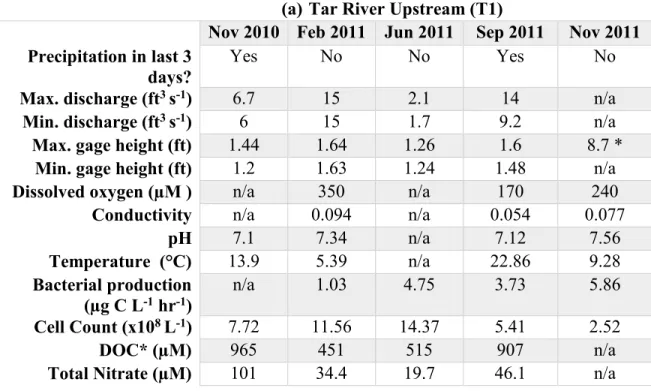
highest upstream in November 2011, and highest downstream in August 2011. The high water level downstream in August 2011 is the result of heavy precipitation by Hurricane Irene. Throughout the entire sampling period, conductivity remained very low upstream and downstream, with the exception of a conductivity peak downstream in June 2011. Bacterial production and cell counts showed high temporal variability. DOC was highest downstream on September 2011, which we interpret to be due to terrestrial runoff from Hurricane Irene (Table 1). Physicochemical data will be used to help explain the emergence of specific bacterial taxa following the hurricane event.
3.3 Bacterial community composition upstream and downstream
A total of 622 nearly full-length and 77 partial-length (from both June 2011 clone libraries, ~700 bp) 16S rRNA gene sequences were retrieved from eleven 16S rRNA gene clone libraries and used for phylogenetic analysis. The most abundant phylotypes, which also appeared in all clone libraries, belonged to the phyla Actinobacteria and Bacteroidetes and the Alpha- and Beta- subphyla of the Proteobacteria. Members of the Gammaproteobacteria were detected predominantly downstream, while Cyanobacteria and Planctomycetes were found exclusively downstream (Figure 2). Members of the Deltaproteobacteria,
17
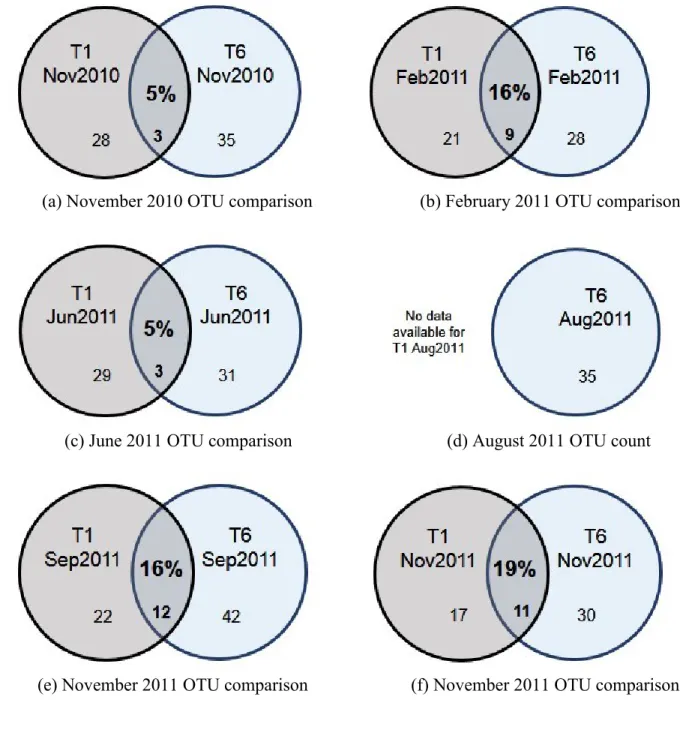
2). The majority of the OTUs found in the upstream and downstream clone libraries are distinct (Figure 3 and 4), although some overlap, ranging from 5% to 19% of the total OTUs found in a given sampling period, was observed (Figure 4).
The relative contributions of some widely-distributed bacterial groups changed from upstream to downstream. For example, Actinobacteria decreased in relative contribution from upstream to downstream in all sampling periods prior to Hurricane Irene; only after the event and persisting into the last sampling date did the actinobacterial contribution to the clone libraries appear roughly equal upstream and downstream (Figure 2). The
Betaproteobacteria showed a more consistent decrease in relative contribution from
upstream to downstream for all sampling periods (Figure 2). Our interpretation is limited by the absence of an upstream August 2011 clone library; however, a previous study on
bacterial succession along the Changjiang River agrees with our findings of a predominant betaproteobacterial community upstream that decreases in relative contribution downstream (Sekiguchi et al. 2002).
3.4 Families of the Betaproteobacteria
Members of the Betaproteobacteria represent the largest fraction of all
proteobacterial phylotypes. The exception is the June downstream 2011 clone library, where clones of the Betaproteobacteria were not detected, and their absence decreases the overall proteobacterial representation (Figure 2). Six betaproteobacterial families were identified in all of the sequence data sets: Alcaligenaceae, Burkholdericeae, Comamonadaceae,
18
cosmopolitan freshwater genus Limnohabitans (Kasalicky et al. 2010) in the family
Comamonadaceae constituted the largest fraction of all betaproteobacterial clones, appearing in all but the downstream June 2011 clone library (Figure 5a, 5b and 6). Other genera and lineages in the family Comamonadaceae did not widely occur in the Tar River, and some were limited to samples after Hurricane Irene. Members of the genus Polynucleobacter (Hahn et al. 2009) in the family Burkholderiaceae comprised the second most abundant group in the Betaproteobacteria class, with representative clones in all but two (November 2010 and June 2011) downstream clone libraries. (Figure 5a, 5b and 6).
3.5 Whole-Community Changes Following Hurricane Irene
The downstream August 2011 clone library showed a microbial community structure that was distinct from other downstream clone libraries. Representation of the Proteobacteria increased significantly in the downstream clone libraries from 14% in June 2011
19
by the fact that clone library contributions offer at best a relative approximation of bacterial abundances, and would require explicitly quantitative controls, such as qPCR quantifications or FISH counts, for validation.
The Cyanobacteria showed a temporally variable presence. Post-Hurricane Irene, however, a distinct pattern emerges: cyanobacteria were undetectable in the August 2011 and September 2011 clone libraries and only resurface scantily in November 2011 (Figure 2). It is very likely that the flux of organic matter and sediment into the river created unfavorable growth conditions for cyanobacteria, either by attenuating sunlight in the water column, by favoring the growth of organisms that proliferate under high organic matter content, or both. The relative contributions of Bacteroidetes, Alphaproteobacteria, Deltaproteobacteria, Gammaproteobacteria, and Verrucomicrobia remained quite similar to that of pre-Hurricane conditions. However, unlike the other phyla and subphyla whose relative contributions remained similar to that of pre-Hurricane sampling periods, Verrucomicrobia appears in all post-Hurricane clone libraries, both upstream and downstream.
3.6 Changes within the Betaproteobacteria
We selected the well-characterized Betaproteobacteria and the Verrucomicrobia for a more detailed sequence-based analysis, towards identification of individual genera and species of cultured bacteria, or well-defined clusters of phylotypes. We are aware that other phyla, for example the Actinobacteria, provide interesting targets where relevant
biogeographical patterns in freshwater and soil habitats can be expected (Warnecke et al., 2004; Warnecke et al., 2005), but these analyses have to be deferred for practicality reasons.
20
The qualitative and quantitative changes in community structure could be explained either by the introduction of allochthonous bacterial groups, a change in environmental conditions conducive to the in-situ growth and emergence of new groups, or both. To understand what brought upon the change in community composition, we examined the preferred ecological niches of the betaproteobacterial members, including ubiquitous phylotypes as well as hurricane-introduced phylotypes that occur only in the post-hurricane time window.
Members of the genus Limnohabitans dominated in the August 2011 clone library. As Limnohabitans is abundant in freshwater lakes and rivers (Hahn et al, 2010), its increased detection immediately post-Hurricane reflects the large flux of hurricane runoff at the Tar River downstream station, but also reveals considerable ecophysiological flexibility of this genus to persist and grow in fast-moving and turbid flood waters. The hydrological data (Table 1), which shows a marked decrease in conductivity from 4.011 in June 2011 to 0.166 in August 2011, confirms the freshening of the water column near the mouth of the river that was conducive to the emergence of members of Limnohabitans in August 2011.
In addition, a significant fraction of the August 2011 betaproteobacterial community is classified as uncultured. Further phylogenetic analysis using ARB reveals that the
uncultured clones are polyphyletic; we refer to the three distinct clusters of uncultured clones in the figure as uncultured cluster 1, 2, and 3 (Figure 5a). In the downstream clone libraries, the three uncultured clusters are found consistently post-hurricane. Members of the
uncultured cluster 1 also appear in upstream samples, so the only strictly downstream post-hurricane uncultured clones are within uncultured clusters 2 and 3. While clones in
post-21
hurricane growth of Limnohabitans downstream must have favored the uncultured
Comamonadaceae groups as well. These bacteria were found to have increased in relative abundance following a large storm event in the marine waters of Kaneohe Bay, Hawaii, where they most likely constituted a freshwater import to the coastal bacterioplankton community (Yeo et al., 2013); however, Yeo et al. did not specify whether the uncultured members found in their study are mono- or polyphyletic.
Other genera within the family Comamonadaceae, including Curvibacter represented by isolates from well water (Ding and Yokota, 2004), Ramlibacter with isolates from
subdesert soil, (Heulin et al., 2003) and Malikia consisting of isolates primarily from activated sludge (Spring et al., 2005) appeared only in the August 2011 downstream clone library. The presence of the genus Malikia could form an anthropogenic hurricane signature imprinted on the natural disturbance on the river, which introduces allochthonous bacterial species that originate from wastewater treatment plants. The presence of a wastewater treatment plant upriver (Rocky Mount, NC) which could impact the downstream sampling site (T6, Washington, NC) supports our hypothesis.
Members of the family Rhodocyclaceae only appear downstream and post-hurricane; these include clones most closely related to the genera Ferribacterium, Dechloromonas and Rhodocyclus (Figure 5b). Ferribacterium limneticum, an isolate from acid-mining impacted lake sediments, is a strictly anaerobic dissimilatory iron reducer (Cummings et al. 2000). The presence of a closely related clone in the downstream August 2011 clone library suggests a sedimentary origin, for example via resuspension of anoxic river sediments. Surface water dissolved oxygen concentrations downstream in August 2011 as well as September
22
river water as well as the presumably large carbon load in August 2011 (as indicated by the large DOC value downstream in September 2011, Table 1) very likely contributed to anoxic conditions in the sediment. The clone identified to be closely related to Ferribacterium limneticum was only present in August 2011, suggesting that hurricane-induced physical mixing in the water column was responsible for the resuspension of surficial sediments. In contrast, clones most closely related to Dechloromonas agitata appeared in August as well as in September (Figure 5b and 6). Dechloromonas agitata is a facultative anaerobe capable of dissimilatory perchlorate reduction (Achenbach et al., 2001). The presence of
Dechloromonas in the August and September downstream clone libraries suggested a
possible perchlorate contamination in the environment, usually originating from manufacture and from the use of munitions and explosives (Urbansky, 1998); however, the presence of natural reservoirs of perchlorate in the environment limits our interpretation (Dasgupta et al., 2005) Additionally, a clone from the downstream September clone library closely matched the cultured isolate Rhodocyclus purpureus, a phototrophic bacterium (Pfennig, 1978). This phototrophic member of the Betaproteobacteria grows in waters that are exposed to light and rich in organic compounds and nutrients (Imhoff, Prokaryotes, 2006); the excess organic compounds and nutrients needed for members of Rhodocyclus were likely washed into the river from nearby land during the landfall of Hurricane Irene. Finally, eight clones from the downstream September clone library were identified as an unclassified Rhodocyclaceae lineage (classified as 12up in the SILVA database), which is otherwise represented by
23
members of the family Rhodocyclaceae appear specifically under the environmental conditions that persisted from the landfall of Hurricane Irene and into September 2011.
Clones of the Methylophilaceae, a family of aerobic methylotrophic bacteria, were consistently visible upstream, but only appeared at the downstream site after the hurricane. The alpha- and gammaproteobacterial marine methylotrophs have been implicated in a DOM degradation cascade (McCarren et al., 2010). We hypothesize that the Tar River clones belonging to the Methylophilaceae, both upstream and downstream, were involved in similar heterotrophic processes. The fact that these clones only arise in the downstream clone
libraries after the hurricane could indicate robust microbial processing of organic substrates, likely due to the input of allochthonous organic matter into the river resulting from the hurricane. Hydrological data (Table 1) shows that DOC concentration in the downstream station was highest in September 2011; unfortunately, no data are available for August 2011. Nevertheless, the high DOC concentration in September 2011 was likely due to terrestrial organic matter input through stormwater runoff. We suggest that the members of
Methylophilaceae exploited the large flux of organic matter into the river. 3.7 Changes within Verrucomicrobia
Throughout the entire sampling period, a total of 25 clones were classified as
belonging to the phylum Verrucomicrobia (Figure 7). These clones consisted of members of four of the seven identified order-level subdivisions within Verrucomicrobia (Hugenholtz et al., 1998; Sangwan et al., 2005; Schlesner et al., 2006), including Subdivision 1
24
clones belonging to Verrucomicrobia reveals changes presumably associated with Hurricane Irene.
Pre-hurricane upstream verrucomicrobial clones are related to one of the following genera: Chthoniobacter in Subdivision 2, Luteolibacter in Subdivision 1, or Opitutus in Subdivision 4. Pre-hurricane downstream verrucomicrobial clones were only found in
February 2011 and belong to the FukuN18 freshwater group in subdivision 2 (Glockner et al., 2000; Newton et al., 2006) and the freshwater genus Prosthecobacter within subdivision 1 (Hedlund et al., 1997).
The post-hurricane verrucomicrobial community consisted of more diverse lineages: Chthoniobacter in Subdivision 2 dominated by soil bacteria (Sangwan et al., 2005); the vadin HA64 lineage in Subdivision 4, and the OPB35 soil group representative of Subdivision 3 (Figure 7). Most interestingly, the cluster which contains strictly downstream, post-hurricane verrucomicrobial clones is Subdivision 3; this subdivision contains one representative
cultured soil isolate, Ellin5102 (Joseph et al., 2003) and multiple related soil isolates (Sangwan et al., 2005). Subdivision 3 is therefore a strong candidate for a soil-derived Verrucomicrobia contribution that reflects specifically post-hurricane terrestrial runoff. Subdivision 2 has been found to be the most dominant in soil communities, while subdivision 1, 3 and 4 are found less frequently (Freitas et al., 2012). Additionally, we found that
25
The consistent detection of Verrucomicrobia clones post-hurricane suggests a change in the river’s biogeochemistry that allows for the persistence of Verrucomicrobia. A recent study illustrates the potentially significant role of Verrucomicrobia in polysaccharide degradation, and therefore in carbon cycling, in a marine habitat. Single-cell genomics of several marine Verrucomicrobia cells within Subdivision I reveal the abundance of genes encoding enzymes involved in carbohydrate degradation, including glycoside hydrolases, sulfatases, carbohydrate esterases and polysaccharide lyases (Martinez-Garcia et al., 2012). Additionally, the genetic makeup of Chthoniobacter flavus, the first cultured representative of Subdivision 2, consists of many genes required to metabolize a wide array of saccharide components of plant biomass (Kant et al., 2011). Drawing from this, we suggest the working hypothesis that members of Verrucomicrobia served the same role as members of
26
4. CONCLUSION
The native microbial population of rivers are highly diverse, comprised of bacterial species isolated from freshwater, sediment, soil, and even activated sludge. Along the river we find evidence for entrainment of new bacterial groups; at any given point in time, downstream microbial communities are more phylogenetically diverse than their upstream counterparts. We also find that the microbial communities are highly sensitive to natural perturbations—in this case, brought upon by the landfall of Hurricane Irene. Analysis of newly-emerged groups suggests flux of soil into the river, possible sediment resuspension, inflow of untreated wastewater and other environmental contaminants, among other changes in environmental conditions. Microbial communities are quick to respond to the perturbation and change in composition as their members exploit new environmental niches, but also seem to exhibit some resilience as they initiate a return to pre-disturbance composition after the disturbance has passed. Specifically, the downstream microbial community gradually shifted from its highly distinct structure two days post-Hurricane Irene to its composition in November 2011, which more closely resembles the pre-hurricane clone libraries.
Our interpretations for why specific bacterial groups arise after a flooding perturbation is strengthened by a consistent, non-random succession pattern of bacterial groups that make geochemical and biological sense: once new environmental conditions emerge, microbes with ecological niche that can exploit these conditions will thrive.
27
ecosystems, as what is expected of riverine communities. Hence, our greatest limitation is that our interpretations are based on the known physiological and metabolic capabilities of closely cultured relatives of the sequenced clones. Woese (1987) warns us of the limitations of phylogenetics, and instead suggests that our hypotheses be tested using other data based on physiology and biogeochemistry. This is directly applicable to our dataset, particularly on the Betaproteobacteria and Verrucomicrobia. The Betaproteobacteria are a metabolically diverse group, and even species of the same genus can have different metabolic capabilities (Spring et al., 2005). As for Verrucomicrobia, recently reported primer biases may have limited us from seeing the full contribution of this group (Bergmann et al. 2011). Finally, this is a scenario for one river. Different conditions in other freshwater environments may
28 FIGURES
29
Table 1. Table of measured parameters from the Tar River. These parameters include hydrological conditions, bacterial production, cell count, *dissolved organic carbon and total nitrate from (a) T1 (upstream) and (b) T6 (downstream) in the Tar River. The data above does not show maximum gage height for T6 on August 27, 2011 during landfall of Hurricane Irene. At that time, the maximum gage height as 7.53 ft (source: USGS).
(a) Tar River Upstream (T1)
Nov 2010 Feb 2011 Jun 2011 Sep 2011 Nov 2011 Precipitation in last 3
days?
Yes No No Yes No
Max. discharge (ft3 s-1) 6.7 15 2.1 14 n/a
Min. discharge (ft3 s-1) 6 15 1.7 9.2 n/a
Max. gage height (ft) 1.44 1.64 1.26 1.6 8.7 * Min. gage height (ft) 1.2 1.63 1.24 1.48 n/a
Dissolved oxygen (µM ) n/a 350 n/a 170 240
Conductivity n/a 0.094 n/a 0.054 0.077
pH 7.1 7.34 n/a 7.12 7.56
Temperature (°C) 13.9 5.39 n/a 22.86 9.28
Bacterial production
(µg C L-1 hr-1) n/a 1.03 4.75 3.73 5.86
Cell Count (x108 L-1) 7.72 11.56 14.37 5.41 2.52
DOC* (µM) 965 451 515 907 n/a
Total Nitrate (µM) 101 34.4 19.7 46.1 n/a
(b) Tar River Downstream (T6)
Nov 2010 Feb 2011 Jun 2011 Aug 2011 Sep 2011 Nov 2011 Precipitation in last 3
days?
Yes No No Yes Yes No
Max. gage height (ft) 1.94 0.23 1.74 2.66 2.10 1.03
Min. gage height (ft) 1 -0.67 0.72 2.14 1.26 0.31
Dissolved oxygen (µM) 330 n/a 220 66 66 260
Conductivity 0.046 n/a 4.011 0.166 0.162 0.135
pH 6.71 n/a 7.74 6.63 6.96 7.54
Temperature (°C) 13.9 n/a 28.73 24.69 27.03 14.02 Bacterial production
(µg C L-1 hr-1) n/a 2.15 5.31 n/a 4.34 n/a
Cell Count (x108 L-1) 9.8 15.16 2.06 n/a 1.5 3.3
DOC* (µM) 892 717 730 n/a 1710 n/a
30
Figure 2. Clone libraries analyzed from November 2011 to November 2011. The pie charts are organized in columns by sampling date, and in rows by sampling station. The different colors indicate distinct phyla; the different shades of brown indicate subphyla within the phylum Proteobacteria. Others = OD1, OP3, OP10, OP11, TM7 and Chloroflexi. The SILVA database was used for taxonomic classification.
(a) November 2010 clone libraries (b) February 2011 clone libraries
(c) June 2011 clone libraries (d) August 2011 clone library
31
32
Figure 4. Comparison of OTUs found in T1 (upstream) and T6 (downstream), including clone libraries from (a) November 2010, (b) February 2011, (c) June 2011, (d) September 2011 and (e) November 2011. The percentage represents the shared OTU fraction of the total OTU found at each sampling period. OTU definition = 0.03.
(a) November 2010 OTU comparison (b) February 2011 OTU comparison
(c) June 2011 OTU comparison (d) August 2011 OTU count
33
Figure 5. Phylogenetic tree of the class Betaproteobacteria. (A) Expanded Comamonadaceae (B) Expanded Betaproteobacteria families that are not Comamonadaceae
Individual well-defined clusters are identified in the tree. Wherever possible, each
identification includes a family and genus name; otherwise, a descriptive name is given to each cluster. Unique representatives were chosen for nearly-identical clones from the same clone libraries and which are identified as belonging to the same cluster. Cultured species are italicized. The Unclassified Burkholderiales cluster is classified by some databases as
belonging to the genus Limnobacter; however, this classification was not chosen because cultured isolates of this genus did not match with the Unclassified Burkholderiales cluster. The tree is rooted by cultured isolates of the subphylum Gammaproteobacteria.
34
35
36
Figure 7. Phylogenetic tree of the phylum Verrucomicrobia. Individual well-defined clusters are identified in the tree. Wherever possible, each identification includes a class and genus name; otherwise, a descriptive name is given to each cluster. Only nodes with
37
38 REFERENCES
Allison, S.D., and Martiny, J.B.H. (2008) Resistance, resilience, and redundancy in microbial communities. Proceedings of the National Academy of Sciences of the United States of America 105: 11512-11519.
Amaral-Zettler, L.A., Rocca, J.D., Lamontagne, M.G., Dennett, M.R., and Gast, R.J. (2008) Changes in microbial community structure in the wake of Hurricanes Katrina and Rita. Environmental Science & Technology 42: 9072-9078.
Azam, F., Fenchel, T., Field, J.G., Gray, J.S., Meyerreil, L.A., and Thingstad, F. (1983) The Ecological Role of Water-Column Microbes in the Sea. Marine Ecology Progress Series 10: 257-263.
Battin, T.J., Kaplan, L.A., Findlay, S., Hopkinson, C.S., Marti, E., Packman, A.I. et al. (2008) Biophysical controls on organic carbon fluxes in fluvial networks. Nature Geoscience 1: 95-100.
Bender, E.A., Case, T.J., and Gilpin, M.E. (1984) Perturbation Experiments in Community Ecology – Theory and Practice. Ecology 65: 1-13.
Connell, J.H. (1978) Diversity in tropical rain forests and coral reefs – high diversity of trees and corals is maintained only in a non-equilibrium state. Science 199: 1302-1310.
Connell, J.H., and Sousa, W.P. (1983) On the evidence needed to judge ecological stability or persistence. American Naturalist 121: 789-824.
Cotner, J.B., and Biddanda, B.A. (2002) Small players, large role: Microbial influence on biogeochemical processes in pelagic aquatic ecosystems. Ecosystems 5: 105-121.
Crump, B.C., and Hobbie, J.E. (2005) Synchrony and seasonality in bacterioplankton communities of two temperate rivers. Limnology and Oceanography 50: 1718-1729. Crump, B.C., Armbrust, E.V., and Baross, J.A. (1999) Phylogenetic analysis of particle-attached and free-living bacterial communities in the Columbia river, its estuary, and the adjacent coastal ocean. Applied and Environmental Microbiology 65: 3192-3204.
Crump, B.C., Kling, G.W., Bahr, M., and Hobbie, J.E. (2003) Bacterioplankton community shifts in an arctic lake correlate with seasonal changes in organic matter source. Applied and Environmental Microbiology 69: 2253-2268.
Crump, B.C., Hopkinson, C.S., Sogin, M.L., and Hobbie, J.E. (2004) Microbial
39
Crump, B.C., Peterson, B.J., Raymond, P.A., Amon, R.M.W., Rinehart, A., McClelland, J.W., and Holmes, R.M. (2009) Circumpolar synchrony in big river bacterioplankton. Proceedings of the National Academy of Sciences of the United States of America 106: 21208-21212.
Dasgupta, P.K., Martinelango, P.K., Jackson, W.A., Anderson, T.A., Tian, K., Tock, R.W., and Rajagopalan, S. (2005) The origin of naturally occurring perchlorate: The role of atmospheric processes. Environmental Science & Technology 39: 1569-1575.
Delong, E.F., Franks, D.G., and Alldredge, A.L. (1993) Phylogenetic diversity of aggregate-attached vs free-living marine bacterial assemblages. Limnology and Oceanography 38: 924-934.
Dempster, E.L., Pryor, K.V., Francis, D., Young, J.E., and Rogers, H.J. (1999) Rapid DNA extraction from ferns for PCR-based analyses. Biotechniques 27: 66-+.
DeSantis, T.Z., Hugenholtz, P., Larsen, N., Rojas, M., Brodie, E.L., Keller, K. et al. (2006) Greengenes, a chimera-checked 16S rRNA gene database and workbench compatible with ARB. Applied and Environmental Microbiology 72: 5069-5072.
Ding, L.X., and Yokota, A. (2004) Proposals of Curvibacter gracilis gen. nov., sp nov and Herbaspirillum putei sp nov for bacterial strains isolated from well water and reclassification of Pseudomonas huttiensis, Pseudomonas lanceolata, Aquaspirillum delicatum and
Aquaspirillum autotrophicum as Herbaspirillum huttiense comb. nov., Curvibacter
lanceolatus comb. nov., Curvibacter delicatus comb. nov and Herbaspirillum autotrophicum comb. nov. International Journal of Systematic and Evolutionary Microbiology 54: 2223-2230.
Droppo, I.G. (2001) Rethinking what constitutes suspended sediment. Hydrological Processes 15: 1551-1564.
Eiler, A., Heinrich, F., and Bertilsson, S. (2012) Coherent dynamics and association networks among lake bacterioplankton taxa. Isme Journal 6: 330-342.
Fox, G.E., Stackebrandt, E., Hespell, R.B., Gibson, J., Maniloff, J., Dyer, T.A. et al. (1980) The Phylogeny of Prokaryotes. Science 209: 457-463.
Freitas, S., Hatosy, S., Fuhrman, J.A., Huse, S.M., Welch, D.B.M., Sogin, M.L., and Martiny, A.C. (2012) Global distribution and diversity of marine Verrucomicrobia. Isme Journal 6: 1499-1505.
40
Hahn, M.W., Kasalicky, V., Jezbera, J., Brandt, U., Jezberova, J., and Simek, K. (2010) Limnohabitans curvus gen. nov., sp nov., a planktonic bacterium isolated from a freshwater lake. International Journal of Systematic and Evolutionary Microbiology 60: 1358-1365. Hedlund, B.P., Gosink, J.J., and Staley, J.T. (1997) Verrucomicrobia div. nov., a new division of the bacteria containing three new species of Prosthecobacter. Antonie Van Leeuwenhoek International Journal of General and Molecular Microbiology 72: 29-38. Heulin, T., Barakat, M., Christen, R., Lesourd, M., Sutra, L., De Luca, G., and Achouak, W. (2003) Ramlibacter tataouinensis gen. nov., sp nov., and Ramlibacter henchirensis sp nov., cyst-producing bacteria isolated from subdesert soil in Tunisia. International Journal of Systematic and Evolutionary Microbiology 53: 589-594.
Huber, T., Faulkner, G., and Hugenholtz, P. (2004) Bellerophon: a program to detect chimeric sequences in multiple sequence alignments. Bioinformatics 20: 2317-2319.
Hugenholtz, P., Goebel, B.M., and Pace, N.R. (1998) Impact of culture-independent studies on the emerging phylogenetic view of bacterial diversity. Journal of Bacteriology 180: 4765-4774.
Ibekwe, A.M., Leddy, M.B., Bold, R.M., and Graves, A.K. (2012) Bacterial community composition in low-flowing river water with different sources of pollutants. Fems Microbiology Ecology 79: 155-166.
Jones, S.E., Chiu, C.Y., Kratz, T.K., Wu, J.T., Shade, A., and McMahon, K.D. (2008) Typhoons initiate predictable change in aquatic bacterial communities. Limnology and Oceanography 53: 1319-1326.
Joseph, S.J., Hugenholtz, P., Sangwan, P., Osborne, C.A., and Janssen, P.H. (2003) Laboratory cultivation of widespread and previously uncultured soil bacteria. Applied and Environmental Microbiology 69: 7210-7215.
Kallmeyer, J., Pockalny, R., Adhikari, R.R., Smith, D.C., and D'Hondt, S. (2012) Global distribution of microbial abundance and biomass in subseafloor sediment. Proceedings of the National Academy of Sciences of the United States of America 109: 16213-16216.
Kant, R., van Passel, M.W.J., Palva, A., Lucas, S., Lapidus, A., del Rio, T. et al. (2011) Genome Sequence of Chthoniobacter flavus Ellin428, an Aerobic Heterotrophic Soil Bacterium. Journal of Bacteriology 193: 2902-2903.
Kasalicky, V., Jezbera, J., Simek, K., and Hahn, M.W. (2010) Limnohabitans planktonicus sp nov and Limnohabitans parvus sp nov., planktonic betaproteobacteria isolated from a
41
Lake, P.S. (2000) Disturbance, patchiness, and diversity in streams. Journal of the North American Benthological Society 19: 573-592.
Lane, D.J., Pace, B., Olsen, G.J., Stahl, D.A., Sogin, M.L., and Pace, N.R. (1985) Rapid determination of 16S ribosomal RNA sequences for phylogenetic analyses. Proceedings of the National Academy of Sciences of the United States of America 82: 6955-6959.
Le Quere, C., Harrison, S.P., Prentice, I.C., Buitenhuis, E.T., Aumont, O., Bopp, L. et al. (2005) Ecosystem dynamics based on plankton functional types for global ocean
biogeochemistry models. Global Change Biology 11: 2016-2040.
Lindstrom, E.S. (2000) Bacterioplankton community composition in five lakes differing in trophic status and humic content. Microbial Ecology 40: 104-113.
Lindstrom, E.S. (2001) Investigating influential factors on bacterioplankton community composition: Results from a field study of five mesotrophic lakes. Microbial Ecology 42: 598-605.
Liu, W.T., Marsh, T.L., Cheng, H., and Forney, L.J. (1997) Characterization of microbial diversity by determining terminal restriction fragment length polymorphisms of genes encoding 16S rRNA. Applied and Environmental Microbiology 63: 4516-4522.
Liu, Z.H., Huang, S.B., Sun, G.P., Xu, Z.C., and Xu, M.Y. (2012) Phylogenetic diversity, composition and distribution of bacterioplankton community in the Dongjiang River, China. Fems Microbiology Ecology 80: 30-44.
Ludwig, W., Strunk, O., Westram, R., Richter, L., Meier, H., Yadhukumar et al. (2004) ARB: a software environment for sequence data. Nucleic Acids Research 32: 1363-1371. Mao-Jones, J., Ritchie, K.B., Jones, L.E., and Ellner, S.P. (2010) How Microbial Community Composition Regulates Coral Disease Development. Plos Biology 8.
Martinez-Garcia, M., Brazel, D.M., Swan, B.K., Arnosti, C., Chain, P.S.G., Reitenga, K.G. et al. (2012) Capturing Single Cell Genomes of Active Polysaccharide Degraders: An
Unexpected Contribution of Verrucomicrobia. Plos One 7: 11.
McCarren, J., Becker, J.W., Repeta, D.J., Shi, Y.M., Young, C.R., Malmstrom, R.R. et al. (2010) Microbial community transcriptomes reveal microbes and metabolic pathways associated with dissolved organic matter turnover in the sea. Proceedings of the National Academy of Sciences of the United States of America 107: 16420-16427.
Methe, B.A., and Zehr, J.P. (1999) Diversity of bacterial communities in Adirondack lakes: do species assemblages reflect lake water chemistry? Hydrobiologia 401: 77-96.
42
amplified genes coding for 16S ribosomal RNA. Applied and Environmental Microbiology 59: 695-700.
Newton, R.J., Kent, A.D., Triplett, E.W., and McMahon, K.D. (2006) Microbial community dynamics in a humic lake: differential persistence of common freshwater phylotypes.
Environmental Microbiology 8: 956-970.
Pace, N.R. (1997) A molecular view of microbial diversity and the biosphere. Science 276: 734-740.
Paerl, H.W., Dyble, J., Twomey, L., Pinckney, J.L., Nelson, J., and Kerkhof, L. (2002) Characterizing man-made and natural modifications of microbial diversity and activity in coastal ecosystems. Antonie Van Leeuwenhoek International Journal of General and Molecular Microbiology 81: 487-507.
Peplies, J., Kottmann, R., Ludwig, W., and Glockner, F.O. (2008) A standard operating procedure for phylogenetic inference (SOPPI) using (rRNA) marker genes. Systematic and Applied Microbiology 31: 251-257.
Pfennig, N. (1978) Rhodocyclus purpureus gen. nov. and sp. nov. A ring-shaped, vitamin B12-requiring member of family Rhodospirillaceae. International Journal of Systematic Bacteriology 28: 283-288.
Pomeroy, L.R. (1974) Oceans food web: A changing paradigm. Bioscience 24: 499-504. Pruesse, E., Quast, C., Knittel, K., Fuchs, B.M., Ludwig, W.G., Peplies, J., and Glockner, F.O. (2007) SILVA: a comprehensive online resource for quality checked and aligned ribosomal RNA sequence data compatible with ARB. Nucleic Acids Research 35: 7188-7196.
Rappe, M.S., and Giovannoni, S.J. (2003) The uncultured microbial majority. Annual Review of Microbiology 57: 369-394.
Sangwan, P., Kovac, S., Davis, K.E.R., Sait, M., and Janssen, P.H. (2005) Detection and cultivation of soil verrucomicrobia. Applied and Environmental Microbiology 71: 8402-8410.
Schimel, J. (1995) Ecosystem consequences of microbial diversity and community structure. Berlin 33: Springer-Verlag Berlin.
Schlesner, H., Jenkins, C., and Staley, J. (2006) The Phylum Verrucomicrobia: A
43
Schloss, P.D., Westcott, S.L., Ryabin, T., Hall, J.R., Hartmann, M., Hollister, E.B. et al. (2009) Introducing mothur: Open-Source, Platform-Independent, Community-Supported Software for Describing and Comparing Microbial Communities. Applied and Environmental Microbiology 75: 7537-7541.
Shade, A., Peter, H., Allison, S.D., Baho, D.L., Berga, M., Burgmann, H. et al. (2012)
Fundamentals of microbial community resistance and resilience. Frontiers in microbiology 3: 417.
Sinigalliano, C.D., Gidley, M.L., Shibata, T., Whitman, D., Dixon, T.H., Laws, E. et al. (2007) Impacts of Hurricanes Katrina and Rita on the microbial landscape of the New Orleans area. Proceedings of the National Academy of Sciences of the United States of America 104: 9029-9034.
Smith, D.C., Simon, M., Alldredge, A.L., and Azam, F. (1992) Intense hydrolytic enzyme-activity on marine aggregates and implications for rapid particle dissolution. Nature 359: 139-142.
Sousa, W.P. (1984) The role of disturbance in natural communities. Annual Review of Ecology and Systematics 15: 353-391.
Spring, S., Wagner, M., Schumann, P., and Kampfer, P. (2005) Malikia granosa gen. nov., sp nov., a novel polyhydroxyalkanoate- and polyphosphate-accumulating bacterium isolated from activated sludge, and reclassification of Pseudomonas spinosa as Malikia spinosa comb. nov. International Journal of Systematic and Evolutionary Microbiology 55: 621-629.
Stackebrandt, E., and Goebel, B.M. (1994) A place for DNA-DNA reassociation and 16S ribosomal RNA sequence analysis in the present species definition in bacteriology. International Journal of Systematic Bacteriology 44: 846-849.
Van der Gucht, K., Sabbe, K., De Meester, L., Vloemans, N., Zwart, G., Gillis, M., and Vyverman, W. (2001) Contrasting bacterioplankton community composition and seasonal dynamics in two neighbouring hypertrophic freshwater lakes. Environmental Microbiology 3: 680-690.
Warnecke, F., Amann, R., and Pernthaler, J. (2004) Actinobacterial 16S rRNA genes from freshwater habitats cluster in four distinct lineages. Environmental Microbiology 6: 242-253. Warnecke, F., Sommaruga, R., Sekar, R., Hofer, J.S., and Pernthaler, J. (2005) Abundances, identity, and growth state of actinobacteria in mountain lakes of different UV transparency. Applied and Environmental Microbiology 71: 5551-5559.
44
Whitman, W.B., Coleman, D.C., and Wiebe, W.J. (1998) Prokaryotes: The unseen majority. Proceedings of the National Academy of Sciences 95: 6578-6583.
Woese, C.R. (1987) Bacterial Evolution. Microbiological Reviews 51: 221-271. Yannarell, A.C., and Triplett, E.W. (2004) Within- and between-lake variability in the composition of bacterioplankton communities: Investigations using multiple spatial scales. Applied and Environmental Microbiology 70: 214-223.
Yannarell, A.C., Kent, A.D., Lauster, G.H., Kratz, T.K., and Triplett, E.W. (2003) Temporal patterns in bacterial communities in three temperate lakes of different trophic status.
Microbial Ecology 46: 391-405.
Yeo, S.K., Huggett, M.J., Eiler, A., and Rappe, M.S. (2013) Coastal Bacterioplankton Community Dynamics in Response to a Natural Disturbance. Plos One 8: 14.
Ziervogel, K., and Arnosti, C. (2008) Polysaccharide hydrolysis in aggregates and free enzyme activity in aggregate-free seawater from the north-eastern Gulf of Mexico. Environmental Microbiology 10: 289-299.