From the University of Colorado Denver, Aurora (S.K.G.); the University of Califor-nia at San Diego, San Diego (R.R.H.); Lexicon Pharmaceuticals, The Woodlands (P.B., D.G.-P., P.L., P.S.), the University of Texas Southwestern Medical Center, Dallas (D.K.M.), and Baylor College of Medicine and Texas Children’s Hospital, Houston (J.A.K.) — all in Texas; the Dia-betes Research Center, University of North Carolina School of Medicine, Durham (J.B.B.); the University of Leicester and University Hospitals of Leicester NHS Trust, Leicester, United Kingdom (M.J.D.); the University of Sydney, Sydney (G.R.F.); University Campus Bio-Medico of Rome, Rome (P.P.); Vall d’Hebron Research Insti-tute, Barcelona, and CIBERDEM-Instituto de Salud Carlos III, Madrid (R.S.); Diabe-tes Center Auf der Bult, Hannover Medi-cal School, Hannover, Germany (T.D.); and the University of Southern Califor-nia, Los Angeles (A.P.). Address reprint requests to Dr. Satish Garg at the Barbara Davis Center for Diabetes, University of Colorado Denver, 1775 Aurora Court, Rm. M20-1323, Aurora, CO 80045, or at satish . garg@ ucdenver . edu.
A complete list of the inTandem3 primary investigators is provided in the Supplemen-tary Appendix, available at NEJM.org.
This article was published on September 13, 2017, at NEJM.org.
DOI: 10.1056/NEJMoa1708337
Copyright © 2017 Massachusetts Medical Society. BACKGROUND
In most patients with type 1 diabetes, adequate glycemic control is not achieved with insulin therapy alone. We evaluated the safety and efficacy of sotagliflozin, an oral inhibitor of sodium–glucose cotransporters 1 and 2, in combination with insulin treat-ment in patients with type 1 diabetes.
METHODS
In this phase 3, double-blind trial, which was conducted at 133 centers worldwide, we randomly assigned 1402 patients with type 1 diabetes who were receiving treatment with any insulin therapy (pump or injections) to receive sotagliflozin (400 mg per day) or placebo for 24 weeks. The primary end point was a glycated hemoglobin level lower than 7.0% at week 24, with no episodes of severe hypoglycemia or diabetic ketoacidosis after randomization. Secondary end points included the change from baseline in glycated hemoglobin level, weight, systolic blood pressure, and mean daily bolus dose of insulin.
RESULTS
A significantly larger proportion of patients in the sotagliflozin group than in the pla-cebo group achieved the primary end point (200 of 699 patients [28.6%] vs. 107 of 703 [15.2%], P<0.001). The least-squares mean change from baseline was significantly greater in the sotagliflozin group than in the placebo group for glycated hemoglobin (difference, −0.46 percentage points), weight (−2.98 kg), systolic blood pressure (−3.5 mm Hg), and mean daily bolus dose of insulin (−2.8 units per day) (P≤0.002 for all comparisons). The rate of severe hypoglycemia was similar in the sotagliflozin group and the placebo group (3.0% [21 patients] and 2.4% [17], respectively). The rate of documented hypoglycemia with a blood glucose level of 55 mg per deciliter (3.1 mmol per liter) or below was significantly lower in the sotagliflozin group than in the placebo group. The rate of diabetic ketoacidosis was higher in the sotagliflozin group than in the placebo group (3.0% [21 patients] and 0.6% [4], respectively).
CONCLUSIONS
Among patients with type 1 diabetes who were receiving insulin, the proportion of patients who achieved a glycated hemoglobin level lower than 7.0% with no severe hy-poglycemia or diabetic ketoacidosis was larger in the group that received sotagliflozin than in the placebo group. However, the rate of diabetic ketoacidosis was higher in the sotagliflozin group. (Funded by Lexicon Pharmaceuticals; inTandem3 ClinicalTrials.gov number, NCT02531035.)
ABS TR ACT
Effects of Sotagliflozin Added to Insulin
in Patients with Type 1 Diabetes
Satish K. Garg, M.D., Robert R. Henry, M.D., Phillip Banks, M.S., John B. Buse, M.D., Ph.D., Melanie J. Davies, M.D., Gregory R. Fulcher, M.D., Paolo Pozzilli, M.D., Diane Gesty-Palmer, M.D., Ph.D., Pablo Lapuerta, M.D.,
Rafael Simó, M.D., Ph.D., Thomas Danne, M.D., Darren K. McGuire, M.D., M.H.Sc., Jake A. Kushner, M.D.,
T
he incidence of type 1 diabetes,which currently affects 29 million adults worldwide, is rising.1 In the United States, the number of patients with type 1 diabetes who are younger than 20 years of age may triple within 30 years.2 Less than one third of adults with type 1 diabetes achieve a glycated hemoglo-bin level lower than 7.0%, and most are over-weight or obese.3-5 Patients with type 1 diabetes also face risks of complications or death from severe hypoglycemia and diabetic ketoacidosis.6-10 The ideal treatment for type 1 diabetes should enable patients to maintain a glycated hemoglo-bin level lower than 7.0% without weight gain or an increased risk of hypoglycemia and diabetic ketoacidosis.
Sotagliflozin (LX4211) is a new oral inhibitor of sodium–glucose cotransporters 1 and 2 (SGLT1 and SGLT2). SGLT1 inhibition reduces glucose absorption in the proximal intestine, which sig-nificantly blunts and delays postprandial hyper-glycemia. SGLT2 inhibition decreases renal glucose reabsorption.11-13 In phase 2 studies, the admin-istration of sotagliflozin improved glycemic con-trol and lowered body weight among patients with type 1 or 2 diabetes; it also reduced glyce-mia, despite a decreased bolus dose of insulin, among patients with type 1 diabetes.14,15 No oral medication has been approved for use in combi-nation with insulin to lower the glucose level in patients with type 1 diabetes. We report the re-sults of the inTandem3 trial, a phase 3 clinical trial that assessed the effects of sotagliflozin as compared with placebo with respect to glycemic control and the occurrence of severe hypoglyce-mia and diabetic ketoacidosis among adults with type 1 diabetes who were receiving their usual insulin therapy.
Methods
Trial Design and Oversight
This multicenter, randomized, double-blind, placebo-controlled trial, which was conducted at 133 sites in 19 countries, evaluated the safety and efficacy of sotagliflozin in combination with insulin therapy (pump or injections) in pa-tients with type 1 diabetes. After a 2-week, single-blind run-in period during which all patients received placebo, eligible patients were randomly assigned, in a 1:1 ratio, to receive either sota-gliflozin (400 mg per day) or placebo for 24 weeks.
Efficacy and safety were assessed at prespecified times during the treatment period, and a final safety assessment was performed 30 days after the last dose of the trial regimen was administered.
The institutional review board at each trial center approved the protocol (available with the full text of this article at NEJM.org) and the con-sent form. All patients provided written informed consent before participation. An independent clinical end-point committee, whose members were unaware of the treatment assignments, adjudicated events of special interest, including severe hypoglycemia, diabetic ketoacidosis, major adverse cardiovascular events, drug-induced liver injury, and death. An independent data and safety monitoring committee reviewed adverse events. An independent statistician performed the statis-tical analysis. The trial was sponsored by Lexicon Pharmaceuticals and was conducted as a collabo-ration between the sponsor and an academic steering committee. A clinical research organi-zation (Covance) executed the trial. The first and last authors wrote the first draft of the manu-script with medical-writing assistance (funded by Lexicon Pharmaceuticals). All the authors had full access to the trial data and participated in preparing the manuscript for submission (for fur-ther details, see the Supplementary Appendix, available at NEJM.org). The first author made the decision to submit the manuscript for publi-cation and vouches for the completeness and accuracy of the data and analysis and the fidel-ity of the trial to the protocol.
Patients
complete list of enrollment criteria, see the Sup-plementary Appendix.)
Procedures
In the sotagliflozin group, patients received the 400-mg dose of sotagliflozin as two 200-mg oral tablets, which they took once daily before the first meal of the day. In the placebo group, patients took two matching placebo tablets in the same manner. The patients continued their existing regimens with any approved insulin, except on the day that they received the first dose of the trial regimen, when they received a 30% lower dose of mealtime insulin for the first meal.14 Investigators subsequently adjusted insu-lin doses to meet target blood glucose levels during self-monitoring (fasting or preprandial target level, 80 to 130 mg per deciliter [4.4 to 7.2 mmol per liter]; 2-hour or peak postprandial target level, <180 mg per deciliter [10.0 mmol per liter]). (For further details about insulin-dose algorithms, see the Supplementary Appendix.) Investigators could individualize target levels, and use of devices for personal continuous glucose monitoring was allowed. Results of laboratory tests for glycated hemoglobin and fasting plasma and urinary glucose levels were masked to trial staff after randomization. From week 16 until the end of the trial, investigators were informed about glycated hemoglobin levels higher than 11.0% so that necessary changes could be imple-mented. Investigators maintained patients’ base-line antihypertensive medications until week 16, unless patient safety was compromised.
All the trial participants received information about the detection and treatment of ketosis and about urogenital hygiene, proper hydration, the use of urinary ketone strips, and the use of β-hydroxybutyrate meters and strips. Trial centers received recommendations for the diagnosis and management of ketosis and diabetic ketoacido-sis (for further details, see the Supplementary Appendix).
End Points
The primary end point was a glycated hemoglo-bin level lower than 7.0% at week 24, with no episodes of severe hypoglycemia or diabetic keto-acidosis after randomization. Prespecified sec-ondary end points were the change from base-line to week 24 in glycated hemoglobin level, body weight, and mean daily bolus dose of
insu-lin (based on the doses administered during the 3 to 5 days before the trial visit, including correction doses) and the change from baseline to week 16 in systolic blood pressure among patients who had a systolic blood pressure of 130 mm Hg or higher at baseline.
Other prespecified end points were defined according to various combinations of the follow-ing criteria: a threshold for glycated hemoglobin level (i.e., a level <7.0% or a ≥0.5% reduction in the level from baseline), a threshold for body weight, and no episode of severe hypoglycemia or diabetic ketoacidosis. Single end points includ-ed the change from baseline to week 16 in dia-stolic blood pressure and the change from base-line to week 24 in fasting plasma glucose level, urinary albumin-to-creatinine ratio, calcium-to-creatinine ratio, glucose-to-calcium-to-creatinine ratio, serum creatinine level, estimated glomerular filtration rate, and mean daily total and basal doses of insulin, as well as the number of documented hypoglycemic events (on the basis of blood glu-cose levels of ≤70 mg per deciliter [3.9 mmol per liter] and of ≤55 mg per deciliter [3.1 mmol per liter] during self-monitoring). The two thresholds for hypoglycemia were based on thresholds com-monly used in previous trials for type 1 diabetes. Severe hypoglycemia was defined as a hypo-glycemic event that required assistance from an-other person or resulted in loss of consciousness or a seizure, regardless of the patient’s glucose level. The diagnosis of diabetic ketoacidosis was based on the presence of anion-gap metabolic acidosis related to excessive ketone production without an alternative cause. (For detailed defi-nitions, see the Supplementary Appendix.)
Safety information, including clinical and laboratory values and data on adverse events, was collected at each trial visit and during a final assessment, which was performed 30 days after the last dose of the trial regimen was adminis-tered. The rates of serious adverse events, adverse events of special interest, death, and discon-tinuation due to adverse events were recorded. Acidosis-related adverse events were prespecified.
Statistical Analysis
sota-gliflozin (400 mg per day) versus placebo with respect to the primary end point. We estimated that a sample size of 700 patients per trial group would give the trial at least 90% power to detect a target effect size in binomial proportions of approximately 0.10 for the primary end point, assuming that 50% of the participants overall would achieve the primary end point (i.e., an estimate that yielded a maximum sample size independent of the response rate among patients receiving placebo). This sample size would also allow a large enough safety population to reli-ably estimate between-group differences in rates of severe hypoglycemia. For the primary and secondary efficacy variables, the null hypothesis of no treatment effect was tested at a two-sided alpha level of 0.05. To control the overall type I error rate across these tests, a hierarchical pro-cedure was applied. In a sensitivity analysis, the influence of missing data was assessed through the application of the imputation method for nonresponse for the primary end point and through the application of several multiple im-putation methods for the secondary end points. Categorical variables were analyzed as propor-tions, and the results were summarized as a cor-responding percentage point. Safety analyses were descriptive. (For further details about statistical methods, see the Supplementary Appendix.)
R esults
Patient Characteristics
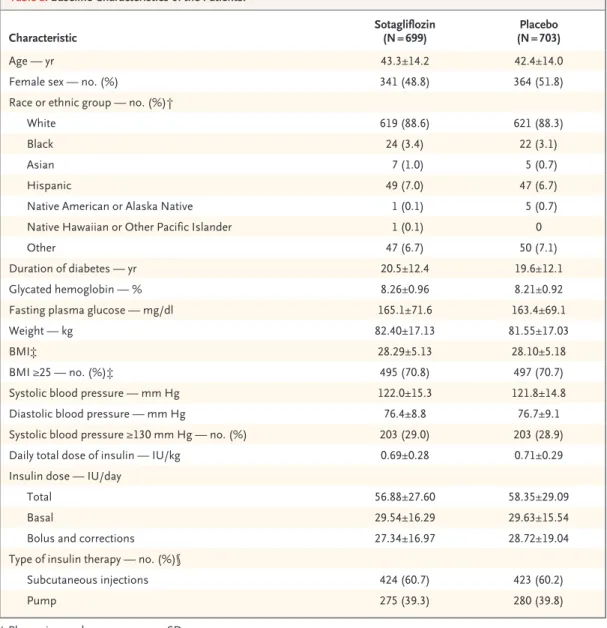
From October 2015 through September 2016, a total of 1405 patients underwent randomization; the trial was completed in April 2017. A total of 1402 patients (699 in the sotagliflozin group and 703 in the placebo group) received at least one dose of the trial regimen and were included in the modified intention-to-treat population. Baseline characteristics of the patients in each trial group are shown in Table 1. (For further details, see Fig. S1 and Table S1 in the Supple-mentary Appendix.)
Prespecified Efficacy End Points
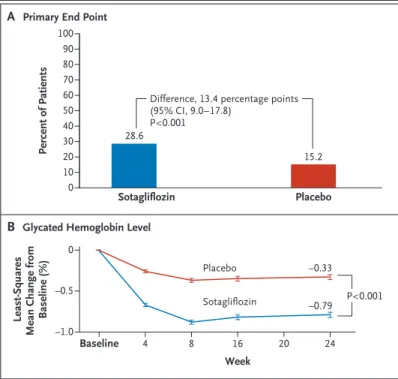
A significantly larger proportion of patients in the sotagliflozin group than in the placebo group achieved the primary end point of a glycated hemoglobin level lower than 7.0% at week 24 and no severe hypoglycemia or diabetic ketoaci-dosis (200 of 699 patients [28.6%] vs. 107 of 703
[15.2%]) (Fig. 1 and Table 2). The estimated between-group difference was 13.4 percentage points (95% confidence interval [CI], 9.0 to 17.8; P<0.001). Similarly, in the subgroup analysis ac-cording to type of insulin therapy (pump vs. no pump), approximately twice as many patients in the sotagliflozin group as in the placebo group, both among those who used an insulin pump and those who did not, achieved the primary end point. Among patients who had a glycated hemo-globin level of 7.0% or higher at week 24, the rate of diabetic ketoacidosis was significantly higher and the rate of severe hypoglycemia was nonsignificantly higher in the sotagliflozin group than in the placebo group (Table 2).
Significantly more patients in the sotagliflozin group than in the placebo group achieved a gly-cated hemoglobin level lower than 7.0% (207 patients [29.6%] vs. 111 [15.8%]). The reduction in the glycated hemoglobin level from baseline to week 24 was significantly greater in the sota-gliflozin group than in the placebo group (dif-ference, −0.46 percentage points; P<0.001), and greater reductions occurred among patients with higher baseline levels (including levels ≥7.7%, >8.5%, and >9.0%) (Fig. 1). (For further details, see Fig. S2 and Table S2 in the Supplementary Appendix.)
A significantly larger proportion of patients in the sotagliflozin group than in the placebo group achieved end points defined according to various combinations of the following criteria: a prespecified threshold for glycated hemoglo-bin level (i.e., a level <7.0% or a ≥0.5% reduction in the level from baseline), a threshold for body weight (i.e., no weight gain or a >5% reduction in weight from baseline), and no episode of severe hypoglycemia or diabetic ketoacidosis. A glycated hemoglobin level lower than 7.0% was achieved with no weight gain in 171 patients (24.5%) in the sotagliflozin group and 51 patients (7.3%) in the placebo group. Among patients in either trial group who achieved a target glycated hemoglo-bin level, less than 2% had severe hypoglycemia and less than 2% had diabetic ketoacidosis; among those who had a 0.5% or greater reduc-tion in the glycated hemoglobin level from base-line, the rate of diabetic ketoacidosis was signifi-cantly higher in the sotagliflozin group than in the placebo group. (For further details, see Fig. S3 and Table S3 in the Supplementary Appendix.)
to week 24 was significantly greater in the sota-gliflozin group than in the placebo group (dif-ference, −2.98 kg; P<0.001). In the sotagliflozin group, the placebo-corrected reductions from baseline in the mean daily total, bolus, and basal doses of insulin were −5.3 units per day (−9.7%), −2.8 units per day (−12.3%), and −2.6 units per day (−9.9%), respectively (P<0.001 for all comparisons). Among patients with a systolic blood pressure of 130 mm Hg or higher at base-line, the reduction in systolic blood pressure from baseline to week 16 was significantly
great-er in the sotagliflozin group than in the placebo group (difference, −3.5 mm Hg; P = 0.002). In addition, in the modified intention-to-treat pop-ulation, the reductions in the fasting plasma glucose level and in systolic and diastolic blood pressure were significantly greater in the sota-gliflozin group than in the placebo group, as were the increases in the calcium-to-creatinine ratio and glucose-to-creatinine ratio. However, the changes in the albumin-to-creatinine ratio, serum creatinine level, and estimated glomerular filtration rate did not differ significantly between
Characteristic Sotagliflozin (N = 699) (N = 703)Placebo
Age — yr 43.3±14.2 42.4±14.0
Female sex — no. (%) 341 (48.8) 364 (51.8)
Race or ethnic group — no. (%)†
White 619 (88.6) 621 (88.3)
Black 24 (3.4) 22 (3.1)
Asian 7 (1.0) 5 (0.7)
Hispanic 49 (7.0) 47 (6.7)
Native American or Alaska Native 1 (0.1) 5 (0.7)
Native Hawaiian or Other Pacific Islander 1 (0.1) 0
Other 47 (6.7) 50 (7.1)
Duration of diabetes — yr 20.5±12.4 19.6±12.1
Glycated hemoglobin — % 8.26±0.96 8.21±0.92
Fasting plasma glucose — mg/dl 165.1±71.6 163.4±69.1
Weight — kg 82.40±17.13 81.55±17.03
BMI‡ 28.29±5.13 28.10±5.18
BMI ≥25 — no. (%)‡ 495 (70.8) 497 (70.7)
Systolic blood pressure — mm Hg 122.0±15.3 121.8±14.8
Diastolic blood pressure — mm Hg 76.4±8.8 76.7±9.1
Systolic blood pressure ≥130 mm Hg — no. (%) 203 (29.0) 203 (28.9)
Daily total dose of insulin — IU/kg 0.69±0.28 0.71±0.29
Insulin dose — IU/day
Total 56.88±27.60 58.35±29.09
Basal 29.54±16.29 29.63±15.54
Bolus and corrections 27.34±16.97 28.72±19.04
Type of insulin therapy — no. (%)§
Subcutaneous injections 424 (60.7) 423 (60.2)
Pump 275 (39.3) 280 (39.8)
* Plus–minus values are means ±SD.
† Race or ethnic group was reported by the patient. Patients who reported Hispanic ethnic group could also report a race. ‡ Body-mass index (BMI) is the weight in kilograms divided by the square of the height in meters.
the trial groups. (For further details, see Figs. S4 and S5 and Tables S2 and S4 in the Supplemen-tary Appendix.)
Results of sensitivity analyses, which were performed for the primary and secondary effi-cacy end points with the use of various imputa-tion methods, confirmed the results of the main analyses.
Documented Hypoglycemia
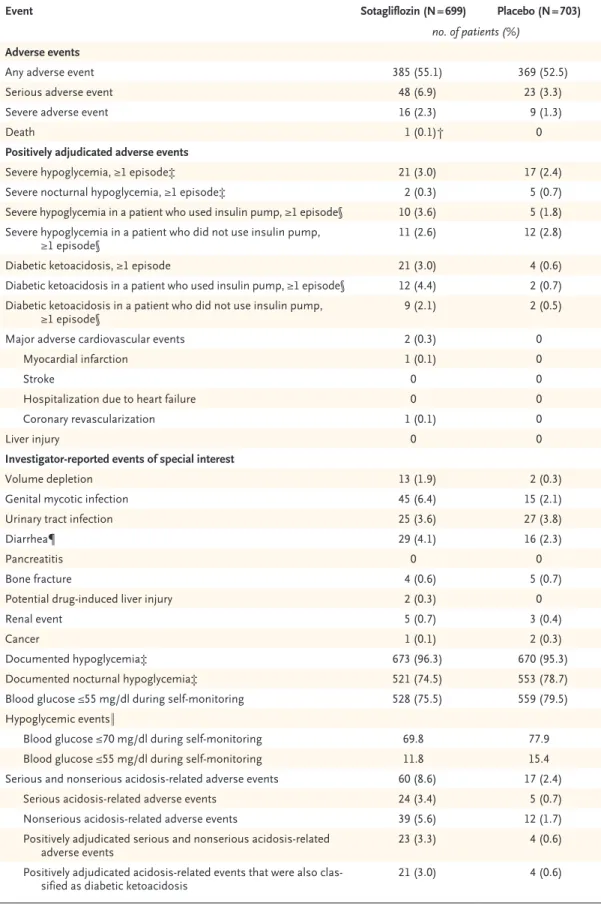
The percentage of patients who had an episode of documented hypoglycemia with a blood glu-cose level of 70 mg per deciliter or lower was similar in the sotagliflozin group and the pla-cebo group (96.3% [673 of 699 patients] and 95.3% [670 of 703], respectively); the corre-sponding event rates were 69.8 per person-year and 77.9 per person-year. The event rate of docu-mented hypoglycemia with a blood glucose level of 55 mg per deciliter or below was significantly lower in the sotagliflozin group than in the pla-cebo group (11.8 per person-year and 15.4 per person-year, respectively) (Table 3, and Table S4 in the Supplementary Appendix).
Safety
The overall rate of adverse events (regardless of cause) was similar in the sotagliflozin group and the placebo group (55.1% [385 of 699 pa-tients] and 52.5% [369 of 703], respectively) (Table 3). Most adverse events were mild to mod-Figure 1. Primary and Secondary End Points.
Panel A shows the percentage of patients who achieved the primary end point of a glycated hemoglobin level lower than 7.0% at week 24, with no episodes of severe hypoglycemia or diabetic ketoacidosis after randomiza-tion. Panel B shows the least-squares mean change in the glycated hemo-globin level from baseline to week 24. The baseline level was 8.26% in the sotagliflozin group and 8.21% in the placebo group. I bars indicate stan-dard errors. Analyses were performed in the modified intention-to-treat population, which included all patients who underwent randomization and received at least one dose of the trial regimen.
28.6
15.2
–0.33
–0.79 Sotagliflozin
Placebo
P<0.001
B Glycated Hemoglobin Level
A Primary End Point
Percent of Patients
100
40 50 60 70 80 90
30
10 20
0
Difference, 13.4 percentage points (95% CI, 9.0–17.8)
P<0.001
Sotagliflozin
Week
Placebo
Least-Squares
Mean Change from
Baseline (%)
0
–0.5
–1.0
Baseline 4 8 16 20 24
End Point Sotagliflozin (N = 699) (N = 703)Placebo Difference (95% CI) P Value
no./total no. (%) percentage points Patients with glycated hemoglobin <7.0% and no severe
hypoglycemia or diabetic ketoacidosis
All patients 200/699 (28.6) 107/703 (15.2) 13.4 (9.0 to 17.8) <0.001
Patients who used insulin pump 88/275 (32.0) 45/280 (16.1) 15.9 (8.6 to 23.3) <0.001
Patients who did not use insulin pump 112/424 (26.4) 62/423 (14.7) 11.8 (6.1 to 17.4) <0.001 Patients with glycated hemoglobin ≥7.0% and ≥1 episode
of severe hypoglycemia* 16/699 (2.3) 13/703 (1.8) 0.4 (−1.0 to 1.9) 0.56
Patients with glycated hemoglobin ≥7.0% and ≥1 episode
of diabetic ketoacidosis* 18/699 (2.6) 4/703 (0.6) 2.0 (0.7 to 3.3) 0.003
* These results are from a post hoc analysis that was performed with the use of asymptotic methods to summarize the differences in binomial proportions without stratification according to randomization factors. The small number of events suggested that stratified tests would not be sensible. This category included patients who had an event of interest and a glycated hemoglobin value of 7.0% or higher at week 24 or missing data at the 24-week assessment.
erate in severity. Gastrointestinal events (consis-tent with SGLT1 inhibition) and genital mycotic infections (consistent with SGLT2 inhibition) were more common in the sotagliflozin group than in the placebo group (Table 3, and Table S5 in the Supplementary Appendix). Diarrhea oc-curred in 29 patients (4.1%) in the sotagliflozin group and in 16 (2.3%) in the placebo group, and it led to discontinuation in 3 patients (0.4%) in the sotagliflozin group and none in the pla-cebo group. Genital mycotic infection occurred in 45 patients (6.4%) in the sotagliflozin group and in 15 (2.1%) in the placebo group, and it led to discontinuation in less than 1% of patients in each trial group. Bone fractures occurred in 4 and 5 patients in the sotagliflozin and placebo groups, respectively. No amputations were re-ported during the trial.
More patients in the sotagliflozin group than in the placebo group had serious adverse events (48 patients [6.9%] vs. 23 [3.3%]), and more pa-tients in the sotagliflozin group withdrew from the trial because of an adverse event (44 patients [6.3%] vs. 16 [2.3%]). One death (a suicide) oc-curred in the sotagliflozin group and was judged to be unrelated to the trial drug. Two major ad-verse cardiovascular events occurred in the sota-gliflozin group.
One or more episodes of severe hypoglycemia occurred in 21 patients (3.0%) in the sotagliflozin group and in 17 (2.4%) in the placebo group. Among patients who used an insulin pump, one or more episodes of severe hypoglycemia oc-curred in more patients in the sotagliflozin group than in the placebo group (10 of 275 pa-tients [3.6%] vs. 5 of 280 [1.8%]); the numbers among those who did not use an insulin pump were similar in the two groups (11 of 424 pa-tients [2.6%] and 12 of 423 [2.8%], respectively). The trial regimen was discontinued due to se-vere hypoglycemia in 2 patients in the sota-gliflozin group and in 1 in the placebo group.
The rate of acidosis-related adverse events at week 24 was 8.6% in the sotagliflozin group and 2.4% in the placebo group. The rate of one or more positively adjudicated episodes of diabetic ketoacidosis was higher in the sotagliflozin group than in the placebo group overall (3.0% vs. 0.6%), as well as among those who used an in-sulin pump (4.4% vs. 0.7%) and those who did not use an insulin pump (2.1% vs. 0.5%). The
trial regimen was discontinued due to an adjudi-cated diabetic ketoacidosis event in 11 patients (1.6%) in the sotagliflozin group and in 1 (0.1%) in the placebo group.
Discussion
In the inTandem3 trial involving patients with type 1 diabetes who were receiving any approved insulin, the percentage of patients who achieved the primary end point of a glycated hemoglobin level lower than 7.0% at week 24 and no episode of severe hypoglycemia or diabetic ketoacidosis was higher in the group that received sota-gliflozin than in the placebo group (28.6% vs. 15.2%). However, the rates of diabetic ketoacido-sis and hypoglycemia were higher in the sota-gliflozin group than in the placebo group. The use of sotagliflozin was also associated with significant decreases in glycated hemoglobin level, fasting plasma glucose level, insulin dose, weight, and systolic blood pressure.
Roughly two thirds of adult patients with type 1 diabetes have a glycated hemoglobin level of 7.0% or higher, and up to two thirds are over-weight or obese.3-5 The baseline characteristics of the patients in our trial are consistent with these data; 71% of the patients had a baseline BMI of 25 or higher, and by design, all patients who underwent randomization had a glycated hemoglobin level of 7.0% or higher at screening. Reductions in the glycated hemoglobin level are usually associated with an increased incidence of hypoglycemia and weight gain.16 However, the target glycated hemoglobin level (<7.0%) was achieved in approximately twice as many patients in the sotagliflozin group as in the placebo group, and the target level was achieved without weight gain in three times as many patients in the sotagliflozin group as in the placebo group.
Event Sotagliflozin (N = 699) Placebo (N = 703) no. of patients (%)
Adverse events
Any adverse event 385 (55.1) 369 (52.5)
Serious adverse event 48 (6.9) 23 (3.3)
Severe adverse event 16 (2.3) 9 (1.3)
Death 1 (0.1)† 0
Positively adjudicated adverse events
Severe hypoglycemia, ≥1 episode‡ 21 (3.0) 17 (2.4)
Severe nocturnal hypoglycemia, ≥1 episode‡ 2 (0.3) 5 (0.7)
Severe hypoglycemia in a patient who used insulin pump, ≥1 episode§ 10 (3.6) 5 (1.8) Severe hypoglycemia in a patient who did not use insulin pump,
≥1 episode§ 11 (2.6) 12 (2.8)
Diabetic ketoacidosis, ≥1 episode 21 (3.0) 4 (0.6)
Diabetic ketoacidosis in a patient who used insulin pump, ≥1 episode§ 12 (4.4) 2 (0.7) Diabetic ketoacidosis in a patient who did not use insulin pump,
≥1 episode§ 9 (2.1) 2 (0.5)
Major adverse cardiovascular events 2 (0.3) 0
Myocardial infarction 1 (0.1) 0
Stroke 0 0
Hospitalization due to heart failure 0 0
Coronary revascularization 1 (0.1) 0
Liver injury 0 0
Investigator-reported events of special interest
Volume depletion 13 (1.9) 2 (0.3)
Genital mycotic infection 45 (6.4) 15 (2.1)
Urinary tract infection 25 (3.6) 27 (3.8)
Diarrhea¶ 29 (4.1) 16 (2.3)
Pancreatitis 0 0
Bone fracture 4 (0.6) 5 (0.7)
Potential drug-induced liver injury 2 (0.3) 0
Renal event 5 (0.7) 3 (0.4)
Cancer 1 (0.1) 2 (0.3)
Documented hypoglycemia‡ 673 (96.3) 670 (95.3)
Documented nocturnal hypoglycemia‡ 521 (74.5) 553 (78.7)
Blood glucose ≤55 mg/dl during self-monitoring 528 (75.5) 559 (79.5)
Hypoglycemic events‖
Blood glucose ≤70 mg/dl during self-monitoring 69.8 77.9
Blood glucose ≤55 mg/dl during self-monitoring 11.8 15.4
Serious and nonserious acidosis-related adverse events 60 (8.6) 17 (2.4)
Serious acidosis-related adverse events 24 (3.4) 5 (0.7)
Nonserious acidosis-related adverse events 39 (5.6) 12 (1.7)
Positively adjudicated serious and nonserious acidosis-related
adverse events 23 (3.3) 4 (0.6)
Positively adjudicated acidosis-related events that were also
clas-sified as diabetic ketoacidosis 21 (3.0) 4 (0.6)
among patients in the sotagliflozin group who did not achieve a glycated hemoglobin level lower than 7.0%.
In phase 2 trials, sotagliflozin, empagliflozin, and canagliflozin were associated with signifi-cant decreases in the glycated hemoglobin level among patients with type 1 diabetes.14,18,19 The design of our phase 3 trial allowed us to evaluate the effects of sotagliflozin in combination with insulin therapy in a setting that resembles day-to-day clinical practice. By week 24, the differ-ence between the sotagliflozin group and the placebo group in the reduction of the glycated hemoglobin level from baseline was 0.46 percent-age points. Slightly more patients in the
sota-gliflozin group than in the placebo group had severe hypoglycemia (21 and 17 patients, respec-tively), but the event rate (the rate per person-year) of documented hypoglycemia, with a thresh-old for blood glucose level of either ≤70 mg per deciliter or ≤55 mg per deciliter, was lower in the sotagliflozin group than in the placebo group. Modest but significant weight loss oc-curred in the sotagliflozin group, possibly be-cause of increased glycosuria, reduced insulin doses, or other unknown factors. Sotagliflozin treatment also led to significant reductions in blood pressure.
Other randomized, controlled trials that have evaluated the adjunctive use of liraglutide,
sita-Event Sotagliflozin (N = 699) Placebo (N = 703)
no. of patients (%) Events that led to discontinuation
Any adverse event that led to discontinuation 44 (6.3) 16 (2.3)
Any event of special interest that led to discontinuation** 21 (3.0) 5 (0.7)
Diarrhea 3 (0.4) 0
Genital mycotic infection 2 (0.3) 0
Urinary tract infection 0 2 (0.3)
Penile infection 1 (0.1) 0
Vulvovaginal candidiasis 1 (0.1) 0
Wrist fracture 1 (0.1) 0
Increase in hepatic enzyme 1 (0.1) 0
Severe hypoglycemia‡ 2 (0.3) 1 (0.1)
Diabetic ketoacidosis 11 (1.6) 1 (0.1)
Acetonemia 1 (0.1) 0
Neoplasm 0 1 (0.1)
Renal failure 0 1 (0.1)
* Data are for patients who received at least one dose of the trial regimen and include events that occurred up to 30 days after the last dose of the trial regimen was administered. For the definitions of volume-depletion events, renal events, and acidosis-related events, see the Supplementary Appendix.
† The death was a suicide that was judged to be unrelated to the trial drug.
‡ Severe hypoglycemia was defined as a hypoglycemic event that required assistance from another person or resulted in loss of consciousness or a seizure, regardless of the patient’s glucose level. Documented hypoglycemia was defined as a blood glucose level of 70 mg per deciliter or lower, with or without symptoms. Nocturnal hypoglycemia was de-fined as a hypoglycemic event that occurred between midnight and 5:59 a.m., regardless of whether the patient was awake during the event. Hypoglycemia was considered to be an event of special interest, with a specialized case-report form. Because the analysis for hypoglycemia was based on data recorded on this case-report form, investigators were asked not to report hypoglycemic events on the case-report form for adverse events unless the episode met criteria for a serious adverse event.
§ Percentages are based on the number of patients in the subgroup of patients who used a pump and the subgroup that did not use a pump, rather than on the total number of patients. In the sotagliflozin group, 275 patients used an insulin pump and 424 did not; in the placebo group, 280 patients used an insulin pump and 423 did not.
¶ Diarrhea was mostly transient and mild-to-moderate. ‖ These data are reported as events per person-year.
** All events of special interest that led to discontinuation were investigator-reported, except for severe hypoglycemia and diabetic ketoacidosis, which were adjudicated.
gliptin, and metformin in patients with type 1 diabetes have not shown consistent or sustained reductions in the glycated hemoglobin level or have shown increases in episodes of severe hypo-glycemia or diabetic ketoacidosis.20-23 The use of off-label adjunctive therapy is uncommon, and the only therapy other than insulin that is approved for the treatment of type 1 diabetes is injectable pramlintide, which modestly reduces the glycated hemoglobin level and weight but is associated with an increased risk of severe hypoglycemia and is thus used infrequently.3,16,24 Reductions in the glycated hemoglobin level, systolic blood pressure, and weight must be maintained for a long-term period to reduce the risk of complica-tions associated with diabetes, but mean changes in these outcomes may be less robust in short-term studies. Therefore, the decision to use ad-junctive therapy can currently be based only on clinical assessment of metabolic needs in patients in whom insulin alone is unlikely to be suffi-ciently effective.
In our trial, the addition of sotagliflozin to existing insulin regimens improved glycemic con-trol and led to reductions in the total, bolus, and basal doses of insulin. A decrease in insulin dose may be a risk factor for diabetic ketoacidosis.25,26
Regulatory authorities have required that warn-ings about diabetic ketoacidosis be added to prescribing labels for the SGLT2 inhibitor class, because these agents have been associated with diabetic ketoacidosis in patients with type 1 or type 2 diabetes.19,26-34 When SGLT inhibitors are administered, monitoring for ketosis, particularly during metabolically stressful situations, is re-quired.26,34 SGLT inhibitors should be discontin-ued before scheduled surgical procedures, and patients and clinicians should remain in close consultation regarding other forms of behavior-al and physiologicbehavior-al stress.26,35 Diabetic ketoaci-dosis may occur more frequently among those who use an insulin pump, because of kinked catheters, infusion-set problems, and other opera-tional failures, and therefore, those who use an insulin pump may require closer monitoring.36,37 The basal insulin formulations used in subcuta-neous-injection regimens, which have a longer duration of action than the rapid-acting insulin analogues used in pump regimens, may mitigate the risk of diabetic ketoacidosis.
Our trial has some limitations. First, the long-term effects of sotagliflozin cannot be deter-mined from this 24-week trial. Second, data on
glycated hemoglobin levels were masked to inves-tigators after screening to make the trial design consistent with other trials of sotagliflozin, and if investigators had had access to the data, they may have adjusted insulin therapy more aggres-sively to meet target glycated hemoglobin levels. Third, this trial employed measures to mitigate the risk of diabetic ketoacidosis that may have been more intensive than those used in typical clinical practice. Fourth, reductions in the gly-cated hemoglobin level, fasting plasma glucose level, and episodes of documented hypoglycemia suggest decreased glucose variability, but data from continuous glucose monitoring were not analyzed in this trial. Blinded data from continu-ous glucose monitoring will be analyzed in the recently completed inTandem1 and inTandem2 trials (ClinicalTrials.gov numbers, NCT02384941 and NCT02421510, respectively). Fifth, no artifi-cial pancreas system had been approved at the time of trial initiation. Since sotagliflozin treat-ment was associated with a decrease in insulin dose, its use in patients who use a currently approved artificial pancreas system may require further evaluation.38,39
In summary, among adult patients with type 1 diabetes who were receiving insulin therapy, the proportion of patients who achieved a glycated hemoglobin level lower than 7.0% and had no severe hypoglycemia or diabetic ketoacidosis was larger in the group that received sotagliflozin than in the placebo group. However, the rates of dia-betic ketoacidosis and severe hypoglycemia were higher among patients who received sotagliflozin but did not achieve the target glycated hemoglo-bin level than among those who received placebo. Supported by Lexicon Pharmaceuticals. (Lexicon Pharmaceuti-cals and Sanofi entered a license agreement, effective November 2015, and are collaborating on the development and commer-cialization of sotagliflozin.)
Disclosure forms provided by the authors are available with the full text of this article at NEJM.org.
References
1. Diabetes atlas. 7th ed. Brussels: Inter-national Diabetes Federation, 2015.
2. Imperatore G, Boyle JP, Thompson TJ, et al. Projections of type 1 and type 2 dia-betes burden in the U.S. population aged <20 years through 2050: dynamic model-ing of incidence, mortality, and population growth. Diabetes Care 2012; 35: 2515-20.
3. Miller KM, Foster NC, Beck RW, et al. Current state of type 1 diabetes treatment in the U.S.: updated data from the T1D Exchange clinic registry. Diabetes Care 2015; 38: 971-8.
4. McKnight JA, Wild SH, Lamb MJ, et al. Glycaemic control of Type 1 diabetes in clinical practice early in the 21st century: an international comparison. Diabet Med 2015; 32: 1036-50.
5. Weinstock RS, Schütz-Fuhrmann I, Connor CG, et al. Type 1 diabetes in older adults: comparing treatments and chron-ic complchron-ications in the United States T1D Exchange and the German/Austrian DPV registries. Diabetes Res Clin Pract 2016; 122: 28-37.
6. Cryer PE. Mechanisms of hypoglyce-mia-associated autonomic failure in dia-betes. N Engl J Med 2013; 369: 362-72.
7. Kitabchi AE, Umpierrez GE, Miles JM, Fisher JN. Hyperglycemic crises in adult patients with diabetes. Diabetes Care 2009; 32: 1335-43.
8. Realsen J, Goettle H, Chase HP. Mor-bidity and mortality of diabetic ketoacido-sis with and without insulin pump care. Diabetes Technol Ther 2012; 14: 1149-54.
9. National diabetes statistics report. At-lanta: Centers for Disease Control and Pre-vention, 2017 (https:/ / www .cdc .gov/ diabetes/ data/ statistics/ statistics-report .html).
10. Number of emergency department vis-its (in thousands) with hypoglycemia as first-listed diagnosis and diabetes as sec-ondary diagnosis, adults aged 18 years or older, United States, 2006–2009. Atlanta: Centers for Disease Control and Preven-tion, 2014 (https:/ / www .cdc .gov/ diabetes/ statistics/ hypoglycemia/ fig1 .htm).
11. Lapuerta P, Zambrowicz B, Strumph P, Sands A. Development of sotagliflozin, a dual sodium-dependent glucose trans-porter 1/2 inhibitor. Diab Vasc Dis Res 2015; 12: 101-10.
12. Zambrowicz B, Ogbaa I, Frazier K, et al. Effects of LX4211, a dual sodium-depen-dent glucose cotransporters 1 and 2 in-hibitor, on postprandial glucose, insulin, glucagon-like peptide 1, and peptide tyro-sine tyrotyro-sine in a dose-timing study in healthy subjects. Clin Ther 2013; 35: 1162-1173.e8.
13. Dobbins RL, Greenway FL, Chen L, et al. Selective sodium-dependent glucose transporter 1 inhibitors block glucose ab-sorption and impair glucose-dependent insulinotropic peptide release. Am J Physiol Gastrointest Liver Physiol 2015; 308: G946-G954.
14. Sands AT, Zambrowicz BP,
Rosen-stock J, et al. Sotagliflozin, a dual SGLT1 and SGLT2 inhibitor, as adjunct therapy to insulin in type 1 diabetes. Diabetes Care 2015; 38: 1181-8.
15. Zambrowicz B, Freiman J, Brown PM, et al. LX4211, a dual SGLT1/SGLT2 inhibi-tor, improved glycemic control in patients with type 2 diabetes in a randomized, placebo-controlled trial. Clin Pharmacol Ther 2012; 92: 158-69.
16. Bode BW, Garg SK. The emerging role of adjunctive noninsulin antihyperglyce-mic therapy in the management of type 1 diabetes. Endocr Pract 2016; 22: 220-30.
17. Einarson TR, Garg M, Kaur V, Hemels ME. Composite endpoints in trials of type-2 diabetes. Diabetes Obes Metab 2014; 16: 492-9.
18. Pieber TR, Famulla S, Eilbracht J, et al. Empagliflozin as adjunct to insulin in pa-tients with type 1 diabetes: a 4-week, ran-domized, placebo-controlled trial (EASE-1). Diabetes Obes Metab 2015; 17: 928-35.
19. Henry RR, Thakkar P, Tong C, Poli-dori D, Alba M. Efficacy and safety of canagliflozin, a sodium-glucose cotrans-porter 2 inhibitor, as add-on to insulin in patients with type 1 diabetes. Diabetes Care 2015; 38: 2258-65.
20. Mathieu C, Zinman B, Hemmingsson JU, et al. Efficacy and safety of liraglutide added to insulin treatment in type 1 dia-betes: the ADJUNCT ONE treat-to-target randomized trial. Diabetes Care 2016; 39: 1702-10.
21. Petrie JR, Chaturvedi N, Ford I, et al. Cardiovascular and metabolic effects of metformin in patients with type 1 diabe-tes (REMOVAL): a double-blind, random-ised, placebo-controlled trial. Lancet Dia-betes Endocrinol 2017; 5: 597-609.
22. Garg SK, Moser EG, Bode BW, et al. Effect of sitagliptin on post-prandial glu-cagon and GLP-1 levels in patients with type 1 diabetes: investigator-initiated, double-blind, randomized, placebo-con-trolled trial. Endocr Pract 2013; 19: 19-28.
23. Ellis SL, Moser EG, Snell-Bergeon JK, Rodionova AS, Hazenfield RM, Garg SK. Effect of sitagliptin on glucose control in adult patients with Type 1 diabetes: a pilot, double-blind, randomized, crossover trial. Diabet Med 2011; 28: 1176-81.
24. Lyons SK, Hermann JM, Miller KM, et al. Use of adjuvant pharmacotherapy in type 1 diabetes: international comparison of 49,367 individuals in the Diabetes Pro-spective Follow-up and T1D Exchange Registries. Diabetes Care 2017 August 2 (Epub ahead of print).
25. Taylor SI, Blau JE, Rother KI. SGLT2 inhibitors may predispose to ketoacidosis. J Clin Endocrinol Metab 2015; 100: 2849-52.
26. Handelsman Y, Henry RR, Bloom-garden ZT, et al. American Association of Clinical Endocrinologists and American College of Endocrinology position state-ment on the association of SGLT-2
inhibi-tors and diabetic ketoacidosis. Endocr Pract 2016; 22: 753-62.
27. Benstetter M. SGLT2 inhibitors: PRAC makes recommendations to minimise risk of diabetic ketoacidosis. Healthcare pro-fessionals should be aware of possible atypical cases. London: European Medi-cines Agency, 2016.
28. Hine J, Paterson H, Abrol E, Russell-Jones D, Herring R. SGLT inhibition and euglycaemic diabetic ketoacidosis. Lancet Diabetes Endocrinol 2015; 3: 503-4.
29. Erondu N, Desai M, Ways K, Meininger G. Diabetic ketoacidosis and related events in the canagliflozin type 2 diabetes clin-ical program. Diabetes Care 2015; 38: 1680-6.
30. Peters AL, Buschur EO, Buse JB, Cohan P, Diner JC, Hirsch IB. Euglycemic dia-betic ketoacidosis: a potential complica-tion of treatment with sodium-glucose cotransporter 2 inhibition. Diabetes Care 2015; 38: 1687-93.
31. Hayami T, Kato Y, Kamiya H, et al. Case of ketoacidosis by a sodium-glucose cotransporter 2 inhibitor in a diabetic pa-tient with a low-carbohydrate diet. J Dia-betes Investig 2015; 6: 587-90.
32. Ogawa W, Sakaguchi K. Euglycemic diabetic ketoacidosis induced by SGLT2 inhibitors: possible mechanism and con-tributing factors. J Diabetes Investig 2016; 7: 135-8.
33. Henry RR, Rosenstock J, Edelman S, et al. Exploring the potential of the SGLT2 inhibitor dapagliflozin in type 1 diabetes: a randomized, double-blind, placebo-con-trolled pilot study. Diabetes Care 2015; 38: 412-9.
34. Fralick M, Schneeweiss S, Patorno E. Risk of diabetic ketoacidosis after initia-tion of an SGLT2 inhibitor. N Engl J Med 2017; 376: 2300-2.
35. American Diabetes Association. 8. Pharmacologic approaches to glycemic treatment. Diabetes Care 2017; 40: Suppl 1: S64-S74.
36. Weissberg-Benchell J, Antisdel- Lomaglio J, Seshadri R. Insulin pump therapy: a meta-analysis. Diabetes Care 2003; 26: 1079-87.
37. Heller S, White D, Lee E, et al. A clus-ter randomised trial, cost-effectiveness analysis and psychosocial evaluation of insulin pump therapy compared with multiple injections during flexible inten-sive insulin therapy for type 1 diabetes: the REPOSE Trial. Health Technol Assess 2017; 21(20): 1-278.
38. Garg SK, Weinzimer SA, Tamborlane WV, et al. Glucose outcomes with the in-home use of a hybrid closed-loop insulin delivery system in adolescents and adults with type 1 diabetes. Diabetes Technol Ther 2017; 19: 155-63.
39. Bergenstal RM, Garg S, Weinzimer SA, et al. Safety of a hybrid closed-loop insu-lin delivery system in patients with type 1 diabetes. JAMA 2016; 316: 1407-8.