IS TOUCH GATING DUE TO SENSORY OR COGNITIVE INTERFERENCE? AN INVESTIGATION USING REPEATED TESTING
Daniel Elliott Harper
A thesis submitted to the faculty of the University of North Carolina at Chapel Hill in partial fulfillment of the requirements for the degree of Master of Arts in the Department of Psychology (Behavioral Neuroscience Program).
Chapel Hill 2011
ii ABSTRACT
DANIEL HARPER: Is touch gating due to sensory or cognitive interference? An investigation using repeated testing
(Under the direction of Mark Hollins)
The present study was conducted to determine whether touch gating, in which pain decreases tactile sensitivity, is the result of sensory or cognitive interference. Touch gating was repeatedly produced by delivering a co-localized painful heat stimulus (45°C) during measurements of vibration threshold on the palm. Pain significantly increased thresholds compared to those measured at normal skin temperature and this interference did not decline over the course of the experiments, despite the fact that perceived pain significantly habituated. For comparison, Stroop interference was also measured
iii
ACKNOWLEDGEMENTS
iv
LIST OF TABLES ...v
LIST OF FIGURES ... vi
LIST OF ABBREVIATIONS ... vii
IS TOUCH GATING SENSORY OR COGNITIVE INTERFERENCE? I. INTRODUCTION ...1
II. METHOD ...8
III. RESULTS ...18
IV. DISCUSSION ...26
V. CONCLUSIONS ...34
TABLES ...36
FIGURES ...38
APPENDIX ...47
v
LIST OF TABLES
Table
1. Raw data from initial and final touch gating measurements ...36 2. Questionnaire scores and correlational comparisons to
vi
LIST OF FIGURES
Figure
1. Experimental timeline ...38 2. Effect of pain on vibrotactile thresholds in
concurrent pain (CP) group ...40 3. Effect of pain on vibrotactile thresholds in
subsequent pain (SP) group ...41 4. Sensitization to 45°C heat during the six
stimulations (CPRs and SPRs) ...42 5. Short- and long-term pain habituation ...43 6. Pain habituation in concurrent pain (CP)
vii
LIST OF ABBREVIATIONS CP: concurrent pain group
CPR: concurrent pain run – pain presented concurrently during measurement of vibration threshold
NPR: no-pain run – measurement of vibration threshold without pain SP: subsequent pain group
Is Touch Gating due to Sensory or Cognitive Interference? An Investigation Using Repeated Testing
The Gating of Touch by Pain
Touch gating refers to the phenomenon in which noxious stimulation reduces tactile sensitivity. The phenomenon was first described by Apkarian and colleagues (1994), who showed that vibrotactile thresholds on the thenar are significantly elevated and the perceived intensity of suprathreshold vibrotactile stimuli is reduced by the concurrent application of painful heat. Later research revealed that touch gating is strongest when the pain and tactile stimuli are presented within the same dermatome, a region of skin innervated by a single spinal nerve segment, as less gating occurs when the stimuli are applied to regions innervated by the same peripheral nerve, but in neighboring dermatomes (Bolanowski et al., 2000).
Neuroimaging studies imply that the tactile decrement induced by nearby noxious stimulation is related to decreased processing of tactile signals in the primary
2
3b and 1 of the somatosensory cortex (Tommerdahl et al., 1996; Whitsel et al., 2010), regions that are important for processing innocuous tactile information. Researchers have suggested that this decreased somatosensory activity is purely sensory in origin
(Apkarian et al., 1994; Bolanowski et al., 2001). However, vibrotactile stimuli have been shown to activate primary and secondary somatosensory cortices more strongly when attention is directed toward them (Johansen-Berg et al., 2000), and distraction by a numeric arithmetic task was found to significantly reduce somatosensory activity evoked by tactile stimulation (Sterr et al., 2007). Therefore, if pain taxes the attentional
resources of the brain and allocates processing away from vibrotactile stimuli through its inherently distracting nature, it could potentially reduce activity in the tactile-processing regions of the somatosensory cortex through non-sensory mechanisms.
Is Touch Gating Related to the Distracting Nature of Pain?
3
(Benedetti et al., 1999). Thus, it is not outside the realm of possibility that distraction could be directed to specific regions of the body. Third, vibrotactile amplitude discrimination has been shown to be unaffected by experimentally induced pain
(Bolanowski et al., 2001). This implies that if touch gating is a form of distraction, pain must selectively reduce tactile sensitivity without reducing the cognitive capacity to discriminate between suprathreshold stimuli.
While the aforementioned psychophysical studies have provided some evidence that touch gating is due to sensory, rather than cognitive, interference, systematic
attempts to fully resolve this important issue are much needed and still lacking. The few arguments discounting the distracting nature of pain as its device of tactile suppression are overshadowed by the abundant literature showing that pain can distract from optimal performance in a variety of tasks (for review, see Eccleston & Crombez, 1999).
4
the distracting nature of a novel pain stimulus, then pain’s effect on touch should decline with repeated stimulus presentations as the pain stimulus loses its novelty, becomes more predictable, and as the distracting nature of pain habituates.
Dynamic Changes in Pain Sensitivity
In addition to the habituation seen with distraction (Crombez et al., 1997), habituation to pain itself has been shown to occur in a variety of situations. Pain habituation refers to a decrement in pain or pain-related responses with repeated or prolonged noxious stimulation. In some stimulation paradigms, habituation can occur over the course of seconds or minutes (Condes-Lara et al., 1981; Defrin et al., 2008; Ernst et al., 1986; Greffrath et al., 2007; Kleinböhl et al., 2006; Milne et al., 1991; Mobascher et al., 2010; Rhudy et al., 2010), a phenomenon often referred to as “short-term” habituation. The main peripheral component of this type of habituation is well understood; when a noxious stimulus is repeatedly or continuously presented to the same region of skin, fatigue in the primary afferents results in the transmission of progressively weaker signals to the central nervous system (Price et al., 1977). However, at least some of the habituation to pain in the short-term is centrally mediated, because habituation to painful heat applied at 8-10 s intervals has still been found, albeit to a lesser extent, when a noxious heat stimulus is moved to fresh skin between stimuli (Greffrath et al., 2007). Long-term pain habituation can also occur across experimental sessions in which exposure to pain is repeated over the course of days or weeks (Bingel et al., 2007;
5
pain decreases in the long-term, brain areas that respond to noxious stimuli (ex. anterior cingulated cortex (ACC), insula, secondary somatosensory cortex (S2), putamen)
decrease in pain-evoked activity; one notable exception is S1, which did not significantly decrease following days of pain exposure (Bingel et al., 2007).
Touch Gating and Perceived Pain
Although experimental evidence of how pain intensity relates to distraction and touch gating magnitude is sparse, chronic pain of high intensity has been shown to involve greater distraction than lower-intensity chronic pain (Eccleston, 1994). A recent study of the distraction produced by experimental heat pain found that, for a given stimulus intensity, perceived pain on a given trial could predict the ensuing impairment on the cognitive task (Buhle & Wager, 2010). Two studies of experimental pain have reported positive correlations between perceived pain and touch gating magnitude (Apkarian et al., 1994; Geber et al., 2008), but another has found no relationship (Kosek & Hansson, 2002). If touch gating is related to distraction, which is partially a function of perceived pain intensity, touch gating magnitude might decrease if perceived pain habituates with repeated application of the noxious stimulus.
Aims of the Present Study
The present study had several aims, all of which concerned testing whether touch gating is a form of sensory or cognitive interference.
6
or she gradually became more familiar with detecting vibrations in the presence of pain, and as perceived pain habituated over time. Since distraction by pain has been shown to be less pronounced in cases where pain is predictable (Crombez et al., 1994) and because distraction habituates (Crombez et al., 1997), I reasoned that touch gating would decline with repeated applications of the same noxious stimulus if distraction is involved. Distractibility was measured with the Cognitive Failures Questionnaire (Broadbent et al., 1982) to determine whether those with high levels of everyday distractibility have
stronger gating. The Fear of Pain Questionnaire-III (McNeil & Rainwater, 1998) and the Pennebaker Inventory of Limbic Languidness (PILL; Pennebaker, 1982), a measure of hypervigilance, were also administered due to the relationship between these
psychological variables and pain’s ability to induce distraction (Vancleef & Peters, 2006b).
As an experimental measure of a type of cognitive interference with which touch gating could be compared, the Stroop color-word task was administered (Stroop, 1935). When asked to report the actual color of words that spell out mismatched colors,
7
irrelevant stimuli and more familiar with (or automatic in) naming colors (Davidson et al., 2007; Stroop, 1935).
Just as subjects who participate in the Stroop task must ignore an automatized tendency to read words, subjects required to detect faint vibrations while co-localized noxious stimulation is present might need to overcome the automatically distracting nature of pain. If this is the case, I reasoned that the amount of interference observed in the Stroop task might correlate with the magnitude of touch gating. Furthermore, if touch gating is a form of cognitive interference, then touch gating, like Stroop interference, should be reduced as subjects repeatedly engage cognitive control mechanisms to overcome the interfering stimulus. Therefore, Stroop interference was repeatedly measured during each session to determine whether touch gating correlates with Stroop interference, and more broadly to observe whether interference in two tasks changes similarly with repeated testing.
8
One group of subjects practiced detecting vibrations in the presence of pain six times, twice per session, to determine whether touch gating is reduced with its repeated activation. A control group received the same amount of pain and the same number of vibrotactile threshold trials, but these subjects were presented with the pain stimulus immediately following threshold measurements (except for an initial and a final measurement of vibration threshold that were carried out in the presence of pain). Therefore, subjects in the control group did not practice detecting vibrations in the presence of pain to the same extent that the other group did. This enabled a
determination of whether any reduction in touch gating was dependent on practice in detecting vibrations in the presence of pain, or whether a comparable reduction could occur with the same amount of stimulation, but less practice with concurrent pain and vibration.
Method
Subjects
9
archival subjects, 12 were in the Concurrent Pain (CP) Group and 12 were in the Sequential Pain (SP) Group (see Procedure). The age of participants ranged from 18 to 25 years, and the mean age was 20.5 years (SD=1.9). For each subject, the four sessions were conducted at the same time of day when possible. The mean number of days from one session to the next was 8.8, and the median was 7 days. The study procedures were approved by the University’s IRB, and written informed consent was obtained from all subjects. Participants were compensated $30 for completion of each session, and each received a $30 bonus for completing the fourth session.
Apparatus
Vibrotactile and thermal stimuli. Vibrations and thermal stimulation were
custom-10
designed LabView programs. A display monitor that was only visible to the experimenters was used to observe the progress of each run.
Color vision test. Because Stroop interference was measured in this study, it was
necessary to ensure that all subjects had normal color vision. During the first session, color vision was tested using a set of pseudoisochromatic plates (American Optical Corporation, 1965). The fourteen plates were shown in succession to participants under lighting provided by a Macbeth easel lamp with a daylight filter. Based on the standard scoring method for this test (American Optical Corporation, 1965), participants were required to miss no more than four of the plates to be eligible for continuing in the study. All participants passed the test.
Stroop stimuli. During each measure of Stroop interference, subjects said aloud
the color of color words that were presented in non-matching colors (ex. the word “red” presented in blue). The stimuli designed to produce an interference effect were
composed of five different color words (blue, brown, red, green, and yellow), which were presented in one of the four non-matching colors during interference runs. An
interference run consisted of 60 color words, 12 of each color, that were simultaneously presented to the subject on a computer monitor. Of the 12 times that each word appeared on the screen, it was colored one of the other four colors an equal number of times (3 times in each color mismatch). The order in which the words in the 16 different
11
same constraints were placed on the development and randomization of these stimulus sheets, including 12 presentations of each of the five colors and on more than two stimuli of the same color in a row. To control for the fact that the different length of the words may have changed the difficulty of the task in the interference condition, different
numbers of X’s were used in the stimuli of the control sheets, corresponding to the length of the words used to produce interference. Therefore, of the 60 stimuli in a control sheet, XXX, XXXX, and XXXXXX, appeared 12 times each (for the words red, blue, and yellow, respectively) and XXXXX appeared 24 times (for green and brown).
Stroop interference was measured 16 times total, four times during each session. Interference was calculated by subtracting the time taken to complete a control sheet from the time taken to complete an interference sheet. The order in which the 16 control and 16 interference sheets was presented to a given participant was randomly determined, subject to the constraint that each sheet was used one time for each subject. Whether the interference or the control run was presented first during each measure of interference was also randomly determined.
Questionnaire measures. The following questionnaires were completed by
subjects at the beginning of Sessions 2 and 4: Cognitive Failures Questionnaire (Broadbent et al., 1982), Fear of Pain Questionnaire-III (McNeil & Rainwater, 1998), Pennebaker Inventory of Limbic Languidness (PILL; Pennebaker, 1982), State portion of the State Trait Anxiety Inventory (STAI; Spielberger, 1983). Current and pain
12 Procedure
Session 1.
Consent and Stroop task training. At the beginning of Session 1 the study was
explained to the subject and informed consent was obtained. The overhead lights were turned off, and a Macbeth easel lamp with a daylight filter was illuminated for the administration of the color vision test. One experimenter presented each stimulus to the subject, while the other experimenter recorded the subject’s response. Following administration of the color vision test, the subject was seated in front of a computer monitor, and he or she was instructed in how to participate in the Stroop task using a series of PowerPoint slides presented on the monitor. At the end of this training, the subject practiced the interference task briefly, using a set of 16 non-matching color words. Any mistakes were corrected by the experimenters.
Vibrotactile threshold training. The subject was seated at the VLS table and
trained in the procedure for measuring vibrotactile threshold in the absence of any noxious thermal stimulation. The subject was instructed to place the palm of the right hand flat on the tabletop with the middle of the thenar positioned over the hole containing the lowered vibrotactile contactor. He or she was instructed to rest the forearm on the table behind the site of stimulation and to sit as still as possible throughout each run. After the subject’s hand was stably positioned on the tabletop and the experimenters ensured that the middle of the thenar was in the correct position, the vibrotactile contactor was raised until it lightly touched the subject’s skin; this was made evident by
13
experimenter’s computer monitor. Following light contact with the skin, the contactor was raised 1mm to provide stable, repeatable contact between the hand and the
minishaker. Vibration threshold was measured at a frequency of 33Hz using a two-alternative forced-choice (2-AFC) procedure. Each trial in the 2-AFC threshold
determination contained two intervals (A and B), each 1 s in duration, separated by a gap of 1s. One of the two intervals contained a vibration and the other did not, the subject’s job being to correctly determine which of the two intervals contained the vibration on each trial. A computer monitor positioned a few feet directly in front of the subject kept the subject on track during runs. The monitor flashed the words “Get Ready” 1s before each trial occurred. Then, the letter “A” flashed on the screen during interval A, and “B” during interval B. After the intervals occurred the monitor prompted the subject’s response (“Respond Now”), and he or she indicated during which interval the vibration occurred using a joystick on a response box (labeled A and B), which was held in the subject’s left hand. After the subject gave a response, he or she was given feedback on the monitor indicating whether the response was right or wrong. Following this
14
experimenters, and for most subjects amplitude was stable during the final portion of a run. Two subjects had unusually low thresholds, necessitating the use of a lower initial amplitude (14 dB) in their runs. At the end of each run, the subject was given a 10 min break after completing the Stroop task (see below). Four measurements of vibration threshold were made during Session 1 in the absence of any thermal stimulation, to ensure that subjects were well-trained in the task.
Stroop task. Following each measurement of vibration threshold during Session
15
sheet, he or she completed a sheet of the opposite type after a delay of approximately 15s. After completing the second sheet, the subject left the experimental room for a 10-min (or 22-min in Sessions 2, 3, and 4) break before starting the next run.
Pain assessment. At the end of Session 1, following four measurements of
vibration threshold and Stroop interference, the subject underwent a pain assessment. Here the subject’s task was to periodically (every 30s) rate the intensity of the thermal stimulus (45°C), using a zero to 100 scale where zero means “no pain” and 100 means “the most intense pain imaginable,” for a period of four minutes. The temperature of the contactor and surround was initially adjusted to 40°C. The subject was instructed to place his or her hand on the tabletop, as was done in vibration threshold measurements, and the contactor was raised into position as described previously. After the 5-10 s it took to position the contactor, a stopwatch was started to record the time of stimulation and the temperature was gradually raised (~1.5 min) to 45°C. The subject called out numerical ratings of his or her perceived pain intensity every 30 s for a period of 4 min. Subjects were discontinued if they were unable to tolerate the stimulus for the duration or if they gave a rating of 100 on the 0-100 scale. If the subject passed the color vision test, followed instructions on the Stroop and vibrotactile threshold experiments, and found the pain stimulus tolerable, he or she was asked to come back for the main experimental sessions.
Main experiment. Sessions 2, 3, and 4 involved measuring (1) vibrotactile
16
Subjects underwent four measurements of vibration threshold during each session, two of which involved pain and two did not. Concurrent pain runs (CPRs) entailed measuring vibration threshold while the VLS was controlled to 45°C. For subjects in the SP group, some CPRs were replaced with subsequent pain runs (SPRs), in which vibration
threshold was measured at a neutral temperature (32°C) and was followed by presentation of the noxious stimulus (45°C) on its own. For the other two runs (non-pain runs, NPRs), a neutral temperature of 32°C was presented during threshold measurement. See Figure 1. The procedures for positioning the subject’s hand and carrying out the threshold
measurement using the 2-AFC protocol were identical to those aforementioned.
17
compared, other runs were conducted at a neutral temperature. These no-pain runs (NPRs) were carried out in an identical fashion, except the VLS temperature was controlled to 32°C (approximately skin temperature) before each NPR began and for its duration.
Participants in the concurrent pain (CP) group underwent two CPRs and two NPRs each session, for a total of 12 measurements of vibration threshold. In order to keep the time between the two exposures to pain within a session the same for all subjects, runs were carried out in the order CPR/NPR /CPR/NPR or
NPR/CPR/NPR/CPR. These orders were counterbalanced across subjects and remained the same for a given subject across sessions. The ordering of run types in this fashion provided two measurements of touch gating per session. See Table 1.
If significant decreases in the amount of touch gating with repeated testing were revealed in the results of the CP group, it would have been useful to know if the
18
replaced by subsequent-pain runs (SPRs), which were identical to NPRs in that the temperature was held at 32°C during the threshold measurement. However, to keep the cumulative amount of noxious stimulation the same as for the CP subjects, the pain stimulation was applied shortly after the threshold measurement of each SPR concluded. Following the vibrotactile threshold measurement portion of an SPR, the subject removed his or her hand from the apparatus while the VLS was heated to 40°C, which took
approximately 1 min. Then, he or she placed the hand on the apparatus in the usual manner, the contactor was raised into position, and the temperature was set to 45°C. Subjects gave ratings as they did during CPRs and NPRs for the first 1.5min (every 30s), and they then gave a rating each minute for the 6.5min duration of the pain stimulus. This duration was chosen because the duration of CPRs and NPRs was approximately 6.5 min.
The order of runs for the SP subjects followed the same format as the CP orders, again counterbalanced. See Table 2. Again, Stroop interference was measured using the same procedure implemented in Session 1 following each run. Approximately 20min elapsed between the end of one CPR, NPR, or SPR and the beginning of the next, within a session.
Results
Vibrotactile Threshold Training
19
highly consistent during the four training periods. Mean, thresholds were 8.2, 8.2, 8.1, and 7.5 dB re 1µm during runs 1, 2, 3, and 4, respectively, and a repeated-measures ANOVA showed that the effect of run number was not significant, F(3, 69) = .65, p = .59. Therefore, any changes in touch gating revealed in later sessions would have been due to the effect of pain on thresholds, rather than to changes in the participants’ baseline sensitivity to vibrations.
Touch Gating
Vibrotactile thresholds measured in the presence of a painful heat stimulus (45°C, CPRs) were compared with those measured in the absence of pain (32°C, NPRs) to determine whether the effect of concurrent pain was significant. An initial measurement of touch gating (CPR threshold – NPR threshold) was calculated using the values
20
Since one of the main goals of this study was to determine whether the magnitude of touch gating habituates with repeated activation of it, it was necessary to compare subjects in whom the touch gate was repeatedly activated (CP group) with others in whom it was not (SP group). Therefore, the CP group underwent four additional
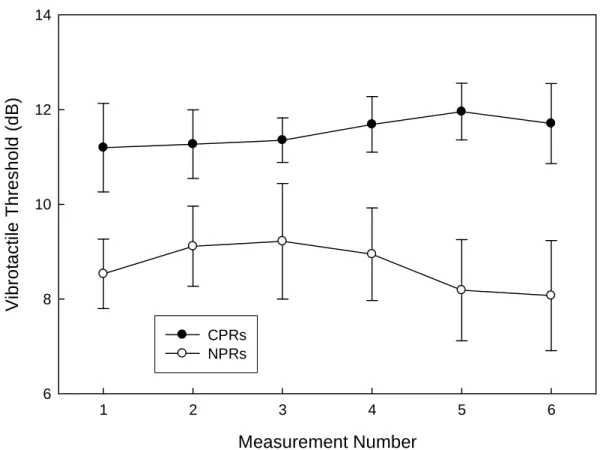
vibration threshold measurements with concurrent pain (CPRs) before the sixth and final touch gating measurement, which was composed of runs 3 and 4 of Session 4. See Figure 2. Paired samples t-tests comparing the four pairs of CPRs and NPRs undergone before
the final measure revealed significant touch gating during the second measure of Session 2, t(11) = 2.4, p = .03. The first measurement of Session 3 did not reach significance (p = .13), but the second did (p = .03), as did as the first measurement of Session 4 (p = .001). Thus, tactile sensitivity was fairly reliably inhibited by pain across repeated activations of the touch gate.
Because participants in the SP group did not undergo CPRs again until the final measurement of touch gating, the effect of pain on vibration threshold could not be tracked on a session-to-session basis. However, paired-samples t-tests were also carried out for threshold runs in these subjects, comparing control run thresholds with the
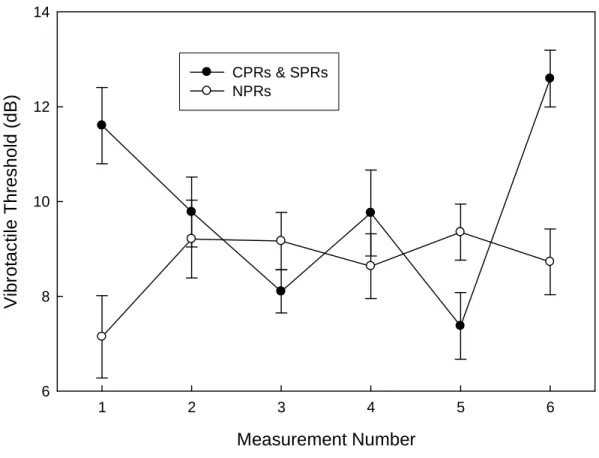
thresholds obtained just before the pain was initiated in modified pain runs, to ensure that thresholds did not significantly differ on a run-to-run basis. These tests revealed no significant difference between NPR and SPR vibration thresholds measured in the second half of Session 2, either half of Session 3, or the first half of Session 4 (p > .05 for all). See Figure 3. This was to be expected because the comparisons were between thresholds
21
course of the sessions in CP subjects, and no artifact resembling touch gating occurred when the corresponding NPR and SPR runs were compared in SP subjects.
To determine whether factors of repeated testing alter the magnitude of touch gating, paired-samples tests were conducted for the Final TG measure, which was
comprised of thresholds measured in runs 3 and 4 of Session 4. The results of these tests showed robust touch gating, t(11) = 3.8, p = .003, t(11) = 4.9, p < .001, and t(23) = 6.2, p < .001, for the CP, SP, and pooled groups, respectively. A repeated-measures ANOVA was carried out to determine whether touch gating changed between the Initial and Final measures. Here, touch gating (Initial vs. Final) was entered into the model as the within-subjects factor, and group (CP vs. SP) was entered as the between-within-subjects factor, to determine whether any change in touch gating over the course of repeated testing differed between the groups. This test revealed no significant effect of test number [F(1, 22) = .04, p = .84], no effect of group [F(1, 22) = .90, p = .35], and no interaction between the two factors [F(1, 22) = .73, p = .40]. Clearly, the magnitude of touch gating was not affected by repeated testing in either group.
Stroop Interference
22
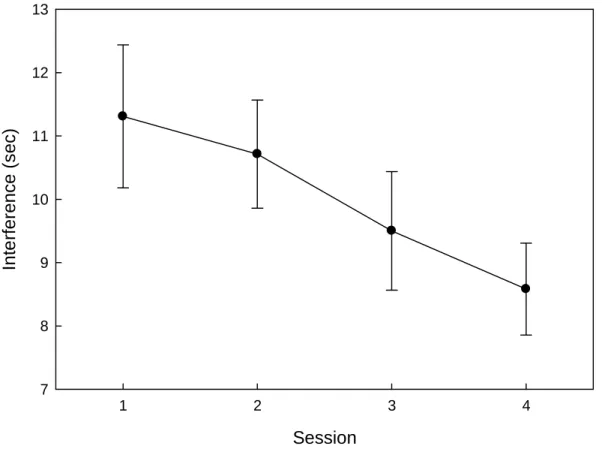
sessions, respectively. See Figure 7. Here, Stroop interference was calculated by
subtracting the time taken to complete the control sheets from the times taken to complete the interference sheets. This analysis revealed a significant main effect of Session [F(3, 66) = 7.2, p < .001], indicating a robust improvement in subjects’ ability to complete the task with distracters present on a session-to-session basis. The main effect of Run was not significant [F(3, 66) = .74, p = .53], which shows that subjects did not improve on the task within sessions. The Run/Session interaction was not significant [F(9, 198) = 1.18, p = .31]. Since Stroop interference was measured during all four sessions and TG during
only three, we looked at Stroop improvement using data from only the first three or last three sessions in a 3 X 4 repeated-measures ANOVA to determine whether the effect was still significant. The main effect of Session was still significant when looking at just the first three sessions [F(2, 46) = 3.9, p = .03] or the last three sessions [F(2, 46) = 6.3, p = .004], and the Run and Session/Run interactions were not significant in either case (p > .10 for both tests).
Pain Ratings
Measuring changes in pain. Because the temperature of the VLS rose from a
23
generally decreased from run to run within a session (short-term habituation), and from session to session (long-term habituation).
Sensitization. Pain did not habituate within a run; in fact, the tonic pain
stimulation caused pain ratings to increase (i.e. sensitize) with time. Repeated measures tests using the pooled data revealed that pain ratings significantly increased during all six of the pain runs that were employed [p<.01 in all cases]. See Figure 4.
Short-term habituation. Short-term habituation to pain was assessed by
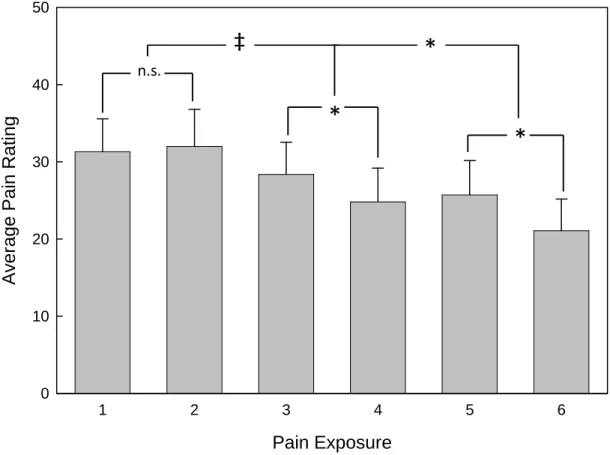
comparing the pain ratings obtained during the first pain run (CPR or SPR) within a session with those from the second pain run (CPR or SPR). See Figure 5. Pain scores (ratings 5-8) obtained during the first pain runs of Sessions 2, 3, and 4 were averaged and compared with the average pain ratings for the second pain runs of each session. A mixed-model ANOVA revealed a significant overall decrease in pain from the first to the second pain run within sessions [F(1, 22) = 7.3, p = .01]. The effect of group and the interaction between group and run were not significant (p > .10). Paired-samples t-tests to examine short-term habituation separately for the three sessions revealed significant decreases in pain during Sessions 3 [t(23) = 2.5, p = .02] and 4 [t(23) = 2.6, p = .01], but not during Session 2 [t(23) = -.36, p = .72].
Long-term habituation. To measure long-term habituation to pain, i.e. to
24
= 13.4, p < .001], and the trend approached significance in the SP group [F(1, 22) = 3.3, p = .057]; pooling the data from the two groups revealed robust long-term pain habituation [F(2,44) = 11.9, p < .001]. When Group was entered into the ANOVA as a between-subjects factor, neither the effect of Group nor the Group x Session interaction was significant (p > .10).
The CP group was exposed to the pain stimulus while they were required to focus on the task of detecting vibrations during all six pain runs (all CPRs), but the SP group was exposed to the pain by itself during the middle four pain runs (SPRs). Tests were conducted to determine whether perceived pain differed between the groups during the CP group’s CPRs and the SP group’s SPRs. To rule out any initial differences in perceived pain between the groups, ratings were normalized by dividing the ratings obtained in pain runs 2-5 by the initial pain ratings in run 1. See Figure 6. A mixed-model ANOVA with group as the between subjects factor and normalized pain scores for runs 2-5 as the within subjects factor revealed a significant main effect of run [F(3, 66) = 5.6, p = .002], indicating significant habituation to pain during this time frame. The main effect of group approached significance [F(1, 22) = 3.2, p = .09], which suggests a trend toward higher ratings in the SP group during pain exposures where they did not undergo the vibration task concurrently. The interaction between run and group was not
significant [F(3, 66) = 1.4, p = .26].
Questionnaire Measures
25
1982), Pennebaker Inventory for Limbic Languidness (PILL; Pennebaker, 1982), and state portion of the State–Trait Anxiety Inventory (STAI; Spielberger, 1983), were administered at the beginning of Sessions 2 and 4 to determine whether these
psychological factors were related to touch gating magnitude, perceived pain, and pain habituation. Pearson correlations between these questionnaire measures and Initial and Final measures of touch gating revealed that none was related to the amount of touch gating that occurred (p > .10 for all). See Table 2.
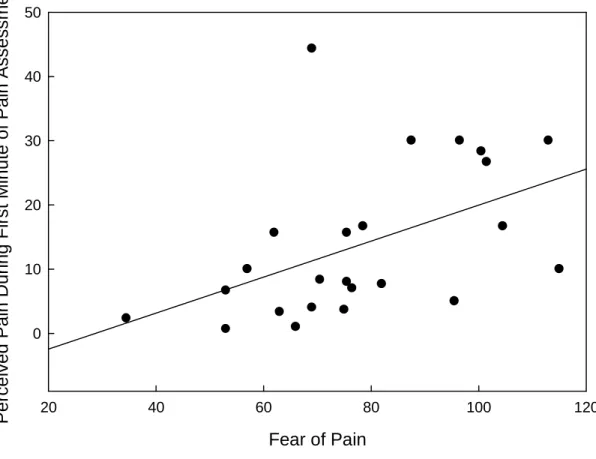
Correlations between perceived pain at various time points during the study revealed a significant relationship between a person’s fear of pain (average of scores on FOPQ administered in Sessions 2 and 4) and his or her perceived pain from the thermal stimulus during the first minute of the pain assessment [r = .45, p = .03]. See Figure 8. Fear of pain was not related to perceived pain during later portions of the pain
assessment, pain during the first minute of any of the six pain runs in the main
experiment, or pain during the later portions of any run (p > .10 for all). It appears that for the type of stimulation this study employed, fear of pain significantly enhanced perceived pain during the initial portion of the first exposure to the stimulus only.
Questionnaire measures of hypervigilance, anxiety, distractibility, and any current extra-experimental pain were not related to perceived pain at any time point in the study or to the amount of pain habituation that took place (p > .10 for all). Long-term pain habituation cannot be explained by changes in anxiety between Sessions 2 and 4, because a paired-samples t-test revealed no significant difference in anxiety (STAI scores)
26
between a subject’s STAI scores in Sessions 2 and 4 was not correlated with the difference in average pain ratings recorded during the two sessions [r = .02, p = .92].
Touch Gating, Stroop Interference, and Perceived Pain
Pearson correlations between the initial measure of touch gating and the amount of Stroop interference revealed no significant relationship between the interference incurred during the two tasks; this was true for both the initial measure of Stroop interference recorded during Session 1 [r = -.28, p = .19] and the Stroop Interference measured during Session 2 [r = -.34, p = .11]. Likewise, the final measure of touch gating was not related to Stroop interference measured during Session 4 [r = .12, p = .56].
Finally, touch gating was compared with perceived pain ratings, to determine whether subjective pain intensity is related to touch gating magnitude. No significant relationship between touch gating and perceived pain during the respective pain runs for the initial [r = -.12, p = .59] or final [r = .07, p = .76] measures was found.
Discussion
27
touch gating was not related to perceived pain intensity of the noxious stimulus and it was unchanged by repeated exposure to it, in spite of the fact that perceived pain
habituated significantly over the course of the sessions. Perceived pain waned, and most likely its distracting nature along with it, but pain’s sensory influence on tactile
sensitivity prevailed throughout. Finally, touch gating magnitude was not significantly related to performance on the Stroop task or to any of the other psychological variables measured in this study. These comparisons revealed that touch gating is uninfluenced by individual characteristics such as cognitive control and distractibility, and it is likewise unrelated to psychological variables that are known to contribute to the distracting capability of pain. These lines of evidence are explored more fully in the following sections.
Learning to Overcome Interference
Touch gating and the Stroop task were the two experimental measures of interference employed in this study. Despite obvious differences between them (somatosensory vs. visual modality, accurate vs. timed responding, manual vs. verbal response, etc.), the procedural administration of them was similar. Both tasks included: 1) providing correct responses, 2) a no-interference condition and an interference condition, 3) substantial practice within and across sessions. Another important
28
control mechanisms to overcome pain’s interference. Furthermore, the results uncovered striking differences between how these two types of interference withstood their repeated activation through practice spanning multiple sessions. Stroop interference declined significantly with practice, but touch gating remained robust.
Although numerous theories explaining the Stroop effect have been proposed (for review, see MacLeod,1991), it is generally accepted that this type of interference occurs because reading is more practiced, and thus more familiar and/or automatic, than color naming (Davidson et al. 2007; MacLeod, 1991). Subjects are required to overcome their initial tendency to read the printed words, a highly practiced, familiar, and automatic task, to provide correct responses. Following from this theory, one would expect that substantial practice in the task of naming colors could decrease the amount of
interference. In fact, Stroop’s (1935) seminal study showed that interference declines significantly when subjects practice the task over the course of hundreds of trials and several days. The effect of practice on decreasing Stroop interference has also been confirmed in more recent studies (Davidson et al., 2007; Dulaney & Rogers, 1994; Edwards et al., 1996; MacLeod, 1998; MacLeod & Dunbar, 1988), including the present.
Why, then, if Stroop interference was reduced through practice, did subjects not learn to overcome pain’s hampering effect on tactile sensitivity? To adequately answer this question, it is first important to note that pain can certainly shift attention
29
out, a good illustration of pain’s virtue is to examine cases in which people are born without the ability to feel pain; severe injury and often an early death are imminent. Thus, one important difference between Stroop interference and pain’s interfering effects is that the latter, at least in generally pain-free individuals, are more innate than learned. However, numerous studies that have recently attempted to gauge pain’s interruptive effects on attention and cognitive processing have failed to find significant effects on performance (see Buhle & Wager, 2010 for summary of literature since 2000). The evidence suggests that pain’s distracting influence on cognitive task performance is greatest, and sometimes only occurs, when pain is novel, unpredictable, and is perceived as threatening and intense (Eccleston & Crombez, 1999; Vancleef & Peters, 2006b). These findings steered me towards using pain habituation as a tool to determine whether touch gating is a sensory or cognitive phenomenon.
Touch Gating and Pain Habituation
Repeated presentations of the same noxious stimulus both within and across sessions permitted examination of dynamic changes in perceived pain over time. Habituation in the short-term was not evident within runs; instead, perceived pain increased significantly as each run progressed. However, short-term habituation did generally occur when the first and second runs of each session were compared, though the effect was only present in Sessions 3 and 4. Long-term pain habituation was
especially evident, consisting of significant decreases in perceived pain across sessions. As a result of pain habituation, perceived pain of the noxious stimulation used to engage the touch gate was significantly higher during the initial measure of touch gating
30
If touch gating is the result of pain’s distracting nature, pain habituation should have reduced the hampering effect of pain on tactile processing. First, Eccleston (1994) found that more intensely perceived chronic pain causes greater distraction in a cognitive task than that of lower perceived intensity, and experimentally-induced thermal pain has been shown to cause greater distraction from a cognitive task on a trial-to-trial basis when it is perceived as more intense (Buhle & Wager, 2010). Second, it has been proposed that pain’s distracting nature habituates as the pain-inducing stimulus loses its novelty (Eccleston & Crombez, 1999). Finally, pain causes less distraction when it is predictable than when it is not (Eccleston & Crombez, 1994; Vancleef & Peters, 2006b). As the current experiment progressed, perceived pain decreased significantly, both within and across sessions. Although subjects did not explicitly report the perceived novelty or predictability of the noxious stimulus, repeated presentations of the same stimulus (in terms of temperature, rise time, stimulated area, and duration) during multiple sessions became very familiar to subjects by the time of the final touch gating measurement. Subjects also likely learned that, while moderately painful at first, the thermal stimulus did not cause any lasting damage to their skin and the pain was therefore not threatening. All of these cognitive changes likely reduced pain’s capability to shift attention and distract. The fact that touch gating magnitude remained consistent throughout the experimental sessions despite substantial decreases in perceived pain, along with likely decreases in these other pain-related cognitions, suggests that neither distraction nor attentional shifts are the instruments with which tactile sensitivity is reduced by pain.
31
32
hampering effect of pain on touch was not decreased as pain habituated – nociceptive signals still may have reached S1 with the same intensity, despite decreases in other brain regions that reflected the habituation in perceived pain.
Psychosocial Factors are Unrelated to Touch Gating
Additional support for the conclusion that touch gating is a sensory phenomenon comes from the lack of any observed correlations between touch gating and the
psychological variables measured in this study. High fear of pain has been shown to enhance pain’s interference with cognitive tasks (Crombez et al., 1999). Likewise, high pain catastrophizing, a psychological construct related to hypervigilance, which was measured in this study, can increase pain’s distracting capability (Crombez et al., 1998; Crombez et al., 2002; Eccleston et al., 1997;Vancleef & Peters, 2006b). Pain’s
hampering effect on tactile sensitivity did not vary according to these variables. Finally, the Cognitive Failures Questionnaire, a measure of distractibility in everyday life, was unrelated to touch gating magnitude. Thus, pain can be distracting under a variety of conditions and distraction by pain can be enhanced by characteristics specific to the observer, but distraction is not responsible for the gating of touch by pain.
Comparison with Earlier Studies of Touch Gating
33
perceived pain was held constant across subjects (Apkarian et al., 2000; Bolanowski et al., 2000, 2001; De Col & Maihofner, 2008; Stammler et al., 2008). The present study shows that higher perceived pain does not necessarily equate to a greater hampering of tactile sensitivity. No study to date has systematically varied the physical intensity of a noxious stimulus to determine whether higher stimulus intensity produces greater gating, although Apkarian and colleagues (1994) reported this association along with a
correlation with perceived pain. Future research should test whether higher physical intensities of noxious stimulation produce greater touch gating, since the present study shows that the gate is not a result of distraction, nor is it enhanced by higher perceived pain at a given physical intensity.
The magnitude of touch gating observed in this study is somewhat less than the effects observed in previous studies using similar parameters of stimulation (Apkarian et al., 1994; Bolanowski et al., 2000, 2001). Apkarian and colleagues (1994) found that painful stimulation of the thenar by a noxious heat stimulus (45°C) was capable of raising vibrotactile thresholds measured at 10Hz approximately 7dB above thresholds measured in a baseline condition. Bolanowski and colleagues (2000, 2001) also reported larger gating effects (~7dB) at 10Hz than those reported presently, but perceived pain, rather than stimulus intensity, was held constant in those studies. In the current study, painful heat raised thresholds in the initial and final measures from 7.8 to 11.4 and from 8.4 to 12.1 dB, increases of 3.6 and 3.7 dB, respectively.
34
found that vibration thresholds were still significantly elevated compared to those measured before activation of the touch gate, though to a lesser extent, up to 10 min following removal of the noxious stimulation. This difference between previous
measurements and those of the current study, in which pain runs sometimes preceded no pain runs in a counterbalanced fashion across subjects, may have contributed to the lower magnitude of touch gating observed presently in two ways. First, since the previous studies always measured thresholds without pain first and participants sometimes participated in 2hr sessions, subject fatigue as the experiment progressed may have overestimated the effect of touch gating since the thresholds measured with pain always came later in the session. Second, the present study may have underestimated the effect of touch gating in some subjects, if any lingering tactile-hampering effects of a previous pain run persisted into the following no–pain run. In fact, touch gating magnitude for the initial measure was somewhat greater in the twelve subjects who underwent the no pain run before the pain run (5.0dB), compared with those whose pain run preceded their baseline measurement (2.2dB), though the effect was not statistically significant [t(22) = 1.9, p = .07]. Future studies could systematically study the temporal dynamics of touch gating. For example, it would be interesting to know 1) whether tactile sensitivity is compromised immediately following application of a noxious stimulus and 2) the extent to which the gating outlasts the noxious stimulation following its cessation.
Conclusions
35
36 Table 1
Raw data from initial and final touch gating measurements
S2 NPR-I S2 CPR-I Initial TG S4 NPR-F S4 CPR-F Final TG CP
(n=12) 8.5 (2.5) 11.2 (3.2) 2.7 (4.4) 8.1 (4.0) 11.7 (2.9) 3.6 (3.3) SP (n=12) 7.1 (3.0) 11.6 (2.8) 4.5 (3.1) 8.7 (2.4) 12.6 (2.1) 3.9 (2.7)
Pooled 7.8 (2.8) 11.4 (3.0) 3.6 (3.8) 8.4 (3.3) 12.1 (2.5) 3.7 (2.9) Note: Each box shows mean with standard deviation in parentheses; CP = concurrent pain group; SP = subsequent pain group; Pooled = grand mean of data from both groups; S2 = Session 2; S4 = Session 4; NPR-I = first no-pain run of Session 2; CPR-I = first
37 Table 2
Questionnaire scores and correlational comparisons to initial and final measures of
touch gating
Session 2 M (SD)
TG Initial r (p)
Session 4 M (SD)
TG Final r (p)
PILL 18.3 (8.9) .25 (.23) 17.3 (9.2) -.20 (.35)
STAI 35 (12.9) .23 (.28) 31.7 (7.9) -.25 (.24)
FOPQ 76.8 (20.7) .18 (.40) 79.4 (20.6) -.06 (.79)
CFQ 45.4 (11.4) .17 (.43) 43.8 (9.1) .01 (.96)
Recent Pain 9.3 (9.0) -.32 (.13) 11.8 (14.4) .05 (.81)
Current Pain 3.2 (4.9) -.15 (.47) 2.8 (5.4) -.17 (.43) Note. M = mean; SD = standard deviation; r = Pearson correlation coefficient for
relationship between touch gating and questionnaire measures recorded during respective session; p = p value for Pearson correlation; PILL = Pennebaker Inventory of Limbic Languidness; STAI = State Trait Anxiety Inventory; FOPQ = Fear of Pain Questionnaire – III; CFQ = Cognitive Failures Questionnaire; Recent Pain = average perceived pain intensity during past two weeks rated on 0 (no pain) to 100 (most intense pain
39
Figure 1. Experimental timeline. RL indicates when a subject’s hand was positioned on
the VLS. No vibrations were presented for the first 1.5min of each run (straight lines), after which vibration threshold was measured using the 2-AFC protocol (wavy lines). The temperature sections underneath the RL sections indicate the temperature of the VLS (thin lines) during each run type. Runs were immediately followed by a measurement of the Stroop effect. The top portion of the figure shows a concurrent pain run (CPR) followed by a non-pain run (NPR). Subjects in the CP group repeated the alternation between CPRs and NPRs shown in the top half of this figure twice per session. Subjects in the SP group completed the top protocol for the first two runs of Session 2 and the last two runs of Session 4 to obtain initial and final measures of touch gating, respectively. During the rest of their runs, SP subjects followed the bottom protocol alternating between SPRs, in which vibration threshold was measured before the pain stimulus was administered, and NPRs. The amount of noxious stimulation, practice detecting
40 Figure 2
Measurement Number
1 2 3 4 5 6
V
ib
ro
ta
c
ti
le
T
h
re
s
h
o
ld
(
d
B
)
6 8 10 12 14
CPRs NPRs
Figure 2. Effect of pain on vibrotactile thresholds in concurrent pain (CP) group.
41 Figure 3
Measurement Number
1 2 3 4 5 6
V ib ro ta c ti le T h re s h o ld ( d B ) 6 8 10 12 14
CPRs & SPRs NPRs
Figure 3. Effect of pain on vibrotactile thresholds in subsequent pain (SP) group. Initial
and final measures of touch gating were assessed in these subjects in the same manner as the CP group (measures 1 and 6). During measures 2-5, pain was never presented during measurements of vibration thresholds. These subjects received the pain stimulus
immediately following threshold measurements every other run. Concurrent pain significantly increased vibration thresholds in both the initial and final measures. There was no significant difference between control and SP runs in measures 2-5. The
42 Figure 4
Rating
5 6 7 8
P
e
rc
e
iv
e
d
P
a
in
5 10 15 20 25 30 35 40 45
Run 1 Run 2 Run 3 Run 4 Run 5 Run 6
Figure 4. Sensitization to 45°C heat during the six stimulations (CPRs and SPRs).
43 Figure 5
Pain Exposure
1 2 3 4 5 6
A
v
e
ra
g
e
P
a
in
R
a
ti
n
g
0 10 20 30 40 50
n.s.
*
*
‡
*
Figure 5. Short- and long-term pain habituation. Each bar represents the average of
ratings 5-8 (those given while the VLS temperature was held at the 45°C) for each run. Significant short-term pain habituation was present during Sessions 3 and 4. Long-term pain habituation (average pain of each session) was evident between Sessions 2 and 3, as well as between Sessions 3 and 4. Error bars represent 1 SEM. (n.s. = not significant; * =
44 Figure 6
Pain Exposure
1 2 3 4 5 6
P a in R e la ti v e t o I n it ia l R u n 0.4 0.6 0.8 1.0 1.2 1.4 1.6 CP Group SP Group
Figure 6. Pain habituation in concurrent pain (CP) and subsequent pain (SP) subjects.
45 Figure 7
Session
1 2 3 4
In
te
rf
e
re
n
c
e
(
s
e
c
)
7 8 9 10 11 12 13
Figure 7. Stroop interference declined with repeated testing. Points represent the average
46 Figure 8
Fear of Pain
20 40 60 80 100 120
P e rc e iv e d P a in D u ri n g F ir s t M in u te o f P a in A s s e s s m e n t 0 10 20 30 40 50
Figure 8. Fear of pain related to initial pain responses. The Fear of Pain
47 Appendix
Participant ID: _______ Date: ______________ Session #: __________ Experimenter: _______
Pain Level Questionnaire
Complete each of the following with a number on a 0-100 scale:
Over the past two weeks…
1. The average intensity of your pain over the past two weeks _______
2. The highest intensity of pain you experienced over the past two weeks _______
3. The lowest intensity of pain you experienced over the past two weeks _______
4. The average unpleasantness of your pain over the past two weeks _______
5. On average, what percentage of your waking day do you have pain? ______%
If you are experiencing any pain right now, rate…
6. The intensity of your current pain ______
7. The unpleasantness of your current pain _______
8. The location of your current pain (check all that apply):
Head ____ Back ____ Left hand ____
Jaw ____ Abdomen ____ Right leg ____
Neck ____ Right arm ____ Left leg ____
Shoulders ____ Left arm ____ Right foot ____
48 References
American Optical Corporation. (1965). Pseudo-isochromatic plates for testing color perception. Philadelphia: The Beck Engraving Co., Inc.
Apkarian, A. V., Stea, R. A., & Bolanowski, S. J. (1994). Heat-induced pain diminishes vibrotactile perception: A touch gate. Somatosensory and Motor Research, 11, 259-267.
Apkarian, A. V., Stea, R. A., Manglos, S. H., Szeverenyi, N. M., King, R. B., & Thomas, F. D. (1992). Persistent pain inhibits contralateral somatosensory cortical activity in humans. Neuroscience letters, 140, 141-147.
Benedetti, F., Arduino, C., Amanzio, M. (1999). Somatotopic activation of opioid systems by target-directed expectations of analgesia. Journal of Neuroscience, 19(9), 3639-48.
Bingel, U., Herken, W., Teutsch, S., May, A. (2008). Habituation to painful stimulation involves the antinociceptive system – a 1-year follow-up of 10 participants. Pain, 140, 393-4.
Bingel, U., Schoell, E., Herken, W., Büchel, C., May, A. (2007). Habituation to painful nociceptive stimulation involves the antinociceptive system. Pain, 131, 21-30. Bolanowski, S. J., Gescheider, G. A., Fontana, A. M., Niemiec, J. L., & Tromblay, J. L.
(2001). The effects of heat-induced pain on the detectability, discriminability, and sensation magnitude of vibrotactile stimuli. Somatosensory and Motor Research, 18, 5-9.
Bolanowski, S. J., Maxfield, L. M., Gescheider, G. A., Apkarian, A. V. (2000). The effects of stimulus location on the gating of touch by heat- and cold-induced pain. Somatosensory and Motor Research, 17, 195-204.
Broadbent, D. E., Cooper, P. F., FitzGerald, P., Parkes, K. R. (1982). The Cognitive Failures Questionnaire (CFQ) and its correlates. British Journal of Clinical Psychology, 21, 1-16.
Buhle, J., Wager, T. D. (2010). Performance-dependent inhibition of pain by an executive working memory task. Pain, 149, 19-26.
Bushnell, M. C., Duncan, G. H., Hofbauer, R. K., Ha, B., Chen, J. –I., Carrier, B. (1999). Pain perception: Is there a role for primary somatosensory cortex? Proc. Natl. Acad. Sci., 96, 7705-9.
49
Crombez, G., Baeyens, F., Eelen, P. (1994). Sensory and temporal information about impending pain: the influence of predictability on pain. Behavioral Research Therapy, 32, 611-22.
Crombez, G., Eccleston, C., Baeyens, F., Eelen, P. (1997). Habituation and the interference of pain with task performance. Pain, 70, 149-54.
Crombez, G., Eccleston, C., Baeyens, F., Eelen, P. (1998). When somatic information threatens, catastrophic thinking enhances attentional interference. Pain, 75, 187-98.
Crombez, G., Eccleston, C., Van den Broeck, A., Van Houdenhove, B., Goubert, L. (2002). The effects of catastrophic thinking about pain on attentional interference by pain: No mediation of negative affectivity in healthy volunteers and in patients with low back pain. Pain Research Management, 7, 31-39.
Crombez, G., Vlaeyen, J. W., Heuts, P. H. T. G., Lysens, R. (1999). Fear of pain is more disabling than pain itself. Evidence on the role of pain-related fear in chronic back pain disability. Pain, 80, 329-40.
Davidson, D. J., Zacks, R. T., Williams, C. C. (2007). Stroop interference, practice, and aging. Neuropsychol Dev Cogn B Aging Neuropsychol Cogn, 10(2), 85-98. De Col, R. & Maihöfner, C. (2008). Centrally mediated sensory decline induced by
differential C-fiber stimulation. Pain, 138, 556-64.
Dulaney, C. L. & Rogers, W. A. (1994). Mechanisms underlying reduction in Stroop interference with practice for young and old adults. Journal of Experimental Psychology, 20, 470-84.
Defrin, R., Pope, G., Davis, K. D. (2008). Interactions between spatial summation, 2-point discrimination and habituation of heat pain. European Journal of Pain, 12, 900-9.
Eccleston, C. (1994). Chronic pain and attention: A cognitive approach. British Journal of Clinical Psychology, 33, 535-47.
Eccleston, C. & Crombez, G. (1999). Pain demands attention: A cognitive-affective model of the interruptive function of pain. Psychological Bulletin, 125(3), 356-66. Eccleston, C., Crombez, G., Aldrich, S., Stannard, C. (1997). Attention and somatic
awareness in chronic pain. Pain, 72, 209-15.
Edwards, S., Brice, C., Craig, C., Penri-Jones, R. (1996). Effects of caffeine, practice, and mode of presentation on Stroop task performance. Pharmacology,
50
Ernst, M., Lee, M. H. M., Dworkin, B., Zaretsky, H. H. (1986). Pain perception decrement produced through repeated stimulation. Pain, 26, 221-31.
Geber, C., Magerl, W., Fondel, R., Fechir, M., Rolke, R., Vogt, T., Treede, R., Birklein, F. (2008). Numbness in clinical and experimental pain – a cross-sectional study exploring the mechanisms of reduced tactile function. Pain 139, 73-81.
Greenspan, J. D. & McGillis, S. L. B. (1994). Thresholds for the perception of pressure, sharpness, and mechanically evoked cutaneous pain: Effects of laterality and repeated testing. Somatosensory and Motor Research, 11(4), 311-7.
Greffrath, W., Baumgärtner, U., Treede, R. (2007). Peripheral and central components of habituation of heat pain perception and evoked potentials in humans. Pain, 132, 301-11.
Johansen-Berg, H., Christensen, V., Woolrich, M., Matthews, P. M. (2000). Attention to touch modulates activity in both primary and secondary somatosensory areas. NeuroReport, 27, 1237-41.
Kleinböhl, D., Trojan, J., Konrad, C., Hölzl, R. (2006). Sensitization and habituation of AMH and C-fiber related percepts of repetitive radiant heat stimulation. Clinical Neurophysiology, 117, 118-30.
Kosek, E. & Hansson, P. (2002). The influence of experimental pain intensity in the local and referred pain area on somatosensory perception in the area of referred pain. European Journal of Pain, 6, 413-25.
Legrain, V., Van Damme, S., Eccleston, C., Davis, K. D., Seminowicz, D. A., Crombez, G. (2009). A neurocognitive model of attention to pain: Behavioral and
neuroimaging evidence. Pain, 144, 230-2.
MacLeod, C. M. (1991). Half a century of research on the Stroop effect: An integrative review. Psychological Bulletin, 109(2), 163-203.
MacLeod, C. M. (1998). Training on integrated versus separated Stroop tasks: The progression of interference and facilitation. Memory & Cognition, 26(2), 201-11. MacLeod, C. M. & Dunbar, K. (1988). Training and Stroop-like interference: Evidence
for a continuum of automaticity. Journal of Experimental Psychology, 14(1), 126-35.
McNeil, D. W., Rainwater, A. J. (1998). Development of the Fear of Pain Questionnaire-III. Journal of Behavioral Medicine, 21, 389-410.
51
Mobascher, A., Brinkmeyer, J., Warbrick, T., Musso, F., Schlemper, V., Wittsack, H. J., Saleh, A., Schnitzler, A., Winterer, G. (2010). Brain activation patterns
underlying fast habituation to painful laser stimuli. International Journal of Psychophysiology, 75, 16-24.
Neisser, U. (1959). Temperature thresholds for cutaneous pain. J Appl Physiol, 14(3), 368-72.
Pennebaker, J. W. The psychology of physical symptoms. New York (NY): Springer-Verlag; 1982.
Peyron, R., Laurent, B., Garcia-Larrea, L. (2000). Functional imaging of brain responses to pain. A review and meta-analysis. Neurophysiol Clin, 30, 263-88.
Price, D. D., Hu, J. W., Dubner, R., Gracely, R. H. (1977). Peripheral suppression of first pain and central summation of second pain evoked by noxious heat pulses. Pain 3, 57-68.
Rennefield, C., Wiech, K., Schoell, E. D., Lorenz, J., Bingel, U. (2010). Habituation to pain: Further support for a central component. Pain, 148, 503-8.
Rhudy, J. L., Bartley, E. J., Williams, A. E. (2010). Habituation, sensitization, and emotional valence modulation of pain responses. Pain, 148, 320-7.
Spielberger C. D. (1983). Manual for the State-Trait Anxiety Inventory (STAI). Palo Alto, California: Consulting Psychologists Press.
Stammler, T., De Col, R., Seifert, F., Maihöfner, C. (2008). Functional imaging of sensory decline and gain induced by differential noxious stimulation. Neuroimage, 42, 1151-63.
Sterr, A., Shen, S., Zaman, A., Roberts, N., Szameitat, A. (2007). Activation of SI is modulated by attention: a random effects fMRI study using mechanical stimuli. Neuroreport, 18(6), 607-11.
Stroop, J. R. (1935). Studies of interference in serial verbal reactions. Journal of Experimental Psychology, 18(6), 643-62.
Taylor, D. J., McGillis, S. L. B., Greenspan, J. D. (1993). Body site variation of heat pain sensitivity. Somatosensory and Motor Research, 10(4), 455-65.
Tommerdahl, M., Delemos, K. A., Vierck, Jr., C. J., Favorov, O. V., & Whitsel, B. L. (1996). Anterior parietal cortical response to tactile and skin-heating stimuli applied to the same skin site. Journal of Neurophysiology, 75, 2662-70.
52
Vancleef, L. M. G., Peters, M. L. (2006b). The interruptive effect of pain on attention. The Journal of Pain, 7(1), 21-2.