Screening of new compounds for the management of
erectile dysfunction
Sumanta Kumar Goswami*
,1, Mohammed Naseeruddin Inamdar
11Department of Pharmacology, Al-Ameen College of Pharmacy, Bengaluru, Karnataka, India
ABSTRACT
Objective/Background: Erectile dysfunction, a male sexual dysfunction generally develops due to impairment of relaxation of penile smooth muscles and arteries. Inhibitors of phosphodiesterase type 5 (PDE5) enzyme like in sildenafi l, vardenafi l, tadalafi l etc. are in clinical use for the management of erectile dysfunction. Ongoing research focuses on development of potent medicine with fewer side effects. Objective of this article is to discuss and demonstrate procedures available to screen new compounds for the management of erectile dysfunction. Methodology: Many animal models (mice, rat, cat, rabbit, dog etc.) are available to screen new chemical compounds for increasing erectile function. In vitro (using isolated corpus cavernosum smooth muscle of penile tissue) and in vivo (measuring intracavernosal pressure) studies may be performed for screening new compounds. In this article, we discuss about two such screening procedures using rat as an animal model. Results and discussion: Compounds those relax isolated rat corpus cavernosum smooth muscles signifi cantly in vitro may increase penile erection in humans. Similarly, the compounds those increase intracavernosal pressure by relaxing erectile smooth muscle and penile arteries in rat may increase erectile function in humans. Conclusion: Rat is a suitable model for screening new compounds to manage erectile dysfunction.
Key words: Corpus cavernosum smooth muscle, intracavernosal pressure, mean arterial pressure
Address for correspondence:
Dr. Sumanta Kumar Goswami, Department of Pharmacology, Al-Ameen College of Pharmacy, Bengaluru - 560 027, Karnataka, India. E-mail: [email protected]
INTRODUCTION
Erectile dysfunction (ED) is a male sexual disorder that mainly affects aged males, smokers and persons with conditions such as diabetes, blood pressure, and depression. It is defi ned as the inability of men to attain and maintain penile erection required for satisfactory sexual intercourse.
Sexual function is regulated by central nervous system, and it is also controlled peripherally. Penile erection is the end result of relaxation of penile smooth muscles and arterioles, therefore, inability of penile smooth muscles to relax in the presence of sexual stimuli may lead to ED.1,2
Penis contains three smooth muscle structures i.e., one corpus spongiosum that surrounds urethra and two corpora cavernosa (singular-corpus cavernosum) whose relaxation is responsible for penile erection. New compound that relaxes isolated corpus cavernosum smooth muscles (CCSMs) signifi cantly in vitro would be helpful therapeutic candidate in the management of ED. Italiano et al., suggested using corpus cavernosum of rat for investigating erectile pharmacology as penile structure
Access this article online Journal Sponsor
Website:
www.jyoungpharm.org
DOI:
of men and rat are similar.1,3 Quinlan et al. showed that rat
can be used as a model for the study of penile erection. Major pelvic ganglions (MPGs) lie on either sideof the dorsolateral lobes of the prostate and autonomic nerves (from MPGs) those that innervate penis are known as cavernous nerves (CN). Stimulation of CN or MPG can increase intracavernous pressure (ICP), a measure of penile erection.4,5 New compound that increases ICP
signifi cantly would be helpful in the management of ED. The new compound that relaxes CCSMs may decrease blood pressure by relaxing blood vessels. Therefore, mean arterial pressure (MAP) is also measured along with ICP.
MATERIALS AND METHODS
Effect of new compound on isolated rat corpus cavernosum
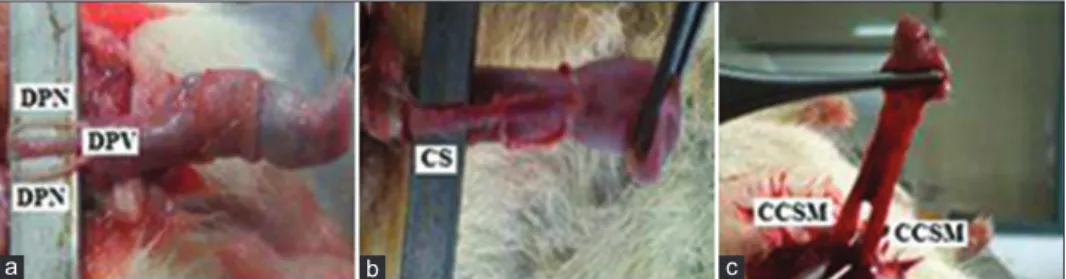
Anesthetize male Wistar rat weighing 150-250 g with ketamine (60 mg/kg, i.p.) and xylazine (10 mg/kg, i.p.) (any other anesthesia can be used). Deglove the prepuce foreskin covering penis followed by cutting dorsal penile nerves and dorsal penile vein from the dorsal surface, and corpus spongiosum covering urethra from the ventral surface. Microsurgically remove tunica albuginea that surrounds corpus cavernosum and cut along the tunica albuginea that holds two corpus cavernosa. Cut both the ends of shaft (body) of penis to get two corpus cavernosa of size 3 mm × 3 mm × 15 mm. Wash the tissues with Krebs-Henseleit (KH) physiological salt solution of following composition (in mM): 118 NaCl, 4.7 KCl, 1.2 KH2PO4, 1.2 MgSO4, 1.5 CaCl2, 25 NaHCO3, and 11 glucose, maintained at 37°C and aerated with carbogen gas (95% O2 and 5% CO2). Tie one end of the tissue to steel hook at the bottom of organ chamber containing KH solution maintained at required temperature, aerated with carbogen gas and another end to force transducer (Model no: MLT0201; ADInstruments, Australia connected to PowerLab/8SP data acquisition system, Chart software, version 7.0; ADInstruments, Australia) using cotton/silk thread. Exert 500 mg of tension to the tissue and equilibrate
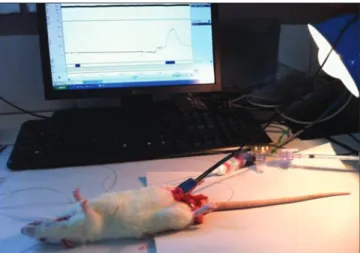
for 1 h, replacing KH solution every 1 h. Contract the tissue with 3 μM phenylephrine (sub-maximal dose) and once the tissue attains maximum contraction, record the relaxant effect of either vehicle, new compound or sildenafi l, the standard drug used in the management of ED (Figures 1 and 2).
Measurement of ICP and MAP
Anesthetize the male rat as described earlier and expose the penile tissue and deglove the prepuce. Locate crus (basal portion of corpus cavernosum) and place the 24G needle connected to PE tubing (fi lled with 200 IU heparin saline) connected to the pressure transducer that in turn should be connected to AD Instrument data acquisition system (or any other data acquisition system). Push 10-20 μL of heparin saline solution into the crus and observe the defl ection in penis that confi rms that needle is in the crus. Remove two testes from the scrotal sac and out of the peritoneal cavity. Lift the seminal vesicle (SV) and place CN/MPG on the dorsolateral lobe of prostrate at the base of SV on the bipolar steel electrode (wire diameter 1 mm or less; distance between two poles: 3 mm) (Figure 3).
Shave the hair of the neck and make a small cut on the skin of the neck. Locate the carotid artery supplying to brain on either side of the trachea along with the vagus nerve. Detach the vagus nerve from carotid artery taking utmost care not to damage/cut vagus nerve. Cannulate carotid artery for placing Millars mikrotip catheter (SPR-320, pressure transducer marketed by AD Instrument, Australia; use 3F size for rat, 2F size for mice; PE tubes connected to any other pressure transducer also can be used)6 (Figure 4).
Stimulate CN/MPG with 5 ms pulses of 5V at a frequency of 12 Hz for 30 s and record the change in ICP and MAP in rats treated with vehicle, new compound or sildenafi l (Figure 5). Voltage, frequency and duration of stimulation can be optimized for your own experiment.
Note: After, needle is inserted to crus of corpus cavernosum, ICP increases up to 10-20 mmHg. After a
Figure 1: Anatomy of rat penile tissue and isolation of corpus cavernosum smooth muscle (CCSM). Deglove prepuce of the rat penile tissue (a) Locate and cut two dorsal penile nerves and one dorsal penile vein (b) Remove corpus spongiosum covering urethra (c) Locate two CCSMs on shaft (body) of the penis and separate by cutting across the tunica albuginea that covers both CCSM
c b
stable baseline of ICP is maintained, CN/MPG can be stimulated to see the effect of treatment on ICP. After the stimulation ceases, ICP return to normal. The same procedure can be repeated 3 times for an animal in the interval of 10 min each for checking reproducibility of the data collected. Maximum ICP recorded area under
the curve, and ICP/MAP can be used for statistical calculation.
RESULTS
Relaxation of isolated corpus cavernosum smooth muscle and increase in intracavernosal pressure provide information about erectile function.
Figure 3: Measurement of (intracavernous pressure) BN: Butterfl y needle, P: Penis, T: Testis, B: Bladder, Pr: Prostrate, SV: Seminal vesicle, E: Electrode
Figure 4: Measurement of mean arterial pressure (MAP). (a) Anesthetize rat and was and shave the hair on the neck (b) Make an incision into the skin of neck and separate the muscles (c) Locate the carotid artery along with vagus nerve and separate the artery (d) Tie the carotid artery with thread (silk thread, 3-0 size is better) and block it by bulldog clip, 1.5 cm apart (e) Tie another thread loosely (f) Lift the carotid artery by an artery forceps and cut it slightly with an iris scissor (g) Open partially collapsed artery by curved iris forceps and insert Millars mikro-tip pressure catheter (3F size) in to the artery (h) Secure the inserted catheter (with thread tied [around the catheter] over artery) and remove bulldog clip (i) measure MAP using AD Instrument data acquisition system
d
h
c
g
b
f a
e
i Figure 2: Screening of new compound using isolated corpus
cavernosum smooth muscle (CCSM) in vitro. (a) CCSM is mounted
in organ bath (b) Recording the effect of vehicle, new compound
and sildenafi l using 4 channel organ bath and AD Instrument data
DISCUSSION
Measurement of ICP and MAP is a gold standard for determining the effect of new compound on erectile function. Sexual behavior study is an alternative method for screening new compoundfor their effect
on sexual function of male rats in the presence of female rats. However, the study is more time taking as we have to train animals before the actual study and require female rats also. Female rats need to be administered estrogen (or derivative) and progesterone to bring them to estrous (heat) phase so that they allow male rats to copulate with them. To avoid pregnancy of female rats they may be ovariectomised that need 6-10 days for the wound to heal.7 The study also
does not provide any data on the effect of treatment on
cardiovascular function. The behavior of animals also may be affected by presence of study personnel, so it is suggested to use video camera for recording sexual behavior and then analyze individual parameters of sexual behavior afterwards. The positive point of sexual behavior study is that the effect of treatment can be studied in reproduction. For past decade or so, most of the researchers have relied more on the ICP and MAP studies than the sexual behavior studies simply because the collected data are accurate, takes less time to acquire the data (Table 1).
CONCLUSION
Rat is a suitable model to screen new compounds for the management of erectile dysfunction.
ACKNOWLEDGEMENT
This study was conducted at Al-Ameen College of Pharmacy
with the help of fi nancial grant (R&D/KR-03/2009–10-NMPB)
from National Medicinal Plants Board, New Delhi, India. We are thankful to Mr. Rohitash of University of Rhode Island, USA for reviewing manuscript and providing suggestion to improve it.
REFERENCES
1. Andersson KE. Mechanisms of penile erection and basis for pharmacological treatment of erectile dysfunction. Pharmacol Rev. 2011;63:811-59. 2. Guay AT, Spark RF, Bansal S, Cunningham GR, Goodman NF, Nankin HR,
et al. American Association of Clinical Endocrinologists medical guidelines for clinical practice for the evaluation and treatment of male sexual dysfunction: A couple’s problem--2003 update. Endocr Pract. 2003;9:77-95. 3. Italiano G, Calabrò A, Pagano F. A simplifi ed in vitro preparation of the
corpus cavernosum as a tool for investigating erectile pharmacology in the rat. Pharmacol Res. 1994;30:325-34.
Figure 5: Measurement of intracavernous pressure (ICP) and mean arterial pressure (MAP). First, second and third channels on computer screen are displaying MAP (deep green line), ICP (pink line) and stimulation (blue line) respectively
Table 1: Optimization of experiment
Nature of trouble Action to be taken
Isolated tissue is not responding to pharmacologic treatment
Partially remove tunica albuginea
Prepare fresh solution of pharmacological agents If KH solution is getting precipitated, prepare fresh solution Mount new tissues
ICP does not increase after nerve stimulation
Check if PE tubing is blocked by clotting of blood in it. If it is due to clotting of blood then remove needle (with PE tubing) from crus and push approximately 10-20 μL of heparine saline solution to remove the clot and again put the needle in crus
Check whether nerve/MPG is on electrode or not
Check whether you have selected suitable stimulating parameter or not Check whether stimulator and electrodes are working or not
Check whether tip of the needle is in crus or not Check integrity of CN/MPG
Check the concentration of heparine in solution and use the solution within 6-12 h
CN is getting burnt Use an electrode of less diameter because more is the diameter more will the amount of heat generated
ICP data is not reproducible
after subsequent stimulation Wait for about 10 min before stimulating nerve/MPG again Animal is waking up during
ICP and MAP measurement Use supplemental dose of anesthesia to increase the duration of anesthesia
4. Quinlan DM, Nelson RJ, Partin AW, Mostwin JL, Walsh PC. The rat as a model for the study of penile erection. J Urol. 1989;141:656-61. 5. Tocharus C, Smitasiri Y, Jeenapongsa R. Butea superba Roxb. enhances
penile erection in rats. Phytother Res. 2006;20:484-9.
6. Rajasekaran M, White S, Baquir A, Wilkes N. Rho-kinase inhibition improves erectile function in aging male Brown-Norway rats. J Androl. 2005; 26:182-8.