R E V I E W A R T I C L E
Occupational dental health hazards: A review
Tarulatha R. Shyagali, Nidhi Rai
Department of Environmental Sciences, Mohanlala Sukhadia University, Udaipur, Rajasthan, India
Abstract
Dental health is as important as general health, but the irony is; it has not received the same amount of importance as that of the general health. This fact is even more prevalent in the labourers, who are bond to neglect their oral health because of busy scheduled and stressful life. The present review article will explore the facts about the relationship between the working environment and the dental health status in diff erent occupation scenarios. An extensive literature survey was performed using the Google scholar, EBSCOhost, science direct and the PubMed central to explore the various dental health conditions existing in diff erent occupational scenarios. The most prevalent oral health conditions were dental caries, periodontitis, dental attrition and erosion, bruxism and missing teeth. All these conditions were either due to the physical environment of the occupation or else due to occupational related stress and the habits to relieve the same stress. Field workers had a higher prevalence of oral health conditions then the offi ce workers. Exposure of the labour class to the varying physical environment in the work place may be the major reason for the deterioration of their oral health and demand of the present time is ‘prevention is better than cure.’ Thus, providing of the protection mask and the utilization of the same are the need of the day.
Keywords: Dental, hazards, health, occupation
Correspondence
Dr. Tarulatha R. Shayagali, Staff Quarter No: 6, Mohanlala Sukhadia University, Loyara, Udaipur - 313 001, Rajasthan, India. Phone: +91-7742129768, E-mail: [email protected]
Received 19 January 2015; Accepted 23 February 2015
doi: 10.15713/ins.ijcdmr.41
How to cite the article:
Tarulatha R. Shyagali, Nidhi Rai, “Occupational dental health hazards: A review,” Int J Contemp Dent Med Rev, vol. 2015, Article ID: 140115, 2015, doi: 10.15713/ins.ijcdmr.41
Introduction
The environment is one among the many determinants of the human health. The key to man’s health lies largely in his environment, and the study of the disease is really the study of man and his environment. Hippocrates was the fi rst person who related the environment and the disease. Later the concept of disease and environment association was revived by Pettenkofer.[1]
The macro or the external environment is all that which is external to the individual human host.[2] And the modern
concept of the environment is not limited to water, the air and soil (physical environment), but also the social and economic condition to which the host is exposed.
‘Occupational environment’ means the sum of external conditions and infl uences, which prevail at the place of work and which have a bearing on the health of working population.[1]
The interaction of the individual with the physical, chemical and biological agents of the work place as great bearing on his physical and the psychological health.
It is considered that the industrialization is the sign of progress, and this can be proved by the fact that all the developed countries in the world are the contributions of the industrialization. It also is the fact that industrial progress and the growth of a nation go hand
in hand. Alteration of the natural existing physical environment by such kind of progress has made the man to live in a complicated environment. By each day, the complexity is increasing as man is becoming more ingenious. If these trends persist, it is feared that the very “quality of life” we cherish may soon be in danger.[1]
Exposure to chemical, physical, and biological agents in the workplace can result in adverse eff ects on workers ranging from simple discomfort and irritation to debilitating occupational diseases such as lung fi brosis, neuropathy, deafness, organ damage, and cancers of various sites.[3] For the overall well-being
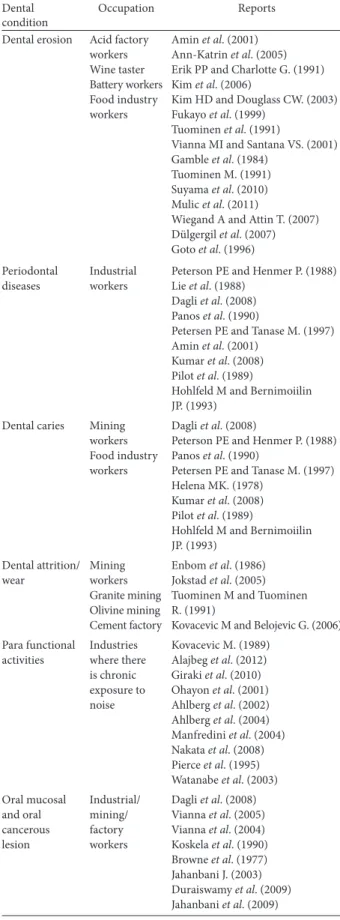
of the person, dental health is as essential as total body health. Through the present article, the truth behind the infl uence of work place environment on the dental health will be reviewed with the help of existing literature based evidence [Table 1].
Dental Erosion
Dental erosion has been defi ned as a progressive, irreversible loss of dental hard tissue by a chemical process, usually by acids other than those produced by plaque bacteria.[4] The erosion of
teeth was most commonly seen in the individuals who worked in acid factories.[5-15] It is a common oral fi nding in professional
Table 1: Diff erent dental hazards and the associate occupation reported in the literature
Dental condition
Occupation Reports
Dental erosion Acid factory workers Wine taster Battery workers Food industry workers
Amin et al. (2001) Ann-Katrin et al. (2005) Erik PP and Charlotte G. (1991) Kim et al. (2006)
Kim HD and Douglass CW. (2003) Fukayo et al. (1999)
Tuominen et al. (1991)
Vianna MI and Santana VS. (2001) Gamble et al. (1984)
Tuominen M. (1991) Suyama et al. (2010) Mulic et al. (2011)
Wiegand A and Attin T. (2007) Dülgergil et al. (2007) Goto et al. (1996)
Periodontal diseases
Industrial workers
Peterson PE and Henmer P. (1988) Lie et al. (1988)
Dagli et al. (2008) Panos et al. (1990)
Petersen PE and Tanase M. (1997) Amin et al. (2001)
Kumar et al. (2008) Pilot et al. (1989)
Hohlfeld M and Bernimoiilin JP. (1993)
Dental caries Mining workers Food industry workers
Dagli et al. (2008)
Peterson PE and Henmer P. (1988) Panos et al. (1990)
Petersen PE and Tanase M. (1997) Helena MK. (1978)
Kumar et al. (2008) Pilot et al. (1989)
Hohlfeld M and Bernimoiilin JP. (1993) Dental attrition/ wear Mining workers Granite mining Olivine mining Cement factory
Enbom et al. (1986) Jokstad et al. (2005) Tuominen M and Tuominen R. (1991)
Kovacevic M and Belojevic G. (2006)
Para functional activities Industries where there is chronic exposure to noise Kovacevic M. (1989) Alajbeg et al. (2012) Giraki et al. (2010) Ohayon et al. (2001) Ahlberg et al. (2002) Ahlberg et al. (2004) Manfredini et al. (2004) Nakata et al. (2008) Pierce et al. (1995) Watanabe et al. (2003)
Oral mucosal and oral cancerous lesion Industrial/ mining/ factory workers
Dagli et al. (2008) Vianna et al. (2005) Vianna et al. (2004) Koskela et al. (1990) Browne et al. (1977) Jahanbani J. (2003) Duraiswamy et al. (2009) Jahanbani et al. (2009)
Nevertheless, in a review article by Wiegand and Attin, they claim that the literature evidence show that the occupational dental erosion is limited to the battery and galvanizing workers. They also claim that the data available for the other occupations needs to be confi rmed by further studies.[17] The fumes produced
in the industries like phosphate, battery (sulfuric acid, lead acid, and chromic acid), silicone sealers (acetic acid release), copper smelters (sulfuric acid), zinc extraction by electrolytic methods, war industry are deleterious to oral hard and soft tissues.[5-18] There existed a highly signifi cant diff erence for the
prevalence of dental erosion between the control group and the acid factory workers.[5,6,10,11,13] The medical problems like
upper respiratory tract symptoms persisted commonly in these workers.[6] In battery factory workers the incidence of erosion was
more common in the anterior region[7,19] and the posterior region
showed incidence of attrition.[7] However, in another study in
organic and inorganic acid factories, showed the prevalence of erosion to be more in maxillary teeth[11,19] contrasting results
were reported in the recent study where the erosion was seen in the mandibular anterior teeth.[15] But, Mullic et al., noted that
the erosion was most commonly seen on the occlusal surface of the mandibular molar tooth[16] in the wine tasters. By wearing
the protective respiratory mask, one can reduce the overall occupational dental erosion.[8,9] Dental erosion was noticed even
in the female food industry workers, owing to the inhalation of the dust containing tartaric acid, sucrose, magnesium sulphate and sodium bicarbonate. It also noted that the Longer the duration of exposure more the chances of dental erosion.[15,19] In the recent
study on dental erosion, they have measured the density of acid in the working environment and have found out a signifi cant relationship between the density of the acid and erosion rate.[15]
Periodontal Diseases
Overall periodontal status of the industrial or the factory workers remained poor.[5,20-24] But the amount of sugar intake
and the sweeting agent use along with sugar increased the risk of periodontal diseases.[25] Age of the worker was directly
proportional to the poor periodontal health and the probing depth.[21,26] Apart from this the habits had their own share of
adding the burden to the prevalence of periodontal diseases.[26]
However, the white collar group or the administration workers had better periodontal health then the factory workers.[21]
Nevertheless, in the survey by pilot et al.[27] it was reported that
there existed no signifi cant diff erence in the periodontal status of three groups of the factory worker; mining equipment factory, a cotton mill and a factory of heavy machinery. There was an increase in the periodontal pocket and attachment loss prevalence, and it was positively associated with age of the acid factory workers[14,28] then the control group.
Dental Caries
workers working in sweet food industries are more prone to have higher caries index.[30,31] Nevertheless, Massiln et al., through
their study discards the hypothesis that airborne sugar is an occupational dental health hazard[32] and same was supported
by the statement that the confectionery industry did not seem to be an exceptionally hazardous environment for dental health in general. Studies do claim that the proper oral hygiene instructions followed by periodic dental evaluation improved the workers oral health condition.[26] There are less chances of
caries development with high income/high occupational status individuals then with individuals of the low status occupation, thus proving the infl uence of social inequalities playing the role in the prevalence of caries.[33]
Dental Attrition/Wear
It is one of the common dental problems noticed in the miners.[34] The duration of the working has a defi nite infl uence
on the enamel wear, longer the person has worked in the mining
fi eld greater are the chances of the enamel wear. Same has been proved in the earliest study to the latest study on the dental wear and the working environment.[20,34,35] Few studies took
control group-the non-miners for comparing the extent of wear between the two groups, they found that white collar workers or the non-miners showed less prevalent dental wear.[20,35,36]
This observation can be attributed to the mining environment, specially the abrasive component of the air which they breathed. Hundred percent abrasion was observed by Peterson and Henmer (1988) in the granite factory workers and was particular severe in the anterior teeth.[20] So, far the occupational related
abrasion studies were conducted on cement factory workers, granite factory workers and olivine mining workers. Even the noise pollution in the industrial set up has bearing on the dental abrasion rate and same was proven in the study by Kovacevic and Belojevic (2006), they found female workers exposed to noise showed more prevalent abrasion.[37]
Para Functional Activities
Studies have shown that the individuals work in the environment with chronic exposure to noise have greater chances of acquiring para functional habits like bruxism.[38] The level of noise usually
ranged from 99 to 105 decibels, with some extreme values to 130 decibels.[38] The sleep bruxism was associated with the
psychological job stress.[39-44] But it also has been reported that
sleep bruxism is weakly associate with certain job stresses in man.[45-47] The studies have shown positive correlation between
smoking and tobacco chewing to the brusixm[39,43] and It was
noted that administration job people had less chances of bruxism development[39] Contrastingly, another study reported no
diff erence in perceived level of stress between bruxers and non-bruxers.[45] However, a statistically signifi cant diff erence was noted
for diff erent job categories and the bruxism, with higher prevalence in highly responsible jobs.[46] There exists a direct correlation
between temopromandibular joint disorder and bruxism.[47-50]
Oral Mucosal Lesions and Oral Cancer
Prevalence of oral mucosal lesions was mainly related to the occupational stress to which the mining workers will be exposed.
Noise, dust or fumes and poor maintenance of equipment added to the predisposing factor; the stress.[51] The exposure of the air
borne dust particles in the mining, or the working atmosphere will lead to the cancerous lesion which can be mortal to the workers. Even the workers who were exposed to acidic fumes were at risk of developing in oral mucosal lesions[52,53] and this
was more so with the workers without lip seal.[54] However,
contrastingly it was reported that occupational acid air fumes didn’t increase the occurrence of oral mucosal lesions but they lead to increase in the periodontal pocket depth.[14] Same was
true for the cancer prevalence when the duration is taken into consideration. Longer the exposure more is the chance of cancer occurrence. The habits like tobacco chewing and pipe smoking apart from mining environment can act as triggering factors in causing the oral mucosal lesions.[55-57] The granite exposure, when
pertaining to the general health, may be the etiological factor for the initiation and promotion of the malignant neoplasms.[57]
However, there were studies which reported occupation has little eff ect on the occurrence of oral mucosal lesions.[58] Vianna et al.,
in their study conclude that the evidence of a chronic rather than acute irritative process suggests a possible step on the etiology of oral malignancies, which needs investigation.[53]
Conclusion
Oral health is as important as general health, but it is receiving less attention than it actually deserves in the present scenario especially in the developing countries. The summary chart [Chart 1] shows the occupations and their relations. Among many factors which can detract the oral health of the person, the working environment and the amount of stress it induces on oneself is of major importance and again it has also not received its share of concern. The data presented in the article emphasis the need for educating the employer and the employees about the oral conditions, which can occur and the measures to prevent the same using the protective equipment.
Reference
1. Park K. Environment and health. In: Park’s Textbook of Preventive and Social Medicine. Jabalpur: M/s Banarsidas Bhanot Publishers (India); 2007. p. 566-58.
2. Last JM. A Dictionary of Epidemiology. New York: Oxford University Press; 1983.
3. Verma DK, Purdham JT, Roels HA. Translating evidence about occupational conditions into strategies for prevention. Occup Environ Med 2002;59:205-13.
4. Meurman JH, ten Cate JM. Pathogenesis and modifying factors of dental erosion. Eur J Oral Sci 1996;104:199-206.
5. Amin WM, Al-Omoush SA, Hattab FN. Oral health status of workers exposed to acid fumes in phosphate and battery industries in Jordan. Int Dent J 2001;51:169-74.
6. Johansson AK, Johansson A, Stan V, Ohlson CG. Silicone sealers, acetic acid vapours and dental erosion: A work-related risk? Swed Dent J 2005;29:61-9.
7. Petersen PE, Gormsen C. Oral conditions among German
battery factory workers. Community Dent Oral Epidemiol 1991;19:104-6.
8. Kim HD, Hong YC, Koh DH, Paik DI. Occupational exposure to acidic chemicals and occupational dental erosion. J Public Health Dent 2006;66:205-8.
9. Kim HD, Douglass CW. Associations between occupational health behaviors and occupational dental erosion. J Public Health Dent 2003;63:244-9.
10. Fukayo S, Nonaka K, Shinozaki T, Motohashi M, Yano T. Prevalence of dental erosion caused by sulfuric acid fumes in a smelter in Japan. Sangyo Eiseigaku Zasshi 1999;41:88-94. 11. Tuominen ML, Tuominen RJ, Fubusa F, Mgalula N. Tooth
surface loss and exposure to organic and inorganic acid fumes in workplace air. Community Dent Oral Epidemiol 1991;19:217-20.
12. Vianna MI, Santana VS. Acid mist occupational exposure and oral disease: A review. Cad Saude Publica 2001;17:1335-44. 13. Gamble J, Jones W, Hancock J, Meckstroth RL.
Epidemiological-environmental study of lead acid battery workers. III. Chronic eff ects of sulfuric acid on the respiratory system and teeth. Environ Res 1984;35:30-52.
14. Tuominen M. Occurrence of periodontal pockets and oral soft tissue lesions in relation to sulfuric acid fumes in the working environment. Acta Odontol Scand 1991;49:261-6.
15. Suyama Y, Takaku S, Okawa Y, Matsukubo T. Dental erosion in workers exposed to sulfuric acid in lead storage battery manufacturing facility. Bull Tokyo Dent Coll 2010;51:77-83. 16. Mulic A, Tveit AB, Hove LH, Skaare AB. Dental erosive
wear among Norwegian wine tasters. Acta Odontol Scand 2011;69:21-6.
17. Wiegand A, Attin T. Occupational dental erosion from exposure to acids: A review. Occup Med (Lond) 2007;57:169-76.
18. Dülgergil CT, Erdemir EO, Ercan E, Erdemir A. An industrial dental-erosion by chromic Acid: A case report. Eur J Dent 2007;1:119-22.
19. Goto H, Kosaka M, Ueda T, Yoshida M, Hara I. Association between dental erosion and exposure to acids in a chemical factory. Sangyo Eiseigaku Zasshi 1996;38:165-71.
20. Petersen PE, Henmar P. Oral conditions among workers in the Danish granite industry. Scand J Work Environ Health 1988;14:328-31.
21. Lie T, Due NA, Abrahamsen B, Böe OE. Periodontal health in a group of industrial employees. Community Dent Oral Epidemiol 1988;16:42-6.
22. Dagli RJ, Kumar S, Dhanni C, Duraiswamy P, Kulkarni S. Dental health among green marble mine laborers, India. J Oral Health Community Dent 2008;2:1-7.
23. Papapanou PN, Wennström JL, Sellén A, Hirooka H, Gröndahl K, Johnsson T. Periodontal treatment needs assessed by the use of clinical and radiographic criteria. Community Dent Oral Epidemiol 1990;18:113-9.
24. Petersen PE, Tanase M. Oral health status of an industrial population in Romania. Int Dent J 1997;47:194-8.
25. Markkanen H. Periodontal treatment need in a Finnish industrial population. Community Dent Oral Epidemiol 1978;6:240-4.
26. Kumar S, Prabu D, Kulkarni S, Dagli RJ. Tobacco as risk factor for periodontal disease in green marble mine laborers of Rajasthan, India. Braz J Oral Sci 2008;7:1641-7.
in 35-44-year-old factory workers in Shanghai. Community Dent Oral Epidemiol 1989;17:216.
28. Hohlfeld M, Bernimoulin JP. Application of the community periodontal index of treatment needs (CPITN) in a group of 45-54-year-old German factory workers. J Clin Periodontol 1993;20:551-6.
29. Duraiswamy P, Kumar TS, Dagli RJ, Chandrakant, Kulkarni S. Dental caries experience and treatment needs of green marble mine laborers in Udaipur district, Rajasthan, India. Indian J Dent Res 2008;19:331-4.
30. Anaise JZ. Prevalence of dental caries among workers in the sweets industry in Israel. Community Dent Oral Epidemiol 1980;8:142-5.
31. Rekha R, Hiremath SS. Oral health status and treatment requirments of confectionery workers in Bangalore city. A comparative study. Indian J Dent Res 2002;13:161-5.
32. Masalin KE, Murtomaa HT, Sipilä KP. Dental caries risk in relation to dietary habits and dental services in two industrial populations. J Public Health Dent 1994;54:160-6.
33. Krustrup U, Holm-Pedersen P, Petersen PE, Lund R, Avlund K. Th e overtime eff ect of social position on dental caries experience in a group of old-aged Danes born in 1914. J Public Health Dent 2008;68:46-52.
34. Enbom L, Magnusson T, Wall G. Occlusal wear in miners. Swed Dent J 1986;10:165-70.
35. Jokstad A, Von Der Fehr FR, Løvlie GR, Myran T. Wear of teeth due to occupational exposure to airborne olivine dust. Acta Odontol Scand 2005;63:294-9.
36. Tuominen M, Tuominen R. Tooth surface loss among people exposed to cement and stone dust in the work environment in Tanzania. Community Dent Health 1991;8:233-8.
37. Kovacevic M, Belojevic G. Tooth abrasion in workers exposed to noise in the Montenegrin textile industry. Ind Health 2006;44:481-5.
38. Kovacevic M. Role of noise as stress – Factor in parafunctions. Stomatol Glas Srb 1989;36:225-9.
39. Alajbeg IZ, Zuvela A, Tarle Z. Risk factors for bruxism among Croatian navy employees. J Oral Rehabil 2012;39:668-76. 40. Giraki M, Schneider C, Schäfer R, Singh P, Franz M, Raab WH,
et al. Correlation between stress, stress-coping and current sleep bruxism. Head Face Med 2010;6:2.
41. Ohayon MM, Li KK, Guilleminault C. Risk factors for sleep bruxism in the general population. Chest 2001;119:53-61. 42. Ahlberg J, Rantala M, Savolainen A, Suvinen T, Nissinen M,
Sarna S, et al. Reported bruxism and stress experience. Community Dent Oral Epidemiol 2002;30:405-8.
43. Ahlberg J, Savolainen A, Rantala M, Lindholm H, Könönen M. Reported bruxism and biopsychosocial symptoms: A longitudinal study. Community Dent Oral Epidemiol 2004;32:307-11.
44. Manfredini D, Landi N, Romagnoli M, Bosco M. Psychic and occlusal factors in bruxers. Aust Dent J 2004;49:84-9.
45. Nakata A, Takahashi M, Ikeda T, Hojou M, Araki S. Perceived psychosocial job stress and sleep bruxism among male and female workers. Community Dent Oral Epidemiol 2008;36:201-9. 46. Pierce CJ, Chrisman K, Bennett ME, Close JM. Stress,
anticipatory stress, and psychologic measures related to sleep bruxism. J Orofac Pain 1995;9:51-6.
47. Watanabe T, Ichikawa K, Clark GT. Bruxism levels and daily behaviors: 3 weeks of measurement and correlation. J Orofac Pain 2003;17:65-73.
48. da Silva AM, Oakley DA, Hemmings KW, Newman HN, Watkins S. Psychosocial factors and tooth wear with a signifi cant component of attrition. Eur J Prosthodont Restor Dent 1997;5:51-5.
49. Nekora-Azak A, Yengin E, Evlioglu G, Ceyhan A, Ocak O, Issever H. Prevalence of bruxism awareness in Istanbul, Turkey. Cranio 2010;28:122-7.
50. Güler N, Yatmaz PI, Ataoglu H, Emlik D, Uckan S. Temporomandibular internal derangement: Correlation of MRI fi ndings with clinical symptoms of pain and joint sounds in patients with bruxing behaviour. Dentomaxillofac Radiol 2003;32:304-10.
51. Dagli RJ, Kumar S, Mathur A, Balasubrimanyam G, Duraiswamy P, Kulkarni S. Prevalence of leukoplakia, oral submucous fi brosis, papilloma and its relation with stress among green marbles mine laborers, India. Med Oral Patol Oral Cir Bucal 2008;13:E687-92.
52. Vianna MI, Santana VS, McKelvey W. Periodontal health and oral mucosal lesions as related to occupational exposure to acid mists. Community Dent Oral Epidemiol 2005;33:341-8. 53. Vianna MI, Santana VS, Loomis D. Occupational exposures to
acid mists and gases and ulcerative lesions of the oral mucosa. Am J Ind Med 2004;45:238-45.
54. Koskela RS, Klockars M, Järvinen E, Rossi A, Kolari PJ. Cancer mortality of granite workers 1940-1985. IARC Sci Publ 1990;43-53.
55. Browne RM, Camsey MC, Waterhouse JA, Manning GL. Etiological factors in oral squamous cell carcinoma. Community Dent Oral Epidemiol 1977;5:301-6.
56. Jahanbani J. Prevalence of oral leukoplakia and lichen planus in 1167 Iranian textile workers. Oral Dis 2003;9:302-4.
57. Duraiswamy P, Dagli RJ, Kumar S, Dhanni C, Kulkarni S. Adverse tobacco habits and their relation with prevalence of oro-mucosal lesions among green marble mine labourers, Udaipur District, India. Singapore Dent J 2009;30:17-25. 58. Jahanbani J, Sandvik L, Lyberg T, Ahlfors E. Evaluation of oral