Copyright © 2004 by John Wiley & Sons, Inc. All rights reserved.
Chapter 4: Mobility
Management
Jyh-Cheng Chen and Tao Zhang
IP-Based Next-Generation Wireless Networks
Published by John Wiley & Sons, Inc. January 2004
Copyright © 2004 by John Wiley & Sons, Inc. All rights reserved. 2
This material is protected under all
Copyright Laws as they currently exist.
©2004 Jyh-Cheng Chen and Tao Zhang,
and John Wiley & Sons, Inc. All rights
reserved. Notwithstanding user’s ability to
use and modify the PowerPoint Slides, it is
understood that the original version of
these slides, as well as any and all
modifications thereof, and all
corresponding copyrights, shall at all times
remain the property of Jyh-Cheng Chen
and Tao Zhang, and John Wiley & Sons, Inc.
Copyright © 2004 by John Wiley & Sons, Inc. All rights reserved. 3
Outline
4.1 Basic Issues in Mobility Management
4.2 Mobility Management in IP Networks
4.3 Mobility Management in 3GPP Packet
Networks
4.4 Mobility Management in 3GPP2 Packet Data
Networks
4.5 Mobility Management in MWIF Networks
4.6 Comparison of Mobility Management in IP,
3GPP, and 3GPP2 Networks
Copyright © 2004 by John Wiley & Sons, Inc. All rights reserved. 4
4.1 Basic Issues in Mobility
Management
4.1.1 Impact of Naming and Addressing
on Mobility Management
4.1.2 Location Management
4.1.3 Packet Delivery to Mobile
Destinations
4.1.4 Handoffs
4.1.5 Roaming
Copyright © 2004 by John Wiley & Sons, Inc. All rights reserved. 5
Types of Mobility
Terminal mobility
discrete
continuous
User mobility
Service mobility
Copyright © 2004 by John Wiley & Sons, Inc. All rights reserved. 6
Basic Mobility Management
Requirements
Support all forms of mobility
Support mobility for all types of
applications
Support mobility across heterogeneous
radio systems
Support session (service) continuity
Global roaming
Copyright © 2004 by John Wiley & Sons, Inc. All rights reserved. 7
Basic Functional Components
Location management
Packet delivery to mobiles
Handoff and roaming
Network Access Control
Authentication
Authorization
Accounting
Copyright © 2004 by John Wiley & Sons, Inc. All rights reserved. 8
4.1.1 Impact of Naming and Addressing
on Mobility Management
A terminal’s address typically identifies a network
attachment point
A telephone number in a PSTN network identifies a port on a
PSTN switch rather than the telephone set itself.
An IP terminal’s IP address identifies an attachment point to
an IP network.
Terminal-independent user names:
International Mobile Subscriber Identifier (IMSI):
independent of the terminal used by the user
Network Access Identifier (NAI): make the IP terminal
names independent of the terminal’s addresses
Email address, SIP URI, etc.
Copyright © 2004 by John Wiley & Sons, Inc. All rights reserved. 9
4.1.2 Location Management
4.1.2.1 Location Update Strategies
4.1.2.2 Location Discovery (Paging)
4.1.2.3 Interactions between Location
Update and Paging
Copyright © 2004 by John Wiley & Sons, Inc. All rights reserved. 10
4.1.2.1 Location Update
Strategies
When a mobile should perform location updates?
every time the mobile changes its network attachment
points
group network attachment points into
location areas
and
only keeps track of which location area each mobile is likely
in when the user and the network have no traffic to send to
each other
A network may use multiple types of location areas
simultaneously.
The location areas used in a radio access network can be
different from the location areas used for location
management in the core network.
Location Update
Time-based update
Movement-based update
Distance-based update
Parameter-based update
also referred to as profile-based update
Implicit update
Probabilistic update
1 2 3 4 5 6 7 8 9Fig. 4.1 Movement-based vs.
Copyright © 2004 by John Wiley & Sons, Inc. All rights reserved. 13
4.1.2.2 Location Discovery
(Paging)
A network performs paging by sending one or
multiple
paging messages
to a
paging area
where the mobile is likely to be located.
Paging areas do not have to be identical to
location areas.
Upon receiving a paging message, a mobile
needs to update its precise current location
with the network.
The mobile may also need to establish the
necessary connectivity with the network.
Copyright © 2004 by John Wiley & Sons, Inc. All rights reserved. 14
Issues with Paging
Paging should be done within a
reasonable time constraint.
How to construct paging areas?
Static or dynamic
How to search a paging area to locate a
mobile?
Copyright © 2004 by John Wiley & Sons, Inc. All rights reserved. 15
Paging Strategies
Blanket paging
Sequential paging
Other paging strategies
Geographic paging
Group paging
Individualized paging
Copyright © 2004 by John Wiley & Sons, Inc. All rights reserved. 16
4.1.2.3 Interactions between
Location Update and Paging
Overhead
network resources consumed by location
updates and paging
Performance:
e.g., paging latency
Complexity
Copyright © 2004 by John Wiley & Sons, Inc. All rights reserved. 17
4.1.3 Packet Delivery to Mobile
Destinations
Direct Delivery
may route packets along the most direct paths
need to know whether destination is a mobile or
fixed host
require every originator to implement protocols for
determining a destination’s location
Relayed Delivery
mobility anchor points could become traffic and
performance bottlenecks
Copyright © 2004 by John Wiley & Sons, Inc. All rights reserved. 18 1. Location Query 2. Location Query Response
3. Call Requests or Packets
(a) Direct Delivery
1. Packets 2. Packets Packet Originator Packet Originator Mobility Anchor Point (b) Relayed Delivery Location Server Destination Mobile Destination Mobile
Fig. 4.2 Strategies for delivering packets
Copyright © 2004 by John Wiley & Sons, Inc. All rights reserved. 19 1. Initial User Packets 2. Initial User packets
relayed to destination Packet Originator Mobility Anchor Point
3. Destination’s location sent by Mobility Anchor Point or destination
4. Subsequent User Packets
Destination Mobile
Fig. 4.3 Integrated Delayed Delivery and
Direct Delivery strategies
Copyright © 2004 by John Wiley & Sons, Inc. All rights reserved. 20
4.1.4 Handoffs
Handoffs in an IP-based wireless
network may occur at different protocol
layers.
Handoffs at each protocol layer may
occur in different scopes.
Handoffs can be hard or soft.
Copyright © 2004 by John Wiley & Sons, Inc. All rights reserved. 21
Layers of Handoff
Physical layer
Logical link layer
IP layer
Mobility at different protocol layers can be
managed by different protocols.
Mobility management at the IP layer may be
independent of mobility management at the
lower protocol layers.
Copyright © 2004 by John Wiley & Sons, Inc. All rights reserved. 22
Scopes of Handoff
Intra-subnet handoff
Inter-subnet handoff
Inter-router handoff
Soft Handoff
Data distribution and selection
Selection and Distribution Unit (SDU)
Data content synchronization
4.1.5 Roaming
Roaming is the process whereby a user
moves into a visited domain.
Home domain: maintain a service
subscription account
Visited domain: does not have an account
Copyright © 2004 by John Wiley & Sons, Inc. All rights reserved. 25
Capabilities to Support Roaming
Network access control for visiting
mobiles
Roaming Agreement between the
mobile’s home domain and the visited
domains
Session continuity while a user crosses
domain boundaries
Copyright © 2004 by John Wiley & Sons, Inc. All rights reserved. 26 Home
Network Provider
Visited Network Provider
1. Can I use your network? 4. Yes 2. Is this user authorized?
3. Yes.
Roam
Mobile Mobile
Fig. 4.4 Roaming
Copyright © 2004 by John Wiley & Sons, Inc. All rights reserved. 27 Home Network Provider Visited Network Provider 1 Visited Network Provider 2 Visited Network Provider 3
1. Can I use your network? 6. Yes 2. Is this user authorized? 3. Is this user authorized? 4. Yes 5. Yes Roaming Broker Mobile
Fig. 4.5 Roaming Broker
Copyright © 2004 by John Wiley & Sons, Inc. All rights reserved. 28
4.2 Mobility Management in IP
Networks
4.2.1 Naming and Addressing of IP Terminals
4.2.2 Mobile IPv4
4.2.3 MIPv4 Regional Registration
4.2.4 Paging Extensions to Mobile IPv4
4.2.5 Mobile IPv6
4.2.6 SIP-based Mobility Management
4.2.7 Cellular IP
4.2.8 HAWAII
Copyright © 2004 by John Wiley & Sons, Inc. All rights reserved. 29
4.2.1 Naming and Addressing of
IP Terminals
IP address
new IP address for new subnet
multiple network interfaces with different
IP addresses
Network Access Identifier (NAI)
username@realm
Copyright © 2004 by John Wiley & Sons, Inc. All rights reserved. 30
4.2.2 Mobile IPv4
4.2.2.1 Agent Discovery
4.2.2.2 Movement Detection
4.2.2.3 Leaving the Home Network
4.2.2.4 Entering and Staying in a Visited Network
4.2.2.5 Returning to the Home Network
4.2.2.6 Mobile-Home Authentication Extension
4.2.2.7 Vendor/Organization Specific Extensions to
Mobile IP Messages
4.2.2.8 Reverse Tunneling
4.2.2.9 Limitations of MIPv4
4.2.2.10 MIPv4 Route Optimization
Copyright © 2004 by John Wiley & Sons, Inc. All rights reserved. 31
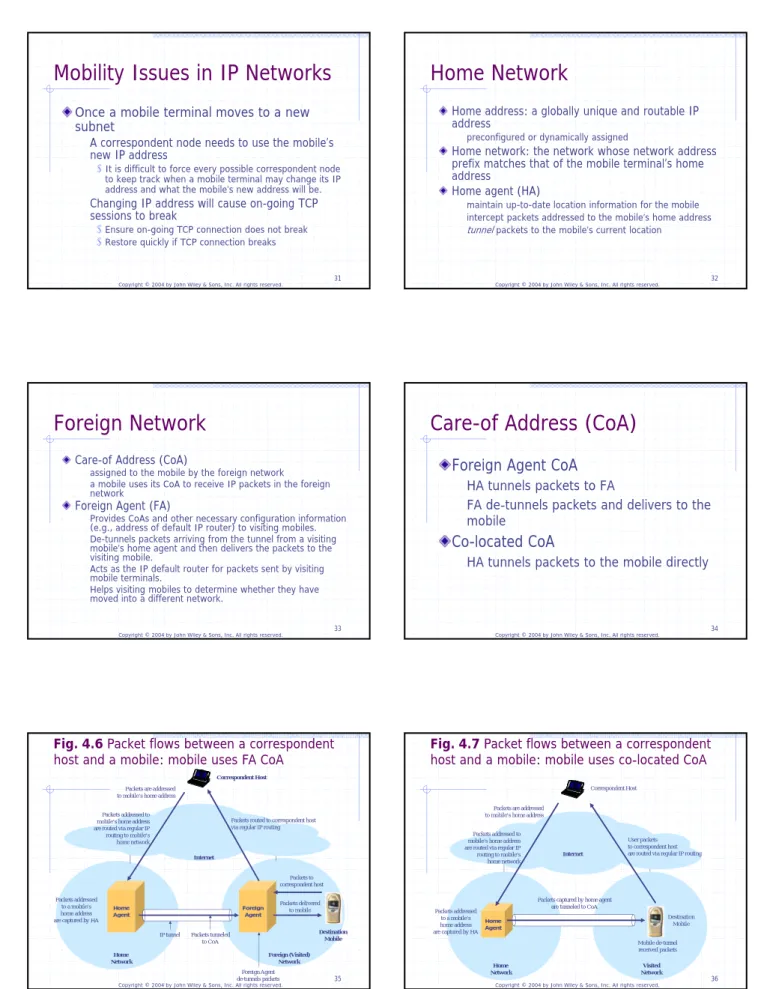
Mobility Issues in IP Networks
Once a mobile terminal moves to a new
subnet
A correspondent node needs to use the mobile’s
new IP address
It is difficult to force every possible correspondent node
to keep track when a mobile terminal may change its IP
address and what the mobile’s new address will be.
Changing IP address will cause on-going TCP
sessions to break
Ensure on-going TCP connection does not break
Restore quickly if TCP connection breaks
Copyright © 2004 by John Wiley & Sons, Inc. All rights reserved. 32
Home Network
Home address: a globally unique and routable IP
address
preconfigured or dynamically assigned
Home network: the network whose network address
prefix matches that of the mobile terminal’s home
address
Home agent (HA)
maintain up-to-date location information for the mobile
intercept packets addressed to the mobile’s home address
tunnel
packets to the mobile’s current location
Copyright © 2004 by John Wiley & Sons, Inc. All rights reserved. 33
Foreign Network
Care-of Address (CoA)
assigned to the mobile by the foreign network
a mobile uses its CoA to receive IP packets in the foreign
network
Foreign Agent (FA)
Provides CoAs and other necessary configuration information
(e.g., address of default IP router) to visiting mobiles.
De-tunnels packets arriving from the tunnel from a visiting
mobile’s home agent and then delivers the packets to the
visiting mobile.
Acts as the IP default router for packets sent by visiting
mobile terminals.
Helps visiting mobiles to determine whether they have
moved into a different network.
Copyright © 2004 by John Wiley & Sons, Inc. All rights reserved. 34
Care-of Address (CoA)
Foreign Agent CoA
HA tunnels packets to FA
FA de-tunnels packets and delivers to the
mobile
Co-located CoA
HA tunnels packets to the mobile directly
Home Network
Foreign (Visited) Network Internet
Packets are addressed to mobile’s home address
Packets tunneled to CoA Packets addressed to a mobile’s home address are captured by HA Packets addressed to mobile’s home address are routed via regular IP routing to mobile’s home network Destination Mobile Correspondent Host Home Agent Foreign Agent IP tunnel Packets delivered to mobile Packets to correspondent host Packets routed to correspondent host via regular IP routing
Fig. 4.6 Packet flows between a correspondent
host and a mobile: mobile uses FA CoA
Home Visited
Internet Packets are addressed to mobile’s home address
Packets captured by home agent are tunneled to CoA Packets addressed to a mobile’s home address are captured by HA Home Agent Destination Mobile Correspondent Host User packets to correspondent host are routed via regular IP routing Packets addressed to
mobile’s home address are routed via regular IP routing to mobile’s home network
Mobile de-tunnel received packets
Fig. 4.7 Packet flows between a correspondent
Copyright © 2004 by John Wiley & Sons, Inc. All rights reserved. 37
4.2.2.1 Agent Discovery
The process for a mobile terminal to discover the mobility
agents and receive information from these agents
Achieved by the mobility agents advertising their services and
system information to the mobiles via
Agent Advertisement
messages
A mobile may solicit an Agent Advertisement message from any
mobility agent by sending an
Agent Solicitation
message
Mobile-Agents Multicast Group address 224.0.0.11
Uses the Internet Control Message Protocol (ICMP) Router
Discovery Message
ICMP Router Advertisement Message
ICMP Router Solicitation Message
Copyright © 2004 by John Wiley & Sons, Inc. All rights reserved. 38
Agent Advertisement
ICMP Router Advertisement message with
extensions to carry MIPv4 specific information
Mobility Agent Advertisement Extension
indicate that an ICMP Router Advertisement message is
also a MIPv4 Agent Advertisement message
carry information specific to a MIPv4 mobility agent
Prefix-Lengths Extension (optional)
indicate the network prefix length (in bits) of each
Router Address advertised
Copyright © 2004 by John Wiley & Sons, Inc. All rights reserved. 39 ICMP Router Advertisement
Mobility Agent Advertisement Extension
Prefix-Lengths Extension Mobile IP
Agent Advertisement Message
MIP-specific Extensions
Fig. 4.8 Structure of Mobile IP Agent
Advertisement message
Copyright © 2004 by John Wiley & Sons, Inc. All rights reserved. 40
Mobility Agent Advertisement
Extension
R (Registration required)
B (Busy)
H (Home agent)
F (Foreign agent)
M (Minimal encapsulation)
G (GRE encapsulation)
r (Reserved)
T (Reverse tunneling)
Copyright © 2004 by John Wiley & Sons, Inc. All rights reserved. 41 0 1 2 3 4 5 6 7 8 9 0 1 2 3 4 5 6 7 8 9 0 1 2 3 4 5 6 7 8 9 0 1
Length
Type Sequence Number
Registration Lifetime Reserved
Zero or more Care-of Addresses R B H F M G r T
Fig. 4.9 MIPv4 Mobility Agent Advertisement
Extension to ICMP Router Advertisement
message
Copyright © 2004 by John Wiley & Sons, Inc. All rights reserved. 42 0 1 2 3 4 5 6 7 8 9 0 1 2 3 4 5 6 7 8 9 0 1 2 3 4 5 6 7 8 9 0 1
Type Length Prefix Length . . . .
Fig. 4.10 MIPv4 Prefix-Length Extension
Copyright © 2004 by John Wiley & Sons, Inc. All rights reserved. 43
Agent Solicitation
ICMP Router Solicitation message
Time-to-Live (TTL) field must be set to 1
Copyright © 2004 by John Wiley & Sons, Inc. All rights reserved. 44
4.2.2.2 Movement Detection
Use the Lifetime field in Agent
Advertisement messages
Use network prefixes
requires the mobile to know the network
prefix lengths of the old and the new
networks
Others
indications of changes in lower layer
Copyright © 2004 by John Wiley & Sons, Inc. All rights reserved. 45
4.2.2.3 Leaving the Home
Network
ARP (Address Resolution Protocol)
REQUEST
Sender Protocol Address
Target Protocol Address
Sender Hardware Address
ARP REPLY
ARP Cache
Copyright © 2004 by John Wiley & Sons, Inc. All rights reserved. 46
ARP in MIPv4
Gratuitous ARP
A mobile broadcasts a Gratuitous APR before
leaving home network.
Any node that receives such a Gratuitous ARP
packet will update its ARP cache to map the
sending mobile’s home address to the home
agent’s hardware address.
Proxy ARP
Mobile’s home agent will reply to ARP REQUEST
on behalf of the mobile.
4.2.2.4 Entering and Staying
in a Visited Network
A mobile will have to acquire a CoA
The mobile will then register the CoA
with HA
Location update
HA will then tunnel packets addressed to
the mobile’s home address to this new CoA
Registration
Registration Request
Transported over UDP port 434
HA authenticates all Registration Request
Registration Reply
Transported over UDP port 434
Mobile terminal authenticates all
Copyright © 2004 by John Wiley & Sons, Inc. All rights reserved. 49
FA CoA vs. Co-located CoA
FA CoA
Registration must be done via the FA
If FA wants to deny network access
discard the Registration Request
generate a Registration Reply to the mobile
Co-located CoA
Registration may be done directly with the HA,
unless the FA requires registration via the FA.
The FA can force a mobile to register through the FA by
setting the ‘R’ flag in the Agent Advertisement it sends to
the mobiles.
Copyright © 2004 by John Wiley & Sons, Inc. All rights reserved. 50 1. Registration Request
2. Registration Reply
(a) Registration with home agent directly.
1. Registration Request 3. Registration Request
4. Registration Reply 6. Registration Reply
(b) Registration through foreign agent
Home Agent Foreign Agent Home Agent 2. Processing by Foreign Agent 5. Processing by Foreign Agent Mobile Mobile
Fig. 4.11 MIPv4 registration
message flows
Copyright © 2004 by John Wiley & Sons, Inc. All rights reserved. 51
Registration Request
In addition to registering a CoA, a mobile
terminal can also use Registration Request
messages to
Discover the address of a home agent
Discover the mobile’s home address, if the mobile
is not configured with a home address
Renew a registration that is due to expire
Deregister with the HA when the mobile returns
home
Copyright © 2004 by John Wiley & Sons, Inc. All rights reserved. 52
Format of Registration Request
Type
S: Simultaneous bindings
B: Broadcast datagrams
D: Decapsulation by mobile terminal
M: Minimal encapsulation
G: GRE encapsulation
r: This field will always be zero and ignored on
reception
T: Reverse Tunneling requested
x: This field will always be zero and ignored on
reception
Lifetime
A zero lifetime indicates a request for deregistration.
Copyright © 2004 by John Wiley & Sons, Inc. All rights reserved. 53
Format of Registration Request
(Cont.)
Home Address
Preconfigured
0.0.0.0: no home address or dynamically assign a home
address
Can use NAI to identify the mobile by using the Mobile Node
NAI Extension
HA will assign a home address in the Registration Reply
message
Home Agent
IP address of HA
Dynamic Home Agent Address Resolution: the mobile does
not know the address of its HA
Mobile sends the Registration Request to the subnet-directed
broadcast address of its home network
HA will reject the registration and returns a Registration Reply
The mobile therefore can learn the IP address of the HA by
examining the Registration Reply
Copyright © 2004 by John Wiley & Sons, Inc. All rights reserved. 54
Format of Registration Request
(Cont.)
Care-of Address
Identification
Matching Registration Requests and
Registration Replies
Protect against replay attack
One or more Extension Fields
Mandatory extension: Mobile-Home
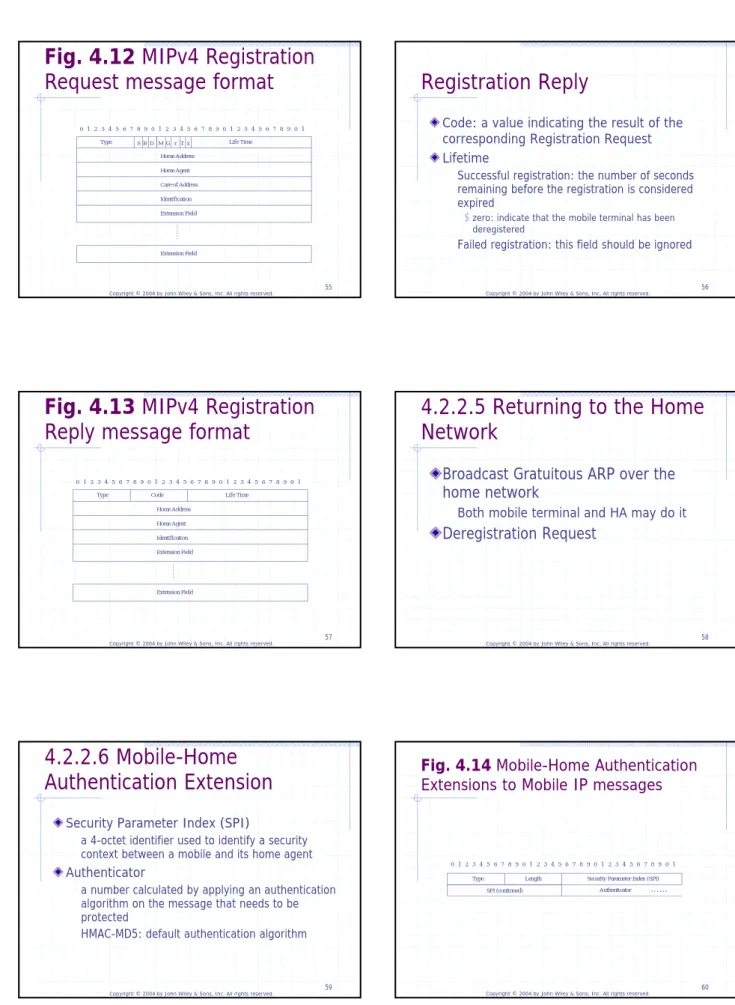
Copyright © 2004 by John Wiley & Sons, Inc. All rights reserved. 55 0 1 2 3 4 5 6 7 8 9 0 1 2 3 4 5 6 7 8 9 0 1 2 3 4 5 6 7 8 9 0 1
S B D M G r T x
Type Life Time
Home Address Home Agent Care-of Address Identification Extension Field Extension Field
Fig. 4.12 MIPv4 Registration
Request message format
Copyright © 2004 by John Wiley & Sons, Inc. All rights reserved. 56
Registration Reply
Code: a value indicating the result of the
corresponding Registration Request
Lifetime
Successful registration: the number of seconds
remaining before the registration is considered
expired
zero: indicate that the mobile terminal has been
deregistered
Failed registration: this field should be ignored
Copyright © 2004 by John Wiley & Sons, Inc. All rights reserved. 57 0 1 2 3 4 5 6 7 8 9 0 1 2 3 4 5 6 7 8 9 0 1 2 3 4 5 6 7 8 9 0 1
Code
Type Life Time
Home Address
Home Agent
Identification
Extension Field
Extension Field
Fig. 4.13 MIPv4 Registration
Reply message format
Copyright © 2004 by John Wiley & Sons, Inc. All rights reserved. 58
4.2.2.5 Returning to the Home
Network
Broadcast Gratuitous ARP over the
home network
Both mobile terminal and HA may do it
Deregistration Request
4.2.2.6 Mobile-Home
Authentication Extension
Security Parameter Index (SPI)
a 4-octet identifier used to identify a security
context between a mobile and its home agent
Authenticator
a number calculated by applying an authentication
algorithm on the message that needs to be
protected
HMAC-MD5: default authentication algorithm
0 1 2 3 4 5 6 7 8 9 0 1 2 3 4 5 6 7 8 9 0 1 2 3 4 5 6 7 8 9 0 1
Type Length Security Parameter Index (SPI)
. . . . SPI (continued) Authenticator
Fig. 4.14 Mobile-Home Authentication
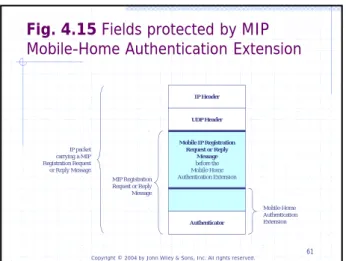
Copyright © 2004 by John Wiley & Sons, Inc. All rights reserved. 61 IP Header UDP Header Mobile IP Registration Request or Reply Message before the Mobile-Home Authentication Extension Authenticator IP packet carrying a MIP Registration Request or Reply Message MIP Registration Request or Reply Message Mobile-Home Authentication Extension
Fig. 4.15 Fields protected by MIP
Mobile-Home Authentication Extension
Copyright © 2004 by John Wiley & Sons, Inc. All rights reserved. 62
4.2.2.7 Vendor/Organization Specific
Extensions to Mobile IP Messages
Allow network equipment vendors and other
organizations (e.g., network operators) to add their
specific information to the Mobile IP signaling
messages
Critical Vendor/Organization Specific Extensions
(CVSE)
When a Mobile IP entity encounters a CVSE but does not
recognize the extension, it must silently discard the entire
message containing the CVSE.
Normal Vendor/Organization Specific Extensions
(NVSE)
When a NVSE is encountered but not recognized, the NVSE
itself should be ignored, but the rest of the message
containing the NVSE must be processed.
Copyright © 2004 by John Wiley & Sons, Inc. All rights reserved. 63 0 1 2 3 4 5 6 7 8 9 0 1 2 3 4 5 6 7 8 9 0 1 2 3 4 5 6 7 8 9 0 1
Type Reserved Length
. . . .
Vendor/Org-IDVendor-CVSE-Type Vendor-CVSE Value
0 1 2 3 4 5 6 7 8 9 0 1 2 3 4 5 6 7 8 9 0 1 2 3 4 5 6 7 8 9 0 1
Type Length Reserved
. . . .
Vendor/Org-IDVendor-NVSE-Type Vendor-NVSE Value (a) Critical Vendor/Origination Specific Extension (CVSE)
(b) Normal Vendor/Origination Specific Extension (NVSE)
Fig. 4.16 Vendor/Organization Specific
Extensions to Mobile IP messages
Copyright © 2004 by John Wiley & Sons, Inc. All rights reserved. 64
4.2.2.8 Reverse Tunneling
Ingress filtering: outgoing packets from a
visiting mobile may not be able to go through
the IP access router in the visited network
RFC 3024: specifies how reverse tunneling
works when a mobile uses Foreign Agent CoA
T flag in Agent Advertisement
T flag in Registration Request
Packet delivery
Direct Delivery Style: FA as default router
Encapsulating Delivery Style
Copyright © 2004 by John Wiley & Sons, Inc. All rights reserved. 65 Home Network Foreign (Visited) Network Internet Packets tunneled to HA HA de-tunnels
packets and route them via regular IP routing to correspondent host Destination Mobile Correspondent Host Home Agent Foreign Agent IP tunnel Packets to correspondent host
Fig. 4.17 Mobile IPv4 reverse
tunneling
Copyright © 2004 by John Wiley & Sons, Inc. All rights reserved. 66
4.2.2.9 Limitations of MIPv4
Triangular routing
route optimization in Section 4.2.2.10
A home agent may become a traffic and performance
bottleneck
Potential long handoff delay
micromobility management in Sections 4.2.3, 4.2.7 and 4.2.8
Potential insufficient deregistration capability
registration with the old foreign agent expires only when the
registration lifetime expires
Insufficient capabilities to support other mobility
management requirements
Copyright © 2004 by John Wiley & Sons, Inc. All rights reserved. 67
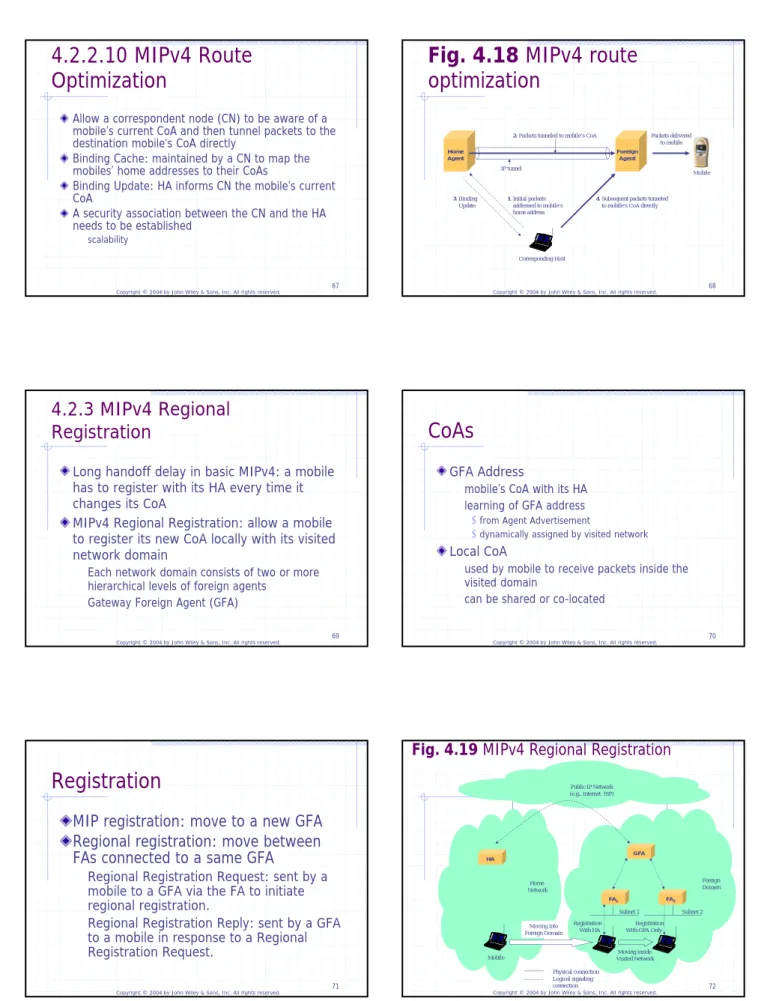
4.2.2.10 MIPv4 Route
Optimization
Allow a correspondent node (CN) to be aware of a
mobile’s current CoA and then tunnel packets to the
destination mobile’s CoA directly
Binding Cache: maintained by a CN to map the
mobiles’ home addresses to their CoAs
Binding Update: HA informs CN the mobile’s current
CoA
A security association between the CN and the HA
needs to be established
scalability
Copyright © 2004 by John Wiley & Sons, Inc. All rights reserved. 68 1. Initial packets
addressed to mobile’s home address
2. Packets tunneled to mobile’s CoA
3. Binding Update
4. Subsequent packets tunneled to mobile’s CoA directly
Home Agent Foreign Agent Packets delivered to mobile Mobile Corresponding Host IP tunnel
Fig. 4.18 MIPv4 route
optimization
Copyright © 2004 by John Wiley & Sons, Inc. All rights reserved. 69
4.2.3 MIPv4 Regional
Registration
Long handoff delay in basic MIPv4: a mobile
has to register with its HA every time it
changes its CoA
MIPv4 Regional Registration: allow a mobile
to register its new CoA locally with its visited
network domain
Each network domain consists of two or more
hierarchical levels of foreign agents
Gateway Foreign Agent (GFA)
Copyright © 2004 by John Wiley & Sons, Inc. All rights reserved. 70
CoAs
GFA Address
mobile’s CoA with its HA
learning of GFA address
from Agent Advertisement
dynamically assigned by visited network
Local CoA
used by mobile to receive packets inside the
visited domain
can be shared or co-located
Registration
MIP registration: move to a new GFA
Regional registration: move between
FAs connected to a same GFA
Regional Registration Request: sent by a
mobile to a GFA via the FA to initiate
regional registration.
Regional Registration Reply: sent by a GFA
to a mobile in response to a Regional
Registration Request.
Home Network Foreign Domain Physical connection Subnet 1 Subnet 2 Registration With HA Registration With GFA Only Moving intoForeign Domain
Moving inside Visited Network Public IP Network (e.g., Internet, ISP)
Mobile
HA
GFA
FA1 FA2
Copyright © 2004 by John Wiley & Sons, Inc. All rights reserved. 73
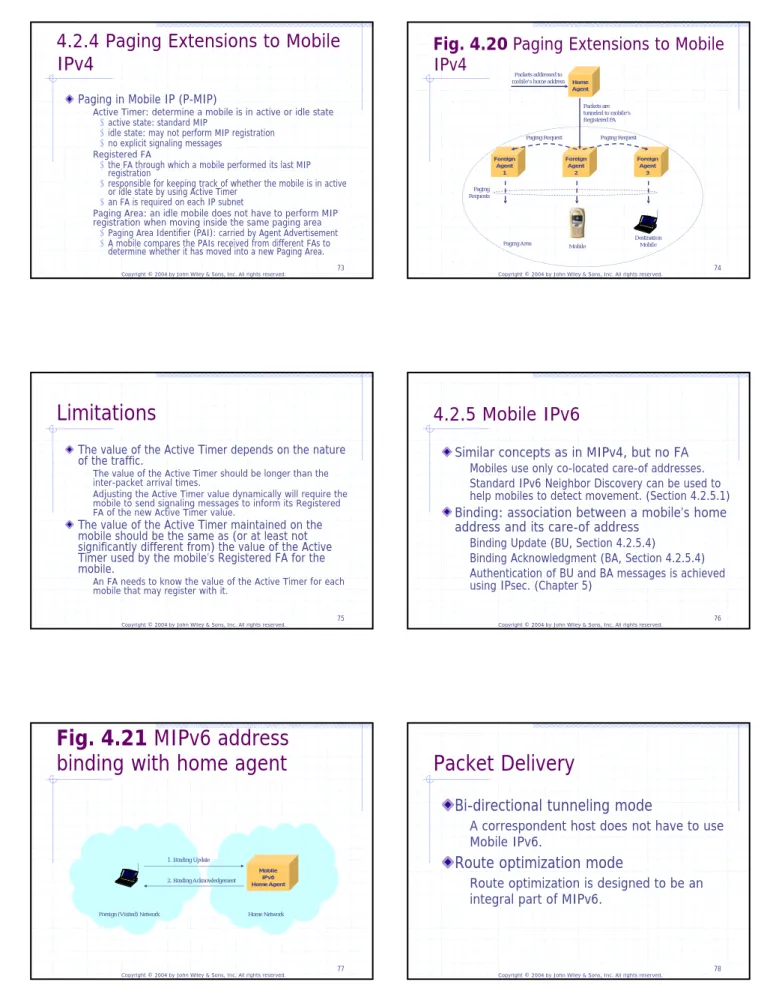
4.2.4 Paging Extensions to Mobile
IPv4
Paging in Mobile IP (P-MIP)
Active Timer: determine a mobile is in active or idle state
active state: standard MIP
idle state: may not perform MIP registration
no explicit signaling messages
Registered FA
the FA through which a mobile performed its last MIP
registration
responsible for keeping track of whether the mobile is in active
or idle state by using Active Timer
an FA is required on each IP subnet
Paging Area: an idle mobile does not have to perform MIP
registration when moving inside the same paging area
Paging Area Identifier (PAI): carried by Agent Advertisement
A mobile compares the PAIs received from different FAs to
determine whether it has moved into a new Paging Area.
Copyright © 2004 by John Wiley & Sons, Inc. All rights reserved. 74 Paging Area
Packets addressed to mobile’s home address
Paging Request Packets are tunneled to mobile’s Registered FA Paging Request Paging Requests Home Agent Foreign Agent 1 Foreign Agent 2 Foreign Agent 3 Destination Mobile Mobile
Fig. 4.20 Paging Extensions to Mobile
IPv4
Copyright © 2004 by John Wiley & Sons, Inc. All rights reserved. 75
Limitations
The value of the Active Timer depends on the nature
of the traffic.
The value of the Active Timer should be longer than the
inter-packet arrival times.
Adjusting the Active Timer value dynamically will require the
mobile to send signaling messages to inform its Registered
FA of the new Active Timer value.
The value of the Active Timer maintained on the
mobile should be the same as (or at least not
significantly different from) the value of the Active
Timer used by the mobile’s Registered FA for the
mobile.
An FA needs to know the value of the Active Timer for each
mobile that may register with it.
Copyright © 2004 by John Wiley & Sons, Inc. All rights reserved. 76
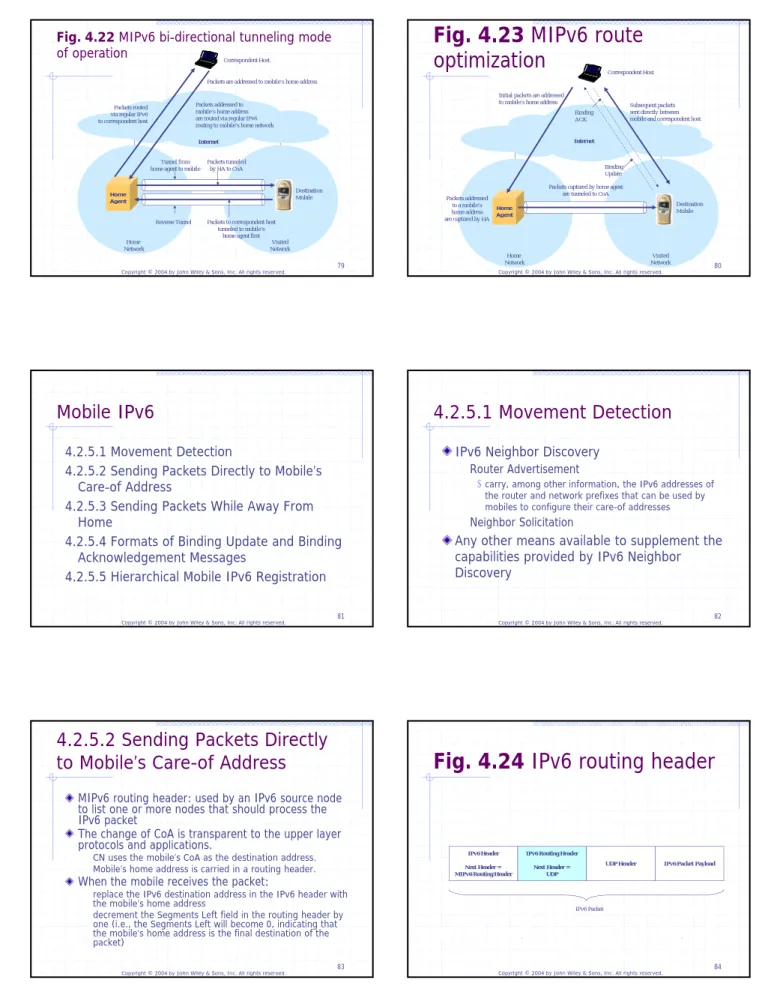
4.2.5 Mobile IPv6
Similar concepts as in MIPv4, but no FA
Mobiles use only co-located care-of addresses.
Standard IPv6 Neighbor Discovery can be used to
help mobiles to detect movement. (Section 4.2.5.1)
Binding: association between a mobile’s home
address and its care-of address
Binding Update (BU, Section 4.2.5.4)
Binding Acknowledgment (BA, Section 4.2.5.4)
Authentication of BU and BA messages is achieved
using IPsec. (Chapter 5)
Copyright © 2004 by John Wiley & Sons, Inc. All rights reserved. 77 1. Binding Update
2. Binding Acknowledgement
Foreign (Visited) Network Home Network
Mobile IPv6 Home Agent
Fig. 4.21 MIPv6 address
binding with home agent
Copyright © 2004 by John Wiley & Sons, Inc. All rights reserved. 78
Packet Delivery
Bi-directional tunneling mode
A correspondent host does not have to use
Mobile IPv6.
Route optimization mode
Route optimization is designed to be an
Copyright © 2004 by John Wiley & Sons, Inc. All rights reserved. 79 Home Network Visited Network Internet
Packets are addressed to mobile’s home address
Packets tunneled by HA to CoA Packets addressed to mobile’s home address are routed via regular IPv6 routing to mobile’s home network
Home Agent Destination Mobile Correspondent Host Packets routed via regular IPv6 to correspondent host
Tunnel from home agent to mobile
Reverse Tunnel Packets to correspondent host tunneled to mobile’s
home agent first
Fig. 4.22 MIPv6 bi-directional tunneling mode
of operation
Copyright © 2004 by John Wiley & Sons, Inc. All rights reserved. 80 Home
Network
Visited Network Internet
Initial packets are addressed to mobile’s home address
Packets captured by home agent are tunneled to CoA Packets addressed to a mobile’s home address are captured by HA Home Agent Destination Mobile Correspondent Host Binding Update Binding ACK Subsequent packets sent directly between mobile and correspondent host
Fig. 4.23 MIPv6 route
optimization
Copyright © 2004 by John Wiley & Sons, Inc. All rights reserved. 81
Mobile IPv6
4.2.5.1 Movement Detection
4.2.5.2 Sending Packets Directly to Mobile’s
Care-of Address
4.2.5.3 Sending Packets While Away From
Home
4.2.5.4 Formats of Binding Update and Binding
Acknowledgement Messages
4.2.5.5 Hierarchical Mobile IPv6 Registration
Copyright © 2004 by John Wiley & Sons, Inc. All rights reserved. 82
4.2.5.1 Movement Detection
IPv6 Neighbor Discovery
Router Advertisement
carry, among other information, the IPv6 addresses of
the router and network prefixes that can be used by
mobiles to configure their care-of addresses
Neighbor Solicitation
Any other means available to supplement the
capabilities provided by IPv6 Neighbor
Discovery
4.2.5.2 Sending Packets Directly
to Mobile’s Care-of Address
MIPv6 routing header: used by an IPv6 source node
to list one or more nodes that should process the
IPv6 packet
The change of CoA is transparent to the upper layer
protocols and applications.
CN uses the mobile’s CoA as the destination address.
Mobile’s home address is carried in a routing header.
When the mobile receives the packet:
replace the IPv6 destination address in the IPv6 header with
the mobile’s home address
decrement the Segments Left field in the routing header by
one (i.e., the Segments Left will become 0, indicating that
the mobile’s home address is the final destination of the
packet)
IPv6 Header Next Header = MIPv6 Routing Header
IPv6 Routing Header Next Header =
UDP
UDP Header IPv6 Packet Payload
IPv6 Packet
Copyright © 2004 by John Wiley & Sons, Inc. All rights reserved. 85 Next Header Header Extension Length Routing Type Segments Left
Reserved
Home Address
Fig. 4.25 MIPv6 routing
header format
Copyright © 2004 by John Wiley & Sons, Inc. All rights reserved. 86
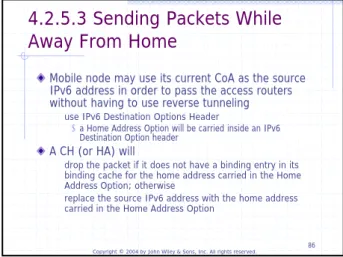
4.2.5.3 Sending Packets While
Away From Home
Mobile node may use its current CoA as the source
IPv6 address in order to pass the access routers
without having to use reverse tunneling
use IPv6 Destination Options Header
a Home Address Option will be carried inside an IPv6
Destination Option header
A CH (or HA) will
drop the packet if it does not have a binding entry in its
binding cache for the home address carried in the Home
Address Option; otherwise
replace the source IPv6 address with the home address
carried in the Home Address Option
Copyright © 2004 by John Wiley & Sons, Inc. All rights reserved. 87 Next Header Header Extension Length Option Type Option Length
Home Address IPv6 Header
Next Header = Destination Options Header
IPv6 Packet
Destination Options Header Next Header = UDP
UDP Header IPv6 Packet Payload
Fig. 4.26 Format of IPv6 Destination Options Header carrying a
Mobile IPv6 Home Address Option
Copyright © 2004 by John Wiley & Sons, Inc. All rights reserved. 88
4.2.5.4 Formats of Binding Update and
Binding Acknowledgement Messages
Mobility Header: defined by MIPv6 to
carry BU and BA
The BU or BA message is carried in the
Message Data field of the Mobility Header.
Copyright © 2004 by John Wiley & Sons, Inc. All rights reserved. 89 Payload Protocol Header Length Mobility Header Type Reserved
Checksum
Message Data (e.g., a BU message or a BA message) IPv6 Header
Next Header = Destination Options Header
IPv6 Packet
Mobility Header Next Header = UDP
UDP Header IPv6 Packet Payload Optional User Data Packet
Fig. 4.27 Mobile IPv6 Mobility Header
Copyright © 2004 by John Wiley & Sons, Inc. All rights reserved. 90
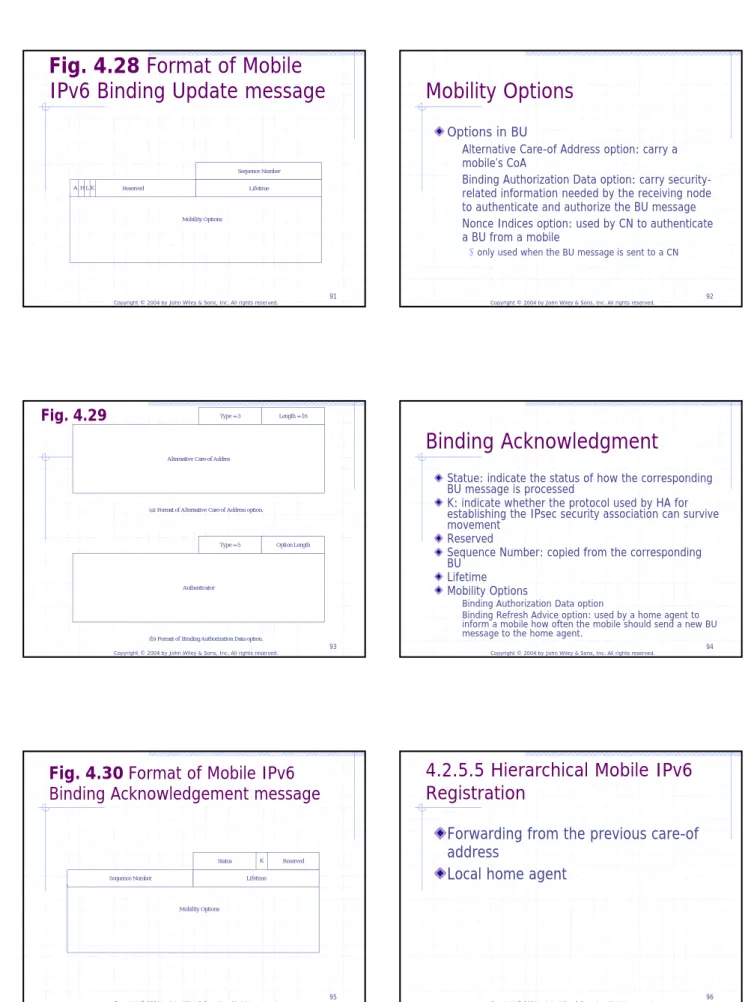
Binding Update
Sequence Number
A (Acknowledge): request a BA message be returned upon
receipt of the BU message
H (Home Registration): request that the receiving node act as
the sending node’s HA
L (Link-Local Address Compatibility): set when the home
address has the same interface identifier as the link-local
address
K (Key Management Mobility Capability): indicate whether the
protocol used for establishing the IPsec security association can
survive movement
only valid in a BU message sent to a HA
Reserved
Lifetime: the number of time units remaining before the binding
expires
Mobility Options: a variable-length field that contains one or
more Mobility Options in a Type-Length-Value format
Copyright © 2004 by John Wiley & Sons, Inc. All rights reserved. 91 Sequence Number
Reserved
Mobility Options
A H L K Lifetime
Fig. 4.28 Format of Mobile
IPv6 Binding Update message
Copyright © 2004 by John Wiley & Sons, Inc. All rights reserved. 92
Mobility Options
Options in BU
Alternative Care-of Address option: carry a
mobile’s CoA
Binding Authorization Data option: carry
security-related information needed by the receiving node
to authenticate and authorize the BU message
Nonce Indices option: used by CN to authenticate
a BU from a mobile
only used when the BU message is sent to a CN
Copyright © 2004 by John Wiley & Sons, Inc. All rights reserved. 93 Type = 3 Length = 16
Alternative Care-of Addres
Type = 5 Option Length
Authenticator (a) Format of Alternative Care-of Address option.
(b) Format of Binding Authorization Data option.
Fig. 4.29
Copyright © 2004 by John Wiley & Sons, Inc. All rights reserved. 94
Binding Acknowledgment
Statue: indicate the status of how the corresponding
BU message is processed
K: indicate whether the protocol used by HA for
establishing the IPsec security association can survive
movement
Reserved
Sequence Number: copied from the corresponding
BU
Lifetime
Mobility Options
Binding Authorization Data option
Binding Refresh Advice option: used by a home agent to
inform a mobile how often the mobile should send a new BU
message to the home agent.
Status Sequence Number Mobility Options Lifetime Reserved K
Fig. 4.30 Format of Mobile IPv6
Binding Acknowledgement message
4.2.5.5 Hierarchical Mobile IPv6
Registration
Forwarding from the previous care-of
address
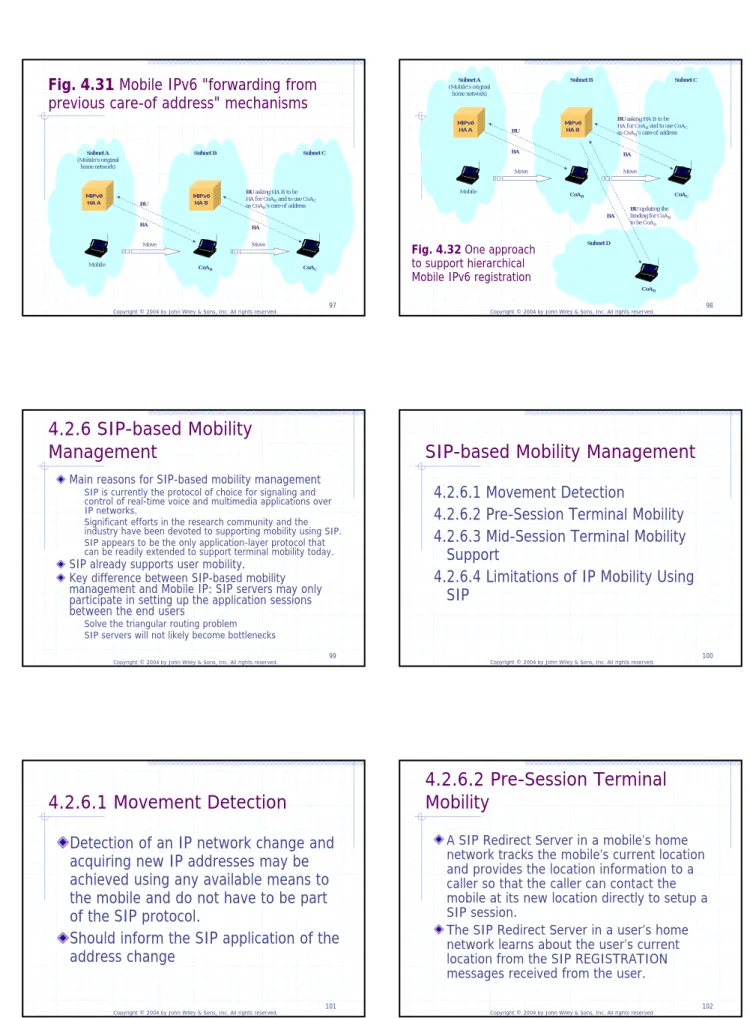
Copyright © 2004 by John Wiley & Sons, Inc. All rights reserved. 97 Subnet A (Mobile’s original home network) CoAB CoAC BU BA BUasking HA B to be HA for CoABand to use CoAC as CoAB’s care-of address
Move Subnet B Subnet C MIPv6 HA A MIPv6 HA B Mobile Move BA
Fig. 4.31 Mobile IPv6 "forwarding from
previous care-of address" mechanisms
Copyright © 2004 by John Wiley & Sons, Inc. All rights reserved. 98 Subnet A (Mobile’s original home network) CoAB CoAC BU BA BUasking HA B to be HA for CoABand to use CoAC as CoAB’s care-of address
Move Subnet B Subnet C MIPv6 HA A MIPv6 HA B Mobile Move BA BUupdating the binding for CoAB to be CoAD
CoAD
BA
Subnet D
Fig. 4.32 One approach
to support hierarchical
Mobile IPv6 registration
Copyright © 2004 by John Wiley & Sons, Inc. All rights reserved. 99
4.2.6 SIP-based Mobility
Management
Main reasons for SIP-based mobility management
SIP is currently the protocol of choice for signaling and
control of real-time voice and multimedia applications over
IP networks.
Significant efforts in the research community and the
industry have been devoted to supporting mobility using SIP.
SIP appears to be the only application-layer protocol that
can be readily extended to support terminal mobility today.
SIP already supports user mobility.
Key difference between SIP-based mobility
management and Mobile IP: SIP servers may only
participate in setting up the application sessions
between the end users
Solve the triangular routing problem
SIP servers will not likely become bottlenecks
Copyright © 2004 by John Wiley & Sons, Inc. All rights reserved. 100
SIP-based Mobility Management
4.2.6.1 Movement Detection
4.2.6.2 Pre-Session Terminal Mobility
4.2.6.3 Mid-Session Terminal Mobility
Support
4.2.6.4 Limitations of IP Mobility Using
SIP
Copyright © 2004 by John Wiley & Sons, Inc. All rights reserved. 101
4.2.6.1 Movement Detection
Detection of an IP network change and
acquiring new IP addresses may be
achieved using any available means to
the mobile and do not have to be part
of the SIP protocol.
Should inform the SIP application of the
address change
Copyright © 2004 by John Wiley & Sons, Inc. All rights reserved. 102
4.2.6.2 Pre-Session Terminal
Mobility
A SIP Redirect Server in a mobile’s home
network tracks the mobile’s current location
and provides the location information to a
caller so that the caller can contact the
mobile at its new location directly to setup a
SIP session.
The SIP Redirect Server in a user’s home
network learns about the user’s current
location from the SIP REGISTRATION
messages received from the user.
Copyright © 2004 by John Wiley & Sons, Inc. All rights reserved. 103
1. SIP INVITE 2. SIP 302 (User Temporarily Moved)
with user’s new location
Mobile’s Home Network Visited Network 3. SIP INVITE 4. SIP OK Mobile moved to a visited network Correspondent User SIP Redirect Server Mobile
Fig. 4.33 SIP-based pre-session
terminal mobility management
Copyright © 2004 by John Wiley & Sons, Inc. All rights reserved. 104 1. SIP REGISTER
2. QUERY 3. Query Response
4. SIP OK Mobile User
Home AAA
Visited Network Home Network
SIP Home Registrar
Fig. 4.34 Location update for supporting
SIP-based terminal mobility
Copyright © 2004 by John Wiley & Sons, Inc. All rights reserved. 105
4.2.6.3 Mid-Session Terminal
Mobility Support
Mobile sends a new SIP INVITE
message to invite the correspondent
host to re-establish the SIP session to
the mobile’s new location.
Mobile also updates its location with its
home SIP Redirect Server.
Copyright © 2004 by John Wiley & Sons, Inc. All rights reserved. 106 1. SIP INVITE
(Carrying the mobile’s new location)
2. SIP OK
Mobile Correspondent User
Fig. 4.35 SIP-based mid-session
terminal mobility management
4.2.6.4 Limitations of IP Mobility
Using SIP
A mobile will have to register its new IP address with
a SIP server in the mobile’s home network every time
the mobile changes its IP address.
long handoff delays when the mobile is far away from its
home network
may be solved by hierarchical registration
It is difficult for SIP-based mobility management to
keep a TCP session alive while a mobile changes its
IP address.
a mobile terminal and a correspondent host may use a
SIP
EYEagent to hide the IP address change from the
on-going TCP sessions
4.2.7 Cellular IP
Designed to support fast handoff in a wireless
network of limited size, for example, a network within
the same administrative domain
Reduce handoff latency by eliminating the need for a
mobile to change its IP address while moving inside a
Cellular IP network
Use host-specific routing
routing and packet forwarding based on the full IP address
maintain a host-specific downlink route for forwarding
packets to each individual mobile, rather than maintaining a
route for each IP address prefix as with regular IP routing
protocols
Copyright © 2004 by John Wiley & Sons, Inc. All rights reserved. 109 Beacon packet broadcast
Downlink packet forwarding Route/location update packets
Move Internet Cellular IP Network Gateway BS 1 BS 3 BS 4 BS 2 BS 5 BS 6
Fig. 4.36 Cellular IP
Copyright © 2004 by John Wiley & Sons, Inc. All rights reserved. 110 Paging Area Paging Area
Gateway Paging Message BS BS BS BS BS BS BS
Base station with paging cache Base station without paging cache
BS BS
Mobile
Fig. 4.37 Paging in Cellular IP
networks
Copyright © 2004 by John Wiley & Sons, Inc. All rights reserved. 111
4.2.8 HAWAII
Similar to Cellular IP, HAWAII
(Handoff-Aware Wireless Access Internet Infrastructure)
is designed to support fast handoff and
paging inside a wireless network under a
single administrative domain.
reduce handoff latency
use host-specific routing
HAWAII and Cellular IP differ in routing and
mobility management implementations.
Copyright © 2004 by John Wiley & Sons, Inc. All rights reserved. 112 Internet
DRR
Router 1 Router 2
BS 1 BS 2 BS 3 BS 4
Fig. 4.38 HAWAII
Copyright © 2004 by John Wiley & Sons, Inc. All rights reserved. 113 Router 2
Router 1
BS A BS B
DRR
1. MIP Registration 5. MIP Registration Request Reply
2 3
4
Fig. 4.39 HAWAII mobile power-up
procedure
Copyright © 2004 by John Wiley & Sons, Inc. All rights reserved. 114 1 2 3 4 5 6 7 1 6 5 4 3 2 7 Router 1 Router 3 BS A BS B BS A BS B Router 1 Router 3
(a) Forwarding Path Setup (b) Non-Forwarding Path Setup
DRR DRR
Router 2 Router 2
Mobile Mobile Mobile Mobile
Copyright © 2004 by John Wiley & Sons, Inc. All rights reserved. 115 Router 2 Router 1
BS A BS B
DRR
1. MIP Registration 7. MIP Registration Request Reply 2 3 MIP HA Mobile’s Current HAWAII Domain Mobile’s Home Network 4 5 6
Fig. 4.41 Handoff
between HAWAII
domains using Mobile
IP
Copyright © 2004 by John Wiley & Sons, Inc. All rights reserved. 116
4.3 Mobility Management in 3GPP
Packet Networks
4.3.1 Packet Mobility Management (PMM) Context and
States
4.3.2 Location Management for Packet-Switched
Services
4.3.3 Routing Area Update
4.3.4 Serving RNS Relocation
4.3.5 Hard Handoffs
4.3.6 Paging Initiated by Packet-Switched Core Network
4.3.7 Service Request Procedure
4.3.8 Handoff and Roaming Between 3GPP and Wireless
LANs
Copyright © 2004 by John Wiley & Sons, Inc. All rights reserved. 117
Overview
As discussed in Chapter 2, all packet-switched user
data to and from a mobile is first sent to the mobile’s
serving GGSN.
The mobile and its serving GGSN use a host-specific
route to exchange user data.
Therefore, mobility management in 3GPP PS domain
is, in essence, to manage the changes of the
host-specific route between each mobile and its serving
GGSN.
A mobile does not have to maintain all the traffic bearers in
the RAN or the CN if it does not expect to send or receive
user data soon.
The mobile does not even need to maintain its dedicated
signaling connection to the SGSN at all times.
Copyright © 2004 by John Wiley & Sons, Inc. All rights reserved. 118
Different Scopes of Mobility
Inter-Node B Handoff
Change Radio Bears
Inter-RNC Handoff
Change
I
u
Bears and Radio Bears
Inter-SGSN Handoff
Update the PDP context; establish a new CN Bears;
change
I
u
Bears and Radio Bears
Inter-GGSN Handoff
Create a new PDP context; establish a new CN
Bears; change
I
u
Bears and Radio Bears
GGSN GGSN SGSN SGSN SGSN RNC Node B Node B RNC
Node B Node B Node B
RNC RNC Node B Inter-GGSN Handoff Inter-SGSN Handoff Inter-RNC Handoff IP Network CN Bearer IuBearer Radio Bearer
Fig. 4.42 Scope of mobility in
3GPP packet-switched domain
4.3.1 Packet Mobility Management
(PMM) Context and States
PMM context: a set of information used by
the network to track the mobile’s location
PMM state
Which network connections (bearers) between the
mobile and the SGSN should be maintained for the
mobile
How the mobile’s location should be tracked by
the network
Copyright © 2004 by John Wiley & Sons, Inc. All rights reserved. 121
PMM States
PMM-DETACHED State
PMM-CONNECTED State
PMM-IDLE State
Copyright © 2004 by John Wiley & Sons, Inc. All rights reserved. 122
PMM-DETACHED State
There is no communication between the
mobile and the SGSN.
The mobile and the SGSN do not have
valid location or routing information for
the mobile.
The mobile does not react to system
information related to the SGSN.
The SGSN cannot reach the mobile.
Copyright © 2004 by John Wiley & Sons, Inc. All rights reserved. 123
PMM-CONNECTED State
The SGSN and the mobile have established a
PMM context for the mobile.
A dedicated
signaling connection
is
established between the mobile and the
SGSN.
A mobile’s location inside the RAN is tracked
by the RNCs at an accuracy level of radio
cells.
Copyright © 2004 by John Wiley & Sons, Inc. All rights reserved. 124
PMM-IDLE State
The SGSN and the mobile have established
the PMM contexts for the mobile.
No signaling or traffic connection exists
between the mobile and the SGSN.
The mobile’s location is tracked by the SGSN
at an accuracy level of a Routing Area
(Section 4.3.2).
The mobile is reachable by the CN via paging.
Copyright © 2004 by John Wiley & Sons, Inc. All rights reserved. 125
PDP Context
When the mobile’s PMM state transitions from
PMM-CONNECTED to PMM-IDLE subsequently,
the mobile’s existing active PDP contexts will
continue to remain in ACTIVE state on the
GGSN and the SGSN.
Reduce the time for a mobile to change from
PMM-IDLE state back to PMM-CONNECTED state
Make it easier for the PS CN domain to support
paging
Allow the GGSN to always know a mobile’s serving SGSN
GGSNs do not have to be aware of the paging operations
Copyright © 2004 by John Wiley & Sons, Inc. All rights reserved. 126 PS Signaling Connection Release PS Detach, or PS Attach Reject, or RAU Reject PMM-CONNECTED PMM-DETACHED PMM-IDLE PS Signaling Connection Establishment PS Attach PS Detach PS Signaling Connection Release PS Detach, or PS Attach Reject, or RAU Reject PMM-CONNECTED PMM-DETACHED PMM-IDLE PS Signaling Connection Establishment PS Attach PS Detach
(a) PMM states on mobile (b) PMM states on SGSN Serving RNS
Relocation
Fig. 4.43 3GPP PMM state
Copyright © 2004 by John Wiley & Sons, Inc. All rights reserved. 127
Synchronization
PMM states of the mobile and the SGSN
may lose synchronization
Will be corrected
When performing Routing Area Update
When performing paging
Copyright © 2004 by John Wiley & Sons, Inc. All rights reserved. 128
4.3.2 Location Management for
Packet-Switched Services
4.3.2.1 Location Concepts
4.3.2.2 Location Tracking
Copyright © 2004 by John Wiley & Sons, Inc. All rights reserved. 129
4.3.2.1 Location Concepts
The RAN uses the following location concepts
Cell Area (or Cell)
UTRAN Registration Area (URA): an area covered
by a set of cells
The CN uses the following location concepts
Location Area (LA): a group of Cells used by the
CS CN domain to track the locations of mobiles
that are using CS services
Routing Area (RA): a group of Cells used by the
PS CN domain to track the locations of mobiles
that are using PS services
Copyright © 2004 by John Wiley & Sons, Inc. All rights reserved. 130 Cell
RA1 RA2 RA3
LA1 LA2
MSC A SGSN A MSC B SGSN B
Cell Cell Cell Cell
RNC RNC RNC RNC Cell Cell Cell Cell
Fig. 4.44 3GPP location
management for packet services
LA vs. RA
LA
One LA is handled by
only one
MSC/VLR.
Each LA is identified by a globally unique Location Area
Identifier (LAI).
When a mobile moves inside a LA, it does not have to
perform location update with the CN CS domain.
RA
One RA is handled by
only one
SGSN.
Each RA is identified by a globally unique Routing Area
Identifier (RAI).
When a mobile moves inside a RA, it does not have to
perform location update with the CN PS domain.
One RA cannot belong to more than one LA while
each LA may contain multiple RAs.
Mobile Country Code (MCC)
Mobile Network Code (MNC)
Location Area Code (LAC)
2 octets
Location Area Identifier (LAI)
Routing Area Code (RAC)
1 octets (a) Structure of Location Area Identifier (LAI)
(a) Structure of Routing Area Identifier (RAI)
Fig. 4.45 Structures of 3GPP Location
Copyright © 2004 by John Wiley & Sons, Inc. All rights reserved. 133
4.3.2.2 Location Tracking
PMM-IDLE state
RRC-IDLE mode: the mobile’s location is tracked
at the RA level by the SGSNs
RRC-CONNECTED mode: the SGSNs will also track
the mobile’s location at the RA level
PMM-CONNECTED state
RRC-CONNECTED mode: the mobile’s serving
SGSN will know the mobile’s serving RNC because
the serving SGSN maintains a signaling connection
through the mobile’s serving RNC to the mobile
Copyright © 2004 by John Wiley & Sons, Inc. All rights reserved. 134
RRC States
CONNECTED mode: A mobile in
RRC-CONNECTED mode has an established RRC
connection.
RRC-IDLE mode: A mobile in RRC-IDLE mode
has not established any RRC connection.
The same RRC connection is used by the
mobile to transport all signaling traffic and
user traffic for its CS and PS services.
Copyright © 2004 by John Wiley & Sons, Inc. All rights reserved. 135
4.3.3 Routing Area Update
4.3.3.1 Intra-SGSN Routing Area Update
4.3.3.2 Inter-SGSN Routing Area Update
Copyright © 2004 by John Wiley & Sons, Inc. All rights reserved. 136
When to Perform RAU
The mobile enters a new Routing Area.
The mobile’s periodic routing area update
timer expires.
The mobile is directed by the network to
re-establish its RRC connection.
The mobile’s Network Capability changes.
A mobile’s Network Capability is a set of
information describing the mobile’s non
radio-related capability. For example, information
needed for performing ciphering and
authentication.
Copyright © 2004 by John Wiley & Sons, Inc. All rights reserved. 137
4.3.3.1 Intra-SGSN Routing Area
Update
Mobile has to be in PMM-CONNECTED state
Mobile initiates RA update by sending a
Routing Area Update Request to the target
SGSN
P-TMSI
Old RAI: used by the target SGSN to determine
whether the RA Update is intra-SGSN or
inter-SGSN
P-TMSI Signature
Update Type
Network Capability
Copyright © 2004 by John Wiley & Sons, Inc. All rights reserved. 138 Mobile
Target Target
RNC SGSN
1. Routing Area Update Request
5. Routing Area Update Accept
6. Routing Area Update Complete 2. Security Procedure
Source RNC
3. SRNS Data Forward Command
4. User GTP PDUs tunneled to Target SGSN
Fig. 4.46 3GPP intra-SGSN routing area update
Copyright © 2004 by John Wiley & Sons, Inc. All rights reserved. 139
4.3.3.2 Inter-SGSN Routing Area
Update
The target SGSN is different from the source SGSN
The target SGSN will send a SGSN Context Request message
to the source SGSN to ask the source SGSN to validate the
mobile’s P-TMSI
The source SGSN will
Upon positive validation of the P-TMSI
SGSN Context Response: carry PMM context and PDP context
SRNS Context Request
Upon negative validation of the P-TMSI
The source SGSN will send an appropriate error cause to the
target SGSN, which will trigger the target SGSN to initiate the
security procedures directly with the mobile to authenticate the
mobile.
If this authentication is positive, the target SGSN will send
another SGSN Context Request message to the source SGSN to
retrieve the mobile’s PMM context and PDP context.
After RAU, the host-specific route is also updated.
Copyright © 2004 by John Wiley & Sons, Inc. All rights reserved. 140 Routing Area Update Request
Forwarded packets
Update PDP Context Request
Update Location
Update Location ACK Iu Release Command
Insert Subscriber Data
Routing Area Update Accept
Routing Area Update Complete
SGSN Context Request
SGSN Context Response
SGSN Context ACK
Update PDP Context Response
Cancel Location
Cancel Location ACK
Insert Subscriber Data ACK SRNS Context Request
SRNS Context Response
Iu Release Complete
Mobile Target Source Source SGSN Target SGSN GGSN HSS/HLR RNC RNC SRNS Data Forward Command Forwarded packets Security Procedure
Fig. 4.47
Copyright © 2004 by John Wiley & Sons, Inc. All rights reserved. 141
4.3.4 Serving RNS Relocation
Relocate I
u
connections from the old
serving RNC to the new serving RNC
This section assumes that before the
relocation, the mobile’s serving RNC is
using the I
ur
interface to forward
signaling and user traffic to another
RNC, which in turn delivers the user
traffic to the mobile.
Copyright © 2004 by John Wiley & Sons, Inc. All rights reserved. 142 Physical network connection
Logical user traffic connection Node B Iu Bearers Radio Bearers CN Bearer (PDP Context) (a) (b) RA1 RA2 Node B Node B Iu Bearers Radio Bearers CN Bearer (PDP Context) RA1 RA2 Node B Source SGSN Source SGSN Target SGSN Target SGSN GGSN GGSN Source (Serving) RNC Target RNC Target RNC Source (Serving) RNC Mobile Mobile
Fig. 4.48
Procedure
Only the source RNC can initiate Serving RNS
Relocation.
Based on measurement results of the quality of
the radio channels to the mobile and based on its
knowledge of the RAN topology
Send a RANAP Relocation Required message to
the source SGSN
Relocation Type: “UE not Involved” or “UE Involved”
Source ID: Identifier of the source RNC
Target ID: Identifier of the target RNC
Source RNC to target RNC transparent container:
information needed by the target RNC to perform serving
RNC relocation including security information, RRC
context
Relocation Required
Relocation Request
Forward Relocation Response Relocation Command Forwarded data Relocation Detect Relocation Complete Update PDP Context Request
Forward Relocation Complete
Iu Release Command
Mobile Source RNC Target RNC Source SGSN Target SGSN GGSN
Forward Relocation Request
Relocation Request Acknowledge
Relocation Commit
Update PDP Context Response RAN Mobility Information
RAN Mobility Information Confirm
Forward Relocation Complete Acknowledge
Iu Release Complete
Routing Area Update Establish Iu Bearer