Measuring the Problem and Examining the Implications
Neil Allison and Arthur MacEwan*
1. Introduction
In Puerto Rico, as in the United States, a very large number of students drop out of school. For the states, recent studies suggest that the dropout problem is much greater than usually acknowledged, with perhaps as many as one-third of all students failing to complete high school in the normal four years. The data for Puerto Rico tell a similar story, but in Puerto Rico the problem appears greater because the data indicate that a large number of students leave the public schools system before even entering high school.
This report examines the school dropout issue in Puerto Rico, provides new estimates of dropout rates, and discusses the economic context and the implications of those estimates. The examination of the Puerto Rican school data and the estimates of dropout rates lead to the following observations:
• Puerto Rico has a serious public school dropout problem. Even though officially
reported public school dropout rates are extremely low, enrollment figures indicate that actual dropout rates are very high.
• Although dropout rates are high in Puerto Rico, they appear to have fallen
significantly during the 1990s and into the new century. Moreover, given that Puerto Rico’s level of income is substantially below that of the states, we might have expected much higher dropout rates.
• The Puerto Rican dropout problem appears to be especially severe for young
students, those at the 7th and 8th grade levels. Whereas high school dropout rates appear to be no higher for Puerto Rico than for the average of the 50 states (and thus significantly better than for many individual states), the dropout rate in Puerto Rico for pre-high school students appears to be higher than in almost all states. Overall, then, from the 6th grade to high school graduation, Puerto Rico is below all or virtually all of the states in its ability to engage and retain students.
• Extremely high dropout rates before the mid-1990s have left a legacy of adults
without high school degrees. Forty percent of adults over 24 lack a high school degree, significantly higher than in any state.
*
Neil Allison, [email protected], is an economics and education consultant and vice president for K-12 services, SMARTHINKING, Inc., a leading provider of online academic support services. Arthur MacEwan, [email protected], is Professor of Economics at the University of Massachusetts Boston.
• There appear to be substantial problems with the data that are available on the
Puerto Rican public schools. These problems mean both that this analysis of dropout rates should be taken with an appropriate degree of caution and that a thorough audit of school data in Puerto Rico would be desirable.
The school dropout problem is important for many well-known reasons. Kids who drop out of school tend to have lower incomes compared to those who stay in school, and poorer life-outcomes by a number of other measures as well. Furthermore, a high dropout rate appears to have many negative impacts for society as a whole – for example, lowering economic performance, reducing social integration and political participation, and raising the crime rate.1
In addition, the dropout phenomenon is important for what it tells us about the schools and about the larger society. Quite simply it tells us that something is wrong. When students drop out of schools, we know that the schools are not working; they are not meeting the needs of the students and of their families. The schools may not be working because of things that are wrong in the schools – a failure to engage the students or a failure to provide a safe environment, for example. Or schools may not be working because they fail to prepare students for the actual economic opportunities that they will face when they leave school. Also, circumstances in society outside of the schools may be the origin of the difficulties – a lack of job opportunities for schooled workers, for example. Whatever the bases of the problem, a high dropout rate is a signal that things are not working.2
Puerto Rico’s dropout problem, and general problems in the schools, may not be fully recognized because by some measures Puerto Rico seems to have a highly educated work force. In 2000, 18.3% of the Puerto Rican population 25 or older had attained a college degree (or more), while in the Untied States the comparable figure was 24.4%; moreover, the Puerto Rican 2000 figure was almost as high as the 1990 figure of 20.3% for the states. Certainly, for its level of income, by this measure Puerto Rico has a highly educated work force. However, Puerto Rico appears to have a “bi-modal” distribution of education: 40% of the 25 and over population in 2000 had not attained a high school diploma and 25.4% had less than 9 grades of schooling, while the comparable figures for the United States were 19.6% and 7.5%.3 In part, the situation represented by these figures reflects the rapid change that has taken place in recent decades, with the younger population in Puerto Rico having much more schooling than the older population.4 Yet
1
The association between dropping out and various individual and social problems does not necessarily mean causation. It is possible that both dropping out and the various problems are caused by other factors – indeed, this is certainly the case to some degree.
2
Part of the measured dropout rate from the public schools may be due to movement from public to private schools, rather than departures from school entirely, an issue we note below. However, the implications for the public schools are the same – the high and increasing enrollment in Puerto Rico’s private schools suggest that many parents and students value the benefits of schooling but are not satisfied with the public schools.
3
See Table 3 below and Statistical Abstract of the United States 2003.
4
the figures also suggest the existence of the limits and problems in Puerto Rico’s school system.
The first step in addressing the dropout issues is an accurate assessment of the degree of the problem. This report offers the beginnings of such an assessment by providing estimates of dropout rates from the Puerto Rican public schools at the aggregate level. We use a set of “cohort methods” to measure dropouts. With data on enrollments by year and class, we are able to follow each cohort through school to see what percentage of the students in a particular class (e.g., the ninth grade in 1996/97) graduates from high school at the time that students from that class would normally graduate (2000 for the ninth grade class of 1996/97).
In Section 2, after commenting on the official dropout data, we will describe the different procedures that are used to estimate dropout rates. We will then explain the various “cohort methods” that we employ to measure dropouts in Puerto Rico and comment on the limitations of those methods.
In Section 3 we will present the results of our estimates of dropout rates from the Puerto Rican public schools. We will present the results for high school, middle school, and overall combined dropout rates for students through middle and high school.
In the final section, Section 4, we will discuss the economic context of the dropout issue and then proceed to examine some of the implications for Puerto Rican schools – especially in light of the No Child Left Behind legislation. We will consider some of the broad policy issues, building on research that focuses primarily on the United States but that has relevance for the Puerto Rican situation. We will conclude by suggesting ways to address data problems and by identifying areas for future research.
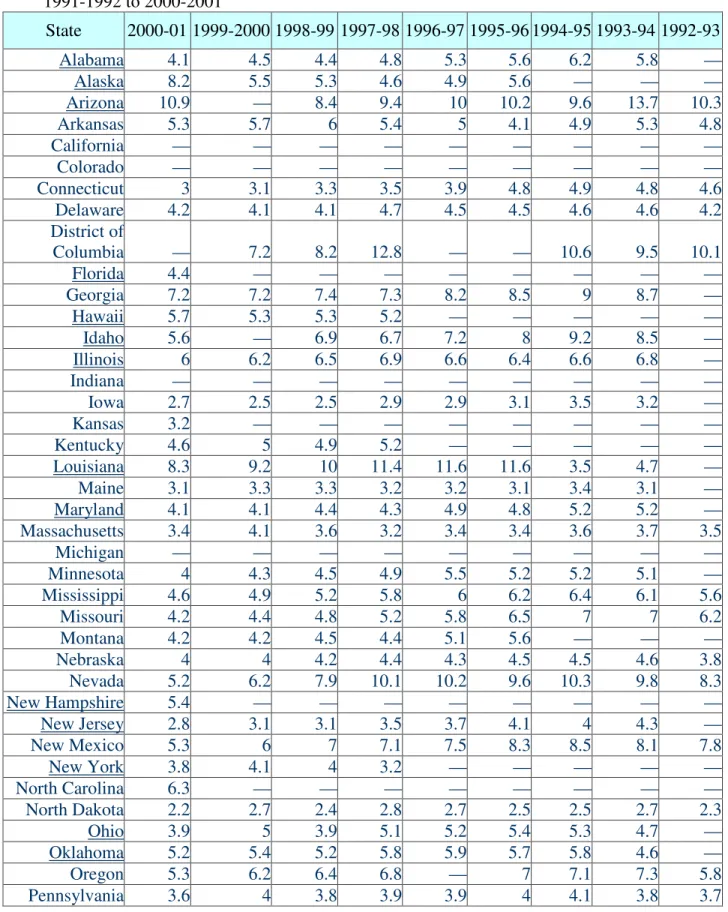
Tables in the Appendix provide dropout data for Puerto Rico and the 50 states and the District of Columbia.
2. ESTIMATING STUDENT DROPOUT RATES
The Digest of Educational Statistics (DES), published each year by the U.S. Department of Education, presents for each state and territory of the United States “the figure reported to the federal authorities as the percentage of 9th to 12th graders who drop out each year.” (See Appendix Table A-2.) The figure for Puerto Rico for 1999-2000 is 0.9%, which is less than half of the figure reported for any state. It is not believable that Puerto Rico’s public schools actually have a dropout rate this low compared to the states. (The 1999-2000 figure is not an anomaly, as the figure is similarly low in other years.) Moreover, the reported figure is dramatically at odds with what many observers believe to be the case on the basis of anecdotal evidence. Indeed, the estimates we will present below suggest that the dropout rate for Puerto Rico’s public schools may be ten times as high as this reported rate.
Given the importance of knowing whether students actually make it through school to graduate, it is surprising to find that data collection systems do not exist to measure the phenomenon accurately anywhere in the United States. Puerto Rico is no different; good data are hard to find. Even the No Child Left Behind (NCLB) legislation does not mandate the use of a consistent definition of the dropout rate that would enable comparisons across districts and states. Existing dropout figures from the public schools or as measured through surveys are widely acknowledged to underestimate the severity of the problem. This report uses the alternative of cohort methods that employ publicly available enrollment figures to estimate dropout rates. While preferable to survey results or school figures, these different cohort alternatives also have their limitations.
Unfortunately, schools do not track individual students using a unique identifier, which would enable a more direct measurement of student completion of high school and the extent to which students drop out before graduation. Although the cost of implementing such a system would be significant, it would help provide a more direct measure of the dropout problem. In the absence of such a direct measure, various estimation techniques are employed.
It is first instructive to review the figures and methods that are commonly used to estimate the extent of the dropout problem, and their limitations. The primary estimates are so-called “event dropout rates” reported by public schools and “status dropout rates” from surveys of young people about their schooling. Then there are the alternative “cohort methods” that we focus on in this report. Table 1 on reviews the characteristics of the different ways of looking at the dropout rate, along with some advantages and limitations of using each; although the information in Table 1 is presented in terms of high school dropout rates, the same information applies when the estimates are for earlier years or for the earlier years plus high school.
2.1. Event Dropout Rates
Event dropout rates measure the number and percent of students who drop out during a one-year period. Event dropout rates capture the dropout flow over a year, but tell little about the extent of the dropout phenomenon: how many students drop out over time. Further, event dropout rates as reported by schools are notoriously inaccurate and are widely considered to underestimate the extent of the school dropout problem – and, as noted above, this seems to be especially so in Puerto Rico.5
5
Underestimating dropout rates does not necessarily result from incentives for schools to do so; tracking dropouts is difficult and costly. It requires that schools track students as they enter and exit school, which is difficult with students who are often a mobile populations. In the rest of the United States, the Current Population Survey also reports on the event dropout rate, which it defines as 15 – 24 year olds who were enrolled in high school in October of one year but had not completed high school and were not enrolled in school a year later.
2.2. Status Dropout Rates
Surveys estimate the percentage of young people who have completed high school and, conversely, the percentage that have dropped out, based on the reports of respondents. Usually measured through surveys of 16 to 24 year olds, the “status dropout rate” refers to the percentage of people who are not currently enrolled in school and have not received a high school diploma or general education development (GED) degree. Similar to the status dropout rates, the “high school completion rate” measures the percentage of 18 to 24 year olds surveyed who have completed high school with either a GED or diploma.
Surveys often provide unreliable estimates of the dropout rate. They tend to under-represent lower income, jailed, and other populations. Respondents also tend to over-state their educational attainment and avoid admitting to dropping out of school.
The Current Population Survey, commonly used to estimate the extent of dropouts, does not cover Puerto Rico (and does not survey enough households nationwide to enable state-level reports for most U.S. states). The decennial Census, however, does survey Puerto Rico and includes similar questions about educational attainment and enrollment.
2.3 Alternative Cohort Rates
As an alternative to event dropout rates and status dropout rates, this report presents estimates of the dropout rate in Puerto Rico using common, so-called cohort methods to track the progress of classes through public schools and to graduation on the basis of reported enrollment figures by grade. Each cohort method brings strengths and limitations, but all share common advantages over other methods of estimating dropouts. Cohort methods rely on enrollment figures, which schools have less difficulty tracking than event dropout rates and which, in themselves, do not reflect poorly on the schools.
2.3.1. Basic Completion Ratio (BCR)
Perhaps the most simple and intuitive of the cohort estimates, the basic completion ratio (BCR) method estimates the high school completion rate by tracking a presumed “cohort” of 9th grade students through high school using reported annual school enrollment figures.6 For example, if school enrollment figures report that 100 9th graders started the 1994-1995 school year, and 75 graduated in 1998, the BCR method would conclude that the graduation rate was 75% and the drop out rate was 25%. The BCR also captures the experience of students over an extended time period as the cohort in question passes through school (four years if high school is the focus, three for middle school).
6
The reverse of the BCR is often known as the Estimated Attrition Rate, which reflects the percentage of students who do not graduate.
For example, the BCR for 6th graders finishing high school this year would cover schooling over the past seven years.
The accuracy of the BCR method is influenced by changes in student population over the window of time covered; the longer the window, the greater the susceptibility to error. Migration, other population changes, and movement to and from private schools can all skew BCR results. As Puerto Rico has a high rate of enrollment in private school – higher than in any state – such movements are even more likely to affect results.7
For Puerto Rico, it is desirable to adjust BCR estimates to take account of net migration to the United States; some of the decline in a cohort as it passes through the grades is accounted for by this net migration and not by dropping out as usually conceived. Based on Census data reported in Christenson (2001), which provides Puerto Rico-to-U.S. net migration by age groups, we have estimated that on net during the 1990s about 250 high school aged students in each cohort emigrated each year. For middle school students, the data allow an estimate of 170 per year from each cohort.8 Thus net out migration accounts for the attrition of about two-thirds of one percent of each high school class and about one-third of one percent of each middle school class.
Further, it is unfortunately also necessary to take account of the unusually high murder rate of juveniles in Puerto Rico. The overall murder rate in Puerto Rico is higher than for any state and almost four times higher than the U.S. average, 20.1 per 100,000 for Puerto Rico in 2002 compared with 5.6 per 100,000 for the United States as a whole. Youth under 18 represent a disproportionately high percentage of these deaths. A rough estimation suggests that about 20 students, an almost full class of students, from each public high school cohort is lost to murder each year in Puerto Rico.9
2.3.2. Cumulative Promotion Index (CPI)
Developed by researchers at the Urban Institute (Swanson, 2004), the cumulative promotion index (CPI) estimates the probability that a student entering 9th grade will graduate based on a cohort analysis of two years of enrollment data. The CPI assumes that the likelihood of graduation is equal to the cumulative likelihood of each high school grade cohort moving successfully to the next year (or graduation) using two years of enrollment data.
By using a shorter, two-year window of analysis, the CPI method requires less data and is less susceptible to errors caused by changes in student population over time. For areas with little volatility in student population, however, the BCR method would
7
According to the 2000 Census, 17.6% of total elementary and secondary enrollments are in private schools in Puerto Rico, compared with 10.4% for the United States as a whole. The state with the next highest private school enrollment rate is Louisiana, with 16.6% of students in private schools.
8
We have assumed that 80% of the net migration is students from public schools, as roughly 20% of Puerto Rican students are enrolled in private schools.
9
provide a more accurate picture of student experience throughout the high school or middle school experience of the cohort than the CPI. Also, by drawing on only two years of data, the CPI may be more distorted by short-term data anomalies than the BCR (as may be the case in Puerto Rico in 2000 – see below).
According to the method discussed in the previous section, we have attempted to adjust for the out migration of students for the CPI method as well by reducing each cohort by the estimated annual attrition of middle or high school students. The high school CPI also accounts for the percentage of students who do not receive a diploma after being accounted for in the first month of their senior year. This cohort is reduced by only 187 (i.e., 75% of 250) students, reflecting the estimate of the 9 months of the year these students are in school. Similarly, the CPI figures should also be adjusted for the loss of students in each cohort to violence.
2.3.3. Greene’s method
The procedure for estimating dropout rates developed by Jay Greene (Greene and Forster, 2003) of the Manhattan Institute also uses a modified version of the cohort method to estimate the high school graduation rate. Greene’s method controls for two potential sources of error in the BCR method by altering the size of cohorts. First, Greene notes that the 9th grade cohort might be inflated due to transfers from private schools into public schools and an unusual number of students held back in 9th grade. To control for anticipated inflated 9th grade enrollments, Greene recommends that 9th grade enrollments be “smoothed” by using an average of 8th, 9th and 10th grade enrollments. Second, Greene proposes to control for student population movements during the time the cohort is moving through the school by adjusting the size of the “smoothed” 9th grade enrollment by the change in population of the high school during the four years that the cohort moves through it.
2.4. Limitations of Cohort Methods
It is important to acknowledge the limitations of the methods used in estimating the dropout rate for Puerto Rico. While widely considered more accurate than even dropout rates reported by schools and status dropout rates from surveys, cohort methods estimate the graduation rate based on annual enrollment figures and not from the tracking of individual students.10 Changes in population (for which we have made some rough corrections) and, especially, movements to and from private schools can skew results based solely on enrollment figures.
Because cohort dropout estimates are derived from public school enrollment figures, they do not allow us to distinguish between students who left the schools
10
entirely11 and those who moved from public to private schools. The difference is important, as the ultimate outcomes for the individuals in the two groups – and consequently for society at large – are very different. As Puerto Rico has a large and growing share of its students in private schools, some of the dropout from the public schools is accounted for by a net movement of students to private schools. However, the dropout rates provided by the cohort estimates are still a useful indication of the situation in the public schools. If students are leaving to go to private schools, this is a different phenomenon than students leaving school entirely, but it still is an indicator of shortcomings in the public schools that deserve attention. Furthermore, the rising enrollments in private schools show that many people in Puerto Rico are willing to pay for schooling, which in turn suggests that schooling does pay if the quality is good.
While not a problem of the cohort method per se, dropout estimates based on the cohort method are only as good as the basic enrollment data on which they are based. Recent aggregate enrollment data for Puerto Rico’s schools, public and private, show a very large increase in total enrollments; private school enrollments move upward sharply from 2000 to 2002 without any corresponding decrease in public school enrollments. The large increase defies explanation, and hence these data call into question the overall reliability of Puerto Rico enrollment data.
Finally, as with any aggregate estimates, the cohort method results obtained here do not provide information about individual schools or regions of the school district. (In Puerto Rico, there is only one district.) There is every reason to think that Puerto Rican schools, like schools elsewhere, vary considerably in terms of their experience with the dropout problem, as well as in terms of their experience with other problems.
Because of these various limitations, the estimates presented here should be viewed with appropriate caution and should be interpreted as approximations, not precise measures. They are, nonetheless, an improvement on other estimates.
11
Table 1. Methods for Measuring Dropout Rates in Puerto Rico
Method Definition Advantages Limitations
Event dropout rates
Drop outs over a one-year period, as identified and tracked by schools; Four years of event dropout rates forms basis for high school
graduation rate and high school attrition rate.
Potential for accuracy by tracking details about students (students leaving might be moving to a private school or another public school).
Reflects flow of students only over one year; Accurate record keeping is difficult and costly for schools;
Negative results reflect poorly on schools, discouraging accurate reporting.
Status dropout rates
Individuals who respond to surveys that they have not finished high school.
Provides results of schooling in actual education attainment of individuals (whether through public or private school, or GED).
Results subject to limitations of surveys; Individuals are often reluctant to admit to dropping out, and often over-report their education level. Estimated cohort dropout rates Percent of a “cohort” of students starting in 9th grade who do not complete high school after four years.
Does not rely on school tracking and reporting of student dropouts.
Population change and movement of students in and out of public schools can distort a cohort over time;
Only as reliable as school enrollment data.
Basic completion rate (BCR)
Percent of cohort that graduates based on enrollment data for 9th grade and graduates three years later.
Adjusted for migration and youth homicide.
Captures experience of a cohort in school over four years.
See above.
Cumulative promotion index (CPI)
Probability student will complete high school based on two years of student enrollment data. Adjusted for migration and youth homicide.
Snapshot picture of high school dropout performance based on 2 years of
enrollment data.
See above;
Two years of data do not reflect experience of cohorts over high school career.
Greene method
Adjusts 9th grade cohort for population change and possible inflation of 9th grade enrollment due to grade retention and private school.
Accounts for possible enrollment anomalies in 9th grade and population change over time.
3. EVIDENCE ON THE DROPOUT RATE IN PUERTO RICO
3.1. Event Dropout Rates
In Puerto Rico, official annual “event dropout rates” report that only 0.9% of high school students dropped out during 2000, a figure lower than that for any reporting state or the District of Columbia (NCES, 2001). Similar figures are not available for middle school students. Due to the limitations of the underlying data, estimates of graduation rates using reported event dropout rates also underestimate the extent of the phenomenon. In Puerto Rico, the calculation of graduation rates using this method suggest that 94.6% of 9th graders subsequently complete high school, a higher graduation rate than in any reporting state or the District of Columbia. The average state reported an 80.5% graduation rate (NCES, 2004). (See Appendix Tables A-1 and A-2 for a listing of available state event dropout rates and completion rates.)
3.2. Status Dropout Rates
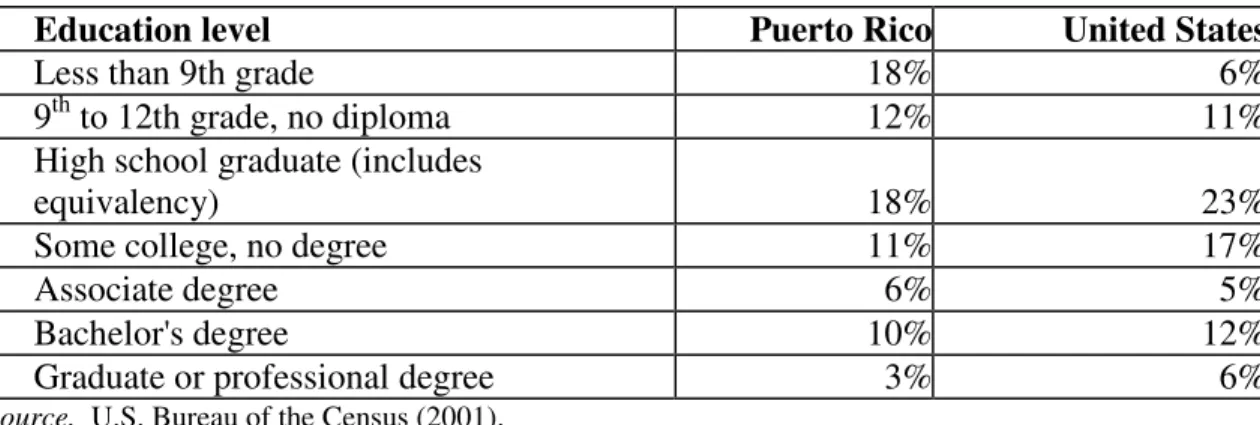
Education attainment for adults 18 and over. The 2000 Census found that 70% of Puerto Ricans 18 and older hold a high school degree or equivalency, or conversely, that 30% of respondents have not yet completed high school; of this 30%, three-fifths, or 18% of all Puerto Ricans, have not completed any high school. In the United States as a whole, 83% hold at least a high school degree, and only 6% have not completed any high school. These figures, along with additional detail, are shown in Table 2.
Table 2. Education Attainment for Population 18 and Higher, 2000
Education level Puerto Rico United States
Less than 9th grade 18% 6%
9th to 12th grade, no diploma 12% 11%
High school graduate (includes
equivalency) 18% 23%
Some college, no degree 11% 17%
Associate degree 6% 5%
Bachelor's degree 10% 12%
Graduate or professional degree 3% 6%
Source. U.S. Bureau of the Census (2001).
A review of educational attainment by age group shows that, after age 25, the older the respondent, the greater the likelihood the respondent had dropped out and had not completed high school. In fact, over half of those 45 and older in Puerto Rico do not have a high school degree, and 70% of those over 65 never finished high school. These data are presented in Table 3.
Table 3. Percent in Puerto Rico without high school degree by age group, 2000
18 to 24 25 to 34 35 to 44 45 to 64 65 and over
29.5% 22.3% 26.8% 44.5% 70.0%
Source. U.S. Bureau of the Census (2001).
Education attainment for adults 25 and over. Compared to the United States, a very large proportion of the Puerto Rican adult population appears to be without high school degrees, and a similarly large proportion is without any high school education at all. For all respondents 25 and older, the Census finds that Puerto Rico’s percentage of adults without a high school degree is about twice as high, 40%, than in the United States as a whole, 19.6% (see Table 4), and higher than in any state or the District of Columbia. Almost two-thirds of adults without high school degrees in Puerto Rico have not completed any high school grades. The share of Puerto Rican adults without any high school education is more than twice as high as in any state. (The figure is 11.7% in Kentucky, the state with the highest proportion of adults who have not reached 9th grade.)
Table 4. Percent of Adults 25 and older without high school degrees, United States and Puerto Rico
No high school degree Less than 9th grade Some high school
Puerto Rico 40.0% 25.4% 14.6%
United States 19.6% 7.5% 12.3%
Source. U.S. Bureau of the Census (2001).
Enrollment of youth aged 16 – 19. The Census also asks about the education enrollment of respondents aged 16 to 19, and finds that 14.1% of Puerto Ricans in this age group are not enrolled in school and do not hold a high school diploma. Only Arizona has a higher proportion of youth without degrees and not enrolled, 14.8%.
3.3. Cohort Estimates
3.3.1. High School Graduation Rates
Table 5 and Figure 1 show the high school graduation rates for the 1994 to 2000 period obtained by using the three described cohort methods. The table shows for comparison the rate provided by the National Center for Education Statistics (NCES); this is based on annual event drop out rates reported by the Puerto Rico Public Schools. In each case, the NCES high school completion rates appear to over-estimate the completion rate estimated by cohort methods by more than 20 percentage points, and in some cases, by up to 30 percentage points.
Table 5 – Puerto Rico High School Graduation Rates, 1994-2000
1994 1995 1996 1997 1998 1999 2000
Basic completion ratio
(BCR) 64.1% 64.7% 65.0% 66.7% 68.2% 69.1% 71.8%
Greene method 63.2% 65.9% 63.5% 64.5% 67.4% 68.0% 67.7%
Cumulative promotion
index (CPI) 63.9% 67.0% 65.6% 67.9% 68.7% 72.5% 76.0%
NCES reported figures -- 93.6% 94.7% 91.5% 92.3% 93.4% 94.6% Basic Completion Ratio (BCR). In 2000, the basic completion rate (BCR) for high school for Puerto Rico was 71.8%, slightly higher than the rate for the United States as a whole, 66.6%.12
Greene’s method. In 2000, Greene’s method estimates the high school graduation rate for Puerto Rico at 67.7%, comparable to the 69% rate for the United States as a whole. Puerto Rico ranks in the middle of the states near Delaware, Washington State, New Hampshire, and Hawaii.
Cumulative promotion index (CPI). In 2000, the cumulative promotion index (CPI) estimates the high school completion rate at 76.0% in Puerto Rico, compared to 83% for the United States as a whole.13
Figure 1 – Puerto Rico High School Graduation Rate, Three Methods, 1994 – 2000
56% 58% 60% 62% 64% 66% 68% 70% 72% 74% 76% 78% 1994 1995 1996 1997 1998 1999 2000
Basic completion rate (BCR) "Smoothed" Cohort (Greene) Cumulative promotion index (CPI)
a
12
Adjusting for out-migration increased the BCR by 2.3 percentage points.
13
Grade by grade progression rates. On the basis of the BCR calculations, the worst high school drop out problems in Puerto Rico appear to be in the transitions from 10th to 11th, and 11th to 12th grades, as indicated in Figure 2. A higher relative percentage of students, 98.5%, progresses from 9th to 10th grade, but then the rate of progression drops to 85.8% from 10th to 11th grade and 85.6% from 11th to 12th grade. Another 8.5% of students who start 12th grade do not graduate at the end of the year. These progression rates reflect the percentage of a cohort that moves from one year to the next. For example, if 100 students were enrolled in 9th grade in 1999, and 90 students enrolled in 10th grade in 2000, the estimated progression rate would be 90%. These progression rates for each high school grade and from 12th grade to graduation are averaged from 1987-1988 to 2001-2002, and take into account the estimated out migration of students each year.14
Figure 2. Progression Rates through High School, Puerto Rico Public Schools, 1986 – 2000 Averages 85.8% 85.6% 91.5% 98.5% 75% 80% 85% 90% 95% 100% 9 - 10 10 - 11 11 - 12 12 to graduation
3.3.2 Middle School “Completion” Rates
The same cohort methods can be applied to estimate the drop out rate for students as they progress through middle school. However, because Greene’s method is designed to account for assumed population changes in 9th grade in particular, we do not use it to estimate the middle school completion rate. Table 6 shows the middle school completion rates for Puerto Rico during the period 1994 – 2000.
14
We also use Christenson (2001) data to estimate the out-migration by high school age cohorts of roughly 250 students annually during the 1980s, similar to our findings for the 1990s, but we find a comparatively lower annual loss of 100 students per cohort at the middle school level during the 1980s.
Table 6. – Middle School “Graduation Rates” 1994-2000, BCR and CPI
1994 1995 1996 1997 1998 1999 2000
Basic completion rate
(BCR) 86.3% 87.6% 90.0% 90.6% 92.0% 91.0% 93.5%
Cumulative promotion
index (CPI) 85.2% 88.2% 91.4% 90.5% 92.5% 88.6% 97.2%
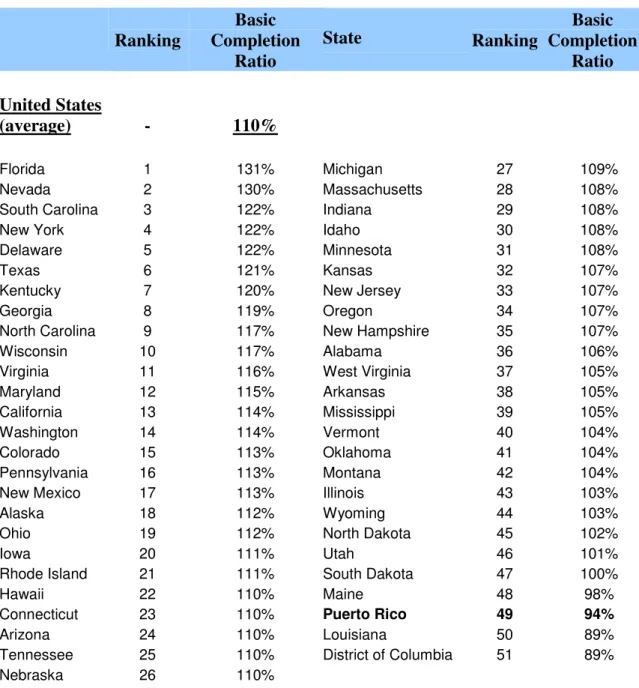
Basic completion ratio (BCR). With the BCR, completion for middle school students refers to enrollment in 9th grade for a cohort of students starting in 6th grade.15 For example, if 100 students were to start 6th grade in the 1994–1995 school year, and 55 enroll in 9th grade in 1997–1998, the middle school completion rate would be 55%, and the drop out rate during that period would be 45%.16
In 2000, the basic completion rate for middle school students in Puerto Rico was 93.5%. This figure compares with 113% for the United States. The figure higher than 100% (typical for individual states as well as the states as a group) reflects students moving back from private schools to enroll in 9th grade, as well as students being held back in 9th grade. Only Louisiana and the District of Columbia have a lower completion rate for middle school students than Puerto Rico. Table A-3 provides a listing of the basic completion rates for middle school students for each state, the District of Columbia, and Puerto Rico.17
Although Puerto Rico ranks at the bottom of the United States, progress has been made since the mid 1990s, as Figure 3 illustrates. This improvement in the 1990s followed a substantial period of relatively little change. The middle school completion rate was 83.9% for the 1977-1978 school year, little different from the rate in 1994.
15
Movement of students from private school in the 9th grade may increase 9th grade enrollments. Similarly, the results will also be skewed to the extent that students are held back more or less in Puerto Rico than in the 50 states.
16
Some of the students who drop out and do not finish on time may complete their degrees later.
17
These figures have also not been adjusted for population change, which will affect some states more than others, and should be understood as a rough estimation of Puerto Rico’s position in comparisons with the states.
Figure 3 – Puerto Rico Middle School “Graduation” Rate, Basic Completion Rate and Cumulative Promotion Index, 1994 – 2000
78% 80% 82% 84% 86% 88% 90% 92% 94% 96% 98% 100% 1994 1995 1996 1997 1998 1999 2000 Year P e r c e n t
Basic completion rate (BCR)
Cumulative promotion index (CPI)
Historical completion rates. A quick review of middle school completion rates since 1962, provided in Figure 4, shows three periods. First, the completion rates improve steadily from the early 1960s through the mid-1970s. The cumulative promotion index (CPI) through middle school increases from 67% in 1962 to 86% in 1976. Second, negligible improvement is made for the next twenty years, until the mid-1990s, when the CPI begins to improve to its current level of 97% in 2000. The BCR follows a similar pattern.
Figure 4 – Puerto Rico Middle School Completion Rates, 1962-2000
56% 66% 76% 86% 96% 1962 -63 1965 -66 1968 -69 1971 -72 1974 -75 1977 -78 1980 -81 1983 -84 1986 -87 1989 -90 1992 -93 1995 -96 1998 -99 MS BCR MS CPI
Cumulative promotion index (CPI). The cumulative promotion index (CPI) provides a 97.2% middle school completion rate for 2000. Almost 9 percentage points higher than in 1999, the 2000 figure might reflect unusual enrollment changes from 1999 to 2000. In comparison, the CPI middle school rate for the United States as a whole was 115% in 2000.
Grade by grade progression. Enrollment figures suggest that the worst drop out problem in middle school occurs during the transition from 7th to 8th grade, and then from 8th to 9th grade, as can be seen in Figure 5. If the cohort from the current year’s class is taken as a percent of the previous year, 90.4% of 7th graders (over the past 15 years on average) progresses to 8th grade, compared to 92.9% of 8th graders to 9th grade. The 6th to 7th grade transition does not seem as problematic: 105.4% of 6th graders progresses to 7th grade. These estimates follow the same methodology used for grade-to-grade progression as for high school.
Figure 5 – Progression Rates through Middle School, Puerto Rico Public Schools, 1986-2000 Averages 105.4% 90.4% 92.9% 80% 85% 90% 95% 100% 105% 110% 6 - 7 7 - 8 8 - 9
3.3.3. Combined Middle and High School Graduation Rates
The dropout rates estimated here mean that 12,000 students who started high school in 1997 did not graduate with their peers in 2001; another 8,000 who had started middle school three years earlier had already dropped out. Students who dropped out in middle school, if they had stayed in school, would have been at risk of dropping out later in high school. As a result, the high early dropout rate in Puerto Rico makes high schools appear better at retaining students than might be merited. Based on 2000-2001 estimates, in Puerto Rico 65% - 74% of students who start 6th grade will complete high school,
using both basic completion rate and cumulative promotion index methods.18 In the United States as a whole, the comparable estimate is in the range of 76 to 78%.
Table 7. Puerto Rico Public Schools High School Graduation Rates for 6th Grade Students
1994 1995 1996 1997 1998 1999 2000
Basic completion rate
(BCR) 55.4% 55.5% 56.6% 57.4% 59.6% 62.0% 64.9%
Cumulative promotion
index (CPI) 54.5% 59.2% 60.0% 61.6% 63.7% 64.4% 74.0%
Grade to grade progression. The comparison between grade-to-grade progression rates in Puerto Rico and the United States in Figure 6 shows which grades students in Puerto Rico are not passing through at the same rate as students in the United States. While students progress from 6th to the 7th grade at a comparable rate (105% in PR and 102% in the United States), a disparity quickly develops in the transition between 7th and 8th grade and grows in the 8th to 9th grade transition to almost 20 percentage points.
In high school, Puerto Rico’s grade-to-grade progression rates are far more comparable to those for the states, showing an advantage in the 9th to 10th grade transition (99% in PR and 91% in the US), and evening out by graduation with comparatively lower progression rates in each subsequent grade.
Figure 6. Grade to Grade Progression Rates, United States and Puerto Rico, 1986-2000 Averages 102.0% 98.7% 111.7% 90.6% 90.7% 91.3% 91.5% 105.4% 90.4% 92.9% 98.5% 85.8% 85.6% 91.5% 60.0% 70.0% 80.0% 90.0% 100.0% 110.0% 120.0% 6 - 7 7 - 8 8 - 9 Grade 9 - 10 10 - 11 11 - 12 12 to grad P e rc e n t US PR 18
The CPI estimate for Puerto Rico, as discussed earlier, shows an unusual 7-percentage point increase from 1999 to 2000, which may reflect some abnormal and questionable enrollments.
3.4. Summary of the Evidence
By way of summary, the findings presented here indicate that Puerto Rico has a serious public school dropout problem. Even though officially reported public school dropout rates are extremely low, enrollment figures indicate that actual dropout rates are very high. However, although dropout rates are high in Puerto Rico, they appear to have fallen significantly during the 1990s and into the new century. Moreover, given that Puerto Rico’s level of income is substantially below that of the states, we might have expected much higher dropout rates.
The Puerto Rican dropout problem appears to be especially severe for young students, those at the 7th and 8th grade levels. Whereas high school dropout rates appear to be no higher for Puerto Rico than for the average of the 50 states (and thus significantly better than for many individual states), the dropout rate in Puerto Rico for pre-high school students appears to be higher than in almost all states. Overall, then, from the 6th grade to high school graduation, Puerto Rico is below all or virtually all of the states in its ability to engage and retain students.
It should also be noted that extremely high dropout rates before the mid-1990s have left a legacy of adults without high school degrees. Forty percent of adults over 24 lack a high school degree, significantly higher than in any state.
Finally, there appear to be substantial problems with the data that are available on the Puerto Rican public schools. These problems mean both that this analysis of dropout rates should be taken with an appropriate degree of caution and that a thorough audit of school data in Puerto Rico would be desirable.
4. CONTEXT AND IMPLICATIONS
As stated earlier, a high dropout rate from Puerto Rico’s public schools indicates that something is wrong. By comparative standards with the states, Puerto Rico’s dropout rate is not as high as one might expect, given the lower level of income in Puerto Rico as compared to the states (and given the general correlation between the level of income and the extent of schooling in various societies). Furthermore, significant improvements occurred in the 1990s. Nonetheless, Puerto Rico’s dropout rate does indicate that something is wrong, and, especially because of the strong association between successful schooling and economic-social-political progress, it is important to figure out what is wrong and to attempt remedial action.
4.1. The Economic Context
Although most discussions of the dropout problem focus on the schools and programs of remediation that might be implemented in the schools, it is important to
recognize that the problem is not necessarily confined to the schools. Students who view themselves as unlikely to go to college may perceive that there is little pay-off to staying in school if the labor market opportunities for high school graduates are relatively poor. Available data, though limited, suggest that this may not be an unreasonable perception. Sample data from the 2000 Census indicate that the people with a high school diploma in Puerto Rico have incomes that average no more than 30% above the incomes of people who drop out. For the states taken as a whole, the comparable figure is 36%. The pay-off to a college degree in Puerto Rico is similar to – or perhaps greater than – that in the states, but, if students from low-income families believe they have very little (if any) likelihood of going to college, they may see limited value in completing high school.19 Furthermore, insofar as there is a large “informal economy” in Puerto Rico, it is likely to provide unreported sources of income for dropouts; therefore the figures noted here from the census may overstate the pecuniary gains from completing high school.
It is also possible that Puerto Rico’s special relation to the United States may weaken the economic incentives for staying in school. The relatively high (compared to Puerto Rican average income) federal transfer payments may reduce labor market incentive for people at the lower income levels. Also, the option of temporary migration to the states to earn income that is high by Puerto Rican standards – for example, in non-union construction activity – may appear preferable to the jobs that can be obtained in Puerto Rico with a high school degree.
A considerable body of literature suggests the overall connection between the dropout rate and the return to a high school degree in the labor market. (For example: Bickel and Papagiannis, 1988; Clark, 1992; Rumberger, 1983). In general, when good jobs are relatively available, there is a stronger incentive for kids to stay in school (as “good jobs” generally require a high school degree). But poor times economically, when families especially need additional income, may reduce this incentive, and there may be a tendency for the dropout rate to rise. In Puerto Rico, it is probably no coincidence that the failure of the middle school dropout rate to continue improving after the mid-1970s – see Figure 6 – was associated with the slow-down of the economy that began roughly at that time.
To the extent that these labor market factors are significant in affecting Puerto Rico’s dropout rate, solutions to the problem are especially more difficult. While it is possible to imagine programs that would improve labor market opportunities for high school graduates and thereby reduce dropout rates, implementation of those programs would take a long time. Recognizing the economic factors that affect dropout rates should, however, prevent either placing extensive blame on the schools for the problem
19
The overall U.S. figures on returns to schooling are from Day and Newburger (2002). The Puerto Rico figures are based on calculations carried out by Ricardo Godoy, Mariana Caram, and their colleagues at Brandeis University who have been engaged in an examination of information on Puerto Rico from the Census Bureau’s Public Use Microdata Series summary files. While these figures based on recent census data suggest similar pay-offs to a college degree in Puerto Rico and the United States, other estimates suggest the pay-off is greater in Puerto Rico. In either case, however, if students see little likelihood that they will continue on to college, the advantage of completing high school may be minimal.
or having unrealistic expectations about the possibilities for solving the problem through reform of the schools. Nonetheless, reforms in the schools can be an important part of the solution to the dropout problem.
Equally important, there is a two-way relationship between improving labor market opportunities for high school graduates and improving the schools themselves. Part of the explanation for a lack of job opportunities for high school graduates may be that high school graduation in itself is not be a meaningful qualification for many jobs. If schools are doing a poor job of preparing students for the labor market – if, for example, a high school diploma does not mean that a person has the requisite skills for many jobs – then there will be little difference between the opportunities available to a person who has graduated and those available to a person who has dropped out.20
4.2. Implications For The Schools
4.2.1. No Child Left Behind Issues
The No Child Left Behind (NCLB) legislation, which applies to Puerto Rico as it does to the 50 states and the District of Columbia, has some immediate implications for Puerto Rico’s approach to the dropout problem in its public schools. In particular, the law will press Puerto Rican authorities to address the problem. NCLB focuses on the graduation rate – and implicitly the dropout rate – as an indicator of a school’s successes and failures, and prescribes improvement in the rate over time. The law has particular provisions regarding calculating and publicizing dropout and completion rates and for the consequences of failing to achieve “adequate yearly progress” in graduation rates.21
NCLB specifically adopts the cohort method of estimating the “on-time” graduation rate, meaning those students who finish high school when expected.22 The law, however, does not require any particular kind of data collection system, and it gives states and territories leeway to use an “alternative” method of measuring the graduation rate.23 In effect, Puerto Rico, like any state, has leeway to use versions of the methods
20
We do not mean that high schools should be expected to endow students with job-specific skills. The skills learned in school that prepare people for employment include a broad range of cognitive and behavioral qualities. Schools are successful if, by developing this broad range of skills, they have endowed the students with the most important skill of knowing how to learn. If employers know that a high school diploma means that a person is capable of learning the skills for a particular job, then the diploma has meaning. Of course, schools have a wider purpose than simply preparing people for the job market, and, while preparing people for the job market is central to the discussion here, that broader purpose should not be forgotten.
21
Such requirements of NCLB have the problem of seeing the actions of students as affected only by the schools, without consideration of factors emanating from economic conditions, of the sort just noted, or other larger societal factors.
22
The graduation rate is defined as “the percentage of students who graduate from secondary school with a regular diploma in the standard number of years” No Child Left Behind Act, Section 1111(b)(2)(C)(vi).
23
described above, including completion ratios, promotion ratios, current NCES figures on annual dropout rates, and others.
NCLB requires that high schools publish graduation rates (however defined) in their annual report cards, but schools may select not to publish dropout rates (however defined). Given that Puerto Rico’s dropout problem appears relatively more severe in middle school than in high school, this NCLB requirement to report high school graduation rates will not draw attention where it is most needed in Puerto Rico.
In the provisions of NCLB, the graduation rate is ostensibly to serve as a secondary indicator for measuring adequate yearly progress (AYP) for schools and districts. Schools that fail to make AYP face escalating “sanctions,” including the provision of supplemental education services and school choice and leading to possible school take-over by the state or territorial government. The graduation rate is specifically selected as an indicator to prevent schools from pushing low-performing students out of the school system to improve their test scores for AYP. However, to date there is no clear specification of the extent to which graduation rates will factor into the calculation of AYP. (See Swanson 2003a and 2003b for more complete discussions of NCLB and calculating dropout rates.)
4.2.2. Policy Directions
The information presented in the previous sections of this report as well as the requirements of NCLB demonstrate the need to address the dropout problem in the schools. On the basis of what is widely recognized about the dropout problem, there are certain policy steps that should be considered. We would call attention to the following:
Quality Improvement. Because students dropping out of school are responding at least in part to labor market conditions, school policies will have limited impact on the dropout rate if employers do not place a higher value on public school completion. By improving the quality of the basic and general skills that they impart to students, schools would raise the value of the diploma and create an incentive for students to stay in school. Quality improvement, in addition to its impact on incentives related to the labor market, can make school a more positive experience in itself.24
Quality improvement is hardly an innovative or controversial policy proposal, and the problem remains how to achieve this improvement. By 2003, as part of a quest for quality improvement, nineteen states had established the requirement that students achieve a level of proficiency on assessments in math, science, language arts and other
24
In a sense, dealing with the dropout problem by improving the quality of schools can be viewed as a “market solution” to the problem. With improved quality of the schools, the value of a degree is raised, and thus students are likely to respond to market incentives and stay in school. Policy, in this situation, affects the endowments that people have when they enter the market and thus alters the structure of the markets.
subjects, as measured by “exit exams,” in order to earn a diploma.25 Such assessments are sometimes required for all diplomas, as they are in Massachusetts and Florida, or only for students interested in receiving a type of diplomas noting the student’s achievement, as New York State used to issue through the Regents degrees. When dropout rates are used as a measure of schools’ success, there can be a temptation to improve success by diluting standards, either directly by making it easier for students to complete school or indirectly by “teaching to the test.” A dilution of academic standards would, of course, be highly undesirable and, while it might (but only “might”) result in short run improvements in dropout rates, would undermine the value of a diploma and thereby contribute to higher dropout rates over the longer run. Exit exams and other forms of assessment might forestall this option.
In itself, however, the exit exam approach to quality improvement is as likely to exacerbate as to reduce the dropout problem. “High stakes” exams can have the impact of pushing poorly performing students out of the schools, even if they succeed in raising the general quality of the schools.26 Perhaps the greatest value of exit exams is that they introduce a higher degree of assessment into the schools. A higher degree of assessment can contribute to quality improvement because it can provide a direct impetus to improvement and because it establishes the possibility of holding schools accountable for the results they achieve. Assessment, however, can be accomplished by various means, including exams but also including alternative measurements of students’ accomplishments.
Furthermore, while exams and alternative assessment mechanisms can be tools of quality improvement, they are unlikely to bring about substantial change unless their introduction is accompanied by the provision of greater resources to the schools. While few would argue that money per se provides a solution to schools’ shortcomings in Puerto Rico (or anywhere else), there is substantial reason to believe that more funds for the Puerto Rican schools is an important element of reform. For example, teachers’ and administrators’ salaries in Puerto Rico appear low as compared to general salary levels (using the relation between school salaries and general salary levels in the states as a basis for comparison). New regulations from Washington are already increasing the availability of federal funds for the Puerto Rican schools, so providing more resources for the schools in coming years may not place excessive burdens on the Puerto Rican government’s budget.
25
Gayler et al (2003). An additional five states have plans to implement an exit exam before 2008. The value and effect of exit exams is the subject of intense debate.
26
Quality improvement initiatives have increasingly included requiring students to pass annual assessments to be promoted to the next grade, often at 3rd or 8th grade. Research clearly demonstrates that student retention dramatically increases the likelihood that students will drop out. Rumberger (1995) found that students retained in elementary or middle school were four times more likely to drop out, after controlling for relevant predictive factors like academic performance and socioeconomic status. School improvement strategies might have a less detrimental effect on student dropout rates if student academic needs were addressed in regular supplemental after-school and summer school programs, rather than through grade retention.
Quality and Connections. A large part of what matters in the schools is not simply what is done but how it is done, how the schools and classrooms are organized. While there are many different effective ways to teach, there is substantial evidenced that a common element of success is firm connections between teachers and students and between schools and communities.
A central element in establishing firm connections between teachers and students is class size. While there is considerable controversy over the impact of class size on student outcomes as measured by achievement tests, the evidence indicates that smaller schools and smaller classes reduce dropout rates. According to the Committee on Educational Excellence and Testing Equity (CEETE, 2003; p. 20): “Providing individual-level counseling to students emerged as a key factor for changing students’ thinking about their education. Another tool was creating smaller school settings, even within a large school, if necessary. Students are more likely to become alienated and disengaged from school [and therefore more likely to drop out] in larger settings, and are likely to receive less individualized attention from teachers and staff.”
Furthermore, while there is controversy over the impact of class size on student outcomes, existing studies do indicate that the positive impacts of small classes appear to be greatest among low-income groups – precisely the groups where the dropout problem is concentrated. (Rumberger, 1995; Mosteller, 1995) To the extent that there is a correlation between test-measured accomplishments and a lower likelihood of dropping out, smaller classes can likely make a positive contribution in this manner as well as through reducing alienation and disengagement.27
Small school settings have part of their positive impact (on student achievement and on dropout rates) because they can create a greater sense of “ownership” of the schools on the part of the students.28 In fact, compared with schools in the states, Puerto Rico has on average relatively small schools and relatively low student-teacher ratios (indicating small classes). For example, of the 100 largest school districts in the United States, only one has a median student-teacher ratio less than that of Puerto Rico; of these
27
As is pointed out by the CEETE (p. 20), smaller classes and smaller schools raise costs and can be a very expensive method of reducing the dropout rate. However, as suggested here, the reduction of dropout rates is only one benefit from small class size, and the costs should not be evaluated against this benefit alone.
28
Cotton (1996) point out several factors that might be accountable for the benefits of smaller school size: “Everyone’s participation is needed to populate the school’s offices, teams, clubs, etc., so a far small percentage of students is overlooked or alienated. Adults and students in the school know and care about one another to a greater degree than is possible in larger schools. Small schools have a higher rate of parent involvement. Students and staff generally have a stronger sense of personal efficacy in small schools. Students in small schools take more of the responsibility for their own learning; their learning activities are more often individualized, experimental, and relevant to the world outside of school; classes are generally smaller; and scheduling is much more flexible. Grouping and instructional strategies associated with higher student performance are more often implemented ins small schools – team teaching, integrated curriculum, multiage grouping (especially for elementary children), cooperative learning, and performance assessments.” Also, on the ability of small schools to engage and connect with students and reduce the dropout rate, see Fetler (1989), Gregory (1992), Jewell (1989), Pittman and Haughwout (1987), Rogers (1987), Smith and DeYoung (1988), Stockard and Mayberry (1992), Toenjes (1989), and Walberg (1992).
100 largest school districts, none has an average school size as small as in Puerto Rico. While smallness in itself does not solve dropout problems – or, for that matter, other problems of the schools – it does provide a basis on which to build.29
Schools can also facilitate the positive sense of “ownership” that often exists in small schools by building stronger ties to the community, especially to parents. Parent involvement has been associated with reduced dropout rates and improved student achievement (Peterson, 1989). Students encounter new academic and social challenges in middle school for which they need support, though this comes at a time when adolescents typically seek independence. Yet, parent involvement usually declines in middle school when students need it the most (Henderson and Marburger, 1990).30
Little research has evaluated the effect of a school’s grade span on student retention and performance. There is, however, anecdotal evidence that the separate middle school or junior high school is less effective in building connections with students than schools spanning grades K through 8. K-8 schools require fewer disruptive transitions for students and provide consistent personalized attention over a longer period. About 80% of Puerto Rico’s middle school aged students are enrolled in separate middle schools spanning from the 6th or 7th grade through 8th or 9th grade, not in so-called K-8 “combined schools,” (NCES, 2004). Given the dropout rate for Puerto Rico’s middle school aged students, a review of the effect of school’s grade span on retention and student performance might be valuable. Districts like Philadelphia have found a strong correlation between combined schools and performance, which may also translate into improved retention (Offenberg, 2001).
The Puerto Rican schools have made formal efforts to create community councils for the schools that would build this connection to communities. (Garcia Blanco and Colon Morera, 1993). As an effective means to implement community connections, these councils seem to have had limited impact. One of the factors that may negatively affect the degree of parent participation in Puerto Rican schools is that, as noted earlier in this report, a high percentage of Puerto Ricans older than 25 themselves lack a high school education. Thus many parents may lack academic skills needed to help their children with their schoolwork, and many may feel intimidated by the school environment. Rebuilding community councils for the schools in Puerto Rico could have significant positive impacts, not the least of which could be a reduction of dropout rates. But such rebuilding would require an effective strategy that addresses the barriers to
29
On school size, see http://nces.ed.gov/pubs2001/100_largest/table04.asp. On the student-teacher ratio, see http://nces.ed.gov/pubs2001/100_largest/table07.asp. Ironically, the one district with a lower student-teacher ratio is the District of Columbia, supporting the point that this ratio per se does not solve school problems. See Mitchell et al (1989) concerning the issue that smaller class size will not automatically generate benefits of increased student engagement and improved performance. For more on the benefits of small class size in positively affecting the dropout problem, see Pate-Bain et al (1999).
30
Schools can engage in a variety of strategies to engage parents, either encouraging home-based activities to support learning (like limiting TV watching or insisting on finishing homework before play) or fostering school-based activities to engage parents in the education of their children. In comparison to elementary schools, the larger size of middle and high schools and the lack of a single point of teacher contact for parents may make parent communication more difficult.
parent engagement. In addition, it should be recognized that creating and maintaining strong connections to communities and parents requires staff input, which is to say that it requires resources.
Another strategy that might affect the quality of the schools in a way that would reduce dropouts in Puerto Rico would be an emphasis on an early exposure of students to vocational education. Some evidence suggests that high quality, career-oriented vocational education programs can help engage and keep students in school. For example, Mertens, Seitz, and Cox (1982) found that increased enrollment in vocational classes in high school was associated with a somewhat reduced likelihood of dropping out. Most vocational programs do not begin until high school, after many students in Puerto Rico have already dropped out, and after many risk factors predicting future dropouts have already developed. It may be worth evaluating the integration of vocational education into education at the elementary and middle school levels to help further engage students in their learning.
Finally, more flexible class scheduling seems to be effective in helping students to successfully manage work and school obligations. More research on the extent to which students’ work obligations increase dropping out will help identify how successful more flexible approaches might be. Flexible scheduling has been identified as effective in retaining high school students and “recovering” older students with work and personal obligations (Rossi, 1996).
Early Intervention. As the data presented previously in this report make clear, many of Puerto Rico’s students drop out from the public schools earlier than their counterparts in the mainland United States, many in the 7th and 8th grades. Even in the states, however, early intervention is an important component in programs to reduce dropouts.31 CEETE concludes the first chapter of its report on Understanding Dropouts
with the following statement:
“The committee concludes that identifying students with risk factors [for dropping out] early in their careers (preschool through elementary school) and providing them with ongoing support, remediation, and counseling are likely to be the most promising means of encouraging them to stay in school. Using individual risk factors to identify likely dropouts with whom to intervene, particularly among students at the ninth-grade level and beyond, is difficult. Evidence about interventions done at this stage suggests that their effectiveness is limited.”
31
Dropping out is not a “one-time event” but a slow disengagement from school, manifested in reduced attendance and lower academic performance; see Audas and Willms (2001, for a review of the literature. Academic achievement and engagement as measured by attendance and social problems in early elementary school grades predict future dropping out (Rumberger, 2001). For example, Barrington and Hendricks (1989) found that future dropouts had significantly lower attendance as early as first grade and lower achievement in third grade.