Understanding the Macroeconomic Effects of
Working Capital in the UK
∗
Emilio Fernandez-Corugedo
1, Michael McMahon
2, Stephen
Millard
1, and Lukasz Rachel
11
Bank of England
2
University of Warwick
First Version: July 2, 2010
This Version: October 20, 2010
Abstract
In this paper we first document the behaviour of working capital over the business cycle stressing the large negative effect of the recent credit contraction on UK firms working capital positions. In order to understand the effects of working capital on macroeconomic variables, we solve and calibrate an otherwise standard flexible-price DSGE model that introduces an explicit role for the components of working capital as well as a banking sector which intermediates credit. We find that financial intermediation shocks, similar to those experienced post-2007, have persistent negative effects on economic activity; these effects are reinforced by reductions in trade credit. Our model admits a crucial role for monetary policy to offset such shocks.
THIS PAPER IS STILL AWAITING FINAL CLEARANCE FROM THE BANK OF ENGLAND PRESS OFFICE AND THEREFORE SHOULD NOT BE QUOTED WITHOUT THE PRIOR PERMISSION OF THE AUTHORS.
Keywords: Working capital; business cycle model; spreads; financial crisis.
JEL Codes: E20; E51; E52.
∗The views expressed in this paper are those of the authors, and not necessarily those of the Bank of England. The authors wish to thank Katharine Neiss and seminar participants at the Bank of England and Reserve Bank of Australia for their many helpful comments. We are also grateful to an annonymous referee for suggestions which improved the paper. McMahon thanks Ilona Serwicka for assistance in the editing of the Latex version of the paper. Any errors and omissions remain the fault of the authors. Correspondence to [email protected].
1
Introduction
Firms spend a great deal of time managing and worrying about their working capital. This is especially true in recessions, and perhaps even more so in banking crises when the availability of credit is affected even more than usual. However, most macroeconomic models do not consider an explicit role for either working capital or a banking sector. While there are a few existing papers that incorporate a working capital constraint, and there is a growing literature that models a banking sector, there is little evidence on the important interactions of the two. This paper is an attempt to address this gap in the literature in both an empirical and theoretical way.
Working capital is defined as the difference between current assets (which are firms’ re-sources in cash or readily convertible into cash such as inventories) and current liabilities (ie, firms’ cash requirements). However it is the economic concept, rather than the accounting definition, that matters for firms; firms have a funding gap to fill between the payments of the costs of the inputs to production (such as labour) and the revenue from the sales of out-put which typically comes much later. As such, working capital represents operating liquidity available to firms and having the right amount of working capital at the right time is therefore crucial for the efficient operation of businesses.
Decisions about working capital are driven mainly by liquidity considerations and, unlike capital investment decisions, tend to be reversible and short term. The financial crisis affecting the world economy that started during the summer of 2007 put a premium on liquidity not only on the financial sector but also on the corporate sector. In particular, the ’credit crunch’ put pressure on firms’ working capital positions. This was a concern to policymakers at the time. For example, the Bank of England’s Monetary Policy Committee noted in their 2008 meeting that:
“the non-banks [. . . ] were apparently concerned about their own liquidity positions and were holding more short-term cash [. . . ]. Such concerns partly reflected the deterioration in the macro-economic outlook, which was likely to put pressure on corporate cashflows and the availability of working capital.”
In addition to the demand side of the economy, working capital problems may also affect the supply side of the economy. For example, problems in the financial sector may increase the cost of raising liquidity for firms, leading to an increase in their overall costs. Uncertainty about receiving payments for goods/services rendered, together with difficulties obtaining trade credit insurance, may lead some firms to delay production (possibly affecting employment) until the uncertainty dissipates. Moreover, working capital difficulties may result in firm insolvencies and, thus, capital scrapping and higher unemployment. According to these supply side argu-ments, weak working capital positions are likely to result in lower employment and output but higher inflation.
The effect of financial disruption as seen in the UK economy post 2007 can, perhaps, be most clearly seen in the increase in spreads faced by both households and firms, and tighter conditions on borrowing more generally. Operating through a transmission channel similar to the well-known financial accelerator framework of Bernanke, Gertler, and Gilchrist (1999), these increased spreads will act to lower consumption, investment (and therefore output) and inflation. In other words, this channel implies that the ’credit crunch’ operates mainly through the demand side of the economy.
But in this model there is no explicit role for the working capital position of firms or for liq-uidity, nor for how firms may adjust their inventories, investment expenditure and employment as a result of stressed working capital positions. All in all, the financial accelerator framework is probably not capturing the crucial role working capital may play in a recession.
The purpose of our paper is to understand how the responses of key macroeconomic variables such as investment, inventories, employment, output and inflation to economic shocks are affected by the need for firms to raise working capital. To this end, we first document the behaviour of working capital over the business cycle in the UK, as well as the recent financial crisis. We then develop a DSGE model that introduces an explicit role for the components of working capital. This model differs from others in the literature in that our working capital constraint considers inventory behaviour, a key elemenet of working capital and a major input to the production process, as well as a reduced form concept of trade credit. Our model incorporates this extended working capital constraint with a stylised banking sector. This banking sector generates spreads between borrowing and lending rates of interest, and allows us to use our model to examine how an increase in spreads, such as that induced by the financial disruption in 2007 and 2008, might affect the economy via its effect on working capital. It is the combination of these shocks from the banking sector, together with the firm working capital constraint, that is important for the results in this paper.
While no paper has modelled all of the components of working capital in a general equilib-rium framework, various papers have successfully introduced individual components in general equilibrium models. As it is our intention to try to keep our model as parsimonious as possible, we adopt the approach to each component that (i) fits reasonably well with the stylised facts of that component’s behaviour over the business cycle, and (ii) is reasonably simple and tractable. In particular, we choose to motivate firms and households use of money via cash in advance constraints; we model inventories as an input into the production function; and we apply a simple, exogenous concept of trade credit. We shall now briefly discuss each of these choices.
In the existing literature there are three popular ways of ensuring that firms hold cash: money in the production function, liquidity considerations as in Kiyotaki and Moore (2008) and a cash in advance constraint. The practice of introducing money in the production function is a reduced form approach to impose a role for money and to capture the ’economic efficiency’ of a monetary, rather than a barter, economy (Sinai and Stokes 1972) or the cost saving ’bookkeeping entries’ purchased from the financial industry (King and Plosser 1984). Kiyotaki
and Moore (2008) endogenously generate a role for money in a model where liquidity, the only special characteristic of money, is important due to the difficulty in reselling some assets to fund new investment opportunities.
We pursue the cash in advance constraint approach to modelling the use of money by firms and households which follows the literature initiated by Fuerst (1992) and Christiano and Eichenbaum (1992, 1995). In the Christiano and Eichenbaum (1992, 1995) model, firms have to finance their labour input in advance of production and hence of sales and revenue and households can only spend what they have as cash toward the end of the period. As a result firms have to borrow from financial intermediaries; ’banks’ lend any cash which the consumer has chosen not to hold for consumption later in the period. Our model takes this framework as a starting point, adding a slightly more developed financial sector and inventories in production.
While inventory adjustment has long been recognised as a major source of business cycles (accounting for almost half of the volatility of GDP growth in the United States and about a third of the volatility in GDP in the United Kingdom), the tradition is for modelling inventories within a partial equilibrium environment.1 One of the first papers that modelled inventories
in general equilibrium was the seminal paper by Kydland and Prescott (1982). These authors assume that inventories enter the production function. Despite the focus of the paper being on explaining overall output fluctuations, Kydland and Prescott show that the model is able to replicate some of the inventory behaviour observed in US data. Christiano (1988) takes a simplified version of Kydland and Prescott’s model and pays more attention to the role of inventories in the model. He shows that variations of the simple Kydland and Prescott model can account for the substantial volatility of inventory investment. We therefore follow this simple approach.2
There are numerous alternative approaches such as considering the stock-out avoidance motives by retailers (Kahn 1987, Shibayama 2008); the (s; S) decision rule framework (Khan and Thomas 2007b, Khan and Thomas 2007a); and explicitly modelling inventories as arising from the existence of delivery lags (McMahon 2008, Alessandria, Kaboski, and Midrigan 2008). While these models may be more appropriate for the analysis of trends in inventory behaviour, these approaches involve more complex numerical solution techniques which would limit the extent to which we can additionally consider other components of working capital.
There are a number of partial equilibrium papers that provide a justification for the inclusion of trade credit (e.g., Bougheas, Mateut, and Mizen 2009), the final component of working
1Metzler (1941) and Abramovitz (1950) are key early references in this regard. After the second World War,
the study of optimal inventory policy at the level of the firm became an active area of research in management science; early papers include Arrow, Harris, and Marschak (1951), Bellman (1956) and Mills (1957). See Elder and Tsoukalas (2006) for UK evidence on the importance of inventories.
2An alternative reduced form approach is to include inventories as an argument of the consumer’s utility
function as Kahn, McConnell, and Perez-Quiros (2002) do. However, as we focus on firm behaviour, modelling inventories as part of the production process seems preferable to modelling them as part of the consumer’s utility function.
capital. There are few papers that model trade credit explicitly in a general equilibrium context; Ramey (1992) presents a model where money services enter the production function of final good producers but money services are a function of transaction services obtained from money (cash plus bank balances) and real trade debt. Her model is consistent with the gross trade credit theory of Ferris (1981). However, given the scarcity of ’off-the-shelf’ general equilibrium approaches to trade credit, we choose to simply impose trade credit as an exogenous parameter. We combine all these modelling choices in an otherwise standard DSGE business cycle model framework.
We believe that this paper makes three contributions to the macroeconomics literature. The first is to document the behaviour of the components of working capital in the UK both on average over business cycles, as well as over the recent financial crisis that has affected the UK since 2007. This is important as there is scant evidence on this potentially important transmission channel of economic shocks. This analysis provides a motivation for both our paper and further research on the topic. It also provides us with a series of stylised facts against which to assess the suitability of the model.
Second, we present a flexible price model of working capital which we can use to investigate the response of macroeconomic variables to economic shocks including to the working of the banking sector and to the availability of trade credit, in addition to the standard shocks such as productivity and monetary policy shocks. The extended working capital constraint faced by firms, along with the standard autoregressive nature of the shocks, provides the key propagation mechanism for these shocks in our model. A number of important results emerge.
The response of macroeconomic variables to productivity shocks is almost identical to a standard model without the working capital channel; working capital tends to dampen the response of hours, stocks, investment and output to the shock, and there is a greater price response. Nonetheless, this otherwise standard flexible price model produces real effects from monetary policy shocks. The reason for this is that monetary policy can directly affect firms’ costs by affecting the price of lending which is necessary for working capital.
Finally, we use the model to investigate the effect on the macroeconomy of a financial crisis similar to that experienced in the UK in 2007 and 2008. Despite fully flexible prices, we find that disruptions to the supply of credit would have large and persistent effects on the real economy through this working capital channel. This finding may help to explain the large and persistent effects of financial crises that have been found in numerous empirical studies and also suggests that the working capital channel was important in explaining the dynamics of the recent downturn in the United Kingdom. We also find that monetary policy, by offsetting widening spreads faced by borrowers in the economy, can work to offset this shock.
This last finding about the role of monetary policy in financial disturbances seems to fit with the recent experience of the UK and a growing research literature. As pointed out by Bean, Paustian, Penalver, and Taylor (2010), in the face of sharp increases in credit spreads after the collapse of Lehman Brothers, monetary policy needed to be loosened simply to maintain key
interest rates at their earlier levels. In terms of the research literature, C´urdia and Woodford (2009) analyse the optimal response of monetary policy in response to financial disturbances that lead to a credit crunch and increased equilibrium spreads. Using a stylised DSGE model that incorporates a role for financial frictions, they find, as was suggested by Taylor (2008) and McCulley and Toloui (2008), that a Taylor rule modified for a spread adjustment is better than the standard (non-adjusted) Taylor rule in the face of such financial disturbances.3
The rest of the paper is structured as follows. In Section 2, we examine the business cycle behaviour of working capital and its components in UK data and, in particular, look at how working capital has been affected by the recent financial crisis. Section 3 discusses the model, its calibration and its implications for the cyclicality and persistence of working capital holdings and their constituent parts and section 4 examines how the need for firms to raise working capital affects the response of the economy to productivity and monetary shocks. Section 5 discusses the model’s predictions for how financial shocks - specifically to bank lending and the availability of trade credit - affect the real economy via working capital. Section 6 concludes.
2
The behaviour of working capital: Empirical evidence
In this section, we provide our first contribution by looking at the cyclicality and persistence of working capital and its constituents in UK data, as well as how working capital has been affected by the recent financial crisis. Knowledge of these stylised facts is important to motivate the importance of our modelling contribution, and will hopefully also stimulate further work on the topic. These facts will also help us assess whether our model has the right implications for the variables in which we are most interested as well as motivate our analysis of how financial shocks affect the macroeconomy via working capital. First we look at measures of corporate liquidity: deposits, loans and the difference between the two (net cash holdings). Then we present our limited evidence on the behaviour of trade credit and debit, before considering stockbuilding. Finally, we consider how firms’ holdings of deposits, loans and inventories have behaved during the current crisis.2.1
Stylised facts
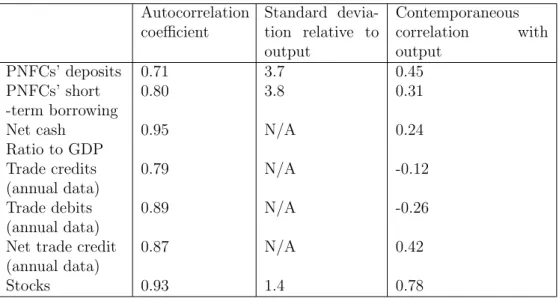
We start with a description of the data on firms cash holdings. Chart 1a looks at Hodrick-Prescott (HP) filtered deposits and short-term borrowing of private non financial companies (PNFCs) in the United Kingdom and compares these with HP-filtered real GDP. Table A suggests that both PNFCs’ deposits and short-term borrowing are around 3.7 times more volatile than output. Both series are mildly procyclical: the contemporaneous correlation of
3However, C´urdia and Woodford suggest that the optimal size of the spread adjustment is less than the full
(as, for example, Taylor suggested). They also warn that such a simply-applied modification is not optimal; the monetary response to endogenous changes in the spread need to be different in the case of non-financial shocks.
deposits with output is 0.45 and the equivalent figure for short-term borrowing is 0.31. And both deposits and borrowing are mildly persistent; the AR(1) coefficients are 0.71 and 0.80, respectively. Chart 1b suggests that the ratio of net cash - measured as the difference between PNFCs’ deposits and their short-term borrowing - to GDP leads the cycle (the correlation with GDP two-quarters ahead of 0.42). It is also persistent, with an AR(1) coefficient of 0.95. These stylised facts are summarised in the first three rows of Table 1.
Chart 1: Working Capital Behaviour in the UK
(a) PNFCs’ deposits and short-term borrowing 20 Percentage deviation from trend 15 10 5 GDP 0 -5 -10 Deposits Loans -15 1987 1992 1997 2002 2007
Source: ONS; Authors calculations
(b) Net cash (deposits less short-term borrowing)
20 4 Percentage deviation from trend Per cent of GDP 10 20 3 4 from trend 10 2 3 GDP (RHS) 0 1 -10 0 -20 -1 -30 Net cash (LHS) -2 -40 -3 1987 1992 1997 2002 2007
Source: ONS; Authors calculations
(c) Trade credit Percentage deviation from
trend Per cent of turnover
1 5 2 15% 20% Trade credit (RHS) Trade debit (RHS) 1 1.5 10% 15% (RHS) 0.5 5% 0 0% -1 -0.5 -10% -5%
Net trade credit (RHS)
-1.5 1 -15% 10% GDP (LHS) -2 -20% 1990 1993 1996 1999 2002 2005 2008 1990 1993 1996 1999 2002 2005 2008
Source: Bureau van Dijk; ONS; Authors calculations
(d) Stocks and stockbuilding: Ratio to GDP
0.80 0.020 0.75 0 010 0.015 Stockbuilding:GDP ratio (RHS) 0.70 0.005 0.010 (RHS) 0 65 0.000 0 60 0.65 0 010 -0.005 0.60 -0.015 -0.010 Stocks:GDP ratio (LHS) 0.55 -0.020 0.50 -0.025 1976 1980 1984 1988 1992 1996 2000 2004 2008 Source: ONS
(e) Stocks and GDP
6 Percentage deviation from
trend 5 3 4 Stocks 1 2 0 1 2 -1 -3 -2 GDP -4 1976 1981 1986 1991 1996 2001 2006 GDP 1976 1981 1986 1991 1996 2001 2006
Source: ONS; Authors calculations
Table 1: Stylised facts Autocorrelation coefficient Standard devia-tion relative to output Contemporaneous correlation with output PNFCs’ deposits 0.71 3.7 0.45 PNFCs’ short 0.80 3.8 0.31 -term borrowing
Net cash 0.95 N/A 0.24
Ratio to GDP
Trade credits 0.79 N/A -0.12
(annual data)
Trade debits 0.89 N/A -0.26
(annual data)
Net trade credit 0.87 N/A 0.42
(annual data)
Stocks 0.93 1.4 0.78
only at annual frequency.4 Nonetheless, we can calculate some basic summary statistics. As can be seen in Chart 1c, gross measures of trade debit and credit (as percentage of turnover) are countercyclical and lead output. Net trade credit is procyclical with a contemporaneous correlation with GDP of 0.42. These stylised facts are summarised in rows four through six of Table 1.
Chart 1d shows that the ratio of stocks to GDP trended downwards between the early 1980s and the late 1990s, since when it has been stable. Elder and Tsoukalas (2006) attributed this to the introduction of ’lean production techniques’ in which firms minimised on stock levels by increasing the rate at which they received inputs and sent out their product, and by taking advantage of the improvements in information and communications technology (ICT) to manage their production on a ’just-in-time’ basis. Our model is not designed to analyse any of these issues and, instead, takes the desired stock-output ratio as given.
Chart 1e shows that once we detrend stocks using an HP filter, they are strongly procyclical, with a contemporaneous correlation with output of 0.78. In addition, they lag the cycle by a quarter. The correlation appears to be particularly high in downturns. Stocks are more volatile than output, with the ratio of standard deviations equal to 1.4, and are persistent, with an autocorrelation coefficient of 0.93. These stylised facts are summarised in the final row of 1.
2.2
The response of working capital to the recent financial shock
The recent financial crisis has put the working capital positions of many firms under pressure. Some firms were affected directly - through tighter financing conditions, quantity constraints on borrowing or through lower profits - and others were affected indirectly through the supply chain. Chart 2a shows that, according to the BCC survey, both manufacturing and service
4These figures are calculated from individual firms’ balance sheets in the FAME dataset provided to the
sector firms’ cash flow positions were particularly weak in late 2008/early 2009. And Chart 2b suggests that tighter financing conditions were affecting the ability of UK firms to raise working capital during the first half of 2009, even for very large firms.
Chart 2: Working Capital Behaviour During the Financial Crisis
(a) Survey evidence on cash flow 30 Net Percentage Balance
20 Services 10 0 -10 Manufacturing -20 -30 -40 1992 1994 1996 1998 2000 2002 2004 2006 2008 2010 1992 1994 1996 1998 2000 2002 2004 2006 2008 2010 Source: BCC Quarterly Survey
(b) Impact of availability of finance on working capital by firm size
All firms SMEs Large Very Large
-10 0 -20 10 -40 -30 -50 40 -70 -60 Jan-09 Feb-09 -80 70 Mar-09 May-09 -100 -90 Jul-09 Sep-09 100 Net percentage balance Source: CBI Access To Finance Survey
(c) Firms’ deposits, loans and net cash 0.9 £ trillion 0.7 0.8 Deposits 0 5 0.6 0.4 0.5 Short term loans
0.2 0.3 0 0.1 Net cash -0.1 0 2000 2002 2004 2006 2008 2000 2002 2004 2006 2008
Source: Bank of England
(d) Stockbuilding 1.5 Per cent of GDP 1 0.5 0 -0.5 -1 -1.5 -2 2000 2002 2004 2006 2008 2000 2002 2004 2006 2008 Source: ONS
(e) Availability of trade credit insurance
All firms SMEs Large Very Large
20 0 -20 -40 Jan-09 -60 Ja 09 Feb-09 Mar-09 -80 May-09 Jul-09 -100 Sep-09
Net percentage balance Source: CBI Access To Finance Survey 100 Source: CBI Access To Finance Survey
But how has this affected their deposits and borrowing, their use of trade credit and their holdings of stocks? Chart 2c shows that firms’ deposits and short-term borrowing both peaked in 2008 Q1.5 Over 2008, firms cut back on both their borrowing and their deposits with
deposits falling faster than borrowing. In other words, over 2008 their working capital positions worsened as their net cash holdings fell. In 2009, firms responded to the tighter credit conditions by increasing their deposit holdings. This caused their net cash (working capital) position to improve. Chart 2d shows that firms responded to the credit tightening by dramatically destocking. Finally we assess the impact of the financial crisis on trade credit by examining the availability of trade credit insurance on the grounds that if this becomes less available, then firms will be less likely to offer trade credit. Unfortunately, we do not have timely data but Chart 2e suggests that the availability of trade credit insurance was greatly reduced in 2009 and this almost certainly would have led to a reduction in trade credit.
3
Model environment
As we said earlier, our model takes as its starting point the model of Christiano and Eichen-baum (1992, 1995) and adds a more fully-specified working capital constraint, inventories in production, combined with a stylised banking sector in which there are positive spreads be-tween lending and deposit rates. The model is a flexible-price, monetary model consisting of four agents: the central bank, households, firms and financial intermediaries (banks). The behaviour of the central bank is exogenously imposed. We have a utility-maximising represen-tative household, which supplies labour to firms and consumes final goods. Firms maximise profits by selling final goods, produced using labour and capital inputs, together with input inventories, to consumers. The banks in our model simply channel the savings of consumers to firms, which need to borrow money for working capital purposes, and these banks are sub-ject to exogenous (stochastic) reserve requirements; although they act as a veil, we will show that they can have important implications for potential output and the monetary transmission mechanism.
3.1
Timing assumptions
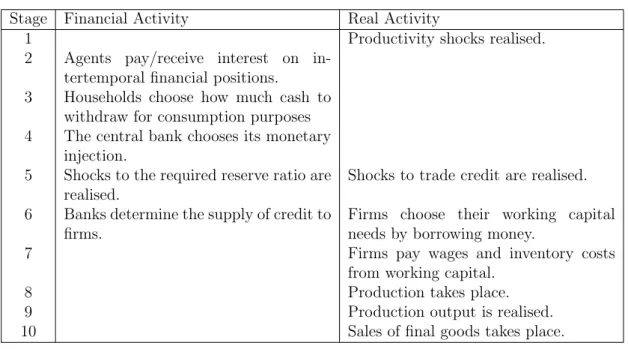
Each agent’s behaviour is discussed in greater detail below, but we first outline the timing assumptions. There are ten phases within each time period and the main financial and real activities are summarised in Table 2.
At the start of the period the productivity shock is realised and agents, who have entered the period with stocks of assets and money, pay/receive interest on their intertemporal financial positions as soon as financial markets open.
We assume that households are subject to a cash-in-advance constraint which requires them to have cash to pay for their consumption needs. The household chooses how much cash to withdraw for consumption purposes and the central bank chooses its monetary injection. Once shocks to the desired reserve ratio of banks are realised, banks determine the optimal supply
Table 2: Timing of events in our model
Stage Financial Activity Real Activity
1 Productivity shocks realised.
2 Agents pay/receive interest on
in-tertemporal financial positions.
3 Households choose how much cash to
withdraw for consumption purposes
4 The central bank chooses its monetary
injection.
5 Shocks to the required reserve ratio are realised.
Shocks to trade credit are realised. 6 Banks determine the supply of credit to
firms.
Firms choose their working capital needs by borrowing money.
7 Firms pay wages and inventory costs
from working capital.
8 Production takes place.
9 Production output is realised.
10 Sales of final goods takes place.
of credit to firms who borrow for their working capital needs.6
The focus then shifts to the production phase of the period. Firms hire labour and pay for storage of inventories using working capital. Production takes place. They can then choose the price of output which will determine sales, and the remainder of realised production output is used for investment and inventories to use as inputs in the next period. Once the final goods are sold to households, the firm determines its end of period deposits and profits are paid into consumers accounts.
3.2
Firms
We assume that firms are monopolistic competitors and have some price-setting power. Mod-elling this as a production aggregator version of the Dixit and Stiglitz (1977) model, each individual firm, j, faces a demand curve for their product given by
Φj,t = (
Pj,t
Pt
)−ηΦ
where Φj denotes sales for firmj,Pj is the price set by firmj, and Φ denotes aggregate demand
(sales). We assume a unit continuum of firms so that, in equilibrium, Φj = Φ and Pj =P∀j.
The firm produces output using three inputs; capital, labour, and inventories. The cap-ital stock is owned by the firm (which makes investment decisions each period). Firms hire labour from the households, and use inventories which have been stored between periods by
6Of course, if the central bank could observe this shock ahead of injecting reserves, then it would be able to
the households for a fee. The production technology for firm j is:
yj,t =kθj,t−1(Athj,t)ξs
1−θ−ξ j,t−1
whereyj is gross output of firmj,kj is firmj’send-of-period capital stock andAis a technology
shock common to all firms. We denote the aggregate capital stock by k.
It is worth, at this point, to pause for a moment and consider the modelling of inventories as a factor of production and how inventories differ from capital. Inventories, unlike capital, have a 100% depreciation rate - once used in production, the good no longer has value as a good. Also, inventories must be stored, at a cost, and this cost is subject to a cash-in-advance constraint (described below). The inventories in our model can be thought of as either input (materials and supplies) or work-in-progress inventories. Of course, we have, therefore, ignored final good inventories; but, in the data, input manufacturing inventories account for 2.5 times as much volatility as final good manufacturing inventories (Tsoukalas 2005), so we feel content to do this.
We impose a working capital constraint on firms such that they must pay households for the wages and a fraction,γ, of the storage costs of inventories in advance of sales revenue being realised. We treat the remainder of inventory storage costs, (1−γ), as a form of trade credit; the availability of trade credit in the period is modelled as an exogenous, stochastic process (an increase in γ is a negative trade credit shock). Firms need working capital loans, Lt, to finance
this funding gap. This is an extension of the standard working capital contraint to include inventory costs and also allow for a degree of trade credit. Typical working capital constraints require only that the firm pay the wage bill in advance.
We require firms to fully repay their loans out of their current deposits. As the firm needs financial resources to meet these obligations, firm j faces two financial constraints:
Fj,t−1 ≥(1 +il,t−1)Lj,t−1
Fj,t−1 −(1 +il,t−1)Lj,t−1+L,t =Wthj,t+γtPtχsj,t−1
The first of these constraints ensures that firms hold some of the cash they receive from sales in the form of deposits with which to repay short-term working capital borrowing. In equilibrium, this constraint will bind since, if it did not, the firm could have paid out higher dividends last period with little effect on this period’s profits. This reduces the second con-straint to state that the firm must borrow (Lt) to cover all input costs that must be paid in
advance.
The firm does not sell as final goods all of the output produced. Some output is stored as stocks, some forms new investment and the remainder covers sales demand. The overall flow of goods for firm j is:
sj,t =kj,tθ −1(Athj,t)ξs
1−θ−ξ
The firms set their price and choose production inputs, together with loans and deposits, so as to maximise the (utility-weighted) present discounted value of the (present and future) dividends they pay to households. For firm j the problem is:
Maximise E0 " ∞ X t=0 βt Ptct (Πj,t) #
The firm’s profit flow is given by inflows of sales revenue less wages, interest on loans and inventory storage costs. Hence, the money it will have available out of which to pay dividends will equal the sum of profits, net new borrowing, and deposits. The remainder will equal the firms’ end-of-period deposit holdings. Hence for firm j:
Fj,t+ Πj, t=Pj,tΦj,t−Wthj,t−Ptχsj,t−1−il,t−1Lj,t−1+ (Lj,t−Lj,t−1) +Fj,t−1
whereFjis firmj’s end-of-period deposits,hj is firmj’s labour input,sj is firmj’s end-of-period
holdings of stocks and Lj is firmj’s borrowing from the banks.
The overall maximisation problem for firm j is:
Maximise E0 " ∞ X t=0 βt Ptct (Pj,tΦt−Fj,t−(1−γt)Ptχsj,t−1) # subject to: Fj,t = (1 +il,t)Lj,t and Lj,t =Wthj,t+γtPtχsj,t−1 and Φj,t = ( Pj,t Pt )−ηΦt and sj,t =kθj,t−1(Athj,t)ξs1 −θ−ξ j,t−1 −(kj,t−(1−δ)kj,t−1)−Φj,t
Solving this problem and using the assumption of a unit continuum of identical firms, we can derive the following first-order conditions:
1 ct =βEt 1 ct+1 (θkθt−1(At+1ht+1)ξs1 −θ−ξ t + 1−δ) (1) ξkθt−1A ξ th ξ−1 t s 1−θ−ξ t−1 η−1 η = Wt Pt (1 +il,t) (2) Ft = (1 +il,t)(Wtht+γtPtχst−1) (3) 1 ct =βEt 1 ct+1 ((1−θ−ξ)kθt(At+1ht+1)ξs −θ−ξ t − χ Pt+1 (1 +γil,t+1) η η−1 (4) st=kθt−1(Atht)ξs1 −θ−ξ t−1 −(kt−(1−δ)kt−1)−Φt (5) Lt=Wtht+γtPtχst−1 (6) Πf,t=PtΦt−Ft−(1−γt)Ptχst−1 (7)
Equations 1 and 2 set the expected user costs of capital and stocks, respectively, to the real interest rate. Equation 3 is a labour demand curve that says the firm is more willing to hire labour the lower is the real wage and the loan rate (since it must borrow the money to pay wages). Equation 4 states that total output is either sold, invested or held as stocks for use in production in the following period. Equation 5 simply defines how much the firm needs to borrow and equation 6 defines how much the firm needs to deposit in order to pay off its loan during the following period. Finally, equations 7 simply defines the dividend paid by the firm to the consumer at the end of the period.
3.3
Financial institutions, financial markets and the central bank
The other key departure from standard business cycle models is the structure of the financial system and the behaviour of banks in our model. The financial structure of our model is relatively simple and builds on Dhar and Millard (2000). The banks in our model act simply to channel the savings of households to the corporate sector as loans. These loans are specifically for the purpose of working capital: they bridge the funding gap between the payment for inputs into production, and the arrival of the payments for the produced output. Thus, our financial institutions are simply facilitating the movement of savings between savers and borrowers; there is no complication of maturity transformation.
We do not explicitly model banking behaviour, and in fact assume there is sufficient com-petition for zero profits to be made; the banking sector, per se, is not our interest in this work. We assume that banks have a desired reserve-asset ratio which is determined exogenously, and we allow this to be hit by random shocks (which we label loan supply shocks).7 The banking sector is, in our model, a source of shocks rather than a channel of independent propagation and our interest is seeing how these shocks affect macroeconomic variables through firms working capital requirements.
At the start of period t households hold savings deposits,Dt−1, as well as current account
deposits, Bt−1. Households receive interest on their savings deposits but not on their current
accounts. The two types of account are differentiated by their liquidity; current accounts balances can be accessed at anytime by consumers whereas savings accounts are time deposits that, once deposited, are not available until the start of the next period. Firms also hold current accounts Ft−1, and enter the period with outstanding loans Lt−1. Finally, financial
institutions - in addition to having liabilities of Dt−1, Bt−1 and Ft−1, and assets of Lt−1 - also
hold reserves Rt−1, at the Central Bank. This is a credit economy in which the financial sector
will determine the size of credit flows through the economy. Nonetheless, high-powered money - reserves - is created only by the central bank through monetary injections. The beginning of
7In our model, the fact that money never leaks out of the banking system implies that there is a zero
probability of a bank run; given this, banks would never wish to hold reserves. However, we feel that imposing an exogenous reserve asset ratio captures the fact that, in reality, banks do hold reserves to ensure that they can meet withdrawals and the level of reserves they hold can change for what looks like purely exogenous reasons (as, could be argued, was the case in late 2007).
period bank balance sheet is:
Banking Sector Balance Sheet
Assets Liabilities
Rt−1 Dt−1
Lt−1 Bt−1
Ft−1
Banks pay interest on the savings deposits held with them at the interest rateid,t−1 and the
firms pay interest on their loans at the interest rate il,t−1 (We assume that the central bank
pays no interest on reserves though this is not necessary for our analysis). Bank profits, given by the difference between the financial inflows and financial outflows, are denoted Πb,t−1 =
il,t−1Lt−1−id,t−1Dt−1. We impose that competition in the banking sector is sufficient to yield
zero profits which suggests that il,t−1Lt−1 =id,t−1Dt−1.
Consumers must decide how much of their resources,(1 +id,t−1)Dt−1 +Bt−1, to leave as
savings deposits in the bank (which will not be available for use this period) and how much to move to their current account,Mt, (which could be negative). This rebalancing of the household
savings portfolio only affects the liabilities side of the balance sheet.
The Central Bank, however, can affect the total size of the bank balance sheet. Follow-ing Dhar and Millard (2000), we assume that the monetary injection, Xt, goes straight to
household deposit accounts and so boosts the level of reserves. Technically, this is equivalent to a government transfer to households financed by printing money and is fairly standard in the ’limited participation’ literature. Through monetary injections, the central bank has com-plete control over the level of reserves in this economy; we shall therefore model total reserves, Rt =Rt−1 +Xt, as being subject to central bank control and model money supply shocks as
shocks to these reserve.
Of course, banks do not simply leave the deposits of savers as reserves. Instead we assume that banks will use some of the savings and lend them to firms for working capital. That is, the banking sector determines the amount of lending to provide which affects total working capital and thus the level of production. As we assume, in this credit economy, no money leaks out of the banking sector, the loans made become current account deposits and so we get a multiplier effect. The balance sheet of the banking sector expands:
Banking Sector Balance Sheet
Assets Liabilities
Rt−1+Xt (1 +id,t−1)Dt−1+Xt−Mt
Lt Bt−1 +Mt
Rather than explicitly model an optimal lending decision, we assume that financial insti-tutions have a desired reserve asset ratio of rt. We model this reserve ratio as a stochastic
process.8 Hence, their desired lending is given by:
Lt= (1−rt)((1 +id,t−1)Dt−1+Xt−Mt+Bt−1+Mt+Lt)
The banking sector will expand credit such that the reserve asset ratio meets its target. If rt = 1, then there is no lending and banks act simply to store ’money’; as rt → 0, Lt → ∞
and there is no limit to the amount of lending the financial system will provide. Firms borrow working capital loans, Lt, to finance their funding gap and the loan interest rate adjusts to
clear the credit market.
After the lending decision is made, access to deposit accounts is closed off; the bank will allow access to current accounts but will not pay interest on these accounts as the money cannot be profitably lent out. However, there are still a number of current account flows in this economy. The wages and inventory fee is paid into the household current account and households use their current account balances to finance nominal consumption. The firm takes the sales revenue and uses it to pay for the portion of inventory costs that was provided on trade credit, (1−γt)Ptχst−1, and then divides the remainder into dividends, Πf,t, - paid directly into
the household’s current account - and retained earnings - kept in the firm’s current account in order to pay back loans at the start of the next period).
The bank’s balance sheet at the beginning of the next period is given by an analogous balance sheet to the beginning of period t.
Overall, the financial system can be summarised by the following three equations:
Balance sheet equilibrium: Rt+Lt=Dt+Bt+Ft (8)
(Zero) Bank profits: Πb,t =il,t−1Lt−1−id,t−1Dt−1 = 0 (9)
Desired lending: Lt =
(1−rt)((1 +id,t−1)Dt−1+Xt+Bt−1)
rt
(10)
3.4
Households
The household is fairly standard and maximises the present discounted value of utility derived from consumption of final goods and from leisure. For simplicity, we assume that preferences over consumption and leisure are natural logarithmic with (constant) weights ψ and (1−ψ) respectively. The main difference with a typical business cycle model is that we also assume that each household can provide inventory storage facilities, without cost, to the firms; this is a reduced form way of introducing another sector to the model.9
8This represents an end of period reserve asset ratio as no further credit is created; there are simply
redis-tributions between accounts.
9The absence of a cost means that households would like to supply infinite storage services which would
drive the price of storage, Ptχ, to zero. To prevent this, we setχ as a parameter of the model meaning the
Households enter the period holding savings and current account deposits, Dt−1, and Bt−1
and immediately earn interest on their savings as well as earning wages, getting paid for the storage of firm inventories, receiving profits from firms and the monetary injection (transfer) from the central bank. Out of their current resources, they must choose how much to leave in the bank as savings deposits ((1 +id,t−1)Dt−1 −Mt) and how much to hold in the form of
liquid assets (Bt−1+Mt).
Once this decision is made, they choose how much to work, for which they earn wages, and how much to consume. Households also receive payment for storing firm inventories overnight as well as earning wages; as we said earlier, a proportion γ is paid in advance of production and the remainder is paid at the end of the period. This extension of credit, which we allow to vary stochastically, can be interpreted as a simple measure of trade credit.
We assume that households consume all of their wages, and cash holdings:
Ptct =Bt−1+Mt+Wtht+γtPtχst−1
whereP denotes the price level,cdenotes consumption,W denotes the nominal wage,hdenotes total hours worked and s denotes end-of-period holdings of stocks. This assumption is mainly for simplification of the solution method. Ex-ante, when having to decideMtand planning their
consumption and labour decisions, the household will not plan to save any money at the end of the period. This is because end-of-period savings, as current account holdings, will earn no interest and because any future consumption is subject to discounting, households would rather plan for no extra savings. However, ex-post, when actually choosing ct and ht, the household
may choose to save if expected (discounted) marginal utility is otherwise going to be very high next period; savings would allow the household to transfer consumption across periods. This occasionally non-binding constraint makes the model much more difficult to solve, and as we are not emphasising consumption behaviour as the key variable in our model, we chose to make our simplifying assumption. Moreover, as the household can also adjust resources this period by working less, the total resources available to consume remain endogenous after the choice of Mt.
The household’s bank balances at the beginning of periodt+ 1 will be given by:
Dt=(1 +id,t−1)Dt−1+Xt−Mt
The household optimisation is given by: Maximise E0 " ∞ X t=0 βt((1−ψ) ln(ct) +ψln(1−ht)) # subject to: Ptct =Bt−1+Mt+Wtht+γtPtχst−1 and Dt= (1 +id,t−1)Dt−1+Xt−Mt and Bt = Πf,t+ Πb,t+ (1−γt)Ptχst−1
The first order conditions imply:
1 Ptct =β(1 +id,t)Et 1 Pt+1ct+1 (11) ht= 1− ψPtct (1−ψ)Wt (12) Ptct =Bt−1+Mt+Wtht+γtPtχst−1 (13) Dt= (1 +id,t−1)Dt−1+Xt−Mt (14) Bt= Πf,t+ Πb,t+ (1−γt)Ptχst−1 (15)
Equation (11) is the standard consumption Euler equation (optimising IS curve) that links expected growth in consumption to the real interest rate. Equation (12) is a labour supply curve that says the consumer is more willing to supply labour the higher is the real wage and the marginal utility of consumption (the lower is consumption itself). Equation (13) states that the consumer must use cash and/or money in his current account (including wages and stock storage costs) to purchase consumption; he cannot use money in his deposit account. Finally, equations (14) and (15) show how the consumers’ deposit and current accounts evolve, respectively.
3.5
Equilibrium and exogenous variables
We solve the 15 equations (1) - (15), together with the goods market clearing condition, c= Φ, conditional on A, R, r, andγ, for the 16 unknowns c,k, h,s, Φ,P,W, Π,D,B, M,L, F,R, id and il.
We log-linearise the model around its steady-state. We have four exogenous variables in our model representing our exogenous, stochastic variables; we assume that these exogenous variables all follow AR(1) processes:
Productivity: Aˆt=ρAAˆt−1+εA,t (16)
Money demand: rˆt=ρrln ˆrt−1+εr,t (17)
Trade credit: γˆt=ργln ˆγt−1+εγ,t (18)
Where ’hats’ denote log deviation from steady state.
3.6
Calibration
We set β= 0.99 implying a steady-state deposit rate of 0.0101 per quarter (4.1% per annum). We also set a value for χ of 0.01 and a value for steady-state γ of 0.5. We normalise hours worked to equal 0.33 in steady state, implying a value for ψ of 0.6131. We set capital’s share in the production function, θ, to 0.1089 so as to imply a capital to gross output of 3.9787, the average in UK data over the period 1976 Q1 to 2009 Q2. We then set the (quarterly) depreciation rate, δ, to 0.0173 so as to imply an investment to gross output ratio of 6.87%, the average in UK data over the period 1976 Q1 to 2009 Q2. We set η equal to 10 implying a mark-up of 1.11. Setting ξ to 0.3882 then implies a stock to gross output ratio of 49.2%, equal to its average value in UK data over the period 1976 Q1 to 2009 Q2. On the nominal side, we normalise the price level to equal unity and set the steady-state spread of the loan rate over the deposit rate equal to 1.96 percentage points: the average spread of nominal PNFC’s loan rates over the Bank of England’s policy rate over the period 1978 Q1 to 2009 Q2. That is, we set the steady-state loan rate to 0.0201. The implied reserve asset ratio, r, will then be equal to 55.87% in steady state. While this is large relative to what might be expected to prevail in the banking sector, it is worth noting that our banks are greatly simplified and hold a much less varied array of assets and liabilities, and since we are more concerned with hitting the correct average spread, we are willing to oversee the discrepancy in this ratio.
Our calibration has the following implications for some key ratios in the data. In our model, the ratio of consumption to private-sector value-added output is 86% and of investment to private-sector value-added output is 14% in line with their values in UK data for our sample.10 Our model implies a labour share equal to 67% compared with 69% in the data. The ratio of M0 to private-sector added in the model is 0.65 and that of M4 to private-sector value-added is 1.03. These values compare with 0.21 and 3.47 in UK data. Finally, in the model corporates’ gross money holdings are equal to 69% of private-sector value-added, gross debt holdings are equal to 68% of private-sector value-added and net money holdings are equal to 1.4% of private-sector value-added. These values compare with PNFCs deposits being equal to 66% of nominal GDP in 2009 Q4, PNFCs short-term lending being equal to 59% of nominal GDP in 2009 Q4 and net cash being equal to 7% of nominal GDP in 2009 Q4.
3.7
Stylised facts in the model
In this subsection, we simulate the model and assess its ability to match the stylised facts discussed in Section 3, above. In order to do this, we need to take a stand on the shock processes, in particular, the autocorrelation coefficients and standard errors of each of the
10Here we have defined ’value-added output’ as the sum of consumption, business investment and
shocks. Since, in practice, we think of credit crunches (proxied by shocks to banks’ reserve asset ratios and trade credit) as being discrete events, we set the standard deviations of these shocks to zero when we simulate the model. (That is, we switch the shocks off.) This seems reasonable given that we wish to compare stylised facts generated by the model with the stylised facts we reported earlier, which reflect the behaviour of our variables over ’normal’ (that is, non credit crunch) times.
For the productivity shock, we first use data on gross output, total hours worked, capital stock and inventories to calculate total factor productivity by inverting the production function:
At = (kθ yt t−1h ξ ts 1−θ−ξ t−1
)1ξ. We then log this series and use an HP-filter with the smoothing
parameter,λ, set to its usual value of 1,600, to calculate a series corresponding to ˆA in the model. Given this series, we then estimated equation 16, obtaining a value of 0.7746 for ρA
and a value of 0.0142 for the standard deviation of εA.
Unfortunately, finding a data analogue for ’reserves’ in the model is not as straightforward. Prior to 2006, the Bank of England published a series for narrow money “M0” that included ’Notes and coin and banks’ operational deposits with the Bank of England’. At this point in time, bank’s operational deposits were small and, so, the bulk of bank ’reserves’ consisted of notes and coin in their own vaults. Since the reforms of the Bank of England’s monetary policy operations on 18 May 2006, banks have held reserve balances at the Bank of England and, with the advent of quantitative easing, these have grown significantly. But, again, it is hard to think of the behaviour of reserves occasioned by quantitative easing as being representative of the period over which we obtained our stylised facts. Given all this, we chose to use ’Notes and coin’ as our measure of ’reserves’ as we felt that this series most closely corresponded to how we thought of ’reserves’ within our model. Again, we logged the series and HP-Filtered it before estimating equation 19. In this case, we obtained values of 0.8279 and 0.0077 for ρR and the
standard deviation of εR respectively.
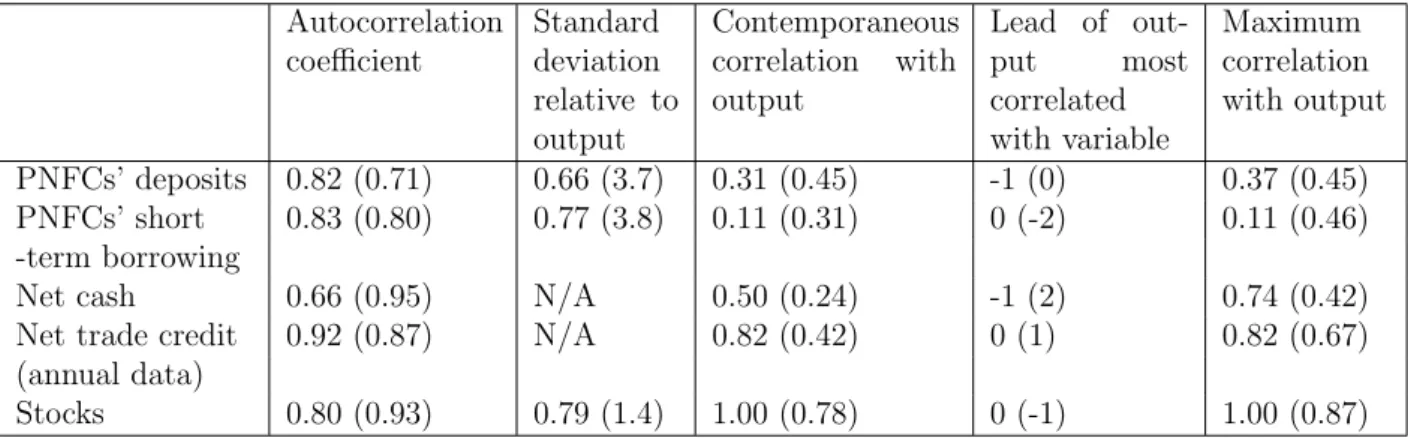
Armed with these results and the calibration discussed in Subsection 4.6, we used dynare to obtain the theoretical values implied by the model matching the stylised facts reported in Section 3, above. Our results are summarised in Table 3, below.
The model is able to generate the degree of persistence of firms’ deposits, loans and net trade credit seen in the data and also implies persistent net cash and stocks, though not quite as persistent as in the data. Against this, the model is not able to generate sufficient volatility in deposits, loans or stocks relative to output. The model implies that all variables are procyclical, as in the data, but where net cash leads output in the data, it lags output in the model and stocks move contemporaneously with output in the model, while lagging output in the data.
Of course, the inability of the model to generate sufficiently volatile fluctuations in deposits and loans relative to output may be a sign that credit conditions do change continuously, ie, that shocks to r have been important even through the Great Moderation period. Given that, and the fact that the model is generating the persistence and correlations that we see in the data, we feel happy in using the model to analyse the effects of financial shocks on the economy.
Table 3: Stylised facts implied by the model and the data (in parenthesis) Autocorrelation coefficient Standard deviation relative to output Contemporaneous correlation with output Lead of out-put most correlated with variable Maximum correlation with output PNFCs’ deposits 0.82 (0.71) 0.66 (3.7) 0.31 (0.45) -1 (0) 0.37 (0.45) PNFCs’ short 0.83 (0.80) 0.77 (3.8) 0.11 (0.31) 0 (-2) 0.11 (0.46) -term borrowing
Net cash 0.66 (0.95) N/A 0.50 (0.24) -1 (2) 0.74 (0.42)
Net trade credit 0.92 (0.87) N/A 0.82 (0.42) 0 (1) 0.82 (0.67)
(annual data)
Stocks 0.80 (0.93) 0.79 (1.4) 1.00 (0.78) 0 (-1) 1.00 (0.87)
Before doing that, however, we consider the effects of working capital on the response of the economy to productivity and monetary policy shocks, asking ourselves whether or not the presence of working capital implies qualitatively different responses of variables to these shocks relative to a more standard model.
4
How do working capital considerations affect the
re-sponse of the economy to shocks?
In this section, we ask the question: how does the economy respond to productivity and monetary policy shocks and how is this response affected by working capital considerations. In order to get at this, we assume that these shocks are uncorrelated and that they are driven by an AR(1) process with persistence coefficients of 0.7746 for the productivity shock and 0.8279 for the monetary policy shock, as estimated above. We then compare the impulse responses of key variables to these shocks in our model with the same impulse response functions generated by a model in which firms do not have to borrow to finance any of their costs. We first briefly describe our comparison model.
4.1
The model with no working capital
In this version of the model, we assume that firms pay wages and inventory storage costs at the end of the period out of money received from sales; they no longer need to borrow from the banks to pay these costs. Wages, inventory storage costs and firm profits are all paid into consumers’ current accounts at the end of the period.11 Against this liability, the banks hold reserves with the central bank. Again, each period the central bank injects additional reserves, Xt straight to household current accounts. Consumers use the money left in their current
accounts at the end of the previous period, together with the new injection to buy consumption
11Since firms do not need to borrow, there will be no bank lending. As a result, banks will not be able to
goods. Finally, in order that we can derive a risk-free interest rate for this economy, we assume that consumers borrow and lend money amongst themselves by issuing risk free bonds though, as we said earlier, there is no net saving on aggregate.
The problem for households is now:
Maximise E0 " ∞ X t=0 βt((1−ψ) ln(ct) +ψln(1−ht)) # subject to: Ptct=Bt−1+Xt+ (1 +it−1)Zt−1−Zt and Bt+Zt =Xt+Bt−1+ (1 +it−1)Zt−1+Wtht+Ptχst−1 + Πf,t−Ptct
where ithe risk-free interest rate (equivalent to the deposit rate in the previous model) and Z represents the houshold’s holdings of bonds, equal to zero in aggregate.
The problem for firm j is now:
Maximise E0 " ∞ X t=0 βt Ptct Πj,t =E0 ∞ X t=0 βt Ptct (Pj,tΦj,t−Wthj,t−Ptχsj,t−1) # subject to: Φj,t = ( Pj,t Pt )−ηΦt and sj,t =kθj,t−1(Athj,t)ξs 1−θ−ξ j,t−1 −(kj,t−(1−δ)kj,t−1)−Φj,t
The banks’ balance sheet constraint is simply that Bt = Rt and market clearing implies
Zt = 0, ct = Φt and Bt=Ptct.
4.2
Positive productivity shock
In Charts 3 and 4 we plot, respectively, the responses of real and financial variables to a 1% productivity shock in the Benchmark model (with the working capital constraint); in Chart 3 we also add the responses of the model without working capital. On impact, a positive innovation to productivity raises marginal products of factors of production and as a result, output rises. Moreover, to take advantage of the higher marginal productivity, firms demand more inventories, labour and, after a one period delay, capital. The real wage rises in response to the increased demand for labour. Both real consumption and labour supply increase. We can note that the response of consumption is much smaller than that of output but much more persistent; households are acting to smooth consumption in response to the shock.12 Chart 3 also shows that the responses are not substantially altered by the presence of a working capital constraint, though the need to raise working capital does act to slightly dampen the response of hours, stocks, investment and output to the shock.
12An interesting corollary to the models main results is that both models generate a hump shaped response
of consumption to the TFP shock. This persistence is not driven by assumed ’consumption habits’ but rather is driven by the inclusion of inventories in the model. As it is germane to the main point of this paper, we have left a discussion of this work for separate work.
Chart 3: Response of Real Variables to a productivity shock 1.2 Per cent GDP 1.0 0.8
Model ex working capital
0 4 0.6
Model ex working capital channel 0 2 0.4 0 0 0.2 Benchmark model 0.0 0 2 4 6 8 10 12 14 16 18 20
Quarters after shock Quarters after shock
0.3 Per cent
Consumption
0.2
Model ex working capital channel 0.2 Benchmark model 0.1 0.1 0 0 0.0 0 2 4 6 8 10 12 14 16 18 20
Quarters after shock Quarters after shock
10.0 Per cent
Investment
8.0
Model ex working capital channel
6.0 2 0 4.0 0 0 2.0 Benchmark model -2 0 0.0 -2.0 0 2 4 6 8 10 12 14 16 18 20
Quarters after shock Quarters after shock
1.2 Per cent
Stocks
1.0
Model ex working capital
0.8
Model ex working capital channel 0.6 0 2 0.4 0 0 0.2 Benchmark model 0.0 0 2 4 6 8 10 12 14 16 18 20
Quarters after shock Quarters after shock
0.6 Per cent
Total Hours
0 4 0.5
Model ex working capital channel
0.3 0.4 0.2 0.1 Benchmark model -0 1 0.0 -0.1 0 2 4 6 8 10 12 14 16 18 20
Quarters after shock Quarters after shock
0 5 0.5 Per cent Real Wage 0 4 0.4 0.5
Model ex working capital channel 0.3 0.4 0.2 0.3 0.1 0.2 Benchmark model 0 0 0.1 . 0.0 0 2 4 6 8 10 12 14 16 18 20
Quarters after shock Quarters after shock
Chart 4: Response of Financial Variables to a productivity shock 0.0 Per cent Price Level -0.1 0 3 -0.2
Model ex working capital channel
-0.4 -0.3 Benchmark -0.5 Benchmark model -0 7 -0.6 -0.7 0 2 4 6 8 10 12 14 16 18 20
Quarters after shock Quarters after shock
0 5 1.0 Per cent
Consumer and firm bank positions Consumer's deposit account
0.0 0.5
Consumer s deposit account
-1 0 -0.5 Firm deposits -1.5 1.0 -2.5 -2.0 Consumer's current account 3 5 -3.0 account -3.5 0 2 4 6 8 10 12 14 16 18 20
Quarters after shock Quarters after shock
0.25 Per cent Interest rates 0 15 0.20 0.10 0.15 Lending rate 0.05 Deposit rate 0.00 Spread 0 10 -0.05 -0.10 0 2 4 6 8 10 12 14 16 18 20
Quarters after shock Quarters after shock
14 0 16.0 Per cent
Firm Net Cash Holdings
10 0 12.0 14.0 6 0 8.0 10.0 2 0 4.0 6.0 2 0 0.0 2.0 6 0 -4.0 -2.0 -6.0 0 2 4 6 8 10 12 14 16 18 20
Quarters after shock Quarters after shock
As this is a pure positive supply side shock, the price level falls. But Chart 4 suggests that the extent of the fall in the price level is crucially dependent on the presence or not of a working capital constraint for the firms. We can see why by considering the money demand equation in the two economies. For the economy with a working capital constraint we can write the money market equilibrium equation as:
Rt=
r
1−r(Wtht+γtPtχst−1) (20) That is money demand (RHS) depends on components of nominal income. For the economy without a working capital constraint we can write the money market equilibrium equation as:
Rt=Ptct (21)
That is, money demand depends on nominal consumption. Since nominal income and its components rise by more than consumption as consumers try to smooth through changes in their income, the price level must fall by more in the economy in which money demand depends on nominal income.
deposits rise when the productivity shock hits; because households anticipate higher (real) labour income (because they are more productive) and the decline in prices, they want to smooth consumption. To do this, they need to leave more of their wealth in the form of illiquid savings and so they cut back on withdrawal of money from their deposit account. Although firms want to borrow more given the positive supply shock, loans to the corporate sector remain unchanged since banks’ reserves and their desired reserve-asset ratio are unchanged. In order to ensure that this happens, the loan rate must rise. Given that deposits increase and loans stay fixed, the banks’ zero profit condition implies that interest rate paid on deposits must rise by less than the loan rate so the spread between the two rises as well. As the spread rises, firms increase their deposits and, hence, their net cash holdings. Households’ current accounts balances fall because nominal payments for storing inventories fall, as do nominal profits.
4.3
Monetary policy shock
In the model with no working capital considerations, a monetary policy shock by which we mean a government transfer of cash to consumers (X in the model) will have a one-for-one effect on all nominal variables. Since we assume that the shock is temporary, agents will expect the price level to fall back to its steady-state, ie, they will expect deflation. By the Fisher equation, this means that the risk-free nominal interest rate, id, will fall on impact, before rising back to
its steady-state level.
Chart 5 shows the effect of a 1% shock to reserves on nominal variables in the model with working capital. The effect of the shock on reserves will be identical to the effect on all nominal variables in the model without working capital. The monetary injection leads to a rise in the deposits of consumers (both time and sight deposits) and firms as well as a rise in loans. Importantly, firms net cash holdings fall; the shock leads to a narrowing in the spread between loan and deposit rates with the implication that firms need to hold lower deposits to pay back a given level of loans. Nominal wages and prices rise, but by less than the rise in reserves; this is because some of the nominal shock leaks into real variables.
So, turning to the effects of such a shock on real variables, we can first note that in the model with no working capital, a monetary injection will have no effect at all on real variables given that nominal variables are able to react perfectly flexibly. But, if firms have to borrow to finance working capital purchases, then monetary policy shocks will have effects, even in a world of flexible prices, since they will affect the quantity and cost of the liquidity that firms require for their working capital. Chart 6 considers the effect of a 1% monetary injection in our model with working capital. Given that the monetary injection leads to a fall in the spread, it will now be cheaper for firms to finance the inputs; since the monetary injection reduces the cost of working capital, it has the effect of a positive supply shock. Firms will increase output by increasing their use of inventories and hours worked. Since the shock is expected to persist, firms will also want to increase their capital; as a result investment rises and the capital stock is persistently higher. Finally, households increase their consumption. Given that they wish
Chart 5: Response of nominal variables to an expansionary monetary policy shock
1.4 Per cent Consumer and firm bank positions
1 0 1.2
Consumer's deposit account
0.8 1.0 0.6 Loans 0.4 Firm deposits 0 0 0.2 Consumer's current account
0.0
0 2 4 6 8 10 12 14 16 18 20
Quarters after shock Quarters after shock
0.0 Per cent Firm Net Cash Holdings
4 0 -2.0 -6.0 -4.0 10 0 -8.0 -12.0 -10.0 16 0 -14.0 -16.0 0 2 4 6 8 10 12 14 16 18 20
Quarters after shock Quarters after shock
0.00 Per cent Interest rates Spread -0.05 Spread -0.10 Lending rate Deposit rate -0.15 Deposit rate 0 20 0. 5 0 25 -0.20 -0.25 0 2 4 6 8 10 12 14 16 18 20
Quarters after shock Quarters after shock
1.2 Per cent Prices, Nominal Wages and Central Bank Reserves
1.0 0.8 Reserves 0.6 Nominal wages 0 2 0.4 Price level 0 0 0.2 0.0 0 2 4 6 8 10 12 14 16 18 20
Quarters after shock Qua e s a e s oc
to smooth their consumption, the increase is small but highly persistent.
5
The effects of financial shocks
In this section, we examine the model’s predictions for how financial shocks - specifically to bank lending and the availability of trade credit - affect the real economy. As stressed earlier, the stylised banking sector and simplistic trade credit variable in our model are both introduced as a source of shocks rather than an independent part of the propagation mechanism. In particular, we are interested in tracing out how these shocks work through firms (via the extended working capital constraint) and, therefore, affect the supply side of the economy.
5.1
Banking sector shock
As discussed earlier, within our model we think of a financial shock as a shock resulting in a higher holding of reserves by banks for a given level of bank lending. This is consistent with what happened in the UK banking sector after the failure of Lehman Brothers in 2008. As confidence among the banks fell, their costs of obtaining wholesale funds rose and this led to an increase in the ratio of bank reserves to bank lending where previously this ratio had been
Chart 6: Response of real variables to an expansionary monetary policy shock
1.0 Per cent National Accounts Variables
0.8 0.6 Investment 0.4 0.2 GDP Stocks 0.0 Consumption -0.2 0 2 4 6 8 10 12 14 16 18 20
Quarters after shock Quarters after shock
0 18 0.20 Per cent Production Inputs 0 14 0.16 0.18 0 10 0.12 0.14 Total hours 0 06 0.08 0.10 Capital stock Stocks 0 02 0.04 0.06 Capital stock Stocks 0 02 0.00 0.02 -0.02 0 2 4 6 8 10 12 14 16 18 20
Quarters after shock Quarters after shock
trending down, as shown in Chart 7.13
Charts 8 and 9 consider the effects of a 1% shock (+0.56 pp) to the banks’ desired reserve asset ratio on financial and non-financial variables, respectively. In our model banks’ lending decision is simple: they lend out a proportion, 1−rt of their liabilities. So the most obvious
effect of the negative credit supply shock, ie a positive shock tortis to cause a sharp contraction
in lending. This shock effectively works as a withdrawal of money available to the private sector. Given the available reserves Rand monetary policy injectionX, banks now hoard more money and so less is available for everyone else. In this way our model replicates the squeeze on firms’ lending in the credit crisis. The interest rate at which firms are able to borrow goes up (+0.27 pp) as ’cash’ is scarcer and thus becomes more expensive. In this sense this shock is similar to a contractionary monetary shock. Consequently, the price level falls. While both firm loans and deposits decline, loans actually fall by more than deposits; net cash rises. At first sight, this seems to differ from the behaviour of net cash in the data. As shown in Chart 2c, deposits initially declined more quickly than short-term loans. Net cash turned positive in 2009 as loans continued to fall and deposits levelled off.
On the real side, the higher borrowing costs feed through to higher input costs. Specifically, it is now more costly for a firm to finance its labour input and inventories, and so demand for these inputs falls. Consequently, firms are producing less, and so output falls. In other words, the shock acts as a ’supply shock’. Firms are demanding less labour and so the real wage falls. Consumers face a loss of labour income and income from storing inventories, so to smooth the impact of the shock they save more, withdrawing a smaller amount of money from their deposit accounts. Households’ withdrawals of cash fall in the first period, but rebound afterwards. Consumers’ saving deposits rise, and the interest paid on deposits falls.
The responses to the financial intermediation shock discussed here show that even though prices are fully flexible in our model, a disruption to the supply of credit has large and persistent
13Unfortunately, the series for M4 lending adjusted for intermediate OFCs only goes back to 1998; the ratio
of M4 lending to notes and coins in circulation has been on a downward trend since about 1970, although the trend was interrupted between about 1992 and 2004 where the ratio was basically flat.
Chart 7: Ratio of notes and coins in circulation to PNFCs short-term borrowing 0.14 Ratio 0 10 0.12 2007 Q3 0 08 0.10 0.06 0.08 0.04 0.02 0.00 2000 2002 2004 2006 2008
Chart 8: Response of financial variables to a financial intermediation shock
0.5 Per cent Consumer and firm bank positions
0 5 0.0
Consumer's deposit account
-1.0 -0.5 Consumer's current account
-1.5 -2.0 Firm deposits 3 0 -2.5 Loans -3.0 0 2 4 6 8 10 12 14 16 18 20
Quarters after shock Quarters after shock
18.0 Per cent Firm Net Cash Holdings
14.0 16.0 10 0 12.0 14.0 8.0 10.0 4.0 6.0 0 0 2.0 0.0 0 2 4 6 8 10 12 14 16 18 20
Quarters after shock Quarters after shock
0.30 Per cent Interest rates 0.25 0.20 Lending rate 0.15 Deposit rate 0.10 Spread 0 00 0.05 0.00 0 2 4 6 8 10 12 14 16 18 20
Quarters after shock Quarters after shock
0.0 Per cent Prices, Nominal Wages and Central Bank Reserves
-0.5 -1.0 -1.5 Price level N i l 2 5 -2.0 R Nominal wages 3 0 -2.5 Reserves -3.0 0 2 4 6 8 10 12 14 16 18 20
Quarters after shock Qua e s a e s oc