Performance-Based Planning
and Programming
Guidebook
1. Report No.
FHWA-HEP-13-041
2. Government Accession No. 3. Recipient’s Catalog No.
4. Title and Subtitle 5. Report Date
September 2013
Performance Based Planning and Programming Guidebook 6. Performing Organization Code
7. Authors
Michael Grant (ICF), Janet D’Ignazio (ICF), Alexander Bond (ICF), Alanna McKeeman (ICF)
8. Performing Organization Report No.
9. Performing Organization Name and Address
ICF International, Inc. 9300 Lee Highway Fairfax, VA 22031
10. Work Unit No. (TRAIS)
11. Contract or Grant No.
DTFH61-10-D-00006
12. Sponsoring Agency Name and Address
United States Department of Transportation Federal Highway Administration
1200 New Jersey Ave. SE Washington, DC 20590
13. Type of Report and Period Covered
June 2012 – October 2013
14. Sponsoring Agency Code
HEP
15. Supplementary Notes
Mr. Egan Smith, Federal Highway Administration, COTM
16. Abstract
Performance-based planning and programming (PBPP) refers to the application of performance management principles within the planning and programming processes of transportation agencies to achieve desired performance outcomes for the multimodal transportation system. The Guidebook has been designed to help State DOTs, MPOs, RTPOs, transit agencies, and other partner organizations understand: the key elements of a PBPP process and the relationship of these elements within existing planning and programming processes. The Guidebook is designed to highlight effective practices to help transportation agencies in moving toward a performance-based approach to planning and programming.
17. Key Words
Transportation planning, performance measurement, programming, project selection, modeling, analysis methods, state DOT, metropolitan planning organization, rural transportation planning organization, transit agency
18. Distribution Statement
No restrictions. This document is available to the public from the National Technical Information Service, Springfield, VA 22161.
19. Security Classif. (of this report)
Unclassified
20. Security Classif. (of this page)
Unclassified
21. No. of Pages
133
22. Price
N/A Form DOT F 1700.7 (8-72) Reproduction of completed page authorized
T
ABLE OF
C
ONTENTS
Foreword/Acknowledgements ... i
Executive Summary ... iii
1. Purpose and Overview ... 1
Building on Existing Practices ... 2
Integrating Performance Management into Planning and Programming ... 5
Challenges Associated with PBPP ... 7
Organization and Use of this Guidebook ... 9
2. Overview of PBPP: Key Concepts ... 10
Why Use a Performance-Based Approach to Planning and Programming? ... 10
Terminology ... 12
Common Elements of PBPP ... 13
Common Themes within a PBPP Process ... 16
Cooperation and Coordination ... 16
Linkages across Performance-Based Planning Activities ... 18
Public and Stakeholder Involvement ... 20
Data and Tools ... 21
Feedback Mechanisms ... 23
3. Develop Goals and Objectives ... 24
Developing Goals: Focus on Outcomes ... 24
Consider Goals Broadly ... 28
Developing Objectives ... 31
Identify Focus Areas ... 31
A Hierarchy of Objectives: Outcomes, Outputs, Activities... 32
Using an Objectives Decision Tree ... 33
Evolution of Objectives ... 34
4. Select Performance Measures ... 40
Roles of Performance Measures ... 40
Factors to Consider in Selecting Measures ... 41
Building on Public Concerns ... 45
5. Identify Trends and Targets ... 47
Desired Trends and Numerical Targets ... 47
Time Frames for Target Setting and Planning Analysis... 49
Process for Setting Targets ... 51
Analyze Baseline Data and Develop Assumptions ... 52
Consider Multiple Factors ... 52
6. Identify Strategies and Analyze Alternatives ... 55
Identify Potential Strategies and Packages of Investment Approaches ... 56
Use Data and Analysis Tools to Inform Potential Options ... 59
Conduct Scenario Analysis ... 62
7. Develop Investment Priorities in the LRTP ... 67
Development of the LRTP ... 67
Link to Other Planning Documents ... 70
8. Programming - Develop Investment Priorities in the TIP/STIP ... 72
Linking Planning to Programming ... 72
Developing an Investment Plan ... 74
Project and Strategy Selection ... 76
Communicating the Connections to Performance ... 79
9. On-going Monitoring, Evaluating, and Performance Reporting ... 81
Monitor System Performance ... 82
Evaluate Program Effectiveness ... 84
Report Performance Results ... 86
10. Keys to Success ... 93
Minnesota Department of Transportation ... 96
Southeast Michigan Council of Governments ... 103
Champaign Urbana Urbanized Area Transportation Study ... 108
Washington Metropolitan Area Transit Authority ... 113
12. Additional Resources ... 124
Glossary ... 124
F
OREWORD
/A
CKNOWLEDGEMENTS
This document was developed in collaboration with stakeholders across the transportation industry. It was guided by a Stakeholder Committee, which spent hours reviewing the work program, draft deliverables, and the final Guidebook. Members of the Committee were selected based on previous work in performance-based planning, previous activities with FHWA (conferences, peer exchanges, webinars), and consultation with national industry associations. The Committee included MPO, State DOT and transit agency staff members, with consideration given to geographic balance and population within the planning area. Additional members were included to represent rural transportation planning and public transportation providers. Members of the Stakeholder Committee included:
Deanna Belden Minnesota Department of Transportation
Natalie Bettger North Central Texas Council of Governments Lynette Ciavarella Illinois Regional Transportation Authority
John Crocker Metropolitan Atlanta Rapid Transit Authority (GA) Brian Fineman North Jersey Transportation Planning Authority Marsha Fiol Virginia Department of Transportation
Amy Kessler North Central Commission (PA)
Jane Hayse Atlanta Regional Commission (GA)
Patricia Hendren Washington Metropolitan Area Transit Authority (DC) Eric Hesse Tri-County Metropolitan Transportation District of Oregon Brian Hoeft Regional Transportation Commission of Southern Nevada
Charlie Howard Puget Sound Regional Council (WA)
Chris Hundt Michigan Department of Transportation
Dick Jarrold Kansas City Area Transit Authority (MO/KS)
Ron Kirby Metropolitan Washington Council of Governments
Andrew Kjellman Regional Transportation Commission of Southern Nevada
Sandi Kohrs Colorado Department of Transportation
Rita Morocoima-Black Champaign County Regional Planning Commission (IL)
Scott Omer Arizona Department of Transportation
Cory Pope Utah Department of Transportation
Camelia Ravanbakht Hampton Roads Transportation Planning Organization (VA) Jim Ritzman Pennsylvania Department of Transportation
Machelle Watkins Missouri Department of Transportation
Lyle Wray Capital Region Council of Governments (CT)
National industry associations played a key role in this project. Support for the project was provided through identification of printed resources, identification of Stakeholder Committee members, review of draft deliverables, among other tasks. The American Association of State Highway and Transportation Officials (AASHTO), Association of Metropolitan Planning
Organizations (AMPO), National Association of Regional Councils (NARC), National Association of Development Organizations (NADO), American Public Transportation Association (APTA), American Planning Association (APA), and Community Transportation Association of America (CTAA) all offered support to this project from its conception through final adoption of the Guidebook. Specific individuals we would like to thank are:
Rich Denbow AMPO
Matt Hardy AASHTO
Jason Jordan APA
Carrie Kissel NADO
Rich Weaver APTA
Erika Young NARC
Chris Zeilinger CTAA
Finally, Egan Smith and Harlan Miller have provided their ongoing support for this project with a clear guiding vision of performance-based planning and programming.
E
XECUTIVE
S
UMMARY
Over the past two decades, transportation agencies have increasingly been applying “performance management” – a strategic approach that uses performance data to support decisions to help achieve desired performance outcomes. Performance management is credited with improving project and program delivery, informing investment decision-making, focusing staff on leadership priorities, and providing greater transparency and accountability to the public.
Performance-based planning and programming (PBPP) refers to the application of performance management within the planning and programming processes of transportation agencies to achieve desired performance outcomes for the multimodal transportation system. This includes a range of activities and products undertaken by a transportation agency together with other agencies, stakeholders, and the public as part of a 3C (cooperative, continuing, and
comprehensive) process. It includes development of: long range transportation plans (LRTPs), other plans and processes (including those Federally-required, such as Strategic Highway Safety Plans, Asset Management Plans, the Congestion Management Process, Transit Agency Asset Management Plans, and Transit Agency Safety Plans, as well as others that are not required), and programming documents, including State and metropolitan Transportation Improvement Programs (STIPs and TIPs). PBPP attempts to ensure that transportation investment decisions are made – both in long-term planning and short-term programming of projects – based on their ability to meet established goals.
Moving Ahead for Progress in the 21st Century (MAP-21) placed increased emphasis on
performance management within the Federal-aid highway program and transit programs, and requires use of performance-based approaches in statewide, metropolitan, and
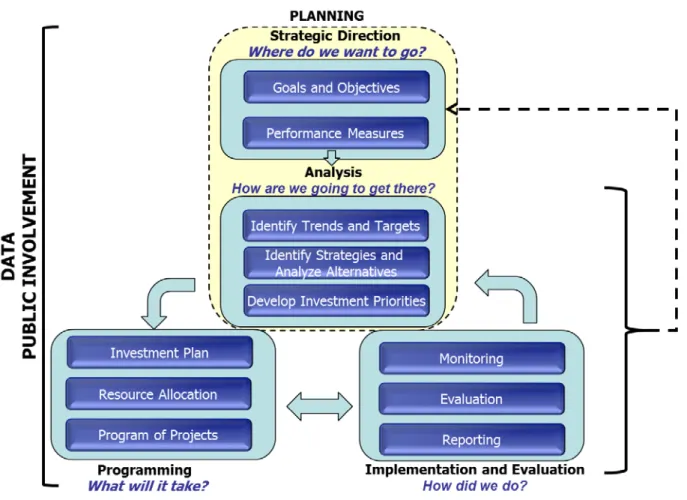
non-metropolitan transportation planning. This guidebook describes a PBPP process, as shown in Figure ES-1, along with examples of effective practices to help practitioners advance these approaches in their own planning and programming activities.
Figure ES-1. Framework for PBPP
This framework demonstrates how PBPP stages fit within a traditional planning and programming process. It includes the following elements:
Strategic Direction (Where do we want to go?) – In the transportation planning process, strategic direction is based upon a vision for the future, as articulated by the public and stakeholders. PBPP includes:
• Goals and Objectives – Stemming from a state or region’s vision, goals address key desired outcomes, and supporting objectives (specific, measureable statements that support achievement of goals) play a key role in shaping planning priorities.
• Performance Measures – Performance measures support objectives and serve as a basis for comparing alternative improvement strategies (investment and policy approaches) and for tracking results over time.
Planning Analysis (How are we going to get there?)–Driven by data on performance, along with public involvement and policy considerations, agencies conduct analysis in order to develop investment and policy priorities.
• Identify Trends and Targets –Preferred trends (direction of results) or targets (specific levels of performance desired to be achieved within a certain timeframe) are
established for each measure to provide a basis for comparing alternative packages of strategies. This step relies upon baseline data on past trends, tools to forecast future performance, and information on possible strategies, available funding, and other constraints.
• Identify Strategies and Analyze Alternatives –Performance measures are used to assess strategies and to prioritize options. Scenario analysis may be used to compare alternative packages of strategies, to consider alternative funding levels, or to explore what level of funding would be required to achieve a certain level of performance.
• Develop Investment Priorities –Packages of strategies for the LRTP are selected that support attainment of targets, considering tradeoffs between different goal areas, as well as policy priorities.
Programming (What will it take?) Programming involves selecting specific investments to include in an agency capital plan and/or in a TIP or STIP. In a PBPP approach, programming decisions are made based on their ability to support attainment of performance targets or contribute to desired trends, and account for a range of factors.
• Investment Plan –In order to connect the LRTP, which has an outlook of at least 20 years, to selection of projects in a TIP/STIP, some areas develop a mid-range (e.g., 10 year) investment plan or investment program.
• Resource Allocation / Program of Projects –Project prioritization or selection criteria are used to identify specific investments or strategies for a capital plan or TIP/STIP. Projects included in the TIP/STIP are selected on the basis of performance, and show a clear link to meeting performance objectives.
Implementation and Evaluation (How did we do?) – These activities occur throughout implementation on an on-going basis, and include:
• Monitoring – Gathering information on actual conditions.
• Evaluation – Conducting analysis to understand to what extent implemented strategies have been effective.
• Reporting – Communicating information about system performance and the
effectiveness of plans and programs to policymakers, stakeholders, and the public. In a PBPP approach, each step in the process is clearly connected to the next in order to ensure that goals translate into specific measures, which then form the basis for selecting and
influenced by expected performance returns. Keeping the next step in the process in mind is critical to each step along the way.
Public involvement and data are critical throughout the process. The public’s vision for the transportation system and their community plays a key role in determining goals, performance measures, and investment priorities. Data on past, existing, and expected future performance, and information on the effectiveness of possible strategies, helps to inform selection of
priorities. Like all planning, the process is cyclical. Over time, and as planning cycles advance, the goals and objectives may be adjusted, and performance measures and targets may be refined to ensure they focus on the most important priorities and are achievable.
Lessons for effective implementation of a PBPP approach include:
• Use measures that matter. Rather than identifying hundreds of measures, it is often preferable to identify a limited set of key measures to best support goals and objectives, guide investment decisions, and evaluate progress.
• Engage the public and stakeholders. Public engagement is critical to identify the issues that residents care about most. Some organizations have chosen to go beyond standard measures such as traffic delay and pavement condition, and to ask questions such as which types of congestion are most problematic and what types of risk factors are most important in managing assets, in order to identify goals and objectives. In addition, keep the public and stakeholders in mind when developing measures to ensure that they are easy to understand and resonate.
• Build on required performance-based approaches, such as State Asset Management Plans, State Strategic Highway Safety Plans (SHSPs), MPO Congestion Management Processes (CMPs), Transit Agency Asset Management Plans, and Transit Agency Safety Plans.
• Communicate successes, constraints, and trade-offs. It may not always be feasible to improve system performance, but information on expected performance outcomes of different options helps to inform decision-making. This information can inform not only where and how to prioritize funding, but can help make the case for the needs for additional funding. Scenario planning is an approach that greatly enhances agencies’ ability to evaluate the anticipated impacts of various investment packages.
• Coordinate and collaborate broadly. Effective PBPP involves coordination within agencies and across agencies so the State DOTs, MPOs, nonmetropolitan planning organizations (also referred to as Rural Planning Organizations or Regional
Transportation Planning Organizations (hereafter “RTPOs”)), and transit agencies are coordinated in the development of goals, objectives, performance measures, and
targets. It also involves coordination with a wide range of partners, including local governments, the business community, freight communities, law enforcement, economic development, and others.
• Link planning to programming (the LRTP to the TIP/STIP in most cases). This linkage is key for all transportation agencies. Economic tools, project prioritization processes, and related approaches that build on performance information can inform project selection and show the link between programs of projects and intended performance outcomes.
• Provide context for performance results. A recent trend in performance management has been to develop dashboards and other data visualization techniques. These tools are helpful for communicating data; however, using a simplified approach to reporting data could create a risk for misinterpretation. It is important to tell a story and combine data with an explanation of performance results.
1.
P
URPOSE AND
O
VERVIEW
The motivation to implement performance-based approaches in transportation decision-making is substantial. Greater competition for limited funding, a need to strategically focus investments, and heightened demand for public sector accountability and transparency are prominent features of transportation planning and programming today. These trends underscore the need to achieve desired transportation system outcomes in the most cost effective way.
Performance-based planning and programming (PBPP) refers to the application of performance management principles within the planning and programming processes of transportation agencies to achieve desired performance outcomes for the multimodal transportation system. PBPP attempts to ensure that transportation investment decisions are made – both in long-term planning and short-long-term programming of projects – based on their ability to meet established goals for improving the overall transportation system. Furthermore, it involves measuring progress toward meeting goals, and using information on past and anticipated future performance trends to inform investment decisions.
PBPP is inherently data-driven, and widely considered to be a best practice in the
transportation industry. Implementation of PBPP can vary based on a region’s size, geography, level and type of development, and the political context. State departments of transportation (State DOTs), Metropolitan Planning Organizations (MPOs), non-metropolitan planning
organizations (known as Regional Transportation Planning Organizations/RTPOs, or Rural Planning Organizations/RPOs), transit agencies, local governments, and other partners that are involved in transportation decision-making can use a PBPP approach, which benefits from coordination among agencies. Though the scale of activities for these agencies and federal planning requirements differ, this Guidebook identifies PBPP elements that are common to all while highlighting examples of approaches that apply to different types of agencies involved in metropolitan and statewide and non-metropolitan transportation planning and programming. The Guidebook has been designed to help State DOTs, MPOs, RTPOs, transit agencies, and other partner organizations understand:
• The key elements of a PBPP process,
• The relationship of these elements within existing planning and programming processes, and
The Guidebook builds on existing PBPP resources and tools, including a white paper and a series of workshop discussions that FHWA and FTA have sponsored to encourage dialogue among the transportation community (see http://www.fhwa.dot.gov/planning/pbp/).
Building on Existing Practices
PBPP builds on the concept of “performance management,” a strategic approach that uses data to support decisions that help to achieve performance goals. For the past several decades, transportation agencies have been transitioning toward performance-based approaches to support decision-making. The Intermodal Surface Transportation Efficiency Act (ISTEA) of 1991 emphasized multimodal solutions, public involvement, and flexibility in transportation funding; and required states to develop a series of management systems addressing asset conditions (pavement, bridges, public transportation and equipment) and efficient system performance (safety, congestion management, and intermodal connections). While most of these
management system requirements were subsequently made voluntary, many states and regions continued using data to monitor transportation system conditions and performance, using this information to support investment decision-making.
Since that time, basic performance measures used by some State DOTs have evolved into sophisticated agency-wide strategic performance management initiatives that are credited with helping many DOTs meet challenges such as managing scarce financial resources more
effectively, focusing staff on leadership priorities, and providing greater accountability to the public. Almost every state uses strategic planning in some form, and all State DOTs use performance measures at various programmatic levels.1 Many, if not most, MPOs, transit
agencies, and other transportation agencies also collect data that are used to support decision-making.
Moreover, many states are implementing transportation asset management (TAM) -- a
strategic and systematic process of operating, maintaining, upgrading, and expanding physical assets effectively through their life cycle. TAM supports a strategic resource allocation process that uses a performance-based approach, with the objective of better decisionmaking based upon quality information and well-defined objectives.2 States are also required to use a
performance-based process through their data-driven development of Strategic Highway Safety Plans (SHSPs), which involve tracking safety indicators, analyzing data, and identifying emphasis areas and strategies. Each state’s Highway Safety Improvement Program (HSIP) should be
1 Washington State DOT, Performance Measurement Library, available at:
http://www.wsdot.wa.gov/Accountability/Publications/Library.htm.
2 AASHTO, Transportation Asset Management Guide: A Focus on Implementation, available at:
http://www.fhwa.dot.gov/asset/hif10023.pdf.
consistent with the SHSP, and includes collecting and maintaining data, conducting studies, establishing priorities, and implementing and evaluating the effectiveness of safety
improvements.3
Most MPOs conduct travel demand modeling and have used performance measures to evaluate plan alternatives through model forecasts. MPOs in areas with populations greater than 200,000, Transportation Management Areas (TMAs), are also required to have a
performance-based Congestion Management Process (CMP), which requires identification of congestion objectives, selection of performance metrics, monitoring of system performance, analysis and selection of strategies, and evaluation of effectiveness.4 Meanwhile transit
agencies receiving funds from the Federal Transit Administration (FTA) also track ridership, vehicle age, and other metrics as part of their reporting to the National Transit Database (NTD).5 Some transit agencies are using performance information, such as ridership and on-time performance, to support operational and capital programming decisions.
Moving Ahead for Progress in the 21st Century (MAP-21), signed into law in 2012, places
increased emphasis on performance management within the Federal-aid highway program, including development of national performance measures to be used by State DOTs and MPOs in setting targets.6 It also emphasizes performance management within the Federal transit program, including development of national performance measures in relation to state of good repair and safety, which are to be used by transit agencies in setting targets.7
The law specifically calls for the use of performance-based decision-making within metropolitan transportation planning and statewide and nonmetropolitan transportation planning [see text box that follows]. It also includes additional requirements for performance-related processes. For instance, State DOTs are required to develop a risk-based asset management plan for the National Highway System to improve or preserve the condition of the assets and the
3 FHWA, Highway Safety Improvement Program Manual, January 2010, available at:
http://safety.fhwa.dot.gov/hsip/resources/fhwasa09029/fhwasa09029.pdf.
4 FHWA, Congestion Management Process Guidebook, April 2011, available at:
http://www.fhwa.dot.gov/planning/congestion_management_process/cmp_guidebook/.
5 Although transit agencies feed performance information into the National Transit Database, there is no
requirement to use this data for performance-based decision-making. NTD data is used largely for apportionment of federal funds.
6 Federally required national performance measures address: pavement conditions and performance for the
Interstate and NHS, bridge conditions, injuries and fatalities, traffic congestion, on-road mobile source emissions, and freight movement on the Interstate System [Section 1203, amending 23 USC Section 150(c)].
7 Section 20019, 49 USC Section 5326 Transit Asset Management; Section 20021, 49 USC Section 5329 Public
Transportation Safety Program.
performance of the system; large MPOs are required to develop a performance plan in relation to the Congestion Mitigation and Air Quality Improvement (CMAQ) Program; and transit agencies are required to develop transit asset management plans and agency safety plans that include performance targets. State DOTs, MPOs, and transit agencies also must coordinate in the development of targets associated with national measures.8
Within this evolving context, this Guidebook is designed to highlight effective practices to help transportation agencies in moving toward a performance-based approach to planning and programming. The Guidebook is not intended to establish requirements or standardize practices that must be used for all agencies; it is designed to provide useful concepts and key lessons for effective implementation.
While many agencies have taken steps toward a PBPP approach, implementing PBPP could involve adjustments over multiple planning cycles, as agencies collect and use data to inform decision-making and refine these approaches over time. Agencies using this Guidebook should expect that implementing PBPP does not involve a one-time set of activities but involves a
8 State target selection shall be coordinated with the relevant MPOs to ensure consistency, to the maximum extent
practicable; in urbanized areas not represented by a MPO, selection of performance targets shall be coordinated, to the maximum extent practicable, with providers of public transportation [23 USC Section 135(d)(2)(B) and 49 USC Section 5304(d)(2)(B)]. MPO target selection shall be coordinated with the relevant State and providers of public transportation, to the maximum extent practicable [23 USC Section 134(h)(2)(B) and 49 USC Section 5303(h)(2)(B)]
Requirements for Performance-Based Planning and Programming
Metropolitan transportation planning: “[MPOs]…, in cooperation with the State and public transportation operators, shall develop long-range transportation plans and transportation
improvement programs through a performance-driven, outcome-based approach to planning.” 23 USC Section 134(c)(1); 49 USC Section 5303(c)(1). “The metropolitan transportation planning process shall provide for the establishment and use of a performance-based approach to transportation decisionmaking to support the national goals….” 23 USC Section 134(h)(2); 49 USC Section 5303(h)(2).
Statewide and nonmetropolitan transportation planning: “The statewide transportation planning process shall provide for the establishment and use of a performance-based approach to
transportation decisionmaking to support the national goals…and the general purposes [of the public transportation program]. The performance measures and targets established [in relation to national performance measures] shall be considered by a State when developing policies, programs, and investment priorities reflected in the statewide transportation plan and statewide transportation improvement program.” 23 USC Section 135(d)(2); 49 USC Section 5304(d)(2).
continuous improvement approach incorporated into the on-going cycles of planning and programming.
Integrating Performance Management into Planning and
Programming
Many transportation agencies currently have performance management programs.
Performance management is the practice of setting goals and objectives; an on-going process of selecting measures, setting targets, and using measures in decision-making to achieve desired performance outcomes; and reporting results.9 Performance management can be applied to many aspects of an agency’s activities, including planning, operations, and
maintenance, and typically addresses both the management of the transportation system and management of organizations. Commonly, the concept is applied in relation to specific issues, such as safety, asset condition, and operational performance, in order to track year-to-year performance trends, and to align staffing and budgeting to achieve desired performance targets within specific program areas. For instance, a State DOT may set targets and track performance in project delivery timeframes in order to focus attention on business processes to reduce project delays. Similarly, a transit agency may set targets for bus on-time performance and track data by route to identify necessary schedule and operational adjustments. While most transportation agencies are using performance management approaches in some form, these efforts often have not been fully integrated into transportation planning and programming. Performance-based planning and programming involves integrating performance
management concepts into the existing federally-required transportation planning and programming processes. PBPP involves using data to support long-range and short-range
investment decision-making. It generally starts with a vision and goals for the transportation system, selection of performance measures, and use of data and analysis tools to inform development of investment priorities, which are then carried forward into shorter-term investment planning and programming.
PBPP should involve a range of activities and products undertaken by a transportation agency, working together with other agencies, stakeholders, and the public, as part of a 3C
(cooperative, continuing, and comprehensive) process. These activities include:
9 For more information see: FHWA, Transportation Performance Management,
http://www.fhwa.dot.gov/tpm/about/tpm.cfm.
• Long range transportation plans (LRTPs). Required for both State DOTs and MPOs10
these documents vary significantly in terms of what is included and the depth of analysis used to create them, especially for DOTs. Some DOTs, MPOs, RTPOs, and local agencies also develop comprehensive visions or broader planning documents that account for transportation, land use, housing, the environment, and other issues that impact their communities, though these are not required by federal law.
• Federally-required plans and processes. Currently, transportation agencies are required to develop a number of documents that have performance-based elements that should be integrated into a PBPP process. Each State DOT is required to develop a Strategic Highway Safety Plan (SHSP), a major component of the Highway Safety Improvement Program (HSIP),11 to address safety of the highway system; each State
DOT also is required to develop a risk-based Transportation Asset Management Plan.12
MPOs in regions with over 200,000 residents – called Transportation Management Areas (TMAs) – are required to develop a Congestion Management Process (CMP), which addresses congestion on the multimodal transportation system.13 Air quality
conformity analysis is also required for areas in nonattainment or maintenance status with the National Ambient Air Quality Standards (NAAQS). Transit agencies are required to adopt Public Transportation Agency Safety Plans and Transit Asset Management Plans.14
• Other (corridor, investment, and modal) plans. In addition to federally required plans, many DOTs, MPOs, RTPOs, and transit agencies conduct a range of more detailed planning efforts to address transportation issues in a specific corridor, program area, mode, or other portion of the transportation system. For example, some transit agencies use transit development plans to help identify needed transit investments. Some DOTs, MPOs, and RTPOs develop operations, Intelligent Transportation Systems (ITS), or transportation demand management (TDM) plans that identify needs related to these aspects of transportation system implementation. Some agencies also develop more detailed investment plans that address specific areas of a state or specific types of investments. Many MPOs have also been involved in creating regional sustainability plans, which typically include a transportation plan and sustainable performance measures. In addition some metropolitan regions have developed a Regional Concepts for Transportation Operations, a management tool used by planners and operations practitioners to define a strategic direction for improving regional transportation
10 The LRTP at an MPO is sometimes called a Metropolitan Transportation Plan (MTP) or Regional Transportation
Plan (RTP).
11 23 USC Section 148. 12 23 USC Section 119(e). 13 23 USC Section 134(k)(3).
14 49 USC Section 5329(d) and 49 USC Section 5337(a)(4).
management and operations in a collaborative manner.15 Each of these can utilize a
performance-based approach and tie into a broader PBPP process that informs the LRTP.
• Transportation Improvement Programs (TIPs). TIPs are developed by MPOs to identify the transportation projects and strategies from the Metropolitan Transportation Plan (MTP) that it plans to undertake over the next four years. All projects receiving federal funding must be in the TIP. The TIP is the region’s way of allocating its limited
transportation resources among the various capital and operating needs of the area, based on a clear set of short-term transportation priorities.16 Historically, TIPs do not
typically include analysis of transportation system performance. However, performance analysis from the TIP can be achieved by linking investments to goals/performance measures and assessing the impact of the selected investments.
• Statewide Transportation Improvement Programs (STIPs). STIPs are similar to TIPs in that they identify statewide priorities for transportation projects and must be fiscally constrained. Through an established process, the State DOT solicits or identifies projects from rural, small urban, and urbanized areas of the state. Projects are selected for inclusion in the STIP based on adopted procedures and criteria. TIPs that have been developed by MPOs must be incorporated directly, without change, into the STIP.17
Challenges Associated with PBPP
Although states, MPOs, RTPOs, transit agencies, and other transportation agencies are more commonly tracking performance measures, many challenges remain to the implementation of PBPP. For instance:
• Although State DOTs, transit agencies, MPOs, and RTPOs collect and analyze large amounts of data, turning data into information that can guide planning and programming decisions remains a complex issue.
• Many transportation agencies are concerned about risks involved with setting targets. Limited funding levels or external factors, such as faster than anticipated population growth, can result in situations where transportation performance can worsen despite valuable investments. At many states and MPOs, there is a large gap between projected needs and projected revenues for transportation projects and services. Agencies
express anxiety regarding the undetermined consequences of failure to achieve targets, particularly given the influence of external factors beyond their control.
15 FHWA, The Regional Concept for Transportation Operations: A Practitioner’s Guide,
http://www.ops.fhwa.dot.gov/publications/fhwahop11032/fhwahop11032.pdf.
16 FHWA, The Transportation Planning Process: Key Issues, A Briefing Book for Transportation Decisionmakers,
Officials, and Staff, http://www.planning.dot.gov/documents/briefingbook/bbook.htm#1BB.
17 FHWA The Transportation Planning Process: Key Issues, A Briefing Book for Transportation Decisionmakers,
Officials, and Staff, http://www.planning.dot.gov/documents/briefingbook/bbook.htm#1BB.
• Collecting data, monitoring performance, conducting baseline assessments, and re-evaluating programs and policies – all fundamental components of PBPP – can be resource-intensive. Some agencies may not have staff or funding resources to implement a robust data collection system. While it is important that performance measures are not chosen solely on already-available data, the cost of obtaining new data and the effort required to analyze it must be taken into account. If there are questions about whether data will be available in the future for a chosen measure, an agency may want to consider the alternative measure it will use if data is not available.
• Tools to accurately predict future performance outcomes from investments and strategies are not well developed for many performance areas.
• The many different transportation agencies, levels of government, and stakeholders involved in transportation decision-making can create challenges in developing
agreement on common goals, objectives, and targets. Moreover, restrictions on project funding using different funding sources can add further challenges in selecting
investments to support goals and objectives.
• A desire to spread funding geographically and the variety of funding sources (both by jurisdiction and specific modal programs) can also be a barrier to linking performance measures to program area investments.
• A time lag exists between the implementation of many transportation improvements and the resulting changes to performance indicators, making the connection between decision making and results unclear. Moreover, system-wide measures used for
monitoring performance may be different than measures or criteria that can be used for prioritizing strategies or projects.
There are no simple solutions to these challenges. Over the past several years, FHWA and FTA have been supporting dialogue about PBPP to help transportation agencies learn from each other and share information on best practices. Activities have included a series of national and regional (multi-state) workshops in coordination with industry stakeholders including the American Association of State Highway and Transportation Officials (AASHTO), Association of Metropolitan Planning Organization (AMPO), National Association of Regional Councils (NARC), American Public Transportation Association (APTA), and National Association of Development Organization (NADO), as well as development of resources focused on performance-based processes, such as TAM, SHSPs and CMPs. In addition, FHWA and FTA developed a White Paper, which laid out key concepts in PBPP.18 Under the National Cooperative Highway Research Program (NCHRP), several important guides and resources have been developed, including NCHRP Report 666: Target-Setting Methods and Data Management to Support
Performance-18 FHWA, Performance Based Planning, http://www.fhwa.dot.gov/planning/performance_based_planning/.
Based Resource Allocation by Transportation Agencies, NCHRP Project 8-36 Task 104
Performance-Based Planning and Programming Pilots, and a series of projects under NCHRP 20-24(37) Measuring Performance among State DOTs: Sharing Good Practices. NCHRP and
AASHTO also have been working together to move the industry to a focus on Transportation Performance Management. The lessons and experiences from those activities form a basis for this Guidebook.
Organization and Use of this Guidebook
The Guidebook is organized around the basic elements of a PBPP process:
• Section 2- Overview of PBPP: Key Concepts introduces basic principles of performance-based planning and programming, including an overall framework and common themes that are features in successful performance-based approaches.
• Sections 3 to 9 step through a PBPP process, addressing the following components:
o Develop Goals and Objectives (Section 3); o Select Performance Measures (Section 4) o Identify Trends and Targets (Section 5);
o Identify Strategies and Analyze Alternatives (Section 6); o Develop Investment Priorities in the LRTP (Section 7);
o Programming: Develop Investment Priorities in the TIP/STIP (Section 8); and o On-going Monitoring, Evaluation, and Performance Reporting (Section 9).
• Section 10 – Keys to Success highlights tips and success factors for an effective process.
• Section 11 – Case Studies provides four examples of agencies that have been using PBPP approaches:
o Champaign Urbana Urbanized Area Transportation Study (Champaign-Urbana,
Illinois MPO)
o Minnesota Department of Transportation
o Southeast Michigan Council of Governments (Detroit area MPO) o Washington Metropolitan Area Transit Authority.
• Section 12 - Additional Resources provides a glossary and links to relevant reference documents and relevant websites.
Throughout the document, examples from around the country of DOTs, MPOs, RTPOs, and transit agencies are provided to help the reader understand how PBPP approaches have been implemented.
In addition to this document, companion documents are being developed focused specifically on the LRTP (Model Long Range Transportation Plans: A Guide to Performance Based Planning) and STIP (Electronic-STIPs: A Guide to Incorporating Performance Measures in Programming). These forthcoming resources will provide more detail on the implementation of PBPP within federally-required planning and programming documents.
2.
O
VERVIEW OF
PBPP:
K
EY
C
ONCEPTS
While performance management has its roots in the private sector, where it is used to improve business outcomes, performance management has become increasingly common among public-sector agencies. Whether the process is public or private, the strategic objective of a performance based approach is to use performance information to make decisions that are more effective and efficient and lead to improved outcomes.
Within transportation planning and programming, this means selecting investments to most effectively and efficiently achieve desired outcomes, as determined through public input and agency strategic direction. A PBPP process becomes cyclical with information on the
performance of the system and the expected benefits of system improvements strategically directing investments.
PBPP is an integrated way of doing business within statewide, metropolitan, and
non-metropolitan transportation planning and programming. While some transportation agencies have dedicated staff for performance management, others do not. Regardless of the
organizational structure for collecting, reporting, and using performance information, it is important that there is an understanding and buy-in among various departments within the agency and among stakeholders about a PBPP approach, given the cooperation associated with this approach. This section provides an overview of:
• The benefits of using a performance-based approach in planning and programming;
• Common elements of PBPP or basic steps as integrated into existing decision-making processes; and
• Important characteristics of PBPP.
Why Use a Performance-Based Approach to Planning and
Programming?
There are many benefits to adopting a performance-based approach to planning and programming. PBPP focuses agencies on desired outcomes, outlines how to attain results, clarifies necessary resources and evaluates the results attained. Below are some of the advantages of adopting a performance-based approach to transportation planning and programming.
Improved Investment Decision Making
PBPP allows for clear and open discussions about desired outcomes of the public and the strategic direction that an agency should take. PBPP provides key information for the decision-making process by heightening the role of data and focusing attention on performance
outcomes. Furthermore, the focus on the multimodal transportation system helps officials move beyond “siloed” thinking and policymaking.
Improved Return on Investments
and Resource Allocation
In a performance-based planning and programming cycle, information about past performance and expected future performance feeds into decisions about the best use of public funds, thus
increasing the return on investments made with increasingly scarce resources. Data on performance gaps and needs and the prioritization of projects using information on their contribution to meeting objectives also improves resource allocation. PBPP should be
integrated into transportation asset management (TAM), transportation safety planning (TSP), congestion management and other performance-based processes, which supply data necessary for informed investment decision-making. By making decisions to improve how the
transportation system functions, agencies engaged in PBPP can minimize life-cycle costs of keeping the transportation system in good condition.
Improved System Performance
By ensuring that resources are spent to achieve the goals set forth in a PBPP process, societal needs such as safety, mobility, asset preservation, and the environment can be addressed in accordance with the priority placed on each by the public. Rather than focusing on the stand-alone benefits of a specific project, PBPP encourages planners to evaluate and recommend strategies, projects, and programs to policy-makers based on anticipated system-wide impacts and support for goals.
Increased Accountability and Transparency
By providing clear documentation about why transportation dollars were spent in a certain manner and what were the performance results, gives the public a greater understanding and faith that transportation dollars are being spent wisely to solve the most pressing problems.
Demonstrates Link between Funding and Performance
Budgets across the country are tighter than ever, and policymakers’ funding decisions receive intense scrutiny by the public. Performance-based planning and programming—by offering
Demonstrating the Funding-Performance Link
In 2005, the Minnesota Department of transportation submitted a proposal to the state’s legislature that outlined a performance-based case for reallocating funding from highway construction to highway maintenance based on reports of poor pavement quality. By demonstrating that the adjustments would result in long-term savings, the DOT was able to get policymakers’ approval of the
clear expectations about the level of performance that is likely to be achieved with a given level of funding—can help make the case for additional funding.
Terminology
Among transportation agencies, terminology related to performance management are often used in different ways – specifically, terms such as “goals,” “objectives,” “policies,” “principles,” “strategies,” and “recommendations” are sometimes used interchangeably or in ill-defined ways. What may be considered an objective in one area may be a goal in another, and sometimes the goals that are defined may be more like policies or strategies in another area. Moreover, terms like “performance measures,” “metrics,” “indicators,” and “measures of effectiveness” are often used in different places to represent essentially the same thing. In order to have a common understanding of the process of PBPP, the following terms are defined in this document as follows (and an example for “safety” as a goal is provided):
• A goal is a broad statement that describes a desired end state.
For example: A safe transportation system.
• An objective is a specific, measurable statement that supports achievement of a goal.
A good objective should include or lead to development of a performance measure that can be tracked over time and is used to assess different investment or policy
alternatives.
For example: Reduce highway fatalities.
• A performance measure is a metric used to assess progress toward meeting an
objective. Performance measures can be used in strategy analysis to compare different investment or policy alternatives and can be used to track actual performance over time.
Examples: Number of highway fatalities, fatality rate per vehicle mile traveled
• A target is a specific level of performance that is desired to be achieved within a certain timeframe. A target can be used as a basis for comparing progress over time to a desired outcome or for making decisions on investments.
Examples: Reduce fatalities by 5% by 2015, which will save more than 150 lives. Reduce serious (fatal/incapacitating injury) intersection crashes by 10% by 2015. This would represent an annual reduction of 516 serious intersection crashes compared to the
baseline year 2002. [From Ohio Department of Transportation 2008-2009 Business Plan and Strategic Highway Safety Plan19]
Common Elements of PBPP
While there are unique issues associated with transportation planning and programming at the statewide level, metropolitan level, non-metropolitan level, and within transit agencies – including different requirements in relation to long-range transportation plans (LRTPs), programming documents (TIP/STIP), and related processes and funding programs – there are common elements associated with PBPP.
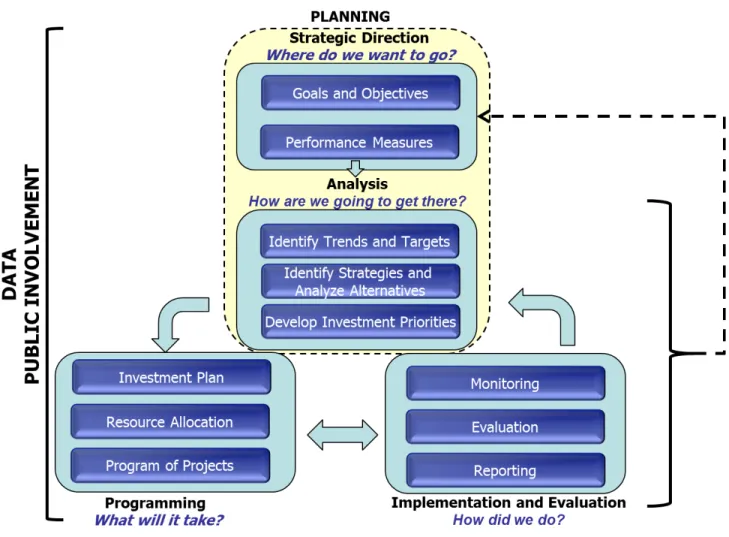
Figure 1 provides a framework for PBPP, identifying primary process elements of an analytic approach to transportation planning and programming, drawing on discussions of PBPP among agencies across the country. This framework demonstrates how PBPP stages fit within a
traditional planning and programming process.20
19 Ohio Department of Transportation, 2008-2009 business Plan, Goal 5. Available at:
http://www.dot.state.oh.us/Divisions/Planning/SPPM/MajorPrograms/Safety/Pages/GoalsObjectives.aspx
20 See: FHWA and FTA, “The Transportation Planning Process: Key Issues – A Briefing Book for Transportation
Decisionmakers, Officials, and Staff.” Updated September 2007. Available at: http://www.planning.dot.gov/documents/briefingbook/bbook.htm.
Figure 1. Framework for PBPP
Strategic Direction (Where do we want to go?) - PBPP is based on a strategic direction, which is used to shape decisions about policies and investments. In the transportation planning process, strategic direction is based upon a vision for the future, as articulated by the public and
stakeholders. This vision often encompasses broad community factors such as quality of life, economic vitality, and environmental quality. PBPP includes:
• Goals and Objectives – Stemming from a state or region’s vision, goals address key desired outcomes, and supporting objectives (specific, measurable statements that support achievement of goals) play a key role in shaping planning priorities.
• Performance Measures. Performance measures support objectives and serve as a basis for comparing alternative improvement strategies (investment and policy approaches) and for tracking performance over time.
Planning Analysis (How are we going to get there?) – Driven by data on performance, along with public involvement and policy considerations, agencies conduct analysis in order to develop investment and policy priorities:
• Identify Trends and Targets – Preferredtrends (direction of results) or targets (specific levels of performance desired to be achieved within a certain timeframe) are
established for each measure to provide a basis for comparing alternative packages of strategies and measuring actual progress. This step relies upon baseline data on past trends, tools to forecast future performance, and information on possible strategies, available funding, and other constraints.
• Identify Strategies and Analyze Alternatives - Performance measures are used to assess strategies and to prioritize options. Scenario analysis may be used to assess alternative packages of strategies, to consider alternative funding levels, or to explore what level of funding would be required to achieve a certain level of performance.
• Develop Investment Priorities - This step builds on strategy analyses, and involves prioritizing strategies and investments and making tradeoffs between different goal areas with a system-level understanding of the level and mix of investments in a given area, for inclusion in the LRTP and related supporting plans. This step requires
prioritizing what performance outcomes are most important. This process of
prioritization should account for performance outcomes using analytical methods, as well as policy priorities, and concerns such as equity, environmental justice, and other considerations.
Programming (What will it take?) – Programming involves selecting specific investments to include in an agency capital plan and/or in a STIP or TIP. In a PBPP approach, programming decisions are made based on their ability to support attainment of performance targets or contribute to desired trends, and account for a range of factors.
• Investment Plan –In order to connect the LRTP, which has an outlook of at least 20 years, to selection of projects in a TIP/STIP, some areas develop a mid-range (e.g., 10 year) investment plan or investment program. The investment plan may essentially be incorporated into the LRTP for an MPO, or may involve a set of investment plans for a State DOT or transit agency, addressing different modes, districts, or program areas.
• Resource Allocation / Program of Projects –Project prioritization or selection criteria are used to identify specific investments or strategies for a capital plan or TIP/STIP. Projects included in the TIP/STIP are selected on the basis of expected performance, and show a clear link to meeting performance objectives.
Implementation and Evaluation (How did we do?) – These activities occur throughout implementation on an on-going basis, and include:
• Monitoring – Gathering information on actual conditions.
• Evaluation – Conducting analysis to understand to what extent implemented strategies have been effective.
• Reporting – Communicating information about system performance and the
effectiveness of plans and programs to policymakers, stakeholders, and the public. The data generated through monitoring system conditions and evaluating the impacts of investments feeds into subsequent cycles of planning, and are critical for refining objectives, measures and targets, and for informing prioritization of future investments.
A significant aspect of PBPP is that each step in the process is clearly connected to the next. Goals tie directly into specific, measureable and actionable objectives, which are often developed in connection with the selection of performance measures. These objectives and performance measures, in turn, are used to develop targets or desired trends and are a basis for selecting and analyzing strategies for the LRTP. The LRTP priorities are tied into project selection decisions for the TIP/STIP. Public involvement and data from monitoring and evaluation efforts are used throughout the process.
Common Themes within a PBPP Process
Some common themes within a PBPP process include: coordination and cooperation among planning partners; integration among planning activities; public and stakeholder involvement; and use of data and tools.
Cooperation and Coordination
Given that the transportation planning process is commonly referred to as a 3C process – due to its cooperative, continuing, and coordinated nature – collaboration among planning partners is vital in a PBPP process.
Within Agencies
PBPP will require greater internal agency coordination across “silos” that can occur when focusing on specific functional areas, such as safety, congestion, asset condition, and
environmental programs. This goes beyond traditional approaches and requires coordination in thinking about how targets relate to each other, as well as considering concepts such as risk management, lifecycle costs, and long-term sustainability. PBPP involves considering the potential trade-offs among goal areas, and considering how strategies support more than one goal.
Effective PBPP almost always involves collaborative thinking about performance across agencies, particularly given the relationships of different agencies in transportation planning, project development, and operations. Specifically, State DOTs, MPOs, RTPOs, and transit agencies need to align their goals, objectives, measures, and targets with one another. This does not mean that each agency must use the same goals, objectives, and measures. Unique local circumstances, agency-specific issues, and differences between urban and rural areas can all spur variations among agencies in the emphasis placed on different performance areas. However, it is important that goals and objectives of various transportation agencies working in the same areas are supportive of each other.
With Traditional and Non-Traditional Planning Partners
In relation to many goals (e.g., safety, economic vitality, asset preservation, health, and environment), non-transportation
decisions and strategies (e.g., driver behavior, vehicle technologies, and land use patterns) play an important role in determining and achieving desired outcomes. Therefore, setting goals and objectives may highlight the important role of collaboration between
transportation agencies and other partners, such as local governments, the business community, freight communities, law enforcement, housing agencies, economic development organizations, and others. This approach has been effectively applied in Strategic Highway Safety Plans, which bring together transportation engineers, law enforcement, public education, and policy makers to examine data on the sources of safety problems and consider a full range of
strategies. Planning partners in PBPP
should include tribal governments, the health community, education community, resource agencies, Federal Land Management agencies, and others. Stakeholders and partners should
Linkages between State, MPO, and Transit Agency Performance-Based Plans
An MPO shall integrate in the metropolitan transportation planning process, the following elements of state and providers of public transportation Performance-Based plans directly or by reference:
• Goals • Objectives • Performance measures • Targets 23 USC Section 134 (h) (2) (D) 49 USC Section 5303 (h) (2) (D)
A State shall integrate into the statewide transportation planning process, the following elements of state and providers of public transportation (in urbanized areas not represented by an MPO) Performance-Based plans directly or by reference: • Goals • Objectives • Performance measures • Targets 23 USC Section 135 (d) (2) (C) 49 USC Section 5304 (d) (2) (C)
also be kept in mind when developing measures to ensure they resonate, are easy to understand, and relate to common goals.
Linkages across Performance-Based Planning Activities
PBPP is integrated throughout the decision-making process. Consequently, data driven and performance-based plans should be integrated into a PBPP process. A range of plans outlined below use performance- based approaches, including the following:
State [Highway] Asset Management Plan: “A State asset management plan shall include strategies leading to a program of projects that would make progress toward
achievement of the State targets for asset condition and performance of the National Highway System.” 23 USC Section 119(e).
State Strategic Highway Safety Plan: “[A] State shall have in effect a State highway safety improvement program under which the state (A) develops, implements, and updates a State strategic highway safety plan that identifies and analyzes highway safety programs and opportunities…, (B) produces a program or projects or strategies to reduce
identified safety problems; and (C) evaluates the strategic highway safety plan on a regularly recurring basis in accordance with subsection (d)(1) to ensure the accuracy of the data and priority of proposed strategies.” 23 USC Section 148(c).
MPO Congestion Management Process: “The transportation planning process in a TMA shall address congestion management through a process that provides for safe and effective integrated management and operation of the multimodal transportation system, based on a cooperatively developed and implemented metropolitan-wide strategy, of new and existing transportation facilities… through the use of travel demand reduction and operational management strategies. The development of a congestion management process should result in multimodal system performance measures and strategies that can be reflected in the metropolitan transportation plan and TIP.” 23 CFR Section 450.320(a),(b).
Transit Asset Management Plan: ‘‘…each recipient of Federal financial assistance under this chapter shall establish performance targets in relation to the performance
measures established by [USDOT]....Each designated recipient of Federal financial assistance under this chapter shall submit to the Secretary an annual report that describes— ‘‘(A) the progress of the recipient during the fiscal year to which the report relates toward meeting the performance targets…for that fiscal year; and (B) the
performance targets established by the recipient for the subsequent fiscal year.” 49 USC Section 5326(c).
Transit Agency Safety Plan: “…each recipient or State… shall certify that the recipient or State has established a comprehensive agency safety plan that includes…methods for identifying and evaluating safety risks throughout all elements of the public
transportation system of the recipient…strategies to minimize the exposure of the public, personnel, and property to hazards and unsafe conditions…performance targets
based on the safety performance criteria and state of good repair standards…” 49 USC Section 5329(d).
State Freight Plans: “The Secretary shall encourage each State to develop a freight plan that provides a comprehensive plan for the immediate and long-range planning
activities and investments of the State with respect to freight.” MAP-21, Section 1118, amending 23 USC 167.
Each of these documents and their associated processes include objectives, performance measures, data collection and monitoring, selection of strategies, and evaluation. These performance-based planning efforts can provide inputs and insights to inform State and MPO LRTPs, and should be developed to support the broader vision, goals, and objectives of the LRTPs.
For instance, transportation asset management is a strategic and systematic process for
managing physical assets effectively throughout their lifecycle in order to make better decisions based upon quality information and defined objectives, and is closely linked to PBPP.
Consequently, a Transportation Asset Management Plan (TAMP) should connect with the LRTP and reflect common goals and priorities. 21 The best way to define the relationship between asset management and performance based planning is to recognize that a transportation system’s performance depends on many factors influenced by the physical condition of facilities, including passenger and freight demand, safety characteristics, capacity, and user behavior. Agencies should try to ensure that the schedule for developing the TAMP aligns with planning and programming cycles so that the results can be incorporated into these processes. Planning staff should be involved in TAMP development so that there is heightened
coordination between the TAMP and LRTP.
In addition to required plans, PBPP approaches can be applied to corridor planning efforts, transit agency capital program development, operations plans, and other efforts, so that these planning activities build upon the goals, objectives, and measures defined through the LRTP. It is important to recognize that since planning and programming is a continuing process,
incremental changes can be made over time. Implementing a PBPP approach does not mean starting from scratch, but builds on existing plans, programs, and procedures.
21 See: FHWA, “Generic Work Plan for Developing a TAMP,” March 2013. In developing a TAMP, the agency will
combine several related but often separate types of analyses: life cycle cost analysis, performance-based planning, risk assessment, financial planning, and programming.
Public and Stakeholder Involvement
Public involvement plays an important role in PBPP. While engaging the public is a required component of metropolitan and statewide and non-metropolitan transportation planning, and is a common practice among transportation agencies at all levels, the public should play a critical role at various stages of a PBPP process. These include: development of goals,
development of objectives and performance measures, selection of targets, and assessment of strategies that feed into planning and programming decisions. Communicating to the public about performance also plays an important role so that the public and stakeholders understand the benefits of transportation investments and can play an informed role in selecting priorities.
VTrans – Performance-Based Asset Management Framework
VTrans, the Vermont Agency of Transportation has a sophisticated system of developing performance measures to guide its asset management, which shares many of the key PBPP process components. The agency’s Asset Management Framework, below, follows a clear performance-based approach to planning and programming that includes key steps such as goal-setting, analysis of strategies, resources allocation, and monitoring and reporting results. Like other PBPP processes, the agency’s process relies on quality information tools.
Source: VTrans Asset Management Vision and Work Plan,
Engaging elected officials is also important, so that they “buy in” to the benefits of a PBPP approach. This approach enhances decision making by building an awareness of the “big picture” providing the opportunity for decision-makers to focus on system performance as a basis for investment decisions as opposed to a focus on individual projects.
Communication with stakeholders is a critical element of PBPP. New technology has changed the way transportation agencies communicate with stakeholders and the public. Vast amounts of technical data can be communicated easily and quickly. Effective visualization significantly improves the ability to assess complex PBPP scenarios and proposed alternatives. Through the use of clear concise visuals—such as annotated maps, graphs, photos, illustrations, and
videos— an audience can be made to quickly understand an important topic more effectively than through statistics and numerical tables.22 It can be used to identify, analyze and evaluate alternative scenarios for clear and effective public involvement and feedback.
Data and Tools
Data and analytical tools play a critical role throughout a PBPP approach. Conducting system or project analysis will require a suite of approaches, tools, and methodologies. Data are a
foundation for:
• Selecting feasible performance measures,
• Understanding current system performance (developing a base line),
• Developing and tracking performance changes over time (monitoring conditions),
• Setting targets, and
• Evaluating the effectiveness of implemented strategies (for instance, through use of before-and-after data, surveys, or other means of collecting information).
Collecting, compiling, and analyzing data is often a challenge for agencies, including the costs of data collection and difficulty of using some types of data (such as the vast amount of real-time traffic information) for planning and programming decisions. However, there are a wide array of national, state, and local data sources and systems available. Some performance areas have significant on-going data collection efforts, such as the National Fatality Analysis Reporting System (FARS), the Highway Performance Monitoring System (HPMS), the National Bridge Inspection (NBI) Program, and the National Transit Database (NTD). Other areas, such as asset condition, have well established tools, such as pavement and bridge management systems. Analysis tools also play an important role in forecasting future performance or in conducting analysis of alternative investments or scenarios. At the metropolitan level, regional travel
22 FHWA, Congestion Management Process, Showcasing Visualization Tools in Congestion Management,
http://www.fhwa.dot.gov/planning/congestion_management_process/cmp_visualization_tools/.