Design and Synthesis of Novel Macrocyclic Mer Tyrosine Kinase
Inhibitors
Xiaodong Wang,*
,†Jing Liu,
†,#Weihe Zhang,
†,∇Michael A. Stashko,
†James Nichols,
‡Michael J. Miley,
§Jacqueline Norris-Drouin,
†Zhilong Chen,
†Mischa Machius,
§Deborah DeRyckere,
∥Edgar Wood,
‡Douglas K. Graham,
∥,‡H. Shelton Earp,
†,⊥,‡Dmitri Kireev,
†and Stephen V. Frye
†,⊥,‡†Center for Integrative Chemical Biology and Drug Discovery, Division of Chemical Biology and Medicinal Chemistry, Eshelman
School of Pharmacy, University of North Carolina at Chapel Hill, Chapel Hill, North Carolina 27599, United States ‡Meryx, Inc., 450 West Dr., Chapel Hill, North Carolina 27599, United States
§Department of Pharmacology, University of North Carolina at Chapel Hill, Chapel Hill, North Carolina 27599, United States ∥Aflac Cancer and Blood Disorders Center of Children’s Healthcare of Atlanta, Department of Pediatrics, School of Medicine, Emory
University, Atlanta, Georgia 30322, United States
⊥Lineberger Comprehensive Cancer Center, Department of Medicine, School of Medicine, University of North Carolina at Chapel
Hill, Chapel Hill, North Carolina 27599, United States
*
S Supporting InformationABSTRACT: Mer tyrosine kinase (MerTK) is aberrantly elevated in various tumor cells and has a normal anti-inflammatory role in the innate immune system. Inhibition of MerTK may provide dual effects against these MerTK-expressing tumors through reducing cancer cell survival and redirecting the innate immune response. Recently, we have designed novel and potent macrocyclic pyrrolopyrimidines as MerTK inhibitors using a structure-based approach. The most active macrocycles had an EC50below 40 nM in a cell-based MerTK phosphor-protein ELISA assay. The X-ray structure of macrocyclic analogue3 complexed with MerTK was also resolved and demonstrated macrocycles binding in the ATP binding
pocket of the MerTK protein as anticipated. In addition, the lead compound 16
(UNC3133) had a 1.6 h half-life and 16% oral bioavailability in a mouse PK study.
KEYWORDS: MerTK inhibitors, MerTK, macrocycle, pyrrolopyrimidine, TAM kinase, structure-based drug design
M
er tyrosine kinase (MerTK) belongs to the TAM(Tyro3, Axl, MerTK) family and regulates adult tissues and organ systems that are subject to continuous challenge and renewal throughout life.1,2 Aberrant expression of MerTK in various hematological and solid tumors promotes cancer cell survival, chemoresistance, and invasive motility.3,4 In addition, MerTK triggers macrophage engulfment of apoptotic material (efferocytosis) and promotes an anti-inflammatory response, preventing excessive inflammation and autoimmune disease. Unfortunately, within the tumor microenvironment this suppresses antitumor innate immune responses.5−9Therefore, inhibition of MerTK may provide dual therapeutic effects against MerTK-expressing tumors by reducing cancer cell survival, invasion, and metastasis as well as stimulating antitumor immune responses.
In addition, TAM family members are used by many enveloped viruses, such as West Nile (WNV), Dengue (DENV), HIV-1, Ebola, Marburg, Zika, and Chikungunya, to attach and gain access to cells through apoptotic mimicry (a phosphatidylserine (PtdSer)-dependent process).10−12 Inhib-ition of MerTK may also lower the infectivity of an important class of enveloped viruses.13
Recently, we reported UNC2025 (1), a potent MerTK/Flt3 dual inhibitor.14 Although, our attempt to obtain an X-ray structure of a complex of MerTK protein with UNC2025 failed, the X-ray structure of compound UNC569 (2) complexed with MerTK protein kinase domain was successfully resolved at a resolution of 2.69 Å (Figure 1a,b).15 UNC569 formed four hydrogen bonds with MerTK protein, two with the hinge region of the protein and the rest two with R727 and N728. UNC2025 is expected to bind MerTK in a similar fashion.14 One interesting observation from this X-ray structure was that thermal motions of the butyl amine side chain and the 4-aminocylcohexylmethyl group could bring them close enough to be connected by a short linker, thus forming a macrocycle. However, connecting these two groups directly was syntheti-cally challenging. Retaining the cyclohexyl ring and the hydroxyl group, the key hydrogen bond donor, would introduce new stereogenic centers in the newly formed macrocycles. To provide a proof of concept for the macrocycle hypothesis, a simplified macrocycle3with an amide linker was
Received: May 26, 2016
Accepted: September 13, 2016
Published: September 13, 2016
proposed (Figure 1c). Although UNC569 belongs to the pyrazolopyrimidine series, we have previously shown that pyrrolopyrimidines have similar structure−activity relationships (SARs) and better solubility (solubility of the HCl salt of1is 47 mg/mL at pH 7.4).13 Therefore, we used a pyrrolopyr-imidine core to form macrocycle3.
Macrocycles have been prominent in drug structures for decades although most macrocyclic drugs on the market are macrolides or cyclic peptides derived from natural products. The structural preorganization and incomplete rigidity provided by cyclization with flexible linkers may facilitate interactions with target protein through favorable entropies and numerous, spatially distributed binding interactions, thus increasing both binding affinity and selectivity.16 Furthermore, some reports suggest that cyclization has a favorable impact on other essential properties required for drugs, such as membrane permeability,17 metabolic stability, and overall pharmacoki-netics.18,19 Currently, a handful de novo designed macrocyclic kinase inhibitors are in clinical development.16 However, limited opportunities in lead optimization, potential increased costs for scale up, and poor understanding of macrocycle absorption, distribution, metabolism, execration, and toxicity (ADMET) are still concerns for drug discovery efforts in this
field. With this background, we explored introduction of
macrocycles into MerTK inhibitors.20
Indeed, compound3proved active against MerTK (IC50 65 nM) with 20- and 30-fold selectivity over Axl (IC501300 nM)
and Tyro3 (IC50 2000 nM), respectively, and similar activity against Flt3 (IC50 160 nM) in our in-house microfluidic
capillary electrophoresis (MCE) assay.21−23 The X-ray
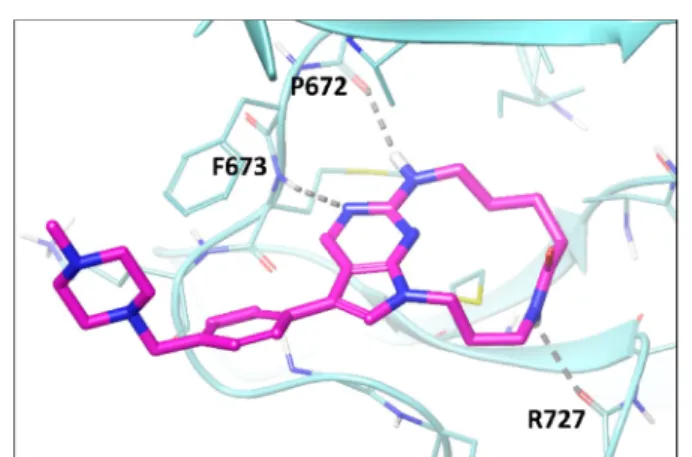
structure of3 complexed with the MerTK kinase domain was also resolved at a 2.55 Å resolution (Figure 2). Overall, the structure was in agreement with the preliminary docking hypothesis (Figure 1). The major difference between MerTK binding by3and2was that the amide group of3was only able to form a hydrogen bond with R727 because of its limited freedom of motion, while the 4-aminocylcohexyl substituent in 2could simultaneously bind to three residues, R727, N728, and D741 (Figure 2).
To improve the hydrogen bonding capability of 3, we
installed an amino or a hydroxyl group in the macrocycle as
shown in structuresIandII(Table 1). The closest analogues to
3 from structures I and II were compounds 4 and 10,
respectively, which had a similar ring size, while4had an amino group and10had a hydroxyl group attached to the macrocycles (inseparable racemic mixture). As proof of concept, both compounds were prepared and, indeed, were 15-fold more active against MerTK than 3. Changing the ring size of the macrocycles would affect not only the conformation of the molecule but also the location of the amino/hydroxyl group, which is crucial for forming the desired hydrogen bond. Thus, we next explored the SAR of the ring size of moleculesIandII. For structureI, whenn= 1, ring expansion of the macrocycle
led to weaker MerTK inhibitors. As shown in Table 1,
analogues 5 (m = 4) and 6 (m = 6) were 4- and 8-fold less active than4(m= 2), respectively. However, a larger ring was better whenn= 2. Analogue9(m= 6) was 10-fold more active against MerTK than analogue7(m= 4) and 3-fold more active than8(m= 4). Interestingly, analogue9was 7-fold more active against Tyro3 compared with UNC2025 although their activities against MerTK were similar. These results also demonstrated the importance of the location of the hydrogen
bond donor. For structure II, when n = 1, the MerTK
inhibitory activity of the analogues varied slightly based on the
ring size (compounds 10−13). Analogue 12 with a
16-membered ring (m= 3) was the most active MerTK inhibitor. However, whenn= 2, a larger ring led to a more MerTK active analogue (compounds 14−17) with less selectivity among
TAM family members (compounds14 (15-fold over Axl and
21-fold over Tyro3) vs 17 (4-fold over Axl and 8-fold over Tyro3)). Forn= 3, analogues18−21(m= 1−4) were equally potent against MerTK independent of the ring size, possibly due to theflexibility of the large ring when the hydroxyl group, the hydrogen bond donor, was at the optimal position. Overall, the ring size had less effect on the activity of macrocycles with structureIIpossibly due to the less restricted nature of the alkyl macrocycles in structureIIversus the amide linked macrocycles in structureI.
To evaluate the inhibitory activity of our compounds in a cell-based assay based on the inhibition of MerTK phosphor-ylation (pMerTK), a 384-well plate ELISA assay was developed (pMerTK ELISA) (Tables 1and2). In this assay, HEK293 cells expressing chimeric proteins24,25consisting of the extracellular and transmembrane domains from the epidermal growth factor receptor (EGFR) and the intracellular kinase domain from MerTK were plated and stimulated with EGF with and without inhibitors. A chimeric protein was utilized because consistent
Figure 1. (a) Structure of UNC569; (b) X-ray crystal structure of UNC569 in complex with MerTK (kinase domain) (PDB code 3TCP); (c) structure of proposed macrocycle3.
stimulation of native MerTK with the complex, natural ligand (GAS6 plus PtdSer) was not practical. In general, compounds in structureIwere more polar due to the primary amine group (shorter retention time in LC/MS spectra), likely less cell permeable, and had weaker cellular activity than compounds in structureII with the exception of analogue8, which was very active in this assay (EC50for UNC2025 was 12±3.1 nM). The
reasons for the exception are unclear and still under investigation.
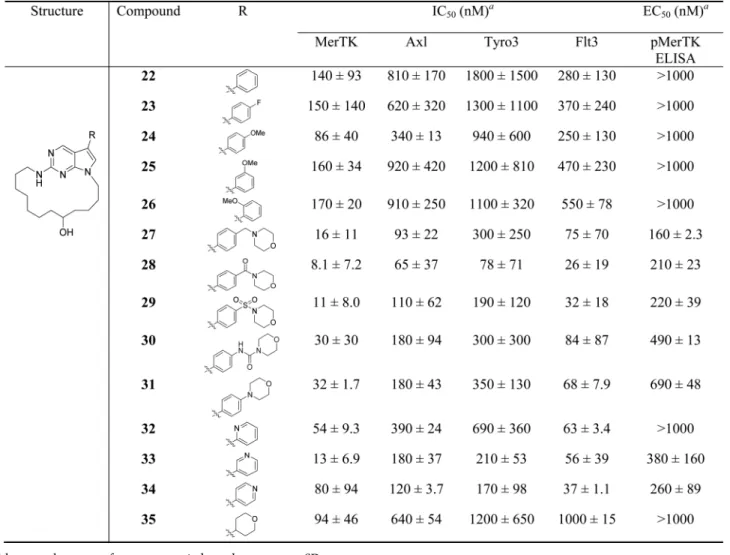
Next, as shown in Table 2, we explored the SAR at the R position whilefixing the macrocycle as a 17-membered ring as in analogue16(UNC3133). The R group projects out of the MerTK active site (Figure 2). Although it interacts mostly with the solvent, it can still affect the activity of the inhibitors and be used for tuning solubility and other pharmacokinetic properties. Various groups were introduced to this site. When a phenyl group was at the R position, analogue 22 was active against MerTK but was much weaker than16(47-fold) (Table 1) and had no activity in the pMerTK ELISA assay at a concentration of 1.0 μM. A small substituent, such as fluoro or methoxyl
group, on the phenyl ring did not affect the MerTK activity in either the MCE or pMerTK ELISA assays (within 2-fold, see analogues23−26). However, a larger substituent on the phenyl ring significantly increased the MerTK activity. Analogues27− 29had similar substituents at the R position, one phenyl and one heterocycle connected by a one atom linker (CH2, CO, or SO2); thus, they shared similar activity against MerTK as
analogue 16. A longer linker (an amide bond) and no linker between the phenyl and the heterocycle led to weaker MerTK inhibitors30 and31, respectively (10-fold weaker than 16in the MCE assay and 5-folder weaker in the pELISA assay). Introducing a pyridine ring at the R position led to analogues that could be very active against MerTK depending on the position of the nitrogen in the pyridine ring. Analogue33with a 3-pyridinyl group at the R position was more active in the MCE assay than analogues32(4-fold) and34(6-fold) with a 2-pyridinyl and a 4-pyridinyl group, respectively. However,34
was equipotent to33 in the pMerTK ELISA assay, while 32
was inactive at a concentration of 1.0μM. A 4-tetrahydropyran group was also tolerated at the R position, and analogue35was Table 1. SAR of the Ring Size
equally potent as analogue 22. The change of the MerTK activity based on the size, shape, and electron density of the R group could not be explained by the X-ray structure of3since the R group was in the solvent front and did not have close interactions with the MerTK protein. Generally, these analogues have some selectivity over Axl (>5-fold) and Tyro3 (>10-fold) and similar activity against Flt3 and MerTK. Analogue16was still one of the most active MerTK inhibitors and had a medium-sized ring and thus was chosen for the further study.
Analogue16was tested in thein vivopharmacokinetic (PK) study in mice via both intravenous (IV) and oral (PO) administration (details inSupporting Information). It had a 1.6 h half-life, 16% oral bioavailability, 106 mL/min/kg systemic clearance (1.2 fold of the normal liver bloodflow in mice), and 6.8 L/kg volume of distribution (Vss) (9.7-fold higher than the
normal volume of total body water) at a dose of 3 mg/kg.
These PK properties are not optimal for an in vivo tool
compound and need to be further improved.
The inhibitory activity mediated by16against a panel of 30 kinases was also determined at a concentration 100-fold above its MerTK IC50(Figure 3) (details inSupporting Information).
This experiment provides a broad survey of kinase families emphasizing tyrosine kinases along with a selection of serine/ threonine kinases. Surprisingly, the selectivity of16across the
kinome was not very high (worse than UNC202514): eight
Table 2. SAR Study of R
aValues are the mean of two or more independent assays±SD.
tyrosine kinases and four serine/threonine kinases were inhibited by greater than 50% in the presence of 300 nM16. This may be due to theflexibility of this type of macrocycles, which would allow it to conformationally adapt to the active site of disparate kinases.
Representative synthetic routes to macrocyclic compounds
are shown in Scheme 1. The synthesis of 4 started with
commercially available 5-bromo-2-chloro-7H-pyrrolo[2,3-d
]-pyrimidine (36) as shown in path a. Mitsunobu reaction
between 36 and 37 led to intermediate 38. An SNAr
replacement of the chloride on the pyrimidine ring with butane-1,4-diamine yielded39. The macrocycle was formed by an intramolecular amide bond coupling reaction of the unprotected acid and the free amine to provide intermediate 40. Thefinal compound4was obtained by deprotection of the
Boc protecting group of 40 followed by a Suzuki coupling
reaction with boronic ester 41. In path b, N-alkylation of 36 with alkyl bromide42under basic conditions followed by an SNAr replacement of the chloride on the pyrimidine ring with
but-3-en-1-amine yielded intermediate 43, a macrocycle
precursor. A ring closing metathesis reaction of 43was then catalyzed by the second generation of Grubbs’catalyst followed by a Suzuki coupling reaction with boronic ester41to yield the intermediate44, which was a mixture ofcis- andtrans-isomers. Reduction of the newly formed double bonds and removal of the TBS protecting group led to the desired analogue16.
In summary, the first potent macrocyclic MerTK inhibitors were developed using structure-based drug design. An amide bond formation or a Ru-catalyzed ring metathesis reaction was the key step to build up the macrocycles. An X-ray structure of
the MerTK protein complexed with analogue 3 showed that
these macrocyclic compounds resided in the ATP binding pocket. The most active analogues had an EC50below 40 nM in
our newly developed high-throughput phospho-MerTK cellular ELISA assay. These macrocycles were not very selective across the kinome. The selectivity and PK properties will need to be improved to develop usefulin vivotool compounds.
■
ASSOCIATED CONTENT*
S Supporting InformationThe Supporting Information is available free of charge on the
ACS Publications website at DOI: 10.1021/acsmedchem-lett.6b00221.
Experimental details and characterization of all com-pounds and biological methods (PDF)
Accession Codes
The atomic coordinates for the X-ray crystal structure of3have been deposited with the RCSB Protein Data Bank under the accession code 5K0K.
■
AUTHOR INFORMATIONCorresponding Author
*Tel: 919-843-8456. Fax: 919-843-8465. E-mail: xiaodonw@ unc.edu.
Present Addresses
#Jing Liu: Icahn School of Medicine at Mount Sinai, 1425
Madison Avenue, New York, New York 10029, United States.
∇Weihe Zhang: BioCryst Pharmaceuticals, Inc., 2100
River-chase Center, Suite 200, Birmingham, Alabama 35244, United States.
Author Contributions
The manuscript was written through contributions of all authors. All authors have given approval to thefinal version of the manuscript.
Funding
This work was supported by the University Cancer Research Fund and Federal Funds from the National Cancer Institute, National Institute of Health, under Contract No. HHSN261200800001E. The content of this publication does not necessarily reflect the views or policies of the Department of Health and Human Services, nor does mention of trade names, commercial products, or organizations imply endorse-ment by the U.S. Governendorse-ment.
Notes
The authors declare the following competing financial
interest(s): J.N., D.D., E.W., D.K.G., H.S.E., D.K., S.V.F., and X.W. have stock in Meryx, Inc.
■
ACKNOWLEDGMENTSWe thank Dr. Brenda Temple for her help in depositing the X-ray crystallographic structure to the Protein Data Bank (PDB).
■
ABBREVIATIONSMerTK, Mer tyrosine kinase; PtdSer, phosphatidylserine; SAR, structure−activity relationship; ADMET, absorption, distribu-tion, metabolism, execradistribu-tion, and toxicity; MCE, microfluidic capillary electrophoresis; IC50, half maximal inhibitory concen-tration; pMerTK, phosphorylated Mer tyrosine kinase; ELISA,
enzyme-linked immunosorbent assay; IC50, half maximal
effective concentration
■
REFERENCES(1) Graham, D. K.; Dawson, T. L.; Mullaney, D. L.; Snodgrass, H. R.; Earp, H. S. Cloning and mRNA expression analysis of a novel human protooncogene, c-mer.Cell Growth Differ1994,5, 647−657.
(2) Lemke, G. Biology of the TAM Receptors.Cold Spring Harbor Perspect. Biol.2013,5(11), a009076.
(3) Cummings, C. T.; DeRyckere, D.; Earp, H. S.; Graham, D. K. Molecular pathways: MERTK signaling in cancer. Clin. Cancer Res.
2013,19(19), 5275−5280.
(4) Graham, D. K.; DeRyckere, D.; Davies, K. D.; Earp, H. S. The TAM family: phosphatidylserine sensing receptor tyrosine kinases gone awry in cancer.Nat. Rev. Cancer2014,14(12), 769−785.
(5) Scott, R. S.; McMahon, E. J.; Pop, S. M.; Reap, E. A.; Caricchio, R.; Cohen, P. L.; Earp, H. S.; Matsushima, G. K. Phagocytosis and clearance of apoptotic cells is mediated by MER. Nature2001,411
(6834), 207−211.
(6) Cohen, P. L.; Caricchio, R.; Abraham, V.; Camenisch, T. D.; Jennette, J. C.; Roubey, R. A.; Earp, H. S.; Matsushima, G.; Reap, E. A. Delayed apoptotic cell clearance and lupus-like autoimmunity in mice lacking the c-mer membrane tyrosine kinase.J. Exp. Med. 2002,196
(1), 135−140.
(7) Guttridge, K. L.; Luft, J. C.; Dawson, T. L.; Kozlowska, E.; Mahajan, N. P.; Varnum, B.; Earp, H. S. Mer receptor tyrosine kinase signaling: prevention of apoptosis and alteration of cytoskeletal architecture without stimulation or proliferation.J. Biol. Chem.2002,
277(27), 24057−24066.
(8) Hu, B.; Jennings, J. H.; Sonstein, J.; Floros, J.; Todt, J. C.; Polak, T.; Curtis, J. L. Resident murine alveolar and peritoneal macrophages differ in adhesion of apoptotic thymocytes.Am. J. Respir. Cell Mol. Biol.
2004,30(5), 687−693.
(9) Todt, J. C.; Hu, B.; Curtis, J. L. The receptor tyrosine kinase MerTK activates phospholipase C I3̂2 during recognition of apoptotic
thymocytes by murine macrophages.J. Leukocyte Biol.2004,75(4), 705−713.
(10) Jemielity, S.; Wang, J. J.; Chan, Y. K.; Ahmed, A. A.; Li, W.; Monahan, S.; Bu, X.; Farzan, M.; Freeman, G. J.; Umetsu, D. T.; Dekruyff, R. H.; Choe, H. TIM-family proteins promote infection of multiple enveloped viruses through virion-associated phosphatidylser-ine.PLoS Pathog.2013,9(3), e1003232.
(11) Mercer, J.; Helenius, A. Vaccinia virus uses macropinocytosis and apoptotic mimicry to enter host cells.Science2008,320(5875), 531−535.
(12) Mercer, J.; Helenius, A. Apoptotic mimicry: phosphatidylserine-mediated macropinocytosis of vaccinia virus. Ann. N. Y. Acad. Sci.
2010,1209, 49−55.
(13) Wang, X.; Frye, S. Mer Receptor Tyrosine Kinase: Therapeutic Opportunities in Oncology, Virology, and Cardiovascular Indications.
Annu. Rep. Med. Chem.2014,49, 301−314.
(14) Zhang, W.; DeRyckere, D.; Hunter, D.; Liu, J.; Stashko, M. A.; Minson, K. A.; Cummings, C. T.; Lee, M.; Glaros, T. G.; Newton, D. L.; Sather, S.; Zhang, D.; Kireev, D.; Janzen, W. P.; Earp, H. S.; Graham, D. K.; Frye, S. V.; Wang, X. UNC2025, a Potent and Orally Bioavailable MER/FLT3 Dual Inhibitor.J. Med. Chem.2014,57(16), 7031−7041.
(15) Liu, J.; Yang, C.; Simpson, C.; DeRyckere, D.; Van Deusen, A.; Miley, M. J.; Kireev, D.; Norris-Drouin, J.; Sather, S.; Hunter, D.; Korboukh, V. K.; Patel, H. S.; Janzen, W. P.; Machius, M.; Johnson, G. L.; Earp, H. S.; Graham, D. K.; Frye, S. V.; Wang, X. Discovery of Small Molecule Mer Kinase Inhibitors for the Treatment of Pediatric Acute Lymphoblastic Leukemia.ACS Med. Chem. Lett.2012,3, 129− 134.
(16) Giordanetto, F.; Kihlberg, J. Macrocyclic drugs and clinical candidates: what can medicinal chemists learn from their properties?J. Med. Chem.2014,57(2), 278−295.
(17) Bogdan, A. R.; Davies, N. L.; James, K. Comparison of diffusion coefficients for matched pairs of macrocyclic and linear molecules over a drug-like molecular weight range.Org. Biomol. Chem.2011,9(22), 7727−7733.
(18) Mallinson, J.; Collins, I. Macrocycles in new drug discovery.
Future Med. Chem.2012,4(11), 1409−1438.
(19) Driggers, E. M.; Hale, S. P.; Lee, J.; Terrett, N. K. The exploration of macrocycles for drug discoveryan underexploited structural class.Nat. Rev. Drug Discovery2008,7(7), 608−624.
(20) Baladi, T.; Abet, V.; Piguel, S. State-of-the-art of small molecule inhibitors of the TAM family: The point of view of the chemist.Eur. J. Med. Chem.2015,105, 220−237.
(21) Pommereau, A.; Pap, E.; Kannt, A. Two simple and generic antibody-independent kinase assays: comparison of a bioluminescent and a microfluidic assay format.J. Biomol. Screening2004,9(5), 409− 416.
(22) Dunne, J.; Reardon, H.; Trinh, V.; Li, E.; Farinas, J. Comparison of on-chip and off-chip microfluidic kinase assay formats.Assay Drug Dev. Technol.2004,2(2), 121−129.
(23) Bernasconi, P.; Chen, M.; Galasinski, S.; Popa-Burke, I.; Bobasheva, A.; Coudurier, L.; Birkos, S.; Hallam, R.; Janzen, W. P. A chemogenomic analysis of the human proteome: application to enzyme families.J. Biomol. Screening2007,12(7), 972−982.
(24) Liu, J.; Zhang, W.; Stashko, M. A.; Deryckere, D.; Cummings, C. T.; Hunter, D.; Yang, C.; Jayakody, C. N.; Cheng, N.; Simpson, C.; Norris-Drouin, J.; Sather, S.; Kireev, D.; Janzen, W. P.; Earp, H. S.; Graham, D. K.; Frye, S. V.; Wang, X. UNC1062, a new and potent Mer inhibitor.Eur. J. Med. Chem.2013,65, 83−93.