RELATED TO THE STRAUSS CONJECTURE
JASON METCALFE AND DAVID SPENCER
Abstract. A coupled system of semilinear wave equations is considered, and a small data global existence result related to the Strauss conjecture is proved. Previous results have shown that one of the powers may be reduced below the critical power for the Strauss conjecture provided the other power sufficiently exceeds such. The stability of such results under asymptotically flat pertur-bations of the space-time where an integrated local energy decay estimate is available is established.
1. Introduction
The purpose of this article is to establish global existence for a coupled system of wave equations, which is related to the Strauss conjecture, on asymptotically flat space-times that permit a localized energy estimate. It is now well-known that nonlinear wave equations
u:= (∂t2−∆)u=Fp(u), (t, x)∈R+×Rn
where
(1.1) X
0≤j≤2
|u|j|∂ujFp(u)|.|u|p forusmall
have global solutions for sufficiently small initial data providedp > pc wherepc>1 solves
(1.2) (n−1)p2c−(n+ 1)pc−2 = 0.
Moreover, blow up is known to occur for p < pc. These results originated in [23] for n = 3 where pc = 1 +√2, and following [44] the problem became known as the Strauss conjecture. Global existence in general dimension was eventually established in [20], [45]; see the references therein for many intermediate results. Blow up below the critical exponent was proved in [40]. See also [39], [51] for further results at the critical exponent.
In the current work, we shall examine a system of the form
u=|v|p,
v=|u|q.
In the flat case, the coupled system was examined in [16], and it was shown that global existence may be established for powers in the nonlinearity below the critical
Date: September 18, 2018.
The first author was supported in part by NSF grant DMS-1054289. The second author was supported in part by a Summer Undergraduate Research Fellowship (SURF) through the University of North Carolina, and the results contained herein were developed as a part of his Undergraduate Honors Thesis.
1
exponent provided the power on the coupled equation exceeds the same. Indeed, setting
(1.3) C(p, q) = maxnq+ 2 +p −1
pq−1 ,
p+ 2 +q−1 pq−1
o
−n−1 2 ,
it was shown that small data global existence holds forC(p, q)<0 and that such fails for C(p, q) > 0. Notice that C(p, p) = 0 corresponds precisely to (1.2). In particular, note that small data global existence may be established for powers
p < pc provided that the other powerqsufficiently exceedspc. In addition to [16],
see [17], [14] for treatments ofC(p, q)>0 and [1], [15], [25], and [21] for analysis of the critical curveC(p, q) = 0. Moreover, see the overview [26] of this and related problems.
Here we seek to establish the same using techniques that are sufficiently robust so as to allow background geometries. Specifically, we shall use a variant of the weighted Strichartz estimates of [22], [19], which were further developed in [27], [35], and the localized energy estimate to prove such global existence.
We shall examine operators of the form
(1.4) P u=∂αgαβ∂βu+bα∂αu+cu
on space-timesM whereM =R+×R3orM =R+×(R3\K) whereKhas a smooth
boundary and K ⊂ {x : |x|< R0}. Here g is a Lorentzian metric, and we make the assumption thatg can be written as
(1.5) g(t, x) =m+g0(t, r) +g1(t, x)
where m = diag(−1,1,1,1) is the Minkowski metric. The components g0 and
g1 will represent long-range and short-range perturbations respectively. They are asymptotically flat in the sense that
(1.6) k∂t,xµ gi,αβk`i+|µ|
1 L
∞
t,x
=O(1), i= 0,1, |µ| ≤3.1
Due to the need to commute with spatial rotations, the long-range perturbation
g0 is assumed to be spherically symmetric in the sense that the coefficients only (spatially) depend onr=|x|and
(1.7)
g−g1= (−1+ ˜g00(t, r))dt2+2˜g01(t, r)dt dr+(1+ ˜g11(t, r))dr2+(1+ ˜g22(t, r))r2dωS22.
and, by (1.6), k∂µt,xgαβ˜ k`|µ|
1 L∞t,x
=O(1) for |µ| ≤ 3. The coefficients of the lower-order perturbations decay are assumed to decay as follows:
(1.8) k∂µt,xbk`1+|µ|
1 L
∞
t,x
+k∂µt,xck`2+|µ|
1 L
∞
t,x
=O(1), |µ| ≤2.
We shall also assume that the perturbations admit a (weak) localized energy decay. More specifically, we assume that there is R1 (with R1 > R0 in the case
1Here, as in [35], for a normA, we set
kuk`s qA=
2
jskφ
j(x)u(t, x)kA
`qj≥0,
X
j≥0
thatM =R+×(R3\K)) so that ifusolvesP u=F then
(1.9) k∂∂µukL∞
t L2x+k(1−χ)∂∂
µuk
`−∞1/2L2t,x
+k∂µuk`−3/2
∞ L2t,x
.ku(0,·)kH|µ|+1+k∂tu(0,·)kH|µ| +
X
|ν|≤|µ|
k∂νFkL1 tL2x
for all|µ| ≤2. Hereχis a smooth function that is identically 1 onBR1/2:={|x| ≤
R1/2}and is supported on BR1.
On (1 + 3)-dimensional Minkowski space (i.e. when g0 ≡g1 ≡ 0), it is known that
k∂ukL∞
t L2x+k∂uk`−∞1/2L2t,x
+kuk`−3/2
∞ L2t,x.
k∂u(0,·)kL2+kukL1 tL2x,
which is a stronger version of theµ= 0 estimate above. And as the flat d’Alembertian commutes with∂t,x, the higher order variants readily follow. Such estimates orig-inated in [36]. They follow, e.g., by multiplying u by a multiplier of the form
r
r+2j∂ru+n−12 r+21ju, integrating over [0, T]×R
3, and integrating by parts. See, e.g., [43], [29]. And see, e.g., [34] for a more complete history. These estimates are known to be rather robust in the asymptotically flat regime. Even without the cutoff, they are known to hold for small, possibly time-dependent perturbations of Minkowski space [29, 30], [33, 32], [2] and for time-independent nontrapping per-turbations in the product manifold setting due to, e.g., [8], [6], [42]. See [31] for the most general results in the nontrapping regime.
The presence of trapped rays is a known obstruction to the localized energy esti-mate [37], [38]. The asymptotic flatness restricts the possibility of trapped rays to a compact set, and when the trapping is sufficiently weak, a localized energy esti-mate where one, say, cuts off away from the trapping may sometimes be recovered. Allowing for this is the reason for the cutoff in assumption (1.9). Previous results have then verified (1.9) in a number of settings where trapping occurs, including on the Schwarzschild space-time [4,5], [10,11], [28], on Kerr space-times withaM
[47] (see also [3], [9,12] for some closely related results and [13] for a related result that holds for the full subextremal range|a|< M), and on certain warped product manifolds that contain degenerate trapping [7].
We now introduce the specific problem at hand. With two possibly different operators P1 and P2 subject to hypotheses (1.5)-(1.9), we examine the coupled system
P1u=Fp(v), u(0, x) =f1(x),
∂tu(0, x) =g1(x),
P2v=Fq(u), v(0, x) =f2(x),
∂tv(0, x) =g2(x).
(1.10)
HereFp andFq are two functions satisfying (1.1).
For the system (1.10), we shall establish the following small data global existence result:
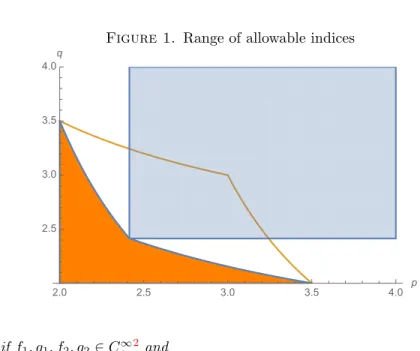
Figure 1. Range of allowable indices
2.0 2.5 3.0 3.5 4.0 p
2.5 3.0 3.5 4.0 q
Then iff1, g1, f2, g2∈Cc∞
2and
(1.11) k(f1, f2)kH3+k(g1, g2)kH2 ≤ε
withε sufficiently small, there exists a global solution(u, v)to (1.10).
We note that the techniques to prove Theorem 1.1 also work in four spatial dimensions, but as they require p, q ≥ 2 andpc = 2 in this case, nothing new is gained over [35].
This result follows a number of studies that established various existence results related to the Strauss conjecture in the presence of background geometry. In ex-terior domains, these included [18], [22], [41], and [52]. And on asymptotically flat backgrounds, see [42], [49], [27], [35], and [48]. See, also, the expository article [50]. A key component of many of these results is the weighted Strichartz estimate of [22], [19]. Here, in particular, we rely on the variant of that developed in [35], which is based on the local energy estimates of [33].
Figure1demonstrates the range of allowable indices. Theorem1.1allows for any pair of indices (p, q) that land outside of the shaded region in the lower left corner. The techniques of, e.g., [35], however, only trivially apply in the rectangular region wherep, q > pc= 1 +√2. The other curve will be discussed further in Section3.
The method that we shall employ is similar in spirit to that of [35], which in turn is based on a number of preceding works. Near infinity, where the asymptotic flatness allows us to think of the geometry as a small perturbation of Minkowski space, variants of the weighted Strichartz estimates of [22], [19] are employed. The assumed localized energy estimate handles the remaining compact region, where the geometry has the most significant role. It also allows the analyses done in the two regions to be glued together. Such a strategy has become common. See, e.g., [27], [28], [33,32], [34], [46].
2For simplicity of exposition, we have taken the data here to be compactly supported, but this
2. Main Estimates
Before we proceed to the main estimates for the linear equation, we first introduce some notation. We shall be using a restricted set of the classical invariant vector fields. We let Ωij = xi∂j −xj∂i denote the generators of spatial rotations. And
we letY ={∇x,Ω} and Z ={∂,Ω}, where ∂ = (∂t,∇x) denotes the space-time
gradient. We also introduce the shorthand |Z≤mu|=P
|µ|≤m|Z
µu| for summing
over multi-indices of order ≤m. A similar notation where the absolute values are replaced by a norm shall also be used. Finally, for the mixed norms that appear in the weighted Strichartz estimates below, we fix the convention
kfkLptLqrLsω=
hZ Z hZ
|f(t, rω)|sdω
S2
iq/s
r2dr p/q
dti
1/p ,
with the obvious changes for Lebesgue indices of∞.
The main linear estimate that will be applied near infinity, where the operators may be viewed as small perturbations of the flat d’Alembertian, is the following weighted Strichartz estimate:
Theorem 2.1([35]). Suppose thatP is an operator of the form (1.4)satisfying the hypotheses (1.5),(1.6),(1.7),(1.8), and (1.9). Suppose thatw(0,·) and∂tw(0, ·)
are compactly supported and satisfy (1.11). Then there exists R2 > R1 so that for
any R > R2 if ψR is identically1 on {|x| ≥2R} and vanishes on {|x|< R}, then
we have
(2.1) kψRZ≤2wk
`
3 2−4p−s p LptL
p rL2ω
≤C1ε+C1kψRY≤1P w(0,·)kH˙s−1 +C1kψRp˜Z≤2P wk
`−
1 2−s 1 L1tL1rL2ω
+C1k∂≤2P wkL1 tL2rL2ω
and
(2.2) kψRwk
`
3 2−4p−s p LptL
p rL2ω
.ε+kψpR˜P wk
`−
1 2−s 1 L1tL1rL2ω
+kP wkL1 tL2rL2ω
for any p∈(2,∞),s∈(1/2−1/p,1/2), andp >˜ 0.
These estimates originated in [22] and [19] for the flat d’Alembertian. The above version is essentially from [35], which in particular allows for asymptotically flat operators and does not necessitate compactly supported initial data though we assume that here for simplicity. These estimates follow by interpolating a variant of the localized energy estimate with a trace theorem on the sphere. We note a few minor modifications from the version in [35]: (1) We have allowed a different power of the cutoff function in the right sides; (2) We have more carefully stated the requirements onRso that in the sequel we are able to use the sameRfor both
uandv; (3) We have stated separately the case where no vector fields are applied since this is used when showing that our iteration is Cauchy. These all follow from trivial modifications of the proof of [35].
A key to tying the region near infinity to the remaining compact region where (1.9) is the primary tool is the following weighted Sobolev inequalities. These are variants of the original estimates of [24] and follow by localizing, applying Sobolev embeddings onR×S2, and adjusting the volume elements to match those ofR3 in
Lemma 2.2. OnR3, for R≥1,β ∈R, and2≤p≤q≤ ∞, we have
(2.3) krβukLqrL∞ω(r≥R+1). X
|µ|≤2
krβ−2p+ 2 qYµuk
LprL2ω(r≥R).
If 2≤p≤q≤4and β∈R, we also have
(2.4) krβukLqrL4ω(r≥R+1). X
|µ|≤1
krβ−2p+2qYµuk
LprL2ω(r≥R).
3. Small data global existence
We now prove Theorem1.1. We shall apply (2.1) touwith (p, s) =q,7+42−2p−3pqpq
and to v with (p, s) = p,7+42−2q−3pqpq. The requirement from Theorem 2.1 that
s > 12−1
p then corresponds to
2 +p+q−1 pq−1 <1,
2 +q+p−1 pq−1 <1
respectively. In the case ofn= 3, this produces the requirement thatC(p, q)<0. We shall assume, without loss of generality, that (p, q) satisfy
(3.1) p(q−2)<3, q(p−2)<3,
which corresponds to the condition that s < 1/2 in Theorem 2.1. It is these conditions that are represented by the curve in Figure 1, below which they are satisfied. In the unshaded region to the left of the rectangle, if (p, q) satisfyC(p, q)<
0 but one of the above conditions is violated, one may simply choose any ˜q < q so that C(p,q˜)< 0 and so that both conditions in (3.1) hold. One simply imagines |u|q = |u|q−˜q|u|q˜ and argues as below with the exponent ˜q replacing q. Simple Sobolev embeddings control the remaining q−q˜powers. In the unshaded region below the rectangle, one argues similarly by reducing the power ofp. In the shaded rectangle, the methods of [35] apply directly and no further argument is needed.
Lets1 = 7+42−2p−3pqpq, s2= 7+42−2q−3pqpq,α1= 32−4q −s1, andα2= 32 −4p−s2. We note that the power of the weight in the right side of (2.1) then satisfies:
−1
2 −s1=pα2, − 1
2 −s2=qα1.
We solve (1.10) via an iteration, and at this point, the arguments that are used are akin to those of [22], [27], and [35]. Settingu−1≡0 andv−1≡0, we recursively defineuj, vj,j ≥0 to solve
P1uj=Fp(vj−1),
uj(0, x) =f1(x), ∂tuj(0, x) =g1(x),
P2vj=Fq(uj−1),
vj(0, x) =f2(x), ∂tvj(0, x) =g2(x). (3.2)
We introduce the quantity
(3.3) Mk(u, v) =kψRZ≤kuk`α1 q LqtL
q
rL2ω+kψRZ ≤kvk
`α2 p LptL
p rL2ω +k∂≤k(u, v)k`−3/2
∞ L2tL2rL2ω
+k∂≤k∂(u, v)kL∞
Our first goal is to inductively show that M2(uj, vj)≤4C2ε for some uniform constantC2. We first note that from (1.11) (and the assumption that the data are compactly supported) we easily obtain
kψRY≤1P1uj(0,·)kH˙s1−1+kψRY≤1P2vj(0,·)kH˙s2−1 ≤Cε. And thus, forC2 chosen large enough, by (2.1),
(3.4) kψRZ≤2ujk`α1 q LqtL
q
rL2ω+kψRZ ≤2vjk
`α2 p LptL
p
rL2ω≤C2ε +CkψRpZ≤2Fp(vj−1)k`pα2
1 L1tL1rL2ω+Ckψ
q RZ
≤2F
q(uj−1)k`qα1 1 L1tL1rL2ω +Ck∂≤2Fp(vj−1)kL1
tL2rL2ω+Ck∂
≤2Fq(uj−1)k
L1 tL2rL2ω. And from (1.11) and (1.9), we have
(3.5) k∂≤2(uj, vj)k`−3/2L2
tL2rL2ω+k∂
≤2∂(uj, vj)k
L∞
t L2rL2ω ≤C2ε +Ck∂≤2Fp(vj−1)kL1
tL2rL2ω+Ck∂
≤2Fq(uj−1)k
L1 tL2rL2ω. From these, we first notice that M2(u0, v0)≤2C2ε, which provides the base case for the induction.
We then assume thatM2(uj−1, vj−1)≤4C2εand show thatM2(uj, vj)≤4C2ε. We first notice that (1.1) gives
(3.6) |Z≤2Fp(u)|.|u|p−1|Z≤2u|+|u|p−2|Z≤1u|2.
By the Sobolev embeddingsH2
ω⊂L∞ω andHω1 ⊂L4ωonS2and H¨older’s inequality,
this gives
kZ≤2Fp(vj−1)kL2
ω.kvj−1k
p−1
L∞
ω kZ
≤2vj−1k
L2
ω+kvj−1k
p−2
L∞
ω kZ
≤1vj−1k2
L4 ω
.kZ≤2vj−1kpL2 ω. It then immediately follows that
(3.7)
kψpRZ≤2Fp(vj−1)k`pα2
1 L1tL1rL2ω.kψRZ
≤2vj−1kp `α2
p LptL p rL2ω .
(M2(uj−1, vj−1))p.εp.
The last inequality results from the inductive hypothesis. A similar argument shows that
(3.8) kψRqZ≤2Fq(uj−1)k`qα1
1 L1tL1rL2ω.ε
q.
To finish the proof of the boundedness ofM2(uj, vj), it remains to examine the L1
tL2rL2ω pieces in the right sides of (3.4) and (3.5). The analyses will be done
separately outside of a ball of radius 2R+ 1, where the resulting terms will be compared to the weighted Strichartz portions of M2(uj−1, vj−1), and inside the remaining compact set where the localized energy portions will be used.
We begin with the former using the weighted Sobolev inequalities of Lemma2.2. Starting again at (3.6), we have
(3.9)
kZ≤2Fp(vj−1)kL1
tL2r≥2R+1L2ω .kr −α2
p−1vj−1kp−1
LptL
2p(p−1) p−2 r≥2R+1L∞ω
krα2ψRZ≤2vj−1k
LptLprL2ω
+ r
2
p−2 −α2−2p+12 vj−1 p−2
LptL∞
r≥2R+1L∞ω
krα2+2p− 1
2Z≤1vj−1k2
LptL4
Since (3.1) guarantees thats1<1/2, it follows thatpα2=−12−s1≥ −1, which is equivalent to
− α2
p−1 − 2
p+ p−2
p(p−1) ≤α2. Thus, (2.3) yields
kr−pα−21vj−1k
LptL
2p(p−1) p−2 r≥2R+1L
∞
ω
.krα2Z≤2vj−1k
LptLpr≥2RL2 ω.
The estimate (2.4) directly applies to yield
krα2+2p− 1
2Z≤1vj−1k
LptL4
r≥2R+1L4ω .kr
α2Z≤2v
j−1kLptLpr≥2RL2 ω. As above,pα2≥ −1, which implies that
2
p−2
−α2− 2 p+ 1 2 −2
p≤α2.
Hence (2.3) gives
r
2
p−2 −α2−2p+12
vj−1 Lp
tL∞r≥2R+1L∞ω
.krα2Z≤2v
j−1kLptLpr≥2RL2 ω.
Plugging each of these bounds into (3.9) and using that ψR is identically 1 on r≥2R, it follows that
(3.10)
kZ≤2Fp(vj−1)kL1
tL2r≥2R+1L2ω.kψRZ
≤2vj−1kp `α2
p LptL p rL2ω .
(M2(uj−1, vj−1))p.εp.
And an analogous argument in the symmetric variableq shows that
(3.11) kZ≤2Fq(uj−1)kL1
tL2r≥2R+1L2ω .ε
q,
which leaves the analysis of the L1tL2rL2ω pieces over the regionr≤2R+ 1 where
the coefficients ofZ are bounded.
We again start with (3.6) and apply H¨older’s inequality to obtain
(3.12) kZ≤2Fp(vj−1)kL1
tL2r≤2R+1L2ω
.kvj−1kpL−2∞
t L∞r L∞ωkvj−1kL 2
tL∞r≤2R+1L∞ωk∂
≤2vj−1k
L2
tL2r≤2R+1L2ω +kvj−1kpL−2∞
t L∞r L∞ωk∂
≤1vj−1k2
L2
tL4r≤2R+1L4ω. By Sobolev embeddings, we have
kvj−1kL∞
t L∞r L∞ω .k∂
≤1vj−1k
L∞
t L6rL6ω .k∂
≤1∂vj−1k
L∞
t L2rL2ω. Similarly, Sobolev embeddings (with a localizing factor) give
kvj−1kL2
tL∞r≤2R+1L∞ω .k∂
≤2vj−1k
L2
tL2r≤2R+2L2ω .k∂
≤2vj−1k
`−∞3/2L2tL2rL2ω and
k∂≤1vj−1kL2
tL4r≤2R+1L4ω .k∂ ≤2v
j−1kL2
tL2r≤2R+2L2ω .k∂ ≤2v
j−1k`−3/2
∞ L2tL2rL2ω
.
These bounds in (3.12) show that
kZ≤2Fp(vj−1)kL1
tL2r≤2R+1L2ω.k∂
≤1∂vj−1kp−2
L∞
t L2rL2ωk∂
≤2vj−1k2
`−∞3/2L2tL2rL2ω
And an analogous argument gives
(3.14) kZ≤2Fq(uj−1)kL1
tL2r≤2R+1L2ω .ε
q.
Using (3.7), (3.8), (3.10), (3.11), (3.13), and (3.14) in (3.4) and (3.5), we obtain
M2(uj, vj)≤2C2ε+C3εmin(p,q)
for some constant C3 that is independent of j. Since p, q ≥2, if ε is sufficiently small, the desired boundM2(uj, vj)≤4C2εfollows.
It remains to show that the sequence converges. To do so, we shall show
(3.15) M0(uj−uj−1, vj−vj−1)≤ 1
2M0(uj−1−uj−2, vj−1−vj−2), and this will complete the proof. Applying (2.2) and (1.9), we have
(3.16) kψR(uj−uj−1)k`α1 q LqtL
q
rL2ω+kψR(vj−vj−1)k` α2 p LptL
p rL2ω
.kψRp(Fp(vj−1)−Fp(vj−2)k`pα2
1 L1tL1rL2ω+kψ
q
R(Fq(uj−1)−Fq(uj−2))k`qα1 1 L1tL1rL2ω +kFp(vj−1)−Fp(vj−2)kL1
tL2rL2ω+kFq(uj−1)−Fq(uj−2)kL1tL2rL2ω, and
(3.17) k(uj−uj−1, vj−vj−1)k`−3/2L2
tL2rL2ω+k∂(uj−uj−1, vj−vj−1)kL∞t L2rL2ω
.kFp(vj−1)−Fp(vj−2)kL1
tL2rL2ω+kFq(uj−1)−Fq(uj−2)kL1tL2rL2ω. Noting that
(3.18) |Fp(vj−1)−Fp(vj−2)|.(|vj−1|p−1+|vj−2|p−1)|vj−1−vj−2|,
we can quickly observe that
kψRp(Fp(vj−1)−Fp(vj−2)k`pα2 1 L1tL1rL2ω
.kψRvj−1k p−1
`α2 p LptL
p rL∞ω
+kψRvj−2k p−1
`α2 p LptL
p rL∞ω
kψR(vj−1−vj−2)k`α2 p LptL
p rL2ω
.kψRZ≤2vj−1kp`α−12 p LptL
p rL2ω
+kψRZ≤2vj−2kp`α−12 p LptL
p rL2ω
× kψR(vj−1−vj−2)k`α2 p LptL
p rL2ω
.(4C2ε)p−1M0(uj−1−uj−2, vj−1−vj−2). (3.19)
A similar argument yields (3.20)
kψRq(Fq(uj−1)−Fq(uj−2)k`qα1
1 L1tL1rL2ω .(4C2ε)
q−1M0(uj
−1−uj−2, vj−1−vj−2).
We also start at (3.18) to control theL1tL2rL2ω terms. There we get, using (2.3) as above,
kFp(vj−1)−Fp(vj−2)kL1
tL2r≥2R+1L2ω
.(kr−pα−21vj−1kp−1
LptL
2p(p−1) p−2 r≥2R+1L∞ω
+kr−pα−21vj−2kp−1
LptL
2p(p−1) p−2 r≥2R+1L∞ω
)krα2ψR(vj
−1−vj−2)kLptLprL2ω
.[(M2(uj−1, vj−1))p−1+ (M2(uj−2, vj−2))p−1]M0(uj−1−uj−2, vj−1−vj−2)
And similarly
(3.22) kFq(uj−1)−Fq(uj−2)kL1
tL2r≥2R+1L2ω .ε
q−1M0(uj
−1−uj−2, vj−1−vj−2).
Finally, using Sobolev embeddings as in (3.13),
kFp(vj−1)−Fp(vj−2)kL1
tL2r≤2R+1L2ω
.[kvj−1kpL−2∞
t L∞r L∞ωkvj−1kLt2L∞r≤2R+1L∞ω +kvj−2k
p−2
L∞
t L∞r L∞ωkvj−2kL2tL∞r≤2R+1L∞ω] × kvj−1−vj−2kL2
tL2r≤2R+1L2ω
.[(M2(uj−1, vj−1))p−1+ (M2(uj−2, vj−2))p−1]M0(uj−1−uj−2, vj−1−vj−2)
.εp−1M0(uj−1−uj−2, vj−1−vj−2), (3.23)
and by the same procedures (3.24) kFq(uj−1)−Fq(uj−2)kL1
tL2r≤2R+1L2ω .ε
q−1M0(uj
−1−uj−2, vj−1−vj−2).
Plugging (3.19)-(3.24) into (3.16) and (3.17) immediately yields (3.15) provided thatεis sufficiently small, and this completes the proof.
References
[1] Rentaro Agemi, Yuki Kurokawa, and Hiroyuki Takamura. Critical curve forp-qsystems of nonlinear wave equations in three space dimensions.J. Differential Equations, 167(1):87–133, 2000.
[2] Serge Alinhac. On the Morawetz–Keel-Smith-Sogge inequality for the wave equation on a curved background.Publ. Res. Inst. Math. Sci., 42(3):705–720, 2006.
[3] Lars Andersson and Pieter Blue. Hidden symmetries and decay for the wave equation on the Kerr spacetime.Ann. of Math. (2), 182(3):787–853, 2015.
[4] P. Blue and A. Soffer. Errata for ”Global existence and scattering for the nonlinear Schr¨odinger equation on Schwarzschild manifolds”, “Semilinear wave equations on the Schwarzschild manifold I: Local Decay Estimates”, and “The wave equation on the Schwarzschild metric II: Local decay for the spin 2 Regge Wheeler equation. Preprint. ArXiv:gr-qc/0608073.
[5] P. Blue and A. Soffer. Semilinear wave equations on the Schwarzschild manifold. I. Local decay estimates.Adv. Differential Equations, 8(5):595–614, 2003.
[6] Jean-Fran¸cois Bony and Dietrich H¨afner. The semilinear wave equation on asymptotically Euclidean manifolds.Comm. Partial Differential Equations, 35(1):23–67, 2010.
[7] Robert Booth, Hans Christianson, Jason Metcalfe, and Jacob Perry. Localized energy for wave equations with degenerate trapping. In preparation.
[8] N. Burq. Global Strichartz estimates for nontrapping geometries: about an article by H. F. Smith and C. D. Sogge: “Global Strichartz estimates for nontrapping perturbations of the Laplacian” [Comm. Partial Differential Equation25(2000), no. 11-12 2171–2183; MR1789924 (2001j:35180)].Comm. Partial Differential Equations, 28(9-10):1675–1683, 2003.
[9] M. Dafermos and I. Rodnianski. Decay for solutions of the wave equation on Kerr exterior spacetimes I-II: The cases|a| M or axisymmetry. Preprint. ArXiv:1010.5132.
[10] M. Dafermos and I. Rodnianski. A note on energy currents and decay for the wave equation on a Schwarzschild background. Preprint. ArXiv:0710.0171.
[11] Mihalis Dafermos and Igor Rodnianski. The red-shift effect and radiation decay on black hole spacetimes.Comm. Pure Appl. Math., 62(7):859–919, 2009.
[12] Mihalis Dafermos and Igor Rodnianski. A proof of the uniform boundedness of solutions to the wave equation on slowly rotating Kerr backgrounds.Invent. Math., 185(3):467–559, 2011. [13] Mihalis Dafermos, Igor Rodnianski, and Yakov Shlapentokh-Rothman. Decay for solutions of the wave equation on Kerr exterior spacetimes III: The full subextremal case|a|< M.Ann. of Math. (2), 183(3):787–913, 2016.
[14] D. Del Santo. Global existence and blow-up for a hyperbolic system in three space dimensions.
[15] D. Del Santo and `E. Mitidieri. Blow-up of solutions of a hyperbolic system: the critical case.
Differ. Uravn., 34(no. 9):1155–1161, 1293, 1998.
[16] Daniele Del Santo, Vladimir Georgiev, and Enzo Mitidieri. Global existence of the solutions and formation of singularities for a class of hyperbolic systems. InGeometrical optics and related topics (Cortona, 1996), volume 32 ofProgr. Nonlinear Differential Equations Appl., pages 117–140. Birkh¨auser Boston, Boston, MA, 1997.
[17] Keng Deng. Nonexistence of global solutions of a nonlinear hyperbolic system.Trans. Amer. Math. Soc., 349(4):1685–1696, 1997.
[18] Yi Du, Jason Metcalfe, Christopher D. Sogge, and Yi Zhou. Concerning the Strauss conjecture and almost global existence for nonlinear Dirichlet-wave equations in 4-dimensions.Comm. Partial Differential Equations, 33(7-9):1487–1506, 2008.
[19] Daoyuan Fang and Chengbo Wang. Weighted Strichartz estimates with angular regularity and their applications.Forum Math., 23(1):181–205, 2011.
[20] Vladimir Georgiev, Hans Lindblad, and Christopher D. Sogge. Weighted Strichartz estimates and global existence for semilinear wave equations.Amer. J. Math., 119(6):1291–1319, 1997. [21] Vladimir Georgiev, Hiroyuki Takamura, and Zhou Yi. The lifespan of solutions to nonlinear
systems of a high-dimensional wave equation.Nonlinear Anal., 64(10):2215–2250, 2006. [22] Kunio Hidano, Jason Metcalfe, Hart F. Smith, Christopher D. Sogge, and Yi Zhou. On
abstract Strichartz estimates and the Strauss conjecture for nontrapping obstacles.Trans. Amer. Math. Soc., 362(5):2789–2809, 2010.
[23] Fritz John. Blow-up of solutions of nonlinear wave equations in three space dimensions.
Manuscripta Math., 28(1-3):235–268, 1979.
[24] S. Klainerman. The null condition and global existence to nonlinear wave equations. In Non-linear systems of partial differential equations in applied mathematics, Part 1 (Santa Fe, N.M., 1984), volume 23 ofLectures in Appl. Math., pages 293–326. Amer. Math. Soc., Prov-idence, RI, 1986.
[25] Hideo Kubo and Masahito Ohta. Critical blowup for systems of semilinear wave equations in low space dimensions.J. Math. Anal. Appl., 240(2):340–360, 1999.
[26] Hideo Kubo and Masahito Ohta. On the global behavior of classical solutions to coupled systems of semilinear wave equations. InNew trends in the theory of hyperbolic equations, volume 159 ofOper. Theory Adv. Appl., pages 113–211. Birkh¨auser, Basel, 2005.
[27] Hans Lindblad, Jason Metcalfe, Christopher D. Sogge, Mihai Tohaneanu, and Chengbo Wang. The Strauss conjecture on Kerr black hole backgrounds.Math. Ann., 359(3-4):637–661, 2014. [28] Jeremy Marzuola, Jason Metcalfe, Daniel Tataru, and Mihai Tohaneanu. Strichartz estimates
on Schwarzschild black hole backgrounds.Comm. Math. Phys., 293(1):37–83, 2010. [29] Jason Metcalfe and Christopher D. Sogge. Long-time existence of quasilinear wave equations
exterior to star-shaped obstacles via energy methods.SIAM J. Math. Anal., 38(1):188–209, 2006.
[30] Jason Metcalfe and Christopher D. Sogge. Global existence of null-form wave equations in exterior domains.Math. Z., 256(3):521–549, 2007.
[31] Jason Metcalfe, Jacob Sterbenz, and Daniel Tataru. Local energy decay for scalar fields on time dependent non-trapping backgrounds. In preparation.
[32] Jason Metcalfe and Daniel Tataru. Decay estimates for variable coefficient wave equations in exterior domains. InAdvances in phase space analysis of partial differential equations, vol-ume 78 ofProgr. Nonlinear Differential Equations Appl., pages 201–216. Birkh¨auser Boston, Inc., Boston, MA, 2009.
[33] Jason Metcalfe and Daniel Tataru. Global parametrices and dispersive estimates for variable coefficient wave equations.Math. Ann., 353(4):1183–1237, 2012.
[34] Jason Metcalfe, Daniel Tataru, and Mihai Tohaneanu. Price’s law on nonstationary space-times.Adv. Math., 230(3):995–1028, 2012.
[35] Jason Metcalfe and Chengbo Wang. The Strauss conjecture on asymptotically flat space-times.arXiv preprint arXiv:1605.02157, 2016.
[36] Cathleen S. Morawetz. Time decay for the nonlinear Klein-Gordon equations.Proc. Roy. Soc. Ser. A, 306:291–296, 1968.
[37] James V. Ralston. Solutions of the wave equation with localized energy.Comm. Pure Appl. Math., 22:807–823, 1969.
[39] Jack Schaeffer. The equation utt−∆u = |u|p for the critical value ofp.Proc. Roy. Soc. Edinburgh Sect. A, 101(1-2):31–44, 1985.
[40] Thomas C. Sideris. Nonexistence of global solutions to semilinear wave equations in high dimensions.J. Differential Equations, 52(3):378–406, 1984.
[41] Hart F. Smith, Christopher D. Sogge, and Chengbo Wang. Strichartz estimates for Dirichlet-wave equations in two dimensions with applications.Trans. Amer. Math. Soc., 364(6):3329– 3347, 2012.
[42] Christopher D. Sogge and Chengbo Wang. Concerning the wave equation on asymptotically Euclidean manifolds.J. Anal. Math., 112:1–32, 2010.
[43] Jacob Sterbenz. Angular regularity and Strichartz estimates for the wave equation.Int. Math. Res. Not., (4):187–231, 2005. With an appendix by Igor Rodnianski.
[44] Walter A. Strauss. Nonlinear scattering theory at low energy.J. Funct. Anal., 41(1):110–133, 1981.
[45] Daniel Tataru. Strichartz estimates in the hyperbolic space and global existence for the semi-linear wave equation.Trans. Amer. Math. Soc., 353(2):795–807 (electronic), 2001.
[46] Daniel Tataru. Local decay of waves on asymptotically flat stationary space-times.Amer. J. Math., 135(2):361–401, 2013.
[47] Daniel Tataru and Mihai Tohaneanu. A local energy estimate on Kerr black hole backgrounds.
Int. Math. Res. Not. IMRN, (2):248–292, 2011.
[48] Chengbo Wang. Long time existence for semilinear wave equations on asymptotically flat space-times.arXiv preprint arXiv:1504.05652, 2015.
[49] Chengbo Wang and Xin Yu. Concerning the Strauss conjecture on asymptotically Euclidean manifolds.J. Math. Anal. Appl., 379(2):549–566, 2011.
[50] Chengbo Wang and Xin Yu. Recent works on the Strauss conjecture. InRecent advances in harmonic analysis and partial differential equations, volume 581 ofContemp. Math., pages 235–256. Amer. Math. Soc., Providence, RI, 2012.
[51] Borislav T. Yordanov and Qi S. Zhang. Finite time blow up for critical wave equations in high dimensions.J. Funct. Anal., 231(2):361–374, 2006.
[52] Xin Yu. Generalized Strichartz estimates on perturbed wave equation and applications on Strauss conjecture.Differential Integral Equations, 24(5-6):443–468, 2011.
Department of Mathematics, University of North Carolina, Chapel Hill, NC 27599-3250, USA
E-mail address:[email protected] URL:http://metcalfe.web.unc.edu
University of North Carolina, Chapel Hill, NC 27599, USA