Relationships between grammatical
encoding and decoding
An experimental psycholinguistic study
Relationships between grammatical encoding and decoding An experimental psycholinguistic study
Proefschrift
ter verkrijging van
de graad van Doctor aan de Universiteit Leiden
op gezag van Rector Magnificus prof. mr. P.F. van der Heijden, volgens besluit van het College voor Promoties
te verdedigen op donderdag 29 november 2007 klokke 13:45 uur
door
Nomi Maria Olsthoorn geboren te Delft
Promotor
prof. dr. Gerard Kempen
Referent
dr. Robert Hartsuiker (Universiteit Gent)
Overige leden van de promotiecommissie
prof. dr. Annette de Groot (Universiteit van Amsterdam) dr. Wido la Heij
prof. dr. Patrick Hudson
Contents
Introduction 3
Chapter 1 The architecture of grammatical processing 5 Chapter 2 Testing the independent-resources model of the
language system
19
Chapter 3 Syntactic Priming: a survey 41
Chapter 4 Reaction time priming in cued picture description 59
Chapter 5 Reaction time priming in sentence completion 85
Chapter 6 General Discussion and summary 107
Appendices 114
References 125
Samenvatting 135
Epilogue 145
A note on the experimental set-up
Introduction
Language is central to our behaviour. We use language all the time, but although speaking and understanding language seem so easy, automatic and effortless, the processes involved are by no means entirely clear and continue to be the subject of many studies. This thesis is no exception. It concerns sentences: how we build them, how we comprehend them. With words being the building stones of sentences, grammar is the mortar that glues together these bricks of meaning and ideas into firm and (usually) well-formed sentences. The bricks are important, but the mortar is essential. Without mortar the bricks are just a pile, but by means of the cement the meaningless pile can become a wall, a house, a church. Grammatical processing is the topic of this thesis. In particular, I will explore some relationships between grammatical production and comprehension processes, thus focussing on two aspects: the overlap between production and comprehension, and the mechanics of syntactic priming from comprehension to production.
Plan of this thesis
and decoding by means of two versions of a new paradigm, the Edited-Reading-Aloud (ERA) task: Pluralising and paraphrasing. At the end of Chapter 2, I will present preliminary comclusions about the relationship between syntactic comprehension and production.
Chapter 1
The architecture of grammatical processing
A dual-processor architecture of language processing
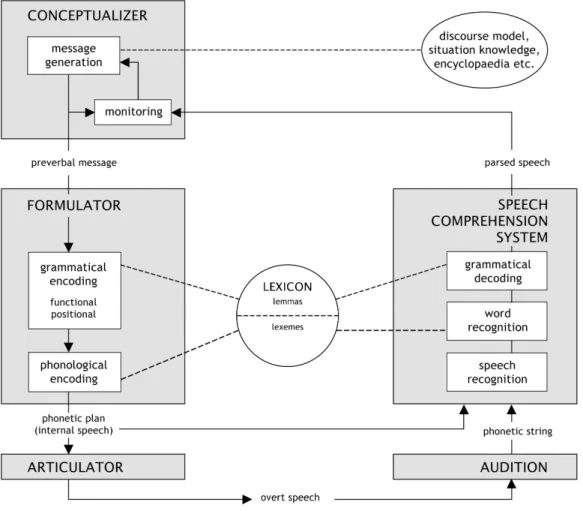
A feature of language is that not only are we able to produce it, we are also capable of understanding it. The standard architecture of the language system reflects this bi-modality of production and comprehension (see also Figure 1.1 below). Most models of language processing distinguish a number of stages in the processes of language use. In language production these stages are: conceptualisation, formulation and articulation (e.g. (Garrett, 1980; Dell, 1986; Levelt, 1989; Bock & Levelt, 1994; Levelt, Roelofs & Meyer 1999). According to Levelt’s blueprint of the speaker, first, speakers decide what it is they like to express: in the Conceptualizer a preverbal message is generated. This preverbal message is the result of several processes, involving the conception of an expressive intention, selection of the relevant information, ordering this information, and keeping track of the conversation. In order to do this, the Conceptualizer accesses declarative knowledge available from long term memory and uses working memory to deposit all information currently accessible to the speaker.
information about the meaning of the lemma, the concept that goes with the word, and it also specifies the way in which the word can be used in combination with other words, the syntax. For instance, the conceptual information represented with the lemma give is that it involves some actor X who causes some possession Y to go from actor X to recipient Y. The syntactic information represented with the lemma give is that it is a verb (V) which can take a subject, corresponding to actor X, a direct object corresponding to the possession Y and an indirect object corresponding to the recipient Z, among other possibilities. Activation of a lemma occurs when part of the preverbal messages matches its conceptual information, causing the syntactic information to become available. According to Levelt (1989), this syntactical lemma information in turn calls syntactic building procedures stored in the Grammatical Encoder. For instance, the syntactic category V connected to the lemma give calls the verb-phrase building procedure. Other syntactic categories activate other phrase-building procedures, resulting in noun-phrases, prepositional phrases and so forth.
a linearisation process, determining the order of the constituents and subconstituents in the sentence.
During the second step of formulation, phonological encoding, the sounds (lexemes) and stress patterns are selected that accompany the string of lemmas produced by the previous stage. The end result of the Formulator is an articulatory, or phonetic plan, used in the final stage of language production. In the Articulator, the resulting speech plans are translated into movements of the speech organs, resulting in overt speech.
In language comprehension, similar stages are distinguished (Ferreira & Clifton, 1986; Frazier & Rayner, 1982; Rayner, Carlson & Frazier, 1983): during speech recognition, the physical speech signal is processed. In the subsequent parsing stage words, word groups and their syntactic relationships are being identified from this speech pattern and syntactic tree assembly takes place: grammatical decoding. Finally, the recognised words (lemmas) in their sentential context are translated into a meaning. In most cases this meaning is the conceptual message intended by the speaker.
word-retrieval difficulty in the Formulator or when additional information is required by a selected lemma in order to satisfy all constraints it imposes.
Figure 1.1 Standard architecture of the language processing system, based on Levelt’s Blueprint for the Speaker (1989). Boxes represent processing components; circle and ellipse represent stores of declarative knowledge.
Arguments for a dual- processor model
Although no one doubts the physical necessity of separate peripheral stages for language production and comprehension, the assumption that grammatical encoding and decoding also make use of entirely independent processing resources is merely motivated by (often implicit) theoretical arguments, discussed below.
Task Requirements
Grammatical encoder and decoder are said to fulfill essentially different tasks (e.g. Branigan, 1995; Thornton & MacDonald, 2003). Although they both are concerned with the assembly of syntactic structures, they concentrate on different aspects of this task and face different problems. For instance, the grammatical decoder is concerned with the task of dealing with lexical and syntactic ambiguity. It has to derive the conceptual structure from the given words and their left-to-right order. Wasow (1996, p. 354) observes that the grammatical decoder hence benefits from “early points of commitment. For the listener, the more predictable the remainder of the sentence, the better, for fewer possible continuations compatible with the string at any point entail less load on memory and less work for the parser later on”. The grammatical encoder has no such disambiguation troubles1: the input conceptual messages are simply given. Finding lemmas that fit together grammatically and determining word order are among the encoder’s main concerns, because it permanently runs the risk of ‘talking itself into a corner’ (syntactic deadlock, De Smedt & Kempen, 1987). According to Wasow (ibid.) the grammatical encoder thus prefers a late point of commitment in order to “postpone decision making which reduces the amount of planning needed and gives the speaker more time to formulate and articulate thoughts. This in turn, should minimize the chances of having to correct or abort an utterance.”
However, this is not to say that in principle both task requirements mentioned in the beginning of this section could not be subserved by common cognitive processing resources. After all, the task of syntactic structure formation is a
1 An exception would be listener modelling. However, current evidence suggests that speakers
common cause for both components. A possibility is that the same cognitive resources are employed for encoding and decoding of syntactic structures, for instance by making only minimal adjustments to the process to provide for the specific characteristics of either encoding or decoding, and keeping all other things equal.
Language Acquisition
The productive and receptive language abilities of children are unbalanced. Grammatical production skills tend to be acquired at a much lower rate than grammatical comprehension skills. Children can understand much more complex and varied constructions than they can produce, and correlations between the two tend not to be very high (Bates, Bretherton & Snyder, 1988; Bates, Dale & Thal, 1995). There are three possible explanations for the dissociation between grammatical production and comprehension: First, the problem may not be the processing of syntactic information as such, but rather the accessibility of the information which is used in language production. Lemma retrieval given certain concepts might be harder than concept retrieval given certain lemmas (c.f. Hirsh-Pasek & Golinkoff, 1991). Furthermore, according to Bates, Dale and Thal (1995, p.114), in language acquisition production and comprehension are linked to different cognitive abilities: “In particular rate of progress in comprehension appears to be associated with a wide range of non-linguistic measures. […] By contrast, variations in production have fewer non-linguistic correlates". Finally, comprehension in children can be shallow, based on surface cues (i.e. which word comes first) and word meanings, especially in predictable contexts, whereas in sentence production no shortcuts are possible in which grammatical processing is circumvented2.
Neurolinguistics
According to traditional views, language production and language comprehension are processed by different parts of the brain and are associated with different neurological symptoms. In particular a double dissociation was believed to exist, with language production deficits typically connected to
2 However, recent research has revealed some local exceptions to the rule that language
comprehension precedes language production. Specifically this is the case for pronoun
frontal cortical lesions in Broca's Area, and language comprehension problems usually associated with temporal lesions in Wernicke's Area. However, the neurological arguments with regard to this double dissociation do not hold. Literature surveys by Zurif and Swinney (1994) and Blumstein (1995) report that most agrammatic patients with lesions in Broca's Area not only have language production deficits, but also have problems with syntactic comprehension (Garrett, 2000; see also Grodzinsky, 2000). Additionally, in neuroimaging studies and electrophysiological research, it has been shown that perisylvian areas in the left hemisphere cortex (in particular the left inferior frontal gyrus) not only subserve syntactic comprehension, as is normally assumed, but also syntactic production (Hagoort, Brown & Osterhout, 1999). Neural network simulations of language processing employing Hebbian cell assemblies have furthermore demonstrated that double dissociations are not necessarily caused by separate underlying systems: a single system can cause similar effects (Pulvermüller, 2002).
Self-monitoring
Commonalities between production and comprehension
There are at least five substantial similarities between syntactic production and comprehension which lead us to speculate that both modalities may be subserved by shared cognitive resources. They fall into two categories: similarities pertaining to control structures and empirical similarities. I will discuss them below.
Similar control structures
First of all, most current models of sentence production and sentence parsing work on the basis of lexical guidance. Lexical entries corresponding to either conceptual structures (in formulating, c.f. Kempen & Hoenkamp, 1987) or to words recognized in the input sentence (in parsing, c.f. MacDonald, Pearlmutter & Seidenberg, 1994) are retrieved from the Mental Lexicon and combined into syntactic structures.
Furthermore, grammatical encoding and decoding are both responsive to conceptual factors. Thematic relations as specified in the conceptual structure are used to assign grammatical functions and relations in formulation. Top down information about conceptual plausibility guides the interpretation process of parsing sentences (e.g. McRae, Spivey-Knowlton & Tanenhaus, 1998). In line with this, a direct mapping between conceptual and syntactic relations was demonstrated in both modalities. For instance no active-to-passive transformations are performed in sentence generation (Bock, Loebell & Morey, 1992), nor are passive-to-active transformations necessary in parsing (Slobin, 1966).
Third, in formulating (Kempen, 1977) as well as in parsing (Kaplan, 1972; Marslen-Wilson, 1973) syntactic trees are processed incrementally. That is, they grow from left to right, in tandem with the unfolding of a conceptual message (in formulating) or a string of words (in parsing).
syntactic deadlock — i.e. the inability to continue the structure in a grammatically well-formed manner, leading to backtracking and repair or revision (De Smedt & Kempen, 1987).
Similar empirical profiles
Apart from the control structures similarities, there is a vast body of performance data suggesting that grammatical encoding and decoding exhibit similar empirical profiles. Indirect evidence from priming experiments (Branigan et al., 1995; Branigan, Pickering & Cleland, 2000; Pickering & Garrod, 2004), attraction errors (Nicol, Forster & Veres., 1997; Bock & Miller, 1991; Vigliocco & Nicol, 1998), shadowing studies (Marslen-Wilson, 1973), lexical frame preferences (Clifton, Frazier & Connine, 1984; Shapiro, Nagel & Levine, 1993), from the structural complexity of sentences — as measured by working memory load (cf. Gibson, 1998)— and from speeded speech monitoring studies (Postma, 2000; Oomen & Postma, 2001) indicates that grammatical encoding and decoding work in a very similar manner. I will discuss this evidence briefly below.
Evidence from priming studies
In syntactic priming, the exposure to a sentence with a particular syntactic construction tends to affect the processing of a subsequent sentence that has the same or a similar syntactic structure but is unrelated semantically and lexically. Syntactic priming effects can be found in production-to-production priming: participants repeat sentences and subsequently describe pictures or complete sentences. It was found that subjects re-used the structure of the prime significantly more often than alternative structures (e.g. Bock, 1986; Branigan, 1995). For instance, participants will describe a picture more frequently with a prepositional dative (PO) sentence such as (3), after having repeated a prime sentence with that structure such as (1), than after a double-object dative prime such as (2):
(1) The secretary bakes a cake for her boss. (PO) (2) The secretary bakes her boss a cake. (DO) (3) The boy gives a flower to the girl. (PO)
white noise (Mehler & Carey, 1967), attachment preferences in sentences with local ambiguities (Mehler & Carey, 1968; Mehler, Carey & Bever, 1970), shorter reading times (Frazier, Taft, Clifton, Roeper & Ehrlich, 1984; Branigan, 1995) and eye-movement studies (Arai, Van Gompel & Scheepers, 2006; Traxler & Pickering, 2004, 2005, Pickering & Traxler, 2005). However, see Chapter 4 for a critical review of reaction time data.
Although similarities between both empirical profiles give us an indication of the resemblance of the two processes, it actually means no more than that (at least) the same syntactic structures are used in production and in comprehension. As for the possibility of shared processing components, between-modality priming effects provide additional evidence. In a typical comprehension-to-production priming experiment (Branigan, Pickering, Liversedge, Stewart & Urbach, 1995; Pickering & Branigan, 1995) participants are presented with fragments to complete. The first sentence of the passage serves as the prime, the to-be-completed sentence is the target. Participants are more likely to complete the fragment in the same way as the prime. More between-modality priming effects were found in priming experiments that took place in a dialogue setting, in English (Branigan, Pickering & Cleland, 2000) and in Dutch (Bos, 1999). Long term between-modality priming was furthermore obtained in a picture description task (Bock, Dell, Chang & Onishi, 2006). (For an overview of syntactic priming studies see Chapter 3).
Apparently, production and comprehension of syntax tap into the same kind of resources. According to Branigan et al., the source of the priming is possibly either a process common to both comprehension and production, or a shared set of representations of syntactic knowledge.
Evidence from subject-verb agreement processes
more likely to occur when a verb is required after a plural non-head noun following a singular head noun as in sentence (4), than when a plural head is followed by a singular non-head, as in (5).
(4) The producer of the adventure movies…(head sg. – non-head pl.) (5) The students from the university… (head pl. – non-head sg.)
Interference from plurals seems to occur not only in sentence production, but in sentence comprehension as well, as was demonstrated in an experiment using the Maze task (Nicol, Forster & Veres, 1997). In this task, participants are presented with the first word of a sentence, followed by two alternative continuations, only one of which is grammatical. Participants have to decide quickly which of these words is the better continuation of the sentence, and indicate their choice by pressing one of two keys. Since agreement does not affect decision making until the verb (and the (in)congruence with the preceding subject) is encountered, the reaction time on the verb is the only dependent variable of interest. It should be noted that in the entire set of words used for one trial there is only one verb. In other words, participants do not have to attend to agreement per se, which would be the case if they were presented with a choice between a congruent verb and an incongruent verb. Instead, possible sentences consisted of all combinations of a singular (non-)head noun and a plural (non-)head, followed by a verb that always agreed with the actual subject of the sentence.
The results were clear. The same pattern of errors (as measured by increases in reaction times) emerged as in the production experiments. When subjects suspected incongruence, as in the author of the speeches is here now, the reaction times on the verb increased.
Pearlmutter, Garnsey and Bock (1999) replicated these results measuring reading times in self-paced reading and eye-tracking experiments. They furthermore argued that the pattern of sensitivity to real and seeming agreement violations in comprehension as well as production results from an inadvertent overwriting process in which the head NP’s number feature is replaced by the local NP’s specification. The fact that these findings only obtain when the head NP is singular, not when it’s plural is accounted for by the proposal (following Eberhard, 1997) that the plural head NP is explicitly marked, making it less likely to be overwritten, in favour of a non-marked local NP.
Thornton & MacDonald (2003) demonstrated that plausibility significantly mediates agreement processes in both production and comprehension, using a single set of stimulus sentences. In the production experiments, participants were asked to create a complete passive sentence given a verb and a noun phrase fragment consisting of a head and a non-head (e.g. the album by the classical composers). The plausibility of the verb was manipulated so that either both nouns could be plausible passive subjects (e.g. praised), or only the head noun could be a plausible subject (e.g. played). The comprehension task was self-paced reading with the same materials. In comprehension longer reaction times on the verb and in production higher agreement error rates were found when both nouns were plausible subjects than when only the head was plausible.
Evidence from shadowing studies
In the shadowing experiments participants are trained to repeat back (shadow) auditorily presented prose (Marslen-Wilson, 1973; 1985). After extensive training, certain participants are able to shadow speech input at extremely short delays: less than 300 ms on average, which is about as long as the time required to pronounce a syllable. These so-called ‘close shadowers’ reported that they were repeating the input words before they even knew what the words were (Marslen-Wilson, 1985). In some of the experiments single words of the input text were modified, so as to create syntactic or semantic violations. However, without being consciously aware of it, the close shadowers restored the anomalous words, without causing any prolongation of the shadowing delays.
shadowing delays are extremely short and participants are not aware of the anomalous words, nor of their own restorations, it follows that the parsed syntactic structure must be somehow directly available for production, suggesting an architecture comprising a close link between modalities, or at least a shared working memory. In a strict interpretation of the independent-resources model, however, one would expect the syntactic structures from the parser to be available to the formulator only via an indirect route, since the processing components are supposed to be informationally encapsulated. Presumably, any indirect route would at least require more time, and perhaps even conscious awareness.
Evidence from working-memory load studies
One of the factors determining working memory load is the structural complexity of sentences (cf. Gibson (1998) for complexity metrics). Structurally more complex sentences are harder to understand and occur less frequently in corpora of spoken and written language (Gibson & Pearlmutter, 1994). This seems to imply that the working memory load of a particular syntactical structure is a predictor of its frequency of occurrence in language production and of its perceived complexity.
Evidence from speeded self-monitoring studies
production. These findings suggest that production and comprehension modules are at least tightly linked, not only for as far as mental representations are concerned (as is demonstrated by priming studies), but also with respect to processing speed.
Chapter 2
Testing the independent-resources model of the language system
Introduction
As described in the previous chapter, current theories of language processing usually distinguish between two independent resources of grammatical processing: Grammatical encoding for sentence production and grammatical decoding for sentence comprehension (e.g. Levelt, 1989). Although this duality is theoretically motivated, empirical evidence is scarce. In this chapter, we introduce a novel task, called “edited reading aloud” (ERA), which allows examining whether speakers are able to construct and maintain simultaneously two separate syntactic structures, as implied by the independent-resources theories, or only focus on the current sentence. The latter option would support a model in which grammatical encoding and decoding are subserved by shared cognitive resources.
critical locations in the sentences to be compared under controlled conditions. Critical locations were defined as those fragments in which ungrammaticalities (if any) surface in the input sentence, In the ERA-task, reading input sentences involves grammatical decoding and editing output sentences, grammatical encoding (for detailed descriptions of experimental trials, see Figures 2.1 and 2.2 in the method sections of Experiment 1 and 2 reported below).
The ERA-task is based on the assumption that an independent-resources model should be able to maintain different syntactic structures for encoding and decoding simultaneously. Importantly, due to the purely grammatical manipulation, the meaning of the input sentence and the output sentence is the same, or very similar; therefore there is no need for participants to construct and maintain more than one conceptual structure.
EXPERIMENT1
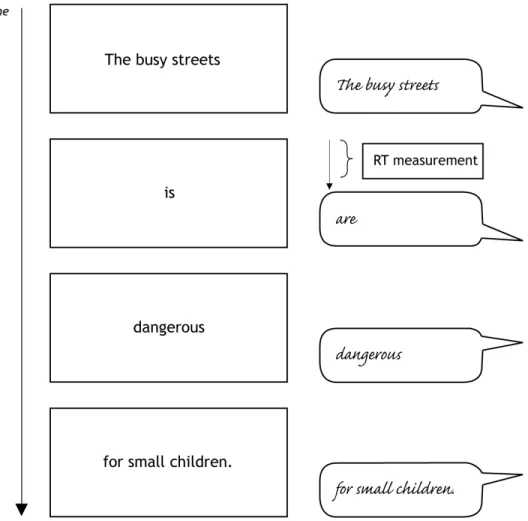
The editing instruction in this experiment was to pluralize part(s) of Dutch input sentences, resulting in a plural subject and verb of the output sentences. The sentences are presented in fragments and voice onset times are registered. A typical pluralising ERA-trial is pictured in Figure 2.1. The number of the subject and number of the verb in the input sentences were systematically varied, leading to four conditions, like (1a-d) below: subject and verb both plural (condition PP) (1a), subject plural and verb singular (condition PS) (1b), subject singular and verb plural (condition SP) (1c) and subject and verb both singular (condition SS) (1d). Note that condition PP is identical to the desired output sentence and that conditions SP and PS are incongruent sentences, containing an error of agreement between subject number and verb number.
(1a) Input condition PP: subject plural, verb plural Desired output sentence in all conditions
De drukke straten zijn gevaarlijk voor kleine kinderen. The busy streets are dangerous for small children.
(1b)* Input condition PS: subject plural, verb singular De drukke straten is gevaarlijk voor kleine kinderen. The busy streets is dangerous for small children.
(1c)* Input condition SP: subject singular, verb plural De drukke straat zijn gevaarlijk voor kleine kinderen. The busy street are dangerous for small children.
(1d) Input condition SS: subject singular, verb singular De drukke straat is gevaarlijk voor kleine kinderen. The busy street is dangerous for small children.
a plural verb in conditions SS and PS, due to new lexeme activation (encoding problem). In conditions that contain an agreement error, the processor needs to deal with the feature mismatch between the subject of the sentence and the verb (decoding problem). Thus, condition PP is predicted to be fastest, followed by conditions SS (new lexeme activation) and SP (dealing with feature mismatch in the input), although it is difficult to foretell which of the latter will be faster.
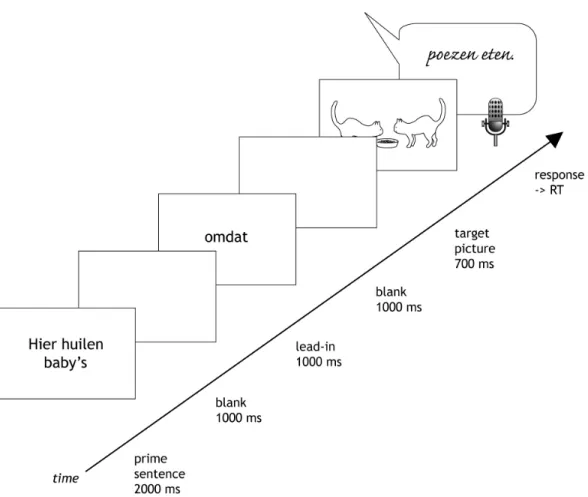
Figure 2.1 Sample Pluralising ERA-trial for condition PS
are incorrect and resources are shared between production and comprehension, we expect the two input conditions with a singular verb to be slower than the conditions containing a plural verb, since the former require pluralisation (activation of a new, plural lexeme: encoding problem) whereas the latter can be incorporated into the output sentence without problems. Crucially, no difference is expected between conditions PP and SP. To sum up, for a shared-resources model we expect: PP = SP < SS = PS and for the independent-resources model we expect PP< [SS, SP] < PS.
Method
Pre-test
Prior to the experiment we conducted a pre-test to confirm that reading incongruous sentences in which subject number and verb number do not agree, as in conditions SP and PS, indeed requires more time than reading the grammatical, congruent sentences. We used the same procedure and the same materials as in the main experiment below with this exception: Instead of having to pluralise the sentences, participants were instructed simply to read the fragments aloud. In both experiments, each voice onset triggered the next sentence fragment to appear on screen. Ten participants took part in the pre-test. Two of them were excluded from the analyses because their data reflected a high percentage of voice key malfunctioning.
mismatch is more difficult, as reflected by longer reading times, than reading the verb in congruent, grammatical sentences.
Table 2.1 Reading task pilot mean verb response voice onset latencies in milliseconds, standard deviations in brackets.
Subject number in input sentence Verb number in input sentence
plural singular
plural 481 (17.9) 507 (14.8) singular 497 (14.6) 487 (20.3)
Main Experiment
Participants
Sixteen participants were paid in course credits or euros to take part in the experiment. All of the participants in the study were native-Dutch-speaking members of the Leiden University community and had normal or corrected-to-normal vision. No one participated in more than one experiment reported in this article. Four further participants were excluded because their sessions failed to be recorded properly due to system malfunctioning.
Materials
We constructed 60 items like (1) above (see Appendix A for the complete list). All items consisted of a subject noun phrase, either including an adjective or followed by a post- nominal modifier, a verb phrase, and a sentence-final adverbial phrase, a prepositional phrase or an object noun phrase. The number of the subject noun phrase and the number of the verb phrase varied systematically to create four conditions: two of which grammatical: subject and verb both plural (condition PP), subject and verb both singular (condition SS), and two of which ungrammatical (incongruent): subject plural and verb singular (condition PS) and subject singular and verb plural (condition SP). Each sentence was presented in four or five fragments, indicated below by slashes, for instance (2):
The fragments corresponded to the noun phrase, the post nominal modifier if applicable, the finite verb, the past participle in case of (auxiliary / past participle constructions) and the sentence final phrase. Note that the finite verb was always presented in isolation, enabling measurement of latencies to the verb directly.
Design
Four lists of items were constructed, with all conditions of all items appearing in each list, totalling 240 trials per session. The lists thus only differed with respect to the order in which the items were presented. The order of the items within each list was random with the restriction that the same condition could not occur within three consecutive trials and the same sentence could not within ten trials. Six participants were assigned randomly to each list. Eight practice sentences, two of each condition, preceded the experimental session. The practice trials were of the same format as the experimental trials.
Procedure
Participants were tested individually facing a computer screen positioned about 80 cm away from them. In front of the participant, a microphone was placed in order to register vocal responses. The experimenter was also present in the room. Reaction times were measured from the appearance of the sentence fragment on the screen until voice onset. Each fragment was presented for 1200 ms, with a 10 ms interval between fragments and a 1000 ms interval between sentences.
Prior to the experiment participants were instructed to edit aloud the sentences fragment-by-fragment so that their response would be a grammatical, sentence containing a plural subject and finite verb, regardless of the number of the input words. They were instructed to speak clearly and were given the opportunity to ask questions before the experiment commenced.
Results
eliminated from the dataset. We removed all extreme data points from the remaining data. Extreme data points were defined as reaction times that deviated more than two times the standard deviation from the mean per subject and per condition. This resulted in the removal of 6.8% of all data points, evenly distributed across conditions and subjects.
Table 2.2 shows the mean latencies (averaged across participants and items after filtering) per condition. Latencies for conditions with a plural input verb are on average 26 ms shorter than for conditions with a singular input verb. To determine if this is significant we conducted 2 x 2 Repeated Measures analyses (subject number x verb number) yielding significant main effects of verb number [F1 (1, 15) = 77.46, p < 0.001; F2 (1, 57) = 28.44, p < 0.001] but no effect of subject number, nor, importantly, of subject number by verb number (all F’s < 1.5).
Table 2.2 Experiment 1. Pluralising-task mean verb response voice onset latencies in milliseconds (standard deviations in brackets).
Subject number in input sentence Verb number in input sentence
plural singular
plural 500 (56.4) 530 (51.2) singular 500 (60.0) 523 (60.0)
Discussion
predicted pattern of reaction times of PP< [SS, SP] < PS. If this were the case we should have found at least an interaction effect of subject number and verb number, and possibly an effect of verb number. However, the pattern obtained (PP=SP < SS=PS) only displayed an effect of verb number. This is in accordance with the predictions of the alternative model in which grammatical encoding and decoding are not separate but operate on shared cognitive resources, implying that at any point in time, participants can only maintain one syntactic structure. In case of the ERA-task, this structure is the edited, output sentence. The pre-test demonstrated that this effect was not due to a lack of detectability of the ungrammaticalities in the input, as this self-paced reading task showed that the (verbs of the) ungrammatical (incongruent) sentences were read significantly slower than the grammatical sentences.
EXPERIMENT2
The aim of Experiment 2 is to replicate the effect obtained in Experiment 1, using a grammatically more demanding editing task, where adopting a simple word-by-word response strategy is minimised. The experiment consists of two parts, a paraphrase task, and a correction task. The paraphrase task in particular calls for a substantial alteration of the sentence structure. Both tasks require participants to read input sentences fragment by fragment and edit these to produce output sentences as the input sentence unfolds. All sentences contain a reflexive pronoun. Grammaticality of the input sentences is manipulated by providing a reflexive pronoun that does or does not correspond to its antecedent with respect to the person feature. Importantly, the input reflexive either does or does not match the antecedent of the intended output sentence. This generates two reflexive conditions per task: one in which the input reflexive can remain the same (condition SAME), the other in which it needs to be changed to fit the output sentence (condition CHANGE).
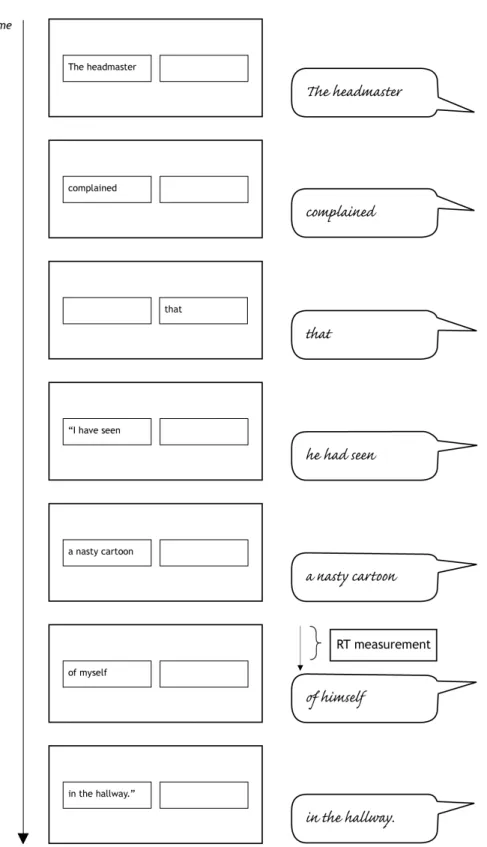
In the paraphrase part, the editing instruction is to paraphrase direct to indirect speech, like example (3), below. Participants have to produce output sentences such as (3c) (The headmaster complained that he had seen a nasty cartoon of himself in the hall), given one of two input sentence conditions, in which grammaticality is manipulated by variation of the person feature of the reflexive pronoun. The paraphrase is cued by the presentation of the word dat (that), see Figure 2.2.
Condition PARA-CHANGE consists of grammatical input sentences, like (3a) (The headmaster complained “I have seen a nasty cartoon of myself in the
hall”), and contains the correct reflexive pronoun (corresponding to the
antecedent) (i.e. mezelf [myself], 1st person singular), In order for the reflexive to suit the indirect speech output sentence, however, it needs to be edited to zichzelf (himself) (3rd person singular).
(3a) Input in condition PARA-CHANGE
The headmaster complained “I have seen a nasty cartoon of myself in the hall”.
(3b)* Input in condition PARA-SAME
The headmaster complained “I have seen a nasty cartoon of himself in the hall”.
(3c) Desired output
The headmaster complained that he had seen a nasty cartoon of himself in the hall.
Thus, grammaticality of the input sentence in the paraphrase part is manipulated by providing a reflexive pronoun whose person feature matches either the antecedent in the input sentence (mezelf, 1st person singular) as in condition PARA-CHANGE, or the output sentence (zichzelf, 3rd person singular), as in condition PARA-SAME.
In the correction part of the experiment, we use the indirect speech versions of the same set of sentences as in the paraphrase task. Participants are instructed to read sentences like (4) below and to correct mistakes. The sentences are presented in fragments, and are either grammatical or ungrammatical. The grammatical input sentences are identical to the desired output sentences (4a, 4c)): (De lottowinnaar zei dat hij had besloten een rode auto te kopen voor zichzelf [The lottery winner said that he had decided to buy a red car for himself]) and do not require a correction, but can simply be read aloud (condition CORR-SAME).
The ungrammatical sentences contain a reflexive pronoun that does not correspond to the antecedent with respect to the person feature, like in (4b): (De lottowinnaar zei dat hij had besloten een rode auto te kopen voor mezelf [The lottery winner said that he had decided to buy a red car for myself]). The reflexive in these ungrammatical sentences needs to be corrected so that it matches its antecedent (condition CORR-CHANGE), resulting in the intended output sentence (4c).
(4a) Input in condition CORR-SAME, desired output
(4b)* Input in condition CORR-CHANGE
De lottowinnaar zei dat hij had besloten een rode auto te kopen voor mezelf. ` The lottery winner said that he had decided a red car to buy for myself.
‘The lottery winner said that he had decided to buy a red car for myself.’
(4c) Desired output
De lottowinnaar zei dat hij had besloten een rode auto te kopen voor zichzelf. The lottery winner said that he had decided a red car to buy for himself. ‘The lottery winner said that he had decided to buy a red car for himself.’
The reaction times of interest in both tasks are those on the reflexive pronoun, since that is where possible ungrammaticalities surface. Condition CHANGE reflexives always require grammatical encoding: the number of the reflexive needs to be brought in accordance with the number of the antecedent in the desired output sentence. Only ungrammatical input sentences (irrespective of the task or the condition) can present a decoding problem.
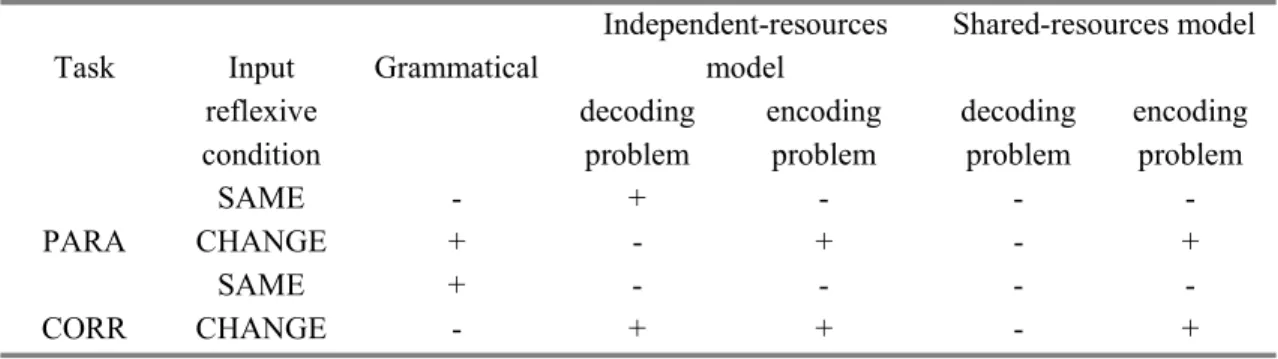
Independent-resources theories predict that response latencies on the reflexive are both affected by the grammaticality of the input as well as by the condition of the reflexive. Condition CORR-SAME is expected to be fastest in this model, since it neither presents a decoding problem — the sentence is grammatical — nor an encoding problem, as the reflexive can be reused. PARA-CHANGE and PARA-SAME, both encounter one problem and are thus expected to be somewhat slower. PARA-CHANGE involves an encoding problem (producing the correct reflexive), PARA-SAME a decoding problem (dealing with the ungrammatical input sentence). Sentences in condition CORR-CHANGE involve both encoding and decoding problems and are therefore expected to generate the longest reaction times.
In sum, the independent-resources model predicts: CORR-SAME < [PARA-SAME, PARA-CHANGE] < CORR CHANGE and the shared-resources model predicts: [CORR-SAME, SAME] < [CORR-CHANGE, PARA-CHANGE] (See table 2.3).
In addition to the ERA-tasks, in order to monitor the degree of awareness of the manipulation, participants receive a brief question following each trial, about whether the input sentence was grammatical. Since the independent-resources model predicts that encoding and decoding structures can be maintained simultaneously, it follows that grammaticality judgements in both the paraphrase task and the correction task should be near perfect. The shared-processor model however implies that only one structure can be maintained at the time. As the ERA-tasks call for encoding of a desired output structure specifically, we expect that ungrammaticalities in the input structures will not even be noticed.
Table 2.3 Model predictions of difficulties per editing task and reflexive condition Independent-resources
model
Shared-resources model Task Input
reflexive condition
Grammatical
decoding problem
encoding problem
decoding problem
encoding problem
SAME - + - - -
PARA CHANGE + - + - +
SAME + - - - -
CORR CHANGE - + + - +
Method
Paraphrase task
Participants
Twenty-two members of the Leiden University community were paid in course credits or euros to participate in this experiment. All were Dutch native speakers and had normal or corrected-to-normal vision.
Materials
consisted of a subject noun phrase, a finite verb followed by a colon and opening quotation marks (“), a sentence in direct speech, containing a reflexive pronoun that either did or did not correspond in person with the antecedent (the subject), and closing quotation marks (”), like (5 a/b). As reflexive pronouns that did not correspond to the antecedent in the input sentence we used the reflexive matching the person feature of the antecedent in the output sentence. This yielded two reflexive conditions: PARA-CHANGE (the reflexive needs to be modified in order to suit the desired output sentence (5a)) and PARA-SAME (the reflexive does not have to be modified in order to fit into the output sentence (5b)). The position of the reflexive pronoun in the sentence varied. In half of the experimental sentences, the reflexive took sentence final position; in the other half it preceded the sentence final infinitive.
(5a) Condition PARA-CHANGE
De lottowinnaar zei: (dat) “ik heb besloten een rode auto te kopen voor mezelf” The lottery winner said: (that) “I have decided a red car to buy for myself” ‘The lottery winner said, (that), “I have decided to buy a red car for myself’.’
(5b)* Condition PARA-SAME
De lottowinnaar zei (dat): “ik heb besloten een rode auto te kopen voor zichzelf”. The lottery winner said: (that) “I have decided a red car to buy for himself” ‘The lottery winner said, (that) “I have decided to buy a red car for himself”.’
(5c) Desired output
De lottowinnaar zei dat hij had besloten een rode auto te kopen voor zichzelf. The lottery winner said that he had decided a red car to buy for himself ‘The lottery winner said that he had decided to buy a red car for himself.’
Each sentence was presented in fragments, like (6) below:
(6) De lottowinnaar/ zei:/“ ik /heb besloten/ een rode auto/ te kopen/ voor mezelf”. (The lottery winner/ said:/ “I/ have decided/ a red car/ to buy/ for myself”.) ‘The lottery winner said: “I have decided to buy a red car for myself”.’
the left-hand frame. To elicit the paraphrase, the word dat (that) was presented in the right-hand frame immediately after the finite verb of the main sentence.
The practice sentences and fillers also were in direct speech. Two out of five practice sentences contained reflexive pronouns, one of which was incorrect. One-third of the filler sentences contained a subject verb agreement error or idiomatic error rendering the sentence ungrammatical. None of the fillers contained a reflexive pronoun.
Design
The experiment started with the practice sentences, followed by the experimental sentences and the fillers in random order with the restriction that no more than two experimental items would occur in consecutive trials. To avoid possible learning effects, participants received only each sentence in one condition only, according to a Greek-Latin square, with half of the sentences embodying condition SAME and the other half condition PARA-CHANGE.
Procedure
Participants were tested individually with the experimenter present, facing a computer screen positioned about 80 cm away and a microphone to register vocal response time. Reaction times were measured from the appearance of the sentence fragment on the screen until voice onset. Each sentence fragment was presented for 1200 ms, with a 10 ms break between fragments and a 1000 ms break between sentences. Immediately following each trial a grammaticality question was presented for 1000 ms.
Correction task
Participants
Fifteen members of the Leiden University community were paid in course credit or euros to participate. All were Dutch native speakers and had normal or corrected-to-normal vision.
Materials
The experiment consisted of twelve experimental sentences, like (7) below, 24 fillers and five practice items. Indirect speech versions of the same experimental sentences as in the paraphrase task were used in the correction task. Each experimental sentence contained either a third person reflexive pronoun that corresponded to the antecedent (condition SAME (7a)), or a first person reflexive which did not correspond to the antecedent (condition CHANGE (7b)).
(7a) Input in condition CORR-SAME, desired output
De lottowinnaar zei dat hij had besloten een rode auto te kopen voor zichzelf The lottery winner said that he had decided a red car to buy for himself ‘The lottery winner said that he had decided to buy a red car for himself.’
(7b)* Input in condition CORR-CHANGE
De lottowinnaar zei dat hij had besloten een rode auto te kopen voor mezelf. The lottery winner said that he had decided a red car to buy for myself ‘The lottery winner said that he had decided to buy a red car for myself.’
(7c) Desired output
De lottowinnaar zei dat hij had besloten een rode auto te kopen voor zichzelf The lottery winner said that he had decided a red car to buy for himself ‘The lottery winner said that he had decided to buy a red car for himself.’
Design
Participants saw half of the experimental items in condition CORR-SAME, the other half in CORR-CHANGE, according to a Greek-Latin square. The experiment started with the practice sentences, randomly followed by the experimental items and the fillers with the restriction that no more than two experimental items would occur in consecutive trials
Procedure
The experimental procedure was the same as in the paraphrase task, with the exception that after each trial no grammaticality judgement had to be made. Participants were instructed to correct mistakes as they read the sentences fragment by fragment and respond clearly and as quickly as possible.
Results
Participants with more than four voice key errors on the experimental items were excluded from analysis, leaving twelve participants in each task. All extreme data points were removed from the remaining data. Extreme data points were defined as reaction times that were either shorter than 300 ms or longer than 1000 ms. This resulted in the removal of 13 data points (9%) for the paraphrase task and 19 data points (13%) for the correction task, evenly distributed across conditions and subjects.
Table 2.4 shows the mean latencies (averaged across participants and items after filtering) per reflexive pronoun condition. Latencies for conditions with reflexives matching the desired output sentence (condition SAME) are on average 52 ms shorter than for conditions with reflexives that needed to be modified (condition CHANGE).
Table 2.4 Experiment 2. Mean response onset latencies in milliseconds on the reflexive pronoun.
Task Input reflexive condition Paraphrase Correction
SAME 604 607
We conducted two repeated measures analyses; an analysis by subjects with task type (paraphrase vs. correction) as between-participants factor and reflexive condition (SAME vs. CHANGE) as within-participants factor, and an analysis by items with task type (paraphrase vs. correction) and reflexive condition (SAME vs. CHANGE) both treated as within factors.
Reflexive condition yielded a significant main effect within subjects (F1 (1, 22) = 8.844, p < 0,005) and a marginally significant main effect within items (F2 (1, 11) = 8.914, p = 0.012). No interaction effect of task type and reflexive condition was found, neither within subjects (F1 (1, 22) = 0.374, P> 0.5), nor within items (F2 (1, 11) = 1,265, p > .25).
The grammaticality judgements yielded six (4%) incorrect answers for the correction task and 36 (25%) for the paraphrase task. Corrected for chance, this means that in the paraphrase task only half of the questions were answered correctly, whereas in the correction task 82% of the grammaticality judgements were accurate.
Discussion
Experiment 2 was set up to determine if the results from Experiment 1 could be replicated in a more grammatically demanding setting where adopting a simple word-by-word response strategy was ruled out. The independent-resources model predicts that both decoding problems such as ungrammatical input sentences, and encoding problems such as modification of the input reflexive pronoun to make it fit the output structure should cause delay. Hence, if the independent-resources assumption is right we expect: CORR-SAME < [PARA-SAME, PARA-CHANGE] < CORR CHANGE. In contrast, the shared-resources model predicts that decoding problems do not affect reaction times, leading to: [CORR-SAME, SAME] < [CORR-CHANGE, PARA-CHANGE].
verbs in Experiment 1, reaction times on the critical word, the reflexive pronouns, are merely affected by how well they fit in the output sentence, not by the grammaticality of the input sentence. Reaction times are considerably faster for conditions PARA-SAME and CORR-SAME in which the reflexive presented in the input fits the output sentence, that is, when it already corresponds to the antecedent in the output sentence, than for conditions PARA-CHANGE and CORR-PARA-CHANGE. This picture is confirmed by the grammaticality judgement data: in 25% of the cases participants could not determine correctly whether the input sentence was grammatical or not. This contradicts the implication of the dual processor assumption that grammatical encoder and decoder should be able to work independently from and parallel to each other.
General discussion
In Experiment 1, the desired output was a sentence with plural subject and verb; the input consisted of sentences in which subject number and verb number systematically varied. The reaction times on the verb did not reflect the grammaticality of the input sentence but only the fit of the verb in the output sentence, with plural verbs producing shorter latencies than singular verbs, indicating that participants do not process the subject-verb disagreement in the input but rather focus on the output sentence alone.
In Experiment 2, we replicated this finding using two variations on the ERA-task. In a paraphrase ERA-task, the editing instruction was to paraphrase direct to indirect speech. This operation was grammatically more demanding and less likely to be accomplished strategically, on a word-by-word basis, without building a syntactic structure. A correction ERA-task required participants to correct errors in the input sentence, so as to produce a grammatical output sentence. Grammaticality of the input sentence in both variants was manipulated by providing a reflexive pronoun that, with respect to the person feature, corresponded either to the antecedent in the input sentence, or to the antecedent in the output sentence. Again, reaction times were only affected by the fit of the reflexive in the output sentence, not by the grammaticality of the input sentence. The percentage of errors in the grammaticality judgements on the input sentences further supported the assumption that proper parsing of the input sentence alone did not take place. The results of Experiment 2 were replicated in a second study (Kempen, Olsthoorn & Sprenger, in preparation).
Conclusions
Given the current findings there are several theoretical possibilities with regard to the architecture of grammatical processing. The first is a modification of the current independent-resources model. We have demonstrated that no two syntactic structures are maintained simultaneously, suggesting that grammatical encoding and grammatical decoding do not take place in parallel. This in turn suggests that encoder and decoder at a minimum share a common working memory. A shared working memory implies that grammatical encoding and decoding cannot take place concurrently, because at one point in time only one syntactic structure can be assembled and maintained. The two processors sharing the working memory may be homogeneous in nature (essentially reduplicating each other) or heterogeneous (each with its own characteristics).
Based upon the theoretical and empirical commonalities between grammatical production and comprehension as well as the current data, another, more extreme option is a shared-resources model in which at least the strict separation of grammatical encoding and decoding is reduced. It assumes that syntactic processing in general is a modality a-specific task which can be executed by shared cognitive resources (a single Grammatical Coder), using a single, shared working memory.
***
Chapter 3
Syntactic priming: a survey
Introduction
Language is productive. Speakers and listeners are able to generate and understand an in principle unlimited, in practice a very large number of different sentences. This creativity and novelty of language have often been emphasised by linguists and psycholinguists. However, although productivity is doubtlessly an important characteristic in language competence, language performance studies such as corpus analyses have demonstrated our speech to be highly repetitious (see Kempen 1977; Miller & Weinert, 1998, for an overview). Almost 70% of the language contained in the London-Lund corpus of spoken English, for instance, was repetitious (Altenberg, 1990). This tendency to repeat seems to affect all populations of speakers (cf. Smith & Wheeldon, 2001 for an overview) and all aspects of language: the lexicon (Altenberg, 1990), phrases and lexemes (Levelt & Kelter, 1982), formulaic language (Vihman, 1982; Kuiper, 1996), syntactic frames (Nattinger & DeCarrico, 1992) and syntactic structures, such as the short-term repetition of passives (Weiner & Labov, 1983).
1995; Fox-Tree & Meijer, 1999; Hartsuiker, Kolk & Huiskamp, 1999; Hartsuiker & Westenberg, 2000; Smith & Wheeldon, 2001) using written and spoken texts and in a variety of languages. The reason for this enthusiastic exploration of the syntactic priming phenomenon is that it opens a window onto the mental representation and workings of grammatical knowledge and processes. For if the processing of a sentence affects the processing of another sentence, and the sentences are similar in one dimension only, it can be assumed that the cognitive system is sensitive to that particular dimension. Although in principle priming effects can be inhibitory as well as facilitatory, in general the prime facilitates the processing of the related target.
A distinction can be made between syntactic priming within modalities (production-to-production priming and comprehension-to-comprehension priming) and priming between modalities (from comprehension to production or vice versa). Within-modality priming effects can provide information about modality-specific knowledge and procedures, between-modality priming on the other hand can give insight into the kind of information that is shared between modalities3. In the following sections I will give an overview of both
within-modality priming studies and between-within-modality priming studies. I will focus on syntactic priming evidence reflected in increased response tendencies. Studies of the online effects or syntactic priming will be discussed in Chapter 4.
Production-to-production priming
The first to establish production-to-production syntactic persistence effects in an experimental setting was Bock (1986). She investigated whether repeating a sentence with a particular structure affected the subsequent description of a picture. Under the guise of a memory test, participants repeated aloud an auditory presented prime sentence containing either a double-object (NP-NP) dative construction as in Example (1) (DO), or a prepositional-object (NP-PP) dative construction as in Example (2) (PO).
3 Although the dichotomy production-to-production and comprehension-to-production priming is
(1) The rock star sold the undercover agent some cocaine. (DO) (2) The rock star sold some cocaine to the undercover agent. (PO)
Next, a picture was shown representing an action involving an agent, a patient and a recipient, for instance: a girl handing a paintbrush to a man. These target pictures could all be described with both a prepositional-object and a double-object dative sentence. Participants were instructed to describe the picture using a single sentence featuring no pronouns. Bock demonstrated a significant tendency for the syntactic structure employed in the priming trial to be re-deployed more frequently during the target picture description task. Thus, participants were more likely to describe the picture with a double-object construction (The girl hands the man a paintbrush) after having repeated a double-object priming sentence than after a prepositional priming sentence. After a prepositional-object prime they would describe the picture with a PO sentence like The girl hands the paintbrush to the man. Similarly, after a passive sentence, more pictures were described in passive voice than after an active sentence.
Subsequent research by Bock and colleagues showed that the syntactic priming effect is insensitive to three kinds of similarities between prime and target. Firstly, syntactic priming effects were not affected by thematic similarities between prime and target sentences. In picture description, it did not matter whether the prime sentence was conceptually similar as well as syntactically similar or rather syntactically similar but conceptually dissimilar. Thus, a picture description such as The girl handed the paintbrush to the man was just as likely to occur after the conceptually similar The wealthy widow gave her Mercedes to the church as after the conceptually different (but syntactically similar) The wealthy widow drove her Mercedes to the church. The syntactic similarity between prime and target sentences still gave rise to the syntactic priming effect (Bock & Loebell, 1990).
mentioned study by Bock and Loebell (1990) it was found that participants were equally likely to describe a picture in the passive voice after a full passive prime (The construction worker was hit by the bulldozer) as after a prepositional locative (The construction worker was digging by the bulldozer), suggesting a lexical source (repetition of the pronoun by) of the persistence effect after all.
Thirdly, syntactic priming is not affected by metrical or phonological similarities between primes and targets. This was also investigated by Bock and Loebell (1990) when they presented participants with sentences that looked like (but in fact were not) true NP-PP syntactic primes because of their metrical and phonological structure, for instance Susan brought a book to study. However, prime sentences like these did not have the same effect as genuine syntactic primes, such as Susan brought a book to Stella.
Apart from picture description, similar production-to-production priming effects have been found using sentence completion (e.g. Pickering & Branigan, 1998; Hartsuiker & Westenberg, 2000) and sentence recall (Potter & Lombardi, 1998) paradigms.
Comprehension-to-comprehension priming
Like sentence production, sentence comprehension is also repetition prone. Intuitively, the way in which we comprehend sentences can be affected by previously encountered sentences. Consider classic garden path sentences such
as The horse raced past the barn fell. Although normally virtually
(3) The canoe floated down the river sank. (4) The man that was thrown down the stairs died.
If grammaticality judgements reflect in part difficulty of parsing, these findings can be interpreted as evidence of a syntactic priming effect: comprehension of a previous sentence with a related structure apparently facilitates the subsequent processing of a structurally similar sentence that is usually difficult to process.
A more direct method to measure comprehension-to-comprehension priming involves explicit sentence interpretation (Mehler & Carey, 1968; Carey, Mehler & Bever, 1970; Branigan, Pickering & McLean, 2005). Mehler and Carey (1968) showed participants a series of pictures and asked them to judge whether a sentence correctly described a picture. The sentences used contained a copular verb and a predicate NP with an intransitive verb, as exemplified in sentence (5), or were progressive transitive structures such as sentence (6).
(5) These are conflicting desires (6) They are forecasting cyclones.
The results indicated no difference between response latencies for pictures that were compatible with the primed interpretation and pictures that were compatible with both interpretations. If the picture was compatible with the unprimed reading however, responses were significantly slowed, suggesting a relative priming effect. Furthermore, in the paraphrase task, the primed reading was significantly more often reported than the unprimed reading. These findings suggest that syntactic priming can affect the processing of ambiguous sentences in such a way that the ambiguity goes unnoticed and the reaction times are no different from equivalent unambiguous sentences.
Another method to test comprehension-to-comprehension priming is by means of reading times. In the whole-sentence self-paced reading paradigm employed by Branigan (1995) participants were instructed to read a prime sentence followed by a target sentence. Priming in comprehension should manifest itself as a reduction in reading time for a sentence in the primed condition compared to the unprimed condition. For instance, using transitives with early-closure subordinate clauses and intransitives with late-closure subordinate clauses such as sentences (7) and (8) below, reading times were considerably shorter in primed conditions, in which two sentences of the same type were paired, than in unprimed conditions, where a transitive prime preceded an intransitive target sentence or vice versa.
(7) While the woman was eating the creamy soup the pudding went cold. (8) While the woman was eating the creamy soup went cold.
Strong and reliable priming effects were also found with complement/relative clause ambiguities and with main clause/reduced relative ambiguities. Overall, Branigan (1995) only found priming effects with locally ambiguous sentences where one continuation produces a strong garden path effect. The effect was syntactic in nature, since primes and targets were controlled for alternative origins of the effect such as lexical and semantic similarity, number of syllables and metrical structure4.
Using a range of syntactic structures that varied in grammaticality from moderately grammatical to very grammatical, Luka and Barsalou (2005)
4 As Branigan used a whole-sentence self-paced reading paradigm, it is unclear whether these data
demonstrated a structural facilitation effect in comprehension by means of grammaticality ratings. Participants rated sentences more grammatical (as compared to novel sentences) if they had read them earlier. Increased grammaticality ratings were also observed for sentences that shared syntactic structure, but not content words with the sentences read earlier. This effect occurred after even a single exposure to the structure, but was enhanced by more exposures.
Between-modality Priming
Levelt and Kelter (1982) already demonstrated that the grammatical form of a question could affect the form of an answer. They registered a strong tendency with shopkeepers to answer to the question posed (in Dutch): At what time does your shop close? with At five o’clock, rather than with Five o’clock, whereas the question What time does your shop close? elicited more Five o’clock responses than At five o’clock responses. The effect disappeared when an additional clause was added to the question, proving it to be short-lived. Nevertheless, the results of this study suggest syntactic priming from comprehension to production. However, it is very well possible that the source of this priming effect is not syntactic in nature, but rather lexical, originating from repetition of the preposition. In addition, it is difficult to generalise on the basis of this study since the circumstances were quite specific, with the prime sentence being semantically related to the target. This makes the Levelt and Kelter results difficult to interpret as strong evidence for between-modality syntactic priming.
Comprehension-to-production priming in a written sentence completion experiment without semantic relationship between prime and target, was found by Branigan et al. (1995). Participants were asked to complete the final sentence in passages like (9) and (10) below:
(9) A soldier was in court, accused of attacking a young man. The victim showed his injuries to the judge. The judge gave…
(10) A soldier was in court, accused of attacking a young man. The victim showed the judge his injuries. The judge gave…
After having read passage (9) which contains a prepositional-object dative construction, participants were more likely to complete it with a prepositional-object construction, whereas after having read (10), containing a double-prepositional-object construction, the written sentence completions tended to consist of more double-object constructions. Although the priming effect occurred only with respect to the double-object completions and did not obtain when participants used pronouns, the results of this study demonstrate a clear syntactic priming effect that cannot be explained in terms of lexical repetition of the pronoun.
subsequently recall sentences whilst performing concurrent tasks. Potter and Lombardi found that sometimes “lure” words slipped into the recalled sentence, causing the surface structure of the sentence to change if the intruding word did not fit with the sentence that was read. These lures were semantically similar to words from the original sentence, but brought with them an alternative sub-categorisation frame. For instance give in the original sentence could have been replaced with donate in the recalled sentence, changing the DO structure in the source sentence to a PO structure in the goal sentence. Other clauses could syntactically prime the target sentence so that it was sometimes misremembered as having the structure of the prime sentence. On the basis of these experiments Potter and Lombardi argued that the meaning of a sentence, rather than its surface form, is remembered and used to reproduce the sentence in recall.
A recall-based sentence-production task was also used by Ferreira (2003) to determine the effect of function word repetition in structural persistence. Three experiments served to measure whether the presence of an optional that in a sentence-complement structure such as The mechanic mentioned (that) the car could use a tune-up can be primed by the prior production (by recall) of a sentence that included a lexically similar that (transitive primes with determiner that, such as The company insured that farm for… or noun-complement primes with complementizer thats like The theory that…) or a lexically and syntactically similar that (sentence-complement primes with and without thats). It was found that only primes that were both lexically and syntactically similar, could lead to priming of the sentence-complement. Furthermore, compared to neutral primes, sentence-complement primes without that decreased target that -mention more than sentences-complement primes with thats increased it. Ferreira thus concluded that lexical priming does not facilitate syntactic priming, but rather the other way around.
confederate of the experimenter, who produced scripted responses that systematically varied in syntactic structure (DO and PO datives), thus serving as prime sentences. It was found that the syntactic structure of the confederate’s descriptions affected the syntactic structure of the other speaker’s subsequent description. If the verbs differed between prime sentence and response, 26% more coordinated (where the structure of the target response repeated the prime structure) than non-coordinated responses (target responses where no such repetition occurred) were produced; if the verb remained the same, the percentage coordinated responses was even 55%. These results were later replicated in Dutch (Bos, 1999).
Thus, syntactic priming between modalities was empirically established, within language users both in writing and in sentence recall, and between language users in dialogue. This suggests that the knowledge or representations that are involved in priming are not modality-specific, but rather reflect something that is common to syntactic processing in general. In the next section I will briefly explore possible explanations for the syntactic priming phenomenon.
Explanations of syntactic priming
Locus of the priming effect