RESEARCH
Student Evaluation of Online Pharmaceutical Compounding Videos
Hanna L. Park, PharmD,a,b and Robert P. Shrewsbury, PhDba
Cape Fear Valley Health System/Southern Regional AHEC, Fayetteville, North Carolina
bUniversity of North Carolina at Chapel Hill Eshelman School of Pharmacy, North Carolina
Submitted January 15, 2015; accepted April 29, 2015; published March 25, 2016.
Objective.To describe pharmacy students’ views on the effectiveness of an expansion of the com-pounding laboratory website at the UNC Eshelman School of Pharmacy.
Methods.Originally, there were 39 videos and three animations available. In 2011, an additional 59 videos and two animations were added. Concurrently, all of the interactive questions were updated to fully integrate with the expanded video library. Students were surveyed about the expanded video library regarding accessibility, functionality, and usefulness, and how using the library impacted their learning of compounding. Surveys were analyzed with descriptive statistics. Means and SDs were calculated for the rating scale questions; independentttests and Wilcoxon nonparametric tests were used to find differences between professional classes and campuses. Analytical results were evaluated with a one-way analysis of variance (ANOVA),ztest, and a homogeneity of variance (Levene’s) test.
Results. The response rate to the survey was 85%. Compounding videos were used by 386/391 students. Thirty-four percent of students used the videos an average of 30 minutes or less per week; 56% used the videos 1–2 hours per week. Approximately 80% of students were satisfied with the functionality and accessibility of the videos. All students, regardless of professional year or campus affiliation, put their confidence/competence at about 70% of the rating scale.
Conclusions.As no standardized compounding curriculum was found in US schools of pharmacy and students reported being satisfied with the website, it could be an accessible, functional, and useful resource for pharmaceutical compounding in schools of pharmacy.
Keywords:compounding, video education, pharmlabs
INTRODUCTION
Compounding is an essential component in pharmacy practice because the skills are used to provide individual-ized medications to meet unique needs of a patient. For this reason, colleges and schools of pharmacy often include compounding education as a part of their curriculum. However, a report in 2012 by the American Association of Colleges of Pharmacy (AACP) Council of Sections Task Force on Compounding Education in Schools of Pharmacy noted that major limitations existed in com-pounding education in US schools of pharmacy.1The most significant findings from the AACP task force were that no standardized compounding curriculum existed, and there were inadequate laboratory facilities, equipment, and ref-erence materials for compounding education activities.
The Pharmaceutical Care Laboratories (PCL) at the University of North Carolina Eshelman School of
Pharmacy has an open access website (“pharmlabs”) that deals exclusively with compounding education and can be used to overcome the limitation of reference materials in schools of pharmacy. The website has been listed in Basic Resources in Pharmacy Education by the American Association of Colleges of Pharmacy (AACP) since 1999. Statistics from the website also indicate that 40% of its usage is in countries outside of the United States, indicat-ing its international utility. Resources freely available on the pharmlabs website include formulation records for a variety of preparations, overviews of common pharma-ceutical dosage forms and related compounding exer-cises, interactive study questions, and a compounding video library with nearly 100 animations and videos.
Initially, the website contained only text material and images, but was enhanced with three animations and 39 videos when digital video cameras became readily accessible. The animations and videos detailed com-pounding procedures and techniques and demonstrated pharmaceutical principles applicable to compounded preparations. In the 2010-2011 academic year, the course coordinator (who was also the pharmlabs webmaster) Corresponding Author:Robert P. Shrewsbury, PhD,
contracted with the university’s Information Technology Services to develop version 3.0 of the website. During the upgrade to version 3.0, pharmlabs was redesigned and more than 350 study questions on the website were pro-grammed into Adobe Captivate (Adobe Systems, Inc., San Jose, CA) to provide an interactive question-and-answer format. Additionally, 61 more high definition videos and animations were added to the video library. Currently, all of the videos on the website can be viewed on Adobe Flash Player (Adobe Systems, Inc., San Jose, CA). They vary in length, but most are typically 6-8 minutes long.
The new videos were added for two primary reasons. First, the compounding component in the laboratory se-quence had significantly expanded to warrant additional website materials. Second, content delivered via the Internet allowed students to control the pace at which they consumed content and determine how, when, and where they wanted to learn the material.2
The 61 new videos and animations were posted to the website at the start of fall 2011 semester. The videos were available to first-, second-, and third-year (P1, P2, and P3) students for the entire fall 2011 and spring 2012 semes-ters. This availability created an opportunity to evaluate the students’ perception of the overall usefulness of the complete video library and to study the effect of the com-plete library (with 98 videos and 5 animations) compared to the more limited library (in version 2.0) on the same group of students as they progressed through their P1, P2, and P3 years. There is no published literature evaluating the use of compounding videos as a learning tool during compounding curriculum in US schools of pharmacy. To address these questions, the first objective of its overall usefulness was measured by surveying all three years of students when they all had access to the complete library. A secondary objective used the analytical results of the students’ compounded preparations to determine if Table 1. Pharmacy Compounding Video Survey
Questions Response Type
Demographic Data
What is your current year in school? Multiple choice
How much time did you spend on average preparing for an individual compounding laboratory? Multiple choice Accessibility of Compounding Video
Did you ever watch the online compounding videos on the pharmlabs website? Dichotomous Were the compounding videos easy to access? (Very hard)/Very Easy) Rating scale Functionality of Compounding Video
Overall picture quality (Very poor)/Very good) Rating scale Narrator’s voice (Not very Clear)/Very Clear) Rating scale Pace of compounding video (Very slow)/Very fast) Rating scale Length of compounding video (Too short)/Too long) Rating scale Satisfaction of video (Not very satisfied)/Very satisfied) Rating scale Usefulness of Compounding Video
When preparing for compounding laboratory, which resources(s) did you use? Multiple choice Which one of the following two resources was more useful? Rating scale
Formulation Record vs compounding video; Textbook vs compounding video;
Asking questions to teaching assistant or peers vs. compounding video; Formulation Record vs textbook;
Formulation Record vs asking questions to teaching assistant or peers; Asking questions to teaching assistant or peers vs textbook.
Were the compounding videos helpful? (Not very helpful)/Very helpful) Rating scale Did your interest in compounding change as a result of using the compounding videos? (Significantly
decrease)/Significantly Increase)
Rating scale
Confidence in Compounding
How confident were you before coming to compounding laboratory? (Not confident)/Very confident)
Rating scale
I feel I am competent in compounding because of the skills I learned in the compounding laboratory. (Strongly disagree)/Strongly agree)
Rating scale
I can compound any dosage form of medication with a formulation record or recipe. (Strongly Disagree
)/Strongly agree)
having access to the complete video library improved students’ performance compared to when the students had access to the more limited version 2.0 library. For several years, chemical analysis has been used in the Eshelman School of Pharmacy PCL sequence as the basis for grading compounded preparations.3,4
METHODS
A written survey instrument was developed to eval-uate aspects of using online videos for compounding ed-ucation. The survey contained 22 items and collected demographic (two questions), accessibility (three ques-tions), functionality (six quesques-tions), usefulness (four questions), and student confidence (three questions) in-formation about the videos (Table 1). Demographic and accessibility information were collected using multiple-response and dichotomous (yes or no) multiple-responses. The remaining data was collected using rating scale ques-tions ranging from 0 centimeters5strongly disagree (or strongly agree with an item on left) to 10 centimeters5 strongly agree (or strongly agree with an item on right). Figure 1 shows an example of the rating scale questions.
The surveys were given as a paper form to all phar-macy students (classes of 2015, 2014, and 2013), except fourth-year pharmacy students and administered during the PCL class time in spring 2012. All analyses were done using SPSS software (IBM, Armonk, NY). Means and standard deviations were calculated for the rating scale response items. For subgroups of data (ie, between classes and campuses), the independentttest was used to deter-mine differences between groups with significance set a priori atp,0.05. The Levene’s test of equality of var-iance was used to examine homogeneity of varvar-iance among three classes at independent campuses. This test was used to verify equal variances at the 0.05 significance level. The three campuses compared in the study were
Chapel Hill (CH), Elizabeth City State University (ECSU), and the University of North Carolina at Ashe-ville (ASHE). The work was exempt from IRB approval at the Eshelman School of Pharmacy.
The accuracy of the active pharmaceutical ingredient (API) preparation strength comparison was possible be-cause the P3 students who had access to the complete video library in 2011-2012 had access to the more limited video library as P2 students in 2010-2011, and as P1 stu-dents in 2009-2010 (see Table 2). The P2 stustu-dents who had access to the complete video library in 2011-2012 had access to the more limited video library as P1 students in 2010-2011. In the different P1 years, the students com-pounded three identical preparations analyzed by the same analytical methods: diphenhydramine syrup, met-ronidazole saturated solution, and phenylephrine nasal gel. In the different P2 years, the students compounded three identical preparations analyzed by the same analyt-ical methods: metoprolol tablet triturates, hydrocortisone medication sticks, and ibuprofen effervescent powder. The analytical data were evaluated with a one-way anal-ysis of variance (ANOVA) for statistical differences. An-other measure of variation in the analytical data was the number of students who compounded the preparation ac-curately on the first attempt, defined as610% of the the-oretical API strength.
RESULTS
The demographic results showed that the survey was completed by 391 students (156 P1, 144 P2, and 91 P3 students), which represents an 85% response rate. More than 50% of all students reported they spent one to two hours, on average, preparing for individual compounding laboratories (Table 3).
All but five students indicated they had used the videos on the pharmlabs website. The majority of students Figure 1. An Example of a Rating Scale Question Regarding Compounding Videos.
Table 2. Progress of Students Through Professional Years Who Completed the Survey
Academic Year (Version of Video Library) Progression of Professional Years
2011-2012 (3.0) Class of 1 as P1s Class of 2 as P2s Class of 3 as P3s 2010-2011 (2.0) Class of 2 as P1s Class of 3 as P2s
2009-2010 (2.0) Class of 3 as P1s
(88.8%) thought the videos were easily accessible. Ap-proximately 80% of all students were satisfied with the functionality of the videos in terms of overall picture quality, narrator’s voice, and comprehensiveness. The mean rating scale for “pace of compounding video” and “length of compounding video” was 5.04 cm and 5.46 cm, respectively. The rating scale was from very slow to very fast for the pace of the video, and from too short to too long for the length of the video. The two ratings being in the middle of the scale meant students were satisfied with both aspects of the videos (ie, the pace was neither too fast nor too slow and the length was neither too long nor too short). A mean rating scale of 8.2 cm indicated that stu-dents were highly satisfied with the videos as a learning methodology in compounding education.
The vast majority of students (99.2%) indicated they had used the videos as a resource to prepare for the com-pounding laboratory. More than 96% of students used the formulation record as well. The video presentation was a demonstration of the compound given on the formula-tion record, so it would be reasonable to expect that stu-dents would predominately use both resources when preparing for the compounding laboratory. Other re-sources students used for compounding laboratories were asking questions of teaching assistants or peers (61.4%), textbook (60.4%), and public online resources (37.6%).
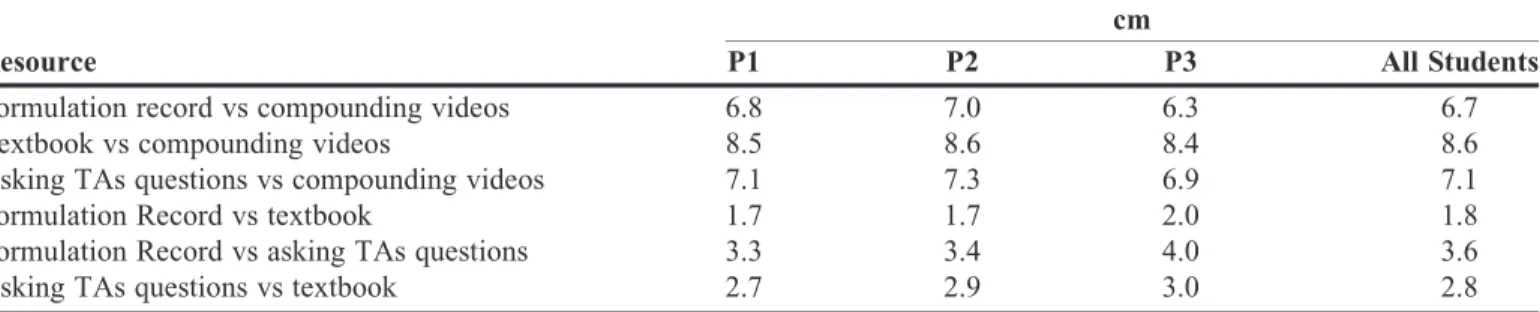
Students were also asked to compare resources in pairs (see Table 4). The first resource listed in the table
cell was on the left side of the scale, and the second re-source was on the right side of the scale. The majority of students preferred the compounding videos to the formu-lation record, the textbook (which is a course require-ment), and consulting with teaching assistants.
Table 5 summarizes the helpfulness of the com-pounding videos and the level of interest by professional year and campus location. Students in the different pro-fessional years found the videos “very helpful” to the same extent (approximately 8.8 cm) regardless of the campus location. This strongly indicated that the accessi-bility and functionality of the videos were equal on all campuses. The rating scales for the “change in interest” were equivalent regardless of campus location. The rat-ings were in the middle of the range, suggesting that using the videos did not increase or decrease the students’ in-terest in compounding.
There was no statistical difference in any of the rat-ing questions when the average of all of the students (P1, P2, and P3), regardless of campus location, was com-pared. However, in the subgroup analysis, the P1 and P2 students differed in their ratings of some of the rating scale questions (Table 6). The P1 class had a correspond-ing cohort at both branch campuses, but at this time, the P2 class did not have a similar cohort at the ASHE campus. The results suggest that overall ECSU and CH students were more satisfied with the videos than ASHE students. This was not unexpected as ECSU had been established for several years as a branch campus, CH is the main campus, and the ASHE program was more recently established.
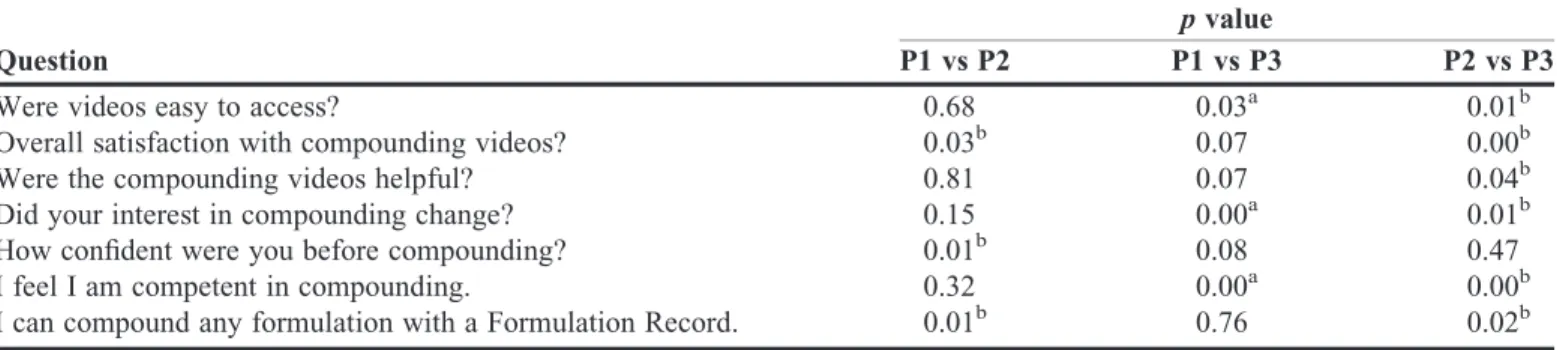
Another analysis was performed to determine differ-ences between the P1, P2, and P3 students who completed the survey. The mean data for each professional year was composed of all of the students in that year regardless of campus affiliation. The questions showing statistical dif-ferences are presented in Table 7. The P2 students gener-ally gave higher ratings than other classes.
To evaluate the issue of self-confidence, three ques-tions were included in the survey (Table 8). The level of Table 3. Preparation Time for Individual Compounding
Laboratories
Preparation Time
%
P1 P2 P3 All Students
Less than 30 minutes 17.3 36.1 58.2 33.8 Between 1 hour and 2 hours 69.9 54.9 36.3 56.5 Between 2 hours and 3 hours 10.3 5.6 2.2 6.6 More than 3 hours 1.9 1.4 2.2 1.8
No Answer 0.6 2.1 1.1 1.3
P15first year-pharmacy students; P25second-year pharmacy students; P35third-year pharmacy students
Table 4. Student Preferences of Resources in the Compounding Laboratory
Resource
cm
P1 P2 P3 All Students
Formulation record vs compounding videos 6.8 7.0 6.3 6.7
Textbook vs compounding videos 8.5 8.6 8.4 8.6
Asking TAs questions vs compounding videos 7.1 7.3 6.9 7.1
Formulation Record vs textbook 1.7 1.7 2.0 1.8
Formulation Record vs asking TAs questions 3.3 3.4 4.0 3.6
Asking TAs questions vs textbook 2.7 2.9 3.0 2.8
confidence or competence was similar regardless of the professional year or the campus location. The rating of approximately 7.0 cm suggests the students felt “some-what” confident in compounding, but not fully confident. Student performance was investigated by reviewing the results of the three common preparations students compounded in their P1 or P2 years (Table 9). Analyses were carried out on almost all of the student compounded preparations as part of the assessment process.3,4 As shown in Table 2, the progression of the students evalu-ated by the survey can be tracked back to the time they were P1 or P2 students. Three compounded preparations were repeated by all P1 students for two years when these students had access to the version 2.0 video library and one year when they had access to version 3.0. Three ad-ditional compounded preparations were repeated by the P2 students for one year using version 2.0 and one year with version 3.0 of the pharmlabs website. The analytical results of these data are shown in Table 9.
The one-way ANOVA did not show any statistical difference between compounded preparations for the P1 group. At face value, the data suggests that P1 students with access to the pharmlabs 2.0 library were as success-ful in compounding as P1 students that accessed version 3.0. This result was also reflected in the P2 student data where there was no significant difference using az test analysis (as the variance of each group was known).
Another way to consider variance in the com-pounded preparations was to determine the number of students who correctly compounded the preparation on the first attempt (Table 9). The largest increase in this parameter was with metoprolol tablet triturates (11% to 86%) when the P2s had access to version 3.0 (all of the video library). It was unlikely that just having more videos on the website would lead to increased accuracy in com-pounding. It is more likely that some other factor was more influential in students achieving greater accuracy such as encouragement from instructors or teaching as-sistants to watch the videos. It might also suggest that the P2s in that year were better prepared to compound any preparation, but the data for the other two preparations does not bear out that conclusion.
DISCUSSION
The unique role of compounding in current phar-macy practice continues to grow, and it is critical to obtain compounding skills as a part of pharmacy curriculum at schools of pharmacy in the United States. Inadequate lab-oratory reference materials for compounding education activities exist in schools of pharmacy.1The open-access pharmlabs website can provide an interactive and reliable source of compounding materials.
Our investigation was to have a portion of the web-site (the compounding videos) assessed by the pharmacy Table 5. Helpfulness of the Videos and Influence on Student’s Interest in Compounding
cm
P1 P2 P3 Chapel Hill Branch Campuses
Were the compounding videos helpful? (Not very helpful)/Very helpful) 9.0 9.0 8.7 9.0 8.7 Did your interest in compounding change as a result of using compounding
videos? (Significantly decrease)/Significantly increase)
6.3 6.1 5.5 6.0 6.7
cm5centimeters; P15first year-pharmacy students; P25second-year pharmacy students; P35third-year pharmacy students
Table 6. Difference Noted Between Campuses Regarding Compounding Website Materials pvalue
CH vs ECSU CH vs ASHE ECSU vs ASHE
P1
Were videos easy to access? 0.73 0.00a 0.14
Overall satisfaction with compounding videos? 0.11 0.19 0.05b
Were the compounding videos helpful? 0.37 0.05a 0.65
Narrator’s voice? 0.04b 0.21 0.01b
P2
Did your interest in compounding change? 0.00b ---
---Significancep,0.05
a
CH (University of North Carolina at Chapel Hill) campus had a larger value
b
ECSU (Elizabeth City State University) campus had a larger value ASHE (University of North Carolina at Asheville) campus
students at the school. The students found the videos were easily accessible, and the functionality and usefulness of videos were highly satisfying to the majority of students in different classes and campuses. The videos were also judged to be the preferable resource compared to a re-quired textbook, a formulation record, or asking teaching assistants or peers for information. Most of the results of the survey were expected and mirrored earlier published results from this laboratory.5
One of the unexpected results was the students’ per-ception of confidence and competence in compounding. These levels were the same (about 7.0 cm) regardless of the professional year or the campus location. It seems reasonable that P3 students would have felt more confident/competent than the P2s, and the P2s more confident/competent than the P1s because those with more semesters of compounding would be expected to have more relevant experience.
One interpretation of these results is that the online compounding videos did not provide a complete resource for the students. A more likely explanation is that re-peatedly compounding specific preparations would give students more confidence, but the students did not have such an opportunity. The students compound more than 20 different preparations during their compounding
years in the PCL. The only opportunity to repeat a com-pound is if they choose to remake a preparation that is outside of the acceptable range of API accuracy. There is no indication that students lacked confidence in basic laboratory operations.
Another unexpected result was that the P2 students were the most often statistically different class for the aspects of this investigation. Class preferences are dif-ficult to understand, but the P2 class might have had more experience in compounding than the P1 students and probably knew how the laboratory information was organized and operated. However, that argument would not hold true for the P2-P3 comparison, as one would expect the P3 to have more experience and laboratory operations. Possibly, more emphasis was to given to the P2 students in reminding them that quiz questions given in the beginning of laboratory periods often came from the video material.
None of the results outlined above were unexpected because a significant body of literature substantiates that video learning can be as effective as in-class instruction.5 Some reports suggest that student performance is en-hanced with online instruction,6,7but there is also litera-ture that shows no difference in performance with additional online instruction.8,9 Several studies looked Table 7. Difference Noted Between Classes Regarding Compounding Website Materials
pvalue
Question P1 vs P2 P1 vs P3 P2 vs P3
Were videos easy to access? 0.68 0.03a 0.01b
Overall satisfaction with compounding videos? 0.03b 0.07 0.00b
Were the compounding videos helpful? 0.81 0.07 0.04b
Did your interest in compounding change? 0.15 0.00a 0.01b How confident were you before compounding? 0.01b 0.08 0.47
I feel I am competent in compounding. 0.32 0.00a 0.00b
I can compound any formulation with a Formulation Record. 0.01b 0.76 0.02b
Significancep,0.05
a
P1 (first-year pharmacy) students had a larger value
b
P2 (second-year pharmacy) students had a larger value P35third-year pharmacy students
Table 8. Confidence Questions in Compounding Survey
cm
P1 P2 P3 Chapel Hill Branch Campuses
How confident were you before coming to compounding laboratory? (Not confident)/very confident)
6.6 7.2 7.0 6.9 7.0
I feel I am competent in compounding because of the skills I learned in the compounding laboratory. (Strongly disagree)/strongly agree)
7.3 7.5 6.7 7.2 7.4
I can compound any dosage form of medication with a Formulation Record or recipe. (Strongly disagree)/strongly agree)
6.5 7.0 6.4 6.6 7.0
specifically at the effects of technology on learner self-confidence.10,11The analytical assays did not indicate any differences in the overall API accuracy between groups that used the more limited video library of version 2.0 compared to the complete library in version 3.0. It was anticipated that the number of students compounding a preparation correctly on the first attempt might increase with the addition of more videos and the integration of interactive questions. Studies have looked specifically at the effects of technology on learner self-efficacy, which is a major influence on academic performance.6,7With the exception of metoprolol tablets, this influence was not seen. The predominate variation in the results may be from the students themselves, as each student would have brought different degrees of experience, foundational knowledge, and comfort level to the compounding labo-ratory. In addition, students were not compounding in a vacuum. Each academic year brought curricular changes and modification in teaching, as well as in the composition of the class.
CONCLUSION
This is the first study that describes pharmacy stu-dents’ perspectives on effectiveness of compounding videos as one of their compounding resources by mea-suring objective and subjective outcomes. The investi-gation shows that the compounding videos on the pharmlabs website were preferred and well-received by the students at the Eshelman School of Pharmacy. As such, the website could serve as a resource for other schools in the United States. The investigation also demonstrated that analysis of compounded products is a necessary corollary for any compounding laboratory
teaching experience to fully understand the sources of true variance in the art.
REFERENCES
1. Shrewsbury R, Augustine S, Birnie C, et al. Assessment and recommendations of compounding education in AACP member institutions.Am J Pharm Educ. 2012;76(7):Article S9. 2. Abdous M, Facer B, and Yen C. Academic effectiveness of podcasting: a comparative study of integrated versus supplemental use of podcasting in second language classes.Comput Educ.2012;58 (1):43-52.
3. Roark A, Anksorus H, Shrewsbury R. Long-term results of an analytical assessment of student compounded preparations.Am J Pharm Educ. 2014;78(9):Article 164.
4. Alford E, Shrewsbury R. Impact of required versus optional remake of a preparation on pharmacy students’ compounding accuracy.Am J Pharm Educ. 2013;77(4):Article 73.
5. Robertson JL, Shrewsbury RP. Video teleconferencing in the compounding laboratory component of a dual-campus doctor of pharmacy program.Am J Pharm Educ. 2011;75(9):Article 181. 6. McLaughlin JE, Roth MT, Glatt DM, et al. The flipped classroom: a course redesign to foster learning and engagement in a health professions school.Acad Med. 2014;89(2):236-243.
7. Lloyd JE, Ehener WC. Inverting a non-major’s biology class: using video lectures, online resources, and a student response system to facilitate deeper learning.J Teach Learn Technol.2014;3(2):31-39. 8. Moffett J, Mill AC. Evaluation of the flipped classroom approach in a veterinary professional skills course.Adv Med Educ Pract. 2014;13(5):415-425.
9. Braun I, Ritter S, Vasko M. Inverted classroom by topic: a study in mathematics for electrical engineering students.Intl J Engineer Pedag. 2014:4(3):11-17.
10. Smith SJ, Roehrs CJ. High-fidelity simulation: factors correlated with nursing student satisfaction and self-confidence.Nurs Educ Perspect. 2009;30(2):74-78.
11. Thomas MC, Macias-Moriarity LZ. Student knowledge and confidence in an elective clinical toxicology course using active-learning techniques.Am J Pharm Educ.2014;78(5):Article 95.
Table 9. API Analysis and Percentage of Students Who Compounded the Preparation Correctly the First Attempt
Mean (SD), %
Preparation 2009-2010 (version 2.0) 2010-2011 (version 2.0) 2011-2012 (version 3.0)
P1
Diphenhydramine Syrup 2.5 mg/mL 2.50 (0.55), 85 2.43 (0.45), 76 2.56 (0.34), 54 Metronidazole Saturated Solution 10 mg/mL 10.16 (1.3), 55 10.00 (0.83), 85 10.00 (1.53), 52 Phenylephrine Nasal Gel 0.5 mg/mL 0.47 (0.04), 85 0.51 (0.16), 69 0.50 (0.08), 76 P2
Hydrocortisone Medication Stick 2.5% — 2.50 (0.50), 52 2.50 (0.47), 45 Ibuprofen Effervescent Powder 3.88 g/bottle — 3.89 (0.84), 72 4.00 (0.69), 66 Metoprolol Tablet Triturates 12.5 mg/tablet — 12.50 (3.82), 11 12.56 (0.88), 86