ACQUIRING SPANISH AT THE INTERFACES: AN INTEGRATIVE APPROACH TO THE L2 ACQUISITION OF PSYCH-VERBS
Inmaculada Gómez Soler
A dissertation submitted to the faculty of the University of North Carolina at Chapel Hill in partial fulfillment of the requirements for the degree of Doctor of Philosophy in the
Department of Linguistics
Chapel Hill 2012
©2012
ABSTRACT
INMACULADA GÓMEZ SOLER: Acquiring Spanish at the Interfaces: An Integrative Approach to the L2 Acquisition of Psych-Verbs
(Under the direction of Dr. Misha Becker)
ACKNOWLEDGMENTS
During the years that I spent in my little carrel in the 6th floor of Davis Library, I have spent many hours reading the acknowledgments section of other students’ dissertations. In a way, it connected me to the person behind the methodology, the statistical analysis and the argumentation. It gave me a window into these people’s stories of success and fulfillment and about the road they travelled to get there. Somehow, now it is my time to tell my story.
priceless contributions, for our enlightening Skype discussions and for the generous time and effort that he has committed to this project. A big part of my success in this enterprise, I owe it to him and the fact that his door was always open for me. In the fourth place, I want to express my gratitude to Dr. Michael Terry for our interesting discussions about semantics and pragmatics. Finally, I thank Dr. Katya Pertsova for her instrumental help with PsyScope and the design of the experiments. Now that I have finally become a professor, I hope my students can look up to me the way I look up to the professors that have guided me through this process.
There are many other people who have contributed to make this dissertation possible: Chris Wiesen, who has helped me immensely with the statistical analysis; Luca Filippin, who provided me with invaluable assistance with PsyScope; the instructors teaching Spanish 300 at UNC, who gave extra credit to their students for participating in my research; and the many many friends across on both sides of the Atlantic who have generously participated in my experiments.
Of course, I cannot forget about my friends and officemates in Chapel Hill and all of the memories that I leave behind in Dey Hall 112. We all had a tough road ahead of us but somehow it always felt better in our office with our cardboard windows and our fake plants. To them, I thank them for their constant encouragement and support.
conocimiento había comenzado mucho antes del doctorado, justo allí en nuestra mesa de la salita.
A mi padre, José, por sus peculiares ideas sobre el 8.5 y por inspirarme a huir de la mediocridad. A mi madre, M Carmen, por ser un ejemplo de constancia, decicación y fuerza de
TABLE OF CONTENTS
LIST OF TABLES ... xii
LIST OF FIGURES ... xiv
Chapter I. CHAPTER 1: INTRODUCTION ...1
II. CHAPTER 2: PYSCH VERB STRUCTURE AND ACQUISITION: A LITERATURE REVIEW ...12
2.1 Theories of Second Language Acquisition ...12
2.2 Theoretical Models of Psych-Verbs ...34
2.4 Introduction to the Current Project ...63
III. CHAPTER 3: SYNTACTIC PROPERTIES OF PSYCH-VERBS ...75
3.1 Design of the Experimental Study ...75
3.2 Experiment 1: Goal and Research Questions...77
3.3 Experiment 1: Methodology ...78
3.4 Experiment 1: Results ...80
3.5 Experiment 1: Summary of Results ...88
3.6 Experiment 1: Contrasts among Groups ...88
3.7 Experiment 1: Discussion ...90
3.8 Experiment 2: Goal and Research Questions...99
3.9 Experiment 2: Methodology ...101
3.11 Experiment 2: Summary of Results ...115
3.12 Experiment 2: Contrasts among Groups ...116
3.13 Experiment 2: Discussion ...118
IV. CHAPTER 4: PSYCH-VERBS AND THE SYNTAX-SEMANTICS INTERFACE...116
4.1 Background for Experiment 3A and 3B ...127
4.2 Experiments 3A and 3B: Goal and Research Question ...130
4.3 Experiment 3A: Goal and Research Questions ...131
4.4 Experiment 3A: Methodology ...132
4.5 Experiment 3A: Results ...135
4.6 Experiment 3A: Summary of Results ...146
4.7 Experiment 3A: Contrasts among Groups ...147
4.8 Experiment 3A: Discussion ...150
4.9 Experiment 3B: Goal and Research Questions ...157
4.10 Experiment 3B: Methodology...160
4.11 Experiment 3B: Results ...162
4.12 Experiment 3B: Summary of Results ...172
4.13 Experiment 3B: Contrasts among Groups ...174
4.14 Experiment 3B: Discussion...176
V. CHAPTER 5: PSYCH-VERBS AND THE SYNTAX-PRAGMATICS INTERFACE...186
5.1 Experiment 4: Goal and Research Questions...187
5.2 Experiment 4: Methodology ...189
5.3 Experiment 4: Results ...194
5.5 Experiment 4: Contrasts among Groups ...206
5.6 Experiment 4: Discussion ...209
VI. CHAPTER 6: A THEORETICAL MODEL FOR PSYCH-VERB ACQUISITION ...226
VII. CHAPTER 7: CONCLUSION ...256
APPENDIXES ...261
Appendix A: Test items ...261
Appendix B: Additional calculations for experiments 1 and 2 ...280
LIST OF TABLES Table
1. Semantic and morphosyntactic differences between Class II(a) and Class
II(b)/III ...66
2. Response means for experiment 1 (Control group) ...81
3. Response means for experiment 1 (Near-native group) ...83
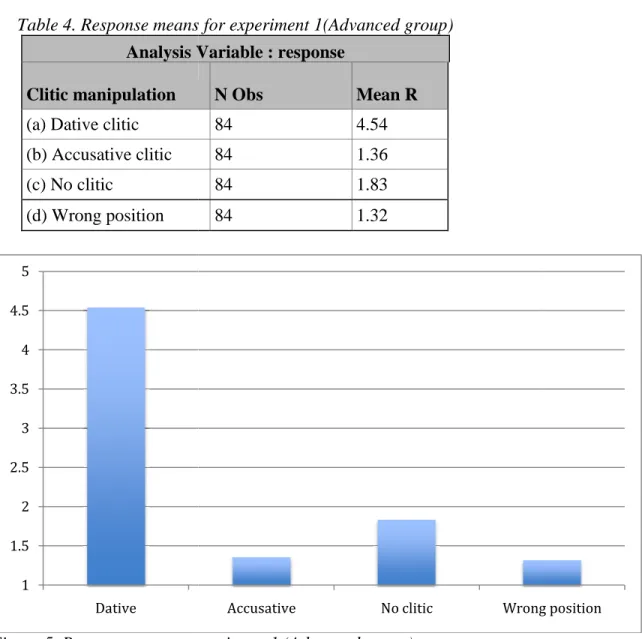
4 Response means for experiment 1 (Advanced group) ...85
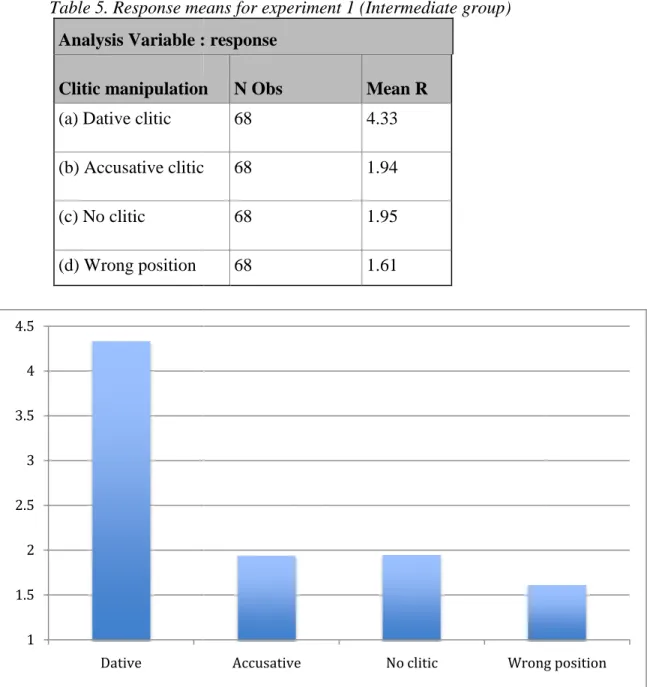
5 Response means for experiment 1 (Intermediate group) ...86
6 Response means for experiment 1 (Low-proficiency group) ...87
7. Response means for experiment 2 (Control group) ...106
8. Response means for experiment 2 (Near-native group) ...108
9. Response means for experiment 2 (Advanced group) ...2
10. Response means for experiment 2 (Intermediate group) ...110
11. Response means for experiment 2 (Low-proficiency group) ...114
12. Semantic and morphosyntactic differences between Class II(a) and Class II(b)/III ...129
13. Response means for experiment 3A (Control group) ...136
14. Response means for experiment 3A (Near-native group) ...138
15. Response means for experiment 3A (Advanced group) ...141
16. Response means for experiment 3A (Intermediate group) ...142
17. Response means for experiment 3A (Low-proficiency group) ...144
18. Response means for experiment 3B (Control group) ...163
20. Response means for experiment 3B (Advanced group) ...167
21. Response means for experiment 3B (Intermediate group) ...169
22. Response means for experiment 3B (Low-proficiency group) ...171
23. The uses of se mapped across four major semantic classes ...182
24. Response means for experiment 4 (Control group) ...194
25. Response means for experiment 3B (Near-native group) ...197
26. Response means for experiment 3B (Advanced group) ...199
27. Response means for experiment 3B (Intermediate group) ...202
28. Response means for experiment 3B (Low-proficiency group) ...204
LIST OF FIGURES Figure
1. Reinhart’s (2006) model of the language architecture ...21
2. White’s (2009) depiction of interfaces ...22
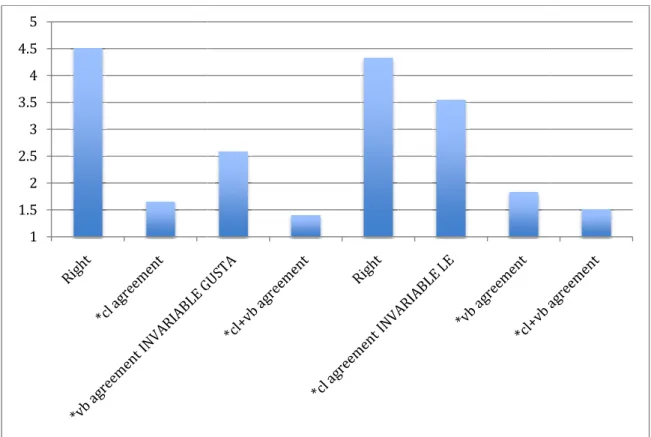
3. Response means for experiment 1 (Control group) ...82
4. Response means for experiment 1 (Near-native group) ...84
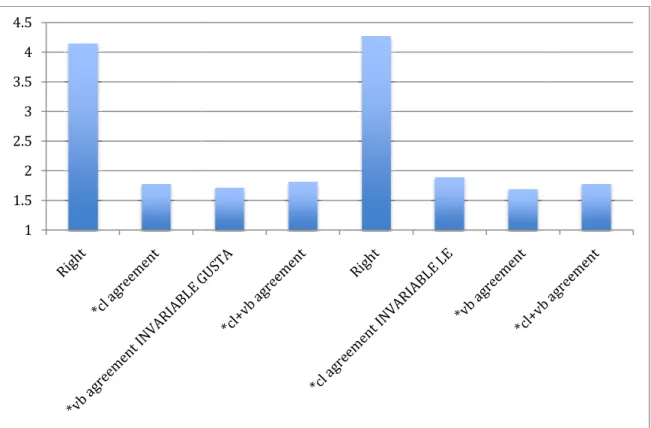
5. Response means for experiment 1 (Advanced group) ...85
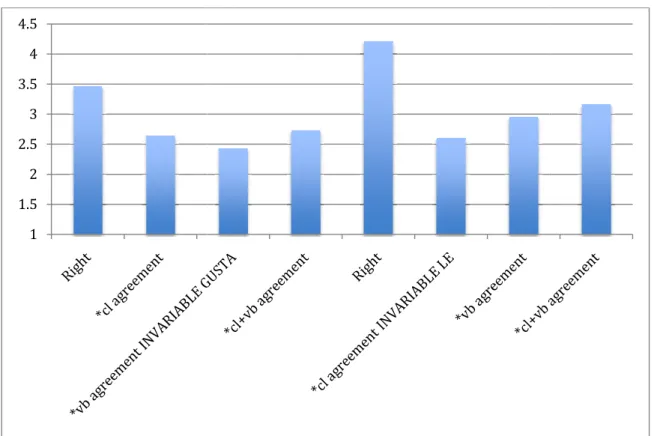
6. Response means for experiment 1 (Intermediate group) ...86
7. Response means for experiment 1 (Low-proficiency group) ...87
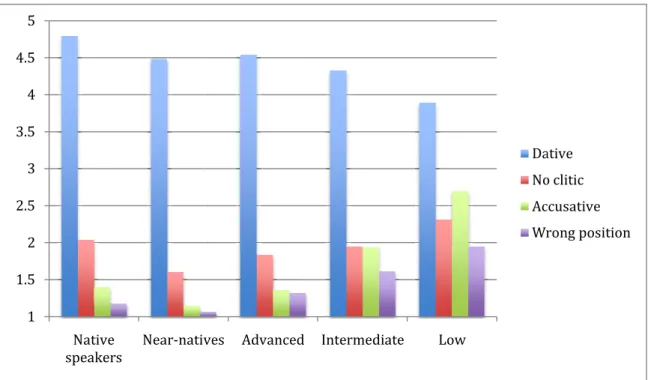
8. Response means for experiment 1 (All groups) ...90
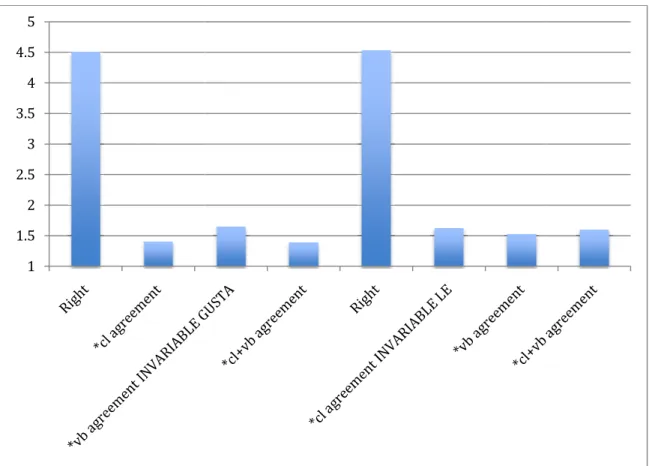
9. Response means for experiment 2 (Control group) ...107
10. Response means for experiment 2 (Near-native group). ...109
11. Response means for experiment 2 (Advanced group). ...111
12. Response means for experiment 2 (Intermediate group). ...113
13. Response means for experiment 2 (Low-proficiency group) ...115
14. Response means for experiment 2 (All groups) ...117
15. Response means for word order by class (Control group) ...137
16. Response means for class by word order (Control group) ...138
17. Response means for word order by class (Near-native group) ...139
18. Response means for class by word order (Near-native group) ... 140
19. Response means for word order by class (Advanced group) ...141
20. Response means for class by word order (Advanced group) ...142
22. Response means for class by word order (Intermediate group) ...143
23. Response means for word order by class (Low-proficiency group) ...145
24. Response means for class by word order (Low-proficiency group) ...146
25. Response means for EVC/TVE sentences in experiment 3A (All groups). .149 26. Response means for CVE/EVT sentences in experiment 3A (All groups). .150 27. Response means for antipassive se by class (Control group) ...163
28. Response means for class by antipassive se (Control group) ...164
29. Response means for antipassive se by class (Near-native group) ...165
30. Response means for class by antipassive se (Near-native group) ...166
31. Response means for antipassive se by class (Advanced group) ...167
32. Response means for class by antipassive se (Advanced group) ...168
33. Response means for antipassive se by class (Intermediate group) ...169
34. Response means for class by antipassive se (Intermediate group) ...170
35. Response means for antipassive se by class (Low-proficiency group) ...171
36. Response means for class by antipassive se (Low-proficiency group) ...172
37. Response means for sentences with antipassive se in experiment 3B (All groups) ...175
38. Response means for sentences without antipassive se in experiment 3B (All groups) ...176
39. Response means for word order by context (Control group) ...195
40. Response means for context by word order (Control group) ...196
41. Response means for word order by context (Near-native group)...197
43. Response means for word order by context (Advanced group) ...200
Figure 44. Response means for context by word order (Advanced group) ...201
Figure 45. Response means for word order by context (Intermediate group) ....202
Figure 46. Response means for context by word order (Intermediate group) ....203
47. Response means for word order by context (Low-proficiency group) ...204
48. Response means for context by word order (Low-proficiency group) ...205
49. Response means for TVE sentences in experiment 4 (All groups) ...208
50. Response means for EVT sentences in experiment 4 (All groups) ...209
51. Full convergence ...218
52. Convergence on SC only ...218
53. Convergence on UC only ...219
54. Parallel disjoint conjunction (Type 1) ...220
CHAPTER 1 INTRODUCTION
Psychological predicates (e.g to please, to worry, to frighten) have consistently attracted special attention from researchers in a number of different fields: theoretical linguistics (e.g. Belletti & Rizzi, 1989; Grimshaw, 1990; Pesetsky, 1995; Franco & Huidobro, 2003, 2007; Dowty, 1991; Landau, 2010), first language acquisition (e.g. Lord, 1979; Figueira, 1984, Torrens at al, 2006; Gómez Soler, 2011), second language acquisition (e.g. Montrul, 1998; White et al. 1998, 1999; Toribio & Nye, 2006; de Prada Pérez & Pascual y Cabo, 2011), language pedagogy (e.g. López Jiménez, 2003; Rubio, 2000, 2001), and language deficits (e.g. Manovilidou, 2008; Thompson & Lee, 2009; Beretta & Campbell, 2001).
significant difficulties for L1 and L2 learners and speakers who suffer from language disorders.1
This dissertation engages the second question and, specifically, sets out to explore the issue of the second language acquisition of Spanish psych-predicates (e.g. gustar ‘to like’, encantar ‘to love’, preocupar ‘to worry’) by L1 English speakers. In particular, through a series of five experiments, I will provide a detailed account on how acquisition of these predicates takes place and how it develops across four L2 proficiency levels: near-native, advanced, intermediate and low.
This project emerged from a preliminary survey, which consisted of an evaluation of about 150 written compositions from students taking their last semester of Spanish at an institution of higher education. The courses in which students were enrolled were topics courses equivalent to, at least, a 6th semester course. The purpose of the survey was to determine some of the areas of Spanish grammar that students were still contending with at the highest levels of proficiency attainable through college instruction and study abroad stays. Psychological verbs proved to be one of the areas more resistant to instruction judging by the amount of mistakes found in the compositions. Here I group some of the errors found into five different categories:
• Wrong agreement on the clitic
(1) *A las personas estadounidenses le fascina el fútbol
To the people US-born le-dat. cl.-3sg. fascinate-3sg. the football Correct version: A las personas estadounidenses les fascina el fútbol
Americans love football
• Wrong agreement on the verb (2) *Me gusta sus pinturas
1 The studies on the L1 acquisition of psych-verbs and the acquisition of psych-verbs in populations with
language disorders mainly point to problems with the unorthodox mapping of thematic roles to syntactic
Me-dat. cl.-1sg. like-3sg. his paintings Correct version: Me gustan sus pinturas
I like his paintings
(3) *Sabíamos que a papá y mamá no les gustarían el restaurante Knew-1pl. that dad and mom no les-dat. cl.-3pl. the restaurant Correct version: Sabíamos que a papá y mamá no les gustaría el restaurante
We knew dad and mom would not like the restaurant
• Wrong agreement on the clitic and the verb (4) *Las películas de horror les asusta a mí
The movies of horror les-dat cl.-3pl. scare-3sg. to me Correct version: Las películas de horror me asustan a mí
Horror movies scare me
• Wrong use of the pronoun se
(5) *Los estudiantes se importan sobre los temas que afectan a su vida. The students se care-3pl. about the issues that affect-3pl. to their life Correct version: A los estudiantes les importan los temas que afectan a su vida
Students care about the issues that affect their lives
(6) *Los padres se caen bien con Calvin The parents se get along-3pl. with Calvin
Correct version: A los padres les cae bien Calvin
The parents get along Calvin
• Wrong word order/Lack of clitic (7) *A Sarah sorprendió el profesor To Sarah surprised-3sg. the professor
Correct version: El profesor sorprendió a Sarah Correct version: A Sarah le sorprendió el profesor
The professor surprised Sarah
the relationship between the semantics of aspect (i.e eventive vs. stative) and how these aspectual differences are morphosyntactically encoded (5-7).
Thus, taking these students’ errors as a starting point, I designed a series of experiments that would allow me to test a varied set of properties (e.g. morphological, syntactic, semantic, and pragmatic), which, in turn, would help me uncover the underlying reasons for the difficulty intrinsic to the acquisition of these predicates. This scenario provided the perfect opportunity to ultimately enlighten questions relevant for the field of generative second language acquisition such as: access to UG, the structure and development of non-native grammars, the causes of learner difficulty, and the issue of fossilization.
In order to answer some of these questions I turned to two different models of bilingual acquisition: the Interface Hypothesis (Sorace and Filiaci, 2006; Tsimpli, Sorace, Heycok & Filiaci, 2004; Sorace, Serratrice, Filiaci & Baldo 2009; Sorace 2011 inter alia) and the Integrative Model of Bilingual Acquisition2 (Pires & Rothman, 2011). The Interface Hypothesis (henceforth IH) is a theory on ultimate attainment based on a particular understanding of the architecture of the language faculty in which three main areas are differentiated: narrow syntax, internal interfaces and external interfaces. First of all, structures that depend on narrow syntax are considered to be purely syntactic. Secondly, structures dependent on internal interfaces are claimed to be those in which two (or more) linguistic modules interact with each other (e.g. syntax-morphology). Finally, external interfaces are those in which linguistic modules interface with other cognitive modules (e.g. syntax-pragmatics). The main argument of the IH is that external
2
interfaces raise more difficulty for learners than internal interfaces/narrow syntax. Consequently, residual optionality, when present at the level of ultimate attainment, will be restricted to external interfaces.3
Psychological predicates offer an excellent testing ground for the Interface Hypothesis since their numerous intricate properties can be tested independently with regard to the type of interface to which they belong. The experiments in this dissertation have been specifically designed to evaluate the soundness of the Interface Hypothesis as a theoretical account of language acquisition (particularly second language acquisition).4 Thus, experiments 1 and 2 test a narrow syntactic property, experiments 3A and 3B test an internal interface phenomenon, and experiment 4 tests an external interface property.
Nevertheless, because the empirical results of this study are incompatible with the Interface Hypothesis, I resort to Pires & Rothman’s (2011) Integrative Model to account for the patterns present in the current project. This model is a multidimensional model, which ascribes differences between native and non-native speakers to the interplay of several factors that influence the language acquisition process; namely, formal complexity of the construction in question, the setting of the L1 and the L2 parameters with respect to this specific construction, the processing resources5 of bilingual speakers,
3
I would like to underscore that the IH in its most recent instantiation argues that underlying representation even of syntax-discourse properties can be totally target-like, but the enactment of such knowledge in real-time is constrained by processing considerations.
4
The IH has been proposed to account for different types of bilingual acquisition (L2 acquisition, L1 bilingual acquisition and L1 attrition). However, since this dissertation is an empirical study of second language acquisition, I will merely evaluate the IH in terms of its claims about second language
acquisition.
and the characteristics of the primary linguistic data. This model, by encompassing a number of different factors that are crucial to evaluate the acquisition process, is able to accurately portray the patterns of behavior shown by the non-native speakers in this dissertation.
Specifically, the differences between the L1 and the L2 with respect to several of the constructions tested turned out to be an essential element in understanding the development of properties related to psych-verbs. Because the L1 plays such an important role in participants’ understanding of particular structures in the L2, and because the non-native grammars showed evidence of being constrained by UG, we can conclude that these data support Schwartz & Sprouse’s (1996) Full Transfer/Full Access Hypothesis. This hypothesis states that the L1 is the starting point of the L2 acquisition process. However, L2ers are considered to be able to reset parameters and achieve native-like linguistic representations.
The comparison of these two models (the Interface Hypothesis and the Integrative Model of Bilingual Acquisition) will allow me to answer some of the most prevalent questions in current generative second language acquisition research: particularly, what the vulnerable areas in second language acquisition are and why. Over the past decade in particular, generative L2 researchers have shifted their focus from the binary question of (in)accessibility to UG as the main driving force in the field; mainly, because most authors (although definitely not all) believe that UG is somehow available either partially (Partial Accessibility theories such as the Interpretability Hypothesis, Tsimpli & Dimitrakopulou, 2007) or entirely (Full Aceesibility Theories, Schwartz and Sprouse,
that reason, the current project will not evaluate either the Interface Hypothesis or the Integrative Model
1996). As a result, the research focus, even for those who believe that access to UG is in fact unrestricted, is on elucidating the reason for non-native divergence from native behaviors in areas of the language outside of the realm of UG. Conceived under this specific theoretical framework and with these questions motivating my research, the current project will help us enlighten some of these general queries about L2 acquisition with empirical data from the acquisition process of L2 Spanish psych-verbs.
Next, I will present a brief outline of the organization of this dissertation. The current study encompasses 7 chapters in which 5 different experiments will be analyzed. As I pointed out previously, in order to test the reliability of the IH, the experiments were designed following the theoretical constructs of this hypothesis. That is, two of the experiments tested narrow syntactic properties of psych verbs; another two examined internal interface structures, and finally, the last experiment focused on an external interface phenomenon. This allows me to compare the alleged difficulty of the external interface property as compared with the properties tested in the syntax and the syntax-semantics experiments respectively.
the general literature of psych-verbs but also some accounts that have been specifically proposed to address the idiosyncrasies of Spanish psych-verbs. These models take into consideration their individual properties that distinguish them from psych-verbs in other languages and also the dialectal variability to which these predicates are subject in different areas of the Spanish-speaking world. These diverse models will be summarized in a section called ‘A crosslinguistic model of psych-verbs’ which emphasizes the common arguments of the different researchers. Next, a review of the studies on second language acquisition of psych-verbs will be presented as a starting point for the present project. Finally, I will introduce the current study and elucidate how it fits with the previous research and what unanswered questions in the field it answers.
Chapter 3 starts by describing the methodology that was followed to design the 5 experiments of the current project. Then, it will focus on the description and analysis of experiments 1 and 2, which test properties that belong to the narrow syntax. Experiment 1 tests issues related to the use of the clitic in psych-verb constructions; particularly, the case of the clitic, the obligatory nature of this element, and its position with respect to its host (i.e. the verb). Experiment 2 also explores the acquisition of syntactic properties but focuses on a different issue: agreement. In particular, this experiment examines L2 learners’ ability to react to clitic and verb agreement violations. Agreement has been the most extensively studied property of L2 acquisition studies of Spanish psych-predicates (e.g. Toribio & Nye, 2006, dePrada Pérez & Pascual y Cabo, 2011) but there are some unresolved questions, which will be addressed in this chapter.
encompasses two different experiments but this time they assess learners’ understanding of constructions that hinge on the interaction between syntax and semantics. The main question in these two experiments targets non-native speakers’ ability to categorize different classes of Spanish psych-verbs according to the distinct aspectual and morphosyntactic properties that set them apart. This task is rendered even more complicated by the fact that these classes tend to overlap. The overlapping issue between different classes of psych-verbs and how learners are able to categorize these verbs according to their syntactic and semantic properties has only been examined by Rubio (2000, 2001), who focused on a very specific aspect of this divide. In this chapter, I will test two different phenomena unexplored by the previous literature. In particular, experiment 3A focuses on the relation between the distinct aspectual nature of Spanish psych-verbs and their possible word order configurations. On the other hand, experiment 3B examines the distribution of antipassive se in two different classes of psych-verbs.
Chapter 5 presents the last experiment of the series. Experiment 4 evaluates second language learners’ ability to understand the connections between discourse and syntactic structure with respect to psych-verb constructions. Specifically, experiment 4 assesses knowledge of how discourse topichood affects the word order configurations of psychological predicates. Consequently, the interface targeted in this experiment is the syntax-discourse interface.6 This experiment is key in testing the IH since it is within external interfaces where residual optionality lies at the highest stages of L2 attainment
6
Rothman and Slabakova (2011, p.571) warn us about the confusion generated in the field by using the terms syntax-pragmatics and syntax-discourse interface interchangeably. Discourse is a subset of pragmatics. Thus, whereas syntax-pragmatic interface properties includes areas such as conversational, implication, deixis or presupposition among others, syntax-discourse has a much restricted scope:
according to this theory. Currently, Toribio & Nye (2006) are the only authors who have studied this property of Spanish psych-verbs. However, I will try to improve their methodology with an experimental design that captures more accurately discourse-related judgments.
This is evidenced in near-native speakers’ response patterns that closely resemble the native patterns of behaviors.
Chapter 7 presents some concluding remarks about the empirical findings of the present study and the theoretical model used to address the patterns in the data.
CHAPTER 2
PYSCH VERB STRUCTURE AND ACQUISITION: A LITERATURE REVIEW
2.1. Theories of Second Language Acquisition 2.1.1 The Logical Problem of Language Acquisition
The language acquisition task would be both daunting and unexplainable if children did not count on a biological mechanism to guide their language choices. This innate mechanism has been termed Universal Grammar (UG) (Chomsky, 1965, 1981; Pinker, 1984, 1994). Children acquire all of the abstract subtleties of language in a minimal amount of time and without access to negative evidence. The key issue is that these subtle aspects of language are underdetermined by the input. This has been referred to as the logical problem of language acquisition or the poverty-of-the-stimulus argument: How does the child achieve an adult language production and comprehension system if the input available to them is insufficient? Advocates of UG have proposed this innate language program as the answer to the logical problem of language acquisition. If we believe that children’s grammars are constrained by UG, then the rapid acquisition of language is explained by the fact that UG restricts the child’s language choices to only those possible in natural languages.
2011) have claimed that there is actually no such a thing as a logical problem in second language acquisition. They believe that if L2 learners’ unconscious knowledge of the target L2 language comes only from the L1 (i.e. there is no direct access to UG in adulthood), then they are not faced with the same challenge as L1 learners.
Thus, in order to test if interlanguage grammars are constrained via direct accessibility to UG in adulthood, there is a necessary set of requirements that have to hold of the situation being tested (see e.g. Schwartz and Sprouse, 2000; Rothman and Iverson, 2008):
(i) The construction investigated needs to be underdetermined by the L2 input. That is, this construction cannot be acquired by means of instruction, observation based on frequency and statistical analysis or any other general language mechanisms.
(ii) This construction needs to work differently in the L1 and the L2. That way, we can rule out the possibility that the learners are transferring the knowledge from the L1.
not clear that learners can actually resort to the L1 to perform tasks related to Spanish psychological predicates.
This logical problem of second language acquisition takes us to the next issue, which has been considered the main question that has dominated the field of generative L2 acquisition research since its establishment in the early 1980s: do L2 learners have access to UG?
2.1.2 Access to UG and Non-Native Linguistic Representations
cannot attain native competence to the extent that the L2 underlyingly differs from the L1. In other words, adult L2ers keep the parameter setting of their L1 upon which local modifications are made, which can give the impression of new L2 acquisition. Under such approaches, the L2 acquisition process is characterized by incompleteness and impaired linguistic representations. There are important differences between these approaches that have come from changes in the development of syntactic theory as well as their particular claims as to exactly what is subject to a critical period. For instance, whereas the Failed Functional Features Hypothesis claimed that new functional features (i.e. those not instantiated in the L1) are subject to a critical period and thus, unacquirable after puberty, the Interpretability Hypothesis argues that it is specifically uninterpretable features (only) that are subject to this critical period. However, as we just saw, all of these accounts form part of the representational deficit approach and share similar theoretical foundations.
ascribed to deficits in their ability to retrieve certain lexical items from the lexicon in real-time language processing and not a deficit in representation. In sum, these two approaches, representational deficit approach and full access, differ in their view of the role of age in second language acquisition (crucial vs. crucial), the nature of non-native representations (impaired vs. non-impaired), parameter setting (no-parameter resetting vs. parameter resetting) and finally, the possibility of attaining a target grammar (not possible vs. possible).
2.1.2.1 Underlying vs. Surface Competence
Another question related to the issue of access is whether performance (i.e. the use of linguistic knowledge) actually reflects competence (i.e. underlying knowledge of the linguistic system) of the language. In other words, researchers working on acquisition take performance data to draw conclusions about learners’ underlying knowledge. However, Duffield (2003, 2005) has postulated that the relation between competence and performance is not as straightforward as it is currently believed to be. Actually, he provides a finer-grained definition of competence, which encompasses underlying competence (UC) and surface competence (SC).
UC is categorical and consists of formal (phonological and syntactic) principles, autonomous from the lexicon. It is plausible to think of UC as innate. SC, by contrast, is intimately determined by the interaction of contextual and specific lexical properties with the formal principles delivered by UC; as a consequence, SC generates gradient effects. SC is largely language-specific learned knowledge (Duffield, 2003, p. 101).
2.1.3 From Principles & Parameters to Minimalism
As we saw in the previous section, acquisition theories are constantly getting updated to keep up with changes in syntactic theory. The transition from the Principles & Parameters framework to the Minimalist Program has been particularly important in this respect. One of the key differences between the Principles & Parameters framework and Minimalism is that whereas the former considered that crosslinguistic variation was mainly syntactic, the latter centers this variation in morphology and the lexicon. Syntax and the features that make up lexical items are part of the UG inventory; thus, the main task of the language learner is to acquire the morphology and the lexicon of a language. Parameters, at the heart of the Principles & Parameters framework, have also been redefined in terms of movement triggered by feature strength. Parametric variation depends on the fact that (a) languages select different features, (b) a feature may or may not project a functional projection and (c) languages allow different combinations of features for a specific functional category (Liceras, Zobl and Goodluck, 2008).
2.1.4 The Interface Hypothesis
now placed on external interfaces, those that require the language modules to interact with cognitive modules such as the syntax-pragmatics interface or the semantics-pragmatics interface.
The Interface Hypothesis is a powerful proposal that has generated a multitude of studies both supporting and rejecting its main tenets. Consequently, it has also generated much debate and discussion, which is far from settled. However, before I analyze this debate, it is important to establish some theoretical constructs intrinsic to the tenets of this hypothesis. We will start by defining the concept of interface and the implications for the architecture of the mental faculties that are subsumed under the Interface Hypothesis.
2.1.4.1 On Interfaces and Why We Should Study Them
Although the term interface has become popular in the past two decades, the concept of interface dates back to the Principles and Parameters framework. Here, Chomsky (1981, 1986) proposes a model in which syntactic computations have to be evaluated at the interfaces with phonetics and phonology (PF) and semantics (LF). In the Minimalist Program (Chomsky, 1995, 2000, 2001) these interfaces are redefined as the articulatory-perceptual interface and the conceptual-intentional interface.
The concept of interface is consistent with Fodor’s (1983, 1984) modular view of the mind.7 In particular, we can see how the notions of information encapsulation and domain-specificity are consistent with this idea of interface because, although a specific mental domain (linguistic or cognitive) cannot affect the inner workings of another domain, it can provide inputs to it or it can use the outputs produced by this other domain. So, the next logical question would be: how are interfaces represented in this modular model of the language faculty? I will review two specific models of the language faculty that have been particularly relevant in the field of second language acquisition and what the role of interfaces is within these models.
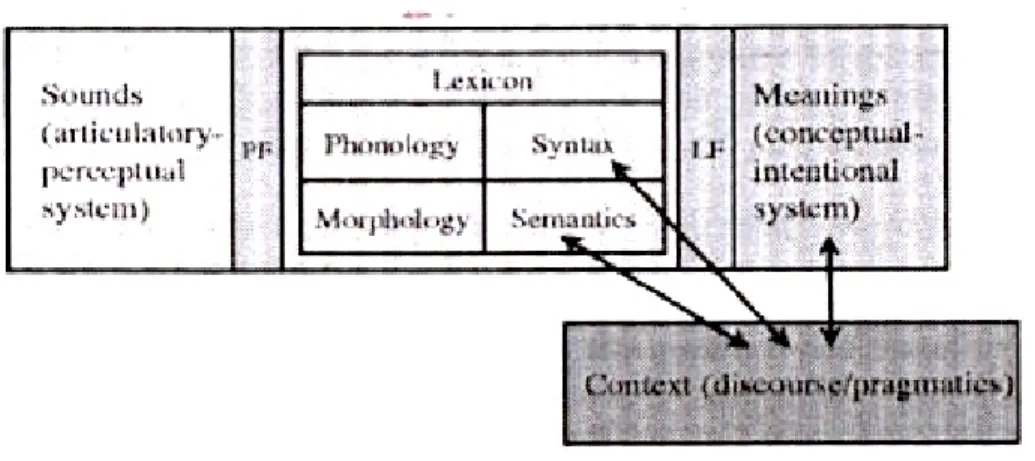
The most widespread model of the language architecture in the acquisition realm is the one put forward by Reinhart (2006). This model stems from Jackendoff’s (2002) parallel architecture. Reinhart’s (2006) model, although based on Jackendoff’s (2002) breaks away from it by returning to a more traditional view of syntax as the main computational system. However, it still keeps the core idea of interfaces. In particular, syntax interfaces with concepts (the lexicon), context (discourse-pragmatics), inference (semantics) and sensory motor-systems (phonetics-phonology).
7
Figure 1. Reinhart’s (2006) model of the language architecture
Reinhart’s model makes specific predictions for acquisition that are in line with the proposals of the Interface Hypothesis. Specifically, she connects difficulty of acquisition with processing limitations in concordance with Sorace and colleagues’ claims (Sorace & Filiaci, 2006; Sorace & Serratrice, 2009; Sorace, 2011 inter alia). Her specific proposal is that when learners have to entertain competing derivations, their processing slows down as a result of a cognitive overload.
the relationship between language and discourse takes place in a separate cognitive module not within the computational system.
Figure 2. White’s (2009) depiction of interfaces
However, there is indeed ample disagreement with regard to the formal relation between syntax and discourse. Although we have seen that some researchers support a discourse-free syntax model like the ones presented before, researchers such as Belletti (2004) and Rizzi (1997) propose a syntax that encodes discourse functions through specific functional categories and features that represent discourse phenomena (e.g. FocP). So, the assumptions about acquisition at the interfaces are going to be intimately connected with researchers’ particular views on how interfaces are represented in the language architecture.
and sophisticated understanding of how language works. This could be done more successfully within the framework of the IH since it allows us to compare specific phenomena across different bilingual populations (L1 bilingual acquisition, L2 acquisition, L1 attrition). On the other hand, the IH opened a new path of research in the acquisition field that, moving away from questions of access to UG alone, tries to find the underlying reasons for language variability at different levels of language development. In particular, stressed processing resources or, more concretely, lack of efficiency in resource allocation have been claimed to underlie acquisition delays for bilingual speakers. Hence, this area opens a path for fruitful research for both acquisitionists and theoretical linguists.
Next, I will provide a review of the literature on the most widely studied interfaces in L2 acquisition (others include, for instance, the phonology-morphology interface or the semantics-pragmatics interface). I will start by describing the findings with respect to internal interfaces and then present the research on external interfaces.
2.1.4.2 Internal Interfaces
2.1.4.2.1 Syntax-semantics interface
(‘how many’). The conclusion of these studies is that syntax-semantics interface properties are successfully acquired by L2 learners. As long as the syntactic mechanism is in place, the interpretive nuances will develop with ease.
Another advocate of the relative ease with which syntax-semantic properties are acquired is Slabakova (2008). Her claim differs from the main gist of the Interface Hypothesis since Slabakova places the locus of difficulty in morphological acquisition (the Bottleneck Hypothesis). Thus, she considers that major acquisition challenges are related to an internal interface (i.e. syntax-morphology). She claims that morphology requires a higher degree of automaticity than syntax and semantics do (Slabakova, 2008, p.107). So, syntax and semantics impose a lower processing load on the L2 learner. Thus, as a general rule, the syntax-semantics interface seems to be unproblematic, which is not surprising, given that both LF and the computational system are universal (Dekydtspotter et al., 1997).
2.1.4.2.2 Syntax-Morphology
In spite of being an internal interface and, thus, according to the IH should be a
priori not problematic, the syntax-morphology interface, is deemed to be the source of
& Leung’s (2004) research on gender agreement found that masculine agreement usually replaces feminine agreement.
The proponents of the Missing Surface Inflection Hypothesis (Haznedar & Schwartz, 1997; Prévost & White, 2000) postulate that lack of morphological markers does not necessarily demonstrate lack of the abstract features and functional categories associated with those markers. They believe the problem comes from an inability to access lexical items, which forces speakers to resort to the use of defaults. Lardiere (2008, 2009) has approached this issue claiming that the problems with the syntax-morphology interface stem from the difficulty intrinsic to disassembling the features of your L1 and re-assembling them in a way that observes the rules and principles of the L2 (Feature Re-Assembly Hypothesis). On the other hand, the Representational Deficit Hypothesis (Hawkins & Liszka, 2003 inter alia) claims that these morphological errors are connected to a representation problem.
2.1.4.3 External interfaces
2.1.4.3.1 Syntax-pragmatics (syntax-discourse)
other authors such as Montrul & Rodríguez-Louro (2006) and Rothman (2009) have actually found evidence for the opposite phenomenon: overgeneralization of null pronouns.
Another phenomenon related to this interface is word order alternations that are regulated by discourse factors. Specifically, several authors studied the acquisition of the word order possibilities of unergative and unaccusative constructions: although in neutral contexts SV and VS is the normal order for unergative and unaccusative verbs respectively; in contexts in which the subject is focused, VS is the expected order for both types of predicates. Lozano (2006) and Hertel (2003) for Spanish and Belletti & Leonini (2004) for Italian found that although learners acquired the syntax side of this distinction, they performed poorly on the conditions regulated by pragmatic factors.
Hopp (2004) also looked at the dichotomy between syntactic and discursive properties with respect to scrambling in L2 German. As in the studies previously mentioned, he found a reliable knowledge of the syntax of scrambling paired with a much less consistent understanding of the pragmatic regulations ruling this phenomenon.
recently shown, contrary to what Valenzuela claimed to have shown, that English learners of L2 Spanish at high levels of proficiency can perform indistinguishably from native controls on CLLD and other related structures. A similar disagreement arises from the conflicting results of Rothman (2009) and Belletti et al. (2007) both dealing with the acquisition of overt and null pronouns in L2 Spanish and L2 Italian respectively. While the former advocates for the target-like acquisition of these structures, the latter claim that near-native speakers never reach native proficiency with respect to these constructions. Although Rothman (2009) and Belleti et al. (2007) both examined discourse constraints on overt vs. null subject pronominal use in L2 Spanish and Italian, the former examined contrastive focus and the latter topic shift environments. Indeed, it is possible that this fact alone explains the disparity in their respective findings, however, as it relates to the IH this difference is of no consequence. The IH predicts residual optionality for all properties involving the integration of syntax and discourse, and so, Rothman’s (2009) evidence constitutes counter evidence to the predictions of the IH even if not completely comparable to Belleti et al. (2007).
2.1.4.4 Why are certain interfaces particularly prone to optionality, transfer and
fossilization?
There is not a straightforward answer to the question of what interfaces are prone to optionality, transfer and fossilization. The intrinsic difficulty related to external interfaces arises from the coalescence of a series of complicated factors. There are opposing views as to what these factors might be and how they interact together. Hence, here I present an overview of the possible causes of this interface’s vulnerability.
(1) Underspecification and crosslinguistic influence: The representational account (Hopp, 2007; Lozano, 2006; Tsimpli, 2007; Tsimpli et al., 2004) argues that differences between bilinguals and monolinguals stem from a representational deficit. The advocates of this position believe that optionality is connected with a parametric choice that differs between the L1 and L2. This results in the underspecification of certain interpretable features on the part of the bilingual speaker (e.g. [+Topic Shift], a feature that in monolingual grammars like Italian and Greek maps onto an overt pronoun (Tsimpli et al., 2004)). This account predicts unidirectional crosslinguistic effects: the language with the less restrictive option will affect the other but not vice versa.
combinations (e.g. overgeneralization of null pronouns in Spanish learners of Italian (Bini, 1993) and Greek learners of Spanish (Marzagaza & Bel, 2006)).
Sorace believes that the vulnerability of the syntax-pragmatics interface is connected with the restricted processing resources of bilingual speakers. Bilingual speakers have the same finite cognitive capacity as monolinguals, however, they have to divide these resources differentially. For example, only bilinguals have to inhibit another grammar while they are accessing the other during language production (see e.g. Green 1998). So, it’s not the combination of the languages being acquired but the mere fact of being bilingual that causes the differences between monolinguals and bilinguals that the IH is most concerned with explaining.
Numerous psycholinguistic studies have demonstrated empirically that accessing two levels of representation is more costly than accessing only the syntactic level for both monolingual and bilingual speakers. Parsing syntactic operations is both faster and more automatic than accessing multiple levels (Sturt, 2002; Burkhard, 2005; Piñango, Burkhard, Brun, & Avrutin, 2001). So, material at the interfaces would be more vulnerable than properties of the narrow syntax because they are harder to process (i.e. they are processed more slowly and in a less automatic way). In particular, the syntax-pragmatics interface will pose special difficulties because it is more costly to integrate material that belongs to different types of modules, in this case, a linguistic module (syntax) and a cognitive model (pragmatics) (Carminatti, 2002, 2005; Alonso-Ovalle, Clifton, Frazier & Fernández-Solera, 2005).
interfaces, particularly, external interfaces. Another possibility is that L2ers’ limitations come from a problem with allocation of processing resources (Wilson, Keller & Sorace, 2010). This is linked to the fact that bilinguals, who have to constantly use processing resources to inhibit the language they are not using, have less attentional resources to devote to other tasks such as linguistic tasks.
(4) Input: both the quality and the quantity of the input have an effect on the properties at the interfaces (Sorace 2005, Paradis & Navarro, 2003). The input that L2 learners/L1 attrited speakers are exposed to can be infrequent since they usually reside in an area where the L2 is not spoken, which restrict their interactions with speakers of this target language. Also, their interactions take place with other L2 learners’ and L1 attrited speakers, which do not provide the best quality of input (see Rothman and Guijarro-Fuentes, 2010). Unsworth et al. (2010) in their studies of simultaneous bilingualism portrayed the complicated relation between type and quantity of input, age of exposure and linguistic factors. Finally, research on priming and alignment mechanisms (Costa, Pickering & Sorace, 2008) has pointed out the importance of the frequency and the type of input in the acquisition of these challenging structures.
2.1.5 Against the Interface Hypothesis
As I pointed out previously, the IH has given rise to a very productive line of research. However, the multiple investigations within the framework of interfaces have also led many researchers to fully or partially contradict the main tenets of the IH. Several of its theoretical concepts have been called into question. For instance, the concept of interface has been claimed to be in need of redefinition. Particularly, Tsoulas & Gil (2011) question the nature of the syntax-pragmatics interface and how it is generated since under current approaches to syntax, pragmatics does not interact with syntax but with the interpreted structure (LF). Another issue that has been the target of objection is the division between internal and external interfaces (Gürel, 2011; Pires & Rothman, 2011): first of all, there is no a priori reason why one interface should be easier or harder to acquire than another. Secondly, empirical data has clearly shown that not only external interfaces but also internal interfaces can be subject to residual optionality at the level of ultimate attainment. For instance, Lardiere (1998) and Slabakova (2008), among many others, found that phenomena related to the syntax-morphology interface are extremely hard to acquire and, actually, quite prone to fossilization. These issues put into question the validity and applicability of the internal vs. external interface divide.
areas for language learners are and what causes this difficulty from a theoretical standpoint.
This leads us to another issue of debate around the IH: or in the words of Lardiere (2011) “who is the Interface Hypothesis about?” Sorace has clearly stated that the IH is a theory of ultimate attainment and, as such, its tenets are only applicable to near-native speakers. Several authors have challenged this claim: Montrul & Polinsky (2011) have advocated for the extension of the IH predictions to a heritage speaker population. Furthermore, Lardiere (2011) and White (2011b) contended that the IH cannot be restrained to end-state grammars since their predictions clearly hold for lower levels of development: in other words, if external interfaces are especially problematic at near-native levels, we should logically anticipate lower-proficiency speakers to have even more problems with this interface. So, we should expect the asymmetry between internal and external interfaces to hold at all levels of second language proficiency. Understandably, at lower levels, we should find other types of problems related to internal interfaces or narrow syntax. However, we should never expect the opposite trend, that is, internal interfaces causing more difficulty than external interfaces, regardless of proficiency level.
in theory, we could find a narrow syntactic property that is hard to acquire because it is, in turn, hard to process. Or, on the other hand, there could be an external interface property, which is easy to acquire because it is easy to process. This would contradict the predictions of the Interface Hypothesis, vouching instead for an explanation based exclusively on processing.
Other researchers have encouraged us to redefine the acquisition problem in more traditional terms. For instance, Pérez-Leroux (2011, p. 72) argues that we should structure our research program taking into account familiar concepts such as “learnability conditions for each of those vulnerable areas of the grammar, the type of processing they require, the types of crosslinguistic interaction that may occur in such processing, and the input conditions relevant for these areas, as defined by the bilingual context.” Pires & Rothman (2011), in the same line as Pérez-Leroux (2011), propose a model of language acquisition that takes into account the role of several factors in the acquisition process and how these factors interact with each other. According to them, the problem with the Interface Hypothesis is its restricted focus, which disregards several factors that are essential in our understanding of how language is acquired by bilingual speakers. From now on, we will refer to this as the Integrative Model of Bilingual Acquisition. Pires & Rothman (2011, p. 74) argue that differences between bilinguals (due to the scope of this dissertation, we will only refer to L2ers) and native speakers can be more accurately explained when we take into consideration the following criteria:
b. The nature of the parameter mapping between different L1s and L2s; c. The role played by processing factors among bilinguals;
d. Properties of the primary linguistic data (PLD).
The results of this project will be evaluated in light of both the Interface Hypothesis and the Integrative Model of Bilingual Acquisition, which will allow us to appraise the soundness of these theories.
In the next section, we will review the literature on psych-verb constructions, particularly, the syntactic models put forward to explain the idiosyncrasies of these predicates.
2.2 Theoretical Models of Psych-Verbs
However, psych-verbs seem to violate both UTAH and the Thematic Hierarchy because they present an apparently arbitrary mapping between thematic roles and syntactic positions.
(3) I fear snakes
Experiencer Theme
(4) Snakes frighten me
Theme Experiencer
In (3) the Experiencer is the subject whereas the Theme is the object. Conversely, in (4) the Theme is the subject whereas the Experiencer is the object. However, both sentences encode roughly the same meaning. This appears to contradict UTAH. Also, (4) violates the Thematic Hierarchy because the Theme is projected higher than the Experiencer. However, several authors have shown that this apparently arbitrary linking from thematic roles to syntactic positions actually arises from regular patterns that can only be found if we perform a more detailed syntactic (Belletti & Rizzi, 1988) or semantic (Pesetsky, 1995) analysis of the Experiencer-predicate sentences. In general, verbs like (3) have been labeled Subject Experiencer verbs whereas predicates like the one in (4) are considered to be Object Experiencer verbs. Subject Experiencer verbs appear in transitive constructions. In contrast, Object Experiencer Verbs occur in causative or unaccusative structures depending on their interpretation in the specific context in which they are embedded.
other hand, he has to realize that the surface structure of these verbs does not correspond directly with the deep structure. If we add the fact that there is crosslinguistic variation as to what verb belongs to which class (e.g. disappoint is an Object Experiencer verb in English but a Subject Experiencer verb in Chinese, like is a Subject Experiencer verb in English but an unaccusative Object Experiencer verb in Spanish) and how the different classes of psych-verbs are represented morphologically, the puzzle becomes even harder to solve. We will explore this issue in depth in section 2.3. This section, however, will provide a survey of the syntactic theories proposed for psych-verbs.
2.2.1 Syntactic Theories of Psych-Verbs
Belletti and Rizzi (1988) divide psych-verbs into three classes in their seminal work. These three classes have the same θ-grid involving an Experiencer and a Theme. However, these arguments are mapped onto three different syntactic configurations. Here, I will present Belletti and Rizzi’s (1988) classification of psych-verbs and explain how they differ syntactically:
(i) Class I (temere) Gianni teme questo
Gianni fears this
(ii) Class II (preoccupare) Questo preoccupa Gianni
This worries Gianni
(iii) Class III (piacere)
a. A Gianni piace questo
To Gianni pleases this
b. Questo piace a Gianni
This pleases to Gianni
subject and the Theme is the object. On the contrary, the Experiencer functions as the object and the Theme functions as the subject in Class II. Class III has a dative Experiencer that can function as the subject. A special property of this class is that either argument can appear in preverbal or postverbal position.
The structure B&R propose for Class I is a simple transitive structure. On the other hand, Belletti & Rizzi (1988) argue for an analysis of Italian psych-verbs classes II (preoccupare) and III (piacere) as unaccusatives. Alexiadou et al. (2004, p. 1-2) present the concept of unaccusativity in the following way:
The Unaccusative Hypothesis, as first formulated by Perlmutter (1978), and later adopted by Burzio (1981), was a syntactic hypothesis that claimed that there are two classes of intransitive verbs, unaccusative and unergative verbs, each associated with a different underlying syntactic configuration. In Relational Grammar this was expressed as a distinction between verbs taking a final subject originating as an initial direct object (unaccusatives) and verbs taking a final subject that was also an initial subject (unergatives). From a Government Binding perspective (see Chomsky 1981 and subsequent work), an unergative verb takes a theta-marked deep-structure subject and no object, whereas an unaccusative verb takes a theta-marked deep-structure object:
a. NP [VPV]
b.[VP V NP]
To sum up, B&R (1988) argu
syntactic positions is guided by the Thematic Hierarchy and UTAH classes the Experiencer is projected higher than the Theme (at least at D apparent arbitrary mapping that
we understand that the different classes of psych
representations: whereas Class I is a transitive construction, classes II and III are unaccusative.
In this dissertation I
B&R’s (1988) work. My model will be based on a more refined version of this tripartite taxonomy such as the one used by Parodi
2007) and Landau (2010). In addition, an analysis such as Pesetsky’s (1995) (see below) provides an advantage with respect
nuanced classification is key to understanding the different classes of psych
specifically classes II and III. Consequently, this dissertation, although proceeding from B&R’s classification, will make use of more recent developments of their taxonomy.
Another influential work in this area has been
analysis that also explains the apparent arbitrariness of mapping of thematic roles to (5)
To sum up, B&R (1988) argue that the underlying mapping of thematic roles to syntactic positions is guided by the Thematic Hierarchy and UTAH since in the three classes the Experiencer is projected higher than the Theme (at least at D-structure) apparent arbitrary mapping that we see in psych-verbs on the surface can be resolved if we understand that the different classes of psych-verbs have different under
lass I is a transitive construction, classes II and III are
I will use a classification of psych-verbs that stems from model will be based on a more refined version of this tripartite taxonomy such as the one used by Parodi-Lewin (1991), Franco and Huidobro (2003, In addition, an analysis such as Pesetsky’s (1995) (see below) provides an advantage with respect to B&R’s with regard to thematic roles since his more nuanced classification is key to understanding the different classes of psych
s II and III. Consequently, this dissertation, although proceeding from B&R’s classification, will make use of more recent developments of their taxonomy.
Another influential work in this area has been Pesetsky (1995). He
lains the apparent arbitrariness of mapping of thematic roles to mapping of thematic roles to since in the three structure). The can be resolved if verbs have different underlying lass I is a transitive construction, classes II and III are
verbs that stems from model will be based on a more refined version of this tripartite nco and Huidobro (2003, In addition, an analysis such as Pesetsky’s (1995) (see below) B&R’s with regard to thematic roles since his more nuanced classification is key to understanding the different classes of psych-verbs, s II and III. Consequently, this dissertation, although proceeding from B&R’s classification, will make use of more recent developments of their taxonomy.
syntactic positions represented by psych-verbs. However, whereas Belletti & Rizzi’s (1988) analysis explores a more detailed syntactic analysis of these predicates, Pesetsky (1995) presented a more detailed semantic analysis. Pesetsky (1995) classifies psych-verbs into Subject-Experiencer (henceforth SE) psych-verbs and Object-Experiencer (henceforth OE) verbs and argues that the thematic roles involved in these different classes are not identical. A SE verb has an Experiencer as a subject and a Target or Subject Matter8 as an object. In contrast, OE verbs have a Causer as a subject and an Experiencer as an object. Pesetsky claims that the Thematic Hierarchy needs to be expanded in order to include these new thematic roles:
(10) Causer>Experiencer>Target/Subject Matter…
Finally, Pesetsky (1995) presents a seemingly contradictory prohibition on the co-occurrence of the Causer and the Target/Subject Matter in the same sentence. This is called the Target/Subject Matter Restriction. However, if Causer and Target/Subject Matter are different thematic roles, there is no apparent reason why they could not co-occur in the same sentence.
(11) *The article in the Times annoyed Bill at the government. (*Causer/Target) (12) The article in the Times made Bill annoyed at the government.
(13)* The television set worried John about the veracity of Bill’s alibi. (*Causer/Subject Matter)
(14) The television set made John worried about the veracity’s of Bill’s alibi. Pesetsky claims that the reason for this restriction comes from the syntactic status of causative morphemes and the syntactic consequences that they entail for the sentence,
8
specifically related to the Head Movement Constraint. The T/SM restriction has been tested in L2 acquisition by White et al. (1998), which I will review in section 2.3.
Arad’s (1998) clear improvement over previous models of psych-verbs is that it takes into account the flexibility of these predicates with regard to their aspectual interpretation in different contexts. The author relates the notion of stativity to the peculiar syntactic properties of verbs. In particular, she claims that psych-predicates have three possible readings: agentive, eventive and stative, which depend on two main factors:
(i) Whether there is an agent, which deliberately does something in order to bring about a mental change in the Experiencer.
(ii) Whether there exists a change of state in the Experiencer
The agentive reading includes a change of state in the Experiencer that is intentionally caused by an agent.
(15) Nina frightened Laura deliberately/ to make her go away
We have the eventive reading when someone or something is causing a change of state unintentionally.
(16) Nina frightened Laura unintentionally
(17) The explosion/the noise/the thunderstorm frightened Laura
Finally, the stative reading is achieved when there is neither an agent nor a change of state involved in the event. Rather, there is a perception by the Experiencer that causes the Experiencer to be in a specific mental state (Pylkkänen, 1997).
The different readings allowed by specific predicates change on a verb-by-verb basis. For instance, whereas some verbs can have the three readings (e.g. frighten), some might have two and some might only have one interpretation (e.g. worry, concern).
The essential point put forward by Arad (1998) is that these three readings do not only differ semantically but also syntactically. The stative reading is the typical “psych” reading. That is, when a psych-predicate has a stative interpretation, it exhibits all of the idiosyncratic properties of psych-verbs. For example, in the stative reading we find no external argument, a non-canonical object and psych effects.9 On the other hand, with the agentive interpretation all of the psych-properties disappear and the verb behaves as a regular transitive verb. In this case, we have an external argument, a canonical object and an absolute absence of psych effects.
The aspectual flexibility of these predicates has also been the main assumption underlying Parodi-Lewin’s (1991) analysis of Spanish psych-verbs (see section 2.2.2.1). Understanding how L2 learners acquire these aspectual distinctions is an important question that I will try to answer with my research. Chapter 4 will focus on this specific issue.
Finally, Landau (2010) is to this date the most recent account put forward for psych predicates crosslinguistically. His main proposal is that Experiencers are mental locations and undergo locative inversion. For Landau, the Experiencers we are dealing with in this dissertation, that is, the Experiencer subjects of Spanish psych-verb predicates are considered to be quirky subjects. He describes a quirky subject as “an
9 Psych-effects were originally described in Belletti & Rizzi’s (1988) seminal work. Psych effects are those
characteristics that distinguish psych-verbs from verbs that have an external argument (deep subject) and a canonical mapping of arguments: backward binding, impossibility of binding an anaphoric clitic, taking
argument that displays more canonical subject properties (except for agreement), but bears inherent case” (Landau 2010, p. 81). He proposes the Quirky Subject Parameter and argues that languages are parameterized according to this parameter. For instance, languages like Icelandic, Faroese, and Greek allow dative, accusative or genitive quirky subjects. In the middle of the quirkiness scale are languages like Italian, Spanish, and Dutch, which only allow dative Experiencers. Finally, languages like English, French, and Hebrew completely disallow quirky subjects. Thus, we need to understand the Experiencer subjects of Spanish psych-verbs as dative quirky subjects.10
2.2.2 Syntactic Theories of Spanish Psych-Verbs
2.2.2.1 Parodi-Lewin (1991)
This author provides a classification of Spanish psych-verbs that replicates B&R’s (1988) taxonomy for Italian psych-predicates. However, she incorporates the concept of causation, proposed by Pesetsky (1990), into her analysis.
The three classes she proposes are:
(i) Transitive verbs like odiar ‘to hate’ or amar ‘to love’ (B&R’s Class I) (ii) Causative verbs like molestar ‘to bother’ (similar to B&R Class II) (iii) Unaccusative verbs like gustar ‘to like’ (B&R Class III)
Where she departs from B&R is in her depiction of Class II. Class II has a hybrid behavior. The predicates belonging to this class can have an eventive or a stative interpretation depending on the context in which they are embedded. For her, the main differences between classes II and III and between the members of the Class II themselves lie in the aspectual notions encoded by these predicates. Class III is composed
10 Here I am referring to classes II(b) and III (see Table 1 in section 2.4.1 for an complete explanation of