MODAL INTENSIONALISM
Craig Warmke
A thesis submitted to the faculty of the University of North Carolina at Chapel Hill in partial fulfillment of the requirements for the degree of Master of Arts in the Department of Philosophy.
Chapel Hill 2011
Approved by: L.A. Paul
ABSTRACT
CRAIG WARMKE: Modal Intensionalism (Under the direction of L.A. Paul.)
ACKNOWLEDGMENTS
TABLE OF CONTENTS
LIST OF FIGURES . . . v
Introduction . . . 1
Inclusion . . . 6
Two Approaches to Modality . . . 9
On Being a World . . . 14
On Parts of Properties . . . 18
Modality with One World . . . 25
Restrictions on the Parthood Relation . . . 30
Semantics and the Systems . . . 34
The S5 System . . . 34
The S4 System . . . 35
The B System . . . 35
The T System . . . 36
The K System . . . 36
No Modal Primitives . . . 37
Conclusion . . . 39
LIST OF FIGURES
Figure
Introduction
Contemporary discussions of necessity and possibility revolve around the Leib-nizian view that our world is one among many possible worlds. On the standard possible worlds approach to modality, what is possible is true in at least one pos-sible world and what’s necessary is true in them all. Pospos-sible worlds help clarify the meaning of our modal discourse and provide the foundation for an elegant semantics for modal logic. And philosophers use them to formulate and evaluate modal arguments and distinguish various philosophical positions. Possible worlds are extremely useful.
Because of this theoretical utility, many philosophers now believe that possible worlds are indispensible. And many who don’t believe in their indispensibility, or even their existence, appeal to possible worlds anyway. Even those who dislike possible worlds realize that they would have nothing to fill the gigantic holes left by removing them from their philosophical toolkits. As a general approach to modality, the standard possible worlds approach is simply the only game in town. To be sure, although possible worlds have a monopoly on our modal theorizing, no particular view of possible worlds does. Broadly speaking, three views of pos-sible worlds have been more influential than any others. The first is David Lewis’s modal realism.1 Lewis identifies possible worlds with spatio-temporally isolated universes. Any way things could be is the way some concrete universe really is. Only our world is actual, however, because ‘actual’ is an indexical like ‘here’: just as ‘here’ refers to the place of utterance, ‘actual’ refers to the spatio-temporally iso-lated universe of utterance. Consequently, modal realism runs afoul of actualism, the thesis that everything is actual, because it implies that non-actual universes
exist.
Secondly, there is the family of views that Lewis calls erzatz modal realism.2 According to these views, possible worlds are intimately associated with represen-tations of ways our world might have been. Something is possible just in case some abstract object or some collection of abstract objects represents it as being so. And what’s necessary is what every relevant abstract object (or collection of abstract objections) represents. These abstracta are variously identified with consistent sets of propositions, exemplifiable properties, and obtainable states of affairs. But whatever kind of abstracta ersatzers identify with possible worlds, we must remember that these possible worlds are not worlds in the ordinary sense, but world-surrogates. Therefore, and secondly, esratzers are actualists insofar as their world-surrogates exist in our world.
Finally, there is Gideon Rosen’s fictionalism about possible worlds.3 Ac-cording to Rosen, modal propositions are on par with propositions about fictional characters. The proposition that Sherlock lives on Baker St. is true according to the Sherlock Holmes stories. Similarly, the fictionalist about possible worlds says that modal propositions are true or falseaccording to the fiction of possible worlds. So, for example, it is possible that there are blue swans because, according to the fiction of possible worlds, there is a universe containing blue swans. Fictions pose no threat to actualism. And fictionalism promises an analysis of modal notions without the ontological costs of the previous views.
And so there are three broad views about possible worlds: modal realism, ersatz modal realism, and fictionalism. Despite their differences, they share important common ground. Theorists of each kind understand or analyze modal notions in terms of possible worlds. And, furthermore, they understand or analyze necessity as truth in (or at) all possible worlds. Each view sees possible worlds as the subject matter of modal discourse.4 But I disagree. I believe there is a more ontologically
2Cf. Adams (1974); Plantinga (1974); Stalnaker (1976); van Inwagen (1986).
3Rosen (1990).
perspicuous account of the modal facts.
The possible worlds approach seems to mislocate the source of necessity. Sup-pose that copper is metal necessarily. According to modal realism, copper is necessarily metal because it happens to be metal in every universe in which it exists. Ersatz modal realism says that copper is necessarily metal because every world-surrogate which represents copper also represents it as a metal. Fictional-ism says that, according to the fiction of possible worlds, copper is metal in every world in which it exists. But this is backwards in every case. There is something about copper itself (or about the concept of copper) which gaurantees that any copper is metal. So prima facie, the source of necessity is not the vast expanse of island universes or the distant realm of world-surrogates. Prima facie, without any recourse to world-surrogates, the source of necessity is our world itself and its constituents. Quite simply, then, fictionalism is bad fiction because it tells the wrong story about the source of modality.
Possible worlds theorists, ersatzers in particular, may reply that world-surrogates weren’t meant to ground the modal facts anyway. They represent those facts, and that’s as good as anyone can do. Fair enough. But if there is an actualist, ontolog-ically sensible alternative approach that accounts for the modal facts themselves and makes sense of our modal judgments, we should prefer it.
the property of being our world unless what has that property is also such that, for example, George Washington is the first U.S. president. We might say that it’s just part of being our world that George Washington is the first U.S. president. On my approach, I take this “part”-talk literally, and use it in my treatment of a proposition’s truth (or falsity). A proposition φ is true just in case the property being such that φ is part of being the actual world.
Our world has a second property. After looking around and noting that our world has the property of beingthis world, we also notice that it has the property of being a world in general. This more general property, being a world, is an abstraction from the property of being this world. But it, too, is a property that our very own world has. It’s helpful to think of being the actual world as a determinate property of the determinablebeing a world. Nothing can be our world unless it’s a world at all, so we might say that part of being our world is that it’s just a world at all. Again, I take this “part”-talk literally so that being a world is part ofbeing the actual world. Now whereas I treat the truth of a proposition with respect to the property being the actual world, I treat necessary or possible truth with respect to the propertybeing a world. Nothing can be a world unless it’s such that 2 + 2 = 4. So we might say that being such that 2 + 2 = 4 is just part of being a world. Once more, I take this “part”-talk literally. The proposition that 2 +2 = 4 is necessarily true because being such that 2 + 2 = 4 is part of being a world. And the central idea is that a proposition φ is necessarily true just in case being such that φ is part of being a world.
our world’s actual properties.
But why should necessary or possible truth have anything to do with the property being a world? The answer to this question depends on our conception of worldhood. I explicate different conceptions of worldhood later in Section 3. But I will make the point now with my favored conception of worldhood. According to my favored conception, something is a world just in case it comprises everything that exists. So there is a world just in case there is a totality of everything that exists. Therefore, if being such that φ is part of being a world, then it’s also just part of the property being a totality of everything that exists. Furthermore, anything that has a property, must also have all the properties that are parts of that property.6 So nothing can have the property of being a totality of everything that exists without also being such that φ. But there is no totality of everything that exists unless something exists. Thus, if something exists, then something has the property being a world, and if something has the property being a world, then something has all the properties that are parts ofbeing a world. Nothing can exist, then, unless φ is true. So if being such that φ is part of being a world, φ is necessarily true. If one holds the totality conception of worldhood, then there is a clear link between necessity and being part of being a world.
Notice that since being a world is part of being the actual world, if being such that φ is part of the former, it’s a part of the latter, too, by the transitivity of parthood. So if φ is necessarily true because being such that φ is part of being a world, then φ is true because being such that φ is a part ofbeing the actual world, by the transitivity of parthood. Thus, we have already secured the validity of the axiom that what is necessarily true is actually true. Surprisingly, this approach is flexible enough to secure other well-known axioms of modal logic. In fact, it’s flexible enough to provide a semantics for the normal modal propositional calculi. I show as much in Sections 5 through 7.
being a world, the actually existing property that grounds necessity and possibility. So we need look no further than our own world for an account of modality. In this regard, it has an advantage over Lewis’s modal realism. And, moreover, this approach guarantees that the intrinsic character of our own world grounds the modal facts. On this point, it has an advantage over other versions of ersatz modal realism. So if one has the fictionalist itch, my approach provides the resources for better fiction.
So I want to discuss this alternative approach in more detail. Along the way, I will provide a new and completely un-Kripkean formal semantics to the modal proposition calculi.
Inclusion
The most basic point of disagreement between the possible worlds approach and my own concerns the relation between the actual world and modal space. These approaches disagree about how best to understand the singular affirmative statement that the actual world is a world. To draw out the substance of this disagreement, I shall take a brief detour through two kinds of inclusion relation one may use to treat the truth of singular affirmative sentences.
To begin, consider the sentence ‘Fred is tall’. On the standard and most familiar treatments, this sentence is true just in case Fred is in the extension of ‘tall’, the class or set of things which are tall. But these standard treatments make a substantive philosophical assumption. They assume that the truth of a subject-predicate sentence consists in the subject-predicate’s extension including the subject’s referent. Let’s call this kind of inclusion relation where the predicate’s extension includes the subject’s referent, extensional inclusion.7 And call the approach to logic which treats the truth (or falsity) of a sentence as depending on extensional inclusion relations,logical extensionalism.
There is an alternative to logical extensionalism. The alternative treatment depends partly on the notion of an intensional entity. Intensional entities are associated with extensions in the actual world just as extensional entities are. But whereas the extensions associated with extensional entities are sufficient to distinguish them, the extensions associated with intensional entities are not.8 Sets and classes are extensional entities because no two sets or classes have the same actual members. For example, the class of renates is identical to the class of cordates because they have the same actual members. In contrast, non-identical intensional entities may apply to the very same actual individuals. For instance, being a renate and being a cordate are distinct properties even though the same actual individuals have them. Similarly, two concepts may apply to the same actual individuals without being identical. Both concepts and properties are intensional in this sense.
Terms like ‘Fred’ and ‘the Eiffel Tower’ have associated intensional entities, like the propertybeing Fred or the conceptbeing the Eiffel Tower. A term’s associated intensional entities are its intensions, and a term may have both fine-grained and course-grained intensions.9 The fine-grained intension of ‘water’ is distinct from the fine-grained intension of ‘H20’ even though the course-grained intensions of ‘water’ and ‘H20’ are identical. Usually, fine-grained intensions are identified with concepts and course-grained intensions with properties. I shall make two assumptions. First, I will identify the course-grained intensions of terms with properties (in the loose sense of “property”). Thus, the course-grained intension (hereafter, just “intension”) of ‘Fred’ is the propertybeing Fred. And I shall assume that predicates express properties. The predicate ‘is tall’ expresses the property being tall. As a result, a predicate term expresses an entity of the same ontological category as a subject term’s intension.
We’re now in a position to state the alternative treatment of sentences like 8Bealer (1998).
‘Fred is tall’. The alternative does not treat the truth of sentences as depending on extensional inclusion relations. Instead, it treats a sentence’s truth (or falsity) as depending on whether the subject’s intension includes the property that the predicate expresses. Call this kind of relation intensional inclusion. And call the approach to logic which treats the truth (or falsity) of a sentence as depending on intensional inclusion relations, logical intensionalism. On this approach, the sentence ‘Fred is tall’ is true just in case the property being Fred includes the property being tall. There is a tradition of identifying properties with sets of individuals, whether actual or possible, but this is not obviously compatible with logical intensionalism. The most natural way to develop logical intensionalism is to let properties stand as sui generis entities in their own right.
The crucial difference between logical extensionalism and logical intensionalism isn’t so much the kinds of entities that do or don’t include one another. Rather, the crucial difference is the direction of inclusion in the treatment of a sentence’s truth (or falsity).10 The figures below depict this difference (where T and F are the properties being tall and being Fred, respectively):
We’re now in a position to state the alternative treatment of sentences like ‘Fred is tall’. The alternative does not treat the truth of sentences as depending on extensional inclusion relations. Instead, it treats a sen-tence’s truth (or falsity) as depending on whether the subject’s intension includes the property that the predicate expresses. Call this kind of re-lationintensional inclusion. And call the approach to logic which treats the truth (or falsity) of a sentence as depending on intensional inclusion relations, logical intensionalism. On this approach, the sentence ‘Fred is tall’ is true just in case the property being Fred includes the property being tall. There is a tradition of identifying properties with sets of indi-viduals, whether actual or possible, but this is not obviously compatible with logical intensionalism. The most natural way to develop logical in-tensionalism is to let properties stand assui generis entities in their own right.
The crucial difference between logical extensionalism and logical in-tensionalism isn’t so much the kinds of entities that do or don’t include one another. Rather, the crucial difference is the direction of inclusion in the treatment of a sentence’s truth (or falsity).10 The figures below depict this difference (where T and F are the properties being tall and being Fred, respectively):
F
T
‘Tall’ :
{
Fred
}
Whereas the set of tall things includes Fred on the extensionalist ap-proach, being Fred includes being tall on the intensionalist approach. Leibniz famously took an intensionalist approach to logic.11 And these
10I owe this point to Christian Loew.
11Leibniz’s conceptual containment theory says that in a true sentence, the concept of the subject includes the concept of the predicate. But I believe Leibniz’s view does not work unless his “concepts” are course-grained intensional entities. See C53 in Couturat (1903) and P20 in Parkinson (1966). See especially Robert Adams (1994, Ch. 2).
7
Fig. 1: Logical intensionalism (left) and logical extensionalism (right)
Whereas the set of tall things includes Fred on the extensionalist approach,being Fred includes being tall on the intensionalist approach. Leibniz famously took an intensionalist approach to logic.11 And these diagrams together provide some
10I owe this point to Christian Loew.
justification for Leibniz’s claim that one approach is the inversion of the other.12 In the next section, I explain why the prevalent semantics for modal logic, possible worlds semantics, constitutes an extensionalist approach to modality. And then I show that there is a genuine alternative.
Two Approaches to Modality
When one offers a semantics for a modal logic, one may mean to accomplish one of two tasks. Minimally, one supplies what Alvin Plantinga (1976: 127) aptly calls apure semantics. A pure semantics for modal logic defines ‘is a valid formula’ for the various modal systems and tells us when formulas with modal operators are valid in a system. A pure semantics need not have any connection at all to the ordinary modal notions of necessity and possibility, though.
So in addition, one may offer an applied semantics for modal logic.13 An ap-plied semantics interprets theas “necessarily” and the ♦as “possibly” and, as a result, allows us to model our modal discourse. In some sense, an applied seman-tics for a modal logic tells us what sentences with the modal operators ‘necessarily’ and ‘possibly’ mean. At the very least, this includes detailing the conditions under which these sentences are true. For the last half-century, Kripke semantics has been the dominant pure semantics for modal logics.14 Possible worlds semantics, the dominant applied semantics for modal logics, is a straightfoward application of Kripke semantics to our modal discourse.
Possible worlds semantics constitutes an extensionalist approach to modal logic. To make this point, we must look at its formal machinery. In possible worlds semantics, the modal operators function implicitly like quantifiers over a his “concepts” are course-grained intensional entities. See C53 in Couturat (1903) and P20 in Parkinson (1966). See especially Robert Adams (1994, Ch. 2).
12See C53 in Couturat (1903) and P20 in Parkinson (1966).
13Plantinga (1976):127-128.
domain of possible worlds. For instance, (let ‘’ be the necessity operator and ‘♦’ the possibility operator, as usual), ‘P’ is read ‘necessarily, P’, and is true just in case ‘P’ is true in every (accessible) possible world. So what is necessarily true is true in every (accessible) possible world. And, similarly, we formalize ‘possibly, P’ as ‘♦P’, which is true just in case ‘P’ is true in some (accessible) possible world. What is possibly true is true in at least one (accessible) possible world.
In Kripke (1963), a model structure or aframe consists of an ordered triplehG, K, Ri, where K is a non-empty set of possible worlds and G, the actual world, is a member of K.15 R is the accessibility relation between worlds represented by a binary relation on K. Amodel is an ordered quadruplehG, K, R, Vi, where V is a valuation function that assigns a truth value to each proposition in every possible world in K. Let’s suppose that in some modelM, K ={w1, w2, w3}, G = w1, and R = {hw1, w2i,hw2,w3i}. As long as V assigns ‘truth’ (or ‘1’) to P in every world in K that is accessible to G, ‘P’ is true. This is the formal machinery behind the claim that what is necessarily true is true in all (accessible) possible worlds.
possible worlds semantics “encode” this sort of treatment. In a frame, there is a set of possible worlds, K, one of which is actual—G. The structure built into the frame “encodes” the structure underlying the model a logical extensionalist would provide for the sentence ‘the actual possible world is a possible world’. Thus, I call the semantic approach to modality according to which the actual possible world is a member of the class of possible worlds modal extensionalism. Possible worlds semantics constitutes an extensionalist semantic approach to modal logic.
On the alternative approach, the sentence we evaluate is not ‘the actual possi-ble world is a possipossi-ble world’ but ‘the actual world is a world’. On my approach, the actual world is this world. And there is only one world—one totality of ev-erything that exists. Intuitively, this is the most natural way to understand the sentence ‘the actual world is a world’. The modal extensionalist cannot “encode” this understanding of ‘the actual world is a world’ in her semantics unless she is prepared to say that our world is the only possible world. For in her extensional treatment of modality, if there is only one possible world, then strong necessitar-ianism follows. So already we should see that modal extensionalism “encodes” a slightly unintuitive understanding of the relationship between the actual world and modal space.
According to the logical intensionalist, the treatment of a statement’s truth-value depends on the intensional inclusion relation between the subject term’s intension and the property the predicate term expresses. Thus, the logical inten-sionalist says that ‘the actual world is a world’ is true just in case the property being the actual world includes another, being a world. Accordingly, a semantics for modal logic may “encode” this intensionalist treatment. Modal intensionalism is the semantic approach to modality according to which being the actual world includes being a world. This is more a caricature than a definition. And this paper’s purpose is to explain that caricature.
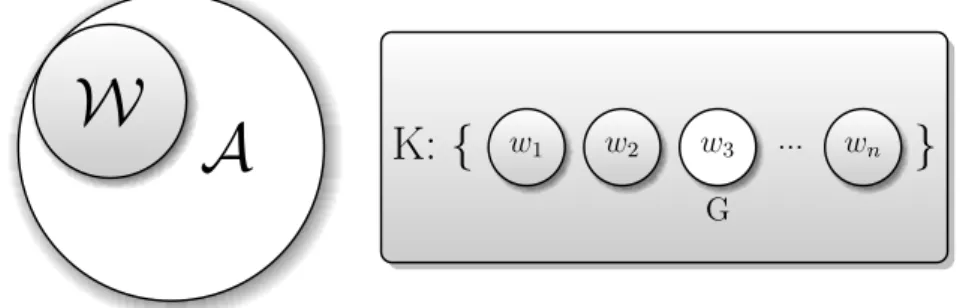
accessibility relation on the set of worlds K and the actual world G, is a member of K. Modal intensionalism replaces Kripke’s triple with another. In my own pre-sentation of modal intensionalism, the property (again, in the loose sense)being a world is part of the property being the actual world. Let A be the property being the actual world,W be the propertybeing a world, and P be the parthood relation on properties. Together, these three comprise the modal intensionalist’s ordered triple: hA,W, Pi. At the core of the semantics, W is a part ofA, an inversion of the modal extensionalist’s core where the actual world is a member of the set of worlds. This intensional inversion is apparent in the diagrams below:
A
W
K:
{
w1 w2 w3}
G
... wn
The modal extensionalist’s picture is the modal intensionalist’s pic-ture turned “inside out.” And, conversely, the modal intensionalist’s picture is the modal extensionalist’s picture turned “outside in.” They appear to be different sides of the same modal coin. This is one reason to be suspicious about rejecting one approachin toto in favor of the other. And, furthermore, this is one reason to be suspicious about the monopoly possible worlds semantics currently has on our modal theorizing.
But, you ask, why bother with another semantics given the success and elegance of Kripke semantics and possible world semantics? I have no objection to Kripke semantics as a purely formal enterprise. And I have no intention of supplanting it with the formal machinery I develop below. But surely there’s nothing wrong with having options, especially purely formal ones. So I see no harm in adding mine to the mix.
Possible worlds semantics is obviously an elegant tool for modeling our modal discourse. Philosophers have used possible worlds semantics to shed light on a number of age-old philosophical problems. Partly due to this success, philosophers began to analyze modal notions in terms of possible worlds. Countless metaphysical debates about the nature of possible worlds followed. But as I mentioned in Section I, possible worlds—whatever they are—don’t have much at all to do with modality on a fundamental level, either metaphysically or epistemologically. Even so, I think that possible worlds semantics is a sometimes-useful heuristic. And, what’s more, I do think ersatz world-surrogates exist. I just don’t buy into the possible worlds framework as a general approach to modal-ity. Each approach has its merits. The modal intensionalist approach just serves some purposes better.16
16Of course, I can’t justifiably claim that modal intensionalism is better suited for
any purpose without an intensionalist approach to quantified modal logic.
Fig. 2: Modal intensionalism (left) and modal extensionalism (right)
The modal extensionalist’s picture is the modal intensionalist’s picture turned “inside out.” And, conversely, the modal intensionalist’s picture is the modal extensionalist’s picture turned “outside in.” They appear to be different sides of the same modal coin. This is one reason to be suspicious about rejecting one approach in toto in favor of the other. And, furthermore, this is one reason to be suspicious about the monopoly possible worlds semantics currently has on our modal theorizing.
But, you ask, why bother with another semantics given the success and elegance of Kripke semantics and possible world semantics? I have no objection to Kripke semantics as a purely formal enterprise. And I have no intention of supplanting it with the formal machinery I develop below. But surely there’s nothing wrong
with having options, especially purely formal ones. So I see no harm in adding mine to the mix.
Possible worlds semantics is obviously an elegant tool for modeling our modal discourse. Philosophers have used possible worlds semantics to shed light on a number of age-old philosophical problems. Partly due to this success, philosophers began to analyze modal notions in terms of possible worlds. Countless metaphys-ical debates about the nature of possible worlds followed. But as I mentioned in Section I, possible worlds—whatever they are—don’t have much at all to do with modality on a fundamental level. Even so, I think that possible worlds semantics is a sometimes-useful heuristic. And, what’s more, I do think ersatz world-surrogates exist. I just don’t buy into the possible worlds framework as a general approach to modality. Each approach has its merits. The modal intensionalist approach just serves some purposes better.16
Modality’s reach is quite impressive, stretching from metaphysics and episte-mology to ethics and the philosophy of language. A new approach to modality provides opportunities to evaluate old debates in a new light. Though a new ap-proach may bring new problems, it may dissolve others. At any rate, the success of possible worlds semantics doesn’t justify its current monopoly on our modal theorizing.
In what follows, I outline an intensionalist approach to modal propositional logic, including the requisite machinery for an alternative to Kripke semantics. In the next two sections I explain two especially basic commitments of modal intensionalism. I’ve claimed that there are such properties as being a world and being the actual world. In the next section, I’ll explain what this claim means for the modal intensionalist. I’ve also claimed that these two properties bear a special parthood relation to one another. In the subsequent section, I’ll propose some axioms that may reasonably characterize this relation.
On
Being a World
Despite the widespread acceptance of possible worlds, some have doubted the very coherence of the concept of a world. Kant, for example understands the world as the sum total of all appearances, i.e., as the sum total of all objects and events in space and time (A420/B448).17 If there were such a world, it would transcend all possible experience. Kant claims the four antinomies show that transcendental realists’ mistakenly believe that there is such a thing. Some have expressed similar Kantian doubts. Bas van Fraassen (1995) argues that ‘world’ is not a count-noun and that there is no thing which corresponds to ‘the world’.18 A related worry concerns the status of absolutely unrestricted quantification. If a world is a collection of everything that exists, then one might question whether there could be such a thing or whether we could even refer to it.19 I shall assume that these worries are answerable, in principle. In any case, both modal extensionalism and modal intensionalism crucially depend on the idea that there is a world. Neither approach carries the special burden of discharging these worries. Modal extensionalists agree that there is at least one world. Of course, many modal extensionalists associate possible worlds with various sorts of abstracta. But these abstracta aren’t worlds in the same sense that our world is a world.20 Even these modal extensionalists agree that we live in a world. However, modal extensionalists disagree with one another about what it takes to be a world. There are two broad camps: those who think that everything in a world must be spatio-temporally interrelated and those who think that everything in a world must comprise everything that exists. Let’s call the first view of worldhood the interre-17He also recognizes a transcendental sense of “world” according to which the world is the “absolute totality of the sum total of existing things” (A420/B448).
18Others lodge Cantorian arguments against modal extensionalists who associate possible worlds with collections of maximally consistent sets of propositions. See, most recently, Ju-bien (2009).
19See the essays in Rayo and Uzquiano (2007).
latedness conception21 and the second view the totality conception.
Modal extensionalists also agree that only one world is actual. But they dis-agree with one another about what this means. And, again, there are roughly two camps. Some say that ‘actual’ is an indexical like ‘here’. Just as ‘here’ refers to the place of utterance, ‘the actual world’ refers to the world of utterance. Others say that everything there is (or exists) is actual. I’ll call the first view of actuality the indexical conception and the second view, the reality conception. The indexical conception of actuality can be paired unproblematically with either the interrelat-edness or totality conceptions of worldhood.22 But one cannot straightforwardly pair the reality conception of actuality with the interrelatedness conception. If everything is actual, even worlds spatio-temporally disconnected from ours, then each of these is actual and none merely possible. This pairing undercuts the appeal to worlds to make sense of mere possibility.
Though I favor the totality conception of worldhood, modal intensionalism is officially mum with respect to whether a world must be an interrelated whole or a complete totality. It’s also officially mum about whether ‘is actual’ is an indexical or whether it’s synonymous with ‘is real’ or ‘exists’. However, I will assume that one combination of views is unavailable, no matter which approach to modality one takes: the interrelatedness conception of worldhood with the reality conception of actuality.
Thus far, I have characterized modal intensionalism as a view that appeals to two properties: being the actual world and being a world. To facilitate the discussion, I shall continue to assume that these are properties in the loose sense of “property.” This is only fair: modal extensionalists appeal to possible worlds, but possible worlds might be spatio-temporally isolated universes, sets of propositions, states of affairs, structural universals, fictions, etc. There is also a wide range of metaphysical options for the modal intensionalist: these properties might be
21The most recent defender is David Lewis (1986).
predicates, concepts, states of affairs, universals, or something else. I require a term that is neutral between these options to delineate the broad commitments of modal intensionalism. And “property” is just as good as any. So for now, I shall call whatever those entities are that play a special role in my semantics “properties.”
The distinction between the abundant conception and the sparse conception of properties is fairly well understood.23 Roughly, sparse properties are those that make for qualitative similarity between intrinsic duplicates, like charge and mass. On the abundant conception of properties, there is a property for any of a wide range of English predicates—‘is tall or ugly’ expresses the property being tall or ugly and ‘is five miles from Cleveland’ expresses the property being five miles from Cleveland. The abundant conception of properties permits disjunctive and extrinsic properties like these, as well as two properties I’ve alluded to thus far: being the actual world and being a world. I shall proceed as if there is an abundant realm of properties, whether those properties end up being universals, concepts, or whatever. And I shall proceed as if being the actual world and being a world both populate the realm of abundant properties. This association is apt because it preserves the required metaphysical neutrality: one may identify properties on the abundant conception with some other kind of entity.24
But we can do more than just proceed “as if” these properties exist as long as we’re willing to set aside the Kantian worries noted above. Given an actual world, why not think there is a property being the actual world in the loose sense of “property”? This is no more problematic than saying that a baseball has the propertybeing a baseball, if the world is an interrelated whole, or that some atoms arranged baseball-wise have the propertybeing some atoms arranged baseballwise, if the world isn’t so much an interrelated whole but a multiplicity of things that
23See Lewis (1983) and Lewis (1986, 59-69).
jointly have some feature. There is a property, being the actual world, and the actual world has it.
The property being the actual world is the property of being this world. Here, I’m using ‘the actual world’ as a name which refers toour world. So the property of being the actual world is importantly different from the property being an actual world. The propertybeing an actual world is merely the property of being a world—nothing can be a world unless it’s an actual one. Something could have the propertybeing an actual world and also be such that George Washington never existed. But the propertybeing the actual world brings George Washington’s existence along with it because our world is such that George Washington exists. Furthermore, the properties being the actual world and being a world are not identical. Nothing can have the former property unless it’s such that George Washington exists, fights in the Revolutionary War, marries Martha, etc. Nothing could have the propertybeing the actual world, unless that something is our world. But things could have gone differently. George might have never been born, for example. George is important, but not so important that nothing could have the property of being a world unless it’s such that George exists. That George exists and fights in the War is part of being the actual world. But that he exists and fights in the War isn’t part of being a world. So there is something true of being the actual world that’s not true of being a world.
determinable property it falls under in a specific way.25 Similarly, being a world in which this or that happens is to be a world in a certain way. So being our world is being a world in a specific way—so specific that being the actual world cannot be a determinable relative to a further set of determinates. It is already maximally specified.
In addition, a determinable’s determinates must share certain features. Funkhouser (2006: 551) calls these non-determinable necessities. Triangles may differ in side-length—that is one determination dimension—but triangles must be three-sided. Similarly, George Washington might not have existed, but a world must be an interrelated whole or complete totality, depending on one’s conception of world-hood. Thus, the propertybeing the actual world behaves like a determinate of the property being a world.
Importantly, of the two properties, being the actual world has epistemological priority. We look around at the blooming, buzzing confusion of the actual world and infer that there is some property, the property of beingthis world. The more general property being a world is an abstraction from the property of being this world. In some sense, the propertybeing a world has lost a great deal of informa-tion encoded in the property of being this world. What’s left are the individually necessary and jointly sufficient conditions for worldhood in general. Given these differences, I conclude that the property of being a world isn’t identical to the property of being our world—not unless some strong form of necessitarianism is true.
On Parts of Properties
Officially, modal intensionalism takes no stand on the sort of intensional in-clusion relation that holds between being the actual world and being a world.26
25Funkhouser (2006: 548).
But I do—being a world is part of being the actual world. In this section, I pro-vide some intuitive support for this claim and propose some axioms that plausibly characterize this mereological relation.
The word ‘part’ has many different uses in English. In a familiar sense of ‘part’, desks and lamps have parts, as do cups and books. Or at least we’re inclined to talk among the folk as if they do. The claim that being a world is part of being the actual world lies at the heart of my intensional approach to modality. And this claim contains a common but less familiar sense of ‘part’.27 Lazy schoolboys and schoolgirls are quite familiar with this sense. The student complains about practicing the piano, and the parent quickly responds that practicing is “just part of being a good pianist.” This usage of ‘part’ is ubiquitous.28 We say that being honest is a part of being moral, that being rational is part of being human, and that “being rectangular is only part of being square.”29 These are perfectly meaningful uses of the word ‘part’. In this section, I provide an intuitive set of definitions and some possible axioms for the kind of relation or relations that hold between these properties.
In the realm of abundant properties, parts of properties are other properties. Not all abundant properties are purely qualitative and so the parthood relation is not something like “qualitative” parthood. Having a particular location in space or time is a property. Being identical to some particular thing is a property, too. Thus, the parts of properties need not be purely qualitative parts. They might also be logical, devoid of qualitative content. So I’ll borrow L.A. Paul’s (2002) term is not a species of intensional inclusion, but just intensional inclusion.
27This usage is briefly mentioned in Varzi (2009).
28Here are just a few examples: In a June 2009 New York Times article, Barack Obama says that “Part of being a good friend is being honest.” Found here: http://www.nytimes. com/2009/06/02/world/middleeast/02prexy.html? r=1. Tony Dungy says that “Part of being a leader at the quarterback position is protecting the football. Found here: http://espn.go.com/ blog/dallas/cowboys/post/ /id/4673175/tony-romo-invites-tony-dungy-to-valley-ranch. In the philosophical literature, I must also mention John Searle’s (1995, 34) famous examples: “Part of being a cocktail party is being thought to be a cocktail party; part of being a war is being thought to be a war.” And Michael Jubien (1996: 119) claims that “being coloured is part of being red.”
‘logical parthood’ for this relation, and I’ll call parts of properties logical parts. The definitions and axioms for logical parthood below differ from Paul’s for at least one simple reason: I’m interested in the mereological relationships between abundant properties while she’s interested in limning the mereological structure of objects under the umbrella of bundle theory. She argues that objects are fusions of properties; I merely claim that (abundant) properties are sums of properties. Obviously, then, we shouldn’t expect the axioms for Paul’s conception of logical parthood to match the ones below.
The axioms of Classical Extensional Mereology and plausible axioms for logical parthood don’t completely overlap. Below, I’ll explain where they diverge and how the axioms for logical parthod outstrip those of Classical Extensional Mereology. To simplify the discussion, I will frequently drop the ‘logical’ in ‘logical parthood’, ‘logical part’, etc. The variables here range over properties. Let ‘’ represent the chosen primitive, ‘is (a) proper part of’. With this primitive we define parthood, overlap, disjointness, and a general sum operator (and I adopt the convention of striking through an operator instead of placing a negation sign with wide-scope over that operator):30
(D1) x < y ≡x y ∨ x = y (D2) x ◦ y ≡ ∃z(z < x ∧z < y)
(D3) xoy ≡ x 6 ◦ y
(D4) σx(x <y) = ιz∀w(w◦z≡ ∃m(m < y ∧ w◦ m))
according to (D4), the logical sum of the properties that are parts of y is the property such that anything overlaps just in case it overlaps y.)
Two axioms straightforwardly carry over from Classical Extensional Mereology to the property mereology:
(A1) x y ⊃ y 6 x
(A2) x y ∧ y z⊃ x z
Axioms (A1) and (A2) imply that proper parthood is asymmetric and transitive, respectively. Logical parthood respects these axioms and definitions. Consider three properties,being rational,being mammalian, andbeing human. Suppose the propertiesbeing rational and being mammalian are parts—logical parts—ofbeing human.31 The property being human isn’t part of being rational. Presumably, there could be rational non-humans. So proper logical parthood seems asymmet-ric. It also seems transitive: being a vertebrate is a proper logical part of being mammalian, which is a proper logical part of being human. By transitivity, then, we should expect that being a vertebrate is part of being human. And it is. The axioms (A1) and (A2) seem to adequately characterize logical parthood.
But two other axioms of Classical Extensional Mereology don’t straightfor-wardly carry over. The two principles below are the property mereology coun-terparts of the weak supplementation principle and the general sum principle, respectively:
(A3) x y ⊃ ∃z(z y ∧ zox)
(A4) ∃x(x <w)⊃ ∃x∀y(y◦x ≡ ∃z(z <w ∧z ◦ y))
The principle (A3) says that any proper part of a property doesn’t overlap some other proper part of that property. It’s not obvious that this principle holds for properties. In fact, I think it fails universally. Pick any two properties, being φ and being ψ. It’s part of being each property that it is that property or the other. Thus, being φ or ψ is a part of both. So every pair of properties overlap. So no property has two disjoint parts. If this is correct, then (A3) doesn’t hold for logical parthood. What does hold is a related, though slightly weaker principle, what Varzi (2009) calls “strong company”:
(A3*) x y ⊃ ∃z(z y ∧ z6< x)
This princple says that anything with a proper part has at least two and that neither is a part of the other. Intuitively, this does hold for properties. Consider again the propertiesbeing rational, being mammalian, andbeing human. The first two properties are proper parts ofbeing human. But all three overlap: they all have the property being a property as a part. So they overlap, but (A3*) allows this. Logical parthood doesn’t obey the weak supplementation principle, but that’s not a reason to think that properties have no mereological structure. They do, and (A3*) better chacterizes that structure.32
Does (A4), the analogue of the general sum principle, hold for logical parthood? That is, is there a logical sum for any collection of properties? There is a reasonable worry about unrestricted composition. Call two properties inconsistent just in case one property has a part thatprecludes some part of the second property. The property being F has a part, itself, that precludes a part of the property being not-F, namely itself. So they are inconsistent properties. The worry is that (A4) guarantees the existence of inconsistent properties, like being F and not-F. This worry is easily assuaged. We may define a predicate ‘is consistent’ that applies to all and only the sums that have no pairs of properties that preclude one another.33 32The weak supplementation principle is disputed for spatio-temporal mereology anyway. For example, Kathrin Koslicki (2007) argues that Fine (1999) rejects the principle. Donald Smith (2009) also rejects it.
Consistent sums are the only sums of properties that are themselves bona fide properties. But inconsistent sums are sums of properties nonetheless.
Now there are a number of further principles one may adopt for logical part-hood. On the intuitive conception of logical parthood, being an animal is part of being a dog. But is it part of being a dog that being an animal is one of its parts? Or more generally, if a property p has another property q as a part, does p therefore have another part, being such that it has q as a part? Or more formally, we might wonder whether logical parthood obeys the following principle (where ‘[x <y]’ signifies the property being such that x is a part of y):
(P5) x < y ⊃[x < y] <y,
We shall call any parthood relation that satisfies (P5) ininclusive and the con-dition itselfininclusivity. There is, I think, some intuitive pull behind ininclusivity. We may judge that one property is a part of another because nothing could have the latter without having the former. There can be no dog unless there is an animal, so we may judge that being an animal is part of being a dog. But could the propertybeing a dog be the very property it is without havingbeing an animal as one of its parts? Of course not. So we may judge thatbeing an animal’s being a part ofbeing a dog is itself part ofbeing a dog. If logical parthood is ininclusive, then a property has an infinite number of parts if it has any parts. The iterations soon become too unwieldy for natural language. For this reason, the formalism in (P5) is useful: if ‘being an animal <being a dog’ is true, then so too is ‘[being an animal <being a dog]<being a dog’. And ifbeing an animal’s being part ofbeing a dog is itself part of being a dog, then by (P5),being a dog has another part: the property, [[[being an animal <being a dog] <being a dog]<being a dog]. And so on.
There is an additional principle one may adopt for logical parthood:
(P6) x < z∧ y < z⊃ [¬x ≮ y] <y
Call (P6) thefortified parts principle and any parthood relation that satisfies (P6) fortified. The fortified parts principle is a bit difficult to state in ordinary language, but I think it’s an intuitive principle for logical parthood. The idea is that if z has two parts, x and y, then something else holds even if x and y have no parts that preclude each other. It’s also built into y in a special way that its parts are consistent. Again, let’s consider the property being a dog. Intuitively, being an animal and being a mammal are two of its parts. So according to (P6), being a dog has two further parts. First, part of being a dog is that being not-an-animal isn’t a part of being a mammal. And, secondly, part of being a dog is that being not-a-mammal isn’t part of being an animal. If (P6) holds for logical parthood, then for every pair of some property’s parts, there are two further parts. This principle, too, implies that anything with a part has an infinite number of parts.
Ininclusivity, (P5), says that if a property has a part, it’s a part of that property that is has that part. Another related principle seems to hold for logical parthood:
(P7) x ≮ y ⊃ [x ≮ y] <y
That is, if x isn’t part of a property, it’s a part of that property that x isn’t a part of it. I call this condition inexclusivity and any parthood relation that satisfies it inexclusive. Ininclusivity tells us that if something has parts, it has parts that detail what parts it has. Inexclusivity does something slightly different: it says that if something doesn’t have some properties for parts, it has parts that detail what parts it doesn’t have. As long as something’s not being a part of a property is always a proper part of that property, (P7) implies that there are no simple or atomic properties. Either a property has every other property as a proper part or it doesn’t. If it does, then it has proper parts. If it doesn’t, then there is some property that it doesn’t have as a proper part. But, then, according to (P7), it does have another proper part, the property that it doesn’t have that other property as a part.
in Section 6, each of these plausible axioms for logical parthood is a possible restriction one may place on P (the parthood relation in my ordered triple). And each possible restriction on P secures the key modal axiom of some modal system. I’ll show as much in Section 6.
Modal intensionalism depends crucially on two claims. First, that there are properties like being a world and being the actual world. And, secondly, that properties have other properties as parts. These claims are reasonable given the theoretical backdrop provided in these last two sections. In the next section, I unveil the gears that make modal intensionalism go.
Modality with One World
We live in a world, the actual world. From this we can infer that there is a propertybeing the actual world. And then we can abstract from this property and infer that there is another less specific propertybeing a world. Intuitively,being a world is a determinable of the determinate property being the actual world. But notice that if there is a property such as being a world then anything which has it has to be a certain way. For instance, if one holds the totality conception of worldhood, whatever has the property has to be a totality of everything that exists. Or if one holds the interrelatedness conception of worldhood, whatever has it has to be such that its spatio-temporal parts are related in a special way.
a world to exist is actually the case. Thus, being such that these things are the case is part ofbeing a world. So if anything has the property being a world, it has every one of that property’s parts: being such that 2 is even, being such that 3 is odd, and so on. The property being a world is a mereological sum of properties. Not only does it have parts like being a totality of everything that exists, it also has all those propositional properties that anything must have in order for a world to exist at all.
Now to the formalism. I’ll only concern myself with the formalism underlying an intensionalist approach to the modal propositional calculi. An intensionalist approach to any logic requires that intensional inclusion relations among properties determine the assignment of truth-values. Thus, an intensionalist approach to the modal propositional calculi requires that there are properties associated with propositions.
There is a function from propositions to the relevant properties. Start with the usual stock of proposition letters p0, p1, p2, ... , which represent propositions not further analyzed. Modal propositional logic contains non-atomic propositions, too. Those non-atomic propositions require connectives. So let’s include the connec-tives written ¬, ∧, ∨, and ⊃, which represent negation, conjunction, disjunction, and the material conditional, respectively. Now let ‘[...]’ represent the function which takes us from a proposition to the property of being such that the propo-sition holds. So given some propopropo-sition φ, [φ] is the property, being such that φ. Thus, for every such proposition φ, there is the property [φ], or being such that φ. The function even takes negated propositions: given some negated proposition¬φ, we get [¬φ], the property being such that not-φ. Similar remarks apply, mutatis mutandis, to all other non-atomic propositions. Thus, there is a 1-1 function from propositions to properties via the function ‘[...]’.
world.34 Remember, being the actual world is a property that “brings along” everything that holds in our world, like George Washington’s existence. Where A is the property being the actual world, modal intensionalism treats the truth of a proposition with respect to to A:
(A) ‘φ’ is true =df. [φ] <A
Consequently, here’s how this treatment of truth “looks”:
a property that “brings along” everything that holds in our world, like George Washington’s existence. Where A is the propertybeing the ac-tual world, modal intensionalism treats the truth of a proposition with respect to to A:
(A) ‘φ’ is true =df. [φ] < A
Consequently, here’s how this treatment of truth “looks”:
A
[φ]For any property [φ],being such thatφ, if [φ] is a part ofA, then [φ]’s corresponding proposition φ is true. The propositionsφ and ¬φ cannot both be true because there are no true contradictions. That is,being the actual world is presumably a consistent property and the properties [φ] and [¬φ] preclude one another. Therefore, if [φ] is a part of A, [¬φ] is not a part ofA, and vice versa.
This suggests a range of principles that govern how these proposi-tional properties relate to A. The following principles follow from our intuitive understanding of ‘if...then’ statements, ‘...and...’ statements , etc. These principles secure the most basic inferences in propositional logic: (i) that if [p ⊃ q] and [p] are parts of A, so is [q], (ii) that if [p
∧q] is part of A, so are [p] and [q], (iii) that if [p] is part ofA, so is [p
∨q], and (iv) that if [p] is part of A, [¬¬p],being such that it isn’t the case that it isn’t the case that p, is also part ofA.
Where W is the property being a world, we can now characterize necessity in modal intensionalist terms:
tions. In that sense, I do think that truth is “intensional.” Most think that truth is extensional, and I basically agree. On my approach to propositional logic, one true proposition may be substituted for any other true proposition salva veritate. My treatment of predicate logic is a more complicated story, but there, too, I want to claim that truth is extensional in the sense that most think it is.
24 Fig. 3: Truth according to modal intensionalism
For any property [φ], being such that φ, if [φ] is a part of A, then [φ]’s cor-responding proposition φ is true. The propositions φ and ¬φ cannot both be true because there are no true contradictions. That is, being the actual world is presumably a consistent property and the properties [φ] and [¬φ] preclude one another. Therefore, if [φ] is a part of A, [¬φ] is not a part of A, and vice versa.
This suggests a range of principles that govern how these propositional proper-ties relate to A. The following principles follow from our intuitive understanding of ‘if...then’ statements, ‘...and...’ statements , etc. These principles secure the most basic inferences in propositional logic: (i) that if [p ⊃q] and [p] are parts of
part of A, so is [p ∨ q], and (iv) that if [p] is part of A, [¬¬p], being such that it isn’t the case that it isn’t the case that p, is also part of A.
Where W is the property being a world, we can now characterize necessity in modal intensionalist terms:
(N) ‘φ’ is true =df. [φ]< W
So if being such that φ is part of being a world, φ is necessary for any proposition φ. Principle (N) “looks like” the picture below:
(N) ‘�φ’ is true =df. [φ] <W
So if being such that φ is part of being a world, φ is necessary for any proposition φ. Principle (N) “looks like” the picture below:
A
W
[φ]This picture suggests a number of other principles analogous to the prin-ciples which secure the basic logical inferences in propositional logic: (i) that if [p ⊃ q] and [p] are parts of W, so is [q], (ii) that if [p ∧ q] is part of W, so are [p] and [q], (iii) that if [p] is part ofW, so is [p ∨q], and (iv) that if [p] is part of W, [¬¬p],being such that it isn’t the case that it isn’t the case that p, is also part ofW. These principles validate a number of intuitive modal inferences: (i) validates the inference from
�(p⊃q) and�p to�q; (ii) validates the inference from�(p∧q) to�p; (iii) validates the inference from �p to �(p ∨q); and (iv) validates the inference from �p to�¬¬p.
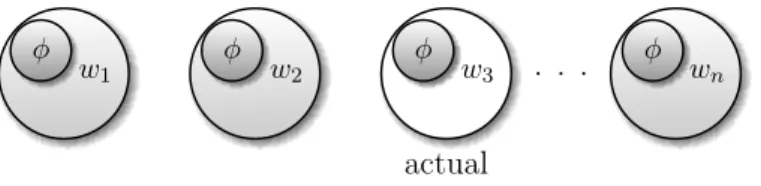
Modal extensionalism “looks” quite different. According possible worlds semantics, modal operators function implicitly like quantifiers over a domain of possible worlds. On this approach, what’s necessary is what’s true in every possible world. Here is what the necessity of some proposition φ“looks like” according to the modal extensionalist:
w1 φ w2 φ w3 actual
φ . . .
wn
φ
Traditionally understood, the necessity and possibility operators are interdefinable: �φis equivalent to¬♦¬φ, and¬�¬φis equivalent to♦φ.
25
Fig. 4: Necessary truth according to modal intensionalism
This picture suggests a number of other principles analogous to the principles which secure the basic logical inferences in propositional logic: (i) that if [p ⊃ q] and [p] are parts of W, so is [q], (ii) that if [p ∧ q] is part of W, so are [p] and [q], (iii) that if [p] is part of W, so is [p ∨ q], and (iv) that if [p] is part of W, [¬¬p], being such that it isn’t the case that it isn’t the case that p, is also part of
W. These principles validate a number of intuitive modal inferences: (i) validates the inference from (p⊃ q) and p to q; (ii) validates the inference from (p
∧ q) to p; (iii) validates the inference from p to (p ∨ q); and (iv) validates the inference from p to ¬¬p.
to the modal extensionalist:
(N) ‘�φ’ is true =df. [φ] <W
So if being such that φ is part of being a world, φ is necessary for any propositionφ. Principle (N) “looks like” the picture below:
A
W
[φ]This picture suggests a number of other principles analogous to the prin-ciples which secure the basic logical inferences in propositional logic: (i) that if [p ⊃ q] and [p] are parts of W, so is [q], (ii) that if [p ∧ q] is part ofW, so are [p] and [q], (iii) that if [p] is part ofW, so is [p ∨q], and (iv) that if [p] is part ofW, [¬¬p],being such that it isn’t the case that it isn’t the case that p, is also part ofW. These principles validate a number of intuitive modal inferences: (i) validates the inference from
�(p⊃q) and�p to�q; (ii) validates the inference from�(p∧q) to�p; (iii) validates the inference from�p to�(p ∨q); and (iv) validates the inference from�p to �¬¬p.
Modal extensionalism “looks” quite different. According possible worlds semantics, modal operators function implicitly like quantifiers over a domain of possible worlds. On this approach, what’s necessary is what’s true in every possible world. Here is what the necessity of some propositionφ“looks like” according to the modal extensionalist:
w1 φ w2 φ w3 actual
φ . . .
wn
φ
Traditionally understood, the necessity and possibility operators are interdefinable: �φis equivalent to¬♦¬φ, and¬�¬φis equivalent to♦φ.
25
Fig. 5: Necessary truth according to modal extensionalism
Traditionally understood, the necessity and possibility operators are interde-finable: φ is equivalent to ¬♦¬φ, and ¬¬φ is equivalent to ♦φ. Therefore, I characterize possibility in terms of this parthood relation also. If ‘φ’ is true if and only if the corresponding property [φ] is part of W, then ‘♦φ’ is true if and only if the property corresponding to the negation of φ, [¬φ], is not a part of W. In other words, if [¬φ] is part of W, then the proposition ¬φ is necessarily true and the proposition φ necessarily false. So φ is only possible if and only if [¬φ] is not part of W. Thus:
(P) ‘♦φ’ is true =df. [¬φ]≮ W
If ¬φ is necessarily true, i.e., if [¬φ] < W, then we shall say that W precludes φ because φ is therefore not possible. Thus, the possible is that which W doesn’t preclude.
Let’s pause to take stock. The modal intensionalist approach to modal propo-sitional logic treats the truth of modal formulas (and propositions generally) as depending on parthood relations between properties. There are two special prop-erties,being a world andbeing the actual world, and the former is part of the latter. A frame, according to the modal intensionalist, consists of the ordered triple hA,
W, Pi, where W is the property being a world,A is the property being the actual world, and P is a binary relation on properties which defines the parthood relation between them.
In the next section, I explain how different restrictions on the parthood relation can secure various axioms of modal logic.
Restrictions on the Parthood Relation
Part of the elegance of possible worlds semantics is that the accessiblity relation can be tweaked to validate certain modal formulas and invalidate others. Because an alternative semantics must do the same, I shall briefly explain how possible worlds semantics accomplishes these tasks and how the modal intensionalist does the same.
In possible worlds semantics, p is necessarily true in a world w iff p is true in every possible world accessible to w. And what worlds are accessible to others depends on the set of ordered pairs of worlds, R. A world w0 is accessible from
another world w just in case hw, w0i is an ordered pair in R. If p is true in all
accessible worlds, p is necessarily true. And p is possibly true in w just in case p is true in some possible world accessible fromw. For example, if hw1, w2iis in R, and p is true in w2, then p is possibly true in w1.
The weakest normal modal logic contains an axiom according to which dis-tributes over the conditional:
(K) (p⊃ q) ⊃ (p⊃q)
According to possible worlds semantics, (K) holds for the following reason. If ‘(p ⊃ q)’ is true in every accessible possible world, then there is no accessible possible world in which ‘p’ is true but ‘q’ is false. So if ‘p’ is true—i.e., if p is true in every accessible possible world—then since there is no accessible possible world in which ‘p’ is true but ‘q’ is false, q is also true in every accessible possible world.
one may translate any axiom into the intensionalist system. And then one may generalize the translation to secure some condition on P. By happy coincidence, the resulting generalizations from the (M), (S4), (B), and (S5) axioms secure the very parthood principles surveyed in Section 4. And (K) itself follows from one of the principles that governs how propositional properties relate to properties such as W and A.
Let’s consider (K) in more detail. Using the translation scheme, ‘(p ⊃q)’ is true just in case the property being such that if p, then q, or [p ⊃ q], is part of
W. If that’s true, then it’s just part of being a world that if p holds, q holds, too. But suppose thatbeing such that p, or [p] is part of being a world. Then q is also part ofW, given the principles from Section 4 that govern how these propositional properties relate to W.
In possible worlds semantics, the accessibility relation may have various fea-tures depending on which ordered pairs are members of R. Doing without the more cumbersome ordered pairs, we shall say that a world w0 is accessible to a worldw just in casewRw0. If every world is accessible to itself, the accessibility relation is
reflexive. In the T system of modal propositional logic, R is reflexive, i.e., for all worldsw,wRw. In the T-system, the following formula is an axiom, and it secures the reflexivity of the accessibility relation:
(M) p⊃ p
Let’s assume that the accessibility relation is reflexive. Then, if p is true in every world accessible to w andw is accessible tow, p is also true inw. Conversely, if p is true in w and w is accessible to itself, then p is also possibly true inw. Possible worlds semantics provides an elegant and convenient way to secure (M).
Since a proposition is necessarily true if and only if its corresponding property is a part of W, it therefore must also be true because its corresponding property is a part of A. Those who desire to validate the M Axiom should therefore adopt the transitivity condition for the parthood relation P:
(A2*) x < y ∧y <z ⊃ x <z35
The transitivity of parthood is widely adopted. Intuitively, the principle also holds for logical parthood, as I argued in Section 4.
Onward. According to possible worlds semantics, the accessibility relation is transitive just in case the following relation holds between worlds: for all worlds, ifwRw0 and w0Rw00, thenwRw00. The following is an axiom of S4, a system which requires transitivity of R:
(S4) p⊃ p
Thus, having a transitive accessibility relation between worlds validates both the inference that what is necessary is necessarily necessary and the inference that what is possibly possible is possible.
On the intensionalist approach, the ininclusivity principle, (P5) x < y ⊃[x < y] <y,
validates the (S4) axiom. The ininclusivity condition ensures that if the property [φ] is in W, then another property is in W, namely [[φ] < W]. We’ve already stipulated that necessity amounts to being a part of W. If the property [φ] is a part of W, then the corresponding proposition φ is necessarily true; so if [φ]’s being a part of W is itself a part of W, then φ is necessarily necessarily true.
In possible worlds semantics, the accessibility relation may be symmetric as well. The accessibility relation is symmetric just in case, for any worldsw and w0,
ifwRw0 thenw0Rw. R is symmetric in the system B and the following is an axiom
of that system:
(B) p ⊃♦p
On the intensionalist approach, the fortified parts principle,
(P6) x < z∧ y < z⊃ [¬x ≮ y] <y,
validates the B axiom. To bring this out, let’s make a number of substitutions. Substitute [φ] for x, W for y, and A for z so that: [φ] < A ∧ W < A ⊃ [[¬φ] ≮
W] < W. The idea is that if [φ] is a part of the property being the actual world, then not only is [¬φ] not a part of W, but it is a part of W that [¬φ] is not a part of W. The fortified parts principle validates the B axiom as follows. If [φ] is part of A (i.e., if [φ] ’s corresponding proposition p is true), then the property [¬φ]’s not being a part of W is a part of W (i.e., then the proposition¬p’s being possibly true is necessary).
And, finally, in possible worlds semantics R is Euclidean if the following con-dition holds: for all worlds, ifwRw0 and wRw00, then w0Rw00. S5 is an example of
a system with a Euclidean accessibility relation. S5 is equivalent to S4 plus the B axiom (so the accessibility relation isn’t merely Euclidean), and the following is an axiom of S5:
(S5) ♦p⊃ ♦p
While (B) ensures that what is actual is necessarily possible, S5 ensures the stronger claim that what is possible is necessarily possible. All modal truths are necessary in S5.
To validate S5, we require the inexclusivity condition for P (with negations before the ‘x’ for ease of presentation):
(P7) ¬x ≮ y ⊃ [¬x ≮y] < y
And then it follows from (P7) that p’s being possibly true is necessary, by (N). And that is just another statement of the S5 axiom.
My intensional interpretation of the modal propositional calculi replaces the accessibility relation R between worlds with a parthood relation P between prop-erties. For the most common restrictions on accessibility, there are analogous restrictions on parthood. The transitivity of parthood is analogous to the reflexiv-ity of the accessibilreflexiv-ity relation. The ininclusivreflexiv-ity of parthood ensures the validreflexiv-ity of the S4 axiom just as the transitivity of the accessibility relation does. And, finally, the fortified parts principle and inexclusivity of the parthood relation val-idate the B and S5 axioms, respectively, just as if we were to require that the accessibility relation were symmetric and Euclidean.
Semantics and the Systems
The modal intensionalism I have developed thus far replaces Kripke’s triple,
hG, K, Ri, with another, hA, W, Pi. In this ordered triple, A is the property, being the actual world, W is the property being a world, and P is a set of ordered pairs which defines the parthood relation. We’ve seen how the various constraints on the parthood relation can validate the axioms of some popular modal systems. Below, I shall suggest how we might use the sort of intensional semantics I sketched above for the S5 system and weaker systems.
The S5 System