Gina Wessinger. Readers’ Advisory in the Public Library: A Look at the Promotion of Diverse Literature to Teens. A Master’s paper for M.S. in L.S. degree. April, 2019. 35 pages. Advisor: Sandra Hughes-Hassell
Teens are reading, and libraries are helping teens read. One way that libraries are helping teens read is through readers’ advisory, the recommendation of books to readers for the purpose of pleasure reading. In the library field, there is a recognition of the need for diverse literature and its positive impacts. This study investigates the perspectives of librarians and library staff on readers’ advisory, with special attention to the promotion of diverse literature. Interview data and document analysis showed that librarians are
performing readers’ advisory often, and teens are taking advantages of the different advisory opportunities provided by the libraries. The librarians view diverse literature as valuable and do promote it, though none cited promoting diverse literature as a guiding principle in readers’ advisory.
Headings:
Readers’ advisory services
Public libraries
READERS’ ADVISORY IN THE PUBLIC LIBRARY: A LOOK AT THE PROMOTION OF DIVERSE LITERATURE TO TEENS
by Gina Wessinger
A Master's paper submitted to the faculty of the School of Information and Library Science of the University of North Carolina at Chapel Hill
in partial fulfillment of the requirements for the degree of Master of Science in
Library Science.
Chapel Hill, North Carolina
April, 2019
Approved by:
__________________________
Table of Contents
Introduction……….………..2
Literature Review ……….………3
Readers’ Advisory ……….…….……....3
Teens in the Library ………6
Diverse Literature ………...7
Methods ……….………...9
Methodology ………...9
Data Collection ……….10
Data Analysis ………11
Findings ……….………13
Interviews ………..13
Document Analysis ………...18
Discussion ……….……….20
Implications ………...24
Limitations & Future Research ……….25
Conclusion ……….………26
References ……….28
Appendix A: Interview Guide ………....31
Introduction
Many people associate the purpose of public libraries with books: the collection
of books, the storage of books, the care of books, and the dissemination of books. While
public libraries throughout the United States are adapting to the twenty-first century and
embracing more than just books, it cannot be denied that books are still a major part of
library operations. This is certainly true for libraries that serve teens, as teens are
definitely reading. For librarians and library staff, an implication of teen patrons who
read is that services like reader’s advisory are essential.
When it comes to what teens want to read, they want to see themselves. Teens
seek books with characters whose lives relate to their own. As such, this should be a
focus for librarians when working on collection development. Collecting books that
reflect the lives and identities of teens is important for encouraging lifelong readers.
Many librarians have made it a priority to collect books with diverse representation and
books that reflect the identities of the teens living in their communities; however, are
librarians just collecting diverse titles or are they also promoting them? This is the basis
for my research question: To what extent do library staff at public libraries in urban areas
of North Carolina consider diverse representation in books when performing readers’
Literature Review
Readers’ Advisory
Readers’ Advisory (RA) seems like it would be one of the most common aspects
of the job for librarians and library staff. After all, for many people, when they think of
libraries, they think of books, and when they think of library staff, they think of
knowledge about books. Even with this idea that RA is a major part of library staff’s
work day, there are different ideas in the field about the purpose and benefits of RA.
In his 2014 article, “Time to Rethink Readers’ Advisory Education?,” Bill
Crowley advocates for a new understanding of RA that values the ways that reading
promotes learning and literacy. Much of Crowley’s article is framed to address how
viewing RA in terms of learning and literacy can please those who affect library funding,
which he considers to be reason enough to refocus RA during times of economic
hardship. Additionally though, Crowley argues for a fundamental change to RA theory:
that reading for pleasure and pleasure alone ignores the advantages of reading and its
benefits to society. Indeed, “an RA service that is focused solely on leisure reading and
lacks emphasis on the numerous advantages of simple reading volume is a program that
diminishes its perceived value to helping solve the illiteracy and resulting adult
employment problems that so often plague personal, educational, and civic agendas,”
(Crowley, 2014, p. 40). Thus, those who perform RA should take into account how
In his article, “Readers’ Advisory: The Who, the How, and the Why,” Duncan
Smith responded to Crowley’s ideas about the future of RA. In “The Why” section of his
article, Smith agrees that in discussion with library stakeholders, we should stress all
values of readings; however, Duncan cites a study by Catherine Sheldrick Ross, in which
readers told her “that books they read for pleasure had awakened them to new
perspectives; provided role models that supported or validated their identity; gave
reassurance, comfort, and confirmed the reader’s self-worth; provided a connection to
other and conveyed an awareness of not being alone; gave them courage to make a
change; and increased their acceptance of themselves and other,” (Smith, 2015, p. 15).
Noting these reader experiences, he urges that we do not “privilege learning to the
exclusion of leisure reading and its importance to our users and its positive benefits to our
communities,” (Smith, 2015, p. 15).
This question of the purpose of RA is visible in the varied definitions and nuances
seen in the literature. In Joyce G. Saricks’s central text, Readers’ Advisory Service in the
Public Library, she defines RA as “a patron-centered library service for adult leisure
readers… in which knowledgeable, nonjudgmental staff help fiction and nonfiction
readers with their leisure-reading needs,” (2005, p. 1). Methods of RA, according to
Saricks, include the readers’ advisory interview; an inviting physical space, including
signage, accessible shelving and space, visibility of readers’ advisors, and a generally
welcoming atmosphere; segregated genre collections, though this should be carefully
done for a specific community of users; book displays; bookmarks; annotated book lists;
booktalks; and book discussion groups (2005). In The Readers’ Advisory Guide to Teen
Carstensen asserts that Saricks’s definition must be expanded when applied to teen
readers (2018). Teens need RA services to find books for assigned reading, not just
leisure reading; reading for teens includes a variety of formats, like audiobooks; and RA
for teens should include television and movies, in addition to books (Carstensen, 2018,
pp. 3-4). Methods of RA for teens, according to Carstensen, are the same as the methods
proposed by Saricks. While Saricks’s definition of RA seems to be reflected by Smith’s
understanding of the purpose of RA, Carstensen’s aligns more with Crowley’s. Perhaps
this is because when understanding the reading habits of teens, it is difficult to separate
reading as a leisure activity and reading as a school assignment. Furthermore, Carstensen
notes many advantages of reading for pleasure, including that “reading builds the crucial
skill of reading comprehension and, along the way, improves test scores,” (2018),
something with which Crowley would certainly agree.
Whether one feels that RA is necessary for the sake of supporting and preserving
leisure reading or for enhancing the learning experience of readers during leisure reading,
RA remains an important part of serving library patrons. Regardless, the formula for
performing RA is basically the same. RA can often look like a reference interview for
recreational reading, which according to Booth, includes “the approach, the interview,
and the presentation of options and resolution,” (2007, p. 20). When performing this
interview with teens, it is necessary to acknowledge the “developmental qualities of
adolescence,” and engage in “active and empathetic listening,” so that teens know that
librarians and staff “are helping adults who want to assist them in finding recreational
reading,” (Booth, 2007, p. 29). While some library staff might consider the face-to-face
books. Some indirect forms of RA include creating booklists, book displays, and online
resources to recommend books. These indirect techniques are essential forms of RA to
ensure that library staff are equitable in their service and can reach patrons in as many
ways as possible (Booth, 2007, p. 122).
Teens in the Library
In a study published in 2007, Denise Agosto surveyed teens in public libraries
about their reasons for visiting the library. Agosto (2007) organized their responses into
three categories: the library as an information gateway, the library as social
interaction/entertainment space, and the library as beneficial physical environment. For
each of these categories of reasons for visiting the library, Agosto gave suggestions for
how the library can support these needs of teens. In both the library as an information
gateway and the library as beneficial physical environment, she gave recommendations
that would fall under the RA umbrella, including “create eye-catching displays of new
YA books, and provide forms for teens to recommend new titles and new series to
collect,” and “create a Web page with links to vocabulary-building games and lists of
great books” (Agosto, 2007, p. 61).
In a study published in 2006, Hughes-Hassell and Lutz found that of the urban
teens surveyed, seventy-three percent read as a leisure activity (p. 40). Even though some
of those teens read more than others, the fact remains that urban teens are reading in their
free time. Additionally, “the school library and public library are among the teens’
primary sources for reading materials,” (Hughes-Hassell & Lutz, 2006, p. 43). Because
urban teens are reading and are using the library to do so, there is a clear opportunity for
importance that librarians consider the subject matter of their recommended reading
materials. Hughes-Hassell and Lutz encourage librarians “to make an effort to provide
materials that reflect students’ interests, such as celebrities, sports, and popular culture, as
well as items that address multicultural and urban topics,” (2006, p. 44). Librarians can
best serve teens through RA when considering teen interests.
Diverse Literature
In 1990, Rudine Sims Bishop published an article entitled “Mirrors, Windows,
and Sliding Glass Doors,” in which she explained that books can be windows through
which the reader can view a different world or books can be sliding-glass doors, where
the reader can enter the world of the book through their imagination. Books can also be
mirrors, when it “transforms human experience and reflects it back to us, and in that
reflection we can see our own lives and experiences as part of the larger human
experience,” (Bishop, 1990). It is necessary for all teens to be able to see themselves
reflected in books and to see experiences different from their own. When teens cannot
find books that reflect their lives and experiences, it communicates to them “how they are
devalued in the society of which they are a part,” and on the flip side of that, when teens
are exposed to books that only reflect their own experience, they can “grow up with an
exaggerated sense of their own importance and value in the world – a dangerous
ethnocentrism,” (Bishop, 1990). It is necessary for everyone to be exposed to books about
diverse characters, not just stories reflecting the dominant members and values of society.
Despite calls for greater diversity in literature throughout the 20th century
(Larrick, 1965; Myers, C., 2014; Myers, W.D., 2014), there has been little progress. The
University of Wisconsin-Madison, documents the number of books that they receive that
are by and about people of color and people from First/Native Nations. The statistics
from the CCBC, starting in 1985, show us that while there has been small improvement
in diverse representation in publishing, this improvement has been very slow.
In April 2014, authors Ellen Oh and Malinda Lo engaged in an exchange on
Twitter in which they expressed frustration around the lack of diversity in children’s
books. Later that month, author Aisha Saeed first used the hashtag
#WeNeedDiverseBooks, which began to trend within days. From this, We Need Diverse
Books was born as a non-profit organization who describes themselves as “a grassroots
organization of children’s book lovers that advocates essential changes in the publishing
industry. Our aim is to help produce and promote literature that reflects and honors the
lives of all young people,” (We Need Diverse Books [WNDB], 2018). We Need Diverse
Books is run by volunteers of all identities and professions, including librarians. The
existence of an organization like this (not to mention many others with similar goals) is
evidence that books for teens are changing for the better, and it is necessary for librarians
Methods
The study investigates the perspectives of public librarians on performing readers’
advisory to teens. Specifically, this study seeks to understand what librarians see as the
value of RA, how they perform RA, and what principles guide their work when giving
RA to teens. Special attention is given to the promotion and inclusion of diverse literature
in RA.
Methodology
I conducted this study from a constructivist ontological and epistemological
paradigm (Lincoln, Lynham, & Guba, 2011). This means that ontologically, I understand
reality to be relative to each human being. Epistemologically, I understand knowledge to
be constructed, that people apply different meanings and develop different
understandings based on their subjective experiences in the world (Lincoln et. al, 2011).
To access these subjective meanings, my study draws on principles from grounded theory
methodology. Charmaz (2006) describes grounded theory methods as “a set of principles
and practices, …not methodological rules, recipes, and requirements,” (p. 9). This
methodology works to create theory “grounded” in data from the participants, which
gives authority to the subjective experiences of the participants (Charmaz, 2006;
Creswell, 2013). This was appropriate for my research question because the focus of my
study is public librarians’ subjective understandings of performing reader’s advisory. To
gain access to the participants’ perspectives and understandings, I engaged in two
is consistent with grounded theory methods to gather several types of data and use
various data-gathering strategies in order to attempt “to enter [the participants’] settings
and situations to the extent possible,” (Charmaz, 2006, p. 14). Semi-structured qualitative
interviews provide a gateway into the perspectives of the participants, through their own
words, on readers’ advisory. The documents collected were forms of readers’ advisory,
like brochures and booklists, both on paper and online. The documents served as concrete
examples of the participants’ readers’ advisory in practice.
Data Collection
The population for this study is librarians and library staff who work with teens at
public libraries in and near urban areas of North Carolina. To determine the sample, I
contacted public libraries in and near urban areas of North Carolina, as defined by the
2010 United States Census Bureau. I contacted specific employees at the libraries based
on their work with teen patrons, which is known as purposive sampling. I began
contacting those libraries in order based on accessibility for me, in the hope of
conducting the interviews face-to-face at the libraries themselves. This proved to be
successful, as all of my interviews were conducted in person. I interviewed four librarians
and one library assistant. There were four women and one man who participated in
interviews. Four of the participants identified as white and one identified as African
American.
To conduct the semi-structured interviews, I worked from an interview guide
(Appendix A). The first questions sought to gain information about the librarians’ RA
practices, such as frequency, kinds of activities, and any RA performed outside of the
differ based on a targeted population. These questions were meant to gain information
about RA, but also give the opportunity to bring diverse literature into the conversation.
The final question had multiple parts, beginning with personal guiding principles of RA.
It was in the follow-up to this question that I inquired about promoting diverse literature
as a guiding principle and asked further about its value and specific times to highlight it.
During the interviews, I used a voice recording device to create an audio file of
the interview. When necessary, I took short notes by hand to describe items shown to me
during the interview. In order to preserve the confidentiality of those interviewed, I stored
them on a password protected device. In collecting the documents for analysis, I asked
the participants if they had any physical booklists or book displays that I could see while
at the library, and then I also explored the library website to find more examples of
readers’ advisory available there.
Data Analysis
To analyze the data gathered from the interviews, I coded each interview as they
were conducted and transcribed. I employed a constant comparison process to analyze
each interview alongside those already collected as each new interview was completed
(Kolb, 2012, p. 83). As I conducted each interview, I also analyzed the documents I
collected. By doing this, the themes and categories that emerged from the interviews and
collected documents evolved gradually throughout the data collection process.
I identify as a white, straight, cis-gendered woman. I have lived in the American
South for the twenty-six years of my life, and at various times, I have witnessed overt and
subtle discrimination toward many people whose identities differ from my own. From
a personal empowerment to resist and end discrimination toward marginalized people.
Knowing all of this, it is possible that my subjective point of view may influence my
analysis of the results of this study. Charmaz notes that researchers “are not passive
receptacles into which data are poured,” and thus, researchers “are obligated to be
reflexive about what [they] bring to the scene, what [they] see, and how [they] see it,”
(2006, p. 15). Nevertheless, the purpose of this study is to explore the role of diverse
representation in reader’s advisory for teens, so my critical lens could serve to highlight
Findings
In this section, I will begin by describing the findings from the interviews. These
findings are organized by the intent of the questions, beginning with how the librarians
perform RA, then why it is valuable to do so, next their guiding principles for RA, and
concluding with their responses about diverse literature. After the interviews, I describe
the findings from document analysis, beginning with the physical book displays in the
library, followed by the resources available on the library websites.
Interviews
The definition of RA given at the beginning of each interview was: “Readers’
advisory is the recommendation of books to readers for the purpose of pleasure reading.
It can take many forms including book displays, bulletin board displays, book lists
(bookmarks, website lists, etc.), formal and informal book talks, and the one-on-one
interview,” (Appendix A).
Questions 1 and 3-5 were designed to learn about the librarian’s RA activities.
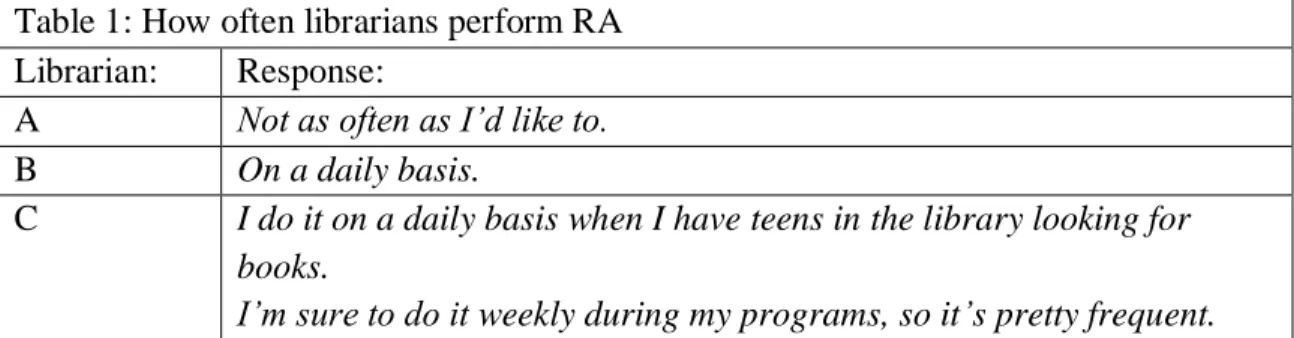
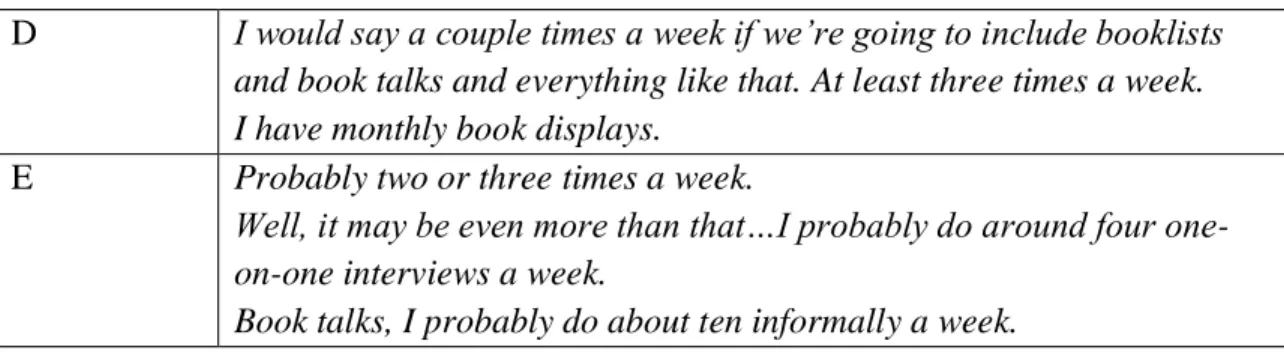
Table 1 shows how often the librarians perform RA to teens, including passive forms of
RA.
Table 1: How often librarians perform RA Librarian: Response:
A Not as often as I’d like to. B On a daily basis.
C I do it on a daily basis when I have teens in the library looking for books.
D I would say a couple times a week if we’re going to include booklists and book talks and everything like that. At least three times a week. I have monthly book displays.
E Probably two or three times a week.
Well, it may be even more than that…I probably do around four one-on-one interviews a week.
Book talks, I probably do about ten informally a week.
All five librarians spoke to a variety of different forms of RA, including the one-on-one
interview, interviews with a teen and their parent, booklists, bibliographies, book
displays, and book talks. Table 2 lists the kinds of RA that four of the librarians think is
most successful. Librarian B was unsure of kind of RA was most successful for the teens
at their library, explaining that “it’s a challenge.”
Table 2: Most successful types of RA Librarian: Response:
A If they’ll ask what the display is, I feel like that’ll have a bigger impact than me just putting up something.
Or if they knew an activity was centered around that display. C Hand selling… we call it hand selling, that’s where you have a
personal, one-on-one interaction with an individual.
D I would say displays. YA books and books in general all usually have pretty covers, and so when you are displaying those covers, especially if they’re going under a theme, that can pique some interest. And usually when I do displays, I’ll include bibliographies tucked into the books so that when they take it home they can find other books on similar topics.
E I think book talks or book conversations.
In terms of question 4, which asked about going to other settings to perform RA, like
the local schools. Additionally, none of the librarians visited those schools for the
purpose of performing RA, though they expressed that they do try to include some kind
of RA if possible. Librarian A mentioned going to schools for to do programming outside
of the library. Librarian B’s library is not located near a middle or high school, so they do
not typically visit the schools. Librarian C typically goes to schools to market the public
library’s services and programs and sometimes includes book talks or RA during those
opportunities. Librarian C also mentioned a specific relationship with a local high school
that has a thriving book club in which the students select potential books for the book
club, so Librarian C will book talk those books for them and sometimes recommend
similar books for them to consider. Librarian D said that they are often asked to go to
schools for homework help or technology help, so there is not often the opportunity to do
RA. Librarian E is also asked to go to schools for a variety of reasons and regardless of
that reason, always ends their time with a few book talks.
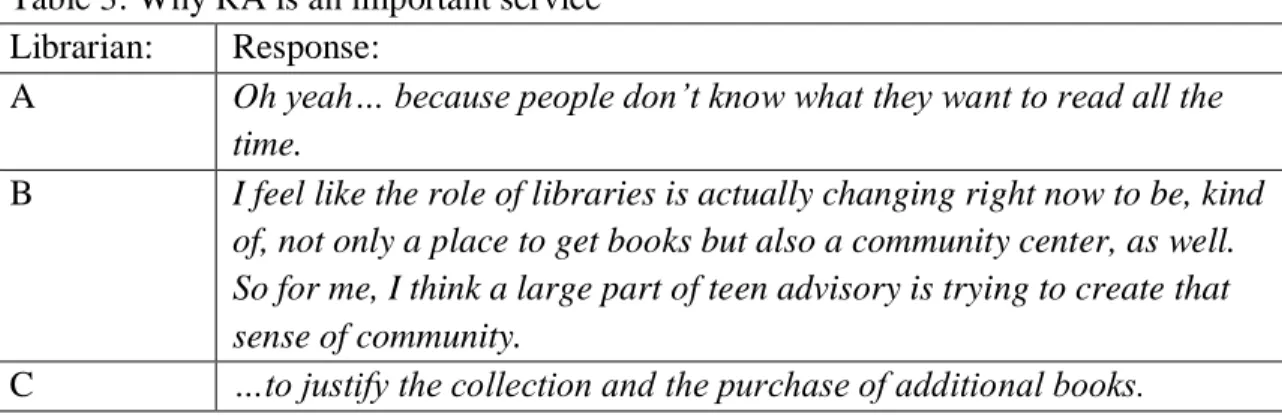
Question 2 was concerned with the librarian’s perspectives on the value of
reader’s advisory. All librarians interviewed felt that RA was still an important service
for libraries to provide, for a variety of reasons.
Table 3: Why RA is an important service Librarian: Response:
A Oh yeah… because people don’t know what they want to read all the time.
B I feel like the role of libraries is actually changing right now to be, kind of, not only a place to get books but also a community center, as well. So for me, I think a large part of teen advisory is trying to create that sense of community.
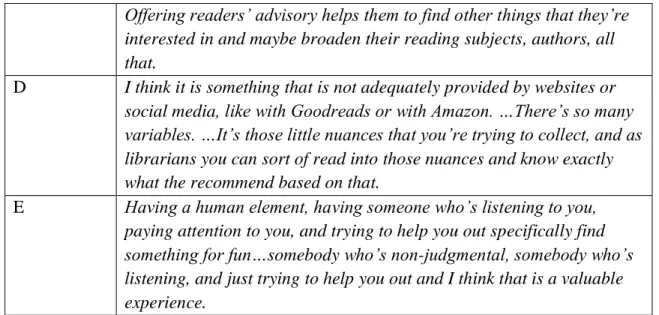
Offering readers’ advisory helps them to find other things that they’re interested in and maybe broaden their reading subjects, authors, all that.
D I think it is something that is not adequately provided by websites or social media, like with Goodreads or with Amazon. …There’s so many variables. …It’s those little nuances that you’re trying to collect, and as librarians you can sort of read into those nuances and know exactly what the recommend based on that.
E Having a human element, having someone who’s listening to you, paying attention to you, and trying to help you out specifically find something for fun…somebody who’s non-judgmental, somebody who’s listening, and just trying to help you out and I think that is a valuable experience.
Question 6 was designed to draw out any ways that librarians differentiate the RA
they perform based on the teen population being targeted. Their responses were quite
varied to this question.
Table 4: On varying RA based on targeted teen population Librarian: Response:
A So if we’re targeting a specific group… we try not to because we don’t want to exclude anybody but we also like for everybody to be
represented. I try to pull…a little bit of everything.
B I find young adult reader advisory is particularly challenging because we can’t read everything that comes out so a lot of it is based on what other teens tell me or request. …So it can be challenging to target their specific interests.
C When I do displays and when I do book talks I try to make sure I’m having a good variety of cultures and backgrounds and races, just, diverse characters on display or when I book talk.
I don’t know how appropriate this is, but when a person is in front of me and I think I can tell what demographic they are from I will try to make an effort to pull books that have characters within their
D I think representation matters so I try and include all topics and all genres, and that can be hard with genres that I’m not super familiar with.
E I think mainly what I want to make sure of is the age of the teen.
Just appropriateness. I don’t want to be censoring anything…but that’s the only restriction that I would do group wise because I try not to stereotype.
Question 7 and all of its parts specifically focused on diverse representation in RA.
Two librarians did not mention diverse representation before this question, while the
other three librarians did mention diverse representation in response to other questions.
All five librarians responded that diverse representation is a guiding principle when
performing RA to teens. Other guiding principles mentioned were:
• Part of readers’ advisory is you really have to know the teens. • I’m probably not going to stop them if they want to read.
• When parents come up to the desk with their teen, they seem like they often have concerns of their own, like they don’t want graphic sex or this and that, so sometimes that guides where I would lead them to.
• I try to be openminded. I have my own thoughts about what a child, what I would let my children read at a certain age, but it’s different for everybody and I have to respect that a parent is raising their child in a way that they see is appropriate, and if they want to have input on what their child is reading, I understand that. • If a child comes to me…I try to always direct all my conversation to the child or
the youth so that I’m making sure that they’re being heard and they get something they want to read.
• You just have to be willing to put your own values aside to give that child what they can, what they can read, what they’re comfortable reading, what they’re interested in.
• With the one-on-one interview… you wanna know what they’ve read in the past or if they aren’t reading, what they’re interested in and the reason why they’re wanting to read.
• With actual displays, I try and stay on trend.
• To listen more than I talk, even if someone is not saying much.
• I’m also conscious of where teens are at developmentally.
When asked about the values of reading diverse literature for teens, the librarians
responded with several different reasons:
• It gives you a different perspective, and that goes for if it’s contemporary or fantasy.
• It gives you a different perspective, and it’s a safe way to do that, which is pretty important.
• So I think just seeing different peoples’ perspectives and reading about different peoples’ life experiences in life and all sorts of stuff is just helpful.
• Even when you’re reading fiction, you can still learn a lot about other people and diversity in every way.
• I think it’s important just because we don’t know who is coming into the library. …I think it’s important for teens especially to see themselves in books and also to see people who are not like them in books.
• I think it makes your world bigger.
• It can give you hope that the world is big and beautiful and you can be a part of it.
In regards to the final question about whether or not they choose to highlight diverse
books during certain months or times, four of the five librarians expressed that they do
highlight diverse books at certain times, in addition to the rest of the year. Three of them
noted that teens often seek out the “special month” displays because of school projects or
assignments or general interest.
Document Analysis
At four of the five libraries, I was able to observe books on display. In Library A,
there were two book display areas in addition to the books placed on top of the shelves in
the teen section. There were diverse titles present in all three of those areas. In Library B,
there were no book display areas, but there were books on top of the shelves in the teen
and books turned to face outward on every shelf. In the four displays and the outward
facing books, there were diverse titles. In Library E, there were three book displays, and
all three contained diverse titles.
For all of the libraries, their websites were part of the larger county library
website. Because of this, it was not possible to assess the author or creator of the
booklists available online. Despite this challenge, I did assess the booklists for teens
available on the websites of the three counties in which I interviewed librarians. In
County A, there were archived newsletters available that contained recommendations and
reviews by teens for teens. They were previously published quarterly; however, the most
recent newsletter was published in 2017. As these lists were not created by the librarians,
they were not analyzed for this study. There were no other booklists available online for
County A. In County B, there were newsletters to which users could subscribe that were
released monthly or bimonthly, depending on the newsletter. They were offered for
various age groups, genres, character types, formats, bestsellers, etc. The most recently
released lists were available to view without subscribing, and each list contained diverse
titles, including the one created specifically for teens. Of the newsletter for teens, nine of
the ten books contained diverse main characters. County B also provided a feature on the
teen page to “Chat With a Librarian,” during normal operating hours. Finally, on their
website, County C had a few different booklists available for teens, and different lists
were located in two different places. Each booklist did feature books with diverse
Discussion
On the purposes of readers’ advisory, the perspectives of the librarians
interviewed in this study echo the literature, including the differences in opinion. Just as
Crowley (2014) noted that library funding can be affected by RA, Librarian C indicated
that RA can be used to justify the collection in order to retain and obtain funding (Table
3). However, Crowley’s notion that reading for pleasure ignores the advantages of
reading and its benefits to society was not addressed by any of the librarians. Librarians
C, D, and E did seem to align with Carstensen’s (2018) assertion that RA for teens should
be expanded to include books for assigned reading both explicitly and passively. As a
guiding principle, Librarian D mentioned knowing why the teen is wanting to read:
“usually it’s for pleasure, but sometimes they might need a book for school and you want
to make that book as fun as possible so it’s not like reading is a punishment.” Concerning
book displays for celebration months, Librarians C, D, and E all mentioned that teens will
come to the library in search of books related to that month because of school projects
and assignments. Librarian E expressed that RA should be performed in a
non-judgmental way, which is also stated explicitly in Saricks’s (2005) definition.
It appears that the most successful forms of RA depends on the specific place and
population. The four librarians who were able to identify their most successful form of
RA talked about book displays, one-on-one interviews, and book talks (Table 2). This
fact speaks to Carstensen’s first point in performing RA for teens: get to know them
librarian will likely look different than the work of another. Even Librarians A and D,
who both said that book displays were most successful with the teens at their library,
gave different reasons for choosing that form of RA. Librarian A felt that book displays
that either were interactive or made them think were most effective, while Librarian D
felt that book displays gave teens the ability to browse without drawing attention to
themselves.
When asked why readers’ advisory is still an important service to provide, each
participant noted their own reasons (Table 3). Librarians A, C, and D spoke to the need
for guidance in deciding what to read next. Librarian C expressed that RA can help to
broaden the scope of what someone is reading, while Librarian D noted how RA services
through websites like Goodreads or Amazon don’t take into account the nuances of past
reading experiences in the way that librarians can. These reasons alone would be
justification for providing RA services to teens, but Librarians B and E each gave other
important reasons for RA. Librarian B recognized how libraries are becoming places of
community, in addition to providing books to its users. This speaks to Agosto’s (2007)
research that for teens, the library is an information gateway, a social
interaction/entertainment space, and a beneficial physical environment. RA can help
build an atmosphere in which teens feel comfortable asking for help and being
themselves. Librarian E spoke to this idea, specifically, that for a teen, it is incredibly
valuable to have someone’s full attention and focus. Having “somebody who’s
non-judgmental, somebody who’s listening, and just trying to help you out,” seems like a
major building block to creating a community among teens in the library, which is
There are a lot of principles that are guiding the librarians who participated in this
study. Librarian A expressed that “you really have to know the teens,” which seems to
explain why there were so many guiding principles expressed. Teens need different
things from their librarians, so it seems natural that librarians would develop different
guiding principles in response to the needs of their teen users. At some point throughout
the interviews, each librarian spoke about the concerns of some parents when it comes to
their child’s reading materials, and for Librarians B and C, parental concerns informed
their guiding principles in some way. This was consistently something that they were all
considering when performing RA to teens, which necessitates a certain level of
knowledge about the parents of the teens coming to the library, in addition to the teens
themselves. While the concerns of parents were on the minds of the librarians, it is
crucial to note that the teen must also feel heard. Librarian C stated, “I try to always
direct all my conversation to the child or the youth so that I’m making sure that they’re
being heard and they get something they want to read.” This is consistent with the 2006
study from Hughes-Hassell and Lutz, in which they encouraged librarians to offer
materials of interest to teens, like celebrity culture and sports. Librarian D echoed this
idea, when expressing that with book displays, they actively work to be “on trend” with
the interests and concerns of teens. For example, they recently created a book display
about books that celebrate Islam, following the tragedy in New Zealand (NBC News,
2019). In all, it appears that the most important principle in performing RA is knowing
the teens and knowing the community.
When asked about the value of reading diverse literature, the responses of the
their own ways, spoke about the ways that literature can provide windows into the lives
of others. Two of the librarians also spoke about the value of books as mirrors, through
which the reader can see themselves. This is positive and encouraging that all of the
librarians saw the value of diverse literature in the lives of teens. Librarian B noted that
“there is a big emphasis on it [diverse books] just in the library community at large.” This
could be due to the efforts of organizations like #WeNeedDiverseBooks, but could also
be a result of the work done in LIS degree programs. Respectively, Librarians D and E
observed that, in regards to diverse literature, things have been improving: “it’s so great
now that, like, so many diverse authors are out there and there’s so much more than there
was even five years ago,” and “almost anybody now can see themselves in a book.”
An interesting finding in this study is that while all of the librarians recognized
the importance of diverse literature, two of them did not mention it until prompted. On
one hand, this could indicate that the librarians have included diverse literature in their
work so deeply that it has become a natural part of what they do. On the other hand
however, it could also indicate that diverse literature has not yet become so important in
RA and the promotion of books as it has in the collection of books. In either case, when
asked about guiding principles in RA, none of the librarians included diverse literature
before being asked explicitly. This suggests that there may still be room to grow as a
profession when it comes to promoting diverse literature.
When it comes to promoting diverse literature during celebration months and
times, librarians are doing that. However, the librarians interviewed spoke about
promoting diverse literature beyond those months, and even engaging in new
Violence Month. Librarian D spoke about creating displays and bibliographies based on
religious holidays, like Hanukkah and Ramadan. Librarian E talked about the value of
celebration month displays, but also mixing it up. For example, in March, they created
both a Women’s History Month display and a display about horror books. They
acknowledged that horror is usually highlighted around Halloween, but it seemed like a
good way to surprise the readers and give them that advisory at an “unusual” time.
On the library website for County B, there were numerous and up-to-date
booklists through monthly and bimonthly newsletters. For County C, there were a few
booklists, but were not intuitively accessible, in that there were different lists located in
different places. As for County A, there were no booklists created by librarians available
online. County A did share booklists created by teens, but these had not been updated in
over a year. Agosto (2007) found that teens were visiting the library for purposes related
to RA, but also recommended that libraries offer online resources, like booklists, for
teens. Making RA services available to teens online is a way that libraries can better meet
teen needs, something for which all public libraries should strive.
Implications
By gathering and analyzing the perspectives of public librarians on RA for teens,
this research can support the continued practices of RA to teens. Even though libraries
are changing and providing new services for their users, services related to books are still
necessary and important. These librarians are performing RA as often as daily, which
clearly shows that teens are making use of RA services.
This research also speaks to the many ways that librarians can support teen
communities, and this research shows that. Librarians should be engaged in their
communities and getting to know their teens in order to provide the best RA possible.
Librarians could potentially acquire new ideas about supporting teen readers through the
methods discussed in this study.
Limitations & Future Research
The limitations of this study fall mostly in scope. Because of the limitations of
travel, only five librarians were interviewed in one state. While the results of this study
are encouraging, they are not generalizable. However, the methods of this study could be
easily replicated in other places in North Carolina and in other states. This study could
also be conducted longitudinally, in order to assess the effects of time of year in the
promotion of diverse literature. Finally, a study could be done to assess the promotion of
different kinds of diverse literature. Only two of the five librarians in this study
mentioned ability, while all mentioned race, ethnicity, and sexuality. All of the libraries
in this study were part of county websites, so it could be valuable to see how librarians in
Conclusion
The research question of this study was: To what extent do library staff at public
libraries in urban areas of North Carolina consider diverse representation in books when
performing readers’ advisory for teens? To explore this question, I conducted interviews
with five librarians, observed the book displays in their libraries, and assessed the RA
resources available on the library websites. I found that the librarians were performing
RA to teens often, up to on a daily basis. They all engaged in many forms of RA, and the
most successful form depended greatly on the preferences of the teens in their
communities. As a whole, they held many guiding principles for performing RA, and
after being prompted, all agreed that promoting diverse literature was also a guiding
principle for their practices.
The significance of this study can be summarized with one principle: know your
teens and be engaged in your community. Knowing the teens for whom RA is being
performed will inform each librarian’s RA best practices, like the forms that are most
successful and the themes in which teens are most interested. Knowing the teens and their
needs will reinforce the necessity of diverse literature and its promotion. Engaging in the
community can involve librarians in community values and make them aware of how
parents feel about their teen’s reading habits. All of these are important parts of working
for teens in the library, and it all comes back to knowing the teens and the community.
Teens are reading, and they are using the library to read. Teens are going to
growth. It is up to librarians to work for a welcoming and inclusive space, and
performing adequate and successful readers’ advisory will help that create a great space
References
Agosto, D. (2007). Why Do Teens Use Libraries? Results of a Public Library Use Study.
Public Libraries, 46(3). Retrieved from
https://search-proquest-com.libproxy.lib.unc.edu/docview/217456905/fulltext/E464C416A2914D72PQ/1
?accountid=14244
Bishop, R. S. (1990). Mirrors, Windows, and Sliding Glass Doors. Perspectives:
Choosing and Using Books for the Classroom, 6(3). Retrieved from:
https://scenicregional.org/wp-content/uploads/2017/08/Mirrors-Windows-and-Sliding-Glass-Doors.pdf
Booth, H. (2007). Serving Teen Through Readers’ Advisory. Chicago: American Library
Association.
Carstensen, A. (2018). The Readers’ Advisory Guide to Teen Literature. Chicago:
American Library Association.
Charmaz, K. (2006). Constructing grounded theory. London: Sage.
Cooperative Children’s Book Center (CCBC) (2018). Publishing Statistics on Children’s
Books about People of Color and First/Native Nations and by People of Color
and First/Native Nations Authors and Illustrators. Retrieved from
https://ccbc.education.wisc.edu/books/pcstats.asp
Creswell, J. W. (2013). Qualitative Inquiry & Research Design: Choosing among five
Crowley, B. (2014). Time to Rethink Readers’ Advisory Education? Public Libraries,
53(4). Retrieved from
https://search-proquest-com.libproxy.lib.unc.edu/docview/1553753516?pq-origsite=summon
Hughes-Hassell, S. & Lutz, C. (2006). What do You Want to Tell Us about Reading?: A
Survey of the Habits and Attitudes of Urban Middle School Students toward
Leisure Reading. Young Adult Library Services, 4(2). Retrieved from:
https://search-proquest-com.libproxy.lib.unc.edu/docview/217717293?pq-origsite=summon
Kolb, S. M. (2012). Grounded Theory and the Constant Comparative Method: Valid
Research Strategies for Educators. Journal of Emerging Trends in Educational
Research and Policy Studies, 3(1). Retrieved from
jeteraps.scholarlinkresearch.org
Larrick, N. (1965). The All-White World of Children’s Books. Saturday Review of
Literature, 48(37). Retrieved from:
http://pnla2012.pbworks.com/w/file/fetch/56625171/Allwhiteworld_Larrick.pdf
Lincoln, Y. S., Lynham, S. A., & Guba, E. G. (2011). Paradigmatic Controversies,
Contradictions, and Emerging Confluences, Revisited. In Denzin, N. K. &
Lincoln Y. S. (Eds.), The SAGE Handbook of Qualitative Research (4th ed.)
(pp.97-128). Los Angeles, CA: SAGE Publications, Inc.
Myers, C. (2014, March 15). The Apartheid of Children’s Literature. The New York
Times. Retrieved from
Myers, W. D. (2014, March 15). Where Are the People of Color in Children’s Books?
The New York Times. Retrieved from
https://www.nytimes.com/2014/03/16/opinion/sunday/where-are-the-people-of-color-in-childrens-books.html
NBC News. (2019). New Zealand Mosque Shooting. Retrieved from
https://www.nbcnews.com/news/world/new-zealand-mosque-shootings
Saricks, J. G. (2005). Readers’ Advisory Service in the Public Library. Chicago:
American Library Association.
Smith, D. (2015). Readers’ Advisory: the Who, the How, and the Why. Reference and
User Services Quarterly, 54(4). Retrieved from
https://search-proquest-com.libproxy.lib.unc.edu/docview/1691315737?pq-origsite=summon
United States Census Bureau (2010). 2010 Census Urban and Rural Classification and
Urban Area Criteria. Retrieved from
https://www.census.gov/geo/reference/ua/urban-rural-2010.html
We Need Diverse Books (WNDB) (2018). About us. Retrieved from
Appendix A: Interview Guide
Interview guide
Public Librarian Perspectives on Diverse Representation in Readers’ Advisory for Teens
[Prior to the interview, test the equipment by recording the following information: a. Date
b. Time c. Location
d. Interviewer name ]
Interview Script:
Thank you for agreeing to participate in this study. The purpose of this research involves investigating the experiences of public library staff and librarians performing readers’ advisory to teens. This interview will likely last between 30-45 minutes. If at any time you want to end the interview, please let me know. If you prefer that this interview not be recorded, please let me know, and I will only take notes by hand throughout this
interview.
Your responses to the interview questions will be confidential. All data obtained in this study will be reported as group data. No individual will be identified. The only persons who will have access to these data are me and my faculty advisor, Dr. Sandra Hughes-Hassell.
[Go over consent form. Remind the participant that interview is being recorded]
Let’s get started.
I’ll begin by sharing the definition of reader’s advisory that we will be using for this interview. Reader’s advisory is the recommendation of books to readers for the purpose of pleasure reading. It can take many forms including book displays, bulletin board displays, book lists (bookmarks, website lists, etc.) or formal and informal book talks.
1. How often do you perform readers’ advisory to teens?
3. Please describe some of your most recent reader’s advisory activities.
4. Do you ever go to other settings like local middle or high schools to provide reader’s advisory?
a. If so, how does that differ from the type of reader’s advisory you provide in the library?
5. What reader’s advisory activities do you find are most successful with teens?
6. Do you vary how you provide reader’s advisory based on the teen population you are targeting?
a. If so, what guides your decision-making process? b. If not, why not?
7. What are some guiding principles for you in performing readers’ advisory?
a. If participant mentions that they consider diverse representation as a guiding principle:
i. Can you explain what you mean when you say _______ (diversity, diverse representation, etc.)
ii. How did that become a guiding principle for you?
iii. What do you think are the values of reading diverse literature for teens?
iv. Are there certain months or times when you specifically choose to highlight diverse books?
b. If participant does not mention that they consider diverse representation as a guiding principle:
i. When performing readers’ advisory, do you ever consider diverse representation?
ii. If yes, why? How did that become a guiding principle for you? What do you think are the values of reading diverse literature for teens? iii. If no, why not?
iv. Are there any certain months or times when you choose to highlight diverse books?
Thank you for participating in this interview.
Appendix B: Informed Consent Document
University of North Carolina at Chapel Hill Research Information Sheet
IRB Study #: 19-0015
Principal Investigator: Gina Wessinger
The purpose of this research study is to learn about the experiences of public librarians and library staff who perform readers’ advisory for teens. You are being asked to take part in this research study because you are a public library employee who works with teens.
Being in this research study is completely voluntary. You can choose not to be in this research study. You can also say yes now and change your mind later.
If you agree to take part in this research, you will be asked to participate in a recorded interview. Your participation in this study will take about 30-45 minutes. We expect that 7 people will take part in this research study.
There are neither risks anticipated should you participate in this study, nor any anticipated benefits from being involved with it. There may be professional benefits from this study, since the information we obtain will be communicated to the profession through publication in the literature, presentation at professional meetings and direct dissemination to the professional associations. There is no cost to you or financial benefit for your participation.
To protect your identity as a research subject, all data obtained in this study will be reported as group data. No individual will be identified. The only persons who will have access to these data are the principal investigator, Gina Wessinger, and faculty advisory, Dr. Sandra Hughes-Hassell.
If you have any questions about this research, please contact the Investigator named at the top of this form by calling (803) 608-0214 or emailing [email protected]. If you have questions or concerns about your rights as a research subject, you may contact the UNC Institutional Review Board at 919-966-3113 or by email to [email protected].