CS-495/595 Big Data
CS-495/595 Big Data
CS-495/595 Big Data
CS-495/595 Big Data
CS-495/595 Big Data
CS-495/595 Big Data
CS-495/595 Big Data
CS-495/595 Big Data
CS-495/595 Big Data
CS-495/595 Big Data
CS-495/595 Big Data
CS-495/595 Big Data
CS-495/595 Big Data
CS-495/595 Big Data
CS-495/595 Big Data
CS-495/595 Big Data
CS-495/595 Big Data
CS-495/595 Big Data
CS-495/595 Big Data
CS-495/595 Big Data
CS-495/595 Big Data
::::::::::::::::::::
:
Syllabus
Syllabus
Syllabus
Syllabus
Syllabus
Syllabus
Syllabus
Syllabus
Syllabus
Syllabus
Syllabus
Syllabus
Syllabus
Syllabus
Syllabus
Syllabus
Syllabus
Syllabus
Syllabus
Syllabus
Syllabus
Spring 2015
Spring 2015
Spring 2015
Spring 2015
Spring 2015
Spring 2015
Spring 2015
Spring 2015
Spring 2015
Spring 2015
Spring 2015
Spring 2015
Spring 2015
Spring 2015
Spring 2015
Spring 2015
Spring 2015
Spring 2015
Spring 2015
Spring 2015
Spring 2015
Wed. 4:20PM - 7:00PM Constant Hall 1043
Wed. 4:20PM - 7:00PM Constant Hall 1043
Wed. 4:20PM - 7:00PM Constant Hall 1043
Wed. 4:20PM - 7:00PM Constant Hall 1043
Wed. 4:20PM - 7:00PM Constant Hall 1043
Wed. 4:20PM - 7:00PM Constant Hall 1043
Wed. 4:20PM - 7:00PM Constant Hall 1043
Wed. 4:20PM - 7:00PM Constant Hall 1043
Wed. 4:20PM - 7:00PM Constant Hall 1043
Wed. 4:20PM - 7:00PM Constant Hall 1043
Wed. 4:20PM - 7:00PM Constant Hall 1043
Wed. 4:20PM - 7:00PM Constant Hall 1043
Wed. 4:20PM - 7:00PM Constant Hall 1043
Wed. 4:20PM - 7:00PM Constant Hall 1043
Wed. 4:20PM - 7:00PM Constant Hall 1043
Wed. 4:20PM - 7:00PM Constant Hall 1043
Wed. 4:20PM - 7:00PM Constant Hall 1043
Wed. 4:20PM - 7:00PM Constant Hall 1043
Wed. 4:20PM - 7:00PM Constant Hall 1043
Wed. 4:20PM - 7:00PM Constant Hall 1043
Wed. 4:20PM - 7:00PM Constant Hall 1043
Instructor: Dr. Cartledge
Instructor: Dr. Cartledge
Instructor: Dr. Cartledge
Instructor: Dr. Cartledge
Instructor: Dr. Cartledge
Instructor: Dr. Cartledge
Instructor: Dr. Cartledge
Instructor: Dr. Cartledge
Instructor: Dr. Cartledge
Instructor: Dr. Cartledge
Instructor: Dr. Cartledge
Instructor: Dr. Cartledge
Instructor: Dr. Cartledge
Instructor: Dr. Cartledge
Instructor: Dr. Cartledge
Instructor: Dr. Cartledge
Instructor: Dr. Cartledge
Instructor: Dr. Cartledge
Instructor: Dr. Cartledge
Instructor: Dr. Cartledge
Instructor: Dr. Cartledge
http://www.cs.odu.edu/˜ccartled/Teaching
http://www.cs.odu.edu/˜ccartled/Teaching
http://www.cs.odu.edu/˜ccartled/Teaching
http://www.cs.odu.edu/˜ccartled/Teaching
http://www.cs.odu.edu/˜ccartled/Teaching
http://www.cs.odu.edu/˜ccartled/Teaching
http://www.cs.odu.edu/˜ccartled/Teaching
http://www.cs.odu.edu/˜ccartled/Teaching
http://www.cs.odu.edu/˜ccartled/Teaching
http://www.cs.odu.edu/˜ccartled/Teaching
http://www.cs.odu.edu/˜ccartled/Teaching
http://www.cs.odu.edu/˜ccartled/Teaching
http://www.cs.odu.edu/˜ccartled/Teaching
http://www.cs.odu.edu/˜ccartled/Teaching
http://www.cs.odu.edu/˜ccartled/Teaching
http://www.cs.odu.edu/˜ccartled/Teaching
http://www.cs.odu.edu/˜ccartled/Teaching
http://www.cs.odu.edu/˜ccartled/Teaching
http://www.cs.odu.edu/˜ccartled/Teaching
http://www.cs.odu.edu/˜ccartled/Teaching
http://www.cs.odu.edu/˜ccartled/Teaching
•
•
•
•
•
•
•
•
•
•
Big data is quadrupling every year!!
Big data is quadrupling every year!!
Big data is quadrupling every year!!
Big data is quadrupling every year!!
Big data is quadrupling every year!!
Big data is quadrupling every year!!
Big data is quadrupling every year!!
Big data is quadrupling every year!!
Big data is quadrupling every year!!
Big data is quadrupling every year!!
•
Big data is quadrupling every year!!
•
Big data is quadrupling every year!!
•
Big data is quadrupling every year!!
•
Big data is quadrupling every year!!
•
Big data is quadrupling every year!!
•
Big data is quadrupling every year!!
•
Big data is quadrupling every year!!
•
•
•
•
Big data is quadrupling every year!!
Big data is quadrupling every year!!
Big data is quadrupling every year!!
Big data is quadrupling every year!!
– Everyone is creating it
– Everyone is creating it
– Everyone is creating it
– Everyone is creating it
– Everyone is creating it
– Everyone is creating it
– Everyone is creating it
– Everyone is creating it
– Everyone is creating it
– Everyone is creating it
– Everyone is creating it
– Everyone is creating it
– Everyone is creating it
– Everyone is creating it
– Everyone is creating it
– Everyone is creating it
– Everyone is creating it
– Everyone is creating it
– Everyone is creating it
– Everyone is creating it
– Everyone is creating it
– Everyone wants to use it
– Everyone wants to use it
– Everyone wants to use it
– Everyone wants to use it
– Everyone wants to use it
– Everyone wants to use it
– Everyone wants to use it
– Everyone wants to use it
– Everyone wants to use it
– Everyone wants to use it
– Everyone wants to use it
– Everyone wants to use it
– Everyone wants to use it
– Everyone wants to use it
– Everyone wants to use it
– Everyone wants to use it
– Everyone wants to use it
– Everyone wants to use it
– Everyone wants to use it
– Everyone wants to use it
– Everyone wants to use it
•
•
•
•
•
•
•
•
•
•
Objectives:
Objectives:
Objectives:
Objectives:
Objectives:
Objectives:
Objectives:
Objectives:
Objectives:
Objectives:
•
Objectives:
•
Objectives:
•
Objectives:
•
Objectives:
•
Objectives:
•
Objectives:
•
Objectives:
•
•
•
•
Objectives:
Objectives:
Objectives:
Objectives:
– Learn how to store and analyze Big Data
– Learn how to store and analyze Big Data
– Learn how to store and analyze Big Data
– Learn how to store and analyze Big Data
– Learn how to store and analyze Big Data
– Learn how to store and analyze Big Data
– Learn how to store and analyze Big Data
– Learn how to store and analyze Big Data
– Learn how to store and analyze Big Data
– Learn how to store and analyze Big Data
– Learn how to store and analyze Big Data
– Learn how to store and analyze Big Data
– Learn how to store and analyze Big Data
– Learn how to store and analyze Big Data
– Learn how to store and analyze Big Data
– Learn how to store and analyze Big Data
– Learn how to store and analyze Big Data
– Learn how to store and analyze Big Data
– Learn how to store and analyze Big Data
– Learn how to store and analyze Big Data
– Learn how to store and analyze Big Data
– Learn about the cloud and its services for Big Data
– Learn about the cloud and its services for Big Data
– Learn about the cloud and its services for Big Data
– Learn about the cloud and its services for Big Data
– Learn about the cloud and its services for Big Data
– Learn about the cloud and its services for Big Data
– Learn about the cloud and its services for Big Data
– Learn about the cloud and its services for Big Data
– Learn about the cloud and its services for Big Data
– Learn about the cloud and its services for Big Data
– Learn about the cloud and its services for Big Data
– Learn about the cloud and its services for Big Data
– Learn about the cloud and its services for Big Data
– Learn about the cloud and its services for Big Data
– Learn about the cloud and its services for Big Data
– Learn about the cloud and its services for Big Data
– Learn about the cloud and its services for Big Data
– Learn about the cloud and its services for Big Data
– Learn about the cloud and its services for Big Data
– Learn about the cloud and its services for Big Data
– Learn about the cloud and its services for Big Data
•
•
•
•
•
•
•
•
•
•
Technologies to be used:
Technologies to be used:
Technologies to be used:
Technologies to be used:
Technologies to be used:
Technologies to be used:
Technologies to be used:
Technologies to be used:
Technologies to be used:
Technologies to be used:
•
Technologies to be used:
•
Technologies to be used:
•
Technologies to be used:
•
Technologies to be used:
•
Technologies to be used:
•
Technologies to be used:
•
Technologies to be used:
•
•
•
•
Technologies to be used:
Technologies to be used:
Technologies to be used:
Technologies to be used:
– Hadoop, Pig
– Hadoop, Pig
– Hadoop, Pig
– Hadoop, Pig
– Hadoop, Pig
– Hadoop, Pig
– Hadoop, Pig
– Hadoop, Pig
– Hadoop, Pig
– Hadoop, Pig
– Hadoop, Pig
– Hadoop, Pig
– Hadoop, Pig
– Hadoop, Pig
– Hadoop, Pig
– Hadoop, Pig
– Hadoop, Pig
– Hadoop, Pig
– Hadoop, Pig
– Hadoop, Pig
– Hadoop, Pig
– MapReduce
– MapReduce
– MapReduce
– MapReduce
– MapReduce
– MapReduce
– MapReduce
– MapReduce
– MapReduce
– MapReduce
– MapReduce
– MapReduce
– MapReduce
– MapReduce
– MapReduce
– MapReduce
– MapReduce
– MapReduce
– MapReduce
– MapReduce
– MapReduce
– HDFS
– HDFS
– HDFS
– HDFS
– HDFS
– HDFS
– HDFS
– HDFS
– HDFS
– HDFS
– HDFS
– HDFS
– HDFS
– HDFS
– HDFS
– HDFS
– HDFS
– HDFS
– HDFS
– HDFS
– HDFS
•
•
•
•
•
•
•
•
•
•
Learn about Big Data questions
Learn about Big Data questions
Learn about Big Data questions
Learn about Big Data questions
Learn about Big Data questions
Learn about Big Data questions
Learn about Big Data questions
Learn about Big Data questions
Learn about Big Data questions
Learn about Big Data questions
•
Learn about Big Data questions
•
Learn about Big Data questions
•
Learn about Big Data questions
•
Learn about Big Data questions
•
Learn about Big Data questions
•
Learn about Big Data questions
•
Learn about Big Data questions
•
•
•
•
Learn about Big Data questions
Learn about Big Data questions
Learn about Big Data questions
Learn about Big Data questions
– What types are easy to answer
– What types are easy to answer
– What types are easy to answer
– What types are easy to answer
– What types are easy to answer
– What types are easy to answer
– What types are easy to answer
– What types are easy to answer
– What types are easy to answer
– What types are easy to answer
– What types are easy to answer
– What types are easy to answer
– What types are easy to answer
– What types are easy to answer
– What types are easy to answer
– What types are easy to answer
– What types are easy to answer
– What types are easy to answer
– What types are easy to answer
– What types are easy to answer
– What types are easy to answer
– What types are hard to answer
– What types are hard to answer
– What types are hard to answer
– What types are hard to answer
– What types are hard to answer
– What types are hard to answer
– What types are hard to answer
– What types are hard to answer
– What types are hard to answer
– What types are hard to answer
– What types are hard to answer
– What types are hard to answer
– What types are hard to answer
– What types are hard to answer
– What types are hard to answer
– What types are hard to answer
– What types are hard to answer
– What types are hard to answer
– What types are hard to answer
– What types are hard to answer
– What types are hard to answer
•
•
•
•
•
•
•
•
•
•
Prerequisites: None
Prerequisites: None
Prerequisites: None
Prerequisites: None
Prerequisites: None
Prerequisites: None
Prerequisites: None
Prerequisites: None
Prerequisites: None
Prerequisites: None
•
Prerequisites: None
•
Prerequisites: None
•
Prerequisites: None
•
Prerequisites: None
•
Prerequisites: None
•
Prerequisites: None
•
Prerequisites: None
•
•
•
•
Prerequisites: None
Prerequisites: None
Prerequisites: None
Prerequisites: None
•
•
•
•
•
•
•
•
•
•
Recommended experiences:
Recommended experiences:
Recommended experiences:
Recommended experiences:
Recommended experiences:
Recommended experiences:
Recommended experiences:
Recommended experiences:
Recommended experiences:
Recommended experiences:
•
Recommended experiences:
•
Recommended experiences:
•
Recommended experiences:
•
Recommended experiences:
•
Recommended experiences:
•
Recommended experiences:
•
Recommended experiences:
•
•
•
•
Recommended experiences:
Recommended experiences:
Recommended experiences:
Recommended experiences:
– Java (CS-330, 361, or equivalent)
– Java (CS-330, 361, or equivalent)
– Java (CS-330, 361, or equivalent)
– Java (CS-330, 361, or equivalent)
– Java (CS-330, 361, or equivalent)
– Java (CS-330, 361, or equivalent)
– Java (CS-330, 361, or equivalent)
– Java (CS-330, 361, or equivalent)
– Java (CS-330, 361, or equivalent)
– Java (CS-330, 361, or equivalent)
– Java (CS-330, 361, or equivalent)
– Java (CS-330, 361, or equivalent)
– Java (CS-330, 361, or equivalent)
– Java (CS-330, 361, or equivalent)
– Java (CS-330, 361, or equivalent)
– Java (CS-330, 361, or equivalent)
– Java (CS-330, 361, or equivalent)
– Java (CS-330, 361, or equivalent)
– Java (CS-330, 361, or equivalent)
– Java (CS-330, 361, or equivalent)
– Java (CS-330, 361, or equivalent)
– An IDE that supports Hadoop
– An IDE that supports Hadoop
– An IDE that supports Hadoop
– An IDE that supports Hadoop
– An IDE that supports Hadoop
– An IDE that supports Hadoop
– An IDE that supports Hadoop
– An IDE that supports Hadoop
– An IDE that supports Hadoop
– An IDE that supports Hadoop
– An IDE that supports Hadoop
– An IDE that supports Hadoop
– An IDE that supports Hadoop
– An IDE that supports Hadoop
– An IDE that supports Hadoop
– An IDE that supports Hadoop
– An IDE that supports Hadoop
– An IDE that supports Hadoop
– An IDE that supports Hadoop
– An IDE that supports Hadoop
– An IDE that supports Hadoop
– Ant, Maven, or Makefiles
– Ant, Maven, or Makefiles
– Ant, Maven, or Makefiles
– Ant, Maven, or Makefiles
– Ant, Maven, or Makefiles
– Ant, Maven, or Makefiles
– Ant, Maven, or Makefiles
– Ant, Maven, or Makefiles
– Ant, Maven, or Makefiles
– Ant, Maven, or Makefiles
– Ant, Maven, or Makefiles
– Ant, Maven, or Makefiles
– Ant, Maven, or Makefiles
– Ant, Maven, or Makefiles
– Ant, Maven, or Makefiles
– Ant, Maven, or Makefiles
– Ant, Maven, or Makefiles
– Ant, Maven, or Makefiles
– Ant, Maven, or Makefiles
– Ant, Maven, or Makefiles
– Ant, Maven, or Makefiles
Other notes:
•
This is not a programming course. You will learn to use an existing framework, not a new language.
•
There will be approx. three programming assignments. Graduate students will expand on the basic
Contents
1 Course description 2
2 Course outline 2
3 Assignments 3
3.1 Typical undergraduate assignment . . . 3
3.2 Typical graduate assignment . . . 3
4 Grading 3 4.1 Overall grading scale . . . 3
4.2 Late assignments . . . 4
5 Course Policies 4 5.1 Attendance Policy . . . 4
5.2 Classroom Conduct . . . 5
5.3 Seeking Help . . . 5
5.4 Disability Services . . . 5
6 Academic Integrity / Honor Code 5
7 Class Schedule 7
1
Course description
Data sets are growing rapidly with the presence of new information generated from business enterprises, scientific and engineering disciplines, social networks, mobile phones, and other sensors. With a 4x growth rate of data each year, it is expected that we will have produced more than 35 zettabytes of data by 2020. Traditional databases and learning methods do not work for this massive amount of mainly unstructured data. This course provides the knowledge to use new Big Data tools and learn ways of storing information that will allow for efficient processing and analysis. In addition, you learn to store, manage, process and analyze massive amounts of unstructured data. This course will introduce tools such as Hadoop, Hive, and Pig for operations on massive data. Since all operations on massive data run on the cloud, we will introduce the cloud and its services for massive data. We will look at Amazon Elastic Cloud, Microsoft’s Azure, Google App Engine, etc.
2
Course outline
On completion of this course students will be able to analyze, design, and implement effective solutions for data-intensive applications with very large scale data sets. More specifically a student will be able to:
1. Describe data-intensive computing concepts, 2. Compute with data-intensive computing concepts, 3. Recognize a data-intensive problem,
4. Identify the scale of data,
5. Analyze the data requirements of a problem,
6. Decide on the algorithms (Ex: MapReduce) and programming models, 7. Design the data-intensive program solution and system configuration,
8. Implement the data-intensive solution and test the solution for functional correctness and non-functional requirements,
9. Study the foundational concepts enabling cloud computing: virtualization, web services
3
Assignments
There will be programming assignments; individual and team. Graduate students will have the same assign-ments as the undergraduates, plus additional requireassign-ments.
3.1
Typical undergraduate assignment
Report the word frequency in a document.3.2
Typical graduate assignment
Report and compare the non-trivial word frequency across two documents.
4
Grading
4.1
Overall grading scale
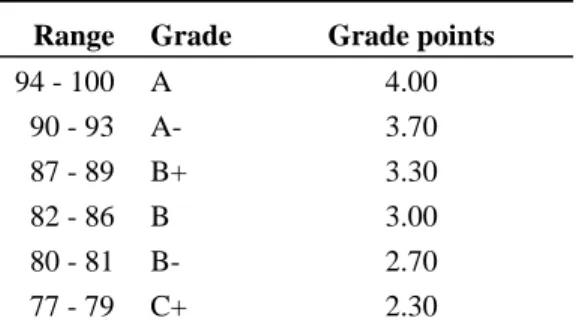
Overall grade for the course will be based on the student’s performance in: class attendance and participation (10%), 2 exams (30%), assignments (30%), projects(30%).
The grading scale follows:
Table 1: Grading scale
Range Grade Grade points
94 - 100 A 4.00 90 - 93 A- 3.70 87 - 89 B+ 3.30 82 - 86 B 3.00 80 - 81 B- 2.70 77 - 79 C+ 2.30
Table 1. (Continued from the previous page.)
Range Grade Grade points
73 - 76 C 2.00 70 - 72 C- 1.70 67 - 69 D+ 1.30 63 - 66 D 1.00 60 - 62 D- 0.70 0 - 59 F 0.00 N/A WF 0.00
4.2
Late assignments
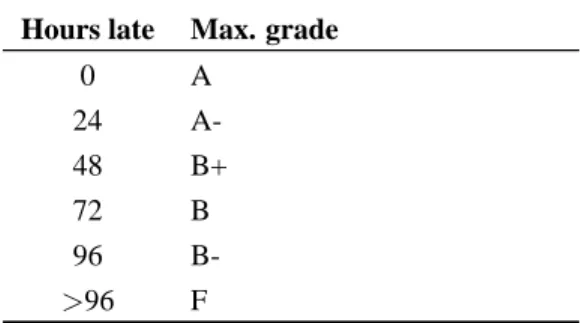
Assignments are due by midnight of the due date. The time of submission is the timestamp of the e-mail saying that the submission is ready. Assignments that are late will be penalized at the rate of one half of a letter grade per 24 hour period. Late submissions will be accepted up to 4 days late (see Table 2).
Table 2: Late submission maximum grade.
Hours late Max. grade
0 A 24 A-48 B+ 72 B 96
B->96 F
5
Course Policies
5.1
Attendance Policy
You are responsible for the contents of all lectures. If you know that you are going to miss a lecture, have a reliable friend take notes for you although slides will be available. Of course, there is no excuse for missing
due dates or exam days. During lectures, we will be covering material from the textbook. Lecture will also consist of the exploration of real world problems not covered in the book. You will be given a reading assignment at the end of each lecture for the next class.
I expect you to attend class and to arrive on time. Your grade may be affected if you are consistently tardy. If you have to miss a class, you are responsible checking the course website to find any assignments or notes you may have missed.
5.2
Classroom Conduct
Be respectful of your classmates and instructor by minimizing distractions during class. Cell phones must be turned off during class.
5.3
Seeking Help
The course website should be your first reference for questions about the class. The schedule will be up-dated throughout the semester with links to assigned readings. Announcements will be posted to the course website. The best way to get help is to set up an appointment for a Skype or Google+ conference
I will be establishing virtual office hours using Skype, Google+ as DrChuckCartledge, and will use Google calendar to coordinate. I am available via email, but do not expect or rely on an immediate response.
5.4
Disability Services
In compliance with PL94-142 and more recent federal legislation affirming the rights of disabled individuals, provisions will be made for students with special needs on an individual basis. The student must have been identified as special needs by the university and an appropriate letter must be provided to the course instructor. Provision will be made based upon written guidelines from the University’s Office of Educational Accessibility. All students are expected to fulfill all course requirements.
6
Academic Integrity / Honor Code
By attending Old Dominion University you have accepted the responsibility to abide by the honor code. If you are uncertain about how the honor code applies to any course activity, you should request clarification from the instructor. The honor pledge is as follows:
“I pledge to support the honor system of Old Dominion University. I will refrain from any form of academic dishonesty or deception, such as cheating or plagiarism. I am aware that as a member of the academic community, it is my responsibility to turn in all suspected violators of the honor system. I will report to Honor Council hearings if I am summoned.”
In particular, submitting anything that is not your own work without proper attribution (giving credit to the original author) is plagiarism and is considered to be an honor code violation. It is not acceptable to copy source code or written work from any other source (including other students), unless explicitly allowed in the assignment statement. In cases where using resources such as the Internet is allowed, proper attribution must be given.
Any evidence of an honor code violation (cheating) will result in a 0 grade for the assignment/exam, and the incident will be submitted to the Department of Computer Science for further review. Note that
honor code violations can result in a permanent notation being placed on the student’s transcript. Evidence of cheating may include a student being unable to satisfactorily answer questions asked by the instructor about a submitted solution. Cheating includes not only receiving unauthorized assistance, but also giving unauthorized assistance. For class files kept in Unix space, students are expected to use Unix file permission protections (chmod) to keep other students from accessing the files. Failure to adequately protect files may result in a student being held responsible for giving unauthorized assistance, even if not directly aware of it. Students may still provide legitimate assistance to one another. Students should avoid discussions of solutions to ongoing assignments and should not, under any circumstances, show or share code solutions for an ongoing assignment. All students are responsible for knowing the rules. If you are unclear about whether a certain activity is allowed or not, please contact the instructor.
7
Class Schedule
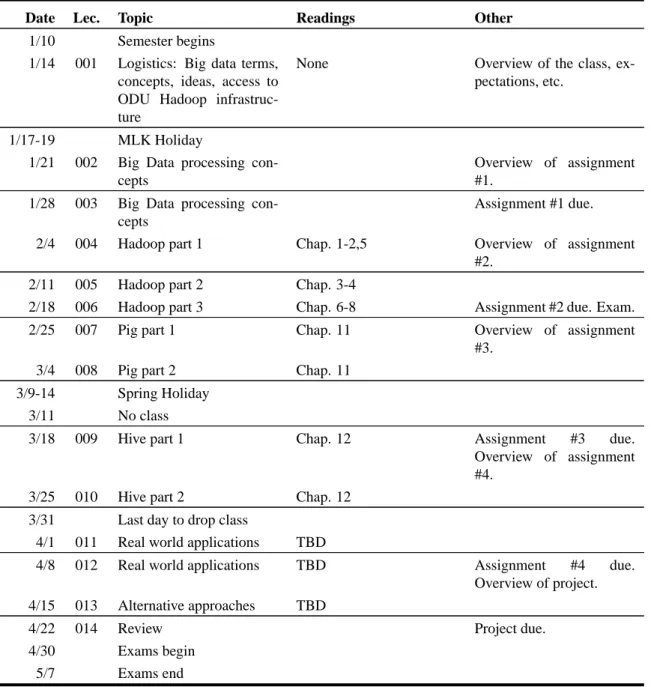
Table 3: Class schedule
Date Lec. Topic Readings Other
1/10 Semester begins
1/14 001 Logistics: Big data terms, concepts, ideas, access to ODU Hadoop infrastruc-ture
None Overview of the class, ex-pectations, etc.
1/17-19 MLK Holiday
1/21 002 Big Data processing con-cepts
Overview of assignment #1.
1/28 003 Big Data processing con-cepts
Assignment #1 due. 2/4 004 Hadoop part 1 Chap. 1-2,5 Overview of assignment
#2. 2/11 005 Hadoop part 2 Chap. 3-4
2/18 006 Hadoop part 3 Chap. 6-8 Assignment #2 due. Exam. 2/25 007 Pig part 1 Chap. 11 Overview of assignment
#3. 3/4 008 Pig part 2 Chap. 11
3/9-14 Spring Holiday 3/11 No class
3/18 009 Hive part 1 Chap. 12 Assignment #3 due. Overview of assignment #4.
3/25 010 Hive part 2 Chap. 12 3/31 Last day to drop class
4/1 011 Real world applications TBD
4/8 012 Real world applications TBD Assignment #4 due. Overview of project. 4/15 013 Alternative approaches TBD
4/22 014 Review Project due. 4/30 Exams begin