Wireless sensor networks for civil structure health monitoring using
GPS and GSM module
B.S Sai Sridhar (M.Tech Embedded Systems)
(under the guidance of
Mr Md. Javeed Mehdi
Gokaraju Rangaraju College of Engineering & Technology, Hyderabad
ABSTRACT
A structural health monitoring system has become an important research problem which has the potential to monitor and ensure the performance and safety of civil structures. The SHM system is designed, implemented, and tested using Wireless Sensor Networks (WSN). Structural Health monitoring system is the implementation of improving the maintenance of any structures like buildings and bridges. It encompasses damage detection and identification of structures from natural disasters like earth quake, fire breakouts and gas leakage threats etc . This project mainly consists of four sensors, depending on the type of damage the input from the corresponding sensor is transmitted to the ARM-7 microcontroller the GPS module receives the sensor input value and transmits it through GSM module in the form of an message to the user’s mobile phone to alert the user.
Keywords: Structure monitoring, wireless
sensor networks, damage detection, GPS, GSM.
I.INTRODUCTION
Structural health monitoring systems leads to the function of safety maintenance and extending the lifetime of real time buildings. Buildings can progressively accumulate damage during their operational lifetime,
due to seismic events, unforeseen foundation settlement, material aging, design error, etc. Periodic monitoring of the structure for such damage is therefore a key step in rationally planning the maintenance needed to guarantee an adequate level of safety and serviceability. However, in order for the installation of a permanently installed sensing system in buildings to be economically viable , the sensor modules must be wireless to reduce installation costs, must operate with a low power consumption to reduce servicing costs of replacing batteries, and use low cost sensors that can be mass produced. [1]
Fig: 1 Block diagram
Wireless sensor networks for civil structure health monitoring using
GPS and GSM module
B.S Sai Sridhar (M.Tech Embedded Systems)
(under the guidance of
Mr Md. Javeed Mehdi
Gokaraju Rangaraju College of Engineering & Technology, Hyderabad
ABSTRACT
A structural health monitoring system has become an important research problem which has the potential to monitor and ensure the performance and safety of civil structures. The SHM system is designed, implemented, and tested using Wireless Sensor Networks (WSN). Structural Health monitoring system is the implementation of improving the maintenance of any structures like buildings and bridges. It encompasses damage detection and identification of structures from natural disasters like earth quake, fire breakouts and gas leakage threats etc . This project mainly consists of four sensors, depending on the type of damage the input from the corresponding sensor is transmitted to the ARM-7 microcontroller the GPS module receives the sensor input value and transmits it through GSM module in the form of an message to the user’s mobile phone to alert the user.
Keywords: Structure monitoring, wireless
sensor networks, damage detection, GPS, GSM.
I.INTRODUCTION
Structural health monitoring systems leads to the function of safety maintenance and extending the lifetime of real time buildings. Buildings can progressively accumulate damage during their operational lifetime,
due to seismic events, unforeseen foundation settlement, material aging, design error, etc. Periodic monitoring of the structure for such damage is therefore a key step in rationally planning the maintenance needed to guarantee an adequate level of safety and serviceability. However, in order for the installation of a permanently installed sensing system in buildings to be economically viable , the sensor modules must be wireless to reduce installation costs, must operate with a low power consumption to reduce servicing costs of replacing batteries, and use low cost sensors that can be mass produced. [1]
Fig: 1 Block diagram
Wireless sensor networks for civil structure health monitoring using
GPS and GSM module
B.S Sai Sridhar (M.Tech Embedded Systems)
(under the guidance of
Mr Md. Javeed Mehdi
Gokaraju Rangaraju College of Engineering & Technology, Hyderabad
ABSTRACT
A structural health monitoring system has become an important research problem which has the potential to monitor and ensure the performance and safety of civil structures. The SHM system is designed, implemented, and tested using Wireless Sensor Networks (WSN). Structural Health monitoring system is the implementation of improving the maintenance of any structures like buildings and bridges. It encompasses damage detection and identification of structures from natural disasters like earth quake, fire breakouts and gas leakage threats etc . This project mainly consists of four sensors, depending on the type of damage the input from the corresponding sensor is transmitted to the ARM-7 microcontroller the GPS module receives the sensor input value and transmits it through GSM module in the form of an message to the user’s mobile phone to alert the user.
Keywords: Structure monitoring, wireless
sensor networks, damage detection, GPS, GSM.
I.INTRODUCTION
Structural health monitoring systems leads to the function of safety maintenance and extending the lifetime of real time buildings. Buildings can progressively accumulate damage during their operational lifetime,
due to seismic events, unforeseen foundation settlement, material aging, design error, etc. Periodic monitoring of the structure for such damage is therefore a key step in rationally planning the maintenance needed to guarantee an adequate level of safety and serviceability. However, in order for the installation of a permanently installed sensing system in buildings to be economically viable , the sensor modules must be wireless to reduce installation costs, must operate with a low power consumption to reduce servicing costs of replacing batteries, and use low cost sensors that can be mass produced. [1]
II.HARDWARE
MICROCONTROLLER
:-ARM core:
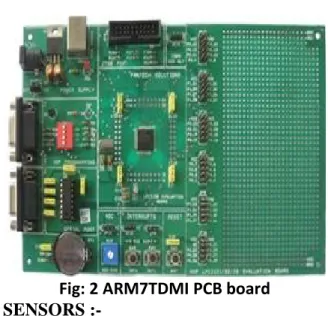
The ARM7 family includes the ARM7TDMI, ARM7TDMI-S, ARM720T, and ARM7EJ-S processors. The ARM7TDMI core is that the industry’s most generally used 32-bit embedded reduced instruction set computer chip resolution. Optimized for price and power-sensitive applications, the ARM7TDMI resolution provides the low power consumption, small size, and high performance required in transportable, embedded applications. The ARM7TDMI-S core is that the synthesizable version of the ARM7TDMI core, obtainable in each VERILOG and VHDL, prepared for compilation into processes supported by in-house or commercially obtainable synthesis libraries.
Optimized for flexibility and that includes a regular feature set to the laborious macro cell, it improves time-to-market by reducing development time whereas providing augmented style flexibility, and facultative >>98% fault coverage. The ARM720T laborious macro cell contains the ARM7TDMI core, 8kb unified cache, and a Memory Management Unit (MMU) that enables the employment of protected execution areas and computer memory. This macro cell is compatible with leading operative systems as well as Windows Ce, Linux, palm OS, and SYMBIAN OS. [2,3]
LPC2148 Processor:
LPC2148 Microcontroller design. The ARM7TDMI-S may be a general purpose 32-bit micro chip, that offers high performance and really low power consumption. The ARM design relies on Reduced Instruction Set pc (RISC)
principles, and also the instruction set and connected decipher mechanism ar abundant less complicated than those of small programmed advanced Instruction Set Computers (CISC). This simplicity ends up in a high instruction turnout and spectacular time period interrupt response from atiny low and efficient processor core [4].
Pipeline techniques are utilized in order that all elements of the process and memory systems will operate ceaselessly. Typically, whereas one instruction is being dead, its successor is being decoded, and a 3rd instruction is being fetched from memory. The ARM7TDMI-S processor conjointly employs a novel fine arts strategy referred to as Thumb, that makes it ideally suited to high-volume applications with memory restrictions, or applications wherever code density is a problem.
The key plan behind Thumb is that of a super-reduced instruction set. basically, the ARM7TDMI-S processor has 2 instruction sets:
• The normal 32-bit ARM set. • A 16-bit Thumb set.
Fig: 2 ARM7TDMI PCB board
SENSORS :-Vibration sensor
The ADXL335 is a small, thin, low power, complete 3-axis accelerometer with signal conditioned voltage outputs. The product measures acceleration with a minimum full-scale range of ±3 g. It can measure the static acceleration of gravity in tilt-sensing applications, as well as dynamic acceleration resulting from motion, shock, or vibration.
Pressure sensor
Pressure sensor used is a capacitive pressure sensor.A capacitor has two metal plates and a dielectric sandwiched between them. In capacitive pressure sensor, one of these metal plates is permitted to move in and out so that the capacitance between them changes due to varying distance between the plates. The movable plate is connected to a diaphragm which senses the pressure and
then expands or compresses
accordingly. The movement of the diaphragm would affect the attached metal plate’sposition and capacitance would vary. These sensors, though much ineffective at high temperatures, are widely used at ambient temperature range due to their linear output. [6]
Gas sensor
Sensitive material of MQ-2 gas sensor is SnO2, which with lower conductivity in clean air. When the target combustible gas exist, The sensor’s conductivity is more higher along with the gas concentration rising. Please use simple electro circuit, Convert change of conductivity to correspond output signal of gas concentration. MQ-2 gas sensor has high sensitity to LPG, Propane and Hydrogen, also could be used to Methane and other combustible steam, it is with low cost and suitable for different application.
Fire sensor
Thermistor is an temperature sensitive resistor which is being used ti detect the fire . All resistors vary with temperature, but thermistors are constructed of semiconductor material with a resistivity that is especially sensitive to temperature. However, unlike most other resistive devices, the resistance of a thermistor decreases with increasing temperature. That's due to the properties of the semiconductor material that the thermistor is made from. For some, that may be counterintuitive, but it is correct. Here is a graph of resistance as a function of temperature for a typical thermistor. Notice how the resistance drops from 100 kW, to a very small value in a range around room temperature. Not only is the resistance change in the opposite direction from what you expect, but the magnitude of the percentage resistance change is substantial [7].
Signal conditioning
The inputs given to the signal conditioning circuit can be in the form of signal inputs or sensor inputs. Signal inputs accepted by signal conditioners include DC voltage and current, AC voltage and current. Sensor inputs can be accelerometer, thermocouple, thermistor etc, based on these given inputs the outputs obtained are the voltages or current or frequency which are required by the system in-order to drive the process forward.
GPS MODULE
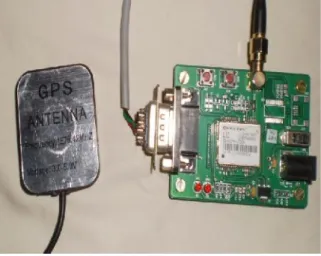
The GPS module L10 brings the high performance of the MTK positioning engine to the industrial standard. The L10 supports 210 PRN channels. With 66 search channels and 22 simultaneous tracking channels, it acquires and tracks satellites in the shortest time even at indoor signal level. This versatile, stand-alone receiver combines an extensive array of features with flexible connectivity options. Their ease of integration results in fast time-to-market in a wide range of automotive, consumer and industrial applications.
Fig: 3 GPS Module
GSM MODULE
This GSM Modem can accept any GSM network operator SIM card and act just like a mobile phone with its own unique phone
number. Advantage of using this modem will be that you can use its RS232 port to communicate and develop embedded applications. Applications like SMS Control, data transfer, remote control and logging can be developed easily.
Fig: 4 GSM Module
III SERIAL COMMUNICATION
Serial communication is common method of transmitting data between a computer and a peripheral device such as a programmable instrument or even another computer. Serial communication transmits data one bit at a time, sequentially, over a single communication line to a receiver. Serial is also a most popular communication protocol that is used by many devices for instrumentation; numerous GPIB-compatible devices also come with an RS-232 based port. This method is used when data transfer rates are very low or the data must be transferred over long distances and also where the cost of cable and synchronization difficulties make parallel communication impractical. Serial communication is popular because most computers have one or more serial ports, so no extra hardware is needed other than a cable to connect the instrument to the computer or two computers together.
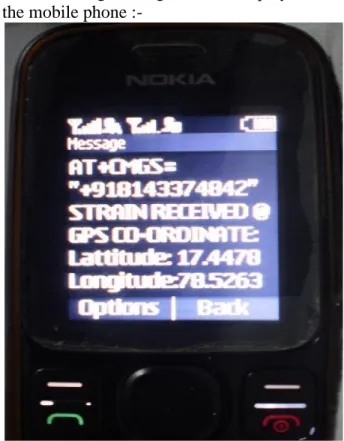
As seen in the block diagram there four types of sensors, signal conditioning , Microcontroller , serial communication, GPS and GSM modules. The four types of sensors include vibration sensor, pressure sensor, gas sensor and fire sensor. The inputs are given to the signal conditioning unit. In the signal conditioning unit the signals are converted into digital signals through analog to digital converter, these digital signals are sent to microcontroller from the microcontroller the signals are sent to serial communication module in which the max232 converts the voltage levels from and sends the desired voltage to obtain the output and then using the GPS module receives the corresponding sensor input and transmits it through the gsm module. This GSM module sends the output in the form of an sms to theuser’smobile phone about the type of damage occurred to the building along with the latitude and longitude co-ordinates [8] .
.
VCONCLUSION
The civil structure health monitoring is an enormous field which can keep updating day by day depending on the upcoming technologies. Here the use of MEMS tri-axial accelerometer sensor, capacitive pressure sensor and MQ2 gas sensor have been made use for the detection of vibration, pressure and gas leakage detection. These sensors are interfaced with an ARM 7 LPC2148 series microcontroller and the GPS and GSM. The GPS module receives the sensor signals and transmits them through the GSM module in order to send the emergency damage detection message and co-ordinates to the users mobile phone. This project can be further upgraded by the addition of moisture sensor and crack
sensor, the above parameters moisture and crack can be detected by making use of fiber optic sensors.
IV OUTPUT
The following message will be displayed in the mobile phone
:-Fig: 3 Output on mobile screen
VII. REFERENCES
[1] A. S. Khan and X. Wang, Strain Measurements and Stress Analysis. Prentice Hall, NJ, 2001.
[2] “PGA309 User’s Guide.” http://focus.ti.com/lit/ug/sbou024a/sbou024a .pdf, January 2005.
2005 ElsevierLtd, Vol. 27, 2005, pp: 1715-1725.
[5] M.J. Chae , H.S. Yoo , J.Y. Kim , M.Y. Cho, “Development of a wireless sensor network system for suspension bridge health monitoring”, see front matter © 2011 Elsevier, vol. 21, 2012, pp: 237-252.
[6] K. S. Raju , Sarika Lamba , A.H. Ansari, “Designing of Wireless Sensor Network Nodes to Detect Vibrational changes for Structural
Health Monitoring Application”, International Journal of Electronics and Computer Science Engineering, Vol. 1, no. 4, pp:
2231-2237.
[7] Yi Li, Yuan-Feng Duan, Yi-Qiang Xiang, “Automatic Recognition and Real -time Alarming of Earthquake Induced Vibration of a Tied Arch Bridge”,IEEE, 2011,pp: 3866-3869