Journal of Language and Linguistic Studies Vol.3, No.1, April 2007
The Contributions of Theme-Based CBI to Turkish Young Learners’ Language Development in English
Nalân Kızıltan Ceylan Yangın Ersanlı
[email protected] [email protected]
Abstract
This study aims at discussing the contributions of Content–based Instruction (CBI) to young learners’ language development in English. Among the three models of CBI, theme-based model has been used in the study, since sheltered and adjunct models are not so functional as theme-based model in Turkish public schools. Experiments have been conducted in both control and pilot groups. The pilot group students have been taught basic language skills in English through theme-based CBI. Both groups have been given an achievement test at the end of the study. The findings indicate that there is a statistically significant difference between the mean scores of both groups in terms of the language development of the young learners. Pilot group can be said to have developed their language skills in English better than those of the control group. Theme-based CBI can be more effective for young learners who are in the process of first language acquisition.
Key Words: Theme-based CBI, teaching English to young learners, language acquisition
Özet
Anahtar Sözcükler: Konuya dayalı İçerik Temelli Öğretim, çocuklara yabancı dil öğretimi, dil edinimi
1. Introduction
The world is getting smaller and smaller through www (the internet use). It is a global village. Therefore, English has become a lingua franca accepted by all the language users. In this global village, learning and teaching English for communicative purposes have become the main objective of learners and teachers.
Since we live in a society where we are supposed to use our communicative competence, the components of which are linguistic, pragmatic, discourse and strategic competence, we need a language teaching approach through which learners are given a meaningful learning in a context.
2. Problem
In Turkey, in public elementary schools, Turkish learners of English are exposed to English in fourth and fifth grades. When their school curriculum and the course books are scrutinized, it is seen that there is no relationship between the units in terms of the topics chosen. Between the each topic, there is not an overall coherence. Besides, students are not given the chance to choose the topics, and their needs and choices are not taken into account in school curriculum.
Additionaly, students are not given the chance for discussing or engaging in problem solving experiences.
3. Purpose of the Study
1- To detect students’ interest in learning a foreign language.
2- To tap students’ schemata (background knowledge)
3- To stimulate students’ interest.
4- To provide main concepts and competence in a meaningful and purposeful manner.
5- To lay the groundwork for the rest of the unit.
6- To create a sense of closure for the unit, providing them with the chance to display newly learnt content.
7- To provide practice in speaking and / or listening, reading and writing.
9- To provide students the chance to learn from their classmates.
10-To give students the chance for presentation of their materials individually or in groups.
4. Research Questions
1. How should we choose a subject of interest of students for learning English?
2. Is Theme-based CBI an effective way of teaching English to young learners in elementary schools?
5. Hypothesis
Relating instructional content to the specific contexts of students’ lives, interest and background, and involving with the students in a participatory way in selecting what is to be learned may enhance the foreign language skills of students as compared with traditional language teaching methods.
6. Content-based Instruction
Canadian French Immersion Programs have revealed that comprehensible input alone is not sufficient to develop an accurate knowledge of a language (Swain 1988, Harley and Swain 1984). Stoller (1997) points out that Content-based Instruction (CBI) has been used in a variety of language learning contexts for the last 25 years.
As Davies (2003) points out it is a method which emphasizes learning about something rather than learning about language.
Brinton, Snow and Wesche (1989:2) define CBI as “the integration of particular content with language teaching aims...as well as the concurrent teaching of academic subject matter and second language skills. According to Brinton, Snow, and Wesche (1989), features of the Content-based approach are:
1- Students are presented with authentic reading texts from the subject area, which they must learn to read not only literally but interpretively and critically as well.
3- A format is provided in which students synthesize factual information and ideas from lecture and reading sources.
4- Content-based teaching allows students to integrate academic skills (eg; note-taking from texts and lectures) and language skills that will prepare them for the rigors of academic life.
7. Types of Content-based Instruction a) The Sheltered Model
Brinton, Snow, Wesche (1989:15) define that “a sheltered content-based course is taught in a second language by a content specialist to a group of learners who have been segregated or ‘sheltered’ from native-language speakers”. In classroom, one of the teachers is a content specialist, and the other is an ESL specialist. They may teach the class together or class time may be divided between the two of them.
b) The Adjunct Model
As Davies (2003) states “adjunct classes are usually taught by ESL teachers”. The aim of the courses is to put emphasis on acquiring specific target vocabulary.
c) The Theme-based Model
Theme-based CBI can be taught by an EFL teacher, a content specialist is not a requirement. Classes are planned to teach about a topic in foreign language. The syllabus is structured around themes or topics, with the linguistic items in the syllabus. “In a theme-based course, the content is exploited and its use is maximized for the teaching of skill areas” (Brinton, Snow, and Wesche 1989:26). Besides, theme-based approach provides coherence and continuity across the skill areas and school curriculum. Additionally, theme-based model is flexible in terms of institutional setting and student proficiency level.
8. Building Coherence in CBI
Making learning a language more interesting and motivating is accomplished by the Six- T’s Approach, which has been put forward by Stoller and Grabe (1997).
a) Themes: The major ideas around which the units are organized are themes determined by taking students’ interests, needs and likes, relevance and institutional appropriateness into account.
c) Texts: language in classroom is presented in meaningful texts. Stoller and Grabe (1997:83) claim that … students’ interest, relevance, and instructional appropriateness, length, coherence, connection to other materials, accessibility, availability, and cost are important.
Criteria for Text Selection
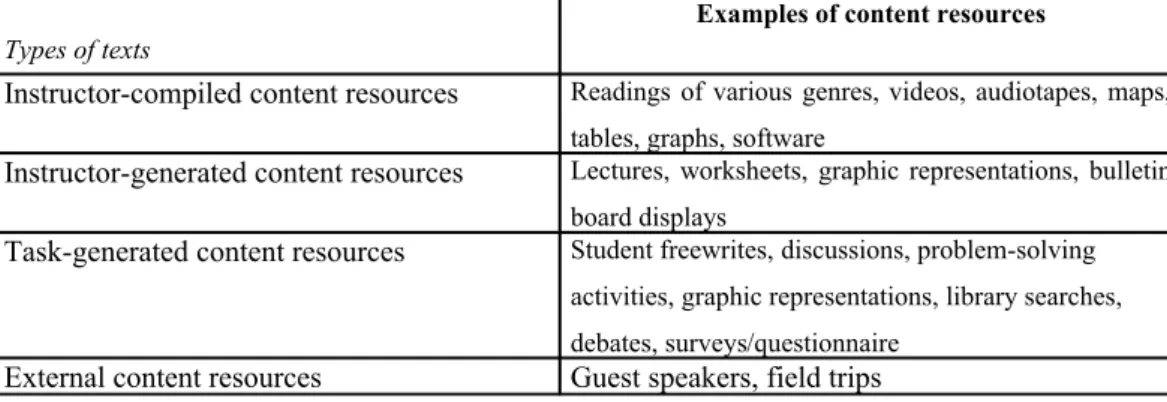
Stoller and Grabe (1997:84) present four basic types of texts used in these units as follows:
Table 1: Types of Texts Used in Theme Units
Types of texts
Examples of content resources
Instructor-compiled content resources Readings of various genres, videos, audiotapes, maps, tables, graphs, software
Instructor-generated content resources Lectures, worksheets, graphic representations, bulletin board displays
Task-generated content resources Student freewrites, discussions, problem-solving activities, graphic representations, library searches, debates, surveys/questionnaire
External content resources Guest speakers, field trips
d) Tasks: Students can develop valuable study skills, such as note-taking, summarizing, and extracting key information from texts through tasks. They may also develop skills in synthesizing, problem solving, and critical thinking.
e) Transitions: Curricular coherence is provided by transitions. Topics and tasks are linked smoothly by transitions.
f) Threads: Another curricular coherence is provided by threads. They are defined by natural linkages across themes. They help students to recycle content, use learning strategies, and to synthesize.
9. Methodology Preparation
The experimental group consists of 44 students and the control group consists of 43 students. However, in the tests applied to the groups the number of the students has varied according to the students’ attendance. Since the difference has not been found to affect the reliability of the mean scores of the groups, the number of the students has been accepted as it is.
To check the students’ English proficiency level a proficiency test has been given to both groups. The reliability of the test is at the level of .977. According to the results of the test proficiency levels of each group can be said to be equal and false beginners.
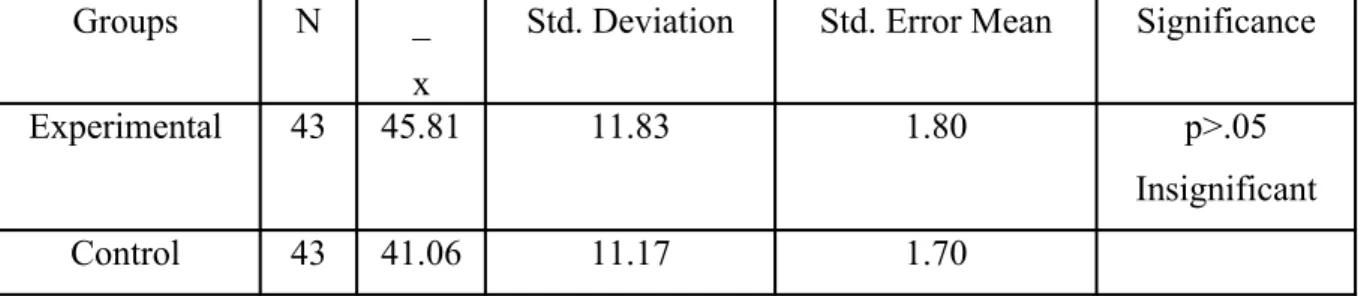
Table 2: Statistical Analysis of the Proficiency Test Administered at the Beginning of the Study
Independent Samples t-test Scores
Groups N _
x
Std. Deviation Std. Error Mean Significance
Experimental 43 45.81 11.83 1.80 p>.05
Insignificant
Control 43 41.06 11.17 1.70
In Table 2, the statistical analysis of the proficiency test scores of the students in the pilot and control groups are given. As is seen, the control group consists of 43 students and the experimental group consists of 43 students. For both of the groups, mean scores, standard deviations and standard error means have been given. As is seen in Table 2, there is not a statistically significant difference between the values of experimental and the control groups. Therefore, the language proficiency levels of both groups can be said to be equal, and they are false beginners.
Choosing a Subject of Interest of Students
not be enough to comprehend it. The students have been also asked to write any missing topic(s) they like most. Then they have been asked to score each of the topics they would like to study most in English in five different categories from five to one. Likert Scale has been used for scoring. Five points is for the topics on which they totally agree, three points is for the topics which they are undecided, and one point is for the topics on which they totally disagree. The results of the questionnaire surprisingly enough have revealed that the topic that they want to learn most is ‘love’. The following graphic demonstrates the results of the questionnaire:
Table 3: The Results of the Questionnaire Administered at the Beginning of the Study
love
famous people
festivals
Special days
Nature
Family
By allowing students to choose their own topics to study, it has been aimed to address their interests and ages and to encourage students to develop a sense of ownership in the unit. The results of the questionnaire indicate that apart from the theme ‘love’, famous people, festivals, special days, nature and family are among the topics which appeal most to the learners, respectively.
Figure 1: The Topics for the Selected Theme 'Love’
LOVE
Language teachers in Theme-based Instruction want to explore meaningful language learning. Once the theme is chosen, teachers should not bring everything they know about the topic to the classroom. In our study, the students have been given the chance to learn the theme ‘love’ from different perspectives and develop their language skills. Therefore, before beginning the instructional procedure, some initial planning factors have been considered, such as the core objectives in terms of language and content learning and determining the most appropriate balance between content and language emphasis, which means ‘Thematic Unit Development’. How it develops as a model is given below:
Figure 2: Thematic Unit Development
Considering Initial Planning Factors
Selecting Theme
A Coherent Set of Topics Expanding Theme
Favorable Special Days
Favorable Festivals
Love for Nature & Country Love for Family
Monitoring Implementation (Instructional Procedure)
Evaluation
During the Lesson
The experiment took fifteen weeks. At the end of each topic, both groups have been given achievement tests and, at the end of the fifteenth week, a final test was given. During the instructional period in the experimental group an integrated skills approach has been used. Therefore, the language skills, such as reading and writing as well as vocabulary and grammar have been given in an integrated way.
Although the students have had a low proficiency level, the instructions in the experimental group have been given in the target language. At first, some anxiety may have been developed because of the lack of comprehension. However, topic-related vocabulary, and structures have helped them to understand the intended meaning. Moreover, most of the times, the visual representations have been used in order to make meaning clearer. In the long run, the students have benefited from it.
In our study a new instructional model in which language and content are closely intertwined has been put into practice with sixth graders in an EFL setting. In the experimental group, content-based language instruction has been used while in the control group, some traditional methods have been used. The curriculum of the experimental group has been determined accordingly, taking the principles of content-based instruction into account. Topic-related tasks and activities have been developed. They involve the active participation of students in the exchange of content or theme-related information. Meanwhile, in the control group the same topics and grammar points have been studied in a traditional view.
these facts, materials, such as cue cards, webs, reading texts and brochures have been classified from easy to difficult.
One of the objectives of theme-based CBI is to tap students’ existing schemata, since it helps to increase effectiveness of the reading, writing processes and leads them to the use of efficient comprehension strategies. In order to achieve this, the students’ schemata in their mother tongue have been checked. For example, while teaching them Cupid, the God of love, we first checked whether they had any idea about the concept in their mother tongue and then tried to build up the necessary information through the help of some visuals, such as an arrow, wings, hearts and pictures. Then its place in mythology was explained. In the first exam in a reading text on Cupid it was tested. Besides, the picture of Cupid was also replaced in order to trigger the necessary background knowledge in them by hoping that it would make the text more comprehensible for the students.
In order to stimulate students’ interest, different kinds of materials have been used, such as calendars, brochures, cards, poems, dialogues, and various texts. The students have been asked to decorate the classroom according to the topic they have been learning. For example, on the day when they have been writing birthday wishes and preparing birthday presents for their beloved ones, the classroom have been decorated by birthday baloons, and presents.
The language skills have been given in an integrated way in the experimental group during the instructional procedure, since Theme-based Content-based language instruction advocates whole language learning. This has been sometimes achieved through the project works, culminating activities and sometimes through the games created. During the theme-based session there has always been created a genuine need to use the language. As a result, the students have provided practice in listening and/or speaking, writing and reading.
Our activities have encouraged students to use their higher order cognitive skills, such as critical thinking, evaluating the given information, making connections, discussing and synthesizing. All these activities have given them opportunities to see the content knowledge from a variety of sources and a different point of view just as they would do in real life. The culminating activities, graphic organizers and the games used are all helpful in those respects. The students have learnt how to approach a problem, to decide on the issue, to be creative and productive.
The last principle that has been taken into account in our study is the emphasis given to meaningful language learning. In our study, various activities, such as work shops, role plays, project-works, and simulations have been used in order to give students concrete experiences in language learning process. By this way, they have had the chance to display newly learnt content in a meaningful and purposeful manner.
10. Data Analysis
The data obtained from the achievement tests have been analyzed by a statistical analysis program named Mann-Whitney U tests. These achievement tests have been given at the end of each topic, and finally at the end of the fifteenth week a t-test has been used to analyze their overall achievement in all the five tests. Students in each class have been observed and the effectiveness of the method has been discussed accordingly.
Table 4: Statistical Analysis of the First Achievement Test of the Control and the Experimental Groups
1st AchievementTest Groups N _
x
Sum of Ranks z
Experimental 43 59.44 2556 -6.24*
Control 42 26.17 1099
*p<.001
students in that group have used the target language more efficiently than the control group.
Table 5: Statistical Analysis of the Second Achievement Test of the Control and the Experimental Groups
2nd Achievement Test Groups N _
x
Sum of Ranks z
Experimental 44 64.16 2823 -7.95*
Control 42 21.86 918
*p<.001
Table 5 shows the statistical analysis of the second achievement test for the experimental and the control groups. According to the test results, it can be said that there is a significant difference between the mean scores of the both groups. Consequently, the experimental group has been more successful than the control group in the second test applied.
Table 6: Statistical Analysis of the Third Achievement Test of the Control and the Experimental Groups
3rd Achievement Test Groups N _
x
Sum of Ranks z
Experimental 43 62.94 2706.5 -8.2*
Control 41 21.06 863.5
*p<.001
Table 6 shows the statistical analysis of the third test of the control and the experimental groups. It is clear that there is a significant difference between the mean scores of the experimental and the control groups. Therefore, the experimental group can be said to be more successful than the control group.
4th Achievement Test Groups N _
x
Sum of Ranks z
Experimental 41 58.83 2412 -6.3*
Control 42 25.57 1074
*p<.001
Table 7 indicates the statistical analysis of the fourth test for the experimental and the control groups. Based on the test results, there is a significant difference between the mean scores of the both groups, and the experimental group has been more successful than the control group.
Table 8: Statistical Analysis of the Final Achievement Test of the Control and the Experimental Groups
Final Test Groups N _
x
Sum of Ranks z
Experimental 42 62.43 2622 -7.82*
Control 41 21.07 864
*p<.001
In Table 8, the statistical analysis of the final test of both experimental and control groups has been given. Based on the findings of this test, it can be concluded that there is a statistically significant difference between the mean scores of the two groups. The experimental group has been more successful than the control group.
Table 9: Statistical Analysis of the Total Sum of the Achievement Tests of the Control and the Experimental Groups
Independent Samples t-test Scores
Groups N _
X
Experimental 5 61.56 2.31 1.03 p>.001 significant
Control 5 23.14 2.51 1.12
Table 10: Total Mean Scores of the Control and the Experimental Group
0 20 40 60 80
1 2
Experimental Control
Based on Tables 9, 10, it can be stated that our research hypotheses have all been verified. The experimental group has scored better than the control group in all five tests administered throughout the study.
11. Conclusion
In this study, among the models of CBI, only theme-based CBI has been used, since sheltered and adjunct models require a partnership of the language teacher with a content-area specialist. The primary aim in those models is to teach a specific subject and specific target vocabulary in some institutional setting, whereas, in a theme-based CBI model, the aim is to develop students’ target language skills irrespective to some institutional settings and language proficiency level of the students.
Since the themes were chosen by the students at the beginning of the study, English lessons were full of fun and motivating. The results of the study have revealed that students may learn better through theme-based CBI. Students can be said to have developed a much wider knowledge of the world through information gap activities, graphic organizers problem solving activities, sequencing and ranking activities.
group work in the study, the students have developed their collaborative. Relevant content material selection has enabled the students to use language in a more meaningful way, to revisit content for different purposes, and also to plan these units.
Since this method is a new for the students, it has caused some problems for the students. During the first month, some students felt confused and felt that they are not improving their language skills. Therefore, we tried to draw their attention to linguistic features by the materials and consolidate any difficult vocabulary or grammar points.
It was hard for us to find information sources in English for lower levels. Therefore, we tried to simplify the text. Some students copied from the source texts in the preparation of their materials. Hence, we tried to design tasks that would require the students’ evaluation of the information in some way and put them in their materials.
12. Some Suggesions for Language Teachers
1. Content-based language instruction should be suggested in schools. Therefore, pre-service language teachers should be trained so well as to use Content-based instruction in their teaching practices.
2. Language teachers can apply Theme-based CBI in their language courses as much as possible, in coordination with other major teachers in their schools.
3. Last but not least, the textbooks might be designed in accordance with themes, topics, texts, tasks, transitions, and threads, which are called the Six T’s Approach in order to create curricular coherence in EFL teaching.
REFERENCES
Brinton, D. M.A. Snow, and M.B. Wesche. 1989. Content-based second language instruction. New York: Newburry House Publishers.
Davies, S. 2003. “Content-based instruction in EFL contexts”. The Internet TESL Journal, Vol. IV, No. 2, February 2003, http://iteslj.org.
Ersanlı Yangın, Ceylan. 2005. “Teaching English through Content-Based Instruction in Elementary Schools.” Unpublished Master Thesis. Ondokuz Mayıs University, Samsun.
Harley, B. & Swain, M. 1984. “The interlanguage of immersion and its implications for second language teaching”. In A. Davies, C. Criper, & A.P.R. Howatt (Eds.),
Interlanguage (pp.291-311). Esdinburgh: Edinburgh University Press. Stoller, F. L. 1997. “Project”. Forum, 35 (4):2-14.
Stoller, F. L. And W. Grabe. 1997. “A six T’s approach to content-based instruction”. In
Content-based Classroom perspectives on integrating language and content
(Eds.). M. A. Snow & D. M. Brinton. New York: Longman. 78-94.
Swain, M. 1988. “Manipulating and complementing content teaching to maximize second language learning”. TESL Canada Journal, 6, 68-83.
Asst.Prof.Dr. Nalan KIZILTAN is a lecturer of linguistics in the Department of English Language Education at Ondokuz Mayıs University, Kurupelit-SAMSUN, TURKEY. She received her MA degree and Ph.D. degree from the Department of Linguistics at Hacettepe University. She completed her postdoctoral studies at Ohio State University in U.S.A. She teaches Linguistics, Language Acquisition and Teaching English to Young Learners courses to BA and MA students in the department of English language Education at Ondokuz Mayıs University. She is also a teacher trainer.