ISSN: 1305-578X
Journal of Language and Linguistic Studies, 10(1), 31-45; 2014
Code-switching in EFL classrooms and the perceptions of the students and teachers Seçil Horasan a*
a Gazi University, School of Foreign Languages, Ankara, 06830, Turkey
APA Citation:
Horasan, S. (2014). Code-switching in EFL classrooms and the perceptions of the students and teachers. Journal of Language and Linguistic Studies, 10(1), 31-45
Abstract
This study aimed to investigate the amount of code-switching in terms of sentential levels and initiation patterns, the discourse functions of code-switching, and the perceptions of the switchers. Accordingly, 43 students at elementary level and four of their instructors in two EFL classrooms took part in the study. These participants were chosen through random sampling. Data were collected through observations, questionnaires to students and teachers, and interviews with a selected sample. The results of the quantitative and qualitative analysis of the triangulated data showed that students’ use of code-switching was rather high. Teachers’ code-switching was even higher than expected. In terms of initiation patterns, student-initiated code-switching was quite high whereas in terms of sentential levels, inter-sentential level was observed a little more than intra-sentential level. The analysis of discourse functions revealed that both the students and the teachers employed code-switching mostly for meta-language, which is a function used to talk about grammar or language tasks. The perceptions of all participants on code-switching overlapped in that they believed that it was a tool that fostered learning in beginner levels and could be used to attract attention or for jokes, yet should be abolished as the proficiency level increases.
© 2014 JLLS and the Authors - Published by JLLS.
Keywords: Code-switching; discourse functions; perceptions.
1.
Introduction
As the need to communicate in English increases, so does the number of bilinguals. Some of the studies on bilingualism (Auer, 1984, 1998) stem from the fact that in bilingual classes it is quite natural to encounter with mixed language use in the learning process. That is, learners tend to utter combinations of two or more linguistic varieties in bilingual classrooms, leading us to code-switching (Eldgridge, 1996).
Code-switching (CS) is regarded as the seemingly random alternation of two languages between and within sentences (Poplack, 1980). It refers to the combination of several languages or dialects in the same conversation or sentence by bilingual people (Gardner-Chloros, 2009, p. 4). It is a non-systematic process of bilinguals who mix two languages during conversation (Cantone, 2007). All in all, defining CS as “the alternative use of two or more languages in the same conversation by bilinguals” is a common consensus (Milroy & Muysken, 1995, p. 7).
*Seçil Horasan. Tel: +90-312-484-5400
Due to the presence of the mother tongue (L1) within in a code-switched communication, some teachers and researchers allege that it shows incompetence and lack of credibility (Hughes, Shauness, and Brice, 2006; Labov, 1971). However, from a socio-cultural perspective, it in fact encourages creative language use and capability of using both languages effectively (Dahl, Rice, Steffensen, Amundsen, 2010). Therefore, it is quite important to understand the nature of CS to interpret such occurrences correctly.
Although there are various studies on the amount of CS by the learners and teachers, fewer have been supported by post-observation interviews and questionnaires. Presumably due to the concerns of teachers, there are few studies on teacher-initiated CS. Moreover, although there are studies referring to the sentential levels, not many of them investigated the amount of these levels with their implications on language learning. Most importantly, only few studies on CS have been strengthened with the perceptions of code-switchers who may provide different aspects. There is, hence, a need to understand how code-switchers see and explain their CS. Thus, this study focuses not only on discourse functions, but also on initiation patterns, sentential levels, and the perceptions of code-switchers.
1.1.
Literature review
CS has been widely studied from a pedagogical aspect to a neurolinguistics aspect (Macizo, Bajo, & Paolieri, 2012; Üstünel & Seedhouse, 2005; Reyes, 2004).
CS has been studied based on different functional approaches such as discourse-related (Myers-Scotton, 1989), socio-linguistic (Gumperz, 1982; Boztepe, 2005), conversational (Auer, 1984, 1998), and other approaches. In terms of discourse functions by teachers, Hobbs, Matsuo, and Payne (2010) focused on three language teachers’ CS: one British and two Japanese. Depending on the findings, they formed twelve categories based on teachers’ CS: opening, warm-up, instructions, explanation, checking comprehension, translation, timekeeping, praise, elicitation, answering students’ questions, correction. These are too specific categories which were covered in the more comprehensive categories presented in this paper.
Framing their own conceptualization of discourse functions, Ariffin and Rafik Galea (2009) defined eleven categories: signaling social relationships and language preferences, obviating difficulties, framing discourse, contrasting personalization and objectification, conveying cultural -expressive message, dramatizing key words, lowering language barriers, maintaining appropriateness of context, showing membership and affiliation with others and reiterating messages. Their study revealed that CS behavior is not random nor a sign of linguistic deficiency, it is rather a negotiation between the language use and communicative preferences.
Aiming to find the circumstances that CS was employed with its advantages, disadvantages and the characteristics as well as its relationship with exposure, Huang (2008) conducted a study on three classes of different levels. The results revealed eight functions of student CS: a linguistic gap, repeating the same pattern, tattle telling, translating, attracting attention, expressing emotions, avoiding punishment, and turning to the L1 in the existence of native teachers. Furthermore, she found that CS decreased when the exposure to the target language (L2) increased ant that the advantages of using CS in a language classroom outweighed the disadvantages.
qualification, and personalization versus objectivization. Overlapping with those of Gumperz (1982), eight different functions of CS proposed by Saville-Troike (1982) are softening or strengthening of a request or command intensification/elimination of ambiguity (repetition), humorous effect, direct quotation and repetition, ideological statement, lexical need, exclusion of other people within hearing, avoidance strategy, and repair strategy. However, the categories suggested by Eldridge (1996), namely equivalence, floor holding, meta-language, reiteration, group membership, conflict control, and alignment and misalignment were adopted as the basic taxonomy for the purposes of this study and expanded in the results.
The amount of CS by students and teachers has received a lot of interest so far. A recent study (Ataş, 2012), for instance, investigated the amount of CS cases by students and teachers in a Turkish school along with their discourse functions and found that the amount of CS by students was more than that of the teachers, but both teachers and students employed a lot of discourse markers which were used for overall discipline; usually for clarification by teachers and for displaying understanding and jokes by students. What’s more, he didn’t find a significant difference between different proficiency levels of learners.
Dahl, et al. (2010) investigated CS on one child who left Norway to the USA. Analyzing the recordings, they saw that the child mostly used Norwegian with 58% although it was the dominant language neither at home nor at school. The code-switched utterances held the 21% of the all utterances. He mostly used CS to clarify things and to fill in the gaps in his lexicon. The researchers interpreted that his language learning patterns were like NNS, rather than a bilingual.
CS cases are also examined in terms of sentential levels in which inter-sentential level refers to the CS across sentences whereas intra-sentential level refers to the CS in a sentence (Saville-Troike, 1982; Milroy and Muysken, 1995). These levels were also referred as inter-phrasal for those between two sentences and intra-phrasal for those in the middle of a single sentence (Ariffin & Rafik Galea, 2009; Gabusi, 2009). The results of the study by Cal and Turnbull (2007) based on two Spanish-English bilinguals sisters’ daily conversations showed that their CS were primarily on inter-sentential levels which were employed to accomplish more than one function such as to quote, signal changes, increase the illocutionary force of a command, show misalignments, or insert a proper name.
In terms of initiation patterns, Üstünel and Seedhouse (2005) differentiated teacher-induced CS that is used to provide a prompt for L2 use from teacher-initiated CS which is used for twelve functions: dealing with procedural trouble, dealing with classroom discipline, expressing social identity, giving an L1 equivalent, translating into the L1, dealing with a lack of response in the L2, providing a prompt for L2 use, eliciting an L1 translation, giving feedback, checking comprehension, providing meta-language information, giving encouragement to participate.
Hobbs, et al (2010) interviewed one NS and two NNS participants and found out that although the target language is desirable; NNS teachers believe that it is sometimes impossible and also unnecessary to insist on because of time and classroom management concerns. Bridging the gap between the culture of learning and the teacher beliefs, such evidence is important both for second language acquisition and for teacher education.
Rather than how code-switchers themselves see the phenomenon of CS, so far researchers have focused more on its pedagogical implications. Üstünel and Seedhouse (2005) in this sense observed code-switched utterances of Turkish students in relation to both pause length for answering a question in L2 and encouraging students to turn back to L2 through teacher-induced and teacher-initiated CS. They concluded that learners’ language choice was related to their degree of alignment or disalignment with the teacher’s pedagogy. They asserted that learners tended to code-switch when engaged in interaction, which differs from the teacher’s intended focus at that stage of the lesson, such as when learners need to deal with procedural issues.
In the same vein, similar switches can trigger different interactions in class and can help bridge the gap in a discourse of a negotiation (Moore, 2002). Addressing the roles and functions of L1 in L2 classes, Moore (2002) highlights the use of L1 for attention-raising which is important in language classrooms in that the amount of attention paid to the language data at specific time of exposure plays a critical role in language learning. Furthermore, based on the CS signs in the conversation, researchers suggest that an increased meta-linguistic awareness be also shown in the data (Moore, 2002; Reyes, 2004).
To sum up, the analysis of CS is critical in two terms: linguistically and methodologically. Numerous research studies have focused on the question of how much code-switching occurs in classrooms based on different methodological aspects such as level, gender, purposes and needs, classroom roles of teachers or students and on some linguistic aspects such as discourse functions, sentential levels, neuro-linguistics aspects, perceptions of the code-switchers, pedagogical aspects, and so on. However, this study is necessary in that it investigates the use of CS in EFL classrooms from student and teacher perspectives in two critical terms mentioned above. That is, this present study aimed to contribute to the field with a combination of some of these aspects such as discourse functions, initiation patterns, CS levels, student and teacher uses, and perceptions of the speakers.
1.2.
Research questions
With the aforementioned rationale in its background, this study aims to answer the following questions:
1. What is the amount of CS by students of elementary level and their teachers in a preparatory school of a public university in terms of:
a. Inter-sentential and intra-sentential levels of CS? b. Student-initiated and teacher-initiated CS?
2. What are the discourse functions of CS used by students and teachers? 3. How do students and teachers themselves see the phenomenon of CS?
Based on personal experiences and earlier observations, it is hypothesized that students will code-switch mostly to fill in the gaps for vocabulary items while teachers will code-code-switch to facilitate understanding and to attract attention. Student-initiated CS is expected to be a lot with inter-sentential level. Furthermore, students are expected to feel that CS is a lack of competence with negative interpretations while teachers are expected to see it as way to assist students’ understanding.
2.
Method
2.1.
Participants
This study was conducted on two classes consisting of 43 students and on four of their teachers at a preparatory school of a public university. Each teacher was observed twice and each class was observed four times. All teachers were observed in the fourth lesson in the afternoons in order to stable the conditions for all participants.
The teachers were all female beginning teachers between the ages of 26 and 28. Their teaching experience in total varies from 4 to 6 years. Only two of them have been abroad for almost a year. However, they were graduates of ELT departments and were very competent in the field of teaching. The teachers were not informed in detail that the study focused on CS so as not to put an effect on their natural flow of speaking, yet instead were briefly informed that the observations were on discourse analysis in general.
Student participants, on the other hand, included 18 females and 25 males aged between 17 and 22 who have been learning English for an average of 7.8 years. Most of them are graduates of Anatolian high schools which are known for their language education, yet they had poor language skills. They were at elementary level. Therefore, their motivation to learn a foreign language was low since they believed they could not learn it after so many years. In addition, their exposure to language was extremely limited to the classroom talk. They used to do neither readings nor listening in the target language. Only three students have been abroad but not more than 3 months, which was with their families or friends, rather than being alone to improve their language skills.
The participants were basically chosen through simple random sampling. All the participants were given an informed consent form with a demographic form which was orally translated to the students to avoid any misunderstanding. The names of the participants were coded in numbers in the analysis.
2.2.
Instruments
This study is a triangulation of classroom observations, questionnaires, and interviews.
First of all, both classes were observed four times. The observations were structured (Flick, 1998, as cited in Cohen, Manion, & Morrison, 2007), direct, overt, and non-participant (Cooper and Schindler, 2001, as cited in Cohen, et al., 2007). The observations were audio-recorded and transcribed after each lesson; and the recordings were supported by the researcher’s notes. An observation scheme called CS Observation Scheme (COS) involving criteria for discourse functions of CS by the students and the teachers was developed by the researcher for non-real time coding. The new scheme was inspired from Spada and Fröhlich’s (1985) COLT (as cited in Dörnyei, 2007) and Eldridge’s (1996) discourse functions of CS.
questionnaires, the questionnaire for the students consisted of 11 items while that of the teachers had 10 items, most of which were parallel. The questionnaires were formed as a likert scale with five options from “strongly agree” to “strongly disagree”.
Finally, all the teachers and only eight students who revealed the most and the least evidence of CS were interviewed to gather better insight of their perceptions. Interviews were used to obtain research-relevant data to understand and interpret the life-worlds of the participants and to use natural data to elicit descriptions (Cohen, et.al, 2007). The framing of the interview questions were shaped for a semi-structured interview in which the prompts were predetermined and some probes were also included to elaborate the answers (Cohen, et.al., 2007). Delayed interviews were preferred so as to avoid the risk that the participants would be influenced by the points discussed in the interview and would not behave naturally in the ongoing observations. The interviews were audio-recorded and transcribed.
2.3.
Procedure
All the participants were first given an informed consent form and a demographic form. The content of the form was orally translated to the students to avoid any misunderstanding. The names of the participants were coded with numbers in order not to reveal any personal information. The data gathered from the demographic forms were entered in SPSS 16 to describe the characteristics of the participants.
The observations were scheduled with the teachers in advance. All observations were arranged for the 4th lesson in the afternoons in order to stable the conditions for both classes and the teachers whose
concerns and wishes were taken into consideration, as well. They were assured that their teaching skills or any other methodological issue was not the focus of the observation. Eight observations in two classroom lasted for five consequent weeks. The audio-recordings and the researcher notes were transcribed after each lesson.
The participants were not informed about the specific topic of the study until the observations were completed in order not to influence their L1 and L2 use in class, except from a short line in the informed consent form. After the administration of the questionnaires, both the students and the teachers were informed in detail. Participants were assisted with examples for each item in the questionnaire while they were completing the questionnaire.
Based on the amount of the code-switching cases in the transcribed data, 2 students providing the biggest amount of switching from each class and 2 students providing the least amount of switching evidence were interviewed to strengthen the data on their perceptions of why they code-switch. Therefore, the interviews had to be delayed interviews due to the structure of the analysis. In total 8 students and all of the four teachers were interviewed with the guided questions. The interviews, about 5 minutes each, were also audio-recorded.
2.4.
Data analysis
The present study is a case study and a mixed method research design combining the qualitative and quantitative analysis was employed (Dörnyei, 2007) to find the amount of CS and to interpret the reasons why participants code-switched.
In the quantitative part, the tally marking on COS was turned into frequencies and the quantitative part was compared to the findings of the interviews.
As the data were examined, there appeared a need to expand the categories of discourse functions defined by Eldridge (1996) and the final version of the categories is as follows:
1. Equivalence: when participants don’t know English meaning. (applies for students)
2. Floor holding: to keep interaction on (applies for both)
3. Meta-language: to talk about the task, comment, evaluate + for grammar explanation (applies
for both)
4. Reiteration: repeating to clarify, emphasize, and reinforce meaning. (applies for both)
5. Group membership: to show group identity. (applies for both)
6. Conflict control: to create ambiguity while blaming, criticizing, etc. because it is easier in
another language. (applies for both)
7. Alignment/disalignment: to change the order by starting in Turkish, turning to English, and
turn back to Turkish to adopt and leave a social role. (applies for both) Newly-added categories:
8. Classroom routine (or procedural talk): to talk about the classroom routines, generally in
the beginning and in the end of the lesson. (applies for both)
T: Yarın writing kitabını getiriyorsunuz. (Literary Translation: Tomorrow bring your
writing books.)
9. Attract attention: to make a difference in class, to attract the attention of the students (applies
for teachers), or to attract the attention of only the teacher or everybody in class, to hold the attention on oneself. (applies for students)
T: Peki bu what is that here? (LT: Then, what is that here?)
10. Checking, clarifying and confirming: to check (değil mi?/right?), to clarify (yani it is../I
mean it is..), to reinforce (to make sure other part understands: yazarmış/She said he was a writer.), to confirm (tamam, yani evet/ OK, yes.) (applies for both)
St: Teacher ilk bebe misin diyor. (LT: Teacher asks ‘Are you the first born child?’) 11. Explanation: when the topic itself is difficult such as scientific issues or when explaining
abstract vocabulary. (applies for both)
T: Do you know culture-specific? Only Muslim culture can understand this yani biri sorduğunda açıklaman lazım. For example… (LT: I mean, when someone asks, you need to explain.)
12. Sense of humor: to make jokes, wordplays, for exact expression of what you want to say without losing its taste, meaning, and wisdom in it.) (applies for both)
St: She has own house, but a rent.
T: Thanks God a rent. Çünkü I have a rent, not my own house. (LT:because) 13. Cultural issues: like “kuma, sarma” and proper names such as the poem “Ben Sana
Mecburum” (applies for both)
St: It’s kuma hocam. (LT: It’s co-wife, teacher.)
14. Classroom management: to keeping students silent, to turn their attention to the lesson, to deal with interaction patters or instruction giving. (applies for teachers)
T: Yes, yoksa naparım? [With an angry voice] (LT: Otherwise what will I do?)
3.
Results
The results gathered from the quantitative analysis of the transcriptions of the observations through frequency analysis of tally marking showed that there was a huge amount of CS in a total of eight observations. The percentages of the CS cases were represented in Table 1.
Table 1. The amount of code-switching in total
CS Amount of all the CS observed % of all CS observed
Students (n=43) 365 67.4
Teachers (n=4) 177 32.6
Total (n=47) 542 100
The table shows that the percentage of CS occurrences is quite high. When the size of student and teacher participants was compared, it is clearly seen that the amount of CS by the teachers was also quite high for four participants.
Another finding was that students initiated more CS occurrences. However, rather than a focus on who initiated CS, the focus was to observe whether participants switched according to the linguistic code they encounter. That is, whether they changed the language they used according to the counter part in the conversation was observed. However, the data provided few examples of such occurrences.
Table 2. The percentages of student-initiated and teacher-initiated code-switching CS Amount of initiation
patterns
% of initiation patterns
Students (n=43) 358 66.05
Teachers (n=4) 184 33.95
Total (n=47) 542 100
1 T: Evet, so write five sentences for her. (Literal Translation (LT):Yes) ST 40: Bunları buraya mı yazacaktık? Yanlış anladım.
(Were we supposed to write them here? I got it wrong) T: Sorun değil. (No problem.)
ST 40: Hocam, what is this? (Teacher) T: It is a drawer.
Excerpt 1 indicates that the teacher starts an intra-sentential level CS, probably to attract the attention on the task, whereas the student makes an inter-sentential level purely in Turkish. Probably because the students talks about a problem, the teacher continues in the same language. Despite the fact that teacher replies in Turkish, the student interestingly turns back to English in the fourth line, which shows that when the student needs something to be clarified, he probably wants to make sure that he understands correctly. Hence, he uses the native language. However, at other times, he is willing to practice the target language. In the last line, the teacher again replies in the switched code, namely in English.
Table 3. The amount of inter-sentential and intra-sentential level code-switching
CS Amount of CS CS %
Intra-sentential 267 49.27
Inter-sentential 275 50.73
As expected, the amount of inter-sentential CS was higher according to the quantitative analysis of the observations; however, in contrast to what was expected, there was just a little difference between the amount of inter-sentential and intra-sentential levels of CS.
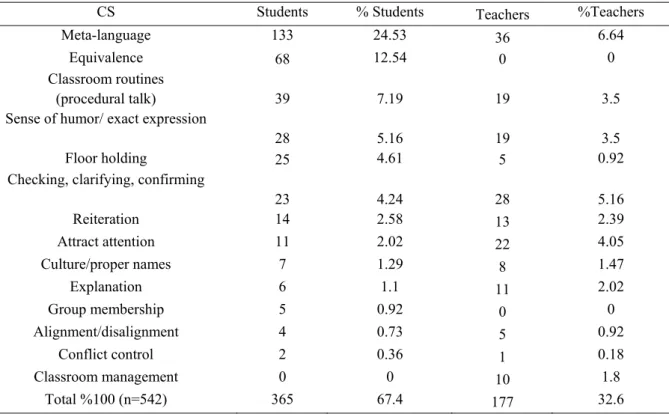
It was also expected that the teachers would use CS to attract attention and to facilitate understanding while students would switch codes mostly to fill in the gaps for vocabulary items. However, it is found that the function of “meta-language” held the highest amount with a percentage of 24.53% by the students and 6.64% by the teachers.
Table 4: Discourse functions employed by the students and teachers
CS Students % Students Teachers %Teachers
Meta-language 133 24.53 36 6.64
Equivalence 68 12.54 0 0
Classroom routines
(procedural talk) 39 7.19 19 3.5
Sense of humor/ exact expression
28 5.16 19 3.5
Floor holding 25 4.61 5 0.92
Checking, clarifying, confirming
23 4.24 28 5.16
Reiteration 14 2.58 13 2.39
Attract attention 11 2.02 22 4.05
Culture/proper names 7 1.29 8 1.47
Explanation 6 1.1 11 2.02
Group membership 5 0.92 0 0
Alignment/disalignment 4 0.73 5 0.92
Conflict control 2 0.36 1 0.18
Classroom management 0 0 10 1.8
Total %100 (n=542) 365 67.4 177 32.6
Students’ need to fill in the gap in their vocabulary knowledge followed with 12.54% in the second rank. For teachers, on the other hand, facilitating understanding by clarifying, checking understanding, and confirming turned out to be second by 5.16% and attracting attention was the third by 4.05%. That is, these functions were also quite high and the teachers would like to make sure of understanding by adding some native language in between.
Although 12 out of 14 functions apply for both students and teachers, “equivalence” only applies for students whereas “classroom language” only applies for teachers. As expected, no contrary results were found in these categories for both participants.
Furthermore, teachers made no use of the function called “group membership” and made only a small amount of use of the functions “alignment/disalignment”, “conflict control”, and “floor-holding”. These are almost in line with the results of the students who also made just a little use of “alignment/disalignment”, “conflict control”, and “group membership”. Yet, they showed a significant amount of “floor-holding” function.
revealed that all the students pointed to their lack of competence in vocabulary knowledge as a reason for their use of CS.
In addition, questionnaires showed that 53.5% of students believe they switch languages to express what they really want to say, which was very high for this function. Another function that is in line with the observation results is that 41.9% of the students think they use CS for floor-holding to keep on the interaction. Most of the students (51.2%) believe they often use CS for the sense of humor which held a fair amount of the all cases. Based on the qualitative analysis of the interviews, it was revealed that they think CS makes speaking and learning easier.
Furthermore, it was seen in the questionnaires that they mostly believed that they do not use CS to attract attention or to reiterate for emphasis as 34.9% for the former and 34.9% for the latter said never for these functions. Interestingly, 39.5% believed that they code-switch to showed group identity, however, in the observations only few cases were noted. In terms of the teachers’ use of CS they had a strict stance that teachers should speak only English according to the qualitative analysis of the interviews.
The teachers, on the other hand, were expected that they would assert that they used it just to assist students’ understanding or to attract attention. The quantitative analysis of the questionnaires showed that most of the teachers (75%) sometimes use CS for classroom management, but only rarely for giving instructions. The qualitative analysis of the interviews supported these perceptions.
Most of the teachers said they ‘sometimes’ used CS in vocabulary teaching; however, for grammar teaching they said they ‘rarely or a little more than rarely’ used it according to the questionnaires. The qualitative analysis of the interviews revealed they all believed this was only valid for the beginner levels, yet should be avoided in the upper levels. One teacher even believed that CS was helpful to create sympathy in the first weeks. Some teachers stated that they usually used it for the sense of humor. Most used it for clarification, but rarely for explanation. When they needed to emphasize or clarify something, most of them used it for reiteration; however, almost none of them used it due to their loyalty to L1.
In terms of the impacts of CS on learning gathered from the findings of the interviews, teachers all believed that it was to some extent negative for students, but still depending on the level. Therefore, they all believed students should not be encouraged for the use of Turkish because for them it did not show advanced skills and did not ease learning. Only one teacher clarified that not the use of Turkish but the use of intra-sentential CS could be of help for their improvement.
All in all, CS was perceived positively by the students and teachers due to some merits; however, they believed that it also had some disadvantages as well.
4.
Discussion
aforementioned reasons caused by the students as well as the ease to conduct lessons with a mixture of two languages, rather than the target language only.
Student-initiated code switching is almost quite as much as expected due to the prior experiences that students do not try to practice English, rather they try to speak Turkish and keep on so unless the teacher turns back to English. Teacher-initiated CS was high for the small number of participants.
Students are prone to use CS in inter-sentential level. In other words, they would not only like to switch words but like to switch the whole sentence in an L2 conversation. This type of CS requires less effort and ability since it includes a block of native language utterances. In this way, they even try to make the teacher speak Turkish, as well.
In contrast to our hypothesis, both the students and the teachers mostly employed CS for meta-language to comment on the task and the grammar points. It means that both sides feel needed to talk about the task, to evaluate the task, or to discuss the grammar points within the task in Turkish although they would like to do and check the task in English. In fact, teachers believe that they do not and should not code-switch for grammar teacher; however, the results showed that they and the students did so. It is understandable that teachers do not want to seem traditional in their way of teaching stating that they do use L1 in grammar lessons.
Students believed that lack of vocabulary knowledge is the primary cause of their CS use. As hypothesized, the function of equivalence was quite high as in the study of Ariffin and Rafik Galea (2009). However, they do not see this as a weakness since they are beginner level learners. Just like the teachers, however, they do not approve it in the upper levels. In other words, both the students and the teachers believe that the occurrences of CS are acceptable in lower levels, yet it should be decreased as the level gets higher. It makes sense in that when students have no idea of the target language, it is easier for them to comprehend the target language using cognates, the Contrastive Analysis Hypothesis (CAH) (Brown, 2007), or other comparisons of the two languages so that they would also feel interested and, hence, motivated.
Since the level of the students is low, teachers may feel needed to employ a lot of code-switching to facilitate understanding and attract attention. Furthermore, when the low classroom motivation and crowded classes are considered, teachers need to attract their attention to the lesson through L1 and L2 at oftentimes. As in line with the hypotheses, these functions appeared high for teachers. These results gathered from the observations were quite parallel to the perceptions of the teachers who believed in using CS for attracting attention and checking/clarifying. However, it was preceded by their use of meta-language which was thought not to be a frequent function in their eyes.
It was interesting to note that the function that only applies for students ranked second out of 14 categories while the one for teachers ranked eighth. This function for students concerns the equivalence of vocabulary items as in the “lexical needs” function of Saville-Troike (1982). That of teachers was classroom management. It indicates that the students mostly make use of the function that characterizes the students although teachers do not.
When it comes to their claim that CS facilitates their expression of ideas in the way they want, students mean that when their level does not allow them to give the exact meaning without losing its influence, they include a bit of L1 so that they become pleased that they achieve communication and are understood though it is a sort of destroying the language, as they stated. According to the interviews, they believe using CS in this sense is useful and improves their survival skills in communication in L2.
are aware that just as they have communicative strategies in their L1, they develop certain strategies in L2 to be paid attention while being listened to and to keep the conversation on even if their strategy includes the use of their native language. Since they employ the function successfully, they believe they learn and improve L2 speaking skills easily. As Ariffin and Rafik Galea (2009) also found, CS is a language preference for communicative purposes. Nevertheless, they do not think that it is an advanced skill probably they believe they already do the same in their L1 and thus they do not think that they put in something from themselves.
On the other hand, students preferred their teacher to speak English mostly. It is interesting that students appreciate teachers’ using L2 most of the time but also complain that they do not understand it when they speak ‘only’ English.
In terms of the affective side of CS, teachers believed it helps to improve their communication with students. Since this language school lasts for one year which is full of English and nothing else, it creates boredom among students from time to time. Therefore, teachers have right on their side that they need to build strong relations to the students and need to be on good terms with the students. As a result, they do use CS to serve such an affective function, which is named in different ways but also exist in the categorizations of Ariffin and Rafik Galea (2009) and Huang (2008).
The statement of one teacher that only intra-sentential level CS was useful appears to be interesting to be addressed. The rationale behind this belief was that within an intra-sentential level CS is the use of two languages. Therefore, according to some teachers, if a student can make use of two languages within a single statement correctly and can achieve communication, then it is of help to improve language skills. On the contrary, inter-sentential level is already in the native language mostly and does not help the students a lot.
Last but not the least, both the students and teachers mentioned the advantageous sides of using CS in their EFL classrooms, along with some restrictions though. The positive perceptions were in line with the study of Huang (2008).
5.
Conclusions
CS includes the use of two languages alternatively in a single conversation (Poplack, 1980) and hence should be considered from two ways in learning: Does it ease learning since it includes the native language and helps to decrease the affective filter (Krashen, 1987), or does it inhibit learning the target language due to the interference of the L1?
This study focused on the CS use of the students and teachers in EFL classes. The analysis of the amount of the CS use, CS level, their initiation patterns, the discourse functions of CS they used, and their perceptions revealed significant implications in second language acquisition. It seems that CS is employed a lot and it serves to a number of functions consciously or unconsciously. The users of CS, on the other hand, sometimes believe different things than they do.
In addition, students should also be encouraged to use L2 more since its positive sides outweigh. However, their switches to L1 for meta-language (comment on the task or talking on grammar), confirming, floor-holding, sense of humor apparently help their learning in various ways. Therefore, to foster effective learning in beginning levels, CS can be seen and even be taught as a communicative strategy. CS is not necessarily related to learners’ proficiency level but it may imply a communicative classroom function to discuss classroom routines, or share their concerns, or repeat for confirmation. Therefore, there should not be a strict approach towards abandoning the use of CS at all in EFL classrooms.
Further study can be conducted as a longitudinal study in a larger scale with a larger sampling. As Boztepe (2005) suggests, ethnographic studies of bilingual classroom interaction should also be done as it may only then be possible to understand the role of CS as a discourse strategy. Therefore, further analysis of both observations and perception gathering can reveal more insight on language acquisition.
Acknowledgements
I would like to express my deepest gratitude to Asst. Prof. Dr. Hale Işık-Güler for her guidance throughout this study.
References
Ariffin, K., & Rafik-Galea, S. (2009). Code-switching as a communication device in conversation. Language & Society Newsletter, 5. Retrieved from November 30, 2012,
http://www.crisaps.org/newsletter/summer 2009/Ariffin.doc
Ataş, U. (2012). Discourse functions of students’ and teachers’ CS: A case study in a Turkish university. Unpublished MA thesis. METU, Social Science Institute, Ankara.
Auer, Peter (1984). Bilingual conversation. Amsterdam: John Benjamins.
Auer, P. (Ed.). (1998). Code-switching in conversation: Language, interaction and identity. London: Routledge.
Boztepe, E. (2003). Issues in code-switching: competing theories and models. Working Papers in TESOL & Applied Linguistics, 3(2), 1-27.
Brown, H. D. (2007). Principles of language learning and teaching. NY: Pearson Longman.
Cal, A., & Turnbull, M. (2007). Code-switching in Spanish/English bilingual speech: The case of two recent immigrants of Mexican descent. Working Papers in TESOL Applied Linguistics, 7(2), 1-52. Cantone, K. (2007). Code-switching in bilingual children. Dordrecht: Springer.
Cohen, L., Manion, L., & K. Morrison. (2007). Research methods in education (6th ed.). London & New York: Routledge.
Dahl, T. I., Rice, C., Steffensen, M., Amundsen, L. (2010). Is It Language Relearning or Language Reacquisition? Hints from a Young Boy’s CS during His Journey Back to His Native Language. International Journal of Bilingualism. 14(4), 490-510.
Dörnyei, Z. (2007). Research methods in applied linguistics. Oxford: Oxford University Press. Eldridge, J. (1996). Code-switching in a Turkish secondary school. Oxford ELT Journal, 50(4),
Gabusi, V. (2009). Code-switching uses: The focus on the teacher. Applied analysis in a high school context. Retrieved on November 25, 2012 from
http://www.facli.unibo.it/NR/rdonlyres/36CF5E3C-A2FB4D24-B4D8BDC2029D2319/81457/TesinadiValentinaGabusi.pdf
Gardner-Chloros, P. (2009). Code-switching. Cambridge: Cambridge University Press. Gumperz, John J. (1982). Discourse strategies. Cambridge: Cambridge University Press.
Hobbs, V., Matsuo, A., & Payne, M. (2010). CS in Japanese language classrooms: An exploratory investigation of native vs. non-native speaker teacher practice. Linguistics and Education, 21, 44– 59.
Huang, Y.-P. P. (2008). Language use of beginning students in a Taiwanese English immersion preschool. Retrieved on November 11, 2012 from http://paperedu.org/docs/index-12606.html. Hughes, C. E., Shauness, E. S., & Brice, A.R. (2006). Code-switching among bilingual and limited
English proficient students: Possible indicators of giftedness. Journal for the Education of the Gifted, 30(1), 7-28.
Labov, W. (1971). The notion of ‘system’ in Creole languages. In D. Hymes, Pidginization and creolization of languages. Cambridge: Cambridge University Press.
Krashen, S. (1987). Principles and practice in second language acquisition. Prentice-Hall International.
Macizo, P. Bajo, T. & Paolieri, D. (2012). Language switching and language competition. Second Language Research, 28(2), 131-149. DOI: 10.1177/0267658311434893.
Milroy, L., & Muysken, P. (1995). Introduction: CS and bilingualism research. In L. Milroy & P. Muysken (Eds.), One speaker two languages: Cross-disciplinary perspectives on CS (pp. 1-14). New York: Cambridge University Press.
Momenian, M., Samar, R. G. (2011). Functions of CS among Iranian advanced and elementary teachers and students. Educational Research and Reviews, 6(13), 769-777.
Moore, D. (2002). Case study: CS and learning in the classroom. International Journal of Bilingual Education and Bilingualism, 5: 279–293.
Myers-Scotton, C. (1989). CS with English: Types of switching, types o communities. World Englishes, 8(1), 333-346.
Polio, C. G., & Duff, P. A. (1994). Teachers’ language use in university foreign language classrooms: A qualitative analysis of English and target language alternation. The Modern Language Journal, 78(3), 313-326.
Poplack, S. (1980). Sometimes I'll start a sentence in Spanish y termino en Español: Toward a typology of code-switching. Linguistics, 18, 581-618.
Reyes, I. (2004). Functions of code-switching in schoolchildren's conversations. Bilingual Research Journal: The Journal of the National Association for Bilingual Education, 28(1), 77-98.
Saville-Troike, M. (1982). The ethnography of communication: An introduction. Oxford, UK: Blackwell.
Üstünel, E., & Seedhouse, P. (2005). Why that, in that language, right now? CS and pedagogical focus. International Journal of Applied Linguistics, 15(3), 302-325.
Yabancı dil sınıflarında dil değişimi ve öğrencilerle öğretmenlerin algıları
Öz
Bu çalışma, cümlesel seviyeler, başlatma şekilleri, söylem fonksiyonları ve konuşmacıların algıları açılardan dil değişimi miktarlarını bulmayı amaçlamaktadır. Buna göre, İngilizcenin yabancı dil olarak öğretildiği sınıflardan 43 öğrenci ve 4 okutman gözlemlere, anketlere ve görüşmelere katılmıştır. Üçlü verinin nicel ve nitel analiz sonuçları göstermiştir ki öğrencilerin dil değişimi yapması ve başlatması oldukça sıktır. Cümleler arası dil değişimi biraz daha fazladır. Söylem fonksiyonları açısından, öğrenciler de öğretmenler de dil ve gramer üstüne konuşma fonksiyonu için çok sayıda dil değişimi yapmıştır. Bu iki grubun da algıları, dil değişiminin başlangıç seviyesinde öğrenmeyi kolaylaştıran bir araç olarak görülmesi yönünden ve dil değişiminin dikkat çekme ya da
şakalarda kullanılabileceğine inanmaları açısından örtüşmektedir. Ancak, dil seviyesi arttıkça dil değişimi de bırakılmalıdır.
Anahtar sözcükler: dil değişimi; söylem fonksiyonları; algılar.
AUTHOR BIODATA