ISSN: 1305-578X
Journal of Language and Linguistic Studies, 9(2), 31-44; 2013
Semiotic analysis of textual communication in
Snow
by Julia Alvarez
Necat Kumral a *
a Police Academy, Faculty of Security Sciences, Ankara 06834 Turkey
Suggested Citation:
Kumral, N. (2013). Semiotic analysis of textual communication in Snow by Julia Alvarez. Journal of Language and Linguistic Studies, 9(2), 31-44. Retrieved from http://www.jlls.org/vol9no2/31-44.pdf
Abstract
The use of literary texts in language classes does not find enough space within the scope of English language teaching programs in English as a Foreign Language (EFL) settings, where direct exposure to second language (L2) is considerably limited due to pseudo communicative language teaching environment. Literary texts provide ample opportunity for the learner to study the target language in a natural way with all the necessary corpora rich in powerful textual communication where linguistic, pragmatic and literary studies are presented in the same medium concurrently. The whole idea behind this article is not to substitute criticism for literature, but to make it the object of study in an inter-textual system of relations by connecting one text to the already existing ones created in the same literary tradition. The relation between semiotic analysis and textual communication with reference to the seven standards of textuality is provided within a mellifluent blend for the sake of comprehensive understanding of the semiotic analysis of textual communication in the story. Textual analysis of the story by considering all the standards of textuality is displayed with all the necessary input in order for the learner to move on to semiotic analysis of textual communication in the short story. Semiotic analysis of the story is presented in line with the accepted strategies of the reading activity developed in consecutive steps. Having provided with the phases of the approach the reader is expected to develop a comprehensive view of how to become autonomous learner responsible for his own learning. The reader not only develops the interpretative skills by acquiring the accepted strategies of semiotic analysis, but also enhances awareness of life, for literary studies help develop a thorough perception of life by going through the private psychological experience of the protagonist. The reader is expected to appreciate and acquire the sort of wisdom lying behind the moral lesson of the story to understand life better, and in turn to appreciate the unalienable human rights that guarantee freedom of the mankind in this world.
© 2013 The Authors and JLLS. Published by JLLS.
Keywords: standards of textuality; semiotic analysis; literary studies; critical reading
1.
Introduction
Semiotic reading as a comprehensive approach to the reading of literary texts consists of three stages that follow one another in a complementary sequence (Scholes, 1982/1985). First the reader simply reads to understand what is communicated literarily. This sort of reading requires first-order signification process, or mimesis, as the verbal signs mean what they say, referring to what they signify in the natural domain. The surface meaning that is reached by deconstructing the syntax and the grammatical patterns formed with the verbal signs, namely words, is the sense of the whole text (Sless, 1986). The deeper layer of meaning lying behind the text is the value that can only be reached by interpreting what is said literally. The effort required for the value, the theme of the text, is the most challenging part of the whole process since it requires intellectual awareness of the cultural background of the text. This interpretative reading skill calls for second-order signification process, or semiosis, as the verbal signs gain symbolic dimension referring to what they possibly mean in the cultural domain other than what they literally say in the natural domain (Barthes, 1994). According to
* Necat Kumral. Tel.: +90-533-567-2398
Queiroz and Merrell (2006, p. 60) semiosis is “a triadic (sign, object and interpretant) [italics added], context-dependent (situated), interpreter-dependent […] dynamic process. It is a social-cognitive process, not merely static symbolic system.”
The reader is to consider all the context features, textual or non-textual, when he tries to reconstruct a text around his own values by creating his symbolic system (Derrida, 1997). Interpretation is, in fact, the process of creating a new text that is based on the reader’s understanding of the text. Semiotics, therefore, puts premium on the effective reading of the literary texts because the reader is not simply a passive agent already conditioned to accept whatever he receives through the text (Eco, 1985). In the process of textual communication a text is often interpreted against the background of codes that are different from those used by the author (Eco, 1985). Finally, feeling confident in his efforts to create a new text around the values, he makes an intellectual move by reading against the author in order to present a counter argument in response to the original text. This third higher order signification process is absolutely reader-centred as the reader raises his own critique to present a coherent counter argument. In the reading process, all the standards of textuality play key roles in reaching the sense; therefore, comprehension is based on how well the reader can do discourse analysis considering all the pragmatic functions of a given text. Doing discourse analysis certainly involves cognitive processes considering all aspects of language function in the interpretation of the text (Brown & Yule, 1985). Cultural background of the text and the intellectual competence of the reader play the most important key role in the act of criticism, because “semiotics studies all cultural processes as processes of communication” (Eco, 1979, p. 8).
1.1.
Semiotics and language teaching
Semiotics, if broadly defined, is the interdisciplinary study of communication, comprising all sorts of communication. Language is a virtual communication system composed of verbal signs, namely words, already stored in long term memory of the members speaking the language concerned. When words are considered as verbal signs with their arbitrarily assigned meanings used for any purpose of communication in any setting, semiotics becomes the main focus of the whole issue, concerning itself with all the domains of language use ranging from semantics to pragmatics, literary studies, social and scientific studies, and the like. Even one word in any social setting with all its context features already in place can be treated as a sentence communicating across whatsoever intended to convey the verbal message.
spectrum to survey all the related fields of scientific study of language and human communication (Figure 1).
Semiotics
Linguistics
Literature
Sociology Psychology Philosophy Anthropology
Figure 1. Semiotics and related fields of study
Phonetics, phonology, lexicology, semantics, pragmatics, psychology, philosophy, anthropology, sociology and the study of telecommunications constitute a wide range of fields of study for language teachers to consider when they are involved in the teaching of a language for any purpose. Language teaching requires one to consider two different fields of study: linguistics and psychology. TEFL is a field-specific jargon that stands for the teaching profession based on linguistic knowledge of English, psychology of human communication and linguistic behaviours that learners display in different settings. EFL pedagogy and semiotics share quite a wide range of phenomena, from acculturation to language acquisition, from L1 and L2 connection to the significance of language learning settings and specific language teaching methods (Erton, 2006; Sert, 2006; Şenel, 2007). Language as a social resource provides a medium for verbal interaction and communication; however, semiotics not only takes language as its province but also considers all other sign systems of communication: verbal, non-verbal, visual and also multi-modal.
1.2.
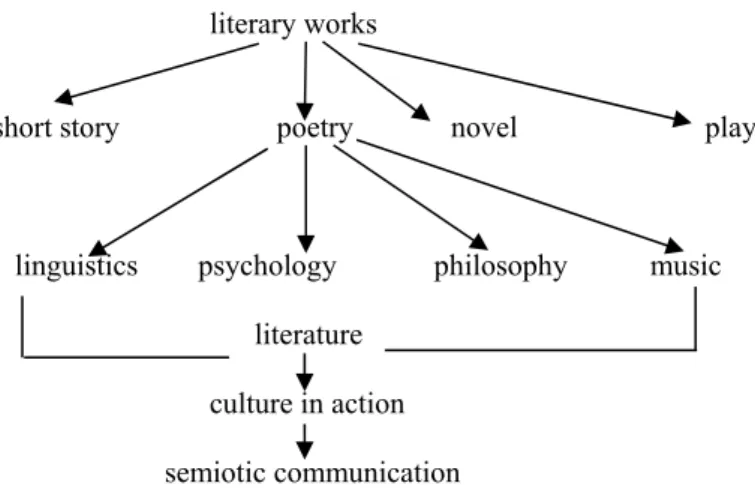
The use of literature in language teaching
literary works
short story poetry novel play
linguistics psychology philosophy music literature
culture in action semiotic communication
Figure 2. Literary works and semiotic communication
Language learning experience offers ample opportunity to make choices just as characters make their moral choices to help widen and sharpen their awareness of life. Wide range of vocabulary use in literary texts helps develop deeper understanding of human relations in social contexts. Learners as individuals with their distinctive personalities are also members of their speech community sharing the same cultural heritage and taking responsibility for their social roles. “We are, says Schärer (1985, p. 12), in danger of losing—in fact we may have already lost—an important element quite beyond the presentation of a specific cultural heritage. It is the dimension of depth that must be emphasized over the fictional pseudo facts of communicative methodology, which make little connection with the underlying emotions and needs of the students.” This dimension of depth is to be tapped for the sake of pedagogical effectiveness of teaching. Literature provides a long established tradition of immense sources allowing teachers ample opportunity to design effective teaching materials focusing not only vocabulary teaching but also how these linguistic signs take effect in social interactions, daily conversations, business transactions, communications and private psychological experiences of learners.
each member signifies a different individual that deserves unalienable human rights endowed at birth to live and pursue their own happiness on earth just like anyone in any society represented by snowflakes. The consistent use of literary works helps develop a deeper understanding of human consciousness without imposing an interpreter’s role upon learners. Regarding the practical use of literary texts in EFL classes the following points prove to be of high interests to language teachers because they
provide useful materials for in-class discussions to increase communication in L2 if they can be developed into more communicative teaching materials
help develop both linguistic and literary competence, which enhances acquisition of L2 as an internalised system of communication
promote intuitive knowledge of L2 through authentic language use
increase exposure to L2 in EFL classes where direct exposure is considerably limited, which in turn paves the way for more mastery over the language in the process of time
foster cultural awareness of L2 as learners enjoy greater opportunity for meeting culture-specific input within the scope of works studied at the time
help increase effectiveness of corpus teaching as wide range of vocabulary use increases in time with due effort
In this article, a step by step schema is proposed. First the reader will follow a consistent approach to the analysis of the text for the proper textual communication, and then move on to the semiotic reading of the story presented in three consecutive stages: (1) reading within the text for the sense, (2) reading upon the text for the value, and (3) reading against the text for the critique. All the numbers placed in parentheses refer to the numbers of the end notes given at the end of the article before the ‘references’ section.
2.
Semiotics of textuality: So much snowed under
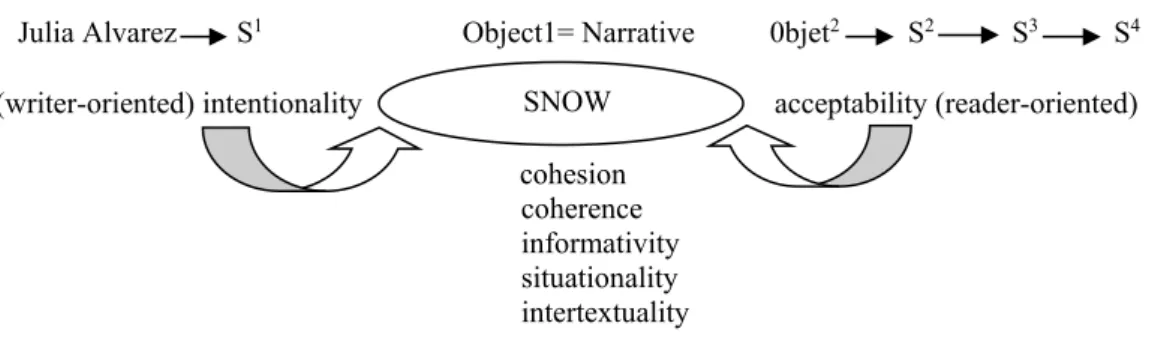
S1= subject O1=object1 O2=object2 S2=subject2 S3= subject 3 S4= Subject 4 Writer (S1=producer) Story (O1=text) ---Reader (O2=receiver; S2=reader; S3=interpreter; S4= critic) Julia Alvarez S1 Object1= Narrative 0bjet2 S2 S3 S4
(writer-oriented) intentionality acceptability (reader-oriented) cohesion coherence informativity
situationality intertextuality
(Text-oriented standards)
Figure 3. Schematic display of textual communication of the story SNOW on discourse plane
The attitude of the text-receiver, namely the prospective reader, towards the text is known as acceptability. If it really makes sense without violating the world knowledge of the reader, it is this characteristic of the text that makes it acceptable on the part of the reader, who takes active reader roles moving from simply being a passive agent as the receiver to the reader, interpreter and critic able to raise counter argument forming a new centre, a semiotic vantage point, for a thorough synthesis of all the points discussed in the semiotic reading process. As far as the information the text conveys is concerned, informativity is an important or rather crucial standard, making reading meaningful and interesting enough on the part of the prospective readers by providing necessary information about the fierce political conflict behind the war that could break out any minute. The sort of information needed for the clarity of the text is adequate for the reader to follow through in order to reach a thorough understanding of the intended message. Political condition of the country of the protagonist, military and political turmoil causing terror because of the probable war between Cuba and her new country provide background information for the reader to understand the extreme terror in her tiny heart as her inner psyche is depicted with the visual reminders of nuclear war and snow covering everything beneath as the symbol of death, cold strife and human heart without love. Figure 4 illustrates the emotional impact of the outer world upon the protagonist, Yolanda.
outer world: the setting inner world: inner psyche
Figure 4. Textual standard of informativity regarding the outer and the inner worlds in the story
Tyranny, suppression Strife, oppression Conflict, war Nuclear weapons, Radio- active fallout
lonely, anxious
timid but happier stranger than before afraid
The intended message given in the story concerned must be relevant to a situation of occurrence, often referred to as situationality, which is when and where it all happens just the same way as it is recounted in the text, or rather presented, which enables the reader to figure out the context of the story and accordingly comprehend the theme developed around all the relevant vocabulary describing the possible and probable results of the imminent nuclear war. What makes the story, or any literary text, meaningful has to do with all the relevant data regarding the given situation since the intended use of the text becomes clear through the situation aggravating the psychological anxiety and terror people have been under. If the reader can see a sort of connection between what the author says regarding the setting of the story both in time and in place, the text is then said to be comprehensible and relevant to what truthfully happens in man’s world. The outer world represented by two different settings is given in contrast to the inner world of the protagonist to complete the whole picture in the mind of the reader. Dominic Republic is given as a macrocosm governed under the totalitarian regime developed around purely modernist thoughts for the sake of man’s own happiness on earth, which creates a highly paradoxical situation, for the narrator finds bliss in a God-centred universe (a catholic school), depicting a religious microcosm, rather than in a man-centred modern society—her own country—where she is supposed to be leading a life not larger than a life under the tyranny of Trujillo.
Setting in time: winter as the months grow cold and she follows her breath on her way to school.
She watches the snowflakes falling and dusting the cars below. She likens the flakes to dusty fallout of the atomic bomb Sister Zoo depicted with flurry chalk marks she dotted on the board for the dusty fallout while teaching all the relevant vocabulary to the wide-eyed classroom.
Setting in place: A nearby Catholic school in New York run by Sisters of charity Yolanda
describes them as she enjoys herself seeing them in peculiar garments and describing their physical look and warm attitude towards the children particularly Yolanda, the immigrant representing total ignorance as she is the one who understands that the holocaust is in the air.
Dominic Republic New York a nearby Catholic School (macrocosm) immigration personal choice (microcosm)
Characters: Yolanda as the central character, and also the narrator narrating the whole event
through innocent eyes using first person limited narration technique. Flat characters are represented by all the other mentioned people.
Yolanda is the youngest of the family who narrates the story during the days of Cuban war crisis.
Sister Zoo is a4th Grade teacher who describes the holocaust by depicting what is likely to happen
in the aftermath of the explosion of the atomic bomb.
President Kennedy looks worried while giving a talk on TV and explaining the delicate situation
while Russia is placing nuclear missiles in Cuba supposedly trained on New York.
Trujillo is the president of Dominic Republic ruling the country under his everlasting tyranny. He
appears to be a powerful figure exercising tyranny under his absolute authority.
with a sound interpretation of the story. The Fog of War, a documentary movie released in 1993 by Errol Morris, for instance, gives some accounts of the highly critical moments of 1960s supplying enough information as to the background of the story. Rita Dove’s poem entitled Parsley provides information about the dictator. In this study semiotic reading of the story and the textual analysis of the text will be provided for the reader to have a comprehensive view of semiotic analysis of textual communication within the scope of the narrative. The Story (2) is about a girl fleeing the tyrant Trujillo (3), ruling Dominican Republic at the time, with her family to enjoy more freedom in New York in pursuit of their happiness.
3.
Semiotic reading and semiotics of textual communication
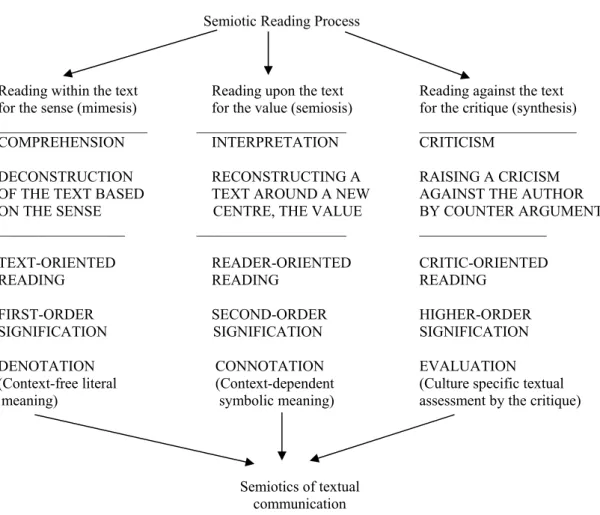
Readers take all of these characteristics of texts for granted; however, the text at hand cannot be understood properly if it does not meet the standards mentioned earlier. It is these standards that make a text meaningful and communicative in the first place. If the text does not make any sense, then the reader cannot make head or tail of what the text is intended to communicate across; then the text is treated as a non-communicative one since it needs “the interaction of text-presented knowledge with the reader’s stored knowledge of the world” (Beaugrande & Dressler, 1982, p. 6), because “meaning cannot exist on its own” unless it is presented “with a specific form of language content” in a verbal medium (Kurtul, 2013, p. 81). Figure 5 below shows the relationship between semiotic reading and textual communication.
Semiotic Reading Process
Reading within the text for the sense (mimesis) ____________________ COMPREHENSION DECONSTRUCTION OF THE TEXT BASED ON THE SENSE _________________ TEXT-ORIENTED READING FIRST-ORDER SIGNIFICATION DENOTATION (Context-free literal meaning)
Reading upon the text for the value (semiosis) ____________________ INTERPRETATION RECONSTRUCTING A TEXT AROUND A NEW
CENTRE, THE VALUE ____________________ READER-ORIENTED READING SECOND-ORDER SIGNIFICATION CONNOTATION (Context-dependent symbolic meaning)
Semiotics of textual communication
Reading against the text for the critique (synthesis) _____________________ CRITICISM
RAISING A CRICISM AGAINST THE AUTHOR BY COUNTER ARGUMENT _________________ CRITIC-ORIENTED READING HIGHER-ORDER SIGNIFICATION EVALUATION
(Culture specific textual assessment by the critique)
Comprehension does not require much effort as the reader deconstructs the text to reach the sense, and then reconstructs a new text with a new centre based on his interpretation if he has not already met any difficulty as to the semantic and syntactic unity of the text (Derrida, 1997). Syntactic unity (cohesion) and semantic unity of the text (coherence) are of great help to the reader in order for him to form a sound base so as to move from sense to value, the theme of the text. In the first order signification process, what verbal signs, namely words, refer to within the text is taken into consideration, as it is basically text-oriented reading. If the reader wishes to move further for the sake of developing literary competence in consecutive stages through systematic reading against the texts, situationality of the text can be of great help to them, as it gives a microcosm depicting the setting with its social environment in terms of both space and time. The reader tries to see how the value of the text stands firm by testing it in relation to those existing in a greater context comprising the whole universe. The reader moves from particular to universal while he moves from microcosm to macrocosm, putting the value out of context as if it could exist regardless of time, place, and speech community, foregrounding the idea that it can turn into a universal truth.
4.
Semiotic reading of Snow
As a reader-centred intellectual activity, this process approach to the reading of literary texts foregrounds the significance of cognitive learning since the reader goes through a process of becoming a competent reader by following a well-planned schema based on comprehension, interpretation and evaluation in that order (Kumral, 2009).
4.1.
Reading for the sense of the text
A summary of the literary text is generally considered to be an effective way to indicate that the text is read and understood to the extent the reader is expected to.
snowflake (sign) snowflake (sign)
death radioactive fallout irreplaceable beauty difference (signified) (signifier) (signified) (signifier)
Figure 6. Yolanda’s signification processes Figure 7. Sister Zoe’s signification process
thought, remembering what Sister Zoe said. “Each flake is different, like a person, irreplaceable and beautiful.”
4.2.
Reading upon the text for the value: A semiotic interpretation
The second step requires the reader to go beyond the text to find out what is communicated behind the words selected to help the reader to move from the said to the unsaid to reach the theme of the text. Interpretation is a highly challenging and demanding reading activity based on literary, linguistic and intellectual competence of the reader. The reader reconstructs a new text around his values to form and present a vantage point to survey the world and view it a fresh (Sless, 1986)
Yolanda makes her choice in accordance with her family’s combined opinion, which appears to be a great shift from a world of tyranny backed up by totalitarian regime to a world of democracy guaranteeing life, freedom of speech and pursuit of happiness by providing equal opportunity for everybody, as they believe that men are created equal and endowed with unalienable rights. The concept of equality in such a monolithic society transforms itself into inequality creating an immense gap between the governing and the governed as people fall prey to the political and economic interests of the mighty powers.
The whole story is simply a challenging escape from totalitarian regime to a more democratic one to enjoy more freedom secured by the Constitution exercised in courts proclaiming Equal Justice under Law, engraved on the porch of the Supreme Court. Here lies a paradox as Yolanda finds bliss in a school run by sisters of charity, a God-centred community ruled by chance denoting no perfect design, while she is supposed to have found it in a man-made universe as in Dominican Republic ruled by Trujillo, representing the authority supposed to be creating a benevolent universal design for man’s own happiness. No matter how all these distinctive characteristics make her a unique individual endowed with certain unalienable rights, she still feels the need not to be a square peg in a round hole. She takes her time to feel fit right in with the new society to reach the whole, becoming a drop in the ocean to be the ocean itself. She is protected after their struggle to escape from an uncaring and cruel monolithic society hostile to spiritual values to a modern society developed around spiritual values protected by constitutional laws. Yolanda, however, seems to have found a better way to live in peace in a world of chaos, finding divine protection in a catholic school, a sanctuary or a haven, so to speak, maintained by Divine Providence rather than threatened by Manly Retribution.
4.3.
Reading against the text for the critique
After the first two stages, the reader is expected to be ready to produce a text against the original text to present a counter argument from a different point of view while he efficiently and effectively develops literary competence in a continuous fashion.
concerns but rather for the never ending political and economic reasons of the mighty lords of war, as Orwell put it in his article published in 1946, by using political language carefully tailored for their purpose “to conceal the truth and obscure the thought” (Abrams, 1993, p. 2242). Constant use of political language through modern media of mass indoctrination, misuse of democracy, and equality for the sake of inequality have been established to help those in power to exercise their absolute authority over the governed and “to insert the power to punish more deeply into the social body” without considering beliefs, interests, political views, national identity, cultural backgrounds, ethnic origins, social status and the like (Foucault, 1979, p. 82). As Shakespeare puts it, All the world is a stage and a worldwide arena where the governed are to keep the mighty agents on top of the hierarchical totem pole by shedding their own blood for the honour of oppressor, sacrificing life for their grim satisfaction and in this way stirring up their intense desire for their own economic interests (Hopkins & Beard, 2011).
The reader may write his own story to foreground the paradox lying behind the story to criticize it, as Yolanda is supposed to have been enjoying her life in a man-centred universe rather than in a God-centred community where she becomes aware of differences that make all those people irreplaceable and beautiful. However, they are killed for their difference in every respect in this uncaring modern world where the oppressed fight a losing battle for their own freedom against the oppressor. Although these stories of people take place in a different setting in time and place, people soon realize that they all have the same plot, no matter how they live or what they believe. They display resigned wisdom with quiet poignancy and take each day as it comes.
5.
Conclusions
Any kind of literary work— narrative, poetry or drama—is of great use to language teachers to help their students develop intuitive knowledge and interpretative skills in consecutive stages without assigning or imposing any interpreter’s role upon them. This article discusses why and how to expose learners to literary texts in order to increase pedagogical effectiveness of teaching programs through in depth study of literary texts in language classes. The reader has been presented with ample opportunity to understand how to do semiotic analysis of the literary text considering textual standards and literary devices by allowing them to follow the strategy in consecutive steps. The whole idea behind this study is based on two basic arguments: (1) Pseudo communicative language teaching methodology, as is often argued, does not help increase the depth of experience of life because it does not consider underlying emotions of the learner with due care, and (2) this depth of experience [of life] is the dimension of depth that should, or rather must underlie all human relations, as the learner should develop a concept of the ‘significant other’. In depth study of Snow helps develop this dimension of depth, as it solely foregrounds the significance of positive attitude towards the other in order to for the individual to be treated well in return. This positive attitude proves to be a powerful antidote to wipe out the negative impact of the deeply seated enmity disguised every which way under innocuous political acts of the mighty hands.
Notes
[1] See Beaugrande and Dressler (1981); Brown and Yule (1985); Cook (1989); Leech (1983); Schiffren (1994); Salkie (1995); Van Dijk (1981); Yule (1997) for all the information concerning discourse analysis.
166-167). See also Sirias (2001); Lyon (2005). The story can be reached easily on the internet as there is free access for readers.
[3] “On October 2, 1935 Rafael Trujillo (1891-1961) had 20.000 Tahitian blacks executed for the sole reason that they could not articulate the sound [r] in Perejil, Spanish word for parsley” (see Hunter et al. 2007, p. 144). Rita Dove, on reading her poem Parsley published in 1993, as the then Poet Laureate at the White House, said, “Those who could not pronounce it correctly—whoever said pelelil instead of perejil were executed. That he had them pronounce their own death sentence, this ultimate little twist was what haunted me. […] I’ve tried to help us understand how Trujillo arrived at this word—not just to say that he was a horrible dictator, but to make us realize that evil can be creative” (see Haba, 1995, pp. 127-128).
References
Abrams, M. H. (Ed.). (1993). The Norton anthology of English literature. (Vol.2). New York: W.W. Norton and Company.
Alvarez, J. (1991). How the Garcia girls lost their accents. New York: Algonquin Books of Chapel Hill.
Barthes, R. (1994). Elements of semiology. New York, NY: Hill and Wang.
Beaugrande, R. A., & Dressler, W. U. (1981). Introduction to text linguistics. London: Longman. Brown, G., &Yule, G. (1985). Discourse analysis. Cambridge: Cambridge University Press. Cook, G. (1989). Discourse. Oxford: Oxford University Press.
Derrida, J. (1997). Writing and difference. London: Routledge.
Eco, U. (1979). A theory of semiotics. Bloomington, IN: Indiana University Press. Eco, U. (1985). The role of the reader. Bloomington, IN: Indiana University Press.
Errol, M. (1993). The fog of war: Eleven lessons from the life Robert Strange McNamara. New York, NY: Columbia Pictures.
Erton, İ. (2006). Semiotic nature of language teaching methods in foreign language teaching and learning. Journal of Language and Linguistic Studies, 2(1), 73-86.
Foucault, M. (1979). Discipline and punish: The birth of the prison. New York, NY: Vintage. Haba, J. (1995). (Ed.). The language of life: A festival of poets. New York, NY: Doubleday. Halliday, M. K., & Hasan, R. (1975). Cohesion in English. London: Longman.
Hawkes, T. (1992). Structuralism and Semiotics. London: Routledge. Hopkins, K., & Beard, M. (2011). The colosseum. London: Profile Books.
Hunter, J. P.; Booth, A., & Mays, K. J. (Eds.). (2007). The Norton introduction to poetry. New York, NY: W. W. Norton & Company.
Kumral, N. (2006). Incorporating semiotic communication into EFL reading classes. Education and Science, 31(141), 21-31.
Kumral, N. (2009). Prufrock is alive and doing well: How to make use of CALLA in semiotic reading of literary texts. Ekev Academic Review, 39, 321-340.
Leech. G. N. (1983). Principles of pragmatics. London: Longman.
Lodge, D., & Wood, N. (Eds.). (2000). Modern criticism and theory (2nd ed.). Harlow: Longman. Lyon, J. K. (2005). Alvarez: Writing a new place on the map. Albuquerque, NM: The University of
New Mexico Press.
Lyons, J. (1990). Language and linguistics. Cambridge: Cambridge University Press.
Queiroz, J., & Merrel, F. (2006). Semiosis and pragmatism: Toward a dynamic concept of meaning. Sign System Studies, 34(1), 37-65.
Salkie, R. (1995). Text and discourse analysis. London: Routledge.
Schärer, G. (1985). A plea for poetry in the African secondary school. English Teaching Forum, 23(1), 12-14.
Schiffren, D. (1994). Approaches to discourse. Oxford: Blackwell.
Scholes, R. (1982). Semiotics and interpretation. New York, NY: Yale University Press. Scholes, R. (1985). Textual power. New York, NY: Yale University Press.
Sert, O. (2006). Semiotic approach and its contributions to language learning and teaching. Hacettepe University Journal of Education, 32, 106-114.
Sirias, S. (2001). Julia Alvarez: A critical companion. West Port, CT: Greenwood Press. Sless, D. (1986). In Search of semiotics. London: Croomhelm.
Şenel, M. (2007). The semiotic approach and language teaching and learning. Journal of Language and Linguistic Studies, 3(1), 117-132.
Julia Alvaraz’in Kar adlı öyküsünde metinsel iletişimin göstergebilimsel çözümlemesi
Öz
Sözde iletişimsel dil öğretim ortamları olduklarından dolayı hedef dille doğrudan ilişkide olma düzeyinin oldukça sınırlı olduğu İngilizcenin Yabancı Dil olarak öğretildiği sınıflarda edebi metinlerin kullanımı dil öğretim programlarında yeterince yer bulamamaktadır. Bu makalenin amacı dilbilim, edimbilim ve yazın çalışmalarının aynı ortamda birlikte sunulduğu iletişimce zengin metinler olan yazın çalışmaları hedef dilin doğal olarak öğrenilmesinde geniş fırsatlar sağladığı uygulamalı olarak gösterilmektir. Bu çalışmanın arkasındaki asıl düşünce ise, göstergebilimsel çözümleme ile metinsel iletişim arasındaki ilişkiyi gösterip, eleştiriyi yazın çalışmalarının yerine geçirmeksizin, söz konusu çalışmayı aynı yazınsal gelenek içinde üretilen metinlerle ilişkilendirerek, eleştiriyi metinler arası ilişkilerin sistemi içerisinde çalışmanın nesnesi haline getirmektir. Yedi metinsel standardı dikkate alarak yapılan göstergebilimsel çözümleme ile metinsel iletişim arasında var olan ilişki kısa öyküdeki metinsel iletişimin göstergebilimsel çözümüyle uyumlu bir bileşim içinde kapsamlı olarak verebilmektir. Metinsel standartlar gözeterek yapılan metinsel çözümlemeden sonra okuyucunun kısa öykünün göstergebilimsel çözümlemesine devam etmesi için gerekli bilginin sağlanmasıyla bu geçişin nasıl yapacağı gösterilecektir. Birbirini takip eden evreler halinde geliştirilen ve kabul gören okuma stratejileriyle uyum içerisinde öykünün göstergebilimsel çözümlemesi yapılacaktır. Yaklaşımın evrelerinin sunumuyla okuyucunun kendi öğreniminden sorumlu nasıl özerk birey olabileceği konusunda kapsamlı görüş edinmesinin yolu gösterilecektir. Okuyucu yalnızca yorum becerilerini göstergebilimin kabul gören çözümleme stratejilerini öğrenerek geliştirmekle kalmayıp, aynı zamanda yazın çalışmalarının derin yaşam algısının gelişmesini sağlaması kahramanın psikolojik deneyimini izleyerek kendi yaşam algısını genişletmesi fırsatını da elde edecektir. Okuyucunun yaşamı daha iyi anlamak için öykünün mesaj içeren dersinin arkasındaki aklı takdir etmesi ve edinmesi ve bunun sonucu olarak dünyada insan özgürlüğünü garanti eden vazgeçilemez insan haklarının kıymetini de takdir etmesi gözetilmektedir.
Anahtar sözcükler: metinsel standartlar, göstergebilimsel çözümleme, İngilizce sınıflarında yazın çalışmaları
kullanımı, eleştirel okuma
AUTHOR BIODATA