Split and Merge LEACH Based Routing Algorithm
for Wireless Sensor Networks
M. Zayoud
1, H. M. Abdulsalam
2, A. Al-Yatama
3, S. Kadry
4*
1
Department of Engineering, American University of Middle East-Kuwait State, P.O. Box 220 Dasman, 15453 Kuwait.
2Dapertment of Information Sciences, Kuwait University- Kuwait State, P. O. Box 5969, Safat 13060, Kuwait. 3
Department of Computer Engineering, Kuwait University- Kuwait State, P. O. Box 5969, Safat 13060, Kuwait.
4
Department of Mathematics and Computer Science, Beirut Arab University, Lebanon. *corresponding author
Abstract: Hierarchical routing and clustering mechanisms in Wireless Sensor Networks (WSNs) help to reduce both the energy consumption, and the overhead that is created when all the sensor nodes in the network are sending information to the central data collection point or base station. LEACH (Low Energy Adaptive Clustering Hierarchy) is one of the most well-known energy efficient clustering algorithms for WSNs. In this paper, we extend the LEACH protocol to (LEACH-SM) protocol by introducing a Split and Merge stage to improve the performance and robustness. We consider the following design aspects: non-uniform distribution of sensors, cluster re-formation by splitting or merging clusters conditionally, routes maintenance, and nodes mobility. OPNET, a well-known simulator tool, is used to simulate LEACH-SM in order to evaluate the performance of the proposed protocol. Simulation results and comparisons with existing protocols show the effectiveness and strength of the proposed protocol in terms of enhancing the lifetime of the whole sensor network, where sensors are either static or mobile with low speed.
Keywords: LEACH, Split, Merge, WSN, Energy, Algorithm.
1.
Introduction
Wireless Sensor Network (WSN) is a network that consists of sensors, deployed over a geographic area either randomly or in pre-deterministic distribution. Sensors get data records that are related to any phenomena and forward those to a central unit called the base station for processing and analysis. Examples of data that can be collected are: temperature, humidity, light conditions, seismic activities, etc. WSNs enable many new and exciting applications in both military and civilian environments [2]. Routing in WSNs is very challenging due to the relatively large number of sensor nodes and limited computational power, memory, and battery power in the sensor [3]. This fosters large endeavors in industrial investments on this field, standardization process and research activities [4-23]. Scholars have provided in-depth discussion on different clustering protocols in wireless sensor networks that are made up by communicating sensor nodes to gather and elaborate information from real world in a distributed and coordinated way in order to deliver an intelligent support to human activities [18-39]. Holistic approaches to evaluate energy efficiency and improve the global energy productivity through the use of high-performance and energy-efficient networks, services and applications are needed. [24].
Designing a reliable WSN requires many efficient methods in routing, data aggregation and localization, and due to the failure of nodes may leave some areas uncovered and degrade the fidelity of the collected data. Therefore, establish
a fault-tolerant mechanism is very crucial [40]. In this work, we only consider the problem of data routing using clusters to improve the network lifetime. Cluster-based routing algorithms for WSNs are algorithms by which nearby sensors are grouped together to form a number of groups (clusters). Each cluster is represented by one sensor called Cluster Head (CH). CHs collect data records from other sensors in their clusters and send them to the base station. Energy is, therefore, saved since not all sensors communicate with the base station for further processing.
LEACH (Low Energy Adaptive Clustering Hierarchy) by Heinzelman [5] is one of the most famous, efficient and widely used clustering algorithm for WSNs utilizing homogeneous randomly deployed sensor nodes. It is a distributed cluster formation algorithm. All nodes in LEACH have a chance to become cluster heads (CH) at some point, in order to balance the energy that is consumed in one round. Extensions of LEACH that are found in the literature include LEACH-F [8], LEACH-C [9], LEACH-GA [10], LEACH-M [11], K-LEACH [12], Q-LEACH, S- LEACH [13], Multi-Hop LEACH [14], and W-LEACH [15, 16]. Aslam et at. [17] present a survey of some of the extended LEACH Protocols. We consider one particular derivation of LEACH, namely LEACH-F [8]. In LEACH-F, only the cluster heads are rotated, while the other cluster members are computed at the initial operation of the network and remain fixed.
We introduce LEACH with Split and Merge (LEACH-SM), a new cluster-based routing algorithm for WSNs, to handle mobility and extend the network lifetime. We base our work on LEACH-F. We mainly target to address the shortcoming of LEACH-F, such that LEACH-SM is able to handle WSNs of un-balanced distribution of the sensor nodes either at deployment stage, or because of the change of the density in some clusters. It is also able to handle mobility of sensors. The key idea of LEACH-SM is that LEACH-SM is based on LEACH-F in defining initial fixed clusters, then in the case of the need to change the clusters structure, the algorithm only splits or merges the existing clusters to define the new clusters’ configuration instead of redefining the whole clusters structure to overcome the overhead of structure formation at each round as in LEACH.
We simulate our algorithm using OPNET and compare the network life time to LEACH-F. Experimental results show that our algorithm performs well when applied on both non-uniform and evolving networks.
characteristics of LEACH-SM. Section 4 states our experimental settings. Section 5 presents numerical results, and Section 6 concludes our work. Finally, future work and references.
2.
Background and Related Work
2.1 LEACH algorithm
Low Energy Adaptive Clustering Hierarchy Aggregation (LEACH) algorithm by Heinzelman [5] is a data aggregation algorithm based on cluster routing. The algorithm works in rounds such that each round has two phases namely, a setup phase and a steady state phase. In the setup phase, p% of n sensors are uniformly randomly chosen to be cluster heads (CHs) based on a threshold
(1)
where p is the desired number of CHs, t is the current round, and G is the set of nodes that have not been CHs in the last 1/p rounds. This ensures that a sensor that is chosen to be CH is not chosen in the next rounds until all other sensors in the network become CHs. This feature increases the lifetime for sensors since it ensures fair energy consumption. The algorithm chooses the CHs uniformly randomly, hence, it does not consider non-uniform networks. After all CHs are chosen, clusters are dynamically defined such that each non-CH becomes a member of the cluster with the nearest non-CH. In the steady state phase, each CH collects data from all sensors in its cluster based on Time Division Multiple Access (TDMA). CHs, then, compress the collected data and send it to the base station.
2.2 LEACH-C algorithm
LEACH-C [9] works exactly like LEACH expect that it assumes centralized CH election, where each sensor sends information about its location to the base station at the beginning of each round, then the base station uses an optimization algorithm, such as Simulated Annealing (SA), to decide which clusters are to become CHs. The CHs are chosen based on their locations and their remaining energy such that clusters with more energy are candidates to be CHs. This gives a generally better distribution for CHs, however, it may reduce sensor lifetime due to the increase of communication between the sensors and the base station.
2.3 LEACH-F algorithm
LEACH-F [8] is a centralized algorithm that assumes fixed clusters while only rotating the CHs for each cluster. This reduces the setup phase overhead since clusters are formed only once which means that there is no set-up overhead in the initial phase of each round. It, however, may force a node to stay in a cluster with a CH that is further than a CH of a nearby cluster. In order to initiate a cluster formation, LEACH-F also employs the same simulated annealing algorithm that is used in LEACH-C. However, LEACH-F is more energy efficient in contrast to C. Yet, LEACH-F, does not handle mobility, adjust its behavior when nodes are dying, or allow addition of new nodes in the system. Furthermore, in F-LEACH, the nodes might require a large amount of energy in order to communicate with their CHs in the case of having their CHs far away from them according to
the fixed clusters structure.
2.4 Simulated Annealing algorithm
Simulated Annealing algorithm (SA) is a probabilistic meta-heuristic, that aims to find a global optimum in a large search space. It searches for the optimal solution by transiting from a current solution x to a neighborhood solution y using the following acceptance probability:
(2)
Where Ci is a controlling parameter. In SA algorithm, there is a decrease observed in the value of control parameter from an initial large value to a small final value. As per the supposition, sequence of Ci can be written (C1, C2… Ci, Cn),
with n being the total iteration number of the algorithm. 2.5 Clusters formations
Cluster based routing is an efficient method for the provision of WSNs lifetime. Thakkar and Kotecha [29] described a solution in which Grid based method was implemented for the derivation of cluster formation. The technique emphasizes cluster head election method such that it is decentralized and uses Bollinger Bands. This pattern is referred to as a realistic topology, which is mainly a result of commonly practiced deployment methods [37].
Li, Qian, and Dai [34] propose a Code Dissemination Protocol. They use a topology that is grounded on LEACH algorithm. The main idea is to support remote code update technology. The findings show that the model is able to fulfill requirements of low energy consumption.
ZORO-MSN [20] is a fixed zone-based partition scheme. Clusters here are presented as square zones, cluster head is presented as zone head (ZH), and the nodes are mobile. ZORO-WSN handles the mobility of the nodes but the zones or clusters are fixed, and they are in square forms rather than random.
Power-Efficient Gathering in Sensor Information Systems (PEGASIS) [6] is a near optimal chain-based protocol. The underlying principle of this protocol is that in order to extend the lifetime of a network, it is crucial that the nodes converse only with the closest neighbors, while they take turns for communicating with the base stations.
3.
LEACH-SM Routing Protocol Overview
Similar to LEACH and F, the basic idea of LEACH-SM algorithm is to organize the network into clusters based on the distances between the nodes and the remaining energy of each node. However, nodes are homogeneous stationary or mobile. All nodes have a chance to become cluster heads at some point, in order to balance the energy spent per round by each sensor node. The cluster heads for each cluster are selected randomly and in a rotary scheme based on their energy load. Nodes join a cluster by depending on its location to ensure that communication with the cluster-head node requires the lowest amount of transmit power and to ensure minimum inter-cluster interference.
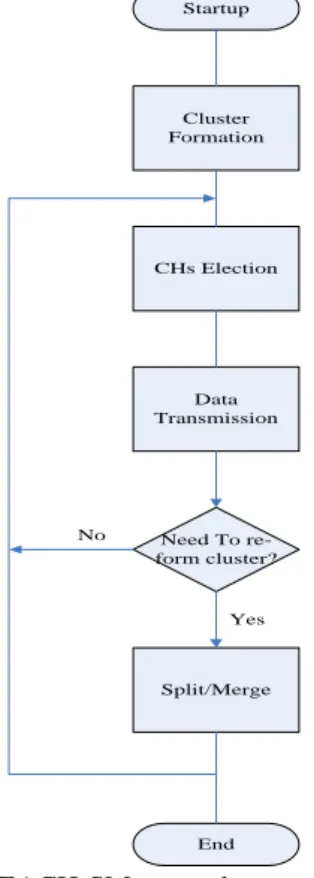
paper is the introduction of split/merge phase that improves network lifetime and handles mobile nodes.
Startup
Cluster Formation
CHs Election
Data Transmission
Need To re-form cluster?
Split/Merge
End Yes No
Figure 1: LEACH-SM network operation phases In the initial setup phase, all nodes send energy and location information to the base station at the network startup. Based on this information, the base station can optimally form clusters since it has a global network view. For forming the clusters, the base station appoints a fixed number of nodes as cluster heads, and evenly distributes the number of nodes in each cluster. The base station uses the Simulated Annealing algorithm (SA) for forming the clusters, since SA finds the near optimal cluster formation.
In the case of the need to change the clusters structure, the algorithm only splits or merges the existing clusters instead of redefining the whole clusters structure in the split/merge phase. This phase is explained in details in below sections. The cluster heads are selected in the cluster-head election phase in which the BS assesses the energy and the coordinates of the nodes then computes the current configurations score of the clusters which means the remaining energy level in the sensors assessed by the BS, and compares it to the previously computed score.
When this score changes, this means we need to re-form the clusters, then the BS triggers to apply split/merge clusters to get a better cluster configuration. The remaining energy in each sensor indicates the score of the current cluster. If this random number is less than a threshold value, then the node with highest energy level becomes a cluster-head for the current round. The threshold value is calculated based on an equation that incorporates the desired percentage to become a cluster-head, the current round, and the set of nodes that have not been selected as a cluster-head in the last rounds. Finally, in the data transmission phase, the actual data is transferred to the base station. The duration of this later phase is longer than the duration of the combined other phases. Hence, the overhead of all earlier phases can be negligible.
3.1 Detailed characteristics of LEACH-SM
The design of the LEACH-SM algorithm is based on specific characteristics, such that the following issues are handled:
The base station is assumed to continuously supervise the energy levels of the nodes and their coordinates. After a period called UPDATE PERIOD (UPTR) the base station assesses the energy and the coordinates of the nodes. It then computes , where score is a numeric value that gives an indication of the optimal clusters configuration. The initial values of these scores are selected randomly by each sensor in the cluster.
When is greater than a threshold, then the base station is triggered to implement splitting or merging clusters to reach a better cluster configuration from the current one. The configuration of the clusters changes by splitting a cluster into two or more clusters or merging two or more clusters to become one cluster.
After the cluster configuration is established, the algorithm selects from all the nodes of the network some nodes to be assigned as cluster heads one by one, such that each node is assigned an integer value that refers to the score of the node of being a cluster head. The score is calculated based on the distance between the node and the base station and the energy level of the node. If the score values is 1, then this node is the best node to become a cluster head. Every increase in the integer value means that this node is less in score.
Cluster heads are then assigned, such that the node with the best score within each cluster is assigned to be the cluster head of this specific cluster.
The algorithm then continues to perform as any regular cluster-based routing algorithm by gathering data records at cluster heads and then sending them to the base station.
3.2 Clusters formation phase
As mentioned earlier, LEACH-SM clusters’ formation is based on SA algorithm in order to compute the optimal cluster configuration. It aims to optimize the energy consumption of the nodes by forming clusters, in which the distances between their members are optimal.
For clusters formation, the algorithm first selects a set of C distinct nodes as initial inputs for the SA algorithm. Then, the score of the specified nodes is calculated as shown in algorithm 1. By the means of SA, iterations are then carried out to find the optimum set of CHs based on the score values.
3.3 Split/Merge Phase
In this phase, the base station monitors the coordinates and energy levels for all nodes in each round, and calculates the
value of . If , then the base
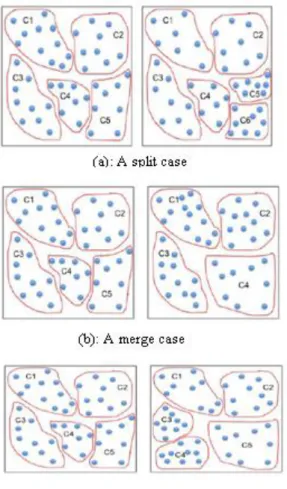
place in the WSN. Figures 2 (a), (b), and (c) represent how LEACH-SM works in the field. The frequency of this phase is based on the value of UPTR. In Figure 2(a), cluster C5 on the left splits into C5 and C6, while in Figure 2(b) clusters C4 and C5 on the left merge into C4. Figure 2(c) show that cluster C3on the left splits into C3 and C4, while clusters C4 and C5 on the left merge into C5.
Figure 2: The WSN network before and after a split and/or merge.
3.4 Algorithm assumptions
In order to facilitate the design of the protocol, a number of assumptions that concern the nodes and the base station are made:
The base station is assumed to be stationary and able to assess the energy and the position of the nodes The initial energy of the sensors is set to 1 J The nodes are:
-Assumed to be homogeneous; such that they dispose of equal physical characteristics and the same amount of energy at the setup of the network. -Able to locate their selves via a pre-defined location
system, and able to move.
-The following method can be used for determining the predefined speed.
(3)
Where p denotes the exchange parameter for partial results, and n denotes the number of nodes in the network.
Compute optimal cluster configuration algorithm (Algorithm 1)
Compute_optimal_cluster_configuration() {
Int prev_CL_number; //defines the number of clusters computed previously
Int previous_score; //defines the score of the clusters computed previously
Int recent_score; //defines the score of the clusters computed recently
// get the coordinates of the nodes of the network Get_all_the_coordinates_of_the_nodes() // get the coordinates of the nodes of the network Get_all_the_energy_levels_of_the_nodes()
If(previous_score!=recent_score) {
// get the optimal cluster configuration. It is the one having // the minimal score produced by the function
// “compute_optimal_clusters_with_sim_ann” that use simulated annealing
// produce a configuration with a given number of cluster (i in our case)
for(i=1;i<max_clusters;i++) {
cost = compute_optimal_clusters_with_sim_ann(i);
if(cost<min_cost)
{ min_cost = cost; nb_c = i; } } }
// The network is now set up previous_score = min_cost; prev_CL_number = nb_c}
4.
Experimental Settings
4.1 Simulation settings
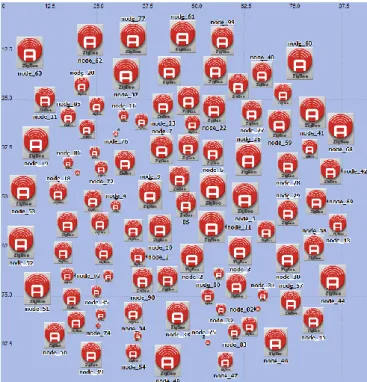
LEACH-SM is evaluated using Zigbee nodes in OPNET Network Simulator [23], which is a well-known discrete event simulator. Figure 3 represents an example of the distribution of 100 sensors in a WSN. Sensor nodes are initially uniformly distributed in a square region of 100m X 100m. All the sensor nodes are initialized with random coordinates within the boundary.
packets/second. The UPTR period can be set depending on the traffic frequency in the network. If we have a high frequency it is better to set a low UPTR period, where we can increase its period if the frequency is low, in our case the default value of UPTR is set to 10 seconds.
The capacity of the Zigbee facilitator is to instate the system, select the fitting channel, and permit alternate devices to associate with its system. It is likewise in charge of routing traffic in a Zigbee system. Zigbee switches are essentially the intermediate devices in the system which guides the information from the source to the destination. A switch is fit for passing the messages in a system and is likewise ready to have children hubs to be associate with it as end gadgets or other switches. The reason for gadget switches is to coordinate the information and sense the information from their encompassing surroundings. The end gadgets of Zigbee don’t get adequate figuring capacities. Then again, the force sparing element of the Zigbee can be ascribed to these end-gadgets. However, the power saving feature of the Zigbee can be attributed to these end-devices. This is because, these nodes are not utilized for routing traffic and they might be at a rest position for maximum time thereby expanding battery life of such devices.
For the case of testing mobility, we have utilized two different speed ranges for our simulation experiments. The first range is between 0 and 5 m/s, and the second range is between 6 and 10 m/s. The simulations have been ran for almost 27 hours.
Figure 3. Wireless Sensors Network field using OPNET environment
4.2 Testing Criteria
The performance of LEACH-SM is evaluated in two cases; with mobility and without mobility. For the case where mobility is not considered, we define three scenarios, such that each scenario shows the impact of the major parameters on the whole network performance. The three tested parameters are, the number of nodes in the network, the update time parameter (UPTR), and the network size and base station location. We also show the effect of implementing LEACH-SM on the end-to-end delay. We
compare all results of LEACH-SM without mobility to the known protocol LEACH-F.
In the case of mobility, we compare LEACH-SM with ZORO-WSN protocol, explained earlier in section 2, because LEACH-F does not handle mobility. As mentioned earlier, ZORO-WSN has fixed square zones, considered as clusters, and handles mobility. For each case/scenario on the network, the criteria by which we evaluate our algorithm are:
- Mean remaining energy: records the mean remaining energy of the network by calculating the summation the battery levels of all the nodes and dividing it by the total number of alive nodes.
Number of dead sensors: counts the number of sensors that are dead and no longer operating at each round.
5.
Results and Discussions
5.1 Number of nodes impact in the network
We test the network with 100, 125, 175, and 200 nodes. Figures 4(a, b, c, and d) represent the mean remaining energy of the network with the different number of nodes respectively. As it can be observed, LEACH-SM (SMR as named in the following figures) consumes less energy than LEACH-F. At the end of the simulation time as in Figure 5(a), the remaining energy of LEACH-F is about 13% while we have about 22% for LEACH-SM. In fact, LEACH-SM adopts the cluster configuration of the network based on the remaining energy of all the nodes, which fairly distributes the energy consumption among all the sensors. In Figures 4(c) and 5(d), it can be noticed that at the end of the simulation, the remaining energy of LEACH-F is about 6%, while we have much more energy with LEACH-SM (is indicated as SMR in the figures) with a level of 21%. The computation method of LEACH-SM optimizes the global energy consumption of the network. Figure 4(d) shows that the remaining energy of LEACH-F is only 20%. Note that LEACH-F reaches this level at 45% of the time of the simulation, while LEACH-SM reaches the same level of energy almost after 80% of the simulation Figures 5(a, b, c, and d) demonstrate the number of dead nodes in the networks of the different sizes respectively. As it can be seen from Figure 5(a), LEACH-F has 35 dead nodes at 35% of the simulation time, where in LEACH-SM only four nodes die at 35% of the simulation time. In the case of 125 nodes shown in Figure 5(b), 21 nodes of the network die at 35% of the simulation time of LEACH-F while only 5 nodes die at 35% of the simulation time of LEACH-SM. In the case of 175 nodes presented in Figure 5(d), all nodes in LEACH-F died at the end of the simulation time, while only 36 nodes died for LEACH-SM.
5.2 The impact of update time parameter (UPTR)
UPTR gives better performance with less than 10 sec values in 200 nodes when comparing them to Figure 4(d), where UPTR is 10 seconds for a 200 nodes network. Note that in all cases for Figures 6(a) through 6(d), LEACH-SM outperforms LEACH-F in terms of mean remaining energy, being better when minimized.
Figure 4. The remaining energy of the network in Leach-F and Leach –SM
Figure 5. The dead nodes of the network in Leach-F and Leach-SM
Figure 6. Consumed energy in the network for both
LEACH-F and LEACH-SM
5.3 Network size impact and base station location The network size is the size of the area where we deploy the sensors, and the base station location could be in any place in the field, not only in the middle as what implemented in the previous sections in this paper. We create a 100 nodes network of size 200 x 200m, and deploy the base station in different locations in the network field. We choose two locations of the base station at points (50.5,50.5) and (20.4,21.5). Figures 7 (a and b) show the mean remaining energy in the network of LEACH-F and LEACH-SM. Clearly, LEACH-SM performs with better mean remaining energy for both figures.
It can have concluded from the figures that changing the size of the network and the base station location have negligible effects on the network performance because even if the base station location affects the energy of some nodes in the network, it also improves the energy of others. Hence, the overall performance is almost the same no matter where is the location of the base station.
Figure 7. (a, b) Remaining energy in the network for both LEACH-F and LEACH-SM in different base stations locations
5.4 End to End Delay
In LEACH-F the cluster formation is only done once and then the clusters are fixed. But in LEACH-SM the nodes’ energy is assessed from time to time and the re-cluster takes place whenever it is better to the performance and network life time. For these reasons and due to the increase of calculations to ensure optimal clusters configuration, the end to end delay might be increased in the network by implementing LEACH-SM rather than LEACH-F. Figure 8 shows the end to end delay in the network in both LEACH-F and LEACH-SM for different number of nodes. From the figure, the average end to end delay when using LEACH-SM is increased by 15% over the fixed clusters formation of LEACH-F. Where both x-axis and y- axis are time in seconds.
Figure 8. End to End delay due to clusters formation 5.5 Performance Evaluation of the Mobile Case
LEACH-SM using OPNET simulator. As can be concluded from Figures 9 (a) through 9 (d), LEACH-SM shows a better performance in WSN that ZORO-WSN using static and low speed sensors. Note that the algorithm for computing optimal cluster is the same in case of low mobility speed, because the change in density of the nodes is seen as if nodes are moving in low speed.
Figures 9 (a, b, c, and d) display the remaining energy of ZORO-WSN, and LEACH-SM for different number of nodes 100, 125,175, and 200 nodes with changing the simulation time.
Figure 9. The remaining energy percentage versus time for ZORO-WSN and LEACH-SM
6.
Conclusions and Future Works
LEACH-SM protocol proposes a new clustering formation procedure that can be considered as semi-dynamic. It redistributes the clusters structure in the network based on its current situation, while not having the need to reconstruct the clusters structure from the scratch. LEACH-SM, instead, splits or merges the existing cluster structure that has been formed initially. The proposed algorithm has been simulated using OPNET and the results show that LEACH-SM improves the life time of the network and decreases the number of dead nodes in the WSN in because it utilizes the resources of the sensor nodes to cover the monitored areas for longer time than in LEACH-F. LEACH-SM also studies specific case of mobility with low speed sensors and improves performance. Although some cases are only studied through this paper, but the overall simulation results show a better remaining energy level when using LEACH-SM which leads us to take it in consideration and try to implement it in real applications.
The increased demand on using WSN (Wireless Sensor Network) in real life applications, enhances the protocols and algorithms that are used to deploy these sensors from different perspectives like energy level management control. The wireless deployment of theses sensors and remote locations accelerate demand of security in WSN. Publicly accessible wireless communication channel also makes WSN vulnerable to numerous security attacks [41]. The future work in this field will be to study the security protocols implemented by WSN and to improve these protocols by checking different sort of challenges and difficulties during implementation of effective security mechanisms.
References
[1] Benenson, Zinaida, Felix C. Gärtner, and Dogan Kesdogan. "User Authentication in Sensor Networks." In GI Jahrestagung (2), pp. 385-389. 2004.
[2] Akyildiz, Ian F., Weilian Su, Yogesh Sankarasubramaniam, and Erdal Cayirci. "Wireless sensor networks: a survey." Computer networks 38, no. 4 (2002): 393-422.
[3] Al-Karaki, Jamal N., and Ahmed E. Kamal. "Routing techniques in wireless sensor networks: a survey." IEEE wireless communications 11, no. 6 (2004): 6-28. [4] Buratti, Chiara, Andrea Conti, Davide Dardari, and
Roberto Verdone. "An overview on wireless sensor networks technology and evolution." Sensors 9, no. 9 (2009): 6869-6896.
[5] Handy, M. J., Marc Haase, and Dirk Timmermann. "Low energy adaptive clustering hierarchy with deterministic cluster-head selection." In Mobile and Wireless Communications Network, 2002. 4th International Workshop on, pp. 368-372. IEEE, 200. [6] Lindsey, Stephanie, and Cauligi S. Raghavendra.
"PEGASIS: Power-efficient gathering in sensor information systems." In Aerospace conference proceedings, 2002. IEEE, vol. 3, pp. 3-3. IEEE, 2002. [7] Liu, Zhong, ZhiKun Liu, and Lin Wen. "A modified
leach protocol for wireless sensor networks." In Advanced Computational Intelligence (IWACI), 2011 Fourth International Workshop on, pp. 766-769. IEEE, 2011.
[8] Heinzelman, Wendi Beth. "Application-specific protocol architectures for wireless networks." IEEE Transactions on Wireless Communications, 660-670., 2000.
[9] Heinzelman, Wendi B., Anantha P. Chandrakasan, and Hari Balakrishnan. "An application-specific protocol architecture for wireless microsensor networks." IEEE Transactions on wireless communications 1, no. 4 (2002): 660-670.
[10] Liu, Jenn-Long, and Chinya V. Ravishankar. "LEACH-GA: Genetic algorithm-based energy-efficient adaptive clustering protocol for wireless sensor networks." International Journal of Machine Learning and Computing 1, no. 1 (2011): 79..
[11] Arboleda C, Liliana M., and Nidal Nasser. "Cluster-based routing protocol for mobile sensor networks." In Proceedings of the 3rd international conference on Quality of service in heterogeneous wired/wireless networks, p. 24. ACM, 2006.
[12] Kumar, G. Santhosh, Paul MV Vinu, and K. Poulose Jacob. "Mobility metric based leach-mobile protocol." In Advanced Computing and Communications, 2008. ADCOM 2008. 16th International Conference on, pp. 248-253. IEEE, 2008.
[13] Bakaraniya, Parul, and Sheetal Mehta. "K-LEACH: An improved LEACH protocol for lifetime improvement in WSN." International Journal of Engineering Trends and Technology 4, no. 5 (2013): 1521-1526.
[14] Haider, Abrar, Nadeem Javaid, N. Amjad, A. A. Awan, Abid Khan, and Noel Khan. "REECH-ME: Regional energy efficient cluster heads based on maximum energy routing protocol for WSNs." In Broadband and Wireless Computing, Communication and Applications (BWCCA), 2013 Eighth International Conference on, pp. 88-92. IEEE, 2013.
(ICDMW), 2010 IEEE International Conference on, pp. 1-8. IEEE, 2010.
[16] Abdulsalam, Hanady M., and Bader A. Ali. "W-LEACH based dynamic adaptive data aggregation algorithm for wireless sensor networks." International Journal of Distributed Sensor Networks 9, no. 9 (2013): 289527. [17] Aslam, M., Nadeem Javaid, A. Rahim, U. Nazir, Ayesha
Bibi, and Z. A. Khan. "Survey of extended LEACH-based clustering routing protocols for wireless sensor networks." In High Performance Computing and Communication & 2012 IEEE 9th International Conference on Embedded Software and Systems (HPCC-ICESS), 2012 IEEE 14th International Conference on, pp. 1232-1238. IEEE, 2012.
[18] Intanagonwiwat, Chalermek, Ramesh Govindan,
Deborah Estrin, John Heidemann, and Fabio Silva. "Directed diffusion for wireless sensor networking." IEEE/ACM Transactions on Networking (ToN) 11, no. 1 (2003): 2-16.
[19] Chatterjea, Supriyo, and Paul JM Havinga. "A dynamic data aggregation scheme for wireless sensor networks." In 14th Workshop on Circuits, Systems and Signal Processing. 2003.
[20] Nasser, Nidal, Anwar Al-Yatama, and Kassem Saleh. "Zone-based routing protocol with mobility
consideration for wireless sensor
networks." Telecommunication Systems 52, no. 4 (2013): 2541-2560.
[21] Kirkpatrick, Scott, C. Daniel Gelatt, and Mario P. Vecchi. "Optimization by simulated annealing." science 220, no. 4598 (1983): 671-680. [22] Heinzelman, Wendi B., Anantha P. Chandrakasan, and
Hari Balakrishnan. "An application-specific protocol architecture for wireless microsensor networks." IEEE Transactions on wireless communications 1, no. 4 (2002): 660-670.
[23] OPNET Modeler Inc. [Online] (2008). http://www.opnet.com/solutions/network_rd/modeler.ht ml. Accessed June 2011.
[24] Aleksić, Slaviša. "Energy-efficient communication networks for improved global energy productivity." Telecommunication Systems 54, no. 2 (2013): 183-199.
[25] Chi, Yuan-Po, and Hsung-Pin Chang. "An energy-aware grid-based routing scheme for wireless sensor networks." Telecommunication Systems 54, no. 4 (2013): 405-415.
[26] Labraoui, Nabila, Mourad Gueroui, Makhlouf Aliouat, and Jonathan Petit. "Reactive and adaptive monitoring to secure aggregation in wireless sensor networks." Telecommunication systems 54, no. 1 (2013): 3-17.
[27] Fang, Can, Peng Zhang, Wei Huang, and Cheng Fu. "Multi-covered path in wireless sensor networks." Telecommunication Systems 54, no. 1 (2013): 19-33.
[28] Bajaber, Fuad, and Irfan Awan. "An efficient cluster-based communication protocol for wireless sensor networks." Telecommunication Systems 55, no. 3 (2014): 387-401.
[29] Thakkar, Ankit, and Ketan Kotecha. "A new Bollinger Band based energy efficient routing for clustered wireless sensor network." Applied Soft Computing 32 (2015): 144-153.
[30] Khediri, Salim EL, Nejah Nasri, Anne Wei, and Abdennaceur Kachouri. "A new approach for clustering in wireless sensors networks based on LEACH." Procedia Computer Science 32 (2014): 1180-1185.
[31] Bęben, Andrzej, Jordi Mongay Batalla, Wei Koong Chai, and Jarosław Śliwiński. "Multi-criteria decision algorithms for efficient content delivery in content networks." Annals of Telecommunications-annales des telecommunications 68, no. 3-4 (2013): 153-165. [32] Poor, H. Vincent. "Competition and collaboration in
wireless sensor networks." In Sensor networks, pp. 3-15. Springer, Berlin, Heidelberg, 2010.
[33] Bhattacharya, Indrajit, Saurav Ghosh, and Suparna Kundu. "Maximizing lifetime of wireless sensor network through extended LEACH algorithm." In International Conference on Computer Science and Information Technology, pp. 377-386. Springer, Berlin, Heidelberg, 2012.
[34] Li, HaiYan, KaiGuo Qian, and ZuCheng Dai. "A Code Dissemination Protocol of Intelligent Wireless Sensor Network Based LEACH Algorithm." In Advances in Computer Science, Intelligent System and Environment, pp. 439-445. Springer, Berlin, Heidelberg, 2011. [35] Chen, Jie. "Improvement of LEACH routing algorithm
based on use of balanced energy in wireless sensor networks." In International Conference on Intelligent Computing, pp. 71-76. Springer, Berlin, Heidelberg, 2011.
[36] Re, Liu, and Wang Xiu-Ping. "An Improvement to Leach-Based Routing Algorithm." In Intelligence Computation and Evolutionary Computation, pp. 527-533. Springer, Berlin, Heidelberg, 2013.
[37] Machado, Renita, Wensheng Zhang, Guiling Wang, and Sirin Tekinay. "Coverage properties of clustered wireless sensor networks." ACM Transactions on Sensor Networks (TOSN) 7, no. 2 (2010): 13.
[38] Sundararajan, Ranjeeth Kumar, and Umamakeswari Arumugam. "Intrusion detection algorithm for mitigating sinkhole attack on LEACH protocol in wireless sensor networks." Journal of Sensors 2015 (2015).
[39] Frattolillo, Franco. "A deterministic algorithm for the deployment of wireless sensor networks." International Journal of Communication Networks and Information Security8, no. 1 (2016): 1.