vSphere Availability
ESXi 5.1
vCenter Server 5.1
This document supports the version of each product listed and
supports all subsequent versions until the document is replaced
by a new edition. To check for more recent editions of this
document, see http://www.vmware.com/support/pubs.
You can find the most up-to-date technical documentation on the VMware Web site at:
http://www.vmware.com/support/
The VMware Web site also provides the latest product updates.
If you have comments about this documentation, submit your feedback to:
Copyright © 2009–2012 VMware, Inc. All rights reserved. This product is protected by U.S. and international copyright and intellectual property laws. VMware products are covered by one or more patents listed at
http://www.vmware.com/go/patents.
VMware is a registered trademark or trademark of VMware, Inc. in the United States and/or other jurisdictions. All other marks and names mentioned herein may be trademarks of their respective companies.
About vSphere Availability 5
1
Business Continuity and Minimizing Downtime 7
Reducing Planned Downtime 7Preventing Unplanned Downtime 8
vSphere HA Provides Rapid Recovery from Outages 8 vSphere Fault Tolerance Provides Continuous Availability 9
2
Creating and Using vSphere HA Clusters 11
How vSphere HA Works 11 vSphere HA Admission Control 18 vSphere HA Checklist 24
Creating a vSphere HA Cluster 25 Customizing vSphere HA Behavior 33 Best Practices for vSphere HA Clusters 36
3
Providing Fault Tolerance for Virtual Machines 41
How Fault Tolerance Works 42Using Fault Tolerance with DRS 43 Fault Tolerance Use Cases 43 Fault Tolerance Checklist 44 Fault Tolerance Interoperability 45
Preparing Your Cluster and Hosts for Fault Tolerance 46 Providing Fault Tolerance for Virtual Machines 51
Viewing Information About Fault Tolerant Virtual Machines in the vSphere Client 56 Viewing Information About Fault Tolerant Virtual Machines in the vSphere Web Client 58 Best Practices for Fault Tolerance 59
vSphere Fault Tolerance Configuration Recommendations 61
Index 63
vSphere Availability describes solutions that provide business continuity, including how to establish vSphere® High Availability (HA) and vSphere Fault Tolerance.
Intended Audience
This information is for anyone who wants to provide business continuity through the vSphere HA and Fault Tolerance solutions. The information in this book is for experienced Windows or Linux system administrators who are familiar with virtual machine technology and datacenter operations.
Business Continuity and Minimizing
Downtime
1
Downtime, whether planned or unplanned, brings with it considerable costs. However, solutions to ensure higher levels of availability have traditionally been costly, hard to implement, and difficult to manage. VMware software makes it simpler and less expensive to provide higher levels of availability for important applications. With vSphere, organizations can easily increase the baseline level of availability provided for all applications as well as provide higher levels of availability more easily and cost effectively. With vSphere, you can:
n Provide higher availability independent of hardware, operating system, and applications. n Reduce planned downtime for common maintenance operations.
n Provide automatic recovery in cases of failure.
vSphere makes it possible to reduce planned downtime, prevent unplanned downtime, and recover rapidly from outages.
This chapter includes the following topics:
n “Reducing Planned Downtime,” on page 7 n “Preventing Unplanned Downtime,” on page 8
n “vSphere HA Provides Rapid Recovery from Outages,” on page 8 n “vSphere Fault Tolerance Provides Continuous Availability,” on page 9
Reducing Planned Downtime
Planned downtime typically accounts for over 80% of datacenter downtime. Hardware maintenance, server migration, and firmware updates all require downtime for physical servers. To minimize the impact of this downtime, organizations are forced to delay maintenance until inconvenient and difficult-to-schedule downtime windows.
vSphere makes it possible for organizations to dramatically reduce planned downtime. Because workloads in a vSphere environment can be dynamically moved to different physical servers without downtime or service interruption, server maintenance can be performed without requiring application and service downtime. With vSphere, organizations can:
n Eliminate downtime for common maintenance operations. n Eliminate planned maintenance windows.
The vSphere vMotion® and Storage vMotion functionality in vSphere makes it possible for organizations to reduce planned downtime because workloads in a VMware environment can be dynamically moved to different physical servers or to different underlying storage without service interruption. Administrators can perform faster and completely transparent maintenance operations, without being forced to schedule inconvenient maintenance windows.
Preventing Unplanned Downtime
While an ESXi host provides a robust platform for running applications, an organization must also protect itself from unplanned downtime caused from hardware or application failures. vSphere builds important capabilities into datacenter infrastructure that can help you prevent unplanned downtime.
These vSphere capabilities are part of virtual infrastructure and are transparent to the operating system and applications running in virtual machines. These features can be configured and utilized by all the virtual machines on a physical system, reducing the cost and complexity of providing higher availability. Key availability capabilities are built into vSphere:
n Shared storage. Eliminate single points of failure by storing virtual machine files on shared storage, such
as Fibre Channel or iSCSI SAN, or NAS. The use of SAN mirroring and replication features can be used to keep updated copies of virtual disk at disaster recovery sites.
n Network interface teaming. Provide tolerance of individual network card failures. n Storage multipathing. Tolerate storage path failures.
In addition to these capabilities, the vSphere HA and Fault Tolerance features can minimize or eliminate unplanned downtime by providing rapid recovery from outages and continuous availability, respectively.
vSphere HA Provides Rapid Recovery from Outages
vSphere HA leverages multiple ESXi hosts configured as a cluster to provide rapid recovery from outages and cost-effective high availability for applications running in virtual machines.
vSphere HA protects application availability in the following ways:
n It protects against a server failure by restarting the virtual machines on other hosts within the cluster. n It protects against application failure by continuously monitoring a virtual machine and resetting it in the
event that a failure is detected.
Unlike other clustering solutions, vSphere HA provides the infrastructure to protect all workloads with the infrastructure:
n You do not need to install special software within the application or virtual machine. All workloads are
protected by vSphere HA. After vSphere HA is configured, no actions are required to protect new virtual machines. They are automatically protected.
n You can combine vSphere HA with vSphere Distributed Resource Scheduler (DRS) to protect against
failures and to provide load balancing across the hosts within a cluster. vSphere HA has several advantages over traditional failover solutions:
Minimal setup After a vSphere HA cluster is set up, all virtual machines in the cluster get failover support without additional configuration.
Increased application availability
Any application running inside a virtual machine has access to increased availability. Because the virtual machine can recover from hardware failure, all applications that start at boot have increased availability without increased computing needs, even if the application is not itself a clustered application. By monitoring and responding to VMware Tools heartbeats and restarting nonresponsive virtual machines, it protects against guest operating system crashes.
DRS and vMotion integration
If a host fails and virtual machines are restarted on other hosts, DRS can provide migration recommendations or migrate virtual machines for balanced resource allocation. If one or both of the source and destination hosts of a migration fail, vSphere HA can help recover from that failure.
vSphere Fault Tolerance Provides Continuous Availability
vSphere HA provides a base level of protection for your virtual machines by restarting virtual machines in the event of a host failure. vSphere Fault Tolerance provides a higher level of availability, allowing users to protect any virtual machine from a host failure with no loss of data, transactions, or connections.
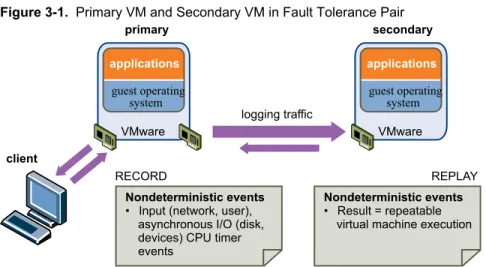
Fault Tolerance provides continuous availability by ensuring that the states of the Primary and Secondary VMs are identical at any point in the instruction execution of the virtual machine. This is done using the VMware vLockstep technology on the ESXi host platform. vLockstep accomplishes this by having the Primary and Secondary VMs execute identical sequences of x86 instructions. The Primary VM captures all inputs and events (from the processor to virtual I/O devices) and replays them on the Secondary VM. The Secondary VM executes the same series of instructions as the Primary VM, while only a single virtual machine image (the Primary VM) executes the workload.
If either the host running the Primary VM or the host running the Secondary VM fails, an immediate and transparent failover occurs. The functioning ESXi host seamlessly becomes the Primary VM host without losing network connections or in-progress transactions. With transparent failover, there is no data loss and network connections are maintained. After a transparent failover occurs, a new Secondary VM is respawned and redundancy is re-established. The entire process is transparent and fully automated and occurs even if vCenter Server is unavailable.
Creating and Using vSphere HA
Clusters
2
vSphere HA clusters enable a collection of ESXi hosts to work together so that, as a group, they provide higher levels of availability for virtual machines than each ESXi host can provide individually. When you plan the creation and usage of a new vSphere HA cluster, the options you select affect the way that cluster responds to failures of hosts or virtual machines.
Before you create a vSphere HA cluster, you should know how vSphere HA identifies host failures and isolation and how it responds to these situations. You also should know how admission control works so that you can choose the policy that fits your failover needs. After you establish a cluster, you can customize its behavior with advanced attributes and optimize its performance by following recommended best practices.
NOTE You might get an error message when you try to use vSphere HA. For information about error messages related to vSphere HA, see the VMware knowledge base article at http://kb.vmware.com/kb/1033634. This chapter includes the following topics:
n “How vSphere HA Works,” on page 11 n “vSphere HA Admission Control,” on page 18 n “vSphere HA Checklist,” on page 24
n “Creating a vSphere HA Cluster,” on page 25 n “Customizing vSphere HA Behavior,” on page 33 n “Best Practices for vSphere HA Clusters,” on page 36
How vSphere HA Works
vSphere HA provides high availability for virtual machines by pooling the virtual machines and the hosts they reside on into a cluster. Hosts in the cluster are monitored and in the event of a failure, the virtual machines on a failed host are restarted on alternate hosts.
When you create a vSphere HA cluster, a single host is automatically elected as the master host. The master host communicates with vCenter Server and monitors the state of all protected virtual machines and of the slave hosts. Different types of host failures are possible, and the master host must detect and appropriately deal with the failure. The master host must distinguish between a failed host and one that is in a network partition or that has become network isolated. The master host uses network and datastore heartbeating to determine the type of failure.
Master and Slave Hosts
When you add a host to a vSphere HA cluster, an agent is uploaded to the host and configured to communicate with other agents in the cluster. Each host in the cluster functions as a master host or a slave host.
When vSphere HA is enabled for a cluster, all active hosts (those not in standby or maintenance mode, or not disconnected) participate in an election to choose the cluster's master host. The host that mounts the greatest number of datastores has an advantage in the election. Only one master host typically exists per cluster and all other hosts are slave hosts. If the master host fails, is shut down or put in standby mode, or is removed from the cluster a new election is held.
The master host in a cluster has a number of responsibilities:
n Monitoring the state of slave hosts. If a slave host fails or becomes unreachable, the master host identifies
which virtual machines need to be restarted.
n Monitoring the power state of all protected virtual machines. If one virtual machine fails, the master host
ensures that it is restarted. Using a local placement engine, the master host also determines where the restart should be done.
n Managing the lists of cluster hosts and protected virtual machines.
n Acting as vCenter Server management interface to the cluster and reporting the cluster health state.
The slave hosts primarily contribute to the cluster by running virtual machines locally, monitoring their runtime states, and reporting state updates to the master host. A master host can also run and monitor virtual machines. Both slave hosts and master hosts implement the VM and Application Monitoring features. One of the functions performed by the master host is to orchestrate restarts of protected virtual machines. A virtual machine is protected by a master host after vCenter Server observes that the virtual machine's power state has changed from powered off to powered on in response to a user action. The master host persists the list of protected virtual machines in the cluster's datastores. A newly elected master host uses this information to determine which virtual machines to protect.
NOTE If you disconnect a host from a cluster, all of the virtual machines registered to that host are unprotected by vSphere HA.
Host Failure Types and Detection
The master host of a vSphere HA cluster is responsible for detecting the failure of slave hosts. Depending on the type of failure detected, the virtual machines running on the hosts might need to be failed over.
In a vSphere HA cluster, three types of host failure are detected:
n A host stops functioning (that is, fails). n A host becomes network isolated.
n A host loses network connectivity with the master host.
The master host monitors the liveness of the slave hosts in the cluster. This communication is done through the exchange of network heartbeats every second. When the master host stops receiving these heartbeats from a slave host, it checks for host liveness before declaring the host to have failed. The liveness check that the master host performs is to determine whether the slave host is exchanging heartbeats with one of the datastores. See “Datastore Heartbeating,” on page 16. Also, the master host checks whether the host responds to ICMP
If a master host is unable to communicate directly with the agent on a slave host, the slave host does not respond to ICMP pings, and the agent is not issuing heartbeats it is considered to have failed. The host's virtual machines are restarted on alternate hosts. If such a slave host is exchanging heartbeats with a datastore, the master host assumes that it is in a network partition or network isolated and so continues to monitor the host and its virtual machines. See “Network Partitions,” on page 15.
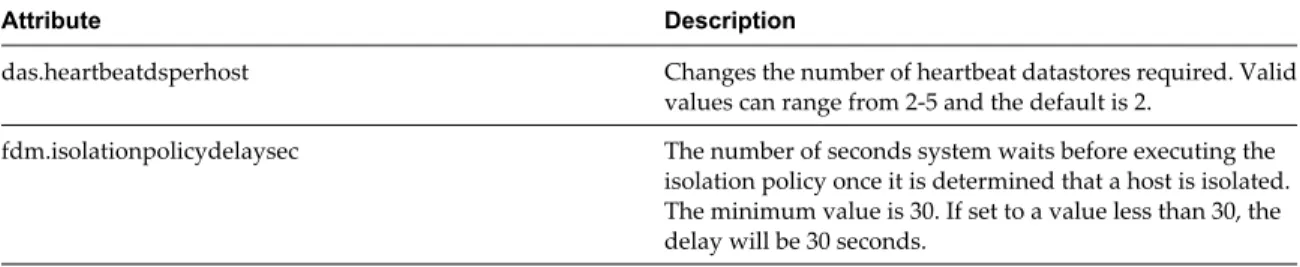
Host network isolation occurs when a host is still running, but it can no longer observe traffic from vSphere HA agents on the management network. If a host stops observing this traffic, it attempts to ping the cluster isolation addresses. If this also fails, the host declares itself as isolated from the network.
The master host monitors the virtual machines that are running on an isolated host and if it observes that they power off, and the master host is responsible for the virtual machines, it restarts them.
NOTE If you ensure that the network infrastructure is sufficiently redundant and that at least one network path is available at all times, host network isolation should be a rare occurrence.
Determining Responses to Host Issues
If a host fails and its virtual machines need to be restarted, you can control the order in which this is done with the VM restart priority setting. You can also configure how vSphere HA responds if hosts lose management network connectivity with other hosts by using the host isolation response setting.
These settings apply to all virtual machines in the cluster in the case of a host failure or isolation. You can also configure exceptions for specific virtual machines. See “Customize an Individual Virtual Machine in the vSphere Client,” on page 36 or “Customize an Individual Virtual Machine in the vSphere Web Client,” on page 36.
VM Restart Priority
VM restart priority determines the relative order in which virtual machines are placed on new hosts after a host failure. Such virtual machines are restarted, with the highest priority virtual machines attempted first and continuing to those with lower priority until all virtual machines are restarted or no more cluster resources are available. Note that if vSphere HA fails to power on a high-priority virtual machine, it does proceed to try any lower-priority virtual machines. Because of this, the VM restart priority cannot be used to enforce a restart priority for a multiple virtual machine application. Also, if the number of hosts failures exceeds what admission control permits, the virtual machines with lower priority might not be restarted until more resources become available. Virtual machines are restarted on the failover hosts, if specified.
The values for this setting are: Disabled, Low, Medium (the default), and High. If you select Disabled, vSphere HA is disabled for the virtual machine, which means that it is not restarted on other ESXi hosts if its host fails. The Disabled setting does not affect virtual machine monitoring, which means that if a virtual machine fails on a host that is functioning properly, that virtual machine is reset on that same host. You can change this setting for individual virtual machines.
NOTE A virtual machine reset causes a hard guest operating system reboot but does not power cycle the virtual machine.
The restart priority settings for virtual machines vary depending on user needs. Assign higher restart priority to the virtual machines that provide the most important services.
For example, in the case of a multitier application you might rank assignments according to functions hosted on the virtual machines.
n High. Database servers that will provide data for applications.
n Medium. Application servers that consume data in the database and provide results on web pages. n Low. Web servers that receive user requests, pass queries to application servers, and return results to
Host Isolation Response
Host isolation response determines what happens when a host in a vSphere HA cluster loses its management network connections but continues to run. You can use the isolation response to have vSphere HA power off virtual machines that are running on an isolated host and restart them on a non-isolated host. Host isolation responses require that Host Monitoring Status is enabled. If Host Monitoring Status is disabled, host isolation responses are also suspended. A host determines that it is isolated when it is unable to communicate with the agents running on the other hosts and it is unable to ping its isolation addresses. When this occurs, the host executes its isolation response. The responses are: Leave powered on (the default), Power off then failover, and Shut down then failover (the last two options are Power off and Shut down, respectively in the vSphere Client). You can customize this property for individual virtual machines.
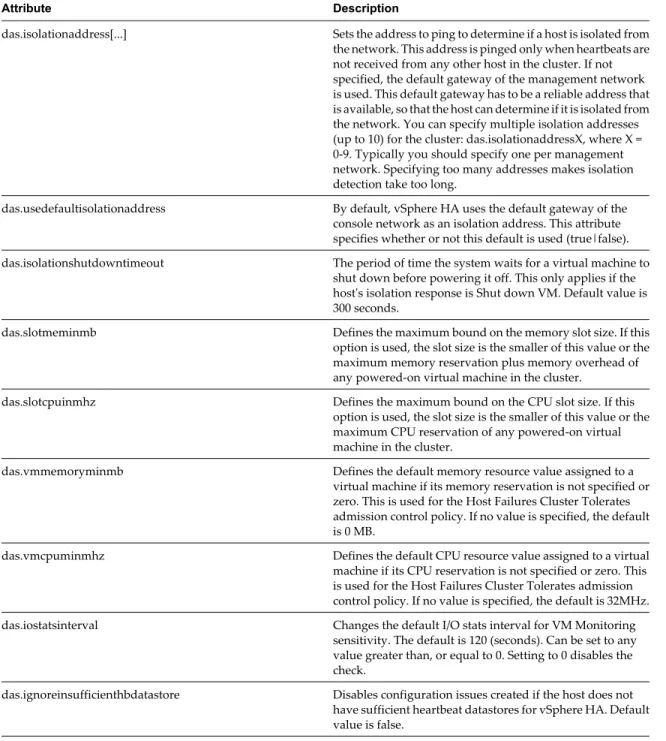
To use the Shut down VM setting, you must install VMware Tools in the guest operating system of the virtual machine. Shutting down the virtual machine provides the advantage of preserving its state. Shutting down is better than powering off the virtual machine, which does not flush most recent changes to disk or commit transactions. Virtual machines that are in the process of shutting down will take longer to fail over while the shutdown completes. Virtual Machines that have not shut down in 300 seconds, or the time specified in the advanced attribute das.isolationshutdowntimeout seconds, are powered off.
NOTE After you create a vSphere HA cluster, you can override the default cluster settings for Restart Priority and Isolation Response for specific virtual machines. Such overrides are useful for virtual machines that are used for special tasks. For example, virtual machines that provide infrastructure services like DNS or DHCP might need to be powered on before other virtual machines in the cluster.
If a host has its isolation response disabled (that is, it leaves virtual machines powered on when isolated) and the host loses access to both the management and storage networks, a "split brain" situation can arise. In this case, the isolated host loses the disk locks and the virtual machines are failed over to another host even though the original instances of the virtual machines remain running on the isolated host. When the host regains access to the virtual machine's datastore, there will be two copies of the virtual machines, although the copy on the originally isolated host does not have access to the vmdk files and data corruption is prevented.
To recover from this situation, ESXi generates a question on the virtual machine that has lost the disk locks for when the host comes out of isolation and realizes that it cannot reacquire the disk locks. vSphere HA automatically answers this question and this allows the virtual machine instance that has lost the disk locks to power off, leaving just the instance that has the disk locks.
VM and Application Monitoring
VM Monitoring restarts individual virtual machines if their VMware Tools heartbeats are not received within a set time. Similarly, Application Monitoring can restart a virtual machine if the heartbeats for an application it is running are not received. You can enable these features and configure the sensitivity with which vSphere HA monitors non-responsiveness.
When you enable VM Monitoring, the VM Monitoring service (using VMware Tools) evaluates whether each virtual machine in the cluster is running by checking for regular heartbeats and I/O activity from the VMware Tools process running inside the guest. If no heartbeats or I/O activity are received, this is most likely because the guest operating system has failed or VMware Tools is not being allocated any time to complete tasks. In such a case, the VM Monitoring service determines that the virtual machine has failed and the virtual machine is rebooted to restore service.
To enable Application Monitoring, you must first obtain the appropriate SDK (or be using an application that supports VMware Application Monitoring) and use it to set up customized heartbeats for the applications you want to monitor. After you have done this, Application Monitoring works much the same way that VM Monitoring does. If the heartbeats for an application are not received for a specified time, its virtual machine is restarted.
You can configure the level of monitoring sensitivity. Highly sensitive monitoring results in a more rapid conclusion that a failure has occurred. While unlikely, highly sensitive monitoring might lead to falsely identifying failures when the virtual machine or application in question is actually still working, but heartbeats have not been received due to factors such as resource constraints. Low sensitivity monitoring results in longer interruptions in service between actual failures and virtual machines being reset. Select an option that is an effective compromise for your needs.
The default settings for monitoring sensitivity are described in Table 2-1. You can also specify custom values for both monitoring sensitivity and the I/O stats interval by selecting the Custom checkbox.
Table 2-1. VM Monitoring Settings
Setting Failure Interval (seconds) Reset Period
High 30 1 hour
Medium 60 24 hours
Low 120 7 days
After failures are detected, vSphere HA resets virtual machines. The reset ensures that services remain available. To avoid resetting virtual machines repeatedly for nontransient errors, by default, virtual machines will be reset only three times during a certain configurable time interval. After virtual machines have been reset three times, vSphere HA makes no further attempts to reset the virtual machines after subsequent failures until after the specified time has elapsed. You can configure the number of resets using the Maximum per-VM
resets custom setting.
NOTE The reset statistics are cleared when a virtual machine is powered off then back on, or when it is migrated using vMotion to another host. This causes the guest operating system to reboot, but is not the same as a 'restart' in which the power state of the virtual machine is changed.
Network Partitions
When a management network failure occurs for a vSphere HA cluster, a subset of the cluster's hosts might be unable to communicate over the management network with the other hosts. Multiple partitions can occur in a cluster.
A partitioned cluster leads to degraded virtual machine protection and cluster management functionality. Correct the partitioned cluster as soon as possible.
n Virtual machine protection. vCenter Server allows a virtual machine to be powered on, but it can be
protected only if it is running in the same partition as the master host that is responsible for it. The master host must be communicating with vCenter Server. A master host is responsible for a virtual machine if it has exclusively locked a system-defined file on the datastore that contains the virtual machine's
configuration file.
n Cluster management. vCenter Server can communicate with only some of the hosts in the cluster, and it
can connect to only one master host. As a result, changes in configuration that affect vSphere HA might not take effect until after the partition is resolved. This failure could result in one of the partitions operating under the old configuration, while another uses the new settings.
If a vSphere HA cluster contains pre-ESXi 5.0 hosts and a partition occurs, vSphere HA might incorrectly power on a virtual machine that was powered off by the user or it might fail to restart a virtual machine that failed.
Datastore Heartbeating
When the master host in a vSphere HA cluster can not communicate with a slave host over the management network, the master host uses datastore heartbeating to determine whether the slave host has failed, is in a network partition, or is network isolated. If the slave host has stopped datastore heartbeating, it is considered to have failed and its virtual machines are restarted elsewhere.
vCenter Server selects a preferred set of datastores for heartbeating. This selection is made to maximize the number of hosts that have access to a heartbeating datastore and minimize the likelihood that the datastores are backed by the same LUN or NFS server.
You can use the advanced attribute das.heartbeatdsperhost to change the number of heartbeat datastores selected by vCenter Server for each host. The default is two and the maximum valid value is five.
vSphere HA creates a directory at the root of each datastore that is used for both datastore heartbeating and for persisting the set of protected virtual machines. The name of the directory is .vSphere-HA. Do not delete or
modify the files stored in this directory, because this can have an impact on operations. Because more than one cluster might use a datastore, subdirectories for this directory are created for each cluster. Root owns these directories and files and only root can read and write to them. The disk space used by vSphere HA depends on several factors including which VMFS version is in use and the number of hosts that use the datastore for heartbeating. With vmfs3, the maximum usage is approximately 2GB and the typical usage is approximately 3MB. With vmfs5 the maximum and typical usage is approximately 3MB. vSphere HA use of the datastores adds negligible overhead and has no performance impact on other datastore operations.
vSphere HA limits the number of virtual machines that can have configuration files on a single datastore. See Configuration Maximums for updated limits. If you place more than this number of virtual machines on a datastore and power them on, vSphere HA protects a number of virtual machines only up to the limit.
vSphere HA Security
vSphere HA is enhanced by several security features.
Select firewall ports opened
vSphere HA uses TCP and UDP port 8182 for agent-to-agent communication. The firewall ports open and close automatically to ensure they are open only when needed.
Configuration files protected using file system permissions
vSphere HA stores configuration information on the local storage or on ramdisk if there is no local datastore. These files are protected using file system permissions and they are accessible only to the root user. Hosts without local storage are only supported if they are managed by Auto Deploy.
Detailed logging The location where vSphere HA places log files depends on the version of host.
n For ESXi 5.x hosts, vSphere HA writes to syslog only by default, so logs
are placed where syslog is configured to put them. The log file names for vSphere HA are prepended with fdm, fault domain manager, which is a
service of vSphere HA.
n For legacy ESXi 4.x hosts, vSphere HA writes to /var/log/vmware/fdm on
local disk, as well as syslog if it is configured.
Secure vSphere HA logins
vSphere HA logs onto the vSphere HA agents using a user account, vpxuser,
created by vCenter Server. This account is the same account used by vCenter Server to manage the host. vCenter Server creates a random password for this account and changes the password periodically. The time period is set by the vCenter Server VirtualCenter.VimPasswordExpirationInDays setting. Users
with administrative privileges on the root folder of the host can log in to the agent.
Secure communication All communication between vCenter Server and the vSphere HA agent is done over SSL. Agent-to-agent communication also uses SSL except for election messages, which occur over UDP. Election messages are verified over SSL so that a rogue agent can prevent only the host on which the agent is running from being elected as a master host. In this case, a configuration issue for the cluster is issued so the user is aware of the problem.
Host SSL certificate verification required
vSphere HA requires that each host have a verified SSL certificate. Each host generates a self-signed certificate when it is booted for the first time. This certificate can then be regenerated or replaced with one issued by an authority. If the certificate is replaced, vSphere HA needs to be reconfigured on the host. If a host becomes disconnected from vCenter Server after its certificate is updated and the ESXi or ESX Host agent is restarted, then vSphere HA is automatically reconfigured when the host is reconnected to vCenter Server. If the disconnection does not occur because vCenter Server host SSL certificate verification is disabled at the time, verify the new certificate and reconfigure vSphere HA on the host.
Using vSphere HA and DRS Together
Using vSphere HA with Distributed Resource Scheduler (DRS) combines automatic failover with load balancing. This combination can result in a more balanced cluster after vSphere HA has moved virtual machines to different hosts.
When vSphere HA performs failover and restarts virtual machines on different hosts, its first priority is the immediate availability of all virtual machines. After the virtual machines have been restarted, those hosts on which they were powered on might be heavily loaded, while other hosts are comparatively lightly loaded. vSphere HA uses the virtual machine's CPU and memory reservation and overhead memory to determine if a host has enough spare capacity to accommodate the virtual machine.
In a cluster using DRS and vSphere HA with admission control turned on, virtual machines might not be evacuated from hosts entering maintenance mode. This behavior occurs because of the resources reserved for restarting virtual machines in the event of a failure. You must manually migrate the virtual machines off of the hosts using vMotion.
In some scenarios, vSphere HA might not be able to fail over virtual machines because of resource constraints. This can occur for several reasons.
n HA admission control is disabled and Distributed Power Management (DPM) is enabled. This can result
in DPM consolidating virtual machines onto fewer hosts and placing the empty hosts in standby mode leaving insufficient powered-on capacity to perform a failover.
n VM-Host affinity (required) rules might limit the hosts on which certain virtual machines can be placed. n There might be sufficient aggregate resources but these can be fragmented across multiple hosts so that
they can not be used by virtual machines for failover.
In such cases, vSphere HA can use DRS to try to adjust the cluster (for example, by bringing hosts out of standby mode or migrating virtual machines to defragment the cluster resources) so that HA can perform the failovers.
If DPM is in manual mode, you might need to confirm host power-on recommendations. Similarly, if DRS is in manual mode, you might need to confirm migration recommendations.
If you are using VM-Host affinity rules that are required, be aware that these rules cannot be violated. vSphere HA does not perform a failover if doing so would violate such a rule.
For more information about DRS, see the vSphere Resource Management documentation.
vSphere HA Admission Control
vCenter Server uses admission control to ensure that sufficient resources are available in a cluster to provide failover protection and to ensure that virtual machine resource reservations are respected.
Three types of admission control are available.
Host Ensures that a host has sufficient resources to satisfy the reservations of all virtual machines running on it.
Resource Pool Ensures that a resource pool has sufficient resources to satisfy the reservations, shares, and limits of all virtual machines associated with it.
vSphere HA Ensures that sufficient resources in the cluster are reserved for virtual machine recovery in the event of host failure.
Admission control imposes constraints on resource usage and any action that would violate these constraints is not permitted. Examples of actions that could be disallowed include the following:
n Powering on a virtual machine.
n Migrating a virtual machine onto a host or into a cluster or resource pool. n Increasing the CPU or memory reservation of a virtual machine.
Of the three types of admission control, only vSphere HA admission control can be disabled. However, without it there is no assurance that the expected number of virtual machines can be restarted after a failure. Do not disable admission control, however you might need to do so temporarily, for the following reasons:
n If you need to violate the failover constraints when there are not enough resources to support them--for
example, if you are placing hosts in standby mode to test them for use with Distributed Power Management (DPM).
n If an automated process needs to take actions that might temporarily violate the failover constraints (for
example, as part of an upgrade directed by vSphere Update Manager).
n If you need to perform testing or maintenance operations.
Admission control sets aside capacity, but when a failure occurs vSphere HA uses whatever capacity is available for virtual machine restarts. For example, vSphere HA places more virtual machines on a host than admission control would allow for user-initiated power ons.
NOTE When vSphere HA admission control is disabled, vSphere HA ensures that there are at least two powered-on hosts in the cluster even if DPM is enabled and can consolidate all virtual machines onto a single host. This is to ensure that failover is possible.
Host Failures Cluster Tolerates Admission Control Policy
You can configure vSphere HA to tolerate a specified number of host failures. With the Host Failures Cluster Tolerates admission control policy, vSphere HA ensures that a specified number of hosts can fail and sufficient resources remain in the cluster to fail over all the virtual machines from those hosts.
With the Host Failures Cluster Tolerates policy, vSphere HA performs admission control in the following way: 1 Calculates the slot size.
A slot is a logical representation of memory and CPU resources. By default, it is sized to satisfy the requirements for any powered-on virtual machine in the cluster.
2 Determines how many slots each host in the cluster can hold. 3 Determines the Current Failover Capacity of the cluster.
This is the number of hosts that can fail and still leave enough slots to satisfy all of the powered-on virtual machines.
4 Determines whether the Current Failover Capacity is less than the Configured Failover Capacity (provided by the user).
If it is, admission control disallows the operation.
NOTE You can set a specific slot size for both CPU and memory in the admission control section of the vSphere HA settings in the vSphere Web Client.
Slot Size Calculation
Slot size is comprised of two components, CPU and memory.
n vSphere HA calculates the CPU component by obtaining the CPU reservation of each powered-on virtual
machine and selecting the largest value. If you have not specified a CPU reservation for a virtual machine, it is assigned a default value of 32MHz. You can change this value by using the das.vmcpuminmhz advanced attribute.)
n vSphere HA calculates the memory component by obtaining the memory reservation, plus memory
overhead, of each powered-on virtual machine and selecting the largest value. There is no default value for the memory reservation.
If your cluster contains any virtual machines that have much larger reservations than the others, they will distort slot size calculation. To avoid this, you can specify an upper bound for the CPU or memory component of the slot size by using the das.slotcpuinmhz or das.slotmeminmb advanced attributes, respectively. See
“vSphere HA Advanced Attributes,” on page 34.
You can also determine the risk of resource fragmentation in your cluster by viewing the number of virtual machines that require multiple slots. This can be calculated in the admission control section of the vSphere HA settings in the vSphere Web Client. Virtual machines might require multiple slots if you have specified a fixed slot size or a maximum slot size using advanced options.
Using Slots to Compute the Current Failover Capacity
After the slot size is calculated, vSphere HA determines each host's CPU and memory resources that are available for virtual machines. These amounts are those contained in the host's root resource pool, not the total physical resources of the host. The resource data for a host that is used by vSphere HA can be found on the host's Summary tab on the vSphere Web Client (or on the Resource tab for the host on the vSphere Client.) If all hosts in your cluster are the same, this data can be obtained by dividing the cluster-level figures by the number of hosts. Resources being used for virtualization purposes are not included. Only hosts that are connected, not in maintenance mode, and that have no vSphere HA errors are considered.
The maximum number of slots that each host can support is then determined. To do this, the host’s CPU resource amount is divided by the CPU component of the slot size and the result is rounded down. The same calculation is made for the host's memory resource amount. These two numbers are compared and the smaller number is the number of slots that the host can support.
The Current Failover Capacity is computed by determining how many hosts (starting from the largest) can fail and still leave enough slots to satisfy the requirements of all powered-on virtual machines.
Advanced Runtime Info
When you select the Host Failures Cluster Tolerates admission control policy, the Advanced Runtime Info pane appears in the vSphere HA section of the cluster's Monitor tab in the vSphere Web Client. This pane displays the following information about the cluster:
(In the vSphere Client, Advanced Runtime Info appears as a link in the vSphere HA section of the cluster's
Summary tab).
n Slot size.
n Total slots in cluster. The sum of the slots supported by the good hosts in the cluster.
n Used slots. The number of slots assigned to powered-on virtual machines. It can be more than the number
of powered-on virtual machines if you have defined an upper bound for the slot size using the advanced options. This is because some virtual machines can take up multiple slots.
n Available slots. The number of slots available to power on additional virtual machines in the cluster.
vSphere HA reserves the required number of slots for failover. The remaining slots are available to power on new virtual machines.
n Failover slots. The total number of slots not counting the used slots or the available slots. n Total number of powered on virtual machines in cluster.
n Total number of hosts in cluster.
n Total good hosts in cluster. The number of hosts that are connected, not in maintenance mode, and have
no vSphere HA errors.
Example: Admission Control Using Host Failures Cluster Tolerates Policy
The way that slot size is calculated and used with this admission control policy is shown in an example. Make the following assumptions about a cluster:
n The cluster is comprised of three hosts, each with a different amount of available CPU and memory
resources. The first host (H1) has 9GHz of available CPU resources and 9GB of available memory, while Host 2 (H2) has 9GHz and 6GB and Host 3 (H3) has 6GHz and 6GB.
n There are five powered-on virtual machines in the cluster with differing CPU and memory requirements.
VM1 needs 2GHz of CPU resources and 1GB of memory, while VM2 needs 2GHz and 1GB, VM3 needs 1GHz and 2GB, VM4 needs 1GHz and 1GB, and VM5 needs 1GHz and 1GB.
Figure 2-1. Admission Control Example with Host Failures Cluster Tolerates Policy
6 slots remaining
if H1 fails
slot size
2GHz, 2GB
2GHz
1GB
2GHz
1GB
1GHz
2GB
1GHz
1GB
1GHz
1GB
VM1
9GHz
9GB
4 slots
H1
9GHz
6GB
3 slots
H2
6GHz
6GB
3 slots
H3
VM2
VM3
VM4
VM5
1 Slot size is calculated by comparing both the CPU and memory requirements of the virtual machines and selecting the largest.
The largest CPU requirement (shared by VM1 and VM2) is 2GHz, while the largest memory requirement (for VM3) is 2GB. Based on this, the slot size is 2GHz CPU and 2GB memory.
2 Maximum number of slots that each host can support is determined.
H1 can support four slots. H2 can support three slots (which is the smaller of 9GHz/2GHz and 6GB/2GB) and H3 can also support three slots.
3 Current Failover Capacity is computed.
The largest host is H1 and if it fails, six slots remain in the cluster, which is sufficient for all five of the powered-on virtual machines. If both H1 and H2 fail, only three slots remain, which is insufficient. Therefore, the Current Failover Capacity is one.
The cluster has one available slot (the six slots on H2 and H3 minus the five used slots).
Percentage of Cluster Resources Reserved Admission Control Policy
You can configure vSphere HA to perform admission control by reserving a specific percentage of cluster CPU and memory resources for recovery from host failures.
With the Percentage of Cluster Resources Reserved admission control policy, vSphere HA ensures that a specified percentage of aggregate CPU and memory resources are reserved for failover.
With the Cluster Resources Reserved policy, vSphere HA enforces admission control as follows: 1 Calculates the total resource requirements for all powered-on virtual machines in the cluster. 2 Calculates the total host resources available for virtual machines.
3 Calculates the Current CPU Failover Capacity and Current Memory Failover Capacity for the cluster. 4 Determines if either the Current CPU Failover Capacity or Current Memory Failover Capacity is less than
the corresponding Configured Failover Capacity (provided by the user). If so, admission control disallows the operation.
vSphere HA uses the actual reservations of the virtual machines. If a virtual machine does not have reservations, meaning that the reservation is 0, a default of 0MB memory and 32MHz CPU is applied.
NOTE The Percentage of Cluster Resources Reserved admission control policy also checks that there are at least two vSphere HA-enabled hosts in the cluster (excluding hosts that are entering maintenance mode). If there is only one vSphere HA-enabled host, an operation is not allowed, even if there is a sufficient percentage of resources available. The reason for this extra check is that vSphere HA cannot perform failover if there is only a single host in the cluster.
Computing the Current Failover Capacity
The total resource requirements for the powered-on virtual machines is comprised of two components, CPU and memory. vSphere HA calculates these values.
n The CPU component by summing the CPU reservations of the powered-on virtual machines. If you have
not specified a CPU reservation for a virtual machine, it is assigned a default value of 32MHz (this value can be changed using the das.vmcpuminmhz advanced attribute.)
n The memory component by summing the memory reservation (plus memory overhead) of each
powered-on virtual machine.
The total host resources available for virtual machines is calculated by adding the hosts' CPU and memory resources. These amounts are those contained in the host's root resource pool, not the total physical resources of the host. Resources being used for virtualization purposes are not included. Only hosts that are connected, not in maintenance mode, and have no vSphere HA errors are considered.
The Current CPU Failover Capacity is computed by subtracting the total CPU resource requirements from the total host CPU resources and dividing the result by the total host CPU resources. The Current Memory Failover Capacity is calculated similarly.
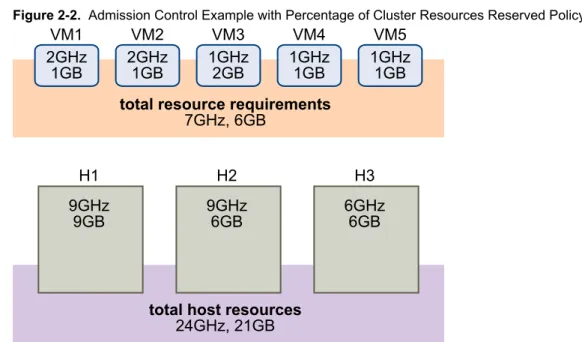
Example: Admission Control Using Percentage of Cluster Resources Reserved
Policy
The way that Current Failover Capacity is calculated and used with this admission control policy is shown with an example. Make the following assumptions about a cluster:
n The cluster is comprised of three hosts, each with a different amount of available CPU and memory
resources. The first host (H1) has 9GHz of available CPU resources and 9GB of available memory, while Host 2 (H2) has 9GHz and 6GB and Host 3 (H3) has 6GHz and 6GB.
n There are five powered-on virtual machines in the cluster with differing CPU and memory requirements.
VM1 needs 2GHz of CPU resources and 1GB of memory, while VM2 needs 2GHz and 1GB, VM3 needs 1GHz and 2GB, VM4 needs 1GHz and 1GB, and VM5 needs 1GHz and 1GB.
Figure 2-2. Admission Control Example with Percentage of Cluster Resources Reserved Policy
total resource requirements
7GHz, 6GB
total host resources
24GHz, 21GB
2GHz
1GB
2GHz
1GB
1GHz
2GB
1GHz
1GB
1GHz
1GB
VM1
9GHz
9GB
H1
9GHz
6GB
H2
6GHz
6GB
H3
VM2
VM3
VM4
VM5
The total resource requirements for the powered-on virtual machines is 7GHz and 6GB. The total host resources available for virtual machines is 24GHz and 21GB. Based on this, the Current CPU Failover Capacity is 70% ((24GHz - 7GHz)/24GHz). Similarly, the Current Memory Failover Capacity is 71% ((21GB-6GB)/21GB). Because the cluster's Configured Failover Capacity is set to 25%, 45% of the cluster's total CPU resources and 46% of the cluster's memory resources are still available to power on additional virtual machines.
Specify Failover Hosts Admission Control Policy
You can configure vSphere HA to designate specific hosts as the failover hosts.
With the Specify Failover Hosts admission control policy, when a host fails, vSphere HA attempts to restart its virtual machines on any of the specified failover hosts. If this is not possible, for example the failover hosts have failed or have insufficient resources, then vSphere HA attempts to restart those virtual machines on other hosts in the cluster.
To ensure that spare capacity is available on a failover host, you are prevented from powering on virtual machines or using vMotion to migrate virtual machines to a failover host. Also, DRS does not use a failover host for load balancing.
NOTE If you use the Specify Failover Hosts admission control policy and designate multiple failover hosts, DRS does not attempt to enforce VM-VM affinity rules for virtual machines that are running on failover hosts. The Current Failover Hosts appear in the vSphere HA section of the cluster's Summary tab. The status icon next to each host can be green, yellow, or red.
n Green. The host is connected, not in maintenance mode, and has no vSphere HA errors. No powered-on
virtual machines reside on the host.
n Yellow. The host is connected, not in maintenance mode, and has no vSphere HA errors. However,
powered-on virtual machines reside on the host.
Choosing an Admission Control Policy
You should choose a vSphere HA admission control policy based on your availability needs and the
characteristics of your cluster. When choosing an admission control policy, you should consider a number of factors.
Avoiding Resource Fragmentation
Resource fragmentation occurs when there are enough resources in aggregate for a virtual machine to be failed over. However, those resources are located on multiple hosts and are unusable because a virtual machine can run on one ESXi host at a time. The default configuration of the Host Failures Cluster Tolerates policy avoids resource fragmentation by defining a slot as the maximum virtual machine reservation. The Percentage of Cluster Resources policy does not address the problem of resource fragmentation. With the Specify Failover Hosts policy, resources are not fragmented because hosts are reserved for failover.
Flexibility of Failover Resource Reservation
Admission control policies differ in the granularity of control they give you when reserving cluster resources for failover protection. The Host Failures Cluster Tolerates policy allows you to set the failover level as a number of hosts. The Percentage of Cluster Resources policy allows you to designate up to 100% of cluster CPU or memory resources for failover. The Specify Failover Hosts policy allows you to specify a set of failover hosts.
Heterogeneity of Cluster
Clusters can be heterogeneous in terms of virtual machine resource reservations and host total resource capacities. In a heterogeneous cluster, the Host Failures Cluster Tolerates policy can be too conservative because it only considers the largest virtual machine reservations when defining slot size and assumes the largest hosts fail when computing the Current Failover Capacity. The other two admission control policies are not affected by cluster heterogeneity.
NOTE vSphere HA includes the resource usage of Fault Tolerance Secondary VMs when it performs admission control calculations. For the Host Failures Cluster Tolerates policy, a Secondary VM is assigned a slot, and for the Percentage of Cluster Resources policy, the Secondary VM's resource usage is accounted for when computing the usable capacity of the cluster.
vSphere HA Checklist
The vSphere HA checklist contains requirements that you need to be aware of before creating and using a vSphere HA cluster.
Requirements for a vSphere HA Cluster
Review this list before setting up a vSphere HA cluster. For more information, follow the appropriate cross reference or see “Creating a vSphere HA Cluster,” on page 25.
n All hosts must be licensed for vSphere HA. n You need at least two hosts in the cluster.
n ESXi hosts earlier than version 4.0 - VMkernel network.
n ESXi hosts version 4.0 and later ESXi hosts - VMkernel network with the Management traffic
checkbox enabled.
See “Best Practices for Networking,” on page 38.
n To ensure that any virtual machine can run on any host in the cluster, all hosts should have access to the
same virtual machine networks and datastores. Similarly, virtual machines must be located on shared, not local, storage otherwise they cannot be failed over in the case of a host failure.
NOTE vSphere HA uses datastore heartbeating to distinguish between partitioned, isolated, and failed hosts. Accordingly, if there are some datastores that are more reliable in your environment, configure vSphere HA to give preference to them.
n For VM Monitoring to work, VMware tools must be installed. See “VM and Application Monitoring,” on
page 14.
n vSphere HA supports both IPv4 and IPv6. A cluster that mixes the use of both of these protocol versions,
however, is more likely to result in a network partition.
Creating a vSphere HA Cluster
vSphere HA operates in the context of a cluster of ESXi (or legacy ESX) hosts. You must create a cluster, populate it with hosts, and configure vSphere HA settings before failover protection can be established.
When you create a vSphere HA cluster, you must configure a number of settings that determine how the feature works. Before you do this, identify your cluster's nodes. These nodes are the ESXi hosts that will provide the resources to support virtual machines and that vSphere HA will use for failover protection. You should then determine how those nodes are to be connected to one another and to the shared storage where your virtual machine data resides. After that networking architecture is in place, you can add the hosts to the cluster and finish configuring vSphere HA.
You can enable and configure vSphere HA before you add host nodes to the cluster. However, until the hosts are added, your cluster is not fully operational and some of the cluster settings are unavailable. For example, the Specify a Failover Host admission control policy is unavailable until there is a host that can be designated as the failover host.
NOTE The Virtual Machine Startup and Shutdown (automatic startup) feature is disabled for all virtual machines residing on hosts that are in (or moved into) a vSphere HA cluster. Automatic startup is not supported when used with vSphere HA.
Create a vSphere HA Cluster in the vSphere Client
To enable your cluster for vSphere HA, first create an empty cluster. After you have planned the resources and networking architecture of your cluster, you can use the vSphere Client to add hosts to the cluster and specify the cluster's vSphere HA settings.
Connect vSphere Client to vCenter Server using an account with cluster administrator permissions.
Prerequisites
Verify that all virtual machines and their configuration files reside on shared storage. Verify that the hosts are configured to access that shared storage so that you can power on the virtual machines using different hosts in the cluster,
Verify that hosts are configured to have access to the virtual machine network.
NOTE Use redundant management network connections for vSphere HA. For information about setting up network redundancy, see “Network Path Redundancy,” on page 39. You should also configure hosts with at least two datastores to provide redundancy for vSphere HA datastore heartbeating.
Procedure
1 Select the Hosts & Clusters view.
2 Right-click the Datacenter in the Inventory tree and click New Cluster. 3 Complete the New Cluster wizard.
Do not enable vSphere HA (or DRS) at this time. 4 Click Finish to close the wizard and create the cluster.
You have created an empty cluster.
5 Based on your plan for the resources and networking architecture of the cluster, use the vSphere Client to add hosts to the cluster.
6 Right-click the cluster and click Edit Settings.
The cluster's Settings dialog box is where you can modify the vSphere HA (and other) settings for the cluster.
7 On the Cluster Features page, select Turn On vSphere HA. 8 Configure the vSphere HA settings as appropriate for your cluster.
n Host Monitoring Status n Admission Control n Virtual Machine Options n VM Monitoring
n Datastore Heartbeating
9 Click OK to close the cluster's Settings dialog box.
You have a configured vSphere HA cluster, populated with hosts, available. For information about configuring the cluster settings, see “Configuring vSphere HA Cluster Settings in the vSphere Client,” on page 26.
NOTE A vSphere HA-enabled cluster is a prerequisite for Fault Tolerance.
Configuring vSphere HA Cluster Settings in the vSphere Client
When you create a vSphere HA cluster or configure an existing cluster, you must configure settings that determine how the feature works.
In the vSphere Client, you can configure the following vSphere HA settings:
Host Monitoring Enable host monitoring to allow hosts in the cluster to exchange network heartbeats and to allow vSphere HA to take action when it detects failures.
Virtual Machine Options Set the VM restart priority and host isolation response.
VM Monitoring Enable VM Monitoring or VM and Application Monitoring.
Datastore Heartbeating Specify preferences for the datastores that vSphere HA uses for datastore heartbeating.
Configure Host Monitoring and Admission Control
After you create a cluster, Host Monitoring enables the vSphere HA master host to respond to host or virtual machine failures and management network isolation. Admission control allows you to specify whether virtual machines can be started if they violate availability constraints. The cluster reserves resources to allow failover for all running virtual machines on the specified number of hosts.
The Host Monitoring and Admission Control page appears only if you enabled vSphere HA.
Procedure
1 In the vSphere Client, display the cluster in the inventory. 2 Right-click the cluster and select Edit Settings.
3 In the left pane of the Cluster Settings dialog box, select vSphere HA. 4 (Optional) Select Enable Host Monitoring.
5 Select an Admission Control option.
n Enable: Disallow VM power on operations that violate availability constraints.
Enabling admission control enforces availability constraints and preserves failover capacity. Any operation on a virtual machine that decreases the unreserved resources in the cluster and violates availability constraints is not permitted.
n Disable: Allow VM power on operations that violate availability constraints.
Disabling admission control allows a virtual machine to be powered on even if it causes insufficient failover capacity. When this happens, no warnings are presented, and the cluster does not turn red. If a cluster has insufficient failover capacity, vSphere HA can still perform failovers and it uses the VM Restart Priority setting to determine which virtual machines to power on first.
NOTE Select this option to power on more virtual machines than the vSphere HA failover level can support. If you select this option, failover is no longer guaranteed.
6 Select an admission control policy to apply to the cluster.
Option Description
Host failures the cluster tolerates Select the maximum number of host failures that you can recover from or to guarantee failover for.
Percentage of cluster resources
reserved as failover spare capacity Specify a percentage of the cluster’s CPU and Memory resources to reserveas spare capacity to support failovers.
Specify failover hosts Click to select hosts to use for failover actions. Failovers can still occur to other hosts in the cluster if a default failover host does not have enough resources.
7 (Optional) Select Advanced Options to configure automation mode options.
Change these settings only when instructed to do so by VMware technical support or when you are following specific instructions in VMware documentation.
Specify Failover Hosts
When you select the Specify Failover Hosts admission control policy, you must also designate which hosts are to be used for this function.
Prerequisites Procedure
1 Open the Specify Failover Hosts dialog box from the vSphere HA screen of the Cluster Settings dialog box of the vSphere Client.
2 In the Available Hosts pane, select an available host to designate as a failover host. 3 Click the >> button to move the host name to the Failover Hosts pane.
4 Repeat steps 1 and 2 for each host you want to designate as a failover host.
5 To remove a host from the failover hosts list, select the name of that host in the Failover Hosts pane. 6 Click the << button to move the host name to the Available Hosts pane.
You can use the hosts designated as failover hosts to support the vSphere HA admission control process.
Set Virtual Machine Options
If you have enabled vSphere HA for a cluster, you can set the restart priority and host isolation response for virtual machines in the cluster.
The Virtual Machine Options page appears only if you enabled vSphere HA.
Procedure
1 Select the VM restart priority for virtual machines in the cluster.
The restart priority determines the order in which virtual machines are restarted when the host fails. Higher priority virtual machines are started first. This priority applies only on a per-host basis. If multiple hosts fail, all virtual machines are migrated from the first host in order of priority, then all virtual machines from the second host in order of priority, and so on.
2 Select the Host isolation response.
The host isolation response determines what happens when a host in a vSphere HA cluster loses its console network connection but continues running.
3 Click Next.
Your virtual machine restart priority and host isolation response settings now take effect.
Configure VM and Application Monitoring
The Virtual Machine Monitoring feature uses the heartbeat information that VMware Tools captures as a proxy for guest operating system availability. This allows vSphere HA automatically to reset or restart individual virtual machines that have lost their ability to heartbeat.
The VM Monitoring page appears only if you enabled vSphere HA.
3 Click Next.
Configure Datastore Heartbeating
vSphere HA uses datastore heartbeating to distinguish between hosts that have failed and hosts that reside on a network partition. Datastore heartbeating allows vSphere HA to monitor hosts when a management network partition occurs and to continue to respond to failures that occur.
Use the Configure Datastore Heartbeating dialog box to specify the datastores that you want to be used for this purpose.
Procedure
1 In the vSphere Client, display the cluster in the inventory. 2 Right-click the cluster and select Edit Settings.
3 In the left pane of the Cluster Settings dialog box, select Datastore Heartbeating.
4 To instruct vSphere HA about how to select the datastores and how to treat your preferences, choose from the following options:
Table 2-2.
Datastore Heartbeating Options Select only from my preferred datastores Select any of the cluster datastores
Select any of the cluster datastores taking into account my preferences
5 In the Datastores Available for Heartbeating pane, select the datastores that you want to use for heartbeating.
The datastores listed are those shared by more than one host in the vSphere HA cluster. When a datastore is selected, the lower pane displays all the hosts in the vSphere HA cluster that can access it.
6 Click OK.
Create a vSphere HA Cluster in the vSphere Web Client
To enable your cluster for vSphere HA, first create an empty cluster. After you plan the resources and networking architecture of your cluster, use the vSphere Web Client to add hosts to the cluster and specify the cluster's vSphere HA settings.
Connect vSphere Web Client to vCenter Server using an account with cluster administrator permissions.
Prerequisites
Verify that all virtual machines and their configuration files reside on shared storage.
Verify that the hosts are configured to access the shared storage so that you can power on the virtual machines using different hosts in the cluster,
Verify that hosts are configured to have access to the virtual machine network.
NOTE Use redundant management network connections for vSphere HA. For information about setting up network redundancy, see “Network Path Redundancy,” on page 39. You should also configure hosts with at least two datastores to provide redundancy for vSphere HA datastore heartbeating.
Procedure
2 Click Create a Cluster .
3 Complete the New Cluster wizard. Do not turn on vSphere HA (or DRS).
4 Click OK to close the wizard and create the cluster. You have created an empty cluster.
5 Based on your plan for the resources and networking architecture of the cluster, use the vSphere Web Client to add hosts to the cluster.
6 Browse to the cluster.
7 Click the Manage tab and click Settings. 8 Select vSphere HA and click Edit. 9 Select Turn ON vSphere HA.
10 Configure the vSphere HA settings as appropriate for your cluster.
n Host Monitoring n Admission Control n VM Monitoring n Datastore Heartbeating n Advanced Options
11 Click OK.
You have a configured vSphere HA cluster, populated with hosts. See “Configuring vSphere HA Cluster Settings in the vSphere Web Client,” on page 30.
NOTE A vSphere HA-enabled cluster is a prerequisite for Fault Tolerance.
Configuring vSphere HA Cluster Settings in the vSphere Web Client
When you create a vSphere HA cluster or configure an existing cluster, you must configure settings that determine how the feature works.
In the vSphere Web Client, you can configure the following vSphere HA settings:
Host Monitoring Enable host monitoring to allow hosts in the cluster to exchange network heartbeats and to allow vSphere HA to take action when it detects failures. You can also set the VM restart priority and host isolation response here.
NOTE Host Monitoring is required for the vSphere Fault Tolerance recovery process to work properly.
Admission Control Enable or disable admission control for the vSphere HA cluster and choose a policy for how it is enforced.
Configure Host Monitoring
After you create a cluster, Host Monitoring enables the vSphere HA master host to respond to host or virtual machine failures and management network isolation. The VM restart priority and host isolation response determine how vSphere HA responds to host failures and isolations.
The Host Monitoring page appears only if you enabled vSphere HA.
Procedure
1 In the vSphere Web Client, browse to the vSphere HA cluster. 2 Click the Manage tab and click Settings.
3 Under Settings, select vSphere HA and click Edit.
4 Expand Host Monitoring to display the configuration options for host monitoring. 5 Select Host Monitoring to enable this feature.
6 Select the VM restart priority for virtual machines in the cluster.
The restart priority determines the order in which virtual machines are restarted when the host fails. Higher priority virtual machines are started first. This priority applies only on a per-host basis. If multiple hosts fail, all virtual machines are migrated from the first host in order of priority, then all virtual machines from the second host in order of priority, and so on.
7 Select the Host isolation response.
The host isolation response determines what happens when a host in a vSphere HA cluster loses its console network connection but continues running.
8 Click OK.
Host monitoring is enabled and your virtual machine restart priority and host isolation response settings take effect.
Configure Admission Control
After you create a cluster, admission control allows you to specify whether virtual machines can be started if they violate availability constraints. The cluster reserves resources to allow failover for all running virtual machines on the specified number of hosts.
The Admission Control page appears only if you enabled vSphere HA.
Procedure
1 In the vSphere Web Client, browse to the vSphere HA cluster. 2 Click the Manage tab and click Settings.
3 Under Settings, select vSphere HA and click Edit.
4 ExpandAdmission Control to display the configuration options. 5 Select an admission control policy to apply to the cluster.
Option Description
Define failover capacity by static
number of hosts Select the maximum number of host failures that you can recover from or toguarantee failover for. Also, you must select a slot size policy.
Define failover capacity by reserving a percentage of the cluster
resources
Specify a percentage of the cluster’s CPU and Memory resources to reserve as spare capacity to support failovers.