State
of the
Art
Timothy
Beatley
and David
R.
Godschalk
The
state of the art in usingdevelopment
management
strategies to reduce hurricane hazards is explored througha 1984 survey of hurricane-pronelocalities in 19states. Contrary tosome
of thehazardmitigationliterature, results
show
notonlyahighpriorityforhazardmitigationbut also a highrelianceon development
management
approaches, ascompared
with building, strengthening,and
environmental alteration.Untilrecently, theplans
and programs employed
by
coastalcommunities
tohelp mitigate hurricaneand
severe storm impacts have been poorly docu-mented.Our
researchseeks abetterunderstandingoflocalhazardmitigationmeasures
and
theireffec-tivenessinreducing storm threats.
To
gatherinfor-mation,
we
mailedaquestionnaireto plannersand
public officials in high-hazard coastal localities in
nineteen states.
The
questionnaire asked:1.
What
types ofprograms
and
measures(including
development
management)
are currentlyemployed
by
coastallocalities to reduce hurricaneand
storm hazards? 2.How
effective are theseprograms
and
measures at reducing storm hazards? 3.
What
are themajor
characteristicsand
at-tributesof coastaldevelopment,
and what
are the factors
which
influence these patterns?4.
What
are themajorfactorswhich
influence thepoliticalfeasibilityand
acceptabilityofhazard mitigation measures,
and
specifi-callydevelopment
management?
5.
What
are thefactorswhich
influence the effectiveness of mitigationprograms
and
measures,
and
specificallydevelopment
management?
This article synthesizes information
from
the surveyfindings.1Among
thehighlightsofthesefind-ings are:
• a surprisingly high priority for hazard
miti-gation;
• a surprisingly high
number
of adopted storm hazard reduction strategies;• asurprisinglyhighdegreeofoperating
develop-ment
management
programs;• a reasonably high effectiveness rating for overall reduction efforts.
Survey Population
The
questionnairewas
designed todocument
mitigationeffortsofcoastal areas
most
susceptibleto hurricane
and
coastal stormforces. Rather thanselectlocalitiesaccording to
some
subjectiveassess-ment
of hurricane risk,we
decided that anobjec-tive selection could be appropriately based
on
"Velocity-Zone" or "V-Zone" designationsprovided
by
the FederalEmergency
Management Agency
(FEMA)
under the National Flood InsurancePro-gram
(NFIP). V-zones are coastalwaterfront areaswhich
are ofsufficientfetchtosupportaminimum
three-foot
wave
atopthestillfloodwaters(seeU.S.Army
Corps
of Engineers, 1975). In these areas,higher actuarial flood insurance rates apply
and
special building provisionsarerequiredunderNFIP. All localitiesofover 1,000populationcontaining V-zonesweresurveyed.
The
populationwas
determinedfrom the
FEMA
"communitiesfile," supplementedbya
FEMA
listing oflocalities currently being studiedforV-zonedesignation.2Questionnaireswere mailed
to636localitiesin18Gulf
and
Atlantic coaststatesTimothy Beatley is a
Doc-toralcandidateinthe
Depart-ment of City and Regional PlanningattheUniversityof
North Carolina at Chapel
Hill.Beatley currentlyworks
asaResearch Associateatthe
Center for Urban and Re-gionalStudiesinChapelHill.
DavidR.Godschalkisa pro-fessor ofplanningatthe Uni-versity ofNorthCarolinaat
Chapel Hill. He is the co-principal investigator ofthe National Science
Founda-tion-funded research project
from which this articlewas drawn. Godschalk has
publishedandtaught inthe fields ofland useand
envi-ronmentalplanning, negoti-ation,andhazardmitigation.
mitigatestorm and
hurricaneimpacts
velocityzone
designations
This article is based
on
information collected underNSF
Grant
No. CEE-8217115, HurricaneHazard
ReductionThrough Development
characteristicsof hurricane-prone localities
storm hazardreduction strategies
(Alabama,
Connecticut, Delaware, Florida,Geor-gia, Louisiana, Maine,
Maryland,
Massachusetts,Mississippi,
New
Hampshire,
New
Jersey,New
York,
North
Carolina,Rhode
Island,South
Caro-lina, Texas, Virginia). Inaddition, thefour countiesin
Hawaii were
included.Each
localitycontainingV-zonesreceived a ques-tionnaire in June, 1984.As
ofDecember
1, 1984,420 survey responses
had
been received, for aresponse rate of 66 %.3
Respondent
CharacteristicsInformation
from
the questionnaire providesuseful insights into a
number
ofimportantcharac-teristics of hurricane-prone localities. Important
highlights include:
•
The
predominant
type ofexistingdevelopmentwithin the floodplains of hurricane-prone survey
communities
issingle-family detachedresidential. Assessments of
new
development
indicate that ahigh degreeofmulti-family
and
commercial
construction (includingcommer-cial, recreational
and
hotel/motel is sited incoastal floodplains.
• In a significant
number
of thecommunities
surveyed(overone-third), hazard-free
develop-ment
sites (sites outside of the 100-yearfloodplain)
were
consideredtobeeither scarceor very scarce.
•
More
than half of the survey respondents(57%)
did notknow
how
long itwould
taketo evacuate their
communities
should a hur-ricane threaten.About
one-half of theserespondentswerelocatedinjurisdictionsofless than 20,000 in population.
•
The
majority of respondentswere
at leastsomewhat
familiarwithstateprograms
assist-ing localities in storm hazard
management.
Most
had
receivedsome
typeofstateassistance inthepastfiveyears, with informationon
the NationalFloodInsuranceProgram
and
floodplainmaps
beingthemostfrequenttypesofassistance. One-half ofthe respondentsalso indicated that their communitieshad
received assistance withdisaster preparedness plans.
• In over half of the communities, a regional
agency
had
beeninvolvedinstormhazardmiti-gation.
The
most
frequenttype ofinvolvementwas
the preparation ofa regional evacuationplan.
Storm
Threat PriorityThe
surveyresultschallengepreviously held per-spectiveson
thelocal politicalsalienceofhurricane hazards.Currentliteraturedescribingthe politicsof natural hazardsdiscount their relative importance to public officials (e.g. Rossi,Wright
and
Weber-Burchin 1982; Drabek,
Mushkatel
and
Kilijanek 1983).We
expected similar resultsfrom
ourques-tionnaire. Overall,however, approximately
72%
ofthe respondents indicated that their jurisdiction's
governing
body
considered the threat of severe coastal storms ofat leastmedium
priorityincom-parisonwith otherlocal issues. Closetohalfof the
respondents
(46%)
indicated the priority to be ofeither high or very high priority. (Table 1)
Table 1
ElectedGoverningBody'sPriority for
Storm
Hazard
in
Comparison With Other
Local IsssuesFrequency Percent
Very
High
Priority 68 16.3High
Priority 126 30.2Medium
Priority 108 25.9Low
Priority 85 20.4Very
Low
Priority 30 7.2N=417
Thus, inapparent contrastto
much
of the recent natural hazardsliterature, a substantialpercentageofcoastallocalitiesconsider thestormthreatofhigh
importanceas
compared
with otherlocal issues.A
partialexplanationforthisis, of course, seeninthenature of the population.
These
are coastal areaswhere
the full force of coastal storms is feltand
where
people havethemost
to lose(i.e.where
therisk to life
and
property is greatest) should a hur-ricane or severe storm occur.Mitigation
Programs and
Their EffectivenessThe
survey asked about storm hazard reductionstrategies
and
aboutthe use ofprograms
to alterthecoastal environment, to strengthen buildings
and
facilities,
and
tomanage
development. Respondentsdescribed
and
ranked theseapproachesand
evalu-ated their effectiveness.Explicit
Storm Hazard
Reduction StrategiesRespondents
were
asked if their localityhad
in addition to their participation in the National Flood InsuranceProgram. Surprisingly, abouthalf
(51%) of therespondentsindicated that an explicit
strategy did exist.
Those
who
indicated theyhad
such a strategy were asked about specific strategy
objectives. Tenobjectiveswerelistedinthe question-nairewith respondents permittedtocircleas
many
objectives aswere
applicable.The
two most
fre-quently selected objectives (by about60%
of therespondentsineachcase)were: conservingthe
pro-tectivefeatures of the natural
environment
and
in-creasingthe abilityofprivate structures
and
facilities to withstand storms.The
two
objectivesmost
closely related to
development
management
also received ahighpercentageofresponses:guidingnew
developmentintolesshazardousareas
and
locating public facilitiesin lesssusceptibleareas. (Table 2).The
lowestrankedobjectiveswererelocation, eitherof private or public structures
and
facilities.Programs
to Structurally Alter the CoastalEnvironment
Programs
which
structurallymodify
oralterthecoastal
environment
include sand trapping struc-tures (e.g. groins, jetties), sandmoving
programs
(e.g. beach nourishment, beachscraping), shorelineprotection
works
(e.g. bulkheads, seawalls, revetments),and
flood controlworks
(e.g. dikes,channels, retaining ponds) (U.S.
Army
Corps
of Engineers, 1981). Substantial use of each of theseapproaches
was
found, although shorelineprotec-tion
works
was
a clearleaderwithmore
thantwo-thirds of the responding localities indicating that
such measures
were
in use.The
use of sandtrap-ping, sand
moving and
flood controlworks
was
about even, with approximately one-third of the
responding localities using them.
Respondents
were
also asked to evaluate theef-fectivenessoftheseprogramsinreducinglocalstorm
hazards. Floodcontrol
works and
shorelineprotec-tionreceived the highest effectivenessratings, with
the remaining
two
categories falling considerablybehind.
Sand
trappingstructuresreceivedthelowestrating even
though
theywere
usedby
almost asmany
localities as flood control works.Programs
to Strengthen Buildingsand
FacilitiesTo
strengthen buildingsand
structures,and
the privateand
public facilities thataccompany
them,local
governments
relyon
building codes,NFIP
re-quirements,
and
construction standards.Almost
allL27
74 9. Relocation of existingpublicfacilitiesand
structures into less-hazardous areas 14
10 Relocation ofexistingprivatedevelopment
into lesshazardous areas 11
N=212
"Respondents were asked tocheckallrelevant categories
responding localities
had
a building code in place(90%) and
had met
theminimum
elevationand
floodproofing standards required
by
FEMA
under
theprovisions of theNationalFloodInsurance
Pro-gram (94%)
(SeeConservation Foundation 1980forareviewof
NFIP
requirements).About
47%
of therespondents
had
special storm resistant buildingstandards in place
and
well over one-thirdwere
floodproofingpublicfacilities
and
structures.Only
15%
of the responding localities, however,had
adopted elevation
and
floodproofing standardswhich were
more
stringent than those requiredunder
NFIP
(Table 3).Development
Management
Measures
"Development
management"
isdefinedtoinclude"programs
and
policieswhich
control or influence the location, density, timingand
typeofdevelop-ment which
occurs in a jurisdiction" (Godschalk,Brower
et al 1979;Brower
et al 1984 fora reviewofthisconcept).Respondents were askedtoindicate
from
a listwhich development
management
toolsand
measureswere
currentlyused intheir jurisdic-tion,and
the extent towhich
they serve to reducelocal storm hazards.
Specificdevelopment
management
measureswereorganizedundersixheadings:1)planning; 2)
develop-59.9 Table 2
Objectives of
Storm
Hazard
Reduction Strategy* Rank Order Frequency Percent1. Increasingabilityofprivate structuresand
facilities inhazardousareastowithstand stormforces
2. Conservingprotective features of thenatural
environment(e.g. duneprotection) 3. Increasingevacuation capacity
4. Increasingability of public structuresand
facilitiesinhazardousareastowithstand storm forces
5. Locatingnewpublicfacilitiesandstructures inareaslesssusceptibletostorm hazards
6. Guidingnewprivatedevelopmentintoareas lesssusceptible tostorm hazards
7. Provision ofadequate storm shelters
8. Structurally-alteringand/orreinforcing the coastalenvironment (e.g. seawalls,
bulkheads)
26 59.4
oo 46.7
^8 46.2
96 45.3
o D 45.3
82 38.7
34.9
6.6
5.2
modifyingthe coastal
environment
developmentmanagement
strategicplacementof capital facilities
the popularity ofzoning and
subdivision regulations
ment
regulation; 3)publicfacilitiespolicy;4) taxation, financialand
other incentives; 5) public acquisition;and
6) information dissemination. Overall, 21dif-ferentmeasures
were
listed in thisquestion, rangingfrom
zoningand
subdivision provisions tobelow
market
property taxes. (Godschalkand
Brower,1985;McElyea,
Brower and
Godschalk, 1982foran
application of these techniquestohazardmitigation).
Table 3
Programs
to Strengthen Buildingsand
FacilitiesAverageEffectiveness
Frequency Percent (on a five-pointscale)
1. Minimum elevation
and flood-proofing
under
NFIP 394 93.8 3.86 2. Building
code 378 90.0 3.6
3. Special storm-resistant
standards
Table 4
Number
ofDevelopment
Management
Measures
inUse
198 47.1 4. Floodproofing
of public facilitiesand
structures 161 40.2 5. More
extensive elevation
and
floodproofing 62 14.8
N=420
3.82
3.47
3.94
Most
localgovernments
areusingsome
form
ofdevelopment
management.
More
than seventyper-cent of therespondentshavesixor
more
techniques currentlyinuse (Table4).About
15%
haveelevenor
more
of thesemeasuresin use.The
majority oflocalities, roughly
55%,
fallwithinthe6to10mea-sure range.
The
most
popular measuresinuse include zoning, subdivision regulations,and
planning.Table5liststhe
development
management
techniques in orderof frequency selected
by
respondents.Development
regulation includestraditionallanduse controls, particularly zoning
and
subdivisionregulations.These
two
measuresarecurrentlyinusein
most
responding localities, including87%
forzoning
and
85%
for subdivision regulations.Ap-Number
1-56-10 11-15
Over
15N=420
Frequency 121 229 58
7
Percent 29.2 54.5 13.8 1.7
proximately halfof therespondentshaveshoreline
setbackprovisions, whileoverone-thirdhave
dune
protection
and
overa quarter have special hazardarea ordinances.
Under
planninginstruments, the comprehensiveor land use plan
was
themost
frequently used (84%). Evacuationplansranked secondinfrequency at66%,
while the capitalimprovements program
rankedthird, withabouthalftherespondents
indi-cating its use.
Not
surprisingly, plansand
policydocuments
dealing specifically with the reductionofstorm hazards
were
considerablyfewer in num-ber.About
19%
of therespondentshad
hurricane/storm
components
intheircomprehensiveplansand
about
21%
had
recovery/reconstruction plans orpolicies.
Public facility policies concerning the construc-tion
and
location offacilities, structuresand
other public investmentscan be an importantmeans
of controllingdevelopment.Forty-sixpercent ofthe re-spondents noted that their localityhad
policy inplacetolocatepublicstructures
and
buildingsinlow
riskareas;
31%
indicatedthat their localityattemptsto discourage
development
in high hazard areasthroughthestrategicplacementofcapitalfacilities.
Unlikethe
more
general techniques, thesecapital fa-cilities approaches are explicitly storm hazardrelated.
Threetypes ofmeasureswereincludedunderthe
headingof taxation
and
financial incentives:reducedor
below market
taxation, impact taxes orspecialassessments,
and
devices for the transfer ofdevel-opment
potential.Each
of these measureswas
specifically related to the mitigation of storm
hazards. Perhaps
due
to the narrowness of thedefinition, relatively
few
respondentssaid theyareusing these techniques for such purposes. Impact
taxes/special assessments received the smallest
below
market taxation (11%).Development
poten-tialtransfermeasureswere
more
popular, beingusedby
22%
of respondents.An
effectiveapproach tostormhazardmitigationis public acquisition of
undeveloped
land in high hazardareas,preemptingitsavailabilityforprivatedevelopment.
One
option is to purchase thefee-simple titlefor theland(all the rightsto theland),
whileanother option istopurchaseonlythe
"devel-opment
rights"tothisland(aneasementrestrictingdevelopment).
The
formerisamore
traditionalap-proach
and
29%
of the respondentsindicated thatsuchan
approach was
in use,compared
with14%
using thesecond
approach
—
thepurchaseofdevel-opment
rights or easements in high hazard areas.Veryfew
were
usingprograms
topurchasedamaged
buildings
and
structures in hazard areas(3%)
orprograms
to relocate structures outside of hazardareas (2%).
Models
ofrationalbehaviorsuggestthatindivid-publicpurchaseof
development rights
Rank
Order
1
2 3 4 5 6
10
11 12
13
14 15
16
17
18 19
20
21
Table 5
Development
Management
Measures
inOrder
of FrequencyUsed
Number
ofSurvey
Type
ofMeasure
Zoning
ordinanceSubdivision ordinance
Comprehensive/land
use planEvacuation plan
Shoreline setback regulation Capital
improvement program
Location of public structures
and
buildings to reduce storm risks
Dune
protection regulationsLocation of capital facilities to reduce or
discourage
development
in highhazard areas
Acquisition of undeveloped land in hazardous areas
Special hazard area ordinance
Hazard
disclosure requirementsin real estate transactions
Transfer of
development
potentialfrom
hazardous to
non-hazardous
sites Recovery/reconstruction plan or policiesHurricane/storm
component
ofcomprehensive plan
Construction practice seminars
Acquisition of
development
rightsor scenic easements
Reduced
orbelow
market taxationAcquisition of
damaged
buildings in hazardous areasBuilding relocation
program
Impact taxes or special assessments
N=420
Communities
Using It Percent368 86.6
359 85.5
352 83.8
278 66.2
225 53.6
222 52.1
193 46.0
159 37.9
131
121 109
107
31.2
28.8 26.0
25.5
89 21.2
88 21.0
81 19.3
65 15.5
58 13.8
45 10.7
14 3.3
2.1
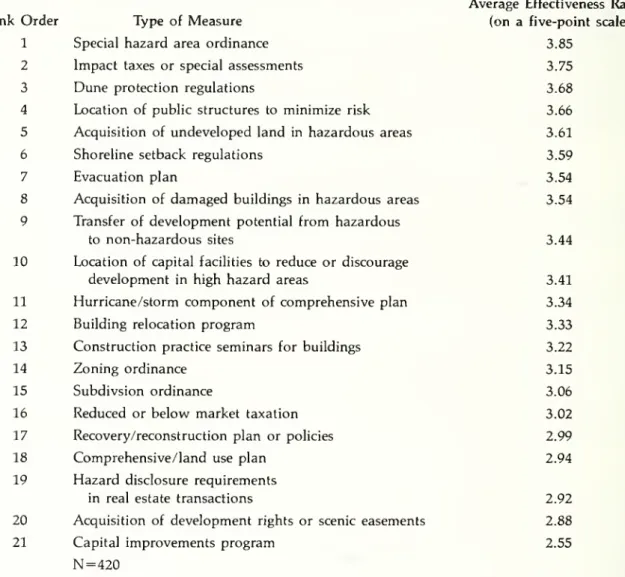
Rank
Order
1
2 3
4
5 6
7
8
9
10
11
12
13
14
15 16 17
18
19
20 21
Table 6
Development
Management
Measures
inOrder
of Perceived EffectivenessAverage Effectiveness Rating
Type
ofMeasure
Special hazard area ordinance Impact taxes or special assessments
Dune
protection regulationsLocation of public structures to minimize risk
Acquisition of
undeveloped
land in hazardous areas Shoreline setback regulationsEvacuation plan
Acquisition of
damaged
buildings in hazardous areas Transfer ofdevelopment
potentialfrom
hazardousto
non-hazardous
sitesLocation of capital facilities to reduce or discourage
development
in high hazard areasHurricane/storm
component
of comprehensive planBuilding relocation
program
Construction practice seminars for buildings
Zoning
ordinanceSubdivsion ordinance
Reduced
orbelow
market taxationRecovery/reconstruction plan or policies
Comprehensive/land
use planHazard
disclosure requirementsin real estate transactions
Acquisition of
development
rights or scenic easementsCapital
improvements program
N=420
(on a five-point scale)
3.85 3.75 3.68 3.66 3.61 3.59 3.54 3.54
3.44
3.41 3.34 3.33 3.22 3.15 3.06 3.02 2.99 2.94
2.92 2.88 2.55
construction practice
ualswill
make
responsible decisionsiftheyhave ac-cesstoalltherelevantinformation.Thishasspurredinterest in
programs
to inform the housing consu-mer, thedeveloper/builderand
thegeneral publicaboutthe risksassociatedwithhurricanes
and
severe coastal storms (e.g. seePalm
1981).Two
types ofinformation dissemination
programs were
investi-gated: hazarddisclosure in real estatetransactions
and
construction practice seminars.About
one-quarter of the respondents
had
hazard disclosure provisionsinplace, whileapproximately15%
usedconstruction practice seminars.
Table6 presentsrankingsofthespecific
develop-ment
management
measuresby
their perceivedef-fectiveness atreducinglocalstormhazards.
No
plan-ning approaches appearin thetop ten interms of
effectivenessatreducingstormhazards.Three regu-latoryapproaches are highlyrated: special hazard
area ordinances,
dune
protection regulations,and
shorelinesetbackregulations. Bothpublicfacilities
policiesare perceivedto behighlyeffective, as are
programs
designedtoacquireundevelopedlandand
damaged
buildingsinhazardousareas. Impacttaxesand programs which
transferdevelopmentpotentialfrom
hazardoustonon-hazardous sitesarealsoper-ceived as highlyeffective.In contrast,
among
thoseprograms
and
policiesperceived asleast effectiveatreducingstorm hazardsarethefollowing(thelowest
five): capital
improvements
programs, acquisitionof
development
rights or sceniceasements, hazarddisclosure requirements, comprehensive/land use
Ranking
MitigationApproaches
Respondents
were
askedtorank the importanceofthe threemitigationapproachesinreducingstorm hazards in their jurisdiction.
Of
the three ap-proaches,development
management
received themost
top rankings. Strengtheningbuildingsand
fa-cilities received themost
second rankings, whilestructuralreinforcement of thecoastalenvironment
received the
most
third rankings (Table 7). It should beremembered
that this ranking isrelativetothespecificrespondinglocality.
That
is, even in circumstanceswhere
developmentmanage-mentisrankedthird(last)bya respondent,thelocality still
may
have a solidand
innovative developmentmanagement
program. Itslower rankingmay
beat-tributable, for instance, totheimportanceof struc-tural
improvements
(e.g., inthe casewhere
a largeamount
of the hazard area has already beendeveloped.)
Overall Effectiveness
After considering all of thestrategies
and
tech-niques
employed
intheir jurisdictions, respondentsrated the
combined
effectivenessof theseatreducinglocal storm hazards.
Most
felt that localprograms
were
at leastpartially effective.Over
70%
believedtheir
combined programs
wereeithermoderatelyef-fectiveorveryeffective, while onlyasmall
6%
be-lievedthese
programs were
noteffective atall.The
majorityofrespondents(58%)
placed their jurisdic-tions in the"moderately effective" category. Thus,in
most
respondingareas,room
forincreasedeffec-tiveness exists (Table 8).
Feasibility of
Enactment and
EnforcementA
primary
objective of the surveywas
toobtaininsights into factors
which
influence the political feasibilityofdevelopment management.
Of
eleven possible obstaclestotheenactmentofdevelopment
management
measures, thefollowingfiveweremost
frequently identified, with each chosen
by
nearlyseventy percent of the respondents: 1) thegeneral conservativeattitudetoward
government
control of privatepropertyrights; 2)a generalfeelingthatthecommunity
can"weatherthestorm"; 3)lack ofade-quatefinancial resources; 4) the existence of
more
pressinglocalproblems
and
concerns;and
5)the op-position ofreal estateand
development interests.In addition, theabsenceofpolitically-activeindividualsand
groups advocating hurricane/stormmitigation,while not as frequentlyselected,
was
rankedas an important obstacle.Respondents
were
also asked to review severalpopular
arguments
againstdevelopment
manage-ment and
toindicatethe extenttowhich
thesehaveTable 7
Ranking
of the Mitigation Strategies Basedon
OverallImportance in Reducing Local
Storm Hazard
Rankings
Most Least
Important Important
1 2 3
1. Structural reinforcement of coastalenvironment
N=397
87(21.9%) 118(29.7%) 192(48.4%)2. Strengthening buildingsand
facilities
N=398
103(25.9%) 185 (46.5%) 110 (27.6%)3. Development management
N=403
215 (53.4%) 90 (22.3%) 98(24.3%)been important in their localities.
One
importantargument
against theenactment
ofdevelopment
management
identifiedby
respondents isthatsuch measureslead toincreaseddevelopmentcosts.Other argumentswhich
weredeemed
importantsuggested:1)decisionsaboutrisks
from
coastal stormsarebestlefttothe individual; 2)
development
management
measures willdampen
the localeconomy;
and
3)particular
development
management
measuresareillegal or unconstitutional.
The
survey also sought to determinewhether
problemsexistinimplementing
and
enforcing thosedevelopment
management
measuresinplace.About
halftherespondents
(49%)
indicated that theyhad
encountered implementation or enforcement
prob-lems.
Of
these respondents, themost
frequentlyidentified typeof
problem
was
thatof insufficientfunds. Public opposition, lack ofsupport
by
publicofficials, lack of qualified personnel,
and an
insuf-ficientdata base werealso indicated asproblems
by
asignificantportionofthe respondents.Moreover, approximately one-third of therespondents
(33%)
indicatedthat theirlocalities
had
experiencednega-tiveconsequencesas aresult of
development
man-agement
programs.The most
frequentselectionby
an
overwhelming margin was an
increase incon-struction costs.
theeffectivenessof
combined programs
opposition todevelopment
management
Analysis of Relations
From
theinformation containedin therelationshipbetween
factors affecting mitigation strategies
feasibilityofmitigation
raisingtheawarenessof local officials
Table 8
Overall Effectiveness of
Storm
Mitigation Frequency Percent1. Very effective 50 12.6
2. Moderately effective 231 58.0
3. Slightly effective 93 23.4
4.
Not
effective 24 6.0N=398
toprovidecluesaboutinteractions
between
coastaldevelopmentpatterns, political feasibilityof mitiga-tion measures
and
perceived effectiveness of theseprograms
at reducing storm hazards.While
thisanalysisispreliminary, severalinteresting
relation-ships emerged:
•
The
extent of the coastal floodplaindeveloped appears to be positively influencedby
the ex-tentofthelocality'sarea lyinginthefloodplainand
the scarcity of hazard-freedevelopment
sites. Also,
where
anagriculturaleconomy
still exists,development
in the floodplain is likelyto be less substantial.
•
Adoption
of an explicit storm hazardmitiga-tion strategy is positively related to the
prior-itygivento thestormhazard
by
thelocalgov-erningbody, thepercentage ofalocality'sland inthe coastal floodplain,
and
theproportionoflocal
development
occurring in these hazardareas.
•
About
60%
of the respondents indicated that their localitieshad
experienceda hurricaneorseverestormsince1970.Thispaststorm experi-enceappearstobepositivelyassociatedwiththe
adoption of explicit storm hazard reduction
strategies
and
development
management
measures.
•
The
quantity ofnew
development, asmeasured
by
buildingpermitdata, ispositivelyassociatedwiththeadoptionofexplicithazardreduction strategies
and
development
management
measures.
•Population size
and
number
of planningper-sonnelarepositively associatedwith the
adop-tionofexplicithazard reductionstrategies
and
development
management
measures.•
An
active role of regional agencies in storm hazardmitigation ispositively associatedwiththeadoptionof explicithazardreduction
strate-gies
and development
measures.•
The
overalleffectiveness ofstormhazardmiti-gationprograms, including
development
man-agement, ispositively associatedwithpriority giventothestormthreat,
and
negativelyassoci-atedwitha lack ofsupport
by
publicofficials.As
well, areas thathaveexplicit storm hazardreductionstrategiesare
more
likelyto haveef-fective storm hazard
management
programs. •Knowledge
of sources of state assistance ispositively associated with the effectiveness of
development
management
measures.Implications for planning
The
preliminarysurvey findings suggest anumber
of implications for coastal planners
and
policy-makers
concerned with enactingand
implementingdevelopment
management
measurestoreducestormhazards.
Many
factorsand
community
characteris-ticsaffectthefeasibilityofhazardmitigation.
Some
are
beyond
thecontrol of planners, whileothers aremore
accessibletoinfluence.Even though
planners cando
littletochange
thefixed factors, theymust
be
aware
ofthese constraintswhen
designing theirprograms.
Obviously, mitigationmeasureswillbe
more
feas-ible in localitieswhere
higher priority is given tostormhazards. Planners can heighten awarenessof the severity
and
potentialdestructiveness ofstormforces, both
on
the part of the general publicand
localelectedofficials.
They
can connect concernover hurricanes with planningand development
solu-tions. Sincemitigationeffortstend tobemore
feas-iblein localitieswhich
havehad
recent experienceswithhurricanes
and
severe coastal storms,plannerscan
highlight thestorm
histories of theirjurisdictions.
Mitigationprogramsare
more
feasiblein localitiesoflargerpopulationsize,
and
withgreaterplanningresources
and
personnel.While
these factorsmay
be largely
beyond
the control of local planners, higherlevels ofgovernment
may
beable toinflu-encethem.Stategrants
which
supporttheprepara-tionoflanduseplansand/or
which
allow fundsfor technical assistancehaveenhanced
many
states' local planning capacity. Regional agencies can also be used to supplement local personnel, resourcesand
planningexpertise. In
many
states, regional agencieshave been instrumentalin raisingtheawarenessof
A
locality'sphysicalcharacteristicsand
develop-ment
patternspresentbothmitigation opportunitiesand
mitigation constraints. Keepingdevelopment
away
from hazardareaswilltendtobemore
feasiblein localities
where
viable non-intensive usesforthese areas, such as agricultural activities, stillexist.As
well,development
pressures in hazard areas willtend tobegreater
where
alternativesitesfordevel-opment
are less available. Inmany
circumstancesit simply
may
not be possible to preventdevelop-ment
in hazardousareas withoutentirelystoppingdevelopment
in the locality.Storm
hazardpriorityisalsoaffectedby
physicalcharacteristics
and
patternsofdevelopment.Where
the hazard area comprises a larger portion of the
locality,
and where
a high degree ofdevelopment
isalready occurringinthehazardzone, storm haz-ardpriorityisenhanced.Inthesesituations, the po-tentialdestructiveness ofstormsishardertoignore.
The
finding,which shows
thatthe use ofdevelop-ment
management
is greaterwhere development
pressures are
more
extensive, supportsthis. Itsug-gests moreover, a kind of "tipping-point" theory
about the use of
development management.
The
needfor
management
programs
may
notexistuntil acritical level ofdevelopment
occurs.The
trickforplanners
and
policymakers concernedaboutmitiga-tion, then, isto
employ development
management
tools before the extent
and
pace of hazard zonedevelopment
foreclosesany
possible futurereduc-tion in coastal
damages and
loss of life.The
survey results also indicate the importanceofpoliticalconstraintsto mitigation, including the opposition ofreal estate
and
developmentinterests,and
the absence of politically-supportive groups.Planners
must
begin towork
withrealestate, busi-nessand
other politically importantgroups in thelocalitytoinform
them
ofthe benefits of mitigation.Planners
may
alsoneedtonurtureand
developotherlocalconstituencies thatwillbepoliticallysupportive
of mitigation efforts. Recreation
and
conservation groups, forexample,may
represent potentpolitical allies in the support of mitigation programs.The
importance of
combining
storm hazard reductionwithothersalient localgoalscannot be overstated.
continued on page42
Wilmington StarNews
politicalconstraints to mitigation
intergovernmental
approaches
comprehensiveand
effective storm hazards
mitigation program
continuedfrom page 27
Coastal setbacksisanothertenable
means
ofdevel-opment
management.
Coastal setbacks can assure protection ofbeachaccessand
continueddevelop-ment
of the localeconomy
in addition to reducingflooddamages. Localplanners
must
begintocapital-ize
upon
this"strategic dovetailing" of localconcerns.Higher levels of government,
and
particularlystates,
may
playan importantroleinassisting plan-nersand
policymakers
in overcominglocalpolitical opposition to hazardmitigation.The
North
Caro-lina coastal
management
program
now
requirescoastal jurisdictionstodevelophurricane mitigation
and
post-storm reconstruction plans as part oftheir localland useplans.Thistypeof extra-localrequire-ment
deflects politicaloppositionfrom
thelocal tothestatelevel,
and
allowslocal supporterstopointto staterequirements for justification
and
supportfor local efforts.
The
importanceof particulararguments
against the use ofdevelopment
management
is also ap-parentfrom
the survey. Thisstrongly suggests theneed for local planners to beable to explicitly ad-dress
and
respond to these challenges. Mitigation proponents shouldnotpermit argumentsagainstthe legalityorconstitutionality of aproposed
develop-ment
management
measure, forexample, to jeopar-dize its adoptionand
effective implementation. Plannersshould be preparedto respondknowledge-ably
and
authoritativelytotheseargumentsinordertoinspirea
more
comprehensiveand
effectivestorm hazards mitigationprogram
for high risk coastalarea.
NOTES
1. SeeBeatley,Brower,
Godschalk
and
Rohe, 1985, foracomplete reviewofthe findings oftheques-tionnaire.Thisreportcanbe obtained
by
writingtotheCenterfor
Urban and
Regional Studies, 108Battle Lane,
Chapel
Hill, N.C. 27514.2. Thesewere communitiesfor
which
anadditionalwave
height (under anew
methodology)
had
been
orwas
in the process of being computed.As
a further check,NFIP
State coordinators ineverysurveyedstate
were
askedforan
indepen-dentlistoflocalitieswith V-zonesintheirstates. Becausewe
feltthatverysmall coastallocalitieswere
unlikely to be undertakingdevelopment
management
programs, localities of less than1,000population(asofthe1980census)werenot surveyed.
3.
A
follow-uptonon-respondinglocalitiesallowedustoeliminate15localitieswithoutcoastalstorm
hazards, bringingouroverallsurvey population
to 621,
and
increasing the final response rateto about68%.
REFERENCES
Beatley, Timothy,
David
J. Brower,David
R. Godschalk,and
WilliamM.
Rhoe. 1985.Storm
Hazard
ReductionThrough
Development
Man-agement: Results of aSurvey of Hurricane-Prone
LocalitiesinNineteen CoastalStates. ChapelHill,
N.C:
University ofNorth
Carolina, Center forUrban
and
Regional Studies, January.Brower,
David
J.,Candace
Carraway,Thomas
Pollard,
and
C. Luther Propst. 1984.Managing
Development
in Small Towns. Chicago:APA
Planners Press.
Conservation Foundation. 1980. Flood
Hazard
Management
and
Natural Resource Protection,Washington,
DC:
PreparedforFEMA,
October.Drabek,
Thomas,
AlvinMushkatel and
Thomas
Kilijanek. 1983. Earthquake Mitigation Policy:The
Experience ofTwo
States. Boulder,CO:
In-stitute of Behavioral Science, University ofColorado.
Godschalk,
David
R.and David
J. Brower. 1985."Mitigation Strategies
and
IntegratedEmergency
Management,"
Public Administration Review,Vol. 45, January, pp. 64-71.
Godschalk,
David
R.,David
J.Brower
et. al. 1979.Constitutional Issues of
Growth
Management.
Chicago: Planners Press, 1979.
McElyea,William
D,
David
J.Brower and David
R. Godschalk. 1982. Before the Storm:Managing
Development
toReduce
HurricaneDamages.
ChapelHill,
N.C:
University ofNorth
Carolina,Center for
Urban
and
Regional Studies.Rossi, Peter,
James Wright and
EleanorWeber-Burchin. 1982. Natural
Hazards
and
Public Choice:The
Stateand
Local Politics ofHazard
Mitigation.
Academic
Press.U.S.
Army
Corps
ofEngineers. 1975. Guidelines forIdentifyingCoastal
High Hazard
Zones.Galves-ton District.
U.S.
Army
Corps
of Engineers. 1981.Low
CostShoreProtection: