What Makes for a Good Doctor? Analyzing the Physician-Patient
Relationship in Grey’s Anatomy and Scrubs
By Sumiyah Enayet
Senior Honors Thesis Interdisciplinary Studies
University of North Carolina at Chapel Hill
March 18, 2018
Contents
Introduction ... 4
What Makes for a Good Doctor? ... 4
Doctor- Patient Relationship ... 4
Stories ... 7
Cultivation Theory ... 10
Past Studies ... 15
Conclusion ... 18
Chapter 1: Explicit, Narrative and Implicit Lessons in Grey’s Anatomy ... 19
Greys as Teaching Hospital: Popularity and Familiarity ... 20
Characters: Modeling virtue (and vice) ... 25
Medical Pedagogy: Didactic, Narrative, and Experiential ... 27
Initial Premise ... 28
Didactic Lessons through Voice Overs ... 30
Narrative Arcs ... 36
Mentor Lessons: The Experiential Level ... 43
Conclusion ... 46
Chapter 2: Mentorship and Camaraderie in Scrubs ... 47
Show’s Conception and Reception ... 47
Structure and Characters ... 50
Initial Premise ... 53
Kelso vs Cox: Balancing Altruistic vs Financial Motives ... 55
Kelso vs Carla: Social Pressure ... 58
Carla vs J.D.: Nurses and Doctors ... 60
Lessons by the Cynical Mentor: J.D. and Cox ... 61
Camaraderie and Competition ... 65
Conclusion ... 68
Conclusion: The Profile of a Good Television Doctor ... 69
Introduction ... 69
The Importance of the Pilot in Setting a Keynote ... 70
Universal Messages of Professionalism, Responsibility, Camaraderie ... 70
Survival through Collaboration ... 72
Introduction
What Makes for a Good Doctor?
This thesis will also explore the nature of what evokes good doctoring in the symbolic environment of two popular and influential medical television shows. It will look at Greys Anatomy and Scrubs, both of which take place in teaching hospitals. This setting makes explicit the act of pedagogy, for many of the plots revolve around the relationship of interns, physicians in training, to their preceptors or clinical mentors. However, this thesis argues that many of the “lessons” about what constitutes good doctoring occurs less implicitly; the serial plotlines encrypt instances of understated pedagogy directed not just at characters but at the audience of these popular forms of entertainment. Both Grey’s and Scrubs offer numerous opportunities to educate by portraying different medical scenarios and outcomes, as well as character traits that are implicitly affirmed or condemned; taken together, these depictions coalesce into a portrait of what constitutes good doctoring. In other words, this thesis will address the following central questions: what are the values, norms, and behaviors that these
television shows affirm as essential for the ethical and effective practice of medicine? Do the shows differ in their portrayal of the ideal ethos of a physician, or does a composite figure of the perfect doctor arise from Grey’s and Scrubs taken together?
Doctor- Patient Relationship
Hollender and Szasz were among the first to break down the complex relationship between patient and doctor.1 On one hand each sick individual has unique needs that
must be addressed and each physician has a unique perspective on how to approach those needs. On the other each patient also must be provided with the same standard of care, and each physician must ascribe to agreed-on standards of conduct. It evokes the question of whether there is such a thing as a perfect doctor and if good health care is solely the responsibility of the physician or shared between patient and physician.
In the modern era, the doctor has had more control and power in the relationship with the patient. In the United States this is especially true: practicing physicians have rigorous, specialized training; have passed rigorous qualifying exams; and often have decades of experience on which to draw. Hollender and Szasz note that a patient who lacks knowledge and the agency to maintain their own health would become ill and would be dependent on the doctor to treat them.2 This is partially due to the nature of
illness where patients may be so sick they don’t have the ability to communicate with the doctor even if they wanted to, but it is also due to the lack of access to information. With greater access to knowledge, patients begin to understand more about their own health and can begin to interact with the doctor more and have more agency.3 Currently, the
medical interview is the “major medium of health care.”4 The three functions of the
medical interview are “gathering information, developing and maintaining a therapeutic relationship, and communicating information.”5 Furthermore the functions are
1Szasz, T. S., & Hollender, M. H. (1987). A contribution to the philosophy of medicine: the basic models
of the doctor-patient relationship. Encounters between patients and doctors: An anthology, 165-77. 2Szasz, T. S., & Hollender, M. H. (1987).
3Szasz, T. S., & Hollender, M. H. (1987).
4Goold, S. D., & Lipkin, M. (1999). The doctor–patient relationship. Journal of general internal
medicine, 14(S1), 26-33.
dependent on one another. If a patient does not trust the doctor then they may reveal less information to him or her. If a patient is anxious or not as well educated it may be difficult for them to communicate information. This description of the functions of the initial interactions between patient and provider point to the two-way nature of the relationship. Due to the increase in mutual cooperation between physicians and patients, health care is moving toward a more interactive approach.
Hollender and Szasz describe this well when they discuss the three models of the doctor-patient relationship. The first model is that of activity-passivity, which is similar to a parent infant relationship in which the doctor does something to the patient with little to no input. This would be the case in anesthesia, a coma, delirium, or great trauma. The second model is guidance-cooperation which is similar to parent-adolescent relationship in which the doctor still tells the patient what to do and they acknowledge the practitioner’s greater wisdom and generally offer compliance. The third model is mutual participation where the physician develops a treatment plan in consultation with the patient. This model is most similar to a mutual relationship
between adults where the patient goes to get expert opinion from the physician and they work together to manage a disorder. Although healthcare in the twenty-first century is shifting toward the third model, in which the patient can have more control over their own health, it is important to note that there is not one correct model of health care. Even the first model is necessary if a patient is unconscious and has no way of communicating with the physician. Hollender and Szasz also point to the fact that different physicians have different goals, and that these often differ from the patient.6 A
surgeon may think that operating and removing an ulcer is a successful outcome, regardless of whether or not the patient gets another illness months later. Their use of the first model of doctor patient relationship, activity-passivity, may be enough to provide them with the successful outcome they wanted. An internist, by contrast, may see the ulcer as a part of a larger problem and may not believe they’ve reached a successful outcome until they can prevent the patient from getting any more ulcers. They may require more from the patient, such as compliance on taking an oral
medication and reducing stress. Because more is necessary for a successful outcome, an internist would need to employ a different relationship model.
Stories
Before diving into analysis, it is helpful to establish why looking at television is beneficial to understanding moral education in a medical context and how the hospital environment provides a useful backdrop to educate the viewers along with the hospital staff. Serial television is essentially a combination of stories featuring a common cast of characters that go through a myriad of trials and adventures to learn more about
themselves and life. Theorists of communication have argued that cultural narratives often embody the values, norms, and practices that a particular group wishes to affirm or disavow. As one trio of researchers have argued that stories are widely considered to be “an indispensable part of moral education in every culture. They simulate social situations that offer insight into what is acceptable and unacceptable behavior in a given society or culture.”7 Stories have a pedagogical effect, helping to socialize us into gender,
7 Bilandzic, Helena, Matthias R. Hastall, and Freya Sukalla. "The Morality of Television Genres: Norm Violations and
class, age roles and give us models of conformity and rebellion.8 Many kids are told the
story of the boy who cried wolf to learn to be honest. The tales that we read in books, watch in films, and hear from others help shape who we are, establish what implicit rules should govern our behavior, what we believe and how we should act. There are many theories for why this is so that have been developed by narratologists,
philosophers, and most recently neuroscientists.
Brain science offers new insights into the power of stories to shape identity and
govern behavior, revealing how merely reading about sensory experiences affect the
body almost as strongly as actual having a stimulus present to the senses. In a 2006
study published in the journal NeuroImage, researchers in Spain asked participants to
read words with strong odor associations, along with neutral words, while their brains
were being scanned by a functional magnetic resonance imaging (fMRI) machine.9
Normally we read something from a text book, the Broca's area and Wernicke's area light up indicating language is being processed.10 However when the participants of the
research study read the words with odor association, their olfactory centers lit up indicating they were smelling the odor while reading.11 Furthermore a team of
researchers from Emory University reported in Brain & Language that when subjects in
their laboratory read a metaphor involving texture, the sensory cortex, which is
responsible for perceiving texture through touch, became active. The same was found to
be true for the motor area of the brain when people read about motions according to a
8 Bilandzic, Helena, Matthias R. Hastall, and Freya Sukalla. 9 Paul, A. (3/17/12). Your Brain on Fiction. Retrieved 1/4/18, from
http://www.nytimes.com/2012/03/18/opinion/sunday/the-neuroscience-of-your-brain-on-fiction.html?adxnnl=1&pagewanted=all&adxnnlx=1354716276-vBCJNxgtIuIFGnU+PmkBpA&_r=0
study conducted in the Laboratory Language Dynamics in France.12 These studies argue
that the brain distinguishes little difference between reading a story and experiencing it.
Neuroscientists also suggest that readers identify strongly with characters,
suggesting that representations can have effects similar to actual encounters with
individuals in one’s life, whether admired mentors or social pariahs. Raymond Mar, a
psychologist at York University in Canada, performed an analysis of 86 fMRI studies
and found that there was substantial overlap in the brain networks used to understand
stories and the networks used to navigate interactions with other individuals.13 In other
words stories not only activate our brains to experience physical sensations such as
smell and touch but also engage the mind in relating to the struggles and feelings of the
characters.
Television shows that are plot-driven and have a consistent set of characters reinforce the power of narrative through visual and auditory stimulus, as well. Evolution has wired our brains to think in terms of cause and effect which is essentially what a story is.14 A character will perform an action and some event will come from it. Someone
listening to the story can learn from the consequences of a character’s actions. For years people would pass on stories and traditions orally, but with the emergence of new technology there are now a multitude of sources to get stories. With books, movies, and television, people can share and accumulate stories faster than ever.15 Mass media
platforms allow for a wide audience to view the same stories and perhaps, experience
12Boulenger, V., Roy, A. C., Paulignan, Y., Deprez, V., Jeannerod, M., & Nazir, T. A. (2006). Cross-talk
between language processes and overt motor behavior in the first 200 msec of processing. Journal of cognitive neuroscience, 18(10), 1607-1615.
13Mar, R. A. (2011). The neural bases of social cognition and story comprehension. Annual review of
psychology, 62, 103-134.
14Boyd, B. (2009). On the origin of stories. Harvard University Press.
similar values and lessons. For the purposes of this analysis, I will be focusing on television. The serialization of television in particular has allowed people to consume a particular story over a long period of time when compared to a book or movie.16 Thereby
people have more time to invest, get attached to characters, and learn from their tales.
Cultivation Theory
Television has always provided engaging stories in the form of serial fiction primarily to attract and entertain large audiences. Researchers have argued that, regardless of intent, the “symbolic environment” they provide offers “plentiful
opportunities” to learn from the fates and actions of the characters.17 This is the premise
of cultivation theory which states that television watching can make us more likely to believe the social reality portrayed on screen and often misconceive what is true in the real world.18 In other words cultivation theory is based on the idea that the images and
messages transmitted through popular television media heavily influence the perceptions of people in the real world. This theory was first developed by George Gerbner and Larry Gross in 1976, through the Cultural indicators project.19 This project
was federally funded in order to see the effects of violence on television audiences.
16Feuer, J. (1984). Melodrama, serial form and television today. Screen, 25(1), 4-17.
17 Bilandzic, Helena, Matthias R. Hastall, and Freya Sukalla. "The Morality of Television Genres: Norm Violations
and Their Narrative Context in Four Popular Genres of Serial Fiction." Journal of Media Ethics 32, no. 2 (2017): 99-117.
18 Potter, W. James. "Cultivation theory and research." Human Communication Research 19, no. 4 (1993): 564-601;
emphasis added.
19 Gerbner, G.; Gross, L.; Morgan, M. & Signorielli, N. (1986). "Living with television: The dynamics of the cultivation
Cultivation theory holds three core assumptions.20 One, television is
fundamentally different from other forms of mass media. Television is auditory, visual and does not require literacy. Although low-income families may not have access to television, for the most part it is available and people from all walks of life can watch. It is meant for general audiences and is cheaper than watching films, which would have to be bought individually. Gerbner, Gross, Morgan, & Signorielli argued that
Television is the source of the most broadly shared messages in history ...Television cultivates from childhood the very predispositions and preferences that used to be acquired from other primary sources [such as religious texts] ... The repetitive pattern of television's
mass-produced messages and images forms the mainstream of a common symbolic environment.21
Novels such as George Eliot’s Middlemarch and films like Patch Adams also portray physicians engaging in medical practice; however, in comparison to popular television shows, the audience for each of these narratives is much smaller and doesn’t give rise to a common symbolic environment. In other words, television is easier to access and understand which lends itself to having a large role in shaping the culture of society. Secondly, television shapes how people think and relate to each other. According to Gerbner and Gross, "the substance of the consciousness cultivated by TV is not so much specific attitudes and opinions, as more basic assumptions about the facts of life and standards of judgment on which conclusions are based."22 These standards of judgments
are crucial in the context of medical shows, supporting the claim of this thesis that plots involving practitioners help to propagate a vision of what constitutes good doctoring.
20 Gerbner, G.; Gross, L.; Morgan, M. & Signorielli, N. (1986).
21 Gerbner, G.; Gross, L.; Morgan, M. & Signorielli, N. (1986). "Living with television: The dynamics of the cultivation process". In J. Bryant & D. Zillman. Perspectives on media effects. Hilldale, NJ: Lawrence Erlbaum Associates. pp. 17–40.
22 Gerbner, G. & Gross, L. (1972). "Living with television: The violence profile". Journal of Communication. 26 (2):
Furthermore, when it comes to controversial topics such as abortion rights, or assisted suicide, the way a story is structured can give insight to a show’s stance on issues.
With cultivation theory in mind, we can see the ways that medical shows may help to socialize people about hospitals, institutions that are generally fairly foreign to lay people. The National Center for Health Statistics reports that only 7.6 % of people have stayed over-night in a hospital.23 The majority of the population doesn’t frequent
hospitals regularly and may be unaware of the culture created within the environment. Once an individual enters the hospital as a patient, therefore, they are plunged into a strange but all-encompassing milieu with rules and norms of behavior with which the person is likely unfamiliar. Sociologist Erving Goffman's concept of the total institution, in which people become immersed in an organization that consumes every aspect of their lives, can be applied to a hospital setting where patients are usually confined to a room with little agency that forces them to adhere to hospital policy.24 Furthermore, the
staff usually works long hours and have themselves become acclimated to the culture of the hospital. Since people have less experience with this environment, medical television shows offer a sort of vicarious experience of this complex total institution. As a result, shows set in hospitals are arguably even more influential in shaping the public views of them (as compared with a show set in a more familiar cultural space such as a school).25
Cultivation theory helps to establish how narrative television shows can be influential; that said, media theorists acknowledge that there is a limit to the effects. Television is understood to be one influence of many, part of a larger sociocultural
23 Centers for Disease Control and Prevention. (2013). Hospital utilization (in non-federal short-stay hospitals). 24 Paul, A. (2007, April 9). Total Institution and Lifeworld. Retrieved 1/4/18, from
http://www.everydaysociologyblog.com/2009/04/total-institution-and-lifeworld.html
system. Although the amount of sway television has on society may fluctuate over time with the emergence of new media or new generations of people, it still has a consistent effect. Simply put, television may not cause an individual to behave a certain way or to adopt particular attitudes, but over time it adds to someone’s perception of and
judgments about the world. In the words of media researcher Clint C. Wilson et al., media shape and reinforce the “collective consciousness” of the population in order to attract a large audience.26 In other words, media have an interactive role with society,
where the stories and conceptions they dramatize both influence perceptions and are influenced by current perceptions.
Because visual media are so influential, they are often studied to get insight into human behavior. Television shows in the 21st century are rarely overtly didactic: the days of “Father Knows Best,” when a tidy moral lesson would be delivered by the family patriarch in the course of thirty minutes, are gone. Rather, television shows tend to deliver their messages more covertly. One way that researchers have argued television affects behavior is through a concept known as ‘norm violations.’ What this refers to an action a character takes that violates what is acceptable. The result of said violation can give insight into whether the action is acceptable or not. The Journal of Media Ethics published an article May 2018 that analyzed social norm violations in fifteen television series which were within the genres of crime dramas, medical dramas, sitcoms, and daily soaps.27 The narrative context of such social violations were also looked at to see
26Wilson II, Clint C., Felix Gutierrez, and Lena Chao. Racism, sexism, and the media: The rise of class
communication in multicultural America. Sage, 2003. p37
justifications and outcomes for the breaches, such as lying, violence, and arguing in order to see how the show was socializing viewers.
Given the consensus on the influential nature of television especially those that deal with niche topics such as medical dramas, there has been controversy over the exaggerations and dramatization of these shows that may lead to misconceptions in society. Some notions of accuracy are currently debated in the public sphere when discussing medical shows.28 For one the work schedules are unrealistic.29 Doctors
usually work long hours and don’t have as much overlap time to socialize with
colleagues. The role of nurses is a fairly controversial topic, in which some think they are misrepresented and disrespected. For instance, the television show House, M.D. doesn’t have nurses while Greys depicts them as inferior and less involved, when in reality nurses spend the most time with patients. That being said, it is important keep in mind the melodrama aspect of the shows. These shows are meant to entertain, so they will often show rare and high adrenaline cases. Television producers have to balance creating entertaining content while minimizing harm with false portrayals. There are also two complaints among doctors concerning the portrayal of CPR and seizure care.30
In the shows, half the time seizure victims are held down, which is not how they are treated in reality. Furthermore CPR is shown in poor form and technique and as a miracle cure. This perceptions gives false hope when it is only effective 5% of the time
28 Harris, D., & Willoughby, H. (2009). Resuscitation on television: Realistic or ridiculous? A quantitative
observational analysis of the portrayal of cardiopulmonary resuscitation in television medical drama. Resuscitation, 80(11), 1275-1279.
29 Davin, S. (2003). Healthy viewing: the reception of medical narratives. sociology of Health & Illness, 25(6),
662-679.
and actually leads to less people signing DNRs even when it would be better to do so.31
Another subject of discussion is the doctor patient relationship which varies greatly among shows and across characters.
The television industry itself is aware of the extent of its cultural influence, especially in relation to television shows about physicians, and has even established a program that seeks to ensure both accuracy and caution in portraying medical
encounters, disease diagnoses, and treatment regimens. It is a CDC funded program called Hollywood, Health, and Society that provides the entertainment industry
professionals with information needed to compose health related storylines.32 They do
this to ensure more accuracy and minimal harm while maximizing entertainment
because they realized how influential the media are. Moreover, medical shows have been the center of many studies that look at how influential the shows can be and whether they can be used as an educational tool.
Past Studies
Grey’s Anatomy and Scrubs have been on air for 13 and 10 years respectively and have brought about many different critiques and studies that are necessary to look at in order to situate this study. Several studies have shown the influential power of medical shows and how they can be used to educate the general public. In 2008 the Kaiser Family Foundation helped with an episode of Greys Anatomy entitled “Piece of my Heart” that was meant to raise public awareness of the fact there is a 98% chance of
31Al Aboud, K. (2012). Medical dramas–the pros and the cons. Dermatology practical & conceptual, 2(1),
75.
32Morgan, Susan E., Lauren Movius, and Michael J. Cody. "The power of narratives: The effect of
people with HIV having healthy babies. The episode repeated this fact and served almost as an educational tool to the general public. In fact viewers’ knowledge about mother-to-child HIV transmission rates rose substantially after the Grey’s Anatomy episode aired and the new information was still retained by many viewers six weeks later.33 Moreover,
a 2005 survey by the Centers for Disease Control and Prevention found that the majority of primetime TV viewers reported learning something new about a disease or other health issue over six months of viewing.34 About one-third of viewers took some kind of
action after learning about a health issue on TV.35 These studies show how the general
public not only can learn from medical dramas, but also retain the information in the context of public health or ethical issues. Jeffery Spikes conducted a study in 2008 and asserts that Scrubs can even be more helpful in teaching students than a bioethics class due to the active nature of watching television.36 This implies that other factors such as
perceptions of hospitals and doctors can also be shaped by television which has been the subject of several other studies.
In 2009 Quick did a study that looked at the effects of viewing Grey’s Anatomy on the perceptions of doctors and patient satisfaction using cultivation theory.37 “Results
demonstrate that heavy viewers of Grey's Anatomy perceive this program to be credible. Credibility was positively associated with a perception that real-world doctors are
33Rideout, V. J. (2008). Television as a health educator: A case study of Grey's Anatomy. Henry J. Kaiser
Family Foundation.
34Chung, J. E. (2014). Medical dramas and viewer perception of health: Testing cultivation
effects. Human Communication Research, 40(3), 333-349. 35Chung, J. E. (2014).
36Spike, Jeffrey. "Television viewing and ethical reasoning: Why watching Scrubs does a better job than
most bioethics classes." The American Journal of Bioethics 8.12 (2008): 11-13.
37 Quick, B. L. (2009). The effects of viewing Grey's Anatomy on perceptions of doctors and patient
courageous.”38 In other words those who watched the show a lot were more likely to
believe it was an accurate portrayal of medicine. Furthermore, the people who thought the show was credible tended to also hold the belief that doctors are brave. Another study looked at professionalism and bioethics in the context of Grey’s Anatomy and found many breeches of professionalism and exploration of bioethical issues.39
Given the influential nature, popularity and teaching potential of medical dramas, the educational theorists K. Jubas and P. Knutson specifically conducted a cultivation analysis to look at how shows portray the intern year which is the first year of residency after medical school and see how real interns feel about this portrayal.40 The
medical students who participated in the study found Grey’s Anatomy to be helpful in preparing their expectations of residency but didn’t like the focus on surgery which made the show dramatic and less realistic. Another student said after seeing the show without shadowing an actual surgeon, they were turned off from the idea of pursuing the specialty given the hardships portrayed on the show. That being said, others found the show to be inspiring and it gives insight into what their life could be like despite the dramatization.41 This study showed how medical students still appreciate the show,
while being able to filter drama from reality it also gives insight into the many forms of teaching that take place within the show and describe it as a blurring of the lines of formal and informal learning.
38 Quick, B. L. (2009).
39 Czarny, M. J., Faden, R. R., & Sugarman, J. (2010). Bioethics and professionalism in popular television medical
dramas. Journal of Medical Ethics, 36(4), 203-206.
40 Jubas, K., & Knutson, P. (2013). Fictions of work-related learning: How a hit television show portrays internship,
and how medical students relate to those portrayals. Studies in Continuing Education, 35(2), 224-240.
Conclusion
Using the theoretical framework cultivation theory alongside health humanities concepts, this thesis examines two popular contemporary television series to determine what these shows depict as core values in medicine. What is important in succeeding in a hospital job? What type of authority do physicians have over patients and their work environment? How do physicians relate to one another and patients? More specifically, I will be analyzing Grey’s Anatomy and Scrubs whose setting of teaching hospitals
provide ample opportunities to socialize viewers into a hospital environment as the new interns who start work are also being socialized into the milieu. Furthermore, the
intern-mentor interactions shed light on powerful dynamics in the hospital and provide explicit lessons that will be analyzed as they are relayed to the interns and viewers. The behaviors of the doctors and outcomes of their actions will be looked at to see what behaviors are favorable and unfavorable within a hospital context. These questions and character interactions will be analyzed to answer the central questions of: Who’s
Chapter 1: Explicit, Narrative and Implicit Lessons in Grey’s
Anatomy
Grey’s Anatomy is a highly popular television show that debuted on the American Broadcast Company (ABC) network in 2005 and is currently on its fourteenth season. Developed by Shonda Rhimes, it features an ensemble cast and takes place in Seattle Washington in the fictional Seattle Grace Hospital, a teaching hospital. Its pilot episode, “A Hard Day’s Night,” aired on March 25, 2005 and set the tone of the show: a
competitive hospital environment with wildly ambitious, even cut-throat surgical staff vying for position within a strictly hierarchical hospital environment. The hierarchy places the attendings at the top, followed by residents, followed by interns at the
bottom. Simply, the longer someone works in the hospital, the more authority they have. Despite these initial impressions, the show challenges these notions. Grey’s
Greys as Teaching Hospital: Popularity and Familiarity
City Hospital was the first fictional medical show launched in 1952 and portrayed doctors as omnipotent healers who represented the authority within the hospital.
Doctors in the 50s and 60s were characterized as “dedicated compassionate heroes.”42
The 70s brought Dr. Marcus Welby and other doctors who were on the cutting edge of medicine and always were successful. The shows would never depict the medical profession in a negative light. At the end of the 1970s, the focus switched from patient illness to the difficulties of being a doctor.43 Although medical shows begun depicting
the struggles of doctors, the portrayals were still positive overall. Grey’s Anatomy continues this trend by depicting the pros and cons of working in medicine.
Grey’s Anatomy follows a tradition of hospital-based television shows that began in 1982 with Joshua Brand’s and John Falsey’s St. Elsewhere and reached a height of popularity with E.R., which aired from 1995 to 2009. Unlike earlier shows that centered on medicine, such as Marcus Welby, M.D., these hospital-based shows explore how medicine is practiced in a purely clinical environment, and include a myriad of side characters as nurses, aides, administrators, and others involved in the whole system of providing medical care.
To make it stand apart, the creator of Grey’s Anatomy, Shonda Rhimes, wanted to make a show about smart women competing.
ER is high-speed medicine. The camera flies around, adrenaline is
rushing. My show is more personal. The idea for the series began when a doctor told me it was incredibly hard to shave her legs in the hospital shower. At first that seemed like a silly detail. But then I thought about the
42 Turow, J. 1996. Television entertainment and the US health-care debate.. Lancet, 347: 1240–1244. 43 Turow, J. and Coe, L. 1985. Curing television's ills: The portrayal of health care.. Journal of Communication,
fact that it was the only time and place this woman might have to shave her legs. That's how hard the work is.44
Rhimes mentions being fascinated with surgical shows and the idea of someone cutting another person open on the same day they do something simple like going on a date.45
Many medical shows at the time, like ER, were fast paced and aimed to provide a lens into the dramatic and exclusive world of medicine that the average person does not get to see. Contrastingly, Rhimes wanted to create a show that was slower paced and
focused on character development. In doing so she wanted to create real characters with flaws. Rather than a show that emphasizes how different doctors are from the general public; Grey’s Anatomy depicts ordinary people doing extraordinary things. In the world of Grey’s Anatomy a surgeon may be cracking open a chest one minute and then organizing party supplies the next, or looking inside a brain while wondering if her crush reciprocates her feelings. As a show, these scenarios serve to make the unfamiliar, seem familiar.
This aspect of the television show is essential for my purposes. Through this emphasis on the ordinary and the familiar within the backdrop of life-and-death medicine, the show makes the elite group of surgeons more relatable. Whereas shows that portray the physician as a heroic figure may lead viewers to identify more closely with the patients, Grey’s positions the surgeons as individuals with distinct
personalities who struggle with familiar concerns: worry about a parent, desire to be admired, and fear of failure. For this reason, viewers can more readily empathize with
44 Winfrey, Oprah (December 2006). "Oprah Talks to Shonda Rhimes". O, The Oprah Magazine. Harpo Productions, Inc. Archived from the original on March 27, 2013. Retrieved May 24, 2012.
the characters in Grey’s. The show, I argue, taps into this identification, and provides a system of moral lessons that the viewer can follow and learn from.
As one of the first medical dramas to slow things down and focus on character experiences, Grey’s Anatomy has experienced immense popularity over the years. One source reported in 2005 that
The Shondaland medical soap is poised to become ABC's highest-rated drama this season among coveted adults 18-to-49 and also ranks among the top five dramas on all of broadcast.46
Nielsen Media Research rankings from 2005–2006 indicate that Grey's Anatomy had an average of 19.9 million viewers per episode, placing it fifth in overall ranking of viewership.47 The show’s popularity stems from many sources. Importantly, the show’s
racially diverse cast differentiates it from other shows of the time.48 Many of the doctors
in positions of authority are African American such as the Chief of Medicine portrayed by James Pickens, the head of cardio portrayed by Isiah Washington, and the resident portrayed by Chandra Wilson. Furthermore Sandra Oh portrays the Jewish Korean intern Christina Yang. By including a diverse cast, the show is relatable to a wider audience, and it gives the opportunity to naturally weave in discourse about race.
Another aspect that draws in viewers is the emphasis on depicting complicated and risky surgeries to make the show more dramatic and create a competitive
environment within the hospital. In the first episode alone, viewers experienced a cardiac bypass, invisible aneurysm and appendectomy gone wrong. The constant
46 Goldberg, L. (2016, March 15). Grey’s Anatomy’ Poised to Become ABC’s Top-Rated Show in 12th Season.
Retrieved 1/10/18, from https://www.hollywoodreporter.com/live-feed/greys-anatomy-poised-become-abcs-879110
47 Goldberg, L. (2016, March 15).
48 Deimen, J. (2006). Grey's Anatomy. The Urban Wire. Retrieved March 5, 2008,
dramatic procedures and unpredictability keep the show entertaining. Running for thirteen years, it is still on air. The show’s popularity has fluctuated over the years, but even in the 13th year it still brings in many viewers. The show in 2011 and 2012 was named the fourth-highest revenue-earning show, behind Desperate Housewives, Two and a Half Men, and American Idol, earning US$2.67 million and US$2.75 million per half hour.49 The earnings speak to the show’s popularity and influence; dedicated
viewers would be well acquainted with the show’s structure, content, and familiar plotlines.
For those unfamiliar, the show is set in a teaching hospital in Seattle Washington, and primarily takes place within the surgical department; this focus on pedagogy allows for small teaching scenarios to be present in almost every episode. The hospital accepts a myriad of patients from wealthy socialites, to the homeless, and sometimes even the surgical staff. Each episode is 43 minutes long and primarily takes place in hospital spaces – the surgical theater, examining room, the cafeteria, and the break room – but occasionally the camera will follow a character home to their sparse apartment.
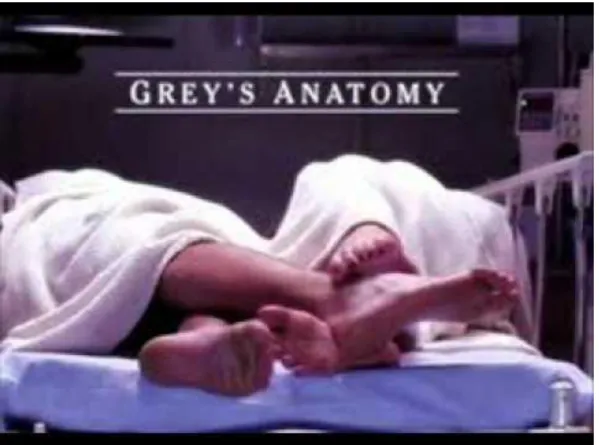
Romance and sex are weaved into the show, which is apparent when looking at the theme song, which overlays the hospital cloths and shoes, with heels and make up, and ending with a suggestive cut of two legs intertwined on a hospital bed.
49 Pomerantz, Dorothy (April 10, 2012). "TV's Biggest Moneymakers". Forbes. Archived from the original on April
Figure 1. The suggestive cut from the title sequence of Grey’s Anatomy, which foreshadows the romantic undertones of the show and the theme of intimacy.
Aside from the romance, usually there are around 3-4 patients that are focused on throughout each episode and an intern and attending will be assigned to each
environment lends each intern to push themselves to the breaking point to improve and be the best. Similarly, the attendings are fighting to prove themselves worthy of being the chief of medicine. The strict hierarchy that is established in the hospital gives the surgeons opportunities to move up making the environment more competitive and gives ample opportunities for growth and improvement as everyone is trying to prove
themselves.
Characters: Modeling virtue (and vice)
Grey’s Anatomy, underneath its romantic side plots and workplace tensions and competition, is essentially a pedagogical story: it offers a collective Bildungsroman, following the different characters as they stumble toward becoming better at their high-pressure vocation. While there are sometimes explicit moments of direct instruction, where a preceptor tells a resident precisely what she did right or wrong, the show’s teaching is largely more implicit. Aristotle’s theory of virtue ethics helps to elucidate how the pedagogy works, in which learning happens through role models and
witnessing the actions of others. Simply put, people can learn through trial and error themselves or by watching others. In the Aristotelian model, if an individual sees another complete an action successfully, both the person viewing and the agent herself will be more likely to complete the same action to achieve the desired result. Since Grey’s Anatomy takes place in a teaching hospital, it is natural for the interns (students) to learn from the residents and attendings (teachers, or in medical terms, preceptors).
offer a series of types that personify different motives and ideals, with some driven by a sincere desire to offer help to suffering patients. Others, however, have more mixed motives, such as desire for wealth and even fame (on a limited basis), or by a more detached interest in understanding how the human organism works. Grey’s Anatomy was cast using color-bind casting to create a racially diverse cast and focuses on a group of surgical interns.
The series follows Meredith Grey, portrayed by Ellen Pompeo, who is a surgeon beginning her intern year at Seattle Grace Hospital. Meredith is “inbred” as in both her parents were doctors. Meredith’s mother was a famous surgeon before getting
Alzheimer’s which Meredith must keep secret to protect her mother. She has to deal with the emotional burden of her mother’s illness alone and living up to her legacy. She is constantly reminded of how great her mother was during work and then sees the deterioration of her mother’s mind afterward. Although initially closed off Meredith learns to open up and a major lesson throughout the series is the importance of collaboration and friendship. The straying from the cutthroat competitive medical environment to one of inclusion and collaboration can clearly be seen in Meredith’s character development as she learns to open up throughout season 1. Moreover, she is a more moderate character than the other interns where she is logical and detached, but also caring and altruistic.
competitive spirt to become the best but has trouble relating to patients. Alex comes from a difficult background and struggles similarly. A former model, Izzie has trouble gaining acceptance as a doctor and her overly empathetic nature makes her get too involved with patients. George’s timid nature earns him the nickname Bambi as he has trouble asserting himself and often gets lost in the shuffle.
They are overseen during their internship by Miranda Bailey (nicknamed the Nazi because of how hard she is on residents, but ultimately cares), a senior resident who works for attending Derek Shepherd (sympathetic to patients, but is older and more jaded than residents), the head of neurosurgery and Meredith's love interest. Preston Burke is the head of cardio who is focused on doing his job and following the rules and doesn’t usually go out of his way for others. He also later becomes a love
interest to Christina. Burke and Shepard are fighting for Chief of Surgery, which is a plot concocted by the current chief Richard Webber, who often serves as a teacher and father figure to Meredith. He is clever and intuitive about what his surgeons need to grow.
Medical Pedagogy: Didactic, Narrative, and Experiential
with some level of authority make direct comments about what does or does not constitute good medicine. Since Grey’s Anatomy takes place in a teaching hospital, there are times where a resident or attending give a lesson to an intern or a fact would be stated in a voice over. In the case of Grey’s Anatomy, each episode begins and ends with a voiceover by Meredith Grey. Usually the ending voice over will correct the initial one to show the lesson she has learned in the episode. The second level of instruction is more implicit, and pertains to how the different patient cases turn out. I call this the narrative level, because it traces the outcome of particular stories within the show. By looking at the actions of the characters and the outcome of said actions, one can see what the show is conveying in a more subtle way. For example, when Christina Yang was rude to the nursing staff she got punished with paper work, teaching the lesson of being kind to the nurses. The third is the experiential level, which focuses on rites of passage that are organized by preceptors but without the knowledge of the characters. This last level conforms most closely to Aristotle’s model, and involves elder staff who helps to arrange conditions within the hospital so that the interns will undergo different sorts of incidents and problems that they themselves have weathered. This model of pedagogy focuses on experiential learning, and is perhaps the most influential and relatable in establishing the values, norms, and behaviors of good doctoring. The viewer is aware of the lesson, but the characters are not; this dramatic irony makes for the most potent education.
Initial Premise
an alarm for her first day of residency. She wakes up after a night spent with a stranger she met at a bar (who, the viewer and Meredith herself later learn, is Dr. Derek Shepard, a preceptor at Seattle Grace). Once she gets to work the Chief of Medicine, Webber, delivers a speech to the first-year interns and sets the stage. He says surgical residency will be the “best and worst” time of their life.
Look around you. Say hello to your competition. Eight of you will switch to an easier specialty. Five of you will crack under the pressure and two of your will be asked to leave. This is your starting line. This is your arena. How well you play? That's up to you.
With this speech, Webber introduces the hospital environment to the interns and viewers. He emphasizes the difficulty of the surgical program and competitive
environment by describing it as a “game” that the interns play against one another. He also empowers the interns by saying their success in the program is something they have control over. The emphasis on competition makes the experience of interning seem isolating, cutthroat and as something to be won. Throughout the first season these initial impressions are challenged and changed to show what internship is actually like.
While Webber’s speech establishes the competitive environment, Dr. Bailey’s speech that takes place later in the episode introduces the interns – and importantly, the viewer – to the hierarchy that exists in the hospital in which interns are on the bottom, residents are one rung up, and attendings are at the top. Miranda Bailey is introduced as Meredith’s resident who will oversee her work and act as a mentor. Her nickname is “the Nazi,” foreshadowing her toughness. Her speech to her first-year interns initiates the viewer and the characters to the fast-paced and difficult world of medicine. She
a run, 3) don’t wake her if she’s sleeping unless someone is dying, 4) don’t let the patient die, and 5) move when she moves.
You're interns, grunts, nobodies, bottom of the surgical food chain. You run labs, write orders, work every second night until you drop, and don't complain!
This speech by Bailey establishes a clear hierarchy in which the interns are at the bottom. The passage casts the interns as completely powerless, at the bottom of a
“natural” hierarchy that is likened to the food chain in the animal kingdom. The resident claims status and authority, and the patients are overlooked entirely, except as beings who are to be prevented from dying. The ideas of competition, rivalry, and a chain of command cast medicine as more like the military than a healing profession bent on reducing human suffering.
This first episode dramatically establishes the ground rules for the student: existing in the context of a teaching hospital is a matter of obedience to the
predetermined structure in order to survive. Greys Anatomy thus establishes a base-line in which the values of collaboration, care, patience, and altruism are rewarded among a highly competitive and cutthroat environment. With the initial premise and tone
established, the episodes of season 1 can be analyzed to see how these premises are affirmed or challenged.
Didactic Lessons through Voice Overs
voiceovers serve as explicit lessons that Grey learns and are stated clearly to the viewers. These explicit messages were categorized together. While the first episode, the pilot, portrays the surgical internship as a competitive game to be won, over time the interns bond over the shared challenge of becoming surgeons and cross professional lines to become real friends who can count on one another.
The first episode sets the premise and expectations that are challenged later. The key value is obedience to the hierarchical, quasi-military structure of the hospital, with the clear implication that the intern’s behavior will be judged against this explicit norm. Episode 1 “A Hard Day’s Night” begins with the messages discussed above from the Chief Webber and Bailey, the resident overseeing Meredith Grey. The main message they convey in the opening speeches is how difficult surgical residency is. Another point they make is how insignificant the interns are by calling them “grunts and nobodies.” A clear hierarchy is established in this opening scene. When this authority is challenged in the name of altruism to save the patient, it shows the importance of this value.
Episode 2, entitled “The First Cut is the Deepest,” begins with Meredith
emphasizing the importance of lines, the finish line, waiting lines, and boundaries. She initially tries to distance herself from Derek who she had spent the night with prior and from her other coworkers as she navigates her new environment. At the end of the episode she realizes life is messy and that one can spend it drawing lines or crossing them, as well as bonds with the other interns, who all admit they have no idea what they’re doing. This episode emphasizes the greyness of the world and how everything is not so black and white. It also introduces the overall theme of friendship and
community that is present throughout the series. The interns are first brought in and told the people around them are competition but then they end up bonding over the shared difficulties they experience.
Similarly, Episode 3 reinitiates the idea of competition with the initial voice over and then directly negates it by the end of the episode. Episode 3, entitled “Winning a Battle, Losing the War,” continues the theme of camaraderie through hard times with Meredith describing her surgical internship. She mentions spending all her time in the surgical unit and her five rules of survival. One, keep score, two, do whatever to
point of medicine is to help others.50 It adds to the overall message of community that is
seen throughout the competitive environment.
Now that the interns are starting to bond and get to know each other, Episode 4, entitled “No Man’s Land,” begins with the duality of intimacy and how it is desired and feared. A value emphasized as important in medicine in collaboration and the fear of intimacy is a hurdle that must be overcome to reach collaboration and is something Meredith greatly struggles with. Meredith initially doesn’t want to let Izzie and George move into her house, but she eventually caves while she learns that there aren’t any rules to intimacy, but rather it is something she has to define for herself. Overall this episode shows Meredith opening up and getting closer to the other interns to emphasize the importance of friendships.
The first four episodes emphasize the importance of having support from the people around you especially in difficult situations such as going through surgical residency. After getting over the hurdles of a competitive mindset and the fear of intimacy, the interns are able to open up more and rely on each other. The next few episodes focus on responsibility.
Residency brings with it immense responsibility; in one day an intern becomes responsible for a human life. Episode 5, entitled “Shake your Groove Thing,” begins by saying adulthood is overrated and ends with the same message. This episode focuses on the idea of responsibility and how being an adult is difficult. She also ends by saying that it also has its perks, such as the independence. Episode 6, entitled “If Tomorrow Never Comes,” continues with this message of responsibility with a quote from Benjamin
50Conrad, P. (1986). The myth of cut-throats among premedical students: On the role of stereotypes in justifying
Franklin “Never leave that till tomorrow, which you can do today.” Then Meredith goes on to say that people usually put things off because of fear of pain, failure, or rejection. In the end she says despite all the warnings and proverbs people need to learn from their mistakes themselves. She points out that the biggest mistake you could ever make is better than never trying at all. These two episodes show responsibility as inevitable but provide an optimistic lens in which the trials are worth going through. Furthermore the episode points to the idea that each intern is responsible for their own growth, which is asserted in the pilot episode in Webber’s speech.
After establishing that people are in control of their own fate in the last two episodes, the next episode explores what happens when those responsible for their own success make the wrong decisions. In Episode 7, entitled “The Self-Destruct Button,” begins with Meredith questioning why people are self-destructive and ends with her wondering if people like the pain. She ends with the saying “Why do I keep hitting myself with a hammer? “Because it feels so good when I stop.” In other words she insinuates that the difficult times make us appreciate the happy ones more. Because the interns are doctors and not just people, they are not simply responsible for their own success but also a patient’s success. This is a common notion that doctors are
responsible for their patient’s well-being. What is interesting about this episode is that it also shifts the responsibility to the patients by depicting their self-destructive
tendencies, which will be discussed later. The last two episode of the season show Meredith really learning to open up as she becomes more hopeful and open to the experiences and people around her.
funny thing and that sometimes good things happen in ways you don’t expect and that people can surprise you and sometimes take your breath away. She comes to this conclusion as she starts to open up more and accept others, such as her intern friends and Derek, into her life. With the burden of hiding her mother’s illness, and Meredith’s overall independent nature she often has a hard time relying on others so this episode and the next one show her character development.
The next episode and season finale solidifies Meredith’s character development as she learns to rely on others. Episode 9, “Who’s Zoomin Who,” beings with ideas of secrets and how they can consume people. Meredith mentions that medicine exposes secrets and how once they are in the open it is freeing because you don’t have to hide behind them. She decides this when her mom is admitted to the hospital and her secret is out. When this happens, all the other surgeons help her through it and Meredith realizes the importance of letting people in. At this point the barrier that keeps Meredith separate from others is removed, so she doesn’t have to be so standoffish.
The technique of the voiceover works within an individual episode to frame the core question related to the process of becoming a good doctor. The voiceover also serves to frame the season of episodes taken together, to establish a base premise that is then corrected, reinforced, or nuanced through the characters’ actions. Since Meredith is the one delivering these voice overs, they show both her progression through the beginning of her internship, as well as the overall themes of the show. The show opens emphasizing the difficulty of the surgical internship and how competitive the
presents the challenge that the protagonists must endure.51 Throughout the season
Meredith is presented with more challenges of secrets, intimacy, and responsibility. While facing these challenges, she bonds with other interns going though similar
struggles and finds she doesn’t have to do it alone. One phrase that emerges in the series that is commonly using as a popular culture reference is having “a person.” In the series, Christina says Meredith is “her person.” Being someone’s person means you put them down as an emergency contact, you tell them what’s going on, and you can rely on them and they can rely on you. This concept along with the character development of
Meredith shows the importance of having people to help through hard times.
Narrative Arcs
After exploring the first level of Didactic messages through Meredith’s voice overs, now we can move on to the narrative level, in which the action and outcome of an action serve as the ultimate basis for whether the action was right or wrong. When learning or trying to get used to a new environment, it is simple trial and error. A protagonist will complete an action and the result of the action will be indicative of whether the action was correct or not. In the case of Grey’s Anatomy, the reward is usually a surgery or verbal affirmation, or a successful patient procedure while
punishments include verbal reprimanding, paper work, undesirable tasks, or death of the patient. When looking at the narrative arcs of Grey’s Anatomy issues of authority and responsibility were key topics. Despite a clear hierarchy being established in the pilot episode, rule breaking runs rampant throughout the show. What determines the
success of these risky actions, is dependent on good intentions where selfish motives are reprimanded and good motives are rewarded.
By looking at instances of rule breaking together, a pattern emerges where standing up to superiors is acceptable, only when it is for the good of the patient. A rule established in the first episode is “no sucking up to the attendings,” yet Christina
In Episode 6, an intern speaks out against an attending, and steps beyond the realm of the clearly established hierarchy, but is ultimately rewarded for his good
intentions. George is in surgery and smells alcohol on the anesthesiologist’s breath, after hearing rumors of him drinking before surgery. No one notices so George asks Taylor, the anesthesiologist, if he had been drinking. Taylor gets angry and yells at George, which prompts Derek to kick him out of the OR. Later Taylor falls asleep during the surgery in his drunken state and his patient begins to awaken during surgery. Derek kicks Taylor out of the OR and apologizes to George after the surgery. In this case George was ultimately rewarded for doing the right thing to help save the patient. He risked getting in trouble by disobeying the hierarchy, but was rewarded for his altruism in doing right by the patient regardless of consequence was rewarded.
efforts, because the patient’s organs go on to save other lives but are reprimanded for breaking the rules by not scrubbing in. Since Christina’s motives were selfish she wasn’t rewarded with the surgery. In the gallery, the differing perspectives of Christina and Izzie are still apparent. Izzie describes the doctors harvesting as vultures while Christina points out that each organ will save another life. In the end both end up going the extra mile and sewing up the body after surgery so it is presentable to the family. This
narrative shows how the two interns can learn from one another and how selfish motives are not rewarded; which supports the values of collaboration and altruism the show emphasizes. Furthermore, it is another instance of the greying of lines of authority in which the good of the patient is the ultimate motivator for breaking rules.
The value of altruism is further enforced in Episode 9 with the same pair of interns. Christina and Izzie have a patient who dies without cause and want to do an autopsy. This was one of their first solo procedures and they wanted to know what had gone wrong. The family does not agree to an autopsy, and Bailey explicitly tells them not to do one, yet they do it anyway. Initially Bailey reprimands them when she finds out but Christina and Izzie discover that a rare genetic disorder caused the death. Then Bailey stands up for them when telling the family and gets them to sign the autopsy papers. In this case the interns did want to absolve themselves from guilt, but their intentions were ultimately altruistic in that they wanted to gain knowledge that would help others in the future and they were rewarded as such.
goes beyond just one patient. Rather than focusing on one client, this implies that it is the doctor’s responsibility to think of what is good for humanity as well. Furthermore, all the narratives above reward altruism and reprimand selfishness, which implies that to be a key moral lesson of the series. Another issue that arises quite frequently within the narrative level is that of responsibility. The show emphasizes how adulthood and being a doctor comes with immense responsibility. That responsibility however, doesn’t only fall on the doctor but rather the patient as well.
From the opening scene, the idea of responsibility is clear. Webber directly states that the intern’s success in their internship is dependent on their actions. This also emerges as a theme when looking at the first level within the voice overs and is further emphasized in the narrative level. Often, a doctor’s behavior is looked at and scrutinized when discussing medical care, but Grey’s Anatomy seems to flip the script and also look at the patient. In fact, often a patient’s behavior leads to the success or failure of the treatment. Furthermore, a doctor’s negative behavior towards a patient is almost justified, if the patient is rude.
Before discussing responsibility, it is necessary to first discuss the doctor-patient relationship as it helps to frame the interactions mentioned below. As discussed in the first chapter in the section titled Doctor-Patient Relationship, there are multiple models doctor and patient interaction can fall into. Since Grey’s Anatomy focuses on surgeons, more of the patient encounters begin in model one of activity-passivity where the patient comes in passed out and needs to be treated or operated on. This is to be
it all on the doctor, while three gives both parties an equal share. Moreover, Grey’s Anatomy’s depiction of the shared responsibility of doctor and patient is reflective of this third model of patient care, mutual participation. Episode 6 and 7 depict this shift in responsibility.
While Grey’s Anatomy portrays what goes into the beneficent and ethical practice of medicine, it also emphasizes that patients themselves have a role to play, both in their health more widely and in the clinical encounter itself. Episode 6
introduces a patient whose outcome was due to their own wrong doing, rather than the actions of a doctor. A patient comes into the hospital with a massive tumor. So massive that Bailey says “no laughing or staring” before entering the room. Throughout the episode the doctors comment on the irresponsibility of the patient in allowing the tumor to grow. Despite no wrong doing of the surgeons, the tumor was just too large and the patient passes away. The patient waited too long and didn’t take care of herself which ultimately led to her death. This focus on the responsibility of the patient is continued in the next episode.
Meredith’s patient had to have her gastric bypass reversed and social services is
contacted because the patient’s mom was the cause of her stress. All the patient’s poor health was a direct consequence of their own wrong doing, which absolves the doctors from blame.
Many times patients suffer from genetic disorders, or get into terrible accidents, but in Episodes 6 and 7, the patients suffer from their own wrong doings. The gunshot patient shot himself and died. Another girl gets illegal bypass surgery and has long term consequences from having to get it reversed. The revealing of the patient’s faults flip the script and show how patients have a responsibility to take care of themselves. If the case of the gunshot patient is looked at closer. Alex is the intern on the case and does
everything right. He relates to the patient, makes eye contact, actively listens and seems to actually care, yet the patient still dies. The patient’s own disregard for his own safety kills him in the end. Furthermore these instances show how the patient is often
responsible for their own health and the doctor does not have full control over the outcome of a patient encounter. That being said, a doctor can also be fully responsible for a poor patient outcome if a mistake is made.
Another layer of the concept of responsibility concerns mistakes. In Episode 5, while operating on an elderly lady, the surgeons find an old towel left in the patient from the last surgery. Records indicate Burke was the person who closed her up last time back when he was a resident. At the same time Meredith almost falls asleep during surgery, and pops her glove during surgery. Meredith becomes so guilty that she admits to the popping the glove after the patient begins to crash in front of the family. Burke
had made earlier in his career and says “even great doctors make mistakes and they need to be able to speak up.” In this instance he saved Meredith’s job by admitting to his own mistakes and neither party is punished or sued. This episode emphasizes the
importance of taking responsibility for ones actions and both characters were rewarded for their candor and altruistic concerns for the patient and each other. Burke risks his job to save Meredith and she risks her job for the good of the patient. Since both characters had good motives, neither were punished for their mistakes.
Mentor Lessons: The Experiential Level
The third level of analysis most conforms to Aristotle’s dictum, in which one must learn by doing. Some lessons the characters can only learn through experience, and as mentioned in the previous chapter, people experience stories while listening to them. Consequently watching these shows allow the viewer to experience these lessons while also seeing them through an analytic lens through the use of dramatic irony, where the viewer sees how the interns are put through the process of education. This reinforces the ultimate values of the show, what it wants to say are truly the values, norms, and
behaviors of good doctors. Furthermore, these lessons are almost like rites of passage that the attendings and residents have already gone through and hope to pass on to the interns. These were recorded chronologically and serve as universal lessons as the interns almost have to go through them to become fully and morally educated. The lessons typically involve the interns going through some experience to teach them a universal code in medicine, which is affirmed by one of the mentor figures.
Burke who sees something in him from the beginning. The family looked worried while talking to George and Burke and after Burke left, George promises the family everything will be ok. The surgery resulted in an unexpected death, which granted George the nickname 007 by the other interns, but what he really got reprimanded for was the false promise. Burke verbally tells him how every surgery is risky and that he can never make promises. Then he tells George to talk to the family. The lesson of not making promises and calling a death, is an important rite of passage that the interns must go through to learn to survive in the hospital. Using his experience and believing in George, Burke thought giving George the first surgery would make him more self-assured, but the unexpected death taught him more than he bargained for.
hand and makes eye contact with her, while she watches her die. Christina verbally admits her sadness and tries to resuscitate her but Burkes stops her. Then Burke makes Christina call the death and she does and storms out of the room to cry. It is the first time she shows real compassion for a patient and had to go through this “hazing ritual” to learn to care. That being said the lesson wasn’t meant to change who she was as a person. She was even told that some of the best doctors distance themselves, but she now understand how it feels to care and empathize.
On the other side of the spectrum Izzie, who is often overly sympathetic, is given a patient who refuses to let her operate on him because she used to be a model. She initially runs out and asks to be reassigned, but then stands up to him and finds out the reason for his behavior and sympathizes. Bailey convinces her to scrub in the surgery and learn to stand up for herself.
In episode 5 Alex must deal with a drug addict who comes in complaining of pain. Derek says the first rule of pain management is to be on the side of caution and tells Alex to give something for the pain. Alex disobeys Derek and is verbally reprimanded. Derek says the pain is real even if the patient is an addict, so he treats and discharges him. The patient refuses to be discharged, hits his head, and starts to bleed. After the whole incident Alex realizes the patient is more than just a drug addict and learns to empathize. He ends up calling a rehab specialist for the patient rather than just discharging him.
In episode 6 a major story line that emerges occurs when the surgeons must treat a rape victim and a rapist. Bailey had to guide the interns through the difficulty of