Abstract
Undocumented immigration has been a major modern political debate, yet there have been few immigration policies achieved since the Immigration Reform and Control Act of 1986. One of the few progressive policies passed, the U Visa, was established in 2000 and
Table of Contents
Chapter Page
Abstract 1
Acknowledgements 3
Tables and Figures 4
Chapter I: Significance and Special Aims 10
Basics of the U Visa 10
Contribution to Current Research 13
Research Outline 14
Note on Language 15
Chapter II: Background and Conceptual Framework 16
Barriers to Services for Undocumented Survivors of Domestic Violence 16
Challenges of the U Visa 19
Parallel Research: The T Visa 20
Theory and Hypotheses 22
Chapter III: Methods 24
Model 24
Data Collection 26
Key Advantages 28
Chapter IV: Results 31
Statistical Significance 31
Control Effects 32
Chapter V: Conclusions 36
Summary of Results 36
Generalizability and Other Limitations 36
Policy Implications 37
Suggestions for Further Research 38
Author’s Biography 42
Acknowledgements
I would like to thank Dr. Rebecca Kreitzer, Assistant Professor for the UNC Chapel Hill Public Policy Department, for her tremendous mentorship in this project and with my career,
intellectual, and academic development as a whole. Dr. Kreitzer redefines what it means to be a caring, insightful, and challenging professor, and to strive to make the university a place for community, state, national, and global wellbeing. I couldn’t be more grateful to have had her support and concern throughout my time at Carolina.
I would also like to thank Drs. Steven Hemelt, Benjamin Meier, and Jeffrey Summerlin-Long for their kind and generous support and encouragement, and for their devotion to bettering our communities for the common good.
I would be remiss to not extend my deepest gratitude towards Drs. Matthew Jansen, Data
Analyst, and Michele Hayslett, Numeric Data Services and Data Management Librarian, at UNC Chapel Hill’s Walter Royal Davis Library for their unyielding patience and expertise.
Tables and Figures
Table 1. Visual Display of the Difference-in-Differences Model Y=(II−I)−(IV−II)
Before the U Visa After the U Visa
Treatment: Latino/a I II
Control: Not Latino/a III IV
Table 2. 2000 Numerical Display of the Difference-in-Differences Model
Y = (0.432-0.39) – (0.365-0.387) = 0.064
Before the U Visa After the U Visa
Treatment: Latino/a 0.39 0.432
Control: Not Latino/a 0.387 0.365
Table 3. 2008 Numerical Display of the Difference-in-Differences Model
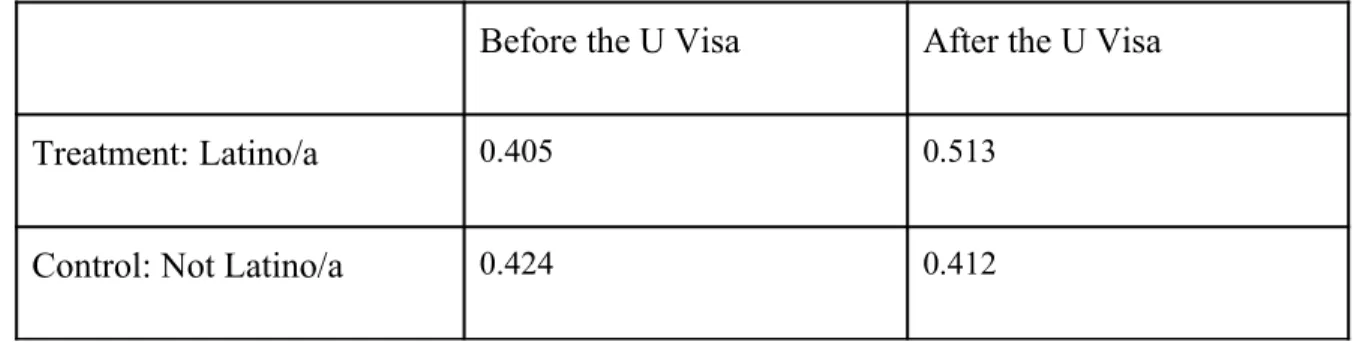
Y = (0.513-0.405) – (0.424-0.412) = -0.096
Before the U Visa After the U Visa
Treatment: Latino/a 0.405 0.513
Figure 4. 2000 Plot of Mean Values for Reports Made by Difference-in-Differences Model
1999 2000 2001 2002 0
0.1 0.2 0.3 0.4 0.5 0.6
Latino/a Non-Latino/a Mean
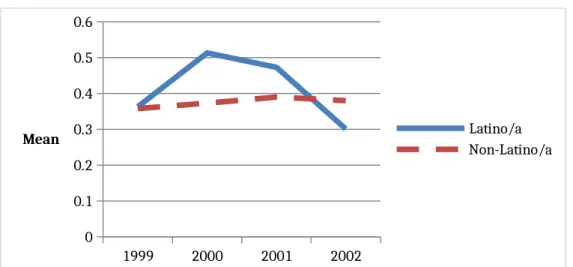
Figure 5. 2008 Plot of Mean Values for Reports Made by Difference-in-Differences Model
2006 2007 2008 2009 0
0.1 0.2 0.3 0.4 0.5 0.6
Latino/a Non-Latino/a Mean
Figure 6. Difference-in-Differences Equation
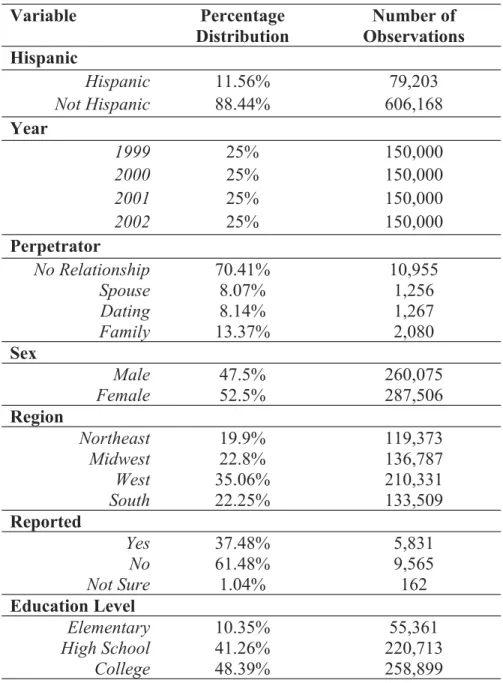
Table 7. 2000 Distribution of Variables
Variable Percentage
Distribution ObservationsNumber of Hispanic
Hispanic 11.56% 79,203
Not Hispanic 88.44% 606,168
Year
1999 25% 150,000
2000 25% 150,000
2001 25% 150,000
2002 25% 150,000
Perpetrator
No Relationship 70.41% 10,955
Spouse 8.07% 1,256
Dating 8.14% 1,267
Family 13.37% 2,080
Sex
Male 47.5% 260,075
Female 52.5% 287,506
Region
Northeast 19.9% 119,373
Midwest 22.8% 136,787
West 35.06% 210,331
South 22.25% 133,509
Reported
Yes 37.48% 5,831
No 61.48% 9,565
Not Sure 1.04% 162
Education Level
Elementary 10.35% 55,361
High School 41.26% 220,713
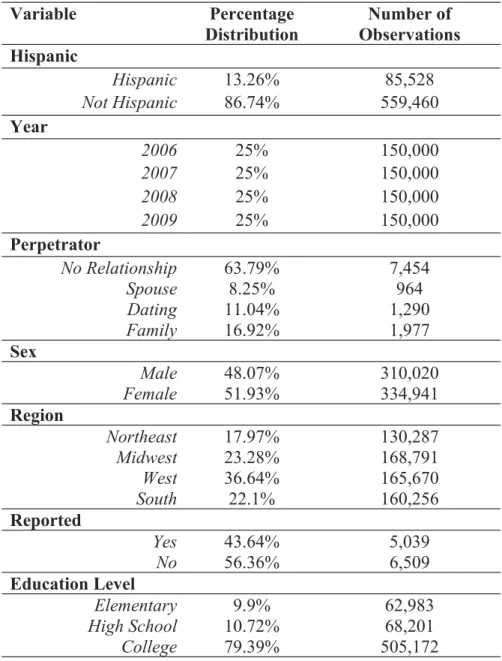
Table 8. 2008 Distribution of Variables
Variable Percentage
Distribution
Number of Observations Hispanic
Hispanic 13.26% 85,528
Not Hispanic 86.74% 559,460
Year
2006 25% 150,000
2007 25% 150,000
2008 25% 150,000
2009 25% 150,000
Perpetrator
No Relationship 63.79% 7,454
Spouse 8.25% 964
Dating 11.04% 1,290
Family 16.92% 1,977
Sex
Male 48.07% 310,020
Female 51.93% 334,941
Region
Northeast 17.97% 130,287
Midwest 23.28% 168,791
West 36.64% 165,670
South 22.1% 160,256
Reported
Yes 43.64% 5,039
No 56.36% 6,509
Education Level
Elementary 9.9% 62,983
High School 10.72% 68,201
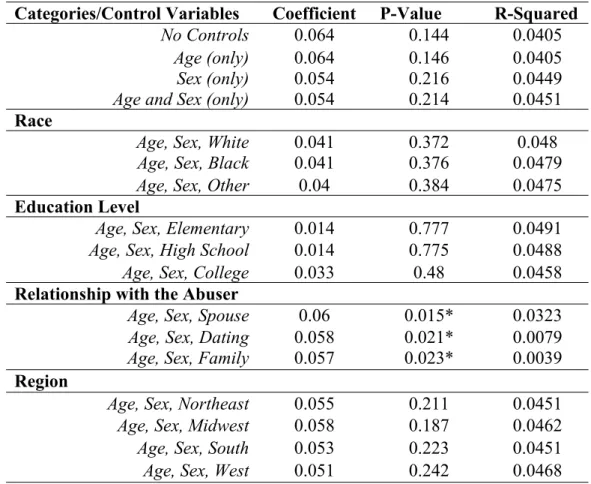
Table 9. Analysis Results for 2000
Categories/Control Variables Coefficient P-Value R-Squared
No Controls 0.064 0.144 0.0405
Age (only) 0.064 0.146 0.0405
Sex (only) 0.054 0.216 0.0449
Age and Sex (only) 0.054 0.214 0.0451
Race
Age, Sex, White 0.041 0.372 0.048
Age, Sex, Black 0.041 0.376 0.0479
Age, Sex, Other 0.04 0.384 0.0475
Education Level
Age, Sex, Elementary 0.014 0.777 0.0491
Age, Sex, High School 0.014 0.775 0.0488
Age, Sex, College 0.033 0.48 0.0458
Relationship with the Abuser
Age, Sex, Spouse 0.06 0.015* 0.0323
Age, Sex, Dating 0.058 0.021* 0.0079
Age, Sex, Family 0.057 0.023* 0.0039
Region
Age, Sex, Northeast 0.055 0.211 0.0451
Age, Sex, Midwest 0.058 0.187 0.0462
Age, Sex, South 0.053 0.223 0.0451
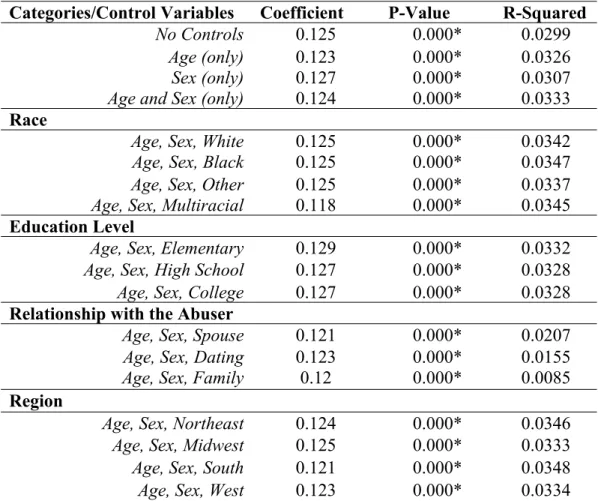
Table 10. Analysis Results for 2008
Categories/Control Variables Coefficient P-Value R-Squared
No Controls 0.125 0.000* 0.0299
Age (only) 0.123 0.000* 0.0326
Sex (only) 0.127 0.000* 0.0307
Age and Sex (only) 0.124 0.000* 0.0333
Race
Age, Sex, White 0.125 0.000* 0.0342
Age, Sex, Black 0.125 0.000* 0.0347
Age, Sex, Other 0.125 0.000* 0.0337
Age, Sex, Multiracial 0.118 0.000* 0.0345 Education Level
Age, Sex, Elementary 0.129 0.000* 0.0332
Age, Sex, High School 0.127 0.000* 0.0328
Age, Sex, College 0.127 0.000* 0.0328
Relationship with the Abuser
Age, Sex, Spouse 0.121 0.000* 0.0207
Age, Sex, Dating 0.123 0.000* 0.0155
Age, Sex, Family 0.12 0.000* 0.0085
Region
Age, Sex, Northeast 0.124 0.000* 0.0346
Age, Sex, Midwest 0.125 0.000* 0.0333
Age, Sex, South 0.121 0.000* 0.0348
I. Significance and Special Aims
Although undocumented immigration has been the focus of major political and policy debate throughout the late 20th and early 21st Centuries, there has been little substantive policy change since the Immigration Reform and Control Act (IRCA) of 1986, which both allowed many undocumented immigrants to apply for legal status and made it illegal for employers to hire undocumented workers, and the Personal Responsibility and Work Opportunity Reconciliation Act (PRWORA) of 1996, which reformed welfare to be unattainable for most immigrants. One of the few exceptions to this thirty-year trend has been the U Visa, established by the 2000 Victims of Trafficking and Violence Prevention Act.
The U Visa will be discussed in-depth in the following sections, but I would like to provide a quick summary. This policy is a path by which an undocumented survivor of several violent crimes, one of which is domestic violence, who works with law enforcement to arrest and prosecute their perpetrator may, with the certification of that law enforcement agency, attain legal resident status and eventual citizenship for themselves and close family members. The rationale behind this policy is geared towards the empowerment of law enforcement, not necessarily a humanitarian cause.
Basics of the U Visa Purpose of the U Visa
The U Visa, one of the few ways for undocumented immigrants to secure a documented and legal presence in the United States, was created as part of The Victims of Trafficking and Violence Protection Act of 2000, and as defined by the United States Citizenship and
prosecution of criminal activity” (U.S. Citizenship and Immigration Services, 2016). United States Citizenship and Immigration Services defines the purpose of the U Visa as to:
“strengthen the ability of law enforcement agencies to investigate and prosecute cases of domestic violence … while also protecting victims of crimes who have suffered substantial mental or physical abuse due to the crime and are willing to
help law enforcement authorities in the investigation or prosecution of the criminal activity.” (U.S. Citizenship and Immigration Services, 2016).
The following discussion of the U Visa will describe how this dual purpose of empowering law enforcement to prosecute criminals who harm undocumented immigrants and supporting undocumented survivors of domestic violence has served as both a “holy grail” for
undocumented survivors of domestic violence and, in other ways, fallen far short of expectations. Eligibility Requirements of the U Visa
There are six criteria for receiving the U Visa: “(1) You are the of qualifying criminal activity1; (2) You have suffered substantial physical or mental abuse as a result of having been a victim of criminal activity; (3) You have information about the criminal activity; (4) You were helpful, are helpful, or are likely to be helpful to law enforcement in the investigation or
prosecution of the crime; (5) The crime occurred in the United States or violated U.S. laws; and (6) You are admissible to the United States. If you are not admissible, you may apply for a waiver on a Form I-192, Application for Advance Permission to Enter as a Nonimmigrant. (U.S. Citizenship and Immigration Services, 2016).”
1 Domestic violence is the qualifying crime that will receive focus for this research. However, there are twenty-seven other qualifying crimes: abduction, abusive sexual contact, blackmail, extortion, false imprisonment, female genital mutilation, felonious assault, fraud in foreign labor contracting, hostage, incest, involuntary servitude, kidnapping, manslaughter, murder,
Of these eligibility requirements, and the one which garners significant further
discussion, analysis, and critique, is, “being helpful, or likely to be helpful, to law enforcement in the prosecution of a crime.” This problematic qualification will be discussed further in the upcoming section, “Structural Dilemmas to Implementation.”
Key Benefits for Beneficiaries
One of the main benefits provided by the U Visa is that the survivor is allowed to stay in the US on a legal nonresident status for four years with work authorization, and ultimately may be granted the opportunity to adjust to legal permanent resident status and, after five additional years, citizenship (Rajaram, Novak, Barrios, Rogers, & Leal, 2015). Qualifying petitioners may petition not only for themselves, but also on behalf of family members, for legal resident status and eventual citizenship. All petitioners may file on behalf of their spouse and children, and survivors under the age of 21 may also file on behalf of their parents and unmarried siblings (U.S. Citizenship and Immigration Services, 2016). Additionally, there are no costs associated with petitioning for a U Visa and all additional forms that do require a fee can have a fee waiver applied to them (U.S. Citizenship and Immigration Services, 2016), eliminating some degree of financial barriers associated with the U Visa, although for many survivors additional costs such as hiring an attorney or missing work may be a barrier to pursuing the U Visa.
Structural Dilemmas to Implementation
and Immigration Services, 2016). This relationship can be exceedingly problematic as
undocumented immigrants may be justifiably wary of police involvement and law enforcement may not act appropriately. Notably, a 2012 randomized telephone survey of Latinos living in four major metropolitan cities (Chicago, Houston, Los Angeles, and Phoenix) found that approximately 70% of undocumented immigrants report that they are less likely to contact law enforcement if they were survivors of a crime (Theodore, 2013). This perception may limit the willingness of undocumented immigrants to report a crime even with the possibility of receiving a U Visa.
Conversely, law enforcement is not required to certify a survivor regardless of their assistance in the case, but rather the onus is on the survivor to receive a certification, possibly leading to an abuse of power and further re-traumatization of survivors (Wixson, 2011). Members of law enforcement may very well have pre-conceived notions of undocumented immigrants and, therefore, harbor prejudice and discrimination towards them regardless of whether they are the survivor or the perpetrator. In less intentionally discriminatory situations, law enforcement may simply be unaware of the process or even existence of the U Visa
(Wixson, 2011). The extent of these phenomena are unknown due to lack of research. Contribution to Current Research
Proponents of the U Visa believe that this policy will help alleviate tensions between the undocumented community and law enforcement, although there is little proven evidence to support or contradict this assumption. Through this research, I seek to determine whether either the implementation of the U Visa in late 2007, or the passing of the law in 2000, affected the rate at which undocumented survivors of domestic violence report their victimizations to law
prevention policies will be better informed by this research, as policymakers currently have a limited idea of which policy changes need to occur, if any, in order for the U Visa to truly be an effective tool in fighting domestic violence in the undocumented community. In the forthcoming chapter, “Background and Conceptual Framework,” the works of several academics will be highlighted. These individuals have investigated the previously discussed limitations of the U Visa but little is known about the actual effects of these limitations.
Although this policy is designed to empower law enforcement to support survivors, it also cannot pass unsaid that policies often have effects antithetical to policymakers’ intentions. Therefore, it is crucial to also understand that any results found throughout the course of this research can only be evaluated positively, rather than normatively. In layman’s terms, the possibility of a U Visa does not necessarily always mean that it is in the best interest of the survivor to report to law enforcement. Police involvement may increase the lethality of the situation, raise concerns about the legality of the survivor’s residence, or indirectly cause circumstances in which the survivor is without necessary resources that their abusive partner provided, such as income or housing. In summary, this research may be able to provide evidence to the effect that the U Visa is, or is not, increasing the rate at which undocumented survivors of domestic violence are reporting to law enforcement but cannot determine whether or not this trend is a beneficial or disadvantageous one for survivors who are reporting.
Research Outline
Conceptual Framework, I will provide common academic discourse regarding the U Visa and the similar T Visa. It should be noted that there is little information available regarding the U Visa, and especially little data analysis. Following this, in Chapter Two, Methods, I will describe the difference-in-differences model used to study my research question as well as explain my source of data (the National Crime Victimization Survey) and their key limitations and disadvantages. Following these explanatory chapters, I will discuss my findings in Chapters Three and Four, Results and Conclusions, respectively.
Note on Language
II. Background and Conceptual Framework
As previously mentioned, there is no widely available research exploring the
effectiveness of the U Visa in increasing the rate at which undocumented survivorsof domestic violence report their abuse to law enforcement. However, several other studies have investigated domestic violence within undocumented communities and the frequent limitations of the U Visa. I hope to use these foundational research, largely qualitative studies and non-experimental discussions of the U Visa and domestic violence in immigrant communities, which will be discussed in this chapter to support my quantitative research about the effectiveness of the U Visa. Furthermore, I will provide an investigation of a remarkably similar policy, the T Visa, which is designed to support survivors of human trafficking.
Barriers to Services for Undocumented Survivors of Domestic Violence Difficulties Related to Immigration Status
37.3% reported economic dependency (Montoya, 2007). However, the rates of survivors listing limited English skills or lack of knowledge about laws and service was only 3.9% (Montoya, 2007). Notably, 74.5% reported “other barriers” including “fear of losing their children” (28%), “fear of retaliation” (28%), and “social isolation” (15%). It is certainly worth mentioning that Montoya collected this data via agency files not through direct contact, meaning that it is not necessarily true that only 3.9% of survivors were harmed by limited English skills but instead only 3.9% of survivors mentioned it. Most notable for the purposes of this research is the high proportion of survivors that reported immigration status and fear of losing children as barriers (since the U Visa is applicable to the survivor and their children).
VAWA self-petitioning, however, is only available for legal and documented immigrant survivors. Zadnik’s, Sabina’s, and Cuevas’ study Violence Against Latinas: The Effects of Undocumented Status on Rates of Victimization and Help-Seeking instead seeks to determine the whether these barriers, in addition to the specific barrier created by being undocumented, affects survivors willingness to seek formal help (Zadnik, Sabina, & Cuevas, 2016). Using chi-squared and logistic regression analysis, Zadnik et al. were able to determine that only 15.4% of
undocumented Latinas experience any form of victimization as opposed to 20.4% of legally residing Latinas. Yet, only 16.1% of undocumented survivors had sought formal help as opposed to 33.4% of legally residing survivors (Zadnik, Sabina, & Cuevas, 2016). This study provides support for the assertion that undocumented survivors may be particularly wary of legal involvement.
and Erez et al. revolutionarily concluded that immigrant survivors were actually impressed and even empowered by the helpfulness and concern of law enforcement in the United States (Erez, Adelman, & Gregory, 2009). Unfortunately, Erez et al. do not mention quantitative statistics on this conclusion and their research methods raise concerns. Participants in the research were chosen through contacts with social services agencies and there may be some selection and response bias in which organizations had the time and concern to participate in the study, as well as which survivors were referred for interviews (Erez, Adelman, & Gregory, 2009). Furthermore, even the selection through social service agencies may mean that these survivors are particularly trusting of United States institutions.
Difficulties with Law Enforcement
One of the main barriers for undocumented survivors of domestic violence pursuing a U Visa is often the “helpfulness requirement,” or the mandate that a survivor must attain a law enforcement certification that they have assisted in the investigation of the perpetrator (Wixson, 2011). Wixson’s research particularly describes a case-study of how the helpfulness requirement has been implemented in Detroit, Michigan, particularly in regards to the role and supportiveness of local law enforcement. Wixson discusses that the Wayne County Prosecutor’s Office2
acknowledges and issue U Visas, but in complete accordance with the law the Detroit Police Department refuses to acknowledge, let alone issue, U visas (Wixson, 2011). Although Wixson’s work only provides a local perspective of the U Visa’s helpfulness requirement, and therefore cannot confirm external validity, this may be occurring in more than one locale. However, it should be noted that Detroit has high poverty rates and frequent fiscal crisis, differentiating it from many other locales in the United States.
Although not directly related to immigration enforcement, Dr. Michael Lipsky’s Street-Level Bureaucrcacy, Dilemmas of the Individual in Public Services provides insight into the scenarios faced by street-level bureaucrats, in this case local law enforcement officials, and the manners in which undocumented survivors of domestic violence may not receive the services that they are due. For example, Lipsky writes that “street-level bureaucrats engender controversy because they must be dealt with if policy is to change…the policy delivered by street-level bureaucrats is most often immediate and personal” (Lipsky, p. 8). Lipsky particularly notes that the ability of street-level bureaucrats is largely due to two factors: “relatively high degrees of discretion” and “relative autonomy from organizational authority” (Lipsky, p. 13). Applied to the scenario with law enforcement’s certification, or lack thereof, a potential U Visa recipient’s “helpfulness” in the investigation and possible prosecution of their perpetrator, these principles become highly applicable. Law enforcement officials are given both total discretion as to whether or not they would certify an applicant and there is no accountability for their failure to treat undocumented survivors fairly in regards to the certification of a U Visa.
Challenges of the U Visa
S., Novak, Barrios, Rogers, & Leal , 2015). This work is relevant because it exemplifies the ways in which the U Visa can be improved.
Parallel Research: The T Visa
One way to gain insight into the U Visa may be to examine the policy outcomes of the T Visa, designed for survivors of human trafficking who are seeking to remain in the United States. The T Visa’s purpose draws striking similarities to that of the U Visa- most notably, the justifiable perception of many that the program is less a form of altruism for trauma survivors and more of a criminal justice tool. This perception is explored within Pollock and Hollier’s T Visas:
Prosecution Tool or Humanitarian Response? From 2001-2010, only about 1,300 T Visas were awarded despite the ability to grant 5,000 a year, and the procedures for allowing survivors permanent residency were not finalized until 2009 (Pollock & Hollier, 2010). This highly mirrors the similarity in which survivors were not awarded U Visas until 7 years after the passing of The Victims of Trafficking and Violence Prevention Act. Pollock and Hollier argue that the underuse of the T Visa may be due to the perception that the U Visa is designed primarily to prosecute perpetrators of human trafficking rather than benefit survivors (Pollock & Hollier, 2010).
Stacie Reimer Smith offers a different perspective on the underutilization of the T Visa in Underutilization of the T-Visa: Comparing the T-Visa to Similar Temporary Residence
Programs Around the World. Smith argues that the discrepancy between available and granted T Visas is due largely to the “expectation of participation in investigation of the trafficker,” or that the survivor should participate in investigating and prosecuting their trafficker; “difficulty in identification,” or that the survivor is misidentified as a prostitute, the survivor is scared of retaliation, or does not self-identify as a survivor; and “procedural and evidentiary problems,” or the frequency with which survivors do not have the legal resources and evidence to prove their need for a T Visa (Smith, 2013). All of these are issues presumably shared with survivors pursuing a U Visa, and it should also be noted that there is not solely an expectation, but also a requirement, that survivors cooperate with law enforcement and participate in the investigation and prosecution of their abuser.
The third pertinent source discussing nuances of the T Visa relatable to the U Visa is “Balancing the equity of mental health injuries: examining the “trauma exception” for sex trafficking T-VISA applicants” by Benjamin Thomas Greer and Scott Davidson Dyle, both experts in the field of human trafficking3. This source discusses the high prevalence of Post-Traumatic Stress Disorder in survivors of human trafficking and the difficulties that this poses when survivors are expected to comply with law enforcement’s requests, regardless of the effect this might have to their physical or, in this case, emotional health (Greer & Dyle, 2014). Among survivors of intimate partner violence, rates of Post-Traumatic Stress Disorder range from 31% to 84.4% and the rate of depression is approximately 60% (Dutton, Green, Kaltman, Roesch, Zeffiro, & Krause, 2006). As has been discussed earlier, recipients of the U Visa are not only
expected but required to fully cooperate with law enforcement and therefore survivors may suffer as much, if not more, further re-traumatization from the process. Therefore, I find Reimer Smith and Green and Davidson Dyle’s works more convincing that Pollock and Hollier’s. Theory and Hypotheses
Due to the dearth of research surrounding the U Visa, it is difficult to theorize about the outcome of this research. However, because there is ample evidence that the process of receiving a U Visa is a challenging, vicarious, and oftentimes dangerous ordeal for a population that is already cloaked in justified and valid fear and apprehension, I have made the following hypotheses:
Hypothesis 1: I expect to see a relatively small (statistically insignificant) increase, if any, in the frequency with which undocumented survivors of domestic violence report their
victimization to law enforcement. The null hypothesis, therefore, would be that there is a statistically significant increase in the frequency with which undocumented survivors of
domestic violence report their victimization to law enforcement.
Hypothesis 2: I expect that identifying as female will have statistically significant positive impact upon the frequency with which undocumented survivors of domestic violence
report to law enforcement. The null hypothesis would be that identifying as female has no statistically significant impact, at all, upon this frequency.
Hypothesis 3: I expect that any impact of the U Visa will lessen for individuals who identify as Afro-Latina due to the even further strained relationship between law enforcement and the African American community. The null hypothesis, therefore, would be that this impact
Hypothesis 4: I expect that any impact of the U Visa will lessen for Latinas with an elementary education level since these individuals may be less likely to know the benefits of the
U Visa. The null hypothesis would be that this effect is unchanged or even strengthened for Latinas with an elementary education relative to their more highly educated (high school and
college) counterparts.
Hypothesis 5: I expect that any impact of the U Visa will be stronger for survivors whose abusers are their spouses than for those whose abusers are their dating partners or non-romantic
family members. Therefore, the null hypothesis is that this impact is not more significantly significant for survivors whose abusers are their spouses than their counterparts.
Hypothesis 6: I expect that any impact of the U Visa will lessen for Latinas living in the Southern U.S. because of the history of racism and oppression in this portion of the country4. The
null hypothesis, therefore, would be that any effect is unchanged or even strengthened when survivors live in the Southern U.S. relative to their counterparts
4 This is not to say that racism has not existed, and does not continue to exist, in every region of this country (indeed, I would argue that it does). This is simply to say that this history of
III. Methods Model
The U Visa was passed in 2000 but did not become available until late 2007. As such, I decided to use 2 basic difference-in-differences models, for years 2000 and 2008, and several controls for each (discussed in depth below). Difference-in-difference models serve to quantify the impact of the U Visa by comparing the difference between the rates at which domestic violence is being experienced and reported for the group that would be affected, Latinas, and the group that would theoretically not be affected, non-Latinas, before and after the threshold year. For the establishment of the U Visa in 2000, I used 1999 and 2000 as the “before” years and 2001 and 2002 as the “after” years because it was not passed until late 2000. For the
implementation of the U Visa in 2007, I used 2006 and 2007 as the “before” years and 2008 and 2009 as the “after” years because it was not implemented until late 2007 and, as is evident in Figures 4 and 5, there is a marked impact in Latino/a reporting between these threshold years
This model is preferential to a simple before-and-after model because it incorporates the ability to differentiate between Latina survivors and non-Latina survivors. Please see Tables 2 and 3 for plots of the mean (in this case, mean percent of observations that included reports) and note that, importantly, neither year seems to visually display a significant increase in reports to law enforcement in comparison to their non-Latina counterparts. Mathematical displays, rather than visual displays, can be seen in Tables 2 and 3.
victimization to law enforcement. The symbol α represents the probability that any survivor will report domestic violence to law enforcement while β1 represents the effect of being Latino/a (the treatment), β2 represents whether or the observation is being measured before or after the
implementation of passing/implementation of the U Visa and β3 estimates the effect of the U Visa on the Latino/a survivor. θλctis a vector that represents all of the control variables (sex, age, region of residency, relationship with the abuser, education level, and race) and the error term encapsulates all that is not taken into account by the rest of the formula.
Using this model, I can determine whether there was an increase, decrease, or stagnation in the share of reporting survivors who identified as Hispanic. Logically, this would be due to an event that occurred during that threshold year. I am hypothesizing that this event was the U Visa. If after the U Visa was passed, the share of reporting survivors who identified as Hispanic increased to a degree that is statistically significant, this would provide evidence that the U Visa was successful in encouraging Latina survivors to report their victimization to law enforcement. Please see Table 1 for a visual display of this concept.
Controls have been incorporated for each region (Northwest, Midwest, South, and West), racial identity (white, Black, and other race5, as well as a control for multiracial identification for the 2008 data6), education level (elementary education, high school education, and college education), the nature of the relationship with the abuser (whether they were family, a spouse, or a dating partner), and the sex of the survivor (male or female). Region was included because different areas of the country hold different Latino/a populations and, according to prior studies, possibly different degrees and natures of racial resentment (Carter & Carter, 2014). These
5 Due to the small proportion of Native American and Asian-identifying individuals, and the low overlap between these populations and Hispanic-identifying individuals, Native American and Asian were combined.
regions were the Northeast, Midwest, South, and West. The sex of the survivor (male or female) was also included because cisgender males and females experience disparate rates of domestic violence (Breiding, Smith, Basile, Walter, Chen, & Merrick, 2014) and education level was included as a socioeconomic proxy, as is commonly used (Oakes).
Year and age are ordinal variables, meaning they are categorized discretely and with a specific and meaningful order. Race, education level, region, and the relationship between the survivor and perpetrator are all categorical nominal variables, meaning that they are placed in descriptive categories that are not organized in a particular way. Finally, Hispanic ethnicity and sex are binary variables, as respondents fit into one of the two categorical options7. Please see Tables 7 and 8 for the data.
One key step in the process of preparing this data was to account for changes in the number of reports made and the breadth of the sample size in order to ensure that statistically significant increases in the amount of reports made by Latinas were not simply due to increases in reports made overall. In order to account for this, and because the sample size originally varied significantly by year (slightly above 150,000 observations some years and over 300,000 in others) a random sample of 150,000 observations was taken by each year. Having a sample size of 150,000 by each year will not only control differences due to sample size, but it will also allow several control variables to be used simultaneously without sacrificing a sample size sufficient for finding accurate calculations.
Data Collection
I used the National Crime Victimization Survey (NCVS), which was downloaded from the Inter-university Consortium for Political and Social Research and prepared using the
provided setup files. I believe that this dataset is the best available because it identifies the ethnicity of the survivor, the crime committed, the relationship between the survivor and the perpetrator, and the region in which the crime occurred. It also provides information about the education level of the survivor, which helps to contextualize the socioeconomic status of the survivor and their abuser. Furthermore, the NCVS is a reputable dataset and collected by the U.S. Census Bureau and maintained by the Department of Justice. However, this does not mean that the National Crime Victimization Survey is without its limitations, which will be discussed in further depth in the following sections.
National Crime Victimization Survey
To observe the rates at which undocumented immigrants experience domestic violence, I used the National Crime Victimization Survey (NCVS) for the years 1999-2002 and 2006-2009. Unfortunately, the NCVS certainly is limited in several ways. The NCVS methodology surveys the entire household in the survey, rather than solely the head of the household, likely affecting the rate at which domestic violence survivors are willing to share that they have experienced violence at the hands of a family member if that family members lives with them. It can be presumed that not all survivors of domestic violence would feel comfortable disclosing this information to a survey, and although this is not unique to the NCVS, the method by which the survey is conducted may have a significant impact on underestimating the rate at which
presumably increase the rate at which undocumented survivors of domestic violence report their violence.
Key Advantages
Although not without flaws, the National Crime Victimization Survey (NCVS) was found to be, by far, the best datasets available. It was created in 1972 in order to understand crimes that were not reported to law enforcement, particularly to estimate how often they are not reported, and thereby distinctly meet the goals of this research, as well (National Archive of Criminal Justice Data). There are two variables that construct whether or not the survivor reported to law enforcement: one for whether or not the crime was reported generally, and another for who reported it8. Data are collected by the Bureau of Justice Statistics through the fieldwork of the U.S. Census Bureau, providing accountability and expertise to the study’s advantages.
Key Limitations of this Research
One key limitation of this study is that we cannot really determine which respondents are undocumented, as the NCVS did not ask for documentation or immigration status (nor did any other relevant dataset) since undocumented respondents would be unlikely to truthfully disclose their residency status. Therefore, “Hispanic” must be used as a proxy for undocumented despite that only 35% of the Hispanic population are not native-born and only 46% of the undocumented population identifies as Hispanic (Zong & Batalova, 2016)9 Although it is absolutely recognized that this situation is not ideal, it is also not an unprecedented proxy. Several key studies have used Hispanic non-citizens as a proxy for undocumented such as Poon’s et al. Treatment
8 Please note that from 1999 to 2002, this variable was reported as one: did the survivor report the crime to law enforcement.
9 Please note that this statistic is for immigrants in general, rather than undocumented
immigrants. Likely due to the clandestine nature of living as an undocumented individual in the United States, few surveys exist to ask an individual about whether or not they are
Outcomes in Undocumented Hispanic Immigrants with HIV Infection (Poon, Dang, Davila, Hartman, & Giordano, 2013) and Potochnick’s How States Can Reduce the Dropout Rate for Undocumented Immigrant Youth: The Effects of In-State Resident Tuition Policies (Potochnick, 2011). Indeed, using the entire Hispanic population as a proxy for undocumented would suggest that any findings found are conservative and likely the effect is larger than predicted.
Furthermore, it is crucial to understand that race is not a biological phenomenon but rather a social construct. In layman’s terms, race is not embedded in our genes but rather an idea that has been fabricated to divide and oppress (Gossett, 1963). Given this understanding, the manner in which this research, and indeed the NCVS, operationalizes “race” and “ethnicity” is necessarily flawed. A person’s self-identification is neither predictable nor absolute, and for this reason Hispanic individuals may feel apprehension at identifying their race given that “Hispanic” is an ethnicity rather than a race (Gonzalez-Barrera & Lopez, 2015). In fact, Pew Research Center reports that only 63% of Hispanics identified as white, Black, Asian, Native American, or Pacific Islander in the 2010 U.S. Census; rather, 37% chose “some other race” (Gonzalez-Barrera & Lopez, 2015). In a separate and more direct Pew Research Center survey, Gustavo López & Gonzalez-Barrera determined that, when directly asked, 24% of Latinos considered themselves to be Afro-Latino (Lopez & Gonalez-Barrera, 2016). Although these numbers may give some insight into Hispanic racial identity, they are subjective and do not provide the “full picture.”
Another key limitation is that, although the U Visa did not become available to survivors until late 2007, the U Visa became law in 2000 and there is a strong possibility that the
IV. Results Statistical Significance
Please see Tables 9 and 10 for data analysis results, including p-values, coefficients, and R2 values for each of the control variables. As is displayed, the data for 1999-2002 are only statistically significant when controlling for the relationship with the perpetrator of domestic violence. I found this particularly fascinating because, in each calculation, it was controlled to ensure that only those observations in which the violence was one of a domestic nature were included and the data in these cases were not statistically significant. However, the p-value in these three cases is significant at the p < 0.01 level. Therefore, I fail to reject the null hypothesis, that the U Visa did not have a significant effect upon the frequency with which Latina survivors of domestic violence report to law enforcement, except in those cases in which we control for the relationship with the abuser. In layman’s terms, this means that there is strong evidence against the null hypothesis (that the U Visa did not have a statistically significant effect on the reports of domestic violence to law enforcement by Latina survivors) as these results would only occur less than 1% of the time due to random sampling error.
For the 2006-2009 data, all calculations are statistically significant at the p<0.001 level, meaning that, on average, these results would be due to random sampling error only 0.1% of the time, providing strong evidence against the null hypothesis above. However, effect of the treatment (being Latino/a) was actually negative, signifying evidence that the U Visa (or some separate event or trend occurring around the same time) actually decreased the likelihood of a Latino/a survivor reporting her victimization of domestic violence to law enforcement.
violence reported to law enforcement. For a more mathematical visual of this occurrence, as well as for 2000, please see Tables 2 and 3. For a plot of this data, pleas see Figures 4 and 5.
However, it also should not go unnoted that the R2 measure for the data is very small, less than .05 in every calculation. This means that, even with all the control variables included, less than 5% of the variation in the reports is due to the variables included for this first set of data. Evidently, this data does not provide all the necessary data to make solid, concrete conclusions and, while it should not be ignored that some of the results were statistically significant, further research is absolutely necessary before any causal relationship can be proven (as well as further research into other possible explanations for the change, such as election cycles or Immigrations and Customs Enforcement policies).
In order to understand more of the stark limitations of this research, please read “Key Limitations” in Chapter Three, “Methods.” In summary, race is a social construct rather than a biological phenomenon, and it is difficult to ascertain the racial self-identification of Hispanic individuals- an incredibly heterogeneous group. Further, it is especially to difficult to determine how undocumented Hispanics may identify, and this concern may create bias.
Control Effects
Age and Sex
In the 1999-2002 data, age was largely irrelevant to the likelihood of a
Latino/a survivor reporting her victimization to law enforcement, as including
age as a control variable did not effect the difference-in-difference
coefficient, the probability of these results occurring due to random error, or
the R2 variable. Therefore, age did not particularly have an impact on this
In the 2006-2009 data, age had slightly more significance as the
difference-in-difference coefficient decrease from 0.125 to 0.123 and the R2 measure
increase from 0.0299 to 0.0326. This means that, with the implementation of
the U Visa in 2006, the older a survivor was the lower likelihood they had of
reporting their victimization to law enforcement. This may be due to barriers
that occur with age, such as health or children.
In the 1999-2002 data, a survivor identifying as female had a negative
effect on the likelihood that they would report their victimization to law
enforcement as, with the inclusion of sex as a control variable, the coefficient
decreases from 0.064 to 0.054. Conversely, in the 2006-2009 data, a
survivor identifying as female had a positive effect on the likelihood that they
would report their victimization to law enforcement. Here, the coefficient
increased from 0.125 to 0.127. Therefore, the 2006-2009 data provides
evidence towards my second null hypothesis, that age would have a
statistically significant positive impact on the likelihood of a survivor
reporting to law enforcement, although the 1999-2002 data does not.
When variables for age and sex are used in conjunction, in the
1999-2002 data, age continues to have little impact. In the 2006-2009 data, as
may be predicted, when age and sex are both controlled for there is a
decreased likelihood of a survivor reporting to law enforcement although this
likelihood is not as low as it would be if control variables were only included
for age.
In both sets of data, race had no significant impact upon the frequency
with which Latina survivors reported to law enforcement. In 1999-2002,
regardless of the category, the coefficient was 0.041 (or, with survivors
identifying as a race other than white or Black, 0.04); in 2006-2009, for
survivors identifying as white, Black, or a race other than white or Black, the
coefficient was 0.125. While there were impacts upon the P-Value (although
the P-Value was so high that this is largely irrelevant) and R2 value, I can fail
to reject the null hypothesis that Afro-Latina survivors would be less likely to
report to law enforcement than their counterparts. However, it is significant
to note than in 2006-2009, survivors who identified as a multiracial were
particularly less likely to report to law enforcement than their counterparts,
with a coefficient of 0.118.
Education Level
For the 1999-2002 data, the education level of the survivor was only
important when they had at least some college experience. In this case, the
coefficient rose from only 0.014 (for survivors who had only an elementary or
high school education) to 0.033. Therefore, I can partially reject my third null
hypothesis, that survivors with only an elementary education would have a
lessened likelihood of reporting their victimization to law enforcement
relative to their high school- and college-educated counterparts. Rather,
those with an elementary education did see a lessened likelihood in
comparison to their college-educated counterparts but no different in
For the 2006-2009 data, the education level of the survivor had rather
an antithetical result than I had expected. Survivors with only an elementary
education had a coefficient of 0.129 while survivors with a high school or
college education had coefficients of 0.127. Therefore, the likelihood that a
survivor decreased with higher education levels and it is likely that the U
Visa had a stronger impact for survivors who had lower educations, possibly
denoting an undocumented immigration status. For 2006-2009, I can reject
the null hypothesis.
Relationship with the Abuser
For the 1999-2002 data, the likelihood of reporting to law enforcement
associated with the relationship with the abuser declined as such: spousal
relationship (including ex-spouse), dating relationship (including ex-partner),
and non-romantic familial relationship. These coefficients were 0.06, 0.058,
and 0.057, respectively. These control variables were also the only ones in
which inclusion produced a statistically significant result. I can also fail to
reject the null hypothesis because survivors whose abusers were their
spouses were in fact, found to be more likely to report their victimization to
law enforcement. Conversely, for the 2006-2009 data, survivors whose
abusive partners were their dating partners (or ex-partners) had a higher
likelihood of reporting to law enforcement than their counterparts with
spouses or non-romantic family members as their abusers. These coefficients
were 0.123, 0.121, and 0.12, respectively. Therefore, for 2006-2009, I reject
Region
In 1999-2002, the likelihood of a survivor reporting to law enforcement
decreases with region as such: Midwest (coefficient of 0.058), Northeast
(0.055), South (0.053), and West (0.051). Therefore, living in the Midwest is
associated with the highest likelihood of a survivor reporting their domestic
violence victimization to law enforcement and living in the West is associated
with the lowest likelihood. Considering this, I fail to reject the null hypothesis
on the basis that living in the West is associated with a lower likelihood of
reporting to law enforcement than living in the South, with the caveat that I
can reject the null hypothesis when only comparing to the Midwest or
Northeast.
` In 2006-2009, these decreasing likelihoods were quite similar to those
of 1999-2002. The Midwest (0.125) continued to have the highest likelihood,
followed by the Northeast (0.124). However, the third highest was the West
(0.123) followed by the South (0.121). Therefore, in this case, I reject the null
hypothesis and provide evidence that living in the Southern U.S. is indeed
associated with a lower likelihood of a Latina survivor of domestic violence
reporting their victimization to law enforcement than their regional
counterparts.
V. Conclusions Summary of Results
enforcement when I control for the specific relationship with the abuser. The implementation of the U Visa in late 2007, on the other hand, is statistically significant under all calculations but with the caveat that it is associated with a decrease in the average likelihood of a Latina survivor reporting to law enforcement. Therefore, this research provided no evidence towards the idea that the U Visa was associated with an increase in this likelihood. It should be noted that we cannot know the counterfactual – that is, the reality without implementation U Visa – and therefore do not know if the decrease in Latina survivors reporting domestic violence in 2008 and 2009 would have been stronger if the U Visa had not been implemented.
Generalizability and Other Limitations
Above all, any limitations associated with the National Crime Victimization Survey are also relevant to these results. Most notably, I would like to reiterate that the surveyors question all members of the household and it is likely than a survivor of domestic violence would not feel comfortable disclosing their victimization status to a stranger, especially when their abusive partner may be nearby. Although this will only create bias if there is a significant difference if survivors who are willing to speak are more/less likely to report their victimization to law enforcement, it should be noted that survivors who are willing to report their victimization to law enforcement may be more likely to also report their victimization to the National Crime
Victimization Survey. Other limitations include that undocumented immigrants may be less likely to have the capacity to participate in the survey, due to language or cultural barriers, or be dissuaded by a (valid and understandable) fear of authority.
otherwise altered since the 2000s, and may continue to alter in the future as economic, political, or social conditions evolve. Therefore, it should not be assumed that the trends seen in 2008 have continued into 2016 or beyond.
Policy Implications
Law Enforcement Certification
This research focused, in particular, on survivors and law enforcement. As evident in the later data, the frequency with which Latina survivors reported domestic violence to law
enforcement was highly variable, especially in relation to their non-Latina counterparts.
Furthermore, the implementation of the U Visa seemingly did little to encourage Latina survivors to report domestic violence. For this reason, I recommend that law enforcement agencies are required to be informed about the U Visa process and the United States Citizenship and Immigration Services (USCIS) put strict, regimented, and transparent guidelines into policy in order to prevent law enforcement from denying the U Visa to immigrants due to personal prejudice or resentments. USCIS should take an active role in overseeing law enforcement conduct in order to ensure that all individuals are being treated with concern, equity, and respect. Not only would this be thorough policy, but it would also conceivably encourage responsible and accountable policing, hopefully improving police relations with the community.
Raise the Cap on U Visas
waitlist is delayed for over two years and USCIS regular receives over 15,000 applications a year, this number of 25,000 will provide enough spaces to mitigate the waitlist, account for current applications, and provide space for any additional applicants that would be received due to the above policy.
In purely rational terms, it may be insightful to recognize that there are few rationales for any cap on the U Visa. If the U Visa is an effective and worthwhile tool for ending violent crime, and there are numerous barriers to prevent abuse of the policy, one might argue that there is little reason to limit how often this policy can be used. Rather, putting a cap on the U Visa only limits how effective the U Visa can be in fighting violent crime. Pollock and Hollier discuss this further in their research entitled T Visas: Prosecution Tool or Humanitarian Response? with the central argument that the cap on T Visas provides a negative perception of the policy in the victimized community (Pollock & Hollier, 2010). Of course, in order to conclude that this is the case, further research must conclude that the U Visa is, in fact, both an effective tool for ending violent crime and that there is little possibility for abuse of the policy.
Suggestions for Further Research
This research is by no means comprehensive. This research only seeks to provide evidence for whether or not the U Visa has affected whether or not undocumented survivors of domestic violence report their victimizations to law enforcement, and which groups have been more affected (if at all) than others. While this research has provided evidence that the U Visa has had an ambiguous effect, there are many aspects of the U Visa, including within this specific topic, left uninvestigated. Below are several suggestions for further research.
As discussed in the introductory section, my quantitative research provided evidence to the outcome of the relationship between the undocumented community and law enforcement, rather than the root of the relationship itself. Although research has been done on the quality of interactions between law enforcement and undocumented immigrants (Romero, 2006), there has been no substantial research done on the quality of interactions between potential U Visa
recipients and the law enforcement agencies tasked with protecting them. The canon of research would be greatly strengthened by qualitative studies involving discussions with body recipients and law enforcement, as an increase (or, as was witnessed here, a decrease) cannot be evaluated for being a positive or negative occurrence if the outcomes of interactions between law
enforcement and potential U Visa recipients are not evaluated. Evolving Policy over Time
My research only provides evidence to the effect of the U Visa on undocumented victims’ of domestic violence reporting rates within the time directly surrounding the crucial years of the U Visa: 2000 and 2008. This research does not seek to explain what this relationship looks like since these years until the current year, and therefore does not provide an accurate or precise understanding of any changes (or lack thereof) in the frequency with which Latina victims would report their victimization of domestic violence. Further research would be well-served to provide a time-series data model to investigate how this relationship has (or has not) changed with time.
undocumented immigrants as rapists and drug dealers. He continued this rhetoric into concrete (albeit unfeasible) policy suggestions such as deporting all undocumented immigrants and “building a wall” across the United States’ southern border with Mexico, and ending sanctuary cities10 (Donald J. Trump for President, Inc.) or defunding sanctuary cities by halting access to federal grants from any city “which refuses to cooperate with federal law enforcement” (Donald J. Trump for President). It is completely plausible that Trump will be able to enact this policy and, in that case, undocumented survivors may feel even less safe and respected communicating
with law enforcement. As this report is being written in late February of 2017, it has become
evident that his campaign rhetoric has continued into his presidency with such actions as
increased Immigrations and Customs Enforcement raids and further threats to “build a wall.”
Notably, Trump has also proposed funding cuts to the Violence against Women Act, which
provides grant funding for domestic violence prevention and support infrastructure (including
state coalitions against domestic violence) and has provisions for self-petitioning for legal
residents (Carlson, 2017).
Effects for LGBTQ+ Immigrants
This research did not take into account the effect of the U Visa on same-sex
undocumented couples or when the survivor identified as LGBTQ+, instead only accounting for whether or not the survivor was identified as male or female (likely identified by the interviewers themselves) due to the limitations of the data. However, an inclusive research canon should include studies that extend past a hetero-normative approach and seek to analyze the
there is significant reason to believe that the effect for LGBTQ+ survivors would be affected differently than their heterosexual counterparts.
Effect for Victims of Crimes Other Than Domestic Violence
As noted in footnote 1 (Chapter One, Significance and Special Aims), there are twenty-seven other crimes that may qualify an undocumented survivor for a U Visa. Thereby, domestic violence survivors are only some of the those immigrants whose options have been affected by U Visa policy. Further research should be done to understand the effect that the U Visa has had on these groups’ willingness to report their victimization to law enforcement, and the effect that racial identity and region have had on their aforementioned willingness. It would be difficult to theorize the results of such research, but results similar to this research might suggest that the results are truly coming from the U Visa, rather than changes in the environment for domestic violence survivors.
Notably, one of the crimes that may qualify an individual for a U Visa is human trafficking. As discussed in Chapter Two, Background and Conceptual Framework, there is a visa similar to the U Visa, the T Visa, that is specifically designed for survivors of human trafficking yet is consistently underutilized. Research analyzing the use of U Visas by human trafficking survivors may provide some explanation as to why human trafficking survivors are choosing not to apply for the T Visa. Furthermore, according to Orloff & Feldman of the Immigrant Women’s Project, almost 20% of U Visa recipients are survivors of rape or sexual assault, and it would be worthwhile to research how the U Visa affects survivors of these crimes (Orloff & Feldman, 2011).
The author, Kathryn Townsend, is an undergraduate Public Policy and Women’s and Gender Studies major at the University of North Carolina, with an expected graduation in December of 2017. She has taken an active role in combatting domestic violence and
reproductive injustice in her community, as a hotline advocate for Compass Center for Women and Families and a volunteer case manager for the Carolina Abortion Fund. Townsend has also been involved as a Duncan MacRae Jr. mentored research assistant for Dr. Rebecca Kreitzer in the Public Policy Department and is expecting to continue her career as the Programs and Development Intern for the North Carolina Coalition Against Domestic Violence in the summer of 2017.
VI. References
States, 2011. Centers for Disease Control and Prevention, Division of Violence Prevention.
Brown, A., & Lopez, M. H. (2013). II. Ranking Latino Populations in the States. Pew Research Center, Hispanic Trends, Washington, D.C.
Carlson, M. (2017, January 21). How will President Trump handle violence against women in the US? The Hill .
Carter, J. S., & Carter, S. K. (2014). Place matters: The impact of place of residency on racial attitudes among regional and urban migrants. Social Science Research , 47, 165-177. Data Collection: National Incident-Based Reporting System (Nibrs). (n.d.). (D. o. Justice,
Producer) Retrieved August 21, 2016, from Bureau of Justice Statistics: http://www.bjs.gov/index.cfm?ty=dcdetail&iid=301
Donald J. Trump for President, I. (n.d.). IMMIGRATION REFORM THAT WILL MAKE AMERICA GREAT AGAIN. Retrieved Dec 1, 2016, from
https://assets.donaldjtrump.com/Immigration-Reform-Trump.pdf
Donald J. Trump for President, Inc. (n.d.). Immigration. Retrieved Dec 1, 2016, from https://www.donaldjtrump.com/policies/immigration
Dutton, M. A., Green, B. L., Kaltman, S. I., Roesch, D. M., Zeffiro, T. A., & Krause, E. D. (2006). Intimate Partner Violence, PTSD, and Adverse Health Outcomes. Journal of Interpersonal Violence , 21 (955).
Erez, E., Adelman, M., & Gregory, C. (2009). Intersections of Immigration and Domestic Violence: Voices of Battered Immigrant Women. Feminist Criminology , 4 (1), 32-56. Farb, J. (2007). e U Visa Unveiled: Immigrant Crime Victims Freed from Limbo. Human Rights
Gonzalez-Barrera, A., & Lopez, M. H. (2015). Is being Hispanic a matter of race, ethnicity or both? Pew Research Center, FactTank, Washington, D.C.
Gossett, T. F. (1963). Race: The History of an Idea in America. New York, NY: Oxford University Press.
Greer, B. T., & Dyle, S. D. (2014). Balancing the equity of mental health injuries: examining the “trauma exception” for sex trafficking T-VISA applicants. International Journal of Migration, Health, and Social Care , 10 (3), 159-191.
Lipsky, M. (1980). Street-Level Bureaucracy: Dilemmas of the Individual in Public Services. New York, NY: Russel Sage Foundation.
Lopez, G., & Gonalez-Barrera, A. (2016). Afro-Latino: A deeply rooted identity among U.S. Hispanics. Pew Research Center, FactTank, Washington, D.C.
Montoya, G. L. (2007). Domestic Violence Among Undocumented Immigrant Women of Hispanic Origin. University of Texas at El Paso, Institute for Policy and Economic Development, El Paso.
National Archive of Criminal Justice Data. National Crime Victimization Survey Resource Guide.
National Archive of Criminal Justice Data. (2010). National Incident-Based Reporting System Resource Guide. The Regents of the University of Michigan.
Oakes, M. Measuring Socioeconomic Status. Office of Behavioral and Social Sciences Research, National Institutes of Health. Washington, D.C.: U.S. Department of Health and Human Services.
Pollock, J. M., & Hollier, V. (2010). T Visas: Prosecution Tool or Humanitarian Response? Women & Criminal Justice , 2010 (1-2), 127-146.
Poon, K. K., Dang, B. N., Davila, J. A., Hartman, C., & Giordano, T. P. (2013). Treatment Outcomes in Undocumented Hispanic Immigrants with HIV Infection. (J. F. Okulicz, Ed.) PLoS One , 8 (3).
Potochnick, S. (2011). How States Can Reduce the Dropout Rate for Undocumented Immigrant Youth: The Effects of In-State Resident Tuition Policies. PAA Conference. Chapel Hill, NC: University of North Carolina at Chapel Hill Department of Public Policy.
Rajaram, S. S., Novak, E., Barrios, A., Rogers, J., & Leal , S. (2015). Women's Voices: Latinas, Intimate Partner Violence & Immigration Policy (U-Visa). Women's Fund of Omaha. Rajaram, S. S., Novak, E., Barrios, A., Rogers, J., & Leal, S. (2015). Women's Voices: Latinas,
Intimate Partner Violence & Immigration Policy (U-Visa). Women's Fund of Omaha. Reaves, B. A. (1993). Using NIBRS Data to Analyze Violent Crime. U.S. Department of Justice,
Office of Justice Programs. Washington, D.C.: Bureau of Justice Statistics.
Romero, M. (2006). Racial Profiling and Immigration Law Enforcement: Rounding Up of Usual Suspects in the Latino Community. Critical Sociology , 32 (2-3), 447-473.
Smith, S. R. (2013). Underutilization of the T-Visa: Comparing the T-Visa to Similar Temporary Residence Programs Around the World. The Georgetown Journal of Gender and the Law , 14 (719).
U.S. Citizenship and Immigration Services. (2016, 7 28). Victims of Criminal Activity: U Nonimmigrant Status. Retrieved 8 19, 2016, from U.S. Citizenship and Immigration Services: https://www.uscis.gov/humanitarian/victims-human-trafficking-other-crimes/
victims-criminal-activity-u-nonimmigrant-status/victims-criminal-activity-u-nonimmigrant-status
Wixson, S. (2011). The U Visa: Proposed Changes to the Code of Federal Regulations to Aid Undocumented Alien Victims. Wayne State University Law School, Wayne Law Review, Detroit, MI.
Wolff, K. B., & Cokely, C. L. (2007, August 7). “To Protect and to Serve?”: An Exploration of Police Conduct in Relation to the Gay, Lesbian, Bisexual, and Transgender Community. Sexuality and Culture .
Zadnik, E., Sabina, C., & Cuevas, C. A. (2016). Violence Against Latinas: The Effects of Undocumented Status on Rates of Victimization and Help-Seeking. Journal of Interpersonal Violence , 31 (6), 1141-1153.
Zong, J., & Batalova, J. (2016). Frequently Requested Statistics on Immigrants and Immigration in the United States. Migration Policy Institute, Migration Information Source,
Washington, D.C.
VII. Appendix Variable Coding
Ethnicity and race were coded into separate variables. Ethnicity was simply coded as “Hispanic” or “Not Hispanic,” due to the ethnic options given by the National Crime
options provided by the NCVS in 2006-2009, “multiracial” for the latter estimations. It should be recognized that “Hispanic” is a problematic proxy for observing undocumented immigrants, and I elaborate about this more under the “Key Limitations” section in Chapter 3.
The more difficult, and indeed subjective, variable to recode was whether or not the perpetrator is one whose crime would be considered domestic violence. For the purposes of this research, domestic violence, as opposed to intimate partner violence, is defined to include violence/crime committed at the hand of any romantic partner or family member. Therefore, I considered the following relationships to be considered domestic violence: spouse, ex-spouse, parent or step-parent, child or step-child, sibling, other relative, boyfriend or ex-boyfriend and girlfriend or ex-girlfriend. Roommate was not included as a category. By this broad range of included relationship categories, it is intended that any results found would be conservative yet entirely capture the range of domestic violence experiences. Furthermore, I divided each of these relationships into categories: spouse or ex-spouse; dating relationship (including former dating relationships); and other family (this category includes parent or step-parent, child or step-child, sibling, and other relative). Finally, I used four regions: Northeast, Midwest, South and West11. Fortunately, the National Crime Victimization Survey pre-records this data by these regions12.
11 Included in the Northeast are the states of Connecticut, Maine, Massachusetts, New
Hampshire, New Jersey, New York, Pennsylvania, Rhode Island, and Vermont. Included in the Midwest are the states of Illinois, Indiana, Iowa, Kansas, Michigan, Minnesota, Missouri, Nebraska, North Dakota, Ohio, South Dakota, and Wisconsin. The South holds the states of the District of Columbia, Alabama, Arkansas, Delaware, Florida, Georgia, Kentucky, Louisiana, Maryland, Mississippi, North Carolina, Oklahoma, South Carolina, Tennessee, Texas, Virginia, and West Virginia. Finally, the West includes Alaska, Arizona, California, Colorado, Hawaii, Idaho, Montana, Nevada, New Mexico, Oregon, Utah, Washington, and Wyoming