THE MUSICAL FEATURES OF 2015’s TOP-RANKED COUNTRY SONGS
By
Mason Taylor Allen
Senior Honors Thesis Department of Music
University of North Carolina at Chapel Hill
April 22, 2016
Approved:
Dr. Jocelyn R. Neal, Thesis Advisor Dr. Allen Anderson, Reader
ABSTRACT
Mason Taylor Allen: The Musical Features of 2015’s Top-Ranked Country Songs Under the direction of Dr. Jocelyn R. Neal
The 2015 top-ten country songs analyzed in this study are characterized by the various formats of their song form, harmonies, and lyrics. This thesis presents a comprehensive study of the structure and narratives in sixty-seven songs that summarizes the distinctive features within those domains of contemporary commercial country music. A detailed description of the norm along with identifiable trends emerges. The song form that features most prominently in this repertory includes a verse-chorus-bridge form with three iterations of the chorus, an intro and outro section, and instrumental sections immediately following each chorus. The top-ten country songs have varying degrees of departure from this typical model. Primary features of the
ACKNOWLEDGEMENTS
TABLE OF CONTENTS
LIST OF TABLES……….vii
LIST OF EXAMPLES……….viii
INTRODUCTION………..1
CHAPTER 1: SONG FORM………...…..6
CHAPTER 2: HARMONIES………20
CHAPTER 3: LYRICS……….………34
CONCLUSIONS………...………50
APPENDIX 1: WEEKLY TOP 10 COUNTRY SONGS ON BILLBOARD CHARTS IN 2015………...…………..56
APPENDIX 2: THE SIXTY-SEVEN TOP SONGS ANALYZED……….…70
APPENDIX 3: SONGS LISTED BY HIGHEST CHART POSITION AND LYRICAL THEME……….75
APPENDIX 4: LIST OF COMMUNICATIONS WITH SONGWRITERS/ MUSICIANS AND DATES……….78
APPENDIX 5: LIST OF QUESTIONS FOR SONGWRITERS/MUSICIANS……….79
LIST OF TABLES
Table
1.1. Variations in the Number of Iterations of the Chorus 1.2. Songs Having a Pre-chorus Section
1.3. Songs with Stripped Down Instrumentation in the Bridge and Full Chorus 1.4. Songs with Abridgement of the Second Verse
2.1. Songs That Employ the Double-Tonic Complex 2.2a. Songs Without a 5 Chord
2.2b. Songs with a 5 Chord Only in the Bridge
2.3a. Songs with the Same Chord Progression Throughout the Song 2.3b. Songs with the Same Harmonic Progression in the Verse and Chorus 2.4. Songs that Have Only Two Chords
3.1a. Songs with the Theme of Romantic Love and Attraction 3.1b. Songs with the Theme of Heartache in Love
3.1c. Songs with the Theme of Good Times and Partying 3.1d. Songs with the Themes of Nostalgia, Home, and Family 3.1e. Songs with the Theme of the Working Class
LIST OF EXAMPLES
Example 1.1 - Luke Bryan’s “I See You” Highlighting the Typical Song Form and Chord Progression Using the Nashville Number System Notation
Example 1.2 - Thomas Rhett’s “Die a Happy Man” Highlighting the Pre-chorus
Example 1.3 - Jason’s Aldean’s “Tonight Looks Good On You” Highlighting the Pre-chorus Example 1.4 - Carrie Underwood’s “Smoke Break” Highlighting the Bridge with the Same
Chords as Verse and Chorus
Example 1.5 - Thomas Rhett’s “Crash and Burn” Highlighting the Bridge with the Same Chords as Verse and Chorus
Example 1.6 - Old Dominion’s “Break Up With Him” Highlighting the Bridge with Contrasting Chords
Example 1.7 - Blake Shelton’s “Lonely Tonight” Highlighting Abridgement of the Second Verse Example 2.1 - Jason Aldean’s “Just Gettin’ Started” Harmonic Transcription Highlighting the
Double-Tonic Complex
Example 2.2 - Luke Bryan’s “Strip It Down” Harmonic Transcription Highlighting the Absence of the 5 Chord
Example 2.3 - Old Dominion’s “Break Up With Him” Harmonic Transcription Highlighting the Presence of the 5 Chord Only in the Bridge
Example 2.4 - Chris Stapleton’s “Tennessee Whiskey” Harmonic Transcription Highlighting the Use of the Same Chords in Verse and Chorus
Example 2.5 - Tim McGraw’s “Shotgun Rider” Harmonic Transcription Highlighting the Use of the Same Chords in Verse and Chorus
Example 2.6 - Michael Ray’s “Kiss You in the Morning” Harmonic Transcription Highlighting the Use of Two Chords in the Verse and Chorus
Example 3.1. - Thomas Rhett’s “Die a Happy Man” Highlighting the Theme of Romantic Love Example 3.2 - Chris Janson’s “Buy Me a Boat” Verse and Chorus Highlighting the Theme of the
Example 3.3 - Jana Kramer’s “I’ve Got the Boy” Chorus Highlighting the Theme of Nostalgia and Heartache
Example 3.4 - Little Big Town’s “Girl Crush” Highlighting the Theme of Heartache and Jealousy in Love
INTRODUCTION
A familiar phrase in country music, “It all begins with a song,” is attributed to country songwriters Tom T. and Dixie Hall.1 This expression is well known among songwriters in Nashville, Tennessee, home of country music, where “it” can be interpreted in different ways, such as the foundation of the music industry, the start of a songwriter’s or artist’s career, the personal journey of the listener, or the growth of the genre. Country music has grown to become one of the largest genres of music in American culture today. It is growing in popularity among American consumers with estimates of more than 98 million fans or 42% of American adults listening to this music in 2013.2 According to historian Bill Malone and musicologist Jocelyn Neal, this music was played by musicians in the southern states and first regularly recorded in the 1920s.3 Musicians played acoustic instruments and told their stories about the everyday lives of working-class people. While these attributes remain at the core of country music today and continue to account for its broad appeal, the genre has also evolved to include influences from rock, pop, blues, and other genres of music. With these different influences and the introduction of electrified instruments, different styles have appeared over the span of nearly half a century,
1 Stephanie P. Ledgin, Homegrown Music, Discovering Bluegrass. Westport, CT: Praeger Publishers (2004), 69.
2 “CMA The Power of Country,” CMA World, (2013), 1, <http://www.cmaworld.com/ cmaaddons/world/2013-ConnectwithCountry.pdf>; Vernell Hackett, “New Statistics About Country Music Fans Revealed at Billboard Country Summit,” Billboard, (08 June 2011), <http://www.billboard.com/biz/articles/country/1177554/new-statistics-about-country-music-fans-revealed-at-billboard-country>.
and subgenres have developed that target different subgroups of fans. Of particular interest for this study are pop country and country rock, along with the more recent emergence of bro
country, which takes influence from hip-hop, rock, and electronic music, and typically references attractive women, alcohol, and partying. The stylistic diversity within country music has long provoked questions and challenges about what characterizes and defines the genre. To address this question with regard to the current landscape of commercial country music in 2015, the present study is aimed at addressing the musical structural, formal, and stylistic elements intrinsic to the recordings themselves through a catalog and analysis of features that most prominently mark today’s songwriting and performing within commercial, radio-targeted country music.
In recent years, several studies have analyzed the lyrics of top country songs and showed that social themes continue to reflect stories of everyday events, traditional relationships, and conservative cultural beliefs. In a narrative analysis of country music from 2001 to 2008, Jessica Gehrke showed that topical songs continue to thrive in the genre, as well as some songs that engaged with extraordinary events and political views in the country during that time.4 Journalist Robert W. Van Sickel also addressed lyrical themes in the number one country songs from 1960 to 2000, finding that romantic love and interpersonal issues have been a common theme, but songs during that time period and in recent years have rarely expressed overly political views.5 Looking at the lyrics of top country songs in 2008, songwriter Ralph Murphy found many
themes of love, including romantic love, love lost, love of family, love of God and country, and love of good times, which were expressed primarily through the use of first-person pronouns.6 Additional studies of lyrics show that family relationships and the Christian faith are key themes addressed in this genre.7 The use of simple words, often filled with emotion, phrases with double meaning, clichés, and humor are common in country songs.8 While lyric analyses continue to make up the majority of published research on country songs, a number of analytic studies, ranging from trade books for songwriters to academic articles also address the common musical elements of country songs, almost always within a mix of pop and rock songs as well.9 However, none of these studies draws together all the characteristics within songwriting of a specific, short time period for more than the number 1 country songs.
In the present study, I undertook formal analysis of the musical and lyrical content of the top ten songs on the 2015 Billboard “Hot Country Songs” chart to identify the most prominent compositional and arranging features of contemporary commercial country music. Billboard’s
6 Ralph Murphy, “Murphy's Laws of Songwriting Part I,” Canadian Musician 31.58 (2 May 2009): 1.
7 Jocelyn Neal, “Narrative Paradigms, Musical Signifiers, and Form as Function in Country Music.” Music Theory Spectrum 29.1 (2007): 42
8 Jimmie N. Rodgers, The Country Music Message: Revisited (Fayetteville, AR: Univ. of Arkansas Press, 1988), 13-14.
9 One book that specifically addresses country music’s form as well as lyrics is Ralph Murphy, Murphy’s Laws of Songwriting. Nashville, TN: Murphy Music Consulting, Inc., 2013. Other published research on the musical elements of contemporary songwriting focuses
“Hot Country Songs” top-ten entries changed on a weekly basis because any particular song may have maintained or changed its rank position, or have been displaced from the top ten (Appendix 1). Consequently, there were a total of sixty-seven songs that were identified as having reached their highest rank as one of the weekly top ten in 2015 (Appendix 2). Except for one song, Heartland’s “I Loved Her First,” which premiered in 2006, all were released in 2014 or 2015.10 For this study, listening to the officially released version of the song was the method of
identifying the song’s form, instrumentation, major or minor key, and chord progressions; the harmonic transcriptions were confirmed at a piano. For purposes of transcription and as a notated form for analysis, this study used the Nashville Number System to notate the harmonic
progression around the tonal center, showing the harmonic content of a song as Arabic numerals (representing scale-degrees of chord roots) laid out by formal section and hypermeter.11 To gain a greater understanding of the songwriting process, trends in the genre and within the industry, and additional insights on the musical features observed in the transcription process, I
interviewed several Nashville songwriters. They shared their process for songwriting and trends they have noticed in country music over many years of working in the industry. Those
interviews were correlated with my formal study of the recordings for this project.
10 The re-entry of Heartland’s song, “I Loved Her First” in the 2015 charts is attributed to a viral wedding video that featured this song; “Sam Hunt Scores Second No. 1 on Hot Country Songs, Heartland Returns,” Billboard, 12 February 2015, <http://www.billboard.com/
articles/columns/chart-beat/6472672/sam-hunt-heartland>.
The primary findings from this analytic study were in the following domains: song form, harmonic progression, and lyrical themes and vocabulary. Chapter 1 of this thesis addresses song form, presenting the most common models. The verse-chorus-bridge form is most commonly used, with three iterations of the chorus, and instrumental sections immediately following each chorus. The bridge frequently has the same chord progressions as the verse or chorus, with contrast provided through variations in texture. An abridged second verse, a pre-chorus, and/or a pullback chorus are features that are present in some songs. Chapter 2 explores the harmonic vocabulary of contemporary country, specifically the trends toward cyclic progressions, the use of a double-tonic complex, the avoidance of the dominant harmony, the same chord progressions in the verse, chorus, and/or bridge, and the use of only two chords in the song. Chapter 3 focuses on traditional themes present in the lyrics, concerning love and family relationships, faith, inspiration, and good times, usually within the context of rural country life. While these themes have been present in country music in the past, specific vocabulary reflects modern times and influences from other popular musical genres. In summary, the analyses of these sixty-seven songs characterize contemporary country music as both linked to its musical past and
CHAPTER 1: SONG FORM
Within contemporary country music, the forms of the songs, meaning the identifiable sections, the musical-rhetorical functions of those sections, and the relationships between them-- follow stock patterns. These basic patterns, which describe such pervasive models as the “aaba” and “verse-chorus” forms, are common across many genres of popular music and can be traced historically through more than a century of vernacular American music and beyond. Yet there are some identifiable trends in how contemporary country songwriters are using those song form patterns that help to characterize today’s top-40 country music. This chapter begins with a very brief explanation of the basic, prototypical models of song forms, then shows how the most common model, namely the verse-chorus-bridge model, is deployed in contemporary country. It then proceeds to identify and analyze five specific features of song form and musical
have shown the relationship between the verse-chorus-bridge models of song form and the more abstract patterns of “aaba,” or “statement-restatement-departure-conclusion” and how these forms have evolved historically.12 Verse-chorus song form has been used in rock music since the 1950s and became the most popular song form in the 1980s.13 In the verse-chorus song form, the verse has a fixed melody and harmony that does not change, and its text tells the story contained in the song, with different lyric content in each successive verse. In the chorus, the melody and harmony are also fixed, but may differ from the verse. The text gives the main point of the song, usually containing the title or hook in the last line of the chorus. Some songs include a bridge section, in the second half of the song, which provides contrast textually, offering a different point of view or perspective. Conventionally, the bridge has contrasting harmonies, frequently changing to the subdominant or other flat-side keys and typically being open harmonically at the ending.14 In 2015, the most common model is a readily recognizable verse-chorus-bridge model.
Along with the basic model just described, contemporary country songs follow a musical organization with other stock elements. These include the song’s intro, various instrumental solos, and an outro. The instrumental sections frequently have guitar solos. Luke Bryan’s song, “I See You,” is a prime example of the form that is most typical of country songs in 2015 (Example 1.1).
12 Walter Everett, Foundations of Rock: From” Blue Suede Shoes” to “Suite: Judy Blue Eyes,” Cary, NC, USA: Oxford University Press, USA (2008), 140-2; Jay Summach, “Form in Top-20 Rock Music, 1955-89,” (Ph.D. Dissertation, Yale University, 2012), 106-9.
Example 1.1: Luke Bryan’s “I See You” Highlighting the Typical Song Form and Chord Progression Using the Nashville Number System Notation
Note: In all of the chord-progression charts, a box around a chord indicates the place where the chorus’s vocal melody cadences. In many instances, there is a phrase overlap such that the conclusion of the chorus occurs on the first bar of the subsequent formal section (usually an instrumental). This structure places the final cadence of the chorus on a hypermetrically strong bar, which gives weight and emphasis to the moment of cadence. The formal charts are laid out on the page based on hypermeter, not melodic phrase structure. In songs with this phrase overlap structure, the conclusion of the chorus coincides with the start of the next formal section.
Time Form Chord Progression
0:00 Intro E♭m C♭ G♭ D♭
E♭m C♭ G♭ D♭
6- 4 1 5 6- 4 1 5
0:20 Verse 1 E♭m C♭ G♭ D♭
E♭m C♭ G♭ D♭
6- 4 1 5 6- 4 1 5
0:34 Chorus E♭m C♭ G♭ D♭
E♭m C♭ G♭ D♭ C♭ D♭ E♭m G♭/B♭ C♭ C♭ D♭ D♭!
6- 4 1 5 6- 4 1 5 4 5 6- 1/3 4 4 5 5 !
1:05 Instrumental E♭m C♭ G♭ D♭ 6- 4 1 5
1:14 Verse 2 E♭m C♭ G♭ D♭
E♭m C♭ G♭ D♭
6- 4 1 5 6- 4 1 5
1:26 Chorus E♭m C♭ G♭ D♭
E♭m C♭ G♭ D♭ C♭ D♭ E♭m G♭ C♭ C♭ D♭ D♭ !
6- 4 1 5 6- 4 1 5 4 5 6- 1 4 4 5 5 !
1:56 Instrumental E♭m C♭ G♭ D♭
E♭m C♭ G♭ D♭
6- 4 1 5 6- 4 1 5
2:11 Bridge E♭m C♭ D♭ D♭ 6- 4 5 5
2:18 Chorus E♭m C♭ G♭ D♭
E♭m C♭ G♭ D♭ C♭ D♭ E♭m G♭/B♭ C♭ C♭ D♭ D♭ !
6- 4 1 5 6- 4 1 5 4 5 6- 1/3 4 4 5 5 !
Example 1.1 represents the typical song form although the bridge section is optional and in this case does not have a contrasting harmony. As noted earlier, the Nashville Number System shows the harmonic content of a song as Arabic numerals (representing scale-degrees of chord roots); all chords are assumed to be major unless indicated with an “m” or “-” for minor. The songs are transcribed around a perceived tonic, as will be discussed further in Chapter 2.
Beyond the basic use of a verse-chorus-bridge model, there are other commonalities among the song forms of today’s country music. For instance, the songs analyzed most
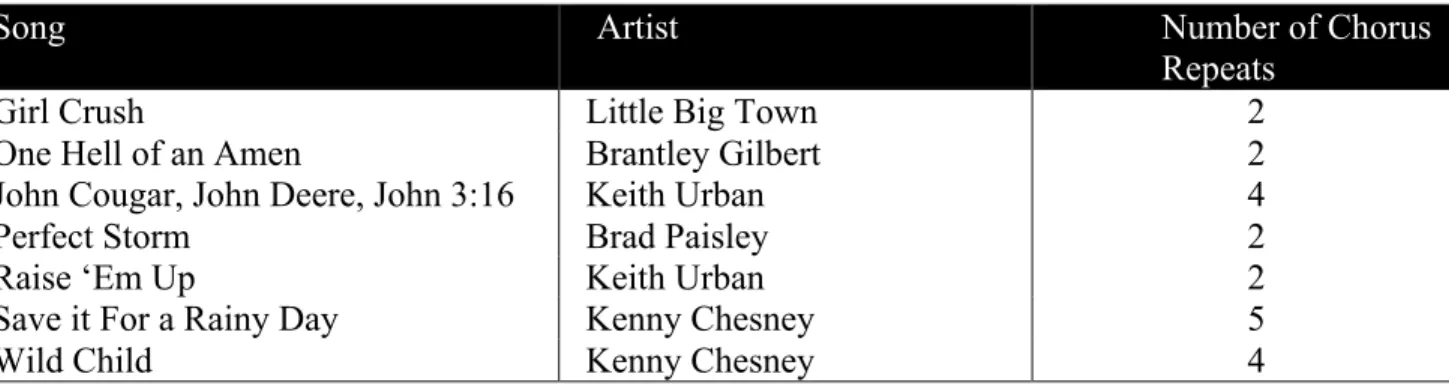
commonly had three iterations of the chorus. Table 1.1 shows the songs that had variations from this standard, namely two, four, or five iterations of the chorus. It is worth noting that fully sixty of the sixty-seven songs analyzed in this project held to the more formulaic approach of three choruses. That means that listeners are entirely acclimated to expect three iterations of a chorus in a song.
Table 1.1. Variations in the Number of Iterations of the Chorus
Song Artist Number of Chorus
Repeats
Girl Crush Little Big Town 2
One Hell of an Amen Brantley Gilbert 2
John Cougar, John Deere, John 3:16 Keith Urban 4
Perfect Storm Brad Paisley 2
Raise ‘Em Up Keith Urban 2
Save it For a Rainy Day Kenny Chesney 5
Wild Child Kenny Chesney 4
the chorus. The harmonies are typically pre-dominant to dominant chord progressions, ending in a half cadence and functioning to prepare for the chorus. In theorist Jay Summach’s analyses of the top-20 rock songs from 1955-1989, he found that the use of a pre-chorus had changed over time, but when used, it provided an increase in momentum through changing harmonic
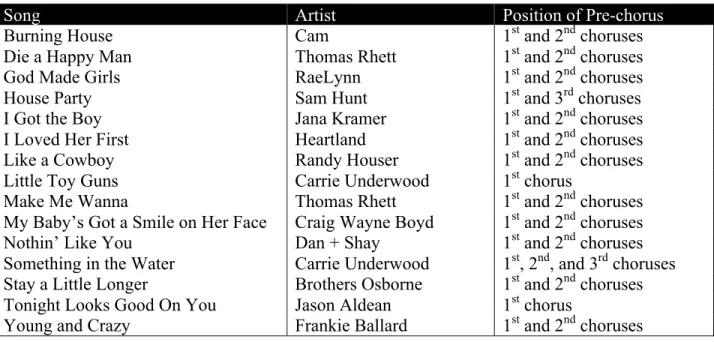
progression, harmonic rhythm, instrumentation, and lyric phrasing.15 Within the corpus of this project, only fifteen songs of the sixty-seven analyzed had a pre-chorus, suggesting that it is currently out of fashion within country song form.16 Table 1.2 lists the songs analyzed that had a pre-chorus.
Table 1.2. Songs Having a Pre-chorus Section
Song Artist Position of Pre-chorus
Burning House Cam 1st and 2nd choruses
Die a Happy Man Thomas Rhett 1st and 2nd choruses
God Made Girls RaeLynn 1st and 2nd choruses
House Party Sam Hunt 1st and 3rd choruses
I Got the Boy Jana Kramer 1st and 2nd choruses
I Loved Her First Heartland 1st and 2nd choruses
Like a Cowboy Randy Houser 1st and 2nd choruses
Little Toy Guns Carrie Underwood 1st chorus
Make Me Wanna Thomas Rhett 1st and 2nd choruses
My Baby’s Got a Smile on Her Face Craig Wayne Boyd 1st and 2nd choruses
Nothin’ Like You Dan + Shay 1st and 2nd choruses
Something in the Water Carrie Underwood 1st, 2nd, and 3rd choruses Stay a Little Longer Brothers Osborne 1st and 2nd choruses Tonight Looks Good On You Jason Aldean 1st chorus
Young and Crazy Frankie Ballard 1st and 2nd choruses
As indicated in Table 1.2, songs varied in having one, two, or three iterations of the pre-chorus. Example 1.2 shows one of the songs with a pre-chorus, Thomas Rhett’s “Die a Happy Man.”
The pre-chorus is 8 bars, begins on a predominant chord, and ends harmonically open on a dominant chord in the second phrase. An acoustic steel string guitar is added to the first electric guitar and begins playing lightly to add texture to this section. In another case, Jason Aldean’s, “Tonight Looks Good On You,” (Example 1.3) includes a four-bar pre-chorus that begins on the subdominant chord and ends on the dominant chord in a half cadence. A change in
instrumentation, which adds another electric guitar and a cymbal hit signals the beginning of the pre-chorus. In both of these instances, the harmonic progression of the verse does not end on a dominant chord, so the pre-chorus provides a moment of tonal orientation and a crucial half-cadence that builds harmonic tension for the arrival of the chorus.
Example 1.2 Thomas Rhett’s “Die a Happy Man” Highlighting the Pre-chorus
Note: A box around a chord indicates the place where the chorus’s vocal melody cadences.
Time Form Chord Progression
0:11 Verse 1 D Bm G D
D Bm G D D Bm G D D Bm G D
1 6- 4 1 1 6- 4 1 1 6- 4 1 1 6- 4 1
0:34 Pre-chorus 1 Em D/F# G D
Em D/F# G A 2- 1/3 4 1 2- 1/3 4 5
0:47 Chorus Bm Bm G D
Bm Bm G D Bm Bm G D Bm Bm G D
Example 1.3 Jason’s Aldean’s “Tonight Looks Good On You” Highlighting the Pre-chorus
Note: A box around a chord indicates the place where the chorus’s vocal melody cadences. The default notation in the Nashville Number System is one chord per bar, and either duple or quadruple meter; where more than one chord occurs per bar, the spacing on the page makes clear that two chords occur within that unit of time. Where two chords occur in one bar, the notation system assumes that they divide the duration of the bar equally. The notation system uses dots— shown here as asterisks—above the chords to show how many beats each chord gets when the division is not equal. For instance, two chords in one bar, with three asterisks over the first and one over the second, would be played with three beats for the first chord and one beat for the second.
Time Form Chord Progression
0:11 Verse 1 *** * *** * F#m F#m E D D E *** *
F#m F#m E D D
*** * *** * 6- 6- 5 4 4 5 *** * 6- 6- 5 4 4 0:34 Pre-chorus 1 D E D E 4 5 4 5 Chorus 1 *** * *** *
F#m F#m E D D E *** * *** * F#m F#m E D D E!
*** * *** * 6- 6- 5 4 4 5 *** * *** * 6- 6- 5 4 4 5 !
1:14 Instrumental *** * F#m F#m E D E
*** * 6- 6- 5 4 5
band. Of the songs that have a pullback chorus, it usually occurs on the third chorus. An example of a song that utilizes the pullback chorus techniques is Chris Young’s “I’m Comin’ Over” at time 2:00 minutes. Right after the bridge, Chris Young begins the third chorus with his solo vocals and a light rhythmic electric guitar strum pattern. As the song approaches the second half of the third chorus, the drums are added to build overall texture. When the second half of the chorus’ lyrics begins, the full band has kicked in.
A third feature examined in the songs analyzed was the presence or absence of a bridge or like section. Forty-six of the sixty-seven songs analyzed (69%) had a bridge or bridge-like section. A bridge traditionally provides contrasting harmonies, a different melody, or lyrics that give a different perspective, point of view, or change in the narrative. Most of the bridge sections in the songs analyzed had chord progressions that were the same as the verse or chorus, which is a striking change from the way that bridges have been traditionally described. In these instances where the harmonic progression is not providing any sharp contrast, other musical features have risen in prominence as marking these sections as “bridges.” Some had new melody over the retained progression, and many had stripped down instrumentation that gave contrast to this section. It is worth noting that songs with a pullback chorus always had bridges with full texture and instrumentation, thereby saving the change in texture for the “pullback chorus” moment in the songs; see for example “Break Up With Him,” by Old Dominion and “Mean to Me” by Brett Eldredge. By contrast, songs that did not employ the pullback chorus, instead, typically used the bridge as the point of radical sonic change by stripping down the
verse, chorus, and bridge (Example 1.4). During the bridge, there is only an acoustic guitar strumming block chords in accompaniment to Carrie Underwood’s vocals for contrast. When the final chorus begins, full instrumentation is added back again to create a dense texture.
Example 1.4: Carrie Underwood’s “Smoke Break” Highlighting the Bridge with the Same Chords as Verse and Chorus
Note: A box around a chord indicates the place where the chorus’s vocal melody cadences.
Smoke Break
Time Form Chord Progression
1:00 Verse 2 F# E B F #
F# E B F#
1 7 4 1 1 7 4 1
1:23 Chorus 2 F# E B F#
F# E B F#
1 7 4 1 1 7 4 1 1:48 Instrumental F# E B F# 1 7 4 1
2:00 Bridge F# E B F# 1 7 4 1
Thomas Rhett’s “Crash and Burn” is an example of a song with a bridge that has the same chord progression as the verse and the second half of the chorus (Example 1.5). The bridge has stripped back instrumentation so that the musical texture is providing contrast where the chord progression is not, and, therefore, this song does not have a pullback chorus. An example of a song with different chords in the bridge section than the verse and chorus is Old Dominion’s “Break Up With Him” (Example 1.6). This song does not have stripped down instrumentation at the bridge, where the contrast is provided not by the texture but rather by the harmonic
Example 1.5: Song Form of Thomas Rhett’s “Crash and Burn” Highlighting the Bridge with the Same Chords as Verse and Chorus
Note: A box around a chord indicates the place where the chorus’s vocal melody cadences.
Time Form Chord Progression
1:07 Verse 2 E♭ Cm E♭ Cm E♭ Cm A♭ B♭ E♭ Cm E♭ Cm E♭ Cm A♭ B♭
1 6- 1 6- 1 6- 4 5 1 6- 1 6- 1 6- 4 5 1:36 Chorus 2 Cm E♭/B♭ A♭ B♭
Cm E♭/B♭ A♭ B♭ E♭ Cm E♭ Cm E♭ Cm A♭ B♭ E♭
6- 1/5 4 1 6- 1/5 4 5 1 6- 1 6- 1 6- 4 5 1 Bridge E♭ Cm E♭ Cm
E♭ Cm A♭ B♭
1 6- 1 6- 1 6- 4 5
Example 1.6: Song Form of Old Dominion’s “Break Up With Him” Highlighting the Bridge with Contrasting Chords
Note: A box around a chord indicates the place where the chorus’s vocal melody cadences.
Time Form Chord Progression
1:17 Verse 2 E♭ Cm A♭ E♭
E♭ Cm A♭ E♭ E♭ Cm A♭ E♭ E♭ Cm A♭ E♭
1 6- 4 1 1 6- 4 1 1 6- 4 1 1 6- 4 1 1:41 Chorus 2 E♭ Cm A♭ E♭
E♭ Cm A♭ E♭ E♭ Cm A♭ E♭ E♭ Cm A♭ E♭
1 6- 4 1 1 6- 4 1 1 6- 4 1 1 6- 4 1
2:10 Instrumental E♭ Cm A♭ E♭
E♭ Cm A♭ E♭
1 6- 4 1 1 6- 4 1
2:23 Bridge B♭ B♭ A♭ A♭
B♭ B♭ A♭ A♭
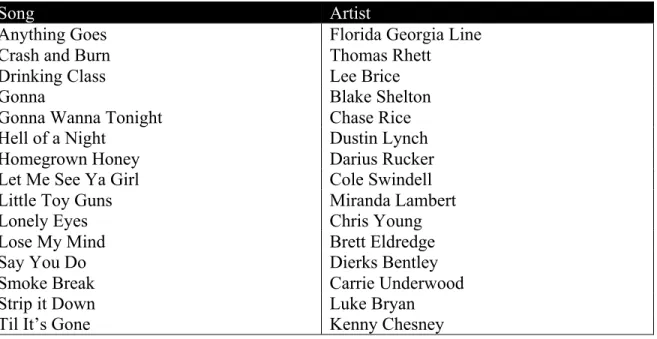
This discussion of the use of bridges and changes in texture highlights the way that significant changes in musical texture stand out in a song. Songwriters and arrangers are limiting themselves to only one of these points of textural contrast in a song, which therefore affects the relationship between bridges and choruses, and how contrast is controlled and balanced within the song’s domains of harmony and texture. In summary, songs tend to have either a pullback chorus or a texturally thin bridge, but not both, and the similarity or difference between the bridge and the verse and chorus’s chord progression determines whether the contrast in the bridge has to be created texturally or not. A list of songs that have stripped down instrumentation in the bridge with a full chorus are listed in Table 1.3.
Table 1.3. Songs with Stripped Down Instrumentation in the Bridge and Full Chorus
Song Artist
Anything Goes Florida Georgia Line
Crash and Burn Thomas Rhett
Drinking Class Lee Brice
Gonna Blake Shelton
Gonna Wanna Tonight Chase Rice
Hell of a Night Dustin Lynch
Homegrown Honey Darius Rucker
Let Me See Ya Girl Cole Swindell
Little Toy Guns Miranda Lambert
Lonely Eyes Chris Young
Lose My Mind Brett Eldredge
Say You Do Dierks Bentley
Smoke Break Carrie Underwood
Strip it Down Luke Bryan
Til It’s Gone Kenny Chesney
and could make the song more interesting.17 However, adding a bridge should not make the song too long since it needs to be around two and a half minutes for the radio. Although the majority of today’s country songs have a bridge, a change in the conventional format from previous decades is that most bridges in the music considered in this study are the same harmonically as the verse and chorus. This creates an unusual situation in which there is a component of
continuity that runs throughout the song without changing, namely the cyclical chord progression. In the absence of a changing chord progression, the writers and arrangers must delve more
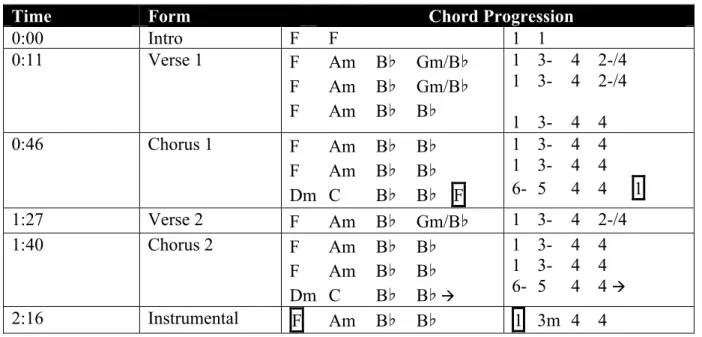
deeply into the other elements to create a sense of contrast and differentiation in the bridge. A fourth common feature among the top country songs in 2015 is the abridgement of the second verse. Many songs have a second verse either cut in half or with only one line of the chord progression in comparison to the first verse, bringing the song back to the chorus more quickly. An example of a song with a shortened second verse is Blake Shelton’s “Lonely Tonight” (Example 1.7).
Example 1.7: Blake Shelton’s “Lonely Tonight” Highlighting Abridgement of the Second Verse
Note: A box around a chord indicates the place where the chorus’s vocal melody cadences.
Time Form Chord Progression
0:00 Intro F F 1 1
0:11 Verse 1 F Am B♭ Gm/B♭
F Am B♭ Gm/B♭ F Am B♭ B♭
1 3- 4 2-/4 1 3- 4 2-/4 1 3- 4 4
0:46 Chorus 1 F Am B♭ B♭
F Am B♭ B♭ Dm C B♭ B♭ F
1 3- 4 4 1 3- 4 4 6- 5 4 4 1 1:27 Verse 2 F Am B♭ Gm/B♭ 1 3- 4 2-/4
1:40 Chorus 2 F Am B♭ B♭
F Am B♭ B♭ Dm C B♭ B♭ !
1 3- 4 4 1 3- 4 4 6- 5 4 4 ! 2:16 Instrumental F Am B♭ B♭ 1 3m 4 4
Songs with an abridged second verse are listed in Table 1.4.
Table 1.4. Songs with Abridgement of the Second Verse
Song Artist
Ain’t Worth the Whiskey Cole Swindell
Break Up in a Small Town Sam Hunt
Gonna Wanna Tonight Chase Rice
Home Alone Tonight Luke Bryan
Homegrown Honey Darius Rucker
Lonely Tonight Blake Shelton
Loving You Easy Zac Brown Band
Nothin’ Like you Dan + Shay
Sangria Blake Shelton
Strip It Down Luke Bryan
Wild Child Kenny Chesney
“story songs” from past decades is still present, but is not as much a part of the musical genre’s profile today, illustrating a significant change in how country music communicates and connects with its audiences.
The final feature seen in the majority of the songs analyzed are instrumental sections immediately following each chorus. These sections are often called turnarounds and frequently employ the same chord progression as the intro. They function as a transition leading into the next section. The instrumental section following the first chorus is often one or two lines of a chord progression and sometimes a simple solo, frequently guitar. The second instrumental section after the second chorus is often a more virtuosic solo, frequently guitar. A prime example that illustrates this form is Luke Bryan’s “I See You,” shown in Example 1.1 at the beginning of this chapter.
CHAPTER 2: HARMONIES
Several in-depth studies of the harmonic patterns in popular songs come from earlier studies of rock songs, from 1950 to 2000, rather than country songs. In an earlier analysis of two periods of pop-rock music from 1957-58 and 1999-2000, the majority of rock songs were tonal; however, they frequently contained elements of the medieval modes and the minor pentatonic scale.18 In a second study, looking at rock music from the 1960s to 1990s, harmonic analyses showed that many rock songs do not fit into a conventional tonality of a particular major or minor key. Rock music often contained tonal, modal, and blues elements that lacked a leading tone.19 In a third study, analyzing 100 songs from the top-20 during the 1950s through the 1990s, rock songs had a mix of major and minor key elements, as well as modal elements and frequent repeating harmonic structures.20 In the 2015 country songs analyzed in this study, four primary characteristics are described as they relate to harmonic progressions of modern country songs. These features include first, the use of a double-tonic complex in many songs; second, the absence of a 5 chord; third, the use of the same chord progression throughout the verse and chorus; and fourth, the use of only two chords in the song.
18 Walter Everett, “Making Sense of Rock's Tonal Systems.” Music Theory Online. 10.4 (2004): 3-6. <http://www.mtosmt.org/issues/mto.04.10.4/mto.04.10.4.w_everett.html>; Everett, Foundations of Rock, 247.
The first feature described in the present study of 2015 country songs is the use of the 6 minor chord in songs that make use of a double-tonic complex, where the tonality of the song seems to identify with two keys.21 Country music’s harmonic language used to be characterized as diatonic, with clearly established tonic identity. However, appropriation of rock harmonic language, most notably its modal elements, can be heard in many of the chart topping country songs today. Many of the songs analyzed here are mixing elements of major and minor keys, as seen in rock music.22 The distinction between the major key and its relative minor are becoming blurred as the songs enter into a modal space. Jason Aldean’s song, “Just Gettin’ Started,” (Example 2.1) illustrates a pitch collection centering around the 6 minor chord that uses 1 and 5 chords in prominent positions, but without a sense of dominant-tonic resolution.
Example 2.1: Jason Aldean’s “Just Gettin’ Started” Harmonic Transcription Highlighting the Double-Tonic Complex
Note: A box around a chord indicates the place where the chorus’s vocal melody cadences.
Time Form Chord Progression
0:00 Intro Am C F Dm
Am C F Dm Am C F Dm Am C F G
6- 1 4 2- 6- 1 4 2- 6- 1 4 2- 6- 1 4 5
0:22 Verse 1 Am Am F Dm
Am Am F G Am Am F Dm Am Am F G
6- 6- 4 2- 6- 6- 4 5 6- 6- 4 2- 6- 6- 4 5
0:44 Chorus 1 Am C F Dm
Am C F G Am C F Dm Am Am G G !
6- 1 4 2- 6- 1 4 5 6- 1 4 2- 6- 6- 5 5 !
1:08 Instrumental Am C F Dm
Am C F G
6- 1 4 2- 6- 1 4 5
1:20 Verse 2 Am Am F Dm
Am Am F G Am Am F Dm Am Am F G
6- 6- 4 2- 6- 6- 4 5 6- 6- 4 2- 6- 6- 4 5
1:42 Chorus 2 Am C F Dm
Am C F G Am C F Dm Am Am G G !
6- 1 4 2- 6- 1 4 5 6- 1 4 2- 6- 6- 5 5 !
2:05 Instrumental Am C F Dm
Am C F G
6- 1 4 2- 6- 1 4 5
2:18 Bridge F F G G
F F G G 4 4 5 5 4 4 5 5
2:31 Chorus 3 Am C F Dm
Am C F G Am C F Dm Am Am G G !
6- 1 4 2- 6- 1 4 5 6- 1 4 2- 6- 6- 5 5 !
2:54 Outro Am C F Dm
Am C F G Am
The effect is one of bitonality with the 6m (Am) structurally serving as tonic (meaning a point of arrival), but the chord progression referencing 1 (C) as the tonic. The pitches linger in a modal space without a defined leading tone and no “5-1” resolution in Am or C. Instead, the dominant chord (G) continuously resolves deceptively back to 6m (Am), so that the motion becomes the stable structure in the piece, “deceptive” becoming normative. The two competing ideas of pitch organization have been documented in rock from the classic rock era of the 1950s to the present. Songs in the present study that employ this double-tonic complex are listed in Table 2.1.
Table 2.1. Songs That Employ the Double-Tonic Complex
Song Artist
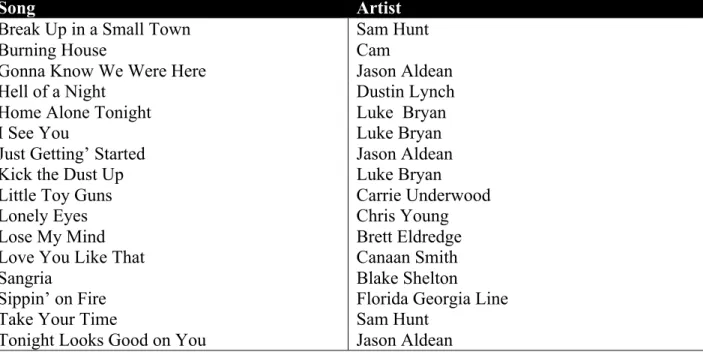
Break Up in a Small Town Sam Hunt
Burning House Cam
Gonna Know We Were Here Jason Aldean
Hell of a Night Dustin Lynch
Home Alone Tonight Luke Bryan
I See You Luke Bryan
Just Getting’ Started Jason Aldean
Kick the Dust Up Luke Bryan
Little Toy Guns Carrie Underwood
Lonely Eyes Chris Young
Lose My Mind Brett Eldredge
Love You Like That Canaan Smith
Sangria Blake Shelton
Sippin’ on Fire Florida Georgia Line
Take Your Time Sam Hunt
Tonight Looks Good on You Jason Aldean
The second prominent feature in the country songs analyzed here is the absence of a dominant chord in a major key. This is also a harmonic practice that has been documented in pop-rock music.23 This lack of a 5 chord creates a sense of the modal ambiguity, where there is a collection of chords without the orienting presence of tonic-dominant cadences. An example of a song that lacks the 5 chord is Luke Bryan’s “Strip It Down” (Example 2.2).
Example 2.2: Luke Bryan’s “Strip It Down” Harmonic Transcription Highlighting the Absence of the 5 Chord
Note: A box around a chord indicates the place where the chorus’s vocal melody cadences.
Time Form Chord Progression
0:00 Intro Bm D A A 2- 4 1 1
0:14 Verse 1 Bm D A A
Bm D A A
2- 4 1 1 2- 4 1 1
0:41 Chorus 1 Bm D A A
Bm D A A Bm D A A
2- 4 1 1 2- 4 1 1 2- 4 1 1 1:22 Instrumental Bm D A A 2- 4 1 1
1:37 Chorus 2 Bm D A A
Bm D A A Bm D A A
2- 4 1 1 2- 4 1 1 2- 4 1 1 2:20 Instrumental Bm D A A 2- 4 1 1
2:33 Bridge Bm D A A 2- 4 1 1
2:47 Chorus 3 Bm D A A
Bm D A A Bm D A A
2- 4 1 1 2- 4 1 1 2- 4 1 1
3:28 Outro Bm D A A
Bm D A A
2- 4 1 1 2- 4 1 1
degrees 1, 3, and 5, confirms this reference point. Songs that do not have a 5 chord anywhere are listed in Table 2.2a, and those with a 5 chord only in the bridge section are shown in Table 2.2b.
Table 2.2a. Songs Without a 5 Chord
Song Artist
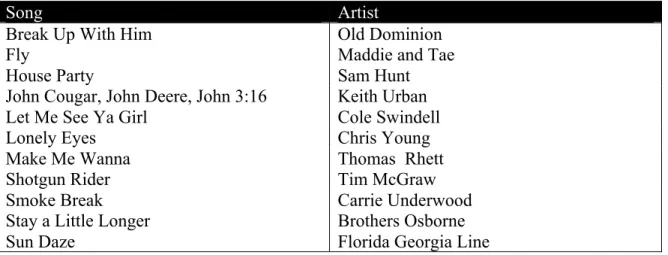
Anything Goes Florida Georgia Line
Fly Maddie and Tae
Gonna Blake Shelton
House Party Sam Hunt
Kiss You in the Morning Michael Ray
Like a Cowboy Randy Houser
Say You Do Dierks Bentley
Shotgun Rider Tim McGraw
Smoke A Thousand Horses
Smoke Break Carrie Underwood
Stay a Little Longer Brothers Osborne
Strip it Down Luke Bryan
Sun Daze Florida Georgia Line
Tennessee Whiskey Chris Stapleton
Til it’s Gone Kenny Chesney
Table 2.2b. Songs with a 5 Chord Only in the Bridge
Song Artist
Break Up With Him Old Dominion
Fly Maddie and Tae
Lonely Eyes Chris Young
Take your Time Sam Hunt
Example 2.3: Old Dominion’s “Break Up With Him” Harmonic Transcription Highlighting the Presence of the 5 Chord Only in the Bridge
Note: Parenthetical chords are those implied by context, but not realized harmonically, and are usually under a single unaccompanied vocal note.
Time Form Chord Progression
0:00 Intro E♭ Cm A♭ E♭
E♭ Cm A♭ E♭
1 6- 4 1 1 6- 4 1
0:14 Verse 1 E♭ Cm A♭ E♭
E♭ Cm A♭ E♭ E♭ Cm A♭ E♭ E♭ Cm A♭ E♭
1 6- 4 1 1 6- 4 1 1 6- 4 1 1 6- 4 1
0:37 Chorus 1 E♭ Cm A♭ E♭
E♭ Cm A♭ E♭ E♭ Cm A♭ E♭ E♭ Cm A♭ (E♭)
1 6- 4 1 1 6- 4 1 1 6- 4 1 1 6- 4 (1) 1:04 Instrumental E♭ Cm A♭ E♭
E♭ Cm A♭ E♭
1 6- 4 1 1 6- 4 1 1:17 Verse 2 E♭ Cm A♭ E♭
E♭ Cm A♭ E♭ E♭ Cm A♭ E♭ E♭ Cm A♭ E♭
1 6- 4 1 1 6- 4 1 1 6- 4 1 1 6- 4 1
1:41 Chorus 2 E♭ Cm A♭ E♭
E♭ Cm A♭ E♭ E♭ Cm A♭ E♭
E♭ Cm A♭ (E♭) A♭ (E♭)
1 6- 4 1 1 6- 4 1 1 6- 4 1
1 6- 4 (1) 4 (1)
2:10 Instrumental E♭ Cm A♭ E♭ E♭ Cm A♭ E♭
1 6- 4 1 1 6- 4 1 2:23 Bridge B♭ B♭ A♭ A♭
B♭ B♭ A♭ A♭
5 5 4 4 5 5 4 4
harmonically closed, to use the 5-1 cadence.24 Marc Beeson commented that it helps to keep the tension up by avoiding the 5 chord at least until the end of the chorus.25 These comments show the deliberate harmonic crafting that is considered by top songwriters.
A third feature of many of the 2015 top country songs is the use of the same chord
progression repeated in different sections of the song, specifically across the verse and chorus. In these instances where the harmonic progression does not contribute to sectional differentiation, other musical parameters are engaged in creating a sense of contrast and variation, namely textural changes and shifts in instrumentation. Differences in texture through the choice of different or additional instruments and backup vocals, as well as how they are used, can create contrast and variety between the verse and chorus. Country music songwriters have confirmed that it is popular to use the same chords in the verse and chorus, but the writers give contrast between the verse and chorus in some way, such as using punchy, phrase driven verses, and long-sustained choruses, or vice versa.26
Example 2.4 shows a song that employs the same chord progression throughout the song, Chris Stapleton’s “Tennessee Whiskey.”
Example 2.4: Chris Stapleton’s “Tennessee Whiskey” Harmonic Transcription Highlighting the Use of the Same Chords in Verse and Chorus
Note: A box around a chord indicates the place where the chorus’s vocal melody cadences.
Time Form Chord Progression
0:20 Verse 1 A Bm/D Bm/D A
A Bm/D Bm/D A
1 2-/4 2-/4 1 1 2-/4 2-/4 1
0:57 Chorus 1 A Bm/D Bm/D A
A Bm/D Bm/D A
1 2-/4 2-/4 1 1 2-/4 2-/4 1
In this song, the verse instrumentation consists of rhythm acoustic guitar, electric base, rim shots and high hats on the drums, and lead vocals by Chris Stapleton. The chorus has added instrumentation that includes an electric guitar in addition to the rhythmic acoustic guitar, a cymbal hit at the beginning, full snare hits instead of rim shots on the drums, and the addition of back up vocal harmony.
The song “Tennessee Whiskey” has an unusual history leading up to its arrival on the 2015 Billboard charts. It was written in 1981 by Dean Dillon and Linda Hargrove and recorded by David Allan Coe. It appeared on the Billboard charts at number 77 in that year. A cover was recorded in 1983 by George Jones on his album “Shine On” and reached number 2 on the
2015 country songs. This is a simultaneously derivative trend and one that is following contemporary “fresh” trends.
Songs with the same chord progression throughout the entire song are listed in Table 2.3a. A second example of a song with the same chord progression is Luke Bryan’s “Strip it Down” in Example 2.2 (shown earlier in Chapter 2). Luke Bryan’s “Strip it Down,” already used (Example 2.2) to show a song that eschews the dominant, is another song that cycles the same progression throughout it’s formal sections. Songs with the same harmonic progression in the verse and chorus, but different chords in the bridge are listed in Table 2.3b.
Table 2.3a. Songs with the Same Chord Progression Throughout the Song
Song Artist
Don’t It Billy Currington
Gonna Blake Shelton
Kiss You in the Morning Michael Ray
Strip it Down Luke Bryan
Tennessee Whiskey Chris Stapleton
Table 2.3b. Songs with the Same Harmonic Progression in the Verse and Chorus
Song Artist
Break Up With Him Old Dominion
Fly Maddie and Tae
House Party Sam Hunt
John Cougar, John Deere, John 3:16 Keith Urban
Let Me See Ya Girl Cole Swindell
Lonely Eyes Chris Young
Make Me Wanna Thomas Rhett
Shotgun Rider Tim McGraw
Smoke Break Carrie Underwood
Stay a Little Longer Brothers Osborne
Similar to the compositional approach of keeping the chord progression the same from one song section to the next, an alternative strategy is to introduce slight variations in
Example 2.5. Tim McGraw’s “Shotgun Rider” Harmonic Transcription Highlighting the Use of the Same Chords in Verse and Chorus
Note: The two asterisks over the chord are the typescript equivalent of two dots in the Nashville number system, indicating that this chord occupies a measure of only two beats instead of four. A box around a chord indicates the place where the chorus’s vocal melody cadences.
Time Form Chord Progression
0:00 Intro G Bm Em C
G Bm Em C
1 3- 6- 4 1 3- 6- 4
0:23 Verse 1 G Bm Em C
** G Bm Em C C
1 3- 6- 4 ** 1 3- 6- 4 4
0:47 Chorus 1 G Bm/D Em C
G Bm/D Em C C C!
1 3-/5 6- 4
1 3-/5 6- 4 4 4 !
1:15 Instrumental G Bm Em C 1 3- 6- 4
1:27 Verse 2 G Bm Em C
** G Bm Em C C
1 3- 6- 4 ** 1 3- 6- 4 4 1:51 Chorus 2 G Bm/D Em C
G Bm/D Em C C C!
1 3-/5 6- 4
1 3-/5 6- 4 4 4 !
2:20 Instrumental G Bm Em C G Bm Em C C
1 3- 6- 4 1 3- 6- 4 4 2:45 Chorus 3 G Bm/D Em C
G Bm/D Em C C C!
1 3-/5 6- 4
1 3-/5 6- 4 4 4!
3:26 Outro G Bm Em C
G Bm Em C G Bm Em C
1 3- 6- 4 1 3- 6- 4 1 3- 6- 4
Table 2.4. Songs that Have Only Two Chords
Song Artist
Anything Goes Florida Georgia Line
Gonna Wanna Tonight Chase Rice
Kiss You in the Morning Michael Ray
Like a Cowboy Randy Houser
Make Me Wanna Thomas Rhett
Some of these songs may have slight variations from the two chords, such as the addition of an extra one or two chords in one of the verses, choruses, or in the bridge. An example of a song that has only two chords is Michael Ray’s “Kiss You in the Morning.” The 1 and 4 chords alternate 4-beat measures consistently throughout the entire song (Example 2.6).
Example 2.6. Michael Ray’s “Kiss You in the Morning” Harmonic Transcription Highlighting the Use of Two Chords in the Verse and Chorus
Note: A box around a chord indicates the place where the chorus’s vocal melody cadences.
Time Form Chord Progression
0:13 Verse 1 F# B
F# B F# B
1 4 1 4 1 4
0:33 Chorus 1 F# B
F# B F# B F# B !
1 4 1 4 1 4 1 4 !
0:58 Instrumental F# B
F# B
1 4 1 4
cadence of the chorus fall on a hypermetric downbeat and overlap with the start of the
instrumental section. As such, the chorus’s cadence is 4-1 (B ! F#) plagal motion that gives a
sense of closure in the songs that use the 1-4 motion in place of a 1-5 motion.
In summary, the distinctive harmonic features observed in the sixty-seven country songs analyzed include a double-tonic complex, the absence of a 5 chord and a dominant-tonic
CHAPTER 3: LYRICS
From its beginnings, country music has incorporated traditional values, practices, and social relationships. The song lyrics typically describe rural settings and lifestyles, and refer to concepts dealing with family, religion, patriotism, work, and romance.27 In the sixty-seven 2015 songs analyzed, the lyrical themes and vocabulary were consistent with those traditionally seen in country songs. In the present study, 82% of the song themes involved heterosexual romantic love and attraction, heartache, and good times and partying. Other themes observed were Christian faith and inspiration, nostalgia, and the centrality of work in one’s life. The common vocabulary included words that supported these themes, described country settings and events, and reflected a conversational or, less frequently, a storytelling tone. In the present sample of 2015 songs, some specific contemporary features that had been less commonly observed in past years are internal rhyme at the syllable level, vocabulary that reflects the current time period, and a lyric delivery that includes spoken sections, rather than sung sections.
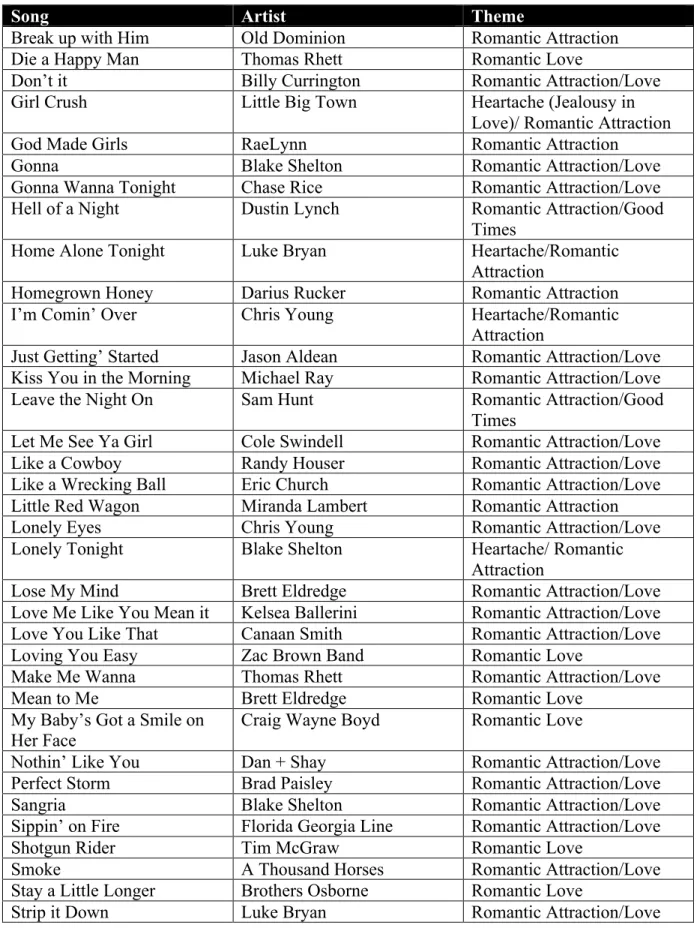
songs in 2009 and 28% in 2010, according to published studies.28 Of the present sixty-seven songs analyzed, 40 (60%) of the top-ten 2015 country songs were about romantic love and attraction (including sexual attraction), and an additional 13 (19%) were about love and
heartache, including topics of break-ups, missing someone, jealousy in a romantic relationship, and moving on from a break-up (Tables 3.1a and 3.1b; many songs have overlapping themes as indicated). The majority of these songs involve the artist as the lover in a first-person point of view, using the personal pronouns “I” and “we,” and singing to a person referred to with the second-person pronoun “you.” This approach gives a personal, intimate feeling to the song and results in an emotional closeness between the listener and the artist.
Table 3.1a: Songs with the Theme of Romantic Love and Attraction
Song Artist Theme
Break up with Him Old Dominion Romantic Attraction
Die a Happy Man Thomas Rhett Romantic Love
Don’t it Billy Currington Romantic Attraction/Love
Girl Crush Little Big Town Heartache (Jealousy in
Love)/ Romantic Attraction
God Made Girls RaeLynn Romantic Attraction
Gonna Blake Shelton Romantic Attraction/Love
Gonna Wanna Tonight Chase Rice Romantic Attraction/Love
Hell of a Night Dustin Lynch Romantic Attraction/Good
Times
Home Alone Tonight Luke Bryan Heartache/Romantic
Attraction
Homegrown Honey Darius Rucker Romantic Attraction
I’m Comin’ Over Chris Young Heartache/Romantic
Attraction
Just Getting’ Started Jason Aldean Romantic Attraction/Love Kiss You in the Morning Michael Ray Romantic Attraction/Love
Leave the Night On Sam Hunt Romantic Attraction/Good
Times
Let Me See Ya Girl Cole Swindell Romantic Attraction/Love
Like a Cowboy Randy Houser Romantic Attraction/Love
Like a Wrecking Ball Eric Church Romantic Attraction/Love Little Red Wagon Miranda Lambert Romantic Attraction
Lonely Eyes Chris Young Romantic Attraction/Love
Lonely Tonight Blake Shelton Heartache/ Romantic
Attraction
Lose My Mind Brett Eldredge Romantic Attraction/Love
Love Me Like You Mean it Kelsea Ballerini Romantic Attraction/Love Love You Like That Canaan Smith Romantic Attraction/Love
Loving You Easy Zac Brown Band Romantic Love
Make Me Wanna Thomas Rhett Romantic Attraction/Love
Mean to Me Brett Eldredge Romantic Love
My Baby’s Got a Smile on Her Face
Craig Wayne Boyd Romantic Love
Nothin’ Like You Dan + Shay Romantic Attraction/Love
Perfect Storm Brad Paisley Romantic Attraction/Love
Sangria Blake Shelton Romantic Attraction/Love
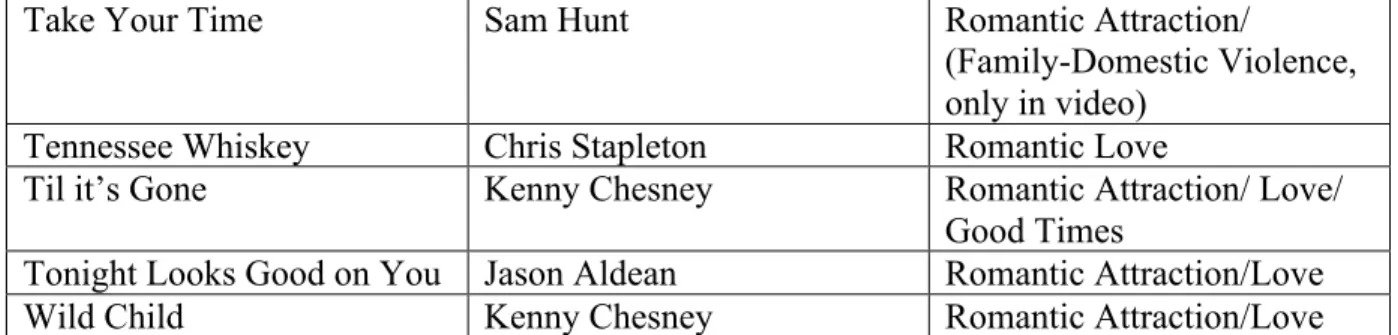
Take Your Time Sam Hunt Romantic Attraction/
(Family-Domestic Violence, only in video)
Tennessee Whiskey Chris Stapleton Romantic Love
Til it’s Gone Kenny Chesney Romantic Attraction/ Love/ Good Times
Tonight Looks Good on You Jason Aldean Romantic Attraction/Love
Wild Child Kenny Chesney Romantic Attraction/Love
Table 3.1b: Songs with the Theme of Heartache in Love
Song Artist Theme
A Guy Walks Into a Bar Tyler Farr Heartache
Ain’t Worth the Whiskey Cole Swindell Heartache (Moving on from a Break-up)/Patriotism
Break Up in a Small Town Sam Hunt Heartache
Burning House Cam Heartache
Crash and Burn Thomas Rhett Heartache
Girl Crush Little Big Town Heartache (Jealousy in
Love)/Romantic Attraction
Home Alone Tonight Luke Bryan Heartache/Romantic
Attraction
I Got the Boy Jana Kramer Nostalgia/Heartache
I See You Luke Bryan Heartache
I’m Comin’ Over Chris Young Heartache/Romantic
Attraction
Lonely Tonight Blake Shelton Heartache/Romantic
Attraction
Save it for a Rainy Day Kenny Chesney Heartache (Moving on from a Break-up)
Say You Do Dierks Bentley Heartache
theme was not clear from the lyrics alone and relied upon the video to highlight this point. In the video, Sam Hunt observes a woman being mistreated. When she attempts to leave her abusive partner, Sam Hunt fights the partner while the woman drives away in her truck. From listening to the lyrics of this song, it is unlikely that one would picture these circumstances from the words alone. This choice of theme for the video departs from the typical themes observed in country music songs, as well as, the lyrics of its own song. Carrie Underwood’s “Little Toy Guns” is the only other song in the present study that had domestic violence as its subject.
Table 3.1c: Songs with the Theme of Good Times and Partying
Song Artist Theme
Anything Goes Florida Georgia Line Good Times and Partying Gonna Know We Were Here Jason Aldean Good Times and Partying
Hell of a Night Dustin Lynch Romantic Attraction/
Love/Good Times
House Party Sam Hunt Good Times and Partying
Kick the Dust Up Luke Bryan Good Time and Partying
Leave the Night On Sam Hunt Romantic Attraction/
Love/Good Times
Let Me See Ya Girl Cole Swindell Romantic Attraction/Love/ Good Times
Sun Daze Florida Georgia Line Good Times and Partying
Til it’s Gone Kenny Chesney Romantic Attraction/Love/
Good Times
Young and Crazy Frankie Ballard Good Times and Partying
Table 3.1d: Songs with the Themes of Nostalgia, Home, and Family
Song Artist Theme
Homegrown Zac Brown Band Home (Contentment)
I Got the Boy Jana Kramer Nostalgia/Heartache
I Loved Her First Heartland Family (Love of Family)
John Cougar, John Deere,
Another three songs were about the working class with one of these specifically concerned with consumerism and money (Table 3.1e).
Table 3.1e: Songs with the Theme of the Working Class
Song Artist Theme
Buy Me a Boat Chris Janson Working Class
(Consumerism, Money)
Drinking Class Lee Brice Working Class/Good Times
Smoke Break Carrie Underwood Working Class/Religion
The theme of Christian religion or faith has been central to this genre.29 References to this theme appeared in six songs, some of which overlapped with the two themes of nostalgia and the working class, and four of the songs had inspirational messages, including religious messages (Table 3.1f). Three songs had references to patriotism or love of country, which has commonly been seen in country songs and in the present study overlaps with themes of heartache (Tables 3.1b) and religion and inspiration (Table 3.1f).
Table 3.1f: Songs with the Themes of Religion and Inspiration
Song Artist Theme
Fly Maddie and Tae Inspiration
John Cougar, John Deere,
John 3:16 Keith Urban Nostalgia/Religion
One Hell of an Amen Brantley Gilbert Religion and Inspiration/ Patriotism
Raise ‘Em Up Keith Urban Religion and Inspiration/
Home/Patriotism
Smoke Break Carrie Underwood Working Class/Religion
Something in the Water Carrie Underwood Religion and Inspiration
The sixty-seven songs analyzed frequently overlap in themes and are shown according to their highest chart position in Appendix 3. There is not a correlation between a song’s highest chart position and its theme.
The specific ways in which these themes appear in the lyrics are embedded in the traditions of country songwriting that rely on images and associations linked to working-class identity. An example of this approach is found in Thomas Rhett’s “Die a Happy Man” (Example 3.1), which is primarily an expression of romantic love.
Example 3.1: Thomas Rhett’s “Die a Happy Man” Highlighting the Theme of Romantic Love
Baby that red dress brings me to my knees Oh but that black dress makes it hard to breathe
You’re a saint, you’re a goddess, the cutest, the hottest, a masterpiece It’s too good to be true, nothing better than you
In my wildest dreams
And I know that I can’t ever tell you enough That all I need in this life is your crazy love
If I never get to see the Northern Lights Or if I never get to see the Eiffel Tower at night
Or if all I got is your hand in my hand Baby I would die a happy man yeah I don’t need no vacation, no fancy destination,
Baby you’re my great escape, We could stay at home, listen to the radio
Or dance around the fireplace
And if I never get to build my mansion in Georgia Or drive a sports car up the coast of California
purchase a mansion and sports car, but staying home is total satisfaction to him because of his partner’s love. This is part of a long country music tradition of valuing simple love over material wealth and travel to foreign countries. This narrative of love is reminiscent of the 1988 song by Randy Travis, “Deeper Than the Holler,” in which the singer proclaims his love to be “deeper than the holler, stronger than the river … and longer than the song of a whippoorwill.” This reworking of the narrative in a different time period and with different music creates continuity in the genre. Some specific features in the lyrics of “Die a Happy Man” include internal rhymes and assonance at the level of the syllable, such as “goddess/cutest/hottest,” which are a modern lyrical feature of rap influence.30
Thomas Rhett’s “Die a Happy Man” contrasts in values with Chris Janson’s “Buy Me a Boat” (Example 3.2). While Rhett’s song is about not needing a rich, cosmopolitan lifestyle, Janson’s song takes a different approach in fantasizing about a materialistic “good life.”
Example 3.2: Chris Janson’s “Buy Me a Boat” Verse and Chorus Highlighting the Theme of the Working Class
I ain’t rich, but I damn sure wanna be Working like a dog all day, ain’t working for me
I wish I had a rich uncle that’d kick the bucket And that I was sitting on a pile like Warren Buffett I know everybody says money can’t buy happiness But it could buy me a boat, it could buy me a truck to pull it, It could buy me a Yeti 110 iced down with some silver bullets
Yeah I know what they say, money can’t buy everything Well, maybe so,
But it could buy me a boat
These conflicting values are both common in today’s country music and represent modern influences. In viewing the videos for these two songs, Thomas Rhett is singing in a paradise and on a nice boat, but in the lyrics of his song, these things are not important to him because he only needs her “hand” in his “hand.” While Chris Janson wants a “pile” of money, the video is ironic because it shows him to have a modest fishing boat, a cooler of beer, and a truck to pull the boat.
Colloquial diction and nonstandard grammar are seen in these lyrics with the use of “ain’t” and “wanna,” while examples of clichés are seen in the phrases, “working like a dog,” “kick the bucket,” and “money can’t buy happiness.” Similes are also frequently used, such as “like a dog”
and “like Warren Buffett.” Colloquial diction, nonstandard grammar, clichés, similes, and metaphors are commonly used in country music.31
The themes of nostalgia for good times of the past and heartache are seen in Jana Kramer’s song, “I’ve Got the Boy” (Example 3.3).
Example 3.3: Jana Kramer’s “I’ve Got the Boy” Chorus Highlighting the Themes of Nostalgia and Heartache
I saw your picture in a paper, Honeymoon in Jamaica, she's a lucky girl
You look so grown up in your black tux, from a ball cap in a pick up, seems like another world You and me and our big dreams, falling in love
We were two kids in the backseat, all fearless and young
I got the first kiss and she'll get the last She's got the future, I got the past
This song is an example of the continuity of country music narratives over half a century.
It speaks to the theme of lost love and remembering the past with both tenderness and regret. The
lyrics parallel those of Patsy Cline in her 1962 song, “She’s Got You,” penned by songwriter
Hank Cochran. In a similar way, her lyrics tell the story of her love from the past where the
protagonist keeps the material objects and memories of the past romance, but the man has moved
on and left her alone with just the tokens: “I’ve got your class ring, that proved you care,” and
“I've got your picture, she's got you.” The two songs open respectively with “I saw your
picture…” (Kramer) and “I’ve got your picture…” (Cline). Those two parallel images, namely
the photograph and the class ring, forge an intertextual relationship between the two songs that
would be readily perceptible to the legions of country fans, who know Patsy Cline’s repertory.
The appearance of the same basic narrative and specific phrases in these two songs is just one of
many examples that shows the continuity within country music themes and narratives over more
than a half-century. In spite of all the changes that have occurred in the daily lives and social
fabric of the American working- and middle-class populations during that time, these particular
narratives still resonate in almost identical forms.
Controversy tends to surround songs within country music with lyrics that deviate into more liberal topics. For example, Little Big Town’s “Girl Crush” received criticism from some listeners who interpreted their lyrics to imply a lesbian attraction, and consequently wanted it removed from airplay.32 In an interview with The Washington Post, Karen Fairchild of Little Big Town clarified the meaning of their lyrics to be about jealousy from one woman to another over the love of a man.33 However, the idea of “I wanna taste her lips,” even if it is to taste the
unnamed “him” vicariously, is still a physical magnetism that complicates the way the song speaks about romance and crushes (Example 3.4).
Example 3.4: Little Big Town’s Girl Crush Highlighting the Theme of Heartache and Jealousy in Love
I wanna taste her lips, yeah, ‘cause they taste like you I wanna drown myself in a bottle of her perfume I want her long blonde hair, I want her magic touch Yeah, ‘cause maybe then you’d want me just as much
I got a girl crush, I got a girl crush
This song reached number 1 on the Billboard charts, indicating its popularity, even though some listeners were critical of its ambiguous lyrics.
The double meaning is similar to the lyrics in the song “Jolene,” released by Dolly Parton in 1973. Parton sang of being jealous because her man is with Jolene, and she obsessed over Jolene’s charm and beauty with the lyrics, “Your beauty is beyond compare/With flaming locks of auburn hair/With ivory skin and eyes of emerald green.” The way in which these songs, performed and presented with a woman as singer and protagonist, point to another woman’s beauty and desirability could be viewed as lesbian imagery, as has been explored by scholar Nadine Hubbs at length.34 If the lyrics of “Jolene” can be interpreted as lesbian imagery, then it would seem that the lyrics of “Girl Crush” could be interpreted similarly. While heteronormative relationships are consistent with the conservative nature of country music, some songwriters present lyrics that can imply multiple meanings and hint at other types of relationships.