Concerned Coalitions:
Informal Groups in the United States House of Representatives
By Collin M. Miller
Senior Honors Thesis Political Science
University of North Carolina at Chapel Hill
March 30th 2018
Approved:
________________________________ Dr. Sarah Treul-Roberts, Thesis Advisor Dr. Jason Roberts, Reader
Acknowledgments
The completion of this project would not have been possible without the significant contributions of many individuals, and their unwavering belief in the importance and value of, as well as my ability to complete, this endeavor. I would like to thank Congressman Mark
Meadows of North Carolina’s 11th Congressional District for providing invaluable insight on the critical role informal groups have on the legislative process in the United States House of
Representatives. In addition, I would like to acknowledge the dedicated staff of Congressman Meadows’ district office in Hendersonville, North Carolina, particularly Wayne King, Pamela Ward, Jenny Maybin, Clay McCreary, Kye Laughter, and Andrew West. It is while I was working as a staff assistant alongside these dedicated civil servants that I first became interested in pursuing research on the role of informal groups. Their support and insights have been crucial to this process.
Table of Contents
I. Introduction 1
Why Informal Groups? 1
Goals of Research 1
II. Literature Review 3
III. Theory & Hypotheses 8
Research Question k 8
Independent Variables 8
Representative Conditions 8
Representative Party 8
Representative Ideology 9
Representative Personal Interest 10
District Conditions 10
District Geographic Conditions 11
District Economic Conditions 12
District Demographic Conditions 13
Dependent Variable 13
Representative Informal Group Membership 13
Hypotheses 14
Hypothesis 1 14
Sub-Hypothesis 1a 14
Sub-Hypothesis 1b 15
Sub-Hypothesis 1c 16
Hypothesis 2 16
Hypothesis 3 17
Hypothesis 4 18
IV. Methods 19
Operationalization of Independent Variables 19
Representative Party 19
Representative Ideology 19
Representative Personal Interest 19
District Geographic Conditions 20
District Economic Conditions 20
District Demographic Conditions 21
Operationalization of Dependent Variable 21
Representative Informal Group Membership 21
Informal Group Classifications 23
Axiom 1 23
Axiom 2 24
Axiom 3 24
Challenges of Preliminary Data Collection Process 26
Adjustment of Initial Data Collection Process 26
“Full” vs. “Listed” Membership of the 115th House of Representatives 27
Nature of Informal Group Membership in The House of Representatives 29
Role of Party 30
Role of Ideology 31
Test Case: Congressional Progressive Caucus 32
Test Case: Bipartisan Pro-Life Caucus 33
Role of Personal Interest 34
Test Case: Military Veterans Caucus 34
Role of Geographic Conditions 34
Test Case: Western Caucus 37
Role of Economic Conditions 37
Test Case: House Manufacturing Caucus 37
Role of Demographic Conditions 38
Test Case: Congressional Asian Pacific American Caucus 38
VI. Conclusions & Discussion 39
Discussion of Findings 39
General Challenges of Research into Informal Groups 39
Potential for Future Research 41
VII. References 42
VIII. Appendices 44
Appendix A – Interview with Congressman Mark Meadows (NC-11) 44
Chairman of the House Freedom Caucus Appendix B – Press Release, 45
Congressional Chesapeake Bay Watershed Caucus Appendix C – Informal Group Classifications and Total Membership 46
Appendix D – DW Nominate Scores for the Full 115th US House 58
Appendix E – DW Nominate Scores for the Listed 115th US House 70
Appendix F – Census Bureau, “My Congressional District” 78
American Community Survey (North Carolina 4thand 8thDistricts) Appendix G – Census Bureau, “My Congressional District” 85
Tables and Figures
Figure 1 – “My Congressional District” 21
as presented by the U.S. Census Bureau Figure 2– House Administration Committee, 22
Congressional Member and Staff Organizations Figure 3 – Sample Member Website with Listed Informal Groups 22
... ... Joe Wilson (SC-2) Figure 4 – Sample Data Collection Correspondence, 26
Staff of Congressman Patrick McHenry (NC-10) Figure 5 – Density Estimate for Listed 115th House 28
Figure 6 – Density of Congressional Progressive Caucus Membership 32
Figure 7 – Effects of Ideology on Bipartisan Pro-Life Caucus Membership 33
Figure 8 – U.S. Census Regions and Divisions of the United States 35
Table 1 – Informal Group Classification Examples 24
Table 2 – Informal Group Classifications 25
Table 3 – 115th House of Representatives Ideology, Full vs. Listed 27
Table 4 – Republican Party Ideology Full vs. Listed 28
Table 5 – Democratic Party Ideology Full vs. Listed 28
Table 6 – Informal Group Membership, 30
Full 115th House of Representatives Table 7 – Informal Group Membership by Party 31
Table 8 – Informal Group Membership Exclusively Based on Party 31
Table 9 – Informal Groups Based Exclusively on Ideology 31
(Moderate and Ideological) Table 10 – Informal Group Membership by Ideology 32
(Conservative, Moderate, and Liberal) Table 11 – Pearson Correlation of Ideology 33
and House Progressive Caucus Membership Table 12 – Pearson Correlation of Ideology 34
and Bipartisan Pro-Life Caucus Membership Table 13 – Pearson Correlation of Military Service 34
and Military Veterans Caucus Membership Table 14 – Informal Group Membership by Broad Region 35
Table 15 – Informal Group Membership by Specific Region 36
Table 16 – Pearson Correlation of Western Geography 37
and House Western Caucus Membership Table 17 – Logit Model of House Manufacturing Caucus Membership 38
Table 18 – Pearson Correlation of Asian Population 38
I. Introduction
Why Informal Groups?
“When you don’t stick together, you don’t have an effect.” — Congressman Mark Meadows (NC-11)
Chairman, House Freedom Caucus
Political scientists have long been interested in how legislators make their decisions in office and on the campaign trail. Excellent scientific scholarship has highlighted why legislators engage in many of the actions we care about such as bill introductions, votes, amendments, statements to the press, and more recently, on social media platforms. In the political science community, however, one crucial piece of the puzzle to understanding these behaviors of has been largely ignored: membership in informal groups. Thus far, there have been very few analyses of the role of these informal groups in the U.S. Congress, and, of those that do, an analysis of the why of Congressional informal group membership is notably absent. This research will seek to meaningfully fill this hole in the literature and develop theories of informal group membership and how they relate to legislative behavior. While grounded in the particular rules, customs, traditions, membership, and norms of the modern U.S. House of Representatives, the findings of this research will attempt to be generalizable to other similar legislative institutions such as the U.S. Senate, state legislatures, parliamentary systems, and perhaps even legislative systems around the world.
Goals of Research
groups, determine what factors are relevant to members of the United States House of
II. Literature Review
The political science literature is rich with competing descriptions, analyses, and explanations regarding how members of Congress choose to campaign, vote, and justify those votes to their constituents. There are, however, specific aspects of congressional behavior that have escaped the rigorous analysis of political scientists. This is the case regarding the
phenomenon under consideration in this work, the formation and corresponding effects of informal groups in the U.S. House of Representatives. Despite this general dearth within the literature, however, there are three stand-out examples of substantive research: Hammond, Mulhollan, and Stevens’ “Informal Congressional Caucuses and Agenda Setting;” Pinney and Serra’s “The Congressional Black Caucus and Vote Cohesion: Placing the Caucus within House Voting Patterns;” and Stevens, Mullohan, and Rundquist’s “U. S. Congressional Structure and Representation: The Role of Informal Groups.” Additionally, there exist two overarching frameworks of Congressional behavior I shall seek to explain and incorporate into my analysis: Elitist Theory and the Electoral Connection1 from David Mayhew (1974).
The framework of Elitist Theory, essentially, contends that public policy outcomes are chiefly the result of the “wisdom, loyalty, and skill” of elite actors in political institutions.2 This is built upon the predication that the voting public is in general uneducated and have policy preferences that range from very weak or none at all. Among the most extreme and well-known examples of this is demonstrated by Converse (1964):
1 David Mayhew, Congress: The Electoral Connection, (New Haven: Yale University
Press, 1974).
2 Jack Walker, “A Critique of The Elitist Theory of Democracy,” The American Political
The substantive conclusion imposed by these technical maneuvers is simply that large portions of the electorate do not have meaningful beliefs, even on issues that have formed the basis for intense political controversy among elites for substantial periods of time. If this conclusion seems self-evident, it is worth reflecting on the constancy with which it is ignored and on the fact that virtually none of the common modes of dealing empirically with public beliefs take it into account.3
This framework of congressional behavior would lend itself to a theory of informal group formation and behavior generally divorced from electoral concerns. Instead, elitist theory would suggest that the primary force behind the creation of informal groups in the House of
Representatives and their corresponding explanatory power over member voting can be explained primarily through the lens of member ideology, interest group theory, or political institutions.
A competing framework of congressional behavior is the “Electoral Connection” model of Mayhew (1974). Mayhew argues for the importance of re-election as the relevant force behind congressional behavior with his characterization of congressmen as “single minded re-election seekers.”4 He notes that congressional preferences for “good policy” rest almost exclusively on the ability of a member to be successfully reelected. Thus, he argues, all other notions of preference and ideology should be considered secondary.5 Within this framework, joining an informal group is among the myriad ways in which a member of the House of Representatives
3 Philip Converse, “The Nature of Belief Systems in Mass Publics.” In Ideology and
Discontent, edited by David Apter, (New York: The Free Press, 1964), 245.
4 David Mayhew, Congress: The Electoral Connection, (New Haven: Yale University
Press, 1974), 17.
can position-take, defined by Mayhew as “the public enunciation of a judgmental statement on anything likely to be of interest to political actors” to increase chances of re-election.6
Beyond these broad behavioral analyses, though, there exist more specific research on the role of informal groups in the House of Representatives. First among these is “Informal
Congressional Caucuses and Agenda Setting.” In this work Hammond, Mulhollan, and Stevens introduce a useful definition of informal groups (though they use the term “caucus”) to their analysis that I plan to incorporate into my research: “We define congressional caucuses as voluntary associations of members of Congress, without recognition in chamber rules or line item appropriations, which seek to have a role in the policy process. These groups have standard organizational attributes: a name, a membership list, leadership, and staffing arrangements.”7 This definition includes several important distinctions that are important for a reader to understand. First, these groups are informal in nature, the importance of this distinction being that an informal group is not recognized or governed by the rules of the U.S. House of
Representatives. Second, these groups are voluntary in that they depend on the decisions of individual congressmen, making them distinct from committee assignments that are mostly determined by House leadership and state delegations that are inherently static. Hammond et al. also develop important theories regarding the purpose and power of informal groups. Primarily, they show that such groups help members to either set or maintain the agenda for the particular issue areas they wish to focus on during their time in public office.8
6 Ibid, 61.
7 Susan Hammond, Daniel Mulhollan, and Arthur Stevens, “Informal Congressional
Caucuses and Agenda Setting,” (The Western Political Quarterly Vol. 38, no. 4 (December 1985), 583.
In “The Congressional Black Caucus and Vote Cohesion: Placing the Caucus within House Voting Patterns,” Pinney and Serra demonstrate the potential power of an informal group as an explanatory variable for voting behavior.9 Pinney and Serra show that membership in the Congressional Black Caucus has a higher degree of explanatory for its members ideology and voting behavior than either their regional or state political party preferences.10 Additionally, Pinney and Serra develop strategic explanations of informal group behavior and the
corresponding incentives for members to participate in them, “Congressional scholars have shown that unity in roll-call voting enhances the impact of legislative groups to bargain within the policymaking process, and more importantly, permits them to negotiate effectively with other blocs in the House of Representatives.”11
In “U. S. Congressional Structure and Representation: The Role of Informal Groups,” Stevens, Mulhollan, and Rundquist study the power of informal groups to allow members to become more representative of their constituencies.12 They demonstrate the ability of caucuses to transcend the boundaries of pre-determined and official organizations in the House of
Representatives:
Informal congressional groups expand the opportunity for members and for Congress collectively to be responsive to constituents. Group membership penetrates the boundaries of committees, sub-committees, parties, and occasionally, the chamber, ameliorating many
9 Neil Pinney and George Serra, “The Congressional Black Caucus and Vote Cohesion:
Placing the Caucus within House Voting Patterns,” (Political Research Quarterly Vol 52, no. 3 (September 1999), 583.
10 Ibid. 11 Ibid.
12 Arthur Stevens, Daniel Mulhollan, and Paul Rundquist. “U. S. Congressional Structure
of the structural constraints on effective representation. Groups play a role in collecting needed information, in placing issues on the legislative agenda and stimulating their consideration, and in mobilizing voting coalitions.13
These findings, coupled with those of Hammond et al. and Pinney, suggest that there is consensus in the literature that informal group membership increases a member’s ability to mobilize support and/or set the agenda for particular policy goals. The underlying motivations for this behavior, however, can be debated. The literature is conflicted concerning the primary motivator of congressional behavior, including informal group membership and their vote cohesion, between individual member preferences and electoral considerations.
III. Theory & Hypotheses
Research Question
Under what conditions do members of the United States House of Representatives choose to participate in informal groups?
Independent Variables Representative Conditions
Every member of the United States House of Representatives has their own beliefs, ideologies, passions, interests, and style. These personal qualities are essential to understand if one wishes to study any aspect of congressional behavior, and holds especially true for the study informal groups. The lack of in-depth research regarding membership of these groups in the United States House of Representatives necessitates an exploration of possible variables
affecting these legislatively significant groups. Among these possible variables are the member-level conditions that shall be noted and developed below and include party, ideology, and personal interest.
Representative Party
this effect will be small.14 In the increasingly partisan post-reform United States House of
Representatives it is likely that these political party structures will have a measurable effect, even if it can simply be explained through socialization effects for members’ respective party
conferences.
Representative Ideology
While legislative voting data has concluded that the political parties have been, in recent Congresses, increasingly polarized and that there exists no overlap in the ideological makeup15 of
the differing parties in the United States House of Representatives, significant intra-party ideological differences in addition to the increasing inter-party differences remain. These
ideological distinctions are often not captured by the traditional conservative-liberal spectrum or by the Republican-Democrat split, so viewing political party as the sole measure of ideological leanings is ineffective. This is particularly true when considering the specificity with which informal groups are able to express policy preferences in conjunction with their ability to allow for broad policy coalitions. The manifestation of intra-party splits as informal groups16 is of special significance here, and seems to clearly communicate the role of ideology in a member’s decision to join particular informal groups and whether or not to advertise this decision to their constituents. These intra-party groups allow members the chance to communicate more nuanced policy positions than would ordinarily be available to them under the binary political party
15 i.e. The most liberal Republican is markedly more conservative than the most
conservative Democrat.
16 Blue Dog Coalition/Progressive Caucus for the Democratic Conference in addition to
system in the House of Representatives. Increasingly challenging political party primary
elections for seats in the House of Representatives likely have made intra-party distinctions more acute in the minds of members and are likely under increased pressure to demonstrate their ideology as it relates to other members of their party.
Representative Personal Interest
Independent of a member’s party and ideological character, every member of the United States House of Representatives has personal traits related to race, nationality, ethnicity, gender, professional history, or interest. While this is more challenging to define than the more public and quantitative measures of vote history and party membership, it is nevertheless an important factor for informal group membership. The huge variance in the organizing mission of these informal groups suggests the role of personal interest in informal group membership. As noted by members of the United States House of Representatives are not wholly replaceable with members who have similar ideologies or party affiliations and their own experiences play a central role in all aspects of their behavior while in office, suggesting its importance for the decision of which informal groups to join. In fact, the informality of these groups suggests that personal interest plays an even more central role to this aspect of legislative behavior as
compared to voting since there is total freedom for members to engage with as many or as few informal groups as they wish and the extent to which they participate within them. This is not the case with legislative actions since the choices of members are significantly constrained by House rules, customs, and the decisions of leadership
District Conditions
factors relevant to the actions of members of the United States House of Representatives, the tradition of representativeness, and the race to appear a credible delegate for their constituency, is important to consider when analyzing any aspect of behavior in Congress. Informal groups in particular are quite often tied to these constituency concerns and signal important priorities to constituents in their districts and can serve, in the words of Congressman Meadows (NC-11), as “resume-boosters” in bids for reelection.17
District Geographic Conditions
District conditions are likely particularly potent predictors of informal group membership for geographic conditions. Members will seek to be associated with the geographic conditions of their districts, particularly if they are known nationally, and to be seen as engaged in their protection, use, or development. The representative function seems particularly strong for these types of conditions and are well represented among the informal groups of the United States House of Representatives. An excellent example of this very type of substantive geographic representation is the Chesapeake Bay Watershed Caucus. Appendix B contains the 2011 press conference announcing its formation and contains meaningful insights into member’s reasons for doing so:
"It is important that we come together for the future of the Chesapeake Bay," [Congressman] Wittman [VA-01] said. "One of the most critical resources in this region, the Bay demands our attention and common sense action to preserve it for future generations. Bay states are historically, economically and culturally tied to the waters of the Chesapeake Bay; its restoration is one of my highest priorities. This Caucus brings together multiple partners to chart a path forward in Congress for the Bay."18
17 Congressman Mark Meadows in discussion with the author, March 2018. 18 “Virginia, Maryland Representatives Launch Congressional Chesapeake Bay
This type of representation is very important to understanding informal group behavior in the House of Representatives since this type of representative description is a significant portion of how members of Congress communicate with their constituents.19
District Economic Conditions
Similar to the above variable, district economic conditions have a nascent effect on the actions of Members of the United States House of Representatives and members seem to take the representative function of the office particularly seriously in regards to economic conditions of their district. Congressman Meadows described the process of joining the Congressional Candy Caucus after a tour of a local confectionary manufacturing facility:
Collin M. Miller: Speaking of constituency driven groups, one of my inspirations for this project was when I was working in your office and you and another Member of Congress toured a local candy manufacturing plant in the 11th district and your subsequent joining of the House Candy Caucus.
Congressman Meadows: We toured one of the manufacturers in the district. I have been convinced to join caucuses I normally would not have been engaged in. The Candy Caucus has tried to convince me to vote with them on candy related issues and legislation, and I have.20
This speaks to the role of economic conditions on informal membership behavior. Members are often able to utilize the zero-cost act of informal group membership to signal to their constituents employed and involved with certain industries that they are plugged into their economic needs.
19 Ibid.
While the type of legislative cooperation discussed by Congressman Meadows represents a cost (as well as potential electoral rewards), it is not the membership itself that has these affects but the effort for cooperation.
District Demographic Conditions
Just as geographic and economic conditions effect legislative behavior, so too does the demographic information of a district. The national origin, race, and identities of constituents and voters in their districts is of understandably high concern to a member of Congress as they seek to be an effective conduit for their constituents’ wishes in Washington. The various identities of constituents in their district affects how a member will behave as a representative and to a large extent determine the informal groups they pursue or accept membership of while in Congress. Similar to economic conditions, the cost of joining an informal group related to a particular demographic/community group is costless and allows members to easily advertise the group’s interests as a priority for their work in Congress. In fact, there can be significant rewards for members who utilize these groups to work within a collective framework to support the interests of a particular demographic/community group. Through this and the utilization of the “Power of Negation,” members can help to mold legislation in favor of their constituent groups’ interests.21
Dependent Variable
Representative Informal Group Membership
The dependent variable in this project shall be the particular informal groups a member of the Unites States House of Representatives chooses to join.
Hypotheses
Hypothesis 1: Members of the United States House of Representatives join informal groups that
are pertinent to their constituency.
This hypothesis is grounded primarily on the framework of legislative behavior as being driven by electoral interests. Informal groups are a method for members of the United States House of Representatives to take positions of high relevance to their constituency. This position-taking is an important factor during the election context in which members of the United States House of Representatives attempt to showcase their legislative efforts and effectiveness to constituents in a succinct and memorable way. Stating membership or leadership in an informal group that is of significance to a member’s constituency is a costless way to communicate this legislative effectiveness, particularly for those who are not politically engaged and who may confuse the role of informal groups and committees in the legislative process.
Sub-Hypothesis 1a: The presence of a distinct geographic region in a representative’s district increases the likelihood that member of the U.S. House of Representative’s district will be a member of an informal group related to that region.
Geographically distinct regions within a member’s constituency represent an ample opportunity to demonstrate they are representing significant component parts of their district of high cultural significance. These are in many ways the low-hanging fruit of representativeness as districts will more than likely already be known for these geographic regions and thus the
Chesapeake Bay Watershed Caucus and its creators noting its status as a “national treasure.”22 This type of language communicates clearly to constituents that a member of the House of Representatives is, at least symbolically, defending their interests while also serving as an important cultural ambassador to the nation on behalf of their district.
Sub-Hypothesis 1b: The higher the level of economic activity23 of a particular industry within
their constituency increases the likelihood that a member of the U.S. House will join an informal group related to that industry.
The zero to low cost associated with either joining or forming a caucus suggest that any perceived electoral benefit by the member will be sufficient to cause either the formation or joining of a caucus by a reelection-minded representative. Therefore, if an industry makes up a significant portion of either the workforce or investment in their constituency, a member will be incentivized to demonstrate their responsiveness to this industry. Membership in such an
informal group helps to build a narrative of an incumbent as being, a least to a certain extent, responsible for economic growth within their constituency. In addition, there are notable cases in which certain industries, similar to geographic conditions, are of significant cultural value. Prominent examples of this are the entertainment industry in Los Angeles (corresponding with the Creative Rights, ECompetiveness in Entertainment Technology, and Film Diversity
Caucuses), the coal industry in West Virginia (corresponding with the Coal Caucus), and the citrus industry in Florida (corresponding with the Citrus Caucus). It is particularly important for members to demonstrate they are in lockstep with these industries due to the fusion of cultural and economic factors
22 “Virginia, Maryland Representatives Launch Congressional Chesapeake Bay
Watershed Caucus,” bobbyscott.house.gov, Office of Congressman Bobby Scott.
Sub-Hypothesis 1c: The higher the number of members of a particular population or community within their constituency increases the likelihood that a member of the U.S. House will join an informal group related to that population or community.
In addition to the desire to represent their constituencies in geographic and economic matters, there also exists the incentive for members of the United States House of
Representatives to be viewed as representative of the needs of their constituent groups and populations (i.e. groups of voters). The increased number and visibility of these groups’ members likewise increases the political power of these groups and the resulting race by members of Congress to be seen as delegates of their interests. While it is sometimes the case that smaller and minority groups can be more organized and have increased levels of
sophisticated political communication, members are more likely to respond to the interests of their largest constituent communities as they are likely to be the source of voters. The race to be perceived as representative of these interests supports the hypothesis that members will join and advertise their membership in informal groups related to these populations and communities. Informal groups can help to demonstrate visibility for the group on the national stage and ensure members of that population that their interests will be at the top-of-mind for the member of the House of Representatives during the course of the legislative process and in oversight of executive agencies. Prominent examples of this type of informal group are the Congressional Black Caucus, Congressional Hispanic Caucus, Congressional Asian-Pacific American Caucus, and the Native American Caucus.
Hypothesis 2: Members of the United States House of Representatives from different political parties will exhibit differing rates of informal group membership.
inter-party differences, but high levels of intra-party cohesion on many tactics and procedure common in the House of Representatives. This socialization effect likely is carried over into the customs and procedures for joining informal groups and should thus be considered a factor for analysis.
Hypothesis 3: Members of the House join informal groups that are related to their own ideology.
In addition to caucus membership as the result of electoral position taking, caucus membership can also be explained through the framework of individual policy preferences of members. In this way, members of congress are, to use the terminology of Junke and Pruhs, not “replaceable” with their co-partisans.24 Individual members have sufficient differentiation of individual ideological preferences that unique combinations of informal group membership not only are possible, but are common. The huge variety of the organizing mission of these groups allows members to engage in ideological issues that are critical to their own conceptions of good governance or good policy. The extremely low cost of either joining or forming an informal group empowers members to communicate their dedication to specific policy issues such as privacy (Privacy and 4th Amendment Caucuses), legislative-executive relations (Article One and Constitution Caucuses), labor policy (Labor & Working Families, Full Employment, Blue Collar, and Manufacturing Caucuses), investment (Global Investment in America Caucus), rural issues (Agriculture and Rural Task Force), and urban issues (Urban and Urban Regional Studies Caucuses).
24 Juenke, Eric, and Robert Preuhs. “Irreplaceable Legislators? Rethinking Minority
Hypothesis 4: Members of the House join informal groups pertaining to their personal interests and backgrounds.
IV. Methods
Operationalization of Independent Variables Representative Party
Representative party shall be collected from the Office of the House Clerk and consists of the official political party conference of which a representative is a member during their time in the House of Representatives.
Representative Ideology
Representative ideology shall be operationalized with the DW Nominate Score system. This system is widely regarded in both the political science and public policy communities as an accurate measure of the ideological voting patterns for members of the United States House of Representatives and Senate and contains data for every member of Congress for all one hundred and fifteen sessions of that institution. The scores for the members included in this analysis can be found in Appendix D and Appendix E.
Representative Personal Interest
or attitudinal characteristics. Future research, however, should seek to seek additional qualitative data from members of the House of Representatives.
District Geographic Conditions
Geographic conditions shall be interpreted rather broadly in this analysis and include factors of state, region, landmarks, and ecosystems. Special emphasis will be placed on geographic conditions that are well-known and have been “exported” to the rest of the nation. These exported geographic conditions are opportunities for members to take advantage of an existing interest voters care about for which there are likely institutionalized support. An example of this can be seen in Appendix B for the Chesapeake Bay (and the corresponding Chesapeake Bay Watershed Caucus) for members of the House of Representatives from Virginia and Maryland for whom the “Old Bay” represents an important cultural as well as geographic component part of their district.25
District Economic Conditions
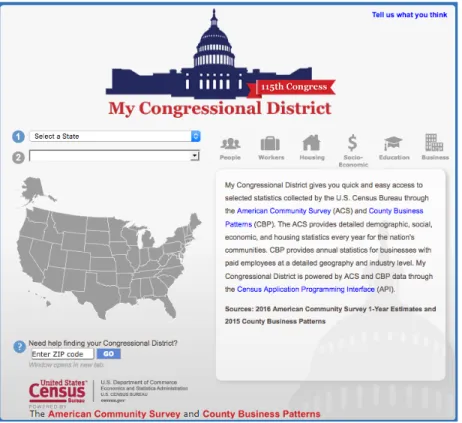
District economic conditions shall be quantified by utilizing the “My Congressional District” data set by the United States Census Bureau as shown by Fig. 1 and demonstrated by Appendix G. This data set consists of the County Business Patterns (CBP) which provides detailed statistics showcasing district and industry specific information for analysis, even
providing multiple measures of business robustness such as total establishments, annual payroll, and total industry employees. This dataset allows for the targeted district-by-district
differentiation needed for this research.
25 “Virginia, Maryland Representatives Launch Congressional Chesapeake Bay
District Demographic Conditions
District demographic conditions shall be quantified by utilizing the “My Congressional District” data set by the United States Census Bureau as shown by Fig. 1. This data set consists of the American Community Survey (ACS) which provides detailed industry statistics which breaks down district populations on age, education, race, ancestry, and veteran status. This is showcased by Appendix F.
Fig. 1 – “My Congressional District” as presented by the U.S. Census Bureau
Operationalization of Dependent Variable Representative Informal Group Membership
The informal group membership of the members of the United States House of
Fig. 2– House Administration Committee,
Congressional Member and Staff Organizations
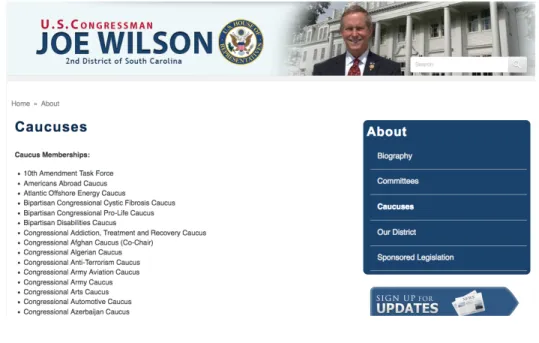
Fig. 3 – Sample Member Website with Listed Informal Groups
... ...Joe Wilson (SC-2)26
26 Congressman Wilson is the member of the House of Representatives with the most
Informal Group Classifications
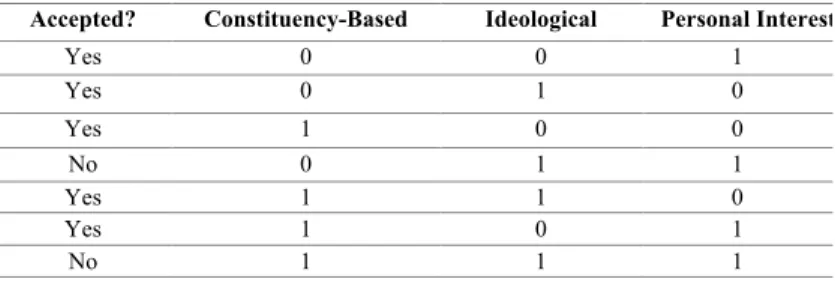
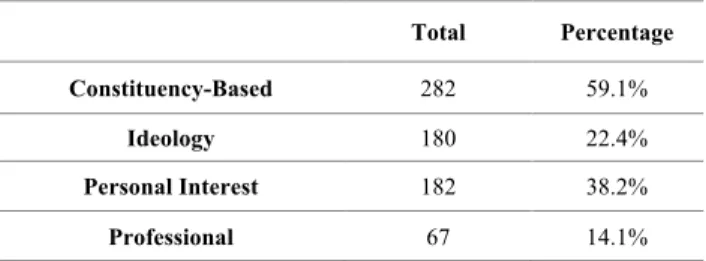
In an effort to determine which independent variable(s) are most applicable to particular informal groups present in the United States House of Representatives, these groups shall be classified into sub-groups. These classifications are in their entirety in Appendix C and, unless otherwise stated by the below axioms, an informal group may be classified under multiple sub-groups. Table 1 denotes examples of informal group classifications and their acceptability under the following axioms. Table 2 denotes the results of the classification and the number of informal groups that are classified under the categories of constituency-based, personal interest, and ideological. Table 2 also showcases the amount of professional informal groups within the House of Representatives.
Axiom 1: An informal group shall not be classified as “Constituency-Based,” “Personal Interest,” and “Ideological” simultaneously.
During the course of this research it became clear that, short of extended member-level interviews beyond the scope of this project, excellent arguments could be developed for differing classifications and member-level motivations for joining particular informal groups. Membership which to one scholar seemed clearly the effects of personal interest were to another scholar a signal that there was a tangential connection to a member’s district. Thus, the necessity for difficult and ultimately subjective classifications was made apparent. In an effort to ensure that these classifications carry weight, informal groups may not be classified as all three despite the reality that all of the informal groups in Appendix C could feasibility be the result of
Axiom 2: An informal group shall either be classified as “Ideological,” or “Personal Interest,” not both.
The line between personal interest and ideology is a surprisingly difficult distinction to make for the informal groups present in the House of Representatives. Determining when a member was drawn to a group because of personal ties or because of their overarching ideology was difficult for informal groups like the Mental Health Caucus. Is a member drawn to
membership of this caucus due to a personal or experience with mental illness or can it be primarily explained as a component part of their overall ideology? This difficultly necessitated a clear line between ideology (which itself is a variant of personal interest) and personal interest within the informal group classifications.
Axiom 3: An informal group shall be classified as “Professional” if it maintains an independent website containing both information concerning the group’s purpose and its membership.
Scholars unfamiliar with informal groups in the House of Representatives may assume that well known informal groups such as the Congressional Black Caucus or the House Freedom Caucus are representative of informal groups in the House of Representatives. In an effort to test this assumption, the classification of professionalism was developed with the relatively low standard of an independent website with membership lists and group goals. Even with this low standard only around fourteen percent of all the informal groups in the House of Representatives are considered professional and very few would be comparable to either the Black or Freedom Caucuses.
Table 1 – Informal Group Classification Examples
Accepted? Constituency-Based Ideological Personal Interest
Yes 0 0 1
Yes 0 1 0
Yes 1 0 0
No 0 1 1
Yes 1 1 0
Yes 1 0 1
Table 2 – Informal Group Classifications
Total Percentage
Constituency-Based 282 59.1%
Ideology 180 22.4%
Personal Interest 182 38.2%
V. Data Collection & Preliminary Results Challenges of Preliminary Data Collection Process
Initial plans of data collection were misguided insofar as they were predicated on the assumption that individual level correspondence with a sufficient number of members of the House of Representatives would be either possible or effective. Initial plans centered around correspondence with the congressional staffs of members of the informal groups (Fig. 4), but this correspondence became stalled and was proven to be an infective method. The universe of cases for informal group membership in the House of Representatives proved to be a more elusive and challenging target to reach than anticipated and the limited time horizon of this particular project caused shifts into alternative methods of data collection.
Figure 4 – Sample Data Collection Correspondence, Staff of Congressman Patrick McHenry
. ... (NC-10)
Adjustment of Initial Data Collection Process
and their informal group listing (Fig. 3). This was developed on the theory that the incentives for information provision would be on the member to provide to their constituents rather than on their staff to supply information to a researcher. While this necessarily limited the number of cases available for analysis and a more complete version of this research would include both a longer time horizon and increased access, the exclusion of unadvertised informal group membership allows for this research to focus on the causal links between informal group membership and electoral considerations.
“Full” vs. “Listed” Membership of the 115th House of Representatives
The large number of members for whom informal membership data was unavailable through the above method of data collection necessitated the creation of the distinction between “Listed” membership of the 115th House of Representatives (to delineate that they have utilized their web pages to advertise or list informal group membership) who will be included in the analysis and predictive models as opposed to the “Full” membership of the 115th House of
Representatives, which is the full membership of the House of Representatives regardless of their informal group advertisements. As demonstrated by Table 3, Table 4, Table 5, and Figure 5, the ideological differences in these two groups is not of high enough significance to suspect that it is not representative of the 115th House of Representatives as a whole.
Table 3 – 115th House of Representatives Ideology, Full vs. Listed
27 Tie between Representative Lou Barretta (PA-11) and Mario Diaz-Balart (LA-05). 28 Tie between Representative Scott Taylor (CA-02) and Scott Peters (CA-52)
Member Average Member Median Median Member
Full 115th House 0.099 0.276 Rep. Baretta27
Figure 5 – Density Estimate for Listed 115th House
Table 4 – Republican Party Ideology Full vs. Listed
Table 5 – Democratic Party Ideology Full vs. Listed
29 Tie between Representative Vicky Hartzler (MO-04) and Ralph Abraham (LA-05). 30 Tie between Representative Scott Taylor (VA-02) and Charles Fleichmann (TN-03). 31 Tie between Representative Suzanne Bonamici (OR-01) and Mike Thompson (CA-05). 32 Representative Daniel Kildee (MI-05).
Member Average Member Median Median Member
Full Republicans 0.489 0.496 Rep. Hartzler29
Listed Republicans 0.474 0.474 Rep. Taylor30
Member Average Member Median Median Member
Full Democrats -0.392 -0.395 Rep. Bonamici31
Nature of Informal Group Membership in the House of Representatives
From this data, we can begin to make some interesting claims regarding informal group membership in the United States House of Representatives. Perhaps the most intriguing suggestion that this data (Table 6) provides is the enormous variance in the rate of informal group membership among members of the 115th House of Representatives. Nearly forty percent of members of the 115th House of Representatives do not list any
informal groups on their webpages. As discussed in earlier section, this does not
necessarily mean (nor is it likely) that these members are not members of informal groups but it does mean they are not taking advantage of a potent position-taking election tool. This is surprising because there seem to be no discernable costs to join an informal group, as they generally seem to be without many commitments.33
This is demonstrated by the approximately twenty three percent of representatives who are members of twenty or more informal groups, and even more acutely by the approximately four percent of members who list at least fifty informal groups on their webpages. It is not feasible, given what we know about the time demands on members of Congress, that any member could dedicate the requisite time for this number of groups, informal or otherwise, unless each one generally met very rarely. It is thus very surprising that there is this high rate of members of the House of Representatives who are not
advertising their membership in these groups, particularly considering that some
members such as Congressman Meadows (Appendix A) and Congressman Bobby Scott (Appendix B) utilize them to such great effect.
33 Notable exceptions to this statement include, but are not limited to, the Congressional
In fact, many of the informal group websites utilized to determine the
professionalism measure (Table 2) are hosted on their chairman/founder’s “house.gov” webpage and list their own staff members as contact information for the group.
Additional qualitative data is necessary to more fully understand this variance.
Table 6 – Informal Group Membership,
Full 115th House of Representatives
Role of Party
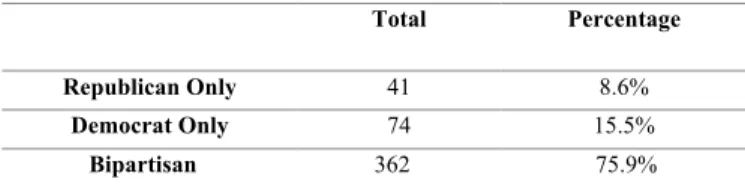
This data seems to suggest that political party is a potent predictor of the rate of informal group membership in the House of Representatives. Democratic party members are reliably more likely to join a higher number of informal groups than their Republican colleagues in the House of Representatives (Table 7). Additionally, there are more informal groups active in the House of Representatives that are Democratic-only, with approximately sixteen percent of all informal groups, than there are active informal groups that are Republican-only, with approximately nine percent (Table 8). This is despite a higher number of Republican members of the 115th House of Representatives.
Total Percentage
0 164 37.96%
1-9 109 25.23%
10-19 64 14.81%
20-29 47 10.88%
30-39 21 4.86%
40-49 11 2.55%
50-59 8 1.85%
60-69 4 0.96%
Table 7 – Informal Group Membership by Party
Table 8 – Informal Group Membership Exclusively Based on Party
Role of Ideology
Similar to party, the data suggests that ideology has an effect on the rate of informal group membership in the House of Representatives, in fact it suggests an even stronger relationship, with members of liberal ideology being reliably more likely to be participants in higher numbers of informal groups than moderate or conservative members (Table 10). The data also suggests a weak relationship between the moderate-ideologue spectrum, with the existence of around five percent more ideologue-only informal groups, but this is far from conclusive.
Table 9 – Informal Groups Based Exclusively on Ideology (Moderate and Ideological)
34 50% Most Ideological (25% Most Conservative & 25% Most Liberal) Listed Members
of the 115th House.
35 50% Most Moderate Listed Members of the 115th House.
Total Average Median
Republicans 1853 14.5 11
Democrats 2817 20.12 16
Total Percentage
Republican Only 41 8.6%
Democrat Only 74 15.5%
Bipartisan 362 75.9%
Total Percentage
Mixed Ideology 379 84.79%
... Ideological Only34 42 9.40%
Table 10 – Informal Group Membership by Ideology (Conservative, Moderate, and Liberal)
Membership Total Average Median
Conservative36 1245 13.99 11
Moderate37 1495 16.61 13.5
Liberal38 1934 21.73 17
Test Case: Congressional Progressive Caucus
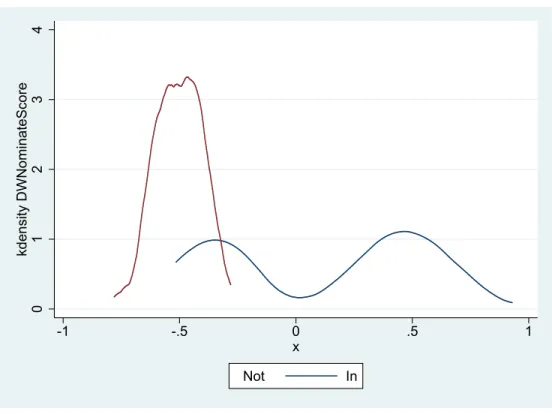
Ideology is perfectly predictive of membership in the Congressional Progressive Caucus in the House of Representatives as all members of this informal group are of liberal ideology (Fig. 6). A decreasing DW Nominate score (corresponding to a more liberal ideology) is highly suggestive of membership in the House Progressive Caucus (Table 11).
Figure 6 – Density of Congressional Progressive Caucus Membership
Table 11 – Pearson Correlation of Ideology and House Progressive Caucus Membership
Variable Membership of the House Progressive Caucus
Ideology (DW Nominate) 0.521*
Number of Cases 268
P* < .001
Test Case: Congressional Pro-Life Caucus
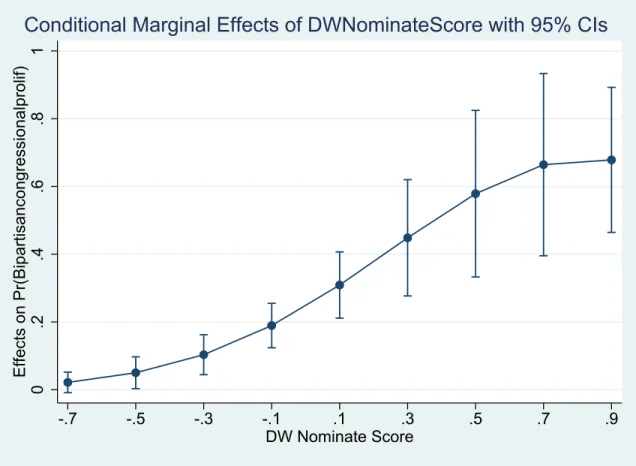
Ideology has some predictive power for membership in the Congressional Bipartisan Pro-Life Caucus (Table 12). Despite the pro-life position being increasingly associated with
conservative ideology, this is not the only factor governing membership in the Congressional Bipartisan Pro-Life Caucus. Further research is necessary to fully understand how other variables affect membership in this informal group.
Table 12 – Pearson Correlation of Ideology and Bipartisan Pro-Life Caucus Membership
Variable Membership of the Bipartisan Pro-Life Caucus
Ideology (DW Nominate) 0.383*
Number of Cases 268
P* < .001
Role of Personal Interest
Qualitative analysis of the data in this project has suggested a connection between representative personal interest and informal group membership. The role and factors that influence this connection, however, are ambiguous. Further qualitative information and superior methods of operationalization for personal interest is likely needed to make any meaningful conclusions about its connect to informal group membership.
Test Case: Military Veterans Caucus
There is no statistically significant relationship between military service and membership in the Military Veterans Caucus (Table 13).
Table 13 – Pearson Correlation of Military Service and Military Veterans Caucus Membership
Variable Membership of the Military Veterans Caucus
Ideology (DW Nominate) 0.014
Number of Cases 268
P* < .05
Role of Geographic Conditions
independently of ideology or party concerns and further analysis must be completed in order to determine the nature of this apparent effect.
Figure 8 – U.S. Census Regions and Divisions of the United States
Table 14 – Informal Group Membership by Broad Region
Total Percentage Average Median
Northeast39 968 20.8% 21 16.5
Midwest40 861 18.5% 16.6 12.5
South41 1564 33.6% 16.1 12
West42 1258 27% 17.5 16.5
39 Pursuant to United States Census Bureau classifications (Fig. 8), the “Northeast”
consists of the states of CT, ME, MA, NH, RI, VT, NJ, NY, and PA.
40 Pursuant to United States Census Bureau classifications (Fig. 8), the “Midwest”
consists of the states of IN, IL, MI, OH, WI, IA, KS, MN, MO, NE, ND, and SD.
41 Pursuant to United States Census Bureau classifications (Fig. 8), the “South” consists
of the states of DE, FL, GA, MD, NC, SC, VA, WV, AL, KY, MS, TN, AR, LA, OK, and TX.
42 Pursuant to United States Census Bureau classification (Fig. 8), the “West” consists of
Table 15 – Informal Group Membership by Specific Region
Total Percentag
e Average Median
New England43 320 6.8% 29.1 30
Middle Atlantic44 648 13.9% 18.5 16
East North Central45 433 9.3% 15.2 11
West North Central46 328 7% 19.3 13
South Atlantic47 856 18.3% 16.8 11
East South Central48 289 6.2% 20.6 14
West South Central49 454 9.7% 13.8 13
Mountain50 211 4.5% 12.4 7
Pacific51 1047 22.4% 19 19
43 Pursuant to United States Census Bureau classification (Fig. 8), “New England”
consists of the states of CT, ME, MA, NH, RI, VT.
44 Pursuant to United States Census Bureau classification (Fig. 8), “Middle Atlantic”
consists of the states of NJ, NY, and PA.
45 Pursuant to United States Census Bureau classification (Fig. 8), “East North Central”
consists of the states of IN, IL, MI, OH, and WI.
46 Pursuant to United States Census Bureau classification (Fig. 8), “West North Central”
consists of the states of IA, KS, MN, MO, NE, ND, and SD.
47 Pursuant to United States Census Bureau classification (Fig. 8), “South Atlantic”
consists of the states of DE, FL, GA, MD, NC, SC, VA, and WV.
48 Pursuant to United States Census Bureau classification (Fig. 8), “East South Central”
consists of the states of AL, KY, MS, and TN.
49 Pursuant to United States Census Bureau classification (Fig. 8), “West South Central”
consists of the states of AR, LA, OK, and TX.
50 Pursuant to United States Census Bureau classification (Fig. 8), “Mountain” consists of
the states of AZ, CO, ID, NM, MT, UT, NV, and WY.
51 Pursuant to United States Census Bureau classification (Fig. 8), “Pacific” consists of
Test Case: The Congressional Western Caucus
There is no statistically significant relationship between western geography and membership of the House Western Caucus (Table 16).
Table 16 – Pearson Correlation of Western Geography and House Western Caucus Membership
Variable Membership of the House Western Caucus
Western Geography52 0.061
Number of Cases 268
P* < .05
Role of Economic Conditions
Both qualitative and quantitative data support the connection between economic conditions and informal group membership. Congressman Meadows’ statement that informal group membership is “constituency driven” seems to be supported by quantitative data.53 The bulk of the informal groups classified as constituency-based (Table 2 & Appendix C) are related to the economic conditions of congressional districts and, furthermore, to specific industries or products.
Test Case: House Manufacturing Caucus
The only statistically significant variable among those collected from the “My
Congressional District” tool is the level of manufacturing employment (Table 17). This conforms with the framework of informal groups as effective position-taking tools for the campaign
context as the only significant measure is the number of employees (and voters) the industry
52 Pursuant to United States Census Bureau classification (Fig. 8), the “West” consists of
the states of AZ, CO, ID, NM, MT, UT, NV, WY, AK, CA, HI, OR, and WA.
contains. These results are all the more surprising considering the large number of representatives who engage in no advertising of informal group membership.
Table 17 – Logit Model of House Manufacturing Caucus Membership
Variable Membership of the House Manufacturing Caucus
Manufacturing Employment (in ten thousands) 1.454* (0.2658)
Total Manufacturing Establishments (in hundreds) 1.125
(0.0979)
Annual Manufacturing Payroll (in millions) 1.108 (0.2922)
Education and Workforce Committee Membership 1.56 (0.8963)
Log Likelihood -89.08 Number of Cases 268
Note: Odds Ratios are Coefficients p* < .05
Role of Demographic Conditions
The data (Table 18) suggests that demographic conditions seem to play an important role in informal group membership. Similar to the effects of economic conditions, it appears to be tied to the number of constituents that are a part of the relevant community and perhaps is related to electoral interests.
Test Case: Congressional Asian-Pacific American Caucus
There is a strong and statistically significant correlation between a district’s Asian population and membership for the Congressional Asian-Pacific American Caucus (Table 18).
Table 18 – Pearson Correlation of Asian Population and CAPAC Membership
Variable Membership of the Congressional Asian-Pacific American Caucus Asian District Population (in ten thousands) 0.507*
Number of Cases 268
VI. Conclusions & Discussion Discussion of Findings
Like any first attempt with a novel research topic, little can be concluded for certain from this project alone. The limitations on data collection inherent to the topic of this project temper the ability of anyone to claim with certainty that they have made scientific discoveries. This project has, though, discovered what appear to be extremely interesting findings on the nature of informal groups in the United States House of Representatives, and the factors which influence representatives to join them. First, it has presented data that supports the claim that political party has an influence on the rate of informal group membership which may in turn have an influence on legislative outcomes. Secondly, data has supported the connection of constituency interests (both economic and demographic) to informal group membership, suggesting they are electoral tools that are not understood by the political science and public policy communities. Lastly, data has supported a connection between ideology and informal group membership both in terms of the rate and type of group membership. This may suggest that extra-party means of cooperation are developing in the United States House of Representatives following the legislative victories of the House Freedom Caucus.
General Challenges of Research into Informal Groups
groups they have thus far generally been seen as beyond the purview of analysis, as even the U.S. Senate’s civil servants seem to imply:
Informal congressional groups and organizations of members with shared interests in specific issues or philosophies have been part of the American policymaking process since colonial times. Typically, these groups organize without official recognition by the chamber and are not funded through the appropriation process.
In the Senate there is one officially recognized caucus -- the Senate Caucus on International Narcotics Control established by law in 1985.54
For the House of Representatives, thankfully, the House Administration Committee makes regular updates to their list of informal groups in their chamber. This committee’s list for the 115th Congress (Fig. 2 & Appendix C) is the best approximation for the makeup of informal
groups in the United States House of Representatives that currently exists and there is no comparable institution-sanctioned list for the United States Senate. This step, though, is itself a formal process and it is likely that there are cases of informal groups that extend beyond the scope of this compilation and still have an effect on the legislative process within the House of Representatives.
Additionally, collecting membership of these groups even with a semi-comprehensive list is not a straightforward process. As noted in previous sections, initial attempts to center on informal group websites or the offices of their chair/co-chair proved to be inaccurate and ineffective respectively. Informal group professionalism (Table 3) varies widely with only around fourteen percent of these groups having any website at all and often the information provided by these sites was too dated to utilize with confidence. The shift to each member and their webpages individually did not prove to be a flawless process either, however, and the necessity for a distinction between the “Listed” and “Full” 115th House of Representatives and
although this proved to be a representative sample in terms of constituency, ideology, party, and personal interest (Tables 3, 4, 5 & Appendices D, E) more information would have allowed for increased certainty.
Potential for Future Research
The potential for future research for this project is immense. Were the time horizon of this project longer, it would have sought additional methods of data collection to ensure that the “Listed” and “Full” distinction would no longer be necessary. Additionally, this project and subject would benefit from significant member-level insight in the vein of Richard Fenno’s “Home Style: House Members in their Districts” since the informality prevents many of the types of analysis social scientists can use for committee structures or other aspects of
Congressional behavior. This research would particularly benefit from time and research within the Washington D.C. area and qualitative engagement with these groups first-hand.
VII. References
“115th Congress (2017-2019): Representatives.” Voteview.com. UCLA. Accessed March 22, 2018. https://voteview.com/congress/house.
“115th Congress Congressional Membership Organizations (CMOs).” cha.house.gov. Congressional Committee on House Administration, February 27, 2018.
https://cha.house.gov/sites/republicans.cha.house.gov/files/assets/115CMOList%282.27.1 8%29.pdf.
“Caucuses.” Joewilson.house.gov. Office of Congressman Joe Wilson. Accessed March 22, 2018. https://joewilson.house.gov/about/caucuses.
“Census Regions and Divisions of the United States.” Census.gov. U.S. Census Bureau. Accessed March 22, 2018.
https://www2.census.gov/geo/pdfs/maps-data/maps/reference/us_regdiv.pdf.
“Committees.” Senate.gov. United States Senate. Accessed March 22, 2018. https://www.senate.gov/committees/committees_home.htm.
Converse, Philip. “The Nature of Belief Systems in Mass Publics.” In Ideology and Discontent, edited by David Apter, 206–49. New York: The Free Press, 1964.
Hammond, Susan, Daniel Mulhollan, and Arthur Stevens. “Informal Congressional Caucuses and Agenda Setting.” The Western Political Quarterly Vol. 38, no. 4 (December 1985): 583-605.
Juenke, Eric, and Robert Preuhs. “Irreplaceable Legislators? Rethinking Minority
Representatives in the New Century.” American Journal of Political Science 56, no. 3 (2012), 705-715.
Mayhew, David. Congress: The Electoral Connection. New Haven: Yale University Press, 1974.
“My Congressional District: 115th Congress.” Census.gov. U.S. Census Bureau. Accessed March 22, 2018. https://www.census.gov/mycd/.
Pinney, Neil, and George Serra. “The Congressional Black Caucus and Vote Cohesion: Placing the Caucus within House Voting Patterns.” Political Research Quarterly Vol 52, no. 3 (September 1999): 583-608.
Stevens, Arthur, Daniel Mulhollan, and Paul Rundquist. “U. S. Congressional Structure and Representation: The Role of Informal Groups.” Legislative Studies Quarterly Vol. 6, no. 3 (August 1981): 415-437.
“Virginia, Maryland Representatives Launch Congressional Chesapeake Bay Watershed Caucus.” bobbyscott.house.gov. Office of Congressman Bobby Scott, May 6, 2011.
https://bobbyscott.house.gov/media-center/press-releases/virginia-maryland-representatives-launch-congressional-chesapeake-bay.
Walker, Jack. “A Critique of The Elitist Theory of Democracy.” The American Political Science
VIII. Appendices
Appendix A - Interview with Congressman Mark Meadows (NC-11) Chairman of the House Freedom Caucus
Henderson County Republican Party Convention Saturday, Mach 10th 2018
Collin M. Miller: Could you describe the effect of informal groups on the legislative process in the House?
Congressman Meadows: Caucuses actually are actually most successful when they vote together using what is called the “Power of Negation.” When you don’t stick together you don’t have an effect. It makes a real legislative difference and you saw that in the Tax Bill.55
Collin M. Miller: How do people convince members to join informal groups? Do staff and members go to different offices in the Capitol trying to gain new group members?
Congressman Meadows: A lot of it is constituency driven. Some of them are relevant and others are there as resume boosters.
Collin M. Miller: Speaking of constituency driven groups, one of my inspirations for this project was when I was working in your office and you and another Member of Congress toured a local candy manufacturing plant in the 11th district and your subsequent joining of the House Candy Caucus.
Congressman Meadows: We toured one of the manufacturers in the district. I have been convinced to join caucuses I normally would not have been engaged in. The Candy Caucus has tried to convince me to vote with them on candy related issues and legislation, and I have.
55 H.R.1 - An Act to provide for reconciliation pursuant to titles II and V of the
Appendix B – Press Release, Congressional Chesapeake Bay Watershed Caucus
Virginia, Maryland Representatives Launch Congressional Chesapeake Bay Watershed Caucus
May 6, 2011½Press Release
Members underscore need for action for Bay's future
WASHINGTON, DC – U.S. Representatives Rob Wittman (VA-1), Chris Van Hollen (MD-8), Robert C. "Bobby" Scott (VA-3), and Andy Harris (MD-1) today announced the launch of the Congressional Chesapeake Bay Watershed Caucus, as they addressed a meeting of the
Chesapeake Bay Commission in Washington, D.C. The Caucus will serve as an informal group of members dedicated to restoration of the Chesapeake Bay, including issues related to water quality, conservation, resource management, recreation and economic development, as well as educating other Members of Congress on these issues. The formation of the Caucus serves to continue and enhance the previous work of the Chesapeake Bay Congressional Task Force. "It is important that we come together for the future of the Chesapeake Bay," Wittman said. "One of the most critical resources in this region, the Bay demands our attention and common sense action to preserve it for future generations. Bay states are historically, economically and
culturally tied to the waters of the Chesapeake Bay; its restoration is one of my highest priorities. This Caucus brings together multiple partners to chart a path forward in Congress for the Bay." "The Chesapeake Bay is a critical natural resource for the economy, culture, and heritage of its watershed states. The Congressional Chesapeake Bay Watershed Caucus continues the work of the Chesapeake Bay Watershed Task Force – fostering cooperation and collaboration between members of the Bay states and educating people across the country on the vital importance of protecting this national treasure. I look forward to working with Co-Chairs Wittman, Scott, and Harris to advance policies to safeguard the Bay," said Congressman Chris Van Hollen (D-MD). "The Chesapeake Bay is one of America's greatest treasures," said Rep. Bobby Scott. "Since my days in the Virginia House of Delegates, I have been committed to the restoration and
conservation of the Bay. I look forward to working with my colleagues in the Chesapeake Bay Watershed Caucus in ensuring that the Bay has the necessary resources and support from Congress so that the next generation of Americans will be able to enjoy this precious natural resource."