William T. Sutherland-Keller. Nomadic Sharing: Information Infrastructures in the Sharing Economy. A Master’s Paper for the M.S. in I.S. degree. April, 2017. 51 pages. Advisor: Mohammad Hossein Jarrahi
This research examined the role of information infrastructures in decentralized contexts of the sharing economy. The community studied was a group of nomadic workers known as digital nomads. An investigation of three online forums was conducted and elements of emergence and generativity were identified in the community’s patterns of sharing and access across information infrastructure.
Headings:
Information infrastructure
NOMADIC SHARING: INFORMATION INFRASTRUCTURES IN THE SHARING ECONOMY
by
William T. Sutherland-Keller
A Master’s paper submitted to the faculty of the School of Information and Library Science of the University of North Carolina at Chapel Hill
in partial fulfillment of the requirements for the degree of Master of Science in
Information Science.
Chapel Hill, North Carolina
April 2017
Approved by
_______________________________________
Table of Contents
Introduction ... 2
Literature Review... 5
1.1 The Sharing Economy ... 5
1.1.1 Gifts, Sharing and Markets ... 5
1.1.2 Trust and Reputation ... 8
1.1.3 Peers, Decentralization, and Entrepreneurship ... 10
1.1.4 Platforms ... 12
1.2 Information Infrastructures ... 13
1.2.1 Defining Information Infrastructure ... 14
1.2.2 Complexity and Emergence ... 16
1.2.3 Infrastructuring ... 17
1.3 Digital Nomadism ... 20
Methods... 22
2.1 Research Context... 22
2.2 Data Collection ... 24
Findings... 26
3.1 Branding ... 26
3.2 Professional Mentoring ... 27
3.3 Transacting and Contracting ... 29
3.4 Knowledge Sharing ... 30
3.5 Community Building ... 31
Discussion ... 33
4.1 Macro-Micro ... 33
4.2 Micro-Macro ... 36
Conclusion ... 40
5.1 Further Research ... 41
Introduction
The host of businesses and applications categorized under the umbrella of “the sharing
economy” has brought about a new worker and consumer relationship with information
services and applications. The classic examples of these services range from transport
and travel services like the ridesharing app Uber and the homestay app Airbnb, to
freelance work marketplaces like WeWork or Upwork. A more abstracted perspective on
the sharing economy, however, reveals a cultural ethic that expands much further than
these specific business models (Belk, 2010). The sharing economy is a worker and
consumer culture which espouses micro-entrepreneurship, self-employment, and
computer-mediated community exchanges (Sundararajan, 2016). A critical element of the
logic of the sharing economy are the information services that coordinate these exchanges
and their highly distributed nature.
In this paper I consider a broad context of the sharing economy. Much of the discussion
surrounding the sharing economy has focused on sharing facilitated by a third-party
application or platform, such as ridesharing apps and hospitality apps like Airbnb (e.g.,
Chaube, Kavanaugh, Perez-Quinones, 2010; Ikkala and Lampinen, 2015).
However, some research has characterized the sharing economy as a broader trend in how
the act of sharing has entered into various contexts of exchange (Sundararajan, 2016). In
this characterization, sharing may be facilitated and conducted by a centralized business
and application, such as with Uber; it may also enter into more distributed, peer-like,
can be arranged on a continuum, some aspects indicating the benefits of hierarchical
coordination, and others the benefits of market-like interactions (Sundararajan, 2016, p.
77). In this regard, sharing economy technologies are highly variable, and represent a
wide field of study.
The platform has emerged as a central concept for understanding sharing economy
applications like Uber and Airbnb. The platform is a locus for users to take advantage of
the scaling and organizing potential of a network (Gawer, 2014; Cusumano, 2010).
However, while the platform is open, and allows its user base to grow and interact
exponentially, its architecture follows the specifications of a designing individual or
business model (Hanseth and Lyytinen, 2010). Consequently, following the broader
characterization of the sharing economy demands new conceptions of the role of
technology in mediating sharing. Specifically, new research should expand our
understanding of digital mediation in more distributed, market-like sharing contexts.
To investigate this aspect of the sharing economy context, I draw on the extensive
literature on Information infrastructures (IIs). IIs are large-scale, and highly complex,
consisting of arrangements of component platforms and applications. Critically, IIs are
not designed from the top down, but rather emerge from the complex interactions of
many technologies (Hanseth and Lyytinen, 2010). This perspective allows for platforms
to be considered in relation and in conjunction with other platforms, and situated as they
are in broader sociotechnical systems (Star and Ruhleder, 1996).
The goal of this investigation, then, is to observe emergent processes in the sharing
economy, specifically in the way that they interact with the digital mediating mechanisms
distributed and emergent aspects of the sharing economy make use of and configure a
diversity of underlying information infrastructures?
In order to pursue this question, this study investigates a specific community of remote
workers known as digital nomads. Digital nomads are workers whose work does not tie
them to any specific place (or to a specific itinerary), and who therefore travel while
working. The length of their sojourns in any given place and the length of their nomadism
varies, as does their age and profession. They are unified, however, by specific practices
of nomadic work, such as maintaining productivity, finding work, developing their skills,
and hunting down wifi (Horton, 2017; “The Rise of the ‘Digital Nomad,’” 2015). As
discussed later in this paper, the digital nomad community is unique for its level of
departure from location and organization-oriented work, its strength of self-identity and
web presence, and for its agency relative to the information infrastructures which support
their work. Digital nomads are mobile, technologically savvy, and entrepreneurial,
making them a good context for the study of distributed sharing across information
Literature Review
1.1
The Sharing Economy
In this study I draw primarily from the definition of the sharing economy provided by
Sundararajan in his book The Sharing Economy, as it has an articulate discussion of the
relationship between work and digital mediating technologies. From that perspective I
draw three aspects of the sharing economy which are most relevant to this discussion: 1)
the integration of social mechanisms as facilitators of exchange, 2) the leveraging of
digital platforms and network effects for benefits which are shared across the community,
and 3) a trend towards decentralization and peer-to-peer interactions. I cover these in the
following sections.
1.1.1 Gifts, Sharing and Markets
Much of the literature on the Sharing economy follows the term “sharing” which is both
one of the most popular and most difficult terms to deal with, as it implies a great deal
about the social meaning of transactions. Some have questioned the accuracy of the term
in describing the economic phenomena to which it is usually attached, and a cluster of
more specific terms have developed around it. These include “collaborative
consumption,” the “collaborative economy,” the “gig economy,” the “freelance
economy,” and others. Still, the term “sharing” is persistent, and is likely the most
encompassing term for these economic changes. Given the amount of conflation and
re-terming that has gone on in the study of the sharing economy, it is worth defining
to be clarified in this regard: the social implications of the word “sharing” and the
organizational and economic model that has developed from sharing-based exchanges.
Yochai Benkler’s Sharing Nicely (2004) was an early description of sharing in economic
exchange, and a precursor to current discussions of the sharing economy. Benkler’s
definition of the sharing economy rests on a model of economic production which stands
on a foundation of social relations, rather than pricing or other commercial indicators.
Importantly, the social relations Benkler describes are light-weight, and do not incur a
large commitment from each transaction, allowing each actor to retain autonomy while
navigating the network and making a large number of micro-exchanges. This facilitates
their integration into economic systems where efficiency is a primary concern, and allows
actors to operate on scaled, digital platforms and applications. In others words, sharing in
a large-scale network is necessarily both social and impersonal. Belk (2010) presents
another, rigorous definition of sharing and types of sharing. He excludes from this
definition the certain characteristics of commodity exchange, such as a focus on rights or
access over social relationships, and a use of calculable weights, measures, or prices.
In Belk’s consideration, the boundaries between gift-giving, sharing, and commodity
exchange are vague and overlapping, but he argues that cases of economically-motivated
sharing are closer to commodity exchange than the act of sharing, and lack the
community investment and “extension of self” which is required for a community to
maintain the commons (Belk, 2010). Belk (2014) uses the related term “collaborative
consumption,” which is separated from sharing because it involves a monetary fee or
some other form of compensation; it is in fact the savvy collaboration of groups in
“access-based consumption” in which access to a resource is secured without the
commitment, cost, or social associations involved in ownership. This access exchange
comes in a number of variations, which may be market-based or simply collaborative,
and these situations imply different levels of social engagement. Access-based
consumption which occurs under anonymity, for instance, has less in common with the
kind of prosocial sharing described by Belk, they argue.
Descriptions of the sharing economy ultimately come up against a distinction between
market-like transaction and bartering or gifting. Belk describes this in the context of the
peer-to-peer filesharing, and how the sharing of music and movie files between peers in
the bitTorrent system sparked a conflict between that exchange system and the market
system in which those music and movies traditionally circulate (Belk, 2010). More often,
market and barter models appear as hybridized alternatives. Sundararajan (2016) is
particularly helpful in describing the sharing economy as a mixing of gift exchangeand
market exchange in economic systems which fall on a continuum. On the one end
Sundararajan describes gift economies, un-commoditized exchanges of social value, and
on the other, market exchanges defined by pricing and commercial exchanges. Between
these two conceptions is a continuum of hybrids which sit (sometimes uncomfortably)
under the term sharing economy. This definition separates itself from the concept of the
gift economy along some of the lines described in Belk’s arguments, but it more closely
follows Benkler’s description of the social understandings behind sharing in the digital
context. Sundararajan describes digital technologies as a kind of vector for a transition
from the prototype of a small closely interdependent community towards a “loosely knit
time the digital context supports exchanges which are more personal than the faceless
capitalism of a market economy, and which reflect shared interests or purpose. This is a
milder view than that of Hamari, Sjoklint, and Ukkonen (2015), which operationalizes
the sharing economy as a technological phenomenon.
1.1.2 Trust and Reputation
As described above, the social context of sharing in the sharing economy is often not the
intimate and committal interaction implied by the term sharing. Previous studies have
investigated the relationship between social factors and tasks carried out on digital
platforms. Sharing economy applications in particular are sensitive to the way that social
connections are maintained in the digital space. Specifically, reputation and trust have
been identified as key factors in supporting exchanges between anonymous or
semi-anonymous peers.
As Sundararajan points out in his book The Sharing Economy, users of digital platforms
have an amazing amount of trust in digitally arranged exchanges. Users are willing to let
semi-anonymous strangers crash on their couch, drive their cars, and even hire them
based on a digitally presented set of skills and experience. The trust that supports these
interactions between strangers is the product of a sophisticated array of trust-building
mechanisms used by digital platforms and applications. Trust has been an integral part of
Web 2.0 technologies in general, as well as in the context of sharing economy or
collaborative consumption applications (Dellarocas, 2003; Chaube, Kavanaugh, and
Perez-Quinones, 2010; Hamari, Sjoklint, and Ukkonen, 2015). For the worker or
employer navigating a large network, their success in finding work or finding capable
Reputation building then has become a central practice for the contemporary knowledge
worker. Freelancers rely on a series of identifying pages from different social networks in
order to verify themselves to potential clients and to publish their skills to a wider
audience. Particularly when reputation involves social networking, these practices
constitutes a kind of digital self-branding (Gandini, 2015).
The establishment of trust in a network is connected directly to its organizing logic
foundation. Ikkala and Lampinen (2015), and Lampinen and Cheshire (2014) trace the
trustworthiness of exchanges organized on the platform to the dynamics of the platform
of the exchange. Specifically, the platform facilitates exchanges between users by
mediating the monetary transaction (making sure that everybody gets paid) and by
resolving client and provider disputes as an authoritative third party. The platform is in
this way a “broker” between users, and orchestrates transactions on a market-like basis,
with compensation as the assumed driver of exchange. In contrast, Collier and Hampshire
(2010) described a set of trust-building mechanisms centered around community interests
and endorsements in the context of a peer-to-peer lending platform. They treat the issue
of trust as a problem of information asymmetries between users; a purchaser in an online
marketplace, for instance, has no real idea of the condition of a product, while a seller has
some guarantee of payment. Even in a peer-to-peer context, the authors conclude, trust
can be established between peers through community-centered mechanisms such as
shared interests, shared criteria, endorsements or rating systems. As the authors point out,
the creation of reputation is difficult to control as it is a social, qualitative act. However,
in all of these digital contexts, reputation and trust are built through channels afforded by
applications. For this reason the development of robust trust and reputation systems,
which will support the large scale peer-to-peer matching and exchanging observed in the
sharing economy, is both a technical and social endeavor.
Sundararajan (2016) indicates a set of specific methods by which digital platforms might
generate trust, including leveraging the experience of the crowd through rating systems or
reviews, brand certification, social capital, and digital channels to external trust
indicators. Of these, the last two are the most recent developments in the web context that
support sharing economy systems. “Digitized social capital” refers to the extension of
trustworthy, real world connections into a digital space through a social networking site
like Facebook. External trust indicators are any institution, external to the application,
through which the application can verify and legitimize the actions of the user. Used
together, these mechanisms create what Sundararajan refers to as a “digital trust
infrastructure,” a robust system of social cues which facilitate efficient exchanges across
a digital platform (Sundararajan, 2016, p. 61). This can be seen as a critical element in the
platforms on which digital sharing is carried out because it engenders the peculiar social
and impersonal network relations of users navigating networks at scale, and thereby
distinguishes those networks from the market economies that operate on commercial cues
for arranging exchanges.
1.1.3 Peers, Decentralization, and Entrepreneurship
Prior research has drawn a number of connections between the sorting and arranging
faculties of sharing economy applications and the increasing autonomy of workers in
arranging their own micro-exchanges. On the macro-scale, this would suggest a
market, dominated by hierarchical organizations, the peer-to-peer model suggests a
flattening of structure, such that individuals with more roles, and agency conduct
transactions between each other with minimal bureaucratic overhead. Sundararajan
discusses this in terms of the kind of mediation provided by a platform, and specifically
the amount of agency the platform affords individuals in producing, merchandizing,
exchanging products or services (Sundararajan, 2016, p.79). Digital organizing
technologies are integral to the viable implementation of a peer system, as with the move
towards socially arranged exchanges described above.
There are some differences between the concept of the peer-system and the distribution
of control observed in the sharing economy. The sharing economy inherits aspects of the
prototypical peer-to-peer system to a varying degree, depending on its position on the
continuum of market-to-hierarchy organizational model. Past studies have associated the
peer system with the gift economy, a comparison Bauwens (2005) attempts to discourage
because the interaction of peers does not imply the exchange of social obligations or
duty; there is no expectation of equal exchange in the peer system. The community in
Bauwen’s description then is a kind of commons, with each peer operating with an
understanding of the benefit of the whole system. This is the fundamental difference
between the peer system and the market, in which individuals are independent but act
only with the vision of their own goals.
The sharing economy, however, does inherit some important architectural attributes from
the peer-to-peer model. Research has associated the sharing economy with a move away
from hierarchical organizational models and towards a population of freelancers, crowds,
has definite implications for the relationship of the peer to the community. Firstly, in a
pure peer system the community or platform has no barriers to entry, and verifies or
legitimates the participation of peers through the act of collaboration itself. Similarly,
peer systems allow extreme horizontal transparency, described by Bauwens (2005) as
holoptism. This refers to the ability of any given peer to view and evaluate the activities
of other peers in the system.
The emphasis on peer transactions in many cases puts some of the weight of business
operations on individuals. A freelancer, for example, must not only perform the task they
are hired to perform for any given project, but they must also carry out negotiations with
their client, arrange for their own work resources, and actively shop for new work and
curate their professional profile, functions often provided for workers embedded in a
larger organization. This implies some necessary entrepreneurialism on the part of the
peer. The amount of freedom (or responsibility) each user has for their own exchanges
depends on the context, and on the affordances of the platform (Sundararajan, 2016). The
fission and distribution of work tasks around a peer network is generally mobilized with
the goal of optimization of efficiency, and concerns have been raised about the effects of
this trend on the nature of work.
1.1.4 Platforms
Platforms are a critical mediating unit in sharing economy systems because they provide
a digital space, with technological constraints, where essential aspects of the sharing
economy might take place. Following Cusumano (2010), the platform is a digital
mediating technological system designed to create value through the network effects of
of products in configurations which provide scaling benefits, such as the ecosystem of
products associated with the Windows operating system. Explicit in Cusumano’s
explanation of platforms, however, is the distinction between platforms and standards.
Standards for Cusumano are underlying protocols, which connect platforms, but are not
themselves platforms. This is a critical distinction because it mirrors the difference
between platforms and infrastructures, discussed below. There have been discussions of
platforms in other configurations and in an ecosystem context, but without a fundamental
redefining of the top-down design model (Thomas, Autio, and Gann, 2014).
The critical aspect of platforms is that they support the network effects and scaling
needed to make a peer-like sharing economy system efficient, and also provide the
critical service elements, such as payment processing or screening which enable
individual peers to carry out exchanges across a network (Sundararajan, 2016). Previous
examples of design for sharing systems have been careful to consider the implications of
digital platform designs on the interactions of community members (Koene et al. 2012).
Furthermore, platforms have been considered in geographically defined groups, and
situated to a certain extent in a geographic and civic context, and in relation to a larger
real-world community (May, Konigsson, and Holstrom). These descriptions consider an
ecosystem of platforms, which benefit from underlying infrastructural elements such as
open data. This is a promising aspect of the research on the sharing economy, and one
that could be developed from an infrastructural perspective.
1.2
Information Infrastructures
Information infrastructures (II) have come about in the literature as a way of studying
of other theories of information technology or design. As technologies have become
increasingly interconnected, in large part through the internet, many discussions of
individual applications or IT implementations have graduated to discussions of expansive
systems and infrastructures (Monteiro, Pollock, and Hanseth, 2013). Drawing on previous
literature I use a model of infrastructure based on practice, and on a reflexive relationship
between structure and practice. Bygstad (2010) and Henfridson and Bygstad (2013) both
rely on an underlying model of micro-macro and macro-micro movements to formalize
observed infrastructuring mechanisms. This model considers sociotechnical
configurations at both levels and allows for an investigation of how practices manifest
new macro configurations, as well as how infrastructural elements facilitate and constrain
practices. I adapt this model by considering it through a practice lens, and consider
structure to be the contextualizing form taken by the practices of many individuals
(Orlikowski, 2000). I present the foundational definition of infrastructures below, and
then discuss two elements that are most critical to this study: emergence and the process
of infrastructural change, or “infrastructuring.”
1.2.1 Defining Information Infrastructure
The study of information infrastructures has become an expansive field, but most of the
essential characteristics of IIs were developed in Star and Ruhleder’s 1996 paper “Steps
toward an ecology of infrastructure.” Following their definition, infrastructures are
embedded in larger social or technological systems, and become transparent in supporting
various practices. This means that users do not reassemble the infrastructure every time
they use it, but rather assume its presence and support in their work. Additionally,
larger sociotechnical context. People often have a history of use of particular
technologies or kinds of information, and infrastructure must in some way negotiate with
these prior understandings (Almklov, Osterlie, and Haavik, 2014). Infrastructures are also
relative to the user. In this regard, new users learn the use of infrastructure, and their
relationship with it, as a member of a community with distinct patterns of usage.
Infrastructures are always based on an installed base, or the construct of extant
technological affordances and practices. This means that new innovations are built in
negotiation with an existing topology, not instituted “de novo” (Star and Ruhleder, 1996).
This lends infrastructures a quality of inertia and path dependence, as established orders
tend to reinforce themselves (Hanseth and Lyytinen, 2010).
Additionally, the II is negotiated and enacted through a central tension between
standardized and localized protocols. When infrastructures accomplish the balance
between local and universal interests, they recede behind the array of typical work
considerations. A person sending an email does not need to consider the programs,
protocols and hardware on which their message is carried and displayed. Rather, these are
assumed aspects of a transparent infrastructure. This transparency is actually a
sophisticated enactment and interface with established practices, a resolution of the
essential infrastructural tension (Hanseth, Monteiro, and Hatling, 1996).
A final critical point about the definition of infrastructures is the inclusion of its human
elements. The flexibility of infrastructure supports varied and dynamic modes of
membership, across distributed teams and groups (Lee, Dourish, and Mark, 2006).
Furthermore, human actors, and, more collaboratively, communities of interested parties
(Bowker et al., 2010). In this regard routines and patterns of usage should be considered
as infrastructural elements, reconfigurable and contextualizing.
1.2.2 Complexity and Emergence
Another, simpler distinction of information infrastructures is that they are very large,
either temporally or spatially, and that they are complex. Information infrastructures are
recursively constructed of simpler but analogous platforms and applications. To some
extent the difference between the infrastructure and its analogous parts has to do with the
infrastructure’s supralocal character, and the observation that once a sociotechnical
structure attains a certain level of complexity, the structure takes on qualitatively
different attributes. Complexity here is not necessarily a number of moving parts, but
rather the absence of particular organizing and formalizing constraints, such as the set of
specifications which might control the creation and use of an application (Hanseth and
Lyytinen, 2010). This complexity has led to the use of naturalistic metaphors for the
growth and development of information infrastructures, because it captures their
heterogenous, emergent, and bottom-up character. It also emphasizes the dynamics of
interaction within infrastructures, and the chaotic qualities of self-organization. This is
also the critical distinction between infrastructures and platforms: infrastructures lack
centralized control, and are recursively composed of heterogenous parts, whereas
platform follow centralized direction and are expansive horizontally between
technologies without being recursively complex (Hanseth and Lyytinen, 2010).
The interaction of heterogenous parts within an infrastructure gives rise to a process of
generativity. Generativity defines the way that new structures adapt and self-organize
This is highly dependent on the infrastructure’s openness and internal heterogeneity. For
this reason keeping infrastructures open, and facilitating ease of movement between
internal strata and platforms are key aspects of cultivating generativity (Bygstad, 2010).
Gateways, which function as bridges between separate localized systems, have been
presented as a way of improving the aggregation of technologies into networks (Jackson,
Edwards, Bowker, and Knobel, 2007). Interconnected platforms and applications are
easily navigable and reconfigurable as infrastructure, and benefit from the
self-reinforcing mechanisms of network effects. This tendency of infrastructure towards
continual organic reconfiguration is a basis for infrastructural growth and extension.
1.2.3 Infrastructuring
Star and Ruhleder’s 1996 paper attempted to displace the classic association of the term
infrastructure with a kind of invisible substrate that is constructed and then sinks
immutably into the background of societies and organizations. Their new conception of
the term information infrastructure was an embedded, dynamic sociotechnical system, the
core of which is a constant tension and process of change. Information infrastructure still
has the position of an assumed resource, or transparency, but rather than being a static
structural force, it is mutable, extensible, and exists fundamentally in practice. An
essential aspect of IIs then is the processes by which they extend and grow. The
formative assumption behind research on infrastructuring is that innovation in
information infrastructures is not the product of holistic design decisions, but rather the
eventuality of a somewhat chaotic resolution of agentic design actions. In the literature
infrastructure, and then more deeply a number of discussions of specific processes by
which infrastructures grow.
Despite the infrastructures’s lack of central control, there are approaches for research on
infrastructuring as a design problem. Hanseth and Lyytinen (2010) presented a list of 19
design recommendations for complex infrastructures based on their evaluation of the
development of the internet, which they characterize as experimental, iterative, and
bottom-up. The recommendations concern primarily how to scale an infrastructure
quickly and how to keep it open, adaptable, and heterogenous. Pipek and Wulf (2009)
break down the designer / user boundary, for which there is understood to be a “design
time” and a “use-time”, which are separate operations. They posit instead a
“design-in-use” model, in which the flexibilities and boundaries of the infrastructure are altered at
use-time. This is an essential change in who is considered to design or construct an
infrastructure, as well as the time or operation in which design occurs. This process
involves a spectrum of competencies and identities, from professional alteration at
use-time to average users taking advantage of work-arounds. As the point of infrastructure is
in fact a re-occurring, perhaps even daily phenomenon, the user is understood to take on
regular improvement tasks, acquire the tools of infrastructural improvement for
themselves, and interact with the traditionally separate design sphere. This view has
similarities with Vertesi’s (2014) account of “surfacing” infrastructures around the seams
between technologies. It has been influential in later research on infrastructuring,
although some research maintains the designer / user distinction (Sanner, Manda, and
The design issues concern the role of actors and their relative agency within an expansive
sociotechnical system, but discussions of exact infrastructuring processes are more
intricate. Pipek and Wulf (2009) introduce the “point of infrastructure,” a point at which a
breakdown in infrastructure becomes a point of infrastructural awareness; the
infrastructure becomes visible because it is problematic. They describe this as an
eventuality of the tension between local and universal aspects of infrastructure because
the point of infrastructure occurs when there is a conflict between a user’s expectations or
use-case and the service provided by the infrastructure. This is followed by a point of
“use innovation” in which the user appropriates, adapts, or works around the affordances
of the infrastructure in order to complete a task. It is through this use-innovation that the
user reconciles the infrastructure with localized practice. The breakdown is then also a
prompt for adaptation and innovation. Similarly, this behavior may surround the
unavoidable gaps between infrastructural systems. Actors carry out their work across
multiple applications or platforms, aligning their different affordances in order to
accomplish tasks. A major obstacle in information infrastructures, and also a significant
point of innovation, is the persistent gaps between different technologies (Monteiro,
Pollock, and Hanseth, 2013; Ericksson and Jarrahi, 2016; Vertesi, 2014).
Related to infrastructuring, innovation is the cultivation of new developments in an
infrastructure, and relies heavily on the the infrastructure’s generative aspects. Bygstad
(2010) and Henfridsson and Bygstad (2013) rather describe a process by which attributes
of the installed base engender self-reinforcing mechanisms operating from macro to
micro aspects of information infrastructure and from micro to macro. They define
design recommendations made by Hanseth and Lyytinen (2010), these mechanisms
concern the cultivation through openness and variety, as well as the scaling of the
information infrastructure and its user base. In both models the extension of information
infrastructure is tied to its scaling and generative aspects. In other words, the information
infrastructure benefits exponentially from its body of users, and from facilitating their
innovative practices.
IIs then give us a sociotechnical model native to highly distributed contexts. However,
given the required scale of many IIs, it is often difficult to apply the concept in a truly
distributed context. Even large corporate systems often have some guiding policy. I apply
the concept of IIs here to the community of digital nomads and the extended array of
technologies they use for their work. These technologies are highly decentralized in that
they have no centralized guiding specification or policy, and they support a heterogeneity
of workers from different industries.
1.3
Digital Nomadism
Digital nomads have had very little attention from academic researchers, but have been
covered to some extent in business journals and other publications interested in
contemporary work arrangements. In regards to the population this research is somewhat
exploratory, and further research is required to make any substantive characterizations of
the community, but a rough outline can be established. Also, it is necessary to distinguish
digital nomadism from other forms of mobile work.
The first distinguishing characteristic of digital nomads their reason for travel. While
many remote workers travel for work, digital nomads typically travel while working.
often accomplished without (or despite) obligations towards a stationary employer or
business (Horton, 2017). This is an important distinction about the motivation for travel,
which, based on studies of motivation for travel in other contexts, could have significant
implications for their work practices and use of technology (Ciolfi and Carvalho, 2014;
Liegl, 2014). While some digital nomads simply work remotely for a location-based
company, many also work as part of remote teams, or as freelancers. The escape from the
office atmosphere is in fact an often-cited motivation for this kind of travel. A large part
of the conversation about digital nomads surrounds dispelling or qualifying the idea that
digital nomadism is a constant vacation, however (Horton, 2017; “The Rise of the
‘Digital Nomad,’” 2015).
Another distinguishing feature of the digital nomad is that they have a strong group
identity. There are a number of digital nomad conferences and programs that train people
to become nomadic, as well as travel programs through which nomads work and travel
together. They are also savvy users of online media and applications, including personal
blogs and forums. Websites like Nomad List1 provide a variety of resources curated
specially for the digital nomad. Through these programs and spaces digital nomads has
access to a community not associated with an organization, but with a situation of work.
A working description can be drawn from these characterizations. The digital nomad
attempts to be spatially and professionally independent. They rely on the savvy use of
technology, and the navigation of access to resources and tools. As a lifestyle, digital
nomadism posits a focus on access and contracting over ownership and employment.
Methods
2.1
Research Context
Attempting to frame an information infrastructure that has not been holistically defined
by a single organization or person is inherently problematic. By definition, the full
breadth of information infrastructure should not be easy to consolidate or bucket in a
single object or application. For this reason, coding was conducted on discussion forums
of the digital nomad community, which provide breadth and community context.
I selected the three forums for breadth of content and for similarity of function. Because
information infrastructure is large and heterogenous, it is necessary to identify points of
entry, certain applications or platforms through which the internal operations and
linkages of the information infrastructure can be seen. To provide a focused perspective,
these entry points should be different enough to provide breadth and similar enough to
reveal common subjects. The three forums have somewhat different formats and material
affordances, but they are similar in two ways: they are all general discussion forums, and
they are all focused on the digital nomad community specifically. I chose the forum as a
vantage point into the community because of the generality of its content. The forum
allows all discussions relevant to the community, and therefore has the broadest view of
the people, technologies, and practices. Because the forums are closely related in
function, they are good venues for corroborating practices across applications and
view of the research subject. The goal of this study is not to make comparisons between
the selected forums.
There is another important aspect of the forums having to do with their positioning in the
larger context of the web, and their relative openness. The openness of the named forums
is in fact a calculated advantage associated with their function. Both the core travel
planning function of Nomad List and the associated forums are open to use by the general
public, but posting on the forum requires a paid membership. This is ostensibly to ensure
that those who post on the site are to some extent invested in the content and the
community. Similarly Digital Nomads Around the World requires approval from an
admin or moderator to join, but contains over 36,000 members. The forums are then
differentiated from more general channels by the term “Digital Nomad.” This is a small
but important seclusion, because while the boundary of these groups is porous and their
populations are large, they are grouped around some common interest. While digital
nomads are highly variable in their professions and personal lives, their common
work/travel situation provides some important continuity for research. Because
information infrastructure is an essentially relative concept, it is difficult to establish a
reliable, consolidated view of the phenomenon. For that reason I use the array of work
practices of the digital nomad community as a somewhat focused and persistent view into
the information infrastructure. Given that the community shares a broadly defined work
context, although not specific work situations, the observed infrastructural forms may
have some durability in relation to the concerns of the community.
Another complicating aspect of the forums is their own position in in the information
are both a window into an array of practices carried out the larger community of digital
nomads, but they are also themselves a platform supporting those activities. Digital
nomads might then perform some operation on the forums and also discuss performing it
in another context or on another platform. This distinction is not made in this study; the
purpose of the forum analysis is to identify a set of practices carried out across an
information infrastructure, and some of those practices may occur on forums. Because the
forums are the focus of the study, they are the primary site for these practices, but not
necessarily the only one. The codes generated are cross-platform, not confined to
describing practices on the forums themselves.
2.2
Data Collection
Data was collected from three forums which self-identified as digital nomad
communities: /r/digitalnomad2, a subreddit of reddit.com for digital nomads; “Digital
Nomads Around the World,”3 a Facebook group for digital nomads; and nomadforum.io
a subsite of data aggregation site Nomad List4. The forums were browsed
chronologically, and posts were excluded from collection using three constraints: 1) the
post had no connection to work or practices immediately relevant to work, 2) they had no
responses, 3) they were older than January 1, 2014. A post could be considered relevant
for the content of the initial post or for content in the responses. Additionally, posts were
excluded if they concerned a theme which, after a number of rounds of coding, was
saturated in the collected data. Posts and their comments identified as relevant were
scraped from the relevant forums and coded electronically using a coding application.
2 www.reddit.com/r/digitalnomad/
Coding was iterative, beginning with the selection of posts and iterating through rounds
of coding and repeated selection of posts. Codes were combined and separated as new
posts and themes were encountered. The process resulted in 104 separate posts,
consisting of 2384 separate comments. The dates of the posts ranged from March 17,
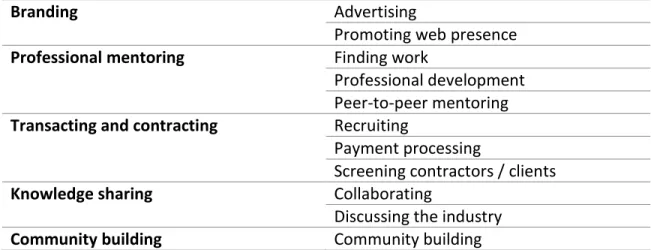
2014 to March 26, 2017. The coding process resulted in 4 primary and 10 secondary
codes (table 1).
Branding Advertising
Promoting web presence
Professional mentoring Finding work
Professional development Peer-to-peer mentoring
Transacting and contracting Recruiting
Payment processing
Screening contractors / clients
Knowledge sharing Collaborating
Discussing the industry
Community building Community building
Findings
3.1
Branding
Branding describes the activities of individuals and projects in making themselves known
within the network. For freelancers, this took the form of promoting web presence, which
involved the creation of easily deployable façades or profiles that represented their skills
and experience, creating legitimacy. This involved establishing the correct portfolio, but
also practices that take advantage of the available properties of different platforms. This
also included tactics for how to market oneself:
“From the beginning, however, you will be putting the systems into place to replace yourself as quickly as possible. You will NOT, I repeat NOT, market yourself as John Smith Freelance Programmer. Instead you will be Smith Enterprises, or Smith Digital Solutions, or some other legit business name. You might be (will be) just one guy in your garage, but that's not the image you want to portray to your potential clients. The freelance blogs endlessly debate this subject, but there's no question. If you don't want to stay just a freelancer forever (you don't), use a business name.”
These activities took place across social media, through personal websites or blogs, and
through the forums themselves. Personal websites and blogs in particular were easily
deployable as links, often without any accompanying text. In this regard the website
functioned as a highly-polished resume, which was easily transferable to potential
employers.
In contrast to individual promotion practices, advertising centered around the promotion
of a product or service. Businesses publish offered services or tools and often take
known publicly: “Hey y'all! My company, http://sailo.com, 'Airbnb of Boats' is looking
to test our event tool that lets you easily organize a group to sail in Europe, USA, and the
Caribbean.” Further, these advertisements also developed into a description of an
application and its uses, a more involved form of promotion. Users asked questions about
the services provided or how the application works, as well as questions about the
positioning of the application in a business context. In a number of instances these
monitored by representatives of the project or business, who answered questions,
promoted the products primary services, and worked with potential customers on
troubleshooting.
3.2
Professional Mentoring
Professional mentoring describes activities surrounding the development of careers and
businesses. As freelancers, finding work constitutes a large part of this practice for
Nomads. These practices allow nomads to both find resources and marketplaces that they
did not know about previously, and also to evaluate and select amongst an array of
resources already identified. For this reason the practice of looking for jobs was not only
mediated by whatever matching or recommender systems are operating on the distributed
set of digital marketplaces, but also the word-of-mouth recommendations by which
nomads are navigating to those distributed locales. Nomads relied heavily on online job
boards or marketplaces to find work, but they also linked out to data-aggregation sites
such as remoteok5, which collects remote job offers from a large number of sources. They
also take advantage of an array of meta-constructions. The best example of these were
lists of different job boards which were linked from blogs or personal web pages. The
forums themselves also acted as a filter for different marketplaces: “My personal opinion
is that the freelancer.com has less value and has more fake client than Upwork.com - this
is only for software development part, I do not know the other segment (Graphic, Sales
etc.).” Arbitration in these cases was conducted in a forum-based word-of-mouth.
Peer-to-peer mentoring describes direct coaching or advising between nomads. This
involved methods for learning: “If you want to start remote directly, I'd advise to try to
collaborate on open source software, as it's a good trial on your communication and
coding skills.” Nomads also mentored each other on general business strategy and the
mechanics of setting up organizational processes as a remote worker. One forum user
described how to turn freelance work into a career:
“Your job from here on out is two fold. 1. Find new clients 2. Find contractors to complete the projects for you. Rinse and repeat. 1, 2 . . . 1, 2 . . . You're on your way to building your global empire from the comfort of your laptop and smartphone. Congratulations, you're no longer a freelancer. You are a real life business owner.”
Mentoring was observed primarily in the forums, but moved into more private channels,
such as private messages or web conferencing software.
Nomads undertook professional development by actively integrating themselves into
social processes of work culture. Freelancers in particular took advantage of remotely
organized professional events and meetings. In this way connections were established
across the network of remote workers that were qualitatively professional, and related to
the furthering of individual’s careers and the closer integration of potential collaborators.
One nomad described the benefits of travelling remote work program for nomads: “Pros:
having awesome people around all the time, collaborating professionally with people,
learning from people, having other people around who are serious and working during the
professional circles of associated nomads, but also through coworking groups like Hacker
Paradise6, which bring typically disperse nomads together to travel and work together.
3.3
Transacting and Contracting
Transacting and contracting represent digitally mediated exchanged carried out between
actors. The most straightforward example of this was payment processing, which
concerned how to transfer money in a remote, international context. As a community
partially centered around remote work, this was an essential affordance of the
information infrastructure. This involved navigating and evaluating a large selection of
transaction applications, and discussion focused closely around the particular properties
of the applications, including hidden fees, and, in the case of bitcoin, the difficulty of use
for clients: “How about the volatility of bitcoin rate - will that affect you personally. I
have opened my bitcoin account but haven't convinced any of my clients to use it because
it is fairly new concept for them. Just want to know your thoughts or experience on that?”
Applications could be used together in order to avoid fees or to interact with clients or
employees in different regions or under different currencies. Some payment processing
applications worked between currencies while others had low fees. These applications
were modular, and could be easily paired with interactions carried out on forums or on
social media, rather than necessarily being built into the application on which the
exchange interaction occurred.
Nomads also took advantage of both the forums and other freelance marketplaces for
contracting. The act of contracting was a formal arrangement organized through a digital
platform. In some cases this revealed a great deal of awareness on the part of the
recruiters in evaluating the benefits of platforms: “I use it as a platform, and it feels really
good knowing that all the people on the platform are quality people which holds the value
of the network.” Recruiting also included general work practices surrounding the use of
these digital platforms, such as rigorous reviewing and training. Nomads also engaged in
direct hiring practices through the forum. Sometimes nomads met serendipitously in a
discussion, but in many cases posts stated explicit requirements or work that needed to be
done, and applicants responded. On forums, many of these interactions transitioned into
private messages, and so the exact nature of the recruiting process could not be observed.
The information infrastructure also supported the screening of clients and contractors
through social cues and digital filtering. Through these channels nomads built up
knowledge about, or trust in the transactions they made across different technologies. In
this way robust transactions and market-like effects were established across platforms.
For instance, one nomad on Nomad List asked for suggestions of a good accounting
office in Bulgaria, and received a contact from a fellow nomad: “I'll send you a private
message with the details of my accountant, I think they can help you.” As in this case,
these mediations took place between nomads on the forums, but also through the filters
provided in freelance marketplaces. Also, the community had accumulated a number of
lists and aggregator websites that curated and organized remote friendly employers.
3.4
Knowledge Sharing
The forums revealed relations between individual workers and the larger, remote
community of digital nomads. Nomads turned to the community for help, and themselves
helped others in the community, sometimes on specific technical problems. Often these
AppYourself in Berlin and still work for them on a DN basis. I can probably answer any
questions you have if you want to Skype?” In these cases help was requested of the
general population and provided by other users without contractual arrangement, such
that the community itself was a knowledge source. Nomads would collaborate on
community resources themselves, especially in developing lists or curated resources: “Hi
guys, I recently put together an 'awesome list' on GitHub for Digital Nomad resources
which anyone can contribute to. Check it out and feel free to make pull requests if you
know of something awesome that's missing.” In this way the configuration of platforms
and resources supported the collaborative exchanging of information and encoding of
information in material formats for reuse. Non-contractual collaboration of this sort was
primarily observed in the forums.
Nomads also made use of platforms to keep abreast of developments in their respective
industries in a broad way. Through direct discussion nomads traded first-hand knowledge
of different industries with other semi-anonymous users. This information included
which skills would continue to be in demand, which cities had good startup scenes,
patterns of employment, and technology trends: “I'm a translator, and I don't know of
anyone working above the ProZ-enabled low end of the business who believes they will
be replaced by computers soon.” These discussions took place on the forums themselves,
and also in blogs, where nomads gave descriptions of their experiences in different fields.
3.5
Community Building
Nomads also showed concern for the community at large. This involved arguments about
the larger work context, especially to companies who might hire or reject freelancers
because of their remote status:
“My biggest pain point in the DN scene is that not enough companies are hiring people remotely, whether as an employee or contractor/consultant. Companies still have the old mindset that they need people to be in the office. I realized that (long ago) that I don't have as many inquiries when I accept only remote work compared to when I live somewhere for more than 1 year. If you look at any popular job boards, 90+% of them are tagged with a location and not "anywhere"; or you can compare the number of jobs being posted on remoteok and any normal tech job board (e.g. Dice).”
Regardless of the term used, nomads showed an awareness of the larger community of
workers who shared their problems, and they identified these problems as communal.
These discussions then were negotiations of the localized set of problems facing nomads
with the standardized processes of the larger web and business context. In much the same
way the three observed forums were secluded but facilitated by the larger web context,
the recognition of community within the forums and over social media facilitated the
development of nomad job boards, nomad web tools, and nomad practices across
information infrastructure. In other words, nomads could use the term “digital nomad” to
Discussion
From the codes developed above it is possible to see that the variety of practices involved
in the professional lives of this community of digital nomads are carried out on a
similarly variable information infrastructure of platforms and applications. Furthermore,
the professional needs of the nomadic worker are negotiated with standards established in
the information infrastructure. In this section I discuss the emergence of information
infrastructure through this negotiation. Specifically, it is possible to see various stages of
the process of innovation depicted in Bygstad, (2010), and Henfridsson and Bygstad
(2013), including the benefits of the malleability of available technologies, and the
macro-to-micro and micro-to-macro movements of innovation. Following these models
of innovation, I outline how information infrastructure enables sharing economy practices
in the digital nomad community, and then describe some emergent elements of the
information infrastructure.
4.1
Macro-Micro
Macro-micro mechanisms consist of generative aspects of information infrastructure
which enable innovations. This is closely associated with the information infrastructure’s
complex and evolving characteristics. In the web resources of digital nomads is possible
to identify structural aspects with facilitate their dynamism and constant reconfiguration.
infrastructures described in Hanseth and Lyytinen (2010), as well as the malleable and
heterogeneous elements present in the information infrastructure.
Excepting the forums themselves, the structure of the system is modular and recursive,
and might be arranged connected and replaced in different configurations over time.
Nomads transited a number of social media applications as well as more specialized
applications to solve specific problems. Applications and platforms also benefitted from
co-presence in the information infrastructure. All business ventures carried out by
nomads, for instance, benefitted from the presence of popular payment processing
applications such as Paypal or Transferwise, because it meant that their application did
not have to process payments. This allowed for scaling of lightweight systems, which
outsource many functions to standard applications. In this way the benefits of different
roles and applications in the system benefitted as a network.
There was also significant malleability in infrastructural practices and technologies
available to digital nomads. The array of web services allowed for quickly-built,
minimum-effort constructions which aided or configured searching and navigating across
the information infrastructure. This meant that standalone applications could be enhanced
with complementary resources, even if only through locating and organizing them, and
information infrastructure could be directly enhanced through the construction of new
resources.
Mirroring or foreshadowing moments of direct infrastructuring were moments of
breakdown, stumbling, and pre-innovative theorizing. In these situations nomads would
identify breakdowns in current systems or seams in the base information infrastructure
reddit criticized how long it took for Nomad List’s main page to load. The founder of
Nomad List joined the conversation in order to address the issues: “I'm fixing things
every day, so if you let me know what's off (with the feedback form in the bottom left), I
get round to fixing it at some point. Thanks :).” As described in Pipek and Wulf (2009),
breakdowns prompt innovations, and while specific problems are addressed by dedicated
designers, the upkeep and evolution of the information infrastructure is carried out by an
active population of users. A Facebook user, for example, constructed a list of online
tools and services, to which others could contribute:
“I have noticed a lot of similar posts in this group. People looking for software suggestions, location suggestions, bank/money transfer suggestions. Thought it might be useful to put this in a central spreadsheet so 1) useful information doesn't get lost 2) is easily accessable and 3) cuts down repeat requests for the same info…Everyone should be able to edit without logging in and I just created a quick few entries. Later we could run some polls in the group as to what people think is the best solution and mark that entry as recommended.” The list was later moved to the Facebook group’s own files, taking advantage of the
channels built into the various platforms which allowed nomads to innovate around
breakdowns or gaps. In many cases these were simple affordances of the site designed for
general usage, such as group files on Facebook groups, Google spreadsheets, and Github.
These more accessible channels of contribution were simple but should not be underrated
as means of infrastructural change for two reasons. The first is that they are indicators of
breakdowns, and are themselves potentials for larger constructions. Nomad List, for
instance, began as a crowdsourced Google spreadsheet. In this regard the availability of
malleable, user-design oriented elements fosters generative use-in-design practices across
the information infrastructure.
The second reason that these low-level activities should not be overlooked is that they are
sharing economy systems. Open resources can benefit from the network effects of a
community, and the contributive practices of sharing. Open resources in fact imply that
usage. That implication, and more broadly the social engagement and agency of the
community, is then a key facilitator for infrastructuring. This was part of a larger means
of infrastructuring present in the community of digital nomads. I discuss this below as the
source of configuring micro-macro processes.
4.2
Micro-Macro
Information infrastructure was extended through the maintenance of community
relations, and the buy-in of individuals in distributed networked interactions. From the
interactions of digital nomads in finding resources, it is clear that community interactions
are significant spaces for arranging systems across platforms. Through discussion
nomads share tactics for integrating new applications into their workflow as well as how
to make the most use of an applications or platforms benefits. This shows that social
interactions, both peer-to-peer and across a community forum are key vectors not only for
facilitating navigation and discovery of relevant applications, but also in shaping
interactions and relationships around systems.
Despite arguments over the term “digital nomad” and the variety of industries represented
in the population, digital nomads actively build connections within the community, and
facilitate peer-to-peer interactions. This is one of the information infrastructure’s primary
affordances in helping workers navigate through the myriad of platforms and applications
towards the resource or access they need. This human element of the infrastructure is
apparent in a nomad’s description of the community:
for nomad-wannabes to learn more about being a nomad. It's not a bad thing, but we need to prepare them (and others) for what happens after they decide to become a nomad. What if they have trouble convincing their boss, or trouble getting clients once they've gone remote?”
The faculties of the network of digital nomads across social media, blogs, forums, and
marketplaces are dependent on interactions of the community, and their willingness to
advise and help each other in navigating work and technology. In this regard the
community benefits both from the network effects of a large population, and also the trust
established behind community interactions.
Nomads are engaged in identifying existing gaps or seams in the information
infrastructure. This was most overt in a post by the founder of Nomad List in which he
asked “What’s next for digital nomads?” The responses ranged from discussions of
desired cultural changes to descriptions of technologies to fill specific gaps: “If there was
a single organized, open-sourced website where you could find all the answers regarding
visas, that would be awesome. It's not sexy, though, so I doubt that it's going to be the
next big thing.” This reveals a great deal of agency in the community as a whole in
identifying innovating around gaps and breakdowns collectively. The community
discussions were then both a public troubleshooting forum, and also, correspondingly, a
cultivation space for new constructions and new materialities.
The process of infrastructuring is not just generative however, but also selective
regarding the integration of new elements into the installed base. The process of selecting
or filtering applications to use does not just support the needs of individuals attempting to
navigate the information infrastructure, it is also an active configuration of infrastructural
elements. Nomads want to know where to find particular resources, or rather where to
There was an array of meta-constructions observed in the forums which served this need
by filtering other technological or professional resources. These were the forums
themselves, as well as blogs and information services which provided filtering functions
through curated lists and through recommendations. Freelance marketplaces or
technologies might be recommended from one user to another or through a list, thereby
propagating usage of that service through the network and facilitating its attachment to
established practices and services through market forces. The process of filtering then is a
process of configuration.
The community is also a context for establishing and passing on infrastructural roles, and
effective patterns of usage. Building on understanding of the affordances of different
applications, new practices can be constructed which take advantage of certain services,
or take advantage of certain configurations of services. Present in the forums were
examples of hiring practices designed for the web context, some of which had been
formalized. For example, a post on /r/digitalnomad prompted a moderator to clarify rules
for hiring on the forum: “On this subreddit, if you wish to be a hiring party you need to
put your real name and a link to your professional profile (LinkedIn, company website
bio, etc). It's also strongly encouraged to give an idea of compensation up front.” Here
the community is a site for the development of protocols, which facilitate efficient
networking across the digital space.
This was visible even in more personal interactions between remote teams. Discussions
facilitated new uses of technologies and of the social contexts in which they are
embedded. Many exchanges concerned new usages, adapting to strained connections in
technology. A nomad described how to keep a “culture of interruption” in the remote
context where one cannot move physically to speak to a colleague: “Working remotely, it
usually takes longer to ping someone to ask for help, etc; not as easy as walking over to
someone's desk in person. I think as a manager you can set the tone you want, that IM's,
email, video, etc need to be used in that same walk-over-to-desk way.” Here a pattern or
culture of usage, and a relationship with extant mechanisms is posited and potentially
recreated or reenacted by other nomads. Taken with the previous example of the protocol
for hiring nomads on /r/digitalnomad, it is possible to see that the protocols, or routines,
which are the standardized forms of the information infrastructure across platforms, are