Honduran Health Alliance
Reproductive Tract Infection Education & Clinical Management Program & Evaluation Plan
By
MeganDaw
A Master's Paper submitted to the faculty of the University ofNorth Carolina at Chapel Hill
In partial fulfillment of the requirements for the degree of Master of Public Health in
the Public Health Leadership Program.
Chapel Hill
Honduran Health Alliance
Reproductive Tract Infection Education & Clinical Management Program & Evaluation Plan
By
MeganDaw
A Master's Paper submitted to the faculty of the University of North Carolina at Chapel Hill
In partial fulfillment ofthe requirements for the degree of Master of Public Health in
the Public Health Leadership Program.
Chapel Hill
2005
Advisor I Date
Abstract
According to the World Health Organization curable sexually transmitted
infections newly infect 340 million people annually1. These curable infections
include gonorrhea, Chlamydia, syphilis, and trichomoniasis and impose the
greatest impact on women and children in low-resource nations. For this reason, a
mission to address STis in women has made it to the agendas of nearly every
global reproductive health conference since 1994; from the International
Conference on Population Development in 1994 to the 57'h World Health Assembly in 20022.3.
Latin America carriers the third largest burden of these infections,
estimated at 38 million in 19994. Honduras, in particular, is deficient in the
resources and infrastructure necessary to provide sufficient education and services
to its communities. Thus, the Honduran Health Alliance (HHA) was established
to develop a composite of programs working with communities to improve
reproductive health. This paper addresses the program and evaluation plan of one
component of this larger program, that is, the clinical management of
reproductive tract infections and educational components associated with the
Table of Contents:
Introduction ... .4
Background Honduran Health Alliance ... 5
A Need for a Program and Evaluation Plan ... 6
Honduras ... ? Lack of Modern Diagnostic Methods in Low-Resource Settings ... 8
Introduction ofSyndromic Management ofRTis ... 9
Review of the Literature ... 12
Effectiveness ... 15
Cost -effectiveness ... .21
Program Plan ... 26
Rationale ... 26
Needs Assessment ... 27
Program Context. ... .30
Goals and Objectives ... .33
I
Logic Model. ... 35Application of program Theories ... 36
Implementation Plan ... 38
Evaluation Plan ... 42
Overview ... .42
Design and Methods ... .43
Program Objectives ... .48
Logic Model. ... 50
Evaluation Planning Tables ... 51
Discussion ... 56
Introduction
Environmental degradation and worsening poverty, morbidity, and
mortality have historically been attributed to population growth beyond available
resources and infrastructure. Supporters of this philosophy point out that women
in developing countries have had higher fertility rates than in industrialized
nations and as a result, attention has been placed on them to slow population
growth. During the last ten years, however, it has been suggested that the true
source of these growing negative trends in morbidity, mortality, poverty, and
environmental degradation are lack of education, economic activities, and
compromised women's rights.
Demographers supporting this reasoning have revealed that when women
become educated, empowered, and participants in their society they begin to
control their fertility by their own choices and capacitl. These women have
higher rates of contraception use and smaller families. This pattern was
recognized by the world leaders at the third conference on population and
development in Cairo Egypt in 19946. Here, 184 governments agreed upon a
declaration to move reproductive health from an after-thought in terms of policy,
programming, and allocation of funding to the forefront of our social
consciousness. The Cairo conference has become the watershed event for the
empowerment of women globally and the recognition that reproductive rights are
human rights. This event was landmark in that it recognized the role reproductive
health and gender equity as a pathway to reducing global morbidity and mortality.
goals of the Cairo conference and the movements in global reproductive health
that followed.
Background
Honduran Health Alliance
The Honduran Health Alliance is a program developed to address the
reproductive health needs of women in rural communities of Honduras. The
program was initiated in 2002 as a University of North Carolina at Chapel Hill
medical student recognized the need for reproductive health services and
education in several rural Honduran communities. The birth of the program then
began with UNC medical students working in partnership with women living in
these rural communities. Each year, as in the initial year, the program assesses the
needs, beliefs, and patterns of behavior of these community members and works
with community lay health promoters to provide education about these issues.
General topics include family planning, cervical cancer, sexually and
non-sexually transmitted diseases, reproductive anatomy, and nutrition. Additionally,
medical students work with the district Ministry of Health, and international
non-governmental organizations to provide clinical assessment, screening, treatment,
and follow-up of a reproductive nature. This paper addresses the program and
evaluation plan of one component of this larger program, that is, the clinical
management of reproductive tract infections and educational components
The Reproductive Tract Infection-related (RTI) components as well as the
broader program, attempt to approach the communities as partners, sharing and
developing the program with them and thus incorporating their cultural belief
systems and dynamics. Ideally, this approach will provide a sense of ownership of
the program by the communities that will allow it to sustain and grow while
empowering the community and its members and building capacity. Additionally,
this program seeks to contribute to meeting the goals of the Cairo conference and
the movements in global reproductive health that followed.
A Need for a Program and Evaluation Plan
The overall goal of this program and evaluation plan is to create structure
for a portion of an existing program, Honduran Health Alliance, in an effort to
contribute to its effectiveness and sustainability. The clinical management and
education of community members with respect to reproductive tract infections is
the specific component of focus for this program and evaluation plan. This
document will attempt to provide a greater understanding of the needs and
challenges of rural Honduran communities will respect to RTls and reproductive
health in general, provide a review of the literature related to syndromic
management ofRTis, and clearly lay out and illustrate how the program is and
Honduras
Honduras is a lower-middle income country, according to the World Bank,
with a per capita gross national income of$760 in 19997• Sixty-six
pe~cent
ofhouseholds were below the poverty line that year with 24% in extreme poverty
defined as earning less than one dollar a dal. Fifty five percent of Hondurans live
in rural areas and typically have poorer reproductive health outcomes than those
living in urban areas8.
The use of modem contraceptive methods by married women in rural
areas was 15% less than the corresponding prevalence in urban areas at 55% and
70% respectively for women 15-49 years of age8• The prevalence of using any
method of contraception among married women overall was 50%8. The total
fertility rate was estimated to be 3.72 when averaged across age distribution and
region8. The maternal mortality rate in Honduras was reportedly 220 per 100,000
live births in 2000. Epidemiologic data related to reproductive tract infections in
Honduras are not readily available in the literature. The lack of accessible
laboratories and modem "gold standard" diagnostic techniques may contribute to
the paucity of this prevalence data.
The United Nations Population Fund (UNFP A) and other international
agencies have been working with the Honduran government in, "seeking to
harmonize population dynamics with sustainable development; promote
reproductive health, including family planning and sexual health, and promote
gender equality and equity, including equal socio-economic opportunities and the
developed in keeping with the human rights framework illustrated by the Cairo
conference mentioned above. This agency, like others, develops program goals
and targets that reflect the declarations made at the Cairo conference in an effort
to contribute to the global movement of improving reproductive health.
Any progress made in Honduras with respect to reproductive health in the 1990s was undermined by the 1998 Hurricane Mitch disaster. The proportion of
poor households increased in from 63.1% in March 1998 to 65.9% in March
19998. Households headed by women have an average of 15-30% lower income
than the average male-headed household. The UNFP A renewed its commitment
to improving reproductive health in Honduras in 2002 as 8 million dollars of the
total 12 million the UNFPA used for programming in Honduras was earmarked
for reproductive health8•
Lack of Modern Diagnostic Methods in Low-Resource Settings
In low-resource settings, such as the rural communities of Honduras, the cost and required resources prohibit the use of current diagnostic techniques for
RTis considered to be the gold standard. The "gold standard" is the most accurate
and validated way to diagnose RTis. For example, laboratory diagnostic
techniques used for the detection of gonorrhea and chlamydia in urine and
cervical specimens such as polymerase chain reaction, demonstrate sensitivities
and specificities of97-100%9. Examples of these limited or unavailable resources
include adequately trained staff, laboratory facilities and equipment, and
often unavailable. Where resources are limited but available, diagnosis is often
delayed thus requiring multiple trips to the clinic or health outpost. This delay
may also become a barrier to follow-up and adequate treatment when compared to
management offered at the initial visit or point of care. Diagnosis of these RTls
often requires being sent out from the clinic for more complex diagnostic
evaluation. Because these results are not available before the completion of the
clinic visit, typically requiring 10-14 days, a return visit to the clinic is required 11.
In rural or low-resource areas, patients are often required to travel long distances that involve transportation or traveling modalities that are often costly, tenuous,
and unreliable and requiring further absence from work or from family11. As a
result of this dynamic patients often do not return for follow-up.
Countries that have the most limited resources for RTI screening,
diagnosis, and treatment are often the same countries that have the greatest burden
of disease10. Approximately 30% of the Honduran population has no access to
even basic health services 12. However, detailed demographic and epidemiologic
data of the patterns and burden of reproductive disease in Honduras are limited.
As mentioned above, the lack of readily available laboratories and modem "gold
standard" diagnostic techniques may contribute to the dearth of this data.
Introduction to Syndromic Management ofRTis
The improvement ofRTI control in resource-poor nations requires the
development of cheap, reliable, non-invasive, and easy to use tests. Given the
A combination of symptom report, clinical judgment, algorithms, basic
field-based microscopy and biochemical tests may provide adequate sensitivity and
specificity to allow for diagnosis and management ofRTis in these resource-poor
settings 10. Syndromic management follows the patterns of signs and symptoms
consistent with the presence of certain RTis or groups I classes ofRTis identified
and illustrated by authorities such as the World Health Organization 13. These
patterns or syndromes allow the provider to offer treatments that address the most
common or most dangerous organisms known to cause this syndrome at the point
of care11• Algorithms or flowcharts of the major RTI syndromes for women have
been developed by the WHO and others and usually include patterns of vaginal
discharge, genital ulcer disease, and lower abdominal pain10. These are often
combined with the level of risk assessed using patients history and in some cases
have been fit into a system that provides a risk-score. The use of risk-scores may
improve the quality of the syndromic approach 10.
The syndromic approach may provide management for symptomatic
patients thus shortening the duration of infection and potential transmission time.
Examples of the primary syndrome starting points for women include genital
ulcers (Fig. I) which follow patterns predictable for herpes, syphilis, chancroid, or
lymphogranuloma venereum (LGV); lower abdominal pain may indicate upper
reproductive tract infection or pelvic inflannnatory disease; and finally, vaginal
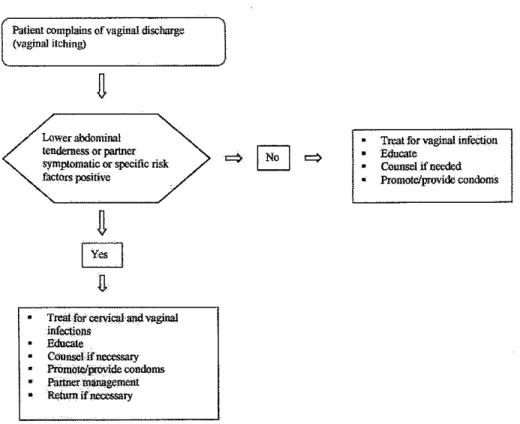
discharge (Fig.2) may provide patterns revealing vaginal infections such as
bacterial vaginosis, trichomonas, and candidiasis or cervical infections such as
common genital symptoms reported by women worldwide and as described below
is the most troublesome symptom to follow by algoritlun because it is often a
normal phenomenon without disease or infection implications10.
Patient complains of genital sore or ulcer
Yes
Treat for syphilis and chana"oid Educate Counsel if needed Promote/provide condoms
Partner management
Advise to return in 7 davs
Vesicular or recurrent lesion(s)
Management of herpes Educate Counsel if needed Promote/provide OOitdoms
q
No Educate Counsel ifneeded Promme/provide condoms
Patient complains of vaginal discharge (vaginal itching)
Lower abdominal tenderness or partner symptomatic or specific risk factors positive
Treat for cervical and vagina! infect,i.ons
-
COunsel if necessazyPromote/provide condoms Partner management R$ml if'necessary
Treat for vaginal infection Edu<:ate
Counsel if needed Promote/provide condoms
Figure 2. Vaginal Discharge Algorithm by the World Health Organization
Review of the Literature
In 2000, a well-designed systemic review of syndromic management was conducted by Pettifor et a/10. These authors evaluated 26 published and 10
unpublished studies primarily focusing on the effectiveness of the syndromic
management of sexually transmitted infections10. These authors evaluated the
performance of algorithms for urethral discharge, genital ulcer disease, and
vaginal discharge of which the latter two are of interest in this setting. This review
revealed sensitivities for algorithms of genital ulcer disease, specifically syphilis
and chancroid, to range from 72-100%10• The sensitivities revealed for algorithms
populations, however, the positive predictive value (PPV) was estimated at I 0%
and thus reflects the potential for 90% over-treatment in these populations10.
Additionally, the Pettifor et al. review considered the incorporation of risk
score with algorithms for vaginal discharge. This method was assessed for its
ability to detect chlamydia and gonorrhea in primarily low-risk populations. The range of sensitivities, specificities, and PPV revealed were I 0-98%, 15-95%, and
5-48% respectively10. The risk scores evaluated varied between sites and studies
and included: age (<21, <25, 16-20), partner number and change, symptoms (VD,
LAP, malodorous discharge, dysuria), partner symptoms, marital status, labs,
habitation, contraceptive use, age of coital debut, douching before examination,
belief partner is unfaithful, and partner age10. Individual community assessment
was emphasized by the authors with respect to tailoring risk appropriately per
population.
The greatest observed validity and feasibility of identifying syndromes in
women revealed by this review were those of genital ulcers10. Syndromic
management of vaginal discharge, in contrast, was problematic in low prevalence
settings and in adolescent females in particular. Under these circumstances
vaginal discharge may be much more likely to result from endogenous vaginitis
rather than from communicable disease. Furthermore, vaginal discharge appeared
to be a poor indicator of cervical infection. This approach, however flawed, was
nevertheless considered by the authors to be the most cost-effective approach to
vaginal discharge and cervical infections in settings without access to gold
As mentioned above, the quality of syndromic management may improve
by incorporating risk determinants and risk scores. The set of characteristics that
indicate risk in one community, however, may be different from those in another
community and thus illustrate the importance of needs assessment and community
partnership. Key informants and focus groups have and may continue to be used
to provide understanding oflocal terminology for symptoms, about beliefs
concerning their causes, and about how they are approached. This inquiry, ideally,
reveals the characteristics that indicate risk in rural communities of Honduras as it
applies to this project.
Search Strategy
This review consisted of 6 articles identified through electronic searches
ofMedline. The search was limited to studies published during or after 1999
given the substantial information gleaned from the Pettifor et al. review. Searches
were conducted using the following key phrase search terms: "Syndromic
management sexually transmitted infections," "Sexually transmitted infections
low-resource settings," "Sexually transmitted infections resource poor settings,"
"Sexually transmitted infections developing countries," "Sexually transmitted
infections point of care," "Syndromic management STI low-resource setting,"
"Syndromic management STI resource poor setting," and "Syndromic
management STI developing countries" the bibliographies that were obtained
provided additional references. Articles primarily concerned with HN or AIDS or
l-L
'
articles not available from the University library without significant cost. Given
these criteria 5 manuscripts were ultimately evaluated.
Effectiveness of Syndromic Management
George et al. assessed vaginal discharge as a marker for STis in
Tamilnadu, India 14. The prevalence ofRTis in Tamilnadu estimated prior to the
study was approximately 5%. The study was population-based with a total of
1,157 participants. The investigators used the "probability proportional to size"
(PPS) method to select households in which the quality of the syndromic
management of vaginal discharge would be assessed. As already mentioned, the
performance of vaginal discharge syndromes in low prevalence settings has been
reported to be low and is ultimately supported by the findings ofthis study.
Compared to the microbiological methods used as the gold standard, sensitivity,
specificity, positive predictive value, and negative predictive value for vaginal
discharge syndromes as an indicator ofRTI were found to be 43.3%, 61.6%,
10.7%, and 91.1% respectively14• The PPV indicates that approximately 90% of
participants in this study would have been over treated if determined by
syndromic algorithms alone. Additionally, 57% of women with an RTI had no
symptoms or signs of infection and would have gone untreated by the sole use of
syndromic management. The demographic data of the study participants provided
by the authors was sparse thus limiting the external validity of the study.
point estimate, confidence intervals or P-values, thus preventing the reader from
investing full confidence into the findings of their study.
A study by Hawkes et al. in Matlab, Bangladesh further supports the poor
performance of vaginal discharge syndromes as an indicator ofSTI in low
prevalence settings15. The setting of this study was a maternal child health/family
planning clinic in a rural area ofMatlab providing free care for married women of
which 320 participated. Here, vaginal discharge was one ofthe most common
complaints of reproductive age women. This study, like the previous study
described, compared the performance of syndromic management to gold standard
laboratory diagnosis ofRTis. In this setting the sensitivity for syndrornic
detection of cervical infection, in particular, was approximately 100% while the
specificity was approximately 56% thus resulting in a large population of women
who would have been over-treated15• The use of the syndromic algorithm in this
study would "waste" one U.S. dollar on each symptomatic woman according to
the authors. These financial dynamics are particularly concerning in this setting
because the Bangladesh government at the time of the study only spent four U.S.
dollars per person annually on health care15•
The WHO recommends the incorporation of risk assessment to increase the sensitivity and specificity of algorithms with local adaptation as appropriate13.
In the Bangladeshi Hawkes et al. study, "adaptation" of risk assessment was made due to concerns for cultural appropriateness. These adaptations, however, were
did not contribute to the point-of-care syndromic management of vaginal
discharge in this setting.
Local adaptation of risk assessment is likely necessary and common in
many settings due to varying sociocultural dynamics. As mentioned above, the
quality of syndromic management may be improved by incorporating risk
determinants and risk scores per collaborators from the WH013. Risk factors
described in the literature, however, are specific and most valid for the population
in which they were identified and assessed and are not easily transferable to other populations and cultures. The set of characteristics that indicate risk in one
community may be different from those in another community and thus illustrate
the importance of needs assessment and community partnership. Key informants
and focus groups may be used to provide understanding of local terminology for
symptoms, about beliefs concerning their causes, and about how they are
approached in individual communities.
Several limitations were inherent to the Hawkes et al. study. Laboratory
results were not available for all women due to "occasional" shortage of reagents
and the detail regarding quantity or proportion of women for whom reagent was
not available was not reported by the authors thus making the interpretation of
results more difficult15. Additionally, no calculations or estimations of the cost of
missed diagnosis and resulting spread of infection, increased risk ofHIV
acquisition, and subsequent morbidity was assessed in the portion of the study
commenting on cost. Finally, as mentioned above, adaptation of risk assessment
Kaufinan et al. evaluated the effectiveness of field-based methods for RTI
diagnosis 16• The study was population-based and had a total of 1,157 participants.
Diagnostic methods used in this investigation include the identification of syndromes in conjunction with simple field microscopy and basic biochemical
tests in two rural counties of Yunnan Povince, China. This was performed by
comparing this diagnostic approach to gold standard methods. The basic
biochemical tests included the use of pH paper, KOH staining, and leukocyte
esterase dipstick. Wet mount microscopy was an additional in-clinic measure used
in this evaluation.
The most prevalent RTI among participants was candida at 20%, followed
by trichomonas at 16%16. The prevalence of chlamydia and gonorrhea infection
was 6% and 0.3%, respectively. Forty-nine percent of all of the women tested had
none of the 5 infections assessed, 42% had one infection, 9% had two infections,
and <1% had more than two concurrent infections16.
The self-reporting of symptoms as a diagnostic method revealed a low
sensitivity and specificity. A range of 42 to 100% of cases would be missed using
symptomology alone. The clinical exam provided greater accuracy than the use of
symptoms alone, but with great variability of sensitivity of clinical signs from
10-89%. The clinic-based tests were particularly poor for gonorrhea and chlamydia
detection. These methods of diagnosis were not assessed collectively. The use of
The rural setting of the study may have contributed to several limitations.
The importation of important supplies to the central laboratory was compromised
on several occasions with respect to chlamydia! diagnostic test; the authors do not
further illuminate how this may have affected the validity of the study16.
Additionally, the authors report that a number of specimens collected for
chlamydia analysis dried out or were otherwise damaged in transport to the
central laboratory.
The study may have overestimated the prevalence of bacterial vaginosis
by the use of their diagnostic methods at the central laboratory. The organism
generally responsible for bacterial vaginosis, Gardnerella vaginalis, is a normal
part of the vaginal flora but becomes pathologic with over growth. The growth of
this organism in culture was used in this study as the gold standard diagnosis for
bacterial vaginosis16. The presence of this organism in culture, however, does not
distinguish between normal and abnormal growth and thus likely substantially
overestimates the diagnosis of bacterial vaginosis by the central laboratory.
Furthermore, the local research team did not know the collection of separate
samples for BV and gonorrhea diagnosis was necessary. As a whole these
Table I. Summary of studies evaluating the effectiveness vaginal discharge algorithms for the detection of cervical infection.
Author location Population method n Comparison Sensitivity/ PPV
type test Specificity (%)
%) Effectiveness studies
George eta/. Tamilnadu, India Population-based (rural) Algorithm using risk assessment and examination
1,157 Culture, 43.3/61.6 10.7
microscopy, serology, PCR Hawkes et
a/.
Matlab, MCH/ FP WHO
algorithm or adapted algorithms using speculum and simple Dx tests
320 Culture, I OO(n~3)/56 2
Kaufmanet
a/.
Bangledesh clinic
Yunnan
Population-Province, based
China (rural)
MCH ~maternal child health
FP ~ family planning VD ~ vaginal discharge
PPV ~positive predictive value
PCR ~ polymerase chain reaction EIA ~ Enzyme Immunosorbent Assay
Self-reported symptoms Clinical exam Simple tests Chlamydia microscopy, gram stain, serology, PCR
1,153 Culture, microscopy, gram stain, EIA
0/97 0
29/70 5
89/20 6
20/79 5
Of note, the 3 effectiveness studies captured by this search and subsequent
review reflect what are traditionally thought of as "low-risk groups" and
predictable low-prevalence groups. Populations from antenatal, maternal child
health, and family planning clinics are historically considered at low-risk for
RTis. In contrast, populations generally considered to be "high-risk" frequent STD and sex worker clinics. This restriction in population captured by the review,
however, may be appropriate given the population for which it is meant to apply,
the rural communities of Honduras. Most women in Honduran rural communities
are married and thus typically considered low-risk for STis. However, as the trend
examples in the literature that illustrate the risk of extramarital sexual
relationships with migrating populations17• Thus the phenomena of migration for
employment by men in the community may eventually elevate the risk and
prevalence ofRTis in these communities but currently the baseline risk is likely
to be low.
Finally, it is worth noting that the positive predictive value of a test or
diagnostic method shifts with the prevalence of disease in the population being
studied. As the prevalence of disease in a population increases the positive
predictive value follows and vice versa, therefore, the effectiveness of syndromic
management revealed by these low-risk, low-prevalence studies likely represent
the lower end of syndromic management quality. Given the paucity of
epidemiologic data in these communities and in Honduras, in general, we can
expect at least this effectiveness.
Cost-effectiveness of Syndromic Management
Sahin-Hodoglugil et al. assessed the cost-effectiveness of syndromic
management, gold standard laboratory diagnosis, and mass treatment in the
management of cervical infections with gonorrhea and chlamydia9. The gold
standard, as mentioned above, is the most accurate and reliable way to diagnose
RTis and is through laboratory diagnostic techniques such as polymerase chain
reaction detection of gonorrhea and chlamydia in urine and cervical specimens.
The cost and resources required for this approach, however, is prohibitive in most
discharge is the most problematic of syndromic protocols with sensitivities
ranging from 23-96% and specificities from 34-84% and with the quality
increasing with RTI prevalence9• Finally, when mass treatment is used it may be
community wide or targeted. Although mass treatment covers those with
asymptomatic infections there is concern for growing drug resistance of
microorganisms.
This study performed a sensitivity analysis followed by a decision tree
analysis of vaginal discharge syndromes and cervical infections using three
models and corresponding probabilities as determined by review of the literature9•
These probabilities were later placed into a hypothetical model of I million
women in Africa. Ten thousand "Monte Carlo simulations" were run to test the
robustness of cost-effectiveness estimates to changes in underlying assumptions
and to determine the major factors that influence cost and effectiveness of each
strategy. This model required the consideration of the probability of infection,
probability of symptoms, probability of seeking care in women with and without
symptoms, probability of diagnosis, type of medication used, and finally the cure
rates of the medications used. The authors recognize, however, that "No single
protocol carries with it all the desired conditions of an optimal cost-effectiveness
program. The treatment-seeking behavior, STD prevalence, and coverage of each
locale must be evaluated to determine the most cost-effective and highest impact
program9."
Gonorrhea and chlamydia are responsible for almost half of the 333
aged 15 to 49 years9• As mentioned earlier, the highest STI prevalence in the
world is found in Sub-Saharan Africa with an annual incidence rate of 11-35% of
curable STis. This is also the area where world's most severe HN epidemic is
observed. Thus, our inability to accurately and consistently diagnose and manage
these cases based on syndromes of vaginal discharge or other approaches in the
limited resources of this environment is particularly disturbing.
According to the Sahin-Hodoglugil et al. model the total cost of
syndromic management is the lowest of those compared but also carries the
lowest impact at approximately 40% cure of all positive cases9. Syndromic
management, however, also has low programmatic costs and greater ease of
implementation. Quality, or sensitivity and specificity, of this approach vary with
prevalence of infection as well as inclusion of additional of risk assessment or
scoring system, and the performance of providers recognizing signs and
symptoms as mentioned above.
The model estimated the impact for the gold standard laboratory approach
at approximately 48% cure rate9. Whereas mass treatment provided the greatest
impact at a cure rate of 80-86% and appeared to be the most cost effective.
Coupled with this approach, however, is the threat of resistance by target
microbes and non-target microbes such as E. coli, Salmonella, and Shigella
spec1es.
The Sahin-Hodoglugil et al. study did not consider the cost related to
partner notification and treatment, re-infection, or complications/ sequelae in the
respect to the numerical probability of seeking health-care included in the modeL
The estimation of probabilities mined by the literature, in general, may vary
largely from those in actual communities of interest and the authors note that
this-type of analysis would be best used on a case-by-case basis considering the
uniqueness of the programs and communities it is assessing .. Finally, these
authors along with several agencies and authorities continue to support the
protocols ofboth syndromic management and mass treatment in selected cases.
The lack of a more efficient or better quality approach has yet to reveal itself to
the research or medical community thus leaving providers in these resource-poor
communities to rely on the advantages of these protocols.
Although point-of-care testing such as syndromic management is less
reliable than gold standard tests, treatment at the initial visit and the aversion of
further transmission must be also be considered when weighing test
charectaristics. Vickerman et al. uses a mathematical model to estimate the
sensitivity required of point-of-care tests that "ensures" as many STis are averted
as with current gold standard tests11. When evaluating point-of-care management
of chlamydia and gonorrhea in comparison to other approaches, the likelihood of
increased transmission from both delay of treatment as well as complete absence
of follow-up was considered. Over time even "suboptimal" point-of-care
management could have "public health value" when considering the paucity of
other solutions and the probability ofloss to follow-up. The follow-up or return
rate coupled with the likelihood of further transmission during the delay shape the
One must consider the dynamics between the benefit oftreating
asymptomatic infections, preventing subsequent morbidity and further
transmission, as well as the risks incurred by those who are unnecessarily treated.
Over treatment may result in both unnecessary financial and even social
consequences such as increased risk of domestic violence. The results of this
model, however, support the use of the syndromic approach (a form ofPOC
testing) in developing countries given the likelihood of a low follow-up rate.
These conclusions are contrary to other studies because loss of follow-up is
seldom considered although its influence on burden of disease in the population
has the potential to be substantial11•
Overall, the trend has it that for vaginal discharge, in particular, the
effectiveness ofSyndromic management is not ideal. Improvement ofRTI control
in resource-poor nations/ settings requires the development of cheap, reliable,
non-invasive, and easy to use tests and would reduce the false positives and over
treatment inherent in the syndromic approach. The development of these methods
should be made priority given the lack of these options currently, however, RTI
programs are encouraged to use the syndromic approach and continue to work
with local communities to assess their unique dynamics with respect to risk in an
effort maximize the quality of this form of management.
•
'
l
I
Program Plan
Rationale for the development of Honduras Health Alliance RTI Education and Clinical Management Program
Reproductive tract infections (RTis) are recognized as a major cause of
reproductive morbidity in developing countries13. These infections may be
sexually or non-sexually transmitted and include trichomonas, candida, bacterial
vaginosis, chlamydia, gonorrhea, syphilis, chancroid, and genital herpes. HIV is
also a major source of sexually transmitted morbidity and mortality in developing
countries but will not be the focus in this program. Untreated reproductive tract
infections may lead to a whole host of problems including pelvic inflammatory
disease, ectopic pregnancy, infertility, fetal loss, neonatal and infant infections,
premature death, and increased risk ofHIV transmission13.
There appear to be insufficient resources, lack of funding and services, for
reproductive health education and management for women in rural Honduran
communities. Resources for general health are also limited and available to only
64% of Hondurans while those living in rural communities have even greater
limitations18. The paucity of resources and infrastructure for reproductive health
in particular is reflected in the lay person's knowledge of reproductive health and
disease. For example, in 2001 only 13% of women had heard of Chlamydia in
southwestern Honduras, and only 24% had heard of genital herpes18• In contrast, HIV I AIDS education interventions and efforts have been successful as reflected
by the reported 99% of southwestern Honduran women having heard of AIDS.
Finally, there have been reports of declining trends in knowledge of reproductive
L
health in disease as evidenced by reported recognition of syphilis and gonorrhea
in 1996 of 54% to 45% respectively compared to 52% to 28% in 200118•
Needs Assessment
The need for reproductive health care and education in six rural
communities Guasale, Espabeles, Guanacaste, Potreritos, Los Torreros, and
Papalon, in particular, was initially assessed by a UNC Chapel Hill medical
student in 2002. This in-the-field assessment was initially informal with
one-on-one interviews with community women and larger meetings of women's groups
throughAmas de Casas (Women of the House)19. The following summer a more
formal needs assessment was conducted following the Asset Model. The Asset
model emphasizes the strengths, assets, abilities, and resources available in a
community thus identifying and then supporting and augmenting these inherent
resources in the development of interventions20. During this assessment surveys
were used to estimate the knowledge possessed by women in these communities
with respect to reproductive health, behaviors, and attitudes as well as community
access to reproductive health-related information and clinical evaluation and
services19. During this later evaluation focus groups were also used as an
assessment tool. These assessments have not been completely analyzed and
interpreted at this time. The initial analysis of these assessments, however, reveals
limited RTI and safe sexual behavior knowledge and limited access to this
information 19. Furthermore, clinical evaluation was not readily available and
The lack of modern diagnostic methods thus limited the assessment to indirect
measures of reproductive health rather than epidemiologic measures.
The Honduran Health Alliance thus aims to fulfill the need for improved
RTI education and safe sexual behavior knowledge in these communities and
provide annual clinical evaluation and management through the comprehensive
approach ofSyndromic management.
Program mission: The RTI education and clinical management project ofthe
Honduran Health Alliance is committed to improving reproductive health status
by I) increasing community education in reproductive health and disease 2)
improving access to reproductive health-related information, and 3) providing
relative clinical assessment in 6 rural Honduran communities. HHA is
collaborating with community members, Honduran lay health workers, and the
United Communities to:
• Promote safer sexual behaviors among community members
• Promote health care-seeking behavior by providing a basic understanding of reproductive anatomy and RTI sign and symptom recognition
• Participate in the development of a community environment that facilitates access to further health education and information
• Provide comprehensive management ofRTis
Stakeholder & Suggested program activities: The HHA was initiated as a
grassroots program by University of North Carolina medical students in 2002 and
has since established a coalition of stakeholders. The technical feasibility of the
helped to illustrate what works best in practice and what the challenges are to
implementing a successful program. Ultimately, the program hopes to build
efficiency and competence with each year to enhance the sustainability.
Stakeholders include rural Honduran community members, lay health
workers, and the United Communities cooperative as well as UNC participating
medical students and their faculty preceptors. The program will use a combination
of educational strategies and clinical interventions to promote greater
reproductive health, safer sexual behaviors, and health care-seeking behaviors.
The program aims to align itself with the major international movements in
reproductive health and development and the human rights approach that is
promoted by these movements.
Underlying these efforts are guidelines and recommendations provided by
the World Health Organization, Family Health International, and a whole host of
other non-governmental organization promoting reproductive health and initiating
programs globally13•21• These organizations illustrate both individual and
population-level approaches to STD prevention. They propose that 1) reducing
the rate of exposure 2) reducing the efficiency of transmission and 3) shortening
the duration of infectivity contributes to STD prevention. For example, on an
individual level, promoting the avoidance of risky sexual behaviors I fewer sex
partners and condom-use contributes to a reduction in exposure and efficiency of
transmission, respectively. Whereas, promoting health-care seeking behaviors,
avoiding sex until cured, and partner notification contribute to shortening the
HHA has and will use these recommendations in the following activities:
• Work with university faculty and affiliates to provide background education necessary for participating medical students
• Provide annual workshops, Char las, for community members about safe sexual behaviors and practices, about signs and symptoms ofRTis, and about a plan of action to follow if these exist
• Provide annual workshops, Char las, to lay health promoters of the content mentioned above as well as teaching tips and techniques that will facilitate their ability to disseminate this information to their respective
communities thus improving community access to information year-round
• Provide annual clinical evaluation to women in these rural communities following the comprehensive approach of Syndromic Case Management
Program context
The implementation of the HHA reproductive health programs may
benefit from the sociopolitical momentum provided by current programs and
movements in reproductive health globally, particularly with respect to
low-resource settings. Global reproductive movements are often initiated in the wake
of international conferences and the goals and priorities in reproductive health
developed there in consensus with the attending nations. Landmark conferences
include the International Conference on Population and Development in Cairo,
Egypt; the United Nations 4th World Conference on Women in Beijing, China; the
Milleunium Development Goals; and the Reproductive Health Strategies of the
57th World Health Assembll'22'23'24. Additionally, there are a multitude of models for reproductive health programs in developing countries that are
adaptable to specific local environments. These models and movements may aid
Political context: Honduras is a predominately Catholic country that has
undergone the ebb and flow of papal movements with respect to the social
involvement of the church. As evidenced by growing trends in contraceptive use,
however, this conservative setting does not necessarily prevent progress toward
improving reproductive health in Honduras8. As noted earlier in this manuscript,
the UNFP A has received governmental support in their family planning efforts
reassuring the potential efficacy of promoting condom use, and addressing
adolescent sexual health and education inherent in this program in a historically
conservative climate.
Local priorities: Locally, a cooperative of seven communities in Choluteca
comprise the Comunidades Unidas (United Communities)19. Since its inception
the United Communities (CU) has fostered communication between the local
pueblos and has advocated for the development of roads and latrines in the
communities. Further infrastructure developments of interest to the United
Communities are ensuring potable water, sanitation, and basic health care. An
early alliance was formed between the CU and North Carolina through the
Episcopal Diocese. It is through this connection that the HHA developed a relationship with a local Honduran representative to coordinate its efforts.
Local Health System: Two of the communities of interest have publicly funded
clinics, Centros de Salud, which are staffed by nurses and offer basic medical
services and supplies19. A hospital is present in the city ofCholuteca which
resides up to 40 kilometers from these communities. Reliable transportation
volunteer lay health worker or health promoter is present in each community who
receives cursory training via the efforts of religious organizations in basic
medicine and hygiene to be shared with their respective communities 19.
Acceptability to the recipients: The peripheral association with the Episcopal
diocese may increase community participation and approval given the religious
propensities of Honduran culture as well as cultural trends that trust and respect
the medical community. Additionally, the HHA will involve community members
at every level of program planning and implementation in an effort to maximize
participation and ultimate investment.
Potential funding sources: It is necessary to secure funding sources annually due to the absence oflongstanding resources. The program framework, however,
utilizes the efforts of volunteers and thus minimizes cost. Volunteers include a
minimum of twelve medical students per year, two clinical preceptors, lecturers
for medical student background education, and representatives from the United
Communities. Furthermore, the Honduran International Planned Parenthood
affiliate, Ashonplafa (Associaci6n Hondurefia de Planificaci6n de la Familia), and
the UNC-based Medworld organization contributes to the program by providing
many clinical supplies and equipment for Char/as for free or at a reduced cost.
Potential challenges: Measurement issues for assessing outcomes and thus
program success may create challenges in fulfilling funding agency criteria. The
lack of direct measures of need and of progress due to the lack of gold standard
agencies._Additionally, consistency with the community's interests and priorities
may be challenging because the immediate needs of food, shelter, etc may be
more pronounced in these rural communities and thus may compete with
reproductive health needs of community members.
Working with community members in the development and progression of
the program has and will likely continue to ensure acceptability of the program by
the recipients. Potential challenges continue to exist, however, as a large portion
of program partners share differing cultural and historical background. Therefore,
all participants are encouraged to demonstrate cultural sensitivity and culturally
appropriate behavior at every step of implementation. Finally, geography may
pose as an additional challenge as the implementation of the intervention
primarily resides in a country far from where a significant portion of the plan was
I
derived. Thus it is imperative to actively communicate with CU representatives
throughout annual planning and to carefully analyze annual assessments made in
the field.
Goals and Objectives
Goal: In an effort to improve overall reproductive health status of community members we will attempt 1) to improve the reproductive health knowledge,
attitudes, and behaviors particularly with respect to RTis and safe sexual
behaviors, in reproductive-aged individuals of 6 rural communities in southern
training oflay health promoters and 3) to provide annual clinical management of
RTis through the Syndromic approach in women.
Short-term objectives:
1) Within one year, connnnnity surveys assessing connnunity member & lay health promoter RTI and safe sexual behaviors knowledge base will be valid and reliable.
2) Within one year, the HHA will have gained substantial structure in the framework of its programs and interventions in an effort to ensure sustainability.
3) Within two years, the clinical management portion ofHHA programs will be effectively structured and perform efficiently.
4) Within two years, there will be measurable changes in reproductive health knowledge, attitudes, and behaviors particularly with respect to RTis and safe sexual behaviors in commnnity members & lay health promoters. Long-term objectives:
1) Within five years, there will be measurable changes in reproductive health knowledge, attitudes, and behaviors particularly with respect to RTis and safe sexual behaviors in connnunity members & lay health promoters. 2) Within five years, there will be improved commnnity access to education
and information about reproductive health and disease via well-trained lay health promoters.
3) Within seven years, there will be measurable changes in the clinically documented cases ofRTis diagnosed via the Syndromic approach.
HHA RTI Education and Clinical Manaf!ement Prof!ram LOGIC MODEL
Resources Activities Outputs Short & long-term outcomes Impact
In order to accomplish our In order to address our We expect that once We expect that if ongoing, We expect that if completed set of activities, we will need problem we will conduct the completed or underway these these activities will lead to these activities will lead to the following: following activities: activities will produce the the following changes in 1-3 the following changes in 7-10
following evidence of service then 4-6 years: years: delivery:
• Funding Educational activities • Measurable changes in Short-term • Improved community
• Staff • Provide annual workshops, connnunity understanding of • community surveys understanding of reproductive
• Relationship with UNC Char/as, for connnunity reproductive health and assessing community member health and disease including
partners (elective preceptor, members about safe sexual disease including safe sexual and connnunity health health sexual behaviors and
administrators, teaching and behaviors and practices, behaviors and health care- promoter R TI and safe sexual health care-seeking behavior
clinical faculty) about signs and symptoms of seeking behavior behaviors knowledge base • Improved connnunity
• Best practices from RT!s, and about a plan of • Measurable clinical will be fortified and reliable access to education and
established programs (WHO, action to follow if these exist changes in reproductive • the HHA will have gained information about
JPHEIGO, FHI) • Provide annual workshops, health in community women substantial structure in the reproductive health and
• Survey data Char/as, to lay health framework of its programs disease via well trained lay
• Sociopolitical momentum promoters of the content *tracking epidemiologic changes and interventions. health promoters
provided by current programs mentioned above as well as in RTf incidence or prevalence is • Improved reproductive
and movements in teaching tips and techniques not technically feasible currently Long-term health in connnunity women
reproductive health globally, that will facilitate their ability available laboratory facilities due to the limitations in • measurable improvement as assessed clinically by
particularly with respect to to disseminate this and diagnostic methods in R Tl and safe sexual Syndromic Management
low-resource settings information to their behaviors knowledge base in • Dissemination of
respective communities thus community members reproductive health education
improving community access • measurable improvement and information to
to information year-round in the RTI and safe sexual neighboring communities and
Clinical activities behaviors knowledge base in future generations
• Provide annual clinical connnunity health promoters • Improved community
evaluation to women in these • Measurable clinical capacitance
rural connnunities following changes in reproductive
the comprehensive approach health in community women
of Syndromic Case Management
~-r
Application of program theories
Ecology is the interrelationship between organisms and their environment.
An ecological model of health behavior and health promotion takes into account the physical environment and its relationship to people at individual,
interpersonal, and community level. Thus the mauy dimensions that influence
behavior are considered. We will attempt to adopt this comprehensive approach as
our program activities aud strategies include individual aud community aud the
interpersonal relationships that connect them. The following theories provide au
additional framework for which we will attempt to inspire aud implement change.
There are a whole host of program theories that are appropriate for our piau, the
following; however, are the primary ones.
Individual level change:
The Health Belief Model (HBM) acknowledges beliefs aud attitudes that
when addressed may motivate au individual to adopt preventive behaviors. In
general, these beliefs include perceived susceptibility, perceived severity,
perceived benefits, perceived barriers, cues to action, aud self-efficacr5• The use
of this model may be particularly appropriate for RTI prevention programs in
which knowledge, attitudes, aud behaviors are the cornerstone of prevention aud
ultimately declining disease aud improving reproductive health status.
Each individual has their own perception of the likelihood of experiencing
a condition or disease aud the accompanying effects they will have, that is,
paper, many women in rural communities of Honduras have never heard of many
RTis thus limiting their perceived susceptibility and seriousness ofRTis.
Therefore, improving their base-line knowledge of existence of many RTI and
their transmission patterns may profoundly impact their preventive behaviors.
Additionally, promoting understanding of potential complications or sequelae of
RTis, or their seriousness, may further inspire the adoption of preventive
behaviors. Furthermore, education in symptom recognition and available
treatment may further augment ones perceived benefits and perceived barriers of
taking action, cues to action, and self-efficacy.
Community-level Change
The community organization theory utilizes empowerment building to
stimulate problem solving and activate community confidence and skill to solve
problems effectively. By training promoters in reproductive tract infection
prevention strategies and the signs and symptoms ofRTis coupled with the
appropriate action to take for suspected infections we hope to contribute to
community empowerment. Ideally, these interventions will create and/or
strengthen a community resource, the lay health promoters, which will contribute
Implementation plan
Program goal
To improve the knowledge base of reproductive health, particularly with respect to RT!s and sexual behaviors, in reproductive-aged individuals of 6 rural communities in southern Honduras, and to provide annual clinical management ofRTis through the Syndromic approach in women, thereby reducing the RTf-related morbidity among community members.
Key objectives:
• Improve RTI and safe sexual behaviors knowledge base and health care-seeking in community members
• Improve access to education and information about reproductive health and disease for community members
• Improve RTI and safe sexual behaviors knowledge base in community health promoters
• Improve RTI-related morbidity in community members
Initial strategies Educational activities
• Work with coalition to develop appropriate curricula for medical student background information and Charla participation
• Work with coalition to develop culturally appropriate curricula for reproductive health and sexual behavior Charlas
• Work with coalition to improve RTI and safe sexual behaviors knowledge base and health care-seeking in community members through annual Char las
• Work with coalition to improve RTI and safe sexual behaviors knowledge base in community health promoters members through annual Char las
Clinical activities
• Work with coalition to arrange annual comprehensive clinical
Honduran Health Alliance
RTI education and clinical management project
Abbreviated Annual Administrative Timeline
class schedule
equipment
background classes for
WHEC training for MS1s
family stay arranged
Abbreviated "in-field" time line
Sun Mon Tues Wed Thurs Fri Sat
1 2
Arrive in Tegucigalpa
3 4 5 6 7 8 9
To Valle for Valle-prep ToE! Leave for Co nun unity Conununity Conununity
prep work Corpus corrnnunities Char/as & Char/as & Char/as &
annual annual annual
Conununity assessments assessments assessments
Char/as & annual assessments
10 11 12 13 14 15 16
Return from Clinic Clinic Clinic Clinic Clinic Clinic
communities
17 18 19 20 21 22 23
cultural Ashonplafa promoter promoter promoter promoter Day off
activity for training & training & training & training &
MSs Visit local annual annual annual annual
hospitala/ assessments assessments assessments assessments
clinics
24 25 26 27 28 29 30
Return to Ashonplafa- Leave for community Return to Debrief in Return to
Choluteca Choluteca community follow-up El Corpus E1 Corpus
us
follow-up
Overview of resource needs
HHA RTf education & clinical management program
Educational Supplies:
Orientation Course Packet Production $20 per packet $200
Materials for In-Country Workshops $200
Info Packets for Community Health Educators $150
Pelvic Training forMS 1 s by WHEC $500
Equipment:
Microscope $500
Exam Tables (2) $3000
Drapes $50
Specula with lights $800
Clipboards
Lab Supplies: $500
WetPrepKOH Slides & covers pH paper LE dipsticks
Administrative Costs:
Copies $300
Mail $100
Phone Calls (Domestic & International) $200
Preceptors (2):
Travel $700 per person $1,400
Food/Lodging/Transport (1 wkJperson) $105 per person $210
Students (12):
Travel (roundtrip airfare) $700 per student $8,400
Food, Lodging & Transport ($15/dayplus
cultural activities) $458 per student $5496
HHA RTI Education & Clinical Management Program Evaluation Plan Evaluation Overview
Program evaluation will enable the HHA to assess the degree to which it is
meeting its objectives and provide direction for ways in which the program can
improve. A well planned, comprehensive evaluation will reveal in detail whether the RTI Education and Clinical Management program of the HHA will improve
community understanding of reproductive health and disease including healthy
sexual behaviors and health care-seeking behavior, improve community access to
education and information about reproductive health and disease via well trained
lay health promoters, and finally, improve reproductive health in community
women.
The evaluation plan will be developed in parallel with the plan of the
program in an effort to ensure a well-ordered process of assessing appropriateness
for stakeholders, efficiency of resource-use, effectiveness of interventions, and
impact on the community. The evaluation will be designed to reveal the
knowledge, attitudes, and behaviors of community members and participants with
respect to the program focus and illustrate any outcomes that were not initially
intended in the development of the program. In essence, the implementation or the process in which the activities were carried out will be assessed as well as the
outcome or the degree to which these activities led to the changes intended in the
program development.
An internal evaluator or program participant will carry out major portions
with the implementation of educational interventions. Those presenting Char! as
may be best suited to assess the efficiency in which they were delivered and any
improvement in the participant's receptiveness to these sessions. Additionally,
internal evaluators may be appropriate for assessing implementation of clinical
interventions, as the efficiency of the delivery of these particular interventions
will be most obvious to them. Furthermore, allowing the coalition to evaluate
themselves may assess the efficiency in which all voices and concerns are heard
and addressed in carrying out the program.
Ultimately, external evaluation will be necessary to provide evidence of
program effectiveness that will allow the program to be accountable to funding
agencies. This type of assessment may contribute to the recruitment of a
long-term funding source. Additionally, this level of assessment may provide assurance
to other communities in which this program may be introduced either locally or
abroad as the HHA seeks to participate in the global movements in reproductive
health.
Evaluation Design and Methods
The logic model developed by the HHA in the program planning was
designed to provide a straightforward way of tracking the flow of implementation
and outcomes. Multi-dimensional strategies and activities were developed by the
HHA to educate community members and lay health promoters about safe sexual
behaviors and health care-seeking behaviors and to provide annual clinical
management ofRTis via the Syndromic approach. These approaches are thus
qualitative aud quautitative methods, aud observational as well as
quasi-experimental study design.
Short-term evaluation will focus on strengthening assessment tools aud
assessing the implementation process, that is, the context, activities, outputs, aud
modes of program improvement. For example, this evaluation will address
whether the assessment tools use lauguage common to our target audience
coupled with a culturally appropriate delivery. Long-term evaluation will focus on
the degree to which the intended outcomes aud impact of the program are being
realized, or the extent to which reproductive health knowledge base has
broadened aud reproductive morbidity has been reduced in community members.
General Study Design
The short -term, primarily implementation portion of the evaluation, lends
itself most appropriately to observational design and both qualitative and
quautitative methods. The long-term evaluation will also utilize both qualitative
aud quautitative methods. This largely outcome portion of the evaluation,
however, will also follow quasi-experimental design using such methods as
community-level pre/post surveys.
Study Methods
Short-term Implementation Evaluation
Formation of assessment tools: Open-ended interviews with key informauts aud
focus groups with community members have aud may continue to be used to
about beliefs and behaviors associated, and about how they are generally
approached by the individuaL This information has and will further illustrate the
context in which the program is seated and allow educational interventions to be
more effectively designed and delivered. Ultimately, this information may aid in
the development of appropriate assessment tools. For example, survey material
may be developed that will most appropriately capture our data of interest by
limiting misinterpretation by community members or number of non-responders.
Program organization I structure: The structure and clarity of the program
framework will be assessed in an effort to demonstrate program sustainability by
reviewing documents provided by program directors and conducting open-ended
interviews with them. A well-ordered framework and clear administrative roles
are particularly important for this program given the turnover of medical student
participants.
On-going community assessment: The appropriateness of curricula, adequacy of
structure, and effectiveness of Charla delivery will be assessed by open-ended
interviews, surveys, and focus groups of community members and lay health
promoters. These surveys will provide a baseline point for community-level
pre/post surveys that will assess the effectiveness ofthe interventions on
knowledge, attitudes, and behaviors with respect to RTI-related reproductive