Hansi Hoskins. A Server-Side User Study of UNC-Chapel Hill‘s 19
th-Century
American Sheet Music Collection Database. A Master's paper for the M.S. in
L.S. degree. April, 2010. 32 pages. Advisor: Diane Kelly
This study describes a server-side user study of UNC-Chapel Hill‘s 19
th-Century American Sheet Music Collection Database. The study was based on
the transaction logs of the database and was conducted to learn about the search
pathways, and habits of the users of the database.
The information collected from the transaction logs included IP addresses,
time-stamps, URLs, and referrers. This data provided information about the
amount of time users spend actively searching the database, the how users are
querying the database, the results they are receiving from their query, and the
documents they chose from the results page.
Headings:
Music Information Retrieval
Sheet Music Databases
A Server-Side User Study of UNC-Chapel Hills‘s 19
th-Century American Sheet
Music Collection Database
by
Hansi Hoskins
A Master's paper submitted to the faculty
of the School of Information and Library Science
of the University of North Carolina at Chapel Hill
in partial fulfillment of the requirements
for the degree of Master of Science in
Library Science.
Chapel Hill, North Carolina
April, 2010
INTRODUCTION
Many libraries across the country maintain large collections of popular sheet
music dating from the 19th century and early 20th century. Sheet music publishing during the 19th and 20th century was quite prolific, but when the popularity of sheet music waned, libraries became the recipients of the outdated media. Recently, there has been a
movement to digitize these collections due to the fragility of the paper on which the
music was printed (Dougan, 2006). Much of the music is now public domain, so libraries
are free to make the music available to the public via internet databases. Institutions such
as the University of Michigan, Duke University, the Library of Congress, Harvard
University, Brown University, University of Chicago, Yale University, the New York
Public Library, the Detroit Public Library, the San Francisco Public Library, Boston
College, and the University of Michigan all house historical sheet music collections and
are in the process of digitizing these bodies of work (Wheeler, 2005).
The vast number of collections prompted the creation of the Sheet Music
Consortium (SMC) which went public in 2003. The SMC provides libraries that have
digitized historical sheet music collections the ability to combine their resources in order
to provide the public with a way to search multiple collections at once. Current
participating institutions include Duke University, Indiana University, John Hopkins
University, Library of Congress, Maine Music Box, National Library of Australia, and
The University of North Carolina at Chapel Hill is also one of the many
institutions to decide to digitize their 19th Century American Sheet Music Collection. While still in the process of uploading information, the majority of UNC‘s 19th
Century
Sheet Collection has been available online since 2009. This collection contains around
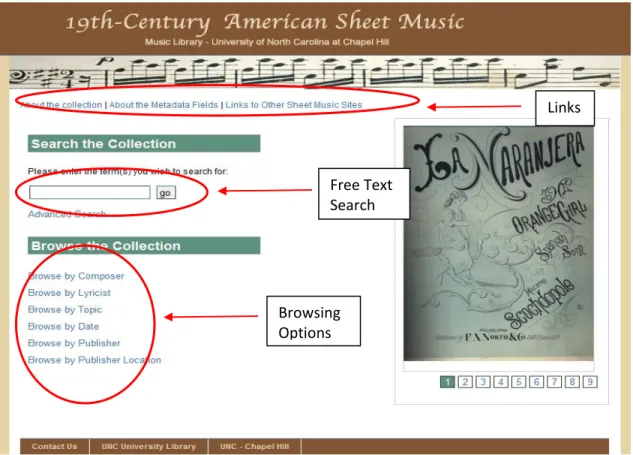
3,500 pieces of music. Each item is represented in the database by 20 metadata fields and
a scanned image of each of the pages of music pertaining to the piece. Patrons can
browse the collection by title, composer, publisher, topic, date, or publisher location. A
free text search option which searches within the metadata fields is also available, as well
as links to other online sheet music collections, including the sheet music consortium.
Figure 1 shows the homepage of the database.
Figure 1 Screen Shot of 19th-Century American Sheet Music Collection Homepage Links
Browsing Options
Although this database has been available to patrons for two years, a user study of
this particular resource has never been conducted. Understanding the ways in which
people search for music is a necessary part of creating and maintaining a music
information retrieval system that is able to fulfill the needs of its users. Knowing how
patrons are using this database is essential if UNC Chapel Hill wants to keep their
LITERATURE REVIEW
The goal of this literature review is to provide the reader with a working
knowledge of the field of music information retrieval in order to provide a basis for
understanding the necessity of conducting a user study on the 19th Century Sheet Music Collection at the University of North Carolina at Chapel Hill.
Music Information Retrieval
In order to create and analyze an historical sheet music database one must have a
working knowledge of the field of music information retrieval. Music information
retrieval (MIR) is an interesting and complex field of study. According to J. Stephen
Downie, ―MIR is a multidisciplinary research endeavor that strives to develop innovative
content-based searching schemes, novel interfaces, and evolving networked delivery
mechanisms in an effort to make the world‘s vast store of music accessible to all‖ (2004,
p.12). MIR concerns catalogers, music librarians, computer scientists, musicologists, and
the general public. It is an important field of study which has implications for all realms
of alternative media searching.
The origins of music information retrieval lie in the thematic catalogs of musical
works. Thematic catalogs, such as A Dictionary of Musical Themes (Barlow, Harold &
Morgenstern, Sam, 1948) and A Dictionary of Opera and Song Themes (Barlow, Harold
& Morgenstern, Sam, 1950), contained short passages of music which represented larger
works. With the advent of digital searching came many new opportunities for MIR
research (Downie, 2000). Unfortunately, there was no standard for evaluating and talking
digital music information retrieval. Due to this need for a scholarly community concerned
with music information retrieval, the International Society for Music Information
Retrieval was born.
MIR researchers are supported by several professional organizations, including
the International Society for Music Information Retrieval (ISMIR). Since its first official
conference in 2000, ISMIR has been providing music information scholars with a
supportive research community and bibliographic materials
(http://php.indiana.edu/~donbyrd/DonMusicIRBibliography.HTML). One of the most
important things that ISMIR has achieved is creating an evaluation standard for music
information retrieval research (Downie, 2004). In his article ―The Scientific Evaluation of
Music Information Retrieval Systems: Foundations and Future,‖ Downie details the
process of creating a standard evaluation system. The need for a standardized way to
evaluate music information retrieval systems arose from the numerous systems which
were being created to accommodate content-based searching. Other systems for
evaluation existed already, such as the paradigm that is used by the text retrieval
community, but due to various music specific issues, a system based on the text retrieval
paradigm would not work. The four main problems fingered by the ISMIR community
include the complexity of music, the complexity of music queries, the evaluation metrics
of relevance, precision, recall in relation to music, and intellectual property law. These
four problems are the basic issues each new system must overcome, and as such they
Creating a Music Information Retrieval System
In order create a way to be able to retrieve music in any of its formats (scores,
recordings, etc.) from an information retrieval system, the physical item must be digitally
represented in the system. ―Music information is a multifaceted amalgam of pitch, tempo,
rhythmic, harmonic, timbral, textual (e.g., lyrics and libretti) editorial, praxis, and
bibliographic elements‖ (Downie, 2004). The complexity of music is the most difficult
problem for database creators to overcome. There are two ways to describe musical
materials: defining the item by its bibliographic properties, and describing the music
itself. Defining the item by its physical properties (title, composer, performer, album art,
etc.) is done by providing metadata tags. However, music is made up of more than just
bibliographic properties—there is the actual music to consider as well. In an attempt to discover the properties of music that people use to identify individual pieces, Kim and
Belkin devised a study in which participants listened to seven classical works of music
and listed terms they associated with the pieces along with terms they would use to
search for the pieces. The results of this study showed that there were seven main
categories of search terms people were applying to music, including movements, neutral
concepts, emotions, nature, objects, occasions or filmed events, and musical features. The
importance of this study is that it illustrates the need for a search tool that allows users to
search for music using search terms that are not necessarily music specific (Kim and
Belkin, 2002).
Most current research in music information retrieval focuses on providing
patrons with a way to conduct content-based queries. Content-based queries are queries
One way is the ‗real-world‘ query. This type of query allows the user to format their
search in full sentences that describe the music. Lesaffre, DeVoogt, Leman, Baets,
Meyer, and Martens discuss one research project which explored how people describe
musical content (Lesaffre, DeVoogt, Leman, Baets, Meyer, Martens, 2008). The research
team conducted a preliminary survey which questioned people about their favorite music,
whether they were musically trained, and if they played an instrument. From the list of
favorite songs, a database was created in which the final participants added semantic
annotations to the pieces of music. The study yielded interesting results, which suggested
that when semantic descriptors were added to music items in a music information
retrieval system, users would be able to conduct content-based searches that would yield
accurate results. Pickens discusses an alternative system in which music is reformatted as
a text document in order to be able to apply text based queries to musical entities. The
study was successful in creating a searchable database of monophonic, reformatted
music, but stated that in order to index polyphonic music another system would be
needed(Pickens, 2000).
Another option that would provide users with a method for conducting
content-based searches is a query-by-humming or query-by-singing search tool that could be
incorporated into a music information retrieval system. A query-by–humming/singing
system would allow users to search for music by singing or humming. The problem
associated with creating this type of search tool is navigating the range of users‘
musicality. A system such as this would have to be able to match a user‘s interpretation
of a piece of music to an actual piece of music in the database. A user‘s query could
process difficult (Byrd and Crawford, 2002). Pardo and Birmingham looked at how well
a query-by-humming system could be expected to perform by comparing three QBH
systems to three human counterparts. This study showed that the two types of QBH
systems which were tested (Hidden Markov Model and probabilistic string matching) did
not achieve human level performance (Pardo and Birmingham, 2002).
Content-based searching is very much so the future of MIR. However, in order to
determine whether or not there is a need for this type of technology used in
correspondence with UNC Chapel Hill‘s 19th
-Century American Sheet Music Collection
a user study of the current data base must be conducted.
User Studies
One way to determine whether a musical information retrieval system such as a
historical sheet music database is meeting the needs of its users is by conducting a user
study. User studies have been conducted in various library settings for many years.
According to Inskip, Macfarlane, and Rafferty, ―The purpose of evaluation is to measure
the performance of an information retrieval (IR) system and to help determine how
effective it is at meeting the information needs of the users‖ (Inskip, Macfarlane, and
Rafferty, 2010:p. 518). User studies provide valuable information to librarians, such as
whether patrons are finding what they need, the type of searches they are conducting,
how much time they are spending on each search, and much more.
Before the invention of the computer, user studies focused on analyzing user
surveys, questionnaires, and interviews. This type of data provided researches with plenty
information about users‘ search habits (Ford, 1977). Once the computer was introduced
to library settings and card catalogs went digital, new research opportunities presented
themselves. Digital databases were capable of retaining transaction logs that provided
researchers with the chance to analyze the large amounts of objective data needed to view
trends in search behavior. The next large change in user studies came with the invention
of the Internet and Google. When library catalogs went online, patrons were able to
search from the comfort of their homes at any time—day or night. The introduction of Google to the internet changed the way in which library patrons formatted their searches
and how they used library search engines (Martin, 2006; King, 2008; Nicholas 2008).
The ways in which researchers analyze search data varies depending on the type
of data and what they want to discover. Transaction logs are one of the most common
forms of collected data used in user studies of sheet music databases. Transaction log
analysis provides researchers with objective data on a large scale (Sheble and Wildemuth,
p. 167, 2009). There are two types of transaction logs: data- server-side logs and
client-side logs. Both types of transaction logs have their benefits and their disadvantages.
Server-side logs are easy to gather, data capture is unobtrusive, and the data is objective
in nature. Client-side logs are resource intensive, but this type of data can provide more
information about users‘ actions. Once the data is mined and analyzed, trends can be seen
that will show weaknesses in the database. A good overview of search log analysis is
detailed by Jansen (Jansen, 2006). Jansen discusses the recent history of search log
analysis and the benefits of using search log analysis to discover information about users
query habits. He also presents a methodology for implementing a search log analysis
The digital era drastically changed the ways in which user studies are conducted.
In addition to being able to analyze transaction logs, researchers are also able to access a
larger group of users through online user surveys and questionnaires. The combination of
subjective and objective data has provided researchers with a large amount of information
about how users search for information. This information is then analyzed and used to
improve information retrieval systems and user services. Other benefits of conducting
METHODOLOGY
For this study, data was collected from the search logs of UNC-Chapel Hill‘s 19th -Centruy American Sheet Music Database
(http://www.lib.unc.edu/dc/sheetmusic/?CISOROOT=/sheetmusic). Ninety-four days worth of
data was collected from the period of time between November 29, 2010 and March 2,
2011. Four fields were extracted from the search logs by David Romani, Library Systems
Department staff at UNC-Chapel Hill, including IP addresses, date and time stamps, the
requested URL, and the referrer. The URL and the referrer were retrieved using the
following command lines:
ack 'CISOROOT=\/sheetmusic.+results\.php' /logs/Content5/access.log | awk -F" " '$11
!~/\"-\"/ { print $1"\t"$4"\t"$7"\t"$11}' | sed 's/\t\[/\t/' >> file.txt
ack 'results\.php.+CISOROOT=\/sheetmusic' /logs/Content5/access.log | awk -F" " '$11
!~/\"-\"/ { print $1"\t"$4"\t"$7"\t"$11}' | sed 's/\t\[/\t/' >> file.txt
sort -u file.txt | sort -n > sorted.txt
The data was then reformatted from a .txt file to an .xlsx file in order to be able to
analyze it in Microsoft Excel.
In order to mask the IP addresses, individual numeric codes were added to each
entry representing the IP addresses. Once the IP addresses were replaced, individual
sessions were identified based on the identifying number assigned to each IP address and
corresponded with the beginning of each session and follow the pathway of each user.
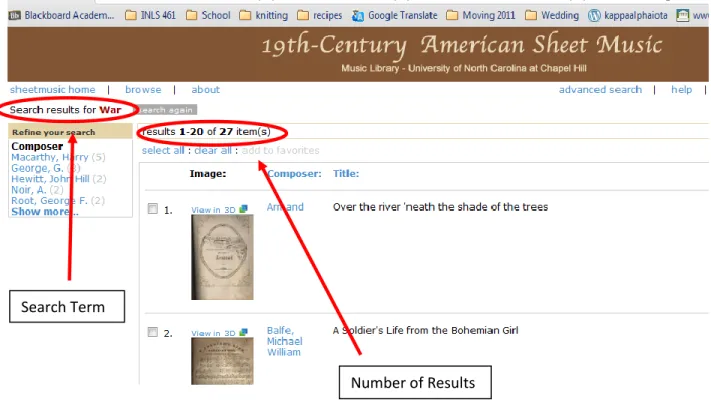
The URL took me to the results page of the user‘s query. On this page the query is
present. I recorded this query along with the number of results the query returned. Figure
2 shows a screen shot of a results page from the 19th-Century American Sheet Music Collection.
Figure 2 Screen Shot of Search Results Page
The referrer statement indicated when the user opened a link to one of the pieces
of music on the results page. I followed these statements and recorded the volume
information as well as the metadata field in which the original query was found. The
result of this process can be seen in Figure 3. Search Term
Figure 3 Screen Shot of Chosen Search Result
Once all the data was collected, I separated the fields into two sections: time data
and search data. As stated earlier, the time data consists of the date and the time stamp of
each transaction completed by a user. In order to determine the amount of time each user
was spending per session, this data was analyzed by subtracting the first time stamp of
each user session from the last time stamp of the session. These subtotals were then
added together to determine the total amount of time spent on the database. The subtotals
were also averaged to determine the average amount of time users are spending on the
site.
The second section of data that was analyzed was the search data. This data
consists of the volume and item number of each requested document, the metadata field
in which the query was located within the requested document, the query entered to begin
the search, and the number of results each query returned. The volume information was
subtotaled to determine how many times each individual piece of music was being looked Volume
at, and which volumes were being utilized the most. The queries were separated into four
categories: dates, people, text strings, and volumes. These categories were then
subtotaled to determine the preferred query category. The actual queries were also
subtotaled to determine which queries were used most frequently.
Other analyses that were applied to the data included comparing the results data
and the time data in order to determine whether there is a correlation between the
amounts of time users were spending on the database and the number of documents they
considered relevant to their search. A comparison was also done of the number of
relevant documents users were finding on their first trip to the database versus repeat
RESULTS
Users
Over the course of the data collection period, 884 IP addresses were recorded as
having queried the 19th-Century American Sheet Music Collection database. This number does not designate individual people as people are not inseparable from their computers.
It does designate individual search sessions during which queries were entered and which
documents may have been retrieved. Of the 884 IP addresses recorded, 80 were recorded
as having returned to the website at least once.
Time
One important goal of this study was to determine how much time users were
spending browsing the UNC-Chapel Hill‘s 19th-Century American Sheet Music database and how that time affected their searching. The data collected provided answers to
following questions regarding time usage:
What is the average amount of time users are spending on the database?
What is the total amount of time users spent on the database?
Are there any apparent trends in usage over the course of the 94 day period?
The total amount of time logged on the database was 93 hours 47 minutes and 4
seconds. The average amount of time users spent actively searching the site was 5
minutes and 27 seconds with a standard deviation of .0114. The median amount of time
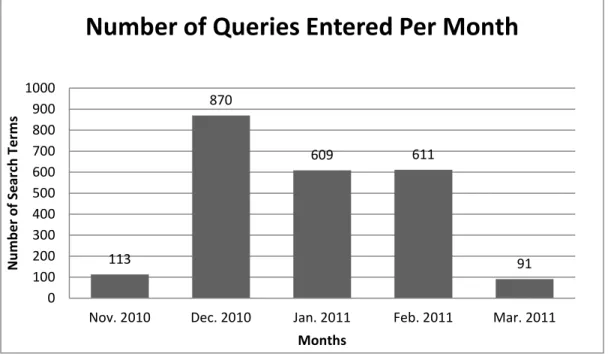
Of the five months during which data was collected, December had the highest
number of search sessions. During this time 870 queries were used to locate documents
within the database. One reason for this may be that December coincides with the end of
the fall semester at UNC-Chapel Hill, meaning that many final projects are due and
students might be using the database more in order to complete their research. Figure 4
illustrates the breakdown of queries entries per month.
Figure 4 Number of Queries Entered Per Month
Figure 4 also shows that usage during November and March appear much lower than
December through February. This is because the data only covered two days from both
November (the 29th and the 30th) and March (the 1st and the 2nd).
Searching the Database
The second goal of this study was to discover what users are doing once they
enter the database. The data that was collected to help answer this question included the 113
870
609 611
91 0 100 200 300 400 500 600 700 800 900 1000
Nov. 2010 Dec. 2010 Jan. 2011 Feb. 2011 Mar. 2011
Nu m b er of Sear ch Ter m s Months
queries people used, the documents they chose from the results page, and where the query
was found within the chosen document. During the period of time that data was collected,
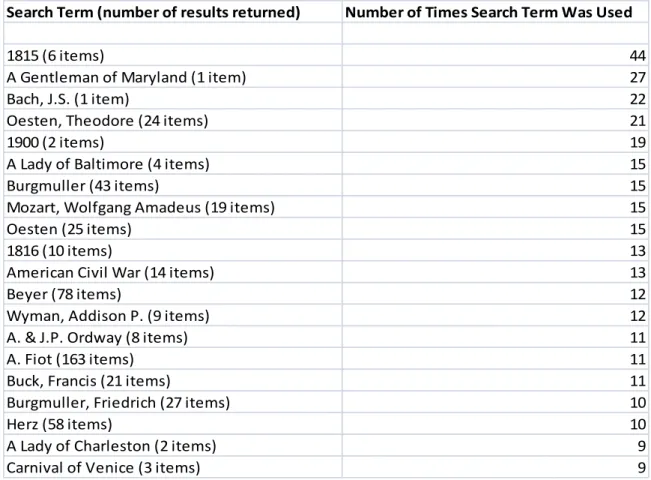
2,292 search queries were used to retrieve results from the database. Of those queries,
1,327 were used more than once. The top twenty queries can be found in Table 1.
Table 1 Top Twenty Queries Used
Of the top 20 searches, three are publication dates, thirteen are people, two are
publishers, and two are other text strings. Publication dates are a metadata field that is
based on the publication date of the piece of music. The publication dates can be
identified as such by comparing the number of search results returned by the search in the
publication date field to the number of results provided by the ‗Browse by Publication Search Term (number of results returned) Number of Times Search Term Was Used
1815 (6 items) 44
A Gentleman of Maryland (1 item) 27
Bach, J.S. (1 item) 22
Oesten, Theodore (24 items) 21
1900 (2 items) 19
A Lady of Baltimore (4 items) 15
Burgmuller (43 items) 15
Mozart, Wolfgang Amadeus (19 items) 15
Oesten (25 items) 15
1816 (10 items) 13
American Civil War (14 items) 13
Beyer (78 items) 12
Wyman, Addison P. (9 items) 12
A. & J.P. Ordway (8 items) 11
A. Fiot (163 items) 11
Buck, Francis (21 items) 11
Burgmuller, Friedrich (27 items) 10
Herz (58 items) 10
A Lady of Charleston (2 items) 9
Date‘ option. It is important to note that dates other than publication dates might be found
in other metadata fields, but based on the number of results returned, none of the dates
used to query the database were typed into the search box.
Searches for people can include lyricists, performers, composers, arrangers,
dedicatees, and inscribers. These searches are formatted as names, possibly including
titles (e.g. Mr., Mrs., Hon., etc). Users who are searching for people might utilize the
‗Browse by Composer‘ or ‗Browse by Lyricist‘ options, or they may enter a name into
the free text search box.
The publisher category consists of the publishers of the sheet music. Publishers
are considered corporate entities and therefore differ from people. They can be
distinguished from people by looking through the list of names of publishers found in the
‗Browse Publisher‘ option on the website.
The fourth category, other text strings, is split up into three sub-categories: topics,
volumes, and text strings of two or more words, which can include titles, subtitles, or
lyrics. Topics can be found using the browsing option, but volumes and longer text
strings cannot. These four categories represent the majority of searches attempted by
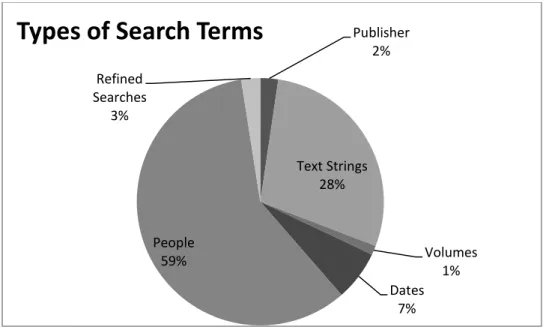
users. Figure 5 illustrates the percentage of each of the preferred query categories out of
the total number of queries. As the chart shows, searches which fall under the ‗People‘
category are the most popular and account for 59% of the total number of searches
Figure 5 Percentage of Types of Queries Utilized by Users
These percentages can be explained by the placement of the browsing options of the
website. On the homepage of the website, the browsing options are listed in the following
order:
Browse by Composer
Browse by Lyricist
Browse by Topic
Browse by Date
Browse by Publisher
Browse by Publisher Location
When comparing the percentages of the types of entered queries to the order of the
browsing options it seems like the percentages correspond with the ordering of the
options. The most common type of query was for ‗People‘ and the top two browsing
options are ‗Browse by Composer‘ and ‗Browse by Lyricist‘. This trend continues for the Publisher
2%
Text Strings 28%
Volumes 1% Dates
7% People
59% Refined Searches
3%
other preferred query types as well. This connection suggests that the website interface
may affect the search process of users.
Search Options
There are two ways to search the 19th-Century Sheet Music Collection database. A user can choose to enter a free text search into a text box, or they can browse the
collection via six different metadata fields including composer, lyricist, topic, publication
date, publisher, and publisher location. When analyzing the data, it was difficult to
distinguish between free text searches and browsing searches. However, there were some
cases when it was apparent the user was utilizing the free text search, such as when they
would search for titles (as there is no browsing option for title), or when there would be
two different numbers of results returned for the same query. For example, a commonly
used term found under the ‗Browse by Topic‘ option is ‗Christmas‘. When someone
searches for items pertaining to ‗Christmas‘ by using the browse option they will receive
one result, but if they type Christmas into the free text search box they receive 118
results. This is because the ‗Browse by Topic‘ option only searches the ‗Topic‘ metadata
field whereas the free text search looks at all of the metadata fields. This is a big issue for
the database because it affects the efficacy and utility of the search. Free text searches
were also apparent when peoples‘ names were misspelled or incomplete.
Sometimes, people would narrow their search if the query yielded too many
results by choosing one of the query options in the ‗Refine Your Search‘ box on the left
side of the results page. This option was utilized by 36 times out of the 2,292 total
Figure 6 Screen Shot Illustrating Refined Search Options
An advanced search option (located as a link underneath the free text search box)
is also available to users. The advanced search option will link a user to UNC-Chapel
Hill‘s Digital Collections homepage. At this page the user can choose the digital
collection(s) and metadata field(s) they want to query. This option was utilized 85 times
by users.
Information was also gathered on the volumes in which the relevant documents
were found. The 125 physical volumes that contain the musical pieces which have been
scanned and uploaded are located in the Music Library of UNC Chapel Hill. The volumes
were all donated to the Music Library by individuals. Each volume consists of musical
pieces that were collected and bound together by the previous owner of the sheet music.
The volumes are distinguishable by their volume number. The volume numbers that have
been assigned to the volumes consist of either a roman numeral, a series designation (Old
Series or New Series) and an Arabic numeral, or a proper name (Person or White) and an
Arabic numeral. Knowing which volumes are being most utilized could be helpful to the In this case, the user can refine their search by
music librarians at UNC-Chapel Hill as it provides them with information about
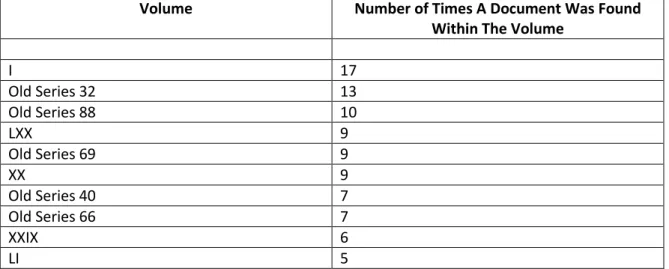
collection usage. The top ten most used volumes can be seen in Table 2.
Table 2 Top Ten Volumes Utilized by Users
Volume Number of Times A Document Was Found Within The Volume
I 17
Old Series 32 13
Old Series 88 10
LXX 9
Old Series 69 9
XX 9
Old Series 40 7
Old Series 66 7
XXIX 6
LI 5
Other Findings
As stated above, of the 884 recorded search sessions, 80 IP addresses were
recorded as having returned to the database at least once. When comparing the first
recorded search sessions of an IP address to the return sessions of the same address, an
interesting trend was discovered. Once a user enters a search query they are presented
with a page of results. From this results page, they may choose one of the documents by
clicking on the thumbnail image of the cover of the sheet music. The documents that they
click into can then be considered relevant to the user because the user chose the
document. This does not necessarily mean that the document was relevant to the search;
it simply means the user found something they wanted to look at and selected the item. IP
addresses that were recorded as having returned to the database more than once were 3
percent more likely to find documents that they wanted to select than those that had
site are more likely to find documents they want to select, or it could simply mean that
users are repeating searches to find documents they found during previous sessions. It
could also mean that repeat searcher rely more heavily upon the database than those who
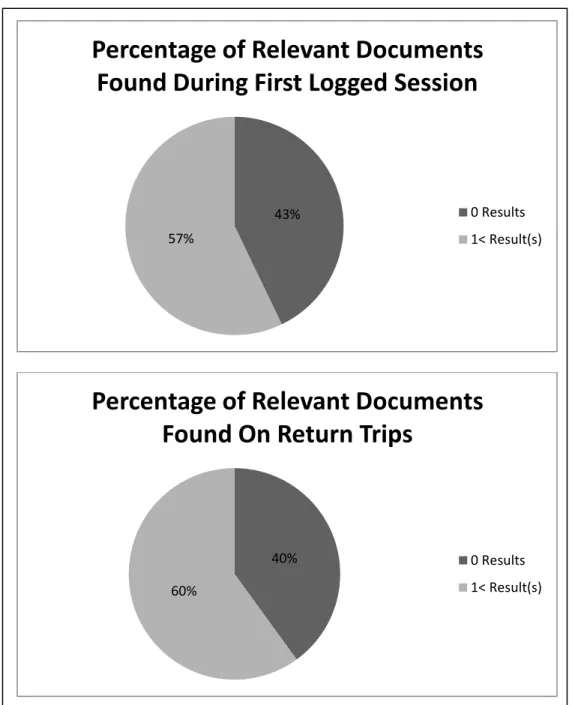
only visit the site once. This information is illustrated in Figure 7.
Figure 7 Comparison of the Number of Documents Selected During First Logged Search Session VS. Return Sessions
43%
57%
Percentage of Relevant Documents
Found During First Logged Session
0 Results
1< Result(s)
40%
60%
Percentage of Relevant Documents
Found On Return Trips
0 Results
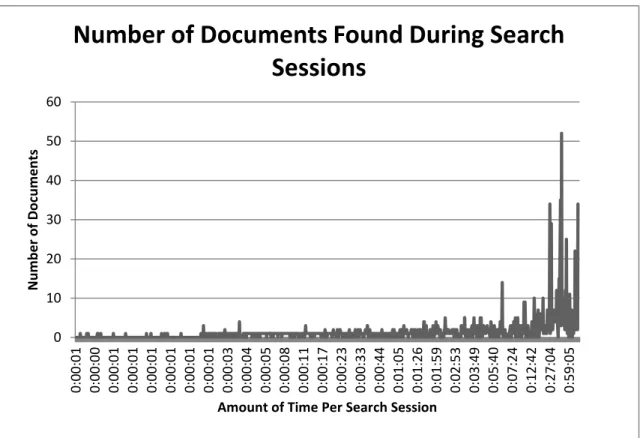
In addition, the data also showed that there was a relationship between the amount
of time a user spent searching for documents and the number of documents the user
clicked into. Figure 8 shows the relationship between the time spent searching and
number of documents chosen by the user.
Figure 8 Number of Documents Found During Search Sessions
Figure 8 also illustrates the median amount of time users spent searching the
database. As mentioned above, the median amount of time spent searching is 18 seconds.
When compared to the average amount of time spent searching the database, the median
time seems very low. This could indicate several things. First, the amount of time it takes
for the database to retrieve results is very low. This is a good thing because it means that
users do not have to wait for long periods of time to see the results of their search.
Second, a low median in regards to time spent searching could indicate that users are not 0 10 20 30 40 50 60 0: 00: 0 1 0: 00: 0 0 0: 00: 0 1 0: 00: 0 1 0: 00: 0 1 0: 00: 0 1 0: 00: 0 1 0: 00: 0 1 0: 00: 0 3 0: 00: 0 4 0: 00: 0 5 0: 00: 0 8 0: 00: 1 1 0: 00: 1 7 0: 00: 2 3 0: 00: 3 3 0: 00: 4 4 0: 01 :0 5 0: 01: 2 6 0: 01: 5 9 0: 02: 5 3 0: 03: 4 9 0: 05: 4 0 0: 07: 2 4 0: 12: 4 2 0: 27: 0 4 0: 59: 0 5 N u m b e r o f D o cu m e n ts
Amount of Time Per Search Session
completing numerous searches during each session. This can be presumed because the
search logs provide information about when a user interacts with the database by clicking
on something or entering text into a free text search. The more queries that are entered
into the database and the more documents that are chosen by the user, the longer the
active search session will become.
Another interesting discovery was that there were several instances of a user
having translated a results page to a language other than English by using Google
Translate. Two sessions were translated into Portuguese and one session was translated to
Italian. Knowing that the site is being translated into languages other than English has
implications for user accessibility. When considering possible improvements to the
website, providing a translation tool on the website could be a valuable addition to users
whose first language is not English.
Issues with the data
Although the data collected provides answers to many questions about the usage
of UNC-Chapel Hill‘s 19th-Century American Sheet Music Collection which have previously gone unanswered, as with any research project, there are limitations to this
study.
First of all, IP addresses do not accurately designate individual users. This means
that we still do not know how many people are regularly using this database, let alone
anything about the individual users. We do not know who they are (students, professors,
or researchers), how they learned about this site, why they are using the database (other
this information, a second study should be implemented to secure user-side information.
This type of study, which could utilize surveys, questionnaires, and interviews, would
also inform collection managers about user satisfaction with the services provided by the
database.
Other limitations of this study are that the period of time during which data was
retrieved covered three full months and two partial months including the months during
which the fall semester ends and the spring semester begins. This study does not show
how the university calendar can affect the usage rates of the database. In order to have a
complete picture of the usage of the database, data would need to be collected over the
course of an entire year. If data was collected throughout the entire year, trends in usage
CONCLUSION
Maintaining the 19th Century Sheet Music Collection at the University of North Carolina at Chapel Hill allows the university to preserve this informative form of media
for future generations to enjoy and access. The collection is currently being cataloged and
uploaded using the database software, CONTENTdm. This software allows patrons to
view scanned images of the actual sheet music along with corresponding metadata tags
online.
This study used server-side data retrieved from the web search logs of the 19th -Century American Sheet Music Collection in order to shed light on the search pathways
and habits of users of the database. Because a study of this kind has never been
conducted in regards to this collection, the data collected contained information that had
never before been reviewed. The findings provided new information regarding length of
search sessions, peak usage during the period which data was collected, the effects of
time on the number of documents selected per search session, the types of key words
used to find documents, the documents chosen by users, and the most common volumes
utilized via the database.
In addition to providing information about users‘ search habits, this study provides a
foundation upon which additional studies can be conducted. Studies conducted during
different times throughout the school year, user-side studies which focus on the user‘s
perspective of the database, and other studies concerned with the content of the database
BIBLIOGRAPHY
Barlow, H. & Morgenstern, S. (1948). A dictionary of musical themes. New York: Crown Publishers.
Barlow, H. & Morgenstern, S. (1950). A dictionary of opera and song themes. New York: Crown Publishers.
Birmingham, W., Dannenberg, R., Wakefield, G., Bartsch, M., Bykowski, D., Mazzoni, D., Meek, C., Mellody, M., & Rand, W. MUSART: Music retrieval via aural queries. Proceedings of the Second International Conference on Music Information Retrieval, 73, 8.
Byrd, D., & Crawford, T. (2002). Problems of music information retrieval in the real world. Information Processing and Management, 38(2), 249-272. Retrieved from http://search.proquest.com.libproxy.lib.unc.edu/docview/57538813?accountid=14 244
Dougan, K. (2006). Online sheet music projects and metadata from a public service perspective. Music Reference Services Quarterly, 9(1), 1-11. Retrieved from http://search.proquest.com.libproxy.lib.unc.edu/docview/57684973?accountid=14 244
Downie, J.S. (2004). Music information retrieval research bibliography [web site]. Canadian Journal of Information and Library Science, 28(2), 45-46. Retrieved from
http://search.proquest.com.libproxy.lib.unc.edu/docview/57549702?accountid=14 244
Downie, J.S., & Nelson, M. (2000). Evaluation of a simple and effective music information retrieval system. Proceedings of ACM SIGIR 2000 Conference on Research and Development in Information Retrieval. New York: Association for Computing Machinery.
Haus, G., Longari, M., & Pollastri, E. (2004). A score-driven approach to music information retrieval. Journal of the American Society for Information Science and Technology, 55(12), 1045-1052. Retrieved from
http://search.proquest.com.libproxy.lib.unc.edu/docview/57622533?accountid=14 244
Inskip, C., Macfarlane, A., & Rafferty, P. (2010). Creative professional users' musical relevance criteria.Journal of Information Science, 36(4), 517-529.
Jansen, B. J. (2006). Search log analysis: What it is, what‘s been done, how to do it. Library and Information Science Research, 28, 407-432.
Lesaffre, M., De Voogdt, L., Leman, M., De Baets, B., De Meyer, H., & Martens, J. (2008). How potential users of music search and retrieval systems describe the semantic quality of music. Journal of the American Society for Information Science and Technology, 59(5), 695-707. Retrieved from
http://search.proquest.com.libproxy.lib.unc.edu/docview/57657096?accountid=14 244
Kim, J.Y., & Belkin, N.J. (2002). Categories of music description and search terms and phrases used by non-music experts. Proceedings of the Third International Conference of Music Information Retrieval, 209-214.
Lippincott, A. (2002). Issues in content-based music information retrieval. Journal of Information Science, 28(2), 137-142. Retrieved from
http://search.proquest.com.libproxy.lib.unc.edu/docview/57549458?accountid=14 244
Martin, P. (2006). Google as teacher: Everything your students know they learned from searching google. College & Research Libraries News, 67(2), 100-101. Retrieved from
http://search.proquest.com.libproxy.lib.unc.edu/docview/57635311?accountid=14 244
Pardo, B., & Birmingham, W. (2003). Query by humming: How good can it get? In The MIR/MDL Evaluation Project White Paper Collection, 107—109.
Pickens, J. (2000). A comparison of language modeling and probabilistic text information retrieval approaches to monophonic music retrieval. Proceedings of the First International Conference on Music Information Retrieval.
Sampsel, L.J. (2007). Sheet music consortium. Digital Media Reviews, Notes, 64(1), 663-667.
Sheble, L. & Wildemuth, B.M. (2009). Transaction Logs. In B.M. Wildemuth (Au.),
Applications of social research methods to questions in information and library
Taheri‐Panah, S. (2004). Music information retrieval systems: Why do individuals use them and what are their needs? Proceedings of the Fifth International Conference on Music Information Retrieval, 455-460.
Wheeler, M. B., & Venetis, M. J. (2005). Evaluation of web access to historical sheet music collections and music-related iconography. First Monday, 10(10) Retrieved from